
Rebecca lifted the latch while keeping the heavy Bible against her chest.
Her neighbor, Mrs. Fletcher, stood outside with dust clinging to her bonnet and worry plain across her face.
“Rebecca, there’s something you need to hear.”
Jonah rose from the table.
Mrs. Fletcher glanced toward him, then stepped inside when Rebecca invited her.
“A fellow from that development company has been asking who saw Thomas pay his taxes.”
Rebecca went still.
“Why would he ask?”
“Seemed more interested in finding nobody who remembered than finding somebody who did.”
The room grew quiet.
Rebecca placed the Bible on the table.
“Then they’re afraid of the receipt.”
“They may be afraid of what that receipt proves,” Jonah said.
Mrs. Fletcher lowered her voice.
“I wouldn’t put it past them to make things difficult elsewhere.”
Her warning proved sound.
Within days, the general store refused the credit Rebecca had used reliably for two years.
The storekeeper could offer only an embarrassed apology.
Without credit, Rebecca would have to spend money she had been saving for the baby’s arrival.
Jonah offered to advance part of his wages back to her.
She refused.
“You earned those wages.”
“And you need supplies.”
“I need to keep my accounts straight. If I take money from you, we’ll record it properly.”
He studied her.
Then nodded.
“Fair enough.”
They worked out what could wait and what must be purchased.
That evening, Rebecca opened her household ledger while Jonah checked the remaining firewood and stores.
It was not romance.
It was arithmetic, necessity, and two tired people refusing to let a dishonest man dictate every decision they made.
Yet Rebecca found unexpected comfort in the fact that Jonah asked for her judgment before moving a single dollar.
Then the court letter arrived.
It questioned whether the presence of an unrelated hired man on the property reflected poorly upon her character.
Rebecca read the accusation twice.
Her hands began to shake.
“They’re making me defend my decency now.”
Jonah took the letter only when she offered it.
His face tightened.
“I can leave,” he said.
She looked up sharply.
“Is that what you want?”
“No.”
“Then don’t give Corwin another thing by riding away.”
She stood and faced him squarely.
“You sleep in the barn. I live in the house. Every neighbor who knows us knows that. I won’t pretend you’ve done something shameful merely because he’s discovered another way to threaten me.”
Jonah folded the letter carefully.
“Then we’ll put the truth before the court.”
The next day he rode to speak with Reverend Whitam, who provided a written account of their respectable working arrangement.
The court accepted it.
Rebecca won that small battle.
But the cost of fighting had begun to show in the shadows beneath her eyes.
And Corwin was not finished.
A second notice arrived announcing that the hearing had been moved forward by ten days to accommodate the proposed stage road survey.
Rebecca sat heavily at the kitchen table.
“He’s running out my strength instead of proving his case.”
Jonah looked toward the calendar she had marked beside her ledger.
“Three days before the hearing, we’ll have everything ready.”
“Unless the baby comes.”
He did not pretend that possibility could be dismissed.
“Then we’ll deal with what comes.”
That night, he brought the completed cradle into the cabin.
The oak had been rubbed smooth.
Thomas’s carved vines now continued across the entire rail, Jonah’s careful work meeting the older cuts without hiding the join.
Rebecca ran her fingers over the place where one man’s carving ended and the other’s began.
“You didn’t erase his work.”
“Wasn’t mine to erase.”
She covered her mouth.
For a moment, all she could see was Thomas bending over the wood, smiling at the thought of a child he would never hold.
Then she saw Jonah, standing quietly beside the hearth, asking nothing of her grief.
“Thank you,” she whispered.
He inclined his head and returned to the barn.
***
Three days before the hearing, the sky turned an unnatural yellow.
Wind began to strike the shutters.
By afternoon, the high desert had disappeared behind a moving wall of dust.
Jonah secured the animals, sealed the worst gaps around the cabin door, and carried fresh water inside.
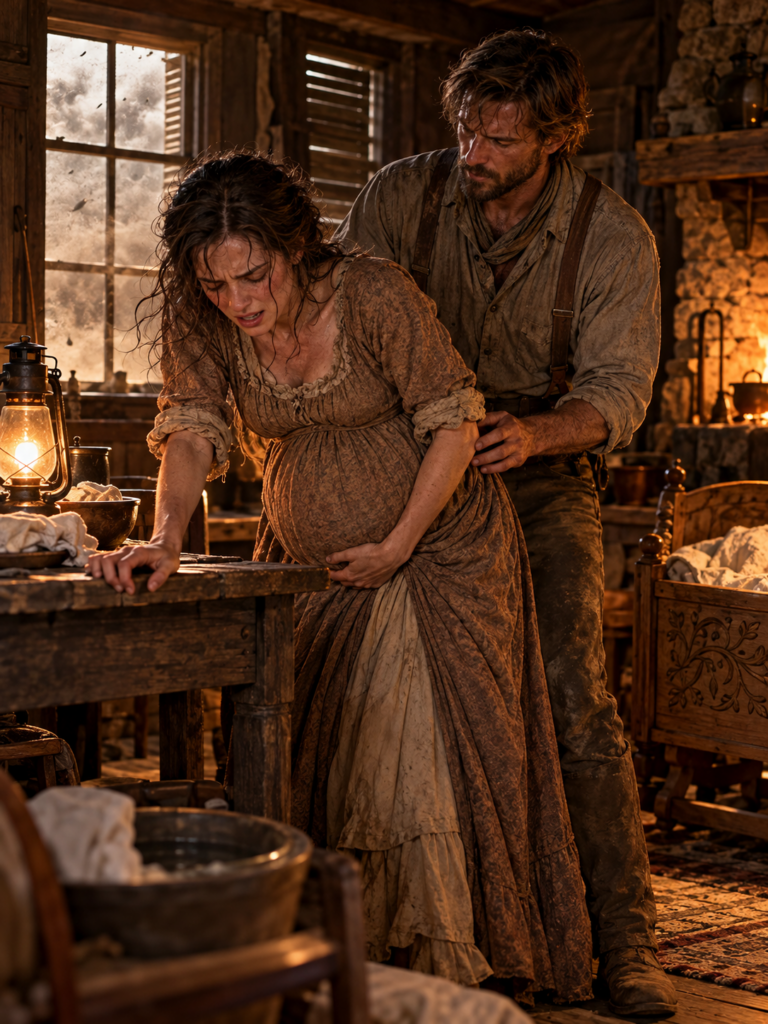
Rebecca stood at the table, arranging clean cloths for the coming weeks.
Then pain seized her lower abdomen.
She caught the table edge.
The cloths slipped from her hand.
“Jonah.”
He turned immediately.
Another contraction came before she could finish speaking.
Her face drained of color.
“It’s the baby,” she gasped. “She’s coming now.”
Outside, the storm slammed against the cabin walls.
The midwife was four miles away.
The road had vanished into blowing dust.
Rebecca reached for Jonah’s outstretched hand, then looked toward Thomas’s completed cradle.
“She’s six weeks early.”
Jonah steadied her.
“I know.”
A second pain bent her forward.
She tightened her grip until his knuckles whitened.
And as the lamp flame shuddered in the wind, Rebecca began pulling the table closer to the hearth, knowing the road to the midwife was already lost.
The table scraped across the cabin floor as Rebecca dragged it toward the warmth of the hearth.
Jonah caught the opposite corner to keep it from tipping.
“Easy,” he said. “Tell me where you need it.”
“There. Near the chair.”
Together they moved it into place.
Rebecca lowered herself carefully, one palm spread over her belly.
The contraction passed, leaving her pale and breathing hard.
Outside, the wind carried sand against the shutters with such force that the sound resembled handfuls of gravel thrown against wood.
“Mrs. Oay said I had weeks yet,” Rebecca whispered.
“I remember.”
“This isn’t supposed to happen.”
Jonah crouched beside her.
“No. But it is happening, and we need to see you through it.”
She searched his face.
“Have you ever helped deliver a child?”
He hesitated only long enough to answer truthfully.
“During the war, I spent two years attached to a field hospital. I helped the surgeons, and I assisted when women near the camps needed help. I’m no midwife, Rebecca, but I know some of what must be done.”
She stared at him.
“You never told me that.”
“Never had reason to.”
A fresh pain came.
Rebecca bent forward and gripped his shoulder.
He remained still until it passed.
“Can you bring Mrs. Oay?” she asked.
Jonah glanced toward the door.
Beyond it, the sky had become a solid wall of ocher darkness. The cabin itself trembled beneath the strongest gusts.
“If I ride now, I may not find the road. And if I don’t get back, you’ll be here alone.”
Rebecca closed her eyes.
When she opened them again, fear still lived there, but something else had joined it.
Decision.
“Then stay.”
“I will.”
“Don’t tell me I’m going to be fine unless you know.”
Jonah nodded.
“I won’t.”
“And if you don’t know what to do, say so.”
“I promise.”
That promise mattered more to her than confident words.
***
Jonah brought clean water, blankets, and the linens Rebecca had prepared for her confinement.
He fed the fire, checked the lamp, and kept the necessary things close at hand.
Rebecca directed him between contractions.
“The smaller blankets are in the chest.”
He found them.
“The cleanest cloths are wrapped separately.”
He brought those, too.
When he tried to rearrange the chair, she told him to leave it.
He left it.
Each instruction gave her something to command in a night that otherwise threatened to take every choice from her.
Hours passed slowly.
The storm intensified.
Dust worked through the cracks despite the damp cloth Jonah had packed around them.
The lamp flickered.
Rebecca’s pains grew stronger.
Between them, she sometimes spoke of Thomas.
Not because she wanted to compare two men, but because there were moments when memory arrived more suddenly than she could resist.
“He would have been frightened,” she said during a quiet interval.
Jonah looked at her.
“Thomas?”
She nodded.
“He pretended nothing worried him. But the day I told him about the baby, he sat down so suddenly I thought his knees had failed.”
Despite everything, a faint smile reached her lips.
“He asked whether a child could possibly be born healthy to a man who couldn’t keep his own hat from blowing away.”
Jonah laughed softly.
“Sounds like a sensible worry in this country.”
“He would have loved her.”
“I’m sure he would.”
Her smile faded.
“I wanted him here.”
Jonah held her gaze.
“I know.”
He offered no assurance that grief would pass quickly.
He did not tell her heaven had arranged a replacement.
He simply stayed.
***
As the evening lengthened, Rebecca began to tire.
She had expected pain.
She had not understood how frightening the spaces between contractions could become, when she found herself listening for the baby’s movement and wondering whether the child was strong enough to survive an arrival so early.
“Jonah?”
“I’m here.”
“Suppose she doesn’t cry.”
He looked toward the cradle beside the hearth.
Then back at Rebecca.
“We’ll do everything we know to help her.”
“And if that isn’t enough?”
His expression changed.
For the first time, she saw the fear he had been holding in check.
“Then I’ll tell you the truth,” he said. “And I’ll stay beside you through it.”
Rebecca reached for his hand.
She kept hold of it until another contraction forced her attention elsewhere.
***
Long before midnight, the labor became harder.
Jonah remembered the surgeons’ instructions in fragments, but he also remembered what mattered most: keep the mother supported, maintain what cleanliness was possible, and never pretend that a laboring woman had ceased to be the person directing her own body.
He spoke when Rebecca asked him to speak.
He was silent when she needed silence.
When she feared she could do no more, he reminded her of what she had already endured, without pretending that suffering was simple.
Once she snapped at him for asking a question at the wrong moment.
He apologized.
Later she squeezed his hand and apologized in return.
“Don’t waste your strength on that,” he said.
“Then stop asking foolish questions.”
“I’ll do my best.”
She nearly laughed.
The next contraction took the laugh away.
***
The child was born sometime after midnight.
For one suspended instant, the only sound in the cabin was the storm.
Jonah worked with the careful urgency he could remember from the hospital, attending to the tiny newborn while Rebecca lay trembling with exhaustion.
Then a thin cry rose above the wind.
Rebecca’s eyes flew open.
“Jonah?”
The sound came again.
Small.
Angry.
Alive.
“A girl,” he said, his voice suddenly unsteady.
Rebecca began to cry.
Jonah wrapped the infant carefully in the blanket her mother had sewn and brought her close.
The baby was astonishingly small.
Her fists moved weakly against the cloth.
Rebecca touched one miniature cheek.
“Oh, sweetheart.”
The child’s eyes remained shut.
“Emma,” Rebecca whispered.
Jonah looked up.
“Thomas chose it,” she explained. “We agreed that if we had a daughter, she’d be Emma.”
He nodded.
“Emma Lang.”
Rebecca pulled the baby closer.
“My darling girl.”
For several minutes, neither of them cared whether the wind would ever stop.
There was only the hearth, the lamp, the exhausted mother, and the child making small, determined sounds against her breast.
But Jonah knew the night was not finished simply because the baby had arrived.
Emma was early.
Rebecca had lost strength.
And the nearest trained help remained beyond a road swallowed by dust.
He continued watching them carefully, mindful of the instructions he remembered and of everything he did not know.
Near dawn, Rebecca finally slept in brief, broken stretches.
Emma rested close beside her.
Jonah remained awake.
***
The storm weakened toward morning.
By the time the pale sun began filtering through the suspended dust, the wind had fallen enough for a rider to make out the fence line.
Mrs. Oay arrived shortly after daylight.
Jonah opened the door looking as though he had aged several years overnight.
“She’s inside,” he said.
The midwife entered without wasting a word.
She examined Rebecca, then Emma, with the practiced attention of a woman who understood how much could go wrong even after a birth appeared successful.
The baby was small and would require careful watching.
But she was breathing well, warm, and showing encouraging signs.
Rebecca’s relief left her shaking.
Mrs. Oay covered her hand.
“You’ve had a hard night, my dear. Now you must give yourself leave to recover.”
Rebecca glanced toward Jonah.
“He helped me.”
Mrs. Oay looked at the tired man standing near the hearth.
“So I see.”
“More than helped,” Rebecca insisted.
Jonah shook his head.
“She did the hardest part.”
The midwife examined the arrangements he had made and asked several pointed questions about the night.
He answered without embellishment.
At last she nodded.
“You kept your head, Mr. McCrae. That’s no small service.”
She stayed through the morning, instructing them on feeding, warmth, rest, and the signs that would require urgent attention.
Before leaving, she promised to return within the week.
Rebecca felt less alone when she knew that promise would be kept.
***
Jonah stepped outside after the midwife departed.
The world looked unfamiliar.
Dust covered the fence rails and lay thick across the yard. The barn stood intact, though the gate needed resetting.
He was studying the damage when a horse came up the track.
Adley Corwin.
The agent wore a clean coat, but dust had settled in the creases of his sleeves.
“McCrae,” he called. “I came to discuss the hearing.”
Jonah moved toward the gate.
“Mrs. Lang gave birth last night.”
Corwin’s expression changed.
“Last night?”
“Six weeks early. During the storm.”
The agent stared past him toward the cabin.
“Is she—”
“Alive. So is the baby. The midwife has just been.”
Corwin took off his hat.
For several moments he said nothing.
Then he lowered his eyes.
“My wife died bringing our child into the world,” he said.
Jonah remained quiet.
“Six years ago. Our daughter lived three days.”
The words seemed difficult for Corwin to shape.
“I sat beside them both and discovered there wasn’t enough money in the territory to purchase one more hour.”
Jonah studied him.
Corwin’s face no longer carried the detached confidence he had displayed from horseback weeks earlier.
“But I kept acquiring things afterward,” the agent continued. “Land. Contracts. Influence. I told myself a man could protect himself from uncertainty if he held enough of the world in his hands.”
He looked toward Rebecca’s door.
“Now I’ve spent weeks threatening the one home a mother has for her child.”
“That was a choice,” Jonah said.
Corwin accepted the rebuke.
“Yes.”
“Your loss doesn’t excuse it.”
“No.”
The wind stirred loose dust between them.
Jonah thought of the soldiers he had watched die during the war, and the years he had spent refusing to become attached to any place or person.
“You can still make a different choice,” he said.
Corwin looked at him.
“Does Mrs. Lang truly have the original receipt?”
“She does.”
“Signed by the clerk?”
“Yes.”
Corwin nodded slowly.
“The company’s ledger records no payment.”
“Then somebody ought to answer for that.”
“They ought.”
Something in Corwin’s expression settled.
He put his hat back on.
“Tell Mrs. Lang I will appear before the court with an explanation. And that I won’t ask her to sign away an acre.”
Jonah did not thank him.
“She’ll want that in writing.”
“She should.”
Corwin turned his horse.
Before he rode away, Jonah spoke again.
“Mr. Corwin.”
The agent looked back.
“A changed mind is a beginning. It doesn’t set the record right.”
Corwin’s jaw tightened, not in anger but in acknowledgment.
“I understand.”
He rode toward town, leaving the dust drifting behind him.
Jonah stood watching until the horse disappeared.
Then he returned to the cabin.
Rebecca was awake, Emma tucked close against her.
“Who was that?” she asked.
“Corwin.”
She stiffened.
“What did he want?”
Jonah drew the chair beside the hearth but remained standing.
“He says he’s ready to correct the record.”
Rebecca looked at him for a long moment.
“Then I want to hear him say it where it matters.”
“At the court?”
“Yes.”
Her fingers closed around the edge of the baby’s blanket.
“I’ve had enough promises made at my gate.”
Jonah nodded.
“Then that’s where we’ll hold him to it.”
Rebecca glanced toward the family Bible.
“Bring me Thomas’s receipt.”
Jonah lifted the book from the shelf and placed it within her reach.
She opened it carefully, removed the folded paper, and laid it beside her daughter.
A mother.
A newborn.
A paid tax receipt.
And eighty acres still waiting for the truth.
Rebecca touched the paper once.
Then she looked up at Jonah.
“When I’m strong enough, I mean to take this to the court myself.”
He pulled up the chair.
“Then we’ll make certain you have the chance.”
Jonah sat down beside the hearth, accepting Rebecca’s decision without argument.
The receipt lay between them on the small table, its old fold lines illuminated by morning light.
Rebecca studied the faded signature.
Thomas had stood beside her when the clerk signed it.
She remembered the sound of coins striking the counter, the satisfaction on her husband’s face, and how he had smiled afterward, saying they were another step closer to giving their child something permanent.
Now that paper carried the weight of everything he had intended.
“I don’t want a favor from Corwin,” she said.
“Neither do I.”
“I want the claim corrected because it’s false.”
“Then that’s what we’ll insist upon.”
She looked down at Emma.
“And I want the record to show that this land belongs with the family who worked it.”
Jonah nodded.
He understood there was a difference between being rescued from a dishonest man’s decision and establishing that the dishonest man had never been entitled to make it.
Rebecca intended to do the latter.
***
During the days that followed, the cabin settled into an uneasy rhythm.
Emma required frequent attention.
Rebecca rested between feedings, gradually regaining strength.
The premature baby’s smallness frightened her more than she admitted aloud, especially during the quiet hours before sunrise when she watched the gentle movement of her daughter’s chest.
Mrs. Oay returned as promised.
She examined Emma carefully and found her progressing.
“She’s a determined little soul,” the midwife remarked.
Rebecca managed a tired smile.
“She has cause to be.”
Jonah remained attentive without making the household revolve around his presence.
He carried water, prepared simple meals, swept the dust from the cabin, and tended the animals.
Sometimes he held Emma while Rebecca rested.
At first, he handled the infant with the astonished caution of a man who had repaired wagons and fences but had never imagined that a person could weigh so little.
Rebecca watched him from her chair.
“You look as if you’re holding something that might explode.”
“Something this small ought to come with instructions.”
“Mrs. Oay gave you plenty.”
“She talked faster than I could remember.”
“Then ask me.”
He did.
And slowly, the unfamiliar tasks became less frightening.
On one morning, Rebecca woke to find Jonah seated beside the hearth, Emma resting securely in his arms.
He was speaking softly.
Not singing.
Not telling a grand tale.
Simply explaining the homestead to her as though she were old enough to understand.
“Your mother knows every patch of this ground,” he murmured. “She knows where the garden ought to stand and which fence rails won’t survive another hard wind. I’m still learning.”
Rebecca remained still in the doorway.
Jonah glanced up.
“Didn’t mean to wake you.”
“You didn’t.”
She looked at Emma.
“What else have you told her?”
“That she’s fortunate to have you.”
Rebecca’s expression softened.
For a moment, she could not speak.
Then she crossed the room and sat beside them.
***
The hearing was resolved without forcing Rebecca to leave her sickroom.
Reverend Whitam came to the homestead with a written notice from town, and Mrs. Fletcher accompanied him.
Corwin had submitted an acknowledgment that the company’s tax records were erroneous.
He had also presented Thomas’s receipt to the territorial authorities for comparison with the disputed account.
The claim was withdrawn.
The threatened sale would not proceed.
Rebecca read the notice twice.
Then a third time.
“Does this mean it’s finished?”
“So far as the tax claim is concerned,” the reverend said. “The company has withdrawn its demand.”
“And the road?”
“They’ve agreed to survey another route.”
Rebecca lowered the paper.
Beyond the window, the eighty acres stretched beneath a pale autumn sky.
The fence still needed work.
The ground would require another season of patient labor.
There was no sudden fortune waiting for her.
But the land remained with the Lang family.
Thomas’s work had not been taken away.
Emma would have a home.
Rebecca pressed the paper against her chest.
For the first time since the tax notice arrived, she allowed herself to cry without immediately forcing the tears back.
Mrs. Fletcher embraced her.
Jonah stood near the door, looking quietly toward the yard.
When Rebecca lifted her face, she found him waiting.
“We kept it,” she whispered.
He shook his head gently.
“You kept it. I helped.”
She looked down at the notice.
“Then we both have reason to be grateful.”
***
Corwin did not return to claim credit.
He did not ask Rebecca to consider his withdrawal an act of generosity.
Instead, he left the matter formally corrected and directed the development company to amend its road survey.
The change cost the company money.
Rebecca considered that an appropriate consequence of attempting to acquire land it had no right to take.
Weeks later, a small parcel appeared on the porch.
Inside lay a modest gift for Emma.
There was no elaborate apology.
Only a short note expressing the hope that the child would grow strong.
Rebecca stood holding the parcel for some time.
Jonah watched from the doorway.
“Are you going to send it back?”
She considered the question.
“No.”
She carried it inside.
“I’ll accept it for Emma. But that doesn’t change what he did.”
“No,” Jonah agreed. “It doesn’t.”
That was the last conversation they needed to have about Adley Corwin.
His grief had explained something about the man.
It had not erased his responsibility.
And Rebecca no longer intended to spend her strength wondering whether he had become better.
Her daughter needed her attention.
Her land needed tending.
And a new question had begun to take shape inside her home.
***
One evening, after Emma had fallen asleep, Rebecca found Jonah standing beside the woodpile.
The sky had cleared completely.
The last amber light stretched over the distant mesas, and a cool breeze moved through the dry grass.
He was examining a piece of split wood before placing it onto the stack.
Rebecca stood for a while without speaking.
Then she said, “You’ve stayed longer than you planned.”
Jonah turned.
“Yes, ma’am.”
“I believe you’ve earned the right to stop calling me ma’am.”
A small smile touched his face.
“Rebecca, then.”
She stepped closer.
“How long did you mean to stay when you came here?”
“Long enough to earn some money before winter.”
“And now?”
He set the wood down.
“Now I’m not sure I want to leave.”
Rebecca felt her pulse quicken.
For weeks she had tried not to examine too closely what Jonah’s presence had come to mean.
At first he had been a hired hand.
Then a reliable companion.
Then the man who had completed Thomas’s cradle.
Then the steady voice beside her while the storm pressed against the walls and her daughter’s first cry rose into the night.
But she was not prepared to mistake gratitude for love.
She had already loved a husband.
She knew the difference between needing help and choosing a person.
“Jonah,” she said, “I need to ask you something.”
“Ask.”
“If you stay, what exactly are you hoping for?”
He looked toward the house.
Then back at her.
“I’d like to work this land alongside you.”
“That could still mean being hired.”
“I know.”
He took a breath.
“And I’d like to court you, if you’d permit it. Not because of Emma or the storm or anything you owe me. Because these weeks have given me reason to admire you, and I’ve begun wanting a place in your days that isn’t measured by wages.”
Rebecca’s eyes glistened.
“You’ve known me hardly two months.”
“I know.”
“I buried my husband barely four months ago.”
“I know that, too.”
“And Thomas will always be Emma’s father.”
“Of course he will.”
She looked at him steadily.
“I won’t have my daughter grow up believing she must forget one man in order to love another.”
Jonah’s expression became grave.
“Neither would I.”
He hesitated.
“I finished the cradle because you asked me to. I never meant to take his place.”
Rebecca glanced toward the cabin.
A warm square of lamplight glowed through the window.
Inside it, Thomas’s daughter slept in something made by two sets of hands.
“I know,” she said softly. “That’s one of the reasons I’m standing here.”
Jonah took off his hat.
“I should tell you something else.”
She waited.
“Before I came here, I spent years telling myself I was better suited to the road than to any settled place.”
“Because of the war?”
“Partly.”
He looked at the horizon.
“In the field hospital, there were men we couldn’t save. Good men. Young men. Men who talked about farms and sweethearts and children they meant to go home to.”
His voice remained quiet.
“I got used to leaving before I belonged anywhere. Figured it was easier than standing beside another grave.”
Rebecca thought of Thomas’s resting place on the rise.
“And then you stopped at my gate.”
“Yes.”
“Because I was chopping wood?”
“Because you were doing hard work that needed doing, and I had hands that could help.”
He looked at her.
“Then I found I cared whether the work got finished. And whether you and Emma would still be here to enjoy it.”
She swallowed.
“That’s a dangerous thing, caring.”
“I know.”
“People can still be taken away.”
“I know that, too.”
She studied the lines around his eyes.
He was not promising that sorrow would never visit her again.
He was offering to face whatever came without immediately running from it.
That was something she could understand.
***
Rebecca reached for his hand.
It was a simple gesture.
Yet Jonah looked down as though it held more meaning than anything he had been offered in years.
“I want you to stay,” she said.
His fingers closed gently around hers.
“But I want us to do this properly.”
“Tell me what properly means to you.”
“For now, you keep your place in the barn. You keep earning your wages. Emma and I have had enough upheaval without rushing into a marriage because people find our household unusual.”
Jonah nodded.
“And if we decide to marry?”
“Then it will be because I love you, and you love me. Not because you rescued us. Not because a child needs a name on a paper. And not because somebody in town thinks a widow can’t govern her own life.”
“I wouldn’t ask for anything less.”
“Thomas’s land remains Emma’s inheritance.”
“Agreed.”
“And whatever future we build, I want a voice in it.”
“You’ll have one.”
Rebecca’s expression became faintly amused.
“I intend to use it frequently.”
“I’ve noticed.”
She laughed.
It came unexpectedly, bright and genuine, and Jonah smiled with such open pleasure that she suddenly understood how little she had seen him smile before arriving at her gate.
She moved closer.
He waited.
Then she rested her forehead against his shoulder.
For a moment, neither spoke.
When Jonah gently put his arm around her, Rebecca did not feel that she had stepped out of Thomas’s memory.
She felt she had stepped toward the life she still possessed.
***
The winter was not easy.
Emma’s early arrival required care, and Rebecca’s recovery took longer than her impatient nature preferred.
The household depended on neighbors, the midwife’s visits, and ordinary work that could not be neglected simply because the people performing it were tired.
Jonah learned to prepare meals Rebecca liked.
Rebecca taught him how she recorded the homestead’s expenses.
They disagreed over how best to repair the south fence.
They settled the matter by walking the line together and examining the posts.
She was right about three of them.
He was right about two.
Neither forgot it.
When Emma grew strong enough to spend more time awake, Jonah carved a small wooden bird for her cradle.
Rebecca inspected it.
“That doesn’t look much like any bird I’ve seen.”
“Perhaps you haven’t traveled far enough.”
“I believe that’s meant to be a chicken.”
“It’s an eagle.”
She laughed so hard that Emma startled awake.
Jonah spent the next quarter hour trying to soothe the baby while Rebecca apologized between renewed bursts of laughter.
Such moments did not undo the sorrow of Thomas’s death.
They made room beside it.
There were still mornings when Rebecca walked to his grave and returned with red eyes.
Jonah never questioned those visits.
Sometimes she went alone.
Sometimes she asked him to accompany her.
On one clear morning near the end of winter, she took Emma with her, bundled warmly against the cold.
Jonah stood some distance away while Rebecca knelt beside the grave.
“She’s here, Thomas,” she whispered.
Emma moved beneath her blanket.
“She’s small, but she’s getting stronger.”
Rebecca looked back toward Jonah.
“And we’re going to be all right.”
She did not ask Thomas’s memory for permission to live.
She spoke to him because he had been loved.
That truth would remain.
Then she rose and walked back toward the man waiting beside the path.
***
When spring began to soften the ground, the homestead changed in visible ways.
The fence stood straighter.
The roof no longer leaked along the eastern seam.
The kitchen garden was prepared for planting.
Jonah built a second sturdy chair for the porch, because Rebecca had remarked that she was tired of watching him sit on an overturned bucket.
She helped choose its height.
He argued that the legs were even.
She demonstrated that one was not.
He corrected it.
They planted vegetables together, Emma resting safely nearby while the adults took turns tending her.
Rebecca continued to manage the accounts.
Jonah handled much of the heaviest outdoor work.
They consulted one another about purchases and improvements, and neither confused partnership with agreement on every matter.
Their courtship grew through these ordinary days.
He learned when Rebecca’s silences meant grief and when they meant she was considering a difficult decision.
She learned that Jonah’s quietness concealed dry humor, impatience with waste, and a great affection for mornings when the work went well.
He told her more about his years after the war.
She told him stories about Thomas: his kindness, his stubbornness, his habit of misplacing tools and blaming the barn.
Jonah listened.
He never asked her to make those memories smaller.
And Rebecca gradually realized she no longer compared the two men.
She loved Thomas for the life they had shared.
She loved Jonah for the life they were learning to build.
The feelings were different.
Both were true.
***
One spring evening, Rebecca stood on the porch while Jonah finished putting away the tools.
Emma slept inside.
The sky glowed rose and gold above the eighty acres.
Rebecca watched Jonah latch the gate.
She remembered the afternoon he had first ridden through it: a stranger searching for work, a widow struggling with an axe, and a child who had yet to take her first breath.
“Jonah?”
He turned.
“Yes?”
“I’ve made a decision.”
He approached the porch.
“About what?”
She held out her hand.
“About us.”
He took it.
“I don’t want you sleeping in the barn forever.”
Jonah blinked.
Then smiled.
“That sounds promising.”
“I don’t want another season spent pretending we haven’t already chosen to share most of our lives.”
His expression grew serious.
“Rebecca—”
She squeezed his hand.
“Let me finish.”
He did.
“I know what it is to be married. I know it means more than being grateful or fond of somebody. I know there will be difficult days, and days when we disappoint one another.”
She looked toward the open cabin door.
“But I also know who has stood beside me while we made this place ready for another year.”
Jonah remained very still.
“I love you,” she said.
The words were quiet.
They did not need the wind or the mountains to make them grand.
Jonah brought her hand to his lips.
“I love you, Rebecca.”
“And I’d like to marry you.”
He laughed once in disbelief.
“I’d been trying to find the right way to ask.”
“I thought you might.”
“You’ve stolen my question.”
“You can still ask it.”
He set his hat on the porch railing.
Then, with a seriousness that made her heart ache, he took both her hands.
“Rebecca Lang, would you be willing to marry me?”
She smiled.
“Yes, Jonah McCrae. I would.”
He leaned closer but waited for her to meet him.
She did.
Their kiss was gentle and unhurried.
Inside, Emma began to cry.
They drew apart.
Rebecca laughed.
“Your future daughter has an opinion.”
“She usually does.”
“Better start listening.”
“I’ve had good practice.”
***
They married in the little congregation where Reverend Whitam preached.
Mrs. Fletcher attended.
Mrs. Oay came as well, carrying Emma for part of the morning and declaring that the child had grown enough to make her mother proud twice over.
There were no elaborate decorations.
No expensive clothing.
No promise that hardship had ended forever.
Rebecca stood beside Jonah and made her vows as a woman who understood their meaning.
Jonah answered as a man who had finally learned that love was not made safer by refusing it.
Afterward, they returned to the homestead.
The spring light fell across Thomas’s grave on the rise, and Rebecca paused there briefly before entering the house.
Jonah waited beside the porch.
She joined him when she was ready.
Inside, Emma slept in the oak cradle.
The carved vines curved around the rail in one continuous pattern.
If a person looked closely, the change in workmanship could still be seen.
Thomas’s cuts were firmer and deeper.
Jonah’s were a little narrower.
Neither had concealed the other’s work.
Rebecca sat beside the cradle, tracing the meeting of those two patterns with her fingertips.
“Thomas wanted her to have something made by her father’s hands,” she said.
Jonah stood beside her.
“She does.”
Rebecca looked up.
“And now she has something else.”
“What’s that?”
“A man who chose to love her.”
He bent to look at the sleeping child.
“I’ll do my best by her.”
“I know.”
She placed her hand over his.
Outside, the wind moved gently through the new garden.
There would be further work.
Dry seasons.
Repairs.
Uncertain harvests.
The thousands of small decisions by which a home was kept alive.
But Rebecca no longer faced them as a woman waiting for someone else to decide whether her family deserved to remain.
The land was secure.
Her daughter was growing.
Her marriage was freely chosen.
And the drifting handyman who once believed every gate was merely another place to pass had found a reason to close this one behind him at day’s end.
***
Years later, Rebecca would still remember that first autumn afternoon.
She remembered the axe slipping in her tired hands.
The strange rider stopping beside her fence.
The way he had waited for permission before approaching.
And the unfinished cradle that had seemed, for a terrible season, like proof that death had interrupted every good thing her family might ever know.
Now the cradle stood carefully preserved within their home.
Emma had grown beyond it, but Rebecca would never part with it.
Sometimes Emma asked about the two different patterns along its rail.
Rebecca always answered plainly.
“Your father Thomas began it before you were born. He loved you before he ever saw your face.”
Emma would touch the first portion of the carving.
“And Papa Jonah finished it?”
“Yes.”
Then Emma would place her small hand over the join.
“Because he loved us?”
Rebecca smiled.
“Because he cared enough to help. And because love grew afterward.”
It was a distinction she wanted her daughter to understand.
Help was not a bargain for affection.
Kindness did not purchase a person’s future.
Real love made room for truth, memory, and choice.
One evening, long after the storm had passed into family history, Jonah found Rebecca standing beside the cradle.
He slipped his hand into hers.
“What’s on your mind?”
She looked toward the window, where the last sunlight lay across the fence and fields.
“That prayer I made before you came.”
“The one about a roof?”
She nodded.
“I asked God to let my child have a home.”
Jonah glanced around the room.
“He did.”
Rebecca smiled.
“Yes. But I think the answer took more work than I understood.”
He looked toward the little cradle.
“Most things worth keeping do.”
She leaned against him.
Beyond the window, the homestead stood beneath the enormous New Mexico sky.
The roof held.
The gate was sound.
The land remained with the family who had worked to keep it.
And beside the hearth, the oak cradle carried the marks of two men who had loved the same child in different ways.
One had begun the work with hope.
The other had finished it with care.
Rebecca had chosen what came afterward.
And that was how a house threatened by greed, grief, and a terrible storm became something more lasting than shelter.
It became a home where no one’s love had to be erased to make room for another.
A home built not by one extraordinary rescue, but by the faithful, ordinary decision to remain.
And every evening, when Jonah came through the gate and Rebecca looked up to greet him, they remembered that the greatest promise he had ever made was also the simplest.
He had come looking for honest work.
He had stayed to do it.
And when the work became a life, he stayed for that, too.

