
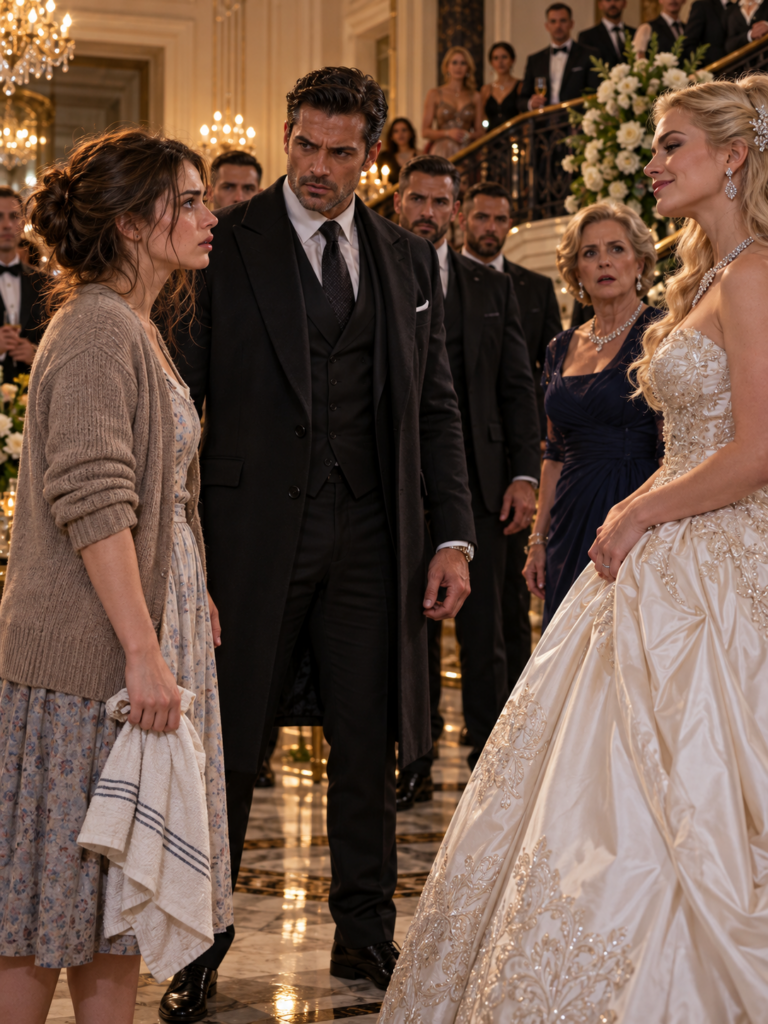
Laurel lunged forward and caught Camille’s arm before her stepsister could fall against the edge of the marble steps.
The guests gasped.
Roman moved instinctively, but Laurel had already steadied Camille.
“Hold the railing,” Laurel told her.
Camille obeyed.
For several seconds, the two women stood close together, one wearing an extraordinary wedding gown, the other wearing an old dress that no longer fit her properly.
Camille stared at Laurel’s hand around her wrist.
“You helped me.”
“You were falling.”
“But—”
“I’m angry with you, Camille. I don’t want you hurt.”
Roman watched the exchange without speaking.
It told him something important about Laurel.
Even now, she could distinguish between demanding justice and seeking humiliation.
Celeste stepped forward, her voice trembling beneath an attempt at authority.
“Mr. Voss, I believe there’s been an unfortunate misunderstanding.”
Roman looked at her.
“What part was difficult to understand?”
“The delivery was unexpected.”
“It was addressed to Laurel.”
“Of course, but Camille is engaged, and naturally I assumed—”
“You assumed the gift belonged to whichever daughter you considered more deserving.”
Celeste fell silent.
Roman’s tone had never risen.
Laurel stepped between them.
“I don’t want a confrontation. I want my dress.”
Roman turned toward her immediately.
“Then that’s what we’ll arrange.”
Camille looked down at the silk.
Her excitement had vanished.
“I didn’t know it was from him,” she whispered.
Laurel regarded her.
“You knew it wasn’t yours.”
Camille lowered her eyes.
For once, she had no answer.
“You can change upstairs,” Laurel said. “I’ll wait here.”
Roman nodded toward the staircase.
Camille gathered the train and disappeared into her bedroom.
Nobody spoke until the door closed.
Then Celeste attempted another smile.
“Surely we can settle this privately.”
Laurel looked at her stepmother.
“We could have settled it privately this afternoon.”
The response silenced her.
Roman glanced toward a narrow table near the entrance.
A silver box rested there beneath discarded tissue paper.
On top lay a small card.
He picked it up.
“Was this inside the package?”
Laurel nodded.
He handed it to her.
She read the message.
For the woman I hope will choose to become my wife.
The words made her breath catch.
Roman watched her carefully.
“I intended to speak with you about that before anyone else saw the gown.”
Laurel looked up.
“You were going to ask me?”
“Yes.”
“And you sent a wedding dress first?”
A faint smile touched his face.
“I may have misjudged the order.”
Despite everything, Laurel almost laughed.
But the smile faded when she saw the expression on Celeste’s face.
Recognition.
Not merely recognition of Roman’s wealth.
Recognition of his influence.
Roman followed Laurel’s gaze.
“Mrs. Renford,” he said, “there’s another matter we need to address.”
Celeste became still.
“What matter?”
“The estate accounts.”
The atmosphere changed.
Laurel looked at Roman sharply.
He had mentioned irregularities during their conversations, but she had not known how far his investigators had gone.
Celeste swallowed.
“I don’t see how our family finances concern you.”
“They concern Laurel.”
“That does not give you authority over them.”
“No,” Roman agreed. “It doesn’t.”
He looked at Laurel.
“The decision belongs to you.”
That surprised her.
And frightened her.
“Decision about what?”
Roman hesitated.
Then he answered.
“My investigators found transfers from accounts connected to your inheritance. Transfers that don’t match the explanations you were given.”
Laurel felt cold.
“How much?”
“Enough that you need independent legal representation.”
Celeste stepped forward.
“This is outrageous.”
Laurel didn’t look at her.
“How long have you known?”
Roman held her gaze.
“I identified the first irregularities several weeks ago.”
“And you didn’t tell me?”
“I wanted to confirm them.”
“That’s not your decision to make.”
“No,” he said quietly. “It wasn’t.”
Her disappointment hurt him more visibly than Celeste’s anger.
Laurel turned toward the silver box.
For years, people had decided what information she deserved.
Now even Roman, the man who had promised honesty, had made a decision for her.
“Don’t handle this without me,” she said.
“I won’t.”
“Promise.”
“I promise.”
Footsteps sounded above them.
Camille returned wearing a blue cocktail dress.
The ivory gown lay carefully over her arms.
She stopped before Laurel.
For a moment, neither spoke.
Then Camille held it out.
“I’m sorry.”
Laurel accepted the dress.
She wasn’t ready to forgive.
But she was ready to stop surrendering.
Roman looked at the gown.
“There’s something inside the lining.”
Laurel frowned.
“What?”
“A small concealed pocket.”
Her fingers searched the inner bodice.
She found a tiny button.
Opened it.
And withdrew an antique diamond necklace.
Roman’s expression changed.
“It belonged to my mother.”
Laurel stared at the jewel.
“Roman…”
“I wanted you to have something from the person who taught me that kindness was not weakness.”
The room seemed to fall away.
Laurel closed her fingers around the necklace.
Then she looked toward Celeste.
“My father’s papers,” she said.
Celeste went rigid.
Roman noticed.
Laurel did too.
And suddenly, the stolen inheritance felt connected to something much larger.
“Roman,” she whispered, “there are documents behind a loose panel in my bedroom.”
His eyes sharpened.
“What documents?”
“My father’s old shipping records.”
Celeste made a small, involuntary sound.
Laurel turned toward her.
And realized her stepmother wasn’t afraid of the wedding dress anymore.
She was afraid of what Laurel might find.
Laurel watched Celeste’s face lose its color.
For six years, her stepmother had been a woman of perfectly measured reactions.
She could dismiss an accusation without raising her voice.
She could make an insult sound like helpful advice.
She could take something that belonged to Laurel and make Laurel feel unreasonable for wanting it returned.
But at the mention of Edwin Renford’s shipping records, Celeste looked genuinely afraid.
“What papers?” she asked.
Laurel held the wedding gown against her arm.
“The records Dad kept in his office.”
Celeste’s eyes moved toward Roman.
“Those documents are outdated. Business correspondence from years ago. Nothing relevant.”
“Then you won’t mind my reviewing them,” Laurel answered.
Roman remained silent.
This was her family.
Her inheritance.
Her decision.
And after what she had just said to him, he understood that stepping in without being asked would repeat the very mistake for which she was holding him accountable.
Laurel turned toward him.
“I want to leave.”
He nodded.
“Where would you like to go?”
“Somewhere I can see the records properly.”
“You can use my home if you wish.”
She studied him.
“On one condition.”
“Name it.”
“Every document goes through a lawyer I choose. Nothing disappears into your organization because you think that’s safer.”
Roman met her eyes.
“Agreed.”
“And you don’t make decisions about my father’s estate without consulting me.”
“Agreed.”
He did not offer a complicated defense.
That helped.
But Laurel was not ready to forget his omission.
She turned back toward Celeste.
“The money is going to be accounted for.”
Her stepmother attempted to recover her composure.
“You have no idea how complicated the administration of an estate can be.”
“I know enough to recognize when someone hides the records.”
Celeste flinched.
Laurel looked around the room.
The guests had grown uncomfortable.
Camille stood beside the staircase, uncertain where to place her hands.
Tristan Belgrave, her fiancé, remained near the fireplace.
He had said very little since Roman entered.
Now Laurel noticed the peculiar way he watched Roman.
Not with surprise.
With calculation.
Roman noticed it too.
But neither spoke about it there.
Laurel stepped toward the front door.
She carried the gown over one arm and held the necklace in her other hand.
Roman walked beside her.
For the first time since her father’s death, she crossed the threshold without glancing backward for permission.
***
In Roman’s car, Boston moved past the windows in cold ribbons of light.
Laurel sat beside him.
For several minutes, neither spoke.
Then she asked, “How much money?”
Roman turned toward her.
“Approximately two million three hundred thousand dollars.”
Laurel stared.
She had suspected thousands.
Possibly hundreds of thousands.
But not that.
“From my inheritance?”
“Accounts and estate assets that appear to have been redirected after your father’s death.”
She looked down at her father’s old sweater.
For years, Celeste had told her money was tight.
That the estate had obligations.
That Laurel should be grateful for an allowance.
Meanwhile, Laurel had been carefully saving twenty-dollar bills in an envelope behind the loose panel in her bedroom.
She had spent forty-three dollars helping Roman and wondered whether she could afford the pharmacy supplies.
The absurdity of it made her feel almost sick.
“What else?”
“Your signature appears on documents that need legal scrutiny. There are questions about the property deed, account transfers, and financial credit assigned to Camille.”
Laurel closed her eyes.
“I signed papers after Dad died.”
“I know.”
“I was grieving. Celeste said they were routine.”
Roman’s voice softened.
“That matters legally.”
“Can it be undone?”
“Some of it may be. But I won’t promise an outcome a court hasn’t decided.”
She looked at him.
It was the answer she needed.
Not certainty purchased with power.
The truth.
“Why didn’t you tell me sooner?”
“I believed I should bring you a complete answer instead of frightening you with suspicions.”
“And you decided I couldn’t handle incomplete information.”
He looked away.
“Yes.”
“You were wrong.”
“Yes.”
Laurel sat with that.
Then she asked, “Will you do it again?”
Roman took several seconds to answer.
“I have spent most of my adult life keeping information compartmentalized. In my world, there are legitimate reasons for that.”
“I know.”
“But I allowed that habit to dictate what you knew about your own life.”
She waited.
“I can’t promise I’ll never be tempted to do that again,” he said. “I can promise that if a decision concerns you, I’ll stop treating my judgment as a substitute for yours.”
Laurel looked out at the harbor lights.
“That is something I can work with.”
***
Later that night, Laurel retrieved the records from her father’s house.
She insisted on collecting them herself, while Roman waited nearby.
Behind the loose panel in her closet sat an old cardboard box.
Inside were shipping papers, notebooks, and an accounting ledger filled with her father’s precise handwriting.
Laurel carried the box out.
Celeste watched from the doorway.
Neither spoke.
At Roman’s home, his assistant Petra photographed the papers to preserve their condition.
Roman stood beside the kitchen table.
Laurel opened the ledger.
Pages of dates.
Payments.
Shipping references.
Small abbreviations.
Roman noticed several entries connected to companies he had been investigating.
His expression became grave.
“Do you recognize these initials?”
Laurel leaned over the page.
Beside a March payment, Edwin had written two letters.
EU.
“Yes,” she said slowly.
“What does it mean?”
“Extortion under threat. Dad abbreviated things when he wanted to keep private notes.”
Roman looked at the next entry.
Then the next.
“Your father was making payments he didn’t want to make.”
Laurel’s heartbeat quickened.
“To whom?”
Roman hesitated.
There was a name he had spent years trying to locate.
A man once close to his father.
A man connected to the conflict that had killed Roman’s mother.
Gideon Strike.
He had vanished fifteen years earlier.
Most people who knew him believed he was dead.
Roman had recently learned otherwise.
And now the shipping records in Edwin Renford’s handwriting connected the same harbor routes to companies controlled by Tristan Belgrave.
Laurel stared at him.
“Camille’s fiancé?”
“Yes.”
“You think Tristan is connected to Gideon?”
“I have reasons to suspect it.”
Laurel looked toward the final page of the ledger.
The entries stopped abruptly.
Her father’s handwriting ended halfway through a line.
She remembered his final weeks.
The unexplained worry.
The closed office door.
His insistence that she concentrate on finishing her studies and let him handle his affairs.
Then the sudden death.
A heart condition, according to the doctor.
Roman pulled out a chair.
“Laurel.”
She remained standing.
“Do you think Gideon hurt my father?”
Roman didn’t answer immediately.
“I think your father was documenting coercion. I think the timing of his death deserves investigation.”
“That isn’t what I asked.”
“No,” Roman said. “It isn’t.”
He met her eyes.
“I believe Gideon may have been involved. But belief isn’t proof.”
Laurel lowered herself into the chair.
For six years, she had mourned a father whose death she believed was natural.
Now she faced the possibility that the man who had built their home had been threatened, exploited, and silenced.
Roman moved closer.
“May I?”
She nodded.
He crouched beside her.
Laurel reached for his hand.
“Tell me about your mother.”
Roman looked surprised.
Then he understood.
She wanted to know the shape of the loss that connected their lives.
He told her about a woman who cooked on Sundays and grew herbs in a small Boston apartment.
A woman who had tried to keep tenderness alive inside a violent family.
A woman killed in a conflict Gideon had helped provoke.
Roman spoke without making himself heroic.
He did not excuse the criminal world that had shaped him.
And Laurel did not ask him to pretend he could erase it.
When he finished, she squeezed his hand.
“We’re going to find out what happened to both of them.”
Roman looked at her.
“We?”
“Yes.”
He gave a faint, troubled smile.
“You know what kind of danger that could involve.”
“I do.”
“Then we need to discuss your safety.”
“We can discuss it,” Laurel said. “You don’t get to decide it alone.”
***
The following morning, Laurel went back to the Renford estate to pack.
Celeste found her placing folded clothes into two bags.
“Where are you going?”
“I’m leaving.”
“For how long?”
“I haven’t decided.”
Celeste stepped into the cramped bedroom.
“You should understand that Roman Voss is not a safe man.”
Laurel paused.
“He hasn’t claimed to be.”
“You don’t know what he’s capable of.”
“I know more than you think.”
“He’s dangerous.”
“Yes.”
The straightforward answer unsettled Celeste.
Laurel closed one bag.
“Roman has told me uncomfortable truths about his life. You’ve spent six years telling me comfortable lies about mine.”
Celeste’s face tightened.
“I did what was necessary to protect this family.”
“No,” Laurel said. “You did what benefited you.”
The room fell silent.
Laurel picked up the second bag.
“And now the money will be examined by people who aren’t afraid to disagree with you.”
Celeste moved aside.
At the doorway, she spoke again.
“Camille didn’t know about the transfers.”
Laurel stopped.
“I know.”
“She benefited, but she didn’t understand everything.”
“That doesn’t make what happened acceptable.”
“No.”
It was the closest Celeste had come to admitting anything.
Laurel looked at her.
“I’m not asking you to like the person I’m becoming.”
She lifted her bags.
“I’m asking you to stop deciding who I am.”
Then she left.
***
Eight days later, someone began following Laurel.
She noticed the dark sedan near a harbor footpath.
At first, she thought it was coincidence.
Then it appeared again after she changed streets.
And again.
She recognized the pattern because her father had taught her to pay attention to the city around her.
She entered a covered market, moved through the crowd, and emerged on the opposite side.
Footsteps quickened behind her.
Laurel continued toward Commercial Street and entered a crowded breakfast restaurant.
Only after she reached a table near the window did she call Roman.
“Someone followed me.”
His voice changed immediately.
“Where are you?”
“Inside Havford’s. Commercial Street.”
“Are you hurt?”
“No.”
“Stay somewhere visible. I’m coming.”
He arrived with his security team.
Laurel remained inside while the situation was assessed.
An hour later, Roman returned to her table.
His face told her enough.
“Gideon’s people?” she asked.
“Yes.”
“What did they want?”
“To take you alive.”
Her fingers tightened around her coffee cup.
“Why?”
“To pressure me into surrendering business interests and territory.”
Laurel looked at him.
“So he thinks I’m something he can use against you.”
“Yes.”
She stared out the window.
For years, Celeste had used Laurel’s grief to control her.
Now Gideon wanted to use Roman’s feelings to control him.
Different men and women.
The same assumption.
That Laurel’s future belonged to whoever had enough leverage to claim it.
“I’m not disappearing into a safe house,” she said.
Roman remained quiet.
“You don’t have to like that answer.”
“I don’t.”
“But?”
“But I understand why you won’t accept a life built entirely around hiding.”
She looked at him.
“I’ll consider practical precautions. I won’t hand over my decisions.”
“We’ll find a way.”
Then Roman reached across the table.
“Laurel, there’s something I intended to ask before any of this happened.”
She studied him.
He didn’t look like a man negotiating.
He looked almost uncertain.
“I wanted to give you my mother’s necklace. I wanted to show you the wedding dress. And then I wanted to ask whether you would marry me.”
Laurel’s breath caught.
He continued.
“I don’t want marriage to be a security arrangement. It won’t make Gideon disappear. It won’t erase the choices I still have to make about my businesses.”
“I know.”
“And I won’t ask you to become responsible for turning me into a better man.”
She looked at their hands.
“What are you asking?”
“To build a life with me. One in which you can still tell me no.”
Laurel thought about her father.
About the cold alley.
About the scar on Roman’s shoulder.
About the house she had finally left.
Then she looked into Roman’s eyes.
“Yes.”
He stared.
She smiled through sudden tears.
“Yes, Roman. I want to marry you.”
He moved to her side of the table.
She met him halfway.
Their kiss was quiet.
And for several seconds, the dangerous world beyond the restaurant windows seemed very far away.
***
The wedding was arranged for April twenty-second.
The ceremony would take place in the garden of the Renford estate, the home Laurel was fighting to recover.
But Gideon remained a threat.
Roman’s security chief, Ferrante, believed an attack on Gideon’s known properties would only force him to disappear again.
Laurel reached a different conclusion.
“If he’s waiting for an opportunity to reach me,” she told Roman, “he’ll consider our wedding one.”
Roman immediately disliked the implication.
“No.”
“You haven’t heard the proposal.”
“I’ve heard enough to know you’re considering putting yourself within reach of a man who wants to take you.”
“I’m considering using the situation he’s already created.”
She laid out the reasoning.
Gideon believed Roman would be distracted by the wedding.
He believed the ceremony would create an opportunity to isolate Laurel.
If they planned carefully, the same expectation might bring him into a location where independent witnesses and law-enforcement personnel could document his actions.
Roman listened.
Then he asked the question Laurel respected most.
“What happens if the plan fails?”
She didn’t pretend there was no risk.
They discussed the danger honestly.
They also agreed the wedding itself would remain real.
Not a performance.
Not a bargain.
Not a trap disguised as affection.
The trap would exist because Gideon might choose to exploit the celebration.
Their marriage would exist because Laurel and Roman wanted it.
***
In the weeks before the ceremony, Camille began visiting.
Her engagement to Tristan had deteriorated after Roman’s appearance at the party.
Tristan had left Boston temporarily, claiming business complications.
Camille was beginning to understand that he had approached her for reasons other than love.
One afternoon, while Laurel examined three possible wedding gowns, Camille pointed to the simplest.
“Wear that one.”
Laurel looked at her.
“You don’t think the ivory dress is better?”
“No.”
“Why?”
“Because that one looks like something you chose.”
Laurel studied the champagne-colored gown.
Camille was right.
It was elegant without being overwhelming.
And Laurel had discovered the designer herself years before, while imagining a future she had never believed she could afford.
She set the original ivory gown aside.
Camille watched her.
“I owe you an apology.”
Laurel turned.
“For which part?”
Camille looked down.
“All of it.”
The admission was clumsy.
But genuine.
“I knew I was taking credit for your work,” Camille continued. “I knew Mom treated you unfairly. I just liked being the person everyone praised.”
Laurel sat beside her.
“That hurt.”
“I know.”
“No. I don’t think you do. Not completely.”
Camille nodded.
“Probably not.”
They sat quietly.
Then Camille said, “I need to figure out who I am when I’m not borrowing something from you.”
Laurel almost smiled.
“That sounds difficult.”
“It is.”
“Then it’s worth doing.”
***
The morning of April twenty-second arrived bright and cold.
Laurel dressed herself.
She arranged her own hair.
She fastened Roman’s mother’s necklace around her throat.
Downstairs, Roman waited in a dark suit.
When he saw her, he stopped.
Laurel smiled.
“Don’t say something rehearsed.”
“I wasn’t going to.”
“What were you going to say?”
Roman studied her.
“That you look like the woman I’ve been hoping to stand beside.”
Laurel stepped down the final stair.
“That one I’ll accept.”
He took her hand.
Then Ferrante appeared in the doorway.
His expression was grim.
“Roman. We have a problem.”
Roman released Laurel’s hand.
“What happened?”
“The eastern security camera has been fixed in one position. There’s a gap in coverage.”
Roman went still.
“Accidental?”
“No.”
Laurel looked between them.
“Someone changed it?”
Ferrante nodded.
Roman turned toward his office.
“Find out who had access.”
Minutes later, the answer emerged.
Petra.
Roman’s trusted assistant.
The woman who had helped photograph Edwin Renford’s records.
The woman who had assisted in planning the wedding.
When Roman confronted her, Petra stood silent for several seconds.
Then she confessed.
Her brother Dove owed money to people working under Gideon’s organization.
They had threatened him.
In exchange for his safety, Petra had disclosed details of the wedding’s security arrangements.
She had believed she could surrender information without anyone being hurt.
Now she understood how badly she had misjudged the situation.
Roman listened without interrupting.
Then he asked one question.
“Where is your brother?”
Petra looked up.
“At his apartment.”
Roman turned to Ferrante.
“Arrange for someone to check on him and keep him safe.”
Petra stared.
“You’re helping him?”
“Your brother isn’t responsible for your decision. And threatening him is how Gideon gained control.”
Her eyes filled.
Roman’s voice hardened.
“You should have come to me.”
“I know.”
Laurel entered the office.
She looked at the camera layout.
Then at Roman.
“He knows where you expect him to enter.”
“Yes.”
“He knows where the recordings are.”
“Yes.”
“And if we cancel everything?”
“He disappears.”
Laurel studied the plan.
Gideon had been waiting years for an opportunity like this.
Now he believed he had one.
Roman looked at her.
“We can postpone the ceremony.”
Laurel shook her head.
“No.”
“Your safety comes first.”
“My safety matters. So does my choice.”
“Laurel—”
She approached him.
“I am not giving this man another part of my life simply because he’s decided he deserves it.”
Roman held her gaze.
She continued.
“We adjust the plan. We tell the independent witnesses what happened. And if the risk can’t be controlled, we stop.”
Ferrante looked at Roman.
Roman looked at Laurel.
Then he nodded.
“Agreed.”
Outside, the first wedding guests were arriving.
Inside, Roman’s security team began making changes to a plan Gideon Strike believed he already understood.
And somewhere beyond the estate gates, the man who had haunted both their families for years was preparing to walk into the celebration.
He believed he knew every weakness.
He had not accounted for Laurel Renford.
Laurel stood before the mirror and adjusted the antique necklace at her throat.
Outside, guests were gathering in the garden.
Sixty white chairs faced an arch covered in pale spring flowers.
The morning sunlight touched the windows of the house her father had built.
It should have been the happiest day of her life.
Instead, Laurel knew that a man connected to the destruction of both her family and Roman’s was somewhere nearby.
And she knew their security arrangements had been betrayed.
She could still call off the ceremony.
Roman had offered her that choice.
He meant it.
But she had spent six years surrendering choices to other people.
Today, she would make her own.
A quiet knock came at the door.
“Come in.”
Camille entered wearing a blue dress.
She stopped when she saw Laurel.
“Oh.”
Laurel looked over her shoulder.
“Is that good or bad?”
Camille gave a small laugh.
“Good.”
She approached.
“You look beautiful.”
“Thank you.”
Camille glanced at the necklace.
“Roman’s mother?”
Laurel nodded.
Camille touched the edge of her own bracelet.
“I’m glad you didn’t wear the first gown.”
Laurel studied her.
“So am I.”
For a moment, the two women considered the strange distance they had traveled from that evening in the foyer.
Camille had stood before the mirror in a stolen dress.
Laurel had stood behind her, afraid to demand something that belonged to her.
Now Camille was here to help.
And Laurel had chosen everything she wore.
Camille looked toward the window.
“Are you nervous?”
“Yes.”
“About marrying Roman?”
“No.”
The answer came without hesitation.
Camille smiled.
“That must be nice.”
Laurel looked at her.
“Knowing what you want?”
“Yes.”
“It took me longer than it should have.”
Camille nodded.
Then she reached for Laurel’s hand.
“I hope you’re happy.”
Laurel squeezed her fingers.
“I intend to be.”
***
Downstairs, Roman stood with Ferrante reviewing the final arrangements.
Petra had been removed from responsibility for security decisions.
Her brother was safe.
The compromised information had been reported to the independent people coordinating the legal side of the operation.
The eastern camera remained visibly misaligned.
But the plan no longer depended on that camera.
Roman understood the risk.
He also understood that uncertainty could not be eliminated by threatening everyone involved or locking Laurel away.
Ferrante approached.
“The guests are seated.”
Roman nodded.
“Is everything ready?”
“As ready as it can be.”
Roman looked toward the garden.
Beyond the glass, the flower-covered arch stood beneath the blue April sky.
He had spent years believing safety meant controlling every variable.
Now the most important person in his life was about to make a decision he could not make for her.
He adjusted his cuff.
Ferrante noticed.
“You’re nervous.”
Roman looked at him.
“Focus on your work.”
Ferrante almost smiled.
***
When Laurel entered the garden, Roman forgot the security plan for one extraordinary second.
She wore a champagne-colored gown.
Her hair was arranged simply.
The diamond that had belonged to his mother rested at her throat.
But what stopped him was her expression.
She wasn’t waiting for someone to tell her where to stand.
She was walking toward the future she had chosen.
Their eyes met.
Roman smiled.
Laurel smiled back.
They stood beneath the arch as the officiant began.
For the first time in years, Laurel felt the Renford estate becoming something other than a place of grief.
Her father had planted the roses beyond the garden wall.
He had built the stone terrace.
He had once told her that a home mattered because of the people who were allowed to feel safe inside it.
She had spent six years believing she needed to remain in the house to preserve his memory.
Now she understood that preserving him meant refusing the silence that had consumed the family after his death.
Roman took her hand.
They exchanged vows.
Not vows of possession.
Not promises that one would rescue the other from every hardship.
They promised honesty.
Respect.
And the willingness to face difficult truths without turning them into weapons against each other.
When Roman placed the ring on Laurel’s finger, his hand trembled slightly.
She noticed.
And smiled.
When she placed his ring, she whispered, “You’re allowed to be nervous.”
His mouth curved.
“I’ve noticed.”
The officiant completed the vows.
Their marriage was real.
Then, before the documents were signed, Ferrante appeared discreetly near the edge of the garden.
His expression told Roman what was happening.
Gideon had arrived.
***
The interruption was explained to the guests as a brief private matter.
Laurel and Roman walked away in separate directions.
Roman moved toward the security team.
Laurel entered the reception room, where Ferrante’s people were positioned and independent documentation arrangements were in place.
She remained within the secure portion of the room, as they had agreed.
Her heart beat hard.
She was frightened.
She did not mistake courage for the absence of fear.
She thought of her father’s ledger.
The last unfinished entry.
The way the handwriting stopped halfway across the page.
Then the door opened.
Gideon Strike entered with two men.
He was older than she expected.
Gray-haired.
Compact.
Neatly dressed.
His face carried none of the theatrical cruelty Laurel had imagined.
That made him more unsettling.
He looked at her.
“Mrs. Voss.”
Laurel straightened.
“Yes.”
His eyes moved around the room.
He noticed the security men.
The door.
The space between himself and Laurel.
Then he looked back at her.
“So you knew.”
“Yes.”
A faint smile touched his mouth.
“I expected Roman to make this complicated.”
Laurel said nothing.
Gideon studied her.
“Interesting.”
“What is?”
“I knew Roman’s habits. His security. His weaknesses. I didn’t account for you making the decisions.”
Laurel held his gaze.
“You made the same mistake with my father.”
Something changed behind Gideon’s eyes.
“Edwin was a careful man.”
“Yes.”
“He documented things that weren’t his concern.”
Laurel felt the words settle heavily.
“He was being threatened.”
Gideon looked toward the door.
Then back at her.
“He became inconvenient.”
Laurel’s throat tightened.
“Inconvenient enough to kill?”
For a moment, Gideon said nothing.
Then he answered with the calm of a man describing a business expense.
“Your father chose not to cooperate. I made sure he could no longer interfere.”
The room seemed to narrow.
Laurel stared at him.
She had spent weeks preparing herself for confirmation.
Preparation did not make the truth less devastating.
“You arranged his death.”
Gideon looked at her without remorse.
“I arranged for a problem to end.”
Laurel felt something inside her go very still.
She thought about Edwin Renford teaching her to ride a bicycle.
His hands guiding the handlebars.
His careful handwriting.
The secret compartment he had shown her when she was nine.
The way he had always reminded her to ask questions when an explanation did not make sense.
Then the memory shifted.
Her father wasn’t merely the man whose belongings she had fought to preserve.
He had been a man who recognized a wrong and began documenting it.
Even knowing there was danger.
“You took him away from me,” Laurel said.
Gideon tilted his head.
“Your father involved himself in affairs he didn’t understand.”
“No.”
Her voice sharpened.
“He understood enough to know you were extorting him.”
Gideon didn’t respond.
Laurel continued.
“He kept records because he knew someday somebody would need the truth.”
The older man’s expression tightened.
For the first time, he looked less certain.
“You have his ledger.”
“Yes.”
“And Roman has it now.”
“The evidence is being handled by people who can bring it into court.”
Gideon glanced toward his men.
The situation had changed.
They were no longer approaching a helpless woman waiting to be taken.
They were facing a documented case and a security arrangement that had not collapsed as expected.
Ferrante spoke from beside the doorway.
“Mr. Strike, the conversation is over.”
Gideon’s gaze moved toward him.
Roman entered from the adjoining hall.
He stopped beside Laurel without placing himself in front of her.
Gideon looked between them.
Then he gave a humorless smile.
“You’ve spent years trying to find me.”
Roman regarded him.
“Yes.”
“And this is how you intend to settle things?”
“Through evidence. Witnesses. And the legal process.”
Gideon laughed softly.
“Your father would be disappointed.”
Roman did not move.
“My father believed violence could solve every problem.”
“And you don’t?”
“I’ve seen what it leaves behind.”
Roman glanced at Laurel.
She remained standing.
The necklace at her throat caught a narrow blade of light.
Gideon followed his gaze.
Recognition appeared.
“That belonged to your mother.”
Roman’s expression became cold.
“Yes.”
Gideon looked at the diamond.
For the first time, something like unease crossed his face.
Roman continued.
“You used my father’s world to put her in danger. And you used Edwin Renford’s businesses to make money through threats.”
Gideon lifted his chin.
“Everything I did was necessary.”
Laurel spoke.
“Necessary for whom?”
He looked at her.
“For maintaining the organization.”
“And my father?”
Gideon remained silent.
“And Roman’s mother?”
No answer.
Laurel stepped no closer.
She didn’t need to.
“That’s what people like you call the lives you destroy. Necessary.”
Roman looked at Gideon.
“You’re not leaving here with her. You’re not leaving here with my business interests. And you’re not making another family pay for your decisions.”
Ferrante moved forward with the security team as the independent authorities coordinated the next steps.
Gideon’s companions were separated without a fight.
For a moment, the older man stood completely still.
Then he raised his hands.
The calculation had finally failed.
Gideon was taken into custody and passed into the legal process.
His recorded statements, Edwin’s documents, financial records, and other evidence would form the basis of the investigation.
There would be no private execution.
No disappearance arranged by Roman.
No revenge hidden behind another family’s silence.
For Laurel, that mattered.
She did not want her father’s death answered by another secret.
She wanted the truth established where it could not be buried again.
***
After Gideon was removed, Laurel remained in the reception room.
The quiet settled around her.
Roman approached carefully.
“Laurel?”
She looked up.
Her eyes were dry.
Her face was pale.
“He admitted it.”
“Yes.”
“My father didn’t die because of a heart condition.”
Roman paused.
“We now have a statement indicating his death was arranged. The medical evidence still needs to be examined.”
She nodded.
The distinction mattered.
Even now.
Even with her grief pressing against her ribs.
She wanted facts.
Not comforting assumptions.
Roman held out his hand.
She stepped toward him.
He embraced her.
Laurel rested her forehead against his shoulder.
For years, she had believed grieving her father meant enduring whatever remained of the life he had left behind.
Now she realized how much of that life had been constructed around a lie.
She breathed against Roman’s jacket.
“I don’t know how to feel.”
“You don’t have to decide.”
“I thought I’d be angry.”
“You may be.”
“I thought I’d feel relief.”
“You may feel that too.”
She closed her eyes.
“Right now, I just miss him.”
Roman’s arms tightened gently.
“I know.”
She stayed there for a moment.
Then another.
Outside, the quartet began playing again.
Laurel lifted her head.
“We have guests.”
Roman almost smiled.
“We do.”
“And I believe we left them in the middle of a wedding.”
“Yes.”
“That’s terribly rude.”
“Unforgivable.”
She gave a shaky laugh.
Roman brushed a loose strand of hair away from her cheek.
“Would you like to go back?”
Laurel looked toward the garden.
Then at him.
“Yes.”
She took his hand.
And together, they returned.
***
The guests rose when they appeared.
The officiant looked relieved.
Camille exhaled visibly from the third row.
Celeste sat beside her, rigid and pale.
The couple completed the remaining paperwork.
When the signatures were finished, applause filled the garden.
For Laurel, the sound carried an unfamiliar warmth.
She was not receiving applause because she had been useful.
Or obedient.
Or conveniently silent.
The people before her were witnessing a choice she had made for herself.
Roman looked at her beneath the arch.
“Are you happy?”
Laurel considered the question.
The answer was complicated.
Her father’s death had become something far more terrible than she had understood.
The legal case would take time.
Celeste’s financial misconduct still required resolution.
Roman’s world remained dangerous and morally complicated.
And marriage would not erase any of it.
But she looked at the man beside her.
The man she had found bleeding in an alley.
The man who had admitted mistakes instead of demanding gratitude.
The man who was learning that love did not make him entitled to choose for her.
“Yes,” she answered.
Then she smiled.
“I am.”
Roman kissed her.
The applause grew louder.
***
In the weeks that followed, the investigation advanced.
Gideon’s financial structures began unraveling.
Records connected Tristan Belgrave’s shipping operations to companies used by Gideon’s organization.
Tristan faced legal proceedings of his own.
Additional testimony and financial evidence strengthened the case.
Eventually, investigators located a physician whose role in Edwin Renford’s death required serious criminal scrutiny.
For Laurel, each new development was painful.
But the truth no longer depended on her ability to afford an investigation.
It was moving through a process in which documents, witnesses, and legal accountability mattered.
The audit of the Renford estate also progressed.
Celeste’s unauthorized transfers were documented.
The amount was substantial.
The estate arrangements were challenged.
Recovery of the inheritance began.
Laurel followed the process carefully.
She read the reports.
Asked questions.
And refused to allow Roman’s advisers to explain things only to him.
When one attorney addressed Roman instead of her during a meeting, she calmly interrupted.
“It’s my inheritance.”
The attorney turned.
“Of course, Mrs. Voss.”
“Please direct the explanation to me.”
Roman said nothing.
Later, when they were alone, Laurel looked at him.
“You didn’t rescue him.”
“From what?”
“From being corrected.”
Roman smiled.
“He needed correcting.”
She laughed.
It was a small moment.
But it represented something important.
Roman did not have to prove himself powerful by speaking over her.
And Laurel no longer needed to make herself smaller to preserve anyone’s pride.
***
Camille came to visit one afternoon.
She looked less polished than Laurel remembered.
Less certain.
But also less artificial.
They sat near the garden where the wedding had taken place.
Camille held a glass of water between her hands.
“I’ve been thinking about Mom.”
Laurel waited.
“She asked whether you’re going to pursue criminal charges personally.”
Laurel looked toward the roses.
Her father had planted them years earlier.
The buds were beginning to open.
“The financial recovery will proceed,” Laurel said.
“And after that?”
“I won’t interfere with what the law requires. But I’m not going to spend the next several years making revenge the center of my life.”
Camille studied her.
“You’re not forgiving her.”
“No.”
“Then why?”
“Because I spent six years reacting to her decisions.”
Laurel turned toward her stepsister.
“I don’t want to spend another six years organizing my life around her punishment.”
Camille lowered her eyes.
“That makes sense.”
They sat quietly.
Then Camille spoke again.
“I’ve started looking for work.”
Laurel smiled faintly.
“Doing what?”
“Something in fashion.”
“You always liked that.”
“Yes. Although I may discover that liking clothes and having an actual job are different things.”
Laurel laughed.
“They are.”
Camille looked toward her.
“I want to know whether I can be good at something without taking credit for somebody else’s effort.”
“That seems worth finding out.”
Camille nodded.
Then hesitated.
“Would it be all right if I called you sometimes?”
Laurel looked at her.
There had been years when Camille treated access to Laurel’s attention as automatic.
Now she was asking.
“Yes,” Laurel said.
Camille blinked.
“Really?”
“You can call.”
It wasn’t forgiveness.
It was an opening.
And for now, that was enough.
***
Celeste eventually left the estate.
Laurel watched her walk toward the side entrance one afternoon.
Her stepmother paused near the garden.
For several seconds, they looked at each other.
Neither waved.
Neither spoke.
Then Celeste turned away.
Laurel felt no great surge of triumph.
She simply felt the absence of an old pressure.
For years, her life had been arranged around Celeste’s approval.
Now there was nothing left to request.
Roman joined her a few minutes later.
“She’s gone?”
“Yes.”
He looked toward the gate.
“Are you all right?”
Laurel considered the question.
“Yes.”
He waited.
She smiled faintly.
“I think I expected it to feel more dramatic.”
“Does it?”
“No.”
“What does it feel like?”
“Finishing a very long conversation.”
Roman took her hand.
She leaned against him.
And together they watched the late afternoon light settle over the garden.
***
Several months later, Laurel stood in a bright upstairs room of the Renford estate.
The room had once been used for storage.
Now it contained a large worktable, shelves, fabric samples, and several carefully arranged sketchbooks.
She opened one and examined a design she had been developing.
For years, she had made drawings in the margins of household notebooks.
Dresses.
Coats.
Simple, elegant pieces she imagined making someday.
Celeste had dismissed the sketches as an impractical hobby.
Camille had occasionally borrowed the ideas without credit.
Laurel had almost convinced herself that wanting a design career was foolish.
Now she was preparing to open a small studio in Boston.
She planned to use part of her recovered inheritance.
Not Roman’s money.
Her own.
Three employees to begin.
A modest space.
A business she could build carefully, with her own judgment and her own name attached to the work.
Roman appeared in the doorway.
“Am I interrupting?”
“No.”
He entered.
Laurel looked up.
“How was your meeting?”
“Productive.”
“Which means?”
“Less unpleasant than expected.”
She laughed.
He glanced at the sketches.
“Is that the collection?”
“The beginning of one.”
Roman picked up a drawing.
It showed an elegant ivory gown with restrained embroidery.
He looked at it.
“This reminds me of something.”
Laurel smiled.
“The original wedding dress?”
“Yes.”
She walked closer.
“I’ve been thinking about what happened that night.”
“The engagement party?”
“Yes.”
Roman set down the sketch.
Laurel continued.
“I was standing in my father’s house, wearing Camille’s old clothes, watching her wear something meant for me.”
He looked at her.
“I know.”
“I thought getting the dress back would be the important part.”
“Wasn’t it?”
“It mattered.”
She touched the sketchbook.
“But what mattered more was discovering that I could ask for what belonged to me without apologizing.”
Roman’s expression softened.
“And that you didn’t need me to decide what justice looked like.”
“No.”
She smiled.
“You helped. Sometimes more than I knew how to ask for.”
“I made mistakes.”
“Yes.”
“And you’ll remind me of them.”
“When necessary.”
He laughed.
Laurel turned toward the window.
Below them, the garden was green.
The house her father had built was being restored.
Her inheritance was no longer an unexplained number controlled by someone else.
Her plans were beginning to take shape.
And the man she loved stood beside her, not in front of her.
Roman approached.
“What are you thinking?”
Laurel looked at him.
“About the night we met.”
He smiled.
“The pharmacy?”
“The alley.”
“An unpleasant place to meet someone.”
“You were very rude.”
“I told you to keep walking.”
“Repeatedly.”
“And you ignored me.”
“You were bleeding.”
“I’ve recovered.”
“Barely, considering your personality.”
Roman laughed.
Then he looked toward the green cashmere scarf folded neatly on the back of a chair.
The scarf Laurel had used to help him that night.
The one her father had given her.
It had been cleaned and carefully preserved.
She followed his gaze.
“You know, I nearly kept walking.”
“Why didn’t you?”
She considered.
“Because you needed help.”
Roman watched her.
“And because I could give it.”
He took her hand.
“You changed my life that night.”
Laurel smiled.
“You changed mine too.”
Then her expression grew thoughtful.
“But not by giving me a dress.”
“No?”
“Not by bringing four cars to my father’s house.”
“I’m beginning to see that.”
“And not by telling everyone you intended to marry me.”
Roman raised an eyebrow.
“That was a memorable evening.”
“It certainly was.”
She squeezed his hand.
“You changed my life because you showed me something I had forgotten.”
“What?”
“That I could be wanted without being useful to someone.”
Roman’s face softened.
“And you reminded me that I could be loved without controlling someone.”
Laurel moved closer.
He kissed her forehead.
Then he waited.
She smiled and kissed him properly.
Outside, sunlight warmed the windows.
Inside, an unfinished collection lay across the table.
There would be more difficult days.
More choices.
More mistakes to acknowledge.
Roman still carried responsibility for a dangerous criminal world, and Laurel would continue holding him to the promises he had made about honesty, accountability, and separating her future from his illicit affairs.
Their love did not erase those realities.
It required them to face them.
But Laurel had learned something she would never surrender again.
She was not valuable because a powerful man had chosen her.
She had been valuable when nobody noticed.
When she was counting pennies.
When she was wearing someone else’s discarded clothes.
When she stood alone in the foyer and demanded her dress back.
Roman had recognized that worth.
He had not created it.
And now, in the home her father had built, Laurel finally had the freedom to build something of her own.
She closed the sketchbook.
“Come downstairs,” she told Roman. “I want to show you the plans for the studio.”
He offered his hand.
She took it.
Together, they walked toward the door.
And this time, Laurel Renford was not leaving a room because someone had ordered her to.
She was walking toward a future she had chosen.
With the man she loved beside her.
Not as her rescuer.
Not as her owner.
As her husband.
And, at last, as her equal.


