
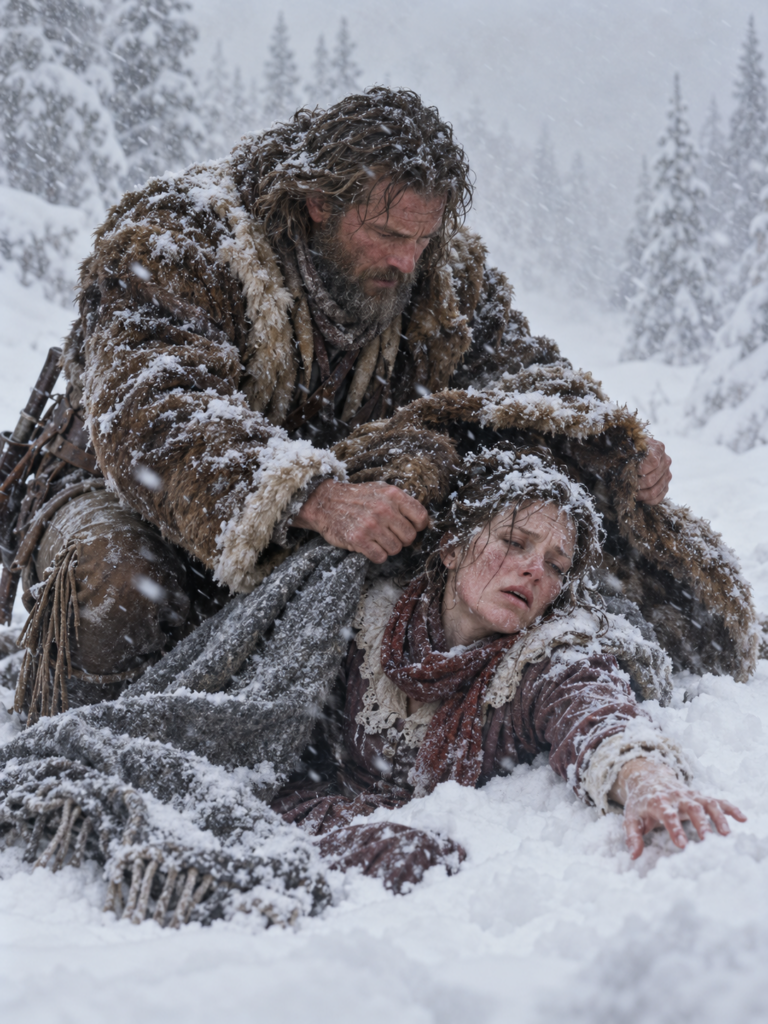
Jed tightened the blanket around Annie while Clara pushed Arthur’s notebook inside her dress, close enough that no storm could tear it away.
“Can she ride?”
Clara looked at her daughter.
Annie’s eyes were open, but exhaustion had made them dull.
“Not alone.”
“Then I carry her.”
Clara hesitated.
Jed noticed.
“You can change your mind.”
She looked at him.
“You keep saying that.”
“About what?”
“Everything.”
Jed frowned as if choice should have been the most ordinary thing in the world.
Clara understood suddenly how strange the past four months had made ordinary decency feel.
“I’m coming,” she said.
Jed lifted Annie.
The girl wrapped both thin arms around his neck.
“Bear Man?”
He sighed.
“Mountain man.”
“Do you have honey?”
Jed looked at Clara.
Clara almost laughed despite herself.
“Yes,” he told Annie. “I have honey.”
That decided the matter for the child.
They entered the storm.
The trip uphill took longer than Jed expected because Clara was weaker than she admitted.
Twice she stumbled.
The second time he extended one hand without touching her.
“Take it if you want.”
She did.
By dusk, his cabin appeared among the pines.
Clara stopped.
It was larger than she had imagined, built from heavy logs with a stone chimney and enough stacked firewood to survive a siege.
Inside, shelves held flour, beans, potatoes, dried venison, preserved berries, and tins of tea.
Annie stared as though they had entered a palace.
“Is that honey?”
Jed set her down carefully.
“Yes.”
“Can I have some?”
He looked at Clara.
Not Annie.
Clara nodded.
Jed put a spoonful into a bowl.
The girl tasted it.
Her eyes widened.
Clara turned away.
Three days without food, and happiness had become a spoonful of honey.
Jed pretended not to see her wipe her face.
He built up the fire, heated broth, and gave Annie small portions until color began returning to her cheeks.
Only after the girl fell asleep beneath two blankets did Clara sit opposite him at the rough table.
Arthur’s notebook lay between them.
“Show me.”
Jed opened to the folded sheets.
Arthur had written ore weights beside dates and marked several assay values received afterward.
Clara traced one line.
“These don’t match.”
“No.”
“This sample says twelve ounces.”
“The mine office reported less than four.”
“And this one?”
“Arthur recorded nearly fifteen.”
The official figure beside it was five.
Clara’s stomach turned.
“Someone was making Deep Creek look worthless.”
“That’s what Arthur believed.”
“Why?”
“To buy the claim cheap.”
Clara thought of Cobb polishing an apple while Annie starved.
She could hear the crunch of his bite.
“He knew.”
“Maybe.”
She looked sharply at Jed.
“Maybe?”
“I won’t tell you something is proven because we want it to be.”
The answer irritated her.
It also made her trust him.
Clara turned another page.
“What did Arthur actually tell you?”
Jed leaned back.
“He had found an opening behind the western wall. Said the ore looked different. Richer.”
“And then?”
“He brought samples to town.”
“To Cobb?”
“He didn’t say.”
Clara tapped the initials.
“T.C.”
“Yes.”
“Thaddeus Cobb.”
“Likely.”
“Likely?”
Jed met her stare.
“You want truth or revenge?”
The words struck hard.
Clara stood.
“I want the man who let my child starve to stop hiding behind careful words.”
Jed remained seated.
“I understand.”
“No, you don’t.”
His eyes changed.
“No. I suppose I don’t.”
That quiet answer took the fight out of her.
Clara sat again.
“I’m sorry.”
“Don’t be.”
She looked toward Annie.
“What would you do?”
“Make copies.”
“Of Arthur’s notebook?”
“Of the important pages. Then put the original somewhere Cobb can’t reach.”
“You think he’d steal it?”
“I think a man who waits for a hungry widow to sign away a mine claim is comfortable using pressure.”
Clara thought for several seconds.
“Can you make copies?”
“I write poorly.”
“I can write.”
Jed nodded.
“Then you copy.”
“And you?”
“I keep watch.”
There it was again.
Help without taking the decision from her.
Clara pulled paper toward herself.
For the next hour she copied dates, ore weights, assay figures, and Arthur’s markings.
Jed sharpened her pencil when it dulled.
He did not ask to hold the notebook.
He did not read over her shoulder.
Near midnight, hoofbeats sounded outside.
Jed stood immediately.
His rifle came off the wall.
“Stay here.”
Clara rose.
“I decide that.”
He looked at her.
Then nodded.
“Fair.”
They went to the door together.
A lone rider stopped beyond the clearing.
Deputy Samuel Price.
“Boone!”
Jed opened the door.
Price removed his hat.
“Mrs. Higgins here?”
Clara stepped into view.
“What happened?”
The deputy looked uncomfortable.
“Cobb filed notice this afternoon that the Higgins claim has been abandoned.”
Clara stared.
“Abandoned?”
“He says your cabin is deserted.”
“For two days?”
Price shifted.
“He also says you stole food from his store.”
Clara gave a short, disbelieving laugh.
“I walked out with nothing.”
“I know what he says and what I believe are different matters.”
“When does the claim transfer?”
Price hesitated.
“Tomorrow at noon if you don’t appear before the recorder.”
Jed swore under his breath.
Clara looked toward Annie sleeping beside the fire.
Cobb had expected her to freeze.
When she disappeared, he had moved for Arthur’s claim immediately.
Fear passed through her.
Then something colder replaced it.
She returned to the table, closed Arthur’s notebook, and tied it beneath her coat.
Jed watched.
“What are you doing?”
Clara reached for the copied pages.
“Making sure Thaddeus Cobb sees the widow he expected to bury.”
Price looked at the snow outside.
“The trail is dangerous.”
“Will it be passable by dawn?”
“Probably.”
Clara faced Jed.
“You said Arthur wanted someone outside town to know.”
“Yes.”
“Tomorrow you tell them.”
Jed’s expression hardened.
“All of it?”
“All you actually know.”
He gave one slow nod.
Clara pulled Arthur’s scarf tighter around her throat.
“And I’m going to put his notebook on Cobb’s counter before noon.”
Then she opened the cabin door to judge the clearing sky while Jed stepped beside her, not ahead of her, and the last clouds began breaking over the ridge.
Clara stood in the open doorway until the first stars appeared between the retreating clouds.
The storm had ended.
The cold had not.
By dawn the trail hardened beneath a crust of ice.
Jed harnessed his strongest horse to a small freight sled and packed blankets around Annie.
Clara carried Arthur’s notebook beneath her buffalo coat.
Jed had tried to return the coat before they left.
She refused.
“You’ll freeze.”
“I own another.”
“You do?”
“No.”
Clara stared at him.
He shrugged.
“I own shirts.”
“You are impossible.”
“I’ve been told.”
She kept the coat.
The descent to Red Ridge took nearly two hours.
As the first rooftops appeared, Annie sat up beneath her blankets.
“Are we getting bread?”
Clara’s throat tightened.
“Yes.”
No matter what happened with the claim, her daughter would eat that day.
She would never again let a piece of paper become more important than Annie’s survival.
Arthur’s warning had mattered.
So did the living child beside her.
That distinction had become painfully clear.
People began watching as the sled entered town.
News traveled quickly in Red Ridge.
The widow who had disappeared in the blizzard had returned with Jedediah Boone.
Clara stepped down outside the mercantile.
Jed started to follow.
She turned.
“Let me go first.”
He stopped immediately.
“All right.”
Inside, Thaddeus Cobb stood behind the counter.
His eyes widened when Clara entered.
Only for a second.
Then his merchant’s smile returned.
“Mrs. Higgins.”
“No relief at seeing me alive?”
“Of course.”
“I doubt that.”
People turned from shelves and barrels.
Cobb’s smile thinned.
“You left your cabin unattended.”
“I was half-buried in the snow.”
“So I heard.”
“From whom?”
He did not answer.
Clara walked to the counter.
“You filed to take Arthur’s claim.”
“The law requires claims to be maintained.”
“I was gone two nights.”
“You were missing.”
“Missing is not abandoned.”
Cobb shrugged.
“The recorder decides.”
Clara placed Arthur’s notebook on the counter.
Cobb looked at it.
His face changed.
Fear.
Tiny.
Gone instantly.
But Clara saw it.
So did Jed from the doorway.
“You recognize this?” Clara asked.
“No.”
“You looked frightened.”
“Of a notebook?”
Clara opened it.
“My husband recorded the ore weights from Deep Creek before the samples were taken for assay.”
A miner near the stove looked over.
Cobb folded his arms.
“Arthur Higgins was no assayer.”
“No. He simply knew how to weigh rock.”
She turned the notebook toward the room.
“He recorded what came out of his claim. Then he wrote down what the mine office reported.”
Old Henry Walsh rose from a chair near the stove.
Henry had worked Deep Creek years before Arthur.
“Let me see.”
Cobb snapped, “This is private business.”
Clara looked at Henry.
“Please.”
Henry crossed the room.
He studied the numbers.
Then another page.
His eyebrows drew together.
“These aren’t the values Cobb posted.”
Cobb struck the counter with his palm.
“They are meaningless scribbles.”
Clara turned.
“Then why did you offer enough food to feed my daughter through spring in exchange for a worthless claim?”
Silence.
Cobb’s face reddened.
“You owed me money.”
“I offered to work.”
“I had no work.”
“You had a deed.”
“I offered a business transaction.”
Clara stepped closer.
“My five-year-old had not eaten in three days.”
Jed moved once behind her.
Not forward.
Just enough that she knew he was there.
Cobb saw him.
“You stay out of this, Boone.”
Jed’s answer was quiet.
“I was out of it until I found her freezing in the woods.”
Deputy Price entered through the front door.
“What’s happening?”
Clara pointed to the notebook.
“My husband believed somebody was falsifying Deep Creek assays.”
Cobb laughed.
“A dead man’s accusation.”
“No,” Jed said.
Every head turned.
“He told me himself.”
Cobb’s face drained.
Jed walked no farther than the doorway.
“Arthur Higgins came to my cabin six days before the explosion.”
Price stared.
“Why?”
“He’d found richer ore behind the western wall. He thought somebody knew and wanted his claim before word got out.”
Cobb recovered quickly.
“Did he name me?”
“No.”
Cobb spread his hands.
“There.”
Jed continued.
“He also said if anything happened at Deep Creek, I shouldn’t believe the mountain caused it.”
The room went silent.
Henry Walsh looked up from the notebook.
“There was an old drift behind the west wall.”
Clara turned.
“What?”
“Closed fifteen years ago. Before Arthur came to Red Ridge.”
“Why was it closed?”
“Unstable in places.”
Jed asked, “Did it connect behind Arthur’s working?”
Henry nodded slowly.
“Could have.”
Clara remembered something Arthur had said during his final month.
There’s air where there shouldn’t be air.
At the time she thought he meant a ventilation problem.
“Arthur found it.”
Henry looked at her.
“He asked me about the old western drift a week before he died.”
Cobb’s hand tightened around the edge of the counter.
Clara saw it.
“So we go look.”
Jed immediately shook his head.
“No.”
She turned on him.
He lifted one hand.
“Not because you’re a woman.”
“Good beginning.”
“Because damaged mines kill people who already know what they’re doing.”
Henry nodded.
“He’s right.”
Clara looked from one man to the other.
“My husband died in there.”
“That’s exactly the reason to be careful,” Jed said.
“I am not asking you to carry me inside.”
“No.”
“I am going.”
Price studied her.
Then Henry.
“If the old drift is still reachable, four people go. No more.”
Jed exhaled sharply.
Price continued.
“Boone first. Henry behind him. Mrs. Higgins third. I bring up the rear.”
Clara looked at Jed.
He did not like it.
She could see that.
But he nodded.
“Your choice.”
They reached Deep Creek that afternoon.
Clara had not approached the entrance since the explosion.
Seeing the black opening in the mountainside stopped her cold.
Arthur had walked through it one morning and never returned.
Jed noticed.
He did not touch her.
“You want a minute?”
“No.”
“That isn’t weakness.”
“I know.”
She took the minute.
Then stepped inside.
Lantern light crawled across timber and stone.
Henry guided them through the damaged main shaft until they reached the western wall.
He found an opening partly concealed by broken boards.
“Here.”
They squeezed through single file.
The old drift smelled different.
Stale.
Wet.
Untouched.
Fifty yards in, Jed raised a hand.
“Stop.”
His lantern illuminated a darkened patch along the stone.
Henry crouched.
He touched the wall.
“Powder scoring.”
Price frowned.
“The official report put the blast center two hundred feet east.”
Henry looked at him.
“It wasn’t.”
Clara felt the tunnel narrow around her.
“You’re saying the explosion started here.”
“Looks that way.”
“Someone placed powder in the abandoned drift.”
Henry did not answer.
He did not need to.
Jed moved his lantern.
Something metallic flashed beneath fallen timber.
A miner’s lunch pail.
Crushed.
Henry pulled it loose.
Inside lay a rusted spoon, rotted cloth, and a sealed tin cylinder.
Clara’s name was scratched across it.
Her knees weakened.
Jed turned toward her.
“I’ll open it if you want.”
“No.”
She took it herself.
Inside was a folded letter in Arthur’s handwriting.
Clara,
If you are reading this, then I was right to be afraid.
She covered her mouth.
For several moments, she could not continue.
Jed looked away.
Price removed his hat.
Clara forced herself to read.
Arthur wrote that he had found an exceptionally rich silver-bearing seam behind the western wall.
He had shown early samples to Cobb.
Cobb immediately offered to purchase Deep Creek.
Arthur refused.
Afterward, official assay results came back far below what Arthur’s own measurements suggested.
He began documenting every sample.
Then, three days before the explosion, he saw Cobb’s foreman carrying blasting powder toward the abandoned drift.
Arthur hid the letter the next morning.
The final lines blurred.
Whatever happens, the claim belongs to you and Annie.
Do not trade it for fear.
Tell our girl that every day I went below ground, I carried the thought of coming home to both of you.
Clara pressed the paper against her chest.
“He knew.”
Jed’s voice was quiet.
“Yes.”
Price took a slow breath.
“This establishes motive and raises serious questions.”
Jed shook his head.
“Not who lit the fuse.”
A voice came from behind them.
“I know who did.”
Every lantern swung.
A man stood farther down the drift.
Thin.
Gray-faced.
Leaning heavily on a wooden crutch.
Henry whispered, “Thomas Reed.”
Clara knew the name.
One of the two miners supposedly killed with Arthur.
She stared.
“You’re dead.”
Thomas gave a broken smile.
“That’s what Cobb paid people to believe.”
The explanation came slowly.
Thomas had survived in a side chamber.
Cobb’s foreman found him injured but alive.
Instead of bringing him to town, they moved him to a remote supply camp.
Cobb threatened Thomas’s family if he spoke.
Months later Thomas escaped.
He had hidden in the mountains, afraid nobody would believe him against the most powerful merchant in Red Ridge.
Then he heard Clara Higgins had publicly challenged Cobb with Arthur’s notebook.
“Arthur saw them setting the powder,” Thomas said.
Clara’s voice barely worked.
“The foreman?”
Thomas looked directly at her.
“Cobb was there too.”
The tunnel became utterly silent.
“What happened?”
“Cobb told Arthur to sign the claim away.”
“And Arthur?”
“He refused.”
Thomas’s eyes filled.
“Arthur yelled for us to run when the foreman went for the fuse.”
Clara gripped the letter.
Thomas swallowed hard.
“He shoved me into the side chamber.”
Her breath caught.
“He stayed behind?”
“Yes.”
“Why?”
“To stop them.”
Clara closed her eyes.
For four months she had imagined Arthur crushed by an indifferent mountain.
Instead, he had known exactly what threatened them.
He had tried to stop it.
And in his final moments, he had saved another man.
Price straightened.
“We leave now.”
Thomas looked frightened.
Price added, “You come with us.”
“To town?”
“Yes.”
“He’ll kill me.”
“Not if I reach him first.”
By the time they emerged from Deep Creek, late light had turned the snow gold.
Clara stood outside the mine holding Arthur’s letter.
Jed came beside her.
“You all right?”
“No.”
He nodded.
No false reassurance.
No demand that grief behave.
Clara looked toward Red Ridge.
“Cobb will run.”
Price heard her.
“He may already have.”
They returned quickly.
They were barely within town when hoofbeats sounded from the southern road.
Two riders approached at speed.
Deputy Price stepped into the street.
The first rider shouted, “Cobb’s leaving!”
Clara looked at Jed.
He did not reach for her.
He reached for his rifle.
Then stopped.
“This is Price’s arrest.”
Clara understood the restraint.
He wanted Cobb.
Perhaps more than he admitted.
But he did not turn vengeance into law.
They followed the deputy toward Cobb’s warehouse.
The back doors stood open.
A wagon waited outside.
Two saddlebags lay on the seat.
Cobb emerged carrying a metal box.
He saw Thomas Reed.
The box slipped from his hands.
That single reaction told everyone more than denial could repair.
Price drew his revolver.
“Thaddeus Cobb, don’t move.”
Cobb looked toward the alley.
Then toward Jed.
Then toward Clara.
His face twisted.
“You should have signed the deed.”
Clara felt something inside her become still.
“No.”
Cobb laughed bitterly.
“Your daughter would have eaten.”
Clara stepped forward.
“And you thought hunger would make anything acceptable.”
His smile vanished.
“That was your mistake.”
Price moved between them.
“Enough.”
Cobb was arrested before sunset.
But as Clara stood in the road with Arthur’s letter under her coat and Annie running toward her from the boardinghouse where she had been waiting, she understood that proving Cobb’s guilt would not be the hardest decision ahead.
Arthur’s silver was real.
The claim was valuable.
And everyone in Red Ridge would soon expect the widow who had nearly starved for it to decide what that value was going to make of her life.
Annie reached Clara at a run and collided with her skirts.
“Mama!”
Clara dropped to her knees and wrapped both arms around her.
The child smelled of soap, woodsmoke, and the bread Mrs. Price had apparently fed her while the adults were at Deep Creek.
Bread.
Such an ordinary smell.
Clara pressed her face into Annie’s hair.
“I’m here.”
“Did you find Papa?”
The question pierced cleanly.
Clara drew back.
“No, sweetheart.”
Annie’s face fell.
“But I found something he left for us.”
She touched Arthur’s letter beneath her coat.
Annie nodded as though letters from dead fathers hidden inside mountains were entirely possible.
Children had room for truths adults struggled to carry.
Jed stood several feet away.
He did not intrude.
Clara looked at him over Annie’s shoulder.
“Come with us.”
He frowned.
“Where?”
“Somewhere warm.”
That evening they sat in the Prices’ kitchen while Samuel completed the first report of Cobb’s arrest.
Thomas Reed repeated his account twice.
Henry Walsh described the blast scoring in the western drift.
Arthur’s notebook was copied under witnesses.
The original returned to Clara.
So did Arthur’s letter.
By midnight, Cobb’s warehouse records had been secured.
Among them were altered assay reports, payment entries connected to his foreman, and several suspicious claim transfers involving miners who had fallen into debt.
Not every ugly suspicion became proof.
Clara insisted on that.
Cobb had profited from desperation.
He had falsified Deep Creek records.
He had conspired to force Arthur from the claim.
Thomas had seen him at the western drift before the explosion.
Those facts were enough.
Clara did not need to make him responsible for every hardship Red Ridge had ever suffered.
Truth had nearly cost Arthur his life.
She would not cheapen it by decorating it.
Two days later, Deputy Price transferred Cobb under guard for formal proceedings.
The merchant did not look at Clara when they brought him from the jail room.
She watched from across the street.
Jed stood beside her.
“You expected something?”
“I don’t know.”
“An apology?”
“No.”
She considered.
“Maybe I thought he’d look larger.”
Jed understood.
Men who controlled stores, freight routes, mortgages, and hungry people could seem enormous from the wrong side of a counter.
In chains, Thaddeus Cobb looked merely like a man who had made terrible choices because he believed other people’s desperation belonged to him.
Clara watched the wagon disappear.
Then she walked to Cobb’s mercantile.
The doors had been temporarily placed under the town’s supervision.
Price allowed her inside to collect the account papers concerning her debt.
The store smelled exactly as it had the morning she begged for food.
Coffee.
Salt pork.
Flour.
Apples.
Clara stopped before the counter.
On that terrible morning, Annie had been starving less than a mile away.
Cobb had sat in warmth and offered survival in exchange for Arthur’s claim.
Clara looked at the drawer where he had kept the deed.
Jed remained near the entrance.
“You want me outside?”
“No.”
She placed both hands on the counter.
“I almost signed.”
Jed said nothing.
“I touched the pen.”
Still nothing.
“I keep thinking that means I nearly failed Arthur.”
Jed finally spoke.
“Did Arthur ask you to let Annie die?”
Clara turned sharply.
“No.”
“Then his warning wasn’t a command to sacrifice your child.”
She stared.
“If you’d signed to feed her, Cobb’s wrongdoing would still have been Cobb’s.”
The words struck somewhere deep.
Clara looked down.
“I refused because I thought Arthur had found something.”
“You refused because Cobb was using a starving child to force an answer.”
“Yes.”
“That doesn’t mean you owed the claim more loyalty than Annie.”
Clara’s eyes burned.
For weeks she had carried secret shame in both directions.
Shame that she nearly signed.
Shame that she did not.
Jed, with one plain sentence, separated love from impossible choices.
“Thank you.”
He looked uncomfortable.
“I didn’t do much.”
“You rarely know when you do.”
That made him even more uncomfortable.
Clara almost smiled.
The winter did not disappear because Cobb had been arrested.
Cold remained.
So did work.
Jed moved Clara and Annie back to their cabin once supplies could be brought safely uphill.
He gave them flour, beans, venison, potatoes, and firewood.
Clara insisted on keeping an account.
Jed objected.
She insisted harder.
Finally they compromised.
She would repay what she could when the Deep Creek claim produced income.
If it never did, the debt ended.
“Why?” she asked.
“Because I decide what I charge for my own supplies.”
She narrowed her eyes.
He added, “And you decide whether to accept.”
“Better.”
He repaired the cabin roof.
But only after asking.
He replaced a broken shutter.
Annie followed him everywhere.
“Bear Man.”
“Mountain man.”
“Bear Man.”
“Your mother should discipline you.”
Clara looked up from kneading bread.
“I believe the wilderness has already punished you enough.”
Annie dissolved into giggles.
Jed tried to glare.
It was not convincing.
Spring came slowly to the Sangre de Cristos.
Snow pulled back from the lower slopes.
The creek began running again.
Deep Creek could not simply reopen because one guilty man had been arrested.
There were inspections.
Ownership questions.
Safety work.
Claims by creditors.
Clara discovered quickly that possessing valuable ground and having money were not the same thing.
Mining required labor.
Timber.
Tools.
Transport.
Legal fees.
And men willing to descend into a place where three miners had supposedly died.
Thomas Reed helped.
So did Henry Walsh.
Clara refused offers from several speculators who wanted controlling interests.
One man told her she had no experience managing a mine.
He was correct.
She did not pretend otherwise.
Instead, she sold a minority interest to investors willing to fund repairs while leaving control of the Higgins claim in her hands.
Every assay would be independently recorded.
Every load weighed twice.
Safety timbers replaced before production resumed.
Thomas became one of the inspectors rather than returning underground.
Clara paid him wages.
“You don’t owe me,” he protested.
“I know.”
“Arthur saved my life.”
“I know.”
“I should work for nothing.”
“No.”
Thomas stared.
Clara remembered Jed saying almost the same thing months earlier.
“You surviving does not make you Arthur’s debtor forever.”
Thomas looked down.
After a while he nodded.
Perhaps freedom had to be relearned by more people than Clara.
The first profitable ore shipment left Deep Creek in early summer.
Clara received her share three weeks later.
It was more money than she had held at one time in her entire life.
She stared at the figures for a long while.
Then Annie tugged her sleeve.
“Are we rich?”
Clara laughed.
“No.”
“We have money.”
“For now.”
“Can we buy honey?”
“Yes.”
“That is rich.”
Perhaps to a five-year-old it was.
Clara took Annie into town.
They did not enter Cobb’s old mercantile.
A new merchant had opened near the livery.
Clara bought twenty sacks of flour.
Then beans.
Cornmeal.
Salt pork.
Dried apples.
Coffee.
Sugar.
The shopkeeper stared at the order.
“Feeding the mine?”
“Partly.”
“What’s the rest for?”
“Winter.”
“Planning ahead?”
Clara looked at Annie.
“Yes.”
But not only for themselves.
She repaired the front portion of the Higgins cabin and turned one wall into storage.
Shelves filled gradually through summer.
When the first early snow dusted the high ridges, Clara posted word through the mine families.
If a household ran short, they could take food from the Higgins pantry.
Those who could repay later did.
Those who could not were never asked in front of their children.
Jed saw the shelves one evening.
He stood in the doorway studying them.
“Twenty sacks?”
“You counted?”
“Hard not to.”
Clara folded a cloth over a bin of cornmeal.
“I remember what an empty shelf looks like.”
Jed’s eyes moved toward Annie.
The girl sat at the table drawing a horse that looked more like a potato with legs.
“You’re trying to feed all of Red Ridge.”
“No.”
“Half?”
“I have limits.”
“Good.”
She glanced at him.
“Do you?”
“Few.”
“Apparently.”
Their friendship had grown in quiet increments.
Jed came down from his cabin to help with repairs.
Clara sometimes sent bread back with him.
Annie claimed this was because Bear Men required biscuits.
Jed claimed he returned only because Clara still had a chair belonging to him.
“You brought that chair here.”
“I may have misplaced it.”
“For seven months?”
“I’m a poor navigator indoors.”
Clara laughed.
The sound surprised her less now.
Jed never spoke as though Arthur needed to disappear before anything new could begin.
When Clara mentioned him, Jed listened.
When Annie asked questions about her father, Jed never inserted himself into the answer.
Once, Annie asked if Jed would have liked Arthur.
Jed considered carefully.
“I met him twice.”
“That isn’t what I asked.”
Clara hid a smile.
Jed sighed.
“I think I would’ve.”
“Why?”
“He cared more about getting home than getting rich.”
Annie seemed satisfied.
Clara had to leave the room.
Some grief arrived softly enough to hurt more.
Jed found her later on the porch.
He remained by the railing.
“I said something wrong?”
“No.”
“You’re crying.”
“That doesn’t mean you did something wrong.”
He absorbed this.
“I am not skilled at that distinction.”
“I’ve noticed.”
He stared toward the mountains.
After a while Clara said, “Sit down.”
He sat.
No touching.
No promises.
Just company.
That winter passed without hunger.
On the anniversary of the day Jed found Clara in the snow, the first heavy storm moved over Red Ridge.
Annie stood at the window.
“Mama.”
“Yes?”
“He’s late.”
Clara knew immediately whom she meant.
Jed usually came down before bad weather.
“He knows mountains.”
“Papa knew mines.”
The sentence silenced Clara.
Children could find the crack in any reassurance.
An hour later, hoofbeats sounded.
Annie shrieked.
“Bear Man!”
She ran to the door.
Jed entered carrying something wrapped in cloth.
Snow covered his shoulders.
“You have a home,” Clara told him.
“I remember.”
“You could use it.”
“Uncertain.”
Annie pulled at his sleeve.
“What did you bring?”
Jed looked embarrassed.
“Something for your mother.”
Clara raised an eyebrow.
“That usually means trouble.”
He unwrapped the object.
Arthur’s pocket watch.
Clara stopped breathing.
She had sold it after his death.
The money had bought food.
“How?”
“Tracked it to Pueblo.”
“You went to Pueblo?”
“Yes.”
“Why?”
Jed turned the watch over.
Arthur’s initials remained on the inner case.
Below them, in smaller letters, Jed had added:
For what was.
For what will be.
Clara touched the metal.
Her eyes filled.
“You had this engraved?”
“Yes.”
“Why?”
Jed looked toward Annie.
Then back at Clara.
“I’ve been trying to find the right way to say something.”
Annie stage-whispered, “Ask her.”
Jed closed his eyes.
Clara stared at her daughter.
“Ask me what?”
“Marriage.”
“Annie.”
“What? He told me.”
Jed looked betrayed.
“I said I might.”
“That means yes.”
Clara covered her mouth.
Laughter escaped before she could stop it.
Jed’s expression softened at the sound.
Then he grew serious.
“I can wait.”
Clara lowered her hand.
“Then ask properly.”
Jed removed his hat.
“I cannot promise an easy life.”
“I no longer believe anybody who does.”
“I cannot promise I’ll enjoy town.”
“That might be incurable.”
“I cannot promise the mountains will be safe.”
“Neither can I.”
He looked at Arthur’s watch between them.
“But I can promise I will never ask you to trade what you love for the right to survive.”
Clara went still.
Jed continued.
“And Annie will never have to wonder whether I intend to come home.”
The words entered the place in her heart where Arthur’s unfinished promises still lived.
Not replacing them.
Standing beside them.
Clara looked at Annie.
The child was vibrating with impatience.
Then Clara looked at Jed.
“Do you understand that I will always love Arthur?”
“Yes.”
“His name stays in this house.”
“Yes.”
“Deep Creek stays Annie’s inheritance.”
“Yes.”
“The pantry stays open.”
“I assumed.”
“And you do not become master of any decision merely because you are large enough to frighten half the county.”
Jed considered.
“Can I frighten a quarter?”
“No.”
“Unfortunate.”
Clara smiled through tears.
Then she became serious.
“I have one more question.”
“All right.”
“If I said no?”
His answer came without hesitation.
“I’d still bring firewood before the next storm.”
That was when Clara knew.
Not because he offered devotion.
Because he left the door open for refusal.
She stepped toward him.
“Yes.”
Annie screamed.
Jed barely had time to smile before the child threw herself against both of them.
He caught her.
Clara laughed.
Then she put her arms around him too.
Snow fell outside.
The same weather that had nearly buried her a year before.
But this time the shelves were full.
Annie was fed.
The fire was strong.
And Clara had chosen the man standing beside her when she could have chosen otherwise.
They married in spring.
Jed kept his mountain cabin.
For a time, he still disappeared there for several days when trapping or solitude called him.
Clara did not ask him to become another man.
He did not ask her to become less of herself.
Eventually they built an additional room onto the Higgins cabin rather than abandoning it.
Arthur’s mining lantern hung above the pantry door.
Annie named it Papa’s Light.
Jed carved her the rocking horse Arthur had once promised to make.
He did not tell Annie he was finishing Arthur’s work.
He simply set the little horse beside her bed.
She understood anyway.
Deep Creek prospered for several years.
Not endlessly.
Silver veins did not respect happy endings.
Production rose, then fell.
Clara invested cautiously in livestock, land, and local businesses instead of assuming ore would last forever.
Annie’s future became secure.
The mine eventually closed when the profitable vein thinned beyond reason.
Clara stood at the entrance on the final day.
Arthur’s claim deed was folded in her hand.
Jed waited beside her.
“You keeping it?” he asked.
“Yes.”
“For the silver?”
“No.”
She looked toward Red Ridge.
“For the day someone tried to buy it with my daughter’s hunger.”
Jed nodded.
They framed the deed at home.
Beside it Clara placed a torn strip from the gray blanket she had worn into the blizzard.
Annie disliked it.
“It’s ugly.”
“It is.”
“Why keep it?”
Clara touched the frayed wool.
“Because Jed saw it.”
“That’s all?”
“That was enough.”
Years passed.
Travelers heard different versions of what happened in Red Ridge.
Some said Clara Higgins became wealthy because Arthur found silver.
Some said Cobb fell because greed finally destroyed him.
Some spoke about the enormous mountain man who came down from the high country and somehow stopped leaving quite so often.
Annie remembered other things.
She remembered three days without food.
She remembered her mother promising bread.
She remembered waking beside a fire while a terrifying stranger stirred broth.
She remembered honey.
And as she grew older, Clara told her the rest.
Arthur’s warning.
The false assays.
The western drift.
The hidden letter.
Thomas Reed.
The claim Cobb tried to obtain while Clara’s child starved.
Clara never taught Annie that courage meant refusing every compromise.
She taught her something harder.
Desperation did not make another person’s coercion honorable.
Love did not require blind obedience to the dead.
Rescue did not create ownership.
Gratitude did not create debt.
And survival sometimes meant accepting help without surrendering the right to choose what happened afterward.
Arthur had left more than silver.
He left evidence.
He left a warning.
He left proof of how fiercely he had tried to come home.
Jed gave them something different.
Food when food was needed.
Truth when truth was painful.
Room when decisions belonged to Clara.
And eventually a future that never demanded she erase the past.
One evening many years later, snow began falling over Red Ridge.
Clara stood in the pantry beneath Arthur’s lantern.
The shelves were full.
Not extravagantly.
Enough.
Flour.
Beans.
Cornmeal.
Dried fruit.
Honey.
A young mining family had taken supplies that morning after illness kept the father from working.
No payment had been requested.
Jed appeared in the doorway.
“You’ll empty the place.”
“No.”
“You said that twenty years ago.”
“And I was right.”
He looked at the shelves.
“You usually are.”
“Dangerous admission.”
“I am old enough to risk it.”
Clara smiled.
On the wall behind him hung Arthur’s claim deed.
Beside it, the strip of gray wool.
Jed followed her gaze.
“You ever think about throwing that away?”
“No.”
“Ugly thing.”
“Annie says the same.”
“Smart girl.”
Clara touched the fabric.
“If you hadn’t seen it—”
“I did.”
“That isn’t the point.”
“It is to me.”
He came closer but stopped until she reached for his hand.
Clara threaded her fingers through his.
Outside, snow covered the road where she had once staggered home without flour.
The mountain disappeared behind white.
Once, that sight had meant hunger, fear, and the possibility that Annie might wake to an empty cabin.
Now lamplight glowed from their windows.
Food waited on the shelves.
Arthur’s history remained where no one asked Clara to hide it.
Jed’s coat hung beside hers.
And the deed Thaddeus Cobb had tried to purchase with a starving child’s supper had become valuable for a reason no assay could measure.
It reminded Clara of the moment desperation had been offered a price.
She had refused that price.
Later she accepted help.
Later still she chose love again.
Those were not contradictions.
They were choices.
And after everything other people had attempted to take from Clara Higgins, the right to choose had become the inheritance she guarded most fiercely.


