
Part 1
The first thing Halvor Ingram noticed about his future wife was not her face.
It was the enormous wooden crate being lowered from the Union Pacific train.
The crate was nearly six feet long, bound with rope, and so heavy that two railroad porters struggled to maneuver it onto the platform. Black lettering along its side identified the contents as a Singer sewing machine.
Halvor stood beside the station office in Plum Bluff, Nebraska, on October 2, 1887, holding his hat in both hands.
He had expected a woman with a suitcase.
Instead, she had brought what looked like enough equipment to open a business.
When Odessa Brandt stepped down from the passenger car, she immediately recognized him.
He was a tall, broad-shouldered man of thirty-four, with tired gray eyes and a weather-beaten face. His brown coat had been patched at the elbows, and the brim of his hat showed years of handling.
Odessa approached him with her chin raised.
“Mr. Ingram?”
He nodded.
“I’m Odessa Brandt.”
She extended her gloved hand.
He shook it awkwardly.
For a moment, neither spoke.
Then Halvor glanced toward the crate.
“That yours?”
“Yes, sir.”
“What’s in it?”
“A sewing machine. A Singer treadle, with its cabinet and spare parts.”
Halvor looked from her to the crate and back again.
“Miss Brandt, I have a ranch eleven miles north of here. The house has two rooms. My barn leaks, and I lost sixty cattle last winter.”
He swallowed.
“I wrote for a wife. I didn’t write for a dressmaking shop.”
Odessa’s expression tightened, but she did not lower her eyes.
“I understand.”
“I don’t have room for all that.”
She stood quietly for a moment.
Then she said, “Mr. Ingram, that machine paid for my train ticket. It has put food on my table for years, and it is the only valuable thing in this world that belongs entirely to me.”
Halvor looked uncomfortable.
“I wasn’t asking you to throw it away.”
“No, but you sound as though you wish I’d left it behind.”
Her voice remained calm.
“If you want me to take the next train east, I’ll do it. But the machine goes with me.”
The stationmaster, who had been pretending not to listen, suddenly found something interesting to examine inside his office.
Halvor stared at the wooden crate.
He had spent the previous winter watching cattle die in snowdrifts. He had borrowed money for feed, repaired machinery with wire, and gone without a new coat for three years.
The last thing he needed was another responsibility.
But then he looked at Odessa.
She was twenty-nine, with dark auburn hair pinned neatly beneath a modest traveling hat. Her brown dress was plain but impeccably fitted. Her gloves had been carefully repaired at the fingertips.
There was nothing helpless about her.
Yet he noticed how tightly she gripped the handle of her small suitcase.
She had crossed hundreds of miles to meet a stranger who had just made her feel unwelcome.
Halvor remembered the words he had written in his advertisement.
Seeking a practical woman of good character to share the work and difficulties of ranch life. Honesty and kindness more important than fortune.
He had meant them.
At least, he thought he had.
He cleared his throat.
“The barn’s dry in one corner.”
Odessa blinked.
“Pardon?”
“The machine. We can put it in the barn until I figure something better.”
She studied him for a moment.
Then she nodded.
“That will do.”
Halvor put on his hat and motioned toward the freight wagon.
“Come on, then.”
By the time the porters had loaded the crate, the wagon sagged noticeably on its springs.
Odessa climbed beside Halvor.
Neither spoke as they passed the small wooden buildings of Plum Bluff, the blacksmith shop, the mercantile, and the white church at the end of Main Street.
Beyond town, the Nebraska Sandhills stretched toward the horizon.
The grasses had turned golden brown with autumn, and the wind moved over them like waves across a restless sea.
Odessa watched the landscape with quiet fascination.
She had grown up among Milwaukee’s factories, crowded boardinghouses, and narrow streets. She had never seen so much open land.
“Does it always look like this?” she asked.
“Like what?”
“Like the earth goes on forever.”
Halvor glanced toward the rolling hills.
“Pretty much.”
She smiled faintly.
“It’s beautiful.”
He said nothing.
Beautiful was not the word he usually used.
To him, the prairie meant fences that needed fixing, wells that could run dry, and winter storms that could bury a herd overnight.
But he remembered that Odessa was seeing it for the first time.
He wondered how long it would take before the beauty became hardship.
The Ingram ranch lay in a broad hollow between two grassy ridges.
There were eleven hundred acres, though only a small portion was fenced for pasture. The rest stretched into uneven hills covered with prairie grass.
The house was built partly of sod and partly of rough timber.
A short plank porch faced south.
Beyond it stood a leaning barn, a chicken shed, and a corral with a broken rail.
Odessa stepped down from the wagon and took everything in.
There were no flowers.
No curtains in the windows.
No vegetable garden.
An old washbasin lay overturned beside the door.
Halvor watched her face.
“It’s not much.”
She turned toward him.
“It’s standing.”
He frowned.
“What’s that supposed to mean?”
“It means you’ve kept it standing, even when things were difficult.”
He looked away.
“Come inside.”
The house smelled of woodsmoke, leather, and coffee.
There were two rooms: a kitchen with a cast-iron stove and a narrow sleeping room separated by a wooden partition.
The kitchen table had one uneven leg.
A worn Bible rested on a shelf beside a cracked blue pitcher.
A faded photograph of an elderly couple hung near the door.
“My parents,” Halvor said when he noticed Odessa looking at it.
“They look kind.”
“They were.”
He carried her suitcase into the bedroom.
“You can take the bed. I’ll sleep out here.”
Odessa looked at the narrow wooden bench beside the stove.
“That doesn’t seem comfortable.”
“I’ve slept worse places.”
He said it without self-pity.
Then he went outside to make room for her machine.
While he worked, Odessa opened her suitcase.
Inside were three dresses, two sets of underclothes, a Bible, a tin sewing box, and a leather-bound ledger.
The ledger was her most private possession.
It recorded eight years of work.
Every coat she had sewn.
Every dress she had altered.
Every payment received.
Every dollar spent.
On the final page, written in careful handwriting, was a number.
1,100.
That was how many coats she had made for other people.
Eleven hundred coats, and she had never owned a proper winter coat herself.
Odessa sat on the edge of the bed and ran her thumb across the number.
Her father had been a tailor.
He died when she was seven.
Her mother had taken in sewing to keep them fed, and Odessa learned to thread a needle before she could properly read.
By twelve, she was working in a tailoring shop.
By sixteen, she could cut a man’s coat without wasting an inch of cloth.
When her mother died of pneumonia three years later, Odessa inherited nothing but debts and the tools of her trade.
She paid the funeral bill a few coins at a time.
She lived in a boardinghouse room so small that her sewing table blocked the window.
She skipped meals to save money.
For three years, she made monthly payments on the Singer machine.
The day she owned it outright, she held the receipt against her chest and cried.
Not because it was beautiful.
Because it meant that nobody could take away her ability to earn a living.
When she saw Halvor’s advertisement in a Chicago newspaper, she read it five times.
He did not promise riches.
He did not describe a fine house.
He offered a hard life and asked for someone willing to share it.
That honesty had drawn her west.
Now, sitting in the little Nebraska bedroom, she wondered whether she had mistaken desperation for an invitation.
Outside, she heard Halvor dragging something heavy across the barn floor.
A few minutes later, he returned.
“Machine’s under cover.”
“Thank you.”
He nodded toward the stove.
“I’ve got potatoes and some salt pork. We can make supper.”
Odessa rose.
“I can cook.”
“I know how to cook too.”
She smiled.
“Then perhaps we can both manage.”
For the first time that day, Halvor almost smiled back.
They ate fried potatoes and salt pork at the uneven table.
Afterward, Odessa washed the dishes while Halvor brought in firewood.
Neither knew what to say about the future.
Their courtship had consisted of six letters.
They had agreed to marry after meeting, and the justice of the peace had performed a brief ceremony that morning with the stationmaster as witness.
On paper, they were husband and wife.
In the house, they remained strangers.
That night, Halvor lay on the hard bench beside the stove.
He listened to the wind pressing against the walls.
From the bedroom came the faint sound of Odessa arranging her belongings.
He thought about his mother’s last request.
Don’t let this place become an empty house, Halvor.
He had promised.
But lying there in darkness, he realized he had no idea how to make another person feel at home.
And outside in the barn, beneath a canvas cover, stood a sewing machine that he had nearly sent back east.
Neither of them knew that before winter ended, that machine would become the most important thing on the ranch.
Part 2
The first week was harder than Odessa expected.
She had prepared herself for cold mornings, hard work, and a poor household.
What she had not prepared for was the silence.
Halvor rose before daylight.
He ate breakfast standing beside the stove, drank coffee from a chipped enamel cup, and went out to tend the cattle.
Most days, he returned after dark.
Their hired hand, Colm Rooney, was nineteen and had lived on the ranch since he was fourteen.
His parents had died during an influenza outbreak, and Halvor had taken him in when nobody else offered.
Colm was thin, shy, and eager to help.
He spoke more freely than Halvor, though he seemed afraid of bothering anyone.
On Odessa’s third morning, she noticed him struggling with the sleeve of his work jacket.
The cuff had torn almost completely away.
“Colm,” she said, “let me see that coat.”
He looked startled.
“Ma’am?”
“Your coat.”
He glanced toward Halvor.
“It’s all right, Mrs. Ingram. Been this way awhile.”
“Then it’s been this way long enough.”
He reluctantly removed it.
Odessa turned the jacket inside out.
The lining was shredded.
One pocket had separated from the seam.
A hole near the elbow was large enough for her fist.
She looked up.
“How do you keep warm in this?”
Colm shrugged.
“Move fast.”
Odessa said nothing.
That afternoon, she went to the barn.
Her Singer stood in the corner where Halvor had cleared a space among hay bales and horse tack.
The air was cold, but the roof overhead was sound.
She removed the canvas cover and opened the cabinet.
The polished black machine gleamed faintly in the afternoon light.
She touched the metal wheel.
It felt like greeting an old friend.
That evening, she carried Colm’s jacket into the kitchen and began taking it apart.
Halvor came in while she was working.
“What’s happened to his coat?”
“Nothing that hasn’t been happening for years.”
She held up the ruined lining.
“This boy’s been wearing a sack with sleeves.”
Halvor frowned.
“He never complained.”
“That doesn’t mean he wasn’t cold.”
She began measuring a piece of wool she had brought from Milwaukee.
Halvor watched her work.
Her hands moved with astonishing certainty.
She measured, cut, pinned, and stitched without wasting a motion.
The treadle rattled steadily beneath the table.
The sound filled the little house.
It was the first sound Halvor could remember hearing there that wasn’t wind, livestock, or the ordinary noise of work.
When Odessa finished, Colm’s coat had a new lining, reinforced sleeves, and a strong collar.
The young man put it on the next morning.
He moved his arms experimentally.
“Feels like a new one.”
Odessa smoothed the shoulder.
“It should last another winter.”
Colm looked at her with such gratitude that she had to turn away.
“Thank you, Mrs. Ingram.”
“Odessa is fine when we’re at home.”
He grinned.
“Yes, ma’am.”
She laughed.
The repair changed something.
Colm began bringing her other things that needed mending.
A torn saddle blanket.
A pair of gloves.
A shirt with missing buttons.
Then Halvor quietly placed his second-best work coat on the kitchen chair.
Odessa examined it.
The seam beneath one arm was open.
She looked toward him.
“Would you like me to fix this?”
“If you have time.”
She nodded.
“I do.”
But when she measured the coat, she noticed something that troubled her.
Halvor was wearing too many thin layers beneath it.
His winter clothes were nearly as worn as Colm’s.
The ranch was not merely struggling.
It was close to ruin.
Odessa learned the full truth one evening when she found a letter beneath a stack of cattle records.
It came from the Plum Bluff Bank.
The amount due was $412.
Payment was required by March 1, 1888.
She read it twice.
In Milwaukee, $412 represented years of careful savings.
On a ranch that had already lost sixty cattle, it could mean losing everything.
Halvor entered while she was still holding the letter.
His expression hardened.
“That doesn’t concern you.”
Odessa looked up.
“I’m your wife.”
“I know that.”
“Then I think it concerns me.”
He took the letter and folded it.
“It’s my father’s note. Been paying on it eleven years.”
“And the bank wants the balance in March?”
“That’s what it says.”
“Can you pay it?”
He did not answer.
That was answer enough.
Odessa waited.
Halvor sat at the table.
“Last winter took a third of the herd. Spring calves weren’t enough to make up the loss. Feed cost more than it should’ve. If we get a bad winter again, we’ll be lucky to keep what we’ve got.”
He rubbed his forehead.
“I didn’t tell you because there wasn’t anything you could do.”
Odessa felt the words sting.
She remembered being twelve years old, sewing sleeves in a shop while grown men told her that girls should be grateful for whatever work they received.
She remembered working late into the night because customers believed a seamstress’s time had little value.
“Halvor,” she said quietly, “you don’t know what I can do.”
He looked at her.
“No,” he admitted. “I suppose I don’t.”
Saturday trips into Plum Bluff became important to Odessa.
She studied the town.
She noticed the children wearing coats too small for them.
She watched women pull thin shawls tightly around their shoulders.
At church, several elderly men wore jackets polished shiny at the elbows.
Everyone seemed poorly prepared for winter.
When Odessa asked about it, the schoolmistress, Ottoline Fenwick, explained that a shipment of winter clothing had been delayed.
“The railroad bridge washed out,” Ottoline said. “Mr. Pell ordered coats and blankets from Omaha, but they’re stranded at Grand Island.”
“How long?”
“Nobody knows.”
Odessa looked toward a little girl standing outside the mercantile.
The child wore a faded cotton dress beneath a thin sweater.
Her hands were red with cold.
“What will the children do?”
Ottoline sighed.
“What they always do. Make do.”
That phrase stayed with Odessa.
Make do.
She had heard it throughout her childhood.
Make do with old shoes.
Make do with cold rooms.
Make do with less food.
But making do did not keep a child warm in a Nebraska blizzard.
Inside the mercantile, Odessa found Ezra Pell counting his remaining stock.
There were eleven winter coats on display.
All were men’s sizes.
All were expensive.
“Freight still delayed?” she asked.
Ezra sighed.
“Bridge repairs. Railroad says another few weeks.”
“Could be longer?”
“Could be.”
Odessa wandered toward the back storeroom.
There, stacked almost to the ceiling, were gray wool blankets.
Heavy blankets.
Thick blankets.
She pressed a hand against one.
The weave was dense and strong.
“Mr. Pell, what are these?”
“Army surplus. Bought them two years ago at a government sale.”
“Why haven’t they sold?”
“Too heavy. Wrong color. Ranchers want ordinary blankets, not something that feels like a horse rug.”
Odessa unfolded one.
The wool was nearly perfect.
She held it against the light.
No weak spots.
No major damage.
Then an idea formed.
“How many do you have?”
“Two hundred sixty, near enough.”
“And what did you pay for them?”
Ezra looked suspicious.
“Why?”
Odessa smiled.
“Because I think you’re looking at winter coats that haven’t been cut yet.”
That evening, she told Halvor what she intended.
They were sitting at the kitchen table after supper.
Colm had gone to check the horses.
Odessa opened her sewing ledger.
“I can make coats from those blankets.”
Halvor stared at her.
“What blankets?”
“At Pell’s store. Army surplus. Heavy wool, good quality. There’s enough to outfit nearly every family in the district.”
“That much?”
“If the patterns are cut properly.”
Halvor leaned back.
“And who’s going to sew them?”
“I will. But not alone.”
She explained that she could teach the neighboring women to cut fabric, prepare linings, sew seams, and finish hoods.
The Singer could handle the heaviest stitching.
They could use donated flannel, old clothing, and supplies bought on credit.
Halvor listened with growing discomfort.
Finally, he shook his head.
“No.”
Odessa closed the ledger.
“Why?”
“I’m not having my wife work herself half to death as a hired seamstress.”
She stared at him.
“Halvor, I have been a seamstress most of my life.”
“You’re my wife now.”
“And what does that change?”
He struggled for words.
“A man ought to provide for his household.”
Odessa was quiet.
Then she said, “Do you think letting me work means you’ve failed?”
He looked away.
She continued gently.
“I didn’t come here to be another mouth you had to feed. I came here to share your life.”
His jaw tightened.
“People will say I can’t provide for my wife.”
“People are already wearing coats that won’t survive December. I think they have more important things to worry about.”
She opened the ledger to its final page.
“Eleven hundred coats, Halvor.”
He looked down.
“That’s how many I’ve sewn.”
“Eleven hundred?”
“For people I barely knew. Wealthy women, storekeepers, clerks, children whose names I never learned.”
Her voice softened.
“I never saw where most of those coats went. I never knew if they kept someone warm.”
She touched the page.
“Now I have a chance to make something for people whose faces I know.”
Halvor said nothing.
“I don’t want to be a hired hand in my own home,” Odessa said. “I want to be your partner.”
He sat motionless for a long time.
Then he rose and went outside.
Odessa remained at the table.
She was too tired to argue further.
For the first time since arriving in Nebraska, she wondered whether she had made a terrible mistake.
Perhaps Halvor had wanted a wife who would cook, clean, and ask no questions.
Perhaps there would never be room in his life for the skills she had spent twenty years developing.
She put away her ledger and went to bed.
The next morning, she woke before dawn.
The kitchen was empty.
She heard heavy footsteps outside.
When she went to the barn, she found Halvor carrying the large kitchen table up a ladder into the hayloft.
He had already cleared away the loose hay, swept the floor, and hung an old blanket across the drafty window.
A lantern stood on a shelf.
Two wooden chairs waited beside the table.
Her Singer machine had been moved to the safest corner.
Odessa stood at the bottom of the ladder.
“Halvor?”
He looked down.
“I figured you’d need somewhere to work.”
She stared at him.
He adjusted the table.
“Not much room in the house.”
Odessa climbed the ladder slowly.
The loft was dusty and cold, but sunlight spilled across the wooden floor.
There was space for cutting fabric.
Space for the machine.
Space for several women to work together.
Halvor cleared his throat.
“Will this do?”
Odessa turned toward him.
Her eyes were shining.
“It’s more than enough.”
He nodded awkwardly.
Then he handed her a small wooden box.
Inside were nails, a pair of scissors, and several spools of thread.
“Found these in Mother’s things.”
Odessa opened the box.
She picked up the scissors.
They were old but sharp.
She looked at her husband.
“Thank you.”
Halvor glanced toward the doorway.
“Well, we’d better get started before the snow comes.”
And in the cold barn above a struggling Nebraska ranch, something new began.
Part 3
By the first week of December, the Ingram barn had become the busiest place in the county.
It began with six women.
Dagny Lindquist arrived first, bringing a sack of old flannel shirts and her twelve-year-old daughter’s outgrown wool dress.
Dagny was broad-shouldered and cheerful, the mother of four children and the wife of a sheep rancher from the neighboring valley.
She looked around the hayloft and laughed.
“Odessa, you planning to sew the whole state of Nebraska into coats?”
“Only the cold parts.”
“Then you’d better work fast.”
Two widows arrived next.
Then Ottoline Fenwick, the schoolmistress.
Then Dagny’s sisters-in-law.
Odessa began by teaching them how to cut cloth.
She spread a gray army blanket across the table and smoothed it with both hands.
“Never waste a straight edge,” she told them. “The blanket already has one. Use it where you can.”
The women watched as she marked the pattern with chalk.
A long body.
Wide sleeves.
A generous hood.
A double seam across the shoulders.
The design was simple, but Odessa had calculated every measurement.
The coats would be long enough to protect the thighs, loose enough to fit over several layers of clothing, and strong enough for ranch work.
She showed Dagny how to cut the larger pieces.
She taught the widows to prepare linings.
Ottoline learned to stitch the hoods.
The youngest women handled buttons and finishing seams.
The Singer rattled steadily throughout the day.
At first, their progress was slow.
A sleeve was cut incorrectly.
One coat came out too narrow.
A hood was sewn backward.
But Odessa did not scold.
She demonstrated again.
She showed them how to remove mistaken stitches without damaging the wool.
She insisted that every finished garment be checked before anyone wore it.
“A coat that comes apart in the first storm isn’t worth making,” she said.
By the end of the first week, they had completed fourteen.
The first went to Colm Rooney.
He stood in the middle of the loft while Odessa helped him into it.
The gray wool reached nearly to his knees.
A deep hood covered his ears.
The lining was warm, and the shoulders were reinforced.
Colm looked down at himself.
Then he stretched his arms.
“Feels strange.”
“Too tight?” Odessa asked.
He shook his head.
“No, ma’am.”
He swallowed.
“It’s just… I’ve never had a coat made for me before.”
The women grew quiet.
Colm had always worn clothes other people no longer wanted.
Halvor had done his best to provide for him, but money was scarce, and the boy had never complained.
Now he stood in a coat cut to his own measurements.
He ran a hand over the smooth wool.
“It’s mine?”
Odessa smiled.
“Every stitch.”
Colm lowered his head.
For several seconds, nobody spoke.
Then Dagny began clapping.
The others joined her.
Soon the entire loft was filled with laughter.
Colm blushed so deeply that Odessa thought his face might match the red flannel stacked beside the machine.
That night, after everyone had gone home, Odessa remained in the loft.
She was examining the finished coats when she noticed something troubling.
The gray wool was nearly the same color as the winter sky.
Against snow, especially in a storm, a person wearing it could disappear into the landscape.
She remembered an old tailor in Milwaukee who had once sewn bright-colored trim onto railroad workers’ coats.
He said the color helped supervisors identify men working in heavy weather.
Odessa picked up a length of red flannel.
She carried it toward the lantern.
The red looked almost startling against the gray wool.
She cut a strip five inches wide.
Then she stitched it down the back of a hood, from the crown to the collar.
She held up the finished coat.
A man wearing it might disappear against a wall of snow.
But the red stripe could help another man find him.
Halvor climbed into the loft carrying a lantern.
“What are you doing up here so late?”
Odessa showed him.
“Look at this.”
He examined the hood.
“Red stripe?”
“Yes.”
“Why?”
“So people can see one another in snow.”
Halvor considered the idea.
“Gray disappears in a blizzard.”
“Exactly.”
He held the coat farther away.
The stripe stood out clearly.
“That’s smart.”
Odessa smiled.
“I think every coat should have one.”
Halvor looked toward the pile of finished garments.
“That’s a lot of stitching.”
“I know.”
He set down the lantern.
Then he picked up the roll of red flannel and began cutting strips.
Odessa stared at him.
“What are you doing?”
“Helping.”
“You’ve got cattle to tend tomorrow.”
“And you’ve got coats to sew.”
He sat beside her.
“Seems we’re both busy.”
They worked until midnight.
The sewing machine rattled.
The lantern burned low.
Outside, the wind pressed against the barn.
At one point, Odessa reached for a spool of thread just as Halvor offered it.
Their fingers touched.
Neither pulled away immediately.
Odessa looked up.
For a moment, she saw something unfamiliar in his eyes.
Not merely gratitude.
Not obligation.
Something warmer.
Halvor looked away first.
“Need more thread?”
She smiled.
“Yes, please.”
By mid-December, thirty women were regularly working at the Ingram ranch.
Wagons arrived in the morning carrying children, baskets of food, scraps of fabric, and bundles of old clothing.
The barn rang with conversation.
Some women brought soup.
Others brought bread.
A few brought eggs or preserved fruit to exchange for materials.
Those who could not afford anything were still welcome.
Odessa organized the work carefully.
She kept a ledger of every coat made, the cloth used, and the family receiving it.
She refused to charge families who could not pay.
When the women argued that she was giving away too much labor, Odessa reminded them of the children.
“Nobody ought to freeze because a winter coat costs more than they earn.”
Ezra Pell visited the barn one afternoon.
He climbed the ladder and stopped in astonishment.
Coats hung from wooden beams.
Dozens of them.
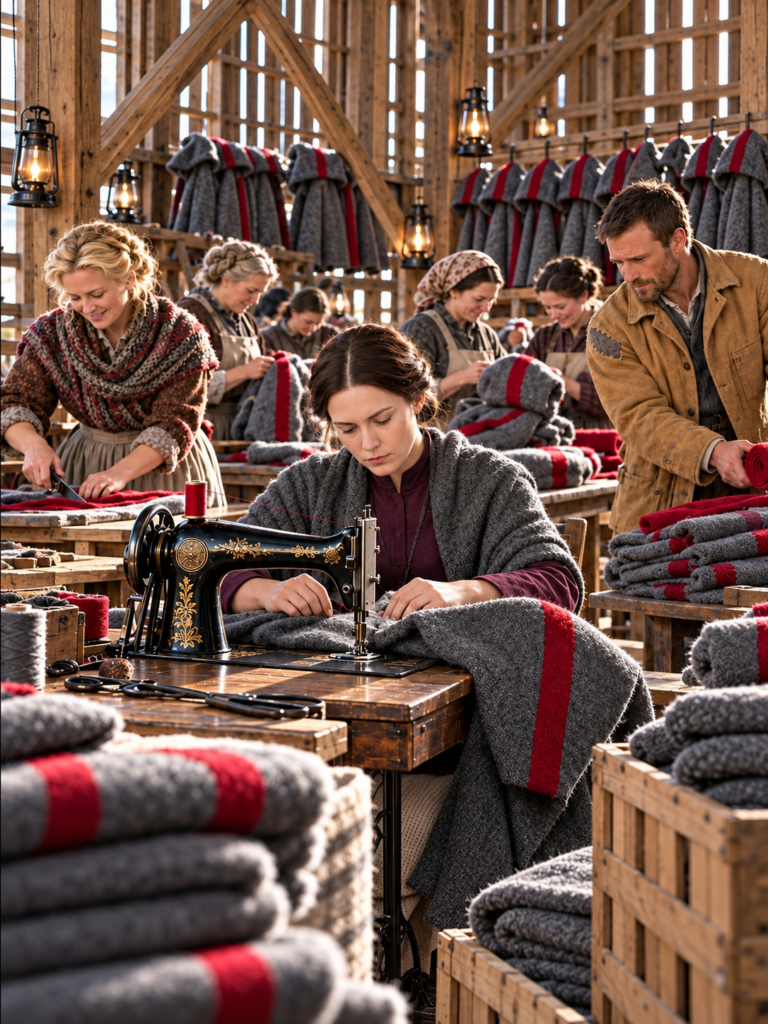
Gray wool coats with bright red stripes.
Women worked around long tables, measuring and stitching.
The air smelled of wool, lamp oil, and fresh bread.
Ezra walked slowly along the row.
He touched the sleeve of a child’s coat.
“Who made this?”
“Ottoline,” Odessa said.
The schoolmistress smiled proudly.
Ezra shook his head.
“I’ve sold clothes for twenty years. Never seen anything like it.”
He turned toward Odessa.
“That shipment from Omaha still hasn’t arrived.”
“I guessed as much.”
“Railroad says the bridge needs more work.”
Odessa glanced toward the window.
Snow had begun falling.
“Then we’d better hurry.”
Ezra removed his hat.
“Mrs. Ingram, I’ve been thinking.”
He reached into his coat and produced a small notebook.
“I can extend credit for thread, buttons, flannel, and anything else you need. Settle it after winter.”
Odessa hesitated.
“That’s generous.”
“It’s practical.”
He looked around the loft.
“You’ve turned blankets I couldn’t sell into something the whole county needs.”
His voice softened.
“Would be foolish not to help.”
After he left, Dagny nudged Odessa.
“Seems you’ve got half the town working for you.”
Odessa laughed.
“With me.”
“What’s the difference?”
Odessa looked toward the women sewing around the table.
“Everything.”
Yet the work was not without cost.
Odessa’s hands grew sore.
Her back ached from long hours at the machine.
She woke some mornings with stiff fingers and had to soak them in warm water before she could sew.
Halvor noticed.
One evening, he found her sitting at the kitchen table, rubbing her wrists.
“You’re overdoing it.”
She smiled tiredly.
“Probably.”
“Then stop.”
“The children’s coats aren’t finished.”
“Your hands won’t be much use if you ruin them.”
Odessa looked at him.
He sat opposite her.
“Let the other women handle more.”
“They’re learning.”
“Then trust what you’ve taught them.”
She considered that.
The next morning, she changed the work schedule.
She began training two of the younger women to operate the Singer.
At first, she found it difficult to surrender control.
The machine was hers.
It represented years of sacrifice.
But as she watched the women learn, she began to understand something.
Her skill could accomplish more when shared.
Soon the loft functioned almost without her constant attention.
There were stations for cutting, lining, stitching, and finishing.
Every coat passed through careful inspection.
Children arrived to be measured.
Mothers waited beside the stove downstairs, warming their hands while their coats were adjusted.
The barn became a gathering place where women exchanged news, shared food, and helped neighbors who had never asked for charity.
For the first time, Odessa felt that her work belonged to something larger than survival.
But while the coat project flourished, the Ingram ranch remained in danger.
Halvor spent his days inspecting fences and watching the sky.
The cattle were thin.
Feed supplies were limited.
And the bank’s deadline was approaching.
One evening, Odessa found him studying the herd records.
“How bad is it?”
He hesitated.
“Bad enough.”
“Tell me.”
He sighed.
“We’ve got enough hay if winter stays ordinary.”
“And if it doesn’t?”
He looked toward the window.
“Then we’re in trouble.”
Odessa sat beside him.
“Can we sell a few coats?”
“People haven’t got money to spare.”
“Some have offered payment.”
“Keep it for supplies.”
She reached for his hand.
“We’ll figure something out.”
Halvor looked at her.
He wanted to believe her.
But he had spent eleven years fighting debt and weather, and experience had taught him how quickly hope could disappear.
The first hard freeze struck on November nineteenth.
By Christmas, snow covered the hills.
On New Year’s Day, the temperature fell so sharply that ice formed inside the barn water buckets.
Halvor worked from dawn to dark.
Colm helped him move feed.
The cattle huddled along the sheltered side of the pasture.
Odessa watched the weather with growing unease.
She remembered her mother’s final winter in Milwaukee.
The cold boardinghouse room.
The terrible coughing.
The helplessness of knowing someone needed warmth and medicine they could not afford.
She had promised herself that if she ever possessed the means to keep another person warm, she would use them.
Now she looked at the rows of gray coats hanging in the loft.
Each bore its bright red stripe.
By January tenth, one hundred forty coats were finished.
Twenty-three were sized for schoolchildren.
And far beyond the ranch, the western sky began turning a strange yellow.
Part 4
The storm arrived on January 11, 1888.
At noon, the air fell unnaturally still.
The cattle stopped moving.
The chickens huddled inside their shed.
Even the prairie grass seemed to hold its breath.
Halvor stood beside the corral, studying the western horizon.
He had seen weather like this once before.
He did not like what he remembered.
“Colm!” he shouted.
The young man emerged from the barn.
“Get the south gate open. We need to bring the cattle into the sheltered pasture.”
Colm looked toward the sky.
“Storm coming?”
“Fast.”
They saddled their horses and rode out.
Inside the farmhouse, Odessa was sorting supplies when she noticed the sudden silence.
She stepped onto the porch.
The sky had darkened to an ugly yellow-gray.
A cold wind touched her face.
Then, somewhere beyond the western ridge, snow began moving across the hills.
At first, it looked like drifting smoke.
Within minutes, it swallowed the horizon.
Odessa hurried inside.
She shut the windows, checked the stove, and filled the water containers.
She brought additional firewood into the kitchen.
Then she went to the barn and made certain the lanterns were ready.
By three o’clock, the wind was screaming.
Snow struck the walls so hard that it sounded like handfuls of gravel.
The barn disappeared behind a curtain of white.
Odessa stood at the kitchen window, watching for Halvor and Colm.
They did not return.
By sunset, she could no longer see the fence ten yards from the house.
She lit every lantern she owned.
One went in the kitchen window.
Another stood on the porch, sheltered behind a wooden board.
A third she placed near the barn door.
She knew the light might not reach far through the storm.
But she could not bear to leave them in darkness.
Hours passed.
The stove required constant tending.
The wind found gaps in the walls and sent sharp drafts across the floor.
Odessa wrapped a blanket around her shoulders and sat beside her machine.
She tried to sew.
Her hands trembled.
Every few minutes, she stopped and listened.
She imagined Halvor somewhere in the white darkness.
She imagined Colm falling from his horse.
She imagined the terrible cold settling over them.
She prayed quietly.
Not for the ranch.
Not for the bank note.
Only that the two men would find their way home.
Near midnight, something struck the kitchen door.
Odessa rose so quickly that her chair fell backward.
She lifted the latch.
The door burst inward.
Halvor staggered through, carrying Colm across his shoulders.
Both were covered in snow.
Ice clung to Halvor’s beard.
His hands were raw.
Colm’s face was deathly pale.
“Help me,” Halvor gasped.
Odessa moved immediately.
They laid Colm near the stove and removed his wet outer clothing, replacing it with dry blankets while checking his breathing and responsiveness.
His fingers were painfully cold.
He shivered violently.
Odessa kept him sheltered from further exposure and worked with Halvor to warm him gradually while they watched for signs that he needed urgent medical attention.
“What happened?” she whispered.
Halvor sank into a chair.
“We got the cattle down near the creek. Storm hit before we could get back.”
He swallowed.
“Couldn’t see a thing.”
Colm stirred.
Halvor continued.
“We got separated. I followed the fence for a while, then lost it. Thought I’d never find him.”
He looked toward the gray coat lying beside the stove.
“Then I saw something red.”
Odessa froze.
“Red?”
“Little flash through the snow. Twenty feet away, maybe less.”
His voice shook.
“It was the stripe on his hood.”
Colm opened his eyes.
Halvor reached for his shoulder.
“Found him half-buried beside a drift. Another few minutes…”
He stopped.
Odessa looked at the coat.
The gray wool was soaked.
But the red stripe remained bright.
She had stitched it there because she wanted people to be visible.
Now it had helped bring Colm home.
She lowered herself beside the young man.
Colm looked up weakly.
“Mrs. Ingram?”
“I’m here.”
“Sorry about the coat.”
Odessa gave a shaky laugh.
“Colm Rooney, if you apologize for that coat one more time, I’ll sew you into it permanently.”
He managed a faint smile.
Halvor leaned forward and covered his face.
Odessa wrapped her arms around both of them.
For a long moment, they sat beside the stove, listening to the storm howl outside.
The next morning, a neighbor reached the ranch by sled.
He carried terrible news.
The schoolhouse at Plum Bluff was nearly out of coal.
Twenty-three children were trapped inside with Miss Fenwick.
Several families in the surrounding hills had also been cut off.
The roads had disappeared beneath deep drifts.
The wind made ordinary travel nearly impossible.
Halvor stood beside the kitchen table.
“How many men are going?”
“Six from town. More if we can find them.”
“What about the children?”
“They’re trying to reach the school.”
Odessa looked toward the barn.
There were finished coats hanging along the rafters.
Coats with red stripes.
She turned to Halvor.
“Take the coats.”
He frowned.
“All of them?”
“As many as you can carry. The children need warmth.”
The neighbor looked uncertain.
“Those coats were meant for paying customers.”
Odessa stared at him.
“Do you think a child cares whether a coat has been paid for when the stove goes cold?”
The man removed his hat.
“No, ma’am.”
“Then take them.”
Halvor helped load coats and blankets onto the sled.
Odessa tied bundles with rope and packed food for the men.
She insisted that every rescuer wear a gray coat with a red stripe.
“Stay together,” she told them. “Keep the stripe ahead of you in sight.”
Halvor looked at her.
“You figured this out before any of us.”
“I only hoped it might help.”
He shook his head.
“It’s already helped.”
The rescuers departed into the storm.
Odessa watched until the last red stripe vanished into the white.
Then she returned to the barn.
Several women had managed to reach the ranch before the roads became impassable.
They were already working.
Dagny stood at the cutting table.
Two widows stitched linings.
Another woman sorted blankets.
“We heard about the school,” Dagny said.
Odessa nodded.
“Then we’d better finish every coat we can.”
They worked through the day.
The women took turns warming their hands beside a small stove.
They stitched by lantern light when the sky darkened.
Every coat was another chance to protect someone from the cold.
Outside, the storm continued.
At the schoolhouse, Ottoline Fenwick struggled to keep twenty-three frightened children warm.
The coal supply had dwindled.
She had moved the students into the smallest classroom and covered the windows with spare cloth.
Some children cried for their parents.
Others sat silently, wrapped in whatever blankets they could find.
Ottoline read stories aloud to keep them calm.
By the second night, her voice had grown hoarse.
She looked at the remaining coal.
Then toward the dark windows.
She wondered whether anyone could reach them.
Far across the frozen prairie, a line of men moved slowly through the storm.
They were tied together with rope.
Each wore a gray wool coat.
Each hood bore a broad red stripe.
When the snow thickened, the men could barely see one another.
But whenever the person ahead became almost invisible, the red stripe gave them a point to follow.
At one difficult crossing, a gust scattered the line.
A rancher named Abner Voss stumbled into deep snow near a frozen creek.
For several moments, he could not tell which direction led to safety.
Then he saw a narrow flash of red through the white.
He followed it.
The man ahead turned, saw him struggling, and reached back.
Together they rejoined the others.
They continued toward the schoolhouse.
Inside, Ottoline was preparing to extinguish the last lantern when she heard shouting.
At first, she thought she had imagined it.
Then came a pounding on the door.
She hurried forward.
“Who’s there?”
“Plum Bluff men! Open up!”
Ottoline pulled the latch.
Snow blew into the classroom.
Behind it stood a line of exhausted ranchers in gray coats.
One held out a bundle.
“Got coats for the children.”
Ottoline stared.
Then she began to cry.
The men carried the smallest children to waiting sleds.
Older children were helped into coats and wrapped in blankets.
Those who could walk were guided in carefully managed groups.
Every movement was slow.
Every trip required planning.
The storm still threatened to swallow anyone who wandered away from the line.
But the rescuers had something the children had lacked.
Warm clothing.
And a way to recognize one another in the white.
By the time the storm finally broke on the fourth morning, every one of the twenty-three children had been brought home.
Families who had feared the worst held their children close.
Neighbors embraced.
Men who rarely cried stood openly weeping.
No family in the district had lost a person to the cold.
The gray coats were everywhere.
And on every hood was the same bright red stripe.
At the Ingram ranch, Odessa stood on the porch as the clouds parted.
Snow lay across the hills in deep blue shadows.
The wind had finally stopped.
Halvor stood beside her.
“Looks like it’s over.”
She nodded.
He took her hand.
For several minutes, neither spoke.
Then Halvor said, “You saved Colm.”
Odessa shook her head.
“You brought him home.”
“I found him because of that stripe.”
He looked toward the barn.
“And those children…”
His voice failed.
Odessa leaned against him.
She had spent her life making clothes for people who barely knew her name.
Now the work of her hands had become part of the survival of an entire community.
But the joy was shadowed by a problem neither could ignore.
March was approaching.
The bank still wanted $412.
The cattle losses had not disappeared.
The ranch remained vulnerable.
And Halvor knew that gratitude, however heartfelt, would not satisfy a bank note.
Part 5
The morning after the storm, Odessa woke to the sound of wagon wheels.
At first, she thought it was another neighbor coming for repairs.
Then she heard several horses.
She rose, wrapped a shawl around her shoulders, and went to the window.
A line of wagons stretched down the snowy road.
There were sleds, farm wagons, and teams of horses.
Men and women stood beside them, bundled against the cold.
More were arriving.
By the time Odessa reached the porch, nearly forty wagons and sleds had gathered outside the Ingram farmhouse.
She stared in disbelief.
“What in heaven’s name…?”
Halvor came from the barn.
He stopped beside her.
“I don’t know.”
Ezra Pell stepped forward from the crowd.
He carried a leather folder.
Behind him stood Dagny Lindquist, Ottoline Fenwick, Abner Voss, and dozens of neighbors.
Children wore gray coats with red stripes.
Some held jars.
Others carried baskets.
A little girl approached Odessa and offered a drawing.
It showed a woman sitting at a sewing machine.
Above her head, the child had drawn a large yellow sun.
Odessa knelt.
“Is this for me?”
The girl nodded.
“My mama said you helped bring us home.”
Odessa took the drawing.
Her throat tightened.
“Thank you, sweetheart.”
Then the neighbors began stepping forward.
One woman placed a basket of eggs on the kitchen table.
Another brought a cured ham.
A farmer carried in a sack of flour.
A widow offered jars of preserves.
Someone placed a pair of knitted mittens beside the stove.
Another woman brought candles.
A rancher offered several days of labor when spring fencing began.
Odessa watched helplessly as her little kitchen filled.
“Please,” she said. “You don’t have to do all this.”
Nobody stopped.
At last, Ezra raised a hand.
The room grew quiet.
“Mrs. Ingram, we’ve got something to say.”
Odessa stood beside the kitchen table.
Ezra opened his folder.
“When you started making coats, most of us thought it was a fine little project. A way to help people get through winter.”
He looked around the room.
“Then the storm came.”
Several women nodded.
Ezra continued.
“Those coats kept our children warm. The red stripes helped our men find one another in weather that could’ve killed them.”
His voice grew rough.
“There’s not a family here that hasn’t been touched by what you did.”
Odessa looked down.
“I only made coats.”
Dagny stepped forward.
“No, Odessa. You made sure people had a chance to come home.”
Tears filled Odessa’s eyes.
She shook her head.
“It was all of us. The women who sewed. Mr. Pell, who gave us credit. The men who went into the storm.”
“That’s true,” Ezra said. “But you brought us together.”
He removed a sheet of paper from the folder.
“We’ve been keeping an account.”
Odessa frowned.
“An account?”
“Of the coats.”
He explained that families had written down what they could contribute.
Some offered cash.
Some offered wool.
Some offered food or labor.
The store had credited materials against the finished garments.
The amounts were small individually.
Together, they had become something substantial.
“Just over six hundred dollars,” Ezra said.
The kitchen fell silent.
Odessa stared.
“Six hundred?”
He nodded.
“More than six hundred in cash, credit, and agreed contributions. We’ve settled the material costs and collected enough cash to take care of something important.”
He reached into the folder again.
This time, he produced a bank receipt.
“Mrs. Ingram, would you read this?”
Her fingers trembled as she accepted the paper.
The words blurred.
She blinked and looked again.
Plum Bluff Bank.
Received in full settlement of note.
$412.00.
She stopped breathing.
“Halvor…”
He stepped closer.
She held out the receipt.
“Your father’s debt.”
Halvor took the paper.
He read it once.
Then again.
His hands began to shake.
The debt that had hung over the ranch for eleven years was gone.
The note his father had signed to buy breeding stock.
The debt that had survived drought, disease, and brutal winters.
The obligation that had followed Halvor into every spring and every Christmas.
Paid.
In full.
Ezra cleared his throat.
“The remaining account has been recorded for the sewing work, jointly in your names. We’ve also arranged to settle the outstanding supplies.”
Odessa pressed a hand over her mouth.
“I can’t accept this.”
Dagny stepped beside her.
“Why not?”
“Because I didn’t make the coats to earn money.”
“We know.”
“I wanted people to be warm.”
“And they were.”
Odessa looked around the room.
Men who had spent the winter risking their lives stood quietly beside their wives.
Children peered around coat sleeves.
Neighbors who had once been strangers now looked at her with unmistakable affection.
Dagny placed a hand on her shoulder.
“Odessa, every woman here knows what it means to work until her hands ache. We know what your time is worth, even if you don’t.”
Ottoline stepped forward.
“Twenty-three children came home because people worked together. Your patterns, your teaching, and those red stripes gave us help when we needed it most.”
Ezra nodded.
“And nobody in this room intends to let you pretend your work has no value.”
Odessa began to cry.
She thought of the eleven hundred coats she’d made in Milwaukee.
The customers who had complained about prices.
The long nights.
The boardinghouse room.
The winter her mother died.
She thought of standing on the railway platform three months earlier, clutching her suitcase while Halvor said he had no room for her machine.
Now an entire community had come to her door.
Not to demand more work.
But to thank her.
One by one, the neighbors embraced her.
Then, quietly, they returned to their wagons.
The children waved.
The horses stamped in the snow.
Before long, the yard was empty again.
Only the gifts remained.
And the bank receipt.
Halvor stood beside the kitchen table.
He held the paper in both hands.
Odessa watched him.
“Halvor?”
He did not answer.
He walked outside.
For a moment, Odessa worried she had upset him.
Then she looked through the window.
He stood beside the barn door with his back toward the house.
His shoulders were shaking.
The man who had survived eleven years of hardship without speaking of his fear was crying.
Odessa opened the door but did not follow.
She understood that some emotions needed privacy.
That evening, after supper, Halvor asked her to sit beside him near the stove.
The house was warm.
Outside, the snow lay deep and still beneath a sky full of stars.
Colm had gone to bed.
The barn lantern was extinguished.
For a long while, Halvor turned his hat between his hands.
Then he looked at Odessa.
“I owe you an apology.”
She tilted her head.
“For what?”
“For the first thing I said to you.”
Odessa smiled faintly.
“About the machine?”
He nodded.
“I told you there wasn’t room.”
She waited.
“Truth is, I had two rooms in this house, six stalls in the barn, and eleven hundred acres of land.”
He looked toward the window.
“But I had no room for hope.”
Odessa’s smile faded.
Halvor continued.
“I’d spent so many years worrying about cattle and debt that I stopped thinking anything good could happen here.”
He swallowed.
“When you stepped off that train with your big wooden crate, all I could see was another thing I didn’t know how to take care of.”
Odessa reached for his hand.
“Halvor…”
“No. Let me finish.”
He looked directly at her.
“You brought everything you owned across the country. You trusted a stranger. And the first thing that stranger did was make you feel like a burden.”
His voice broke.
“I’m ashamed of that.”
Odessa squeezed his hand.
“You made room.”
He shook his head.
“Not enough.”
“You moved the kitchen table into the barn before sunrise.”
She smiled through her tears.
“You hung a blanket over the window so my fingers wouldn’t freeze.”
Halvor looked down.
“You remember that?”
“I remember everything.”
She moved closer.
“I remember Colm’s face when he put on his first new coat. I remember the women laughing in the loft. I remember you staying up until midnight cutting red strips.”
Her voice softened.
“And I remember the way you looked at me when you realized I wasn’t asking you to carry another burden.”
Halvor raised his eyes.
“What were you asking?”
“To carry some of yours.”
He sat very still.
Odessa continued.
“I didn’t come west because I wanted a fine house. I didn’t come because I thought you’d make me rich.”
She glanced around the humble kitchen.
“I came because your letter said you wanted somebody to share a hard life honestly.”
Halvor’s eyes glistened.
“I did.”
“I know.”
He took both her hands.
“Odessa, I can’t promise there won’t be more bad winters.”
“I know.”
“Can’t promise the cattle won’t get sick or the grass won’t dry up.”
“I know that too.”
He drew a breath.
“But I can promise you this.”
She waited.
“I’ll never again make you feel like there’s no room for what matters to you.”
Tears slipped down Odessa’s cheeks.
Halvor leaned forward.
He kissed her gently.
It was a careful, almost shy kiss, filled with more tenderness than either had expected to find in a marriage arranged through newspaper letters.
When he drew back, Odessa rested her forehead against his.
“I think we make a good team,” she whispered.
Halvor laughed softly.
“Best one I’ve ever had.”
Then he glanced toward the narrow bench beside the stove.
“Been sleeping on that thing three months.”
Odessa followed his gaze.
“It’s a terrible bench.”
“Worst I’ve ever slept on.”
She smiled.
“Then perhaps it’s time we found a better arrangement.”
Halvor looked at her.
“Are you sure?”
Odessa took his hand.
“Quite sure.”
Spring came slowly to the Sandhills.
Snow melted into muddy creeks.
The grass turned green.
Calves appeared in the pastures.
Without the bank debt hanging over them, Halvor could buy feed when it was needed and repair equipment before it failed.
Colm helped rebuild the damaged fences.
Odessa returned to sewing, though now she had more work than one machine could manage.
Women came from neighboring counties asking to learn her methods.
Some wanted winter coats.
Others needed sturdy work clothes.
Several young girls hoped to earn their own money through sewing.
Odessa welcomed them.
She kept the prices fair.
She paid women for their labor.
And she insisted that no apprentice be made to feel ashamed for asking questions.
One morning, Halvor told Odessa he needed her help with something in the barn.
She followed him across the yard.
He stopped beside the south wall of the farmhouse, where an unfamiliar wooden door had appeared.
Odessa stared.
“What’s this?”
Halvor looked suddenly nervous.
“Open it.”
Inside was a new room.
Sunlight poured through a wide south-facing window.
A long cutting table stood against one wall.
Shelves lined another.
There was a cabinet for thread, a rack for patterns, and a sturdy place for the Singer machine.
The floorboards were smooth.
The walls were newly whitewashed.
Odessa stepped inside slowly.
She touched the table.
Then the window frame.
Then the polished wooden cabinet.
“Halvor…”
He stood in the doorway.
“Figured you ought to have a proper place to work.”
She turned.
“You built this?”
“Colm helped. So did a couple of neighbors.”
Odessa pressed her hand against her chest.
In all her life, she had never had a room built for her.
As a child, she had sewn in corners.
As a young woman, she had worked in rented rooms.
Even the machine she’d sacrificed so much to own had lived wherever space could be found.
Now there was a room designed around her work.
Around her needs.
Around the future she wanted to build.
She looked at Halvor.
“I don’t know what to say.”
He smiled.
“That’s a first.”
She laughed through her tears.
Then she crossed the room and embraced him.
By the following year, Odessa had opened a small sewing shop on Main Street in Plum Bluff.
The sign above the door read:
Brandt & Ingram — Coats and Mending.
The shop employed several local women.
Young apprentices learned measuring, cutting, stitching, and bookkeeping.
Odessa kept the Singer machine in the workshop Halvor had built, using it for special orders and teaching.
The gray coats with red stripes remained popular.
But they had become more than clothing.
When winter approached, families checked their coats and brought damaged ones to Odessa’s shop.
Children grew into new sizes.
Old coats were repaired and passed along.
The county commissioners eventually set aside funds to help provide winter clothing for schoolchildren who needed it.
Odessa supplied the pattern.
Every coat carried the same red stripe down the hood.
Over time, the stripe became a symbol of Plum Bluff.
It reminded people of the winter when neighbors had carried one another through the snow.
It reminded them that a small act of preparation could save a life.
And it reminded them of the woman who had arrived in town with a wooden crate nearly as large as a coffin.
The Ingram ranch prospered.
The herd slowly recovered.
Halvor invested in better winter shelter and improved feed storage.
Colm grew into a capable ranch foreman.
The little two-room house expanded as the family grew.
Odessa and Halvor eventually had four children.
Their home filled with voices, laughter, muddy boots, schoolbooks, and the smell of fresh bread.
On the mantel above the stove stood a small brass plate.
Ezra Pell had commissioned it from an engraver in Chicago.
It bore a simple inscription:
The town owes you everything.
Below those words, in smaller letters, were another seven.
We know we can never repay it.
Odessa never completely believed the inscription.
She had never thought of herself as a woman to whom anyone owed anything.
But she kept it there.
Years passed.
Then decades.
The children grew.
Grandchildren came.
Halvor’s hair turned white.
Odessa’s hands became marked by age and years of sewing.
Yet every winter, she climbed the steps to her workroom and inspected the coats waiting for families who needed them.
One December afternoon, when she was an old woman, her youngest granddaughter sat beside the Singer machine.
The child traced a finger over its polished black surface.
“Grandma, is this the machine you brought on the train?”
Odessa smiled.
“The very same.”
“Was Grandpa angry?”
Odessa laughed.
“Not exactly.”
“But he said there wasn’t room for it.”
“He did.”
The little girl frowned.
“Then why did you stay?”
Odessa looked toward the window.
Outside, the Nebraska prairie stretched beneath a pale winter sky.
In the yard, Halvor sat on a bench watching two grandchildren play.
He had grown slower with age, but his smile was as warm as ever.
Odessa looked back at the child.
“Because sometimes people speak from fear before they learn to speak from love.”
The granddaughter considered that.
“Did you know he’d change?”
“No, sweetheart.”
“Then weren’t you scared?”
Odessa nodded.
“Very.”
She opened the old leather ledger.
The pages had yellowed.
The ink had faded.
But on one page, the number remained.
1,100.
“Before I came here, I’d made eleven hundred coats for people who hardly knew my name.”
The child leaned closer.
“That’s a lot.”
“It was.”
“Did they thank you?”
“Some did.”
Odessa turned the page.
There were new entries now.
Names of families.
Orders for children.
Records of women she’d taught.
Notes about apprentices who had opened their own shops.
“After I came here, I learned that work can be worth more than the money somebody pays for it.”
The granddaughter looked puzzled.
“How?”
Odessa smiled.
“Because sometimes it keeps somebody warm. Sometimes it gives a woman a way to support her family. And sometimes…”
She looked toward a gray coat hanging beside the door.
A bright red stripe ran down its hood.
“Sometimes it helps somebody find the way home.”
The child sat quietly.
Then she pointed toward the brass plate above the stove.
“Does the town really owe you everything?”
Odessa looked at the inscription.
She thought of the blizzard.
The frightened schoolchildren.
The men walking through the white in their gray coats.
She thought of Colm being carried through the farmhouse door.
She thought of the day the neighbors had arrived with forty wagons and paid the debt that had haunted her husband for eleven years.
Then she looked outside again.
Halvor had risen from the bench.
He was helping a little boy repair the wooden wheel of a toy wagon.
The old rancher moved carefully, but his hands were steady.
Odessa’s eyes softened.
“No, darling,” she said. “The town doesn’t owe me everything.”
“But the plate says—”
“I know what it says.”
She placed a hand over the child’s.
“The truth is, we helped one another. I gave them something I knew how to make. They gave your grandfather and me the chance to keep this ranch.”
She looked around the warm room.
“Then we spent the rest of our lives making sure other people had chances too.”
The girl thought about this.
Finally, she asked, “Can you teach me to sew a red stripe?”
Odessa smiled.
“I certainly can.”
She guided the child’s hands toward the cloth.
Outside, snow began falling gently across the Sandhills.
It settled on the barn roof, the corral fences, and the long grass beyond the pasture.
Inside, the old Singer began to turn.
The treadle moved beneath Odessa’s feet.
The needle rose and fell.
And the familiar sound filled the room, just as it had on that first lonely autumn night when a stranger arrived at a struggling ranch carrying everything she owned.
Halvor heard the machine from the porch.
He paused in the doorway.
For a moment, he watched Odessa teaching their granddaughter.
Then he smiled.
He remembered a railway platform in October 1887.
A woman standing proudly beside an enormous crate.
A tired rancher who thought he had no space for another responsibility.
He remembered how close he had come to sending her away.
And he understood, as he had understood every winter since, that the most important thing Odessa had brought west had never been the sewing machine.
It was her courage.
Her skill.
Her determination to be useful without surrendering her dignity.
And her belief that even in a hard and lonely place, people could build something better together.
Halvor entered the room and rested a hand on her shoulder.
Odessa looked up.
“Need something?”
He shook his head.
“Just wanted to see what you were making.”
She held up the gray wool.
Their granddaughter proudly displayed the bright red stripe.
Halvor smiled.
“Looks like another good coat.”
Odessa returned his smile.
“With a little work, it will be.”
And as the snow drifted quietly beyond the window, the old rancher stayed beside her, watching the woman who had once asked him for a single chance.
A chance he had almost refused.
A chance that saved his ranch, helped protect his neighbors, and gave two lonely people a life neither had believed possible.
The house that had once contained little more than debt, silence, and grief was now filled with family, purpose, and love.
And in that warm room, with her granddaughter beside her and her husband standing close, Odessa knew that she had finally found what she’d been searching for all those years.
Not wealth.
Not recognition.
Not even the security of owning something nobody could take away.
She had found a place where her work mattered, her voice was heard, and her presence was cherished.
She had found a home.
And after a lifetime of making coats for strangers, she had helped build a world in which no one she loved would have to face the cold alone.


