a lonely rancher hired a widow to mend his cowboys’ shirts—then his wildest horse followed her home through the snow
Part 1
In the autumn of 1891, Wade Holloway hired Rosalie Bennett because seven cowboys had managed to tear more clothing in one month than his housekeeper could mend in three.
He nearly fired her three days later.
Instead, a horse changed his mind.
Holloway Ranch lay in a broad Colorado valley where dry grass ran toward blue-gray mountains and winter often arrived before a man had finished preparing for it. By late September, the cattle were coming down from the high country, water troughs froze thin at dawn, and Wade measured every remaining warm day according to how much work could still be done before snow closed the passes.
At forty, he had owned the ranch for sixteen years.
He had seven permanent hands, nearly four hundred head of cattle, three barns, one badly leaking equipment shed, a mortgage he disliked discussing, and no wife.
His mother had died when he was twenty-two. His father followed six years later. Wade had been engaged once, briefly, but the woman decided life forty miles from Denver society was not the future she wanted.
He understood.
That did not mean he liked remembering it.
By 1891, Wade had made himself into the kind of man who needed very little from anybody.
Then Amos Cray hired Rosalie Bennett.
Amos was Wade’s foreman, sixty-three years old, narrow as a fence rail and twice as difficult to move.
He had found Rosalie’s name through the postmaster’s wife in Glenbrook.
“Widow,” Amos said.
Wade kept examining a feed invoice.
“Plenty of those.”
“Seamstress.”
“Useful.”
“Good with horses too, according to somebody.”
That made Wade look up.
“I’m hiring her to sew.”
“Didn’t say otherwise.”
Amos handed him Rosalie’s letter.
Her handwriting was precise.
Mr. Holloway,
I can accept the work beginning September 23. I require agreed weekly wages, lodging separate from the bunkhouse, and a room with sufficient daylight. I would also prefer to be addressed as Mrs. Bennett rather than simply “the seamstress.”
If those terms are acceptable, I will arrive on Tuesday’s stage.
Rosalie Bennett.
Wade read it twice.
“She’s particular.”
“So are you.”
“Write back.”
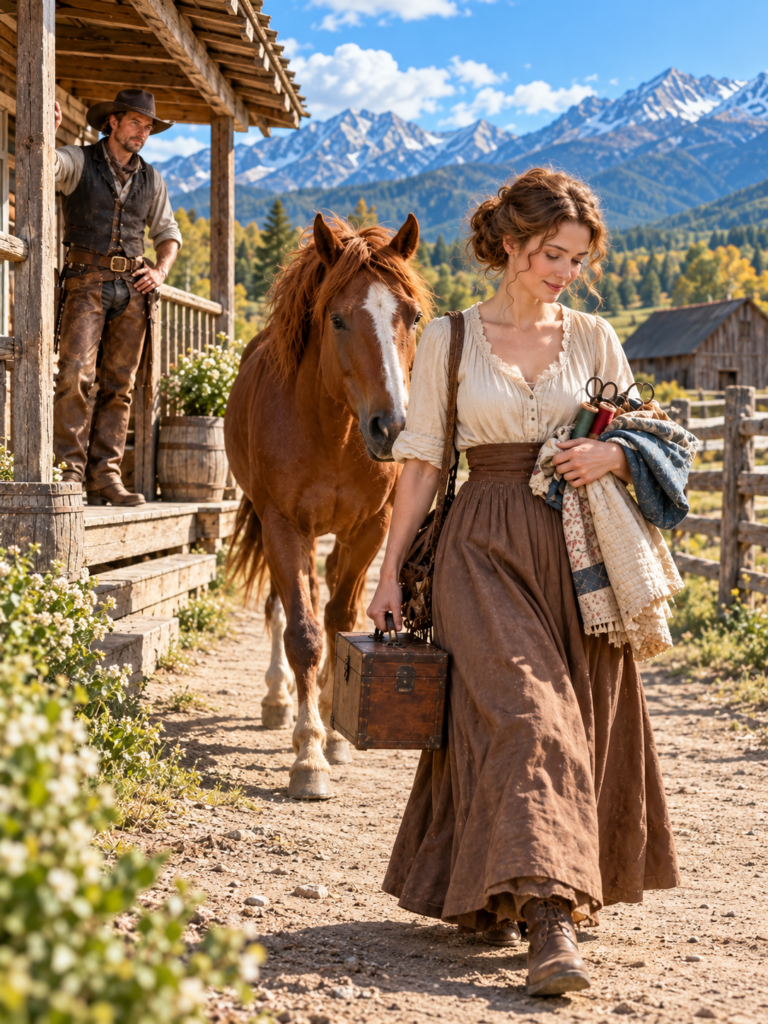
Rosalie arrived carrying one trunk, a sewing machine wrapped in canvas, and no visible interest in impressing anybody.
She was thirty-two.
Her auburn hair was pinned beneath a dark hat. Her coat was worn but carefully repaired. The buttons on one sleeve did not match the other, though the stitches holding them were so neat Wade noticed the difference only because he had spent the past week staring at ripped clothes.
“Mrs. Bennett.”
“Mr. Holloway.”
He extended his hand.
Her handshake was firm and brief.
“Amos will show you to the cottage.”
“I’d like to see where I’ll be working first.”
Wade hesitated.
“Fine.”
The room off the back of the main house contained one table, a south-facing window, shelves, and a chair that rocked because one leg was shorter than the others.
Rosalie entered.
She tested the table.
Sat in the chair.
Immediately stood.
“I’ll need another chair.”
“I’ll have this one fixed.”
“I’d rather not spend tomorrow waiting for a chair to become level.”
Wade looked at Amos.
Amos became deeply interested in the ceiling.
“Anything else?” Wade asked.
“Nothing can block that window before noon.”
“Why?”
“Dark cloth, dark thread, poor light. I get headaches.”
“We usually put supply crates there.”
“Then I’d appreciate them being put somewhere else.”
Wade crossed his arms.
“You’ve been here twelve minutes.”
“Yes.”
“And already reorganized a room in my house.”
“No.”
She looked at him evenly.
“I’ve reorganized the conditions under which you expect me to do good work.”
That should have irritated him.
It did.
The greater irritation was that she was right.
“You’ll get the chair.”
“Thank you.”
The next morning, Rosalie began work at seven.
By noon, she repaired six shirts, two pairs of trousers, one winter coat, and a canvas vest Pete Dugan had declared permanently ruined.
Pete found the vest folded on his bunk after supper.
He wore it the next day without thanking her.
Rosalie did not appear to care.
On the third morning, Wade decided to dismiss her anyway.
Not because of her sewing.
Because the ranch felt different with her there.
Men noticed her.
Conversations stopped when she passed.
Pete suddenly discovered he owned five shirts requiring repairs.
Garrett combed his hair before breakfast.
And Wade himself had looked through the sewing-room window twice for no practical reason.
He disliked complications.
A beautiful widow living twenty yards from seven unmarried cowboys qualified.
So before breakfast, he rehearsed what he would say.
It isn’t going to work.
You’ll receive full wages.
Amos will drive you into Glenbrook.
Simple.
Then Copper escaped.
Copper was an eight-year-old chestnut gelding with powerful shoulders and enough bad history to make sensible men give him distance.
Wade bought him cheaply from a ranch farther south.
The seller described him as “spirited.”
That had been dishonest.
Copper had thrown three riders in four months.
He kicked at saddling.
Crow-hopped when mounted.
Bolted when anyone tightened a cinch.
Wade kept him because he saw what the horse ought to have been.
Strong.
Fast.
Intelligent.
Worth money.
That morning the faulty corral latch failed.
Copper came through the gate like a cannonball.
Pete grabbed a rope.
Garrett tried getting ahead of him.
“Don’t!” Wade shouted.
Too late.
Copper turned sharply, nearly knocking Garrett flat.
Men scattered.
Dust rose.
The horse galloped the length of the yard, spun near the water trough, and came back with the whites of his eyes showing.
Then Rosalie stepped from her cottage.
She had a sewing basket in one hand.
Her apron was folded over the other arm.
Copper stopped.
Not slowed.
Stopped.
The ranch became quiet.
Rosalie studied him.
The horse studied her.
Then she turned around.
And walked away.
Copper followed.
Pete lowered his rope.
“What in God’s name?”
Rosalie continued toward her porch.
Copper followed six feet behind.
She stopped.
He stopped.
She turned.
The horse dropped his head and released a long breath.
Rosalie raised one hand.
Waited.
Copper closed the final distance himself.
Her fingers touched his forehead.
Wade had owned horses since childhood.
He had never seen Copper allow that kind of contact without bracing.
He crossed the yard.
Rosalie glanced over.
“Tell him to put the rope down.”
Pete looked offended.
“I already did.”
“Farther down.”
Pete dropped it.
Wade asked, “What did you do?”
“Nothing.”
“He followed you.”
“Yes.”
“Why?”
“I was the only person not chasing him.”
Her answer was irritatingly sensible.
Then Rosalie’s attention moved toward the saddle Garrett had left near the fence.
She walked over.
Picked it up.
Turned it.
Pressed the underside.
Her expression changed.
“Mr. Holloway.”
“What?”
“Come here.”
She pulled back the pad.
The wooden saddle tree had cracked beneath the leather.
A sharp ridge pressed upward exactly where the saddle would bear weight under a rider.
Wade touched it.
The wood shifted.
“How long?”
Rosalie examined the wear.
“Months.”
Amos came closer.
Rosalie looked toward Copper.
“Every time somebody mounted him with this saddle, that broken edge dug into his back.”
Nobody spoke.
“Three men rode him,” Amos said.
“Three men hurt him.”
Rosalie’s voice went flat.
“They decided he was dangerous because pain made him try to get away.”
Wade felt heat rise in his face.
Nobody had checked the saddle.
Not him.
Not Amos.
Not any of his riders.
They had blamed the horse.
“Can it be fixed?”
“The saddle?”
“The horse.”
She looked at him.
“That’s a different question.”
“What do you need?”
“A veterinarian first.”
“And after?”
“Time.”
“We have the fall drive in three weeks.”
“Then don’t count on him.”
Wade stared.
“He cost me money.”
“I imagine he knows very little about that.”
“He’s a ranch horse.”
“He’s an injured horse.”
Something hardened between them.
Wade was accustomed to people understanding schedules.
Weather.
Money.
Necessity.
Rosalie seemed to understand those things perfectly and still refuse to let them outrank what she saw.
“You were hired to repair clothes.”
“Yes.”
“Not tell me how to run livestock.”
“Correct.”
She set the broken saddle against the fence.
“So don’t ask me questions you don’t want answered.”
Then she picked up her sewing basket and went inside.
Wade stood in the yard.
Amos remained beside him.
“Don’t,” Wade said.
“I didn’t say anything.”
“You’re thinking.”
“Hard to prevent.”
Wade looked at Copper.
The horse stood outside Rosalie’s cottage.
Waiting.
That evening Wade knocked on her door.
Rosalie opened it with thread wrapped around one finger.
“Mr. Holloway.”
“I want to hire you to work with Copper.”
“You hired me to sew.”
“I know.”
“Then we need another agreement.”
He almost smiled.
“Of course we do.”
“Separate wages.”
“Fine.”
“My sewing hours don’t change without agreement.”
“Fine.”
“And if I say Copper stops, he stops.”
Wade paused.
Rosalie waited.
“You’re asking me to give you final say over one of my horses.”
“Only if you want my judgment.”
He thought of the cracked saddle.
“Fine.”
“One more thing.”
“What?”
“I promise effort. Not results.”
Wade nodded slowly.
“Where did you learn?”
Rosalie’s eyes changed.
“My father raised horses in Missouri.”
“Anything else?”
“Yes.”
She did not elaborate.
Wade understood that the conversation was finished.
For three days, Rosalie did almost nothing with Copper.
At least, that was how it looked.
She stood outside his corral.
Twenty minutes.
Sometimes thirty.
She brought an apple once.
Another afternoon she brought sewing and worked beside the fence without looking at him.
On the second day Copper approached.
On the third, he allowed her hand along his neck.
On the fourth, Wade became impatient.
“When will someone ride him?”
“I don’t know.”
“That’s your answer?”
“Yes.”
“The drive is coming.”
“I know.”
“I need certainty.”
Rosalie turned toward him.
“Then buy a clock.”
He stared.
She continued.
“A horse isn’t going to heal according to your cattle schedule.”
“I understand that.”
“No. You understand the sentence.”
Wade’s jaw tightened.
Rosalie’s voice softened slightly.
“He spent months learning that saddles hurt. I need more than four days to teach him they don’t.”
That night Wade hired three replacement horses.
It cost more than he wanted to spend.
He wrote the expense into his ledger.
Then he crossed the yard to Rosalie’s cottage.
She sat on the porch repairing a blue work shirt.
“I took Copper off the drive.”
She looked up.
Wade continued.
“Hiring replacements.”
“That’ll cost you.”
“Yes.”
Rosalie put down the shirt.
“That was the right decision.”
“Didn’t feel right when I paid for it.”
“The right decision and the cheap decision rarely share a bunk.”
For the first time, Wade laughed in front of her.
Something small changed.
Neither mentioned it.
Part 2
The veterinarian confirmed everything Rosalie suspected.
Copper had an old rib fracture that healed poorly.
Months beneath the broken saddle had inflamed his back and left his shoulder muscles tight from compensating against pain.
“No cattle work,” Dr. Schroeder said.
“For how long?” Wade asked.
“Maybe never.”
Wade’s face tightened.
Rosalie asked, “Light riding eventually?”
Schroeder looked at Wade when he answered.
“Possibly.”
Rosalie waited.
Then repeated:
“Light riding?”
Schroeder finally turned to her.
“Months. Walking first. Maybe an easy trot if he stays sound.”
“What movements should we avoid?”
“Hard lateral work.”
She asked three more technical questions.
By the end, Schroeder stopped looking toward Wade entirely.
Wade noticed.
More importantly, he did nothing to redirect the conversation.
Rosalie noticed that too.
The autumn drive began.
Wade spent four days moving cattle down from the high pasture, returned briefly to handle supply invoices, then left again.
While he was gone, Rosalie worked.
Mornings belonged to sewing.
Afternoons belonged to Copper.
The horse learned her rhythm.
She never entered his space without warning.
Never tightened anything quickly.
Never trapped him in a corner.
When he stepped away, she allowed it.
Then waited.
Her father used to say horses did not trust promises.
They trusted repetition.
Ten ordinary mornings in which nothing hurt mattered more than one dramatic act of kindness.
On the seventh morning, Copper came to her before she called.
Rosalie stood beside the fence with her hand on his neck.
“You’re starting to believe me.”
Copper breathed against her sleeve.
She smiled.
It was the first unguarded smile Amos had seen from her.
He said nothing.
Wade returned dusty and exhausted after the first stage of the drive.
He dismounted near the barn.
Then saw Rosalie at the corral.
He went there before going inside.
“How’s he doing?”
“Better.”
Copper stood beneath her hand.
“He’s letting me use a clean pad. No saddle yet.”
Wade studied the horse.
“He looks different.”
“He feels different.”
“Because he’s not hurting?”
“Because he’s starting to expect not to hurt.”
That distinction stayed with Wade.
Rosalie looked at him more closely.
“You came back early.”
“Accounts.”
“Amos could’ve handled them.”
“He could have.”
“So that isn’t why.”
Wade removed his hat.
“I wanted to see the ranch.”
She looked toward Copper.
“The ranch appears to be here.”
Wade smiled tiredly.
“So I’ve noticed.”
That evening, Rosalie invited him into her cottage for coffee.
The room had changed since her arrival.
Thread arranged by color.
Mended clothes stacked neatly.
Blue curtains at the window.
A photograph of a man on a small horse sat near the sewing machine.
Wade noticed it but did not ask.
Rosalie sewed while he drank.
After a while, Wade spoke.
“Three men missed morning muster because of a poker argument.”
“What did you do?”
“Put them at drag.”
Rosalie glanced up.
“Eight hours eating trail dust?”
“They became punctual.”
“You’re sentimental.”
“I’ve been accused.”
Silence returned.
Not uncomfortable silence.
The sewing machine moved steadily.
Wade noticed a shirt in her hands.
“Pete’s?”
“Yes.”
“He didn’t ask you.”
“He tore the shoulder. He started carrying his right side differently to keep the fabric from pulling.”
Wade looked at her.
“You saw that from the way he carried water?”
“Yes.”
He leaned back.
“You see everything.”
“No.”
“Seems that way.”
“Everybody sees more than they think. Most simply decide some details aren’t important.”
Wade looked into his coffee.
“My mother noticed things.”
Rosalie kept sewing.
“She managed this ranch better than my father knew.”
“Your father didn’t appreciate it?”
“He thought she fussed.”
“Did she?”
“No.”
Wade looked toward the window.
“She saw trouble before the rest of us.”
Rosalie tied off a thread.
“My husband was like that about me.”
Wade became still.
The photograph.
“Henry?”
She nodded.
“We worked horses together.”
“You trained them?”
“We both did.”
“What happened?”
“Henry died three years ago.”
“I’m sorry.”
She continued before sympathy could settle between them.
“We had a forty-acre place. Fifteen horses some years. Less others. When he became sick, medical bills ate through almost everything.”
“You sold?”
“I tried not to.”
Her voice changed.
“After Henry died, everybody talked about what he had built.”
Wade said nothing.
“They forgot I had worked every horse beside him. Kept the accounts. Negotiated feed. Delivered foals. Repaired fences.”
She looked at her hands.
“The farm became his life’s work because he was dead and I was a widow.”
Wade understood something then.
“The terms you gave me.”
“Yes.”
“The separate wages. Authority over Copper.”
“Yes.”
“Because you weren’t going to let your knowledge disappear into another man’s name.”
Rosalie looked directly at him.
“No.”
Wade thought about the day she arrived.
His assumptions.
Seamstress.
Widow.
Woman needing employment.
“I wouldn’t have hired you as a horse trainer.”
“I know.”
“That was wrong.”
She studied him.
There was no defensiveness in his voice.
No request that she forgive him for ignorance.
Only recognition.
“Thank you,” she said.
Wade nodded.
He left after dark.
During the second part of the cattle drive, Rosalie began placing weight across Copper’s back.
No rider.
No saddle.
She stood on a box and leaned over him.
The first time his entire body tightened.
She waited.
One breath.
Two.
Three.
Four.
He relaxed slightly.
Then she stepped away.
Next afternoon, he relaxed after two breaths.
On the third, he barely tensed.
Amos watched.
“When do you get on?”
“When he stops wondering whether I intend to hurt him.”
“How can you know that?”
“The same way you know when a man quits expecting a fight.”
Amos scratched his jaw.
“Wade’s going to ask.”
“He generally does.”
“He trusts you.”
Rosalie looked at him.
“With Copper?”
Amos’s mouth almost smiled.
“With more than Copper.”
He walked away.
Rosalie stood very still.
At thirty-two, she did not confuse being wanted with being valued.
Men had wanted her before.
That was easy.
Henry had loved her.
That had been real.
Losing him taught Rosalie how completely grief could rearrange a life.
She would not build another life on attraction alone.
If Wade wanted something beyond an employee, he would have to show he understood the difference between needing a woman’s labor and respecting a woman’s choices.
When Wade returned, he found her sitting on Copper’s back.
No saddle.
Only the soft pad.
Copper walked slowly around the corral.
Wade stopped at the gate.
Rosalie saw him but continued.
“He’s been carrying me twenty minutes.”
“He looks good.”
“He is good.”
“You did that.”
“No.”
She guided Copper in a wide turn.
“He did.”
Wade laughed softly.
“You always give the horse credit.”
“He’s doing the work.”
A week later, Wade asked Rosalie to join the Friday account review.
She found two arithmetic errors.
Corrected the winter coal estimate.
Increased salt pork orders.
Moved supply delivery from Thursday to Tuesday.
“Thursday’s fine,” Wade said.
“Tuesday is safer.”
“Why?”
“November weather.”
“We’ve ordered Thursday for five years.”
“And been lucky five years.”
Wade studied the figures.
Then wrote:
COAL — TUESDAY.
Their Friday account meetings became routine.
So did coffee.
So did conversations that wandered beyond numbers.
Outside ranchers began hearing about Copper.
Three arrived with difficult horses.
Wade directed each toward Rosalie.
One man kept speaking to Wade while asking Rosalie questions.
Finally Wade said:
“Mrs. Bennett sets the terms.”
The rancher looked surprised.
Then looked at her.
Something warmed quietly in Rosalie.
Not because Wade defended her.
She did not require rescuing.
Because he removed himself from a place he did not belong.
She assessed three animals.
Accepted two.
Rejected one because his behavior came from deteriorating eyesight, not training.
“Can’t you cure that?” the owner asked.
“No.”
“You sure?”
“Yes.”
Wade stayed silent.
The owner finally accepted it.
Rosalie’s reputation grew.
By November, she reduced sewing hours and formalized training work.
She wrote her own contract.
Wade read it.
“You’re undercharging.”
“I’m charging what I need.”
“You could ask more.”
“Yes.”
“Why don’t you?”
“Because what I can extract from somebody and what my work is worth aren’t always the same number.”
Wade signed.
Amos witnessed.
Rosalie carried the contract home.
HEAD TRAINER SERVICES was not yet written anywhere.
But her work had a legal place.
Her own work.
Her own wages.
Her name.
That night she sat on the cottage porch beneath a blanket and listened to cold wind coming down from the mountains.
For the first time since Henry died, the future did not feel like the leftover portion of somebody else’s life.
Then winter arrived.
And on Christmas Eve, Copper disappeared into a snowstorm.
Part 3
The storm began with wind.
By ten that night, the unfinished section of the barn roof was snapping violently beneath a canvas cover Wade had been meaning to replace since summer.
At ten fifty, the canvas tore loose.
The sound cracked across the ranch.
Copper panicked.
One fence post gave.
Then another.
By the time Wade reached the corral, Copper was gone.
Snow drove sideways through lantern light.
“Which direction?” Rosalie demanded.
“East.”
She looked toward darkness.
“He’ll look for shelter.”
“The line shack.”
“How far?”
“Almost two miles.”
“If you chase him, he’ll run.”
Wade already knew what she would say next.
“I ride wide.”
“You push east-southeast and get ahead if you can. Don’t turn him. Don’t pressure him.”
“And you?”
“I’m walking his track.”
“Rosalie—”
She stopped.
It was the first time he had used her first name.
Both noticed.
Neither had time to discuss it.
“The horse matters,” Wade said. “You matter more.”
For one second, something crossed her face.
Then she handed him a saddle pad.
“Ride wide, Mr. Holloway.”
He did.
Everything in Wade wanted speed.
Catch the horse.
Control the situation.
End uncertainty.
Instead, he rode wide through darkness because Rosalie told him pressure would make things worse.
Forty minutes later, he found Copper’s tracks near the creek.
Walking tracks.
Not running.
Rosalie reached the old line shack first.
The building sat inside a rock hollow protected from the worst of the wind.
Copper stood at the far side, blowing hard.
Rosalie put down her lantern.
Then sat on a stone.
She did nothing.
The horse watched.
Snow collected on her coat.
Five minutes passed.
Copper stepped forward.
Stopped.
Stepped again.
Rosalie waited.
He smelled the saddle pad beside her.
Then approached.
She touched his nose.
His entire body released with one long breath.
“There you are.”
When Wade arrived, he found Copper standing over her shoulder.
Rosalie looked up.
“Took you long enough.”
Relief almost knocked him over.
He laughed.
“Creek slowed me.”
Copper had a small cut on one foreleg.
Rosalie wrapped it with a strip of blue cloth she carried in her pocket.
Then she said:
“We walk back.”
“Both horses?”
“Both.”
“It’s two miles.”
“He needs another horse showing him home is safe.”
So they walked.
Snow eased.
The horses followed loose behind them.
After twenty minutes Wade noticed Rosalie shivering.
He removed his coat.
“No.”
“You’ve been walking.”
“So have you.”
“I rode part of it.”
She looked at him.
Then accepted.
They walked in silence.
Finally Rosalie said:
“When Henry was sick, I kept thinking if I worked harder I could save everything.”
Wade listened.
“I couldn’t save him.”
The words came without drama.
“I couldn’t save the farm either.”
Her breath showed white in the cold.
“But the part that hurt afterward wasn’t only losing Henry.”
Wade waited.
“It was losing the right to say the work had been mine too.”
He looked at her.
“Everybody called it Henry Bennett’s place.”
“Yes.”
“Never yours.”
“Not after he died.”
Copper walked behind them.
Rosalie continued.
“I loved Henry. This isn’t bitterness against him.”
“I know.”
“But people treated my knowledge like something I had borrowed from my husband.”
Wade’s voice was quiet.
“I hear you.”
Rosalie glanced over.
“I know you do.”
That mattered more than he realized.
They reached the ranch before dawn.
The corral had been repaired.
Coffee waited inside.
Rosalie’s hands shook when she wrapped them around the cup.
Wade built the fire.
Bread.
More coffee.
No speeches.
Eventually Rosalie said:
“Trust isn’t believing Copper can’t leave.”
Wade looked over.
“It’s knowing he can and not closing every gate because you’re afraid he will.”
The fire cracked.
Wade understood this was no longer only about the horse.
“You’ve been watching me.”
“Yes.”
“Since when?”
“Since I arrived.”
“To see what?”
“Whether you’d listen when listening cost you something.”
She counted on her fingers.
“You took Copper off the drive. You let Schroeder talk to me instead of through you. You signed the contract I wrote. You let me turn down work. You backed me in front of other ranchers.”
“All reasonable.”
“Yes.”
She looked at him.
“That doesn’t make them common.”
Wade sat across from her.
“Can I tell you something?”
“You generally do.”
“I want you here.”
“Because I’m useful?”
The question landed harder than he expected.
Rosalie did not soften it.
“Because this ranch runs better with me?”
“Yes.”
Her face closed slightly.
“And because I want to be near you.”
She became still.
“Those are two separate things.”
“I know.”
“Do you?”
“Yes.”
Wade rubbed his hands together.
“The first is something I can pay you for.”
“And the second?”
“The second isn’t something I’m owed.”
Rosalie held his gaze.
For the first time that morning, the carefulness in her face eased.
Not disappeared.
Eased.
“Ask me in spring.”
Wade did not smile immediately.
“Spring?”
“Yes.”
“That’s not no.”
“No.”
“It’s not yes.”
“No.”
He nodded.
“Spring.”
Winter passed slowly.
Copper improved.
By February he could carry Rosalie at a relaxed trot.
Other ranchers brought horses.
Rosalie began earning more from training than from sewing.
She kept her own ledger.
Her own accounts.
Her own clients.
In March, Wade called her into the account room.
A new document waited.
HEAD TRAINER — HOLLOWAY RANCH.
Rosalie read it twice.
“Full authority?”
“Yes.”
“You can question my decisions.”
“I own the ranch. I intend to remain irritating.”
That almost made her smile.
“But training decisions are yours.”
“One addition.”
“Which is?”
“Two days each week are mine.”
“For what?”
“Whatever I choose.”
Wade understood.
“Done.”
They wrote it.
Signed.
Witnessed.
Rosalie carried the paper back to her cottage.
Spring had come.
So had the answer Wade was waiting for.
But before either of them could speak about it, a letter arrived from Denver.
Carver Valley Ranch.
One of Colorado’s most respected horse operations.
They offered Rosalie a position as head trainer.
The salary was nearly twice what she earned.
Professional facilities.
Breeding stock.
National reputation.
Housing.
Resources Wade Holloway could not match.
Rosalie handed him the letter during Friday coffee.
He read silently.
Then:
“You should go.”
Her expression changed.
“You want me to?”
“I want you to see it.”
“That isn’t what I asked.”
Wade placed the letter down.
“I want you to have the choice.”
Rosalie looked through the window toward Copper.
Wade continued.
“You built this reputation.”
“Yes.”
“If Carver Valley is offering you something I can’t, you need to know what that is before you decide anything about me.”
“About you?”
He exhaled.
There was no useful reason to wait anymore.
“I love you.”
Rosalie did not move.
Wade continued before courage became foolishness.
“I’ve loved you for months.”
“Wade.”
“I know this is terrible timing.”
“It is.”
“Still true.”
She looked angry.
Then frightened.
Then neither.
Wade said:
“Go to Denver.”
“After saying that?”
“Yes.”
“That isn’t fair.”
“No.”
“Why now?”
“Because if you leave, I don’t want you finding out six months from now that I stayed silent because I was afraid.”
He came around the table.
Stopped several feet away.
“I won’t use loving you to make this ranch another place you couldn’t freely leave.”
Rosalie’s eyes filled.
Wade did not reach for her.
That mattered.
She looked at the letter.
“I leave Thursday.”
“I’ll arrange transport.”
She walked toward the door.
Then stopped.
“Wade.”
“Yes?”
“Ask me again when I come back.”
Four days later, she left for Denver.
Copper watched the stage disappear down the road.
Wade understood the horse perfectly.
For the first time, the gate was open.
Part 4
Carver Valley Ranch was everything the letter promised.
Its barns were larger than Holloway’s main house.
Training pens had properly graded footing.
Saddles were fitted and cataloged.
Veterinary records were meticulous.
A dedicated breeding barn housed bloodlines Rosalie had previously seen only in horse journals.
Aldis Carver greeted her respectfully.
He never called her “the widow.”
Never asked whether Wade had approved the trip.
Never looked behind her for a man when she answered technical questions.
By the end of the second day, Carver made the formal offer.
Rosalie asked for a night to consider it.
“Take two.”
“One is enough.”
In her hotel room, she placed both contracts side by side.
Carver Valley represented something Rosalie had once dreamed of.
Professional recognition.
Money.
Facilities.
A position no one could dismiss as sentimental favor.
If she accepted, people would know Rosalie Bennett because of horses.
Not because she had married Henry.
Not because Wade Holloway loved her.
Not because she had once been hired to repair shirts.
That mattered enormously.
She wanted it.
That surprised her.
She also wanted Holloway Ranch.
Not the cottage.
Not Wade’s money.
Not even Wade alone.
She wanted the particular life forming there.
Her own clients.
Copper.
Amos.
Friday accounts.
The freedom to shape a training program from nothing.
Men who had learned to ask her before saddling an uncertain horse.
A rancher who had become capable of changing his mind without treating the change as humiliation.
Could she choose Holloway without disappearing into Wade?
That was the real question.
The next morning she returned to Carver.
“I won’t take the job.”
He looked disappointed.
“Is Holloway paying more?”
“No.”
“Matching facilities?”
“No.”
“Then may I ask why?”
Rosalie considered.
“Yes.”
She folded her gloves.
“You’re offering me an excellent position inside something you already built.”
Carver nodded.
“At Holloway, I’m building something.”
“Those are not always different.”
“No.”
She smiled slightly.
“But for me, right now, they are.”
Carver leaned back.
“I had a feeling.”
“You did?”
“You spent more time asking whether I’d allow outside clients than you spent asking about salary.”
Rosalie laughed.
He extended his hand.
“If you change your mind, write.”
“I will.”
Before she left, Carver offered something unexpected.
“Send me an article.”
“About what?”
“Copper.”
Rosalie stared.
“I’ve heard that story from three different people, all badly told.”
“That’s usually how stories travel.”
“You have a methodology.”
“I have experience.”
“Write the experience down properly and it becomes something other people can examine.”
The idea followed Rosalie all four days home.
Wade met the stage in Glenbrook.
He did not ask her decision until they were halfway to the ranch.
“How was Denver?”
“Large.”
“I’ve heard.”
“Carver is smart.”
“That sounds dangerous.”
“He offered me exactly what the letter said.”
Wade’s hands tightened slightly on the reins.
“And?”
“I said no.”
He did not look at her.
“Why?”
“I wanted to come back.”
Wade finally turned.
Rosalie continued:
“But if you think that answer means I came back to become Mrs. Holloway and quietly let the horse work become something I do around your ranch chores, drive me back to Glenbrook now.”
Wade pulled the wagon to a stop.
He looked at her.
“I don’t think that.”
“Good.”
“I’d like to marry you.”
She stared.
“You don’t waste transitions.”
“You told me to ask again.”
“I expected something less efficient.”
“I can give a longer speech.”
“Please don’t.”
He smiled.
Rosalie’s eyes filled.
Wade became serious.
“I love you.”
“I know.”
“I want you beside me.”
“I know.”
“Not underneath my name.”
She looked down.
That sentence reached the place nothing else had.
“Then yes.”
Wade blinked.
“That was faster than Denver.”
“Don’t ruin it.”
He laughed.
They did not marry immediately.
Rosalie insisted on waiting until August.
Before that, several things needed doing.
Her training operation required its own account ledger.
Separate income.
Separate contracts.
A dedicated corral.
Wade agreed to all of it.
One disagreement nearly ended the engagement.
It began with a shelf.
Wade decided Rosalie’s training records would be safer in the main office.
He moved them from her workroom while she was away.
Rosalie returned.
Saw the empty shelf.
Found the records.
And became furious.
“You moved my files.”
“To keep them dry.”
“You didn’t ask.”
“The roof leaked.”
“You didn’t ask.”
“They’re still your records.”
“That is not the point.”
Wade became defensive.
“I was protecting them.”
“By deciding for me.”
“I own the building.”
Silence.
The moment the words left him, he knew.
Rosalie’s face changed.
Not rage.
Worse.
Withdrawal.
“Then perhaps I’ve misunderstood what we’re building.”
She left.
Wade stood alone.
Amos entered several minutes later.
“You said something stupid.”
“Yes.”
“How stupid?”
“I reminded her the building was mine.”
Amos winced.
“That’s impressive.”
“Thank you.”
“What are you going to do?”
“Move the shelf back.”
“Good start.”
Wade moved it.
Every file.
Every book.
Exactly where Rosalie kept them.
Then he waited.
She returned after dark.
Saw the shelf restored.
Wade stood near the door.
“I was wrong.”
“Yes.”
“I saw rain coming and solved a problem without considering what the solution represented.”
“Yes.”
“I don’t want ownership of a building to become ownership of your work.”
Rosalie looked at him.
“You can’t only understand these things when you’re calm.”
“I know.”
“Marriage won’t make that easier.”
“I know.”
“You will make mistakes.”
“Yes.”
“So will I.”
“I assume you’ll notify me efficiently.”
A reluctant smile appeared.
“Probably.”
He held out a key.
“What is that?”
“The old tack room.”
“For?”
“Your records. Clients. Whatever you want.”
Rosalie did not take it immediately.
“I don’t need you to give me rooms every time we argue.”
“That’s not what this is.”
“What is it?”
“A better solution than moving your papers when the roof leaks.”
She took the key.
They married in August.
Small ceremony.
Amos stood with Wade.
Mae Schroeder from Glenbrook stood with Rosalie.
Pete wore his repaired coat despite the heat.
Copper remained at the ranch because Rosalie refused the suggestion of decorating him with flowers.
“He’s suffered enough.”
After the ceremony, Wade asked whether she wanted to change the name on her training contracts.
“No.”
“Bennett?”
“Yes.”
He nodded.
“Good.”
She looked at him.
“That’s all?”
“It’s your name.”
That evening, after everybody left, Rosalie sat with Wade on the cottage porch.
They had not yet decided whether to move her into the main house.
“Your room is larger,” Wade said.
“My light is better.”
“My kitchen is warmer.”
“My porch faces west.”
“We may be married and live in separate buildings.”
“Could improve our chances.”
Wade laughed.
In September, they compromised.
Rosalie moved into the main house.
Her sewing machine remained in the cottage, which became the beginning of Holloway Ranch’s training office.
Copper’s corral gate stayed open one morning while Pete repaired the latch.
Nobody noticed for several minutes.
Wade saw first.
“Rosalie.”
She came out.
Copper stood in the middle of the corral.
The gate was wide open.
“He can leave,” Wade said.
“Yes.”
They waited.
Copper lowered his head and continued eating.
Rosalie smiled.
“He isn’t going.”
“I know.”
“Think he sees the gate?”
“Yes.”
They stood together.
Wade understood then that what happened between him and Rosalie was never really about convincing someone to stay.
It was about creating a place they could leave without fear.
Only then did staying mean anything.
Months passed.
Rosalie wrote the article Carver requested.
She called it “Pain Mistaken for Temperament in Working Horses.”
A regional horse journal published it.
Under the name:
Rosalie Bennett Holloway.
Wade saw the proof.
“You used Holloway.”
“Yes.”
“You told me you wanted Bennett.”
“I did.”
“What changed?”
“Nothing.”
She looked at him.
“Bennett is Henry. Holloway is you. Rosalie is me.”
Wade did not fully understand.
Rosalie smiled.
“I don’t have to erase one life to prove another is mine.”
That was the first time she understood it herself.
Part 5
One year after Rosalie arrived at Holloway Ranch, winter approached differently.
The coal was already delivered.
On Tuesday.
The barn roof was repaired before storms arrived.
Copper’s corral latch had been replaced.
Training appointments were booked through January.
Rosalie had published two articles.
The second described a mare whose “bolting problem” turned out to involve hearing sensitivity on one side.
Three ranchers wrote asking for consultations.
A veterinarian in Wyoming sent her a letter.
Carver Valley began referring difficult cases.
Rosalie hired help.
She chose Lyall Garrett, twenty-four, quiet and unusually patient.
Wade questioned the choice.
“He’s a ranch hand.”
“He’s a ranch hand who knows when to stop moving.”
“That qualifies him?”
“It qualifies him to learn.”
Lyall accepted the role immediately.
Rosalie watched his first session with a young bay.
He made two mistakes.
She corrected both afterward.
He did not argue.
That evening she wrote in her private ledger:
Good instincts. Listens. No pride about corrections. Keep.
She showed Wade the note months later.
“You evaluated him like a horse.”
“No.”
Rosalie closed the book.
“Horses are often easier.”
Amos laughed from the doorway.
Christmas Eve came clear and bitter.
No storm.
No broken fence.
No desperate search.
Rosalie went to Copper’s corral at sunrise.
The chestnut horse came immediately.
He pressed his nose against her shoulder.
“One year,” she told him.
Wade arrived with two coffees.
“That sentimental?”
“No.”
“Sounded sentimental.”
“You’re imagining things.”
He gave her a cup.
They stood together.
Rosalie said:
“I found the note from last Christmas.”
“What note?”
“My Copper record.”
“What did it say?”
“December twenty-four. Broke corral during storm. Tracked two miles. Minor cut to foreleg. Returned on foot. No incident.”
Wade smiled.
“Accurate.”
“Yes.”
“But?”
“It leaves out almost everything that mattered.”
Wade looked toward the mountains.
“Yes.”
Copper had been the beginning.
Not because an animal magically brought two lonely people together.
Because Copper forced them to look at the difference between behavior and cause.
Pain and character.
Control and trust.
Usefulness and worth.
The habit spread.
Wade learned to ask why before deciding something was stubborn.
Rosalie learned that independence did not require refusing every offered hand.
Pete learned to check saddles.
Garrett learned moving faster did not always solve fear.
Amos claimed he had learned nothing because he already knew everything.
Nobody believed him.
Rosalie took blue thread from her pocket.
Wade noticed.
“You always carry that.”
“Yes.”
“Why blue?”
“My mother used blue thread.”
“For what?”
“Everything.”
“That doesn’t sound efficient.”
“She bought too much once.”
Wade laughed.
Rosalie looked toward Copper.
“I’m writing another article.”
“About?”
“Assumptions.”
“That sounds dangerous.”
“It probably is.”
“What assumptions?”
“The ones people make when something behaves in a way that’s inconvenient.”
Wade waited.
Rosalie continued.
“A horse feels pain, fights the saddle, gets called vicious.”
She looked down at her hands.
“A widow loses her husband and farm, struggles to find work, gets called helpless.”
Wade looked at her.
“A rancher changes his mind and worries people will call him weak.”
“That one about me?”
“Everything is partly about you.”
“Comforting.”
Rosalie smiled.
“I spent years after Henry died being judged as though grief were my personality.”
The smile disappeared.
“People saw what happened to me and decided it was what I was.”
Wade reached for her hand.
She let him.
“I want to write about the difference.”
“Then write it.”
“Some men won’t like it.”
“Good.”
“That’s your editorial advice?”
“Yes.”
Copper walked away toward his trough.
The open gate stood behind him.
He could still leave.
They no longer tested him.
That was another lesson.
Once trust existed, constantly demanding proof could become its own kind of distrust.
In spring, Holloway Ranch added a separate training barn.
Not large.
Six stalls.
One examination pen.
One quiet paddock.
Rosalie designed the layout.
Wade looked at her drawing.
“You put the office facing east.”
“Morning light.”
“I thought you preferred south.”
“For sewing.”
“Of course.”
Wade had learned there was usually a reason.
Occasionally he even asked before disagreeing.
Rosalie considered that progress.
Business expanded carefully.
Rosalie refused more clients than she accepted.
Some owners wanted miracles.
Some wanted a frightened animal made obedient quickly.
She turned those away.
One wealthy rancher became angry when she refused to work his stallion.
“You calling my horse dangerous?”
“Yes.”
“I’ve had three men tell me he’s trainable.”
“Then hire them.”
“You don’t want my money?”
“Not enough to get killed for it.”
Wade overheard.
He remained inside the barn.
Years earlier he might have stepped in.
Now he understood that intervention could undermine her authority as easily as disrespect did.
The rancher left furious.
Two months later, he sent a letter acknowledging one of those other trainers had been badly injured.
Rosalie folded it.
No satisfaction.
Only sadness.
She had learned that being right did not always arrive before damage.
The ranch itself changed.
Not dramatically.
Little things.
Saddle inspections became routine.
Injured horses received rest instead of punishment.
Work schedules improved.
Amos started insisting every young hand learn basic signs of soreness.
Pete, to everyone’s surprise, became good with nervous colts.
Wade increasingly asked Rosalie’s opinion on more than horses.
Not because she was his wife.
Because she was observant.
She often caught costs, supply shortages, and small maintenance problems before they grew.
But she learned something too.
Wade sometimes knew things she did not.
Cattle markets.
Water rights.
Grass conditions in the western sections.
Men.
One November they disagreed badly about reducing the herd.
Rosalie thought Wade was becoming too conservative.
Wade thought drought risk justified selling forty head.
They argued through supper.
Neither surrendered.
Next morning Wade showed her water records.
Rosalie changed her mind.
“You’re right.”
He looked suspicious.
“What?”
“You’re right.”
“Could you say it again?”
“No.”
He grinned.
That was marriage.
Not perfect agreement.
Not one person absorbing another.
Two separate judgments occasionally meeting in the same place.
Years later, Rosalie would write that some of the finest horse training happened after a person stopped believing obedience was the same thing as trust.
She could have written the same about marriage.
On the second anniversary of her arrival, Rosalie stood near the ranch gate watching a stage come down from Glenbrook.
A woman stepped off.
Forty-five.
Recently widowed.
Looking for work.
She had heard Holloway Ranch needed someone experienced in bookkeeping.
Wade began the interview.
Then stopped.
Looked toward Rosalie.
“Want to join us?”
Rosalie did.
The woman’s name was Eleanor Finch.
She was nervous.
Apologized repeatedly.
Explained that her husband had managed a mercantile store and she had “helped.”
Rosalie recognized the word.
“How much did you help?” she asked.
Eleanor hesitated.
“I kept the books.”
“Inventory?”
“Yes.”
“Payroll?”
“Yes.”
“Supplier accounts?”
“Yes.”
Rosalie looked at Wade.
Wade looked at Eleanor.
“Then you didn’t help keep the store books,” he said.
“You kept the store books.”
Eleanor’s expression changed.
Small.
Almost invisible.
Rosalie saw it.
Afterward Wade asked:
“What?”
“You did that well.”
“What?”
“The distinction.”
He shrugged.
“I’ve had a good teacher.”
Rosalie took his hand.
That evening they went to Copper’s pasture.
The horse was older.
Still unable to perform hard ranch work.
He became what Wade once called the quiet horse.
Children could ride him at a walk.
New hands learned balance on him.
He carried injured cowboys back from fields twice.
He never worked cattle.
Never needed to.
His value changed when the ranch stopped measuring him only according to the job they originally expected him to do.
That became Rosalie’s favorite part of his story.
A living thing could remain useful without proving itself in the original way somebody demanded.
Perhaps a widow could too.
Perhaps a rancher.
Perhaps an aging foreman.
Perhaps anybody.
One September morning, Wade intentionally opened Copper’s gate.
Rosalie saw.
“What are you doing?”
“Nothing.”
“You opened it.”
“Yes.”
“Why?”
“Wanted to see.”
“See what?”
Copper noticed.
He looked directly at the opening.
Then at Wade.
Then Rosalie.
The horse walked toward the gate.
Wade’s stomach tightened.
Rosalie remained still.
Copper reached the opening.
Stopped.
Outside lay the yard.
Pasture.
Road.
Freedom.
He lowered his head.
Turned.
Walked back to his water.
Wade laughed softly.
Rosalie looked at him.
“You doubted?”
“A little.”
“Then why open it?”
“Maybe I needed reminding.”
“Of?”
Wade put his arm around her.
“That staying isn’t worth much if leaving isn’t possible.”
Rosalie leaned into him.
A year earlier she might have corrected the sentimentality.
Now she let it stand.
Later that morning she worked in the training barn with Lyall.
Wade reviewed winter accounts.
Amos complained about his knees.
Pete repaired a fence.
Eleanor organized invoices so efficiently that Wade became embarrassed about several years of his own filing.
The ranch continued.
Ordinary work.
Ordinary mistakes.
Ordinary corrections.
That afternoon Rosalie received another journal in the post.
Her article appeared inside.
The byline read:
ROSALIE BENNETT HOLLOWAY
Head Trainer, Holloway Ranch, Colorado
She ran her finger across the name.
Henry’s name.
Wade’s name.
Her work.
Her choice.
Nothing had been erased.
That mattered.
Near sunset Wade found her on the cottage porch.
The sewing machine still stood inside.
She used it occasionally.
Mostly for herself now.
“Published?”
“Yes.”
“Good?”
“I haven’t decided.”
“Everybody else will.”
“They’re often wrong.”
Wade sat beside her.
“What did you write at the end?”
Rosalie handed him the journal.
He read the last paragraph.
Then closed it.
“You wrote about Copper.”
“I told you I would.”
“You wrote about yourself.”
“Possibly.”
“Me too.”
“You’re hard to avoid.”
Wade smiled.
After a while he asked:
“Are you happy?”
Rosalie looked toward the mountains.
“No.”
He turned.
She smiled.
“Not every day.”
“That’s comforting.”
“You asked the wrong question.”
“What should I ask?”
She thought.
“Am I content with what I’ve chosen?”
Wade waited.
Rosalie looked at the ranch.
Copper in his pasture.
The training barn.
Her office.
The cottage where blue curtains still hung.
The main house where Wade’s boots sat beside hers.
She remembered Denver.
Carver Valley.
Henry.
The lost farm in Missouri.
The stage ride into Colorado.
The cracked saddle.
Christmas snow.
An open gate.
“Yes.”
One word.
Complete.
Wade nodded.
“So am I.”
Rosalie stood.
“I need to check the gray gelding.”
“Now?”
“He’s favoring his left hind.”
“I hadn’t noticed.”
“I know.”
“That sounded insulting.”
“It was observational.”
Wade laughed.
She started toward the barn.
At the door, Rosalie looked back.
“Wade.”
“Yes?”
“Did you order the coal?”
“Thursday.”
Her expression changed.
He grinned.
“Tuesday.”
“Good.”
She disappeared inside.
Wade remained in the yard with two coffee cups.
Copper grazed thirty yards away.
His gate stood open.
The horse knew it.
Everybody knew it.
Nobody closed it.
And Copper stayed.
Not because Wade owned him.
Not because Rosalie trained him.
Not because a fence forced him.
He stayed because enough ordinary mornings had taught him what this place was.
Safe.
Known.
His.
Wade had spent most of his life believing a ranch survived through strong fences, firm hands, hard work, and knowing when to hold on.
Rosalie Bennett had taught him something harder.
Sometimes what mattered most could only remain if nobody held it too tightly.
A horse.
A livelihood.
A woman’s work.
A second chance at love.
Trust was not the locked gate.
Trust was the open one.
And the rarest thing a man could ever earn was to stand beside it, make no demand at all, and watch someone who knew exactly how to leave decide to stay.