
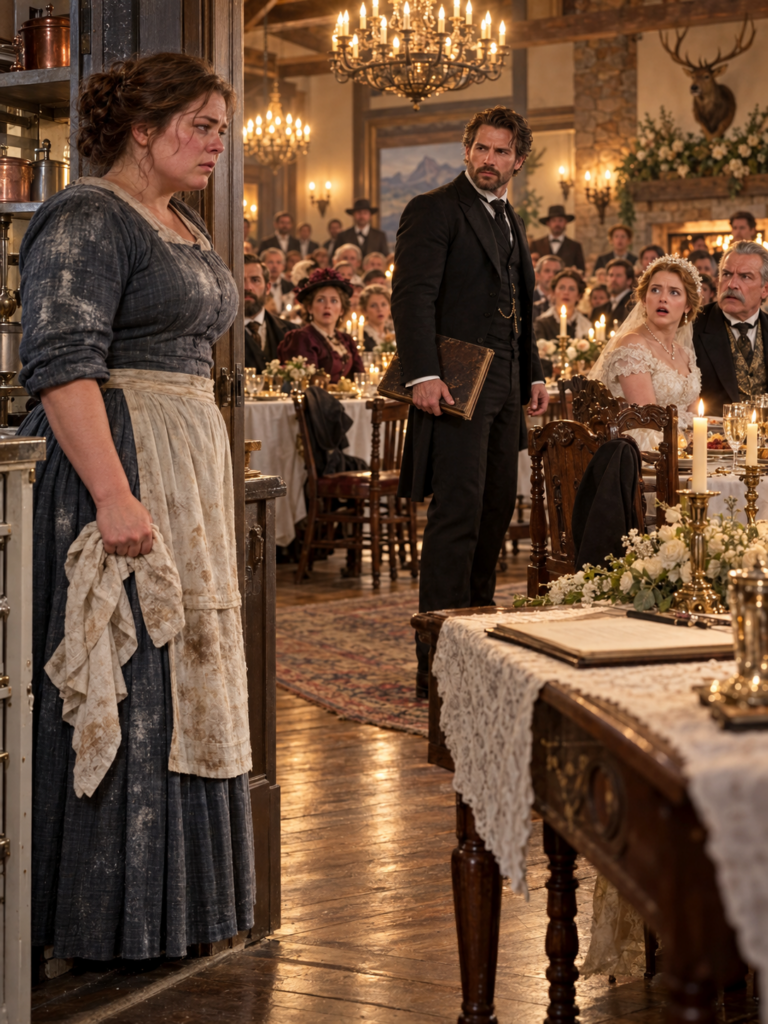
Hannah stepped through the kitchen doorway with two hundred faces turning toward her.
For one second she nearly stopped.
Her worn shoes suddenly felt louder than the orchestra had.
Flour streaked her skirt.
Her hair had escaped its pins.
She could feel every place where her body differed from Victoria’s polished elegance.
Then Caleb held the ledger toward her.
Not as a rescue.
As evidence.
“Tell them what you found.”
Victoria stared at Hannah.
“This is ridiculous.”
Hannah met her gaze.
Six weeks earlier, that tone might have sent her quietly back into the kitchen.
Now three families’ water depended upon facts.
“The original Bennett agreement grants permanent access to Mill Creek for three downstream properties.”
A gray-haired rancher stood near the back.
“Which properties?”
Hannah named them.
When she said Miller, Charles Whitmore’s mouth tightened.
When she named the last property, the gray-haired man struck the table with one palm.
“My grandfather owned that place.”
Charles snapped, “An old ranch book is not a deed.”
“No,” another man said.
Judge Amos Fletcher rose slowly from his chair.
“But a witnessed agreement with parcel descriptions may correspond to county filings.”
Charles went pale.
Caleb looked at Hannah.
“You found references?”
“Yes.”
“In the ledger?”
“Two filing numbers.”
The judge nodded.
“Then they can be checked Monday.”
Whispers broke across the room.
Charles slammed his hand onto the table.
“This is a wedding, not a courthouse.”
Caleb looked at him.
“No.”
Then he turned toward Victoria.
“It was supposed to become a marriage.”
Victoria’s eyes filled.
“Caleb, I didn’t know about the creek.”
Hannah believed her.
The confusion had been real.
Caleb seemed to believe her too.
But he asked, “When your father insisted the marriage papers be completed before Monday, did you ask why?”
Victoria said nothing.
“When he asked that my eastern acreage become part of the settlement?”
Her silence continued.
“You knew land was involved.”
“I knew he wanted it.”
“Did you ever ask what it cost anyone else?”
Victoria looked toward Hannah.
For the first time, shame replaced disdain.
“My father said it would strengthen both families.”
Caleb nodded slowly.
“That explains enough.”
Victoria reached toward him.
He stepped back.
Her face changed.
“You’re humiliating me.”
Hannah almost looked away.
The irony was too sharp.
Caleb’s voice remained quiet.
“I’m refusing to sign a marriage agreement while learning that business affecting my land was deliberately concealed.”
“My father concealed it!”
“Yes.”
Victoria’s chin trembled.
Caleb continued.
“But you spent six weeks treating Hannah as though need made her beneath you.”
Victoria flushed.
“That has nothing to do with us.”
“It tells me something about us.”
Caleb looked toward the minister.
“The register hasn’t been signed?”
The minister shook his head.
“No.”
Caleb closed the ledger.
“Then I won’t sign it.”
No one applauded.
No one dared.
Victoria stared at him, stunned.
Charles moved toward his daughter.
The railroad men began speaking rapidly among themselves.
The judge asked Hannah for the filing numbers.
Everything fractured at once.
And Hannah suddenly remembered why she had come through the door.
Not for Caleb.
Not for Victoria.
For the creek.
“The record must be protected,” she said.
Judge Fletcher looked at her.
“Where is the original ledger usually kept?”
“An upstairs storage room.”
Charles Whitmore’s eyes flicked toward the staircase.
Hannah saw it.
So did Caleb.
She closed both hands around the old book.
“No.”
Caleb frowned.
Hannah tucked the ledger firmly against her ribs.
“It stays with me until the county clerk sees it.”
Charles took one step forward.
“That belongs to the Bennett family.”
Hannah looked at Caleb.
He answered without hesitation.
“She carries it.”
Charles’s face darkened.
Hannah did not thank Caleb.
This was not a favor requiring gratitude.
It was the practical decision necessary to preserve evidence.
She looked toward Judge Fletcher.
“You said the filings can be checked Monday.”
“Yes.”
“Then I will bring this myself.”
Caleb started to speak.
Hannah raised one hand.
“I said myself.”
Something almost like approval entered his expression.
“All right.”
Across the room Victoria stood beside the unsigned register, wedding flowers still pinned into her hair while the future arranged around her only hours earlier disappeared.
Hannah felt no triumph.
Only exhaustion.
She turned toward the kitchen.
There were still dishes stacked to the ceiling.
There were exhausted assistants who deserved pay.
And there was forty dollars she had not yet received.
She took one step.
Then stopped.
The leather ledger was still against her chest.
For the first time Hannah understood that by Monday morning she would have to walk into the county office carrying evidence that might save her water while Charles Whitmore, the bank, railroad men, and perhaps half the valley tried to decide whether an indebted widow had any right to stand in their way.
Hannah tightened her hold on the ledger and walked back into the kitchen.
Caleb followed several minutes later.
She had already rolled up her sleeves.
“What are you doing?”
“Washing dishes.”
He stared at the mountain of plates.
“You just helped end my wedding.”
“I noticed.”
“And now you’re washing dishes.”
“My assistants have been working since before dawn.”
“I employ staff.”
“So did Victoria.”
Caleb winced.
Hannah lowered another plate into the hot water.
“I am finishing the work I promised.”
“Hannah.”
She looked at him.
He took off his formal coat.
“What are you doing?”
“Helping.”
“You own this house.”
“And apparently that prevents me from drying china?”
“It should.”
He picked up a towel.
For several minutes they worked without speaking.
The banquet hall beyond them emptied slowly.
Wheels rolled across the drive.
Doors opened and closed.
Once Hannah heard Victoria crying upstairs.
She did not rejoice.
Cruelty was cruelty even when the person suffering had once delivered it.
Near midnight, Caleb placed an envelope beside Hannah’s hand.
“Your wages.”
She opened it.
Then counted again.
“Two hundred dollars.”
“Yes.”
“We agreed forty.”
“The agreement was foolish.”
“It was yours.”
“I underestimated the work.”
“That was your mistake.”
“Hannah.”
She removed two twenty-dollar bills.
Then pushed the rest toward him.
Caleb looked almost offended.
“You earned it.”
“I earned forty because forty is what I accepted.”
“You worked far beyond what I expected.”
“Then next time offer a fair wage before the work begins.”
His mouth opened.
Closed.
Hannah returned to the dishes.
Caleb stared at her.
Then a laugh escaped him.
She looked sideways.
“What?”
“Nothing.”
“It was clearly something.”
“I have spent this entire day discovering how expensive poor judgment can be.”
“That seems healthy.”
He laughed again.
By morning, the unsigned marriage register had been removed.
Victoria departed with her father.
Hannah took the ledger home.
Sunday night she barely slept.
Every creak of her farmhouse roof seemed louder.
The old Bennett book sat on her table beside Tomas’s rolling pin.
The bank notice rested beneath both.
Water rights might preserve the farm’s usefulness.
They would not erase her debt.
Monday morning Hannah rode into town alone.
Caleb had offered to come.
She refused.
He respected that.
Judge Fletcher met her at the county office.
The clerk located the referenced filings.
Old survey descriptions.
Recorded signatures.
Corresponding agreements.
The gray-haired rancher from the wedding arrived carrying his grandfather’s copy.
By noon the matter had become too substantial for anyone to dismiss as kitchen gossip.
The proposed diversion stalled immediately.
Whitmore Development disputed the interpretation.
Railroad lawyers reviewed the route.
For several weeks Hannah heard more legal language than she ever wanted again.
But the basic problem remained simple.
Three properties had longstanding documented water access.
Any buyer of the Bennett acreage would have to confront those rights.
By early autumn, Whitmore Development withdrew.
The railroad shifted its planned route farther south.
Mill Creek remained where it was.
Hannah stood beside the water one evening watching it move through reeds along her property.
Tomas had dug irrigation channels from that creek with his own hands.
Saving it should have felt like saving everything.
Then another bank notice arrived.
She read it at the same kitchen table.
Payment due.
No extension promised.
Hannah folded it.
The next morning she rode into town.
The banker looked puzzled when she placed the notice before him.
“Mrs. Miller?”
“I’m here about the mortgage.”
He read the paper.
“This was sent before the balance changed.”
Hannah frowned.
“What change?”
“The debt was cleared.”
She stared.
“By whom?”
The banker hesitated.
“Mr. Bennett.”
Anger arrived before gratitude could.
Hannah rode directly to Bennett Ranch.
Caleb was repairing a gate.
He saw her coming and set down the hammer.
“You paid my mortgage.”
“Yes.”
“Why?”
“You preserved water for my land and two neighboring farms.”
“I preserved my farm too.”
“I know.”
“That does not make my debt yours.”
“No.”
His agreement only irritated her more.
“Then why did you do it?”
Caleb rested both hands on the fence rail.
“Because your husband’s illness should not take your home six years after it took him.”
The anger shifted painfully.
But it remained.
“You had no right.”
Caleb nodded.
“No.”
Hannah blinked.
“I thought you would argue.”
“I can if it helps.”
“It will not.”
“Then you are right. I should have asked.”
Hannah studied him.
He did not explain generosity as authority.
He did not say she ought to be grateful.
He simply admitted he had crossed a line.
“Can the payment be reversed?”
“I doubt the bank wants its money returned.”
“Then I repay you.”
“Hannah—”
“I repay you.”
Caleb looked toward the house.
His regular cook still had trouble using her injured hand for long days.
“We need kitchen help through winter.”
Hannah narrowed her eyes.
“You want me to cook.”
“For wages.”
“Proper wages.”
“Name them.”
She did.
Caleb’s eyebrows rose.
“That much?”
“You wanted fair.”
He considered.
Then held out his hand.
“Agreed.”
Hannah shook it.
Five days each week she worked at Bennett Ranch.
Every evening she returned to her own farmhouse.
Caleb resumed appearing in the kitchen before sunrise.
At first Hannah accused him of supervising.
“I live here.”
“You also possess a dining room.”
“The coffee there is weak.”
“My coffee could dissolve fencing wire.”
“Exactly.”
Winter became spring.
They spoke of everything except what other people in town had already begun discussing.
Tomas came up often.
Caleb never acted threatened by a dead man.
One morning Hannah arrived to find him holding Tomas’s rolling pin.
She stopped.
“That belongs at my house.”
“I know.”
“How did it get here?”
“You brought it yesterday.”
She remembered.
A crack had been widening near one handle.
Caleb had fitted a narrow wooden insert into it and sanded the repair smooth.
Hannah ran her thumb along the seam.
“You fixed it.”
“Yes.”
“You could have told me.”
“I thought it would be nicer finished.”
Her throat tightened unexpectedly.
Tomas had shaped that rolling pin for her during their second winter together.
For years every mark on it had belonged to memory.
Now another man had repaired it without trying to replace the one who made it.
“Thank you.”
Caleb leaned against the worktable.
“Hannah.”
She looked up.
“Have dinner with me.”
“I cook dinner here constantly.”
“No.”
For the first time since she had known him, he looked uncertain.
“I mean with me. At the table.”
Hannah’s expression changed.
“Caleb.”
“I know.”
“You almost married Victoria less than a year ago.”
“Yes.”
“Half the county believes I ruined that wedding.”
“You didn’t.”
“That will not stop them.”
“No.”
She looked down at her hands.
“And people already talk about how you spend time with me.”
Caleb waited.
Hannah hated the next part.
“Victoria said something cruel because she knew exactly what people notice when they look at me.”
Caleb’s brow tightened.
“I am heavy.”
“Yes.”
Hannah looked up sharply.
He continued before she could speak.
“You are also stubborn about money, merciless with undercooked potatoes, and apparently incapable of walking past a dirty pan without washing it.”
She stared.
“Is that meant to improve matters?”
“I am trying.”
“You require practice.”
“Dinner would provide some.”
Despite herself, Hannah smiled.
Caleb’s expression softened.
“I do not pity you.”
“I know.”
“I am not asking because I think you need another man to save your land.”
“I know.”
“I am asking because the mornings when you are not here have become irritatingly quiet.”
Hannah stopped smiling.
No man had said anything like that to her since Tomas.
For years she had feared that wanting another person might somehow betray the husband she had loved.
Caleb did not ask her to solve that fear immediately.
He simply waited.
“One dinner,” Hannah said.
“One.”
“And I am not cooking it.”
His face fell.
“That seems excessive.”
She laughed.
They had dinner.
Then another.
Their courtship remained slow because Hannah required it to remain slow.
Caleb repaired part of her roof that summer, but she paid for every board.
By autumn she had repaid almost half what he had sent the bank.
Whenever he suggested forgetting the balance, she wrote another payment.
Then one evening Caleb came to Hannah’s farmhouse carrying the old Bennett ledger.
She looked at it suspiciously.
“That book has caused enough trouble.”
“I agree.”
He opened it near the back.
Inside lay a new legal document.
Hannah read carefully.
The Bennett water rights connected to Mill Creek would be placed into a permanent arrangement shared by the three downstream properties.
No future Bennett owner could simply sell those rights away.
Hannah read the first page again.
“Why?”
“Because your farm should not depend upon whether the next man who owns my land happens to be decent.”
Her gaze rose.
Caleb placed another sheet beneath it.
Not a contract.
A letter.
She read the first lines.
He had written that he once believed home meant acreage, stock, timber, buildings.
Then he wrote that she had taught him the empty part of a house was measured by the person one wished were inside it.
Hannah stopped.
Caleb drew a simple gold ring from his pocket.
“Hannah Miller.”
Her eyes filled.
“I know you do not need rescuing.”
She said nothing.
“I know you can keep your own farm.”
He swallowed.
“And I know loving Tomas did not end because he died.”
Hannah’s breath caught.
“I am not asking you to erase him.”
Caleb looked more nervous than he had when canceling a wedding before two hundred witnesses.
“I am asking whether there might be room beside that love for something that belongs to us.”
Hannah looked through the window toward Tomas’s orchard.
The last light lay across the forty acres she had nearly lost.
Caleb waited without moving closer.
No audience.
No pressure.
No debt hanging between them that she had not insisted upon repaying.
Hannah touched the ring but did not take it yet.
“What happens to my farm if I say yes?”
Caleb blinked.
“It remains yours.”
“And my work?”
“Your choice.”
“And Tomas’s things?”
“Wherever you want them.”
Hannah studied him.
“Then ask me again.”
Caleb’s eyes widened slightly.
She smiled.
“Properly this time.”
He took one breath.
“Hannah Miller, will you marry me?”
She looked at the man who had first known her as the cook behind a kitchen door, had later learned when help became interference, and now stood in her house asking instead of arranging.
“Yes.”
Only then did she hold out her hand for the ring.
Hannah kept her hand extended while Caleb slid the simple gold band onto her finger.
It fit.
She looked down at it.
Then back at him.
“That was suspiciously well measured.”
Caleb’s mouth twitched.
“Mrs. Higgins lent me one of your pastry rings.”
“You stole kitchen equipment to measure my hand?”
“Borrowed.”
“I may reconsider.”
“You already said yes.”
“That does not remove my freedom of judgment.”
“I have learned that lesson.”
She believed him.
Their engagement did not turn Hannah into a woman waiting for marriage to complete her.
She still rode home after work.
She still made payments against what Caleb had paid the bank.
She still negotiated the price of lumber for her own roof.
Caleb still managed Bennett Ranch.
He still appeared in the kitchen before dawn and complained about the coffee.
The difference was that a future had become something they discussed aloud.
Where would they live?
Hannah refused to simply abandon the farm.
Caleb did not ask her to.
They decided to maintain both properties.
Her farmhouse would remain productive ground and a home she could use whenever she wished.
A tenant family eventually helped work part of it under terms Hannah wrote herself.
She retained control.
Caleb read the agreement and changed exactly one sentence after Hannah agreed the revision improved it.
“Marriage is already changing you,” she told him.
“How?”
“You asked before altering paperwork.”
He sighed.
“I was happier ignorant.”
They planned a spring wedding.
Forty-three guests.
Hannah insisted upon the number because every person invited had some genuine relationship to one of them.
No crowd assembled for prestige.
No railroad delegation.
No investors.
No room full of strangers waiting to be impressed.
The ceremony took place near Mill Creek.
Judge Fletcher attended.
So did the gray-haired rancher whose grandfather had signed the original water agreement.
The other downstream family came with three children and a basket of bread.
Even the banker appeared, though Hannah told Caleb privately she suspected he came mainly because he enjoyed free food.
Hannah cooked none of it.
This required a battle.
“I can prepare the pies,” she argued three days before the wedding.
“No.”
“The woman you hired makes poor crust.”
“She does not.”
“She refrigerates the butter too long.”
“It is March in Wyoming. Everything is refrigerated.”
“Caleb.”
“Hannah.”
She narrowed her eyes.
He remained firm.
“You spent your first Bennett wedding feeding two hundred people who barely knew your name.”
“That was work.”
“This one is ours.”
“I enjoy cooking.”
“You may enjoy sitting down more.”
Hannah crossed her arms.
Caleb added, “A bride is entitled to one unreasonable demand.”
“I am the bride.”
“Then demand that I stop talking.”
“I demand that you stop talking.”
He stopped.
Hannah stared.
Caleb smiled.
She laughed first.
On the wedding day the creek ran cold and clear beside the gathering.
Hannah wore a dark cream dress made by a seamstress in town.
It fit her body rather than attempting to disguise it.
That decision had mattered more than she expected.
For years she had dressed to become less noticeable.
Victoria’s cruelty had once hurt because it echoed what Hannah already feared strangers thought.
Now she stood beside Caleb without attempting to disappear.
Judge Fletcher began the ceremony.
Hannah listened.
Caleb’s hand rested at his side until she reached for it.
Then hoofbeats sounded from the road.
Conversation shifted.
A carriage approached.
Hannah turned.
Victoria Whitmore stepped down.
For one instant the old kitchen doorway returned.
The laughter.
The insult.
The humiliation.
Caleb moved slightly closer.
Hannah touched his arm.
Not yet.
Victoria wore a plain blue traveling dress.
No diamonds.
No elaborate hat.
No father.
She stopped several yards away.
“I won’t stay.”
Hannah looked at her.
Victoria’s face had changed since the canceled wedding.
Not dramatically.
She was still beautiful.
Still unmistakably from wealth.
But some certainty had left her.
“I heard you were marrying,” Victoria said.
“Yes.”
“I brought something.”
She held out an envelope.
Hannah did not take it immediately.
“What?”
“Papers from my father’s files.”
Caleb’s expression hardened.
Victoria looked toward him.
“I am not here to cause trouble.”
Hannah accepted the envelope.
Inside lay an old debt record.
Tomas Miller’s name appeared near the top.
Her fingers went cold.
“What is this?”
Victoria swallowed.
“My father purchased medical debts years ago while he was trying to acquire smaller properties in this valley.”
Hannah looked up.
“He owned Tomas’s debt?”
“For a time.”
Caleb stepped nearer.
Victoria continued.
“He later transferred several accounts to the bank. I found this while sorting his records.”
Hannah read farther.
A payment.
A large one.
Made by Tomas during the final months of his illness.
Credited in Whitmore’s private ledger.
Not properly transferred when the debt moved.
Hannah’s breath caught.
If the payment had been recorded correctly, the balance she spent six years fighting would have been dramatically smaller.
Caleb read over her shoulder.
His jaw hardened.
Victoria stared toward the creek.
“I thought you should have it.”
Hannah looked at her.
“Why?”
Victoria’s eyes filled.
The question seemed harder than she expected.
“Because I was cruel to you.”
Silence settled around them.
Victoria continued.
“I thought admiration made a person important.”
Her voice trembled.
“And I thought making someone smaller made me larger.”
She looked directly at Hannah.
“I was wrong.”
Hannah said nothing.
There was no requirement that apology produce immediate absolution.
Victoria appeared to understand that.
“My father lost most of the railroad investors after the land dispute. We barely speak now.”
“I’m sorry.”
Victoria looked surprised.
“You needn’t be.”
“Perhaps.”
Hannah folded the papers carefully.
Victoria glanced toward Caleb.
“I am sorry to you too.”
Caleb nodded once.
“I hope you build something better from what happened.”
“So do I.”
Victoria turned.
Then paused.
“Hannah.”
“Yes?”
“You were a very good cook.”
Hannah raised one eyebrow.
“Better than I was at eating?”
Victoria closed her eyes.
A faint, embarrassed laugh escaped.
“I deserved that.”
“Yes.”
Hannah allowed herself a smile.
“You did.”
Victoria laughed again.
So did Hannah.
Nothing became friendship.
It did not need to.
Some endings were simply two people refusing to repeat the worst version of themselves.
Victoria returned to the carriage.
Hannah watched her leave.
Then Judge Fletcher cleared his throat.
“We do still have a wedding.”
Hannah looked at Caleb.
He was watching her, not the carriage.
“Are you all right?”
She considered.
“Yes.”
“Do you want to stop?”
“No.”
He nodded.
No argument.
No assumption that the assembled guests required them to continue.
The choice remained theirs.
Hannah placed the papers safely inside the house.
Then returned to the creek.
The ceremony resumed.
When Judge Fletcher asked whether she took Caleb Bennett as her husband, Hannah answered without hesitation.
“Yes.”
Caleb’s answer came just as clearly.
Dinner afterward was good.
Hannah complained privately about one pie crust.
Caleb refused to discuss it.
The recovered records concerning Tomas’s payment went to the bank the following week.
The error was confirmed.
Part of Hannah’s old balance had been wrong for years.
The correction cleared what she still owed Caleb and returned a modest amount to her.
More importantly, examination of the transferred accounts exposed similar problems affecting other borrowers.
Two neighboring families received corrections.
Hannah experienced no satisfaction in Charles Whitmore’s decline.
She had wanted her land protected.
Her debt corrected.
Her dignity respected.
Revenge had never been part of the bargain.
The railroad eventually built farther south.
It brought trade without taking Mill Creek.
The three farms remained watered.
Caleb’s eastern acreage stayed part of Bennett Ranch, but the protected water agreement meant no future owner could treat the creek as a private possession.
The document Hannah had forced into the open outlived nearly everyone who attended that first wedding.
Marriage changed Hannah’s daily life.
It did not erase Tomas.
His rolling pin moved into the Bennett kitchen.
At first one young kitchen worker nearly replaced it because the wood looked old.
Hannah reacted so strongly that the poor woman thought she had committed a crime.
Caleb found Hannah sanding the handle afterward.
“You frightened Martha.”
“I apologized.”
“She believes the rolling pin is sacred.”
“It is useful.”
Caleb touched the repaired insert he had added years before.
“So was the man who made it.”
Hannah looked at him.
Caleb never competed with Tomas.
That remained one of the reasons Hannah loved him.
A heart did not become honorable by refusing to love twice.
Tomas belonged to the life behind her.
Caleb belonged to the life beside her.
Neither erased the other.
The old Bennett ledger also stayed in the house.
Unlike Tomas’s rolling pin, it was not used daily.
Hannah had one page copied and framed.
The page recording the Mill Creek agreement hung above the kitchen table.
Caleb questioned this choice.
“You spend enough time looking at accounts.”
“This one matters.”
“Because it saved the farm?”
“Partly.”
“What is the other part?”
Hannah touched the frame.
“Because people forget where worth comes from.”
Caleb leaned against the table.
“Explain.”
“Victoria believed mine depended upon whether people wanted to look at me.”
He frowned.
“The bank measured me by what I owed.”
Caleb remained quiet.
“Your family records measured land through acreage, cattle, water.”
“And?”
Hannah looked toward Tomas’s rolling pin.
Then toward the windows facing the valley.
“What matters most is often what you do when nobody thinks you matter.”
Caleb understood.
Years passed.
Hannah continued cooking because she loved it.
But she never again accepted work that required swallowing contempt as part of the wage.
When local families asked her to cater harvest suppers, she named her price plainly.
When someone claimed it was expensive, she told them they were welcome to feed two hundred people themselves.
Most paid.
Some tried.
Several came back humbled.
Her body did not become smaller.
The story never required that.
Her life became larger.
That difference mattered.
She rode between Bennett Ranch and her own acreage.
She managed accounts.
She grew vegetables.
She helped establish a cooperative arrangement among the three Mill Creek farms for maintaining shared channels and reporting water problems.
Caleb handled cattle better than she ever would.
Hannah understood household purchasing and food storage better than he did.
Neither pretended partnership required identical skills.
They learned where each person’s judgment deserved trust.
Caleb sometimes crossed lines.
So did Hannah.
Once he authorized repairs at her farmhouse without asking because a porch support was becoming unsafe.
Hannah discovered the carpenters already working.
She rode home furious.
Caleb listened.
“I was trying to prevent the porch from falling.”
“It is my porch.”
“Yes.”
“You could have told me.”
“Yes.”
“You could have asked.”
“Yes.”
Hannah narrowed her eyes.
“You are agreeing too quickly.”
“I have learned arguing does not improve your mood when you are correct.”
She almost smiled.
Almost.
“You are paying those men.”
“I intended to.”
“And next time?”
“I ask.”
There was a next time.
He asked.
Hannah said yes.
That was marriage as they actually lived it.
Not perfect instinct.
Changed behavior.
One winter morning Caleb entered the kitchen before sunrise while Hannah was kneading biscuit dough.
“Coffee?”
She pointed toward the pot.
He poured two cups.
Steam rose between them.
“You know,” he said, “your coffee is still terrible.”
“You proposed because of it.”
“I proposed despite it.”
“You specifically mentioned needing it.”
“That was humor.”
“You were nervous. Humor was beyond you.”
Caleb sat.
“I also said I loved you.”
“That came afterward.”
“It did not.”
“I was present.”
“So was I.”
Hannah laughed.
It filled the kitchen.
Years earlier, she had learned to laugh carefully.
Widowhood had made people watch her grief.
Poverty had made people watch her clothes.
Victoria had made her aware of people watching her body.
Now Hannah no longer edited the sound to make it smaller.
Caleb still paused sometimes simply to hear it.
One morning, after nearly a decade of marriage, Hannah found him standing beneath the framed Mill Creek agreement.
“What are you doing?”
“Remembering.”
“That sounds dangerous.”
He turned.
“The first wedding.”
Hannah groaned.
“Must we?”
“You were leaving.”
“Yes.”
“You had untied your apron.”
“Yes.”
“I thought you were furious.”
“I was.”
“At Victoria?”
“At myself.”
Caleb frowned.
Hannah sat at the table.
“I spent six weeks tolerating things I should not have tolerated because I needed forty dollars.”
“You needed your home.”
“I know.”
She looked toward the window.
“I do not judge the woman I was for enduring it.”
Caleb waited.
“But I remember the moment I realized necessity did not require me to help someone humiliate me.”
Caleb sat opposite her.
“You would have walked away.”
“Yes.”
“Even knowing the bank might take the farm.”
“Yes.”
He studied her.
“Were you afraid?”
“Terrified.”
Caleb reached toward her hand.
Then stopped just short, an old habit formed from years of knowing she valued being asked through action as much as words.
Hannah noticed and placed her palm beneath his.
“I think that was the first moment,” she continued, “when I understood losing the farm would not be the same as losing myself.”
Caleb squeezed gently.
“You kept both.”
“Eventually.”
“And saved my land.”
“My water.”
“And three farms.”
“Do not make me heroic. I found papers because your storage room was disorganized.”
“That is less romantic.”
“It is more accurate.”
Caleb smiled.
The truth became legend around the valley anyway.
People improved stories when retelling them.
Some claimed Caleb hurled the ledger onto the wedding table.
He had not.
Some claimed Hannah marched into the banquet and denounced Victoria.
She had spoken calmly.
One version said guests cheered when the wedding ended.
The truth was that most had stared at their plates, embarrassed by how eagerly they had laughed minutes earlier.
Hannah preferred accuracy.
The truth was stronger.
A widow desperate for forty dollars had entered a wealthy ranch through the kitchen.
She had been ordered to remain out of sight.
While doing the work everyone expected but few respected, she noticed invoices powerful men had overlooked.
She recognized what a diverted creek would do because water mattered differently to someone who could lose everything.
She found an old ledger because cooks searched cupboards, storerooms, shelves, and drawers other people considered beneath notice.
She understood the paper because debt had taught her to read every number twice.
Her hardship had not made her magically wise.
It had given her specific knowledge.
She used it.
That mattered more.
Caleb never claimed he rescued Hannah.
He had paid her mortgage once without asking and learned exactly why generosity did not erase boundaries.
Hannah never forgot that lesson either.
Help could be loving.
So could refusal.
Their best decisions usually happened when neither confused the two.
Long after Charles Whitmore and the railroad dispute had faded from daily conversation, Mill Creek continued crossing Hannah’s forty acres.
In dry summers its level fell.
In wet springs it spread beyond its banks.
Children from neighboring farms waded in it.
Cattle drank downstream.
Gardens survived because of it.
The protected agreement remained filed with county records.
One autumn afternoon, Hannah walked beside the creek with Caleb.
They were older.
The cottonwoods had begun turning gold.
Caleb’s pace had slowed.
Hannah’s knees complained on uneven ground.
Neither mentioned this unless teasing the other.
They stopped near the place where Tomas had once dug the first irrigation ditch.
Hannah touched the old scar in the earth.
“He would have liked you.”
Caleb looked at her.
“Tomas?”
“Yes.”
“You sure?”
“No.”
Caleb laughed.
Hannah smiled.
“He would have argued with you.”
“That sounds more likely.”
“He argued with everyone.”
“Then I might have liked him.”
Hannah’s expression softened.
For a moment grief returned with surprising clarity.
Not the crushing grief of six years alone.
A gentler ache.
Caleb did not rush to replace it with himself.
He stood beside her.
Eventually Hannah slipped her hand into his.
They continued walking.
That evening she used Tomas’s rolling pin to prepare biscuits.
Caleb ate three.
Then criticized her coffee.
Nothing dramatic happened.
That was perhaps the greatest victory.
The farmhouse still stood.
The Bennett ranch still worked.
The creek still ran.
The ledger page remained framed.
And Hannah Miller Bennett’s name remained connected to Mill Creek not because she married a wealthy rancher, but because she had been paying enough attention to notice what wealth almost destroyed.
The woman once ordered to remain hidden in the kitchen had not become important when Caleb loved her.
She had already been important.
The difference was that eventually she stopped accepting the judgment of people who failed to see it.
One winter morning Caleb found her standing beneath the framed ledger page.
He handed her coffee.
Hannah tasted it.
Her face twisted.
“This is weak.”
“I made it.”
“I know.”
“You could pretend.”
“I married you after you promised honesty.”
“That was foolish of me.”
Hannah laughed.
Caleb leaned against the table.
“Why do you still keep that page up there?”
She looked at the old agreement.
At Tomas’s rolling pin on the shelf.
At Caleb’s repaired wooden insert near one handle.
At the kitchen where grief, work, anger, second chances, and ordinary mornings had all found room together.
“Because I walked into your house needing forty dollars,” she said.
Caleb waited.
“And someone decided that meant she could make me small.”
His expression tightened even after all these years.
Hannah shook her head.
“That is not the part I want remembered.”
“What is?”
Hannah looked through the window toward the creek.
“That I finally understood she could only make me small if I agreed to become smaller.”
Caleb smiled.
“You never were especially cooperative.”
“No.”
She lifted her coffee.
“Fortunately.”
Outside, Mill Creek moved steadily through the valley.
Inside, Hannah’s laugh filled the kitchen again.
Full.
Unhidden.
Entirely her own.


