
Part 1
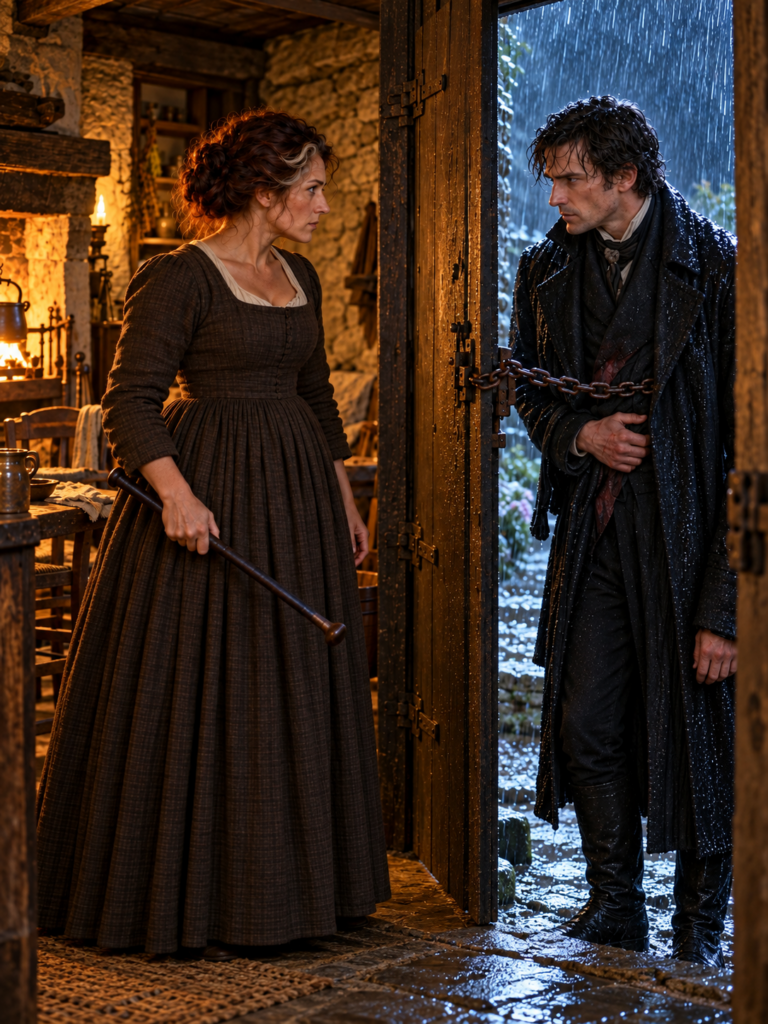
The first time Margaret Whitmore saw the man who would change her life, he was standing on her porch in the middle of a thunderstorm, bleeding through a black wool coat and looking deeply offended that she had not opened the door sooner.
It was nearly midnight in the foothills of western Virginia.
Rain hammered the roof of her little farmhouse. Beyond the kitchen window, lightning flashed over the rolling pastures and the dark Blue Ridge Mountains. Her old barn leaned against the wind, and the pear tree her late husband had planted thirty years earlier scraped its branches against the siding.
Margaret was fifty-eight years old, widowed, and accustomed to being alone.
She had spent that evening mending a quilt beneath the yellow light of the kitchen lamp. A pot of vegetable soup cooled on the stove. Her husband’s old hunting dog, Cooper, slept beside the wood-burning fireplace.
Then someone struck the front door three times.
Not politely.
Not like a neighbor needing help.
Like a man accustomed to having every door in the world opened for him.
Margaret took the iron poker from beside the hearth.
“Who is it?”
A pause.
“Open the door.”
She stared at the dark wooden panels.
“That’s not much of an introduction.”
The man outside breathed heavily.
“Madam, I require assistance.”
“And I require better manners from strangers who arrive after midnight.”
For a moment, the only answer was the storm.
Then, through the rain, came a different word.
“Please.”
Something about the way he said it made Margaret move.
She unfastened the lock but left the safety chain in place.
A tall man stood beneath the porch roof.
He was perhaps forty-five, broad-shouldered, with rain-soaked dark hair, a hard, handsome face, and gray eyes that seemed determined to remain commanding even as his body failed him.
One hand pressed against his ribs.
Blood slipped between his fingers.
Margaret looked down.
“Have you been shot?”
“No.”
“Then you’ve developed a very unusual way of sweating.”
His mouth tightened.
“I need somewhere to stay.”
“You need a hospital.”
“No hospitals.”
“And I suppose there’s a perfectly innocent explanation for that.”
His gaze moved toward the black woods behind her house.
“Are you alone?”
Margaret raised the poker.
“That’s a dangerous question to ask a woman holding a piece of iron.”
A faint expression crossed his face.
It might have been amusement.
Then his knees buckled.
Margaret barely caught him before his forehead struck the porch boards.
“Oh, for heaven’s sake.”
She shut the door, removed the chain, and dragged him inside.
He was heavier than any sensible wounded man had a right to be.
Cooper rose, sniffed the stranger’s boots, and gave a low warning growl.
“Don’t start,” Margaret told the dog. “One difficult man is enough for tonight.”
By the time she got her unexpected guest onto the old leather couch, blood had stained the rug her husband Samuel had bought at a county auction twenty years earlier.
Margaret stared at the stain.
“If you die on that carpet, mister, I’m going to be extremely displeased.”
The stranger opened one eye.
“I shall endeavor to avoid it.”
Then he fainted.
Margaret had been married to a country doctor for thirty-one years.
Samuel Whitmore had treated everything from broken farming equipment injuries to hunting accidents, and because the nearest hospital had once been nearly forty miles away, Margaret had learned more about emergency medicine than most people expected.
She cut open the stranger’s shirt.
A bullet had torn across his left side, leaving a deep, ugly groove beneath his ribs.
He was fortunate.
Another inch inward and the injury might have been fatal.
She washed the wound, applied pressure, and dressed it with the supplies Samuel had left in a locked medical cabinet. She knew enough to recognize the danger of infection and blood loss, and she kept the telephone within reach in case his breathing or consciousness worsened.
Halfway through, the man woke and caught her wrist.
“What are you doing?”
“Knitting a sweater.”
He looked down.
His fingers loosened.
“You’ve treated gunshot wounds before?”
“My husband was a physician.”
“Where is he?”
Margaret paused.
“Buried behind St. Andrew’s Church.”
The man’s expression changed.
“I am sorry.”
“So was I.”
She returned to the bandage.
Samuel had been gone two years.
Two years of fixing fences alone, paying overdue bills, and eating supper at a table built for two.
Two years of hearing neighbors say she ought to sell the farm because a woman her age had no business managing twenty-seven acres by herself.
Two years of refusing.
She finished dressing the wound and brought the stranger water.
“What’s your name?”
He hesitated.
“Daniel Gray.”
“Really?”
“Yes.”
“Those gray eyes must have inspired your parents.”
He said nothing.
Margaret sighed.
“Well, Mr. Gray, you can stay until morning. After that, we’ll discuss how you managed to get yourself shot on a quiet country road.”
He glanced toward the window.
“Keep the curtains closed.”
“Why?”
“Someone may be following me.”
Margaret folded her arms.
“Are you wanted by the police?”
“No.”
“Are you a criminal?”
“No.”
“Then why would someone be following you?”
His face became unreadable.
“Because there are people who believe I should be dead.”
Before Margaret could answer, Cooper growled.
Outside, beneath the storm, came the sound of a vehicle moving slowly along the gravel road.
Headlights swept across the kitchen curtains.
The man pushed himself upright.
“Turn off the lights.”
Margaret hesitated.
“Now, please.”
She extinguished the lamp.
A dark pickup stopped near the mailbox.
Its engine idled.
Through a narrow opening in the curtains, Margaret saw two men inside.
The passenger lifted a flashlight and aimed it toward the barn.
For nearly a minute, nobody moved.
Then the truck continued down the road.
Margaret turned toward her guest.
He stood beside the fireplace, pale and shaking, one hand gripping the mantel.
Whatever had happened to him, it was no ordinary quarrel.
She set the poker on the table.
“You have until breakfast to decide whether you’re going to tell me the truth.”
He looked at her.
“And if I don’t?”
Margaret pointed toward the rain.
“Then you can explain yourself to the sheriff.”
For the first time, the stranger smiled.
It was brief and tired.
But it made him look startlingly younger.
Margaret disliked noticing that.
She disliked even more the strange feeling that her quiet house, after two years of silence, had somehow begun breathing again.
She fetched Samuel’s old blue bathrobe and laid it beside the couch.
“Get some rest, Mr. Gray.”
He watched her walk toward the bedroom.
“Mrs. Whitmore?”
She stopped.
“Thank you.”
Margaret glanced back.
“Don’t thank me yet. My breakfast isn’t very good.”
The stranger closed his eyes.
And Margaret went to bed without knowing that the man sleeping beside her fireplace had been officially dead for three months.
Or that the person responsible for his supposed death was already searching the valley.
Part 2
Morning arrived cold and clear.
The storm had stripped yellow leaves from the old maples and scattered them across Margaret’s yard. Mist rose from the creek beyond the pasture.
When she entered the kitchen, the couch was empty.
Her heart gave an unpleasant jump.
Then she found the stranger standing barefoot beside the window, wearing Samuel’s faded blue bathrobe.
The sleeves ended several inches above his wrists.
Margaret pressed her lips together.
“What?”
He turned.
“Nothing.”
“You’re smiling.”
“I’m considering whether the robe suits you.”
“It is regrettably short.”
“It was made for a man who didn’t argue about everything.”
He glanced toward the stove.
“Is that coffee?”
“If you’re lucky.”
Margaret poured two cups.
The simple act unsettled her.
For two years, she had measured coffee for one person.
Set one plate.
Heated one portion of leftovers.
Now a man stood beside her kitchen table, occupying space that had been painfully empty.
He noticed the stack of unpaid bills beneath a ceramic rooster.
“You run this farm alone?”
“Unless you’re volunteering.”
“Twenty-seven acres?”
She frowned.
“How would you know that?”
His eyes shifted toward the pasture.
“A guess.”
It was too precise to be a guess.
Before she could question him, he picked up the local newspaper.
On the front page was a photograph of a grand stone mansion surrounded by Virginia hills.
ASHCROFT ESTATE TO HOLD MEMORIAL SERVICE FOR LATE DUKE.
Below it was a formal portrait of Nathaniel Ashcroft, Seventh Duke of Ashcombe.
Margaret had read the story several times.
The Ashcroft family had owned property in the region for generations, descendants of English aristocrats who had retained their ancestral title while building a vast agricultural and timber operation in Virginia.
Three months earlier, Nathaniel’s vehicle had plunged from a mountain road into a ravine.
The wreckage had burned.
The remains had been identified by his uncle, Sir Roland Vale.
Nathaniel’s cousin Edmund was expected to inherit responsibility for the family holdings.
A public memorial would take place that Friday.
Margaret reached for the newspaper.
“Terrible business.”
The stranger did not answer.
She glanced up.
His fingers had tightened around the page.
“You knew him?”
“No.”
Margaret studied his face.
Then she looked at the photograph.
The strong nose.
The scar beside the jaw.
The pale gray eyes.
She moved closer.
“Good Lord.”
He slowly lowered the paper.
“Mrs. Whitmore—”
“No.”
“Please listen.”
“No, absolutely not.”
She pointed at the photograph.
“That’s you.”
Silence.
Outside, a rooster crowed from the neighboring farm.
Margaret looked from the portrait to the man in Samuel’s bathrobe.
“You’re Nathaniel Ashcroft.”
He closed his eyes.
“Yes.”
“The Duke of Ashcombe.”
“Unfortunately.”
“The man whose memorial is on Friday.”
“Apparently.”
Margaret stared.
Then, against all reason, she laughed.
She laughed so hard she had to sit down.
Nathaniel regarded her with injured dignity.
“I fail to understand what’s amusing.”
“They’ve ordered flowers for your funeral.”
“I am aware.”
“And you’re standing in my kitchen wearing my dead husband’s bathrobe.”
“That has not escaped my attention.”
“Mrs. Bennett from the church has been baking memorial cakes.”
“How unfortunate for Mrs. Bennett.”
Margaret wiped her eyes.
“You really are a duke. Nobody else could sound so annoyed about surviving.”
His expression softened, but only briefly.
Then he folded the newspaper.
“I should leave.”
Margaret’s laughter stopped.
“Why?”
“Because whoever tried to kill me knows I survived.”
The kitchen became very quiet.
Nathaniel sat slowly.
He told her about the mountain road.
About discovering irregularities in the estate accounts.
About timber shipments that had disappeared from official records and proposed mining agreements he had refused to authorize.
He had ordered an independent audit.
Two days later, during a storm, he noticed fresh damage beneath the vehicle when the driver stopped at a roadside station.
Before he could investigate, someone struck him from behind.
He remembered water.
Cold rocks.
A terrible pain in his head.
Then nothing for two days.
A shepherd and his daughter found him downstream, half-conscious and badly injured.
For weeks, Nathaniel had barely remembered his name.
By the time his memory returned, the newspapers had announced his death.
Someone else had been buried in his place.
“Who?” Margaret asked.
“My valet, Peter Lang, may have been in the vehicle.”
“May have?”
Nathaniel looked away.
“I never found him.”
Margaret felt the sorrow beneath his controlled voice.
“And your uncle identified the body?”
“Yes.”
“Have you contacted him?”
Nathaniel nodded.
“Once.”
“What happened?”
“A man came to the inn where I was staying with a knife.”
Margaret set down her coffee.
“And you still don’t know whether your uncle betrayed you?”
He looked at the framed photograph of Samuel on the mantel.
“Roland raised me after my parents died. He was the closest thing I had to a father.”
That explained more than Nathaniel realized.
Margaret had known men who could face financial ruin, illness, and war without flinching, yet refused to acknowledge betrayal by someone they loved.
“Love doesn’t make a person incapable of cruelty,” she said.
Nathaniel looked at her.
“No. But it makes the truth difficult.”
For a long moment, neither spoke.
Then tires crunched on the gravel driveway.
A black SUV rolled toward the farmhouse.
The Ashcroft crest gleamed on its door.
Nathaniel stood.
“Who is that?”
Margaret peered through the curtain.
“A woman. About thirty-five.”
He leaned closer.
“Beatrice.”
“Who?”
“My cousin’s sister.”
“Can she be trusted?”
Nathaniel hesitated.
Margaret pointed toward the pantry.
“In there.”
“I will not hide in a pantry.”
“Then you can introduce yourself to the woman who thinks you’re in a cemetery.”
Nathaniel looked thoroughly offended.
But he went.
Lady Beatrice Ashcroft arrived carrying a wicker basket of groceries.
She was a pleasant woman with intelligent eyes and a practical manner.
“My brother thought the cottages along this road might need supplies after the storm,” she explained.
Margaret accepted the basket.
“That’s kind.”
“Sir Roland asked whether your roof had been repaired.”
“It still leaks.”
“Then we’ll send someone.”
Beatrice glanced at the memorial newspaper.
“Poor Nathaniel. He would have hated all this fuss.”
A faint noise emerged from the pantry.
Margaret coughed.
“Did you know him well?”
“Since childhood.”
“Was he a good man?”
Beatrice smiled sadly.
“He was impossible. Stubborn, proud, and convinced everybody needed his advice.”
Another faint noise came from the pantry.
“But he was fair,” Beatrice continued. “And he cared about people more than he knew how to show.”
Margaret felt something tighten in her chest.
“Who identified his body?”
“Sir Roland. And Dr. Lionel Lyall.”
“How were they certain?”
“The signet ring. And an old fracture in his left wrist.”
Margaret went still.
She had examined Nathaniel’s arms the night before.
Neither wrist showed the deformity one might expect from the severe old fracture Beatrice described.
Before she could ask another question, a second vehicle arrived.
A pickup.
The same dark pickup from the night before.
A broad man in a brown jacket climbed out.
Beatrice sighed.
“Mr. Sykes. Sir Roland’s head of estate security.”
Sykes approached the porch.
“Lady Beatrice, your uncle wants you back at the house.”
“Then tell him I’m coming.”
Sykes looked past her.
“We’re searching for an armed trespasser.”
Margaret’s pulse quickened.
“How unfortunate.”
“We think he came through these woods.”
“Then perhaps you should search the woods.”
Sykes did not smile.
“May I look inside?”
“No.”
“Ma’am, I have instructions.”
“And I have a front door.”
His gaze moved toward the men’s boots beside the fireplace.
“Those yours?”
Margaret crossed her arms.
“My husband’s.”
“Thought you were widowed.”
“I am. His boots survived him.”
Beatrice stepped forward.
“Mr. Sykes, Mrs. Whitmore has answered your questions. We should go.”
For one frightening moment, Sykes looked ready to refuse.
Then he stepped back.
“Of course, my lady.”
But his eyes lingered on the farmhouse.
Margaret watched the vehicles disappear.
Only then did she open the pantry.
Nathaniel emerged holding a jar of blackberry preserves.
“Your security arrangements are peculiar.”
“My security arrangements just kept you alive.”
He placed the jar on the counter.
“Beatrice mentioned my wrist.”
“Yes.”
“I’ve never broken it.”
Margaret stared at him.
“Then your uncle invented a detail to identify the body.”
Nathaniel lowered himself into a chair.
The color drained from his face.
For the first time, he looked like a man who had lost more than a title.
Margaret sat opposite him.
“Whatever happened at that ravine, Nathaniel, someone wanted the world to believe you were dead.”
He looked up at the sound of his real name.
“And now?”
She studied his wounded side, Samuel’s bathrobe, and the rain-washed fields beyond the kitchen window.
“Now we find out why.”
That afternoon, Margaret moved Nathaniel into a narrow storage loft above Samuel’s old workshop.
The loft had once been used for drying herbs and storing medical equipment. Its entrance was concealed behind a row of shelves.
She brought blankets, water, food, and a lantern.
“You’ll be safe here until we decide what to do.”
Nathaniel caught her sleeve.
“Margaret.”
She turned.
“If Sykes finds out you’re helping me, he won’t hesitate to hurt you.”
“I understand.”
“No, I don’t think you do.”
Her expression hardened.
“My husband spent the last year of his life hiding debts and illness because he thought he was protecting me.”
Nathaniel released her sleeve.
“When he died, I discovered everything at once. The bank notices. The unpaid bills. The money he’d borrowed for treatments he never told me about.”
Her voice trembled.
“I loved him with all my heart. But I spent two years paying for decisions he made without me.”
Nathaniel remained silent.
“So if you’re going to ask me to risk my life, tell me the truth. Don’t make the choice for me.”
He looked at her for a long time.
Then nodded.
“You’re right.”
Margaret blinked.
“Well, that’s unexpected.”
“What?”
“A duke admitting somebody else is right.”
Against his will, Nathaniel laughed.
The sound was deep, surprised, and painfully human.
For an instant, Margaret saw the man beneath the wounded pride.
Then the sound of approaching vehicles silenced them both.
Six men arrived at the farmhouse.
And standing at their head was Sir Roland Vale.
Part 3
Sir Roland was a tall, silver-haired man in his late sixties, dressed in a dark overcoat that looked far too expensive for a muddy country lane.
He stood on Margaret’s porch with a leather-gloved hand resting on the head of a polished walking stick.
Behind him waited Sykes and four men from the estate.
“Mrs. Whitmore,” Roland said with a courteous smile. “Forgive the intrusion.”
Margaret kept one hand on the door.
“People have been saying that quite a lot lately.”
Roland’s smile widened.
“We’re searching for a dangerous individual.”
“So I’ve heard.”
“A violent man, possibly wounded.”
“Sounds unpleasant.”
“He may have taken shelter on your property.”
Margaret looked past him at the armed men.
“Do you have a sheriff’s deputy with you?”
“No.”
“A search warrant?”
Roland’s smile faded slightly.
“I’m hoping we can avoid unnecessary formalities.”
“I’ve always found formalities useful when strangers arrive with guns.”
Sykes shifted his weight.
Roland lifted one hand.
“Your late husband was an excellent physician, Mrs. Whitmore. Nathaniel spoke highly of him.”
Margaret held his gaze.
“Did he?”
“Indeed. Samuel Whitmore was an observant man.”
There was something in Roland’s tone she disliked.
He stepped into the kitchen after she reluctantly opened the door wider.
His eyes moved over the room.
The fireplace.
The medical cabinet.
The bloodstain Margaret had scrubbed from the wooden floor.
“Have you had a visitor?”
“Only the usual trouble.”
Roland paused near Samuel’s bookshelves.
Behind them lay the concealed entrance to Nathaniel’s hiding place.
Margaret felt her heartbeat climb.
“Would you care for coffee?” she asked.
“How kind.”
She turned toward the stove.
Roland moved closer to the shelves.
Cooper rose from the hearth and growled.
“Easy, boy,” Margaret said.
Roland glanced at the dog.
“Protective creature.”
“He has excellent judgment.”
For the first time, Roland did not smile.
He looked toward the ceiling.
Margaret imagined Nathaniel above them, wounded and motionless, listening to the voice of the man who had raised him.
Finally, Roland placed his untouched coffee on the table.
“I’d like my men to search the house.”
“No.”
“Mrs. Whitmore—”
“You have no warrant, no officer of the law, and no evidence that I’ve done anything wrong.”
Roland considered her.
Then he gave a quiet laugh.
“Nathaniel would have admired your stubbornness.”
Margaret met his eyes.
“Perhaps he would.”
Something flickered across Roland’s face.
Then he turned toward the door.
“Search the barn and orchard,” he told Sykes. “Leave the house.”
Before departing, he paused.
“The memorial begins at six on Friday evening. I hope you’ll attend.”
Margaret stood perfectly still.
“I wouldn’t miss it.”
Only when the vehicles had disappeared did she uncover the loft entrance.
Nathaniel descended slowly.
His face was gray with pain.
“He knew,” he said.
“About you?”
“About Durham. About the inn. He mentioned details no one else should know.”
Margaret helped him into the chair.
“Then we need evidence.”
Nathaniel nodded.
“The audit.”
He explained that his independent accountant, Harold Shaw, had investigated false leases, missing timber revenue, and payments to companies registered under unfamiliar names.
The report had been scheduled for delivery to his study at Ashcroft Hall before the crash.
If the audit existed, it might explain why someone had wanted him removed.
But Margaret had a question of her own.
“Why did those men search Samuel’s bookshelves?”
Nathaniel looked at her.
“What do you mean?”
“They weren’t interested only in you. Roland kept looking at Samuel’s medical records.”
She opened the cabinet.
Several green account books stood beside dusty bottles and old instruments.
“Samuel treated people from the estate. He knew things.”
“Such as?”
“He never told me everything. But he kept a private notebook about cases he found troubling.”
“Where is it?”
Margaret shook her head.
“I haven’t seen it since he died.”
That afternoon, she went through Samuel’s belongings.
She opened drawers she had avoided for two years.
There were photographs of their wedding.
Letters written during their courtship.
Receipts from the hardware store.
A worn silver pocket watch with a cracked crystal.
At the bottom of a wooden box, she discovered a folded scrap of paper.
Samuel’s handwriting.
N.A. complains of dizziness and nausea after wine. Symptoms repeated at Ashcroft Hall. Possible foxglove exposure. Lyall dismisses concern. I disagree.
Margaret read it twice.
Her stomach tightened.
She carried the note to Nathaniel.
“Did you ever become ill after drinking wine at the estate?”
His expression changed.
“Yes.”
“When?”
“Two years ago. Several times.”
“What did Dr. Lyall say?”
“Exhaustion.”
Margaret handed him the paper.
“Samuel thought somebody was poisoning you.”
Nathaniel read the note.
Slowly, his hand began to shake.
They sat beside the fireplace, listening to the wind move through the trees.
At last, Nathaniel whispered, “Roland.”
Margaret did not answer.
It was one thing to suspect a man’s uncle of financial dishonesty.
Quite another to suspect him of slowly poisoning the boy he had raised.
The next morning, Margaret drove into town to buy medical supplies and learn what she could.
At the general store, people were discussing the wanted fugitive.
According to Sykes, a violent stranger had robbed an innkeeper, assaulted a stable worker, and threatened local residents.
A reward had been offered.
Fifty thousand dollars.
Margaret nearly dropped her shopping basket.
By the time she reached the farmhouse, dread had settled into her bones.
The front door stood open.
Inside, drawers had been overturned.
Books lay scattered across the floor.
Samuel’s photograph had been smashed.
The green medical ledgers were gone.
“Nathaniel?”
No answer.
She ran toward the workshop.
The hidden panel hung open.
The loft was empty.
Blood marked the wooden ladder.
Margaret’s knees almost failed.
Then Cooper began barking toward the orchard.
She stumbled outside.
Beneath the old pear tree stood Nathaniel, pale and breathing heavily, one hand pressed against his wounded side.
“Sykes found the hiding place,” he said.
Margaret reached him.
“Are you hurt?”
“A little.”
“That is not a medical description.”
He tried to smile.
It failed.
She helped him inside and changed the blood-soaked dressing, checking carefully for signs that the injury had worsened.
As she worked, Nathaniel studied her face.
“You were frightened.”
“Don’t flatter yourself.”
“Margaret.”
She tightened the bandage.
“You disappeared. There was blood everywhere. What did you expect?”
His expression softened.
“I am sorry.”
She looked away.
Then, unexpectedly, she began to cry.
Not loudly.
Not dramatically.
Just a few exhausted tears that slipped down her cheeks while she tried to tie the bandage.
Nathaniel reached for her hand.
“Margaret.”
“I spent two years in this house without anybody to worry about,” she whispered. “I thought that was the hardest part of being alone.”
He waited.
“Turns out I was wrong.”
She looked up.
“The hardest part is finally having someone to worry about again.”
Nathaniel’s hand closed around hers.
Neither spoke for a long moment.
Then he leaned forward.
His other hand touched her cheek.
Margaret felt the warmth of his fingers against her skin.
She had not been touched that gently in two years.
He looked at her mouth.
She did not move away.
But before he could kiss her, she whispered, “Not yet.”
Nathaniel stopped immediately.
“Of course.”
She smiled through her tears.
“If we survive this, you can ask me properly.”
His answering smile was quiet.
“And if I do?”
“Then perhaps I’ll be foolish enough to say yes.”
That evening, Margaret contacted Mr. Pritchard, the elderly undertaker who had arranged Nathaniel’s funeral.
Pritchard arrived after dark in a battered funeral van.
When Nathaniel stepped into the kitchen, the old man nearly dropped his hat.
“Good heavens.”
“Hello, Pritchard.”
“But I buried you.”
“Apparently you did a poor job.”
Pritchard stared.
Then he shook his head.
“I always said the coffin measurements were wrong.”
Once he recovered, the undertaker listened carefully.
He remembered that an accountant named Harold Shaw had delivered a sealed packet shortly after Nathaniel’s accident.
Sir Roland had demanded the papers.
Shaw refused.
Instead, he had entrusted a second copy to Pritchard.
“Where is it now?” Margaret asked.
Pritchard adjusted his glasses.
“In a coffin.”
Nathaniel stared.
“Naturally.”
“An unfinished oak coffin in my workshop. Nobody thinks to search one.”
Margaret leaned forward.
“Can you get it?”
Pritchard nodded.
“But there’s something else you ought to know.”
He looked toward Nathaniel.
“Your cousin Edmund has been terribly ill.”
“What kind of illness?”
“Dizziness. Trembling. Weakness.”
Margaret and Nathaniel exchanged a look.
“Who’s treating him?” she asked.
Pritchard swallowed.
“Dr. Lyall.”
The same physician Samuel had suspected of concealing Nathaniel’s poisoning was now treating the man who had inherited his position.
The implication was terrifying.
Nathaniel stood.
“We have to get Edmund away from him.”
Margaret caught his arm.
“Not without evidence.”
Pritchard looked between them.
“The memorial is tomorrow. Everyone will be at Ashcroft Hall.”
Nathaniel’s expression hardened.
“Then tomorrow we go there.”
Margaret understood the danger.
A dead duke returning to his own memorial might be the greatest scandal Virginia had seen in generations.
But unless they acted, Edmund might become the second Ashcroft heir to die.
Part 4
The next morning, Nathaniel lay concealed beneath the false floor of Pritchard’s funeral van.
Margaret sat in the passenger seat, wearing her best navy dress and carrying Samuel’s leather medical bag.
The countryside rolled past beneath a gray October sky.
Farms stood quiet behind split-rail fences.
Cattle grazed beside distant barns.
The Blue Ridge Mountains rose dark against the horizon.
Margaret watched the road.
“Does he have enough air?”
Pritchard glanced toward the concealed compartment.
“More than most men I’ve transported.”
A muffled thump came from below.
Margaret smiled despite herself.
“His Grace disagrees.”
Pritchard chuckled.
“Well, he has a right to complain. He’s the only customer who’s ever come back.”
At Ashcroft Hall, workers hurried beneath black memorial ribbons.
The mansion stood on a broad hill overlooking thousands of acres of pasture and woodland.
A stone chapel occupied the eastern side of the property.
Beyond the western ridge lay three small farming communities.
Families who had lived there for generations.
Margaret knew some of them.
She knew their children.
Their churches.
Their old cemeteries.
She knew the land meant far more than its market value.
Beatrice met her in a private sitting room.
“Mrs. Whitmore. Your note sounded urgent.”
“It is.”
Margaret opened Samuel’s medical bag.
She showed Beatrice the handwritten note.
Then she explained the connection between Nathaniel’s symptoms and Edmund’s recent illness.
Beatrice’s face grew pale.
“You’re saying Dr. Lyall may be poisoning my brother?”
“I’m saying Samuel suspected Nathaniel was being poisoned two years ago. Edmund now has similar symptoms under the same doctor.”
Beatrice stared at the paper.
“Why would Roland do that?”
“Perhaps because a weak duke is easier to control than a healthy one.”
A footstep sounded outside.
Margaret lowered her voice.
“Meet me at Nathaniel’s old study in half an hour. Come alone.”
Beatrice caught her wrist.
“Margaret, what aren’t you telling me?”
Margaret hesitated.
Then said, “Something you won’t believe until you see it.”
She left before Beatrice could ask another question.
Nathaniel was waiting in an abandoned greenhouse behind the hall.
He wore a plain worker’s jacket and a borrowed cap pulled low over his dark hair.
Margaret inspected him.
“You look almost respectable.”
“I have been respectable all my life.”
“That’s a matter of opinion.”
He glanced toward the mansion.
“My portrait is hanging over the main staircase.”
“Of course.”
“They’ve made my nose too straight.”
Margaret smiled.
“Death seems to have improved your appearance.”
He gave her a wounded look.
Then together they entered the building through an old service corridor.
Nathaniel knew every passage.
Every stair.
Every locked door.
Yet walking through his childhood home was clearly painful.
Black ribbons framed portraits of his parents.
A vase of white lilies stood beside his father’s old chair.
Servants whispered about him as though he belonged to history.
On the staircase, Margaret saw a young maid pause beneath Nathaniel’s portrait and bow her head.
Nathaniel stopped.
“What’s wrong?” Margaret whispered.
He shook his head.
“I spent my whole life believing I mattered because of that title.”
He looked at the portrait.
“Now I’m standing three feet from my own servants, and nobody knows I’m alive.”
Margaret touched his arm.
“Titles make people visible. They don’t always make them known.”
He looked at her.
For a moment, the grandeur of the mansion disappeared.
There was only the exhausted man who had stumbled into her kitchen during a storm.
Then footsteps approached.
They hurried into the study.
Nathaniel opened a concealed compartment behind a bookcase.
It was empty.
His face fell.
“The report isn’t here.”
Margaret knelt beside him.
“Perhaps Shaw never delivered it.”
Voices sounded in the corridor.
She pulled Nathaniel behind heavy curtains.
The study door opened.
Sir Roland entered with Dr. Lyall.
“If Nathaniel survived the ravine,” Lyall said nervously, “we should contact the authorities.”
“And tell them what?” Roland replied.
“That he’s alive.”
Roland laughed without humor.
“After three months? After a funeral? After witnesses identified his body? He’ll be dismissed as an impostor.”
Lyall lowered his voice.
“Edmund’s condition is worsening.”
“Then reduce the medication.”
“You told me to increase it.”
“Because I need his signature before Friday.”
Margaret felt Nathaniel’s hand tighten around hers.
Lyall sounded frightened.
“Another dose could kill him.”
“Then make certain it doesn’t.”
A long silence followed.
Finally Lyall whispered, “What about the widow?”
Roland’s voice turned cold.
“If she knows anything, she has made herself part of the problem.”
The door closed.
Margaret remained motionless.
Nathaniel slowly released her hand.
His expression had changed.
Not to fury.
To grief.
The terrible, exhausted grief of a man hearing the voice of someone he loved discussing his death as an inconvenience.
Margaret touched his cheek.
“Nathaniel.”
He looked away.
“I called him father.”
Her heart broke for him.
Then he moved toward the desk.
“We need to know what Edmund is being forced to sign.”
They searched the drawers.
Inside a folder of memorial arrangements, Nathaniel found a draft contract.
A ninety-nine-year mineral lease.
The Bellweather Mining Company would gain extensive rights beneath the western woodlands.
The agreement included access roads, excavation privileges, and authority to displace existing agricultural tenants under certain conditions.
Margaret read the document.
“The families in those villages—”
“Would lose their homes,” Nathaniel finished.
He pointed toward the projected mining area.
“Three villages. Nearly two hundred households.”
A second document described a private commission payable to Roland through a consulting company.
Several million dollars.
Margaret stared.
“This was never about protecting the estate.”
Nathaniel’s face was hard.
“It was about selling it.”
He gathered the papers.
Then Beatrice entered.
She stopped dead.
Her eyes widened.
“Nathaniel?”
He turned.
“Hello, Bea.”
For several seconds she could not speak.
Then she crossed the room and slapped him.
Hard.
Nathaniel blinked.
“I suppose I deserved that.”
She slapped him again.
Then threw her arms around him and began sobbing.
“You horrible, selfish man. We buried you.”
He held her tightly.
“I’m sorry.”
“You should be.”
For a long time, the cousins clung to one another.
Margaret turned away, giving them privacy.
When Beatrice finally released him, Nathaniel explained everything.
The ravine.
The false burial.
The attempt on his life.
The medical note.
The mining contract.
Beatrice sat down heavily.
“Edmund signed nothing yet,” she said. “Roland plans to finalize the agreement after the memorial.”
Nathaniel nodded.
“Then we still have time.”
Beatrice looked toward Margaret.
“What about the accountant?”
Margaret explained the missing audit.
Beatrice frowned.
“Harold Shaw came to the hall after Nathaniel’s accident. Roland demanded his papers, but Shaw refused.”
“Where did he go?”
“He told me he’d left a copy somewhere Roland would never think to look.”
Margaret smiled slowly.
“In a coffin.”
That evening, Pritchard retrieved the hidden packet.
Inside was the missing audit.
Its pages documented years of fraudulent timber sales, falsified leases, and payments through shell companies linked to Roland.
There were also records showing payments to Sykes around the time of the crash.
More disturbing still, a pharmacy order revealed that Dr. Lyall had obtained medication charged to Roland’s private account shortly before Nathaniel’s accident.
A signed statement from an estate stable worker described Sykes receiving a sedative intended for the driver.
Margaret read the papers beneath the yellow light of her kitchen lamp.
Nathaniel sat opposite her.
They finally had evidence.
But they did not yet have an arrest.
And Roland still controlled the estate security staff.
Pritchard agreed to deliver a duplicate packet to the county magistrate attending the memorial.
Beatrice would keep Edmund away from Lyall’s medication.
Nathaniel would wait outside the chapel until the evidence had been secured.
It was a dangerous plan.
But it was a plan.
Near midnight, Margaret found Nathaniel standing beside the old pear tree.
The clouds had cleared.
Stars shone above the mountain ridge.
He wore Samuel’s blue bathrobe beneath his coat because the night had turned cold.
Margaret stood beside him.
“You look ridiculous.”
“I am beginning to suspect you enjoy saying that.”
“I do.”
They stood quietly.
Then Nathaniel took her hand.
“Margaret, if we survive tomorrow, may I ask you something?”
She looked at him.
“What?”
“May I court you?”
She stared.
He continued before she could answer.
“Properly. Openly. Without hiding. Without pretending that gratitude is the same as affection.”
Margaret felt her throat tighten.
“Nathaniel, people will talk.”
“People already think I’m dead. I find their opinions increasingly less impressive.”
She laughed softly.
But the laughter faded.
“I’m not a duchess.”
“I’ve noticed.”
“I’m a widowed country woman with a leaking roof, overdue bills, and a stubborn old dog.”
Nathaniel looked toward Cooper sleeping by the porch.
“An extremely judgmental dog.”
“He’s a good judge of character.”
“Then I hope to improve his opinion.”
Margaret looked into his gray eyes.
“Ask me tomorrow.”
Nathaniel nodded.
“Tomorrow.”
He lifted her hand and kissed her knuckles.
Then, more quietly, he asked, “May I kiss you tonight?”
Margaret hesitated.
The life she had built with Samuel was gone.
She had spent two years believing the best part of her life had ended with him.
Now a man she had known only days stood before her asking for something she had thought she would never feel again.
Hope.
She stepped closer.
“Yes.”
Nathaniel kissed her gently.
It was not a desperate kiss.
Nor a foolish one.
It was a promise neither dared speak aloud.
When they separated, Margaret rested her forehead against his.
“Don’t die tomorrow.”
His arms tightened around her.
“I’ll do my best.”
But when morning came, Margaret found his chair empty.
On the table lay a folded note.
I cannot ask you to risk your life for mine. Forgive me.
The audit was gone.
The mining contract was gone.
And Nathaniel had disappeared.
Margaret read the note twice.
Then she folded it carefully and slipped it into her pocket.
“Oh, Nathaniel,” she whispered.
“You foolish, stubborn man.”
Outside, clouds gathered over the mountains.
The memorial would begin at six.
And somewhere beyond the western woods, Roland Vale was waiting.
Part 5
Nathaniel never reached the chapel.
Two miles from Ashcroft Hall, Sykes and his men stopped him on a narrow logging road.
They struck him from behind and dragged him into the cellar of an abandoned hunting lodge.
When he woke, his wrists were bound to a wooden chair.
A brazier burned beside the door.
Pages from the audit curled and blackened in the flames.
Sir Roland sat opposite him.
For a long moment, the older man said nothing.
Then he sighed.
“I had hoped you would remain dead.”
Nathaniel lifted his bruised face.
“That must be disappointing.”
Roland’s expression tightened.
“Always the same arrogance.”
“You tried to murder me.”
“I tried to save the estate.”
“You sold it.”
“I kept it alive.”
Roland rose and walked toward the window.
“Your father left debts. Your grandfather left debts. Every generation expected me to find a way to preserve the land, maintain the buildings, pay the workers, and satisfy creditors.”
Nathaniel stared at him.
“So you poisoned me?”
“I delayed you.”
“You nearly killed me.”
“Lyall miscalculated.”
Nathaniel’s voice shook.
“And the ravine?”
Roland turned.
“That was never supposed to happen.”
He explained that Sykes had arranged to incapacitate the driver and force the vehicle off the road after Nathaniel’s journey began.
But Peter Lang, Nathaniel’s loyal valet, had remained in the vehicle unexpectedly.
Nathaniel was struck during the roadside stop and thrown into the flooded stream.
The vehicle later went over the ravine with Peter inside.
When Roland discovered the mistake, he chose concealment.
He identified the burned remains as Nathaniel.
He planted Nathaniel’s missing signet ring.
He invented the old wrist fracture.
He allowed Peter Lang to be buried beneath another man’s name.
Nathaniel stared at him.
“Peter had a mother.”
Roland looked away.
“I know.”
“She buried her son believing he was missing.”
“I know.”
“You stood beside me when my parents died. You taught me duty. Honor. Responsibility.”
Roland’s voice hardened.
“And what would you have done? Let the estate collapse? Put hundreds out of work?”
Nathaniel shook his head.
“You were prepared to destroy three villages to enrich yourself.”
“The mining company would have paid the debts.”
“And paid you millions.”
Roland did not deny it.
Nathaniel looked at him for a long time.
“You taught me that protecting someone mattered more than being believed.”
“I did.”
“Then you should have trusted me with the truth.”
Roland’s eyes flashed.
“You were never willing to listen.”
“Because you never asked.”
Silence filled the cellar.
At last, Roland stepped toward the door.
“The memorial begins in an hour. Once it is finished, Sykes will make certain the dangerous fugitive troubling this county is found dead.”
Nathaniel struggled against the ropes.
Roland paused.
“At least the widow is safe. I saw her scheduled coach leave town.”
For the first time, Nathaniel smiled.
“Then you don’t know Margaret.”
Back at the farmhouse, Margaret had already gone to Pritchard.
She showed him Nathaniel’s note.
Beatrice arrived minutes later.
Together, they examined the remaining payment records Roland had not known Margaret possessed.
One entry caught her attention.
A payment to Sykes after the Bellweather Ravine accident.
A second payment scheduled for Friday.
The location was abbreviated.
G.L.
Margaret looked up.
“Gamekeeper’s lodge.”
Beatrice’s face changed.
“It’s abandoned. Beyond the western wood.”
“Then that’s where they’ll take him.”
Pritchard reached for his coat.
“We should call the sheriff.”
“We will,” Margaret said. “But first we make sure the evidence reaches the magistrate.”
By five thirty, the memorial guests were entering the chapel.
The county magistrate had received Shaw’s duplicate audit, Samuel’s medical note, and copies of the suspicious payment records.
Two deputies were instructed to remain nearby.
Roland stood at the chapel entrance, greeting mourners.
He wore a black suit and the solemn expression of a grieving father.
Margaret watched him from the rear pew.
For one moment, she felt almost overwhelmed by the cruelty of it.
This man would stand before an entire congregation and praise the nephew he had tried to murder.
Then she remembered Samuel.
His debts.
His hidden illness.
The years she had spent rebuilding a life from secrets.
And the words she had spoken to Nathaniel.
Give me the truth and let me choose.
She rose.
Beatrice followed.
Together, they slipped through the side door.
The hunting lodge stood beyond a narrow path of wet leaves and moss-covered stones.
Sykes waited outside, smoking beside his pickup.
Margaret stepped into the clearing.
“Mr. Sykes.”
He spun.
“What are you doing here?”
“Looking for something that belongs to me.”
Sykes frowned.
“What?”
“A man who doesn’t listen.”
Sykes reached toward his holster.
“Stop right there.”
Margaret stood still.
“Sir Roland isn’t going to pay you.”
His eyes narrowed.
“Shut up.”
“He has used you for three months. Once Nathaniel is dead, you’ll be the only witness who can connect him to the ravine.”
Sykes hesitated.
“And what happens to men who know too much?”
“You’re lying.”
Margaret looked directly at him.
“Then why hasn’t he paid you already?”
Sykes’s gaze shifted.
Behind him, Beatrice emerged from the trees carrying a heavy wooden handle she had found beside the lodge.
She struck his gun arm.
The weapon discharged into the branches.
Margaret dropped behind a fallen log.
Beatrice knocked the gun away.
Sykes stumbled.
Before he could recover, Margaret raised the pistol Nathaniel had left in Samuel’s medical bag.
“Don’t.”
Her voice was steady.
“One wounded man has been enough trouble for me this week.”
Sykes froze.
“Where is he?” she demanded.
Sykes stared at the gun.
Then at Beatrice.
Finally, he pointed toward the cellar.
“Inside.”
Beatrice took his keys.
They locked Sykes in a storage room and called the deputies, then hurried down the cellar steps.
Nathaniel lifted his head when the door opened.
For a moment, he looked unable to believe what he saw.
“Margaret?”
She crossed the room.
“You left without telling me.”
“I was trying to protect you.”
“Well, you’ve done a dreadful job.”
Beatrice cut the ropes from his wrists.
Nathaniel stood unsteadily.
Margaret caught him.
He looked into her eyes.
“I’m sorry.”
“You can apologize properly after we get you out of here.”
He smiled faintly.
“Yes, ma’am.”
Together, they returned to the chapel.
Inside, Sir Roland stood at the pulpit.
“Nathaniel believed duty was the highest expression of love,” he was saying. “Though his life was tragically brief, his devotion to this family will never be forgotten.”
A voice sounded from the doorway.
“How touching.”
Every head turned.
Nathaniel Ashcroft stood beneath the chapel’s stone arch.
His clothes were torn.
His face was bruised.
Blood marked the bandage beneath his coat.
But he stood upright.
And beside him were Margaret and Beatrice.
A woman screamed.
An elderly tenant dropped his prayer book.
Someone whispered, “Dear God.”
Pritchard rose from the rear pew.
“I knew those measurements were wrong!”
Nathaniel slowly walked down the aisle.
Roland gripped the pulpit.
“This man is an impostor!”
Beatrice stepped forward.
“He’s my cousin.”
“A resemblance proves nothing.”
Nathaniel stopped before the pulpit.
“Do you remember the window I broke in the long gallery when I was eleven?”
Roland went pale.
“You told my father you had broken it,” Nathaniel continued. “You said protecting someone was more important than being believed.”
For a moment, something like grief crossed Roland’s face.
Then it vanished.
“An impostor could have learned that story.”
Margaret opened Samuel’s medical bag.
“Perhaps. But an impostor wouldn’t explain Dr. Whitmore’s medical note documenting suspicious poisoning symptoms two years ago.”
She handed the paper to the magistrate.
“Or the audit connecting Roland Vale to fraudulent timber sales and the proposed mineral lease.”
The magistrate rose.
“Sir Roland, I suggest you remain where you are.”
Dr. Lyall began moving toward a side door.
Edmund, pale and unsteady, blocked his way with his walking stick.
“What have you been giving me?” he asked.
Lyall froze.
Roland reached inside his coat.
A pistol appeared.
“Stay back!”
The chapel erupted.
Nathaniel moved in front of Margaret.
Roland pointed the weapon at his chest.
“Don’t make me finish this here.”
Nathaniel looked at him.
“You finished it at the ravine.”
Roland fired.
The bullet struck the wooden pulpit as Beatrice pulled Margaret down.
Nathaniel lunged forward.
The two men crashed against the altar rail.
Roland struck Nathaniel’s wounded side.
Nathaniel staggered.
Then Edmund swung his walking stick into Roland’s knee.
The older man fell.
Nathaniel seized the pistol and forced it from his hand.
Two deputies rushed forward.
Within moments, Roland was restrained.
Dr. Lyall was taken into custody.
Sykes was arrested at the lodge and began confessing after the investigators confronted him with the surviving records.
When it was over, the chapel fell silent.
Nathaniel stood beside the altar, breathing hard.
He looked at Roland.
“You taught me obedience,” he said quietly. “And called it duty.”
Roland said nothing.
Nathaniel turned away.
He crossed the chapel toward Margaret.
Her face was wet with tears.
“You stayed,” he whispered.
She gave him an incredulous look.
“You sound surprised.”
“I am grateful.”
“Be careful. I might start charging for medical services.”
A few people laughed nervously.
Nathaniel took her hand.
Then he turned toward the congregation.
“Mrs. Margaret Whitmore saved my life. More than once. She protected me when she had every reason to turn me away.”
His voice grew stronger.
“And she taught me something I should have learned years ago. Love without honesty is not protection. It is control.”
Margaret looked up at him.
For the first time, the entire county saw something beyond his title.
A frightened, wounded man who had been given another chance.
The weeks that followed were difficult.
Investigators recovered Samuel’s missing medical notebooks from a locked cabinet in Dr. Lyall’s office.
The records supported the earlier poisoning allegations.
They also confirmed that Samuel had died from his own illness, not from any plot against him.
The truth gave Margaret a quiet, painful kind of peace.
Peter Lang’s remains were formally identified, and his grave was marked with his real name.
Nathaniel stood beside Peter’s mother when the new headstone was unveiled.
He made certain she received the wages owed to her son and financial restitution from the estate.
But he never described the money as compensation for her loss.
“No sum can return him,” Nathaniel said. “The least we can do is stop pretending his life belonged to someone else.”
The legal proceedings against Roland, Sykes, and Lyall continued.
The mining lease was abandoned.
Nathaniel hired independent auditors and placed estate finances under outside supervision.
He met with farmers whose land had nearly been sold without their knowledge.
He listened.
Sometimes impatiently.
Sometimes awkwardly.
But he listened.
Edmund slowly recovered after Lyall’s treatments were stopped.
Beatrice supervised his rehabilitation with such enthusiasm that he threatened to hide her walking shoes.
And Margaret returned to her farmhouse.
At first, she expected Nathaniel to disappear into the obligations of his restored life.
Instead, he began visiting every afternoon.
The first day, he brought roses.
The second, a basket of books.
The third, a new rug.
Margaret stared at it.
“That’s too expensive.”
“You complained about the old one.”
“I complained because you bled on it.”
“I thought a replacement appropriate.”
“Next time bring something useful.”
On the fourth day, Nathaniel arrived carrying a bag of chicken feed.
Margaret looked at him.
“Now you’re learning.”
He spent the afternoon helping her repair a broken fence.
He was terrible at it.
His hammering was inefficient.
His measurements were suspicious.
And he insisted on explaining how the work ought to be done while Margaret corrected every mistake.
By sunset, both were laughing.
Nathaniel leaned against the fence.
“You know, I own thousands of acres.”
Margaret wiped her forehead.
“And yet you can’t repair ten feet of fencing.”
He smiled.
“Apparently not.”
She looked at him.
“Does that bother you?”
“Not nearly as much as it once would have.”
Winter settled over the Blue Ridge Mountains.
Snow covered the orchard.
Cooper slept beside the stove.
And Nathaniel continued coming to the farmhouse, never arriving without calling first.
He learned to ask rather than command.
He learned that Margaret liked her coffee strong and her windows open when the weather allowed.
He learned that Samuel’s memory would always be part of her life.
He never asked her to forget it.
One afternoon, beneath the old pear tree, Nathaniel stopped walking.
Margaret turned.
“What’s wrong?”
He looked unusually nervous.
“Margaret Whitmore, would you permit me to court you openly?”
She smiled.
“You already do.”
“Then perhaps I should ask a better question.”
He reached into his coat.
Margaret raised one hand.
“If that’s a ring, I hope you’ve thought about what you’re asking.”
Nathaniel paused.
Then slowly put it away.
“You’re right.”
Margaret laughed.
“You’ve become very agreeable.”
“Only when you’re correct.”
“Then you must spend a great deal of your time agreeing with me.”
He took her hands.
“I don’t want you to become someone else. I don’t want you to surrender your home, your memories, or your independence. I want to share whatever years we have left.”
Margaret felt tears rise.
Nathaniel’s voice softened.
“Will you marry me?”
She looked toward the farmhouse.
At the porch Samuel had repaired.
At the pear tree they had planted together.
At the barn she had kept standing through storms and debt and loneliness.
Her old life had been good.
It had also ended.
For two years, she had mistaken surviving that ending for the end of her own story.
Now a man stood before her asking to begin another chapter.
“Yes,” she whispered.
Nathaniel blinked.
“Yes?”
Margaret laughed.
“Don’t make me repeat myself, Your Grace.”
He kissed her beneath the bare branches.
They married the following spring in the little stone church where Samuel had been buried.
Margaret wore a simple ivory dress.
Beatrice cried through the ceremony.
Edmund walked without his cane.
Pritchard insisted on arranging the flowers himself.
And Cooper slept beneath the front pew.
Margaret kept her farmhouse.
The legal agreements protected it as her separate property.
Some evenings, she and Nathaniel stayed at Ashcroft Hall.
Others, they returned to her little house, where the floors creaked and rain still sometimes found its way beneath the porch roof.
Nathaniel repaired the leaking roof himself with the help of a local carpenter.
He also tried to fix the pantry door.
It never quite closed properly afterward.
Margaret refused to let anyone replace it.
Years later, visitors to Ashcroft Hall often wondered why a faded blue bathrobe hung in a glass cabinet beside priceless family portraits.
Nathaniel always said it was an important historical garment.
Margaret told a different story.
“It belonged to my first husband,” she would explain. “Then one rainy night, a dead duke arrived at my door, bled on my carpet, complained about my tea, and stole it.”
Nathaniel would raise an eyebrow.
“I did not complain about the tea.”
“You called it bitter.”
“It was bitter.”
“You had a bullet wound.”
“Surely a man may be wounded and still possess standards.”
Margaret would laugh.
Then Nathaniel would take her hand.
Because the man who had once possessed a magnificent estate, a noble title, and a thousand people who obeyed his commands had nearly died without ever understanding what it meant to be truly loved.
And the widow who had spent two years setting one cup on her kitchen table had discovered that grief did not mean her heart had finished living.
Every morning after that, she set out two cups.
Not because she feared being alone.
Not because she needed a duke to rescue her.
But because, at last, someone had learned that sharing a life meant sharing the truth.
And every morning, when Nathaniel walked into the kitchen and kissed her cheek, Margaret remembered the stormy night she had almost refused to open her door.
The night a wounded stranger arrived with nothing but a borrowed name.
And gave her something neither wealth nor titles could ever purchase.
A second chance at love.


