
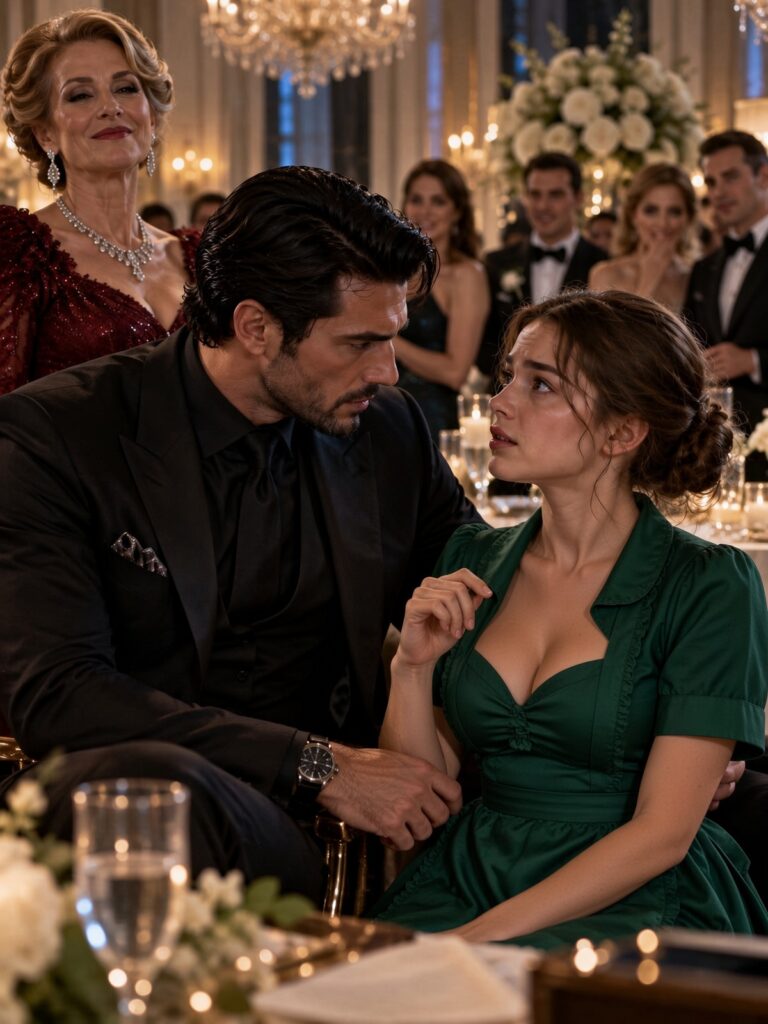
HIS STEPMOTHER INVITED A DEAF WAITRESS TO HUMILIATE HER—THEN THE MOST FEARED MAN IN NEW YORK ANSWERED HER IN SIGN LANGUAGE
Bianca Ferraro invited a poor deaf waitress to a ballroom full of powerful families because she thought watching her stepson reject the girl would be funny.
The laughter had already begun when Philippe Ferraro—the man half of New York’s waterfront feared—rose from his chair and walked directly toward the woman everyone else had reduced to a joke.
Then he lifted both hands and signed, You are the only person in this room who has nothing to be ashamed of.

PART 1 — THE JOKE THAT STOPPED BEING FUNNY
Haven Hart had learned at nine years old that silence was not the same thing as peace.
Meningitis had taken her hearing in less than a week. Rain disappeared first. Then music. Then her mother’s voice.
What remained was movement.
Faces.
Hands.
The shape of anger before a mouth formed the words.
At twenty-seven, Haven worked evening shifts at a small Brooklyn diner because observation could compensate for many things employers insisted on calling limitations.
Not everything.
“Three complaints this month.”
Her manager stood beneath the kitchen’s fluorescent light, speaking slowly enough for her to read his lips.
“I don’t care whether customers understand your hearing problem.”
“I need faster service.”
Haven said nothing.
He knew sign language only well enough to wave her away.
So she walked back into the dining room, lifted another tray, and kept moving.
Pearl, the diner’s seventy-year-old former owner, watched from the register.
When Haven passed, Pearl slid a handwritten note toward her.
DON’T LET PEOPLE WHO DON’T KNOW HOW TO SEE MAKE YOU FORGET WHAT YOU’RE WORTH.
Haven folded it carefully.
Beside it in her apron pocket sat a hospital collection notice left from her mother’s final illness.
Six figures once.
Still crushing.
Then the diner door opened.
Every head turned.
A handsome man in an expensive coat walked straight toward Haven.
Trevor Ashford.
He spoke deliberately and also wrote as he talked.
A private event.
Long Island estate.
One evening.
Two thousand dollars.
Haven wrote:
Why me?
His smile remained perfect.
His eyes changed.
Only for half a second.
“My aunt once saw you work here.”
“She admired how observant you are.”
Pearl read over Haven’s shoulder.
Two thousand dollars could buy months of breathing room.
Haven’s instincts said no.
Her bank account said otherwise.
Three days later, she stood inside Pearl’s apartment while the old woman altered a midnight-blue dress she had worn forty years earlier.
“Beautiful clothes don’t belong only to wealthy women.”
Pearl wrote.
“Neither do beautiful rooms.”
Saturday night, Haven arrived at the Ferraro estate.
Nobody explained why she was placed alone in a waiting room instead of being shown to a work station.
Nobody gave her instructions.
When towering doors finally opened, she stepped into a ballroom beneath three crystal chandeliers.
Forty guests turned toward her.
Bianca Ferraro stood at the head table wearing wine-colored silk and pearls.
She raised a glass.
Haven read her lips.
At first:
Welcome.
Family reconciliation.
A surprise.
Then:
“My stepson Philippe has ignored every suitable woman in New York.”
Laughter began.
Haven saw it before she understood why.
Bianca continued.
“So I decided perhaps we should lower expectations.”
More laughter.
“And I found him someone wonderfully simple.”
“A Brooklyn waitress.”
Then Bianca smiled directly at Haven.
“And do be patient with her.”
“The poor girl can’t hear a word you’re saying.”
Haven stopped breathing.
The two thousand dollars.
Trevor.
The borrowed dress.
The waiting room.
She was not staff.
She was entertainment.
Guests laughed behind raised glasses.
One woman leaned toward another.
A man covered his mouth.
Haven saw every movement.
Silence did not protect her from laughter.
It only forced her to watch it happen.
Then the room changed.
One by one, mouths closed.
Heads turned.
At the center table, Philippe Ferraro had risen.
Black suit.
Broad shoulders.
A face New York newspapers rarely photographed clearly and criminals rarely forgot.
Bianca’s smile faltered.
Philippe crossed the marble floor.
Not toward his stepmother.
Toward Haven.
He stopped an arm’s length away.
Looked directly into her eyes.
Then raised both hands.
Haven’s heart stopped.
His fingers moved.
Not awkwardly.
Not performatively.
Fluently.
Hello.
Haven forgot the room.
Philippe continued.
I’m sorry for what they did.
Another sentence.
You have nothing to be ashamed of.
His hands paused.
Then:
You are the only person here who doesn’t.
At the far end of the ballroom, Bianca’s wineglass tilted.
Dark red spilled across the white carpet.
And suddenly nobody was laughing anymore.
PART 2 — THE WOMAN HIS MOTHER TAUGHT TO SPEAK
Haven stared at Philippe’s hands.
They were large hands.
Hands that, according to every whispered story in New York, had signed shipping contracts, property transfers, and orders powerful men obeyed without asking twice.
Yet they moved through American Sign Language with the ease of memory.
Her own hands rose.
They trembled once.
She steadied them.
You are the last thing I expected tonight.
Something almost human touched Philippe’s mouth.
Not quite a smile.
Behind him, Bianca remained standing beside her chair.
Philippe did not look back.
Instead, he turned toward the house manager.
“Set another table.”
His voice was quiet.
Everyone obeyed.
“A private table.”
“By the windows.”
Bianca finally spoke.
“Philippe, darling, this was only—”
He lifted one finger.
That was all.
She stopped.
The Table by the Window
A small table appeared beside the long glass wall overlooking the Ferraro gardens.
The change took less than two minutes.
That frightened Haven almost as much as the banquet itself.
Power, she realized, could move furniture faster than embarrassment could leave a body.
Philippe pulled out her chair.
He did not touch her.
Haven sat.
Then he sat opposite.
The remaining forty guests attempted to resume dinner while pretending not to watch them.
Nobody succeeded.
A young server approached.
He looked only at Philippe.
“What would sir like?”
“And what may I bring for the lady?”
Haven had lived that sentence a thousand times.
People saw deafness and transferred her adulthood to whoever stood nearby.
She reached for the menu.
Philippe stopped the server.
“You have two guests.”
The young man went pale.
“Sir?”
“Turn around.”
“Look at her.”
“Wait for her to answer.”
The server obeyed.
Philippe signed to Haven:
What would you like? I’ll interpret if you want me to.
Haven looked at the menu.
Fish. Chamomile tea. No lemon.
Philippe repeated it.
Exactly.
The server bowed to Haven first.
It was a tiny thing.
So tiny Haven hated the sting that formed behind her eyes.
Respect should not feel extraordinary.
That it did said more about the world than about Philippe Ferraro.
Why Do You Know My Language?
The question remained between them until the server left.
Haven signed:
Why do you know ASL?
Philippe’s hands became still.
The hardness returned to his face.
Then two words.
My mother.
Haven waited.
He did not elaborate.
She understood closed doors.
So she changed the subject.
Did you know about tonight?
No.
Would you have come if you did?
Philippe thought.
Yes.
Her eyebrows rose.
He continued.
Because Bianca stages things when she feels control slipping. I prefer seeing the stage.
Haven glanced toward Bianca.
The older woman sat rigidly beneath the chandeliers.
One red-painted fingernail tapped her champagne flute.
Again.
Again.
Again.
Haven signed:
She hates me now.
Philippe answered:
She didn’t know you before tonight. Hate would require effort. What she hates is losing control of the story.
Haven looked at him differently.
Maybe powerful men survived by reading rooms too.
Franco
An elderly man stood near the wall.
Silver hair.
Straight posture.
The composure of someone who had served one family long enough to stop being mistaken for staff.
His eyes never left Philippe’s hands.
Haven noticed.
Philippe noticed her noticing.
Franco.
He signed.
He worked for my father.
Haven asked:
Why is he crying?
Philippe turned.
Franco looked away immediately.
Philippe’s expression changed.
Just slightly.
He did not answer.
The First Memory
Dinner ended.
Philippe escorted Haven outside himself.
Trevor was nowhere to be seen.
A taxi waited.
Philippe handed her a black business card.
No company logo.
Just a number handwritten on the back.
He signed:
If you need anything.
Haven stared.
Then:
I don’t like owing people.
Philippe’s gaze sharpened.
Good. Neither do I.
She left.
Inside the estate, Philippe found Franco in the library.
“You were staring.”
Franco looked toward the dark windows.
“Your mother used to sign that way.”
Philippe’s jaw tightened.
“I know.”
“No.”
Franco turned.
“I mean your face.”
Philippe went still.
“When you signed.”
“You looked like her.”
“Enough.”
Franco nodded.
But before leaving, he said:
“I have not seen you use that language since Adelina died.”
Philippe stood alone after that.
His hands felt strange.
Awake after years of sleep.
The Diner
Haven returned to work Monday.
At six-thirty, the manager summoned her.
This time he spoke slowly.
Too slowly.
Almost enjoying himself.
“We’re cutting staff.”
Haven looked at the full schedule posted behind him.
He continued.
“You receive too many complaints.”
“So tonight is your last shift.”
Haven reached for her notebook.
Then stopped.
On his desk sat a thick cream envelope.
High-quality paper.
Gold-edged.
Something expensive enough not to belong beside greasy payroll folders.
The manager noticed her looking.
Closed the drawer.
Haven understood.
Not proof.
A pattern.
She removed her apron.
Folded it.
Placed it on the desk.
No argument.
Outside, rain had started.
She walked home.
The next morning, a rent-increase notice appeared under her door.
Nearly double.
Thirty days.
Haven sat on her bed.
Counted the banquet money.
Rent.
Food.
Collections.
Seven weeks.
Maybe eight if she stopped paying medical debt.
Her hand went toward Philippe’s business card in the drawer.
Stopped.
She could ask.
One message.
He could probably buy the building.
That was exactly why she did not.
Pearl Knows
For four days, Haven applied everywhere.
Restaurants.
Hotels.
Event halls.
Every interview changed when they learned she was deaf.
“Phones are important.”
“Emergency communication.”
“Guest expectations.”
Haven offered speech-to-text technology.
Written systems.
Experience.
Most smiled politely.
No.
At night she returned to the diner after closing and drank tea with Pearl.
She did not mention the rent.
Pearl learned anyway.
Older women who have spent decades behind cash registers develop investigative techniques that require no formal authority.
Friday afternoon, the diner door opened.
Conversation stopped.
Philippe Ferraro walked in.
Franco behind him.
Haven was not there.
Philippe looked toward Pearl.
“She hasn’t answered.”
Pearl removed her glasses.
“Phone disconnected.”
“Why?”
“Couldn’t pay.”
Philippe’s face hardened.
“Where is she?”
Pearl studied him.
Not the suit.
Not the bodyguard.
His hands.
Then she said a name.
“Adelina.”
Philippe froze.
Pearl leaned forward.
“You’re Adelina’s boy.”
It was not a question.
Franco inhaled.
Philippe stared at her.
Pearl pointed toward the chair opposite.
“Sit down.”
Nobody had ordered Philippe Ferraro to sit in years.
He sat.
Fifteen Years Earlier
Pearl had owned the diner then.
Next door stood a struggling community center.
Every Tuesday afternoon, a deaf woman named Adelina taught sign language there for free.
Poor children.
Immigrant families.
Kids who had lost hearing through illness and had no access to specialized services.
“She never gave me a surname.”
Pearl said.
“She arrived by taxi.”
“Left by taxi.”
“She wore an old wool coat.”
“And a little silver bird.”
Philippe’s breath changed.
Pearl saw.
“A swallow.”
His mother’s brooch.
Wedding gift from Aurelio Ferraro.
Unique.
Philippe remembered it pinned to her lapel every Tuesday.
She never told him where she went.
His father never asked in front of the children.
Pearl continued.
“One student was twelve.”
“Deaf since nine.”
“Mother drowning in medical bills.”
“Father gone.”
“She barely knew proper sign language.”
“She sat in the back corner.”
“Wouldn’t look at anyone.”
Philippe already knew.
Not consciously.
Some deeper part of him had arrived before the story.
The diner door opened.
Haven entered carrying job applications.
She stopped.
Pearl waved her over.
Then wrote:
Do you still have Adelina’s swallow?
Haven’s face changed.
She reached into her canvas bag.
Removed a chipped tin box.
Opened it.
Silver.
Darkened with age.
Wings spread.
Philippe’s entire body became still.
Pearl placed the brooch in his hand.
Haven Learns Her Teacher’s Name
Philippe stared at the swallow.
His father fastening it to Adelina’s wedding dress.
His mother wearing it to Mass.
His mother laughing silently when five-year-old Philippe signed the wrong word for horse and accidentally asked for a refrigerator.
His mother’s coffin.
No swallow.
At the time, he had assumed it lost.
Haven watched him.
Then remembered the banquet.
His answer:
My mother.
Understanding spread across her face.
Her hands rose.
Adelina was your mother?
Philippe tried to answer.
His fingers trembled.
The most feared man along the New York waterfront could not produce a sentence.
Pearl did it for him.
“Your mother gave Haven her first language.”
Haven’s eyes filled.
Pearl continued.
“She pulled that girl out of silence.”
“Fifteen years later, her son walked across a ballroom and did the same thing.”
Philippe looked at Haven.
Then at the swallow.
Something locked inside him for twelve years shifted.
His Offer
Philippe learned about Haven’s firing.
The rent.
The debt.
His first instinct was exactly wrong.
“I’ll handle it.”
Haven’s hands cut through the air.
No.
He frowned.
She continued.
If you pay my bills because your mother helped me, then her kindness becomes debt.
Philippe had never heard it phrased that way.
The diner manager was paid.
He signed.
I can prove that.
Haven’s expression hardened.
Then prove it. But don’t buy my life.
Franco hid the smallest smile.
Philippe noticed.
Ignored him.
What can I do?
Haven thought.
Then:
Give me access to a fair opportunity. Nothing else.
Philippe knew one.
Ferraro Grand Hotel.
Lobby coordinator vacancy.
Real position.
Real HR director.
He signed:
I can request they accept your application. I won’t decide the interview.
Haven studied him.
Then nodded.
The Interview
Helen Park had spent thirty years in hotel operations and did not care who Philippe Ferraro’s mother had taught.
She cared whether Haven could manage a guest screaming about lost luggage during a convention check-in surge.
Every interview question appeared on a tablet.
“Telephone communication?”
Haven showed speech-to-text software.
Relay services.
Prepared written protocols.
“Emergency announcements?”
Visual alert integration.
Radio-to-text device.
Team buddy system.
“What advantage do you bring?”
Haven typed:
I read rooms before they become problems. Hearing people often wait until anger becomes loud. I notice earlier.
Helen staged three scenarios.
Haven solved all three.
In the final scenario, the guest actor became increasingly aggressive over an incorrect invoice.
Haven wrote calmly:
You are right that the total is wrong. You do not need to become louder for me to take it seriously. Give me three minutes.
The actor stopped performing.
Helen laughed.
Three days later, Haven received the job.
One-and-a-half times her diner pay.
Full benefits.
No unexplained bonus.
Haven read the email four times.
Then opened her apartment window.
She laughed silently into Brooklyn evening traffic.
The Locked Room
That night Philippe stood outside a door at the end of his penthouse hallway.
Locked twelve years.
Adelina’s room.
Aurelio had never changed it after she died.
After Aurelio’s death, Philippe kept the room sealed out of habit and cowardice.
He put in the key.
Turned it.
Dust.
Books.
A faded armchair.
A wool coat.
Old ASL teaching manuals.
One workbook contained the pencil handshapes of a five-year-old Philippe.
He sat until nearly three in the morning.
Then began practicing.
Slowly.
Stiff fingers relearning a language grief had persuaded him to abandon.
Autumn
Coffee became a walk.
Walk became dinner.
Dinner became Sunday afternoon beside the harbor.
Philippe’s ASL returned quickly.
His style was economical.
Short sentences.
Few decorative movements.
Haven teased him.
You sign like a contract.
He replied:
Efficient.
Emotionally constipated.
He stopped.
She smiled.
Then slowly showed him the correct sign because he had misunderstood one word.
For the first time in years, Philippe laughed.
Real laughter.
One of his guards turned around in shock.
Haven could not hear the sound.
She watched his shoulders shake.
That was enough.
Silence
One cold Sunday, they sat beside the Hudson.
Haven signed:
Hearing people are terrified of silence.
Philippe looked at her.
Why?
They think if nobody speaks, something is wrong.
She looked toward the water.
My world is mostly silent. I learned silence is only lonely when the person beside you wishes they were somewhere else.
Philippe said nothing.
For ten minutes.
Neither signed.
Neither reached for a phone.
Nothing felt missing.
That frightened him more than attraction.
Bianca Watches
Bianca knew.
Of course she knew.
Photographs arrived at her estate.
Philippe entering the diner.
Haven leaving the hotel.
The two walking beside the river.
Bianca arranged them beneath a lamp.
Trevor stood nearby.
“Why do you care?”
She looked at him.
“Because Philippe has spent twenty years with no obvious vulnerability.”
Trevor glanced at Haven’s photograph.
“And now?”
Bianca touched one painted fingernail to the image.
“Now he has a face.”
Aurelio’s File
Franco entered Philippe’s office one Monday morning.
No knock.
Cream folder.
Private-flight itinerary.
“Bianca flew before dawn.”
“Where?”
“Private airport outside the city.”
“Voss-controlled hangar.”
Philippe looked up.
Elias Voss.
Old rival.
Patient.
Rich.
Never touched anything directly.
“What can she offer?”
“Thirty percent shares.”
“No control.”
“Not enough.”
Franco sat without permission.
That told Philippe more than the flight itinerary.
“Sir.”
“I kept something after your father died.”
Philippe’s expression changed.
Franco placed a safe-deposit key on the glass desk.
One hour later, Aurelio Ferraro’s leather file lay open.
Customs seizures.
Shipping schedules leaked.
Offshore payments.
A shell company linked through legal intermediaries to Bianca’s expenses.
Jewelry.
Miami apartment.
Travel.
All funded by investment structures associated with Elias Voss.
Philippe read.
“Father knew?”
“Suspected.”
“He scheduled a council meeting.”
“When?”
“Three days after he died.”
Philippe looked up slowly.
Franco did not sensationalize.
“I cannot prove Bianca killed him.”
“The medical record said cardiac arrest.”
“Your father did have heart disease.”
“But she benefited from his death.”
“She also escaped investigation because the file disappeared from active review.”
“Why didn’t you tell me?”
Franco’s face tightened.
“I had suspicion.”
“Not proof.”
“You had just inherited the family.”
“You wanted war with everyone.”
“I thought if I gave you a ghost, you would shoot at shadows.”
Philippe closed the file.
He was angry.
Franco accepted it.
Finally Philippe said:
“Put someone on Bianca.”
“Licensed investigators.”
“Financial forensic team.”
“No family soldiers.”
Franco raised an eyebrow.
“You’ve changed.”
“No.”
Philippe looked toward Haven’s last message on his phone.
No debt disguised as kindness.
“Maybe I’m becoming more expensive.”
Bianca Apologizes
A handwritten invitation reached Haven through the hotel.
Bianca wanted lunch.
Public restaurant.
Formal apology.
Haven showed Pearl.
Pearl wrote:
A snake can apologize. It still has teeth. Meet in public. Order your own drink. Tell someone where you are.
Haven laughed.
Then went.
Bianca wore no pearls.
No theatrical gown.
Simple cream blouse.
She used a writing pad.
I behaved cruelly.
I spent years being treated as an outsider before I married Aurelio. I became the exact woman I once hated.
Haven read.
Bianca’s eyes reddened.
Just enough.
I am ashamed.
Then the black box.
Cream leather handbag.
Elegant.
Expensive.
Haven hesitated.
Bianca wrote:
No conditions. An apology from one woman to another.
Haven should have refused.
Her instincts told her something remained too polished.
But the orphaned part of a person is often vulnerable to older women admitting fault.
She accepted.
Bianca smiled.
In the car afterward, Trevor gripped the steering wheel.
“The device was bought through my account.”
“You said it would be destroyed.”
Bianca looked out the window.
“Drive.”
The Council Meeting
End of November.
Six allied families.
Top floor of Ferraro Grand.
Confidential discussion about port structure.
Haven had no role in it.
Philippe simply messaged:
Wait for me in the executive lounge at six. Dinner after.
At five-forty-five, Haven left her front-desk shift.
Cream handbag over one shoulder.
Bianca’s assistant personally escorted her upstairs.
The ordinary security checkpoint was bypassed under his credential.
Fifteen minutes later, the same assistant reappeared.
“Secondary VIP security check.”
He spoke slowly enough for Haven to read.
She handed over the bag.
He opened it.
Reached beneath the lining.
Stopped theatrically.
Cut the seam.
Pulled out a flat black recorder.
Red light blinking.
Haven went cold.
Conference doors opened.
Men emerged.
Voices.
Questions.
Angry mouths everywhere.
One technician examined the recorder.
Then said a name Haven understood immediately.
Voss.
Every face turned toward her.
Bianca’s Performance
Bianca pushed through the circle.
Hand over chest.
Tears.
“My God.”
Then she spoke slowly.
Deliberately.
For Haven.
“It was me.”
“I brought her into this family.”
“Remember the dinner.”
“I selected her.”
“I thought she was random.”
“I never realized she was placed where I would find her.”
Heads turned.
Bianca continued.
“They studied Philippe.”
“They knew about Adelina.”
“They knew a deaf girl would affect him.”
“They used his mother’s memory.”
Haven’s hands rose.
She gave me the bag.
Nobody understood.
She invited me to lunch.
Men watched her hands move.
Blank faces.
She signed faster.
Check the restaurant. Check the box. Trevor brought me to the estate.
Nothing.
For the first time since childhood, Haven was not merely deaf.
She was voiceless.
Then Philippe stepped forward.
He understood everything.
The elder council representative said:
“Ferraro.”
“The law is clear.”
“A recorder inside this meeting is betrayal.”
“If she belongs to you, you deal with her.”
Haven saw the phrase:
belongs to you.
Her face hardened.
Philippe crossed the room.
Stopped before her.
Raised both hands.
Look at me.
She did.
Tell me the truth.
Haven’s shoulders straightened.
I knew nothing about the recorder. Bianca gave me the bag.
Then:
But I won’t beg.
Philippe’s jaw tightened.
Haven continued.
My entire life people looked through me. You were the first man who stopped a room and made them look at me. If even you cannot see me now, then do whatever you believe you must. I will not make myself smaller to look innocent.
She removed the handbag.
Placed it on the table.
Stepped back.
No tears.
No pleading.
Bianca cried beautifully behind them.
The guilty, Philippe remembered, often prepared their emotions better than the innocent.
But evidence remained evidence.
He turned toward the council.
“The law also requires proof.”
“You have forty-eight hours.”
The elder replied.
Philippe nodded.
“If she did this, I will bring you the proof myself.”
“And if she didn’t?”
The elder asked.
Philippe looked toward Bianca for the first time.
“Then somebody in this room made a mistake they will remember for the rest of their life.”
Haven left.
Rain swallowed her outside the hotel.
Philippe remained with the blinking recorder on the table.
Forty-eight hours.
And somewhere inside him, the son Adelina raised was already certain of one thing the kingpin could not yet afford to say aloud.
Haven had told him the truth.
PART 3 — THE WOMAN WHO BUILT THE STAGE STOOD ON IT LAST
Philippe did not follow Haven.
Every instinct demanded it.
He wanted to find her, tell her he believed her, put guards around her apartment, erase the rent increase, destroy the manager who had fired her.
That was precisely why he stayed.
Trust that ignored evidence was not trust.
It was indulgence.
And Haven had not asked him to indulge her.
She had asked him to see her clearly.
“Franco.”
The old man stepped forward.
“Cancel everything.”
“Pull hotel footage for seven days.”
“Every corridor.”
“Every service entrance.”
“Parking.”
“Elevators.”
“Employee access records.”
“And nobody connected to Bianca touches the archive.”
Franco nodded.
“What about Haven?”
Philippe’s voice lowered.
“One guard.”
“Distant.”
“She does not see him unless risk changes.”
“Do not enter her apartment.”
“Do not speak to Pearl.”
“Do not interfere with her.”
Franco almost smiled.
“You learned.”
“Go.”
Brooklyn
Haven sat inside the dark diner after closing.
Pearl poured tea.
It went cold.
Haven wrote:
I’m returning the swallow.
Pearl read.
Said nothing.
Haven continued.
It belongs to Philippe’s family.
I don’t.
Pearl took off her glasses.
Then closed Haven’s fingers around the brooch.
Her note came slowly.
This bird cannot sing.
Yet it crosses oceans and returns home through storms.
Haven looked up.
Pearl continued.
Adelina did not give you language so you could disappear whenever powerful people refused to understand it.
Haven’s eyes burned.
Keep the bird.
Decide where you belong after the truth arrives. Not before.
Haven put the swallow back into its tin box.
Camera One
At eleven-forty, Philippe found the first inconsistency.
Bianca’s assistant had passed through the executive lounge three times before Haven arrived.
No assigned duty.
No guest request.
Each time, he checked his watch.
Waiting.
“Mark it.”
Franco did.
Camera Two
One-thirty in the morning.
Parking footage from five days earlier.
Bianca’s reconciliation lunch.
Trevor’s car.
A black gift box sat on the rear seat.
Bianca’s assistant removed it.
Carried it inside.
Thirty-eight minutes later, Haven exited carrying the cream handbag.
Philippe paused the frame.
“Trevor stayed in the vehicle?”
“Yes.”
“Get purchase history through lawful channels.”
“Already moving.”
The Serial Number
The recorder was custom hardware.
Not common retail.
A security supplier had sold a small batch to corporate-investigation firms.
Payment records required cooperation.
Philippe’s lawyers obtained emergency preservation requests first.
No threats.
No break-in.
No magical hacker.
By noon, they had an invoice.
A consulting company.
Another shell.
Payment card linked to Trevor Ashford.
Franco placed the record down.
“That’s enough to clear Haven.”
“No.”
Philippe looked at him.
“It is enough to begin clearing her.”
“We need the person who gave the order.”
Trevor Breaks Before Anyone Touches Him
Trevor was not a criminal mastermind.
He was a wealthy nephew who enjoyed proximity to dangerous people but had never learned to withstand pressure.
Investigators interviewed him through counsel.
He denied everything.
Then surveillance records showed his account paid for the device.
Hotel access logs showed Bianca’s assistant bypassing primary security.
Restaurant camera showed the gift box.
Trevor’s attorney requested another meeting.
This time:
“My client wishes to clarify his involvement.”
Philippe did not attend.
He wanted evidence uncontaminated by fear of him.
Franco did.
Trevor admitted purchasing the recorder.
Claimed Bianca said it was for “defensive intelligence.”
Admitted recruiting Haven for the first banquet.
Admitted being instructed specifically to locate “someone poor, unconnected, preferably socially vulnerable.”
Franco’s face hardened.
“Why deaf?”
Trevor looked down.
“Bianca knew Philippe’s mother was deaf.”
There it was.
The original humiliation had never been random.
Bianca had aimed directly at Adelina’s memory.
Aurelio’s File Matches
The lawyer used to purchase the recorder had represented one intermediary in Aurelio’s old offshore investigation.
Same address history.
Same accountant.
Different shell company.
Three years apart.
Philippe spread both sets of papers on the glass desk.
Present betrayal.
Past betrayal.
One structure.
Franco whispered:
“She never stopped.”
Philippe looked toward the harbor.
“No.”
“She just got better at costume changes.”
The Medical Question
Bianca’s connection to Aurelio’s death remained different.
Suspicion.
Not proof.
Philippe refused to merge them.
Franco asked:
“You think she killed him?”
Philippe answered:
“I think she had motive.”
“That is not evidence.”
“Then we do not call it murder.”
He ordered Aurelio’s archived medical records preserved and reviewed by independent forensic specialists through counsel.
No conclusion promised.
The distinction mattered.
Haven would have demanded it.
That thought surprised him.
Twenty-Nine Hours
Philippe had enough to clear Haven long before the deadline.
He used the remaining time to build a chain nobody could dismiss.
Device purchase.
Trevor.
Assistant access.
Restaurant box transfer.
Bag seam.
Hotel bypass.
Bianca’s communications with Voss-linked intermediaries.
Then, finally, an email deleted but preserved through a cloud backup:
She must enter through executive lounge with the bag intact. Make sure she does not pass normal screening.
Sender:
Bianca.
Philippe read once.
Closed the laptop.
“Call the council.”
“When?”
“Tomorrow.”
“Where?”
Franco knew before he finished asking.
The Long Island estate.
Same ballroom.
Same chandeliers.
Same chair.
Philippe said:
“She built the stage.”
“She should see how it looks from the center.”
Haven Does Not Know
Franco suggested calling her.
Philippe shook his head.
“Why?”
“Because if I tell her now, I’m asking her to trust my version before I finish proving it publicly.”
“She deserves the same room that accused her.”
Franco nodded.
“Your mother would approve.”
Philippe looked at him.
“Do not weaponize the dead against me.”
Franco smiled.
“There you are.”
Seven O’Clock
No dinner.
No music.
No white flowers.
Just six families around a long table.
Bianca wore black.
Trevor sat beside her looking ill.
Philippe stood beneath the chandelier where Haven had once stood in a borrowed dress.
The elder council representative looked at his watch.
“You asked forty-eight hours.”
“You used thirty-one.”
Philippe replied:
“I found the truth early.”
Bianca smiled faintly.
Confident.
“Then perhaps we can stop humiliating this family and move on.”
Philippe clicked the remote.
The first video appeared.
Her assistant.
Executive lounge.
Waiting.
Second.
The reconciliation lunch.
Gift box.
Trevor’s car.
Third.
Security access.
Primary screening bypassed.
Fourth.
Invoice.
Device model.
Trevor’s card.
Trevor stood.
“That account was compromised.”
Philippe clicked again.
Email.
Bag intact. Executive lounge. Avoid normal screening.
Bianca’s name.
Trevor sat down.
Nobody spoke.
Trevor Chooses Himself
Philippe did not threaten him.
He did not need to.
Trevor’s attorney had already explained exposure.
The young man broke in the exact way cowardice often breaks:
By sacrificing the person who taught it.
“She told me to do it.”
Bianca’s head turned.
“Trevor.”
“You told me to find the girl.”
“You said it would make Philippe ridiculous.”
“You said he would never defend her because he hates weakness.”
“Trevor.”
“You told me to buy the recorder.”
Her voice sharpened.
“Be quiet.”
“You promised my name wouldn’t appear.”
“Enough.”
“No.”
The word surprised even Trevor.
He looked toward the council.
“I drove her to meet Voss people.”
“I opened the account.”
“I paid the supplier.”
“She told me it was one use.”
“She told me the bag would be destroyed.”
Bianca stared at him.
The beautiful mask finally cracked.
Aurelio
Philippe raised one hand.
Trevor stopped.
A leather file appeared on the screen.
“My father assembled this.”
Bianca’s face changed.
Not much.
Enough.
“Three years of payments from a Voss-linked fund into a shell structure connected to Bianca.”
“Shipping information leaked during the same period.”
“My father scheduled a council review.”
“He died before that review.”
Bianca spoke immediately.
“Philippe, do not disgrace Aurelio’s memory with conspiracy theories.”
“I’m not.”
His calm unsettled her.
“I am presenting financial records.”
“Nothing more.”
He looked toward the elders.
“My father’s death is being independently reviewed.”
“If it was natural, the record will say natural.”
“If it was not, investigators will decide what follows.”
Bianca swallowed.
A trap works best when the accused overreacts to facts you have not yet stated.
Voss Walks Away
The Voss representative closed his leather portfolio.
“Elias did business with intermediaries.”
He said.
“He did not authorize surveillance inside a council meeting.”
The room heard the meaning.
Voss would sacrifice Bianca before sharing her fall.
Philippe nodded.
“Expected.”
The representative left.
Bianca watched him go.
For the first time that night, she understood she was alone.
The Council’s Question
The elder said:
“Under old rules, conspiracy against the council has consequences.”
Nobody needed the details.
He looked toward Philippe.
“What do you request?”
Bianca’s eyes moved to him.
Fear.
Real this time.
Philippe placed a sealed evidence box on the table.
“Nothing from this room.”
Murmurs.
He continued.
“Copies of financial records, obstruction evidence, surveillance purchase records, and tax documentation have been preserved through counsel.”
“Tomorrow morning they go to federal authorities.”
Bianca’s mouth opened.
Philippe looked directly at her.
“You spent your life believing private power was safer than public law.”
“I think you should test that theory.”
The elder studied him.
Then nodded.
No execution.
No disappearance.
No romanticized punishment.
Paperwork.
Subpoenas.
Charges if prosecutors found the evidence sufficient.
Consequences requiring no applause.
Bianca’s Last Weapon
As the room emptied, Bianca approached Philippe.
“You think that deaf girl made you better?”
Her voice shook.
“She made you weak.”
Philippe looked at her.
“No.”
“She reminded me weakness and cruelty are different things.”
Bianca laughed bitterly.
“You think she loves you?”
“She loves what you did for her.”
He shook his head.
“I gave her nothing she didn’t earn.”
“Job?”
“Interview.”
“Center?”
Bianca frowned.
“What center?”
Philippe did not answer.
Not yet.
That belonged to Haven.
The Diner at Dawn
Franco called Pearl at six-fifteen.
The old woman wrote everything down.
Haven arrived at seven.
Read it.
Bianca exposed.
Trevor confessed.
Device traced.
Council acknowledged Haven’s innocence.
Federal investigators receiving records.
Haven placed both hands on the table.
Pearl waited for tears.
None came.
Haven signed:
I need to walk.
Pearl nodded.
The Old Community Center
Haven’s feet carried her next door to the building that once held Adelina’s Tuesday class.
Boards covered windows.
Door locked.
She stood on the sidewalk.
Fifteen years collapsed.
A twelve-year-old Haven in the corner.
No language.
No confidence.
Adelina kneeling.
First sign:
HELLO.
Second:
MY NAME.
Third:
YOU.
Not deaf girl.
Not poor child.
You.
Haven touched the tin box inside her bag.
Then another shadow joined hers.
Philippe.
No guards beside him.
Simple dark coat.
Tired eyes.
He did not sign.
He placed a brass key in her palm.
Haven frowned.
Philippe nodded toward the door.
She climbed the steps.
The lock was new.
Inside, morning light crossed freshly cleaned wood floors.
Boards had been removed from the windows.
Tables waited beneath plastic coverings.
A wall-mounted screen.
Visual emergency alarms.
Shelving.
A small office.
And beside the entrance, a wooden sign.
THE ADELINA CENTER
WHERE HANDS ARE A VOICE
Haven stopped.
Not a Gift
Philippe signed quickly before emotion changed the meaning.
Before you refuse: this does not belong to you.
She blinked.
He continued.
A nonprofit trust owns the building. Independent board. Pearl accepted a seat. The Deaf Community Alliance accepted another. My foundation funded renovation, not control.
Haven looked toward Pearl, who had just entered with Franco.
Pearl smiled.
Philippe continued.
You have been offered a paid program-director role if you want it. You can say no. The board will hire someone else.
Haven stared at him.
He had anticipated every reason she might reject it.
Not to corner her.
To preserve her choice.
Why?
He looked around.
My mother gave language here.
Then at Haven.
You carried it out.
I only reopened the door.
The Question
Philippe’s hands became less certain.
For perhaps the first time since she met him.
There is something else.
Haven waited.
For twelve years I kept my mother’s room locked because remembering her made me feel weak.
He paused.
Then you walked into a ballroom wearing her language.
You made me understand I had not protected her memory. I had buried part of myself with her.
Haven’s eyes filled.
Philippe continued.
I don’t want to own your problems.
I don’t want to pay for your life so you owe me a place in it.
I want something more difficult.
His hands trembled.
I want you to stay because you want to.
Not forever.
Not marriage.
Not destiny.
Just:
Stay long enough to see what this can become. The center. Us. Whatever we choose.
Haven cried then.
Silently.
She opened the tin box.
Removed Adelina’s silver swallow.
Pinned it to her own coat.
Philippe stared.
Haven signed:
I am staying for the center.
His mouth almost smiled.
She added:
And I’m willing to keep finding out about us.
That smile finally arrived.
No Kiss Yet
Philippe stepped closer.
Stopped.
Asked:
May I?
Haven looked at him.
Then shook her head.
His face changed.
She smiled through tears.
Signed:
Not with Pearl watching.
Behind them, Pearl slapped Franco’s arm.
Franco laughed.
They went outside.
Five minutes later, alone beside Philippe’s car, Haven kissed him first.
The Investigation
Bianca was not arrested the next morning merely because Philippe wanted it.
Months followed.
Subpoenas.
Grand jury.
Financial analysis.
The recorder plot produced clean evidence.
Tax and money-laundering counts followed documented transactions.
The Voss connection widened the investigation.
Aurelio’s death remained more complicated.
Exhumation was considered but forensic experts warned time and embalming limited what could be established.
Medical records showed his heart condition was real.
One medication discrepancy raised questions.
Not certainty.
Ultimately, prosecutors did not charge Bianca with Aurelio’s death.
Philippe hated the uncertainty.
Haven did not comfort him with a lie.
She signed:
Not knowing is painful. It is still better than inventing certainty because certainty feels cleaner.
He carried that sentence for years.
Bianca was eventually convicted on financial and surveillance-related offenses supported by evidence.
She lost assets tied to criminal proceeds.
Lost influence.
Lost the Ferraro family.
Not everything.
Justice rarely creates perfect symmetry.
Trevor
Trevor cooperated.
Received lesser consequences than Bianca.
Public disgrace hurt him more than he admitted.
Months later, he wrote Philippe.
Then Haven.
Haven read the apology once.
He explained he needed money.
Wanted Bianca’s approval.
Never thought the banquet humiliation would become “that serious.”
Haven wrote back only one sentence.
Humiliation was already serious before it became dangerous.
No friendship followed.
Haven Keeps Her Hotel Job
She did not immediately quit.
That surprised Philippe.
“The center needs a director.”
He signed.
Haven replied:
It also needs someone who understands workplaces from the employee side. I’m finishing six months at the hotel first.
Helen Park promoted her to senior guest-services coordinator after performance review.
No Philippe vote.
No Ferraro exception.
Haven trained staff on disability communication.
Not just deaf guests.
Mobility.
Vision.
Cognitive differences.
She redesigned one check-in protocol so every guest could choose text, speech, or written communication.
Complaint resolution improved.
Helen showed her the numbers.
“Your system saves time.”
Haven smiled.
Accessibility had once been treated as charity.
Now it appeared in an efficiency report.
That amused her.
Philippe’s Mother’s Room
He invited Haven inside months later.
Not the first week.
The room remained mostly unchanged.
Adelina’s coat.
Books.
Photographs.
A small framed picture showed Aurelio young, smiling, his hands awkwardly forming a sign beside his wife.
Haven laughed silently.
Philippe frowned.
What?
She pointed.
He signed ‘cow’ instead of ‘love.’
Philippe stared.
Then laughed.
His father—the feared Aurelio Ferraro—had apparently preserved his linguistic humiliation in a framed photograph.
Haven touched one shelf.
Was she born deaf?
Yes.
Did your father sign?
Badly. Enthusiastically.
That explains you.
He pretended offense.
Aurelio’s Answer
Franco once told Haven the story Philippe already knew.
At a dinner years earlier, a man mocked Adelina.
Asked how Aurelio could choose a wife who could not hear.
Aurelio answered:
“All of you have ears and understand nobody.”
“My wife looks at me once and knows whether I’m lying.”
“Which one of us is disabled?”
Haven read Franco’s lips.
Then signed to Philippe:
Your father was dramatic.
Philippe nodded.
Italian.
Franco protested:
“I heard that tone even if I did not understand the hands.”
The Center Opens
Three weeks before Christmas.
Twelve children.
Then seventeen.
Then thirty-two enrolled across several programs.
Free ASL classes.
Parent education.
Deaf mentors.
Employment coaching.
Assistive-tech support.
After-school tutoring.
The first class Haven taught began with eight children.
She stood beneath the silver swallow pinned to her sweater.
One little girl sat in the back.
Head down.
Haven saw herself.
She did not call the child forward.
She walked over.
Knelt.
Eye level.
Signed:
HELLO.
The girl stared.
Then copied it.
Haven smiled.
At the back of the room, Philippe sat holding terrible coffee.
Franco stood in the doorway.
Pearl poured tea.
For one suspended moment, fifteen years disappeared.
The First Time Haven Hears His Laugh
Not literally.
Never.
But she learned to recognize it.
The tightening beside his eyes.
Shoulders moving.
Head tilting back a fraction.
Philippe’s laughter became one of her favorite things to watch because it arrived only when he forgot to be Philippe Ferraro.
Once she signed:
Your face looks less expensive when you laugh.
He replied:
Insult?
Compliment.
Poorly delivered.
You understood it.
His World
Haven did not romanticize what Philippe was.
His legitimate holdings were enormous.
Ports.
Hotels.
Warehouses.
Shipping.
There were also family businesses whose histories were not clean.
Relationships with men she disliked.
Traditions she distrusted.
One evening, she signed:
If being with you requires me to pretend I approve of everything around you, we stop now.
Philippe answered immediately.
It doesn’t.
If my work at the center becomes reputation laundering for your family, we stop.
He nodded.
Agreed.
If somebody is harmed because you decide power matters more than law—
Philippe stopped her hands gently.
Not restraining.
Just asking pause.
Then released.
You leave.
Haven studied him.
Yes.
He nodded.
Not romantic.
Necessary.
Philippe Changes What He Can
He could not rewrite generations.
He could restructure current businesses.
Clean ownership.
Independent audits.
End relationships built purely on intimidation.
Shift port operations under transparent compliance.
His old allies called it weakness.
Philippe called it lower legal risk.
Haven laughed when he explained.
You make morality sound like accounting.
Accounting lasts longer than speeches.
Fair.
Bianca’s Empty Chair
One year after the first banquet, the family held another dinner.
Smaller.
No spectacle.
Bianca absent.
Her chair remained removed entirely.
Haven attended by choice.
Not as matchmaking entertainment.
Not as Philippe’s possession.
As Haven Hart.
Program director of Adelina Center.
Guest.
Pearl came too.
When someone asked Philippe whether Haven was “the woman who finally tamed him,” Haven read the lips before Philippe replied.
She signed:
If he were tame, I would be bored.
Philippe translated aloud.
The entire table laughed.
This time Haven could not hear it.
She saw no cruelty.
That difference mattered.
Two Years
Haven paid down her mother’s debt herself.
Slowly.
Center salary.
Hotel savings.
A nonprofit legal clinic eventually challenged part of the old hospital billing and reduced it substantially.
Philippe asked once:
Want help?
No.
He never asked again.
When the final payment cleared, Haven printed the confirmation.
Took it to Pearl.
They drank tea.
Then she showed Philippe.
He signed:
Proud of you.
Haven replied:
Don’t make it dramatic.
He immediately became dramatic.
Of course.
Pearl’s Health
Pearl suffered a mild stroke at seventy-three.
Haven spent two nights beside her hospital bed.
Philippe brought food.
Did not take over.
Did not call specialists until Haven asked.
Growth.
Pearl recovered.
Her signing became slower because one hand remained weak.
Haven adapted.
So did Philippe.
Pearl joked in writing:
NOW YOU BOTH HAVE TO WAIT FOR THE OLD WOMAN TO FINISH TALKING. EXCELLENT.
The Swallow
Haven wore it only on important days.
Adelina Center anniversaries.
Pearl’s birthday.
Community graduations.
Philippe never asked for it back.
One evening she said:
It technically belongs to your family.
He signed:
My mother gave it away. That was her choice.
You really don’t want it?
I have what it meant.
Haven looked at him.
That answer remained with her.
The Proposal
It came four years after the banquet.
Not in the center.
Philippe understood better by then.
He took Haven to the river.
Same bench where she taught him silence.
No guards visible.
No photographers.
No elaborate dinner.
He held out a ring but did not kneel immediately.
Haven raised an eyebrow.
He signed:
I have a prepared speech.
Terrible start.
Let me suffer.
She smiled.
Then his hands moved.
You never needed me to give you a voice.
You already had one.
You taught me that power is not making everyone silent. It is becoming quiet enough to hear someone who speaks differently.
He swallowed.
I love the life we built.
I want to keep building it.
Then he knelt.
Will you marry me?
Haven stared.
Then signed:
One condition.
Philippe closed his eyes.
Of course.
No ballroom matchmaking games.
He laughed.
She said yes.
Marriage Contract
Separate counsel.
Financial independence.
Adelina Center permanently independent of Ferraro family control.
No automatic board position for Philippe.
No condition requiring Haven to stop working.
No access to her personal assets.
Philippe signed.
His attorney asked:
“Anything else?”
Haven wrote:
Yes. He is never allowed to choose curtains without me.
Philippe objected.
The attorney added it as a joke in the meeting notes.
Wedding
Small by Ferraro standards.
Which meant sixty people instead of four hundred.
Pearl in the front row.
Franco beside her.
Helen Park.
Children from the Center made paper swallows.
Haven walked in wearing no borrowed dress.
The silver swallow sat on her lapel.
Philippe saw it.
His eyes filled.
During vows, spoken words were interpreted.
Philippe signed his own.
Haven signed hers.
No translation needed between them.
Bianca’s Final Letter
Years into her sentence, Bianca wrote.
Haven received a separate letter.
She almost threw it away.
Read it instead.
Bianca wrote:
I chose you because I thought poverty and deafness made you easy to humiliate.
Then I discovered that the person I considered weakest had one advantage none of us possessed.
You had spent your whole life learning to watch.
I had spent mine assuming everyone watched me.
Those are not the same thing.
I am sorry.
Haven did not answer.
Forgiveness is not always correspondence.
The Center at Five Years
Two locations now.
Hundreds of families served.
Deaf adult mentors.
Interpreting scholarships.
Employment partnerships.
Parent ASL classes.
One wall displayed Adelina’s photograph.
No Ferraro empire branding.
Beneath:
ADElINA FERRARO
SHE TAUGHT US THAT ACCESS IS NOT CHARITY.
Philippe stood before it during the anniversary.
Haven joined him.
He signed:
She would like this.
Haven replied:
She would probably complain about the picture.
Definitely.
Franco Retires
At seventy-five, Franco announced retirement.
Philippe did not believe him.
Franco continued appearing three days a week.
Eventually two.
At the Center anniversary, he found Haven alone.
“You know what changed him?”
She expected:
You.
Franco said:
“Nothing.”
Haven frowned.
He continued.
“You did not change Philippe.”
“You gave him somewhere he wanted to change himself.”
Haven looked toward her husband across the room.
Correct.
That distinction mattered.
Philippe’s Son?
They did not rush into children.
When people asked, Haven disliked the assumption.
Five years into marriage, they fostered an older deaf teenager temporarily through a licensed program connected to the Center.
Not as publicity.
No adoption promise.
The young woman eventually reunited with extended family.
Philippe took the goodbye harder than Haven.
She signed:
Helping someone leave safely is still love.
He understood.
The Old Diner
Pearl eventually bought the Brooklyn diner back with help from a cooperative loan—not Philippe.
She turned it into an employee-owned business.
Haven teased her.
At seventy-five?
Pearl wrote:
I HAVE BAD JUDGMENT AND GOOD CREDIT.
The diner installed visual-order systems.
The manager who had fired Haven was long gone.
A framed copy of Pearl’s old note hung near the register:
DON’T LET PEOPLE WHO DON’T KNOW HOW TO SEE MAKE YOU FORGET WHAT YOU’RE WORTH.
No explanation.
People asked.
Pearl said:
“Long story.”
Ten Years After the Banquet
The Long Island estate no longer belonged to Bianca.
Ferraro family trust sold it.
Philippe never objected.
The ballroom chandeliers went to auction.
One buyer purchased them for a hotel in Connecticut.
Haven laughed when she heard.
Good. Let somebody get married under them without psychological warfare.
Philippe agreed.
The Locked Room Opens Permanently
Adelina’s room eventually stopped being a shrine.
Haven suggested converting part of it into a reading room.
Philippe hesitated.
Then agreed.
Books remained.
Coat preserved carefully.
Children from the family could visit.
Nothing sacred became ordinary.
Nothing ordinary became disrespectful.
Memory had air again.
One Winter Morning
Snow touched New York lightly.
Haven arrived at Adelina Center before eight.
A mother waited outside with a boy around ten.
Newly deaf after meningitis.
Terrified.
The mother spoke constantly.
Too quickly.
The boy stared at the pavement.
Haven opened the door.
Knelt.
Eye level.
Exactly as Adelina once had.
She signed slowly.
HELLO.
The boy looked up.
His hands did not move.
Haven waited.
No pressure.
Then one uncertain hand rose.
Copied her.
Across the lobby, Philippe stood holding two coffees.
He did not interrupt.
The Question the Boy Asked
Weeks later, that same boy signed to Haven:
Were you scared when you became deaf?
She answered truthfully.
Yes.
Did it stop?
She thought.
Some fears stopped. Others changed.
Will I be okay?
Haven did not promise.
She signed:
You won’t have to figure it out alone.
From the hallway, Philippe watched.
He recognized the sentence.
Not because Adelina had ever said it exactly.
Because it was the entire reason the Center existed.
The Final Dinner
One evening after class, Haven and Philippe ate at a small restaurant in Brooklyn.
No private table.
No security spectacle.
Philippe’s phone buzzed.
He ignored it.
Haven raised one eyebrow.
Important?
Probably.
Should you answer?
He looked at the screen.
Then at her.
Can wait ten minutes.
Years ago, everyone around him had treated immediacy as proof of power.
Now he understood sometimes power meant deciding what could wait.
Pearl’s Brooch Story
Pearl joined them later.
She was eighty now.
Slower.
Still dangerous.
She carried the original chipped tin box.
Placed it on the table.
Haven laughed.
Why do you have that?
Pearl wrote:
YOU LEFT IT AT THE DINER THREE MONTHS AGO. YOU ARE BECOMING CARELESS IN OLD AGE.
Haven was thirty-seven.
She objected violently.
Philippe took Pearl’s side.
A terrible betrayal.
Inside the tin:
The swallow.
Haven picked it up.
Philippe watched.
She pinned it to Pearl’s sweater.
Pearl froze.
Haven signed:
Your turn.
Pearl’s eyes filled.
She shook her head.
Haven insisted.
You kept the door open after Adelina was gone.
Pearl touched the little silver bird.
No language required.
What the World Got Wrong
Years later, articles about the Ferraro family told the story in a way Haven disliked.
“Deaf Waitress Changes Crime Boss.”
“Kingpin Rescues Humiliated Server.”
“Beauty and the Underworld.”
All wrong.
Philippe did not give Haven dignity.
She had dignity when the ballroom laughed.
Haven did not civilize Philippe through romance.
He made choices.
Paid costs.
Reorganized parts of his life because he decided certain old forms of power were not worth preserving.
Adelina did not magically arrange fate.
She taught a child.
Years later, that child met her son.
Meaning grew afterward.
That was enough.
The Last Lesson
On the tenth anniversary of Adelina Center, Haven stood before a crowded room of students, parents, teachers, interpreters, and alumni.
Philippe sat in the back.
Exactly as Aurelio once had.
Pearl’s chair beside him was empty now.
She had died peacefully the previous spring.
The silver swallow rested on Haven’s lapel.
She signed:
My first teacher once told me my hands were my voice.
An interpreter spoke for hearing guests.
Haven continued.
For years, I misunderstood her. I thought she meant I had to become skilled enough for the world to accept the way I communicated.
She paused.
Now I think she meant something else.
Children watched.
Parents watched.
Philippe watched.
A voice is not valuable because everyone understands it immediately.
A voice is valuable because it belongs to a person.
The responsibility of a decent community is not to make every person communicate the same way.
It is to become capable of listening in more than one way.
Philippe lowered his eyes.
The interpreter’s voice cracked slightly.
Haven smiled.
Afterward
The building emptied.
Chairs crooked.
Paper cups.
Children’s drawings on tables.
Philippe helped stack chairs.
Still bad at it.
Haven signed:
Ten years and you still put them backward.
Architecture problem.
You own hotels.
Different chairs.
She laughed.
Then saw something near the classroom door.
A little paper swallow.
Made by a student.
Haven picked it up.
Placed it in Philippe’s hand.
Home
They walked outside together.
Cold Brooklyn air.
No bodyguards immediately visible, though Haven knew they existed at reasonable distance.
Philippe took her hand.
She allowed it.
At the curb, she stopped.
Looked back at the sign.
THE ADELINA CENTER.
Light remained on in one upstairs window.
Philippe signed:
You okay?
Haven nodded.
Then:
Do you remember the first thing you said to me?
He did.
His hands moved.
You are the only person here who has nothing to be ashamed of.
Haven watched.
Ten years later, the sentence still felt warm.
She replied:
You were wrong.
Philippe frowned.
She continued.
You had nothing to be ashamed of in that moment either.
His face softened.
Only that moment?
I have a long list for the rest.
He laughed.
She saw it.
Shoulders.
Eyes.
The face beneath the legend.
The Swallow
Before getting into the car, Haven touched the brooch on her coat.
A small silver bird.
Unable to sing.
Built to fly.
For years, people had called her world silent as though silence meant absence.
They were wrong.
Her world contained laughter she saw.
Love she touched.
Music she felt through floors and tabletops.
Arguments written across hands.
Apologies in eyes.
Promises demonstrated by who came back tomorrow.
And sometimes, when the world was very loud around her, silence was where she heard people most clearly.
Philippe opened the car door.
Waited.
Never assumed.
Haven stepped inside.
He followed.
No ballroom.
No audience.
No woman arranging the scene.
Just two people leaving a building where children would return tomorrow morning to learn they did not need permission to have a voice.
The car pulled away.
The Center grew smaller behind them.
The silver swallow caught one passing streetlight and flashed once against Haven’s coat.
Not a symbol of rescue.
Not a debt.
Not proof that suffering had happened for a reason.
Just evidence that one woman had once knelt in front of a frightened child and decided she was worth the time it took to understand her.
Fifteen years later, that child had stood beneath chandeliers while an entire room laughed.
One man had crossed that room.
Not to speak for her.
To speak with her.
And that had made all the difference.


