The first thing I learned about Massimo Pascale was that he hated being helped.
The second was that he hated being watched while he needed help.
By the end of my first morning at the estate, I understood that those were not the same thing.
“You’re doing it wrong,” he said.
I looked down at the transfer board between his wheelchair and the padded therapy table.
“I haven’t done anything yet.”
“Exactly.”
I lifted my eyes.
Massimo sat with both hands gripping the arms of his chair, his expression set in the particular form of patience people wore when they believed everyone around them was incompetent.
Behind him, the enormous rehabilitation room gleamed with equipment that would have made my clinic director jealous. Parallel bars. Resistance machines. Adjustable tables. Electrical stimulation units. An aquatic treadmill behind a glass partition.
Someone had spent a great deal of money preparing for a recovery Massimo did not appear convinced would happen.
I put one hand on my hip.
“Would you like to demonstrate?”
His gaze dropped briefly to his legs.
The silence that followed was small but sharp.
I regretted the words immediately.
Massimo looked toward the windows.
“No.”
I softened my voice. “Then maybe we let the person with the neurological rehabilitation degree handle the transfer.”
“You don’t have the degree yet.”
“I have enough of it to know when a patient is stalling.”
His head turned.
“Patient?”
“That’s what you are between nine and five.”
“And after five?”
“Someone else’s problem.”
His mouth moved slightly.
Not quite a smile.
Progress, I decided.
Not medically.
But progress.
The house was quieter than I had expected.
From the outside, the Pascale estate looked like the sort of place that belonged in a magazine article about inherited wealth: pale stone, slate roof, long lawns rolling toward a line of maple and pine. Inside, however, there were signs that actual people lived there.
A cardigan hung over the back of a dining chair.
Someone had abandoned a crossword beside a half-empty mug.
Family photographs crowded the shelves of the library without any concern for symmetry.
The grand piano in the drawing room had sheet music propped open on its stand.
And every morning at ten-thirty, an elderly woman named Lucia Pascale came downstairs carrying two cups of coffee and pretending she had not come specifically to check on her son.
She was Massimo’s mother.
I learned that on my second day.
She was perhaps sixty-five, with silver beginning at her temples and the same dark eyes as Massimo, though hers seemed permanently amused by the world.
“You must be Tessa.”
I was adjusting a brace around Massimo’s knee.
“That depends. Are you bringing coffee?”
Lucia smiled.
Massimo muttered, “Don’t encourage her.”
Lucia handed me one of the cups.
“I like her already.”
“You like everyone.”
“No. I’m simply polite to everyone. There is a difference.”
Massimo gave his mother a look.
Lucia ignored it with decades of practice.
I took the coffee. “Thank you.”
She glanced at her son’s leg.
“Anything?”
It was an ordinary question.
But Massimo’s shoulders changed.
Barely.
Enough that I noticed.
I answered carefully.
“We’re establishing baseline function. His right quadriceps showed trace activation yesterday.”
Lucia’s face brightened.
Massimo’s did not.
“It twitched,” he said.
“A twitch is a signal.”
“A twitch is a twitch.”
“It means the message may still be getting through.”
He looked at me.
“And if it isn’t?”
“Then we work with what is.”
Something shifted in Lucia’s expression.
Gratitude, maybe.
Or relief.
She squeezed Massimo’s shoulder as she passed.
He stiffened for half a second, then leaned almost imperceptibly into her touch.
That was the third thing I learned about him.
Massimo Pascale loved his mother.
He just didn’t like anyone noticing.
By the end of the first week, we had established a routine.
Medication at seven.
Breakfast at seven-thirty.
Morning mobility assessment at eight.
Strength and neuromuscular retraining until ten.
Rest.
Transfer practice.
Lunch.
Afternoon occupational work, stretching, endurance, and, on good days, the pool.
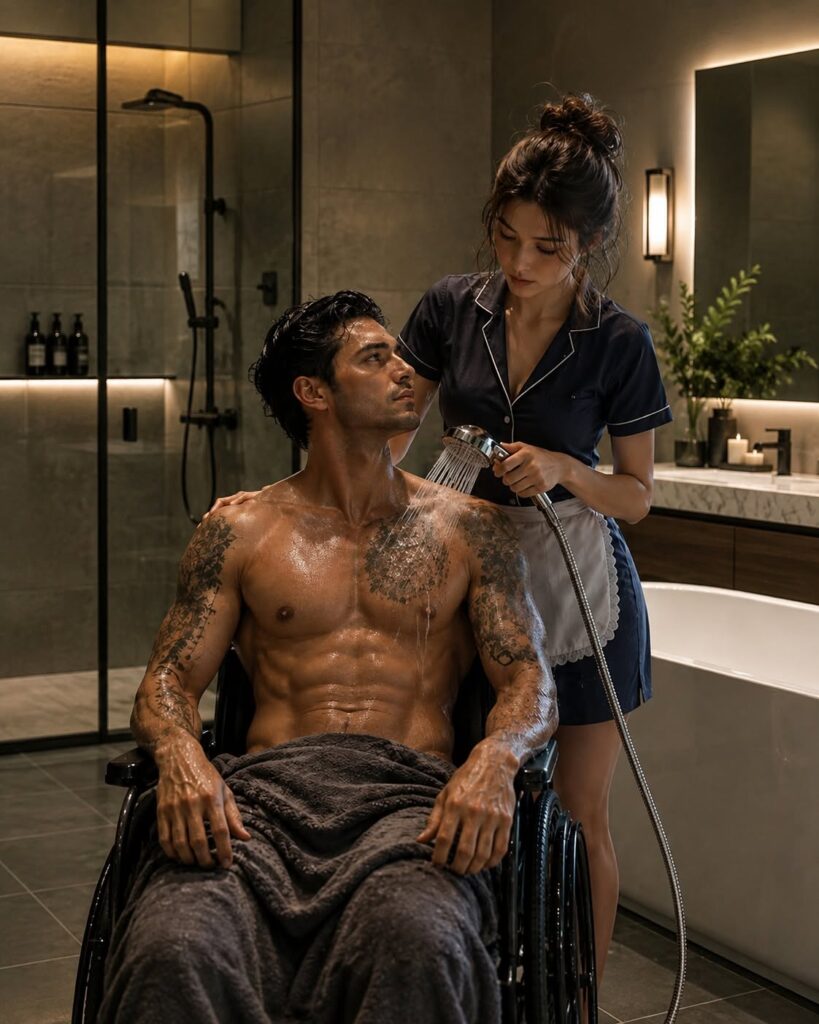
Bathing was the part he disliked most.
Not because I was a woman.
Not because he was embarrassed by nudity.
It was dependence itself that bothered him.
The first time I assisted him, he stared at the opposite wall while I checked the water temperature and prepared the accessible shower bench.
“You can ask me to leave if there are things you can safely do yourself,” I said.
His eyes flicked toward me.
“The last nurse didn’t.”
“Didn’t what?”
“Ask.”
I paused.
“What did she do?”
“Everything.”
“Even when you didn’t need it?”
“Yes.”
I understood then.
His anger was not only about what he had lost.
People had begun assuming he had lost more than he had.
Control.
Privacy.
Choice.
Capability.
I placed the towel within his reach.
“Then we’re doing this differently.”
His gaze sharpened with suspicion.
“I’ll help with what requires help,” I said. “You do the rest.”
“You’re paid to take care of me.”
“I’m paid to help you recover. Those are different jobs.”
For the first time that morning, Massimo looked directly at me.
Then he nodded.
Once.
That became our rule.
I never did for him what he could do himself.
And he stopped pretending he could do things he couldn’t.
Mostly.
On day nine, he nearly slid out of the wheelchair because he refused to ask for help reaching a book from a lower shelf.
I caught the chair with my hip.
He caught the book.
We remained frozen like that for three seconds.
Then I said, “Worth it?”
He looked at the book in his hand.
“The Count of Monte Cristo.”
“Of course it is.”
“What’s wrong with Dumas?”
“Nothing. It just seems dramatic for a man who nearly hit the floor retrieving it.”
He sighed.
“You make everything irritating.”
“And yet you keep surviving me.”
His eyes lifted.
Something warm flashed there.
It disappeared before I could decide what it meant.
Camila visited at the end of the second week.
She found me in the kitchen eating leftover lasagna with Lucia.
Massimo was upstairs with his brother.
Camila stopped in the doorway.
“You’re eating with the family now?”
Lucia pointed her fork at her.
“She was underfed.”
“I was not.”
“She thinks yogurt is lunch.”
Camila looked at me.
“That is concerning.”
“Why is everyone suddenly monitoring my food?”
Lucia rose.
“Because you work twelve-hour days.”
“They’re ten.”
“You arrive early.”
I opened my mouth.
Closed it.
Lucia looked satisfied.
“I’ll leave you two to talk.”
When she was gone, Camila sat opposite me.
“You look better than I expected.”
“What does that mean?”
“I thought by now you’d either quit or be googling how to fake your own death.”
I laughed despite myself.
“He’s difficult.”
“I told you.”
“He’s also not what you told me.”
Camila’s expression became guarded.
“I told you he was injured.”
“You told me he controlled everyone around him.”
“He did.”
“Did he?”
Camila studied me.
“That sounded defensive.”
“It wasn’t.”
“Good.”
“Why?”
She looked down at the table.
“Because you’re there to work.”
There was something in her voice I didn’t like.
Not accusation.
Concern.
I lowered my fork.
“What exactly do you think is happening?”
“Nothing.”
“Camila.”
She exhaled.
“I think Massimo has spent most of his adult life in a world where relationships are complicated by obligation. Loyalty. Money. Family expectations. People want things from him.”
“I want fifty thousand dollars.”
“That’s actually what makes you safer.”
“Comforting.”
“I mean emotionally.”
I waited.
Camila glanced toward the doorway before continuing.
“He’s not used to people disagreeing with him without wanting something in return.”
“So?”
“So you do it constantly.”
“That sounds like a him problem.”
Camila smiled.
“That is exactly what I mean.”
I leaned back.
“You’re being weird.”
“I am being an attorney.”
“You’re terrible at pretending those are different things.”
Her smile faded.
“Tessa, finish the job. Pay your tuition. Go back to school.”
There was no judgment in it.
Only worry.
That bothered me more.
“Was that always the plan?”
“Yes.”
“And after three months?”
She hesitated.
The same hesitation she had made in the café.
If you still want to.
I remembered it exactly.
“What haven’t you told me?” I asked.
Camila reached across the table and covered my hand.
“Probably less than you think.”
“That is not an answer.”
“No.”
But before I could press her, footsteps sounded in the hallway.
A man entered the kitchen.
He was tall, slightly younger than Massimo, with the same dark hair and an easier face.
He looked at Camila.
Then at me.
“You must be Tessa.”
I withdrew my hand.
“And you are?”
“Luca Pascale.”
Massimo’s younger brother.
He extended his hand.
His grip was warm and ordinary.
“Thank you for staying.”
“Is that unusual?”
He smiled.
“For this house lately? Yes.”
Luca was the first Pascale who spoke openly about the accident.
Or, at least, he spoke more openly than anyone else.
It happened three days later while Massimo was resting after a particularly difficult therapy session.
His right leg had responded to electrical stimulation.
Not much.
But visibly.
The muscle had contracted.
Massimo had stared at it as though it belonged to someone else.
Then he had asked to stop.
I didn’t argue.
Hope could be exhausting.
I was documenting the session in the library when Luca came in carrying a stack of folders.
“How was he?”
“Tired.”
“That usually means you accomplished something.”
I glanced at him.
“You’ve learned the system.”
“He complains most when he cares.”
“You say that like it’s charming.”
“It isn’t.”
Luca sat across from me.
For a few minutes, the only sounds were my pen and the ticking clock.
Then he said, “He used to run five miles every morning.”
I stopped writing.
“Massimo?”
“Six days a week.”
“I can’t picture that.”
“He hated running.”
“Then why?”
Luca smiled faintly.
“Because our father told him once that discipline meant doing things you disliked without needing anyone to praise you for them.”
There was affection in the memory.
And sadness.
“Your father?”
“Died four years ago.”
“I’m sorry.”
Luca nodded.
“Massimo took over everything after.”
Everything.
The word carried more than business.
“You mean the family?”
“And the companies.”
I waited.
Luca glanced at me.
“You know who we are.”
“I know what Camila told me.”
“That’s probably enough.”
There was no menace in it.
Only weariness.
I closed the chart.
“What happened the night of the accident?”
Luca’s expression changed.
“A car accident.”
“I know that part.”
“Then you know.”
“No. I know Massimo suffered spinal trauma in a car accident. I don’t know whether his vehicle rolled, whether he was hit, whether there was prolonged compression, whether he lost consciousness, whether—”
“He was a passenger.”
That stopped me.
Everything in Massimo’s medical notes had described the collision clinically.
Thoracolumbar trauma.
Pelvic fractures.
Internal injuries.
Surgical stabilization.
But I had assumed he was driving.
“Who was driving?”
Luca looked toward the windows.
“Our cousin, Nico.”
“Was he injured?”
“Yes.”
“Is he recovering?”
A pause.
“He recovered physically.”
Something in that phrasing was deliberate.
I waited.
Luca stood.
“I should let you work.”
“Luca.”
He stopped.
“Did the accident happen because of something Nico did?”
His back remained toward me.
“I think,” he said quietly, “that you should ask Massimo.”
Then he left.
I did not ask Massimo.
Not that day.
Not the next.
There is an important line in rehabilitation between knowing a patient and invading him.
I had already crossed enough invisible boundaries simply by entering Massimo’s life at its most dependent point.
He would tell me when he wanted to.
If he wanted to.
Instead, I focused on his legs.
At the beginning of week three, we attempted supported standing.
The parallel bars seemed to offend him personally.
Massimo stared at them from his wheelchair.
“No.”
“Yes.”
“No.”
“That’s a convincing argument.”
“I’m not ready.”
That made me pause.
Massimo rarely admitted uncertainty.
I crouched in front of him.
“Physically or otherwise?”
His jaw tightened.
“Does it matter?”
“Yes.”
He looked away.
I followed his gaze toward the long windows.
Outside, autumn had begun touching the estate. A few maple leaves had turned copper. The grass shivered under a cool wind.
“I don’t want everyone watching,” he said.
I looked behind me.
Two household staff had paused in the hall.
A security guard stood near the door.
Lucia was pretending to arrange flowers twenty feet away.
I understood.
“Everybody out.”
Four heads turned.
Massimo stared at me.
Lucia smiled.
One by one, they left.
His mother was last.
She kissed her fingers and touched them lightly to his hair before disappearing through the doorway.
Massimo closed his eyes.
“She thinks I don’t notice when she does that.”
“You do.”
“Every time.”
When we were alone, I wheeled him between the bars.
“I’ll block your knees. You use your arms. We’re not trying to prove anything.”
“What are we trying to do?”
“Stand for three seconds.”
“That’s all?”
“That’s enough.”
His hands closed around the bars.
I positioned myself carefully.
“On three.”
He nodded.
“One.”
His shoulders tightened.
“Two.”
He drew a breath.
“Three.”
Massimo pushed.
For a moment, nothing happened.
Then his hips lifted.
His arms trembled.
His legs remained unreliable beneath him, but the braces held, my hands stabilized his knees, and he rose.
Not fully.
Not gracefully.
But enough.
His face changed.
I watched it happen.
The disbelief came first.
Then concentration.
Then something deeper.
Grief, perhaps.
Because standing reminded him how much he had once taken for granted.
“Three seconds,” I murmured.
He stared straight ahead.
“Four.”
“Tessa.”
“Five.”
“Tessa.”
“Six.”
His arms gave.
I guided him safely into the chair.
He sat breathing hard.
I was grinning.
He was not.
Then I realized his eyes were wet.
I looked away.
Not because tears embarrassed me.
Because I sensed he needed the dignity of choosing whether I saw them.
For a while, neither of us spoke.
Finally he said, “You cheated.”
“How?”
“You counted slowly.”
“I have a Boston education. Numbers are difficult.”
A laugh escaped him.
Quiet.
Ragged.
Real.
When I looked back, he had wiped his eyes.
“Again,” he said.
My own throat tightened.
“Tomorrow.”
“Now.”
“No.”
“I’m paying you.”
“And apparently wasting your money, because you still don’t understand how muscles fatigue.”
“Tessa.”
“Massimo.”
We stared at each other.
He lost.
It became my favorite part of the day.
That evening, Lucia found me on the back terrace.
I had stayed later than usual finishing paperwork.
She carried a blanket and draped it over the chair beside me.
“You don’t have to take care of me too,” I said.
“I’m Italian. Feeding and covering people is how we avoid discussing our feelings.”
I laughed.
She sat.
For a while we watched leaves drift across the lawn.
“He stood,” she said.
I turned.
“Who told you?”
“No one.”
“You were listening.”
“I am a mother.”
“That’s not a defense.”
“It has worked for thirty-eight years.”
I smiled.
Lucia folded her hands.
“When Massimo was six, he broke his arm falling from a tree.”
“Was he climbing?”
“No. He was rescuing his brother.”
That sounded strangely right.
“Luca?”
“Luca had climbed too high and became frightened. Massimo went after him.”
Lucia’s smile faded into memory.
“When they came home from the hospital, Massimo refused pain medicine because he thought Luca would blame himself if he saw him hurting.”
“He was six?”
“Yes.”
“That seems young to become impossible.”
Lucia laughed softly.
Then her eyes drifted toward the windows.
“He has always believed love means carrying what other people cannot.”
I thought of the man between the parallel bars.
The way he had waited until everyone left before allowing himself to fail.
“Who carries him?” I asked.
Lucia’s eyes met mine.
“Until recently?”
She looked down.
“No one.”
I felt a strange pressure in my chest.
I didn’t want to examine it too closely.
“Lucia, why did the other nurses quit?”
She sighed.
“One left because her husband became ill. One accepted another position.”
“And the third?”
“Massimo fired her.”
“Camila said they quit.”
Lucia looked surprised.
“Did she?”
“Yes.”
Lucia considered that.
“The third nurse was kind. Very capable. But she treated Massimo as though his life had ended.”
“What does that mean?”
“She spoke around him instead of to him. Made decisions without asking. Told visitors he needed rest when he had not said so.”
I nodded slowly.
That sounded less dramatic than the story I had been given.
“So he fired her.”
“Yes.”
“Then why tell me three nurses quit?”
“I don’t know.”
I did.
Or I thought I did.
Because Camila had wanted me to believe Massimo was difficult enough to justify fifty thousand dollars.
But that led to a more interesting question.
Why did the job need justifying?
The answer began arriving in fragments.
The first fragment came from Massimo himself.
We were working on seated balance when he asked, “Why neurological physical therapy?”
I steadied the exercise ball beneath his hand.
“What?”
“Your doctorate.”
I looked at him.
“You remembered.”
“You’ve mentioned it forty-seven times.”
“I have not.”
“Thirty-six.”
“Still no.”
He raised an eyebrow.
“Why that field?”
I sat on the therapy stool.
“My dad.”
Massimo waited.
It surprised me that he didn’t fill silence.
Most people did.
“My father had a stroke when I was sixteen,” I said.
“Severe?”
“At first.”
I turned the resistance band around my fingers.
“He couldn’t use his right arm. His speech was affected. He was a high school history teacher, so losing language…” I swallowed. “That was difficult.”
“Did he recover?”
“Mostly.”
Massimo’s shoulders relaxed slightly.
“He teaches again?”
“He died five years ago.”
The room became very still.
“Not from the stroke,” I added. “Cancer.”
Massimo looked down.
“I’m sorry.”
“Thank you.”
“Is that why you stayed in school?”
“What do you mean?”
“You said eight years.”
I smiled faintly.
“Bachelor’s, prerequisites, clinical work, doctorate. Yes.”
“No.”
His eyes lifted.
“Why didn’t you stop?”
The question landed differently.
I considered it.
“Because my dad’s therapist gave us something we didn’t have.”
“Hope?”
“No.”
Massimo frowned.
“Information.”
I leaned forward.
“She didn’t promise he’d recover. She told us what could happen, what might not happen, and what we could do either way. She made uncertainty feel survivable.”
His gaze stayed on mine.
“That’s why.”
Massimo was silent.
Then he said, “Your tuition.”
I stiffened.
“What about it?”
“Camila said you were behind.”
“Camila talks too much.”
“She said you’d lose your place.”
“I won’t.”
“You’re sure?”
“No.”
He watched me.
I knew what was coming.
“No.”
“I haven’t offered anything.”
“You were going to.”
“How do you know?”
“Because you have the face.”
“What face?”
“The rich-man-about-to-solve-a-problem-with-money face.”
For several seconds he stared at me.
Then he laughed.
“I don’t have that face.”
“You absolutely have that face.”
“I was going to suggest an advance.”
“No.”
“Against money you’re already owed.”
“I said no.”
His expression sobered.
“Why?”
“Because I need this arrangement to stay simple.”
His eyes narrowed slightly.
“Is it complicated?”
My pulse changed.
“No.”
The word came too quickly.
Massimo noticed.
So did I.
He leaned back.
“Then we agree.”
“On what?”
“That it should remain simple.”
The room suddenly felt warmer.
“Yes.”
“Good.”
“Good.”
Neither of us moved.
Then Massimo looked toward the parallel bars.
“Can we stand now?”
I stood too quickly.
“Yes.”
His mouth curved.
He had noticed that too.
The second fragment came in the form of an envelope.
It arrived at my apartment on a Saturday.
I had returned home for the weekend for the first time since starting the job.
My apartment looked smaller than I remembered.
There were textbooks stacked on the coffee table, laundry hanging over a chair, and three unopened letters beside the sink.
The envelope lay beneath them.
Boston University.
My stomach dropped.
I opened it standing up.
Then read the first paragraph twice.
My outstanding balance had been placed under temporary administrative hold.
No dismissal proceedings would occur for thirty days.
I immediately called the bursar’s office.
After twenty minutes on hold, someone confirmed it.
“An extension request was submitted on your behalf.”
“By whom?”
“I’m afraid I can’t see that.”
“I didn’t submit one.”
“It may have come through your department.”
“Who authorized it?”
“All I can tell you is that supporting documentation was received.”
“What documentation?”
“I’m sorry.”
I ended the call and dialed Camila.
She answered on the fourth ring.
“Hello?”
“What did you do?”
A pause.
“Good afternoon to you too.”
“My tuition deadline.”
“What about it?”
“It moved.”
Silence.
“Camila.”
“I made a call.”
My anger cooled into confusion.
“To whom?”
“The university.”
“You can’t just call a university and move tuition deadlines.”
“You would be amazed what polite persistence can accomplish.”
“That’s not what happened.”
“Tessa—”
“Did Massimo pay them?”
“No.”
The answer came instantly.
I believed it.
“Did you?”
“No.”
“Then what?”
Camila exhaled.
“I requested hardship consideration.”
“Why?”
“Because you qualified.”
“How did you know enough about my finances to do that?”
“You told me.”
“I told you I was behind.”
“That was enough.”
“No, it wasn’t.”
Another silence.
Then Camila said, “Tessa, take the thirty days.”
“That isn’t the point.”
“It should be.”
“Why are you trying so hard to keep me in this job?”
This time, she didn’t answer.
A cold thread of unease moved through me.
“Camila?”
“I have to go.”
“Don’t you dare—”
The call ended.
I stared at my phone.
For the first time since entering the Pascale estate, I wondered if I had misunderstood which person was keeping secrets from me.
Monday morning, Massimo noticed my mood before I put down my bag.
“What happened?”
“Nothing.”
“You’re bad at lying.”
“So are you.”
“I’m excellent at lying.”
“That sounded almost proud.”
“It was observational.”
I checked his medication log.
Everything was correct.
“You’ve been avoiding eye contact for six minutes,” he said.
“I’m working.”
“You reorganized the same bottles twice.”
I stopped.
Massimo waited.
I turned.
“Did you ask Camila to interfere with my tuition?”
“No.”
“Did anyone in your family?”
“Not that I know of.”
“Did you ask her to keep me here?”
His expression sharpened.
“No.”
“Are you sure?”
“Yes.”
I watched him.
He looked genuinely confused.
Then something changed.
“Why?”
“My university suddenly granted me thirty extra days because Camila submitted something.”
Massimo frowned.
“Without your permission?”
“Yes.”
His expression darkened, but not with anger toward me.
“I’ll speak to her.”
“No.”
“Tessa—”
“No. This is exactly what I don’t want.”
“What?”
“People making decisions because they think they’re helping me.”
He became still.
The irony reached both of us at the same time.
Massimo looked at his legs.
Then at me.
“I see.”
I sighed.
“I didn’t mean—”
“Yes, you did.”
“I wasn’t talking about you.”
“But you understand it now.”
I did.
More than I wanted to.
His gaze softened.
“I won’t call her.”
“Thank you.”
“But you should.”
“I will.”
“Good.”
The strange thing was that after that conversation, our work changed.
Not dramatically.
There was simply less resistance between us.
He told me when an exercise hurt.
I told him when I was worried.
He asked before changing the schedule.
I stopped assuming every disagreement was stubbornness.
Trust, I discovered, rarely arrived as a grand declaration.
Mostly, it looked like small permissions.
You could know this.
You could help with that.
You could see me fail here.
I will believe you when you say stop.
On Thursday of that week, Massimo moved his right foot.
Not much.
Barely enough for anyone else to notice.
But I noticed.
“Again.”
He stared at it.
“I didn’t do that.”
“Yes, you did.”
“It was reflex.”
“Again.”
His forehead creased.
Nothing happened.
“Don’t force it.”
“You just said again.”
“I changed my mind.”
“You do that often.”
“Occupational hazard.”
He closed his eyes.
I watched the tendons of his ankle.
“Think about the movement,” I said softly. “Don’t chase it. Just picture lifting the toes.”
Ten seconds.
Twenty.
Then—
Movement.
A tiny upward flick.
Massimo opened his eyes.
I was already smiling.
He stared at his foot.
“Was that—”
“Yes.”
He looked at me.
Something enormous passed between us without words.
Then he laughed.
Not the short, surprised laugh from our first meeting.
A full one.
Disbelieving.
Young.
It changed his entire face.
Lucia appeared in the doorway.
“What happened?”
Massimo looked at his mother.
For one brief second, I saw him consider hiding it.
Then he said, “Watch.”
It took four attempts.
Lucia stood perfectly still.
On the fifth, his toes moved.
She covered her mouth.
Massimo looked down, suddenly embarrassed.
Lucia crossed the room.
She did not hug him.
She seemed to know instinctively that too much celebration might turn hope into pressure.
Instead, she knelt beside his chair and placed her hand over his.
“I saw,” she whispered.
Massimo nodded.
His fingers closed around hers.
And I looked away.
That moment did not belong to me.
The third fragment came from Nico.
I met him accidentally.
He arrived at the estate on a rainy afternoon near the end of my first month.
I was in the front hall searching for my umbrella when the door opened.
A man stepped inside carrying a soaked cardboard box.
He was around Massimo’s age, leaner, with light brown hair and tired blue eyes.
He stopped when he saw me.
“You’re Tessa.”
I had become accustomed to strangers knowing my name in that house.
“You are?”
“Nico.”
The cousin.
The driver.
Something in my expression must have changed.
His did too.
“Right,” he said quietly. “You know.”
“I know you were in the accident.”
He nodded.
Rainwater darkened his coat.
The box in his hands had PROPERTY OF M. PASCALE written across one side.
“I’m bringing back some things from the old office.”
“Does Massimo know you’re here?”
“No.”
The answer was calm.
But sad.
I glanced toward the stairs.
“He’s resting.”
“I know.”
“You know his schedule?”
“I used to know everything about his schedule.”
The sentence held history.
I wasn’t sure what to say.
Nico looked toward the library.
“Could you give this to Luca?”
“Of course.”
He handed me the box.
It was heavier than expected.
I adjusted my grip.
Nico’s eyes went to my hands.
“You should hold it underneath.”
“I’ve got it.”
He smiled faintly.
“That sounds like something Massimo would say.”
“I spend too much time with him.”
“Yes.”
There was something else in his tone.
Not resentment.
Recognition.
He turned toward the door.
“Nico.”
He stopped.
I shouldn’t have asked.
But I did.
“What happened that night?”
His shoulders rose with a breath.
For a long moment he faced the rain outside.
Then he said, “Massimo saved my life.”
I stared at him.
Nico looked back.
“And that is exactly why he doesn’t want to see me.”
Then he stepped into the rain.
I carried the box into the library.
I should have left it untouched.
Instead, when I set it down, the damp cardboard gave way at one corner.
Several folders slid onto the carpet.
“Great.”
I knelt to gather them.
Invoices.
Property documents.
Insurance correspondence.
A photograph.
I picked it up.
Massimo and Nico stood beside a fishing boat, both younger, sunburned, laughing at something outside the frame.
They looked less like cousins than brothers.
I put the photograph back.
Then I saw the medical envelope.
Not Massimo’s.
Nico’s.
I didn’t open it.
I didn’t need to.
A handwritten note was clipped to the outside.
M—
They said I can drive again next month. I know that doesn’t fix anything. I know saying I’m sorry doesn’t either. But you keep telling everyone I caused what happened, and I need to understand why.
You grabbed the wheel.
You made the choice.
You saved us both.
Please stop letting me carry a blame that belongs to neither of us.
—N
I read it twice.
Then a third time.
Footsteps sounded behind me.
I turned.
Massimo was in the doorway.
His face went still when he saw the note.
I stood slowly.
“The box broke.”
“I can see that.”
“I wasn’t trying to read your mail.”
“I know.”
Rain traced the windows behind him.
I held out the note.
He did not take it.
“What does he mean?” I asked.
Massimo looked at the photograph on the floor.
For several seconds, he said nothing.
Then he wheeled into the room and closed the door.
“Nico was driving,” he said.
I waited.
“He was tired. I knew he was tired.”
“Had he fallen asleep?”
“No.”
Massimo stared at his hands.
“A truck lost part of its load ahead of us. Nico swerved.”
I felt my breath slow.
“He would have gone into the opposite lane.”
“So you grabbed the wheel.”
“Yes.”
“You redirected the car.”
“Yes.”
“Then why does everyone think Nico caused it?”
“Because I told them he did.”
The answer was so simple that I almost didn’t understand it.
“Why?”
Massimo’s jaw tightened.
“Nico had just gotten engaged. He was applying for a professional license. There were questions about whether he had been too tired to drive safely. Insurance. Investigations. Family pressure.”
“So you took responsibility?”
“No.”
His eyes met mine.
“I did something worse.”
I frowned.
“I let everyone believe he was responsible because I knew they would forgive him faster than he would forgive himself if he knew the truth.”
“That doesn’t make sense.”
“It did at the time.”
“Massimo—”
“He was already blaming himself before I woke up from surgery.”
His voice remained quiet.
“He sat beside my hospital bed every day. He kept saying if he had reacted faster, I would still be walking.”
“So you agreed with him?”
“I thought anger would be easier for him than guilt.”
I stared.
“And was it?”
“No.”
The word was barely audible.
The room filled with rain.
I looked at the note again.
“You haven’t spoken to him?”
“Not properly.”
“For how long?”
“Four months.”
I folded the note carefully.
“That isn’t protecting him.”
“I know.”
“Does he know you know?”
“That he remembers what happened?”
“Yes.”
Massimo’s eyes closed briefly.
“I didn’t know until now.”
The answer changed something.
This was not a secret he had been deliberately maintaining after learning the truth.
It was a misunderstanding that had outlived its purpose.
A terrible, quiet distance built by two men each trying to carry the other’s pain.
I put the note on the desk.
“You should call him.”
Massimo looked toward the window.
“I don’t know what to say.”
“You don’t have to know.”
“That’s very easy for you.”
“No, it isn’t.”
His eyes came back to mine.
I thought about my father.
Hospital rooms.
Things left unsaid because everyone assumed there would be another day.
“Sometimes you start with the part you can say.”
Massimo looked at the note.
“What part?”
“That you miss him.”
He gave me a look.
“You assume a lot.”
“Do you?”
Silence.
Then, very quietly:
“Yes.”
I nodded.
“That part.”
He did not call Nico that night.
Or the next.
I didn’t mention it.
Rehabilitation teaches patience in strange ways.
A nerve may need time.
A muscle may need repetition.
A family may need both.
At the beginning of week five, Massimo stood for eighteen seconds.
Three days later, twenty-four.
His right leg began producing weak voluntary contraction.
His left remained inconsistent.
His doctors adjusted their prognosis from guarded to cautiously optimistic.
Massimo reacted by becoming more irritable.
“You’re getting better,” I told him after he complained through an entire morning session.
“That is not an explanation.”
“It is.”
“For what?”
“For why you’re impossible this week.”
He frowned.
“Hope is stressful.”
“That’s absurd.”
“Not really.”
I sat on the mat across from him.
“When you thought nothing might change, your job was adapting.”
“And now?”
“Now you have something to lose again.”
His expression altered.
He looked down.
I knew I had touched the truth.
He said nothing for nearly a minute.
Then:
“What if this is all I get?”
“You mean the movement you have now?”
“Yes.”
“Then we build from here.”
“And if I walk?”
“Then we build from there.”
“And if I don’t?”
“Same answer.”
He studied me.
“You make everything sound simple.”
“No.”
I shook my head.
“I make it smaller.”
“What’s the difference?”
“Simple means easy. Smaller means manageable.”
Something about that stayed with him.
I knew because the next morning, when I asked how he felt, he said:
“Manageable.”
The first snowfall came early that year.
Thin, temporary flakes that melted on the stone terrace.
Lucia insisted on dinner together.
I tried to decline.
She ignored me.
“You are here until eight.”
“I finish at seven.”
“You stay late.”
“Because Massimo’s afternoon sessions run long.”
Massimo, beside her, said, “She has evidence.”
“Traitor.”
Luca laughed.
It was the first time I had sat with all three of them outside a medical context.
The dining room felt less formal when Lucia lit only the lamps instead of the chandelier.
There was pasta, roasted vegetables, bread, and a bottle of wine I declined because I was driving.
Massimo had one glass.
Luca had two.
Lucia asked me about school.
“What will you do after the doctorate?”
“If I still have a doctorate to finish.”
“You will,” Massimo said.
I looked at him.
He cut into his dinner.
“You’re annoyingly persistent.”
“That’s not how tuition works.”
“It should be.”
Luca smiled.
“Massimo believes persistence is legal tender.”
“It has worked before,” Massimo said.
Lucia shook her head.
Then she asked, “Will you stay in Boston?”
“I think so.”
“Family here?”
“My mother lives in Vermont. My younger sister is in Providence.”
“You have a sister?”
Massimo looked genuinely surprised.
“Yes.”
“You never mentioned her.”
“You never asked.”
“What does she do?”
“Architect.”
“Older or younger?”
“Younger. Claire.”
Lucia smiled.
“Are you close?”
The question made me hesitate.
“We used to be.”
Massimo noticed.
Of course he did.
“What happened?” Luca asked gently.
I looked down at my plate.
“After our dad died, my mother needed help. Claire was finishing school. I handled most things.”
“That sounds difficult,” Lucia said.
“It was fine.”
Massimo’s eyes narrowed.
I knew that look.
He had recognized the lie because he told the same kind himself.
I sighed.
“It wasn’t fine. But somebody had to do it.”
Massimo lowered his fork.
“And Claire?”
“She offered.”
“But?”
“I told her to finish school.”
There was a short silence.
Then Massimo said, “You decided for her.”
I looked at him.
He looked back.
The irony was unbearable.
Luca began laughing first.
Lucia followed.
I pointed at Massimo.
“Don’t.”
He was smiling now.
“You protected her.”
“Don’t.”
“You carried what she couldn’t.”
“She was twenty-one.”
“So?”
“I hate this family.”
Lucia reached across and patted my wrist.
“No, you don’t.”
The table went strangely quiet.
Heat rose into my face.
Lucia seemed to realize what she had said.
She rescued me immediately.
“You only hate my son.”
“Mother.”
“Frequently,” I said.
Luca laughed again.
But Massimo didn’t.
He was watching me.
And for one suspended second, the crowded room seemed to narrow to the space between us.
Then the doorbell rang.
A staff member entered.
“Mr. Pascale?”
Massimo turned.
“You have a visitor.”
“Who?”
A pause.
“Nico.”
No one spoke.
Lucia’s hand tightened around her napkin.
Luca looked at his brother.
Massimo stared at the doorway.
I saw uncertainty cross his face.
Not fear.
Not anger.
Something more vulnerable.
He looked at me.
I didn’t nod.
I didn’t tell him what to do.
That choice had to belong to him.
After several seconds, Massimo set down his fork.
“Ask him to come in.”
Nico entered carrying no coat despite the snow melting in his hair.
He stopped at the edge of the room.
Lucia stood first.
She crossed to him and kissed his cheek.
“Hello, sweetheart.”
His face tightened.
“Hi, Aunt Lucia.”
Luca hugged him.
Then there was only Massimo.
The cousins looked at each other across the table.
Four months of silence lived in that space.
Nico spoke first.
“I can leave.”
Massimo’s hand closed around the arm of his chair.
“No.”
Another pause.
“I read your note.”
Nico nodded.
“I assumed.”
“The box broke.”
Nico glanced at me.
“I packed it badly.”
I almost smiled.
Massimo drew a breath.
“You remember.”
“Yes.”
“All of it?”
“Enough.”
Massimo nodded.
His eyes dropped.
“I thought you didn’t.”
“I didn’t at first.”
“When?”
“About three weeks ago.”
“And you didn’t tell me?”
Nico gave a tired laugh.
“You weren’t speaking to me.”
That truth was allowed to settle.
Massimo looked at the empty chair beside Luca.
“Sit.”
Nico sat.
No one made a speech.
No one cried.
Lucia simply asked whether he had eaten.
He hadn’t.
She filled a plate.
And the family resumed dinner around a silence that, for once, did not feel like a wall.
It felt like a door left open.
Later, I found Massimo alone in the rehabilitation room.
Nico had left.
Lucia had gone upstairs.
Luca was on a phone call.
Massimo sat beside the parallel bars, looking at the empty space ahead of him.
“You okay?”
“Yes.”
“You’re lying.”
“I’m improving.”
I smiled.
“Did you talk?”
“A little.”
“That’s a start.”
“He apologized.”
“For driving?”
“For believing me.”
I leaned against the wall.
“And you?”
“I told him the truth.”
“All of it?”
Massimo hesitated.
“Most.”
“What did you leave out?”
His eyes shifted toward me.
“That I was afraid.”
The word surprised me.
“During the accident?”
“After.”
I waited.
Massimo looked at his legs.
“When I woke up and couldn’t move them, everyone started looking at me differently.”
His voice remained level.
“My mother tried not to. Luca tried not to. Nico couldn’t hide it.”
“What did you see?”
“Pity.”
“Maybe it wasn’t.”
“No.”
He nodded slowly.
“I know that now.”
He looked toward the bars.
“But I didn’t then.”
I moved closer.
“I thought if Nico believed I blamed him, he would stop looking at me like something terrible had happened.”
“Something terrible had happened.”
“To me.”
“Yes.”
“And to him.”
“Yes.”
His mouth tightened.
“I didn’t know how to let that be true at the same time.”
There it was.
The center of it.
Massimo had spent his whole life believing that if someone he loved hurt, he had to reduce their pain by taking more himself.
It had never occurred to him that grief could be shared without being transferred.
I sat beside him.
“My sister didn’t speak to me for almost a year after my dad died.”
He looked at me.
“Because you told her to stay in school?”
“Because I made every decision. Funeral arrangements. Mom’s finances. Selling Dad’s car. I thought I was helping.”
“Were you?”
“Sometimes.”
“And the rest?”
“I was deciding what everyone could handle.”
Massimo gave a faint smile.
“That sounds familiar.”
“I learned from the worst.”
His smile grew.
Then faded.
“Did she forgive you?”
“Yes.”
“Did you forgive her?”
The question caught me.
“For what?”
“For letting you do it.”
I stared at him.
I had never thought about it that way.
Claire had done exactly what I told her.
Stayed at school.
Finished her degree.
Trusted me when I said I could manage.
And some small, hidden part of me had resented her for believing me.
“I don’t know,” I admitted.
Massimo nodded.
“Maybe you should.”
I laughed softly.
“You’re giving me emotional advice now?”
“I’m diversified.”
I shook my head.
But later that night, driving home through thin snow, I called my sister.
We talked for two hours.
By the middle of the second month, everything should have felt simpler.
Massimo was improving.
Nico had returned to family dinners.
Claire and I had begun speaking every few days.
My tuition deadline remained extended.
And somewhere along the way, I stopped counting how many days remained in my contract.
That should have worried me.
Instead, something else did.
Camila stopped returning my calls.
Not completely.
She sent messages.
Busy. Court all day.
Call tomorrow.
Sorry. Long week.
But the conversation about my tuition never happened.
Then, one Tuesday afternoon, I went searching for Massimo’s original imaging reports.
His neurologist had requested a comparison between preoperative and postoperative nerve response studies.
Luca told me copies might be in the downstairs office.
The office belonged to Massimo, though he rarely used it now.
I found the medical files in a locked cabinet after he gave me the key.
The imaging reports were exactly where Luca said.
So was another folder.
FITZGERALD, TESSA.
I froze.
My name was printed across the tab.
Not handwritten.
Printed.
Professionally labeled.
I stared at it for several seconds.
There was no reasonable explanation for my name to be in Massimo Pascale’s private office.
I should have closed the cabinet.
Instead, I pulled out the folder.
Inside was my résumé.
My clinic biography.
A copy of my doctoral program profile.
Two published research summaries I had helped write.
My employment history.
A letter of recommendation from a professor.
And, beneath all of it, a printed email.
From Camila.
Dated six weeks before she had offered me the job.
Massimo,
I found her.
Dr. Mercer confirms she is the Fitzgerald who worked with the adaptive mobility project three years ago. She has no idea you funded the equipment after reading her proposal.
Before you ask: no, she does not know your name was involved.
She is clinically strong, stubborn, and probably the only person I know who won’t be impressed by your reputation.
If you’re serious about rehabilitation, I think she’s the right person.
But there is something else you should know.
Her tuition situation is becoming urgent.
If we offer enough to solve that problem, she may say yes.
—Camila
I stopped breathing.
Six weeks before.
Before the café.
Before the job.
Before I had ever heard the name Massimo Pascale.
I read the first lines again.
Adaptive mobility project.
Three years earlier, I had written a funding proposal for a small community program providing rehabilitation equipment to uninsured stroke patients.
The grant had appeared anonymously.
Forty thousand dollars.
It had kept the project alive.
I remembered crying in my supervisor’s office when we got the approval.
I remembered my father’s face in my mind as we delivered the first adaptive walker.
And now—
I looked down at the signature.
Massimo had known who I was before I walked through his door.
He had known my work.
He had known about my tuition.
He had not hired me because three nurses quit.
He had asked Camila to find me.
A sound behind me made me turn.
Massimo sat in the doorway.
He looked at the open folder in my hands.
Neither of us spoke.
I held up the email.
“How long?”
His face went still.
“Tessa.”
“How long have you known who I am?”
He looked at the papers.
Then back at me.
“Three years.”
And suddenly the question was no longer why Massimo Pascale had hired me.
It was why, three years before we met, he had been quietly investing in work that mattered to me—and why he had made certain I never knew his name.
For several seconds, I could hear nothing except the faint hum of the heating system.
Massimo remained in the doorway.
I remained beside the cabinet with the folder open in my hands.
Three years.
The number would not settle in my mind.
“You funded the adaptive mobility project.”
“Yes.”
“Why?”
His gaze moved to the folder.
“Can we talk somewhere else?”
“No.”
“Tessa—”
“I’m not angry because you gave money to a rehabilitation program.”
“I know.”
“I’m angry because you investigated me.”
“I didn’t investigate you.”
I lifted the folder.
“This has my employment history.”
“I asked Camila to find a therapist.”
“You asked her to find me.”
“Yes.”
The answer was immediate.
That stopped me.
He could have softened it.
He could have offered some technical distinction.
Instead, he simply admitted it.
“Why?”
Massimo wheeled farther into the room.
“Three years ago, the Pascale Foundation was looking for community health programs.”
“The Pascale Foundation?”
“My mother runs it.”
I had never heard of it.
“Our family name isn’t attached publicly to most of the grants,” he continued. “That was my father’s preference.”
“Why?”
“He thought people should be able to accept help without feeling obligated to us.”
The answer was so different from the version of Massimo I had first been given that I almost laughed.
“You read my proposal?”
“Yes.”
“Why?”
“Because the committee rejected it.”
I stared.
“What?”
“The first review committee.”
“I never knew that.”
“You weren’t supposed to.”
He came to a stop several feet away.
“One of the reviewers thought the program was too small to produce measurable impact.”
I remembered the proposal.
Twelve patients.
Maybe fifteen if we stretched the budget.
It had been small.
“That’s normal,” I said. “Foundations reject projects all the time.”
“I know.”
“Then why did you override them?”
Massimo hesitated.
“You included a story.”
“What story?”
“About your father.”
I felt something shift inside me.
The original application had required a personal statement.
I had written about Dad relearning to button a shirt.
About the first time he managed to walk from our kitchen to the mailbox without assistance.
About how a simple piece of equipment could turn a humiliating dependence into an ordinary choice.
I had forgotten anyone beyond the grant committee would ever read it.
Massimo continued.
“You wrote that independence is sometimes measured in ten feet instead of ten miles.”
I remembered the exact sentence.
“You remember that?”
“Yes.”
“After three years?”
“Yes.”
The room seemed to contract.
I closed the folder.
“You gave us forty thousand dollars because of one paragraph?”
“No.”
“Then why?”
“Because I visited the clinic.”
I stared at him.
“You what?”
“After hours.”
“When?”
“Before the grant was approved.”
“You were there?”
“You weren’t.”
That made sense.
Three years earlier, I had been splitting my time between coursework and supervised clinical placements.
Massimo looked toward the windows.
“There was a man practicing transfers from a wheelchair to a car.”
I waited.
“His wife was learning how to help without lifting him. She kept trying to do too much. The therapist kept telling her, ‘Give him time.’”
Something softened in his voice.
“I remember thinking that three words could change an entire relationship.”
Give him time.
I had said those words myself dozens of times.
Massimo looked at me again.
“The clinic didn’t need to be large. It needed to exist.”
My anger had not disappeared.
But it was losing its clean edges.
“You could have told me.”
“About the grant?”
“About any of this.”
“Yes.”
“Why didn’t you?”
“Because I didn’t want it to matter.”
“It does matter.”
“I know that now.”
“No, Massimo. You knew my financial situation. You knew I was desperate enough to take a job I might otherwise refuse.”
His expression tightened.
“That part was wrong.”
The direct admission startled me.
“I told Camila I wanted the best neurological therapist she could find.”
“She found me six weeks before offering me the position.”
“Yes.”
“And the tuition?”
“I didn’t know about it when I asked for you.”
I looked at the email.
“But once you did—”
“I told her to offer enough that leaving your clinic for three months wouldn’t hurt you financially.”
“She said three nurses quit.”
“I never told her to say that.”
I remembered Lucia.
One nurse had left because of illness.
One for another position.
Only one had actually been dismissed.
“Why fifty thousand?”
“Because you were interrupting your doctorate, your clinic schedule, and your life.”
“You could have hired someone else for half that.”
“Yes.”
“Then why me?”
His eyes stayed on mine.
“Because I trusted the way you thought before I trusted you.”
Silence.
It was an extraordinary sentence.
Not romantic.
Not flattering in the usual sense.
Something stranger.
Deeper.
He had known my ideas before he knew my face.
I looked down at the folder.
“And you kept all of this.”
“I keep records.”
“You kept my research papers.”
“You wrote them.”
“That isn’t an explanation.”
“It’s the only one I have.”
I almost smiled.
Almost.
Then I remembered Camila.
“Did you ask her to get my tuition extension?”
“No.”
“I believe you.”
Massimo looked surprised.
“I’m still angry.”
“I assumed.”
“But not about the same things I was five minutes ago.”
“That sounds promising.”
“It isn’t.”
“Understood.”
I put the folder on the desk.
“I’m going home.”
His face changed.
“Are you coming back?”
There was no command in the question.
No expectation.
Only uncertainty.
That mattered.
“I don’t know.”
Massimo nodded.
He moved aside from the doorway.
I stopped beside him.
For a moment, neither of us spoke.
Then he said, “For what it’s worth, the offer was never meant to trap you.”
I looked down at him.
“But it did make it harder to say no.”
“Yes.”
“And you should have understood that.”
“Yes.”
No excuses.
No argument.
Just yes.
I walked out.
Camila opened her apartment door wearing sweatpants and an expression of immediate regret.
“Oh.”
“Very convincing.”
“Tessa—”
I walked past her.
“You have ten seconds before I start going through your cabinets looking for hidden files about me.”
“There are no hidden files.”
“Eight seconds.”
Camila shut the door.
“You found out.”
“Excellent legal instincts.”
She rubbed both hands over her face.
“I was going to tell you.”
“When?”
“Before the contract ended.”
“That is not comforting.”
“I know.”
“Why did you get my tuition deadline extended?”
“Because I panicked.”
That was not the answer I expected.
Camila walked into the living room.
Her usually immaculate apartment looked lived-in for once. Legal briefs covered the dining table. A takeout carton sat beside her laptop.
I followed.
“Explain.”
She sat on the edge of the sofa.
“When I called your university originally, I was trying to understand how much money you needed immediately.”
“You called them before you offered me the job?”
“I called an administrator I knew through a nonprofit board. I did not access private records.”
I folded my arms.
“She told me there was a hardship process.”
“And you filed it for me.”
“I started the inquiry.”
“Without asking.”
“Yes.”
“Why?”
Camila looked miserable.
“Because I thought if you had another month, you wouldn’t feel forced to stay at the estate if you hated it.”
That stopped me.
“What?”
“I knew how much you needed the money. I also knew what Massimo’s family history looked like from the outside.”
“So you deliberately made him sound worse?”
Her face tightened.
“I was trying to make sure you took the risk seriously.”
“You told me three nurses quit because he couldn’t handle losing control.”
“I oversimplified.”
“You lied.”
“Yes.”
The admission landed heavily.
Camila looked down.
“I thought I was balancing things.”
“By controlling the information I had?”
She closed her eyes.
“I hear it.”
“Do you?”
“Yes.”
I sat across from her.
For a moment, neither of us spoke.
Camila and I had been friends since college.
She had been there when my father died.
I had slept on her couch after my first terrible clinical rotation.
She had once driven three hours through snow because Claire had called and said I sounded depressed.
I knew her well enough to understand that whatever she had done had not come from malice.
That did not make it right.
“Why didn’t you just tell me the truth?” I asked.
She stared at her hands.
“Because the truth was complicated.”
“Try me.”
“Massimo asked for you specifically. I thought that would make you suspicious.”
“It does.”
“He had read your work. He remembered the grant. He believed you were qualified.”
“Also suspicious.”
“I know.”
Camila looked up.
“But I met with him before I contacted you.”
“And?”
“He was different.”
“From what?”
“From every version of him I’d seen before the accident.”
I said nothing.
Camila continued.
“He wasn’t asking whether you could make him walk. He asked whether you would tell him the truth if you thought he wouldn’t.”
That sounded exactly like Massimo.
“He asked whether you had ever worked with patients who had lost function permanently.”
My anger weakened another degree.
“And I told him yes.”
Camila’s mouth twisted.
“Then he asked whether you were kind.”
I stared at her.
“What did you say?”
“I said no.”
Despite everything, I laughed.
Camila smiled faintly.
“I said you were competent, direct, stubborn, loyal, chronically overcommitted, and pathologically incapable of letting anyone pay for dinner.”
“That’s rude.”
“It’s accurate.”
She reached for my hand.
I did not pull away, but I didn’t squeeze back either.
“I made decisions for you because I thought I was protecting your choices,” she said. “That doesn’t make sense now that I say it out loud.”
“No.”
“I’m sorry.”
I believed her.
Forgiveness, however, was not the same as pretending nothing had happened.
“I need you to never do that again.”
“I won’t.”
“Even if I’m about to make a terrible decision.”
Camila hesitated.
“Define terrible.”
“Camila.”
“Fine. Yes.”
“And no calling my school.”
“Yes.”
“No arranging extensions.”
“Yes.”
“No secret paperwork.”
“Yes.”
I narrowed my eyes.
“Why did that one sound reluctant?”
“Because bureaucracy responds beautifully to paperwork.”
I laughed again.
Some of the tightness in my chest released.
Then Camila asked quietly, “Are you going back?”
“I don’t know.”
She nodded.
“You don’t have to.”
“I know.”
“He’ll understand.”
That surprised me.
“You think so?”
“Yes.”
Camila leaned back.
“That’s one of the things I got wrong about him.”
I spent the next day at my clinic.
Technically, I had reduced my schedule, not resigned entirely, so I still covered one short weekly shift.
The familiar fluorescent lights and squeaking rubber soles felt almost strange.
My supervisor, Dr. Evelyn Mercer, found me studying a patient progress board.
“You look troubled.”
“Is that your professional assessment?”
“I charge extra for those.”
She was in her late fifties, sharp-eyed and endlessly practical.
I followed her into her office.
“Did you know who funded the adaptive mobility program three years ago?”
Evelyn stopped.
“That is a very specific question.”
“Massimo Pascale.”
Her expression answered before she did.
“You knew.”
“Yes.”
“Why didn’t you tell me?”
“Because the donor requested anonymity.”
“Did he ask about me?”
“Once.”
My stomach tightened.
“When?”
“Three years ago.”
“And you didn’t think that was strange?”
“He asked who wrote the proposal.”
“What did you tell him?”
“Your name.”
“That’s it?”
“And that you were an excellent student who needed to learn how to sleep.”
I stared.
“Why does everyone tell strangers about my sleep schedule?”
“Because you look like a cautionary brochure.”
I sighed.
Evelyn folded her arms.
“What happened?”
I explained.
Not everything.
Enough.
When I finished, she considered me for a long moment.
“You want me to tell you whether to go back.”
“Yes.”
“No.”
I blinked.
“No?”
“That decision is yours.”
“This is becoming a theme.”
“As it should.”
Evelyn sat.
“But I will tell you something about rehabilitation.”
“I’m listening.”
“Patients rarely become the people they were before injury.”
I frowned.
“That’s depressing.”
“It isn’t.”
She leaned forward.
“We use words like recovery and restoration because they sound hopeful. But even when function returns, experience changes people. Families change. Priorities change. Identity changes.”
I thought of Massimo standing between the bars.
“You aren’t helping someone return to a previous life,” Evelyn said. “You’re helping them decide what comes next.”
“And if I’m too involved?”
“That is a different question.”
I looked at her.
Evelyn’s eyes softened.
“Are you?”
I thought about dinner with Lucia.
Luca’s jokes.
Nico in the rain.
Massimo remembering a sentence I had written three years before meeting him.
“Yes.”
“Then be honest about that too.”
I returned to the estate the following morning.
Not because of the money.
That realization frightened me more than leaving would have.
Massimo was already in the rehabilitation room.
He sat alone beside the parallel bars.
When I entered, he looked toward the door.
Neither of us spoke.
I placed my bag on the table.
“You’re late.”
I checked the clock.
“By forty-three seconds.”
“I was concerned.”
“I’m touched.”
Something eased in his face.
But I didn’t let him escape that easily.
“We need rules.”
“All right.”
“No researching me.”
“I wasn’t—”
He stopped.
“Fine.”
“No fixing things in my life without asking.”
“Yes.”
“No money outside the contract.”
“Yes.”
“No using Luca, Lucia, Camila, or anyone else to find out something you could ask me directly.”
He considered that.
“Reasonable.”
“And if I say I need space, you give me space.”
“Yes.”
I folded my arms.
“That was suspiciously easy.”
“I’ve had twenty-four hours to think.”
“Dangerous.”
“Extremely.”
He looked at his hands.
“I also owe you an apology.”
I waited.
“I should have told you I knew your work.”
“Yes.”
“I should have told you why the position was offered to you.”
“Yes.”
“And I should have understood that knowing about your tuition created pressure even if I never intended to use it.”
I sat on the therapy stool.
“Yes.”
Massimo looked at me.
“I’m sorry.”
No grand gesture.
No justification.
I believed him because he did not ask to be forgiven immediately.
“Thank you.”
His shoulders lowered.
I glanced toward the parallel bars.
“Now.”
He looked suspicious.
“What?”
“We work.”
“That’s it?”
“For this morning.”
“And later?”
“We’ll see.”
Massimo nodded.
“Manageable.”
I smiled despite myself.
“Exactly.”
The remaining weeks did not become magically uncomplicated.
If anything, honesty made them more difficult.
It also made them real.
Massimo told Nico the entire truth about the accident.
Nico listened.
Then he became angry.
Not loudly.
Not destructively.
He simply said, “You don’t get to decide which truth I can survive.”
Massimo accepted it.
They spent several days avoiding each other.
Then Nico returned with the old fishing photograph in a new frame.
He placed it in Massimo’s room without comment.
That was their first step.
Their second came a week later when Nico joined a therapy session.
Massimo was practicing supported steps in the parallel bars.
He had progressed from standing to shifting weight.
His right leg responded more reliably now.
The left remained weak.
I positioned a brace.
“Nico, stand behind the chair.”
Nico obeyed.
Massimo looked back.
“If I fall, don’t catch me.”
I stared at him.
“I’m literally here to prevent that.”
“I meant Nico.”
Nico smiled.
“Gladly.”
Massimo rolled his eyes.
The humor loosened something.
He stood.
Shifted.
Lifted his right foot.
Placed it forward.
His arms trembled.
“Good,” I said. “Now left.”
Nothing.
He breathed.
Again.
The leg moved half an inch.
“Good.”
“Tessa.”
“Again.”
His jaw tightened.
He tried.
The foot dragged forward.
Nico made a sound behind us.
Massimo looked back.
“Do not cry.”
“I’m not.”
“You are.”
“I have allergies.”
“In December?”
“Seasonal.”
Massimo laughed.
The tension broke.
He tried again.
That afternoon, he took four assisted steps.
Lucia watched from the doorway.
This time, he had invited her.
My mother visited the estate in week ten.
That was not planned.
Claire caused it.
Apparently, rebuilding a relationship with my sister meant she felt free to interfere in my life again.
She called me one morning.
“Mom knows.”
“Knows what?”
“About the job.”
I nearly dropped my coffee.
“You told her?”
“She asked why you’re never home.”
“I am twenty-seven.”
“She remains your mother.”
“What did you tell her?”
“That you’re treating a wealthy patient outside Boston.”
“Claire.”
“What?”
“Did you tell her who?”
Silence.
“Claire.”
“She googled.”
Of course she did.
Two days later, Margaret Fitzgerald arrived at the Pascale estate carrying a pie.
I met her at the front door.
“You cannot bring baked goods into every complicated situation.”
“Why not?”
“Because this is not a church committee.”
She looked past me at the marble entry hall.
“No. The church committee has worse parking.”
My mother was sixty, red-haired, practical, and entirely unimpressed by money.
Perhaps that was hereditary.
Lucia appeared before I could decide how to handle anything.
“You must be Tessa’s mother.”
Mom smiled.
“You must be Lucia.”
They embraced like cousins at a reunion.
I stared.
“How do you know each other’s names?”
“You talk about us,” Mom said.
“I do not.”
Lucia and Mom exchanged a look.
I felt betrayed by women over sixty as a demographic.
Massimo entered from the corridor.
He had recently begun using a lighter wheelchair for daily mobility.
Mom’s eyes went to him.
Then to me.
Then back.
“Mr. Pascale.”
“Mrs. Fitzgerald.”
“Margaret.”
“Massimo.”
She handed him the pie.
He looked at it.
“What is it?”
“Apple.”
“Thank you.”
“My daughter says you’re stubborn.”
“Mom.”
Massimo’s mouth curved.
“She says the same about you.”
My mother looked delighted.
“I knew I liked you.”
“Why does everyone in my life do this?”
No one answered.
Lunch happened.
Naturally.
My mother and Lucia became friends in approximately eleven minutes.
Luca charmed her.
Nico asked her about Vermont.
Massimo mostly listened.
Then Mom asked him, “What are you going to do when Tessa leaves?”
The table fell silent.
My hand stopped halfway to my glass.
Massimo’s expression did not change.
“My mother has the subtlety of a fire alarm,” I said.
Margaret ignored me.
Massimo looked at her.
“I haven’t decided.”
“You have two weeks.”
“I’m aware.”
“And your therapy?”
“I’ll continue.”
“With someone else?”
“Yes.”
The word sounded strange.
Not wrong.
Just unfamiliar.
Mom nodded.
“Good.”
Then she returned to her soup.
Conversation resumed.
But the question remained.
What happens when Tessa leaves?
I had avoided thinking about it.
Massimo apparently had too.
That evening, Mom and I walked through the garden.
The paths had been cleared of snow.
Bare branches arched above us.
“You like them,” she said.
“The family?”
“Yes.”
“I do.”
“And him.”
I looked at her.
“Don’t.”
“I didn’t say how.”
“You were about to.”
“No.”
She tucked her hands into her coat pockets.
“I was going to say he respects you.”
That surprised me.
“You saw him for two hours.”
“I was married to your father for thirty-two years. I know what respect looks like.”
I looked down at the path.
Mom continued.
“Your father used to disagree with me constantly.”
“That is not romantic.”
“It was when he listened afterward.”
I smiled.
“That sounds like Dad.”
We walked a little farther.
“Are you worried I’m making a mistake?” I asked.
“With the job?”
“With any of it.”
Mom considered.
“I worried when you took the job.”
“Because of who they are?”
“Partly.”
“And now?”
“Now I worry because you’ve built another life around helping someone.”
That stung.
“I’m doing my job.”
“I know.”
She stopped walking.
“Tessa, when your father was sick, you became useful because being useful hurt less than being scared.”
I stared at her.
“You handled appointments. Food. Bills. Medication. You learned everything.”
“I was helping.”
“Yes.”
Mom touched my sleeve.
“But helping became the place you hid.”
The garden blurred slightly.
I looked away.
“You think I’m doing that now?”
“I think you should ask yourself.”
Massimo had spent his life carrying other people because it gave him a role.
Had I?
The thought unsettled me.
“What if I care about him?”
Mom smiled gently.
“Then make sure you care about the man, not the patient.”
The next morning, I changed Massimo’s schedule.
“No therapy until noon.”
He stared at me.
“Why?”
“Because we’re going out.”
“Where?”
“I’m not telling you.”
“That violates our rules.”
“No, it doesn’t.”
“You said no manipulation.”
“This is not manipulation. It is therapeutic ambiguity.”
“That phrase should get your license revoked.”
“I don’t have one yet.”
He sighed.
An hour later, we drove to a community rehabilitation center in Cambridge.
Not my clinic.
Another program.
Massimo looked through the window.
“What are we doing here?”
“You’re meeting someone.”
“Who?”
“A rehabilitation consultant.”
“I have six.”
“This one is different.”
Her name was Aaron Patel.
He had sustained a spinal cord injury twelve years earlier.
He also happened to be one of the best adaptive design specialists in Massachusetts.
Aaron met us in the lobby using a manual wheelchair.
Massimo looked at me.
I saw immediate understanding.
And irritation.
“You brought me here for inspiration.”
“No.”
“Good, because I’m leaving.”
Aaron laughed.
“Excellent. I hated inspirational patients when I was injured too.”
Massimo looked at him.
Aaron extended a hand.
“Come upstairs. We’re redesigning a kitchen.”
Against his better judgment, Massimo followed.
For two hours, Aaron talked about nothing that resembled motivation.
He discussed counter heights.
Vehicle modifications.
Travel.
Workplace accessibility.
Transfer techniques.
Exercise.
Dating.
Bad hotel bathrooms.
Good wheelchairs.
He spoke about walking only when Massimo asked.
Eventually, they were alone at a worktable while I pretended to read emails across the room.
Massimo said, “Did you ever expect to walk again?”
Aaron answered, “Every day for the first two years.”
“And?”
“I regained some movement. Not enough for functional walking.”
Massimo looked down.
“You seem fine with that.”
“I’m fine now.”
“How?”
Aaron considered.
“I stopped treating walking as the price of admission to my own life.”
The sentence hit even from twenty feet away.
Massimo was quiet.
Aaron continued.
“I still train. Still work on strength. Medicine changes. Bodies change. But I don’t postpone living while I wait.”
On the drive home, Massimo barely spoke.
Finally he said, “Was that your idea?”
“Yes.”
“I hated it.”
“I assumed.”
“It was helpful.”
“I know.”
He looked out the window.
Then, after a moment:
“Thank you.”
Something changed after that.
Massimo still worked fiercely.
But recovery stopped being the only future he could imagine.
He returned to his office.
At first for thirty minutes a day.
Then an hour.
He met with Luca about legitimate family businesses and the charitable foundation.
He began reviewing grant proposals again.
One evening, I found him reading an application from a small rural rehabilitation program.
“You’re working.”
“So are you.”
“I’m leaving.”
He glanced at the clock.
It was seven-ten.
“You’re terrible at that.”
“At what?”
“Leaving.”
I leaned against the desk.
“What’s the proposal?”
“Mobile neurological rehabilitation for northern New England.”
I took the pages.
“They want a van?”
“And equipment.”
I skimmed the budget.
“They’re underestimating staffing.”
“I thought so.”
“You should ask for a revised budget rather than rejecting it.”
Massimo looked amused.
“You’re consulting now?”
“I charge.”
“How much?”
“Apparently sixteen thousand dollars a month.”
“Outrageous.”
“You agreed.”
“I was vulnerable.”
“You still are.”
The joke disappeared before either of us could catch it.
Our eyes met.
The air shifted.
There had been moments like that increasingly often.
A pause too long.
A glance that carried more than the conversation required.
Neither of us crossed the line.
Partly because of professionalism.
Partly because neither of us knew what would exist on the other side of the contract.
Massimo looked down at the proposal.
“Twelve days.”
I knew exactly what he meant.
Until my three months ended.
“Yes.”
He nodded.
“What happens then?”
“I go back to school full-time.”
“And here?”
“You hire another therapist.”
“That wasn’t my question.”
I swallowed.
“I know.”
His gaze stayed on the paper.
“I don’t want you to stay because I need you.”
The words were quiet.
I stepped closer.
“Good.”
He looked at me.
“Why?”
“Because I don’t want to stay because you need me.”
Understanding crossed his face.
Neither of us said anything more.
But for the first time, leaving began to feel less like an ending and more like a necessary test.
Three days before my contract ended, Massimo walked twelve steps.
With braces.
With a walker.
With me beside him and another therapist behind.
Twelve imperfect, exhausting steps across the rehabilitation room.
When he reached the chair, he collapsed into it laughing.
Lucia cried openly.
Luca recorded nothing because Massimo had asked everyone to keep their phones away.
Nico stood with both hands on his head.
I knelt in front of Massimo.
“How do you feel?”
He was breathing hard.
“Terrible.”
“Excellent.”
“Twelve?”
“Twelve.”
His eyes closed.
Then opened.
“Twelve.”
I smiled.
“Don’t turn it into ten miles.”
He knew immediately.
The line from my old proposal.
Independence is sometimes measured in ten feet instead of ten miles.
Massimo looked toward the distance he had crossed.
“About twenty feet.”
“Show-off.”
His smile faded into something quieter.
“You gave me time.”
My throat tightened.
“No.”
I shook my head.
“You did the work.”
“You gave me time to do it.”
Behind us, the room went respectfully silent.
I reached for his hand.
Not as a therapist.
Not entirely.
His fingers closed around mine.
Neither of us pretended not to notice.
My last day arrived on a clear January morning.
I had imagined it would feel triumphant.
Instead, I spent most of it labeling resistance bands and overexplaining medication notes to Massimo’s new physical therapist, Daniel Kim.
Daniel was excellent.
I disliked him immediately for it.
“You know he understands the schedule,” Massimo said.
“I’m explaining.”
“For the fourth time.”
Daniel smiled.
“I appreciate thoroughness.”
“Don’t encourage her,” Massimo said.
I glared at both of them.
At noon, Lucia made lunch.
At two, Luca gave me a fountain pen engraved with my initials.
At three, Nico brought me a ridiculous mug that read I SURVIVED THE PASCALES.
At four, I cried in a bathroom for approximately ninety seconds and denied it afterward.
At five, Massimo and I had our final session.
No dramatic milestones.
Stretching.
Balance work.
Six supported steps.
A transfer.
Ordinary things.
When we finished, I closed the chart.
“That’s it.”
Massimo looked at the folder.
“Apparently.”
“You have Daniel’s number.”
“Yes.”
“Your neurologist appointment is Thursday.”
“Yes.”
“Keep doing the left-side stimulation program.”
“Yes.”
“Don’t overtrain because you’re impatient.”
“Yes.”
“Don’t—”
“Tessa.”
I stopped.
He was smiling.
“You’re doing it again.”
“What?”
“Deciding what I can handle.”
I exhaled.
“Right.”
He held out his hand.
I stared at it.
“What?”
“My chart.”
I gave it to him.
He placed it on the table.
Then said, “Walk with me.”
I looked at the walker.
“Now?”
“Six steps.”
“You already trained.”
“Five.”
“No.”
“Four.”
I laughed.
“Fine.”
I positioned the walker.
Massimo stood with effort.
He steadied himself.
One step.
Two.
Three.
Four.
Then he stopped.
We were near the windows.
Winter sunlight spilled across the floor.
He looked out over the lawn.
“I thought I would hate this place forever.”
“The house?”
“The chair.”
I said nothing.
He continued.
“I thought if I accepted any part of what happened, it meant giving up.”
I moved beside him.
“And now?”
“Now I think accepting something just means you stop arguing with reality long enough to choose what to do with it.”
I smiled.
“That’s annoyingly healthy.”
“You’re responsible.”
“I deny everything.”
He looked at me.
“Tessa.”
Something in his voice changed.
I waited.
“I don’t know what happens after today.”
My heart beat harder.
“Neither do I.”
“I know what I want.”
I looked down at his hands gripping the walker.
“What?”
“I want you to finish your doctorate.”
“That seems strangely responsible.”
“I’ve grown.”
“Marginally.”
He smiled.
“I want you to go back to your clinic.”
I nodded.
“And I want you to build the programs you were trying to build before you came here.”
I swallowed.
“Okay.”
Massimo drew a breath.
“And when I am no longer your patient, I would like to take you to dinner.”
There it was.
No ownership.
No demand.
No promise larger than the moment.
Just dinner.
A choice offered freely.
I looked at him.
“How long are we waiting?”
He blinked.
“What?”
“To make sure you’re no longer my patient.”
His mouth curved.
“Thirty days?”
“That sounds clinically arbitrary.”
“Sixty?”
“Excessive.”
“Tessa.”
“Two weeks.”
He laughed.
“You negotiate terribly.”
“I learned from organized crime.”
He shook his head.
Then his expression softened.
“Two weeks.”
“Ask me then.”
“I will.”
He took the fifth step.
Then the sixth.
And I helped him sit.
For the last time.
Leaving was harder than arriving.
Lucia hugged me at the front door.
Luca kissed my cheek.
Nico told me I was still required at Sunday dinner at least once a month, which I informed him was not legally enforceable.
Massimo remained inside.
That was right.
Goodbyes did not need to become performances.
I carried my medical bag down the stone steps.
At the bottom, I looked back.
Massimo was visible through the window.
He lifted one hand.
I lifted mine.
Then I got into my car.
And left.
Two weeks later, I was sitting in the university library when my phone buzzed.
Unknown number.
I opened the message.
This is Massimo Pascale. We met briefly.
I laughed out loud.
A student across from me glared.
Another message appeared.
I believe fourteen days have passed.
Then:
Would you have dinner with me?
I stared at the screen.
For once, I did not overthink.
Yes.
His reply came immediately.
Friday?
Yes.
7?
Yes.
Then:
You’re disturbingly agreeable when I’m not your patient.
I typed:
Don’t get used to it.
Dinner was at a small Italian restaurant in Cambridge.
Not an expensive private room.
Not somewhere intimidating.
A place with twelve tables, paper-wrapped candles, and an owner who kissed Massimo on both cheeks.
He arrived using forearm crutches.
I stopped when I saw him.
He noticed.
“Don’t.”
“I didn’t say anything.”
“You made the face.”
“What face?”
“The therapist face.”
“I no longer have a therapist face.”
“You absolutely do.”
He moved carefully to the table.
I resisted every instinct to help.
He noticed that too.
“Thank you.”
“For doing nothing?”
“Yes.”
I smiled.
“I’m learning.”
Dinner lasted three hours.
We talked about books.
My dissertation.
His foundation.
Claire.
Luca.
Lucia’s aggressive campaign to get my mother to visit Boston again.
We barely discussed rehabilitation.
That was how I knew my mother had been right.
I cared about the man.
Not only the patient.
At the end of the evening, Massimo asked, “Are you afraid?”
I looked at him.
“Of what?”
“This.”
I considered lying.
Instead:
“A little.”
“Because of my family?”
“Partly.”
“That’s fair.”
“Because you were my patient.”
“Yes.”
“Because I know what you look like when you’re vulnerable.”
His gaze stayed on mine.
“You say that like it gives you an advantage.”
“Doesn’t it?”
“No.”
He leaned back.
“Because I know what you look like when you’re afraid too.”
I frowned.
“When have you seen me afraid?”
“The first day.”
I stared.
“You thought I wasn’t afraid of you.”
“You said you weren’t.”
“I lied.”
Massimo laughed.
“I knew it.”
“No, you didn’t.”
“I suspected.”
“I was terrified.”
“Then why did you call me rude?”
“Because you were rude.”
He laughed again.
I looked at him across the candlelight.
Months earlier, that laugh had surprised an entire room.
Now I knew its different versions.
Amused.
Disbelieving.
Defensive.
Happy.
This one was happy.
So was I.
Spring arrived slowly.
Massimo did not make a miraculous recovery.
That mattered.
He continued using his wheelchair for distance.
Crutches for shorter stretches.
On good days, he could walk farther.
On difficult days, his legs refused to cooperate.
He learned to accept both without treating either as a verdict.
I returned to my doctoral program.
The fifty thousand dollars paid what I owed and left enough for the next semester.
I refused every offer of additional help.
Massimo complained exactly once.
Then honored it.
Camila and I rebuilt trust gradually.
She stopped trying to engineer my choices.
Mostly.
Claire came to Boston twice.
The second time, she and Massimo spent forty minutes arguing about accessible architectural design while I regretted introducing them.
Nico began volunteering with a driver-safety nonprofit.
Not because he needed punishment.
Because he wanted the accident to become part of his life without defining it.
Luca took over more of the family’s legitimate business responsibilities, something Massimo had resisted before the accident because he had assumed carrying the entire burden was an act of love.
He finally asked his brother whether he wanted it.
Luca said yes.
Lucia pretended not to cry when they told her.
The Pascale Foundation expanded its rehabilitation grants that summer.
Not because of me.
Though I helped design the review criteria.
Massimo insisted that every application include one question:
What ordinary choice will this program give back to someone?
Sometimes the answer was driving.
Sometimes dressing.
Sometimes working.
Sometimes walking ten feet to the mailbox.
A year after I first entered the Pascale estate, I defended my dissertation.
My mother attended.
Claire attended.
Camila attended.
Lucia attended with Luca and Nico.
Massimo sat in the front row.
When the committee announced that I had passed, everyone applauded.
Massimo did not stand.
He could have.
He had walked into the building with his crutches.
But he remained seated.
Later, outside, I asked why.
He smiled.
“Because it wasn’t my moment.”
Something about that nearly made me cry more than the degree itself.
We stood beneath the turning leaves.
The same color they had been the year before when I first taught him to stand.
“Doctor Fitzgerald,” he said.
“Don’t.”
“Doctor.”
“You’re enjoying this too much.”
“Eight years.”
“Nine, technically.”
“Even worse.”
He handed me a small box.
I narrowed my eyes.
“We have rules.”
“It isn’t money.”
I opened it.
Inside was a framed copy of the first page of my three-year-old grant proposal.
At the bottom, beneath the paragraph about my father, Massimo had added a handwritten note.
You were right.
Ten feet can be a whole life.
I looked at him.
For once, I had no clever response.
“You kept this?”
“Yes.”
“Why?”
He considered.
“Because it reminded me of something before I needed to understand it.”
I touched the glass.
“What?”
“That independence isn’t the same as doing everything alone.”
My throat tightened.
He took my hand.
A year earlier, I had been terrified of losing school.
Massimo had been terrified of losing himself.
Both of us had mistaken control for safety.
Both of us had believed survival depended on carrying everything ourselves.
We had been wrong.
Not completely.
There were things no one else could carry for you.
Grief.
Choice.
Responsibility.
The work of becoming someone new after life refused to return you to who you had been.
But there were other things you were never meant to carry alone.
Hope.
Family.
Forgiveness.
The uncertainty of beginning again.
I looked toward the people waiting for us beneath the trees.
My mother was arguing cheerfully with Lucia.
Claire was showing Luca something on her phone.
Nico was holding the ridiculous graduation balloons Camila had bought.
No one looked perfect.
No family was.
No recovery was.
No future was.
But they were there.
Massimo squeezed my hand.
“Dinner?”
“With all of them?”
“No.”
He looked horrified.
“I survived neurological rehabilitation. I have limits.”
I laughed.
“Just us?”
“Just us.”
I glanced toward our families.
“They’re going to follow us.”
“Almost certainly.”
“And your mother will bring food.”
“Definitely.”
“And Camila will claim she accidentally made a reservation at the same restaurant.”
“Without question.”
I smiled.
“Then we should leave quickly.”
Massimo adjusted his crutch.
I automatically moved to help.
Then stopped.
He noticed.
“You can.”
I looked at him.
“Are you sure?”
“Yes.”
So I offered my arm.
Not because he could not move without me.
Because he had asked.
He rested one hand lightly against it.
Together, we started down the path.
Not toward the life either of us had planned.
Toward the one we had chosen.
And this time, neither of us needed to carry it alone.