Part 1
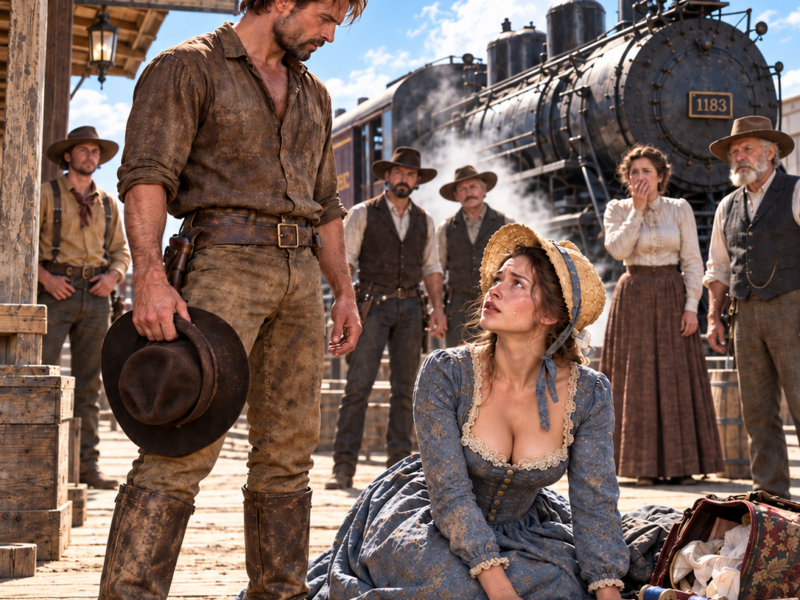
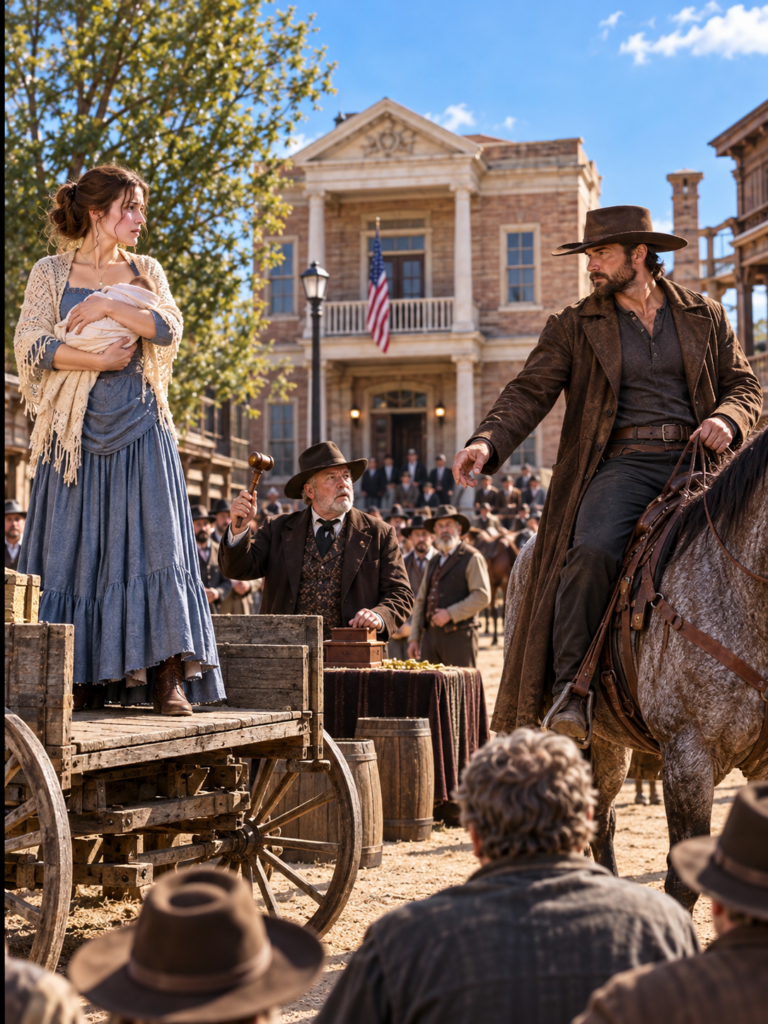
The first time Cora Evans saw Boone Fletcher, she was standing on the back of a wagon with her three-month-old son in her arms, listening to six men argue over how much a desperate widow was worth.
The August sun beat down on Oak Haven, Montana, until the dust in the street seemed to shimmer. Flies gathered around the horses tied outside the saloon. Somewhere behind the general store, a dog barked without stopping.
Cora had not slept properly in eleven nights.
Her husband had been dead for fourteen.
And now Mayor Thaddeus Webb, a man who had shaken Thomas Evans’s hand every Sunday for the past two years, was attempting to auction away a year of her labor to settle forty dollars in unpaid accounts.
“Twenty-five dollars,” called Amos Pike, the pig farmer from the south flats.
A few men laughed.
Cora held her baby tighter.
Seth stirred against her breast, his little mouth searching blindly through the fabric of her faded blue dress. He was hungry again. There was hardly enough milk for him these days, and she had learned to fear the small, desperate sounds he made when she could give him no more.
“Twenty-five,” Webb repeated, lifting his gavel. “A year’s work from a healthy young woman. Cooking, cleaning, washing, whatever respectable labor the purchaser requires.”
“Respectable?” someone muttered from the saloon porch.
Another man laughed.
Cora stared over their heads toward the mountains.
She had come west with Thomas believing that honest work could make a life where poverty had followed them everywhere else. They had purchased a little homestead outside Oak Haven, built a chicken coop, planted potatoes, and talked about the orchard they would have someday.
Then came the sickness.
Thomas had taken ill after helping a traveling family whose youngest child was feverish. By the third day, he could hardly stand. By the fifth, he was buried behind the church, and their future was nothing but an unfinished fence and an empty chair.
The bank had taken the land.
The storekeeper wanted his money.
And Mayor Webb had invented a solution that suited everyone except the widow being offered.
Cora knew perfectly well that no lawful court had sentenced her to servitude. She had told Webb so that morning. He had smiled and explained that a woman without property, money, or family would have considerable trouble finding a magistrate willing to listen.
“Consider it a voluntary labor arrangement,” he had said.
“I haven’t volunteered.”
“Then consider what happens when you and that child have no roof.”
Now she stood in the scorching sunlight while the town watched from behind windows and curtains.
“Twenty-five going once!”
Amos Pike showed his yellow teeth.
Cora knew his reputation. Everybody did. His first wife had died during a winter when the farm was snowbound. His second had been buried two years later, worn down by childbirth and work that began before dawn and ended after dark.
She would rather sleep beneath an open sky than enter his house.
But Seth could not survive beneath an open sky.
“Going twice!”
Then came the sound of hooves.
Slow ones.
Heavy ones.
A powerful roan gelding entered the square from the northern road, carrying a broad-shouldered rider in a weathered canvas coat. The horse was enormous, its dark mane tangled with burrs, its nose marked by an old white scar.
The man riding it looked as though he had traveled straight out of the wilderness.
His beard was dark and threaded with gray. A battered hat shadowed his eyes. A rifle rested in a leather scabbard beside his saddle, and his boots were coated with pale mountain dust.
He stopped beside the wagon.
“Forty dollars,” he said.
His voice was low enough that people leaned forward to hear it.
Mayor Webb blinked.
“What was that?”
“Her debts. Forty dollars, you said.”
“That’s correct, but we’re bidding on a labor contract—”
“No.”
The stranger reached into his vest, removed two gold pieces, and dropped them onto the wagon boards.
The coins rang sharply against the wood.
“Forty dollars,” he repeated. “Give the creditors their money.”
For the first time that morning, Mayor Webb looked uncertain.
“Now see here, mister. There’s a procedure—”
“Then write a receipt.”
The rider did not raise his voice.
Somehow that made him more intimidating.
A hush spread through the square.
Amos Pike stepped forward. “I had the high bid.”
The stranger looked at him.
Nothing more.
Amos stopped moving.
Cora studied the newcomer with a coldness born of fear. A man who paid forty dollars for a stranger usually expected something in return. The only question was what.
Mayor Webb retrieved the coins.
“Your name, sir?”
“Boone Fletcher.”
A murmur traveled through the crowd.
Cora had heard that name.
Fletcher lived somewhere high in the Bitterroot Mountains, beyond the northern timber camps and the last reliable wagon road. People said he trapped in winter, hunted elk, and came into town so seldom that some years his appearances could be counted on one hand.
They also said he had once carried a wounded man eighteen miles through snow.
Other stories made him sound considerably less civilized.
Webb cleared his throat.
“And the widow’s employment arrangement?”
“There isn’t one.”
Boone turned his gaze toward Cora.
For the first time, she could see his eyes.
Gray.
Not the pale blue-gray of a summer sky, but the steady, searching gray of river stones beneath cold water.
“Do you want to get off that wagon?” he asked.
Cora almost laughed.
No man had asked what she wanted since Thomas died.
“Where would I go?”
“That’s for you to decide.”
“With what money?”
Boone glanced at the mayor.
“Her debt’s settled. She can walk away.”
“And sleep where?” Cora demanded.
The mountain man’s expression changed slightly.
He seemed to consider that.
“I’ve got a cabin. Work that needs doing. If you want it, there’s shelter and food.”
“What sort of work?”
“Keeping house. Preserving meat. Watching the stove when I’m away.”
“And my son?”
“He comes too.”
“What would you pay?”
“Fifty dollars at the end of winter. Food and a roof until then.”
Cora stared at him.
He had just offered her more consideration in thirty seconds than the entire town had given her in two weeks.
But she had learned that good offers could hide terrible bargains.
“And what else?”
His brow creased.
“What else?”
“You understand me, Mr. Fletcher.”
For one long moment he looked at her, then at the child in her arms.
“No other expectations,” he said.
Mayor Webb made an impatient noise.
“Well, are you going or aren’t you, Mrs. Evans?”
Cora turned toward him.
“I want the receipt.”
“What?”
“The receipt showing my debts are paid in full. With your signature and the creditors’ names. And I want it to say that no claim exists upon my labor.”
A few people shifted uncomfortably.
Boone looked at her with something very close to approval.
“Give her the paper,” he said.
Webb’s cheeks reddened.
But there were too many witnesses now, and the gold lay plainly upon the wagon. He called for ink and a scrap of writing paper.
Cora made him write every word.
Only when the receipt was folded inside her bodice did she step down from the wagon.
Boone dismounted and offered his hand.
She hesitated.
He waited.
Finally, with Seth held against her shoulder, she placed her fingers in his broad palm.
His hand was calloused and warm, and when he helped her to the ground, he did so carefully, as though he knew she was exhausted without wishing to remind her of it.
“Have you got belongings?” he asked.
“One trunk. The bank has it.”
Boone looked toward the general store.
“Where?”
“Behind the counter. Mr. Bell says I owe storage fees.”
“How much?”
“I don’t know. He invented them this morning.”
Boone took a breath through his nose.
Then he said, “Let’s fetch your trunk.”
The storekeeper objected, naturally.
Boone asked him to produce a written agreement.
When none appeared, Cora collected her trunk.
She had packed it herself when the bank took the house. Inside were two dresses, her mother’s Bible, a sewing box, six letters from Thomas, and a little white blanket she had embroidered while expecting Seth.
Her entire married life fit inside a wooden box with a broken brass clasp.
Boone secured it behind his saddle.
He helped her onto the gelding, settling her sideways on the broad saddle while he took the reins from the ground.
“You aren’t riding?” she asked.
“Not until the road climbs. Horse can manage one passenger better than three.”
“Three?”
He glanced at Seth.
Cora almost smiled.
Almost.
They left Oak Haven without another word.
By the time the town disappeared behind the dusty hills, she was crying silently into her son’s blanket.
Boone did not turn around.
He simply kept walking beside the horse, giving her the dignity of pretending he had noticed nothing.
They traveled for hours.
The lower valley smelled of sagebrush and sun-baked earth. Grasshoppers sprang from beneath the gelding’s hooves. By afternoon, the country rose into dark forests of pine and fir, and cool wind moved through the trees.
Boone mounted when the trail grew steep, seating himself ahead of her and letting her hold the back of his coat.
Cora had never been so far into the mountains.
They passed streams clear enough to show every pebble on the bottom. They crossed narrow slopes where loose rock slid beneath the horse’s feet. Once, a golden eagle circled above them, its shadow crossing the trail like a dark sail.
Seth slept through most of it.
Cora could not.
“Mr. Fletcher?”
“Boone will do.”
“Why did you come to Oak Haven today?”
“Supplies.”
“Why did you stop at the square?”
“Saw a crowd.”
“That isn’t what I asked.”
“No.”
She frowned at the back of his coat.
“Are you always this talkative?”
“Only on special occasions.”
Despite herself, Cora gave a small, startled laugh.
Boone turned his head just enough for her to see the edge of his cheek.
Then he faced forward again.
An hour later the wind sharpened.
Cora’s thin shawl did almost nothing against the cold. She drew Seth close, afraid that his little hands might grow chilled.
Boone stopped without being asked.
From his saddlebags he took a thick wool blanket, dark brown and faintly smelling of wood smoke. He wrapped it around Cora and the baby, tucking it beneath her elbows.
“Better?”
“Yes.”
He stepped away.
“Thank you.”
He gave a small nod.
Then they continued toward the high valley.
Cora watched him more carefully after that.
He had given her the blanket without reminding her of its value. He had paid her debts without asking for gratitude. He had walked beside the horse for miles rather than make her ride cramped behind him in the heat.
She did not trust him yet.
But she began to wonder whether trust might someday be possible.
The cabin appeared just as the last sunlight caught the granite ridges.
It stood in a sheltered valley enclosed by tall mountains, with a narrow stream winding through the meadow below. A grove of pines protected it from the north wind. Beyond the house were a sturdy barn, a woodshed, and a fenced pasture where the summer grass had grown high.
Cora had expected a crude trapper’s shack.
Instead, she saw a solid dwelling built from enormous peeled logs, with a steep roof, a stone chimney, and shutters strong enough to withstand a blizzard.
“Did you build it?” she asked.
“Most of it.”
“By yourself?”
“Had help lifting the beams.”
She looked at the carefully fitted logs.
“It must have taken years.”
“Three summers.”
She imagined three summers of solitary labor, a man cutting and shaping timber while the mountains watched.
“Why make it so large?”
Boone said nothing.
For the first time, his silence felt less like reserve and more like a door he had closed deliberately.
He helped her down near the porch.
“The latch lifts,” he told her. “Go in. I’ll see to the horse.”
Cora entered cautiously.
The cabin smelled of cold ashes, dried herbs, leather, and pine.
Its main room held a broad stone fireplace, an iron cookstove, a table, two chairs, shelves lined with tin cups, and a rack for drying clothing. A wooden staircase led to a low sleeping loft.
There was a large bed near the rear wall.
Only one.
Cora’s breath stopped.
She stood motionless, holding Seth against her.
One bed.
One isolated cabin.
One man who had paid forty dollars to bring her here.
Her courage, so carefully maintained throughout the day, deserted her.
She backed toward the wall, sank onto a small bench, and pressed her face into Seth’s blanket.
When Boone entered twenty minutes later, carrying firewood and the saddlebags, he found her there.
He stopped.
His gaze moved from her white face to the bed.
Understanding came slowly, then completely.
“Mrs. Evans.”
She looked up.
“I won’t share a bed with you.”
“Didn’t ask you to.”
“Then where am I supposed to sleep?”
He pointed toward a narrow door beside the stairs.
“In there.”
Cora blinked.
Boone set the wood down, crossed the room, and opened the door.
Inside was a small bedroom containing a narrow bedstead, a washstand, a chest, and a window overlooking the meadow.
The furniture was plain but sound.
There were no curtains.
No pictures.
Nothing personal.
“The room hasn’t been used in some time,” Boone said. “Mattress is clean. I’ll bring your trunk in.”
Cora rose slowly.
“And you?”
“Main room.”
She looked past him at the large bed.
“That one?”
“Yes.”
He stepped back to give her room to inspect her quarters.
“Door has a latch on the inside. Use it if you like.”
Cora stared at him.
“You’re telling me I may lock you out?”
“Wouldn’t be much use having a latch otherwise.”
She lowered her eyes.
A curious ache spread through her chest.
“I owe you an apology,” she said.
“For what?”
“Thinking the worst.”
Boone glanced toward Seth, who had begun to fuss.
“You had cause.”
He spoke those three words quietly.
Then he went to light the stove.
That evening, Cora ate fried salt pork, beans, and a thick slice of bread Boone had brought from town.
She ate too quickly, embarrassed by her own hunger.
Boone noticed but made no comment.
Instead, he placed the rest of the loaf beside her plate.
“You’ll need that,” he said.
“For tomorrow?”
“For tonight, if you’re hungry.”
She studied his face.
“Do you have a habit of rescuing strangers?”
“No.”
“Then I should be honored.”
“Wouldn’t go that far.”
“You’re a remarkably difficult man to thank.”
“Most folks don’t try.”
That made her smile.
Seth, fed and wrapped in his soft blanket, slept in a shallow wooden box lined with folded cloth beside Cora’s chair.
Boone looked at him.
“What’s his name?”
“Seth Thomas Evans.”
“Good name.”
“He has his father’s eyes.”
Boone nodded.
Cora waited for some question about her husband.
None came.
The restraint touched her more than curiosity would have.
After supper, Boone showed her the pantry, the root cellar, the water barrel, and the woodpile.
There was flour, dried beans, cornmeal, salt, coffee, and several jars of preserved berries. Smoked venison hung from hooks in a cool storeroom.
But Cora immediately saw that the supplies were poorly arranged.
Different sacks held the same grains. There were three open containers of salt. The potatoes were piled too close to an exterior wall, and one barrel of flour had a loose lid.
“You’ll lose half this if mice get into it,” she said.
Boone leaned against the doorway.
“Probably.”
“Don’t you keep an inventory?”
“Know what I’ve got.”
“Then how much flour is in that barrel?”
He considered.
“Some.”
“How much salt?”
“Enough.”
“For how long?”
He was silent.
Cora lifted her eyebrows.
“Well, Mr. Fletcher, I can see why you need a housekeeper.”
Something shifted at the corner of his mouth.
“Beginning to see it myself.”
She folded her hands.
“Before I agree to stay, I want our terms clear.”
Boone straightened.
“All right.”
“One: I keep my own room, and you knock before entering.”
“Agreed.”
“Two: Seth is my responsibility. You may tell me if you believe something is dangerous, but you will not make decisions for him without speaking to me.”
“Agreed.”
“Three: I handle the household stores, provided you tell me what you bring home.”
“Fair.”
“Four: I won’t be kept here against my wishes.”
Boone’s expression grew serious.
“You won’t.”
“And five: I expect you to speak to me like a person, not a hired mule.”
He looked almost offended.
“Never spoken to a mule much.”
“Good. Then this should be easier.”
Boone gave a short sound.
Cora realized with astonishment that it was a laugh.
He extended his hand.
“Six months, then. Until the pass is clear and travel’s safe. Fifty dollars.”
She took his hand.
“And if either of us wishes to change the arrangement?”
“We talk.”
“Like sensible adults?”
“Could try.”
Their handshake lasted no longer than necessary.
But afterward, Cora felt the warmth of his fingers lingering in her palm.
The first weeks were difficult.
Boone rose before dawn and departed into the timber with his rifle, traps, and packhorse. Sometimes he returned before noon. Sometimes the shadows were long across the meadow before Cora heard his horse.
She learned quickly that mountain living offered no patience for idleness.
Water had to be carried.
Ashes emptied.
Clothes scrubbed and dried before the afternoon cold returned.
Meat salted.
Bread made.
Beans soaked.
The fire tended.
And Seth, who had recently discovered the pleasure of grasping anything within reach, required constant watching.
On her fifth day, Cora burned a loaf of bread.
On her seventh, she dropped a bucket of creek water and soaked her boots.
On her tenth, she tried to split kindling with Boone’s hatchet and managed to wedge the blade firmly into a stubborn knot.
Boone found her standing beside the chopping block, glaring at the trapped hatchet.
“Trouble?”
“No. I’m conducting an experiment.”
“What’s the question?”
“Whether an ax can be persuaded by insults.”
“Results?”
“Disappointing.”
He took the handle, worked the blade loose, and showed her how to choose wood that split along the grain.
Then he handed the hatchet back.
He did not take over.
She appreciated that.
By the end of the month, Cora could split kindling neatly, make a respectable loaf, and identify which stores needed replenishing before winter.
She also discovered that Boone’s cabin contained surprising remnants of a different life.
Beneath a stack of old newspapers she found a geography book with a worn blue cover.
In a wooden chest were a few pieces of delicate china, carefully wrapped in cloth.
And upstairs in the loft, beneath a moth-eaten blanket, she discovered a small rocking chair.
Its arm had been broken and repaired with considerable care.
She carried it downstairs one afternoon.
Boone was mending a harness beside the fire.
“Where did this come from?”
His hands stopped.
For a moment, Cora thought he would refuse to answer.
“My mother’s.”
“She lived here?”
“No. Brought it when I came west.”
Cora ran a finger over the smooth wood.
“It’s beautiful.”
“Needs oil.”
“I thought it might be useful when Seth won’t sleep.”
Boone looked at the chair for a long moment.
Then he nodded.
“Use it.”
That evening, he brought her a small tin of furniture oil.
The next morning, Cora found the chair beside her bedroom window.
He had repaired the loose runner while she slept.
By the middle of September, the cabin no longer looked quite the same.
Cora washed the windows until sunlight filled the main room. She cut strips from an old flour sack and stitched them into modest curtains. She rearranged the pantry, labeled the jars, and moved the potatoes to a safer place in the cellar.
She placed her mother’s Bible on the shelf beside the geography book.
Then she discovered that Boone owned no proper cradle.
Seth had been sleeping in a padded drawer placed securely on the floor, and while it served well enough, she wanted something sturdier before he began rolling and reaching.
She mentioned this over supper.
Boone grunted.
Three evenings later, she found a little wooden cradle beside her bedroom door.
It had smooth pine sides, carefully rounded corners, and strong rockers beneath it.
Cora stood looking at it for so long that Boone grew uncomfortable.
“Didn’t know what size,” he said. “Might be too small.”
She knelt and ran her fingers along the joinery.
There wasn’t a splinter anywhere.
“You made this?”
“Had wood.”
“For Seth?”
“He’s the only baby here.”
Her eyes filled unexpectedly.
Boone looked toward the stove.
“If it isn’t suitable—”
“It’s perfect.”
He went still.
Cora laid her palm upon the cradle.
“Nobody has made anything for him since his father died.”
The words changed the silence between them.
Boone looked at the child sleeping against her shoulder.
Then he said, very softly, “A boy ought to have things made for him.”
That night, after Boone retired to his bed beside the hearth, Cora sat in the rocking chair with Seth in her arms.
Through the window she watched the stars glitter over the black mountains.
In Oak Haven, she had been a widow whose debts were worth more than her future.
Here, in a cabin miles from the nearest neighbor, she had work, shelter, a room of her own, and a cradle made by a man who spoke fewer words in a day than most people spoke before breakfast.
She did not know what to make of him.
She only knew that each evening she had begun listening for the sound of his horse.
And Boone Fletcher, who had spent nearly a decade returning to a silent cabin without caring whether anyone waited inside, had begun hurrying home before dark.
Neither of them mentioned it.
Neither of them understood quite how dangerous that small change might become.
Part 2
The first snow fell on September twenty-eighth, covering the meadow in a thin white sheet before dawn.
Cora discovered it when she opened the door to carry out the ash bucket.
The world beyond the porch had turned silver.
Every blade of grass shone beneath the rising sun. Frost decorated the fence rails. The creek ran black between white stones, and the distant granite peaks had disappeared beneath fresh snow.
She stood watching until the cold reached through her boots.
Behind her, Boone said, “Shut the door before the stove quits trying.”
Cora stepped inside.
“Does it always snow this early?”
“Sometimes earlier.”
“How comforting.”
He poured coffee into two tin cups.
“You’ll get used to it.”
“I was beginning to like the mountains.”
“They aren’t asking to be liked.”
Cora took the cup he handed her.
“No. I believe that is your particular philosophy of life.”
His mouth twitched.
She sat at the table and opened her household ledger.
Boone had never seen a woman examine sacks of grain with such seriousness. Cora recorded every pound of flour, every jar of dried apples, and every piece of smoked meat as though she were managing a bank.
“How much more elk do we need?” she asked.
“One good bull would help.”
“And firewood?”
“Another cord.”
“And candles?”
“Enough tallow to make more.”
“And your winter coat?”
Boone looked up.
“What about it?”
“There’s a tear beneath the arm.”
“Still keeps out weather.”
“Until the tear becomes a hole.”
“Then it’ll be a hole.”
Cora put down her pencil.
“Mr. Fletcher, has anyone ever told you that stubbornness is not an adequate substitute for common sense?”
“More than once.”
“Did you listen?”
“Apparently not.”
She sighed and held out her hand.
“The coat.”
He looked at her.
She looked back.
At last, Boone rose, fetched the coat, and placed it beside her sewing basket.
It was the first argument she had won without raising her voice.
It would not be the last.
As the nights grew colder, the rhythms of their lives changed.
Boone began leaving a fresh bucket of water beside the cookstove before Cora woke. In return, she made sure a pot of coffee was waiting when he came downstairs.
He split wood before breakfast.
She baked bread every third day.
He brought in venison and grouse.
She found ways to turn the same ingredients into meals that tasted different enough to make the passing weeks bearable.
One afternoon, she made an apple pudding from dried fruit, flour, and the last of a jar of molasses.
Boone tasted it.
Then he took another spoonful.
Cora watched him over the rim of her cup.
“Well?”
“Good.”
“That’s all?”
He considered the question.
“Very good.”
She folded her arms.
“I see. You are a man capable of extravagant praise.”
He looked at the pudding.
“Could eat the rest.”
“Absolutely not. That’s tomorrow’s dessert.”
“Thought you wanted compliments.”
“I wanted appreciation.”
He pushed his empty bowl toward her.
“Appreciate another helping.”
She laughed so hard that Seth began laughing too, though he had no idea why.
Boone looked from mother to child.
His face changed.
Not dramatically.
Just enough that something long shuttered seemed to open behind his eyes.
For an instant, Cora saw the man he might have been before solitude settled over him.
Then he reached across the table and touched the baby’s hand with one finger.
Seth grabbed it.
Boone sat very still.
The child refused to let go.
“Looks like you’re caught,” Cora said.
“Seems so.”
“He has a strong grip.”
“Takes after his mother.”
She looked at Boone.
He seemed surprised by his own words.
Neither spoke for a moment.
Then Seth pulled Boone’s finger toward his mouth.
“Well,” Cora said briskly, “at least one gentleman in this house knows what he wants.”
Boone laughed.
It was a real laugh this time, low and warm, and Cora carried the sound with her for the rest of the day.
Their first disagreement of consequence came over the smokehouse.
Boone had planned to build additional racks beneath its roof before the heavy snow arrived. The existing structure stood some distance from the cabin, close enough to reach in bad weather but far enough that smoke would not drift constantly through the windows.
Cora inspected it one afternoon and noticed a dark patch beneath the western eaves.
Rain had worked its way through the shingles.
Several boards were soft.
“That roof needs repair,” she told Boone.
He examined it.
“Needs patching.”
“It needs more than patching.”
“I’ll see to it.”
“When?”
“After I check the upper traps.”
Cora put her hands on her hips.
“The smoked meat will spoil if water keeps getting in.”
“Won’t spoil before tomorrow.”
“Perhaps not. But the weather is turning, and you told me yourself the next storm may close the upper trail.”
Boone stood with one hand resting on the ladder.
For a moment, the familiar stubbornness settled into his expression.
Then he looked again at the boards.
“You’re right.”
Cora blinked.
“Excuse me?”
“Roof needs doing first.”
She tried not to look too pleased.
“I suppose mountain men can learn.”
“Some.”
He handed her the tin containing the roofing nails.
“Want to hold these?”
“I thought you’d never ask.”
Together they spent the afternoon repairing the smokehouse.
Boone removed the damaged shingles and replaced the soft boards. Cora handed him nails, held the ladder, and spread pine pitch along the seams where he directed.
The work was cold, awkward, and slow.
At one point a gust of wind sent her bonnet tumbling into the mud.
Boone climbed down to retrieve it.
She was embarrassed to discover that he was smiling.
“What?”
“Nothing.”
“You’re laughing at me.”
“Wouldn’t dare.”
“You most certainly would.”
He handed back the bonnet.
A lock of hair had escaped her braid and fallen across her cheek.
Boone’s gaze lingered.
Cora felt suddenly conscious of the narrow space between them.
His hand rose slightly, as though he meant to brush the hair away.
Then he stopped.
The moment passed.
He stepped aside.
“Wind’s picking up,” he said.
She adjusted her bonnet.
“Yes.”
They finished their work in silence.
But that evening, when Boone reached for his coffee, Cora noticed a small scrape along his knuckles and went to fetch her salve.
“Give me your hand.”
“It’s nothing.”
“Then treating it ought to be very easy.”
He obeyed.
Her fingers rested beneath his broad palm as she applied the ointment.
His skin was rough and warm.
She was aware of the strength in his hand, but more aware that he kept it completely still beneath hers.
“There,” she whispered.
Boone looked at her.
“Thank you.”
Neither moved immediately.
Then Seth knocked his wooden spoon against the table and demanded attention.
Cora withdrew her hand.
The ordinary sound seemed almost a rescue.
On the first Sunday in October, Boone surprised her by carrying a wooden board into the cabin.
It was nearly four feet long, sanded smooth and fitted with handmade brackets.
“What’s that?” she asked.
“Shelf.”
“I can see that.”
“For your books.”
Cora turned toward the two volumes beside the mantel.
“My books?”
“And whatever others you get.”
She stared.
“Boone, I own exactly two books.”
“Then there’s room for more.”
He fastened the shelf against the wall above her sewing basket.
Cora watched him work.
“You don’t read much, do you?”
“Enough.”
“What do you read?”
“Weather. Tracks. Letters when they come.”
“That’s not what I mean.”
He drove in the final nail.
“Used to read more.”
“Why did you stop?”
The hammer paused.
Then he set it down.
“Didn’t see the point.”
Cora studied his broad back.
There was something in that answer that made her speak gently.
“Books can be good company.”
“Had enough quiet company.”
She tilted her head.
“Would you object if I read aloud in the evenings?”
Boone looked at her.
“Wouldn’t object.”
“Even if the book is terribly dull?”
“Can always fall asleep.”
“That’s very encouraging.”
He hung the shelf.
That night, after Seth had been fed and put into his cradle, Cora opened the geography book and began reading about the great rivers of North America.
Boone sat by the hearth mending a bridle.
At first, he appeared not to listen.
Then she came to a passage describing the Mississippi.
“Did you ever see it?” she asked.
“Once.”
“Was it as wide as they say?”
“Wider.”
“Where?”
“Near St. Louis. Years ago.”
“What were you doing there?”
“Working.”
“At what?”
“Railroad freight.”
She looked at him over the book.
“I find it difficult to imagine you in a city.”
“So did I.”
“Did you dislike it?”
“Too many people.”
“That does sound dreadful for you.”
He glanced up.
She smiled.
He went back to his bridle.
But as she continued reading, she noticed that his hands had slowed.
And when she stopped at the end of the chapter, he asked, “What happens to the river after that?”
Cora hid her smile.
“Mr. Fletcher, I believe you were listening.”
“Hard not to. You’re the only one talking.”
“Tomorrow we’ll read about the Rockies.”
“Already know those.”
“Then perhaps you’ll correct the author.”
“Likely.”
She closed the book.
For a while they listened to the fire.
Then Boone said, “My mother used to read in the evenings.”
Cora looked up.
He sat with his elbows on his knees, staring into the coals.
“After my father died, she’d read while I worked on the harnesses. Said a house ought to have more in it than the sound of a man breathing.”
Cora kept very still.
“What was she like?”
Boone’s eyes remained on the fire.
“Small. Stubborn. Could make a meal out of nearly nothing.”
Cora smiled.
“She sounds remarkable.”
“She was.”
He rubbed his thumb along a seam in the leather.
“Lost her before I came west.”
“I’m sorry.”
He nodded.
Then he looked toward the shelf.
“She would have liked that book.”
Cora waited until he had gone out to check the barn before she touched the shelf with her fingertips.
She understood then that Boone had not merely made a place for her books.
He had made a place for something he had once loved and believed lost.
By late October, Cora had begun to notice the small things he did when he thought she wasn’t watching.
He left the driest kindling close to the stove because she disliked struggling with damp wood.
He shaved the rough edge from the kitchen table after seeing her catch her sleeve upon it.
He carved Seth a little horse, then another, and finally a third when the child discovered the great pleasure of throwing toys from his cradle.
He never complained when the baby cried at night.
Once, during a particularly restless evening, Cora emerged from her room to find Boone standing awkwardly beside the cradle, humming beneath his breath.
Seth stared up at him, fascinated.
Boone stopped the moment he noticed her.
“What were you singing?” she asked.
“Nothing.”
“I heard you.”
“Old song.”
“Will you sing it again?”
“No.”
“Why?”
“Can’t sing.”
“Seth seemed to disagree.”
Boone glanced at the child.
The baby kicked both feet.
Cora folded her arms.
“You’ve been entertaining him behind my back.”
“Only because he asked.”
She laughed.
Boone’s expression softened.
Then Cora said something she had not intended.
“You would have made a good father.”
The warmth disappeared from his face.
He looked toward the window.
“Don’t know about that.”
She immediately regretted the words.
“Boone—”
“Need to check the stock.”
He went outside before she could answer.
That night he stayed in the barn for nearly an hour.
Cora sat beside the fire, turning his reaction over in her mind.
She knew almost nothing of his past.
She knew he had built the cabin years earlier. She knew his mother was dead. She knew that he had worked on railroad freight and that some grief had driven him into the mountains.
But she had never asked why.
She had begun to care for him.
And caring, she discovered, made ignorance difficult to bear.
The following week brought a storm that changed everything.
It began before daylight.
Wind swept down from the northern peaks, shaking the cabin shutters and sending powdery snow beneath the porch roof.
Boone had gone out the previous morning to inspect a trapline above the valley. He had expected to return before evening, but a fallen tree had forced him to take a longer route.
Cora had left supper warming on the stove.
He had not come home.
By midnight, she could hear nothing beyond the wind.
By morning, the storm had swallowed the valley.
Cora stood at the window with Seth against her shoulder.
She told herself Boone knew the mountains.
He knew where to find shelter.
He carried matches, food, and a blanket.
But each hour that passed tightened the fear around her heart.
She remembered another time she had waited beside a bed, telling herself a fever would break because she could not bear the possibility that it would not.
She remembered Thomas’s hand growing cold.
She had thought that losing one husband had taught her everything there was to know about grief.
Now she understood that grief could return before anyone had even died.
At noon she went to the barn, following a rope Boone had strung between the buildings for bad weather.
The gelding stood safely inside.
She fed him, checked the latch, and returned to the house.
The snow was already above her knees.
She wanted to go searching.
Every part of her wanted to march into the white wilderness and call Boone’s name until she found him.
But Seth was asleep in his cradle, and Cora knew enough about storms now to understand that wandering into the timber would accomplish nothing except leave her son without his mother.
So she did what she could.
She kept the fire high.
She heated water.
She set clean bandages beside the table.
Then she carried a lantern onto the sheltered porch and hung it beneath the eaves, where its light might be visible through a break in the snow.
She waited.
As dusk approached, the wind slackened for several minutes.
Cora heard a faint sound.
Not a voice.
A hollow knock.
Then another.
She hurried to the doorway.
Through the blowing snow, a dark figure appeared beside the woodshed.
Boone.
He was bent beneath the weight of his pack, moving with an uneven step.
Cora seized the rope and pushed into the storm.
“Boone!”
He raised his head.
Even at a distance she could see the ice covering his beard.
She reached him beside the porch steps.
“What happened?”
“Slipped.”
“You’re hurt.”
“Some.”
“Can you walk?”
“Been doing it.”
“Then do it a little farther.”
She pulled his arm across her shoulders.
Together they stumbled into the cabin.
Boone tried to set his pack beside the door.
Cora caught his sleeve.
“Leave it.”
“Meat—”
“The meat can freeze. You already have.”
He made no further argument.
She settled him near the stove, removed his icy coat, and discovered a deep cut across his upper arm where he had struck a broken branch after slipping on a ledge.
His shoulder was badly bruised.
His fingers had grown stiff from cold.
Cora worked without allowing herself to tremble.
She gave him warm broth, helped him remove his wet boots, and wrapped a blanket around his shoulders.
Then she cleaned the wound.
Boone hissed when the warm water touched the torn skin.
“Hold still.”
“Am.”
“You’re moving.”
“Breathing.”
“Then breathe more quietly.”
He looked at her.
Despite the pain, one corner of his mouth lifted.
Cora pressed the clean cloth against the wound.
“You could have died.”
“Didn’t.”
“That is not a satisfactory answer.”
He looked down at her hands.
They were shaking now.
Cora tried to steady them.
Boone reached out with his uninjured hand and covered her fingers.
“Easy.”
She looked at him.
His expression changed.
He had never seen her quite like this, with tears standing in her eyes and anger fighting desperately against fear.
“I thought I had lost you,” she whispered.
Boone said nothing.
The fire cracked sharply behind them.
Cora lowered her head.
“I kept telling myself that if you were hurt, if you needed help, I ought to do something. But I couldn’t leave Seth, and I didn’t know where you were, and every time I looked at that door—”
Her voice broke.
Boone’s hand tightened gently around hers.
“Cora.”
She looked up.
“You’re here,” he said.
“Now.”
“Yes.”
“But someday you might not be.”
His face grew solemn.
“That’s true.”
She wanted him to deny it.
She wanted him to make the impossible promise that he would never leave her frightened or alone.
Instead, he gave her the truth.
And somehow that hurt less than a lie would have.
She finished bandaging his arm.
When she tried to pull away, Boone did not release her hand immediately.
“Thank you,” he said.
“For what?”
“The lantern.”
She blinked.
“You saw it?”
“Through the trees. Couldn’t see the cabin, but I could see that light.”
Tears spilled down her cheeks.
He lifted his hand, then hesitated.
“May I?”
Cora nodded.
Boone brushed one tear from her cheek with his thumb.
His touch was so gentle that it almost undid her.
For several seconds they stood close enough for her to feel the warmth returning to him.
His gaze lowered to her mouth.
Her breath caught.
She could have crossed the small distance between them.
She knew he would not stop her.
But Seth began crying in the next room.
Cora stepped back.
Boone lowered his hand.
Neither apologized.
Neither pretended nothing had happened.
For the next several days, Boone remained near the cabin while his shoulder healed.
Cora insisted upon it.
He resisted for exactly one morning.
Then he attempted to lift a sack of grain, turned pale, and reluctantly admitted that she might have a point.
“I believe those were the words ‘you were right,'” Cora observed.
“Didn’t say that.”
“You implied it.”
“Don’t make a habit of listening for things I don’t say.”
“Then you should say more.”
He gave her a look.
She smiled sweetly.
With Boone unable to do much heavy work, they spent long afternoons together.
He repaired leather straps and carved wooden spoons while she sewed beside the fire.
They talked more than they ever had.
Cora told him about her childhood in Ohio, where her father had been a schoolmaster and her mother could grow flowers in almost any soil. She spoke of Thomas, too, though at first she was careful.
“Was he kind?” Boone asked one evening.
Cora looked up from her sewing.
“Yes.”
He waited.
“Not perfect,” she added. “He could be impatient. And he worried too much about money. Sometimes he made promises that were larger than our means.”
She smiled sadly.
“But he loved Seth. He held him the day he was born and cried harder than the baby.”
Boone looked toward the cradle.
“He sounds like a good man.”
“He was.”
“Then the boy has a good beginning.”
Cora swallowed.
“Thank you for saying that.”
Boone bent his head over his work.
After a while, she asked, “Were you ever married?”
His knife stopped.
“No.”
“Did you ever want to be?”
He looked toward the far wall.
“Once.”
She waited.
Boone remained silent so long that she thought he would say nothing more.
Then he spoke.
“Her name was Ruth.”
Cora laid aside her sewing.
“We were engaged when I worked near Helena. She was a schoolteacher. Liked music. Had a laugh you could hear down the street.”
His expression held a tenderness Cora had never seen.
“I had a little land. Plans for a house. Thought I had time.”
“What happened?”
“Fever came through that winter. Took her in nine days.”
Cora closed her eyes.
“I’m sorry.”
“Built this place afterward. Figured if I got far enough from people, I couldn’t lose any more of them.”
He gave a humorless smile.
“Worked well for a while.”
Cora looked around the cabin.
The sturdy walls.
The extra bedroom.
The careful workmanship.
He had built a home for a life that never arrived.
And then he had lived inside its emptiness for years.
“Boone,” she said quietly, “being alone doesn’t keep grief away.”
“No.”
“It only means there’s nobody to sit beside you when it comes.”
He looked at her.
For a long moment neither spoke.
Then Boone put down his knife.
“That’s something Ruth might’ve said.”
Cora’s heart tightened unexpectedly.
She was glad he remembered the woman he had loved.
And she was frightened by how much she wanted him to have room in his heart for another.
November arrived with deeper snow.
Boone’s shoulder healed, and their days settled into a warm, almost comfortable pattern.
One evening, Cora found him sitting on the floor while Seth crawled over his legs.
The child had become fascinated with Boone’s beard.
He seized a handful of it.
Boone winced.
“Careful there, young fellow.”
Seth squealed with delight.
Cora laughed from the doorway.
“He’s training you.”
“Seems determined.”
“Perhaps you’ll learn obedience.”
“Not likely.”
Seth tugged again.
Boone surrendered.
“All right. Maybe a little.”
Cora stood watching them, her heart feeling both wonderfully full and dangerously exposed.
Without warning, she imagined Seth growing older in that cabin.
A small boy following Boone to the barn.
A child learning the names of the mountains.
A man teaching him to hold a hammer, mend a fence, and care for an animal.
She imagined a second chair by the hearth.
A garden beneath the southern window.
A life measured not by months remaining on an agreement, but by years.
The thought frightened her.
Because it was no longer merely shelter she wanted.
It was Boone.
And she had no idea whether he wanted anything more than the arrangement they had made.
The letter came during the second week of November.
Boone had traveled as far as the lower trading post before another storm closed the road. When he returned, he brought salt, lamp oil, a sack of dried apples, and a small bundle of mail.
One envelope bore Cora’s name.
She recognized the handwriting immediately.
Her cousin Margaret lived in St. Louis. They had been close as girls, though marriage and distance had carried them into different worlds.
Cora opened the letter beside the window.
Margaret had heard of Thomas’s death through a relative in Ohio. She offered sympathy, but more importantly, she offered something practical.
A position had opened at a small girls’ school where Margaret taught. The school needed a woman to assist with younger pupils and keep the accounts. The pay was modest, but there would be a room for Cora and Seth in Margaret’s household.
The position would be available in the spring.
Cora read the letter three times.
Then she sat very still.
It was everything she had once prayed for.
Respectable employment.
An income.
A school for Seth when he grew older.
A house filled with people.
And no dependence upon a man.
She should have felt nothing but relief.
Instead, she looked across the room at Boone, who was patiently showing Seth how to tap two wooden blocks together.
Her chest hurt.
“What is it?” Boone asked.
She folded the letter.
“An offer of employment.”
He raised his head.
“Where?”
“St. Louis.”
Boone glanced at the paper.
“Good?”
“Very good.”
“What kind of work?”
“Teaching younger children. Keeping accounts.”
He nodded slowly.
“You’re suited to that.”
Cora waited.
She did not know what she hoped he would say.
Perhaps that he would miss her.
Perhaps that he would ask if she wanted to remain.
Perhaps simply that he would look disappointed.
Instead, he said, “Railroad runs east from Missoula. Once the pass clears, I can take you down.”
Cora felt something small break inside her.
“Yes,” she said.
Boone lifted Seth from his knee and placed him gently on the blanket.
“Be a good opportunity for the boy.”
“Yes.”
“Doctors close by. Schools.”
“Yes, Boone. I understand.”
He looked at her sharply.
She turned toward the window.
Outside, snow drifted silently between the pines.
“I suppose,” she said, struggling to keep her voice steady, “you’ll be glad to have your house back to yourself.”
Boone went motionless.
“Didn’t say that.”
“You didn’t have to.”
“Cora—”
“Our arrangement ends in spring. You’ve made that very clear.”
His jaw tightened.
“I gave you my word.”
“Yes. You’ve never failed to remind me.”
He looked as though she had struck him.
For one terrible second, Cora wanted to take the words back.
Instead, she folded the letter and put it inside her sewing box.
“I should prepare supper.”
Boone remained by the hearth.
“I never meant—”
“Please.”
He stopped.
She kept her eyes on the stove.
“Not tonight.”
He went outside to tend the horse.
Cora stood alone in the warm kitchen, staring at the pot of stew.
She had come into the mountains afraid that Boone Fletcher would keep her against her will.
Now she was afraid he would let her go without asking her to stay.
And Boone, standing in the cold barn with one hand resting on his gelding’s neck, believed that the first woman he had loved in ten years had finally been offered the life she deserved.
He would not take it from her.
Even if keeping his promise meant watching the light leave his house again.
Part 3
Winter settled into the Bitterroot Mountains with a patience that seemed almost cruel.
By December, the snow lay shoulder-deep in places. The creek froze along its banks. Frost thickened around the windows, and the morning sun reached the cabin only after clearing the eastern ridge.
The house remained warm.
But something between Cora and Boone had grown cold.
They were never unkind.
That almost made it worse.
Boone continued carrying water, bringing in wood, and leaving small pieces of carved timber for Seth. Cora still prepared his supper and mended his shirts. They spoke about provisions, weather, and the animals.
They avoided everything else.
Sometimes Cora caught him looking at her across the table.
He would lower his eyes.
Sometimes Boone heard her reading aloud to Seth, her voice soft and musical, and stopped in the doorway simply to listen.
Then he would remember the letter from St. Louis.
And he would go outside.
Cora began to hate that letter.
Not because it was unkind or unwelcome, but because it had revealed how badly she wanted something she had never intended to ask for.
She had told herself she needed independence.
That was still true.
She needed a way to raise Seth, to earn her living, and to know that no man could ever again use poverty to decide her fate.
But independence and loneliness were not the same thing.
She had learned that in the mountains.
She had also learned that belonging somewhere did not necessarily mean surrendering herself.
Yet Boone had given her no reason to believe he wished her to belong permanently.
And her pride would not allow her to beg.
Christmas approached beneath skies so clear and cold that every star seemed sharpened against the darkness.
Cora had saved dried apples, a little sugar, and some precious cinnamon for a holiday pudding. She fashioned a tiny wreath from evergreen branches and hung it above the mantel.
Boone said nothing about the decorations.
But the next morning, she discovered a small pine tree standing in a wooden bucket beside the hearth.
Its branches were crooked.
Its top leaned noticeably to one side.
It was, Cora thought, the most beautiful Christmas tree she had ever seen.
“Where did you find it?” she asked.
“North slope.”
“In this snow?”
“Wasn’t far.”
She looked at him.
“Boone Fletcher, you are a dreadful liar.”
He examined the tree.
“Crooked, too.”
“Perfectly crooked.”
She decorated it with strips of red thread, dried berries, and little stars cut from scraps of paper.
Seth watched from his cradle, making enthusiastic noises.
On Christmas morning, Cora found a small parcel beneath the tree.
Inside was a pair of soft leather boots for Seth, made from carefully cut scraps and lined with warm wool.
There was also a wooden box.
When she opened it, she discovered a beautiful set of sewing needles, a little thimble, and a pair of scissors with polished handles.
Cora looked at Boone.
“You bought these for me?”
“Ordered them from the trading post.”
“But you already paid for my winter work.”
He shifted uncomfortably.
“Christmas present isn’t wages.”
She ran her thumb over the scissors.
They were finer than anything she had owned in years.
“Thank you.”
He nodded.
Then she brought out his gift.
It was a wool scarf, dark green, knitted from yarn she had purchased with the small amount of money left from selling two of her embroidered handkerchiefs at the trading post.
She had worked on it after he went to bed.
Boone held it without speaking.
“I know you don’t like unnecessary things,” she said. “But your old scarf has more holes than wool.”
He looked up.
“Made it yourself?”
“Every stitch.”
He wrapped it around his neck.
It was a little uneven at one end.
Cora waited for his usual dry remark.
None came.
Instead, he touched the scarf and said, “Best thing I’ve had in a long while.”
She turned away before he could see her tears.
That night, while snow fell silently outside, they sat together beside the tree.
Cora read the Christmas story from her mother’s Bible.
Boone listened.
Seth fell asleep in his cradle, one tiny hand curled around the wooden horse.
For a little while, the letter from St. Louis seemed very far away.
In January, the smokehouse roof collapsed.
It happened after three days of heavy snowfall followed by freezing rain.
Cora heard the crash just after breakfast.
The sound rolled across the yard like thunder.
Boone hurried to the window.
The western half of the smokehouse roof had fallen inward beneath a great burden of ice and snow.
For several seconds neither spoke.
Then Boone seized his coat.
“Stay inside. I’ll see what’s damaged.”
Cora was already fastening her boots.
“I’ll come.”
“Snow’s deep.”
“I have noticed.”
He turned.
“Some of the beams could still fall.”
“Then we should both be careful.”
His face tightened.
She met his eyes.
“Boone, I helped you build those racks. I know where the meat is stored. And I know which provisions we can afford to lose.”
He studied her.
Then he nodded.
“All right. Bring the canvas covers.”
They worked together in the bitter cold.
The main supporting beam had cracked, crushing one rack and scattering smoked meat across the floor. Several pieces were buried beneath snow and splintered timber.
Boone cleared the dangerous debris while Cora gathered what could be saved.
She carried each piece to the cabin, inspected it, and separated the sound provisions from those spoiled by dampness or contamination.
By noon, their hands were stiff.
By afternoon, Boone had discovered another problem.
The fallen beam had struck the side of the small supply shed, breaking its door and exposing several sacks of grain to drifting snow.
They could repair the structures.
But if another heavy storm arrived before they finished, their winter stores would be in danger.
Boone stood in the damaged doorway, studying the broken timbers.
“We’ll have to ration.”
Cora looked over her ledger.
“We can manage.”
“May be a long winter.”
“I know.”
“Could be late May before the trail’s safe.”
She raised her eyes.
“And?”
He looked at her.
“You and Seth need proper food.”
“So do you.”
“I can manage with less.”
“Absolutely not.”
“Cora—”
“No.” She shut the ledger. “We will ration intelligently. We will repair what can be repaired. And we will all eat enough to stay healthy.”
He opened his mouth.
She lifted one finger.
“If you’re about to suggest that you live on coffee and stubbornness, I refuse to hear it.”
Despite everything, Boone smiled.
It vanished quickly.
But Cora had seen it.
And for the first time in weeks, she felt they were working together again.
The next morning brought another difficulty.
Boone’s gelding, Ranger, had injured his hind leg on a broken fence rail during the storm.
The wound was not deep, but it left the horse lame.
Boone cleaned and bandaged it carefully.
Cora held Ranger’s head, speaking softly while the great animal shifted unhappily.
When the work was finished, Boone stood back.
“Won’t be traveling for a while.”
Cora glanced toward the mountain trail.
“There’s nowhere to travel to.”
“Trading post might have spare grain.”
“Not in this weather.”
He nodded.
They returned to the cabin together.
By evening, Boone had grown quiet again.
Cora found him sitting at the table with the household ledger open.
He was studying the accounts she had kept so carefully.
“What are you doing?”
“Figuring what we’ll need come spring.”
She set down the kettle.
“That’s months away.”
“Need to plan.”
“For what?”
“Repairs. Supplies. Your wages. Travel money.”
Cora froze.
“Travel money?”
He looked up.
“For St. Louis.”
Her hands tightened around the kettle handle.
“Must we discuss that now?”
“Thought you’d want to know you’ll have enough.”
She placed the kettle down slowly.
“Boone, for months I’ve tried to understand whether you want me here.”
He went very still.
“You’re welcome here.”
“That isn’t what I asked.”
He looked at the ledger.
Cora felt anger rise through her sadness.
“Do you know what I was afraid of when I first came to this cabin?”
“Yes.”
“I thought you would demand something because you’d paid my debts.”
He closed his eyes briefly.
“I know.”
“And then you gave me a room. You respected every boundary I set. You made a cradle for Seth and taught me to split wood and treated my work as though it mattered.”
“It does matter.”
“Then why do you keep speaking as though we’re simply waiting for the day I leave?”
Boone stood.
His chair scraped against the floorboards.
“Because you have a chance at something better.”
“Better than what?”
“A proper life.”
Cora stared at him.
Boone gestured toward the mountains.
“Look around. We spend half the year snowed in. The nearest doctor is a long ride away. Roofs fall in. Horses go lame. You have to work every day just to keep warm and fed.”
“I know where I live.”
“Seth ought to have a school.”
“He will.”
“A town. Other children. Things I can’t give him.”
“Have you considered asking what I want to give him?”
Boone stopped.
Cora came around the table.
“I want him to grow up knowing kindness. I want him to understand that work is honorable and that a woman has the right to make decisions about her own life. I want him to learn that strength can be gentle.”
Her voice trembled.
“And there is a man in this cabin who has taught me more about those things than anyone else I’ve ever known.”
Boone’s expression changed.
“Cora.”
“No. You’ve listened to me for months when I spoke about flour and candles and firewood. Now you will listen to this.”
He stood motionless.
“I am grateful to Margaret. Her offer is generous. It may even be the sensible choice. But I have not decided to take it.”
His voice came quietly.
“Why not?”
Cora looked directly at him.
“Because I love you.”
The words settled into the room.
Outside, the wind moved through the pines.
Boone did not move.
Cora felt her courage slipping, but she forced herself to continue.
“I didn’t mean to. I certainly didn’t expect to. At first I was afraid of you. Then I respected you. Then I looked for you every evening and worried when you were late and found myself laughing at things that would have annoyed me in any other man.”
A tear slipped down her cheek.
“I love how you care for Seth. I love the way you pretend not to listen when I read. I love that you repair things before anyone asks. I love that you’ve never once made me feel ashamed of needing help.”
She drew a breath.
“But I will not stay here merely because you need someone to tend your fire. And I will not ask you to take me as a wife out of pity for a widow and her child.”
Boone looked as though speech had become physically difficult.
He took one step toward her.
Then stopped.
“Cora, I have wanted to ask you to stay since October.”
Her breath caught.
He looked down at his hands.
“I wanted to ask you that night you stood on the porch with the lantern. I wanted to ask when Seth reached for me the first time. Wanted to ask when you put those curtains up and made this place look like somebody lived in it.”
“Then why didn’t you?”
His eyes lifted.
“Because I’ve seen what happens when a man mistakes another person’s need for love.”
Cora stood silent.
Boone swallowed.
“You came here with no money. No family close by. A baby to feed. If I asked you to stay, how could I know you weren’t agreeing because you had nowhere else to go?”
“Boone—”
“I couldn’t bear the thought of you waking up ten years from now and realizing you’d spent your life here because I made it hard to leave.”
His voice roughened.
“You’re free, Cora. You have been since the day we met. I need you to know that.”
She stared at him.
For months she had believed his silence meant indifference.
Now she understood that the same stubborn honor which had brought her safely into his house had kept him from speaking.
Cora wiped her cheek.
“You foolish man.”
His brow furrowed.
She moved closer.
“Do you imagine I would have spent all these months arguing with you about flour, mending your shirts, and keeping your house if I were afraid to tell you what I thought?”
“No.”
“Then why assume I cannot decide whom to love?”
His expression softened painfully.
“I didn’t know you could love me.”
Cora placed her hand against his chest.
“I do.”
Boone covered her hand with his.
For a long moment he looked at her as though he feared she might disappear.
Then he whispered, “I love you too.”
Cora closed her eyes.
The words were simple.
There was no grand speech, no promise that the mountains would grow gentle or that life would become easy.
But she believed him.
When she opened her eyes, Boone was still watching her.
“May I kiss you?” he asked.
She smiled through her tears.
“I was beginning to think you’d never ask.”
He bent toward her slowly.
Their first kiss was tender and uncertain, the kiss of two people who had spent months learning how to trust and were only now brave enough to reach for what they wanted.
His hand rested lightly against her cheek.
Hers curled into the wool of the scarf she had made him.
When he drew back, he looked almost astonished.
Cora laughed softly.
“Well?”
Boone shook his head.
“Never was much good with words.”
“Then I suppose you’ll have to kiss me again.”
This time he smiled before he did.
They did not marry that winter.
Cora wanted time.
Not because she doubted her love, but because she had come to understand how precious it was to choose deliberately.
Boone accepted that without argument.
They spoke long into the evening about the life they might build.
Cora wanted to keep teaching. Even in an isolated valley, she believed there must be children among the scattered homesteads whose parents would welcome lessons.
Boone knew of three families below the ridge and another farther east.
There was a small room above the barn that might be finished into a schoolroom during the warmer months.
“And books,” Cora insisted.
“How many?”
“As many as we can afford.”
Boone looked toward the shelf he had built.
“May need another.”
“Several.”
He smiled.
They also agreed that she would have her own savings, that the earnings from any teaching would belong to her, and that decisions about the property and household would be made together.
Boone seemed puzzled when she explained this.
“Thought we already did that.”
“Mostly,” Cora admitted.
“Then we keep doing it.”
She leaned forward and kissed his cheek.
“That may be the most romantic thing you’ve said all winter.”
He turned his head.
“Thought I was getting better.”
“You are.”
Seth, sitting between them on a blanket, knocked his wooden blocks together.
Boone picked him up.
“What do you think, young fellow?”
The baby grabbed his beard.
Cora laughed.
“I believe he approves.”
The rest of winter was hard.
Their repaired smokehouse held, but food remained carefully rationed. Boone hunted only when the weather permitted. Cora found new ways to prepare venison, beans, and cornmeal, and once made a surprisingly pleasant soup from dried vegetables and a little smoked meat.
When Boone complained that her portions were too small, she informed him that a man who wanted larger meals might first learn to measure his supplies properly.
He did not mention the matter again.
In February, Ranger’s leg healed sufficiently for short walks around the pasture.
In March, a late storm buried the woodshed door, and Boone spent half a day digging it out while Cora kept hot coffee waiting.
One morning, Seth stood by gripping the edge of the table.
Boone was kneeling nearby, shaping a wooden peg.
Cora watched her son rise unsteadily, release one hand, and wobble.
“Seth,” she whispered.
The baby took a step.
Then another.
He fell directly into Boone’s waiting arms.
Boone caught him with a look of such complete amazement that Cora felt tears prick her eyes.
“Did you see?” she cried.
Boone looked up.
“Saw it.”
“He walked!”
“Two whole steps.”
Seth laughed and patted Boone’s beard.
Cora knelt beside them.
“Your father would have been so proud,” she whispered to the child.
Boone looked at her.
There was no jealousy in his expression.
Only tenderness.
Cora rested her hand on his shoulder.
“And I think,” she added softly, “you have another man who is proud of you too.”
Boone bent his head.
For a moment he could not speak.
Then he kissed the top of Seth’s dark hair.
“Always will be, son.”
The spring thaw came slowly.
In April, water began dripping from the eaves.
By the end of the month, patches of brown grass appeared along the creek. The pines released their burdens of snow, and the meadow filled with the sweet, damp scent of earth waking beneath the sun.
The mountain trail remained difficult, but Boone believed they could safely descend to the trading post within a few weeks.
One evening, he came inside carrying a small leather pouch.
He placed it on the table before Cora.
She looked at it.
“What’s this?”
“Your wages.”
She opened the pouch.
Inside were coins totaling fifty dollars.
Cora looked up.
“Boone.”
“A bargain’s a bargain.”
“Even now?”
“Especially now.”
She stared at the money.
He pulled out a chair and sat opposite her.
“I want you to have it. Whatever happens next.”
She closed her fingers around the pouch.
“And what do you hope happens next?”
Boone met her eyes.
“I hope you’ll marry me.”
Cora went very still.
He continued before she could answer.
“Not because I need somebody to mind the stove. Not because I paid your debts. And not because it’s easier for you than going east.”
His hands rested flat on the table.
“I want to marry you because I love you. I love Seth. And every morning I wake up grateful that this house has your voice in it.”
Cora pressed her lips together.
Boone’s eyes shone with emotion.
“I can’t promise you an easy life. But I can promise I will listen when you disagree with me. I will never make you earn your place here. And if someday you need something this mountain can’t give, I’ll help you find it.”
He paused.
“If you want to go to St. Louis, I’ll take you to the train myself. The money’s yours either way.”
Cora looked down at the pouch.
Forty dollars had once been used to place a price upon her freedom.
Fifty dollars now lay before her, given without conditions.
She understood the difference.
And she loved him all the more for it.
“Boone Fletcher,” she said, “you have a remarkable talent for making a woman cry.”
He smiled uncertainly.
“Is that a yes?”
She stood, walked around the table, and took his hands.
“Yes.”
His shoulders sagged with relief.
“But I have conditions.”
He laughed softly.
“Figured you might.”
“I want a garden.”
“Ground’s yours.”
“I want that schoolroom above the barn.”
“We’ll build it.”
“And I want you to stop pretending you don’t enjoy my reading.”
Boone considered.
“That one’s difficult.”
She laughed.
Then she kissed him.
When he wrapped his arms around her, she felt not the grip of a man claiming something, but the embrace of someone grateful to be chosen.
They were married in Oak Haven on a warm morning in June.
Cora had not wanted to return to the town.
The thought of that wagon, the gavel, and the faces of the men who had watched her humiliation still troubled her.
But Boone had offered to arrange a ceremony elsewhere, and Cora had surprised herself by refusing.
“No,” she said. “I want to walk through that town on my own feet.”
Boone understood.
They rode down together with Seth perched safely in a small traveling basket secured to their wagon.
Cora wore a pale blue dress she had sewn during the final weeks of winter. It had a simple white collar and tiny pearl-colored buttons that Boone had ordered as a surprise.
A sprig of wildflowers rested in her hair.
The church stood exactly where she remembered it.
So did the wagon yard.
So did the dusty square.
But Cora was not the same woman.
When they passed the general store, Mr. Bell stepped onto the porch.
He stared.
“Mrs. Evans?”
Cora looked at him calmly.
“Good morning, Mr. Bell.”
His eyes moved toward Boone.
“I heard you were living up in the mountains.”
“I am.”
Bell glanced at her fine, clean dress and the healthy baby sitting beside her.
“Well. That’s good to hear.”
Cora smiled politely.
“Yes. It is.”
They continued without another word.
At the church, an elderly widow named Mrs. Whitcomb waited beside the minister.
She had been one of the few women who had offered Cora kindness after Thomas died, bringing a little bread and milk to the homestead before the bank took it.
When she saw Cora, tears filled her eyes.
“My dear child.”
Cora embraced her.
Mrs. Whitcomb held her tightly.
“I prayed you’d be safe.”
“I am,” Cora whispered.
The older woman’s gaze moved toward Boone, who stood holding Seth.
“That man of yours looks rather serious.”
Cora smiled.
“He is.”
“Is he good to you?”
Cora looked across the church.
Boone had taken off his hat and was trying unsuccessfully to prevent Seth from chewing its brim.
The sight filled her heart.
“Very.”
Mrs. Whitcomb patted her hand.
“Then that is what matters.”
The ceremony was simple.
Sunlight streamed through the church windows.
The minister read the vows.
Cora took Boone’s hand.
When asked whether she freely took him as her husband, she answered clearly enough to be heard throughout the little church.
“I do.”
Boone’s voice was rough when he spoke the same words.
He slipped a plain gold band onto her finger.
It was not expensive.
He had purchased it with money from the sale of his winter furs, and he had spent considerable time choosing one that would not catch upon her work.
Cora loved it immediately.
When the minister pronounced them husband and wife, Boone looked at her with tears standing openly in his gray eyes.
He bent and kissed her.
The church bells rang.
Outside, the mountain breeze carried the smell of summer grass.
And Cora Evans, who had once stood helpless in that same town while men argued over the value of her labor, walked out of the church as Cora Fletcher, choosing her husband and her future for herself.
They returned to the valley before sunset two days later.
The mountains rose blue and green beneath the summer sky.
Wildflowers covered the meadow.
The creek sparkled between its banks, and Ranger grazed peacefully beside the barn.
The cabin waited beneath the pines.
Cora stood on the porch while Boone carried Seth inside.
For a moment she simply looked.
The little curtains moved in the breeze.
Her books rested on the shelf.
The rocking chair stood beside the bedroom window.
The cradle Boone had made was nearly too small now, and Seth’s wooden horses occupied a basket near the hearth.
There was flour in the barrel, fresh bread cooling on the table, and a row of seedlings in little clay pots beneath the southern window.
Nothing about the house was grand.
The roof would need repairing again someday.
The winter stores would have to be gathered.
There would be storms, illnesses, difficult harvests, and lonely stretches of weather when the mountain passes closed.
But there would also be mornings filled with coffee and laughter.
Summer evenings in the garden.
Books read beside the fire.
Small boots drying near the stove.
Arguments over whether Boone had remembered to eat his midday meal.
Years of ordinary work and ordinary joy.
Cora stepped inside.
Boone stood beside the table with Seth in his arms.
“Something wrong?” he asked.
She shook her head.
“I was remembering the first night I came here.”
He glanced toward her bedroom.
“Thought you were afraid of me.”
“I was.”
“Don’t blame you.”
She crossed the room and rested her hand against his cheek.
“You gave me that little room. You put food on the table. You never asked me for more than I freely offered.”
Boone covered her hand with his.
“Seemed the right thing.”
“It was.”
She looked around.
“And somehow, without either of us expecting it, we made a home.”
He smiled.
“Think you did most of the making.”
“No,” Cora said softly. “I brought the curtains. You built the walls.”
Seth reached between them, demanding attention.
Boone laughed and lifted the child higher.
Outside, the afternoon sunlight turned the meadow gold.
Cora opened the window, letting in the scent of pine and wildflowers.
Then she heard Boone behind her.
“Cora?”
She turned.
He stood in the center of the room with Seth against his shoulder.
There was a strange, tender expression on his face.
“Glad I was late that day.”
She smiled.
“Late?”
“To Oak Haven. I’d planned to be there the morning before. Lost a shoe off Ranger and had to stop and fix it.”
Cora stared at him.
Then she began to laugh.
“Boone Fletcher, are you telling me that the most important day of our lives happened because your horse lost a shoe?”
“Looks that way.”
She crossed the room and kissed him.
“Then I suppose we owe Ranger something special.”
“An apple?”
“An entire bushel.”
Boone shook his head.
“That horse will get spoiled.”
“He’s earned it.”
Seth squealed, delighted by the laughter around him.
Boone held out his free arm.
Cora stepped into it.
For a long moment the three of them stood together while the breeze stirred the curtains and the fire burned low in the hearth.
Boone looked over Cora’s shoulder at the little shelf filled with books, the cradle beside the bedroom door, and the sunlight lying across the clean wooden floor.
For nearly ten years, he had believed the cabin was the place he came to hide from everything he had lost.
Now he understood that the mountains had not been keeping him apart from the world.
They had simply been holding a place for the people who would teach him how to live in it again.
He kissed Cora’s hair.
She leaned against him.
And when evening settled over the Bitterroot Mountains, no one in the little cabin feared the approaching dark.
There was wood beside the stove.
Bread on the table.
A child laughing in his father’s arms.
And a woman who had once been told she was worth forty dollars stood beside the man who had never mistaken her value for a price.
Outside, the wilderness stretched vast and beautiful beneath the first stars.
Inside, the lamps were burning.
And Boone Fletcher, the lonely mountain cowboy who had once needed only someone to keep his fire alive, had finally found a reason to come home.