Part 1
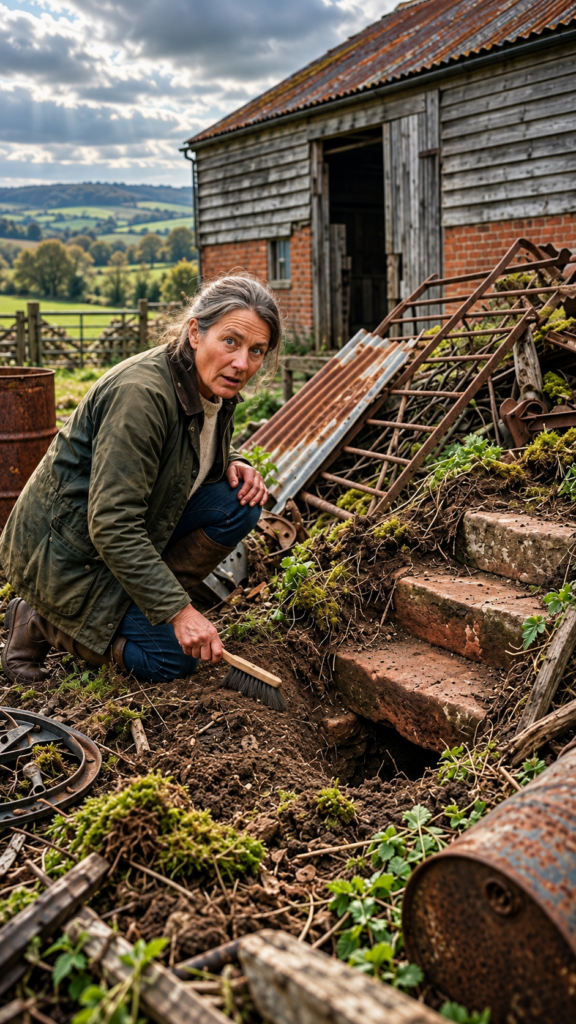
Margaret Hollis was trying to fix a drainage problem when she uncovered the first stone step behind her barn.
By the time she realized what she was looking at, she had already spent most of a Thursday dragging away rusted machinery, broken fencing, and agricultural equipment that nobody had touched in decades. Her back ached, the knees of her work trousers were stiff with dried mud, and the last thing she wanted was another problem to solve.
But the edge of stone emerging from the compacted earth was too straight to be accidental.
She brushed away another handful of dirt.
A second stone surface appeared beneath the first.
Then a third.
Margaret stood slowly, the spade hanging loosely in her hand.
Someone had built a staircase behind her barn.
And judging by the way it descended beneath ground that had remained undisturbed for years, whatever lay at the bottom had been forgotten long before she inherited the farm.
Eighteen months earlier, Margaret had become the owner of Brackfen Farm, a working property in the countryside of South Shropshire, England, after the death of her uncle.
She had not arrived with romantic ideas about country life.
The place needed work, and she understood that owning a farm meant inheriting all its problems along with its fields and buildings.
During her first year, she had concentrated on things that could not wait. She sorted through years of accounts, checked boundaries, repaired fences, and gradually learned the character of every field.
Some fields drained beautifully, even after days of rain.
Others seemed determined to hold water.
The farmhouse itself was reassuringly solid. It needed maintenance, but nothing beyond the ordinary demands of an aging rural property.
The main barn presented a more immediate problem. Four roof purlins had rotted badly enough to require replacement. Once that work was finished, however, the building was sound.
The ground behind it was another matter entirely.
A rough rectangle measuring approximately thirty feet by forty-five feet stretched from the rear barn wall toward an old hawthorn boundary.
It was difficult to describe the area as anything other than an outdoor dumping ground.
Broken machinery lay beneath collapsing timber. Rusted metal disappeared into tangled vegetation. Moss had spread across objects whose original purposes were no longer obvious.
Somewhere beneath it all was the ground Margaret had inherited, although she had never actually seen much of it.
For eighteen months, she had left the mess alone.
It was hidden from the lane, posed no immediate threat to the working parts of the farm, and had clearly been neglected for so long that another few months seemed unlikely to matter.
There were always more useful ways to spend a day.
Then the drainage problem in Lower Fallow became impossible to ignore.
Lower Fallow was Margaret’s name for the field beyond the hawthorn boundary. Its northeastern corner remained wet long after surrounding ground had dried. Water collected there stubbornly, turning what should have been workable soil into an unreliable patch of mud.
At first, she suspected it was simply the natural character of the land.
After another season of watching the same corner hold water, she decided to investigate.
In early spring, an agricultural drainage consultant traveled from Shrewsbury to examine the field.
He was a methodical man who seemed more interested in what the ground could tell him than in offering a quick answer.
For two hours, he walked the affected area with a probe and clipboard, examining the soil and studying the slope between the field and the buildings.
Margaret accompanied him, answering questions about where water collected and how long it remained after heavy rain.
Finally, he stopped near the boundary and looked back toward the barn.
“The original land drains are almost certainly blocked or collapsed,” he explained.
Margaret followed his gaze.
“Behind the barn?”
“That’s where I’d want to start looking.”
She glanced at the wall of rusted iron and rotting timber visible through the hawthorn.
“There’s a fair amount to move.”
He studied the obstruction.
“Afraid so. Until we can get access, there’s no proper way to see what’s happened underneath.”
His conclusion was simple enough.
Somewhere along the back of the farm, old drainage infrastructure had stopped functioning. It might be blocked, broken, or partly collapsed. Whatever the cause, examining it properly would require clearing the ground behind the barn.
Margaret accepted the diagnosis with the resignation of someone accustomed to discovering that one repair required three preliminary jobs.
She had intended to clear the area eventually.
Now eventually had acquired a date.
A dry Thursday in late April offered the opportunity.
She began early, carrying a spade and other tools around the side of the barn before bringing the telehandler within reach of the debris.
The morning air was cool, and the ground remained firm enough to work without sinking into mud.
Up close, the rubbish was worse than it appeared from a distance.
Immediately beside the barn wall lay the remnants of timber sheep hurdles. Once, they had been sturdy barriers used for controlling livestock. Now they had collapsed into a dark, fibrous mass beneath years of moss and decomposing leaves.
When Margaret lifted the first section, the wood broke apart in her gloves.
She stood holding the rotten pieces for a moment, then dropped them into the pile she had designated for burning.
Beneath the timber were several sheets of corrugated galvanized metal.
They had probably been useful once. Farmers could find a purpose for almost any piece of corrugated iron, whether patching an outbuilding, covering an opening, or making a temporary shelter during lambing.
These sheets, however, had reached the end of their usefulness.
They were bent, heavily rusted, and sharp along their damaged edges.
Margaret worked them free carefully and carried them to the telehandler bucket.
Next came a diesel drum with its lid missing.
Three coils of barbed wire had become entangled with old baler twine. The wire had grown brittle with rust, but its barbs remained more than capable of tearing through fabric or skin.
She spent an uncomfortable stretch of the morning separating that mess from the surrounding junk.
There was a chain harrow frame with broken tines and the wheel assembly from a machine she could not confidently identify.
Perhaps an old manure spreader.
Perhaps a seed drill.
The axle had sheared, and the hub was split beyond practical repair.
Whatever its original purpose, there was nothing left to salvage.
By midmorning, Margaret had developed a rhythm.
Lift what could be lifted.
Separate the metal.
Drag the rotten timber clear.
Stop occasionally to examine whatever new layer appeared beneath the last.
She loaded the salvageable scrap into the telehandler bucket for collection by a scrap merchant and kept the timber in a separate pile.
At first, the job felt like little more than the physical removal of decades of poor decisions.
Then she began noticing something curious about the layers.
The rubbish nearest the surface was relatively recent.
Plastic twine, drum fittings, and certain pieces of equipment suggested material abandoned during the 1990s.
Farther down, the objects seemed to belong to another period of farming altogether.
They were heavier and less standardized.
Cast iron replaced thinner pressed steel.
Some components had been forged rather than welded.
Margaret uncovered the rusted remains of a portable Lister engine, the sort once used to power pumps and generators on farms before electricity became readily available.
The engine had deteriorated badly, but its weight and construction spoke of a time when machinery was expected to be repaired repeatedly rather than discarded at the first serious failure.
Nearby, she discovered several cast-iron weights that looked as though they had once belonged to a weighbridge.
She set one upright, wiped mud from its surface, and studied it.
For a moment, she wondered who had last used it.
Her uncle?
His father?
Someone even earlier?
She knew the recent history of Brackfen well enough. Her uncle had inherited it from his father, who had inherited it from his own father.
But beyond her grandfather’s generation, Margaret had never investigated much.
There had never seemed to be a practical reason.
The people who had worked this land before her existed mostly as names attached to family relationships and occasional memories.
Their daily routines, decisions, and compromises had largely disappeared.
Yet here were objects they had handled, repaired, moved, and eventually abandoned.
Every piece of junk represented somebody deciding that dealing with it could wait.
Eventually, it seemed, all those postponed decisions had become hers.
Margaret placed the weight with the other scrap and continued.
By midafternoon, she had cleared approximately two-thirds of the area.
For the first time since taking ownership of the farm, she could see an uninterrupted stretch of the ground behind the barn.
It was pale and tightly compressed, almost chalky in places.
Nothing had grown beneath the rubbish for years.
As she worked toward the hawthorn boundary, she noticed a faint difference in the ground.
A strip of earth ran away from the barn at a roughly perpendicular angle.
It was not a formal path. There were no neatly laid stones or obvious edging.
But the surface looked worn and compacted in a way that suggested repeated foot traffic.
Someone had once walked across this ground often enough to leave a trace.
Margaret paused with one hand resting on her spade.
She looked from the strip of pale earth toward the boundary.
There was no visible gate or doorway waiting at the other end.
Perhaps the path had once led to a farm structure that had been demolished.
Perhaps it was nothing more than the result of animals passing along the same route.
She made a mental note of it and resumed working.
The afternoon was slipping away, and she wanted to reach the hawthorn before stopping.
One of the last obstacles was an old cast-iron gate resting awkwardly against broken concrete blocks.
Its hinges were gone, and one corner had sunk into the soil.
Margaret took her time shifting it.
The gate resisted, caught on rubble, then came loose with a sudden scrape.
She dragged it clear and leaned it against the growing heap of scrap.
When she turned back, something caught her eye.
There was a straight edge in the exposed ground.
Not the uneven outline of a broken concrete slab.
Not the rounded surface of a buried stone.
A precise, deliberate line.
Margaret crouched and brushed away loose soil.
The stone underneath was reddish brown.
She recognized the material as the local sandstone common throughout this part of South Shropshire.
But this piece had been carefully dressed.
Its edge was straight, and its upper surface was remarkably even beneath the dirt.
She cleared more earth.
A lower surface appeared.
Then another.
Margaret realized she was looking at steps.
Three were visible at first, each approximately two feet wide and nine inches deep.
Their risers were neatly cut. Their treads sloped very slightly forward, as if the builder had considered how rainwater would drain from them.
She sat back on her heels.
The arrangement made no sense.
A staircase belonged somewhere.
It connected one level to another, provided access to a building, or led into a cellar.
But these steps were behind a barn, beneath decades of rubbish, in ground that showed no obvious sign of another structure.
She looked toward the hawthorn hedge.
Then back at the steps.
“Where were you supposed to go?” she murmured.
There was no answer except the small sounds of the farm continuing around her.
Margaret fetched a stiff-bristled broom and returned with her spade.
She stopped thinking about finishing the general clearance.
Whatever this was, she wanted to understand it.
Working carefully, she loosened the compacted soil from the sides of the steps.
The upper layer came away in relatively fine material, but beneath it the earth was heavier, thick with clay.
She removed it in manageable pieces rather than risking damage to the stonework.
At the third step, her spade struck something hard.
The sound was different from stone.
A dull metallic ring.
Margaret stopped immediately.
She cleared the surrounding soil by hand and uncovered a circular cast-iron fitting mortared into the left side of the staircase.
It measured roughly two inches across.
The fitting looked like a socket intended to hold a rail.
She examined its position and imagined someone descending these steps while carrying a load.
A handrail would have made sense, especially after dark or in wet weather.
The detail unsettled her more than the steps themselves.
Someone had not merely carved a way down into the ground.
They had designed it for regular use.
By late afternoon, she had uncovered twelve steps.
The staircase descended into a narrow opening below the original ground level, its sides enclosed by carefully arranged sandstone.
Margaret expected the final step to reveal a doorway.
Instead, she found a wall.
It was built directly across the bottom of the staircase, using substantial stones set in mortar.
She cleaned the exposed surface, looking for signs that it had collapsed from another structure.
There were none.
The stonework was intact.
Someone had deliberately sealed the bottom of the stairs.
Margaret stood on the lowest visible step and studied the wall.
If the staircase had always ended here, there would have been little reason to construct it so carefully.
The handrail socket, the dressed sandstone, and the regular descent all suggested that the steps had once provided access to something beyond the barrier.
She crouched closer.
Near the base of the wall was a narrow gap, approximately four inches high, between the bottom of the masonry and the stone floor.
Margaret reached toward it.
Cold air moved across her fingers.
She held her hand still.
The movement was faint but unmistakable.
It was not the foul, stagnant air she might have expected from a forgotten pit. It smelled faintly mineral, with the cool steadiness of ground protected from sunlight.
There was space on the other side.
An enclosed space large enough for air to move through it.
She slowly withdrew her hand.
The wall was not the end of the staircase.
It was hiding whatever the staircase had originally served.
For several minutes, Margaret remained on the steps, looking at the barrier and trying to imagine the people who had built it.
Had there been a cellar?
An old agricultural storeroom?
Had some forgotten building once stood behind the barn?
The possibilities were interesting, but the light was fading, and she knew better than to start dismantling unfamiliar underground masonry without understanding what she was dealing with.
She put her tools away.
Inside the farmhouse, she washed the worst of the dirt from her hands, made tea, and sat at the kitchen table.
The ordinary sounds of the building seemed unusually noticeable.
The kettle settling after boiling.
A faint movement of air around an old window.
The quiet ticking of a clock.
Margaret stared at her cup.
She had spent the day trying to uncover drains.
Instead, she had found a staircase whose existence nobody had thought to mention.
Her uncle had lived with the same barn and the same rubbish-covered patch of ground.
Had he known?
Had his father known?
It was possible the entrance had disappeared before either man had reason to remember it.
The junk had clearly accumulated over many decades.
But someone must once have decided to build that wall.
Margaret thought about taking a hammer to the mortar the following morning.
Then she reconsidered.
The farm was old, and South Shropshire had no shortage of historic structures. If the staircase belonged to a protected site, or if the concealed room contained anything of archaeological importance, she wanted to know before damaging it.
She had developed a simple habit since inheriting the property.
When something was unfamiliar, she investigated before acting.
On Friday morning, she drove to the county archives in Shrewsbury.
An archivist named Ruth helped her examine the available records.
Ruth was patient and quietly knowledgeable, the sort of person who could look at a faded mark on a map and recognize that it might represent something worth investigating.
Margaret described the staircase, the sealed masonry, and the cold air coming through the gap.
Ruth listened without interrupting.
Then she brought out old tithe maps, historical Ordnance Survey sheets from the 1880s and 1890s, and agricultural estate records covering the valley during the middle of the nineteenth century.
For approximately forty minutes, the two women worked through the documents.
The earliest useful map had been surveyed in 1884.
Ruth positioned it on the table and found Brackfen Farm.
The barn appeared in its familiar location.
The neighboring fields were recognizable, although some boundaries had changed.
Behind the barn, near the area where Margaret had uncovered the staircase, was a small mark accompanied by a cramped handwritten notation.
Margaret leaned forward.
“What does that say?”
Ruth adjusted the map and brought a magnifying glass closer.
For a moment, she did not speak.
Then she read the first word.
“Store.”
Margaret looked at her.
“A storeroom?”
“Possibly.”
Ruth moved the magnifying glass slightly.
Beside the first word was another.
“Common.”
Margaret repeated it quietly.
“Common store.”
Ruth nodded.
“That would usually suggest something shared.”
“Shared by whom?”
“More than one farm, perhaps.”
Margaret looked down at the map.
She had expected to find evidence of an old agricultural building.
What she had not expected was the suggestion that the ground behind her barn had once served other people as well.
She thought about the staircase, the handrail socket, and the air moving through the gap below the wall.
If the room beyond had been a shared storeroom, someone must have taken considerable trouble to construct it.
And if several farms had depended upon it, why had it been sealed and forgotten?
Margaret left the archives carrying photocopies of the records.
For the first time since inheriting Brackfen, she realized that understanding the farm might require more than learning its boundaries and keeping its buildings standing.
There were parts of its history that had never been passed down to her.
And twelve stone steps behind the barn had just given her a reason to look for them.
Part 2
Margaret returned to Brackfen with the photocopied maps spread across the passenger seat of her vehicle.
During the drive, she kept returning to the two words Ruth had deciphered.
Common store.
They were ordinary enough words, but they altered the meaning of everything she had found.
Until that morning, Margaret had imagined the staircase as something belonging exclusively to the farm. Perhaps an old cellar, a disused storage pit, or a forgotten addition to the barn.
Now there was reason to think the structure had served an entire group of neighboring farms.
It was not difficult to understand why farmers might have shared equipment or labor. Margaret knew firsthand how expensive maintaining a property could be, even with modern machinery.
But what sort of underground room would justify the cooperation of several households?
She tried to picture farmers working together to excavate the ground behind the barn, then hauling heavy sandstone into position.
The staircase alone represented considerable effort.
The walls beyond it, if any remained, must have demanded even more.
And someone had eventually decided to close the entrance.
That final decision bothered Margaret almost as much as the structure itself.
Why spend so much time and effort building something only to seal it away?
By Saturday morning, she had decided to investigate.
She spread her copied records across the kitchen table once more, checked the notes she had made at the archive, and returned to the staircase with a hammer and bolster.
The wall at the bottom looked more substantial in the morning light.
It had not been carelessly filled with loose stones. The pieces were arranged deliberately, their gaps packed with mortar.
Whoever sealed the entrance had intended the barrier to remain in place.
Margaret knew that simply smashing through it could damage the older stonework surrounding the opening. She wanted to preserve as much as possible, particularly now that she understood the staircase might be historically significant.
She began at the base.
The first piece of mortar resisted her efforts.
She worked the edge of the bolster into a joint and tapped it carefully with the hammer.
Small fragments fell onto the landing.
She stopped occasionally to brush the dust away and check whether the surrounding stones were moving.
Progress was slow.
For every stone she loosened, another required more patience than she had expected.
She found herself becoming strangely respectful of the wall.
It was an obstacle, certainly, but it was also part of the farm’s history.
Someone had stood on these same steps, perhaps nearly ninety years earlier, fitting the stones into place.
Margaret wondered whether the person had known the entrance might never be reopened.
By midday, she had removed enough masonry to see deeper into the space beyond.
The first thing she noticed was darkness.
Not the shallow shadow of a small cavity, but the deeper absence of light that suggested a room.
The second thing was the temperature.
As the opening widened, cool air continued to move through it.
Despite the work she was doing, Margaret could feel the difference whenever she leaned close.
She kept removing the stones carefully, working upward rather than forcing the top of the barrier to collapse.
Most of Saturday passed that way.
By the time she stopped, the sealed entrance had been opened sufficiently to allow access.
Margaret cleared loose fragments from the landing, collected her tools, and stepped back to examine the opening.
The staircase now led into darkness.
She was tempted to explore immediately.
Instead, she waited for full daylight on Sunday.
She wanted to see the space properly, not discover its condition by stumbling through it at the end of a long day.
The next morning, she descended all twelve steps.
The air grew cooler around her as she moved below ground level.
At the bottom, she passed through the opening where the wall had stood.
Then she stopped.
The chamber was much larger than she had imagined.
It extended away from the entrance beneath an arched stone ceiling, the walls disappearing into the dim light toward a far end that was clearly part of the same carefully built structure.
There were no heaps of household belongings or abandoned tools waiting inside.
The space was remarkably empty.
But it was not crude.
The walls were constructed from courses of local sandstone joined with lime mortar. The same warm reddish-brown material used in the staircase surrounded her on every side.
The floor was covered with stone flags.
Above, the ceiling formed a shallow arch, its weight carried into the sidewalls by the arrangement of the masonry.
Margaret stood quietly, allowing her eyes to adjust.
Whoever had constructed the chamber had understood far more than simply how to dig a hole and line it with stone.
The proportions, the ceiling, and the floor all suggested a building intended to last.
She fetched a tape measure.
The room was approximately twenty-two feet long and eleven feet wide.
At the highest point of the arch, the ceiling stood just under seven feet above the floor.
It was considerably larger than a simple root cellar.
Margaret walked slowly toward the far wall.
Two tiers of shallow sandstone shelves were built directly into the masonry.
Each extended approximately eighteen inches from the wall.
The surfaces were worn but intact.
She ran her fingers along the edge of one shelf and imagined the weight of whatever had rested there.
There were no labels and no surviving containers to identify its original purpose.
Yet the arrangement was clearly practical.
Someone had needed storage space that stayed off the floor.
When she turned, another detail caught her attention.
Iron hooks projected from the longer walls.
Margaret counted them.
Nine on one side.
Nine on the other.
All eighteen were set at approximately the same height, around five feet above the stone floor.
Their positions were too regular to be accidental.
She examined one more closely.
The iron was rusted, but it remained firmly embedded in the masonry.
Beneath the hook, the stone was darkened and worn smooth.
The same pattern appeared beneath several others.
Something had been hung from these fittings repeatedly, over a long period.
Ropes or chains, perhaps.
Heavy loads, certainly enough to leave marks on stone.
Margaret tried to imagine the room in active use.
People descending the twelve steps.
Goods being carried from farms along the valley.
Hooks occupied, shelves filled, footsteps crossing the flagstones.
The silence around her made the imagined activity feel strangely distant.
Then she looked upward.
Near each end of the vault, just below the point where the arched ceiling began to rise from the walls, were narrow openings.
Two at one end.
Two at the other.
She moved closer and examined their edges.
They were lined with clay pipe.
The pipes angled upward into the surrounding ground.
Margaret felt a small, involuntary smile form.
Ventilation.
The openings had not been created by damage or deterioration. They were part of the original design.
She began to understand.
The chamber was not simply a room where things could be hidden from the weather.
It was a controlled environment.
The heavy stonework and surrounding earth insulated it from the changing temperature above.
The vents allowed air to move through.
The shelves kept stored goods away from the floor, while the hooks provided space for hanging items that required circulation around them.
She still did not know exactly what had been kept there.
But she now understood why someone had gone to so much trouble.
Later that afternoon, Margaret searched the surface along the hawthorn boundary.
The vegetation was thick in places, and decades of growth had concealed almost everything at ground level.
She worked along the hedge, checking places where the underground pipes might reasonably have emerged.
Eventually, she found a small stone cap.
It was almost invisible beneath the surrounding growth.
Nearby was another.
She continued until she had located all four surface vents.
Each opening was roughly three inches across, protected by stone and connected to the clay-lined ventilation system below.
Margaret cleared enough vegetation to see their arrangement.
The care taken over such a small feature impressed her.
A person walking past the hedge would probably have missed them altogether.
Yet the builders had provided the underground room with a means of exchanging air without leaving a large, exposed opening through which rain or animals could easily enter.
Back inside the chamber, Margaret took a thermometer reading.
Eight degrees Celsius.
She looked at the number for a moment.
The temperature was considerably cooler than the air outside.
But the important question was whether it remained stable.
Two days later, she checked again.
Eight degrees.
Exactly the same.
The finding made the construction seem even more remarkable.
The chamber had no electrical equipment, no refrigeration unit, and no mechanical system maintaining its temperature.
Its cooling depended upon the earth, the thickness of the masonry, and the movement of air through the carefully positioned vents.
The builders had created conditions that remained almost unchanged despite the weather above.
Margaret thought of all the machinery on the modern farm.
Every pump, every engine, every piece of equipment demanded energy, servicing, and eventual replacement.
Yet this underground chamber had been abandoned for decades and was still performing the basic function for which it had been designed.
The realization changed her curiosity into admiration.
There was another feature she had not yet understood.
While examining the shelves at the far end, Margaret noticed marks cut into the underside of the second tier.
She crouched to get a better view.
They were letters.
Not random scratches, but deliberate carvings arranged in a rough vertical column.
Four sets of initials.
Some were easier to distinguish than others. One appeared to read T H, while other groups of letters had been cut into the stone nearby. A surname, Meredith, was also visible.
Margaret took several photographs.
Her first instinct was to treat the markings as labels for stored goods.
Perhaps the letters represented different categories of produce or indicated where particular supplies belonged.
Turnips, she thought, looking again at the T.
Then she reconsidered.
The letters did not seem to form a consistent system of abbreviations.
And the recognizable surname was difficult to explain as a label for food.
She made a note to ask Ruth.
When she telephoned the archive the following week, Ruth recognized the significance of the markings much faster than Margaret had.
“You said one of them includes Meredith?”
“Yes. That’s the clearest part.”
Ruth paused.
“There were Merediths farming Higher Brackfin. They appear in the records for quite a long time.”
Margaret pulled the photocopied map closer.
“Higher Brackfin?”
“The neighboring property. The family remained there until the early twentieth century.”
Margaret looked at the photograph on her phone.
“So you think these are names?”
“Family initials, possibly. What else can you make out?”
Margaret described the remaining carvings as carefully as she could.
Ruth compared them with what she knew of the local parish records.
The Pew family had farmed at Cwm-Ewrn, another property along the valley. Their presence could be traced in the records back to the 1820s.
A surname beginning with W likely belonged to the Wilton family, who had occupied a smallholding across the lane and appeared in the 1891 census as mixed farmers.
The connections were beginning to form.
Meredith.
Pew.
Wilton.
Three farming families with ties to the land surrounding Brackfen.
Then Ruth returned to the initials Margaret had first noticed.
“T H,” she repeated.
Margaret waited.
“Could that be a Hollis?”
For a moment, Margaret said nothing.
She looked through the kitchen window toward the farm buildings.
Hollis.
Her own family.
The name connected her to Brackfen, but she had never imagined that someone bearing it might have helped construct the underground chamber.
Her uncle had inherited the farm from his father.
His father had inherited it from his.
She knew that much.
She had always assumed the earlier generations belonged to a history she would probably never need to examine.
Now she was looking at the possibility that an ancestor had left his initials beneath a stone shelf more than a century earlier.
The carvings were not proof of every detail. They could not establish exactly who had built the vault or how each family had contributed.
But they made the notation on the 1884 map suddenly understandable.
Common store.
Four sets of names.
Four farming families.
A shared underground facility.
The possibility was compelling.
Margaret thanked Ruth and ended the call.
Then she remained at the table for a long time, comparing the photographs with the historical records.
She had entered the vault expecting to learn something about an old farm building.
Instead, she was beginning to learn something about the relationships that had once connected the entire valley.
The room had probably belonged to a cooperative arrangement.
No single farm may have had the materials, money, or labor to undertake the construction alone.
But several households working together could have shared the expense and then shared the benefits.
The idea made practical sense.
A reliable place to store perishable food would have been valuable long before modern refrigeration became common.
For farmers who worked with unpredictable weather, seasonal harvests, and limited means of preserving fresh produce, the ability to keep food cool could mean the difference between waste and security.
Margaret began studying the chamber with that purpose in mind.
The shelves could hold cheeses and other goods requiring cool, stable conditions.
The hooks could support items that needed hanging space.
The ventilation system would prevent the underground air from becoming completely stagnant.
And there was one more detail she discovered only after examining the floor at close range.
The flagstones were not perfectly level.
Their surface sloped almost imperceptibly toward a narrow channel running along the center of the room.
Margaret crouched and traced the line with her eyes.
Drainage.
Of course.
Water that reached the floor had somewhere to go rather than collecting against the walls.
The arrangement worked with the ventilation to help prevent unwanted moisture from accumulating inside.
She almost laughed at the irony.
She had started clearing behind the barn because she needed to repair a drainage problem.
The forgotten structure beneath that same ground contained its own carefully designed drainage system.
Whoever had built it had understood how water moved through this landscape.
They had simply used that understanding for a purpose Margaret had never suspected.
Still, questions remained.
The maps and carvings told her the room had existed and suggested who had used it.
They did not explain when the arrangement began, what was stored inside, or why the entrance had eventually been sealed.
For those answers, she needed someone who remembered the families, even if only through stories.
Margaret contacted the local history society.
Through its records, she was put in touch with Owen Meredith, a seventy-three-year-old retired schoolteacher who lived in a village approximately three miles away.
Owen had previously given a talk about Victorian farming in the valley.
More importantly, he belonged to the family whose surname Margaret had found carved inside the vault.
When she explained what she had uncovered at Brackfen, he listened with polite skepticism.
An underground room shared by several neighboring farms was certainly possible.
But an intact nineteenth-century storage vault that had disappeared beneath decades of rubbish was another matter.
Margaret did not try to convince him over the telephone.
She invited him to see it.
On a Tuesday afternoon in May, Owen arrived at the farm.
He was lean, careful in his movements, and used a walking stick.
Margaret greeted him and led him around the barn.
The rubbish had been moved, the staircase was exposed, and the old sealed entrance now stood open.
Owen stopped at the top of the steps.
For the first time since arriving, his expression changed.
He looked down into the stone passage.
Then he looked at Margaret.
“All of this was under the rubbish?”
“Every step.”
He studied the dressed sandstone.
“Remarkable.”
Margaret walked beside him as he descended slowly, taking care on the old treads.
At the bottom, Owen stepped into the chamber.
He stood in the middle of the flagged floor and looked around.
He did not immediately ask questions.
He studied the arched ceiling, the hooks along the walls, and the shelves at the far end.
Then he approached the carved initials.
He lowered himself carefully to examine them.
Margaret waited nearby.
For a long moment, Owen remained silent.
Finally, he reached out and touched the stone shelf.
“My grandmother mentioned this,” he said.
Margaret looked at him.
“She knew about the room?”
Owen continued studying the stone.
“I always assumed it was a figure of speech.”
He straightened slowly.
“She used to say her father knew where the cold was kept.”
Margaret felt the meaning of those words settle around her.
Where the cold was kept.
The room had not simply been a forgotten building.
It had once been familiar enough to survive in a family saying.
And someone who remembered hearing those words had finally returned to the place they described.
Part 3
Owen Meredith stood beside the stone shelf, one hand resting against its worn edge.
For Margaret, the vault had been a surprising discovery. For Owen, it appeared to be something more complicated.
He was seeing a place that had survived in his family’s memory without ever becoming a place he expected to visit.
Margaret gave him time to look.
Eventually, he turned toward the iron hooks along the wall.
“My grandmother used to talk about her father,” he said. “He was a practical man.”
Owen looked around the chamber again.
“They all were.”
Margaret understood what he meant.
Nothing about the room was ornamental.
The shelves, hooks, drainage channel, ventilation pipes, and carefully dressed stonework existed because somebody had needed them.
The builders had not been trying to create a monument.
They had been solving a problem.
Owen walked slowly along the wall, examining the hooks and the smooth patches of stone beneath them.
Margaret explained what she had learned from the records in Shrewsbury.
She described the 1884 map, the notation identifying a common store, and Ruth’s connection between the carved initials and the neighboring farming families.
Owen listened closely.
When she mentioned the Meredith name, he returned to the shelves.
He studied the lettering again, tracing its position with his eyes.
Whatever uncertainty he had felt before arriving seemed to have faded.
His grandmother’s old expression had acquired a physical location.
Margaret asked whether he knew what the room had been used for.
Owen could not answer every question immediately.
But the family records he had access to offered a way forward.
Among them was a pocket diary dating from the 1890s, written by an earlier member of the Meredith family.
The diary contained ordinary observations about farm life, including references to food that had been stored in the shared underground chamber.
The details were not dramatic.
That was precisely what made them valuable.
They described the room as part of everyday farming rather than as a curiosity.
Cheeses wrapped in cloth had been stored there.
Cured meat had been suspended from hooks.
During the summer months, when warm weather made spoilage a constant concern, the families sometimes kept joints of salt beef inside.
The diary helped explain why the chamber had been constructed with such care.
Food preservation had once depended on techniques that modern farmers rarely needed to consider in the same way.
Without widespread mechanical refrigeration, a cool and stable storage space could protect valuable provisions through periods when keeping them elsewhere would have been difficult.
The underground vault made use of the surrounding earth to moderate temperature.
The ventilation shafts allowed gentle air movement.
The stone shelves and hooks provided room for different kinds of supplies.
Its drainage channel helped control moisture.
The whole arrangement had been built around a problem shared by neighboring households.
Margaret began to see how four farming families might have arrived at the idea.
Each had land to work, buildings to maintain, and food to preserve.
Each had limited resources.
Building a sophisticated underground chamber would have demanded a significant investment of labor and materials.
For any one household, the cost might have been impossible to justify.
But together, the families could pool what they had.
Stone.
Labor.
Practical experience.
Knowledge of the soil and the local climate.
They could build something no individual farm could easily afford, then share the benefits for decades.
The evidence suggested that the vault had been constructed during the latter half of the nineteenth century.
Its presence on the 1884 map confirmed that it was already established by then.
The carved names connected it to the Hollis, Meredith, Pew, and Wilton families, all of whom had lived or farmed in the surrounding valley.
No single record explained the entire arrangement.
There was no surviving document Margaret found that listed every person’s contribution or described the day construction began.
But the combination of physical evidence, historical maps, parish records, family memories, and the Meredith diary gave the chamber a coherent history.
The old structure was no longer an unexplained space beneath the ground.
It was the remains of a cooperative undertaking.
Margaret found herself thinking about the eighteen hooks.
Nine along each wall.
To her, the number had first seemed like an architectural detail.
Now she imagined them occupied by food belonging to different households.
The chamber might have served several families during the same season, each relying on the others to maintain the place.
Someone would have needed to keep the entrance clear.
Someone would have attended to the drainage.
The ventilation openings had to remain unobstructed.
The shelves and hooks had to be kept usable.
A shared building demanded more than a shared investment.
It demanded continuing cooperation.
And that raised the question Margaret had not yet answered.
Why had it stopped?
The answer emerged gradually from the historical records and the changing circumstances of the valley.
By the early twentieth century, the farming community that had supported the vault was no longer the same.
Families moved.
Properties changed hands.
New equipment and technologies altered the routines that earlier generations had taken for granted.
Domestic refrigerators began appearing in Britain during the years between the two world wars. They were still expensive and far from universal in rural homes, but the possibility of mechanical refrigeration was becoming familiar.
Other changes in food distribution and farming practices also reduced the importance of certain older storage arrangements.
The vault had not suddenly stopped working.
Its usefulness had simply become less central to the lives of the people who once maintained it.
The Meredith farm had been sold out of the family by 1938.
The Wiltons had left the valley earlier.
As those households disappeared from the original arrangement, the cooperation that had sustained the chamber gradually fell apart.
Margaret could imagine how quietly that happened.
There need not have been an argument or a dramatic final decision.
Perhaps fewer people brought food to the store each year.
Perhaps the responsibility for maintenance became less clear.
Eventually, there may have been nobody who considered the chamber necessary enough to preserve as a shared facility.
The records suggested that the entrance was sealed sometime in the late 1930s.
Margaret thought about the masonry she had spent a Saturday dismantling.
At first, the wall had seemed mysterious, almost as though someone had deliberately concealed a secret.
Now the explanation appeared much more ordinary.
An open staircase descending into the ground could be dangerous on a working farm.
Livestock might wander into it.
Someone unfamiliar with the property could fall.
Once the chamber was no longer needed, closing the entrance would have been a sensible precaution.
The wall had probably been built for safety, not secrecy.
Margaret wondered whether her grandfather had done the work.
He had lived at Brackfen during the period when the vault was likely abandoned.
It was possible he had decided that sealing the staircase was easier than maintaining an unused underground room.
But Margaret had no evidence identifying the person responsible.
She knew only that someone had carefully laid the stones, closed the entrance, and allowed the chamber to disappear from daily life.
The rest had happened gradually.
Vegetation thickened along the hawthorn boundary.
The small ventilation caps became hidden beneath growth.
Moss spread over the exposed stone.
Farm machinery broke down and was set aside.
Old timber was stacked where it would no longer be needed.
An iron gate was abandoned, followed by metal sheets, wire, drums, and more equipment.
Year after year, another layer accumulated.
The original staircase vanished beneath soil and rubbish.
The room below remained intact.
Eventually, even the memory of its existence faded.
For decades, people had worked beside the barn without knowing what lay behind it.
Margaret had done the same for eighteen months.
The thought stayed with her.
The chamber had not required some extraordinary chain of events to be rediscovered.
It had required a wet corner of a field, an agricultural consultant, and a farmer willing to spend several days moving old junk.
If Lower Fallow had drained properly, she might never have cleared the area.
If the gate had remained in place, she might not have noticed the first dressed stone.
And if she had not visited the archives, she might have opened the room without understanding the history of the people who had constructed it.
Each step of the discovery had depended on an ordinary decision.
There was something satisfying about that.
Margaret did not feel as though she had uncovered buried treasure.
She had found something she considered more useful: evidence of knowledge and cooperation that had survived long after the circumstances that produced it had disappeared.
By the end of June, she had begun putting the staircase and vault back into proper condition.
She cleared the remaining debris from the steps and repointed the masonry using lime mortar, consistent with the original construction.
She did not want modern repairs to create new problems in old stonework.
A local stonemason came to examine the underground chamber.
He inspected the walls and the arch, paying particular attention to joints where the mortar had deteriorated.
After examining the structure, he concluded that it remained fundamentally sound.
Two courses of masonry along the far wall needed minor attention, but the chamber had suffered surprisingly little serious damage.
Margaret felt reassured.
The structure had spent decades underground without routine maintenance, yet its essential design had held.
The drainage channel was cleared.
The ventilation shafts were rodded through to remove accumulated obstructions.
The surface vents were made accessible again.
As each part was restored, the reasoning behind the original construction became easier to appreciate.
The vault did not depend upon elaborate machinery.
It depended upon modest features working together.
Stone kept the interior insulated.
Ventilation encouraged slow air movement.
Drainage prevented unwanted water from collecting across the floor.
The shelves and hooks used the available space efficiently.
Margaret checked the thermometer again after the work.
Eight degrees Celsius.
The temperature remained the same.
She stood in the center of the chamber, looking at the instrument, and smiled.
The builders had understood their problem.
And they had solved it remarkably well.
Margaret began using part of the chamber for its original purpose.
She kept three dairy cows on the farm and had cheese to store.
The lower stone shelves offered a suitable place for it.
She also experimented with hanging two small joints of cured pork from a pair of the old iron hooks.
It was a modest trial, nothing like the quantities the room might once have held when several farms used it together.
Nevertheless, she was curious to see whether the conditions remained effective.
After three weeks, both the cheese and the cured pork had kept successfully in the cool chamber.
Margaret found the result quietly astonishing.
A storage system built in the nineteenth century, sealed during the twentieth, and rediscovered in the twenty-first was performing its intended function once again.
The same shelves that had been empty for decades held food.
The same iron hooks were being used.
Air passed through the original ventilation system.
Water could drain away along the stone floor.
There was no need to redesign the chamber.
There had been a need to uncover it, understand it, and restore the small features that time had obstructed.
By late summer, the area behind the barn looked entirely different.
The rusted equipment and rotting timber were gone.
The twelve sandstone steps were visible and properly maintained.
Margaret had fitted a new timber door at the entrance to secure the vault.
The old hawthorn boundary remained, but the small ventilation outlets were no longer lost beneath decades of growth.
What had once been the most neglected corner of Brackfen had become one of its most interesting features.
One evening, after finishing her work elsewhere on the property, Margaret returned to the staircase.
She stood at the top and looked down toward the cool darkness.
There were still countless things she did not know about the chamber.
She could not identify every person who had carried stone to build it.
She did not know how long the excavation had taken or which household had first proposed the shared store.
She could not say who had last locked or closed its entrance before the wall was constructed.
Those details had disappeared with the generations that knew them.
But she knew enough to understand the essential story.
Four neighboring farming families had faced a practical problem.
They had needed a reliable way to preserve food.
None could easily create such a substantial facility alone.
So they had joined their resources and built one together.
The room had served them for many years.
Then the world around it changed.
The families moved or sold their properties. New technologies arrived. The cooperative arrangement ended.
Eventually, the store became unnecessary.
But unnecessary was not the same as poorly designed.
Margaret thought about the consultant who had first stood in Lower Fallow, explaining that old drainage infrastructure might be blocked behind the barn.
She had been irritated by the prospect of clearing all that rubbish.
At the time, the job had seemed like one more inconvenient obligation attached to an inherited farm.
Now she was grateful that she had done it.
She had discovered more than a piece of forgotten agricultural engineering.
She had found a connection to the people whose work had made Brackfen what it was.
The initials carved beneath the sandstone shelf mattered to her.
Especially the two letters Ruth had suggested might belong to a Hollis.
T H.
Margaret still could not prove exactly whose initials they were.
She did not need to.
The possibility alone reminded her that the farm had been shaped by people whose names were rarely spoken anymore.
They had repaired fences, managed fields, dealt with water, protected livestock, and worried about preserving food.
They had made decisions according to the resources and knowledge available to them.
Some decisions had lasted only a season.
Others, like the underground store, had lasted more than a century.
Margaret looked toward the barn.
Beyond it lay the fields she had spent eighteen months learning to manage.
There were still fences to repair and drainage problems to solve.
The farm would continue demanding her attention tomorrow, just as it had demanded the attention of generations before her.
But something about her understanding of the place had changed.
She no longer thought of Brackfen merely as land and buildings passed down through one family.
The chamber reminded her that its history had also been shaped by neighbors helping neighbors.
Four families had built something that outlasted all of them.
And although progress had eventually made their shared store unnecessary, it had not diminished the intelligence of what they created.
Margaret descended the twelve steps.
The air became cooler as she approached the bottom.
She passed through the entrance and stood for a moment beneath the sandstone arch.
The thermometer still read eight degrees.
Along the walls, the iron hooks remained in their original positions.
The shelves stood ready.
The ventilation system continued its quiet work.
The room was no longer forgotten.
Margaret took one final look around, then returned to the staircase.
She closed the new timber door behind her and walked back toward the barn.
There were chores waiting.
And, as there always had been at Brackfen Farm, work to be done.