Hannah noticed his face.
“What?”
He did not answer.
“Elias?”
He crossed the cabin slowly.
His hand rose toward the coat but stopped before touching it.
“Whose is that?”
“My husband’s.”
He turned.
“What was his name?”
Hannah felt something unpleasant move through her chest.
“Thomas Mercer.”
Elias’s face lost what little color it had.
“No.”
“What do you mean, no?”
He finally touched the coat.
His fingers found the inside pocket.
“Your husband have a brass compass?”
Hannah stared at him.
“Yes.”
“Cracked glass?”
Her mouth went dry.
“Yes.”
“Letters T.M. carved crooked into the back?”
Hannah’s heartbeat began hammering.
“How do you know that?”
Elias closed his eyes.
When he opened them, he no longer looked like a dangerous stranger.
He looked like a man standing at another grave.
“Because I gave it back to Thomas two nights before he died.”
The room seemed to tilt.
Hannah grabbed the table.
“You knew my husband?”
Elias glanced at Nell.
Then toward the windows.
“Ma’am, lock your door.”
“What?”
“Lock it.”
“Elias—”
“The men who killed that baby’s mother are still looking for her.”
A chill slid across Hannah’s skin.
He looked again at Thomas’s coat.
“And if Thomas Mercer was your husband, then his death wasn’t the accident they told you it was.”
For six months, Hannah had wondered why grief felt unfinished.
Now she knew.
Someone had left a door open inside it.
And Elias Wade had just stepped through.
Hannah did not remember sitting down.
One moment she was standing beside the table.
The next, she was in Thomas’s chair.
“Say it again.”
Elias remained near the door.
“Which part?”
“The part where you accuse a dead man of being murdered.”
“I didn’t accuse Thomas.”
“You accuse somebody.”
“Yes.”
“Who?”
“I don’t know yet.”
“Then what do you know?”
Elias looked toward Nell.
The baby made a weak sound.
Whatever explanation waited would have to wait longer.
“Milk first,” he said.
Hannah wanted to scream.
Instead she laughed once, bitterly.
“Of course.”
Because babies did not care about murder.
Pregnancy did not pause for grief.
Banks did not postpone foreclosure because a widow’s dead husband had acquired a mystery.
That was the cruelty of ordinary life.
The unimaginable happened, and somebody still had to feed the goat.
They worked together.
Hannah milked Daisy while Elias heated water and washed a small glass bottle Thomas had bought months before Hannah even knew she was pregnant.
With boiled cloth wrapped around a carved wooden stopper, they fashioned something Nell could drink from.
The child sucked desperately.
Elias watched every swallow.
“How long since she’s eaten?”
“Too long.”
“When did you find her?”
“Four days ago.”
Hannah stopped.
“Four days?”
“Her mother fed her the first night.”
“The first night?”
Elias stared at the flames.
“Her mother didn’t die right away.”
The story came slowly.
Her name was Rebecca Hale.
Twenty-three years old.
A bookkeeper at a timber office two counties north.
Elias had found her wagon broken in a ravine after hearing gunshots from the ridge.
The driver was dead.
Rebecca had been shot.
She survived until dawn.
“She knew Thomas,” Elias said.
Hannah stared at him.
“How?”
“Your husband hauled lumber through the north valley twice a month.”
“I know that.”
“He also carried letters.”
“What kind of letters?”
“Land records. Loan papers. Copies of deeds.”
“Why?”
“Because people were losing farms that weren’t supposed to be lost.”
Hannah’s stomach tightened.
Thomas had been moody during his final months.
Secretive.
He had ridden out after dinner twice without explaining where he was going.
Once, she had accused him of meeting another woman.
He had looked hurt.
Then angry.
Then he had said, “There are some things safer for you not to know.”
She had thrown a plate at the wall.
It remained one of the last arguments they ever had.
Now nausea rose in Hannah for an entirely different reason.
“Gideon Vane?”
Elias looked at her.
“You know the name.”
“Everyone does. His bank owns half the debt in this valley.”
Elias nodded.
“His timber company buys distressed land through other men.”
“You’re saying he’s stealing farms?”
“I’m saying Thomas believed somebody was changing loan terms after signatures were made.”
Hannah thought of the forty dollars.
The foreclosure notice.
Gideon’s eagerness in town.
“Why would Rebecca know?”
“Because she copied the books.”
“And Nell?”
Elias looked at the baby.
“Wrong place to be born.”
Rebecca had discovered records showing mortgages altered, payments erased, property transferred through forged defaults.
She began copying them.
Thomas helped her.
Two days before his death, he met Elias at a trapping cabin.
Thomas had planned to bring Rebecca and the records south.
“He told me if anything happened, I was to get the papers somewhere safe.”
“Where are they?”
Elias shook his head.
“Rebecca didn’t have them when I found her.”
“Then maybe they never existed.”
“They existed.”
“How do you know?”
“Because men killed her looking for them.”
Silence filled the cabin.
Hannah turned toward Thomas’s coat.
Her eyes burned.
“Why didn’t he tell me?”
Elias did not answer.
“Why?”
“He had a wife carrying his child.”
“He didn’t know.”
Elias frowned.
Hannah swallowed.
“I found out after he died.”
Something softened in Elias’s face.
“Then maybe he thought he was protecting only you.”
“I didn’t ask to be protected with lies.”
“No.”
That answer surprised her.
“No?”
“No.”
Most men Hannah knew would have defended Thomas.
Good intentions.
A husband’s duty.
Dangerous business.
Elias merely sat across from her.
“People call secrecy protection when they’re the one choosing the secret,” he said. “Doesn’t make it hurt less.”
Hannah looked at him differently.
“Who chose secrets for you?”
Elias stared into the fire.
“My wife.”
She waited.
He did not continue.
That night, Hannah put Nell in the cradle intended for her own baby.
Elias slept on the floor beside the door.
At dawn, she woke to hammering.
By noon, the barn door hung straight.
By evening, the fence stood.
Over the next three days, Elias repaired the roof, cleared weeds, reset the well pulley and discovered one of Hannah’s hens had been laying eggs under the smokehouse instead of in the coop.
He brought seven eggs into the kitchen.
Hannah stared at them as though he had discovered gold.
“You’ve been feeding a criminal,” he told the hen.
Hannah laughed before she could stop herself.
It felt wrong.
Then it felt worse that laughter felt wrong.
Thomas had been dead six months.
Did grief expect lifelong obedience?
She put the eggs in a basket.
“Tomorrow we eat the evidence.”
Elias smiled.
A real smile this time.
He looked younger when he did.
Not happy.
But reachable.
At night, however, he woke violently.
Hannah heard him breathing in the darkness.
Sometimes his hand went to a knife beside his bedroll.
Once he whispered a woman’s name.
“Clara.”
His wife, Hannah assumed.
She never asked.
Some questions required invitation.
On the fourth morning, Elias found the letter.
He was repairing a tear in Thomas’s old coat.
Hannah almost told him to leave it alone.
Then his fingers discovered a seam that had been stitched shut by hand.
Not factory stitches.
Thomas’s stitches.
Ugly and uneven.
Elias cut the thread.
A folded strip of paper slid out.
Hannah recognized the handwriting immediately.
Her knees weakened.
Han,
If you are reading this, then I failed to come home.
I told myself I was keeping you safe.
Maybe that was cowardice.
The second wall remembers what the first wall hides.
Trust Elias Wade if he comes.
Do not trust anyone who already knows what this means.
Forgive me if you can.
T.
Hannah read it twice.
Then a third time.
She hated him.
For nearly one full minute, she hated her dead husband.
Not because he had been involved.
Because he had prepared for death and still kissed her goodbye pretending tomorrow was promised.
She folded the letter.
“What second wall?”
Elias asked.
“I don’t know.”
They searched the cabin.
Nothing.
The barn.
Nothing.
Smokehouse.
Nothing.
By sunset, Hannah was exhausted and furious.
“There is no second wall.”
Elias studied the cabin.
Then his gaze landed on the iron stove.
Behind it, years earlier, Thomas had built a false heat barrier from stone and timber after the original wall scorched.
Hannah stopped breathing.
“The stove.”
They moved it the next morning.
Behind the heat wall was a loose board.
Behind the board was a narrow tin box.
Hannah sat on the floor.
Elias opened it.
Inside were twenty-three copied loan contracts, nine property deeds, payment ledgers, two letters from Gideon Vane’s office, and a list of families.
Some Hannah knew.
Widows.
Immigrants.
Old ranchers.
A schoolteacher who had disappeared three winters ago.
At the bottom was the Mercer mortgage.
Hannah took it with shaking hands.
Her signature appeared below a repayment schedule.
Forty dollars every quarter.
But beside it was another document.
Same signature.
Different terms.
Forty dollars every month.
The signature had been copied.
Her land had never been legally in default.
Hannah sat there for a long time.
Then she began to cry.
Not delicately.
Not beautifully.
Her body folded around the grief.
Thomas had known.
Thomas had died because he had known.
And while she sold quilts, skipped meals and counted pennies in the dark, Gideon Vane had stood behind a polished desk pretending she had failed.
Elias crouched beside her.
He did not touch her.
“I’m sorry.”
Hannah wiped her face.
“No.”
She looked at the documents.
“Don’t be sorry.”
Her voice changed.
“Help me make him sorry.”
They could not simply ride into town waving papers.
Elias knew that.
So did Hannah.
Paper was powerful only if someone survived long enough to make it matter.
They decided to take copies to three families named in the ledger.
If the evidence existed in several homes, burning one cabin would accomplish nothing.
The first family was the Whitlocks, four miles east.
Their farm had been seized the previous year.
They were living above a feed stable in town.
Mrs. Whitlock stared at the document for almost five minutes.
“My husband died believing he’d lost the farm because he couldn’t provide for us.”
Her voice cracked.
“He drank himself to death over that shame.”
Hannah had no comforting answer.
There are losses justice cannot reverse.
The second copy went to an elderly rancher named Samuel Price.
The third to the local schoolmistress, who locked the pages in a church Bible no one had opened in years.
By then, people had begun whispering.
Gideon Vane stopped smiling when Hannah entered town.
He approached her outside the mercantile.
“You seem busy.”
“Pregnant women often are.”
His gaze shifted toward Elias.
The mountain man stood beside the wagon with Nell in his arms.
“You’ve become attached to your purchase.”
Hannah stepped closer.
“He’s not my property.”
“You bought his bond.”
“I burned it.”
That was true.
The night before, she had put the labor contract in the stove.
Elias had watched silently.
“You’re free,” she had said.
He had looked toward Nell.
“Freedom’s complicated.”
“Not in my kitchen.”
So she burned the paper.
Now Gideon’s jaw tightened.
“Your mortgage comes due Friday.”
“No, it doesn’t.”
His eyes changed.
Just slightly.
But enough.
Hannah knew.
He knew she knew.
She leaned closer.
“My husband was a better man than you counted on.”
Gideon walked away.
Elias waited until they were outside town.
“That was foolish.”
“I know.”
“You enjoyed it.”
“Immensely.”
He shook his head.
“You scare me.”
“Good.”
The problem came that evening.
Their milk goat was dead.
No wound.
No blood.
Poison.
Beside the barn door someone had nailed one of Thomas’s old gloves to the wood.
Hannah stared at it.
Elias pulled the nail free.
“We leave tonight.”
“No.”
“Hannah.”
“No.”
“They know.”
“They already knew.”
“They’re threatening you.”
“They murdered my husband.”
“And now they can murder you.”
She rounded on him.
“Do you think leaving will make me unborn? Will it make Nell disappear? Will it put Thomas back in the ground a second time where nobody has to think about why he died?”
Elias said nothing.
“I have spent six months being afraid,” she continued. “Afraid of money. Afraid of winter. Afraid my baby won’t live. Afraid I’ll lose the farm. Afraid I’ll give birth alone. I’m tired, Elias.”
Her voice broke.
“I am so tired of men deciding fear is supposed to make my decisions.”
He looked down.
Hannah immediately regretted the cruelty.
“You weren’t deciding for me.”
“I was.”
“No. You were trying to keep us alive.”
“Sometimes they’re the same thing.”
Then he told her about Clara.
They sat on the porch beneath a cold September sky.
Nell slept between them in a basket lined with blankets.
Elias had married at twenty-four.
Clara hated the mountains.
Not because they were ugly.
Because they were lonely.
Every winter Elias promised it would be the last season trapping.
Every spring he returned.
“I kept saying I was building us a future.”
He rubbed his palms together.
“She kept saying she was living in the present alone.”
One year he returned and found the cabin empty.
A letter waited on the table.
Clara had gone east with her sister.
Three months later, fever killed her.
Elias learned by telegram.
“I spent years angry she left.”
He watched Nell breathe.
“Then one day I realized she’d asked me to choose her maybe fifty times.”
His voice lowered.
“I just thought choosing her later counted.”
Hannah felt tears prick her eyes.
Life did that.
It taught lessons after the exam.
She reached over and took his hand.
Neither of them moved away.
The first snow arrived early.
With it came Hannah’s labor.
She was only thirty-five weeks.
Too soon.
She woke before dawn with pain low in her abdomen.
By breakfast it came every twenty minutes.
By noon, every eight.
Elias saddled the mule.
“I’ll get Mrs. Keller.”
Mrs. Keller was the nearest midwife.
Hannah gripped the table.
“Go.”
Then she looked outside.
Snow had erased the road.
“Be careful.”
Elias pulled on his coat.
He paused.
There was more he wanted to say.
Instead he touched the back of Hannah’s chair.
“I’ll come back.”
She almost told him not to make promises men could not control.
But she was tired of goodbye sounding like wisdom.
“Then come back.”
He left.
Three hours later, Hannah heard horses.
More than one.
Relief flooded her.
Then vanished.
Mrs. Keller would come in a wagon.
Hannah moved to the window.
Four riders emerged through the snow.
Elias was not among them.
Gideon Vane rode in front.
Hannah felt the entire world become very quiet.
Nell began crying.
Gideon dismounted.
The other men remained mounted.
Hired hands.
Hannah recognized two.
Gideon walked onto the porch.
He knocked.
“Hannah.”
She picked up Thomas’s shotgun.
“Hannah, don’t make this foolish.”
A contraction hit.
She leaned against the wall until it passed.
“Go away.”
“You have documents belonging to my company.”
“I have documents belonging to the people you stole from.”
“Your husband stole private records.”
“My husband discovered fraud.”
“Thomas was emotional.”
Something inside Hannah went white-hot.
“Careful.”
Gideon sighed.
“Give me the box and I’ll cancel your mortgage.”
“It isn’t valid.”
“I’ll give you the deed anyway.”
“No.”
“Five hundred dollars.”
Hannah laughed.
Even through the pain.
“You killed my husband and think five hundred dollars makes us neighbors again?”
Silence outside.
Then Gideon spoke softly.
“I didn’t kill Thomas.”
Hannah froze.
“What?”
“He was never supposed to die.”
It was an admission without being one.
“My men confronted him at the mill. He ran. He fell near the machinery.”
“You expect me to believe that?”
“No.”
His voice hardened.
“I expect you to understand that the world doesn’t care what you believe.”
The door shook under a heavy impact.
Nell screamed.
Hannah cocked the shotgun.
“Next man through that door loses something.”
No one entered.
Then a gunshot came from the tree line.
One rider toppled from his saddle.
Chaos erupted.
Another shot.
A horse reared.
Hannah rushed to the window.
Elias emerged through the snow on foot, rifle against his shoulder.
Blood streaked his forehead.
Behind him came Samuel Price and three farmers carrying rifles.
Then the schoolmistress appeared in Price’s wagon with Mrs. Keller beside her.
Hannah almost laughed.
The copies.
Of course.
The evidence had done something more important than threaten Gideon.
It had given frightened people permission to compare stories.
Gideon’s hired men scattered.
Gideon himself stood in the yard, furious.
“This proves nothing!”
Samuel Price raised a packet of documents.
“Then you won’t mind explaining these.”
Another contraction tore through Hannah.
The shotgun dropped from her hands.
She cried out.
Elias’s head snapped toward the cabin.
“Hannah!”
He ran.
She barely saw him enter.
Then Mrs. Keller.
Then the room became pain.
Hot water.
Blood.
Sheets.
Hands.
Voices.
Nell crying somewhere.
Snow blowing through the open door.
Hannah screamed Thomas’s name once.
She did not mean to.
Elias flinched.
Mrs. Keller ordered him outside.
Hannah grabbed his wrist.
“No.”
“Hannah—”
“Stay.”
So he stayed.
Hours blurred.
At sunset, Hannah gave birth to a boy.
For one terrible moment, he made no sound.
Nothing.
Mrs. Keller rubbed his back.
Hannah stopped breathing.
“Why isn’t he crying?”
No answer.
“Why isn’t he crying?”
Elias stood at the foot of the bed, face drained of color.
Then—
A cough.
A thin cry.
Hannah sobbed.
The baby cried again.
Angry.
Insulted.
Alive.
Elias turned his face away.
Hannah saw him wipe his eyes.
“You can look,” she whispered.
He came closer.
The newborn was small.
Too small.
His skin was red, his head covered with damp brown hair.
Hannah touched his cheek.
“Thomas.”
Elias looked at her.
She shook her head.
“No.”
Another tear escaped.
“Not Thomas.”
For months she had imagined naming her son after his father.
Now it felt unfair.
A child should not be born carrying a dead man’s unfinished business.
“Henry,” she whispered.
“Henry Mercer.”
Elias smiled.
“Henry’s a good name.”
Hannah looked toward Nell.
“And she needs a name that belongs to her too.”
“Nell is her name.”
“I mean a family name.”
Elias understood.
He looked frightened.
More frightened than he had facing guns.
Hannah smiled weakly.
“Nell Wade has a decent sound.”
His eyes filled.
He looked down.
“I don’t know if I’m fit to be anybody’s father.”
“Most fathers aren’t when they start.”
“You seem very sure.”
“I’m improvising.”
He laughed.
Quietly.
Then the door opened.
Samuel Price stood there.
His expression destroyed the warmth in the room.
“Elias.”
Elias turned.
“What?”
Samuel removed his hat.
“Vane got away.”
Gideon Vane disappeared before sunrise.
His house was empty.
So was the bank office.
Several account books were gone.
So was nearly nine thousand dollars deposited by townspeople.
That was the part no one expected.
Cruel men rarely ruin only enemies.
Sometimes they ruin people who trusted them too.
For the next year, Red Willow fought over the wreckage.
Some families recovered land.
Others did not.
The Whitlocks never got their old farm back because it had already been sold twice.
Samuel Price recovered eighty acres but lost the northern pasture.
Three families discovered they had been cheated but lacked enough original records to prove exactly how.
Justice arrived unevenly.
Like rain in dry country.
Enough to save one field.
Not enough to save them all.
No one ever proved conclusively who had caused Thomas Mercer’s death.
There were witnesses who heard an argument.
A worker remembered seeing two men follow Thomas toward the mill.
Another remembered Gideon’s foreman washing blood from his shirt.
But memory became uncertain once questions became official.
Some people became afraid.
Some became forgetful.
Some simply wanted life to move on.
Hannah hated them for that.
Then, slowly, she understood.
Not forgave.
Understood.
Courage was expensive.
People with children calculated the price differently.
By spring, the Mercer mortgage was declared invalid.
The farm belonged to Hannah outright.
The first thing she did was walk to Thomas’s grave.
Henry slept against her chest.
Nell sat in the grass pulling at dandelions.
Elias stood twenty yards away repairing a section of fence, close enough to come if needed, far enough to give Hannah privacy.
She placed Thomas’s letter beneath a stone.
“I know now,” she said.
The wind moved through the grass.
“I wish you had told me.”
She waited, as if six feet of earth might answer.
“You were trying to save people.”
Her throat tightened.
“But you hurt me doing it.”
That was the truth she had needed months to permit herself.
Good people could hurt you.
Love did not erase that.
Death did not make every mistake sacred.
“I forgive you for some of it,” she whispered.
A sad smile came.
“Maybe I’ll get to the rest.”
Henry stirred.
Hannah looked down.
“You never knew about him.”
That hurt most.
She pressed her lips to the baby’s forehead.
When she returned to the house, Elias had finished the fence.
He was holding Nell above his head while she shrieked with laughter.
The mountain man once auctioned in chains now stood in clean work clothes beneath the spring sun, pretending to be terrified of an eleven-month-old girl.
“Mercy!” he cried. “She’s got me!”
Nell grabbed his beard.
“Violent little outlaw.”
Hannah leaned against the porch.
For a second, something like happiness arrived without asking permission.
Elias noticed her.
Their eyes met.
He lowered Nell.
“How’d it go?”
“He’s still dead.”
Elias nodded.
That was why she loved talking to him.
He did not decorate pain.
“Yes.”
“But I’m still here.”
“Yes.”
She looked toward the fields.
“So are you.”
Elias became quiet.
Almost a year had passed since the auction.
They had never discussed whether he would stay permanently.
He slept in the small room he had built onto the barn.
He ate with Hannah.
Raised Nell.
Rocked Henry during colic.
Plowed fields.
Fixed the chimney.
Argued about fence posts.
Sometimes, late at night, he and Hannah sat near the stove talking until neither remembered how the conversation began.
Once they kissed.
It happened in January.
One kiss.
Slow.
Terrifying.
Neither mentioned it the next morning.
Hannah had loved Thomas.
Part of her still did.
Elias had loved Clara.
Part of him always would.
They were not empty houses waiting for new owners.
They were occupied ruins.
Rebuilding required care.
“Elias?”
“Ma’am?”
“Don’t call me ma’am.”
He smiled.
“Hannah.”
“Better.”
She walked down from the porch.
“You planning on leaving?”
He looked toward the mountains.
For years, they had been the closest thing he had to home.
“I think about it.”
Her heart tightened.
“Oh.”
“Mostly when you tell me how to repair something I’ve been repairing longer than you’ve been alive.”
Hannah stared.
“I’m thirty-one.”
“I’m thirty-eight.”
“Ancient.”
“Exactly.”
She tried not to smile.
He shifted Nell onto one arm.
“I used to think staying meant getting trapped.”
His voice softened.
“Then I figured out leaving can trap you too.”
Hannah looked at him.
“That’s not an answer.”
“I’m learning from you.”
“Terrible habit.”
“I reckon I’ll stay until you throw me out.”
“And after that?”
“Probably sleep by the barn until you change your mind.”
She laughed.
He stepped closer.
Not too close.
Neither of them rushed anymore.
There had been enough rushing in their lives.
“One thing,” Hannah said.
“What?”
“If you ever decide something is too dangerous for me to know—”
“I tell you.”
“If you ever decide lying is protecting me—”
“You hit me with a plate.”
“I have several.”
“I’ve counted.”
She looked at him for a long moment.
Then rested her forehead briefly against his chest.
Elias closed his eyes.
Nell tugged Hannah’s hair.
Henry began crying from the porch cradle.
A mule brayed.
One chicken escaped the fence.
Hannah began laughing.
“This is a disaster.”
Elias looked around at the children, the crooked barn, the unfinished field and the chicken sprinting toward freedom.
“Seems like a home to me.”
Years later, people in Red Willow would tell the story differently.
Some said Hannah Mercer bought a dangerous mountain man for forty dollars and turned him into a husband.
That was not true.
You cannot buy loyalty.
You cannot purchase love.
And broken people do not become whole simply because someone is kind to them.
Others said Elias Wade saved Hannah’s farm.
That was not quite true either.
Hannah had saved the farm before Elias arrived by refusing to surrender inside herself.
Elias simply gave her another pair of hands.
Some claimed Nell had been the reason everything happened.
Perhaps she was.
But Nell grew up remembering none of it.
To her, Elias was simply Papa.
Hannah was Mama Hannah.
Henry was the annoying little brother who followed her everywhere.
She did not remember hunger.
Or blood.
Or chains.
That, Hannah eventually decided, was victory enough.
Gideon Vane was never brought back to Red Willow.
Rumors placed him in California.
Then New Orleans.
Then aboard a ship heading south.
No one knew.
That bothered Hannah for the rest of her life.
Some wrongs received consequences.
Others merely acquired distance.
Thomas remained buried beneath the cottonwood.
Clara remained buried hundreds of miles east.
Rebecca Hale rested beside a nameless creek in the mountains where Elias had placed stones above her grave.
Not everyone survived long enough to see what their courage changed.
Not every sacrifice received recognition.
Not every villain stood in a courtroom.
Not every widow got an explanation.
Life was less organized than stories.
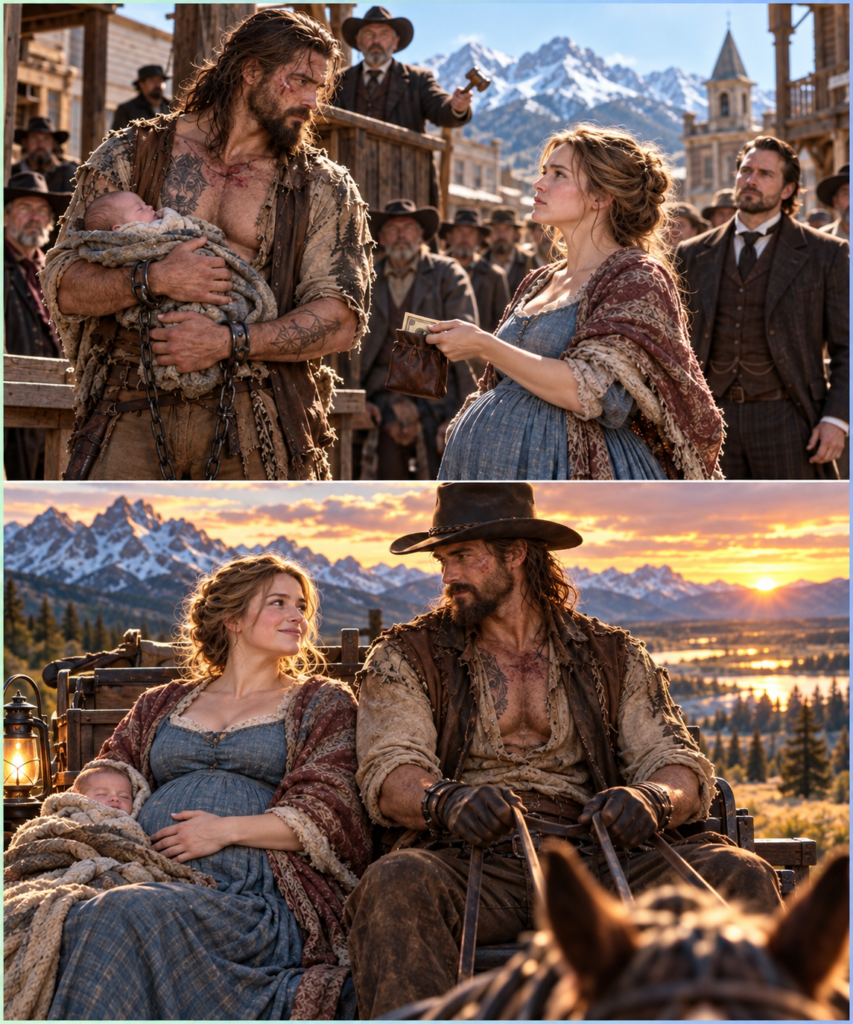
But every September, on the day Hannah had first seen Elias standing beneath the Wyoming sun with chains around his wrists and a dying baby against his chest, the Mercer-Wade family placed forty silver dollars in a wooden box at the general store.
Anyone could take from it.
No questions.
Food.
Medicine.
A night’s lodging.
Train fare.
A debt payment.
Forty dollars had once nearly cost Hannah Mercer everything.
It had also purchased nothing she thought she was buying.
Not a laborer.
Not protection.
Not salvation.
It had bought a choice.
One human being had looked at another human being in his worst moment and decided his life was worth becoming poorer for.
Years later, when Henry asked his mother why she had done it, Hannah gave him the only answer that still felt honest.
“I was afraid.”
Henry frowned.
“You were brave.”
“No.”
She smiled.
“I was afraid.”
She watched Elias on the far side of the field teaching Nell how to repair a gate.
“Then the baby stopped crying.”
Henry waited.
Hannah’s eyes became distant.
“And I realized there are moments when you don’t get to know whether helping someone will save your life or ruin it.”
“What do you do then?”
Hannah looked at her son.
“You decide what kind of person you can live with being afterward.”
Across the field, Elias shouted because Nell had dropped a hammer on his boot.
Henry laughed.
Hannah laughed too.
The house behind them still had Thomas’s coat hanging beside the door.
She had never taken it down.
Elias had never asked her to.
Some evenings, Hannah missed Thomas so fiercely that she went outside where no one could hear her cry.
Some nights Elias dreamed of Clara and woke with guilt because Hannah was sleeping beside him.
Some winters money still ran short.
Some arguments ended with doors slammed.
Some wounds never became wisdom.
They simply became scars people learned not to press too hard.
But when babies cried in that house, someone always answered.
Maybe that was all a family really promised.
Not that no one would leave.
Not that no one would die.
Not that love would be perfect.
Only that while you were there, while you still had breath and choice and the strength to cross a dark room, you would answer.
Hannah had answered once in a dusty town square.
Elias had answered on a mountain road when a dying mother handed him a newborn.
Thomas had answered too, imperfectly, secretly, and at terrible cost.
And because of those choices, Nell Wade grew old enough to forget she had once been a silent infant wrapped in a filthy blanket.
Henry Mercer grew up on land his mother had nearly lost.
And Elias Wade, who had spent half his life believing mountains were safer than people, eventually stopped looking toward the road every morning.
Not because the world had become safe.
It never did.
He simply had somewhere worth staying.
THE END