
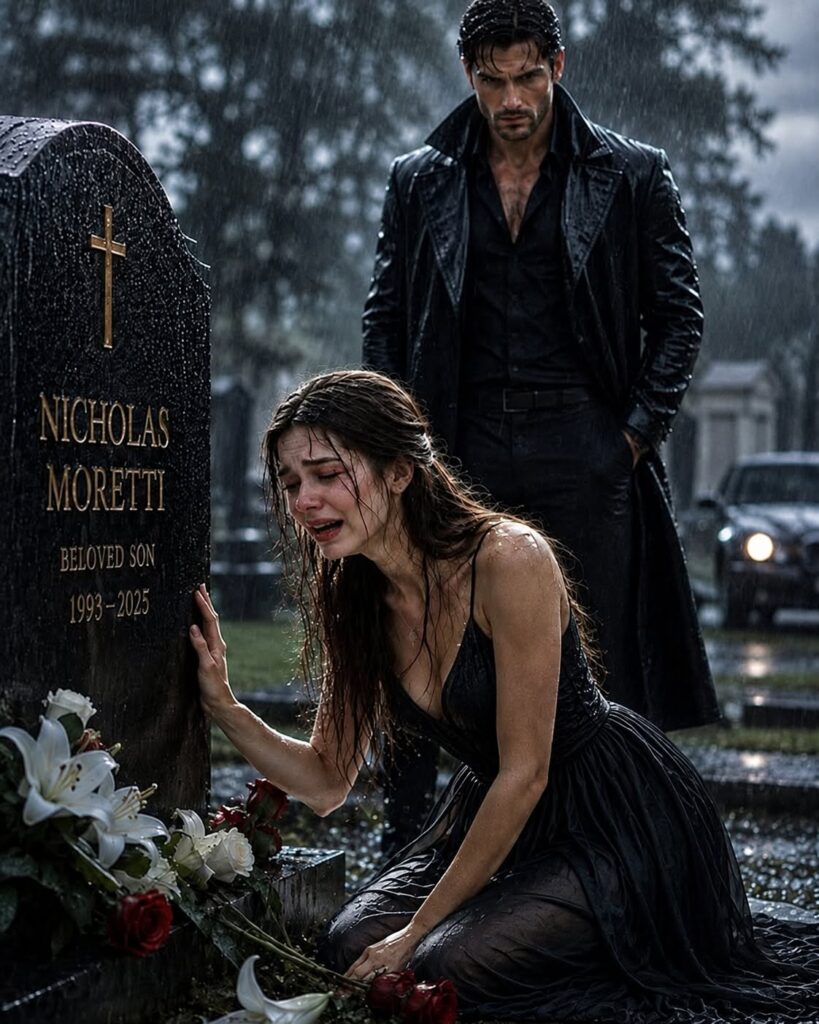
For several seconds, neither of us moved.
Rain whispered through the bare branches above the cemetery, gathering on the brim of Nicholas’s black coat and slipping down his face in narrow streams. He looked older than he had six months ago. Not dramatically older. There were no theatrical wounds, no hollow cheeks suggesting some impossible escape from death.
He simply looked tired.
It was somehow worse.
Death would have explained the distance between us.
Exhaustion did not.
“We can’t talk here,” he repeated.
I folded my arms around myself. “You had six months to decide where we could talk.”
His eyes closed briefly.
That tiny movement hurt more than an argument would have.
Nicholas had always possessed an almost infuriating stillness. Even during our worst disagreements, he had rarely raised his voice. He would listen, jaw tight, gaze fixed on me as though weighing every word before choosing his own.
Now he looked like a man who had rehearsed this reunion hundreds of times and discovered that none of his rehearsals had included rain, a gravestone, or the expression on his wife’s face.
“There’s a car outside the east gate,” he said.
“I have my own car.”
“I know.”
“Of course you know.”
His gaze met mine.
That was the first moment I understood what his survival truly meant.
He had known things.
Where I went.
What I did.
Perhaps what time I left the house every Sunday.
The realization settled heavily inside me.
“You’ve been watching me.”
His silence answered first.
Then he said, “Making sure you were safe.”
“That isn’t an answer.”
“It’s the truth.”
“No. It’s a sentence that sounds better than the truth.”
His mouth tightened.
In another life, I would have softened at that expression. I would have reached for his hand and told him that whatever impossible thing had happened, we would figure it out.
But six months had happened between us.
Six months of opening my eyes each morning and remembering that I was a widow.
Six months of hearing his mother cry behind a closed bathroom door because she didn’t want anyone else to hear.
Six months of his younger sister, Elena, texting me photographs she had found in childhood albums because neither of us knew what else to do with our grief.
Six months of sleeping diagonally across a bed because sleeping on my side left too much empty space beside me.
“You let your mother bury you,” I said.
Nicholas looked away.
There it was.
Not fear this time.
Shame.
I had never seen Nicholas ashamed.
His entire life had been built upon certainty. He had inherited rooms where men twice his age once dismissed him as Salvatore Moretti’s quiet son and left those rooms with everyone understanding who held authority.
Yet one mention of his mother made him look almost boyish.
“My mother doesn’t know,” he said.
I stared at him.
“What?”
“She believes what you believe.”
The cold entered me in a different way.
“You did this to all of us?”
“I didn’t have another choice.”
“You always have another choice.”
“Not this time.”
“Then explain it.”
“I will.”
“Here.”
His attention flicked toward the gates again.
“Nicholas.”
“I need you to trust me for twenty minutes.”
A laugh escaped me, quiet and disbelieving.
“You buried yourself and left me flowers on our anniversary.”
His expression changed.
I hadn’t meant to say that.
The bouquet had appeared outside my apartment door three weeks earlier. White peonies and eucalyptus, the same flowers Nicholas gave me every year because I had once mentioned, on our third date, that roses felt like flowers people bought when they didn’t know what else to buy.
There had been no card.
I had assumed Elena sent them.
Later, she assumed I had ordered them for myself because she didn’t want to ask.
Nicholas glanced down at the wet gravel.
“That was you,” I whispered.
“I shouldn’t have done it.”
“You think?”
“I knew you’d understand.”
“I thought I was losing my mind.”
That landed.
His face tightened.
“I’m sorry.”
There were six months of apologies I wanted from him, and hearing the first one made none of them easier.
I picked up my handbag from beside the grave.
“My car.”
He nodded.
“I’ll follow you.”
“No.”
His eyebrows drew together.
“You don’t get to follow me either.”
For the first time, something almost familiar appeared in his eyes.
Not amusement exactly.
Recognition.
The recognition of the woman he married.
“Then I’ll ride with you.”
“You have men here?”
A pause.
“Yes.”
“How many?”
“Two.”
“Are they the same men who helped convince me you were dead?”
“No.”
That distinction mattered to him.
I did not know yet whether it mattered to me.
I turned toward the parking lot.
Nicholas fell into step several feet behind.
He did not reach for my umbrella.
He did not place his hand at the small of my back as he once did crossing icy sidewalks.
He kept his distance.
I appreciated that.
And hated that I appreciated it.
My car smelled faintly of peppermint gum and the vanilla air freshener Elena had hung from the mirror because she said my old one smelled like “a dentist’s waiting room.”
Nicholas sat in the passenger seat.
He had occupied that seat hundreds of times.
Yet his presence now seemed almost improper.
I gripped the steering wheel.
“Where?”
“Lakeview.”
I looked at him.
He gave me an address.
I knew the building. A quiet brick apartment property near a narrow residential street lined with old trees and small coffee shops.
It was one of Moretti Development’s earliest renovations.
Of course it was.
I started the engine.
For nearly ten minutes, we drove without speaking.
Chicago blurred around us through wet glass. Traffic lights glowed red against the gray afternoon. Pedestrians hurried beneath umbrellas. A cyclist splashed through a puddle beside us and swore at a delivery truck.
Normal life.
That offended me almost as much as Nicholas’s breathing.
I glanced at him at a stoplight.
He was watching the city.
His hands rested loosely on his knees.
There was a pale line across the back of his right hand that I didn’t remember.
“You were injured.”
He looked down.
“Not badly.”
“The explosion?”
“Yes.”
“You were there?”
“Yes.”
“So there really was an explosion.”
“Yes.”
“And everyone thought you died.”
“Most people.”
I tightened my grip on the wheel.
“Most.”
“Nora—”
“Who knew?”
He fell silent.
The light changed.
A horn sounded behind me.
I drove.
“How many people knew, Nicholas?”
“Four at first.”
I stared straight ahead.
“Names.”
“Marco. Daniel Russo. Dr. Ferris. And Adrian Cole.”
Marco Bellini had been Nicholas’s closest friend since childhood.
Daniel Russo handled finances for the family businesses.
I knew Dr. Ferris only as an emergency physician who had treated Nicholas’s father years earlier.
Adrian Cole was Nicholas’s attorney.
Four men.
Four men had watched me stand beside a coffin.
Four men had shaken my hand.
“I saw Marco cry at your funeral.”
“He wasn’t pretending.”
That stopped me.
“What does that mean?”
Nicholas looked toward the window.
“He thought I was going to die.”
The anger inside me shifted around something colder.
I remembered Marco standing at the cemetery six months earlier. He had kept one hand on Nicholas’s mother’s shoulder as the priest spoke.
Afterward, he had hugged me for a long time.
He had whispered, “I’m sorry, Nora.”
His voice had broken.
I had believed he meant he was sorry Nicholas was gone.
Perhaps he had meant something else.
“What happened?” I asked.
“We’ll talk upstairs.”
“You keep saying that.”
“Because some things require context.”
“That’s an interesting word for lying.”
He accepted that without defense.
We reached the building twenty minutes later.
Nicholas directed me into an underground garage.
I immediately noticed the cameras.
New ones.
He noticed me noticing.
“They were installed after I moved in.”
“Moved in.”
He flinched almost invisibly.
Yes.
Moved in.
As if he had merely changed apartments.
The elevator required a key.
He used one.
We rode to the fourth floor.
The hallway was quiet and freshly painted.
Nicholas stopped before apartment 4C.
Then he hesitated before opening the door.
That hesitation frightened me more than the cemetery had.
“What?” I asked.
“Nothing.”
“You’ve never hesitated before opening a door in your life.”
His gaze settled on me.
“I haven’t had you inside my home in six months.”
My home.
The words slipped between us.
Not ours.
His.
He opened the door.
The apartment was modest by Nicholas’s standards.
Two bedrooms. Hardwood floors. Gray walls. A kitchen overlooking a narrow balcony.
No expensive art.
No staff.
No evidence of the life Nicholas once lived except the immaculate shoes near the entrance and the dark coats arranged neatly inside an open closet.
Then I saw the coffee mug.
White ceramic.
Cracked handle.
My mug.
I walked toward it.
Nicholas stayed near the door.
I picked it up.
Across the front, faded blue letters read:
WORLD’S OKAYEST WIFE.
Elena had given it to me at my bridal shower.
I turned.
“You took this?”
Nicholas removed his coat.
“I asked Marco to get a few things.”
“A few things?”
My eyes moved through the room differently now.
A green hardcover novel on the side table.
Mine.
A photograph facing downward beside the sofa.
I picked it up.
Our wedding day.
We were standing beneath strings of lights in the courtyard of his mother’s house. Nicholas was looking at me instead of the camera.
I remembered teasing him about it later.
“You ruined every photograph because you wouldn’t look at the photographer.”
“I was looking at the reason I was there.”
Back then, I had rolled my eyes.
Now the memory nearly folded me in half.
I set the photograph down.
“You lived here with pieces of our life.”
Nicholas’s voice was quiet.
“Yes.”
“While I thought you were dead.”
“Yes.”
“You could see me?”
“Sometimes.”
My head lifted.
He did not try to hide from the question.
“How?”
“Security feeds. Reports from Marco. I drove past the apartment twice.”
“Twice.”
“Only twice.”
I laughed weakly.
“As if that makes it normal.”
“No.”
His answer was immediate.
“It doesn’t.”
For the first time since the cemetery, my anger lost its shape.
Because Nicholas wasn’t arguing.
He wasn’t explaining me out of my own feelings.
He seemed to understand that whatever reason he had, there would be no clean justification.
That frightened me too.
“Tell me everything.”
He nodded toward the sofa.
I remained standing.
So did he.
“All right.”
He took a breath.
“The warehouse explosion wasn’t meant to kill me.”
I waited.
“It was meant to destroy records.”
“What records?”
“Financial records. Property transactions. Shell companies. Payment histories.”
My stomach tightened.
“Illegal?”
“Some.”
At least he didn’t insult me by pretending otherwise.
Nicholas continued.
“For two years, I had been separating the legitimate businesses from the family’s older operations.”
I frowned.
“You never told me.”
“No.”
“Why?”
“Because I didn’t know whether I could finish it.”
That was Nicholas.
He announced completed decisions.
He did not share uncertainty.
“I inherited things from my father that I should never have inherited,” he said. “Relationships. Agreements. Expectations. I spent years believing I could manage them without becoming trapped by them.”
“And were you?”
“Yes.”
The admission sounded costly.
“My father used to tell me there were two ways to leave our world. One was through the cemetery. The other was by becoming important enough that nobody wanted you gone.”
A faint bitterness touched his expression.
“He was wrong.”
I leaned against the edge of the dining table.
“So you were trying to leave?”
“I was trying to make sure the businesses could survive without the rest of it.”
“Why?”
He looked at me as if the answer should be obvious.
Then his gaze softened.
“You.”
I shook my head immediately.
“Don’t.”
“I’m not placing responsibility on you.”
“It sounds like you are.”
“I started thinking about it after we married. I decided after you told me you wanted children someday.”
My chest tightened.
We had spoken about children only twice.
The second time had been in our kitchen at two in the morning while we ate leftover tiramisu directly from the container.
I had told him I wanted two.
He said one.
We compromised jokingly on “one and a half.”
I had not known that conversation changed anything beyond the kitchen.
“I realized I couldn’t ask you to raise a child inside a life you never chose,” he said.
“I chose you.”
“You didn’t choose everything attached to me.”
“That should have been my decision.”
“Yes.”
Again, no defense.
Nicholas walked to the kitchen but did not come closer.
“Three months before the explosion, Daniel found irregular transfers inside one of the holding companies. Small amounts at first. Then larger ones.”
“Someone was stealing?”
“No. Someone was creating a trail.”
“For what?”
“To make it look as though I was moving money into accounts connected to people I had already begun cutting ties with.”
I understood slowly.
“Someone wanted it to appear that you weren’t leaving.”
“Exactly.”
“Who?”
“We didn’t know.”
“And the warehouse?”
“The documents stored there could prove which transactions I authorized and which ones I didn’t.”
“So someone destroyed them.”
“Yes.”
“And nearly killed you.”
Nicholas’s gaze held mine.
“We still don’t know whether that part was intentional.”
That was somehow more believable than a dramatic confession of attempted murder.
Business decisions, old loyalties, hidden financial interests.
Human motives were often messier than hatred.
“What happened after?”
“I woke up in a private clinic outside the city.”
“Dr. Ferris?”
“Yes. Marco brought him in because going to a hospital would create a public record.”
“And then you decided to die.”
“No.”
Nicholas looked toward the rain sliding down the balcony doors.
“Marco decided I had already died.”
I blinked.
“What?”
“The first reports from the warehouse listed one presumed fatality because a security contractor’s vehicle was found beside mine. The contractor wasn’t inside. He’d left earlier and forgotten to sign out.”
“So the news was wrong.”
“For about four hours.”
“And Marco used it.”
“He asked me a question.”
“What question?”
“Whoever destroyed the records believed I was alive when they did it. If they believed I had died, what would they do next?”
I stared at him.
“They’d stop hiding.”
“That was the theory.”
“Your theory.”
“Marco’s first. Mine afterward.”
“So you stayed dead to see who moved.”
“Yes.”
“For six months?”
His eyes dropped.
“No.”
The room became very still.
“How long was it supposed to be?”
“Two weeks.”
Something inside me cracked—not dramatically, but quietly, like ice shifting beneath a foot.
“Two weeks.”
“I planned to come back.”
“But you didn’t.”
“No.”
“Why?”
Nicholas exhaled.
“Because after nine days, Daniel found a transfer authorization carrying my signature.”
“That doesn’t sound unusual.”
“It was dated three days after I died.”
I frowned.
“So someone forged it.”
“Yes.”
“Who had access?”
“Several people.”
“Family?”
His silence returned.
That word again.
Family.
The Morettis treated the word almost religiously.
Sunday dinners.
Christmas Eve at his mother’s.
Elena arriving unannounced with bakery boxes.
Cousins who argued loudly and hugged even louder.
A complicated network of affection and obligation.
“Nicholas.”
“Yes,” he said. “Someone close enough to know our internal systems.”
“Marco?”
“No.”
“Daniel?”
“I don’t believe so.”
“Your mother?”
His expression sharpened.
“No.”
“Elena?”
“No.”
The answer came even faster.
I stared at him.
“You can’t investigate everyone except the people you love.”
“I did investigate them.”
“And?”
“And nothing pointed to them.”
His jaw tightened.
“Until something pointed to you.”
For one second, I thought I had misunderstood him.
“To me?”
He didn’t move.
“What are you talking about?”
Nicholas looked almost ill.
“That transfer went through an authorization key registered to your office laptop.”
I laughed.
Not because it was funny.
Because the sentence was absurd.
“My office laptop?”
“Yes.”
“At the foundation?”
“Yes.”
I had worked for the Moretti Family Foundation after leaving Bellavue, overseeing educational grants and neighborhood development programs. The foundation occupied three floors of a building on Wabash.
My laptop had access to donor records.
Not Nicholas’s financial empire.
“That’s impossible.”
“I know.”
“Then why did you say it?”
“Because it happened.”
“I don’t even know how to authorize your transfers.”
“You wouldn’t need to. Someone used your credentials as part of a layered verification process.”
“You think I did it?”
“No.”
The certainty in his voice stunned me.
“Then why stay dead?”
“Because whoever did it had access to your devices.”
My anger changed shape again.
This time into confusion.
“You thought someone near me was involved.”
“Yes.”
“So instead of telling me, you watched me.”
“If I returned, they would know we’d discovered the forgery.”
“You could have warned me.”
“And said what? That someone in your office might be using your credentials? You would have changed your behavior.”
“Of course I would have.”
“So would they.”
I turned away.
On the windowsill stood a small pot containing a dying basil plant.
Nicholas had never been capable of keeping plants alive.
For reasons I couldn’t explain, the sight of it made my eyes burn.
“You let me believe you were dead to protect an investigation.”
“No.”
I turned back.
“To protect you.”
I shook my head.
“You don’t get to make that sound noble.”
“I’m not trying to.”
“Then what are you trying to do?”
His answer came quietly.
“Tell you why I made a choice I regret.”
The word remained between us.
Regret.
Not defend.
Not justify.
Regret.
I sank onto the edge of the sofa.
The room suddenly felt too small for six months of grief.
Nicholas remained across from me.
“Did you come to the funeral?”
His expression changed.
“Yes.”
I looked up sharply.
“Where?”
“Across the road.”
“You watched?”
“Yes.”
“How could you?”
His face tightened.
“I almost walked across.”
“But you didn’t.”
“No.”
“Your mother collapsed beside the car afterward.”
“I know.”
“You saw that?”
“Yes.”
I stood again.
He looked at me but didn’t move.
“You saw Elena hold her up?”
“Yes.”
“You saw me?”
His voice lowered.
“Yes.”
“And still you stayed away.”
“Yes.”
I wiped my cheeks and realized I was crying.
Nicholas looked like he wanted to cross the room.
He didn’t.
Good.
I wasn’t ready to be touched by him.
Perhaps part of him understood that.
“I hated you sometimes,” I whispered.
“I know.”
“No. You don’t.”
He said nothing.
“I hated you for leaving me. I hated you because we fought the night before you died.”
The memory had lived inside me like a stone.
We had argued about dinner.
Not really dinner.
Nicholas had canceled again.
I accused him of always putting his work first.
He told me I knew who he was when I married him.
I said, “Maybe that was the problem.”
He left without answering.
The next morning, there was an explosion.
For six months, I had believed those were the last words I gave my husband.
Maybe that was the problem.
“I spent six months thinking that was the last thing I said to you.”
“I remember.”
My breath caught.
Of course he remembered.
He had been alive to remember it.
“I thought you died believing I regretted marrying you.”
“I never believed that.”
“You didn’t know.”
“Yes, I did.”
“How?”
He looked at me with the patience that once infuriated and comforted me in equal measure.
“Because I knew you.”
I gave him a broken laugh.
“You knew me so well that you let me grieve you for half a year.”
His eyes lowered.
“That is the part I don’t know how to ask forgiveness for.”
The honesty of it stopped me.
Perhaps because he wasn’t asking.
Not yet.
We stood inside the strange apartment while afternoon darkened into evening.
Eventually, Nicholas made coffee.
He remembered mine with milk but no sugar.
I hated that it comforted me.
I hated even more that I drank it.
We talked for nearly three hours.
Not only about the explosion.
About the six months after.
His mother had moved into Elena’s guest room for five weeks because she couldn’t bear the silence of her own house.
Elena had taken over several foundation responsibilities because I stopped answering emails.
Nicholas knew these things.
He listened as I told him anyway.
“I couldn’t go into your office,” I said.
He sat in an armchair across from me.
“I heard.”
“I locked it.”
“I know.”
“I sold your car.”
A faint smile touched his mouth.
“I know that too.”
“You loved that car.”
“I loved you more.”
I looked away.
“That used to work.”
“What?”
“Saying things like that.”
“I’m not trying to make it work.”
I believed him.
That was inconvenient.
“Your mother still cooks enough food for you every Sunday.”
His gaze lowered.
“I know.”
“She sends containers home with me.”
“I know.”
I stared at him.
“You know too much about us.”
“I know.”
“Stop saying that.”
For the first time, he smiled properly.
Small.
Sad.
Familiar.
“I’ll try.”
My heart reacted before my anger could stop it.
That frightened me.
The Nicholas I had mourned was becoming human again, one expression at a time.
Not a ghost.
Not a betrayal.
A man sitting twelve feet away, wearing socks because he had left his wet shoes by the door.
I suddenly noticed one sock had a tiny hole near the ankle.
I almost laughed.
Nicholas Moretti, alleged king of half the city’s underworld, had returned from the dead with worn socks and a dying basil plant.
Reality had a cruel sense of humor.
“What happens now?” I asked.
His smile vanished.
“That depends on you.”
“Not the answer I expected.”
“I’m done deciding for you.”
Something in his tone made me study him.
“You mean that.”
“Yes.”
“What changed?”
His eyes moved toward the wedding photograph.
“Being dead gives you a great deal of time to understand what you handled badly while alive.”
I almost told him he wasn’t dead.
But perhaps I understood.
He had lived outside his own life.
Watched his family continue without him.
Saw consequences he could not control.
For a man like Nicholas, maybe helplessness had taught what power never could.
“What do you want me to do?” I asked.
“Go home.”
“Which home?”
He understood immediately.
“Your apartment.”
“Our apartment.”
He swallowed.
“Yes.”
“And you?”
“I’ll stay here.”
“For how long?”
“Until I finish this.”
“No.”
His eyebrows lifted.
The word surprised both of us.
I stood.
“You don’t get to appear at your grave, tell me someone used my computer, then disappear again.”
“Nora—”
“If my credentials are part of this, I’m part of it.”
“I don’t want you involved.”
“I was involved six months ago. I just didn’t know.”
That stopped him.
I walked toward the table where his phone lay.
“Show me.”
“What?”
“Everything connected to my laptop.”
He hesitated.
“You said you were done deciding for me.”
His gaze held mine.
Then he unlocked the phone.
“Come here.”
We sat beside each other at the dining table.
Not touching.
He opened photographs of financial records, access logs, login histories.
Most meant nothing to me.
Then I saw a familiar name.
BELLWETHER EDUCATIONAL INITIATIVE.
My foundation program.
Bellwether funded scholarships for students entering trades, nursing, and teaching.
I leaned closer.
“Why is Bellwether here?”
“That’s what I couldn’t understand.”
He enlarged the document.
A transfer had moved through a corporate account into Bellwether’s reserve fund, then outward again within nineteen minutes.
“How much?”
“Two hundred and eighty thousand.”
My stomach turned.
“I would have noticed.”
“You were supposed to.”
“What?”
“The transfer was designed to appear on your monthly audit.”
“But it didn’t.”
“No.”
“Why?”
Nicholas swiped to another document.
“Someone altered the audit file.”
I studied the details.
Then my attention caught on a date.
March 11.
Four days after Nicholas’s funeral.
I knew exactly where I had been.
At his mother’s house.
For nearly the entire day.
Elena had convinced me to leave the apartment.
We made soup.
I cried in the pantry because I found Nicholas’s childhood height marks penciled along the kitchen doorway.
“My laptop was at home,” I said.
“Yes.”
“Could someone have accessed it remotely?”
“Possibly.”
“No.”
Nicholas looked at me.
“What?”
“I didn’t bring my office laptop home after you died.”
“You’re sure?”
“I couldn’t work. Elena collected it from the apartment because the foundation needed grant files.”
“When?”
I thought carefully.
“The morning after the funeral.”
Nicholas went still.
“Who did she give it to?”
“I don’t know. IT, probably.”
He was already typing a message.
“Wait.”
He stopped.
“What?”
“There was something strange.”
I closed my eyes.
Memory returned slowly.
A Thursday afternoon.
Elena standing in my kitchen carrying groceries.
Her apologetic face.
“I remember her telling me the laptop was missing.”
Nicholas stared at me.
“Missing?”
“For a few hours. She thought she left it in her car, but it turned up in a conference room.”
“Which conference room?”
“I don’t know.”
I reached for my own phone.
Elena had texted me constantly in those weeks.
Most messages were still there.
I searched her name and “laptop.”
Then I found it.
March 10, 2:14 p.m.
Found your stupid laptop. Apparently somebody moved it into Dad’s old conference room. No idea why. Crisis over. Eat something. Love you.
I showed Nicholas.
He read it twice.
“Dad’s old conference room,” he repeated.
“It’s been mostly unused since your father died.”
“Not unused.”
I looked at him.
“Daniel still works there on Wednesdays.”
The implication settled between us.
“You said you didn’t think Daniel was involved.”
“I didn’t.”
“Now?”
Nicholas took his phone from the table.
“I need to check something.”
He called someone.
“Marco.”
His voice changed—not harsher, but more focused.
“Pull the March entry logs for the foundation. Wabash building. Ninth floor.”
A pause.
“All access. Especially March tenth and eleventh.”
Another pause.
“No. Don’t call anyone.”
Nicholas ended the call.
I watched him.
“You still sound exactly the same on the phone.”
He glanced at me.
“I’m not sure whether that’s criticism.”
“I’m not sure either.”
We waited.
The apartment filled with evening shadows.
The rain had stopped.
I stood near the balcony while Nicholas changed the basil plant’s position, moving it away from the cold glass.
“You know that won’t save it.”
“I’ve been trying.”
“You’re overwatering.”
He looked offended.
“How do you know?”
“The soil looks like soup.”
He touched it.
Then looked at me.
“It does.”
A laugh escaped before I could stop it.
Nicholas stared.
I covered my mouth.
His expression softened.
“What?”
“Nothing.”
“You laughed.”
“I’m aware.”
“I haven’t heard that in six months.”
My laughter disappeared.
He looked away immediately.
“I’m sorry.”
There were moments when grief returned without warning.
It seemed absurd that he could miss my laughter while I missed his entire existence.
His phone vibrated.
Marco.
Nicholas opened the message.
His expression slowly changed.
“What?”
He handed me the phone.
The access records listed employees who entered the ninth floor on March tenth.
Elena Moretti.
Daniel Russo.
Three foundation employees.
A maintenance supervisor.
And one name I did not expect.
I read it twice.
Then a third time.
“Why was Adrian there?”
Nicholas said nothing.
Adrian Cole.
His attorney.
One of the four men who knew Nicholas survived.
My skin prickled.
“There has to be a reason.”
“There probably is.”
“You don’t sound convinced.”
“I’m not convinced of anything.”
I scrolled.
Adrian entered at 1:52 p.m.
He left at 2:27.
Elena’s text saying she found my laptop was timestamped 2:14.
I looked up.
“He was there when my laptop went missing.”
“Yes.”
“That doesn’t mean he took it.”
“No.”
“But he could have.”
“Yes.”
I sat down.
Adrian had been part of our lives for years.
He drafted our prenuptial agreement.
He handled the closing documents when Nicholas bought our apartment.
He came to Christmas dinner twice because his own family lived in Arizona.
At the funeral, he handed me a folder containing Nicholas’s will.
He told me quietly, “He made sure you’d be protected.”
I remembered crying harder because of that sentence.
“What would Adrian gain?”
Nicholas looked toward the window.
“I don’t know.”
“Money?”
“Possibly.”
“Control?”
“Possibly.”
“Then why help you fake your death?”
“That’s the question.”
It was the first time that night I saw genuine uncertainty in Nicholas.
And suddenly the mystery felt less like his world and more like ours.
A collection of ordinary choices made by people we trusted.
A laptop left on a desk.
A conference room.
A transfer.
A man entering a building.
Not proof.
Only questions.
“Maybe he was helping you,” I said.
“Maybe.”
“Maybe he knew the laptop had been compromised.”
“Maybe.”
“You don’t believe that.”
“I don’t know what I believe.”
His phone rang.
Marco again.
Nicholas answered.
He listened without speaking.
Then his gaze moved to me.
“What?” I whispered.
He raised one finger.
“Send it.”
The call ended.
A document appeared on his phone moments later.
Nicholas opened it.
Then went very still.
I crossed the room.
“What is it?”
He turned the screen toward me.
It was an email.
Sent from Adrian Cole to Daniel Russo three months before the explosion.
The subject line read:
MORETTI TRANSITION PLAN — PRIVATE
The message itself was short.
Daniel,
Nicholas has begun taking concrete steps toward dissolving several legacy structures. He has not informed Nora of the full scope. Before anything is finalized, we need to discuss the consequences for the foundation, Elena, and Mrs. Moretti.
There is also the matter of Salvatore’s original partnership agreement.
Nicholas does not appear to know that Nora’s family is named in it.
My entire body went cold.
I read the sentence again.
Then again.
“What does that mean?”
Nicholas had lost all color.
“I don’t know.”
“You’ve never seen this?”
“No.”
“Who is Salvatore?”
“My father.”
“I know that. What partnership agreement?”
Nicholas looked at me.
The confusion in his face was real.
For the first time since he had stepped out of the rain beside his own grave, I believed completely that he was as unprepared for what came next as I was.
“My father had dozens of partnerships,” he said. “But none involving your family.”
“My parents?”
“I never met your father.”
“He died when I was twelve.”
“I know.”
“My mother has never even been to Chicago.”
“I know.”
I stared at the message.
Nora’s family is named in it.
A memory surfaced.
My mother visiting three weeks after Nicholas’s funeral.
Standing inside my kitchen.
Looking at our wedding photograph.
She had asked an odd question.
“Did Nicholas ever talk about his father’s early business partners?”
At the time I assumed grief had made the conversation wander.
I had said no.
She changed the subject.
I slowly lowered the phone.
“Nicholas.”
“Yes?”
“I think my mother knows something.”
We drove to my apartment together.
I did not invite him to stay.
He didn’t ask.
At the garage entrance, he stood beside my car with his hands in his coat pockets.
“You shouldn’t call your mother tonight if you’re tired.”
I studied him.
“Is that concern or an instruction?”
“Concern.”
“Good answer.”
A faint smile.
Then silence.
Neither of us knew how to say goodbye.
For eight years, goodbye had meant a kiss at the door.
Text me when you get there.
Pick up milk.
Don’t forget dinner with Elena.
Now there was no ordinary language for parting from a husband who had returned from the grave.
“I need time,” I said.
“I know.”
“And answers.”
“Yes.”
“And you’re not coming upstairs.”
“I know that too.”
I opened my car door.
“Nicholas?”
He looked at me.
“Tomorrow.”
Something changed in his face.
Hope, carefully restrained.
“Tomorrow,” he agreed.
I drove away.
In the rearview mirror, he remained beneath the garage lights until I turned the corner.
My mother answered on the second ring.
“Nora?”
Her voice carried sleep and concern.
It was nearly eleven.
“Mom, I need to ask you something.”
A pause.
“Are you all right?”
The easy answer would have been no.
Instead I said, “I don’t know.”
That woke her immediately.
“What happened?”
I sat on the edge of my bed.
Nicholas’s side of the room was still almost untouched.
His watch box.
His books.
A sweater folded over the chair.
“I need to ask you about Salvatore Moretti.”
Silence.
Not confusion.
Silence.
My heart began beating faster.
“Mom?”
“Where did you hear that name?”
“My husband’s father.”
“I know who he was.”
The words were quiet.
Certain.
My hand tightened around the phone.
“You knew him?”
Another silence.
Then my mother exhaled slowly.
“I wondered how long it would take before this found you.”
I stood.
“What does that mean?”
“Nora, there are some things I should have told you years ago.”
“Then tell me now.”
“I will.”
“When?”
“Tomorrow.”
“Mom—”
“I have something here you need to see. It isn’t a conversation I want to have over the phone.”
I closed my eyes.
“Is this about Dad?”
“Yes.”
My throat tightened.
My father had been dead seventeen years.
He existed mostly in photographs and small fragments of memory.
His terrible singing.
The way he cut apples into thin slices.
A blue jacket he wore every winter.
“What did Dad have to do with the Morettis?”
My mother’s answer came after a long pause.
“More than I ever wanted you to know.”
I sat slowly.
“Did Nicholas know?”
“No.”
“Are you sure?”
“Yes.”
“How?”
“Because if Nicholas had known, he would have asked me about the letter.”
My breathing stopped for half a second.
“What letter?”
“The one his father wrote to yours.”
I stared at the dark bedroom.
“When?”
“Twenty-two years ago.”
“What did it say?”
My mother was quiet.
Then she said the words that would keep me awake until morning.
“It said that one day, if the Moretti family ever tried to leave the life they had built, they would need someone from our family to help them do it.”
“No.”
That seemed to relax her.
A little.
“He wanted to give us space.”
My mother looked toward the hallway as if Nicholas might materialize anyway.
“He has changed.”
“So have I.”
She nodded slowly.
“I suppose you both have.”
I sat across from her.
“Mom, I need the truth.”
“I know.”
“All of it.”
Another nod.
“No protecting me.”
Her expression softened.
“That habit is harder to stop than you think.”
“I’m beginning to understand.”
She heard what I meant.
Nicholas.
Her.
Perhaps every person who loved me seemed determined to decide what truths I could survive.
My mother opened the suitcase.
Inside were papers.
Photographs.
A small wooden box.
Several notebooks tied together with faded ribbon.
And a manila folder marked:
MORETTI — 2004.
My pulse quickened.
“Dad kept this?”
“We both did.”
She removed the folder carefully.
“Your father met Salvatore Moretti in 1998.”
I stared at her.
“Where?”
“Milwaukee.”
That made even less sense.
My father, Thomas Bennett, had been an accountant for a regional manufacturing company.
He owned three ties and complained whenever work required him to wear one.
“How?”
“Your father’s company was being purchased by a group of investors. Salvatore was one of them.”
“Moretti Development?”
“Not exactly. One of Salvatore’s legitimate holding companies.”
She opened the folder.
“Your father was asked to review financial records before the sale. He found irregularities.”
“What kind?”
“Money entering businesses without clear explanations. Payments routed through unnecessary companies. Contracts that made no sense.”
My mother gave me a pointed look.
“Your father was not naïve.”
I almost smiled.
“No.”
“He knew what he was looking at.”
“Why didn’t he report it?”
“He planned to.”
My stomach tightened.
“But?”
“Salvatore came to see him first.”
I stared at her.
“At our house?”
“No. At his office.”
“What did he want?”
“To know what Thomas intended to do.”
My mother’s fingers rested on the folder.
“Your father told him.”
“What?”
“That he was going to resign from the acquisition team and submit a confidential report to the company’s board.”
“That sounds like Dad.”
“Yes.”
“What did Salvatore do?”
“Something your father never expected.”
She slid a letter toward me.
“He agreed.”
I looked down.
The paper was yellowed at the edges.
The handwriting was broad and slanted.
Thomas,
You are correct about the accounts.
There are obligations behind them I inherited and decisions I allowed to continue because stopping them seemed harder than maintaining them.
I have spent twenty years telling myself that providing for my family justified the cost.
It does not.
I am asking you for something unusual.
Do not protect me.
Help me separate what can be saved from what should end.
I looked at my mother.
“Salvatore wrote this?”
“Yes.”
“The mafia king asked Dad for accounting advice?”
Despite everything, my mother smiled.
“Your father described it less dramatically.”
“What did he say?”
“That a very stubborn man had finally discovered spreadsheets could ruin his afternoon.”
I laughed.
Unexpectedly.
It sounded strange in the room.
My father would have said exactly that.
“What happened?”
“Your father helped Salvatore reorganize several businesses. Quietly. Salvatore moved legitimate properties away from some of the older partnerships.”
“So Nicholas wasn’t the first one who tried to leave.”
“No.”
That realization landed slowly.
Nicholas had believed his struggle began with him.
Perhaps he had inherited not only his father’s burdens but also his unfinished attempt to escape them.
“Why didn’t Salvatore finish?”
“Because people depended on him.”
“For illegal things?”
“For everything.”
My mother looked toward the window.
“Life is rarely divided as neatly as people would like. There were businesses that employed hundreds of ordinary people. Buildings with tenants. Families tied financially to each other. Salvatore told your father that if he pulled everything apart carelessly, people who had done nothing wrong would lose jobs, homes, pensions.”
“So he wanted a gradual transition.”
“Yes.”
“And Dad helped.”
“For six years.”
I looked at the folder label.
The year my father became sick.
“He stopped when he was diagnosed.”
My mother nodded.
“Pancreatic cancer.”
The old grief arrived gently.
Not the sharp grief of Nicholas’s supposed death.
My father’s death had softened with time.
It had become a room I could enter without losing myself.
“He had fourteen months,” my mother said. “At first they told us eighteen.”
“I remember.”
“You remember pieces.”
“I remember enough.”
She reached across the table and squeezed my hand.
“What happened to the plan?”
“Salvatore suspended it. He told your father he would continue someday.”
“But he didn’t.”
“Not fully.”
“Why?”
“I don’t know.”
I looked again at the papers.
“Where does our family come into the partnership agreement?”
My mother reached for the small wooden box.
Inside was a flash drive.
And a key.
A literal brass key.
“This belonged to your father.”
“What does it open?”
“A safe-deposit box.”
“Where?”
“Downtown Chicago.”
I stared at her.
“You’ve had a safe-deposit box in Chicago for twenty years?”
“Technically, your father did.”
“Mom.”
“I know.”
“That is an absurd sentence.”
“I know.”
“You live in Madison.”
“I also know that.”
Despite myself, we both smiled.
The moment eased something between us.
Then my mother grew serious.
“The partnership agreement was Salvatore’s solution to a problem.”
“What problem?”
“He didn’t trust anyone inside his own organization to control the transition after his death.”
“So he trusted Dad.”
“Yes.”
“Why?”
“Because Thomas had nothing to gain.”
That sounded like my father too.
He would have considered that the most flattering possible explanation.
My mother unfolded another document.
“Salvatore created a special trust. A legal one. Completely legitimate. It holds minority interests in several Moretti properties.”
“How much?”
“Your father never told me.”
“Who controls it?”
“No one person.”
She pointed toward several names.
“Salvatore. Your father. And an independent trustee.”
“All dead?”
“Salvatore and your father are. I don’t know about the trustee.”
“What happens after their deaths?”
“That’s where it gets complicated.”
I leaned closer.
The document contained language I barely understood.
Successor beneficiary.
Advisory authority.
Contingent signatory.
Then I saw my name.
Nora Elizabeth Bennett.
I stopped breathing.
“I was eleven.”
“Yes.”
“Why is my name here?”
“You weren’t given ownership.”
“What was I given?”
“A choice.”
I looked up.
My mother’s eyes had filled with tears.
“Your father hated that part.”
“What part?”
“Salvatore insisted the agreement needed someone outside the Moretti family who could someday authorize the final conversion of the trust.”
“Conversion into what?”
“A charitable public-benefit structure.”
I stared at her.
“The foundation?”
“Eventually.”
Pieces began moving into place.
Bellwether.
My office laptop.
The strange transfers.
The foundation appearing inside Nicholas’s financial records.
“Why me?”
“Because Salvatore knew Thomas was dying.”
The answer felt too heavy.
“So they named his child.”
“Not exactly. Your father refused at first.”
“Good.”
My mother smiled sadly.
“He said you weren’t going to inherit somebody else’s problems.”
“Also good.”
“But Salvatore changed the agreement. You could never be forced to do anything. You could only choose, as an adult, whether to sign the final transfer.”
“Why didn’t Dad tell me?”
“He planned to when you turned thirty.”
I blinked.
“I’m thirty-two.”
“I know.”
“Mom.”
“He died when you were twelve, Nora.”
“I know that.”
“And I…”
She looked down.
“I chose not to tell you.”
There it was.
Another person who loved me.
Another secret.
This time, however, I heard the fear beneath it.
“Why?”
“Because by the time you were thirty, you had married Nicholas Moretti.”
The irony was almost unbearable.
“You knew exactly who he was before I introduced him to you.”
“Yes.”
“Why didn’t you say anything?”
“I wanted to.”
“You could have saved me one extremely awkward first dinner.”
She almost laughed.
Then she wiped one eye.
“When you called and said his name, I thought perhaps I had misheard you.”
“I said it twice.”
“I know.”
“You asked what his middle name was.”
“I was hoping there were several Nicholas Morettis in Chicago.”
“There are probably three.”
“Not three who own half the block they’re standing on.”
That time we both laughed properly.
And somehow that made the hurt easier to hold.
“Why keep quiet after you met him?”
My mother considered carefully.
“Because he was kind to you.”
That answer surprised me.
“You expected him not to be?”
“I didn’t know what to expect.”
She folded her hands.
“Then I watched him refill your water glass without interrupting the conversation. I watched him carry my suitcase upstairs even after I told him I could manage it. I watched him listen when you talked.”
“That convinced you?”
“No.”
Her expression softened.
“But I watched you with him too.”
I looked down.
“You were happy.”
“I was.”
“Then I thought, perhaps his name did not have to determine your life.”
“And the agreement?”
“I told myself it didn’t matter unless Salvatore’s transition plan was revived.”
My breath caught.
“And now it has been.”
“Yes.”
“Nicholas revived it without knowing I was connected.”
“It appears so.”
For a long moment, neither of us spoke.
Then I asked the question that mattered most.
“Why would someone use my laptop?”
My mother looked at the documents.
“Because your credentials may carry more authority inside that trust than either you or Nicholas realized.”
Nicholas came over at noon.
He rang the bell.
That mattered.
For years, he had simply used his key.
The key had been taken from his personal effects after the funeral and placed in my jewelry drawer.
I had not returned it.
When I opened the door, he looked first at me.
Then at my mother.
“Mrs. Bennett.”
My mother stood.
“Nicholas.”
He hesitated.
“I owe you an apology.”
“You owe many people apologies.”
His eyebrows lifted slightly.
I nearly smiled.
My mother continued.
“But you also appear to be alive, which complicates my preferred response.”
Nicholas gave a quiet laugh.
“I understand.”
She studied him for several seconds.
Then, unexpectedly, hugged him.
Nicholas froze.
My mother whispered something I could not hear.
When she stepped away, his eyes were bright.
“What did she say?” I asked.
“Nothing.”
“Both of you are terrible liars.”
My mother sat down.
“I told him I’m glad my daughter was wrong about being a widow.”
Nicholas looked toward me.
I looked away first.
We spent the next hour showing him the documents.
He read each page carefully.
His expression changed when he saw his father’s handwriting.
He touched the letter once.
“Do you recognize it?” I asked.
“Yes.”
He swallowed.
“He wrote me notes when I was in college. Usually to criticize my parking.”
My mother smiled.
“Your father complained about Salvatore’s handwriting.”
Nicholas looked up.
“You knew him?”
“Apparently better than either of you knew.”
For a strange moment, the three of us sat around my dining table like relatives comparing stories about eccentric fathers.
Except two of those fathers had built a legal mechanism twenty-two years earlier that now seemed central to a financial mystery.
Life was ridiculous.
Nicholas reached the trust documents.
When he saw my name, he leaned back.
“Unbelievable.”
“That’s approximately what I said.”
He read further.
Then suddenly stood.
“What?”
He walked toward the window.
“Nicholas?”
“My father knew.”
“Knew what?”
“That someday this would need someone outside the family.”
He rubbed his jaw.
“He told me something before he died.”
Neither my mother nor I spoke.
“He was in the hospital. He said, ‘When the time comes, trust the person who doesn’t need anything from us.’”
I felt gooseflesh rise along my arms.
“What did you think he meant?”
“That he was medicated.”
My mother laughed unexpectedly.
Nicholas looked at her.
“He was heavily medicated.”
“I believe you.”
Then his expression softened with an old grief of his own.
“I thought maybe he meant Marco. Or Elena.”
“He meant Dad,” I said.
“Originally.”
“And after Dad died?”
Nicholas looked at the agreement.
“You.”
I shook my head.
“No.”
“Nora—”
“I didn’t know any of this.”
“That may have been the point.”
I stood.
“I’m not some symbol of moral purity because I didn’t grow up in your family.”
“I didn’t say you were.”
“My name being on a twenty-year-old document doesn’t mean I understand your businesses.”
“I know.”
“Then stop looking at me like I’m the answer.”
His face softened.
“I’m looking at you like you’re my wife.”
That silenced me.
Not because it solved anything.
Because for six months, I had been no one’s wife.
Or I had believed I wasn’t.
My mother studied us.
“I think I’m going to make coffee.”
“Mom.”
“I’m sixty-three, not oblivious.”
She disappeared into the kitchen.
Nicholas sat again.
“I meant what I said yesterday.”
“What?”
“I won’t decide for you.”
I looked at the papers.
“What if the decision affects your entire family?”
“It probably will.”
“And if I make the wrong one?”
“Then we live with it.”
“That simple?”
“No.”
A faint smile touched his mouth.
“But adulthood is mostly complicated choices followed by breakfast the next morning.”
“That sounds like something my father would have said.”
“Maybe our fathers were more alike than we knew.”
Perhaps that was true.
Two stubborn men.
Two families.
One incomplete attempt to build something better out of what already existed.
The thought made the mystery feel less sinister.
Still serious.
But human.
We went to the bank that afternoon.
My mother came with us.
Nicholas did not.
That was my choice.
He accepted it.
The safe-deposit box was held under an old trust name. My mother had the identification paperwork, and the brass key opened the second lock.
Inside were three folders and a sealed envelope.
The envelope had my name on it.
Not typed.
Handwritten.
Dad’s handwriting.
My knees weakened.
For seventeen years, I had not seen anything new written by my father.
Every birthday card and grocery note that survived his death had become an artifact.
This was different.
This was something he had written for a future version of me.
My mother touched my shoulder.
“You don’t have to read it here.”
I nodded.
We took everything home.
I waited until evening.
Nicholas still wasn’t there.
I sat alone at the dining table and opened the envelope.
Nora,
If you are reading this, then either your mother finally decided you are old enough to make complicated decisions, or I underestimated how stubborn she can be.
I laughed through tears.
Then I kept reading.
There is something I need you to understand before the legal language makes this look more important than it is.
You do not owe anyone anything because of my choices.
Not the Moretti family.
Not the trust.
Not me.
I helped a man named Salvatore Moretti because I believed he was trying to leave something better for his children than what he inherited.
That does not mean you must finish what we started.
If this responsibility ever reaches you, ask one question:
Does saying yes help people live more freely, or does it simply preserve a system because everyone is afraid to change it?
Choose the answer you can live with.
Then go have dinner.
Life becomes very small if you let other people’s problems consume all of it.
Love,
Dad
P.S. Your mother will tell you I approved this arrangement easily. I did not. I argued for three weeks.
I pressed the page against my chest.
My father had been gone most of my life.
Yet the letter sounded so completely like him that, for a few minutes, time folded.
I called Nicholas.
“Can you come over?”
He arrived twenty-five minutes later.
He rang the bell again.
I opened the door.
He took one look at my face.
“What happened?”
I handed him the letter.
He read it quietly.
When he finished, he returned it carefully.
“Your father was wise.”
“He liked coupons and once tried to repair a toaster with duct tape.”
“Wisdom is apparently broad.”
I laughed.
Then cried again.
Nicholas stood uncertainly.
That uncertainty broke something open in me.
For eight years, he had never been uncertain about whether he could comfort me.
Now he waited.
I stepped forward.
His arms came around me slowly.
Not tightly.
Not possessively.
Just enough.
I pressed my face against his shirt.
He smelled like cedar and amber.
For six months, that scent existed only in closets and pillows.
Now it surrounded me.
Warm.
Living.
Real.
I cried for my father.
For Nicholas.
For myself.
For six months I had spent speaking to marble.
Nicholas held me until I stepped away.
Neither of us called it forgiveness.
It wasn’t.
But it was something.
Adrian Cole agreed to meet us the next morning at the foundation offices.
Nicholas wanted Marco there.
I asked him not to.
“I don’t want this to feel like an interrogation.”
He understood.
So it was only Nicholas, Adrian, and me.
Adrian entered the conference room carrying a leather briefcase and looking exactly as he always had.
Silver at his temples.
Wire-framed glasses.
Conservative navy suit.
He saw Nicholas.
Stopped.
Then closed his eyes.
“I wondered when you’d appear.”
Nicholas watched him carefully.
“That isn’t the reaction I expected.”
“I’ve had six months to imagine it.”
Adrian set his briefcase down.
Then looked at me.
“Nora.”
I couldn’t read his expression.
“Did you use my laptop?”
His shoulders sank.
“Yes.”
Nicholas became very still.
I raised one hand before he could speak.
“Why?”
Adrian sat.
“Because I needed to test whether the trust authorization still functioned.”
I stared at him.
“What?”
He opened his briefcase and removed a file.
“Salvatore’s transition trust had been dormant for nearly fifteen years. Nicholas’s restructuring triggered clauses nobody in the current legal team understood.”
“You knew?”
“I discovered it eight months before the explosion.”
“Why didn’t you tell me?”
“Because I didn’t know you were the Nora Bennett named in the documents.”
I frowned.
“What changed?”
“Your marriage license.”
Nicholas looked at him.
“Our marriage license is eight years old.”
“Yes. But the trust records listed Nora Elizabeth Bennett without current identifying information. I only confirmed it after cross-referencing old files.”
I folded my arms.
“So you used my computer.”
“I made an error.”
“That is a generous description.”
“Yes.”
His voice carried genuine embarrassment.
“I believed I could create a harmless authorization ping. A transfer that would move through the system and immediately reverse.”
“The two hundred and eighty thousand dollars?”
“Yes.”
“You call that harmless?”
“The money never left controlled accounts.”
“Why hide it from my audit?”
“Because I didn’t want you discovering an unexplained transfer before I understood what it meant.”
Nicholas’s voice was quiet.
“You should have told me.”
“Yes.”
“Why didn’t you?”
Adrian looked at him.
“Because every time anyone suggested slowing your restructuring, you assumed they were protecting the old system.”
Nicholas did not respond.
Adrian continued.
“You were moving too fast.”
“That wasn’t your decision.”
“No.”
The answer mirrored Nicholas’s own admissions to me.
Perhaps everyone in this story had convinced themselves secrecy was a form of care.
“I thought I could understand the trust before bringing it to you,” Adrian said.
“And the forged signature?” Nicholas asked.
Adrian frowned.
“What forged signature?”
Nicholas placed the document before him.
Adrian read it.
Then removed his glasses.
“I didn’t create this.”
“You had access.”
“Yes.”
“You were in this room when Nora’s laptop disappeared.”
“Yes.”
“Why?”
“I took it.”
“At least we’re making progress.”
Adrian looked toward me.
“I returned it twenty minutes later.”
“You logged into the trust?”
“Yes.”
“Then someone used that access afterward,” I said.
His gaze sharpened.
“What?”
I showed him the transfer dated after Nicholas’s reported death.
He studied it for nearly a minute.
Then pointed toward a line near the bottom.
“This isn’t Nora’s authorization.”
Nicholas leaned closer.
“It uses her key.”
“Yes, but look at the verification sequence.”
I saw letters and numbers.
“It means nothing to me.”
“It meant nothing to me either until I studied the original agreement.”
Adrian opened his folder.
“The Bennett signatory doesn’t authorize transactions.”
I looked at him.
“What does it do?”
“It authorizes conversion.”
“Conversion of what?”
“The ownership structure.”
Nicholas went still.
Adrian looked at both of us.
“This transfer wasn’t moving money.”
He turned the page.
“It was testing whether Nora’s authorization could be used to begin converting the trust.”
My pulse quickened.
“To the charitable structure?”
“Yes.”
I frowned.
“Why would someone secretly try to do what Nicholas wanted anyway?”
Adrian’s expression changed.
“Because Nicholas wasn’t trying to convert everything.”
He looked at him.
“You planned to preserve family ownership of the legitimate companies.”
“Of course.”
“But Salvatore’s original agreement gives Nora another option.”
Nicholas read the clause.
His eyebrows drew together.
“What option?”
Adrian looked at me.
“You can transfer the trust’s entire controlling interest into the foundation.”
I stared at him.
“How much is that?”
“Potentially?”
He paused.
“Enough to make the foundation the single largest voting stakeholder in Moretti Development.”
Nicholas slowly sat down.
I looked at him.
“That’s your company.”
“Yes.”
“Your family’s company.”
“Yes.”
“And I can give control of part of it away?”
“Not exactly.”
Adrian tapped the page.
“You can place it under independent public-benefit governance.”
I felt suddenly dizzy.
“This is insane.”
“It’s unusual.”
“That is lawyer language for insane.”
Adrian almost smiled.
“Yes.”
I looked at Nicholas.
He looked thoughtful.
Not angry.
That surprised me.
“You’re not upset?”
“I’m processing.”
“Your wife can apparently reorganize part of your family business using a document your dead father wrote with her dead father.”
“When you put it that way, I’m reconsidering processing.”
A laugh escaped me.
Adrian relaxed slightly.
Then I saw another line.
“Wait.”
Both men looked at me.
“This requires three authorizations.”
“Yes,” Adrian said.
“Mine. The trustee’s. And a Moretti family representative.”
“Yes.”
“Who is the trustee?”
Adrian hesitated.
“That is the question I’ve been trying to answer.”
“Nobody knows?”
“The original trustee resigned twelve years ago. A successor was appointed through a private filing.”
“Name?”
“The record is sealed.”
Nicholas frowned.
“Can it be unsealed?”
“With the successor’s consent.”
“And if they refuse?”
“Then through court proceedings, possibly.”
I leaned back.
“So we still don’t know who tried to use the trust.”
“No.”
“But we know what they were trying to test.”
“Yes.”
“Whether the conversion still works.”
“Yes.”
The mystery had narrowed.
Not an enemy trying to destroy Nicholas.
Perhaps someone trying to force an outcome.
That difference mattered.
“Who benefits if the foundation gets control?” I asked.
Adrian considered.
“Potentially the public programs it funds.”
“That’s not what I mean.”
“I know.”
He looked at Nicholas.
“Employees might benefit from more stable governance. Some family shareholders might lose influence. Others might gain financial security because the structure limits certain liabilities.”
“So nearly everyone benefits somehow.”
“And loses something.”
That sounded more realistic than a villain.
“What about Elena?” I asked.
Nicholas looked at me.
“What about her?”
“She works at the foundation. She knew my laptop was missing. She was in the building.”
“Nora.”
“I’m not accusing her.”
He exhaled.
“Sorry.”
“Stop protecting people from questions.”
He nodded.
“You’re right.”
Adrian looked between us.
Then said quietly, “Elena asked me about the trust.”
Nicholas’s head snapped toward him.
“When?”
“Two weeks before the explosion.”
The room fell silent.
“What did she ask?” I said.
“Whether there was a legal mechanism to keep the legitimate businesses intact if Nicholas left family leadership.”
Nicholas frowned.
“She never asked me that.”
“No.”
“Why ask you?”
Adrian adjusted his glasses.
“She was worried about you.”
Nicholas’s expression hardened slightly.
Not anger.
Hurt.
“She could have spoken to me.”
Adrian gave him a look.
“Could she?”
Nicholas said nothing.
That answer told me more than words.
Elena arrived at my apartment that evening carrying Thai food.
She still did not know Nicholas was alive.
That had been Nicholas’s decision yesterday.
Today, it became mine.
I hated being part of another secret.
When I opened the door, Elena walked in without waiting.
“I brought noodles, curry, and enough spring rolls to repair whatever emotional disaster your text implied.”
Then she saw my face.
“What?”
I closed the door.
“Sit down.”
“That is never a good sentence.”
“Elena.”
She put the food on the counter.
“What happened?”
Before I could answer, the guest-room door opened.
Nicholas stepped into the hallway.
Elena stared at him.
The color left her face.
He said her name.
“Ellie.”
She covered her mouth.
For several seconds, she simply stood there.
Then she crossed the room and hugged him.
No screaming.
No dramatic collapse.
She held him.
Nicholas held her.
And I watched a brother and sister recover something neither of them had known how to mourn correctly.
When Elena finally stepped back, tears streamed down her face.
“You absolute idiot.”
“I know.”
“You were alive?”
“Yes.”
“For six months?”
“Yes.”
She hit his shoulder once with the flat of her hand.
Not hard.
More disbelief than anger.
Then she hugged him again.
“I hate you.”
“I know.”
“No, you don’t.”
“You’re right.”
She cried harder.
Nicholas closed his eyes.
I turned away to give them privacy.
Family grief had its own language.
Eventually, we ate cold spring rolls around my kitchen counter.
Elena demanded answers.
Nicholas gave them.
All of them.
When he explained why he stayed hidden, Elena listened with growing disbelief.
“You watched Mom mourn you?”
His face changed.
“Yes.”
“Did you see me?”
“Yes.”
She looked down.
“That was a terrible choice.”
“I know.”
“You keep saying that.”
“Nora said the same thing.”
Elena looked at me.
“Good.”
A small alliance formed instantly.
Nicholas almost smiled.
Then I brought out the trust papers.
Elena read them.
Her expression became strangely familiar.
Not surprise.
Recognition.
Nicholas noticed too.
“You knew.”
She looked up.
“Some of it.”
“How much?”
“Not Nora’s involvement.”
“Then what?”
Elena set down the page.
“That Dad wanted the businesses separated.”
Nicholas stared.
“How?”
“He told me.”
“When?”
“Before he died.”
Nicholas’s face tightened.
“He told you?”
“Yes.”
“And not me.”
“You were running everything.”
“I was his son.”
“So was I, apparently, for purposes of being trusted with family information.”
Despite the tension, I covered a laugh.
Elena sighed.
“He didn’t tell me details. He said he regretted leaving you so much responsibility.”
Nicholas looked away.
“He said you would think responsibility meant preserving everything.”
That landed.
Elena continued gently.
“He wanted me to remind you that some things were allowed to end.”
For a long moment, Nicholas said nothing.
Then he whispered, “Why didn’t you?”
“I tried.”
“When?”
“Every Christmas for five years.”
He frowned.
“What?”
“Every time I said you should sell the old South Side warehouses.”
“That was you fulfilling Dad’s dying wish?”
“It was one of the less poetic parts.”
I laughed.
Even Nicholas smiled.
Then Elena grew serious.
“I asked Adrian about the trust because I was worried.”
“About me?”
“Yes.”
“Why?”
“You stopped sleeping.”
Nicholas’s expression changed.
“You canceled dinners. You missed Mom’s birthday lunch. You started carrying three phones again.”
I remembered those months.
I had noticed too.
I had called it work.
Perhaps because calling it anything else required a conversation Nicholas wasn’t ready to have.
“I thought you were getting pulled back into the old structures,” Elena said.
“I was trying to dismantle them.”
“I didn’t know.”
“You could have asked.”
Elena stared at him.
“You didn’t answer questions, Nick.”
He fell silent.
That truth had followed him everywhere.
I reached for my water.
“What did Adrian tell you?”
“That there was an old trust connected to Dad’s restructuring plans.”
“Did he tell you about my authorization?”
“No.”
“Did you use my laptop?”
Elena’s eyes widened.
“What?”
“Someone did.”
“No.”
“You found it in the conference room.”
“After it disappeared from my desk.”
“You left it unattended?”
“For maybe five minutes.”
“What happened?”
“I went downstairs because Mom called.”
Nicholas leaned forward.
“What did she want?”
Elena frowned.
“She said someone from Dad’s old office had contacted her.”
All three of us went still.
“Who?” Nicholas asked.
“I don’t remember.”
“Think.”
She closed her eyes.
“Peter something.”
Nicholas looked at Adrian’s documents.
“Peter Hale?”
Elena opened her eyes.
“Yes.”
Nicholas sat back.
I had heard the name.
“Who is Peter Hale?”
“My father’s former controller.”
“Accountant?”
“Yes.”
“Is he alive?”
Nicholas looked at me.
“Yes.”
“Where is he?”
“Retired. Florida, I think.”
Elena shook her head.
“No.”
We looked at her.
“He moved back.”
“When?”
“Last year.”
“Where?”
“Chicago.”
Peter Hale was seventy-four and lived in Evanston.
We didn’t descend upon him as a group.
I called first.
He sounded tired but unsurprised.
When I told him my name, there was a long silence.
Then he said, “Thomas Bennett’s daughter.”
“Yes.”
“I hoped somebody would eventually call.”
The next afternoon, Nicholas and I went together.
Peter’s house was small and neat.
Wind chimes hung beside the porch.
He answered wearing a cardigan and reading glasses.
His eyes settled on Nicholas.
“Well.”
Nicholas looked almost uncomfortable.
“Mr. Hale.”
“You look like your father when you’re worried.”
“That’s not something anyone has ever told me.”
“Most people were afraid to tell Salvatore he looked worried.”
He invited us inside.
His living room smelled like coffee and old books.
Nothing about Peter Hale suggested danger, conspiracy, or grand ambition.
He looked like somebody’s grandfather.
Perhaps he was.
There were photographs of children on the mantel.
“I assume you found the trust,” he said.
I sat across from him.
“You’re the successor trustee.”
“Yes.”
Nicholas exhaled.
“Why keep it secret?”
“Because that was the job.”
“Did you forge my signature?”
Peter looked offended.
“No.”
“Did you use Nora’s credentials?”
“No.”
“Then who did?”
“I don’t know.”
That answer was so immediate I believed him.
Peter folded his hands.
“But I know why someone might.”
“To test the conversion.”
“Yes.”
“Did you want it converted?”
Peter looked at Nicholas.
“Your father did.”
“That isn’t what I asked.”
A faint smile.
“You really are Salvatore’s son.”
Nicholas almost smiled back.
Peter turned toward me.
“The trust was designed as a last door.”
“What does that mean?”
“If the Moretti family could successfully separate its legitimate businesses from the older operations, the trust could remain private.”
“And if they couldn’t?”
“Then the controlling interest could move into independent governance.”
“So nobody could drag it backward.”
“Exactly.”
Nicholas leaned back.
“My father created a failsafe.”
“Yes.”
“Why didn’t he tell me?”
Peter’s expression softened.
“Because he hoped you would never need it.”
That silenced Nicholas.
I asked, “Who knew about the failsafe?”
“Originally? Five people.”
“Salvatore. My father. You.”
“Yes.”
“Who else?”
“Salvatore’s attorney at the time.”
“Dead?”
“Yes.”
“And?”
Peter hesitated.
“Your mother.”
Nicholas stared.
“My mother?”
“Yes.”
Sunday arrived gray and cold.
For the first time in six months, I did not go to the cemetery.
Instead, we went to Teresa Moretti’s house.
Nicholas waited in the car.
He insisted I speak to her first.
Not because he wanted control.
Because after what happened with Elena, he understood that appearing without warning was unfair.
I entered through the kitchen.
Teresa stood at the stove stirring tomato sauce.
She smiled when she saw me.
“You’re early.”
“I need to tell you something.”
She turned.
Perhaps something in my face warned her.
She lowered the spoon.
“What is it?”
I took her hands.
“Teresa, Nicholas is alive.”
Her fingers tightened around mine.
No sound came.
Then she whispered, “No.”
“He’s alive.”
Tears filled her eyes.
“How?”
I explained enough.
Not everything.
Not yet.
When I finished, Teresa sat at the kitchen table.
“He stayed away.”
“Yes.”
“For six months.”
“Yes.”
Her chin trembled.
“He thought he was protecting us.”
“Yes.”
She looked at me.
“Men in this family have always been very creative when explaining foolishness.”
I laughed through tears.
“So I’m learning.”
“Where is he?”
“Outside.”
She stood so quickly the chair scraped.
Then stopped.
Her hand pressed against her heart.
“I don’t know whether I want to hug him or make him stand on the porch until Easter.”
“You can do both.”
Teresa wiped her cheeks.
“Bring me my son.”
Nicholas entered the kitchen two minutes later.
His mother stared at him.
He stopped near the doorway.
“Ma.”
Teresa crossed the room.
She touched his face with both hands.
As if verifying him.
Then she kissed his forehead.
Then both cheeks.
Then she held him.
Nicholas folded around her.
For the first time since his return, I saw him cry without trying to hide it.
“I’m sorry,” he whispered.
Teresa held him tighter.
“I know.”
“I’m sorry.”
“I know.”
He repeated it again.
She let him.
Eventually, they sat at the table.
Teresa made coffee because apparently no Moretti family crisis was permitted to proceed without coffee.
I waited until Nicholas was ready.
Then I asked about the trust.
Teresa sighed.
“I wondered if that was why you came.”
Nicholas stared.
“You knew.”
“Some things.”
“Everyone knew except me.”
“No.”
She gave him a pointed look.
“Everyone knew different pieces because your father was terrible at communication.”
I coughed to hide a laugh.
Nicholas looked at me.
“Don’t.”
“I didn’t say anything.”
Teresa patted his hand.
“Your father created the trust because he was afraid.”
“Dad wasn’t afraid.”
“Your father was afraid of many things. He simply considered admitting it bad manners.”
Nicholas lowered his gaze.
“What was he afraid of?”
“That you would become him.”
The kitchen went quiet.
Teresa continued.
“He loved you. That was exactly why.”
Nicholas’s jaw tightened.
“He thought if he handed you everything, you would spend your entire life carrying it because you believed that was what being his son required.”
I watched Nicholas absorb this.
“He told me responsibility was everything.”
“Yes.”
“He taught me that.”
“He believed it when he taught you.”
She touched his cheek.
“People are allowed to learn too late.”
That sentence seemed to reach him somewhere I could not.
Perhaps because his father had become fixed in memory.
Salvatore the patriarch.
Salvatore the businessman.
Salvatore the man whose expectations Nicholas had inherited.
Now there was another Salvatore.
A man who regretted.
A man who tried.
A man who left a door open for his children because he had not managed to walk through it himself.
“Did you use Nora’s authorization?” Nicholas asked.
Teresa looked horrified.
“I can barely authorize my television.”
I laughed loudly.
Even Nicholas did.
“No, sweetheart,” she said. “I didn’t touch any computer.”
“Did you tell anyone about the trust?”
“One person.”
“Who?”
“Elena.”
“We know she knew part of it.”
“No. Years ago.”
Elena, sitting beside me, frowned.
“You never told me about Nora.”
“I didn’t know Nora was Thomas Bennett’s daughter until the wedding.”
I stared.
“You knew my father?”
Teresa smiled softly.
“Once.”
“When?”
“Your parents visited Chicago when you were little.”
A memory flickered.
A hotel lobby.
A Christmas tree.
A man with a deep laugh handing me a wrapped chocolate.
I had always assumed it was a business trip.
“You met me?”
“You were six.”
I stared.
Nicholas looked equally stunned.
Teresa continued.
“Your father brought you because he said you should see the lake in winter.”
“That sounds like him.”
“He and Salvatore argued for two hours upstairs. Your mother and I drank tea while you drew horses.”
“I couldn’t draw horses.”
“No.”
Teresa smiled.
“They looked like potatoes.”
My mother, who had arrived with Elena, laughed.
“They did.”
I looked around the table.
Two mothers.
A sister.
A husband who had returned from the dead.
And twenty-two years of secrets slowly becoming ordinary family memories.
Something in me softened.
Not because the secrets stopped mattering.
Because I finally understood their shape.
Nobody had planned my life.
They had simply made imperfect choices and left behind consequences.
Just as Nicholas had.
Just as I would.
The final answer came from Daniel Russo.
Not because we cornered him.
Because he called Nicholas.
“I heard you’re alive,” he said.
Nicholas put the phone on speaker.
“That information is spreading faster than I hoped.”
“Your sister called me crying.”
“That would do it.”
Daniel was quiet.
Then: “I need to tell you something.”
We listened.
Daniel had discovered the trust two months before the explosion.
Not through Adrian.
Through old financial archives.
He had also discovered that Nicholas’s restructuring would trigger its conversion clause unintentionally.
“What did you do?” Nicholas asked.
“I tried to delay the restructuring.”
“You told me the bank required revisions.”
“It didn’t.”
Nicholas closed his eyes.
Another lie disguised as protection.
“Why?”
“Because if the trust activated without Nora knowingly consenting, everything could end up in litigation.”
“So you forged my signature?”
“No.”
“Then who did?”
“I did something else.”
Daniel exhaled.
“I created the test transfer.”
My stomach tightened.
“You used my credentials?”
“No.”
“Adrian did.”
“What?”
Daniel explained.
He saw Adrian’s authorization ping inside the system and copied the verification pattern weeks later.
“You moved the money after Nicholas’s reported death.”
“Yes.”
“Why?”
“To see whether the trust would accept an authorization while Nicholas was legally presumed dead.”
Nicholas stared at the phone.
“You could have told me you found the trust.”
“I planned to.”
“When?”
“When I understood it.”
The room fell silent.
Then Nicholas started laughing.
Not because it was funny.
Because apparently every person involved had made exactly the same mistake.
Adrian didn’t tell Nicholas because he wanted to understand first.
Daniel didn’t tell Nicholas because he wanted to understand first.
Nicholas didn’t tell me because he wanted to understand first.
My mother didn’t tell me because she wanted to protect me.
Salvatore didn’t tell Nicholas because he hoped the problem would never reach him.
A family history built on unfinished explanations.
Daniel’s voice came through the speaker.
“Why are you laughing?”
Nicholas looked at me.
“Because we are all idiots.”
“That seems unnecessarily broad.”
“No,” I said. “I think it’s accurate.”
Daniel confessed that the warehouse fire had destroyed records by accident after an electrical fault.
The timing made it look connected.
The security contractor’s mistaken fatality created another coincidence.
Nicholas’s decision to remain “dead” turned those coincidences into a mystery far larger than the truth.
“There was no conspiracy?” I asked.
Daniel hesitated.
“There were people protecting their interests. People withholding information. People making unauthorized decisions.”
“So…”
“So a normal family business.”
Nicholas rubbed his face.
I laughed.
Months of fear.
Suspicion.
Secrets.
And beneath it, not one mastermind.
Only human beings acting independently, each convinced they were preventing disaster.
It was almost disappointing.
Then I realized it was better.
Because a villain would have been easier.
A villain could be blamed.
People we loved required conversation.
Three weeks later, Nicholas officially returned.
There were lawyers.
Corrections to public records.
News coverage.
Questions.
He handled the public explanation through Moretti Development’s communications team.
A serious accident.
Incorrect initial identification.
Private medical recovery.
Legal complications.
It was not the full truth.
But the rest belonged to us.
More importantly, Nicholas stepped down from several leadership roles.
Not dramatically.
Not overnight.
He built a transition plan.
This time, everyone was included.
Elena joined the restructuring committee.
Daniel remained CFO after admitting his unauthorized transfer and agreeing to independent oversight.
Adrian offered to resign.
Nicholas refused.
“You’re going to stay and help fix the thing you complicated.”
Adrian sighed.
“I suspected you’d say that.”
Peter Hale agreed to continue as trustee for one final year.
My mother returned to Madison with the blue suitcase, minus my father’s letter.
That stayed with me.
Teresa started Sunday dinners again.
At the first one, Nicholas sat in his old chair.
Nobody knew quite how to behave.
Finally Teresa placed a bowl of pasta in front of him.
“You’re too thin.”
Nicholas looked at me.
“I gained four pounds.”
“Your mother does not recognize measurements that contradict her opinions,” Elena said.
Teresa pointed her fork at her daughter.
“Eat.”
And somehow we became a family again.
Not the old one.
Something more honest.
The trust decision took me two months.
Nobody pressured me.
Nicholas made sure of that.
We talked.
Sometimes badly.
Sometimes late at night.
Sometimes over coffee.
One evening, we sat on the floor of our apartment surrounded by spreadsheets.
Nicholas had moved back in two weeks earlier.
Into the guest room.
That had been my decision.
He accepted it without complaint.
“Tell me what you want,” I said.
He leaned back against the sofa.
“I want you to choose.”
“That is very enlightened and extremely unhelpful.”
He smiled.
“I’ve been practicing.”
“Nicholas.”
His expression grew serious.
“All right.”
He thought for a long moment.
“I want the legitimate businesses protected.”
“Why?”
“Because people work there. They built careers there.”
“Good.”
“I want my family financially secure.”
“Good.”
“And I want the old structure gone.”
“Completely?”
“Yes.”
“You could lose control.”
“Yes.”
“Does that bother you?”
He considered.
“Yes.”
I appreciated the answer.
“But I think losing control may be part of the point.”
I studied him.
Six months ago, that sentence would have been impossible.
“What do you want?” he asked.
I looked at my father’s letter.
“I want the foundation to become independent from the family.”
Nicholas nodded.
“I think so too.”
“I want employee representation in the businesses transferred into the trust.”
“Reasonable.”
“I want Elena involved.”
“She’ll hate meetings.”
“She’ll survive.”
“Probably.”
“And I don’t want my name on anything permanent.”
He looked surprised.
“Why?”
“Because Dad gave me a choice, not a dynasty.”
Something softened in Nicholas’s face.
“That sounds like him.”
“Yes.”
We sat quietly.
Then Nicholas reached across the carpet.
Not for me.
He placed his hand palm-up between us.
An invitation.
Nothing more.
I looked at it.
Then placed my hand in his.
We signed the conversion agreement on a Wednesday morning.
The trust transferred its controlling interest into a hybrid public-benefit structure governed by independent trustees, employee representatives, foundation leadership, and a limited Moretti family board.
Nicholas retained a substantial ownership stake.
So did Elena.
But neither could control everything alone.
The Bellwether Educational Initiative received permanent funding.
Several older companies were sold.
Others closed gradually with transition assistance for employees.
There were no dramatic endings.
Mostly paperwork.
Meetings.
Negotiations.
Choices.
Real change was surprisingly uncinematic.
It happened in conference rooms under fluorescent lights while someone complained the coffee was cold.
Six months later, Bellwether awarded its largest scholarship class ever.
I attended the ceremony with my mother.
Nicholas sat three rows behind us.
Not beside me.
Not because we were separated.
Because I had asked him to sit with Elena and Teresa.
I wanted that day to belong to the students.
Afterward, a young woman named Carla hugged me because the scholarship meant she could finish nursing school without working overnight shifts.
My father’s question returned.
Does saying yes help people live more freely?
For the first time, I knew my answer.
Nicholas and I did not repair our marriage quickly.
I wouldn’t have trusted any repair that happened quickly.
We went to counseling.
That surprised everyone except me.
Nicholas hated the first session.
“I don’t understand why she keeps asking how things make me feel.”
“That is approximately the purpose.”
“She asks it after I already explained what happened.”
“Those are different things.”
“I disagree.”
By the fifth session, he stopped disagreeing.
By the tenth, he admitted he had spent most of his adult life believing love meant removing problems before the people he loved could see them.
“That sounds exhausting,” I told him afterward.
“It was efficient.”
“No, it wasn’t.”
He considered.
“No. Apparently not.”
I learned things too.
That grief had made me idealize the husband I thought I lost.
The dead Nicholas never interrupted.
Never canceled dinner.
Never hid things.
He had become perfect because memory had removed his complications.
The living Nicholas was harder.
And better.
He forgot to replace the milk.
He worked too late.
He left cabinet doors open.
He also learned to say, “I don’t know.”
He learned to ask, “What do you think?”
He learned that protecting someone could include telling them the truth.
I learned forgiveness wasn’t a door.
It was a road.
Some days I walked farther.
Some days I stopped.
Nicholas never rushed me.
That mattered.
One Sunday, almost a year after I had found him in the rain, we returned to the cemetery.
The false gravestone still stood.
We had debated removing it.
Teresa refused.
“I paid good money for that marble.”
So the family added a small line beneath Nicholas’s dates:
REPORTS OF HIS DEATH WERE PREMATURE.
Elena chose it.
Nicholas objected.
He lost the vote.
I stood before the stone with him.
Sunlight moved through spring leaves overhead.
No rain.
No black coat.
No impossible ghost beside the path.
Just my husband.
Alive.
He looked at the inscription.
“I still hate it.”
“It’s funny.”
“It encourages people.”
“To do what?”
“Make jokes.”
“You survived a fake funeral. You can survive jokes.”
He looked at me.
“You make that sound reasonable.”
“It is.”
We stood quietly.
Then I touched the marble.
For six months, I had come here every Sunday and apologized.
“I said terrible things to this stone.”
Nicholas slipped his hands into his pockets.
“Anything interesting?”
“I once told you your mother’s lasagna was better than yours.”
“That’s not terrible. That’s factually accurate.”
“I told you I regretted our last fight.”
“I know.”
“I told you I was sorry I was still here.”
His expression changed.
I looked at him.
“I’m not sorry anymore.”
The words felt simple.
But everything inside them was enormous.
Nicholas nodded.
“I’m glad.”
I looked at the ridiculous gravestone.
“You know what the strangest part is?”
“What?”
“I spent months thinking grief was about learning to let go of you.”
He waited.
“But it wasn’t.”
“No?”
“No. It was about learning that I could keep living even when the life I expected disappeared.”
Nicholas looked toward the trees.
“And now?”
“Now I know that even when something comes back, you don’t have to return to who you were before.”
He turned toward me.
“No.”
“We’re different.”
“Yes.”
“Do you miss the old us?”
He thought carefully.
“Sometimes.”
“Me too.”
Then his eyes met mine.
“But I trust this version more.”
That was the right answer.
Not because it was romantic.
Because it was true.
I slipped my hand into his.
We walked toward the cemetery gates.
Halfway there, Nicholas stopped.
“What?”
“I forgot something.”
He returned to the grave.
From his coat pocket, he removed a small folded paper and placed it beneath the stone vase.
“What is that?”
“A note.”
“To yourself?”
“Yes.”
“That’s strange.”
“So is having your own grave.”
“Fair.”
He came back.
We walked on.
I waited until we reached the car before asking.
“What did the note say?”
He opened my door.
“I’ll tell you someday.”
I raised an eyebrow.
His expression changed immediately.
“Actually, no. That sounded like my old habits.”
“Yes, it did.”
He leaned against the car.
“I wrote, ‘You don’t get to disappear from your own life again.’”
Something tightened warmly inside my chest.
“For yourself?”
“For both of us.”
I looked back toward the cemetery.
Toward the stone that once represented everything I lost.
Then at Nicholas.
A husband I had mourned.
A man I had been furious with.
A person I had chosen again—not because our past demanded it, but because our future finally belonged to both of us.
“You ready?” he asked.
I smiled.
“Yes.”
This time, when we went home, we went together.
Not to the marriage we had buried.
To the one we had chosen to build after learning that love could survive truth better than it could survive silence.
And that sometimes the most important thing a family passes down is not a name, a business, a house, or even a secret.
Sometimes it is an unfinished choice.
And the courage to finish it differently.

