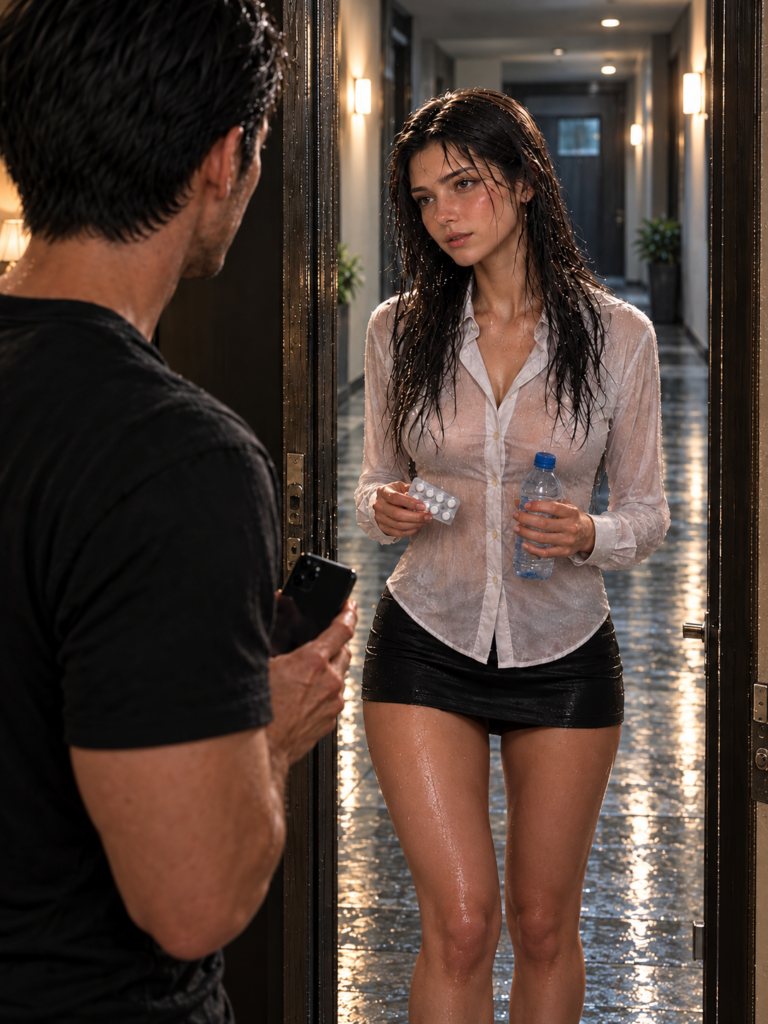
I Accidentally Texted My Boss, “Baby, I’m Sick.” 5 Minutes Later, She Arrived With Meds.
My thumb hit the wrong name at 6:10 in the morning.
And that was it. That was the whole hinge my life swung on.
My head felt like somebody had wedged a crowbar behind my eye and was leaning on it. Throat raw. I grabbed my phone off the nightstand without really looking, thumb already moving before my brain caught up, and fired off a text to the person I’d been seeing.
Callie, three weeks in. The kind of thing where you still check on each other when you’re sick because it feels good to be checked on.
“Baby, I’m sick.”
Except I didn’t send it to Callie.
I sent it to Vanessa Ashford, my boss.
The actual sits-at-the-top, name-on-the-building boss of Ashford Diagnostics.
People called her the Glacier when they thought the walls didn’t have ears. She’d fire someone for being four minutes late to a call and not blink.
She did not get texts that started with “Baby.”
I sat up so fast the room tilted. Stared at the screen like if I looked hard enough, it would unsend itself.
Delivered.
Then worse.
Read.
My hands were actually shaking when I typed the follow-up.
“Sorry, wrong message. Ignore that. I’ll be in soon.”
Three dots.
Gone.
Back again.
Gone.
I watched that stupid ellipsis longer than I’ve watched anything in my life.
Finally.
“No. Stay home.”
Not what I expected. Not even close.
Before I could figure out how to respond to that, another one landed.
“Temperature?”
I put my hand to my own forehead like that would tell me anything useful. Felt like a stovetop.
Some dumb instinct, pride maybe, or just not wanting to look weak in front of her, of all people, made me type that it was probably nothing, just a cold.
“That wasn’t my question.”
I dug an old glass thermometer out of the bathroom drawer, the kind you have to shake down.
And when I finally got a reading, it said 102.1.
I sent her the number, a little embarrassed, like I’d failed a test.
The reply came almost before I’d set the phone down.
“Do not leave your apartment.”
I tried to make a joke. Told her I wasn’t exactly in shape to run a marathon.
Longer pause this time, then just:
“Dean.”
That was it.
My own name typed out by her. Somehow it landed heavier than any actual sentence could have.
I put the phone face down and tried to sleep.
Made it maybe an hour before it started buzzing against the nightstand. Over and over.
Twelve missed calls by the time I looked.
First text was from Marcus, my closest thing to a friend at the office. Works two desks down from me in compliance.
“What did you do?”
Second text made my stomach drop straight through the floor.
“Big meeting got cancelled. Like THE meeting.”
I sat up too fast again. Had to grab the wall this time.
That wasn’t just any meeting.
It was the acquisition pitch.
The deal Vanessa had been building toward for four months, the one that had people flying in from two other countries.
She didn’t cancel things.
She’d run a board call from a hospital waiting room once, or so the story went. Nobody actually knew if that was true, but nobody doubted it either.
I called Marcus back immediately.
He picked up on the first ring and just said, “You’re alive.”
Like he’d been placing bets.
“Barely,” I said. “What happened?”
“Vanessa walked into the boardroom this morning, told everyone the meeting was off, and walked back out. Didn’t take questions. Preston looks like he’s about to have an aneurysm.”
My face went hot.
“You’re sure it was her? Not, like, someone relaying?”
“I was standing right there, man. I watched it happen.”
Pause.
Then quieter.
“Did you text her something?”
I didn’t answer right away, which was answer enough.
“Dean.”
“It was an accident,” I said. “I meant to send it to Callie. My thumb. I wasn’t even fully awake.”
Another pause, longer this time.
And then he started laughing. This disbelieving kind of laugh.
“You cancelled a multimillion-dollar acquisition meeting with a text that said, ‘Baby, I’m sick.’ That’s… I don’t even have a joke for that. That’s beyond jokes.”
I hung up before he could keep going.
My head was spinning, and it wasn’t just the fever anymore.
I tried texting Vanessa again. Told her I’d heard about the meeting, that she really didn’t need to worry about me, that I’d be fine by tomorrow.
The message sat there unread.
That scared me more than an actual reply would have.
At 8:10, somebody knocked on my door.
I figured it was Marcus dropping off some paperwork, or worse, coming to gawk at the guy who just torched a boardroom by accident.
I wrapped a blanket around my shoulders like a cape I didn’t earn and shuffled over, hair a mess, probably smelling like a sickbed, and opened the door without checking the peephole, which in hindsight was not my best moment.
It wasn’t Marcus.
It wasn’t a delivery guy either.
It was Vanessa Ashford, standing in my hallway in an actual coat, the long wool kind she wore to board meetings, holding a pharmacy bag in one hand and a plastic container of soup, the kind with the little handle, in the other.
Neither of us said anything for a solid five seconds.
I remember counting them stupidly in my head.
One, two, three.
She looked at me the way you’d look at a car accident you were mildly responsible for.
“You look worse than the text implied,” she said finally.
I opened my mouth.
Nothing came out.
My boss was standing in my hallway holding soup, and somewhere behind her, two floors down, a fax machine or something was beeping, and none of it made any sense, and my head hurt too much to make it make sense.
So I just stepped back and let her in.
I stood there holding the door open, blanket cape and all, watching my boss walk into my apartment like she’d been there a hundred times before.
She didn’t wait for an invitation.
Set the soup down on my kitchen counter, looked around, really looked the way you’d assess a room for a fire hazard, and clocked everything in about four seconds.
The medicine cabinet standing open because I couldn’t be bothered to close it. The water bottle on its side, empty. Last night’s takeout untouched, congealing on the coffee table.
“You haven’t eaten,” she said.
Not a question.
“Not hungry.”
“Eat anyway. Then take something.”
She set the pharmacy bag next to the soup like she was closing an argument before it started.
I looked inside once she’d stepped away.
Fever reducer, the good cough syrup, one of those electrolyte drink packets.
Every single thing I actually needed.
Nothing I didn’t.
“How do you know what to get?” I asked. “This is like… this is disturbingly accurate for someone shopping off a text that just said a temperature.”
“My mother was a doctor.”
She said it flat, like a fact filed away a long time ago, not up for discussion.
That explained the knowledge part.
It did not explain why the CEO of a five-hundred-person company had gotten in her own car and driven across town instead of, I don’t know, sending an assistant or a fruit basket or literally nothing at all, which is what I would have expected from anyone else with her job.
I asked her that more or less half-joking, because the alternative was sitting there feeling the full weirdness of it in silence.
“You cancelled a meeting people flew in for over a wrong-number text.”
Her hand paused over the spoon she was holding out to me, just for a second.
With Vanessa, that second meant something.
I’d sat across from her in enough meetings to know she didn’t hesitate ever. Not even when she probably should.
“The message reached the right person,” she said finally. “Even if it wasn’t meant for her.”
I didn’t have anything to say to that.
I just took the spoon.
She sat down across the little table from me while I ate.
And after a minute, not looking up from her phone, she said, “You take care of everyone else. Your team, that intern who can’t format a spreadsheet, apparently whoever this Callie is. You don’t let anyone take care of you.”
“That’s not…”
I started and then stopped because it kind of was true, and we both knew it.
“I’m not going to pretend I didn’t see the opportunity,” she said, dry.
Almost a joke, except her face wasn’t doing the joke thing.
She stayed most of the morning.
Checked my temperature twice with the back of her hand first, then the actual thermometer when I made a face about the hand thing.
Refilled my water without me asking.
Answered emails on her phone in that hunched, thumb-typing way that made her look, for the first time since I’d known her, like a regular person instead of a headline.
At some point, I fell asleep on the couch without meaning to.
When I woke up two hours later, the light in the room had shifted, and she was still there, asleep, sitting up, head tipped back against the cushion.
And her hand was resting over mine on the couch cushion between us.
Neither of us had put it there on purpose.
I lay still for a minute, not moving, not sure if I wanted her to wake up or not.
Two days later, my fever broke, and I went back into the office on a Thursday, looking like I’d aged a week in forty-eight hours.
The lobby went quiet the second I walked in.
Actually quiet. Conversations just stopping mid-sentence.
People suddenly very interested in their phones.
Marcus met me by the elevator bank, took one look at my face, and said, “You look like you’re walking into your own sentencing.”
“That bad?”
“Preston’s been telling anyone who will listen that Vanessa abandoned company priorities. His words. I think he practiced saying it in a mirror.”
The elevator doors opened before I could ask who Preston even was.
I knew the name vaguely.
Board member, older guy, wore a lot of cufflinks.
And Vanessa was standing inside it alone.
Everyone in the lobby who’d been drifting toward the elevator suddenly remembered somewhere else to be.
I stepped in.
The doors closed.
She looked me over the way she had in my doorway, checking, cataloging.
“Color’s better,” she said. “Cough mostly gone.”
She reached out and straightened my tie without asking, tugging the knot up half an inch.
And her hand stayed there a beat too long, flat against my collarbone.
I stopped breathing for a second.
There was a camera bolted into the corner of that elevator.
There’s a camera in every elevator in that building. Everyone knows it.
And I watched her clock it, too, in the reflection of the brushed steel doors, and not move her hand right away.
“Anyway, you came back too soon,” she said quietly.
Probably.
The doors opened on the executive floor.
Three board members were standing right there waiting for the car, including, I’d learn in about four seconds, Preston.
And all three of them saw exactly what they saw.
Her hand still resting near my collar.
Her not exactly rushing to pull it back.
Nobody said a word.
Vanessa lowered her hand, slow, no scramble to it.
No guilt in the movement, which somehow made it worse for the people watching.
“Vanessa,” Preston said in the tone of a man opening a conversation he’d already had in his head three times. “A word when you have a moment.”
“Not right now,” she said.
Then to me, “You’re in the strategy meeting today.”
Preston’s eyebrows went up.
“Is that really necessary?”
“Yes.”
One word.
Sharp enough that he didn’t push it.
Not there in the hallway.
Anyway, I followed her down the corridor, aware of every head turning as we passed, aware that by lunch, this would be the only thing anyone in the building was talking about.
Inside the meeting room, she pointed to the seat beside her own.
Not my seat, not anywhere near where junior analysts usually sat.
And there was a folder already there with my name printed on the tab.
I sat down.
Fifteen people at that table, and every single one of them was looking at the seating chart like it had personally offended them.
The numbers on the screen looked too clean, and something in my gut said, “Perfect numbers usually mean somebody scrubbed them before you got to see them.”
The meeting was about the acquisition, a diagnostics company overseas whose machines supposedly caught certain conditions earlier than anything else on the market.
On paper, it looked like the deal of the decade.
I’d spent three weeks going through their trial data as part of due diligence, which was technically my job, technically under my supervisor, Grant.
And something about it had been nagging at me the whole time.
Real trial data is messy.
Patients drop out. Records get incomplete. Error rates jump around between hospitals because hospitals are different and doctors are different and equipment gets calibrated on different Tuesdays.
These numbers didn’t do any of that.
Five separate hospital sites, error margins within a hair of each other.
That doesn’t happen.
Not organically.
While the sales team ran through their charts, Vanessa slid a folded note across the table to me without so much as glancing over.
“What don’t you like about this?”
I wrote back.
“Results are too uniform across sites.”
Slid it back.
She read it, wrote one word under mine, “Unnaturally,” and looked up at me for exactly one second before turning her attention back to the presentation like nothing had happened.
When the guy leading the pitch, sharp suit, spent more time talking about diagnostic confidence intervals than actual diagnostics, finished walking through the accuracy rate, the room did the thing rooms do when they’ve decided to be impressed.
Nodding, a couple of low appreciative whistles from someone near the end of the table.
Vanessa didn’t nod.
She turned to me right there in front of fifteen people and said, “Dean, do you agree with what we just saw?”
Could have said yes.
It would have taken four seconds, and nobody would have thought about it again.
Instead, I said, “No.”
The room went very, very quiet.
The pitch guy actually laughed, a short surprise sound, and said, “I’m sorry. Can you explain that?”
“Five hospitals,” I said. “Different equipment, different patient populations, different countries even. Their error rates shouldn’t line up this closely unless someone smoothed the data after collection. That’s not how trials work in the real world.”
Grant, my actual boss, the guy who’d signed off on this whole review, jumped in before the pitch guy could respond.
“This has already been reviewed and approved, Dean. Multiple times.”
“I know it has,” I said. “I’m saying maybe it needs another look anyway.”
“This isn’t the place for guessing.”
Grant’s voice had an edge to it I hadn’t heard from him before.
Something closer to alarm than annoyance, though I didn’t clock that at the time.
“It’s exactly the place for it,” Vanessa said, cutting through both of them. “What else did you find, Dean?”
I pulled a printout from my folder.
I’d brought it half out of habit, half because some part of me had known this exact moment might come, and laid it flat on the table.
Patient intake notes.
Dozens of files across three different countries with identical phrasing.
Same sentence structure.
Same spelling error in two of them.
“Recommend” with two C’s, repeated across files that were supposedly written by different doctors in different languages originally.
Nobody said anything for a second.
Vanessa turned to Grant.
“Did you personally verify any of this before it came to my desk?”
Grant’s jaw worked.
“The regional team verified it.”
“That’s not what I asked.”
He didn’t answer that time.
She closed the folder in front of her, hers, not mine, and said, “The deal is frozen until this is independently reviewed. All of it.”
That was when Preston, seated near the far end, leaned forward with the particular posture of a man who’s been waiting for his moment.
“We can’t halt a nine-figure acquisition over a spelling error, Vanessa. That’s, with respect, that’s not how this works.”
“One employee caught something every paid consultant on this deal missed,” Vanessa said. “That’s reason enough to slow down. I’m not interested in being polite about due diligence.”
Preston wasn’t finished, and I think everyone at the table could feel him building up to it before he even opened his mouth again.
“People are already talking,” he said, “about how close you two have gotten. And now here you are, stopping a major deal on this young man’s say-so.”
The room’s temperature seemed to drop about ten degrees.
I felt my neck go hot, that specific kind of heat that comes right before you say something you’ll regret.
And I dug my thumbnail into my palm under the table to keep from doing that.
Vanessa stood up.
Not fast, not dramatic, just stood the way she did when a meeting was over whether or not the meeting agreed with her.
“Say what you mean, Preston. Specifically.”
“I mean, you personally delivered soup to his apartment two days ago, and now he’s sitting in a strategy meeting he has no business being in, and the two facts are related.”
“His analysis stands on its own,” she said. “It would stand on its own if I’d never met him. If you’d like to challenge the math, challenge the math. If you’d like to keep talking about my personal life in a board meeting, we can discuss that with HR present.”
Preston sat back.
Didn’t apologize.
Didn’t need to.
The point had been made, and everyone at that table had heard it, and it would be all over the building by the end of the day, regardless of what happened with the deal.
The room cleared out slowly after that.
People gathering folders in that overly careful way you do when you don’t want to look like you’re rushing to gossip in the hallway.
Once it was just the two of us, I asked her, “Did you believe me? Just right away, before I showed you anything?”
“You showed me enough to justify a closer look,” she said. “That’s all I needed.”
I looked around at the empty chairs, at the projector screen still glowing with a chart nobody trusted anymore.
“You know how this looks to them. What Preston just said.”
“People find something to say about me no matter what I do,” she said.
Then quieter, like it cost her something.
“Part of why I brought you into that room was because I wanted you close to me. Part of it was because you’re good at your job. Both of those are true. I don’t see why they can’t be.”
“So what is this?” I said. “Between us. What are we calling it?”
For the first time since I’d known her, through two years of quarterly reviews and one very bad holiday party, she didn’t have an answer ready.
She opened her mouth, closed it again.
The door banged open before either of us had to figure out what came next.
Her assistant, out of breath, tablet clutched against her chest.
The outside investigators had found something in the overseas company’s compliance records.
Vanessa took the tablet.
I watched her face change as she scrolled.
Go from irritated to something flatter, harder.
She turned the screen toward me.
An approval form, a signature at the bottom, small and slanted and completely familiar because I’d seen it on a hundred internal documents over the past two years.
Grant’s signature.
The voicemail hit my phone that evening, and my hands went cold in a way that had nothing to do with the fever from three days earlier.
By that afternoon, Grant had been suspended, his laptop already bagged and taken by building security, and someone from legal had used the phrase “potential criminal referral” in a hallway conversation I wasn’t supposed to overhear.
The overseas company had falsified results at two of its five testing sites, and Grant’s signature was on the internal approval that let the falsified numbers pass through without a second look.
Whether he’d known and looked the other way or just been sloppy in a way that happened to be extremely convenient for someone was still an open question.
Nobody was saying bribe out loud yet.
Everyone was thinking it.
I sat in Vanessa’s office that evening trying to make my brain hold still long enough to process all of it while she paced a slow line in front of the window with her arms crossed.
“You shouldn’t go home alone tonight,” she said, not looking at me.
I laughed a little, more out of nerves than humor.
“I’m not exactly in witness protection.”
“I’m serious, Dean.”
“I noticed.”
She stopped pacing.
“You open your door without checking who’s on the other side. You did it for me. You do it for anyone.”
A beat.
“That’s how I ended up in your apartment in the first place, if we’re being honest about it.”
“That was different.”
“It wasn’t, actually.”
She said it plainly.
No heat behind it.
Just a fact she was laying down between us.
“You’re staying somewhere with real security tonight. My house has it. Yours has a deadbolt, from what I could tell.”
I opened my mouth to argue and then didn’t.
Mostly because some part of me, a part I wasn’t proud of, didn’t actually want to argue.
“Do you have a guest room?” I asked, half-joking, testing the water.
“Several.”
Paused longer than it needed to be.
“You don’t have to use one of them,” she added, quieter, not quite looking at me when she said it.
I didn’t have a response ready for that either, so I just grabbed my coat and followed her out to the car.
Her house wasn’t what I’d pictured.
I’d built up some image in my head of marble floors and a kitchen nobody ever used.
The kind of place featured in a magazine spread about power players at home.
Instead, it was lived in.
Bookshelves crammed two rows deep in places.
A piano near the window with sheet music actually open on the stand, not just staged there.
A blanket thrown over the back of the couch, wrinkled, clearly used for actual naps and not for photographs.
We made dinner together, which is generous phrasing.
I handled the stove while she stood next to me reading the instructions on a box of pasta twice out loud.
Like she didn’t quite trust either of us to get it right the first time.
It was the first stretch of time in days where neither of us mentioned Grant or the deal or the board or any of it.
Just pasta, whether the sauce needed more salt, small, dumb, normal things.
After dinner, she showed me to the guest room, towels already folded on the end of the bed, a glass of water on the nightstand.
And I noticed it and didn’t say anything at first.
The same brand of cough syrup she’d bought me days earlier, sitting next to the water like she’d grabbed it out of habit.
She knocked around eleven just to check if I needed anything.
I said no.
She didn’t leave right away, standing in the doorway with one hand still on the frame.
“When I found out Grant might have been targeting you specifically,” she said, “I got scared. Actually scared, not the boardroom kind.”
“Vanessa, I…”
“I know you’re fine. That didn’t make the fear go away.”
She said it flat, almost annoyed at herself for admitting it.
I stood up and crossed the room, not entirely sure what I was doing until I was already doing it.
“You don’t have to protect me from every single thing.”
“I know that.”
A short pause.
“I’m still going to try.”
“Why?”
She looked at me for a long moment before answering, like she was deciding how much of the real answer to give.
“Losing the deal would have cost the company money. A lot of it. Losing you would have cost me something I don’t think I could replace.”
She said it like it embarrassed her a little to say out loud.
That landed harder than I expected it to.
When she turned to go, I reached out and caught her hand before she could leave the doorway.
“Stay,” I said.
“For how long?”
“Long enough that we stop pretending this is just you being concerned about an employee.”
She didn’t say anything right away.
Then she stepped back into the room and pushed the door shut behind her.
The next morning, my phone rang with a call from building security, not Vanessa’s house line, and that alone told me something was wrong before I even answered.
Grant had tried calling my cell the night before from a blocked number twice.
And when I hadn’t picked up, he’d left a voicemail.
Security had already pulled the recording as part of the investigation and wanted me to hear it before the police did.
The message was short.
His voice was tighter than I’d ever heard it.
Controlled in the specific way people get controlled right before they stop being controlled at all.
“Stop asking questions if you want to keep your job, Dean.”
That’s all it said.
No name, no signature.
But I’d know Grant’s voice anywhere after two years of sitting through his status updates.
Vanessa’s whole face changed while she listened to it over my shoulder.
The fear from the night before, the quiet, private kind, turned into something else, something sharper.
“I’m calling people,” she said, already reaching for her phone. “I want to know exactly where he is right now.”
I grabbed her wrist.
Not hard, just enough to stop the motion.
“You can’t fix this by declaring war on the entire situation.”
“Watch me.”
“Vanessa.”
I waited until she actually looked at me.
“Let security and the investigators handle it. That’s what they’re for.”
She stared at me for a long moment, and I watched something in her shoulders go slack, the fight draining out of her all at once, the way it does when you’re more tired than angry underneath it.
“I almost lost you before I’d even really had you,” she said quietly.
“You have me now. I’m not going anywhere.”
By early afternoon, Grant turned himself in to investigators.
His lawyer’s idea, apparently, once it became clear the voicemail alone was enough to make things much worse for him if he didn’t.
The immediate threat, at least, was over.
I thought that meant we could breathe for a minute.
I was wrong.
That same evening, Preston called an emergency session of the board.
Not about the deal this time.
Not about Grant or the fraud or any of the actual crisis the company had just weathered.
About Vanessa and me, and what exactly the board intended to do about it.
Preston slid a single sheet of paper across the table, and the whole room went still before anyone had even read a word of it.
It was an ultimatum, typed up clean like it had been drafted by legal ahead of time, which it probably had.
Vanessa had to choose: keep her position as CEO or continue “the relationship in question,” as the paper called it, like I was a line item.
She didn’t reach for it right away, just looked at it sitting there, then at Preston.
“What gives you the authority to put this in front of me?”
“The board has a fiduciary duty to address any appearance of conflict of interest,” Preston said.
The kind of sentence that sounds like it was memorized.
“There’s no conflict,” Vanessa said. “Dean was brought into strategy discussions because his work on the acquisition mattered. Work that I’ll remind everyone just kept this company out of a fraud scandal that would have cost us the deal and possibly a lawsuit. Bringing him soup when he was running a 102 fever isn’t a conflict of interest. It’s called being a decent person.”
“Your judgment looks compromised regardless of how you explain it,” Preston said.
I felt the anger climbing up my chest before I decided to let it.
The kind that makes you want to say something before you’ve actually thought it through.
“I can step away from anything related to the deal,” I said. “Recuse myself completely if that’s what fixes this.”
“That’s not the answer,” Vanessa said, cutting me off without even looking at me.
Then to the table.
“I have put this company first for eleven years. One relationship does not erase that record, and I’m not going to pretend it does just because it makes people at this table uncomfortable.”
“Prove it,” Preston said.
For about one full second, I genuinely thought she might sign the thing just to end the meeting.
I watched her hand actually move toward it.
Instead, she picked it up and tore it straight down the middle.
Not dramatically.
Just one clean rip.
The sound small in that big, quiet room, but it landed like something much louder.
Preston’s face went hard.
“You’re risking everything over this.”
“I’ve thought it through,” she said. “Call a vote on my leadership right now. This table, everyone here.”
The room did an actual audible thing.
A couple of sharp inhales, someone’s chair creaking as they shifted.
I hadn’t seen that coming either, and I was standing three feet from her.
Before anyone could second-guess whether that was actually happening, she pulled up numbers on the screen behind her.
Revenue growth for the year, two new market segments the company had broken into, and then, pointed and deliberate, the fraud catch.
“This is what nearly slipped past every paid consultant on that deal,” she said. “One employee caught it. If this board genuinely believes I can’t lead because of who I choose to spend my time with outside this building, then vote me out. But be honest with yourselves and with me about what this vote is actually about.”
One by one, they gave their answers.
Most sided with her.
Not enthusiastically in every case.
I could tell a couple of them were doing math about their own positions more than voting on principle, but sided with her regardless.
When the final count came back, she kept the seat comfortably.
Preston wasn’t done.
He pulled a second document from his folder.
And this one wasn’t personal opinion dressed up as policy.
This one was actual company policy printed straight from the employee handbook.
No romantic relationships between employees and anyone in their direct or indirect chain of leadership above a certain level.
Vanessa, as CEO, sat at the top of every chain in the building whether she personally managed someone or not.
That part wasn’t Preston being petty.
That part was real.
If I stayed, every promotion, every project, every good review would come with the same asterisk hanging over it for the rest of my career there.
People would assume it whether or not it was true, and there’d be no way to prove otherwise.
Not really.
You can’t cross-examine an assumption.
I said as much right there in front of everyone, which probably wasn’t the moment for it, but felt like the only honest thing left to say.
“Preston’s right about that part, at least.”
Vanessa turned to me sharply.
“We can restructure the reporting lines. Move you to a different division entirely. No overlap with my office at all.”
“That doesn’t stop the whispers,” I said. “Everyone would still know.”
“So what are you saying?”
“I’m saying I don’t want my whole career to be Exhibit A in an argument about whether I only got anywhere because of you.”
That stopped her.
I watched it land.
Not anger, more like recognizing a fear she’d been carrying from the opposite direction the whole time.
Not that she’d stop choosing me, that I’d eventually stop being able to choose for myself and resent her for it later, quietly, for years.
Neither of us said much else in that room.
The meeting adjourned in that awkward shuffling way meetings do after something real has happened in them.
A few weeks later, I turned in my resignation.
Nobody pushed me into it.
Vanessa argued against it, actually.
Twice, sitting across from me at her kitchen table with a legal pad full of restructuring ideas that all would have technically worked and all would have left the same asterisk hanging there regardless.
I wanted to build something that was mine, something nobody could point at and say she handed it to me.
On my last day, people gathered near the lobby the way they do, half genuine and half because it gave them something to do besides work.
Marcus hugged me hard enough that it actually hurt my ribs a little, and said, “You went from accidentally texting the CEO to starting your own company in under a year. I need you to understand how insane that sentence is.”
“Believe me, I know.”
Vanessa was waiting by the elevator once most people had drifted back to their desks.
I walked over.
“I’m not your employee anymore,” I said. “As of about four minutes ago. Does that mean you can stop pretending to be professional around me?”
“I stopped pretending weeks ago. You just let me keep the act going for HR’s sake.”
Right there in the lobby, in front of the security desk and anyone else who happened to be walking by, she pulled me in and kissed me.
When she pulled back, she said, “Dinner tonight. My place.”
“Is that an invitation or an order?”
“For once,” she said, “it’s actually an invitation.”
Six months later, I stood backstage with my hands shaking.
And for once, it had nothing to do with being sick.
I’d built a small company by then.
Four employees, a lease on an office with a coffee machine that made a noise like it was dying every single morning, and a growing list of hospital clients who paid us to check their data for exactly the kind of problems I’d caught at Ashford.
Every one of those contracts came in because of my own name on the proposal, not because anyone recognized Vanessa Ashford’s boyfriend on a business card.
That distinction mattered to me more than almost anything else that had happened that year.
My first real public talk was at an industry conference downtown.
A couple hundred people in the audience from hospitals and diagnostics companies across the region.
Ashford Diagnostics was one of the sponsors.
Of course it was.
So Vanessa was there, front row, dark suit, doing a very good impression of someone who was calm.
I could tell she wasn’t.
She kept recrossing her legs, which she never did in actual board meetings.
Right before I walked on, my phone buzzed.
“Don’t rush your main points. Drink water before questions start.”
I texted back.
“Is that professional advice or you being protective?”
“Both.”
Then a second later:
“You’re going to do great.”
The talk went fine.
Better than fine, actually.
I walked through how small, overlooked inconsistencies in data can snowball into serious problems if nobody’s checking, without naming the company or the deal specifically, though.
I’d bet at least half that room had already connected the dots on their own.
When I finished, the applause ran a beat longer than the polite kind usually does.
And Vanessa was on her feet clapping before anyone else, looking prouder than I think I’d ever actually seen her look.
Prouder even than the day she’d won that board vote.
That evening, she told me we were having dinner at her place.
I showed up with flowers, cheap ones, from the bodega near my new office because old habits, and found her standing in the kitchen with smoke curling lazily up toward the vent fan.
“You tried cooking again,” I said.
“I did not try. I executed poorly. There’s a difference, apparently.”
We ended up ordering from a little place near my old apartment while we waited for the smoke to clear and the smell of burnt garlic to give up and leave the kitchen.
While we waited, she kept checking her phone, glancing at it, and then away too fast, like she was hiding a text from a teenager.
“What?” I said.
“Nothing, Dean. It’s nothing.”
She said it a little too quickly.
And when I reached for the phone, half-joking, she actually pulled it back behind her, which only made me want it more.
“Okay, now you have to show me.”
She sighed and handed it over.
On the screen was an unsent draft addressed to someone named Rosalind, her assistant.
I realized after a second she was asking if Rosalind thought I’d say yes to the question.
No other context given.
I looked up at her.
She had the decency to look mildly caught.
“I’ve been asking around,” she admitted, “trying to figure out the right way to do this, the right moment.”
Before I could say anything else, she reached into her jacket pocket and pulled out a small box.
Not wrapped, not staged with rose petals or any of that.
Just a small velvet box, slightly worn at one corner, like she’d been carrying it around for a while, working up to something.
“I had a whole speech,” she said. “It’s gone now. Somewhere between the smoke alarm and you catching me texting my assistant like a teenager, I lost the entire thing.”
“So what are you asking?”
She opened the box.
A simple ring.
Nothing flashy.
Exactly her taste.
“Will you marry me?”
No speech.
No boardroom voice.
Just her standing in a kitchen that still smelled faintly like burnt garlic, asking.
I didn’t hesitate.
“Yes.”
She looked at me like she genuinely hadn’t expected it to go that easily.
Not after everything it had taken to get here.
The ultimatum, the board vote, the resignation, all of it.
“That’s it? No speech from you either?”
“A wrong text three years ago got us here,” I said. “I’m not messing with a good thing by overthinking my answer.”
We got married the following spring.
A small ceremony by the water.
A strange and good mix of people from her old office and mine standing together, laughing about how the whole thing had technically started with three words meant for somebody else entirely.
Marcus gave a toast that went on about four minutes too long and involved a slideshow he’d clearly made without asking anyone’s permission, including a photo of me looking half-dead in a work badge from three years back.
Even Preston sent flowers, which nobody at either table expected.
Least of all Vanessa, who read the card twice like she was checking for a hidden clause.
There wasn’t one, as far as either of us could tell.
Just his name, and a line about wishing the company’s two best assets well, which was as close to an apology as anyone had ever gotten out of him.
On our first anniversary, I woke up with a mild headache, nothing barely worth mentioning, and mostly as a joke, sent her a text from the other room where she was already up making coffee.
“Baby, I’m sick.”
She appeared in the doorway less than a minute later, already smiling, already knowing it wasn’t true, holding two mugs of coffee instead of a pharmacy bag this time.
“Very funny,” she said.
“I thought so.”
This time there was nothing accidental about where the message landed.
It went exactly where it was supposed to go.
Same as everything else eventually had.
Disclaimer: This story is fictional and created for entertainment purposes only.
Any names, characters, places, or events are fictitious or used fictitiously.
No real person or organization is intended to be portrayed.
“I’ll Take Her!” — The Cowboy’s Shocking Choice Left the Entire West Speechless The whole station went silent when the cowboy stepped out of the crowd and said…
Part 1 Margaret Hollis was trying to fix a drainage problem when she uncovered the first stone step behind her barn. By the time she realized what she…
Part 1 “Sixty dollars.” The voice came from somewhere near the back of the auction crowd, small enough that Royce Mabry almost missed it. He lowered his microphone…