
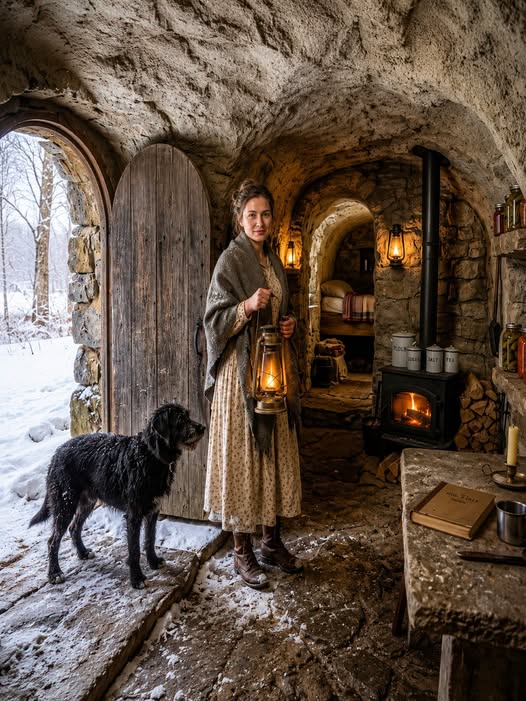
three weeks after burying her husband, a nebraska widow discovered a hidden door beneath the frozen hill—and when the deadliest blizzard came, she finally understood the terrible secret it had protected for years
Part 1
Three weeks after burying her husband, Ruth Carver counted the firewood on her sled.
Six branches.
That was all she had managed to drag from the frozen Nebraska ravine before dark.
Six might keep the cabin stove burning until midnight.
After that, Ruth would have to decide whether to break apart one of Thomas’s handmade chairs.
She looked down at the branches, then toward the distant roof of the cabin where her two children waited.
Benjamin was nine years old. Annie was five.
Neither was old enough to understand why the house had grown so cold since their father died.
And neither was old enough to understand why their mother sometimes stood at the kitchen window after supper, staring toward the creek, holding a cup of coffee that had gone cold in her hands.
Thomas Carver had been dead for twenty-one days.
Ruth knew because she counted every morning.
Twenty-one mornings without hearing his boots strike the kitchen floor.
Twenty-one evenings without seeing him bend beneath the doorway, carrying an armload of wood against his chest.
Twenty-one nights of waking suddenly and reaching toward the empty half of the bed.
The accident had happened down by Willow Creek.
Thomas had gone to inspect a stretch of fence where the spring floods had eaten away the bank. He had taken his shovel and an old length of chain, promising to return before dinner.
Instead, a section of frozen earth had broken beneath him.
The bank collapsed.
By the time Ruth heard the noise and reached the creek, Thomas was pinned beneath a slab of limestone and wet soil.
She had tried to dig him out with her hands.
She had called his name until her throat burned.
He had looked at her once.
That was what she remembered most clearly.
Not the blood on his collar or the weight of the stone.
His eyes.
He had looked frightened, not for himself, but for her.
Then he had whispered, “Take care of our babies, Ruth.”
Those were his last words.
Now the north wind swept across the Nebraska prairie with a sound like something large and hungry moving through the grass.
Ruth tightened the scarf beneath her chin.
“Come on,” she whispered to herself. “Just get home.”
She leaned into the rope attached to the sled.
The runners scraped over frozen ground.
Above the western horizon, clouds were piling up in heavy gray layers. The sun had disappeared behind them almost an hour earlier, though it was not yet dark.
Winter had arrived early that year.
The first hard freeze had come before the corn was properly gathered. A sleet storm had broken two fence posts, and the creek had already begun to crust over.
Thomas had always prepared for winter.
Every autumn he cut enough cottonwood and cedar to fill the shed behind the cabin. He stacked the logs with their split faces turned outward and covered the top with canvas so the snow could not soak through.
But this autumn had been different.
There had been the broken fence, the sick milk cow, the unpaid account at the general store, and finally the accident.
Now the woodshed stood nearly empty.
Ruth had asked Thomas’s younger brother, Owen, where the remaining wood had gone.
He had avoided her eyes.
“Thomas didn’t get around to cutting enough this year,” he said.
She had believed him.
She had been too tired to ask another question.
The sled caught against a stone.
Ruth pulled harder.
Her boots slipped.
She went down on one knee, and a sharp pain traveled through her hip.
For a moment she remained there, staring at the dirty snow beneath her hands.
She was thirty-eight years old, but grief and cold had made her feel twice that.
At home, Annie would be sitting beside the stove with the rag doll Thomas had made from scraps of cloth.
Benjamin would be trying to act like a grown man, feeding the stove one little stick at a time.
Ruth pushed herself upright.
She could not afford to rest.
Not with darkness coming.
She dragged the sled farther along the ravine, beneath a crooked line of cedar trees growing against the base of a limestone ridge.
And then something strange happened.
The wind stopped.
Ruth took another step.
There was no gust against her face.
No icy air pushing beneath her collar.
Twenty feet behind her, the prairie grass still bent nearly flat beneath the north wind.
But beneath the cedars, the branches barely stirred.
She frowned.
Then she felt something brush her cheek.
A faint breath of cold air.
It came from her right.
From the hill.
Ruth turned.
The hillside was a tangle of dead thorn brush, exposed cedar roots, fallen needles, and dirt hardened by frost.
She stepped closer.
The air touched her face again.
It smelled faintly of stone and old earth.
She lowered the sled rope.
With stiff fingers, she pushed aside a clump of thorn branches.
Beneath them was something straight.
Too straight to be a root.
She scraped away loose dirt.
A dark vertical line appeared.
Then another.
Wood.
Ruth knelt, ignoring the cold soaking through her skirt.
She pulled away more dead brush, revealing the edge of a thick wooden panel.
Her heartbeat quickened.
A door.
There was a door buried in the hillside.
The boards were dark with age, reinforced by two heavy crosspieces. Rust covered the hinges, and an iron latch hung crooked near the center.
Half the frame had disappeared beneath soil and cedar needles.
Ruth stared.
She and Thomas had lived on this land for five years.
They had walked the ravine together.
Thomas had cut fence posts along this very ridge.
Neither of them had ever mentioned a door.
She touched the iron latch.
It was cold enough to sting.
For one moment, she considered leaving.
She had children waiting.
There were six branches on the sled.
And whatever stood behind that door had been hidden for a reason.
But then she thought of the empty woodshed.
The cracked window beside Annie’s bed.
The frost that formed on the inside of the kitchen walls.
Ruth pulled at the latch.
It resisted.
She tried again.
A small shower of rust fell onto her hand.
Then the latch lifted.
The door groaned as she leaned against it.
At first, it opened only a few inches.
She shoved harder.
Something crumbled behind the lower edge.
The opening widened.
Cold, earthy air drifted outward.
Ruth reached for the lantern hanging from the sled handle. She lit it with trembling fingers, raised it before her, and stepped inside.
The room was larger than it had any right to be.
Its ceiling was low near the entrance but rose farther back where the limestone ridge formed a natural hollow.
Thick cedar posts supported the earthen roof.
The walls had been reinforced with stone and heavy timbers.
There was a narrow wooden bench against one side, a shelf built into the wall, and a shallow channel cut into the floor.
Near the rear stood something made of stone.
Ruth approached it cautiously.
It was not an ordinary fireplace.
The structure was nearly as long as her kitchen table, built from fitted stones and old brick. Its lower opening was blackened with soot.
But there was no chimney rising directly above it.
Instead, a stone passage ran sideways through its body before turning toward the rear wall.
Ruth crouched.
She had seen plenty of fireplaces in her life.
She had never seen one built like this.
She held her hand near the stones.
Cold.
Yet not as cold as the ground outside.
That was when she noticed something else.
There was no frost in the room.
After several nights below freezing, the floor remained dry beneath the lantern.
The walls were cold but not icy.
Not a breath of wind crossed the interior.
Ruth stood very still.
Above her, the prairie wind howled.
But here, beneath the earth, there was silence.
She turned the lantern toward one of the cedar supports.
Rows of marks had been carved into the wood.
Each row began with a number.
Beside every number was a little shape resembling a flame.
Some rows had three marks.
Others had seven.
Farther down, one row had seventeen.
At the bottom was a larger number.
Twenty-three.
Ruth lifted the lantern closer.
Someone had been counting something.
But what?
She ran a finger over the deepest carving.
The marks were old.
The wood around them had darkened until the numbers seemed almost black.
Then her lantern illuminated something beneath the last row.
Words scratched into the cedar.
The letters were uneven, but she could make them out.
keep the fire. remember the living.
Ruth read the words twice.
Then she heard a noise.
A faint scrape.
From somewhere behind the stone structure.
She froze.
“Who’s there?”
No answer.
She raised the lantern.
“Hello?”
The scrape came again.
She found a narrow opening in the limestone wall, covered by a loose wooden panel.
Behind it, darkness extended farther into the hill.
A cold current moved through the opening.
Ruth backed away.
There were too many questions in this place.
Who had built it?
Why had they concealed the entrance?
Why would anyone put a strange stone fireplace underground?
And what had they been counting?
Outside, a gust of wind moved through the cedars with a sudden roar.
Ruth looked toward the doorway.
Dusk had settled over the ravine.
Her children were waiting.
Whatever this place was, she could not solve its mysteries tonight.
She closed the wooden panel, stepped outside, and pulled the heavy door behind her.
Then she gathered the thorn branches back over the entrance.
As she bent to lift the sled rope, something caught her eye.
Above the hidden doorway, half-buried in the limestone, was a small iron ring.
A length of old wire ran from it into the cedar roots.
Ruth touched it.
The wire disappeared beneath the earth.
Another mystery.
She stood looking at the hill until the cold forced her to move.
When she finally reached the cabin, Benjamin was waiting on the porch.
“Ma!”
He came running down the steps.
“Annie’s crying. She says the stove’s dying.”
Ruth wrapped one arm around him.
“I brought wood.”
He looked at the sled.
His face fell.
“Is that all?”
“That’s what I found.”
He swallowed.
“I could go tomorrow.”
“No, you couldn’t.”
“Pa would’ve let me.”
The words hurt more than Ruth expected.
She looked at him.
“Your pa would have gone with you.”
Benjamin lowered his eyes.
“I’m sorry.”
Ruth brushed snow from his cap.
“I know, sweetheart.”
Inside, Annie sat wrapped in two quilts beside the stove.
Her cheeks were pale.
“Mama, are we going to freeze?”
Ruth stopped beside the door.
There was something terrible about hearing such a question from a five-year-old child.
She crossed the room, knelt, and gathered Annie against her chest.
“No, baby.”
“Promise?”
Ruth hesitated.
A promise seemed like a dangerous thing now.
Thomas had promised to come home for dinner.
He had meant it with all his heart.
Still, Ruth kissed her daughter’s cold forehead.
“I promise I’ll do everything I can.”
That evening, after the children were asleep, Ruth placed two of the branches inside the stove.
She sat in Thomas’s chair, watching the flames.
The chair had taken him three Sundays to build.
He had carved a small leaf into the backrest because Ruth had once told him she loved the cottonwoods along the creek.
She touched the carving.
Her hand trembled.
“Thomas,” she whispered, “what am I supposed to do?”
The stove cracked softly.
There was no answer.
But beyond the cabin, beneath the limestone ridge, a door waited in the darkness.
And for the first time since Thomas died, Ruth had found something she could not explain.
Something that might be more than another problem.
Something that might be a chance.
Part 2
The next morning, Ruth woke to ice on the bedroom window.
Annie had crawled into bed beside her during the night.
Benjamin was already awake, standing beside the kitchen stove with his father’s old work gloves hanging past his fingertips.
“I put the last branch in,” he said.
Ruth looked at the stove.
The fire was weak.
She had hoped to keep one branch for breakfast.
“Thank you, Ben.”
He watched her face.
“Are you mad?”
“No.”
“Because I used it?”
“No, sweetheart. Because there’s no more.”
She made cornmeal mush with the last of the milk from their cow, Molly.
There was no sugar.
She sweetened Annie’s bowl with a spoonful of sorghum syrup and gave Benjamin the larger portion.
When the children finished eating, Ruth told them about the door beneath the hill.
Benjamin’s eyes widened.
“A real door?”
“A real one.”
“What’s inside?”
“I’m not sure.”
“Could be a mine.”
“Too small for a mine.”
“Could be a robber’s hideout.”
“Then whoever hid there had strange ideas about comfort.”
For the first time in days, Benjamin smiled.
Annie looked concerned.
“Is there a ghost?”
Ruth shook her head.
“Just old stones and an old stove.”
“Like our stove?”
“Not exactly.”
Benjamin leaned forward.
“Can we see it?”
Ruth studied her son’s thin face.
He had been trying so hard since the funeral.
He carried water without being asked. He checked the chicken house. He watched his sister while Ruth worked outside.
But he had stopped playing.
He had stopped asking questions about anything except chores.
Now there was a spark of the boy she remembered.
“Put on your coat,” she said.
They left Annie with their nearest neighbor, Mrs. Eleanor Finley, whose little farmhouse stood half a mile south.
Mrs. Finley was sixty-seven, widowed, and sharp-tongued enough to make most men lower their voices.
When Ruth explained where she was going, the older woman frowned.
“An old room beneath the ridge?”
“That’s what it looks like.”
“Well, don’t go crawling into something that’s fixing to fall on your head.”
“I’ll be careful.”
Mrs. Finley glanced toward Benjamin.
“And you mind your mother.”
“Yes, ma’am.”
The old woman took Annie’s hand.
“Come inside, little bird. I’ve got biscuits.”
Annie brightened immediately.
As Ruth turned to leave, Mrs. Finley caught her sleeve.
“Ruth.”
“Yes?”
“You need wood?”
Ruth opened her mouth to deny it.
Mrs. Finley gave her a hard look.
“Don’t insult me by lying.”
Ruth looked away.
“Some.”
“I’ve got a little stack behind the shed.”
“You need it yourself.”
“I know what I need. I’ll send a few pieces home with Annie.”
Ruth felt heat rise into her face.
“I can mend your winter coat in exchange.”
“You already mended it last spring.”
“Then I’ll do your washing.”
Mrs. Finley sighed.
“Lord preserve us from proud women. Just bring the girl home before dark.”
Ruth thanked her quietly.
Then she and Benjamin headed for the ravine.
The door was exactly where Ruth had left it.
Benjamin stared as she pulled aside the brush.
“How come nobody found it?”
“That’s what I’d like to know.”
They opened the door together.
Inside, Benjamin held the lantern while Ruth examined the walls.
The room was perhaps eighteen feet long and twelve feet wide, with a smaller chamber cut into the rock at the back.
There were three wooden shelves, most of them empty.
A rusted iron pot sat beneath one.
In a corner lay a coil of rope so old it crumbled when Benjamin touched it.
Along the north wall stood a narrow table made from thick cedar planks.
The furniture was simple but carefully built.
Nothing suggested anyone had used the place recently.
At the back, Ruth pulled aside the wooden panel she had noticed the night before.
Behind it was a passage barely wide enough for a grown person to enter sideways.
It sloped gently upward.
She followed it for several feet before finding a vertical shaft lined with rough stones.
Daylight shone faintly through a narrow opening high above.
A cold draft descended toward her face.
“That’s where the noise came from,” she said.
Benjamin peered past her.
“What is it?”
“Air, I believe.”
She thought of the strange stone fireplace.
Then something began to make sense.
She returned to the main chamber.
With Benjamin holding the lantern, she examined the masonry structure.
The firebox was narrow but deep.
Above it, thick stone formed a broad, flat surface.
The passage from the firebox ran through the body of the stove before turning toward a channel in the limestone.
Ruth touched the old mortar.
“My grandfather knew a German family back in Iowa,” she murmured. “They had a stove that warmed the walls instead of the air.”
Benjamin frowned.
“How can a stove warm a wall?”
“You build the fire inside a great deal of stone. The smoke travels through passages before it leaves. The stone keeps the heat long after the fire burns out.”
“Would it work?”
“Maybe.”
Her father had once told her that certain European families used less wood during winter because their masonry stoves held heat for hours.
She had never expected to find anything like one buried in a Nebraska hillside.
Then Benjamin called from the far corner.
“Ma! Come see!”
He was kneeling beside a low wooden chest.
The lid was swollen with age, but its hinges still worked.
Inside lay folded canvas, two wool blankets, a bundle of short iron tools, and several tightly stoppered earthenware jars.
Ruth opened the first jar.
Beans.
Dried, old, and dusty.
The next held corn.
The third was empty.
Tucked beneath the blankets was a small leather-bound notebook.
Its cover had nearly fallen away.
Ruth opened it carefully.
The pages were yellow and stiff.
Most of the writing had faded, but the first page held a name.
Martha Ellison, 1890.
Beneath the name was a sentence.
For the winter that comes when nobody believes it will.
Ruth felt a strange chill that had nothing to do with the room.
She turned another page.
There were drawings.
One showed the stone stove, with arrows tracing the path of smoke through its passages.
Another showed a hillside with cedar trees and a narrow entrance beneath their roots.
Small handwritten instructions filled the margins.
Dry wood only.
Clear the upper smoke outlet before lighting.
Do not block the fresh-air passage.
Keep the outer door covered against the northwest wind.
Ruth read every word.
“Who was Martha Ellison?” Benjamin asked.
“I don’t know.”
“Did she live here?”
“Seems she did.”
He looked around the room.
“Underground?”
“At least some of the time.”
Ruth turned to the last page.
The writing had grown shakier.
There was no date.
Only a short message.
If there are children, bring them inside first. A grown person can bear the cold longer than a little one.
Ruth closed the book.
For several seconds, she could not speak.
She thought of Annie sleeping beneath two quilts.
Of Benjamin standing beside the stove in his father’s oversized gloves.
Of Martha Ellison, whoever she had been, writing those words in this silent underground room.
“Mama?”
Ruth looked down.
Benjamin was watching her.
“Could we live here?”
She glanced toward the stone walls, the benches, the narrow entrance.
“I don’t know if we could live here.”
“But we could get warm?”
“If we can make the stove work.”
Benjamin nodded with fierce determination.
“Then let’s make it work.”
They spent the next two hours examining the flue passages and clearing fallen debris from the entrance.
Near the rear wall, Ruth found an iron cleanout plate beneath years of dirt.
Inside was a shallow cavity full of old soot and cedar needles.
She scraped it clean with one of the iron tools from the chest.
Then she followed the stone smoke passage toward the rear shaft.
By midday, she had identified the outlet above the ridge: a short stone chimney tucked inside a rocky cleft, protected from direct wind but clogged with years of fallen needles.
It would need careful clearing before any fire could be started safely.
The discovery gave her hope.
It also gave her work.
And work was something Ruth understood.
On their way home, Benjamin walked beside her with the notebook tucked inside his coat.
For a while neither spoke.
Then he said, “Ma, I have to tell you something.”
Ruth glanced at him.
“What is it?”
He kicked at a frozen clump of dirt.
“About the wood.”
“What wood?”
“The wood Pa cut.”
Ruth stopped.
Benjamin stared at his boots.
“Uncle Owen came two days after the funeral.”
“I remember.”
“He brought his wagon.”
“Yes.”
“He took the wood from our shed.”
Ruth felt her stomach tighten.
“What?”
“He said you knew.”
She turned fully toward him.
“Ben, look at me.”
The boy raised his eyes.
“How much wood?”
“Most of it.”
Ruth stared.
“Most?”
“He loaded the big split pieces first. Then the smaller ones. I asked why, and he said the family owed money.”
A slow, sick feeling moved through her.
“Did he tell you not to say anything?”
Benjamin nodded.
“He said you had enough to worry about.”
Ruth looked toward the cabin.
She could picture the wood neatly stacked behind it.
Thomas had spent two Saturdays cutting that wood in October, before the creek bank collapsed.
She remembered hearing his ax while she washed clothes.
Remembered the way he had rubbed his aching shoulder at supper.
Remembered him saying, “That ought to see us through the worst of it.”
Ruth pressed a hand against her mouth.
Owen had taken it.
The heat Thomas had prepared for his children.
The one practical protection he had left behind.
Benjamin’s voice shook.
“I’m sorry, Ma.”
Ruth crouched and put her hands on his shoulders.
“Listen to me. You didn’t do anything wrong.”
“I should’ve told.”
“You’re nine years old. A grown man told you your mother knew. You believed him.”
“But I saw him take it.”
Ruth drew him close.
For a moment, she closed her eyes.
She could forgive many things.
Confusion.
Fear.
Poor judgment.
But she could not understand how Owen had looked into the faces of his brother’s children and hauled away their winter wood.
That afternoon, she went to see him.
Owen lived six miles away with his wife, Clara, and their two sons.
He was younger than Thomas by five years, broad across the shoulders, with the same dark eyes but a nervous way of looking toward the floor when uncomfortable.
He met Ruth in the barnyard.
“Ruth. What brings you out?”
“Where’s my wood?”
He blinked.
“What?”
“The wood Thomas cut. The wood you took from my shed.”
Owen’s face changed.
He looked toward Benjamin, who stood beside the wagon.
“Ben told you?”
“Answer me.”
Owen rubbed the back of his neck.
“I sold it.”
The words struck harder because he said them so plainly.
“To whom?”
“Hollis at the store. He needed stove wood.”
“How much?”
“Twenty-six dollars.”
Ruth stared at him.
“Twenty-six dollars.”
“I used some to settle the undertaker’s bill.”
“Some?”
“And some toward Thomas’s account.”
“How much toward his account?”
Owen hesitated.
“Eleven.”
Ruth waited.
“And the rest?”
He looked away.
“There were hauling expenses. And I had a little money tied up in the wagon.”
The cold seemed to settle inside Ruth’s chest.
“You took my children’s firewood to pay yourself?”
“That’s not fair.”
“Fair?”
Owen’s jaw tightened.
“Somebody had to handle things after Thomas died. You were barely speaking. The undertaker wanted payment. The store was asking questions. I was trying to keep people from coming after you.”
“You could have asked me.”
“You weren’t in any condition to make decisions.”
Ruth took one step closer.
“That was not your decision to make.”
He lowered his voice.
“Ruth, you can’t keep that place going alone. You know that.”
“Thomas kept it going.”
“Thomas was a man.”
She felt something break inside her.
Not her strength.
Something else.
The last small belief that family would understand what she needed.
Owen sighed.
“Mr. Pritchard still wants the property. He’s offered five hundred and forty dollars. With the debts cleared, you’d have enough to take the children into town.”
“You spoke to Pritchard about my land?”
“I was looking out for you.”
“Did I ask you to sell my home?”
“No, but—”
“Did I?”
Owen said nothing.
Ruth turned toward the wagon.
“That land is mine and Thomas’s. Those children are mine and Thomas’s. You don’t get to decide what happens to any of us.”
“Don’t be foolish, Ruth.”
She stopped.
Owen looked frustrated now.
“Winter’s coming hard. You haven’t got enough wood. You haven’t got a hired man. You haven’t got money for the feed note when it comes due.”
Ruth looked at him for a long moment.
“You’re right about one thing.”
He waited.
“Winter is coming.”
Then she climbed into the wagon.
“And when it does, I’ll remember who took the wood.”
She drove away before he could answer.
By the time she reached home, darkness was spreading across the prairie.
Mrs. Finley had left four pieces of cottonwood beside the stove.
Annie was asleep.
Benjamin sat at the kitchen table, turning the pages of Martha Ellison’s notebook.
Ruth hung up her coat.
“Find anything?”
Benjamin nodded.
He pointed to a drawing near the middle.
“Look at this, Ma.”
It showed the hillside from above.
A narrow dotted line connected the hidden room to a second opening farther along the ridge.
Beside it, Martha had written three words.
the winter passage.
Ruth leaned closer.
Outside, the wind struck the cabin wall.
And for the first time, she wondered whether the hidden room was only the beginning of what lay beneath the hill.
Part 3
The next morning, Ruth returned to the ridge carrying a shovel, a hammer, a lantern, and Thomas’s old carpenter’s square.
Benjamin brought the notebook.
The air had turned sharper overnight.
A hard white crust covered the grass, and the creek made hollow noises beneath its new skin of ice.
Ruth could see her breath inside the cabin now.
She knew she had very little time.
They entered the hidden room and began tracing the dotted line in Martha Ellison’s drawing.
It led behind the rear cedar supports to a narrow gap in the limestone.
At first, Ruth thought the opening had collapsed.
Then she noticed a line of carefully fitted stones.
She pushed against one.
Nothing happened.
Benjamin knelt beside her.
“Maybe it’s like the door.”
“Maybe.”
They scraped away dirt until a small iron handle appeared.
Ruth pulled.
The stone panel shifted.
Behind it was a low passage cut through the limestone, perhaps four feet high.
It had been partly filled with fallen earth, but the ceiling remained supported by thick wooden beams.
Ruth raised the lantern.
The passage curved toward the south.
“Stay behind me.”
They moved slowly.
The air was dry.
The floor had been lined with flat stones, and shallow grooves carried moisture toward a narrow drainage channel.
After nearly thirty feet, the passage opened into another chamber.
This one was smaller.
And unlike the first, it was full.
Wood.
Ruth could hardly believe what she was seeing.
Several short stacks of split timber stood against the wall, raised from the ground on stone blocks.
Most pieces were thin, old cedar and hardwood, dry but dusty beneath a layer of fallen needles.
Some had begun to crumble.
Others were solid.
Enough to fill several sledloads.
In the corner stood two empty water barrels, a heavy iron bucket, and a rack of wooden shelves.
Benjamin rushed forward.
“Ma! Look!”
Ruth followed him.
On the upper shelf were six sealed crocks.
She opened one carefully.
Inside was dried corn.
Another held beans, though their age made them uncertain food.
A third contained salt, hardened into a pale lump.
The supplies had been preserved remarkably well in the dry chamber, but Ruth knew she could not trust food that had sat forgotten for decades without examining it closely.
The wood, however, was different.
She picked up a split log.
It was light and dry.
She struck it against a stone.
The sound was firm.
It would burn.
Ruth sat down on a wooden block.
Benjamin turned to her.
“Ma?”
She looked at the stacks.
Then she began to cry.
Not loudly.
There was no strength left for loud crying.
She lowered her head and covered her face with both hands.
For three weeks she had been trying to find enough wood to get her children through one more night.
She had walked frozen creek beds.
Dragged dead branches through snow.
Considered burning Thomas’s furniture.
And here, a short distance beneath the hill, stood the work of someone who had prepared for a winter Ruth had not yet imagined.
Benjamin approached slowly.
“Are you sad?”
Ruth wiped her face.
“No, honey.”
He looked confused.
She reached for him.
“I’m grateful.”
He put his arms around her neck.
They stayed like that for a while.
Then Ruth stood.
“Come on. Let’s get some of this home.”
They worked until noon.
Ruth carried what she could through the passage while Benjamin stacked it near the entrance.
They loaded the sled twice.
It was hard work, and Ruth’s back began to ache.
But each load placed in the woodshed felt like another night won back from the cold.
By evening, there was enough dry wood at the cabin to last several days if burned carefully.
That night Annie fell asleep beside a warm stove.
Benjamin ate his supper without shivering.
Ruth sat at the table with Martha’s notebook.
She studied every page by lantern light.
There were drawings of the stone heater, instructions for keeping the smoke passage clear, and notes about collecting water from snow.
On several pages, Martha described something she called the great storm.
She wrote about frozen cattle.
About wagons buried beneath drifts.
About people walking toward lights they never reached.
And about children.
So many children.
One line caught Ruth’s attention.
January 12, 1888. The day the sky disappeared.
Ruth had heard of that winter.
Every Nebraska family had.
The blizzard of 1888 had swept across the plains with terrible speed, catching children leaving school and farmers far from shelter.
People still told stories about it.
Some spoke of teachers who tied students together with rope.
Others remembered families who waited days for loved ones who never returned.
Ruth turned another page.
Martha’s handwriting grew darker, pressed hard into the paper.
We buried Samuel behind the cottonwoods. He was eleven. I will never let another child freeze because a house was too far away.
Ruth looked up.
Eleven.
Only two years older than Benjamin.
She read on.
Jacob says the old quarry beneath the ridge can hold heat if we build the proper stove. The limestone is sound. The cedar roots keep the ground from washing loose. If we turn the doorway away from the north wind, the storm will pass above us.
The next page contained sketches.
The room.
The stove.
The air passage.
The winter passage.
And the stacks of wood.
Ruth understood then.
Martha and Jacob Ellison had not merely been building a cellar.
They had been building a refuge.
A place where people could survive weather that no ordinary prairie cabin could withstand.
But one question remained.
Why had they hidden it?
The answer came two days later.
Ruth had driven to town to buy lamp oil and ask about the feed note Thomas had left unpaid.
She stopped at the general store, where Mr. Hollis stood behind the counter with a pencil tucked over one ear.
He looked surprised to see her.
“Mrs. Carver.”
“Morning.”
“How are the children?”
“Keeping well.”
She placed two coins on the counter.
“Small bottle of lamp oil, please.”
As he turned toward the shelf, Ruth said, “Did you buy wood from Owen Carver after Thomas died?”
Mr. Hollis stopped.
Slowly, he turned back.
“Yes, ma’am.”
“Twenty-six dollars’ worth?”
“That’s right.”
Ruth held his gaze.
“That wood belonged to me.”
His face reddened.
“Owen told me he was settling the estate.”
“He had no right to sell it.”
Mr. Hollis lowered his eyes.
“I didn’t know.”
Ruth believed him.
The merchant had always been fair with Thomas, and she could see the discomfort in his face.
He opened a drawer and removed a ledger.
“For what it’s worth, I can show you the payment.”
Ruth examined the entry.
Twenty-six dollars.
Paid in cash to Owen Carver.
On the next page, Thomas’s account showed a payment of eleven dollars.
The undertaker’s bill was fourteen.
That accounted for twenty-five dollars.
Only one dollar remained unaccounted for, assuming Owen had paid the entire funeral bill as he claimed.
The knowledge did not make what he had done right.
But it changed the shape of his wrongdoing.
He had taken their wood because he believed debts mattered more than warmth.
He had made that decision without asking her.
And he had lied afterward because he knew it was wrong.
Mr. Hollis cleared his throat.
“Ruth, Owen wasn’t trying to rob you.”
“I know.”
“He was frightened.”
“So am I.”
The merchant said nothing.
She closed the ledger.
“But being frightened doesn’t give a man the right to leave children cold.”
Mr. Hollis nodded slowly.
“No, ma’am. It doesn’t.”
Ruth bought the lamp oil.
Then she walked to the little office of Mr. Edmund Pike, the local banker.
The feed note was still open.
Seventy-eight dollars had been borrowed the previous spring to purchase seed and repair equipment.
Thirty-four dollars remained due, with the final payment expected before planting season.
Pike showed her the account.
Ruth studied the figures carefully.
“Can I make smaller payments through winter?”
The banker folded his hands.
“I can’t promise an extension without something to show against it.”
“I have a milk cow and a wagon.”
“Both are already listed as security for the note.”
“Then I have my work.”
Pike sighed.
“Mrs. Carver, I respect that. But the bank has its rules.”
Ruth looked at the papers.
“So if I can’t pay by spring, you take the cow?”
“That’s a possibility.”
She stood.
“Thank you for telling me.”
He looked almost relieved when she left.
Outside, the sky had turned white.
Not the white of ordinary clouds.
A thin, flat white that stretched across the prairie and swallowed the horizon.
Ruth knew the look.
Bad weather was coming.
She was fastening the reins when an elderly voice called her name.
“Ruth Carver?”
She turned.
A small woman stood beside the dry goods shop, leaning on a cane.
Her name was Abigail Mercer.
She had lived near the settlement for more than forty years and was said to remember nearly every family that had ever passed through the county.
“Yes, Mrs. Mercer?”
The woman studied her.
“I heard you were asking about Martha Ellison.”
Ruth felt a sudden thrill.
“You knew her?”
Abigail nodded.
“I knew Martha.”
Ruth stepped closer.
“Then I need to talk to you.”
They sat inside the general store near the back stove.
Ruth told her about the door.
The stone heater.
The carved numbers.
The hidden wood.
As she spoke, Abigail’s expression slowly changed.
When Ruth finished, the old woman sat silent.
Then she whispered, “Merciful heavens. It’s still there.”
“You knew about it?”
“I knew where it used to be.”
Abigail stared into the stove.
“Martha Ellison lost her boy in the blizzard of 1888. Samuel was caught on the road between the schoolhouse and their farm. His father found him the next morning.”
Her voice grew quiet.
“Martha never forgave winter after that.”
Ruth listened.
“Her husband, Jacob, had been a stone mason before they came west. He knew how to make a fireplace that held heat. They spent two summers working beneath that ridge. Cut the passage by hand. Hauled stone. Built shelves. Stored wood. Martha said there would never be another storm that took children from that stretch of prairie without a warm place waiting.”
“Then why did they hide the door?”
Abigail looked at her.
“Because they learned what happened when everybody knew there was wood down there.”
She explained that during several difficult winters, men had helped themselves to the refuge’s supplies.
One ranch hand had taken nearly half the stored wood.
Another had broken open the food crocks.
Martha had pleaded with the neighboring families to leave the winter provisions untouched until an emergency.
Some listened.
Others did not.
“So Jacob built the entrance farther back under the cedars,” Abigail said. “Covered it with brush and gave the location to the families who needed to know. He marked a stone above the doorway. It was never meant to keep frightened people out. It was meant to keep the supplies safe until frightened people needed them.”
Ruth remembered the iron ring above the entrance.
“And the carved numbers?”
Abigail closed her eyes.
“Those were Martha’s.”
“What did she count?”
“People.”
Ruth leaned forward.
“People?”
“During the blizzard of 1895, that shelter held neighbors from three farms, a traveling family, and some boys caught hauling hay. Every evening Martha carved the number of people who had made it through another day beside a little flame.”
Abigail smiled sadly.
“She said a warm room meant nothing unless you remembered the people inside it.”
Ruth thought of the number twenty-three.
“Twenty-three people?”
“On the fullest night.”
The old woman nodded.
“Martha fed twenty-three souls down there, Ruth. Twenty-three people who might have died on the prairie.”
Ruth felt the significance of the old marks settle over her.
“Did anyone die?”
“Not in the shelter.”
Abigail looked toward the window.
“Jacob passed away some years afterward. Martha held on a while longer, but she eventually moved east to live with a niece. Nobody tended the entrance. Dirt washed down from the ridge. Cedars grew thicker. People forgot.”
She turned back to Ruth.
“But Martha always said one thing.”
“What?”
“She said the prairie doesn’t care how strong a man thinks he is. When the sky turns white, the only thing that matters is whether there’s a door somebody can reach.”
Ruth drove home in silence.
The words stayed with her.
That evening she took Benjamin to the ridge again.
Together they cleaned the smoke passage and removed debris from the stone chimney outlet.
Ruth checked the fresh-air channel, making certain it remained open.
They repaired a damaged joint in the cleanout cover with clay mortar.
She inspected the old beams carefully, looking for rot or movement.
Some timber would need replacing eventually, but the main supports were sound.
The room had stayed dry because the drainage channels still worked.
The entrance faced southeast beneath the ridge, protected by the limestone wall and the thick cedars.
The builders had understood the land.
They had known where the wind struck.
Where snow gathered.
Where stone held steady.
Where a desperate traveler might find a few feet of earth that could mean the difference between life and death.
Once Ruth was satisfied the passages were clear, she built a small test fire.
Dry kindling caught in the firebox.
The flame burned steadily.
Smoke moved through the stone channels and out through the chimney.
No smoke escaped into the room.
Ruth watched for a long while, checking the draft and the joints.
Then she added two small pieces of wood.
Slowly, the stones began to warm.
Benjamin sat on the bench with both hands outstretched.
“Ma.”
“Yes?”
“It’s getting warm.”
Ruth touched the broad stone top.
He was right.
The outer surface was no longer icy.
An hour later, the masonry held a gentle warmth that spread through the room.
Even after the little fire burned down, the stone remained warm.
Ruth sat beside her son.
For several minutes, they listened to the faint ticking of the cooling stones.
Then Benjamin looked up.
“Do you think Pa would’ve liked this place?”
Ruth smiled through sudden tears.
“He would’ve loved it.”
“He could’ve fixed everything.”
She put an arm around him.
“Your pa was good at fixing things.”
Benjamin leaned against her.
“But he wasn’t the only one.”
Ruth looked at him.
He shrugged.
“You’re fixing it too.”
She turned toward the glowing firebox before he could see her cry.
Outside, the wind was rising again.
But beneath the hill, the stone held its warmth.
And Ruth Carver, who had spent three weeks believing her useful life had ended with Thomas’s death, began to understand something she had forgotten.
She was not helpless.
She was grieving.
There was a difference.
Part 4
The storm warning came on a Thursday.
A farmhand riding south from town stopped at Ruth’s gate shortly after noon.
He was a young fellow named Walter Briggs, with frost on his eyebrows and a scarf tied over his mouth.
“Mrs. Carver!”
Ruth stepped onto the porch.
“What is it?”
“Mr. Hollis sent word. Weather’s coming out of Wyoming. Telegraph says heavy snow and northwest winds by morning.”
“How heavy?”
Walter glanced at the sky.
“Bad enough they’re telling folks not to travel.”
Ruth looked toward the ridge.
The clouds were already gathering.
“Did you tell the Finleys?”
“Going there next.”
“Thank you.”
Walter turned his horse.
“Best keep your children close tonight.”
Ruth watched him ride away.
Then she went inside and began packing.
She did not waste time deciding whether to trust the hidden shelter.
She had spent days examining it.
The stone heater worked.
The air passage was clear.
The wood chamber held enough dry fuel to keep a small fire going for an extended period if managed carefully.
The room stood protected beneath solid limestone.
It was safer than her drafty cabin.
She packed blankets, cooking utensils, flour, cornmeal, dried apples, salt pork, a little coffee, medicine, and Thomas’s heavy wool coat.
She filled two buckets and several bottles with fresh water.
Then she sent Benjamin to gather eggs and bring the chickens into the most protected part of the henhouse.
“What about Molly?” he asked.
The cow stood in the barn with her calf, both sheltered from the wind but vulnerable if the roof failed or the drift piled too high.
Ruth considered the problem.
The old barn sat on exposed ground.
Its eastern wall had been patched twice.
She looked toward the lee side of the limestone ridge.
There was a shallow stone-walled hollow near the entrance, protected from the north by the hill and from the west by a line of trees.
If she could strengthen the temporary gate and provide hay, the animals would have better protection there.
“We’ll move them near the ridge,” she said. “Where the wind can’t strike them straight on.”
They worked through the afternoon.
Ruth dragged hay from the barn.
Benjamin carried buckets.
Together they led the cow and calf along the ravine and settled them in the sheltered hollow.
Ruth fastened an old canvas sheet across part of the opening, leaving ventilation and a way for the animals to move.
By the time she finished, her hands were aching.
Her right shoulder throbbed.
The first snowflakes began falling as she secured the gate.
They were small, dry flakes.
Ruth had seen that kind before.
Snow that did not melt.
Snow that gathered.
Snow that the wind could drive through cracks no wider than a knife blade.
At sundown, Mrs. Finley appeared.
She was bundled in an old black coat, carrying a covered basket.
“I heard you found a place under the hill,” she said.
Ruth nodded.
“Come see it.”
They walked together to the entrance.
Mrs. Finley stopped when Ruth uncovered the door.
“Well, I declare.”
Inside, the older woman studied the stone heater, the benches, and the stacks of provisions Ruth had already moved into the chamber.
“You’ve been busy.”
“I’ve had to be.”
Mrs. Finley touched the warm stone.
“Feels better than my kitchen.”
“There’s room for you.”
The older woman looked at Ruth.
“What?”
“If the storm gets as bad as they say, I want you here.”
“Nonsense. I’ve lived through Nebraska winters since before you were born.”
“And I’d like you to live through another.”
Mrs. Finley narrowed her eyes.
“You’re getting bossy.”
Ruth almost smiled.
“Thomas used to say that.”
The old woman looked away.
Then she nodded.
“I’ll bring my blankets.”
Before leaving, she studied the carved numbers on the cedar post.
Ruth explained what Abigail Mercer had told her.
Twenty-three people.
Twenty-three lives sheltered during an earlier storm.
Mrs. Finley ran one finger down the old marks.
“My goodness,” she whispered. “All that time, we thought there was nothing under this hill but rock.”
That night the wind arrived.
It began as a steady moan along the eaves.
Then the gusts strengthened.
The cabin walls trembled.
By nine o’clock, snow was driving horizontally past the windows.
Ruth stood beside the stove, looking toward the bedroom where her children slept.
A familiar fear crept into her.
She remembered the night Thomas died.
The terrible helplessness of knowing something was happening that she could not stop.
She turned away.
Not this time.
She woke Benjamin.
“Get your sister.”
He sat up.
“Is it time?”
“Yes.”
They dressed Annie in layers.
Ruth wrapped a quilt around her and tied it beneath her arms.
Benjamin took the lantern.
Ruth carried the food basket.
Together they stepped into the storm.
The wind struck so hard Annie cried out.
Ruth lowered her head and held her daughter close.
Snow blew against her cheeks like thrown sand.
The cabin disappeared behind them almost immediately.
But Ruth had prepared.
Earlier that afternoon, she had stretched a strong rope from the back porch toward the cedar grove, fastening it at intervals to fence posts and trees.
She gripped it now with one hand.
Benjamin held the back of her coat.
“Don’t let go!” she shouted.
They moved slowly.
Each step required effort.
The wind pushed against their legs.
Loose snow swirled around the roots.
At last, the cedars appeared as dark shapes against the storm.
The wind dropped as they stepped behind the limestone shoulder.
Ruth found the door by touch.
She pulled it open.
One by one, they entered.
Inside, the air was cool but calm.
The stone heater still held a little warmth from the afternoon firing.
Ruth closed the door and settled the children on the bench.
Annie looked around.
“Are we in the hill, Mama?”
“Yes, baby.”
“Will it keep us?”
Ruth touched her cheek.
“I believe it will.”
She opened the cleanout, checked the passage, and lit a modest fire in the stone heater.
The flame caught.
Soon the smoke drew steadily into the passage.
The stones began warming.
Benjamin unfolded the blankets.
Ruth prepared a simple supper of beans and cornmeal.
For a little while, the world outside ceased to exist.
There was only the sound of the small fire, Annie’s spoon against her bowl, and Benjamin asking questions about the old room.
Then came a pounding at the door.
Three hard blows.
Ruth looked up.
Benjamin froze.
The pounding came again.
“Help!”
A man’s voice.
Ruth rose and crossed the room.
She lifted the latch.
The door flew inward against her shoulder.
Mrs. Finley stumbled through, nearly falling.
Behind her stood a young woman Ruth recognized as Clara Mills, the schoolteacher from the little one-room schoolhouse near the crossroads.
Three children clung to her skirts.
Their faces were white with cold.
Ruth reached for the nearest child.
“Come in! Hurry!”
They crowded inside.
Mrs. Finley slammed the door.
For several moments, nobody spoke.
Clara was shaking too hard.
Ruth wrapped a blanket around her shoulders.
“What happened?”
Clara’s lips trembled.
“We were at the schoolhouse. I kept the children late because the weather was turning. Their families hadn’t come. Then the wind got worse.”
She swallowed.
“I thought we could reach Mrs. Finley’s farm.”
Mrs. Finley lowered herself onto the bench.
“They did. I was coming here when they arrived at my door.”
Clara looked around the room.
“Where are we?”
“Someplace safe,” Ruth said.
She knelt before the children.
Two boys and a little girl.
The youngest looked no older than Annie.
“Can you feel your fingers?”
The girl nodded weakly.
Ruth removed her wet mittens and began warming her hands gradually beneath a blanket.
She checked the others for signs of serious frostbite.
One boy’s cheeks were pale and stiff, but he could speak clearly.
The children were frightened, exhausted, and very cold.
Ruth gave them warm broth and had them sit near the stove, far enough from the heated stone to avoid burns.
When everyone had settled, she looked at Mrs. Finley.
“How did you find the door?”
The older woman gave a tired smile.
“I remembered where you showed me.”
Outside, the wind screamed across the ridge.
Ruth looked at the children.
She imagined them still struggling through the white darkness.
Her throat tightened.
Another few minutes, perhaps, and they might never have reached the cedars.
She glanced toward Martha Ellison’s carved marks.
Now she understood why the old woman had counted.
Every person inside the room mattered.
Every one.
The storm worsened throughout the night.
Snow gathered so heavily against the cabin that Ruth could no longer see its roof through the narrow gap in the cedars.
The wind made a low roaring sound above the limestone.
Once, something large cracked outside.
A tree limb, perhaps.
Nobody moved.
Then a deep thud shook the earth.
Annie sat upright.
“Mama?”
Ruth listened.
The sound did not come again.
“Probably a tree,” she said.
But she wondered whether it had been the barn.
Toward midnight, a new sound reached them.
A faint metallic ringing.
Ruth looked toward the door.
There it was again.
Clang.
Clang.
Clang.
Mrs. Finley raised her head.
“That’s a wagon bell.”
Ruth stood.
Clara looked frightened.
“Out there?”
The bell rang once more.
Then silence.
Ruth moved toward the door.
Mrs. Finley caught her wrist.
“You can’t go out in that.”
“Someone’s there.”
“You won’t see ten feet.”
Ruth looked at the sleeping children.
Then toward the old cedar post.
She remembered Martha’s words.
If there are children, bring them inside first.
Ruth put on Thomas’s wool coat.
She wrapped her face with a scarf.
Then she took a long rope from the supply chest and tied one end securely to the heavy interior post.
“Ben,” she said, “you stay here.”
He stood.
“I can help.”
“You can help by keeping your sister safe.”
He looked ready to argue.
Then he nodded.
Ruth turned to Mrs. Finley.
“If I pull the rope three times, come to the doorway. Don’t go farther.”
The old woman set her jaw.
“All right.”
Ruth opened the door.
The storm struck her like a wall.
She stepped outside.
Snow swirled around the cedars.
The world had become a moving whiteness.
She gripped the rope.
“Hello!”
The wind swallowed her voice.
She moved toward the faint place where the bell had sounded.
One step.
Then another.
The rope slid through her gloved hand.
She reached the edge of the sheltered grove.
The wind nearly knocked her down.
She crouched, calling again.
“Anybody there?”
For several seconds, there was nothing.
Then a voice answered.
“Here!”
Ruth turned.
A dark shape emerged through the snow.
A horse.
Then a wagon tilted into a drift.
And beside it, a man on his knees.
Owen.
His face was crusted with ice.
One hand was wrapped around the wagon wheel.
Ruth stared.
“Ruth?”
His voice was barely audible.
“What are you doing out here?”
He coughed.
“Road’s gone. Couldn’t see the turn.”
She looked toward the wagon.
Another person was inside.
Owen’s wife, Clara.
And beneath a heavy blanket were their two sons.
Ruth’s heart lurched.
“Can they walk?”
Owen shook his head.
“The little one’s too cold.”
Ruth climbed onto the wagon.
Clara Carver looked at her with desperate eyes.
“Ruth, please.”
Ruth reached beneath the blanket.
The younger boy, six-year-old Matthew, was limp with exhaustion but breathing.
His older brother, Daniel, trembled violently.
Ruth had every reason to be angry with Owen.
Every reason to remember the empty woodshed.
Every reason to think of Thomas’s labor sold from beneath his own children’s roof.
But the children in that wagon had done nothing wrong.
And the storm did not care whose children they were.
“Listen to me,” Ruth shouted. “There’s shelter under the hill. Follow my rope.”
Owen stared at her.
“What?”
“Take Daniel. I’ll carry Matthew. Clara, hold Owen’s coat. Nobody lets go.”
They struggled through the snow.
Ruth carried Matthew against her chest, feeling his weak breathing through the blankets.
Owen stumbled twice.
Each time, he forced himself upright.
At last they reached the cedars.
Mrs. Finley was waiting at the doorway.
“Here!” she shouted.
One by one, they entered the hidden room.
The warm air seemed almost unreal.
Clara sank onto the bench and began sobbing.
Owen stood near the entrance, staring around him.
Ruth laid Matthew down, removed his wet outer clothing, and wrapped him in dry blankets.
Mrs. Finley helped.
They warmed him carefully and gave him small sips of warm liquid once he was alert enough to swallow safely.
An hour passed before color began returning to his cheeks.
Clara held him against her.
Owen stood silently near the wall.
At last he approached Ruth.
“How did you find this place?”
She looked at him.
“Beneath the hill.”
“Thomas never said anything about it.”
“He didn’t know.”
Owen stared at the stone heater.
Then at the wood stacked beside it.
Then at the children asleep beneath the blankets.
His face changed.
He understood.
Ruth watched him look at the firewood.
He had taken their winter supply.
And now the same woman he had left without it had brought his family into warmth.
He opened his mouth.
“Ruth, I—”
“Not tonight,” she said.
He fell silent.
“Tonight we keep everyone alive.”
The hours crawled forward.
The storm did not weaken.
Snow pressed against the outer door.
Ruth and Benjamin took turns checking the entrance, pushing away what they could from inside.
The masonry stove continued giving off heat.
But toward dawn, Ruth noticed something troubling.
The fire had begun burning unevenly.
A faint smell of smoke drifted into the room.
She crouched beside the firebox.
The flame flickered.
Then smoke curled outward through the opening instead of drawing into the flue.
Ruth’s stomach tightened.
The chimney outlet.
Snow or ice had blocked it.
She closed the firebox door and stopped adding wood.
Then she opened the cleanout cautiously.
The draft was failing.
If they could not restore it, they could not safely use the heater.
She looked around at the twelve people now sheltering inside.
Children.
Two older women.
A schoolteacher.
Owen and Clara.
Her own little family.
The warmth stored in the stone would not last forever.
Ruth stood.
“We have a problem.”
Owen came toward her.
“What is it?”
“The smoke isn’t drawing.”
“Can you fix it?”
“I need to clear the outlet.”
He looked toward the door.
“Outside?”
“Yes.”
The room fell silent.
Mrs. Finley shook her head.
“Ruth, the wind’s worse than it was.”
“I know.”
Owen stepped forward.
“I’ll go.”
Ruth looked at his frostbitten cheeks and trembling legs.
He could barely stand steadily.
“No.”
“Ruth—”
“You’ll collapse halfway up the ridge.”
“Then tell me what to do.”
She hesitated.
For the first time since Thomas died, she heard something different in Owen’s voice.
Not certainty.
Not authority.
A willingness to listen.
Ruth handed him the rope.
“Hold this. And don’t let it go.”
Then she took the iron chimney hook from Martha’s tool chest, wrapped herself in Thomas’s coat, and prepared to step back into the storm.
Part 5
The wind was so loud Ruth could not hear the door close behind her.
She had tied the rope around her waist, leaving enough length to reach the stone chimney above the protected cleft.
Owen held the other end inside.
Benjamin stood beside him, watching with wide, frightened eyes.
“Come back, Mama,” he had whispered.
Ruth had bent and kissed his forehead.
“I intend to.”
Now she climbed into the blowing snow.
The ridge rose sharply beyond the cedar grove.
She knew the chimney was perhaps forty feet from the door, tucked between two projecting slabs of limestone.
On a clear day, it would have been a short walk.
In this storm, it felt like crossing an ocean.
Snow struck her face.
The scarf froze against her mouth.
She held the iron hook in one hand and felt along the rock with the other.
The rope tightened behind her.
She climbed.
A gust shoved her sideways.
Her boot slipped on ice.
She caught a cedar root and pulled herself upright.
“Just a little farther,” she muttered.
Thomas’s coat was heavy.
Its familiar smell had long since faded, but she knew every patched seam.
She remembered sewing the left pocket after he caught it on a fence nail.
Remembered him laughing and saying he would wear that coat until it fell off his shoulders.
Now it was wrapped around hers.
Ruth reached the rock cleft.
She felt for the chimney.
Her gloved fingers found its cold stone rim beneath a cap of packed snow.
The outlet had become almost completely buried.
She scraped at it with the iron hook.
Hard ice.
She struck again.
A piece broke away.
Wind tore it from her hand.
She bent lower and worked.
The iron rasped against stone.
Snow filled the space almost as quickly as she cleared it.
She used her shoulder to shield the opening.
Then she felt something give.
A plug of icy snow dropped away from beneath the chimney cap.
The hook slid deeper.
She scraped the remaining ice loose, taking care not to damage the masonry.
A sudden breath of warmer air moved upward through the opening.
The draft.
She had opened it.
Ruth nearly laughed.
Then the wind shifted.
A powerful gust struck the ridge from the west.
Her boot slipped.
She fell backward.
The rope snapped tight around her waist.
She struck the snow-covered slope and slid several feet before catching against a cedar trunk.
Pain shot through her left side.
For a moment, she could not breathe.
The world spun white around her.
She tried to stand.
Her knee buckled.
The rope pulled against her waist.
She gripped it.
Far below, the hidden door was invisible.
There was nothing but snow.
Ruth suddenly understood how people died in prairie blizzards.
Not always because they wandered miles.
Sometimes they were only a few yards from safety.
Sometimes they knew exactly where home was.
But the wind stole every familiar shape, and exhaustion took the rest.
She lay against the cedar trunk.
Her fingers began going numb.
A terrible thought entered her mind.
I can’t do this.
She was tired beyond anything she had known.
Tired of cold.
Tired of carrying water.
Tired of worrying about bills and children and animals and firewood.
Tired of waking without Thomas.
Tired of being strong because no one else was there to be strong for her.
She closed her eyes.
For one brief moment, the thought of remaining still seemed almost peaceful.
Then she heard Benjamin’s voice in her memory.
You’re fixing it too.
Ruth opened her eyes.
She saw Thomas at the kitchen table, carving the little leaf into her chair.
She saw Annie asleep with her rag doll.
She saw twelve frightened people under the hill.
And she remembered what Martha Ellison had written.
Keep the fire. Remember the living.
Ruth tightened her grip on the rope.
“No,” she whispered.
She rolled onto her side.
Forced one knee beneath her.
Pushed herself upright.
Then she began following the rope down the ridge, one hand after the other.
A few feet.
Then a few more.
She stumbled through the cedars.
The rope jerked.
Someone was pulling.
Ruth tried to call out.
Her voice disappeared in the wind.
Then a dark shape emerged from the snow.
Owen.
He had ventured just outside the doorway, anchored by Benjamin and Mrs. Finley holding the rope inside.
When he saw her, he grabbed her arm.
“Ruth!”
She could not answer.
He pulled her into the shelter.
The door slammed shut.
Warmth touched her face.
Ruth sank onto the floor.
For several seconds, all she could hear was her own ragged breathing.
Benjamin dropped beside her.
“Mama!”
She reached for him.
“I’m here.”
Annie began crying.
Mrs. Finley brought dry blankets.
Owen knelt beside Ruth, helping remove her frozen scarf.
“Did you clear it?”
Ruth nodded.
“I think so.”
He looked toward the stone heater.
A few minutes later, after Ruth had warmed enough to supervise, Owen reopened the cleanout and checked the draft.
Ruth insisted they inspect the firebox and chimney passages before relighting.
Then they built a small test fire.
The smoke moved through the stone channel.
Upward.
Away from the room.
The draft held.
Only then did Ruth let Owen add another log.
Gradually, heat returned to the stones.
Nobody cheered.
There was no great celebration.
Mrs. Finley simply lowered herself onto the bench and whispered, “Thank the Lord.”
Clara Mills covered her face with her hands.
Benjamin held his mother’s arm.
And Owen sat silently beside the fire, staring into the little orange flames.
The storm lasted another day and a half.
For nearly forty-eight hours, the people inside the hill lived by lantern light and the slow warmth of the masonry stove.
They rationed food carefully.
Ruth boiled snow for additional water in the iron pot, using only clean snow gathered near the protected entrance.
Mrs. Finley supervised the cooking.
Clara Mills kept the children occupied with stories, spelling games, and quiet songs.
Benjamin helped Owen carry wood from the storage chamber.
Annie shared her rag doll with the youngest schoolgirl, who had been crying for her mother.
At night, they slept close together beneath blankets.
Sometimes the wind grew so violent that the earth seemed to tremble.
Sometimes there were long stretches of silence, when everyone waited for the next gust.
On the second evening, Owen approached Ruth.
She was sitting near the stone heater, massaging her aching knee.
He stopped a few feet away.
“Can I speak to you?”
She looked up.
“Go ahead.”
He removed his cap.
For a moment, he seemed unable to find the words.
Then he said, “I owe you an apology.”
Ruth waited.
Owen looked toward his sleeping sons.
“I thought I was helping when I sold that wood.”
“You told me Thomas hadn’t cut enough.”
“I lied.”
He said it plainly.
That mattered.
“I sold it because the undertaker was asking about payment and Hollis wanted something against the store account. I figured if those bills were settled, people would leave you alone for a while.”
Ruth looked at him.
“And you figured I didn’t need to know.”
Owen nodded.
“I told myself you couldn’t handle another worry.”
“You took away the one thing Thomas had already handled.”
His eyes filled.
“I know that now.”
Ruth looked toward the children.
“Benjamin was afraid to tell me. Did you know that?”
Owen lowered his head.
“I told him you already knew.”
“He believed you. He thought he was protecting me.”
Owen rubbed his face.
“I was ashamed almost the minute I drove away. But I kept telling myself I’d made the practical choice.”
Ruth’s voice remained quiet.
“Practical for whom?”
He had no answer.
After a while, he said, “Thomas was always better at these things.”
Ruth looked at him.
“He wasn’t better at everything.”
“Maybe not. But he knew how to keep a place running. He knew when to cut wood, when to plant, how to fix a wagon without buying parts.”
Owen swallowed.
“And after he died, I saw you standing beside that grave with those two little children, and I got scared. I didn’t know how you were going to manage. So I started making decisions.”
“You never asked what I wanted.”
“No.”
“You never asked what I could do.”
“No.”
Ruth took a long breath.
“That’s what hurt, Owen. Not only the wood. You looked at me and saw somebody useless because my husband was gone.”
He flinched.
“I didn’t think you were useless.”
“You acted like it.”
He nodded slowly.
“I did.”
They sat in silence.
Finally Owen reached into his coat and removed a small folded envelope.
“I brought this when we left home. I was going to give it to you after the storm.”
Ruth looked at it.
“What is it?”
“Eight dollars. I sold some fencing wire and saved what I could. I figured you could use it.”
She did not reach for the money.
Owen placed it on the bench.
“It doesn’t repay the wood. I know that.”
“No.”
“When we get out of here, I’ll cut and haul a full winter stack for you. Not out of your timber. Out of mine. And I’ll make up whatever else I can.”
Ruth studied his face.
He looked older than he had three days earlier.
There was no smug certainty left.
Only exhaustion.
Shame.
And something that might eventually become understanding.
She picked up the envelope.
“I’ll take this toward the feed note.”
Owen nodded.
“And the wood?”
“You can bring it when the roads clear.”
He looked relieved.
Then Ruth added, “But I want something else.”
“Anything.”
“When you have an idea about my farm or my children, you come and ask me. You don’t decide for me.”
Owen met her eyes.
“All right.”
“And you tell Mr. Pritchard the land isn’t for sale.”
“I will.”
Ruth looked back toward the fire.
“Then we can begin there.”
Owen remained seated a while longer.
At last he said quietly, “Thomas would’ve been proud of you.”
Ruth stared at the flame.
Her throat tightened.
“I wish he could’ve seen it.”
“So do I.”
For the first time since the funeral, she believed Owen meant exactly what he said.
The blizzard finally weakened on Saturday morning.
At first, they noticed only that the roaring above the ridge had become a low steady hiss.
Then the silence grew longer between gusts.
Ruth opened the outer door a few inches.
Sunlight flashed against the snow.
Bright, sharp, almost painful after so much darkness.
She stepped outside.
The prairie had disappeared beneath great white drifts.
Fence lines were buried.
The old wagon road was invisible.
Snow lay piled against the north face of the limestone ridge, some drifts nearly reaching the lower cedar branches.
But beneath the overhanging rock, the hidden entrance remained clear enough to open.
The cedars had broken the force of the wind.
The southeast-facing doorway had been protected from the worst drifting.
And the main chamber, buried deep within the hill, had stayed warm and dry.
Ruth stood beneath the trees and looked around.
Now she understood the full genius of Martha Ellison’s refuge.
It had not been hidden merely because someone wanted a secret.
It had been placed where the landscape itself offered protection.
The door could not be seen from the exposed prairie.
The stone chimney was sheltered within its rocky cleft.
The roof did not rise above the ground to catch the wind.
The passages provided air while shielding the room from direct blasts.
And the thick masonry stove stored the heat of each small fire, allowing precious wood to last.
A house aboveground had to fight the storm.
This room beneath the hill had allowed the storm to pass over it.
Martha and Jacob Ellison had built their answer to the winter that took their son.
They had understood a truth that Ruth now knew in her bones.
Survival was not always about being stronger than the world.
Sometimes it was about learning where the world could not strike you.
By noon, the people in the shelter began making their way home.
Owen’s horse had survived beside the wagon, sheltered partly by a drift and the nearby limestone shoulder. They freed it carefully and led it toward the ridge.
The Carver cow and calf were alive in their protected hollow, hungry but unharmed.
The barn had lost part of its roof.
The chicken house had tilted.
Two fence lines were buried.
And Ruth’s cabin had suffered broken shutters and a large drift against its northern wall.
But it was still standing.
So was she.
So were her children.
The families separated slowly.
Clara Mills hugged Ruth before leaving.
“I don’t know how to thank you.”
Ruth shook her head.
“You brought those children here. Mrs. Finley guided you. We all helped.”
The schoolteacher looked back toward the hidden entrance.
“Without that room…”
She did not finish.
Ruth understood.
Mrs. Finley took her hand.
“That Martha Ellison would be proud too.”
Ruth smiled.
“I hope so.”
The news spread across the settlement within days.
A widow and two children had discovered an underground refuge on the Carver land.
Twelve people had survived a terrible Nebraska blizzard inside it.
The old stone heater had kept them warm.
The hidden supplies had saved their lives.
Families began visiting the ridge after the roads reopened.
Some came out of curiosity.
Others came quietly, carrying gifts.
A sack of potatoes.
A barrel of oats.
A bundle of kindling.
A pair of warm boots for Benjamin.
Mrs. Hollis sent blankets.
Clara Mills and several mothers brought boards to repair the old barn.
Walter Briggs helped mend the broken fence.
And on the following Tuesday, Owen arrived with a wagon loaded high with split firewood.
He unloaded it behind the cabin without waiting to be praised.
Then he came to the kitchen door.
“Where do you want the rest?”
Ruth looked at the stack.
“Against the shed wall. Split faces outward.”
Owen nodded.
“Same way Thomas did it.”
“Same way Thomas did it.”
He worked until sunset.
The next morning, he returned.
And the next.
By the end of the week, the woodshed was filled.
Not with apologies.
With wood.
That was a language Ruth understood.
A few days before Christmas, Mr. Pike came to visit.
He removed his hat at the kitchen door and stood awkwardly beside Thomas’s chair.
“I’ve been hearing about the shelter,” he said.
Ruth nodded.
“There’s been a lot of talk.”
“Seems you saved quite a few people.”
“They found their way there. I just kept the place warm.”
Pike looked toward Benjamin, who was sitting beside Annie at the table.
Then he cleared his throat.
“About the feed note.”
Ruth’s stomach tightened.
She had made a small payment with Owen’s money and the few dollars earned from sewing.
But the balance remained.
“I haven’t forgotten it,” she said.
“I know.”
He opened his leather case.
“I’ve spoken with the bank directors. Given the storm losses across the county, we’re extending several farm notes through the next harvest.”
Ruth looked at him carefully.
“Several?”
“Yours included.”
She sat down.
For a moment, relief left her almost dizzy.
Pike continued.
“The interest will still be owed. But the extension is written here. You’re welcome to read it before signing.”
Ruth took the paper.
She read every line.
Thomas had taught her never to sign anything she had not read.
When she finished, she asked two questions about the payment dates.
Pike answered both.
Then Ruth signed.
He placed the document in her hands.
“I believe you’ll make it, Mrs. Carver.”
Ruth folded the paper carefully.
“I intend to.”
The banker looked around the small cabin.
“I suppose you’ve had offers for the property.”
“Yes.”
“Still considering them?”
“No.”
He nodded.
“Then I wish you good luck.”
After he left, Ruth sat for a long time with the extension agreement in her lap.
It did not erase the debt.
It did not repair the barn.
It did not bring Thomas back.
But it gave her time.
And time was what she needed.
Time to plant.
Time to harvest.
Time to rebuild the fences.
Time to prove that this home could continue without the man who had once carried so much of its burden.
That winter, the hidden shelter became something more than Ruth’s private refuge.
The township trustees asked whether it might be maintained as an emergency warming place for families traveling the road during severe storms.
Ruth agreed, but she insisted on clear terms.
The entrance would be marked for those who needed to find it, without exposing it to the full force of the weather.
The wood supply would be checked every autumn.
The stove and chimney would be inspected and maintained.
And no one would remove provisions without replacing them.
The township agreed to pay Ruth a small annual sum for maintaining the shelter and its emergency stores, with neighbors volunteering additional supplies.
It was not a fortune.
But it was honest income.
Work she knew how to do.
Work that mattered.
In the spring, Benjamin helped his mother plant the garden.
Owen repaired the barn roof and hauled posts to replace the broken fence.
Mrs. Finley taught Annie to make biscuits without burning the bottoms.
And Ruth found herself laughing again.
Sometimes the sound surprised her.
Sometimes it made her cry afterward.
Grief had not disappeared.
It had simply begun making room for other things.
One warm evening in May, Ruth walked alone to Willow Creek.
The snow was gone.
Green grass lined the banks.
Cottonwood leaves fluttered in the breeze.
She stood near the place where Thomas had died.
For a long time, she said nothing.
Then she sat on the grass.
“Well,” she whispered, “we made it through.”
The creek moved gently over the stones.
“I don’t know if I’ve done everything right.”
She pulled at a blade of grass.
“I’ve been angry. I’ve been frightened. I’ve said things I wish I hadn’t.”
Her eyes filled.
“And there were nights I wanted you so badly I thought I couldn’t stand another morning.”
She looked toward the horizon.
“But the children are growing. Ben’s learning to handle the plow. Annie can read more words every day.”
A faint smile touched her mouth.
“And I found something under that old hill, Thomas. Something you would’ve loved.”
The wind moved through the cottonwoods.
Ruth closed her eyes.
“I wish you’d been there to see it.”
She stayed until the sun slipped lower.
Then she stood, brushed the grass from her skirt, and walked home.
That evening, Benjamin was waiting on the porch.
“Ma, can we go down to the shelter?”
“What for?”
“I want to show you something.”
Ruth followed him along the ravine.
Annie came too, skipping between them.
The cedars were green again.
The entrance had been repaired with new hinges, and a modest wooden marker stood near the protected path.
Its words were simple.
winter refuge — shelter and warmth
Inside, Benjamin lit the lantern.
He walked directly to the cedar post where Martha Ellison had carved her numbers.
Ruth saw that her son had been working there.
Beneath the old rows, he had carefully carved a new line.
Beside a little flame was the number twelve.
Ruth touched it.
“Twelve?”
Benjamin nodded.
“There were twelve of us, Ma. Us three, Mrs. Finley, Miss Mills and the three schoolchildren, and Uncle Owen’s family.”
Ruth counted silently.
Twelve.
He had carved it correctly.
“Why did you do that?”
Benjamin looked at the older marks.
“Because Martha counted the people who made it.”
He glanced up at his mother.
“And we made it too.”
Ruth felt tears gather in her eyes.
She looked at the old numbers.
Three.
Seven.
Seventeen.
Twenty-three.
Then the new one.
Twelve.
Different winters.
Different families.
Different people frightened by the same cold.
All of them remembered by a woman who had refused to let loss become the end of her story.
Annie tugged at Ruth’s sleeve.
“Mama?”
“Yes, baby?”
“Is Papa proud of us?”
Ruth knelt in front of her children.
She put one arm around Benjamin and one around Annie.
Her voice trembled.
“I believe he would be very proud.”
Annie pressed her cheek against her mother’s shoulder.
Benjamin leaned into the embrace.
For a moment, Ruth held them as tightly as she could.
Then she looked around the underground room.
At the stone heater.
At the cedar beams.
At the supplies on the shelves.
At the strong old walls that had protected them from a storm that might have killed them.
Martha Ellison had once come to this hill carrying a grief no mother should ever know.
She had lost a son.
She could not bring him back.
So she and her husband had built a place where other mothers might keep their children alive.
Years later, Ruth Carver had arrived at the same hillside carrying a different grief.
She had lost her husband.
She could not bring him back either.
But because of Martha’s work, she had found shelter.
And because of that shelter, twelve people had come through the storm.
The realization settled quietly in her heart.
A person’s life did not end when the people they loved were gone.
Their love could remain in the things they built.
The lessons they taught.
The kindness they offered.
The homes they protected.
Thomas had left behind a chair with a little leaf carved into its back.
He had left a farm, a family, and a thousand small memories.
Martha had left a door beneath a hill.
And Ruth now understood that her own life was not finished.
There were fences to mend.
Seeds to plant.
Children to raise.
Neighbors to help.
More winters to face.
She stood and took the lantern from Benjamin.
“Come on,” she said. “Supper’s waiting.”
They walked out together into the evening light.
Behind them, the hidden stone room lay warm and quiet beneath the limestone ridge.
Above it, prairie grass moved gently in the spring breeze.
The world looked ordinary again.
But Ruth knew how easily ordinary things could disappear.
A husband leaving for the creek.
A warm kitchen.
A full woodshed.
A familiar voice calling from the barn.
She also knew something she had not known on the day she dragged six frozen branches through the ravine.
There were kinds of strength that did not announce themselves.
Strength could be a woman lifting an iron latch when she was frightened.
It could be a boy carrying wood beside his grieving mother.
It could be an elderly neighbor sharing the last of her biscuits.
It could be a man admitting he had been wrong.
It could be a hand reaching through a blizzard for someone who had once caused terrible hurt.
And sometimes strength was simply a person who had suffered greatly, choosing to make certain that someone else suffered less.
That was what Martha Ellison had done.
And now it was what Ruth intended to do.
Years afterward, people in that part of Nebraska still spoke about the blizzard and the widow who found the hidden door.
They remembered how the snow swallowed fences and roads.
How livestock disappeared beneath drifts.
How families waited beside cold stoves, praying for daylight.
And how twelve people survived beneath a limestone hill because one grieving mother, long before their time, had refused to forget the children winter had taken.
But Ruth never thought of herself as the hero of that story.
Whenever someone thanked her, she told them about Martha.
About the husband who had shaped the stones.
About the cedar posts carved with numbers.
About the wood stored for strangers who might never come.
And then Ruth would say the same thing.
“A person never knows who may need the warmth they leave behind.”
On cold evenings, when the wind rose over the prairie, a lantern could still be seen glowing beneath the cedars.
Not because someone was hiding.
But because someone was waiting.
Waiting with dry wood.
Waiting with blankets.
Waiting with a warm room beneath the earth.
And above the old stone heater, carved deep into the cedar post, the words remained.
keep the fire. remember the living.
Ruth Carver never changed them.
She only made certain there would always be another flame carved beneath them.
And another person alive to tell the story.


