
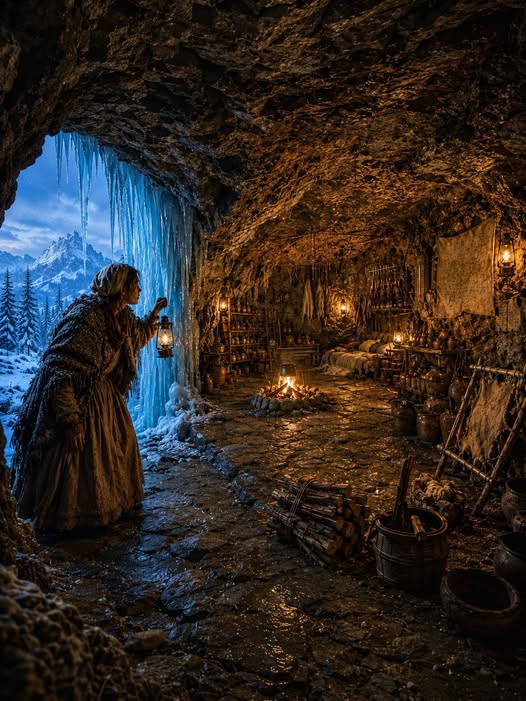
they called her a thief and left her to freeze in the mountains, but the forgotten shelter behind a waterfall kept her alive until winter exposed the terrible lie that destroyed the whole camp
Part 1
The morning they called Laura Whitcomb a thief, she had been awake since three o’clock, making biscuits for the very men who would stand silent while she was thrown out into the cold.
Outside, the mountains of northern Idaho were disappearing beneath the first hard weather of November.
Rain struck the tin roof of the mess hall. Wind moved through the tall pines with a low, restless moan. Beyond the cookhouse windows, smoke rose from the bunkhouses of Pine Spur Timber Camp, where nearly seventy people lived at the mercy of the Silver Run Timber Company.
There were loggers with broken fingers and bad backs. Miners who came down from the higher claims when the ground froze. Widows who took in washing. Children who had never seen a town larger than the collection of rough wooden buildings where they had been born.
And there was Laura.
At thirty-two, she had already lived through enough sorrow to make her feel twice that age.
Four years earlier, she had buried both parents beneath a crooked cedar cross on the southern hillside.
Her father had worked as a saw filer until sickness took the strength from his hands. Her mother, once a schoolteacher, had spent her last weeks coughing blood into folded handkerchiefs while Laura sat beside her bed and prayed for the medicine to work.
The medicine had been expensive.
Gideon Harrow, the camp superintendent, had paid for it.
At the time, Laura had believed he was saving her family.
Only later did she learn what his kindness would cost.
He had placed a labor contract before her on the kitchen table, explaining that she could repay the medical expenses by working in the company cookhouse.
“You’ll have a roof,” he told her. “Food enough to keep yourself going. And I’ll credit something against the account every month.”
Laura had signed.
She had not known that the debt would become a chain.
Four years of cooking, washing, scrubbing floors, mending clothes, and copying supply figures had done almost nothing to reduce it.
Every month brought another charge.
Soap. Shoes. Lamp oil. A broken crock. Replacement blankets. Medicine when she caught a winter fever.
Even the thread she used to mend company shirts appeared in Gideon’s accounting books.
Whenever she questioned the figures, he would tap the ledger with a thick finger.
“Numbers don’t lie, Miss Whitcomb.”
Her mother had taught her differently.
Numbers could be honest.
The person holding the pencil was another matter.
That morning, Laura stood over a flour-covered table, pressing biscuit dough with the heel of her hand. The kitchen smelled of coffee, bacon grease, woodsmoke, and wet wool.
Ruth Bell entered carrying a basket of clean towels.
Ruth was a forty-one-year-old widow with two boys, Tommy and Ben, who had been growing thinner since the company reduced winter rations.
“You look like you didn’t sleep,” Ruth said.
Laura kept working.
“Didn’t get much.”
“Something troubling you?”
Laura glanced toward the open doorway.
Across the muddy yard stood Gideon’s office.
One of its windows was still covered from the inside.
“Something happened last night,” Laura said.
Ruth lowered her basket.
“What happened?”
Laura hesitated.
A little after midnight, she had gone to the storehouse for another sack of flour.
The moon had been hidden, but there was enough lantern light spilling from Gideon’s office for her to recognize the man slipping through its rear door.
Caleb Harrow.
Gideon’s twenty-six-year-old son.
He had carried the walnut payroll box against his chest beneath his coat.
Laura had recognized its brass corner plates and the deep scratch across its lid.
She had also noticed Caleb’s right hand.
Three knuckles were scraped bloody.
That afternoon, two men had whispered about Caleb losing a large sum in a card game near the railroad settlement.
Laura knew he had a spare office key.
She knew his father trusted him with the payroll.
And she knew that by morning the walnut box would be missing.
“I saw Caleb taking something from the office,” she finally whispered.
Ruth’s face changed.
“Laura.”
“I know what I saw.”
“Then keep it to yourself until you know what it means.”
“But if money is missing—”
“His father owns our food, our houses, and half the road out of here.”
Ruth glanced toward the yard.
“Sometimes being right doesn’t keep a person alive.”
Before Laura could answer, the mess hall door opened.
Gideon Harrow stood beneath the lintel in his heavy black coat.
Behind him were Caleb and two company guards.
“Miss Whitcomb,” Gideon said. “Come with me.”
Laura wiped her hands on her apron.
“Breakfast isn’t finished.”
“It can wait.”
Something in his voice made Ruth step backward.
By seven o’clock, Gideon had gathered almost the entire camp inside the mess hall.
Men crowded along the walls. Women stood near the kitchen door. Children pressed against their mothers’ skirts.
The room smelled of wet boots, coffee, and fear.
Laura stood alone before the head table.
Gideon held up a narrow strip of Silver Run company scrip.
“This was discovered among Miss Whitcomb’s belongings.”
Laura stared at it.
“Where?”
“In your sewing pouch.”
“That’s impossible.”
Caleb stood beside his father, avoiding her eyes.
Gideon continued.
“The payroll box was stolen from my office last night. Miss Whitcomb was seen near the building after midnight.”
“By whom?” Laura asked.
Caleb lifted his head.
“By me.”
The words struck harder than she expected.
She turned toward him.
“You were carrying the box.”
A murmur moved through the hall.
Caleb’s expression tightened.
“That’s a lie.”
“I saw you come through the back door. You had it under your coat.”
“I was checking the office.”
“After midnight?”
“My father asked me to.”
Laura looked at Gideon.
“Did you?”
The superintendent’s jaw moved.
He did not answer.
Laura felt every face in the room watching her.
“The lock wasn’t broken,” she said. “Who had the key?”
Silence.
“If I stole a locked payroll box, why would I leave one piece of company scrip in my own sewing things?”
No one spoke.
Old Silas Crow, who hauled timber and repaired wagons, shifted uneasily near the back wall.
Laura searched his face.
He looked down.
Gideon removed her labor contract from his coat.
“You have betrayed the trust placed in you.”
“No,” Laura said quietly. “I haven’t.”
“You lived under my roof. Ate food purchased with my money. And this is how you repay my generosity.”
“My wages paid for that food.”
A few men glanced at one another.
Gideon’s face reddened.
“Your wages barely covered your debt.”
“Then let me see the account.”
“You have seen it.”
“I’ve seen the numbers you chose to show me.”
For an instant, the room seemed to stop breathing.
Then Gideon tore the contract in half.
The sound was small.
Paper ripping.
But inside Laura, something much larger tore with it.
“You are no longer employed by Silver Run,” he announced. “You will leave Pine Spur before sunset.”
Laura swallowed.
“And my debt?”
Gideon folded the torn paper.
“That remains.”
“But you just tore the agreement.”
“The obligation remains, whether or not you have the privilege of working it off.”
Laura stared at him.
The man who had once stood beside her mother’s bed promising help was looking at her as though she were something spoiled that needed to be carried outside.
Ruth stepped forward.
“Mr. Harrow, she can’t go into the mountains without proper clothes.”
“She should have considered that before stealing.”
“There’s snow coming.”
“Then perhaps she’ll learn the price of dishonesty.”
Ruth’s youngest boy began crying.
Gideon raised his voice.
“Anyone found providing assistance to a thief may have their winter ration reduced.”
That ended the discussion.
Not because everyone agreed.
Because they were hungry.
And hunger makes cowards of people who once believed themselves brave.
Laura returned to the small room behind the cookhouse where she had slept for four years.
Her possessions fit inside a single canvas sack.
A tin cup.
A dull hunting knife that had belonged to her father.
A folded blanket.
A small wooden box containing her mother’s thimble, a photograph of her parents, and three letters tied with blue thread.
She stood beside the bed, staring at the place where her father’s old wool coat had once hung.
It had been sold two winters earlier to pay a charge Gideon claimed she owed.
There was nothing else worth taking.
At noon, Ruth came to the door carrying her late husband’s heavy winter coat.
“Put this on.”
Laura shook her head.
“Ruth, no.”
“He won’t know.”
“He will.”
“I don’t care.”
Laura looked beyond her friend’s shoulder.
Tommy and Ben stood in the hallway, frightened and silent.
“You have two boys to feed,” Laura whispered.
“And you’re my friend.”
“I know.”
Ruth tried to put the coat around her shoulders.
Laura caught her wrist.
“Don’t let him punish them because of me.”
Ruth’s eyes filled.
“Then what am I supposed to do?”
Laura leaned forward and held her.
For a moment neither woman spoke.
Then Laura whispered, “Remember what happened here.”
By sunset, the camp had settled into an unnatural quiet.
Laura walked through the muddy yard carrying her sack.
A few faces appeared at windows.
Nobody called out.
Nobody offered a ride.
Gideon stood on the office porch, watching.
Caleb remained inside.
At the gate, Laura stopped and looked back.
She had cooked thousands of meals in that camp.
She had sat through fevers, funerals, births, blizzards, and weddings.
She knew which men needed soft food because their teeth were gone. Which children were afraid of thunder. Which old women preferred tea instead of coffee.
Yet the camp had allowed one man’s accusation to erase every good thing she had done.
Laura turned away.
The rain found her before she had gone two miles.
By dusk, the logging road had become a ribbon of black mud.
Her thin coat clung to her shoulders.
Water filled her boots.
Every breath came out in a white cloud.
She tried following the lower road toward Mill Creek, but a fallen pine blocked the route.
Beyond it, the creek had swollen into a furious brown torrent.
There was no bridge.
No safe crossing.
And darkness was coming.
Laura stood beneath a dripping fir tree, shivering so violently she could barely hold her sack.
She could not go forward.
She could not return.
For the first time that day, fear overwhelmed her anger.
“Papa,” she whispered into the rain. “I don’t know what to do.”
The mountain gave no answer.
Then she heard another sound beneath the wind.
A distant, continuous roar.
Raven Fall.
She remembered her father talking about it when she was a girl.
A waterfall hidden in a narrow gorge above the old survey trail.
There were cliffs there, he had said, and plenty of danger.
But also high ground.
Laura followed the sound.
Twice she slipped on wet stones.
Once she fell hard enough to tear her skirt and skin her knee.
The last hundred yards required climbing over roots and crawling beneath the branches of a wind-thrown tree.
Then the waterfall appeared.
White water plunged from a dark cliff, crashing into a basin surrounded by huge boulders.
Spray drifted through the gorge like smoke.
And behind that pounding sheet of water, Laura saw something strange.
A dark line in the stone.
A crack.
She approached carefully, testing every foothold.
The rock was slick. The noise was deafening.
One misstep would send her into the basin.
She pressed herself against the cliff and slipped behind the falling water.
The crack opened into a narrow passage.
Laura dropped to her hands and knees.
Cold stone scraped her palms.
She crawled forward until the noise of the waterfall softened behind her.
Then her outstretched hand touched something round and hard.
A circle of stones.
A hearth.
Laura froze.
Someone had lived here.
Someone had built a fire here and arranged stones around it.
She felt along the wall.
A shelf carved into the rock.
A clay crock.
A coil of old wire.
Something that felt like folded animal hide.
She was too cold to understand what she had found.
All she knew was that the air inside was still.
The ground was mostly dry.
And the wind could not reach her.
She gathered brittle twigs and old bark from a pile near the wall.
With trembling fingers, she struck her father’s fire steel against a piece of flint.
The first spark died.
The second landed on damp tinder.
The third caught a tiny curl of dry bark.
Laura bent over it, shielding the flame with both hands.
“Come on,” she whispered.
The flame grew.
Light spread across the chamber.
Stone shelves emerged from darkness.
Old hides hung from wooden pegs.
A rusted iron pot rested beside the hearth.
And on the far wall, barely visible beneath soot and age, someone had carved four words.
Keep count. Keep living.
Laura stared until the letters blurred.
Then she sank onto the cold floor and began to cry.
Not because she was safe.
She did not know that yet.
She cried because the mountain had given her one more night.
And one more night was something the people of Pine Spur had refused her.
Part 2
Laura nearly died the following morning because she made the mistake of believing a fire was always a friend.
She woke stiff and aching beside the cold hearth.
Her blanket was damp.
Her clothes smelled of smoke.
Outside, the storm had turned colder.
A thin crust of ice covered the rock at the entrance, and the waterfall thundered beyond it with a force that made the chamber tremble.
She had eaten two small pieces of bread the night before.
Now the rest was beginning to go stale.
Her stomach hurt with hunger.
She searched the chamber more carefully.
It was larger than she had first believed.
A low passage led to a second alcove where old wooden pegs had been driven into cracks in the stone.
There were three clay crocks, all empty except for one containing coarse salt hardened into a lump.
A bundle of old snares hung from an iron hook.
Several animal hides lay folded beneath a flat rock.
They smelled musty but were mostly intact.
A narrow spring emerged from the rear wall and disappeared through a crack in the floor.
Someone had even constructed a rough wooden platform above the dampest ground.
Near the hearth lay a length of hollow iron pipe, a broken shovel head, and a flat stone blackened from years of cooking.
Laura examined everything.
Nothing was new.
Nothing was easy.
But nearly everything had a purpose.
Her father had once told her that a man could freeze to death in a barn full of tools if he did not understand which tool mattered first.
Laura decided warmth mattered first.
She gathered another armful of fuel from the entrance and built a larger fire.
For one glorious minute, the flames rose bright and strong.
Then the smoke changed direction.
Instead of climbing into the dark chimney opening above the hearth, it rolled across the ceiling.
A thick black cloud spread through the chamber.
Laura coughed.
She moved toward the entrance, but smoke dropped around her shoulders.
Her eyes began to stream.
She bent low.
The air was no better.
A sharp headache struck behind her forehead.
Panic came fast.
She crawled toward the waterfall, coughing so hard she could hardly breathe.
Cold air hit her face as she reached the outer passage.
She collapsed against the stone.
Behind her, the fire continued burning.
Smoke poured toward the entrance.
For several minutes Laura lay on the rock, sucking in the wet mountain air.
She had found shelter from the storm.
And almost turned it into her tomb.
When she could stand, she searched the cliff above the chamber.
She found a narrow smoke opening hidden behind a shelf of rock.
Dead leaves, fallen needles, and an old bird’s nest had packed the passage nearly shut.
Using the broken shovel head and a long branch, she worked at the obstruction.
Bits of rotten wood fell against her face.
Her fingers scraped stone until blood appeared beneath two nails.
She kept digging.
At last, a dark plug of debris dropped free.
Air moved through the opening.
Laura returned to the chamber and allowed the old fire to die completely.
She waited until the smoke cleared, then built a much smaller fire.
This time she watched its movement.
A thin thread of smoke lifted toward the vent.
She held a loose strand of wool near the hearth and saw it draw gently upward.
The draft was working.
She made herself a rule.
No large fire.
No sleeping beside an unchecked flame.
And if the air stopped moving, she would get outside before doing anything else.
She used charcoal to mark the first lesson on the wall.
Fire needs a way out.
Below it she wrote:
One day lived.
That evening, Laura ate another piece of bread and explored the old belongings.
On the far shelf she found a deer-hide packet wrapped with brittle twine.
Inside was a map.
It showed Raven Fall, the surrounding ridges, an old freight trail, and a narrow route drawn along the mountain above the gorge.
Near the bottom was a name.
Martha Wren, October 1887.
The map was accompanied by several pages of writing, faded but readable.
Martha Wren had been the wife of a surveyor who worked in the mountains before the timber company arrived.
A flood had stranded her and her husband near Raven Fall.
They had discovered the chamber, enlarged the hearth, cleared a smoke vent, and spent part of one winter there waiting for the river to fall.
Her husband had died of fever before spring.
Martha had survived alone.
One sentence caught Laura’s attention.
The cave will not save a person who refuses to learn its ways.
Laura read it twice.
Then she looked at the carved words above the hearth.
Keep count. Keep living.
She understood now.
The cave was not a miracle.
It was a collection of lessons left by someone who had suffered before her.
And lessons were useful only if she followed them.
She began making lists.
Food.
Fuel.
Water.
Dry bedding.
Tools.
Paths.
Risks.
She used small stones to count how much bread remained.
She inspected each snare, replacing rotten cord with wire from the old bundle.
Her father had shown her how to set rabbit snares when she was a child, although she had never been particularly good at it.
She remembered his hands guiding hers.
“Don’t set them where you hope a rabbit will go,” he had told her. “Look for where it’s already been.”
The memory hurt.
Still, she went looking.
Beyond the waterfall, the forest floor showed narrow trails beneath the brush.
Laura set three snares along the most promising paths.
The first morning, all three were empty.
The second, one was pulled loose.
The third morning, she found a rabbit hanging in a wire loop.
She stood staring at it.
Then she knelt and whispered a small apology before taking it down.
She skinned it with her father’s dull knife, saved the hide, and boiled the meat with water from the spring.
The broth was thin.
The meat was tough.
She ate every piece.
That night, she wrote another sentence on the wall.
Waste nothing.
By the end of the first week, Laura had improved her shelter.
She raised the old sleeping platform with stones so moisture could pass beneath it.
She hung the driest hides around a small sleeping alcove, leaving a gap for air.
She gathered dead lower branches from sheltered trees and broke them into lengths she could carry.
From the forest floor she collected dry pine resin and strips of birch bark for tinder.
She washed her one pair of stockings in spring water and dried them beside the hearth.
She repaired the tear in her skirt with thread salvaged from an old hide seam.
When the nights grew colder, she heated smooth stones beside the fire, wrapped them in several layers of cloth, and placed them near her feet.
Sometimes they stayed warm long enough for her to fall asleep.
Sometimes they did not.
Hunger remained her greatest enemy.
A rabbit did not provide as much nourishment as she had imagined.
Some days the snares were empty.
Other days the cold rain kept her indoors.
She collected rose hips where she could find them and boiled them into a bitter drink.
She found an old fishing hook in the shelter and fashioned a line, but her first attempts brought nothing.
The bread disappeared.
Then she began dreaming of food.
In one dream, she was back in the mess hall, cutting a fresh apple pie.
Her mother sat at the table.
Her father was washing his hands at the sink.
Laura reached for a slice.
She woke with her fingers closed around empty air.
For a long time she lay motionless beneath the hides.
Then she turned her face against her mother’s folded letters and wept without making a sound.
Meanwhile, Pine Spur was teaching itself to forget her.
Three days after Laura disappeared, Caleb told the men she had probably fallen into a ravine.
The following week, he claimed a trapper had seen signs of someone being swept into Mill Creek.
Later, when the nights became colder, he mentioned wolves.
Each story pushed Laura farther from the camp.
Farther from responsibility.
Farther from the uncomfortable possibility that someone might have to admit what had been done.
Gideon made no effort to search for her.
He posted a notice outside the company store.
Outstanding debt: Laura Whitcomb. Account remains collectible.
Below it he listed one hundred and eighty-six dollars and forty cents.
Ruth Bell stood reading the notice with her sons beside her.
Tommy tugged her skirt.
“Mama, if Miss Laura is dead, why does she still owe him money?”
Ruth stared at the figures.
“Because some people,” she said, “don’t know when they’ve taken enough.”
The loss of the payroll box had also begun to hurt the camp.
Gideon announced that until company funds were replaced, wages would be credited instead of paid.
Families received reduced quantities of flour, beans, and salt pork.
The company store refused new purchases without written approval.
Some workers grumbled.
Others defended Gideon.
He was doing his best, they said.
The company had been robbed.
Hard times called for sacrifice.
But the sacrifices did not reach Gideon’s house.
His pantry remained full.
His horses received good grain.
And Caleb continued traveling toward the railroad settlement whenever the weather permitted.
Ruth noticed.
So did Silas Crow.
Silas was sixty-eight, bowlegged, and stiff in the shoulders from half a lifetime of hauling timber.
He had known Laura’s father.
He remembered the day the Whitcombs arrived at Pine Spur.
He remembered how Laura’s mother taught children their letters in the empty tool shed.
And he remembered the morning Laura was accused.
More than once he had opened his mouth to speak.
More than once fear had closed it.
Silas had a room in the company stable.
He had no family left nearby.
The work he did for Gideon provided his meals, tobacco, and a little cash.
He told himself that speaking would have accomplished nothing.
But he could not stop seeing Laura walking out beneath the rain.
One cold morning, seventeen days after her exile, Silas took a mule up the old north survey trail to inspect a washed-out wagon crossing.
The air was clear.
Frost covered the fallen branches.
As he passed above Raven Fall, he saw something that made him stop.
A narrow thread of smoke rose from the cliff.
It was barely visible against the gray sky.
Silas removed his hat.
He knew that place.
Not the cave itself, but the old survey stories.
His father had once spoken of a woman surviving behind Raven Fall long before the railroad came through.
Silas stood watching the smoke until it faded.
Then he turned his mule toward home.
That evening, Gideon called him into the office.
“Anything unusual on the north trail?”
Silas hesitated.
“Bridge needs work.”
“I know about the bridge. Anything else?”
Silas thought of the smoke.
He thought of Laura.
He thought of the winter ahead.
“May have seen a little smoke near Raven Fall,” he finally admitted.
Caleb, seated by the stove, looked up sharply.
“Smoke?”
“Could’ve been a hunter.”
“Where exactly?”
Silas regretted his words immediately.
“Didn’t get close.”
Caleb rose.
“Then maybe I ought to.”
Gideon frowned.
“Leave the mountain alone.”
But Caleb was already reaching for his coat.
That night, Laura sat behind the waterfall repairing a snare.
She did not know that three men were preparing to climb the trail.
She did not know that one carried a rifle and another a pry bar.
She only knew that the wind had changed.
Snow was gathering above the ridge.
And for the first time since her exile, she had begun to believe she might survive long enough to see spring.
Part 3
Silas Crow arrived at Raven Fall before Caleb did.
He left his mule below the old survey trail and climbed the last stretch on foot, carrying a sack over one shoulder.
The waterfall was louder than he remembered.
Ice hung from the overhanging rock like broken glass.
He stood near the basin, trying to decide whether the thread of smoke had been real.
“Laura?”
His voice disappeared beneath the roaring water.
He called again.
“Laura Whitcomb. It’s Silas.”
Behind the waterfall, Laura froze.
She had been scraping the inside of a rabbit hide with the edge of her knife.
For several seconds she did not move.
Then she slipped toward the passage and peered through the spray.
Silas stood alone.
He was older than her father had been when he died.
His coat was patched at the elbows.
His hat was pulled low against the cold.
He looked tired.
Laura stepped out far enough to be seen.
Silas stared at her.
“Merciful heaven.”
His voice broke.
“Girl, you’re alive.”
Laura remained close to the cliff.
“Why are you here?”
“I saw smoke. Thought maybe someone was sheltering.”
“Did you tell Gideon?”
Silas closed his eyes briefly.
“I mentioned it.”
Laura felt her stomach tighten.
“Then you need to leave.”
“Laura—”
“Now.”
Silas set down his sack.
“I brought oats. A little salt pork. Some matches. And an old horse blanket.”
She stared at the bag.
The sight of food made her dizzy.
“Did Ruth send you?”
“No. She doesn’t know I’m here.”
“Does Gideon?”
“He knows I saw smoke. Caleb asked questions.”
Laura stepped closer.
“What kind of questions?”
“Where the smoke was. How a person might reach the cliff. Whether there’s another way out.”
She turned toward the cave.
Silas followed her gaze.
“You found the old shelter.”
“It was here.”
“Your father used to talk about places like this. Said the mountains kept more history than the men who claimed to own them.”
Laura studied his face.
“Why didn’t you speak for me?”
Silas took off his hat.
The question had been waiting for him every morning since she left.
“I was afraid.”
“Of what?”
“Losing my work. Losing my place. Spending winter in the poorhouse.”
Laura looked at the food.
“And you think a sack of oats makes it right?”
“No.”
He swallowed.
“I don’t reckon anything makes it right.”
For a long moment, she said nothing.
Then she picked up the sack.
“My fire is small. You’ll have to come in carefully.”
Silas followed her behind the water.
When he entered the chamber, he stopped in wonder.
Laura had transformed the abandoned shelter.
Wood was stacked on stones near the entrance.
Snares hung in a tidy row.
The spring ran into a clean stone basin.
Her bedding was raised and covered with hides.
On the wall were dozens of charcoal marks.
Silas stepped closer.
He read them aloud.
“Fuel dry. Check vent. Boil water. Three snares east trail.”
Then he saw the lines beneath.
Each represented another day.
“You’re keeping a calendar?”
“Someone had to.”
He counted the marks.
“Twenty-one days.”
Laura nodded.
Silas lowered himself onto a rock.
For a moment he could not speak.
“I figured you’d died the first week.”
“So did I.”
She opened the sack and found the oats, matches, salt pork, and blanket.
There was also a small twist of paper.
Inside lay six peppermint candies.
Silas gave a sheepish shrug.
“Found those in my trunk.”
Laura stared at them.
Her mother had loved peppermint candy.
Every Christmas, she had put one beside each child’s plate in the little schoolroom.
Laura pressed the paper to her lips.
Then she looked away.
Silas pretended not to notice.
While they ate a little oatmeal, he told her what was happening at Pine Spur.
The missing wages.
The reduced rations.
The anger beginning to spread.
“The north crossing is worse than Gideon says,” he added. “Upper creek’s been eating the bank under the bridge. We were supposed to put in new braces before winter.”
“Why didn’t you?”
“Lumber was marked for it. Never arrived.”
Laura frowned.
“I copied the order in September. Twelve heavy beams, six iron straps, and two kegs of bolts.”
“Well, they didn’t make it to the bridge.”
“Where did they go?”
Silas looked toward the waterfall.
“Gideon’s new stable has twelve fresh beams in the loft.”
Laura was quiet.
Then she rose and retrieved Martha Wren’s map.
“Look at this.”
Silas unfolded it carefully.
His eyes followed the faded lines.
“Old ridge trail,” he murmured. “Haven’t seen this marked in forty years.”
“It goes above the north crossing?”
“Looks like it.”
“And comes down behind the bunkhouses?”
“If it’s still passable.”
Laura pointed to another mark.
“What does this mean?”
Silas squinted.
A narrow line ran from the rear chamber toward a small opening high above the gorge.
“High escape,” he read. “Used when the basin flooded.”
Laura looked toward the back of the cave.
She had assumed the dark crack there was only a drainage passage.
Silas studied the drawing.
“Could be worth examining.”
Before Laura could answer, something sounded outside.
A horse.
Then a man’s voice.
Silas stood.
Laura moved quickly to the entrance.
Through the waterfall she saw three figures emerging from the trees.
Caleb Harrow.
Jonah Pike, a broad-shouldered logger whose wife had been sick all autumn.
And Ed Kessler, a young teamster.
Caleb carried a rifle.
Jonah held a pry bar.
Laura turned to Silas.
“There’s a narrow space behind the rear shelf. Stay there.”
“What about you?”
“I know where the rocks are.”
They extinguished the visible flame and moved into the rear chamber.
Outside, Caleb approached the waterfall.
“Laura!”
His voice echoed against the cliff.
“I know you’re in there.”
Laura held her breath.
Caleb waited.
Then he shouted again.
“My father sent me to bring you back.”
Silas leaned close to Laura.
“He didn’t.”
She nodded.
Caleb moved nearer.
“You’ve caused enough trouble. Come out and we’ll settle things.”
Jonah said something too quietly to hear.
Caleb answered sharply.
“She’s in there. I saw the smoke.”
The men crossed behind the waterfall.
Boots scraped against rock.
The pry bar struck stone.
Laura listened as they explored the entrance.
“There’s a fireplace,” Ed called. “And wood stacked by the wall.”
Caleb’s voice hardened.
“Laura, I know you’re listening.”
She remained still.
“You think you can hide here forever?”
No answer.
“You come out now, maybe I’ll talk Father into letting you work off what you owe.”
Laura felt anger rise through her fear.
Four years.
Four years of labor.
And he was offering the same chain.
Caleb struck a stone shelf with the rifle butt.
“You hear me?”
Laura stepped into the main chamber before Silas could stop her.
“I hear you.”
All three men turned.
Caleb’s eyes widened.
For one instant, he looked almost frightened.
Then his expression changed.
“There you are.”
Laura stood near the hearth.
Her face was thinner.
Her hands were rough and scratched.
Her skirt was torn and badly mended.
But she stood straight.
“What do you want?”
“You’re coming back.”
“To what?”
“To answer for what you stole.”
Laura looked directly at him.
“You know I didn’t steal that box.”
Jonah glanced toward Caleb.
Caleb lifted the rifle slightly.
“Don’t start.”
“The lock wasn’t broken,” Laura said. “You had the key.”
“You’d better stop talking.”
“And your knuckles were bleeding that night.”
Caleb took a step forward.
“You’re coming out.”
“No.”
He turned toward Jonah.
“Get her.”
Jonah did not move.
“She’s not hurting anybody,” he said.
“Do what you’re paid to do.”
Jonah looked at Laura.
Then at the narrow passage and the pounding water beyond it.
“Mr. Harrow, we can bring the sheriff if there’s a proper charge.”
Caleb’s face darkened.
“You work for my father.”
“That doesn’t make me a deputy.”
For a moment the two men stared at each other.
Then Caleb shoved past him toward Laura.
She retreated into the narrow rear passage.
Caleb followed.
He struck at a wedged stone with the pry bar.
The blow loosened a shelf of old rock beside the wall.
A large slab shifted.
Jonah lunged to catch it before it fell across the passage.
His boot slipped on the wet floor.
He went down hard.
The slab struck his leg and pinned him against the stones.
Jonah screamed.
Ed rushed forward.
Caleb stumbled backward, dropping the pry bar.
Water seeped rapidly through the loosened rubble.
“Help me!” Jonah shouted.
Ed strained against the slab.
It would not move.
Caleb looked from the trapped man to the passage.
Then toward the entrance.
“The water’s coming up,” he said.
Laura saw what he meant.
The storm-swollen basin outside had begun forcing water into the lower entrance.
The cave floor was slick.
If the flow increased, Jonah could drown where he lay.
Laura grabbed the old iron bar from beside the hearth.
“Ed, put that short rock beneath the edge.”
Ed obeyed.
“Silas!” she shouted.
The old man emerged from hiding.
Together, they wedged the iron bar beneath the slab.
Laura forced a smaller stone into the gap to hold their progress.
“On three,” she said.
Jonah groaned.
“One.”
The bar bent.
“Two.”
Water reached Laura’s ankles.
“Three!”
They heaved.
The slab rose just enough.
Jonah dragged his injured leg free.
Ed caught him beneath the arms.
Silas pulled from behind.
The stone dropped again with a crash that shook the chamber.
Caleb had already reached the entrance.
“Move!” he shouted. “The whole place is coming down!”
He disappeared behind the waterfall.
Ed stared after him.
Then he helped Laura carry Jonah toward the higher alcove.
The water stopped rising after a few minutes, but the lower passage remained dangerous.
Jonah’s leg was badly bruised and bleeding where the rock had scraped it.
Laura cleaned the wounds with boiled water that had cooled, wrapped them with strips of clean cloth, and helped him onto the sleeping platform.
Silas built a small fire.
Ed sat near the entrance, trembling.
No one spoke for a while.
Then Jonah looked at Laura.
“You could’ve left me.”
She tied the last bandage.
“Yes.”
“After what we came here to do.”
“You weren’t the one holding the rifle.”
Jonah closed his eyes.
“Doesn’t make me innocent.”
Laura sat back.
“No. It doesn’t.”
Outside, Caleb called for Ed.
Ed stood.
“I ought to get help.”
“You should,” Laura said. “But tell the truth about what happened.”
Ed hesitated.
Then he nodded.
When he had gone, Jonah asked Laura for water.
After drinking, he stared at the fire.
“There’s something you need to know.”
Laura waited.
“Night the payroll went missing, Caleb came to my cabin.”
Her hands tightened around the cup.
“He offered me five dollars to haul a sack up to the old assay shed beyond North Creek. Said it held tools he didn’t want his father knowing about.”
“Did you?”
Jonah nodded.
“Used my mule. We got there after midnight.”
“What was in the sack?”
“He wouldn’t let me look. But when I lifted it, I heard a metal corner strike the boards. And he kept warning me not to damage the walnut.”
Laura felt the blood rush through her.
“The payroll box.”
“I figured that afterward.”
“Where did he put it?”
“Under the floor of the assay shed. There’s a loose hatch beneath the broken stove.”
Silas leaned forward.
“Why didn’t you tell anyone?”
Jonah looked ashamed.
“My wife needed medicine. We had no credit left. Five dollars seemed like a fortune.”
He stared at his bandaged leg.
“Next morning, when they accused you, I told myself I couldn’t be certain what I’d hauled.”
Laura said nothing.
Jonah’s voice broke.
“That was easier than admitting what kind of man I’d been.”
The fire cracked softly.
Laura looked toward the wall where she had recorded every day.
She had spent three weeks fighting cold, hunger, and fear.
Now the truth was close enough to touch.
But it was still buried beneath a shed, guarded by a man who had already come into the mountains with a rifle.
“What will you do?” Silas asked.
Laura looked at Jonah.
“That depends on whether he’s willing to tell the truth when somebody besides me is listening.”
Jonah swallowed.
“Will you help me get home?”
“Yes.”
“Then I’ll speak.”
Laura wanted to believe him.
She also remembered seventy people standing silent in the mess hall.
She had learned that fear could make promises weak.
So she did not celebrate.
Instead, she walked to the rear of the shelter and studied Martha Wren’s map once more.
Above the cave, a narrow line led toward the northern ridge.
A second way out.
A way to move without taking the camp road.
A way to reach the abandoned assay shed.
For the first time since Gideon threw her into the rain, Laura was no longer thinking only about surviving.
She was thinking about returning with proof.
And she knew a man like Gideon Harrow would never surrender the truth willingly.
Part 4
The first heavy snow arrived on the twenty-seventh day after Laura’s exile.
It came without warning.
A gray morning turned white before noon, and by evening the mountain trails had vanished beneath drifts.
Inside Raven Fall, Laura listened to wind screaming across the gorge.
Silas had helped Jonah descend the lower trail the morning after the accident.
Jonah could barely walk, but he had insisted on returning to his wife.
Before leaving, he had taken Laura’s hand.
“I’ll not lie for him again.”
Laura had watched him go.
She wanted to trust him.
But trust had become a costly thing.
Now she sat beside the fire, tracing the faded route on Martha Wren’s map.
The old surveyor’s wife had marked a passage that climbed from the rear of the shelter to a high shelf above the waterfall.
Laura had spent two days investigating it.
The opening was partly blocked by stones and roots.
She cleared enough debris to crawl through.
Beyond it, a narrow tunnel climbed sharply before opening onto a ledge hidden among the pines.
The passage was tight.
Her shoulders scraped rock.
At one place she had to turn sideways and push her sack ahead of her.
But it worked.
From the upper opening, she could see North Creek winding through the valley and the old abandoned assay shed standing beside a grove of cedar trees.
She could also see the weak bridge that connected the north bunkhouses to the main camp.
It looked smaller from above.
More fragile.
That frightened her.
She had copied the repair order herself.
She knew exactly how much lumber should have been used.
And she knew Silas had found none of it there.
While she studied the valley, the weather worsened.
Snow piled against the timber roofs.
The creek filled with ice.
In Pine Spur, families began burning broken furniture to keep their rooms warm.
The company store issued smaller portions of flour.
Gideon insisted supplies were merely delayed.
But the workers knew something was wrong.
Railroad wagons had stopped coming.
The missing payroll had not been replaced.
The camp’s debt accounts kept growing.
And Caleb was becoming increasingly nervous.
Two days after the accident at Raven Fall, he had returned to the office with a torn coat and a shallow cut on his cheek.
Gideon demanded an explanation.
“Rockfall,” Caleb said.
“You found her?”
Caleb nodded.
“She’s alive.”
For a long moment Gideon stared at him.
Then he closed the office door.
“Did anyone else see her?”
“Jonah and Ed.”
“Can they be trusted?”
Caleb gave a bitter laugh.
“Jonah got himself hurt. She’s patched him up and turned him against us.”
Gideon walked to the window.
Beyond the glass, men stood outside the company store waiting for flour.
“We cannot afford another scandal.”
“Then let me take care of her.”
Gideon turned sharply.
“No more foolishness.”
“She knows about the box.”
“I know what she claims.”
“She’ll come back.”
Gideon rubbed his forehead.
His face looked older than it had a month earlier.
The company district accountant was due to inspect the books before winter ended.
If he discovered that hundreds of dollars were missing, Gideon could lose his position.
Perhaps worse.
Caleb stepped closer.
“We could say she took the payroll into the mountains and hid it. If they find it near her shelter—”
“Enough.”
“Father—”
“I said enough.”
For the first time, Caleb saw something in his father’s face that frightened him more than anger.
Shame.
But Gideon covered it quickly.
“Go home. Stay away from Raven Fall.”
Caleb did not obey.
That night he rode to the abandoned assay shed.
He lifted the broken stove, pried open the floor hatch, and checked the walnut box hidden beneath it.
It was still there.
He had not spent all the money.
Some of the company drafts and gold coins remained.
But a large portion was gone.
He had used part of it to settle gambling debts in Wallace and another part to pay money he owed a man who threatened to tell his father.
Caleb sat on the cold floor with the box between his knees.
For years, Gideon had protected him.
Paid his losses.
Explained his mistakes.
Covered his drunken quarrels.
Each rescue had made the next failure easier.
Now Caleb was facing the first trouble his father might not be able to fix.
He closed the box and returned it beneath the floor.
He did not see the figure watching from the timberline.
Silas Crow had followed his tracks.
Nor did he know that Laura, high above the gorge, had seen his lantern moving through the trees.
The following morning, Silas found Laura near the upper entrance to the shelter.
“He’s been to the shed,” Silas whispered.
“Did you see the box?”
“No. But I watched him pull up the floor.”
“Could you get inside?”
Silas shook his head.
“Snow’s too deep for me to move quietly. And he’s got a lock on the outer door.”
Laura looked toward the valley.
“We need the sheriff.”
“County seat’s two days away in good weather.”
“And this isn’t good weather.”
Silas nodded.
“There’s something else.”
He reached inside his coat and removed several folded pages.
“Ruth asked me to bring these.”
Laura took them carefully.
They were supply tallies.
Written in her own hand.
A few had been copied onto brown wrapping paper. Others were torn from old account books.
Laura recognized the dates immediately.
“Where did she get these?”
“Ruth used to help you sort the kitchen accounts, didn’t she?”
“Sometimes.”
“She kept the scraps you gave her to check the flour and soap charges.”
Laura spread the pages across a flat rock.
There were months of figures.
Food issued to the cookhouse.
Laundry supplies.
Company charges.
Wages credited to workers.
And, in a column she remembered particularly well, credits entered against her own debt.
Only the credits were missing from Gideon’s current ledger.
Laura looked up slowly.
“He changed the account.”
Silas sat beside her.
“Looks that way.”
“No. It is that way.”
She pointed to a date.
“Look. Three dollars and fifty cents credited for extra laundry in June.”
Another page.
“Four dollars for keeping the supply books while the clerk was sick.”
Another.
“Six dollars for the logging crew’s Sunday meals.”
She laid the papers side by side.
“He added charges, but never carried over the payments.”
Silas was silent.
Laura’s throat tightened.
“Every time I thought I was getting close, he moved the end farther away.”
The words came out barely above a whisper.
She remembered long winter nights working by lantern light.
Her hands raw from lye soap.
Her back aching from lifting wash tubs.
Her mother lying beneath the cedar cross.
And Gideon’s voice telling her that numbers did not lie.
Silas touched one of the pages.
“There’s a lawyer in the county seat who can put these before a judge.”
Laura nodded.
But another question troubled her.
“Why did Ruth keep them?”
“Because she didn’t trust the store accounts. She was trying to make sure nobody charged her for soap twice.”
He paused.
“And because she always figured you might need them someday.”
Laura pressed the papers flat.
For the first time in weeks, she felt the possibility of something beyond survival.
Not revenge.
Not riches.
The right to have the truth written down where no one could tear it in half.
But before they could act, the mountain began to move.
A warm rain arrived behind the snowstorm.
It fell hard for nearly thirty hours.
Snow softened on the slopes.
Ice broke apart along North Creek.
The water rose until the banks disappeared.
Silas returned to Pine Spur before the worst of it.
Laura remained in the shelter, watching the river from the high ledge.
By late afternoon, she saw logs collecting against the north bridge.
They struck the wooden supports with heavy, hollow blows.
The bridge shuddered.
She thought of the missing beams.
Then she saw a wagon approaching from the far side.
It carried firewood.
Behind it walked Ruth Bell with Tommy and Ben, along with three other women returning from a small storage shed where the camp had kept emergency supplies.
The wagon halted when the driver saw the swollen creek.
Laura could hear nothing over the waterfall.
But she saw Ruth pointing toward the bridge.
She saw men gathering on the main bank.
And she saw the first support shift.
A great crack carried across the gorge.
The bridge sagged.
The wagon driver whipped his horses away.
Ruth grabbed the boys and hurried backward.
Then the center span collapsed.
Timbers plunged into the creek.
A surge of brown water carried them downstream.
The people on the far bank stumbled away from the edge.
Laura felt her stomach turn.
The bridge was gone.
And Ruth’s children were trapped on the wrong side.
Laura ran back through the upper passage.
She gathered her rope, blanket, knife, and the old deer-hide map.
She took the remaining oats and a small packet of salt pork.
Then she climbed to the ridge.
Rain and melting snow had turned the trail into a dangerous mixture of mud and ice.
She moved slowly where the rocks were slick.
Fast where the ground was firm.
Her old boots leaked.
Her fingers stiffened.
By the time she reached the north slope, darkness was beginning to fall.
She found Ruth and the others sheltering beneath a stand of fir trees.
Tommy was crying.
Ben’s lips were turning blue.
The wagon driver had gone farther upstream looking for a crossing, leaving the women with two sacks of flour and one small lantern.
Ruth looked up when Laura emerged from the trees.
For a moment, she could not speak.
“Laura?”
“It’s me.”
Ruth stood.
Then she began to cry.
“Oh, thank God.”
She pulled Laura into her arms.
The two women held each other in the rain.
But Laura knew there was no time for a long reunion.
“We have to move.”
“The bridge is gone.”
“I know.”
“We can’t cross.”
“Not there.”
Laura unfolded the map.
“There’s an old ridge path. It leads to shelter.”
One of the women stared at her.
“Behind the waterfall?”
Laura nodded.
“How do you know?”
“Because I’ve been living there.”
Nobody spoke.
Then Ruth looked at Laura’s thin face and patched clothing.
“You were there all this time?”
“Yes.”
“Alone?”
“Most of it.”
Ruth’s expression crumpled.
She looked toward her sons.
Then back at Laura.
“We let you walk out.”
Laura swallowed.
“Right now, we need to keep your boys warm.”
She wrapped the blanket around Ben and helped Ruth secure it.
Then she led them toward the ridge.
The journey took almost three hours.
They crossed wet roots, climbed beneath fallen trees, and edged along a narrow shelf where the creek roared far below.
Once, Tommy slipped and slid several feet down a muddy bank.
Laura caught the back of his coat.
Her injured knee buckled.
Pain shot through her leg.
But she held on until Ruth pulled him to safety.
When they reached the high entrance to Raven Fall, everyone was exhausted.
Laura helped them crawl through the narrow passage.
Inside, she built a small fire.
She checked the vent.
She brought water from the spring.
She divided the oats into a thin porridge and gave the first portions to the children.
Ruth sat beside the hearth, holding Ben against her chest.
Her gaze moved over the shelves, the snares, the patched hides, and the charcoal marks.
She read the words on the wall.
Keep count. Keep living.
Then she saw the row of days Laura had marked.
There were thirty-four.
Ruth covered her mouth.
“All those nights.”
Laura knelt beside the fire.
“One at a time.”
Ruth reached for her hand.
“I wanted to help you.”
“I know.”
“No,” Ruth whispered. “Wanting isn’t the same as doing.”
Laura looked at her friend.
She could have said many things.
She could have asked why nobody had followed her down the road.
Why nobody had demanded proof.
Why hungry children were considered a reason to let an innocent woman die.
Instead, she squeezed Ruth’s hand.
“You came through the storm,” she said. “That’s what matters tonight.”
Outside, Pine Spur was falling apart.
The bridge collapse had cut off the north storehouse.
A second flood channel had washed beneath the tool shed.
The mill was closed.
Several families had lost access to their firewood.
Gideon’s private stable stood on higher ground, its new beams dry and strong, while the bunkhouse porches sagged beneath the weight of wet snow.
People began shouting questions that had gone unasked for years.
Where had the bridge lumber gone?
Why were wages missing?
Why had the camp store run short of flour?
Why had one woman been thrown out without a proper hearing?
And why had nobody done anything?
Near midnight, Silas arrived at the edge of the main camp with Jonah Pike leaning on a crutch beside him.
Jonah’s leg was healing, though he still walked painfully.
They had just received word that Ruth and the children were missing beyond the collapsed bridge.
Silas knew where Laura might have taken them.
But before he could gather a rescue party, Caleb emerged from the office.
He was carrying his rifle.
“Where are you going?” Caleb demanded.
“To look for the women.”
“Bridge is out.”
“There’s another way.”
Caleb’s eyes narrowed.
“Raven Fall.”
Silas said nothing.
Gideon stepped onto the porch behind his son.
“What is this?”
Jonah straightened.
“Mr. Harrow, there’s something you need to hear.”
Caleb turned sharply.
“Not now.”
Jonah looked directly at Gideon.
“I helped your son hide the payroll box.”
The words fell into the yard like a hammer.
Silas watched Gideon’s face turn pale.
Caleb moved toward Jonah.
“Shut your mouth.”
“No.”
“You don’t know what you’re saying.”
“I know exactly what I hauled.”
Gideon’s voice trembled.
“Caleb?”
His son said nothing.
In the distance, a great cracking sound came from the creek.
Another bridge support gave way.
Then the lamps inside the mess hall flickered.
A shout rose from the lower bunkhouses.
Water was entering the buildings.
The people of Pine Spur had spent a month arguing over whether Laura Whitcomb deserved mercy.
Now winter had brought them a harder question.
Whether they could survive the consequences of their silence.
Part 5
At dawn, Gideon Harrow walked into the mess hall and found nearly forty people waiting for him.
Nobody had called a meeting.
They had simply gathered because there was nowhere else to go.
The lower bunkhouses were soaked.
Two families had moved into the cookhouse.
The store shelves were almost empty.
The bridge was gone.
And the men who had once accepted Gideon’s word without question now stood with their arms folded, waiting for answers.
Silas Crow occupied the place near the front where Laura had stood a month earlier.
Beside him was Jonah Pike.
Ruth and the others were still missing from camp, though Silas had explained where he believed they were sheltering.
Gideon entered with Caleb close behind.
“What is this?” Gideon demanded.
No one moved.
Silas removed his hat.
“It’s time we heard the truth.”
“About what?”
“The payroll. The bridge lumber. Laura Whitcomb.”
Gideon’s eyes hardened.
“We’ve already settled the matter of Miss Whitcomb.”
“No,” Silas replied. “You pronounced judgment. That isn’t the same thing.”
A murmur of agreement moved through the room.
Caleb stepped forward.
“You’re taking the word of an old fool and a man who can barely stand?”
Jonah lifted his head.
“I’m taking responsibility for something I did.”
He told them about the night Caleb had hired him to carry the sack.
The walnut box.
The old assay shed.
The loose hatch beneath the broken stove.
He told them about the trip to Raven Fall.
About Caleb’s rifle.
About the rock that trapped his leg.
And about the woman they had abandoned, who risked her life to free him.
When he finished, the mess hall was silent.
Then one of the loggers spoke.
“Where’s the box now?”
Caleb said nothing.
Gideon gripped the edge of a table.
“These are accusations. We need evidence.”
“Then we’ll go get it,” Silas said.
Caleb reached for the rifle hanging at his shoulder.
Three loggers moved toward him.
Not threatening.
Not shouting.
They simply stood between him and the door.
“Leave that here,” one said.
Caleb looked around the room.
For the first time in his life, his father’s name was not enough to move people out of his way.
Slowly, he lowered the rifle.
But before the men could organize a search, the mess hall door opened.
A young teamster rushed inside.
“The north ridge!” he shouted. “There’s people coming down!”
Silas turned toward the window.
Through the blowing sleet, he could see a small group emerging from the trees above the ruined crossing.
Women.
Children.
And at their head, carrying a walking stick cut from a pine branch, was Laura Whitcomb.
She had left the shelter shortly after daylight.
Ruth had wrapped her dead husband’s wool coat around Laura’s shoulders.
This time, Laura had accepted it.
The children were warm enough to travel.
The women had rested through the night.
And the old ridge path had brought them safely around the destroyed bridge.
Silas hurried outside.
Laura stepped down from the last rocky slope with mud to her knees and rain dripping from her hair.
Ruth followed, holding Ben by the hand.
Tommy ran ahead.
“Mister Silas! Miss Laura kept us safe!”
The old man stopped in front of her.
For a moment he seemed unable to find words.
Then he took off his hat.
“Welcome home, Laura.”
She looked past him.
The bunkhouses were damaged.
Men carried wet bedding into the yard.
Women gathered around the rescued children.
Smoke rose weakly from the mess hall chimney.
The camp looked smaller than she remembered.
And far less certain of itself.
Laura glanced at Silas.
“Is Gideon here?”
“Yes.”
“Then I need to speak to him.”
Silas hesitated.
“Laura, Jonah told them everything.”
“Not everything.”
She reached into her coat.
Her mother’s old letters were tucked against her chest.
Beside them were the copied account pages Ruth had saved.
Laura held them tightly.
“Some things still need to be counted.”
Inside the mess hall, everyone stood when she entered.
It happened without anyone giving an order.
One by one, the men rose.
Then the women.
Finally, Gideon stood at the head table.
Laura stopped in the same place where he had accused her.
She looked around.
There were familiar faces everywhere.
Men whose meals she had cooked.
Women whose children she had tended.
People who had heard Gideon call her a thief and had turned away.
Nobody spoke.
Laura set the papers on the table.
“I’m not here to beg for my old job.”
Gideon cleared his throat.
“Miss Whitcomb, there have been developments—”
“Yes,” she said. “There have.”
He stiffened.
She continued.
“You accused me of stealing a payroll box. I told you your son had the key. You wouldn’t listen.”
“That’s not proof.”
“Then listen to Jonah.”
“He could be mistaken.”
“Then go to the assay shed.”
Gideon’s gaze flickered toward Caleb.
Laura saw it.
And she understood something she had not fully allowed herself to believe.
He already knew.
Not every detail.
Not how much money Caleb had lost.
But enough.
She looked directly at him.
“You knew there was something wrong with the story.”
Gideon remained silent.
“You didn’t know where the box was, perhaps. But you knew Caleb had access. You knew the lock wasn’t forced. You knew that strip of scrip proved nothing.”
His face tightened.
Laura’s voice remained steady.
“And you threw me out anyway.”
Gideon looked older suddenly.
“I had a camp to protect.”
Laura glanced toward the children standing beside their mothers.
“How did that turn out?”
No one laughed.
There was nothing funny in it.
Gideon’s shoulders sagged.
“My son made mistakes.”
“Then your son should have answered for them.”
“You don’t understand what happens when a company camp loses its payroll.”
“I understand what happens when a woman is sent into freezing rain without a coat.”
The silence that followed seemed to fill the entire room.
Gideon looked at the floor.
Laura laid out Ruth’s saved account pages.
“These are copies of the figures I recorded. Payments earned. Credits entered. Supplies charged.”
She pointed to the dates.
“Your ledger doesn’t match them.”
Gideon did not touch the papers.
“Those are incomplete records.”
“Then bring your full ledger.”
For several seconds he remained motionless.
Then he turned to Caleb.
“Fetch the account books.”
Caleb stared at him.
“Father.”
“Bring them.”
But Caleb did not move.
Jonah’s crutch struck the floor as he stepped forward.
“Before he goes anywhere, we ought to find the payroll.”
Silas agreed.
Six men left for the assay shed.
Jonah rode with them in a wagon.
Ed Kessler went too.
He had seen Caleb at Raven Fall, and after hearing Jonah speak, he could no longer pretend the matter was none of his concern.
Laura remained in the mess hall.
Ruth took the children to the kitchen.
Someone made fresh coffee.
For the first time in weeks, nobody asked Gideon’s permission before opening the storehouse flour.
They were not stealing.
They were feeding families whose wages had already paid for it.
Two hours later, the men returned.
The walnut payroll box stood between them on the wagon seat.
Its brass corners were tarnished.
The scratched lid was unmistakable.
Jonah climbed down slowly.
Ed carried the box into the mess hall.
Caleb stared at it.
Then he sat heavily on a bench.
The men opened it in front of Gideon.
Inside were company drafts, payroll lists, several packets of scrip, and a smaller quantity of cash than the records showed should have been there.
The missing money had not magically reappeared.
Some of it was gone.
But the box itself had been found exactly where Jonah said it would be.
And beneath the drafts lay a small notebook filled with Caleb’s gambling debts.
Names.
Dates.
Amounts.
A few receipts.
A note from a lender demanding repayment.
Gideon took one look at the notebook and closed his eyes.
“Caleb,” he whispered.
His son stared at his hands.
“I was going to put it back.”
Nobody answered.
“I only meant to borrow enough to settle things.”
Gideon lowered himself into a chair.
Caleb’s voice began to shake.
“The man in Wallace said he’d come here. He said he’d tell everybody. I thought I could win it back.”
Laura watched him.
He looked nothing like the confident young man who had pointed at her before the whole camp.
He looked frightened.
Small.
Almost boyish.
But the memory of his rifle remained clear.
“So you blamed me,” Laura said.
Caleb looked up.
“I panicked.”
“You planted the scrip.”
He swallowed.
“Yes.”
The word seemed to strip the last warmth from the room.
Ruth, standing near the kitchen door, gripped the frame.
Tommy looked at Caleb with open bewilderment.
“Why?” the boy asked.
Caleb stared at him.
No answer came.
Laura spoke quietly.
“Because he thought his life mattered more than mine.”
Caleb began crying.
Not loudly.
Not dramatically.
He covered his face with both hands and bent forward.
Gideon reached toward him.
Then stopped.
For years he had protected his son from consequences.
He had paid debts, covered mistakes, and demanded that other people bear the cost.
Now, sitting before the camp, he finally understood how much damage that protection had done.
Silas turned to the men.
“We’ll keep Caleb here until the sheriff comes.”
Nobody objected.
Caleb offered no resistance.
But Laura was not finished.
She moved the payroll box aside and faced Gideon.
“Now the other account.”
He looked at her.
“My debt.”
“Laura—”
“Four years.”
Her voice shook for the first time.
“Four years I worked in that kitchen. Four years I scrubbed clothes until my hands bled. I copied your books and counted your supplies while you told me I was still in debt.”
Gideon lowered his eyes.
“Bring the ledger,” she said.
Eventually, he did.
The books were heavy, bound in brown leather, and marked with the Silver Run company stamp.
Laura opened them at the beginning of her account.
The first page listed the medical expenses for her parents.
Eighty-six dollars and twenty cents.
There were later additions.
Interest.
Clothing.
Supplies.
Housing charges.
And, as Laura had suspected, many of the wage credits had either disappeared or been entered incorrectly.
She showed the discrepancies to Silas and three men who could read the accounts.
The figures were checked twice.
Then Ruth brought another item from the kitchen.
An old envelope.
“I kept this because it had your father’s name on it,” she told Laura.
Inside was a yellowed receipt from the county relief committee, dated shortly after the epidemic that killed Laura’s parents.
It confirmed that Gideon Harrow had received reimbursement for medical expenses advanced on behalf of several families.
One entry was plainly marked:
Whitcomb household — eighty-six dollars and twenty cents.
Laura stared at it.
Her fingers began trembling.
She read the name again.
Then the amount.
The debt had been paid.
Not by her labor.
Not by a future promise.
It had been reimbursed from the relief fund shortly after her parents died.
Yet Gideon had continued charging her for it.
She looked up.
“Why?”
Gideon stared at the receipt.
For a long time, he said nothing.
Then he spoke so softly the people nearest him had to lean forward.
“The camp was losing money that year.”
Laura waited.
“I had men threatening to leave. The company wanted expenses reduced. The relief payment came through, but I had already carried the charge in my own books.”
“So you left it there.”
Gideon swallowed.
“At first, I meant to correct it.”
“At first.”
“Then the winter was bad. There were other losses. I told myself the work arrangement was helping you.”
Laura looked at the old account.
“Helping me.”
“You had somewhere to live.”
“You charged me for that somewhere.”
Gideon could not meet her eyes.
Laura continued.
“My mother died believing you’d been kind to us.”
His face changed.
It was the first thing she had said that seemed to wound him beyond his defenses.
“She thanked you,” Laura whispered. “Do you remember? She could barely speak, but she thanked you.”
Gideon pressed his hands together.
“I remember.”
“And you used her illness to keep me working.”
He bowed his head.
There was no argument left.
No number he could write that would repair what had happened.
Outside, the rain began to ease.
The camp remained damaged.
The bridge still lay broken in the creek.
People were still hungry.
No confession could undo those things.
But the truth was finally in the open.
And nobody could bury it beneath another entry in a ledger.
The sheriff arrived three days later by the southern wagon route with a county deputy and a representative from Silver Run’s district office.
By then, the camp had begun organizing itself without Gideon’s orders.
The men salvaged timber from the ruined bridge.
Women cooked communal meals from the remaining supplies.
Silas supervised repairs to the lower bunkhouses.
Jonah, still limping, kept the work accounts.
This time, the figures were posted where everyone could read them.
The sheriff took statements from Laura, Ruth, Jonah, Ed, and several others.
The payroll box was examined.
The company records were copied.
Caleb was taken into custody to answer charges involving the missing funds.
Gideon was removed from his position pending the investigation.
He did not resist.
As he was led from the office, he stopped beside Laura.
His hair looked almost white in the gray afternoon light.
“Miss Whitcomb.”
She turned.
He struggled to find words.
“I have no excuse.”
“No,” Laura said. “You don’t.”
He nodded slowly.
“I thought keeping this place running justified things I wouldn’t otherwise have done.”
Laura glanced toward the camp.
“That’s how you made yourself believe they weren’t wrong.”
Gideon accepted the words.
Then he looked toward the mountains.
“Your father was a good man.”
Laura’s throat tightened.
“I know.”
“He would have hated what I did.”
“Yes.”
For a moment, neither spoke.
Then Gideon said, “I’m sorry.”
Laura studied the man who had held four years of her life in his hands.
She had imagined hearing those words many times.
Sometimes, during the coldest nights behind Raven Fall, she had imagined making him beg.
But now he stood before her as an old, defeated man.
And the satisfaction she had expected did not come.
Only sorrow.
“For a long time,” she said, “I thought I needed you to believe I was honest.”
Gideon looked at her.
“I don’t anymore.”
She stepped aside.
The sheriff led him away.
The months that followed were difficult.
Justice did not arrive all at once.
There were hearings.
Affidavits.
More accounting books.
Questions about company scrip and unpaid wages.
Laura traveled to the county seat twice, riding in a borrowed wagon wrapped in Ruth’s husband’s coat.
At one hearing, she sat across from men who had spent their lives speaking over women.
This time, she brought her own figures.
She answered every question.
When one lawyer suggested that her memory might be unreliable after weeks of hardship, Laura placed her charcoal calendar beside the copied ledgers.
“I learned to count days because I didn’t know how many I had left,” she said. “I can count dollars just as well.”
The county court determined that the original medical charge had been reimbursed and that Gideon’s accounting had improperly withheld substantial earnings from Laura.
Her remaining debt was canceled.
The company agreed to pay the wages that could be documented, along with additional compensation as part of a settlement reached after its own investigation.
It was not a fortune.
It did not repay every lost year.
But it was money she could hold without asking permission.
Money that was hers.
The company also paid overdue wages to workers whose earnings had been improperly withheld during the payroll dispute.
Gideon’s private property and financial accounts became part of the effort to recover missing funds and satisfy claims.
Caleb eventually pleaded guilty to stealing company money and falsifying records related to the theft.
His sentence meant years away from the camp.
Gideon faced his own legal consequences for the false accounts and unlawful withholding of wages.
For the people of Pine Spur, those proceedings were less painful than one quiet Sunday in February.
That morning, the families gathered inside the mess hall.
The repaired stove burned hot.
Children sat on benches near the front.
Ruth had called the meeting.
Nobody had been ordered to attend.
Nobody’s wages or rations depended on being there.
Laura arrived wearing a simple blue dress Ruth had helped her sew.
She still walked with a slight limp when the weather was cold.
Her hands remained scarred from the rocks behind the waterfall.
She sat near the door, uncomfortable with the attention.
Silas stood first.
“I have something to say.”
He looked around the room.
“I watched Gideon accuse Laura. I knew there wasn’t proof enough to send a dog into that weather, much less a person.”
He swallowed.
“And I stayed quiet because I was afraid of losing my work.”
A few men lowered their heads.
“I’ve spent most of my life thinking I was a decent man,” Silas continued. “But decency doesn’t amount to much when it only works on easy days.”
He turned toward Laura.
“I’m sorry.”
Ruth stood next.
Then Jonah.
Then Ed.
One by one, people spoke.
Some apologized for their silence.
Others admitted that they had believed the accusation because Gideon sounded certain.
A few confessed they had been relieved when someone else became the target of his anger.
Not everyone spoke well.
Some stumbled.
Some cried.
Some said too little.
But for the first time, the people of Pine Spur stopped pretending that Gideon alone had created the injustice.
He had used his power.
Caleb had told the lie.
But the camp had helped the lie survive.
They had stood in the mess hall.
They had watched Laura leave.
And they had gone home to their suppers.
When the room finally fell quiet, Ruth asked Laura whether she wished to say anything.
Laura stood slowly.
She looked at the faces before her.
For weeks she had imagined this moment.
She had prepared angry speeches beside the cave fire.
She had thought of every accusation she would make.
Now she found herself thinking instead of Tommy and Ben sleeping safely beneath blankets.
Of Jonah’s injured leg.
Of Silas carrying oats through the snow.
Of her mother teaching children their letters.
Of Martha Wren, whose forgotten shelter had kept another lonely woman alive.
Laura folded her hands.
“I was angry with every one of you.”
No one looked away.
“Some nights I was so cold I couldn’t stop shaking. I would think about the cookhouse stove, and I would remember every face in this room.”
Her voice grew quieter.
“I wondered whether anybody had gone to look for me. Whether anybody had asked if I was alive.”
Ruth began crying.
Laura continued.
“I don’t think I’ll ever forget how that felt.”
She paused.
“But I don’t want to spend the rest of my life standing in that doorway, waiting for someone to call me back.”
She looked toward the children.
“I’d rather help build a place where nobody gets sent out like that again.”
The room remained silent.
Then Silas nodded.
“That’s something worth building.”
By spring, the worst of winter had passed.
Green shoots appeared beside the creek.
The damaged bridge was replaced with stronger supports, inspected by men who no longer accepted missing lumber as a harmless accounting error.
The camp established a small workers’ committee to review wages, supplies, and safety repairs.
Ruth joined it.
So did Jonah.
A company representative objected at first.
But after the investigation, Silver Run was in no position to insist that the old way of doing things had worked.
Laura did not return to the cookhouse as an employee.
She had spent four years working there under someone else’s control.
She would not exchange one account book for another.
Instead, she used part of her settlement to purchase a little abandoned property on the southern side of Mill Creek.
It had once belonged to a retired teamster.
There were five acres of uneven ground, a small weathered house, a leaning barn, and an apple tree that had not produced much fruit in years.
The roof leaked.
The porch sagged.
The chimney needed repair.
But the deed carried her name.
Laura Whitcomb.
No debt attached.
No company conditions.
No superintendent’s signature beneath hers.
On the afternoon she received the papers, she sat alone at the kitchen table.
Dust floated through a beam of sunlight.
The floor creaked beneath her chair.
She spread the deed before her and read it three times.
Then she took out the photograph of her parents.
Her mother looked serious in the picture.
Her father wore his best coat.
Laura placed it on the table beside the deed.
“We have a place again,” she whispered.
The house did not answer.
But for once, its silence felt peaceful.
Over the summer, people began arriving to help.
Silas repaired the barn door.
Jonah brought lumber for the porch.
Ed fixed the chimney flashing.
Ruth helped scrub the kitchen and sew curtains from flour sacks.
Tommy and Ben planted beans along the fence.
Laura insisted on paying for materials whenever she could.
The others insisted on contributing labor.
They argued about it often.
Sometimes the arguments ended in laughter.
By autumn, the little property had become something more than a home.
Laura began taking in meals for travelers using the southern road.
Loggers stopped for coffee.
Widows came to trade sewing and preserves.
Children arrived after lessons for biscuits and arithmetic help.
She kept a slate beside the kitchen door.
Anyone who could pay, paid.
Anyone who was hungry ate.
She made the accounts public.
And she refused to let debt become a weapon.
Once a week, she walked up to Raven Fall.
The first trip back was difficult.
The path brought memories she had spent months trying to quiet.
The rain.
The blocked road.
The desperate crawl behind the water.
The terror of the smoke-filled chamber.
But when she stepped inside, she no longer felt trapped.
The shelter was exactly as she had left it.
The stone hearth.
The raised bedding.
The dry wood stacked near the entrance.
The old deer-hide map.
And the charcoal calendar covering part of the wall.
Thirty-seven marks.
Thirty-seven days between the night she crawled inside and the morning she returned to Pine Spur with Ruth and the children.
She stood before them for a long time.
Then she found a small wooden box and placed several things inside.
Matches sealed against moisture.
Fishing line.
Clean bandages.
A small knife.
A packet of oats.
A folded blanket.
She added a note written carefully in her mother’s old handwriting style.
If you are reading this, you have found shelter.
There is a spring in the rear chamber. Keep the smoke vent clear. Build small fires. Watch the water level. The high passage offers another way out.
Take what you need to live.
When you are safe, leave something for the next person.
She signed it.
Laura Whitcomb.
Beneath her name, she added another.
Martha Wren, who survived here before me.
Then she placed the box on the stone shelf.
Later that afternoon, Silas climbed the trail to meet her.
He found Laura standing near the waterfall, watching sunlight shine through the falling water.
“Thought I’d find you here,” he said.
She smiled.
“Needed to check the place.”
Silas peered into the cave.
“You keeping it ready?”
“Yes.”
“For who?”
Laura looked toward the mountain.
“Whoever needs it.”
Silas nodded.
They stood together while the creek moved over the stones.
After a while he said, “You ever think about how close it came?”
Laura knew what he meant.
A little more rain.
A colder night.
One wrong step beside the basin.
A blocked smoke vent.
An empty snare.
Any of those things might have ended her story before anyone learned the truth.
“Every day,” she answered.
Silas looked ashamed.
“I should have followed you that first night.”
Laura watched a hawk circling above the pines.
“Yes,” she said.
He accepted it.
Then she added, “But you came when it mattered later.”
He removed his hat and rubbed the gray hair beneath it.
“Wish I’d been braver sooner.”
“So do I.”
She turned toward him.
“But we can’t live backward, Silas.”
He smiled faintly.
“No. I suppose we can’t.”
They began the walk home together.
That evening, Ruth and her boys came for supper.
Laura baked chicken with potatoes, onions, and the last carrots from her garden.
She served warm bread with butter.
The kitchen smelled of rosemary, woodsmoke, and apple preserves.
Tommy and Ben argued over who would get the largest biscuit.
Silas sat beside the stove, pretending not to hear them.
Ruth poured coffee into the old chipped mugs Laura had bought from a traveling merchant.
For a moment, Laura stood in the doorway and watched them.
There had been a time when she believed her life was finished.
When she had crawled through a crack behind a waterfall because no human being would open a door.
She remembered how her hands had shaken around the first flame.
How she had written her failures on the wall so fear could not change the facts.
How she had counted days because she did not know whether she would have many more.
Now there were voices in her kitchen.
Warm food on the table.
Children laughing.
A house that belonged to her.
And beyond the window, five acres of earth where she could plant whatever she pleased.
Ruth noticed her standing there.
“Laura?”
She looked up.
“Come sit down. Your supper’s getting cold.”
Laura glanced once more toward the darkening mountains.
Somewhere beyond those ridges, Raven Fall was still pouring over the cliff.
The little shelter remained hidden behind its curtain of water.
The firewood was stacked.
The spring was running.
The instructions were waiting.
And if another lost soul ever crawled through that passage, frightened and alone, they would find evidence that someone had suffered there and lived.
Someone had refused to surrender.
Someone had left the door open.
Laura sat down at her own table.
Tommy passed her the bread.
Silas asked for more coffee.
Ruth laughed at something Ben said.
Outside, the autumn wind moved gently through the apple tree.
For the first time in many years, Laura was not counting what she owed.
She was counting what remained.
A home.
Good friends.
Honest work.
The truth.
And the simple, extraordinary privilege of another ordinary morning.
Pine Spur would remember the winter it nearly destroyed itself by believing a lie.
The people would remember the bridge that fell, the wages that disappeared, and the woman they had sent into the mountains to die.
But Laura would remember something else.
She would remember that, when every door was shut against her, she found a forgotten place in the stone.
She learned its dangers.
She endured its darkness.
And she stayed alive long enough to prove that a person’s worth cannot be measured by the judgment of a frightened crowd.
The camp had called her a thief.
The mountain had taught her to survive.
And in the end, the life she built afterward was worth more than everything they had tried to take from her.


