The oilcloth caught beneath a loose strip of lining, and Evelyn pulled harder until the packet slid free.
Nathan heard the faint tearing of thread.
She examined the bundle, checking that its bindings remained secure, then placed it on the bedroom table.
“May I come in?” he asked.
She nodded.
He entered but stayed near the door, leaving her room and the papers entirely under her control.
“These are the reason I left Philadelphia,” she said.
Nathan looked at the packet.
“What are they?”
“Records. Copies of accounts, correspondence, transactions.”
“From the firm where you worked?”
“Yes.”
He waited.
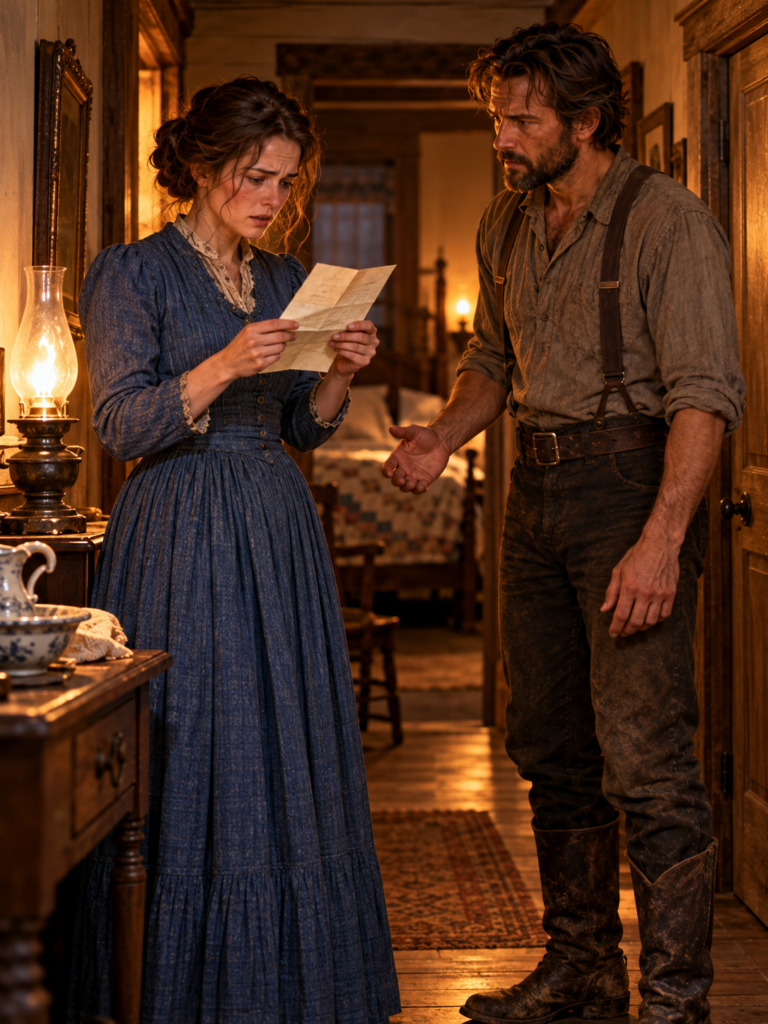
She removed a narrow ribbon and spread several pages beneath the lamp.
Nathan could recognize figures and dates, but the arrangements of entries meant little to him.
Evelyn pointed to two columns.
“That money belonged to clients. Families who entrusted their savings and estates to Whitmore and Associates.”
“And?”
“It was moved without their knowledge.”
Nathan frowned.
“An accounting error?”
“That’s what I hoped at first.”
She turned another page.
“The same thing happened again. And again. Different accounts, similar entries. Eventually I found instructions approving the movements.”
“Who signed them?”
She looked up.
“Gerald Whitmore.”
The name meant nothing to Nathan.
But the way she spoke it carried years of carefully contained fear.
“He owned the firm,” she explained. “A respected businessman with influential friends.”
“Did you confront him?”
“No. I gathered evidence.”
“Then what?”
“I took what I had to the authorities.”
Her voice remained steady, though her hands had begun to shake.
“Three days later, the firm dismissed me. The documents I’d submitted were supposedly misplaced. A man connected to the investigation was transferred. Then two strangers came to my lodgings and advised me to leave Philadelphia.”
Nathan stared at her.
“You’ve been carrying this ever since?”
“I kept copies before I reported it. I believed I might need them.”
He looked at the thick packet.
“How long?”
“Four years.”
The room seemed to shrink around them.
Nathan thought of every night he’d found her working after midnight.
Every time she’d straightened a stack of papers that was already straight.
Every moment she had looked toward the road when a horse approached unexpectedly.
“Why answer my advertisement?”
“Because Montana was far away. Because I needed somewhere to live and work. Because you asked for a capable partner rather than a woman prepared to pretend she’d fallen in love.”
She drew a breath.
“I never meant to bring trouble here.”
Nathan looked toward the hallway.
“And the letters?”
“The first told me someone knew I had come west. The second named Montana.”
She held up the newest envelope.
“This one names Billings.”
He sat down carefully.
“Do they want the papers?”
“They want them returned. And they want me silent.”
“Are they claiming you stole them?”
“That may be what they intend to say.”
Nathan watched the lamplight move over the neatly arranged pages.
In six weeks, Evelyn had saved money his ranch could not afford to lose.
She had given his men a reason to believe the business could recover.
She had planted a garden where he had allowed grief to leave the soil empty.
And all that time, she had been carrying proof that powerful men had taken money from people who trusted them.
“Do you have proof the transfers were improper?” he asked.
“Enough to justify an investigation. But Whitmore has influence, and I’ve already seen what happened when I tried to report him.”
Nathan nodded.
“We’ll need someone who knows the law.”
“We?”
He met her eyes.
“You’re my wife.”
“That doesn’t make these papers your responsibility.”
“No. But it means I can choose to help you.”
Her expression tightened.
“Nathan, I won’t surrender them. Not to you, not to anyone who promises to make the problem disappear.”
“I haven’t asked you to.”
“And I won’t let you speak for me if someone comes demanding answers.”
“Then you’ll answer them yourself.”
She stared at him.
He continued.
“I can stand beside you without taking over.”
Evelyn looked down at the documents.
For the first time since leaving Philadelphia, she could imagine discussing the evidence without having to defend her right to possess it.
Then a new thought struck her.
“Mr. Whitmore has contacts. If he claims I took his records improperly, he could try to involve the courts here.”
Nathan glanced at the papers.
“Then we should prepare before he does.”
Evelyn carefully replaced the pages in the packet.
She had spent years keeping them hidden.
Now their secrecy might become another danger.
“If I involve you,” she said, “your ranch could suffer.”
“It already has problems. You’ve been helping me solve them.”
“This is different.”
“I know.”
She looked into his face.
“You’re not frightened?”
“I am,” Nathan admitted. “But I’d rather know what we’re facing.”
Evelyn drew the packet close, then held it between them.
“Then first we make a plan. We don’t threaten anyone. We don’t give away the originals or the copies without proper advice. And you don’t make promises on my behalf.”
Nathan nodded.
“Agreed.”
She reached for the drawer where she kept her writing paper.
But before she could open it, Nathan took a breath.
“There’s something else I need to tell you.”
Evelyn froze.
He looked at the packet, then at her.
“I married you because I believed I could live beside someone without ever having to care deeply again.”
Her hand remained on the drawer handle.
“And now?” she asked.
Nathan struggled for an answer.
Because the truth was no longer simple.
He reached toward the oilcloth packet, stopped short of touching it, and asked, “Will you show me enough to understand what we’re protecting?”
Evelyn slowly turned the first page toward him.
Evelyn turned the first page toward Nathan and placed her finger beside a single name.
Margaret Hoskins.
“A widow,” she said. “She trusted Whitmore’s firm to manage her estate.”
Nathan examined the figures.
The amounts were not enormous individually.
That was what disturbed him.
A withdrawal here.
A transfer there.
Small sums, carefully spaced, disappearing from the woman’s account over several years.
“Would she have noticed?” he asked.
“Not without comparing the original records against the balances she was given.”
Evelyn showed him another page.
Joseph Callaway, a retired schoolteacher.
Thirty years of savings, reduced to a fraction of what should have remained.
There were other names.
Other families.
Other losses.
Nathan had expected the documents to describe a business disagreement.
Instead, they described people who had trusted a respectable institution and been quietly deprived of their money.
He looked at his wife.
“You found all this?”
“Not at once. It took four months to assemble the first complete account of what was happening.”
“And you still have the supporting papers?”
“Yes.”
“Then we begin there.”
They worked until the lamp burned low.
Nathan did not pretend to understand the finer points of Evelyn’s profession.
When he could not follow a transaction, he asked her to explain it.
She did.
When he misunderstood, she corrected him.
At last he understood enough to see that this was no ordinary dispute over a dismissed employee’s papers.
Someone had concealed a systematic theft.
And Evelyn had refused to let it remain concealed.
Before they parted for their separate bedrooms, Nathan stood beside the table.
“I need to tell Tom that we may have visitors,” he said.
“Not the whole story.”
“No. Only what he needs to know to keep strangers from wandering around the place.”
Evelyn nodded.
“Thank you for asking.”
Nathan looked at her.
“Next time, if there’s a decision affecting you, I’ll try to remember that you’re entitled to make it with me.”
Her expression softened.
“That’s all I’ve wanted.”
The next morning, Nathan spoke privately with Tom Briggs.
The older foreman listened as Nathan explained that a Philadelphia business concern might send someone looking for Evelyn.
“Are they likely to cause trouble?” Tom asked.
“Possibly.”
“Does Mrs. Carter know?”
“More than I do.”
Tom considered that answer.
“Then I suppose we’ll ask her how she’d like us to handle it.”
Nathan almost smiled.
“That’s the plan.”
Tom nodded.
Later, without making a fuss, he began keeping a closer watch on the ranch road.
Meanwhile, the work continued.
Evelyn completed another round of negotiations over winter feed credit.
She reorganized supply purchases and identified expenses the ranch could reduce without cutting wages or neglecting its livestock.
The Carter Ranch was still in debt.
But the decline had slowed.
For the first time since Clara’s death, Nathan could see a path through the coming winter that did not involve selling off pieces of the ranch merely to survive.
Evelyn’s work had made that possible.
She had also become part of the life around her.
Tom sought her advice on purchases.
Walt Dunning, the youngest hand, occasionally brought her letters he could not quite understand.
She helped him without making him feel foolish.
At the supper table, the men began asking about subjects beyond the ranch.
Evelyn spoke about Philadelphia’s crowded streets, its shops and offices, its busy railway stations.
She never told them everything.
But she no longer treated every question as a threat.
One evening, Nathan found her beside the neglected garden.
The last of the autumn vegetables had been gathered.
She was marking where the roses could go when spring returned.
“Clara always wanted them there,” he said.
“I remember.”
Evelyn looked toward the south fence.
“You were married six years?”
“Yes.”
“Did she like the ranch?”
“She loved it. More than I did some days.”
Nathan rested one boot against a fence rail.
“She could make friends with anyone. Once, a family passing through stopped to ask directions. Clara invited them to supper. By the time they left, she’d learned their names, their troubles, and where they hoped to settle.”
Evelyn smiled.
“She sounds remarkable.”
“She was.”
He paused.
“We wanted children. It never happened.”
Evelyn remained quiet.
“Clara had been writing to a settlement house in Billings. She hoped we might take in a child who needed a family.”
He looked toward the darkening fields.
“Then she got sick.”
“Eleven days,” Evelyn said softly, remembering what he had told her.
“Eleven days.”
He swallowed.
“The doctor did what he could. She died before the month was out.”
Evelyn reached toward him, then stopped.
Nathan noticed.
He offered his hand.
She took it.
“I’m not asking you to stop loving her,” she said.
“I couldn’t.”
“I wouldn’t want you to.”
He looked at her for a long time.
Something in his chest eased.
He had feared that speaking Clara’s name would make his second marriage feel dishonest.
Instead, Evelyn was giving him permission to remember that his first had been real.
After a while, Nathan asked, “Was there someone you loved in Philadelphia?”
“Once.”
She released his hand gently.
“He was a lawyer. We had an understanding for a time. But when he learned what I was recording at Whitmore’s firm, he asked me to stop.”
“Did he know why you were doing it?”
“Yes.”
“And he still wanted you to stop?”
“He was concerned about his future. His connections. What it might mean for his career if I challenged Whitmore.”
Evelyn glanced toward the garden.
“I understood his concerns. I simply couldn’t agree to let those people lose everything.”
“So he left.”
“Yes.”
Nathan looked at the woman beside him.
She had paid for her principles with employment, security, and the prospect of marriage.
Yet she had not abandoned them.
He found himself admiring her in a way that went far beyond gratitude.
He was beginning to love her.
And that frightened him more than the letters.
The stranger arrived three days later.
He rode in from the south road shortly after noon.
Tom saw him first.
The man wore polished city shoes and a dark coat and carried himself with the confidence of someone accustomed to being admitted wherever he appeared.
Nathan met him in the yard.
“Mr. Carter?”
“Yes.”
“I’m Fenton. I represent interests in Philadelphia. I understand Evelyn Brooks may be living here.”
Nathan’s eyes narrowed.
“My wife’s name is Evelyn Carter.”
Fenton adjusted his gloves.
“Then I believe I’m in the proper place.”
“What is your business?”
“Certain records were removed from Whitmore and Associates under circumstances that raise serious legal questions.”
Nathan kept his expression level.
“You’ll need to explain those questions to my wife.”
Fenton hesitated.
“I would prefer to speak privately.”
“That will be her decision.”
Nathan went to the house and told Evelyn who had arrived.
She looked toward the window.
Then she wiped her hands on a clean towel.
“Show him in.”
They sat at the kitchen table.
Fenton began with an elaborate explanation of confidential materials, company property, and the consequences of retaining documents without authorization.
He claimed his clients were prepared to settle the matter discreetly.
Evelyn let him finish.
Then she folded her hands.
“Mr. Fenton, I was authorized to examine the accounts involved. I recorded transactions I believed to be fraudulent and reported those concerns.”
“Mrs. Carter, you were dismissed for misconduct.”
“After I reported the transactions.”
“That is your account.”
“And I have documents supporting it.”
Fenton’s gaze sharpened.
“The original records were recovered.”
Evelyn looked at him steadily.
“That does not mean the information disappeared.”
He leaned forward.
“Are you saying you retained copies?”
“I’m saying that if your clients intend to pursue a claim, they should be prepared for an examination of the underlying accounts.”
Fenton looked from her to Nathan.
“Your wife faces serious consequences if she persists.”
Nathan remained silent.
Evelyn answered for herself.
“I understood the risk before I spoke to the authorities. I understand it now.”
The visitor stood.
“I’ll convey your position.”
“Please do.”
Fenton left without another word.
Only when his horse had disappeared along the road did Evelyn allow her shoulders to drop.
Nathan returned to the kitchen.
She sat where he had left her.
“Are you all right?”
“I’m trying to decide what he’ll do next.”
“Then we’ll need proper advice.”
She nodded.
“There’s something I want you to understand. Those records belong in an investigation, not in the hands of whoever offers the strongest threats.”
“I agree.”
“But I can’t simply give you every decision because you’re my husband.”
Nathan drew out the opposite chair.
“I don’t want every decision.”
She regarded him.
He continued.
“I want to know enough that I can make the ones that are mine. And I want you to be able to make yours without facing this alone.”
Her eyes grew bright.
She looked down before he could see the full extent of her emotion.
The next day, Nathan wrote to Edward Marsh, a lawyer in Billings whom he had consulted on ranch business.
Marsh’s reply confirmed that inquiries were being made about Evelyn and the Carter property.
He advised them to organize the evidence, preserve the correspondence, and prepare for a possible legal challenge.
Evelyn began the work immediately.
Each page was numbered.
Each copied transaction was connected to supporting correspondence.
She explained where and when she had obtained the information.
Nathan assisted by checking the order of the papers and reading the summary she prepared for Marsh.
The work required several long evenings.
But something important happened as they sat across from each other.
Evelyn stopped apologizing for the trouble she had brought.
Nathan stopped pretending he was helping merely because it was the sensible thing to do.
One night, she looked up from a ledger.
“Why haven’t you asked me to leave?”
Nathan put down his pencil.
“Would you leave if I did?”
“I’d have to consider how to protect the evidence.”
“Then that isn’t what you want.”
“No.”
“Nor what I want.”
She studied him.
“You’re taking a risk.”
“So are you.”
Her hand rested beside the papers.
“I’ve spent years expecting people to decide I’m too much trouble.”
Nathan looked at her.
“You’ve been more help to this ranch in six weeks than I managed to find in three years.”
“That isn’t the same thing.”
“No,” he admitted. “It isn’t.”
He hesitated.
“The truth is, I look forward to hearing you moving around the house. I notice when your chair is empty. And when I think about what might happen, I’m frightened for you in a way I haven’t allowed myself to feel for anyone since Clara died.”
Evelyn remained still.
He looked away.
“I’m not asking you to do anything about that.”
She spoke gently.
“Nathan.”
He met her eyes.
“I’m frightened, too.”
They sat quietly for a while.
Then she reached across the table and placed her hand over his.
It was the first time she had done so without a practical reason.
Nathan turned his hand beneath hers and held it.
Neither spoke of love.
Not yet.
The danger from Philadelphia still stood between them and an ordinary future.
But they had begun to understand that their marriage could become something neither had expected.
Several days later, Evelyn wrote to Catherine, a former colleague who had also worked at Whitmore’s firm.
Catherine had witnessed some of the irregularities.
She had children and had been afraid to speak.
Evelyn did not demand that she place herself in danger.
She explained the situation, described the evidence she had preserved, and asked whether Catherine possessed anything that could support the investigation.
Then she waited.
Meanwhile, Gerald Whitmore himself came to Miller’s Creek.
He arrived with assistants, legal documents, and a carefully prepared account of a dishonest former employee who had supposedly fled across the country to avoid responsibility.
He visited the hotel.
He spoke to merchants.
He sought out Sheriff Dale Purcell.
By the time Nathan and Evelyn reached town, people who had greeted her warmly the previous week were watching her with uncertainty.
Whitmore had brought papers issued in Pennsylvania and claimed they entitled him to the return of records Evelyn possessed.
He said he expected further action from the territorial authorities.
Nathan and Evelyn met him at the hotel.
Whitmore rose when they entered.
“Mrs. Brooks.”
“Carter,” Evelyn corrected.
A narrow smile crossed his face.
“Of course.”
He began explaining the accusations.
Evelyn listened.
When he finished, she said, “I will not surrender evidence of financial misconduct merely because the man implicated in it demands possession.”
Whitmore’s expression hardened.
“You are making a mistake.”
“That is what you said when I first reported the missing money.”
A few people nearby turned to listen.
Whitmore glanced at them.
“Perhaps we should speak privately.”
“No.”
Evelyn stood beside the table.
“You have accused me publicly. I will answer through proper counsel, with the records available for examination.”
Nathan watched Whitmore’s composure falter.
It lasted only a moment.
Then Whitmore gathered his papers.
“We shall see what the authorities decide.”
At the sheriff’s office, the situation became more serious.
Purcell had reviewed the documents Whitmore presented.
He was unwilling to ignore them merely because Nathan was a longtime acquaintance.
Marsh, however, was examining their validity and the requirements for any enforcement in Montana.
The sheriff agreed not to take immediate action while the relevant legal questions were clarified.
Nathan and Evelyn left understanding that the accusation would not disappear through simple denial.
Whitmore had influence.
He had documents.
And he had already turned part of the town against her.
Outside the sheriff’s office, Evelyn stopped.
“They’re beginning to believe him.”
“Some are.”
“He’s done this before.”
Nathan looked toward the hotel.
“Then we’ll have to put the facts where people can hear them.”
She turned to him.
“You’re suggesting we tell the town?”
“If you’re willing. Marsh can explain the papers. You can decide what you’re prepared to say.”
Evelyn considered the risk.
Public attention might make it harder for Whitmore to bury the matter.
But public attention would also expose her to judgment.
For four years, she had survived by keeping her knowledge hidden.
Now hiding might be the very thing Whitmore expected.
“Sunday,” she said.
Nathan looked at her.
“After church?”
“Yes.”
She straightened.
“I want Catherine’s reply first, if it comes.”
Nathan offered his arm.
Evelyn took it.
Together, they walked through Miller’s Creek toward the wagon, past the merchants who had suddenly found reasons to look elsewhere.
Neither quickened their pace.
At the wagon, Evelyn turned once more toward the church.
“If Catherine cannot help,” she said, “I’ll still tell them what I know.”
Nathan nodded.
“But you won’t have to do it without me.”
She climbed onto the wagon seat.
Then she looked down at him.
“Nathan, I think I’m ready to stop running.”
He climbed up beside her.
And for the first time since the letters began arriving, Evelyn looked toward the road home without wondering how long it would remain hers.
The wagon started toward the ranch, its wheels rattling over the hard-packed road.
Evelyn held the side rail and watched Miller’s Creek disappear behind them.
Nathan kept his eyes on the horses.
After a mile, she said, “There’s something I want settled before Sunday.”
“What is it?”
“If people ask about the records, I want them to understand that I’m not trying to protect my reputation at the expense of the clients.”
Nathan nodded.
“Then say so.”
“And if Catherine is willing to come, she must be allowed to speak for herself.”
“Of course.”
Evelyn studied his profile.
“You make it sound simple.”
“It isn’t.”
“No.”
“But it is clear.”
She turned toward the broad Montana landscape.
For years, the truth had been something she carried alone.
Now it was becoming something that could be examined, questioned, and defended.
The prospect frightened her.
It also gave her hope.
The next four days were difficult.
Evelyn continued working at the ranch, but she went into town whenever business required.
She refused to hide.
At Mueller’s store, she asked about a delayed order.
At the post office, she collected correspondence.
At the church hall, she spoke to Reverend Howell about the accounts she had previously helped straighten.
Some townspeople were courteous.
Others were distant.
Dorothy Marsh, the lawyer’s wife, initially seemed uncertain what to believe.
Evelyn visited her and spoke plainly about the accusations.
She did not ask Dorothy to take her side without evidence.
She asked only that she consider what Whitmore stood to gain from silencing a former employee.
Dorothy listened.
By the end of their conversation, she promised to hear the evidence before making a judgment.
On Saturday evening, a letter arrived from Philadelphia.
Evelyn recognized the handwriting immediately.
Catherine.
She sat at the kitchen table and opened it.
Nathan remained nearby but did not intrude.
Evelyn read the letter once.
Then again.
“Catherine is coming,” she said.
Nathan looked up.
“To Montana?”
“She left Philadelphia several days ago. She should reach Billings tomorrow morning.”
“Does she have anything useful?”
Evelyn nodded slowly.
“Correspondence I never saw. Letters connecting Whitmore directly to the transfers. She kept them because she was afraid they might someday be needed.”
Her voice caught.
“She’s frightened, Nathan. She’s been frightened for years. But she says she’s tired of being silent.”
Nathan pulled up a chair.
“Then we’ll meet her at the station.”
The next morning, they traveled to Billings early.
Catherine stepped down from the train looking exhausted.
She was a modestly dressed woman with intelligent eyes and a traveling bag clutched tightly in one hand.
When she saw Evelyn, she stopped.
For a moment, neither woman spoke.
Then Evelyn went to her.
They embraced.
Catherine’s composure broke first.
“I thought I might never see you again.”
“I’m glad you came.”
Catherine stepped back.
“I have the letters.”
Evelyn nodded.
“Marsh will want to examine them.”
“He can examine everything.”
By the time they reached Miller’s Creek, the church service was approaching.
Reverend Howell welcomed Catherine and gave the travelers a place to sit.
Whitmore was present.
So was Sheriff Purcell.
Nathan noticed Whitmore glance toward Catherine and stiffen.
He recognized her.
That single reaction told Nathan more than any boast Whitmore had made.
After the service, Nathan rose and asked the congregation for a few minutes.
He did not accuse anyone of wrongdoing.
He explained that serious allegations had been made against his wife and that she wished to have the evidence considered openly.
Then he stepped aside.
Edward Marsh came forward with the documents.
Evelyn stood beside Catherine.
Nathan remained nearby.
Marsh explained the accounts in language ordinary townspeople could understand.
He showed the repeated transfers.
The discrepancies between money entrusted by clients and balances reported to them.
The correspondence authorizing transactions.
Then Catherine confirmed that she had seen the same pattern while employed at the firm.
She produced letters that independently supported Evelyn’s records.
Whitmore interrupted.
“These women are disgruntled employees.”
Catherine turned toward him.
“Then explain your instructions approving those transfers.”
The church fell silent.
Whitmore looked at the papers.
Marsh continued presenting the evidence.
He explained why a proper investigation was necessary and why the documents raised questions far beyond whether Evelyn had retained copies of company records.
Reverend Howell asked Catherine whether she stood by her statements.
“Yes,” she answered.
Her voice trembled slightly.
But she did not withdraw a word.
Whitmore attempted another interruption.
Dorothy Marsh spoke from the congregation.
“Let the lawyer finish.”
Others agreed.
Nathan watched the townspeople listening more carefully now.
These were not simply strangers from Philadelphia arguing over business papers.
The accounts belonged to ordinary people.
Widows.
Teachers.
Families who had saved for years.
Evelyn had preserved their names because she believed they deserved an answer.
When Marsh finished, Evelyn stepped forward.
“I did not come to Montana to escape accountability,” she said.
Her voice carried through the room.
“I came because I had already tried to report what I found, and the people I trusted to investigate it failed me.”
She glanced toward Whitmore.
“I knew these records might someday be challenged. That is why I preserved them.”
Then she faced the congregation.
“I ask only that the evidence be examined honestly. Not because I’m Nathan Carter’s wife. Not because I’ve helped with your church accounts. But because the people whose money is missing deserve the truth.”
She stepped back.
For several moments, nobody spoke.
Then Sheriff Purcell approached Marsh.
They discussed the papers quietly.
Whitmore rose as though preparing to leave.
But the confidence with which he had entered Miller’s Creek was gone.
The town had heard another account.
And that account had documents and a witness behind it.
The public meeting did not settle the criminal allegations.
It could not.
But it prevented Whitmore from quietly defining Evelyn as a dishonest woman without challenge.
Marsh arranged for the evidence to be provided to appropriate investigators.
The disputed order would face formal scrutiny.
And Evelyn, who had expected to stand alone before hostile strangers, discovered that several people in Miller’s Creek were prepared to stand beside her.
Reverend Howell came first.
Then Dorothy Marsh.
Others approached with questions, apologies, or simple expressions of support.
Evelyn answered what she could.
She did not pretend the danger had vanished.
It had not.
But something essential had changed.
Whitmore no longer controlled the entire story.
When they returned to the ranch that evening, Catherine sat quietly at the kitchen table.
“I don’t know where I’ll go when this is finished,” she admitted.
Evelyn looked at Nathan.
He understood the question without needing it spoken.
“We have room,” he said. “If you’d like to stay while matters are arranged.”
Catherine looked surprised.
“I wouldn’t want to impose.”
Evelyn smiled faintly.
“There’s correspondence piling up already. I could use another capable pair of hands.”
Catherine considered the offer.
“Actual work?”
“Actual wages,” Evelyn replied.
Nathan nodded.
“And a room.”
Catherine looked from one to the other.
“Then perhaps I’d like to stay.”
Within weeks, she became part of the ranch’s operations.
Her ability to organize letters and orders complemented Evelyn’s accounting work.
Tom Briggs discovered that neither woman could be persuaded to accept an incorrect invoice.
Walt Dunning became openly fascinated by Catherine, though his attempts to impress her with stories of cattle work usually left Tom shaking his head.
The house grew busier.
Sunday meals became occasions when the hands came inside rather than eating separately.
The old quiet remained available when someone needed it.
But it was no longer the only sound the house knew.
The legal matter continued through the winter.
Evelyn and Catherine worked with Marsh to arrange the evidence.
In January, they traveled with Nathan and Marsh to Helena to give formal testimony.
The questioning was careful and exhaustive.
Evelyn described how she had identified the unusual transfers, preserved copies, and attempted to report them.
Catherine explained what she had witnessed and produced the correspondence supporting those accounts.
Nathan watched Evelyn throughout the proceedings.
He saw the strain.
He also saw something he had admired since the day she stepped off the train.
When she knew the answer, she gave it.
When she did not know, she said so.
She refused to embellish.
That honesty had once made her vulnerable.
Now it made her testimony powerful.
In February, word came that Gerald Whitmore had been indicted on multiple charges arising from the financial investigation.
Other men connected to the firm were cooperating with prosecutors.
The official who had mishandled Evelyn’s original report was no longer in office.
The Pennsylvania judge involved in the earlier order against her was under separate investigation.
Marsh brought the news himself.
They sat around the kitchen table.
Evelyn read the papers, then laid them down.
“It’s not finished,” Marsh warned.
“I know,” she said.
“The proceedings may take considerable time.”
She nodded.
Then she asked a question that surprised him.
“What happens to the people whose money was taken?”
Marsh paused.
“Restitution may be pursued through the proceedings, though the amounts and timing are uncertain.”
“Margaret Hoskins,” Evelyn said.
“The widow?”
“Yes. She lost almost everything.”
Marsh studied her.
“You haven’t forgotten a single one of them, have you?”
“No.”
She looked at the stack of records.
“They were the reason I started.”
Nathan reached beneath the table and took her hand.
She squeezed his fingers.
He understood then that her fight had never been chiefly about proving her own courage.
It was about the people whose names she had copied into her notebooks when nobody else was willing to protect them.
That evening, Tom found Nathan repairing a harness in the barn.
“You going to tell her?” the foreman asked.
Nathan looked up.
“Tell her what?”
Tom sighed.
“That you’re in love with your wife.”
Nathan stared at him.
“That’s an extraordinary thing for a man to concern himself with.”
“I’ve worked here twelve years. I’ve watched you walk around looking half-dead for three of them. Then Mrs. Carter arrived, and now you actually laugh at supper.”
Nathan returned to the harness.
“Tom.”
“She ought to hear it from you.”
The old foreman took his feed bucket and walked out.
Nathan sat alone.
He had loved Clara completely.
When she died, he believed any future happiness would somehow diminish what they had shared.
But that was not how he felt now.
He missed Clara.
He would always miss her.
And he loved Evelyn.
The two truths did not cancel each other.
When spring finally came, the garden began to revive.
Evelyn planted rose bushes along the south fence where Clara had once hoped to see them growing.
Nathan watched from the kitchen window.
Later, she entered with soil on her sleeves.
“The roses are in,” she announced.
“Will they survive?”
“If we care for them.”
Nathan looked at her.
She noticed the seriousness in his expression.
“What is it?”
He set aside the ledger he had been reading.
“When I signed the marriage agreement with Reverend Howell, I thought I was doing something sensible.”
“You were.”
“I thought I could share a house with someone without letting her matter too much.”
Evelyn stood still.
“And now?”
“Now I think I was mistaken.”
She rested her hands on the back of a chair.
Nathan drew a breath.
“I love you, Evelyn.”
The words were simple.
But they had cost him three years of fear and six months of slowly surrendered defenses.
“I don’t expect you to answer because we’re married,” he continued. “And I won’t change the promises I made you if your feelings are different.”
Evelyn looked at him for a long moment.
Then she crossed the kitchen.
She stopped close enough to touch him.
“Nathan, when I answered your advertisement, I wanted a place where I could work and live without being frightened every day.”
He nodded.
“I didn’t imagine I could love the man I married.”
Her voice softened.
“But you let me remain myself. You listened when I said no. You let me tell the truth in my own time. And when I was afraid, you stood beside me without demanding that I become someone else.”
She touched his cheek.
“I love you, too.”
Nathan closed his eyes.
He had expected the admission to be terrifying.
Instead, it felt like returning to a room he had locked and forgotten how to enter.
When he opened his eyes, Evelyn was smiling.
“May I kiss you?” he asked.
“You certainly may.”
He kissed her gently.
It was the first kiss that belonged not to their marriage arrangement but to the love they had chosen.
Outside, the spring wind moved across Clara’s newly planted roses.
Inside, Nathan held his wife without feeling that loving her meant betraying anyone he had lost.
Their marriage changed after that.
Not because they suddenly became different people.
Nathan remained quiet and occasionally stubborn.
Evelyn still corrected his arithmetic.
He still preferred working outdoors to writing letters.
She still believed a problem was easier to solve when someone stopped pretending it did not exist.
But they began making room for affection as naturally as they made room for work.
They spoke more openly.
They sometimes disagreed.
They learned how to apologize without turning every mistake into an injury.
And they stopped treating the future as something merely to survive.
The ranch continued recovering.
With better supply terms and more disciplined accounts, the operating losses eased.
The cattle business became steadier.
Catherine took formal responsibility for correspondence and supplier arrangements, and Marsh eventually offered her some work assisting his office.
She accepted with enthusiasm.
Walt Dunning’s admiration for her became a source of quiet amusement around the ranch.
Tom Briggs insisted he had more important things to worry about.
Nobody believed him.
One morning, a letter arrived addressed to Evelyn.
It concerned Margaret Hoskins, the elderly widow whose depleted estate had first helped Evelyn understand the scale of Whitmore’s wrongdoing.
Restitution proceedings had restored a substantial portion of the woman’s funds.
There was a second letter.
Its handwriting was unsteady.
Mrs. Hoskins wrote that she was eighty-one years old and had not expected to see any justice for what had happened to her.
She thanked the woman who had saved the proof.
She thanked those who had helped her.
And she said that knowing the truth had finally been heard meant more to her than she could adequately express.
Evelyn sat at the kitchen table for a long time after reading it.
Nathan brought coffee.
He did not ask why she was crying.
She gave him the letter.
He read it quietly.
Then he returned it.
“I think she’d be pleased to know you’re safe,” he said.
Evelyn wiped her cheek.
“I wanted her money returned.”
“I know.”
“I wanted all of them to have a chance.”
Nathan put his arm around her.
“And you gave them one.”
She leaned against him.
For once, there was no argument.
Months passed.
The federal case moved forward.
Then, one August afternoon, Tom rode in from town carrying a telegram.
Nathan met him in the yard.
The message was brief.
Gerald Whitmore had been found guilty on all counts at the conclusion of his trial.
Nathan read it twice.
Then he went inside.
Evelyn was at the table working through a list of autumn supply purchases.
He laid the telegram in front of her.
She read it.
Her pen stopped moving.
For several seconds, she said nothing.
Then she looked at Nathan.
“It’s finished.”
He nodded.
“The trial is.”
She rose.
He opened his arms.
She stepped into them.
For four years, Evelyn had lived with the knowledge that a powerful man could use his influence to discredit her and escape accountability.
Now the courts had judged the evidence.
There would still be consequences to administer and losses that could never be fully repaired.
But she no longer had to wonder whether the truth would ever be heard.
Nathan held her until she was ready to step away.
Then they went back to the day’s work.
Life at the ranch had become something neither could have planned.
The house was no longer simply a place where Nathan slept between exhausting days.
It had become a gathering place.
The ranch hands came inside on Sundays.
Catherine brought laughter and an extraordinary talent for organizing other people’s business.
Walt found excuses to speak with her whenever possible.
Tom, now sixty-one, occasionally allowed himself the luxury of sitting through supper without reminding everyone what needed doing in the morning.
And Evelyn remained the person Nathan trusted with the figures that determined their livelihood.
He remained the person she trusted to treat her choices as her own.
Their partnership was practical.
It was affectionate.
And it was no longer cold.
In August, Daniel Hansen, a fourteen-year-old who lived with his family a few miles away, came to help with fence work.
One Saturday, his mother was ill, and he had to bring his younger sisters.
Evelyn welcomed them into the kitchen.
She gave them cornbread, found a deck of cards, and showed them how to play.
By afternoon, the girls were laughing in the yard.
The next Saturday, Daniel brought them again.
Soon another Hansen child came.
Then children from a neighboring homestead.
Nobody had planned for the Carter house to become a place where young visitors felt welcome.
It simply happened.
Nathan watched Evelyn at the kitchen table one afternoon, explaining a card game while the youngest children argued cheerfully over the rules.
He thought of Clara.
Of the letters she had written to the settlement house in Billings.
Of the family she had hoped they might build.
He knew their household had not followed her plans.
It had become something else.
But it had not remained empty.
And he thought Clara would have been glad.
Later that evening, Nathan and Evelyn walked toward the south fence.
The roses had bloomed.
Their flowers moved gently in the warm Montana air.
Evelyn stopped to examine one of the branches.
“Clara would have liked these,” she said.
Nathan nodded.
“She would.”
Evelyn turned toward him.
“Do you ever think she’d have minded someone else living here?”
Nathan looked at the house.
He remembered Clara laughing on the porch, welcoming travelers, making plans for children, and working beside him when the ranch was younger.
“No,” he answered.
“How can you be sure?”
“Because she wanted a home full of living people. She never wanted me to spend the rest of my years guarding empty rooms.”
Evelyn touched his hand.
“I wish I’d known her.”
Nathan smiled.
“She’d have liked you.”
“You think so?”
“Very much. Though I suspect the two of you would have reorganized every account on the place before breakfast.”
Evelyn laughed.
Nathan joined her.
Across the yard, Tom was correcting something Walt had done perfectly well.
From the kitchen came the sound of Catherine speaking with the younger Hansen children.
The horses were settling in the barn.
The ranch was alive with the ordinary sounds of people who had found a place together.
Nathan looked at Evelyn.
He remembered the day he had signed a marriage agreement while Reverend Howell waited across the table.
He had expected help with his failing ranch.
A woman willing to share his roof.
Someone who would occupy an empty chair without asking him to reopen an empty heart.
He had thought a practical arrangement would be enough.
Instead, Evelyn had brought skill, courage, and the determination to stand against a powerful man who had stolen from people unable to defend themselves.
She had helped rescue the ranch from its debts.
She had offered Catherine work and a place to recover.
She had welcomed children who needed somewhere to spend an afternoon.
She had remembered Clara without attempting to replace her.
And she had taught Nathan, not through lectures but through the life they built, that loving someone again did not erase the love that had come before.
Evelyn looked at him.
“What are you thinking?”
“That I was very certain of myself when I wrote that advertisement.”
“Your letter was rather stern.”
“I remember.”
“You described the position as practical, demanding, and unsuitable for anyone expecting luxury.”
“All true.”
“You forgot to mention the faulty barn door.”
“I should have.”
“And the dreadful accounts.”
“I warned you about those.”
“Not sufficiently.”
He laughed.
Then he took her hand.
“I didn’t know how much I was asking someone to share.”
She stepped closer.
“Neither did I.”
The sun was disappearing behind the Montana hills.
Nathan looked at the roses along the fence.
Then at the woman beside him.
Three years earlier, grief had convinced him that caring for another person would only provide another way to suffer.
Four years earlier, injustice had convinced Evelyn that trusting the wrong person could take away everything she had built.
Neither had been foolish to fear what they had experienced.
But neither had needed to spend the rest of life obeying that fear.
Evelyn rested her head against Nathan’s shoulder.
He placed his arm around her.
They watched the last light settle over the pasture.
Tomorrow, there would be more work.
Accounts to reconcile.
Horses to feed.
Fences to inspect.
Letters to answer.
Children to welcome.
Ordinary problems to solve together.
And Nathan Carter, who had once believed he could never love again, understood at last what his mail-order marriage had become.
Not a replacement for Clara.
Not a bargain that had purchased Evelyn’s devotion.
Not a rescue in which one person saved the other.
It was a life two people had chosen, day after day, until trust became affection and affection became love.
He tightened his hand gently around hers.
“Come inside,” he said. “It’s getting late.”
Evelyn looked toward the warm windows of their house.
“One more minute.”
Nathan smiled.
“One more minute.”
And beneath the wide Montana sky, beside the roses planted for a woman Nathan would never forget, he stood with the woman he loved now.
For the first time in years, he was no longer measuring his future by what he had lost.
He was looking forward to everything they still had time to build.