
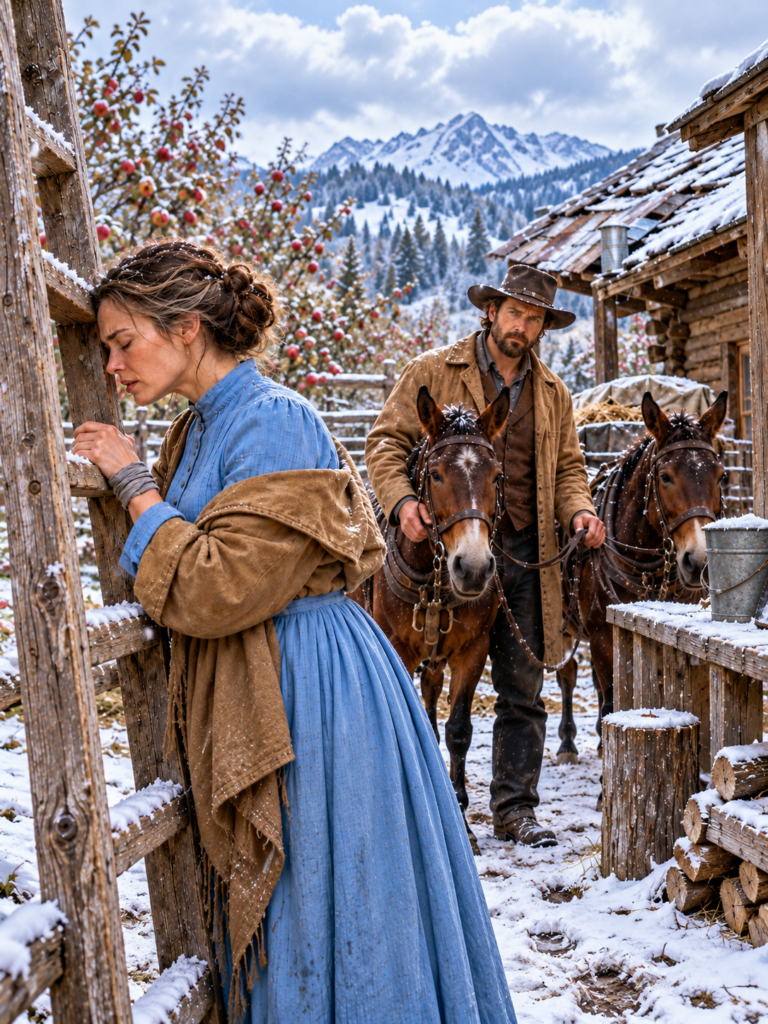
she whispered lord send someone to fix this roof before snow not knowing the man at her gate had already heard every word
Part 1
The sleet had begun an hour before dark on the first of October, 1883, and it was still falling when Ezra Colton turned his team off the foothill road. The mules were done. Their shoulders steamed under the wet harness, and the wagon wheels had already started to pick up the clay that would set hard by morning. A sagging gate stood open on his left. Beyond it he could see the dark bulk of a barn and the low line of a cabin roof that dipped in the middle the way a horse’s back dips when the cinch has been left too loose for too long.
He had not meant to stop. The hay buyer in Loveland expected the load by the twelfth, and the public house at Pine Fork was only four miles farther if the road held. But the tarp over the bales was already letting water in at the seams, and the mules had put their heads down and stopped of their own accord at the gate. Ezra sat a moment with the lines slack in his hands. He always asked first. He had grown up in a house where a man did not walk onto another man’s land without saying so.
He was still deciding when he heard her.
The ladder stood against the north slope of the cabin. She was halfway down it, both hands locked on the rails, her forehead almost touching the next rung. Her voice was quiet enough that the sleet nearly covered it.
“Lord, send someone to fix this roof before snow.”
She added something else, softer, and did not say amen. Ezra sat very still. He had been raised to believe that prayer was a private room. He did not walk into private rooms. He kept the mules where they were and waited until she stepped off the bottom rung and stood in the yard with her face turned up and her eyes closed. Only then did he turn the team through the gate.
She opened her eyes when the wagon creaked. In the gray light he watched her face move through surprise, embarrassment, suspicion, and finally a plain, steely politeness that did not ask for sympathy.
“This is private land,” she said.
“Yes, ma’am.” He took off his hat. “Ezra Colton. I’m hauling hay to Loveland. The road’s gone to mud. I wondered if I might put my mules under your barn roof for the night. I’ll sleep in the wagon.”
She looked at the mules, then at his boots caked to the ankle, then at the sagging tarp. Last of all she looked at her own roof. Water was already dripping somewhere inside the house. He could hear the steady sound of it striking tin.
“There’s a public house at Pine Fork,” she said.
“My mules won’t make four.”
She was somewhere in her middle thirties, thin and straight-backed in a man’s canvas coat that hung past her wrists. A gray wool skirt was hitched up over her boots. Her right wrist was wrapped in a strip of flannel, and she held that hand a little away from her body the way a person does when the joint has been telling them the truth for weeks. She studied the barn for a moment.
“The barn doesn’t leak,” she said. “I’d be obliged if you didn’t go in the house.”
“I wouldn’t.”
“Nobody puts stock in my barn for free, Mr. Colton. A dime a night for the mules. Ten cents. You can leave it on the post.”
He nearly smiled. She said it so fiercely, chin up, that it would have been an insult if he had taken it that way. “A dime’s fair.”
She turned and walked up the porch steps under the split-pine lintel. He could read the letters cut into the weathered wood from where he stood: Except the Lord build the house. She paused with her hand on the door and looked at the words the way a person looks at a debt they have already paid once and expect to pay again. Then she went inside and shut the door.
Ezra led the mules to the barn. It was a good barn, tight and swept, with a harness room and stalls kept as neatly as church pews. At the back, under a canvas tarp lashed with rope, lay a long stack of pine bolts. Each one was the length of a man’s arm, split once, and stacked with air between them to season. Someone had cut them knowing exactly what they were for. They were shake wood. Someone had meant to re-roof the house and then had not.
He unharnessed the mules, rubbed them down, and gave them hay from the load. He climbed into the wagon bed with his blanket and a supper of cold biscuit and sat with his back against a bale, watching the lit window of the cabin. A thin figure crossed it once, then twice, carrying buckets. Water was still dripping inside. He had not been asked for anything. He told himself so as he lay awake listening to it. But he had heard the prayer, and long after the last light went out he found that he was still hearing it.
Morning came up hard and clean. Ice stood in the puddles. The first sun lay along the tops of the orchard rows, and the apples that had fallen overnight shone red against the frost. Ezra put his dime in the twist of paper she had tied to the gate post. She came out of the house with a coffee pot in her good hand and two tin cups hooked over her fingers. She set the pot on the porch rail and did not offer him a cup. She put it where he could see it, looked at the barn, and then looked at him.
“The dime wasn’t a gift either,” she said.
“I know. I thought you might want to count it.”
“I counted it.”
She poured one cup and set it on the rail and stepped back from it. He understood that it cost her something. He took the coffee and drank it standing in the yard.
“Those are shake bolts under the tarp,” he said. “Pine, properly seasoned. That’s a fine stack.”
Her face went still. “They were my father’s. He cut them for the roof. He cut them for a number of things. He was a man of plans.”
She came down the steps and crossed to the barn. He followed a pace behind. In the half-light by the tarp she stood looking at the long stack.
“I can split my own shakes, Mr. Colton. I’ve watched it done for thirty years. I’ve got the tools.”
She did. A froe hung on a nail by the harness-room door with a heavy wooden mallet below it. A shaving horse stood in the corner, dusty as if the dust had gone unbroken for a season. She took the froe down with her good hand and set a bolt on the block. She held it with her bad one. The first blow of the mallet was clean. The second slid, and the shake peeled off crooked and thin at one end. She frowned. She tried again. Her wrapped wrist jerked at the shock, and she caught her breath through her teeth and set the mallet down very carefully, as though it were something that might break.
“Grain’s running out at the tail,” Ezra said. He set the observation to the air mildly. “If you turn the bolt end for end, the split follows the tree instead of fighting it.”
She stood for a moment, the muscle tight in her jaw. Then she turned the bolt. The next shake came away whole, a clean straight board as long as her forearm, its face rippled like water.
“That’s what I’d have done,” she said stiffly.
“Yes, ma’am. I was about to.”
Something happened at the corner of her mouth. It was not a smile. It was the place where one might have been, and she put it away at once.
“How many shakes does it take to roof that north slope?” he asked.
“Thirty more. The whole roof is closer to six hundred. I have the bolts for about five hundred. It takes a man a week to split and lay it. A man who knows how. I’ve had two come and quote me. One wanted twenty-two dollars and the other would not climb the ladder after he looked at it.” Her eyes flicked away and came back. “I have six dollars and some cents and apples. A good many apples. Two hundred trees. My father put every one of them in. Nobody can pick them because I can’t pick and press at the same time, and the frost will have them by Sunday. Nobody here buys what I can’t deliver.”
Her voice had gone flat in the way of someone reciting a list she has recited to herself in the dark.
“I’ve got a wagon and two days’ slack,” he said, as if thinking aloud. “My hay buyer in Loveland doesn’t care which day it comes so long as it’s there by the twelfth, and I’m tired of eating cold biscuit.” He rubbed his jaw. “I know how to split a shake. I don’t know a thing about cider.”
She was quiet a long moment. “That is an offer.”
“It’s a question. I haven’t got any offer. I haven’t got the right to one.”
She studied him, the long weathered face and the hat in his hands. “You have labor I need,” she said. “I have fruit I cannot move. That is not a favor. That is trade.”
She went into the harness room and came out with a pencil stub and the back of an old flower sack. She smoothed it on a grain bin and wrote in a square, hard hand. When she was finished she turned it to him.
One week. Mr. Colton splits and lays the north slope and what shakes he can on the south. Miss Prior picks and presses. Board in the barn. Meals at the table on the porch, not in the house. Miss Prior keeps the cider. Mr. Colton may take one half of whatever is pressed to sell. No other payment either way.
Underneath, a line for signatures.
He read it twice. It was not generous to either of them. It was the fairest thing he had ever been handed.
“You’re giving me half the cider.”
“It’s what the work is worth. I did the sum.” She held out the pencil. “Sign it, Mr. Colton, or go on to Loveland.”
He signed it. His name looked large and clumsy beside hers. She folded the flower sack in four and put it in her coat pocket, and for the first time since he had driven in, her shoulders eased the width of a finger. She looked up at the north slope. She looked at it longer than she needed to.
“Don’t climb it till I tell you,” she said.
“No, ma’am.”
She turned and went in to put out the coffee, and the door shut behind her.
Part 2
By Thursday they had worked out a rhythm, the kind two stubborn people find when they have agreed on a few words and nothing else. Ezra split shakes in the barn doorway from first light until the sun stood over the orchard. The mallet rang. The thin boards piled against the wall, clean pine, sweet-smelling, each one rippled along its face. Willa picked. She worked a ladder not ten feet high and down again, filling canvas sacks that she hauled to the press shed in a barrow with one good hand and one that she would not let him see her favor.
At noon they ate at the plank table on the porch, a body’s length apart. She set out bread and a boiled potato and a square of cheese on a plate, and there was always a second plate exactly like the first. They did not talk much. On Thursday he asked what kind of apple the tall trees in the north row were, and she told him in more detail than he needed—the name, the year her father had grafted it, the way it kept through February in a cold cellar. He listened. He had not expected her to answer at all.
On Thursday afternoon she showed him the press. It stood in a lean-to shed behind the house, a great oak screw press with a slatted tub the size of a washtub, a grinder on a hand crank, and a stone trough that caught the juice. The air in the shed was thick and sweet, humming with wasps. She fed apples into the hopper. He turned the crank. She showed him how to fold the pulp into cloth and lower the screw until the juice ran brown-gold into a bucket.
“Taste,” she said, and held out a tin cup.
It was cold and sharp and almost too sweet to bear. It tasted like the whole autumn at once. He drank it and stood with the cup in his hand, and she watched his face with an expression he could not read.
“My father pressed this in the same bucket for twenty years,” she said. “He said the first cup belonged to whoever turned the crank.”
“Then it’s yours. I didn’t turn it. You did.”
She took the cup out of his hand, filled it again, and drank from it herself. She set it down on the edge of the trough, and for a moment she stood with her sore wrist cradled and her eyes on the floor.
“I haven’t given anybody the first cup since June.”
He did not ask what had happened in June. He had learned in a hard school what it meant when a person put a date in a sentence and then stopped. He only nodded and turned the crank until his shoulders burned.
On the way back to the barn she stopped beside the porch and looked at the north slope. The sagging place caught the late sun and shone like a dark tooth. Without turning her head she said, “The almanac says snow by the tenth. That’s six days. It’s never right, but it’s usually close.”
He noticed that she never went near the ladder unless she had to, and that when she did she held her breath. As he went to unharness the mules he found himself counting shakes and counting days and finding that the sum did not quite come out.
That evening the cold came down early and clear, with a band of green still hanging over the western ridge. Willa carried supper out to the porch table and set down two plates as usual. She sat for the first time. She did not wait for him to take his place before she picked up her fork.
“I’ve been wrong about you,” she said.
Ezra looked up from the potato. “Ma’am?”
“I thought you’d want something.” She cut her cheese into precise squares. “I’ve watched you three days. You haven’t asked about my debts or my father. You haven’t told me what I ought to do about the roof. You should know one thing before you decide what sort of man I’ve been.”
He put his fork down. He had not planned to say it, but she had shown him the one honest thing in her hand, which was that she trusted him, and he would not take that trust on half the facts.
“Miss Prior, I haven’t been honest with you.”
Her fork stopped.
“The first night when I drove in,” he said, keeping his eyes level, “I came to the gate before you saw me. You were at the foot of the ladder. You said something with your eyes shut.”
The green light went out of the ridge. A long time seemed to pass, though it was perhaps three breaths.
“What did I say?”
“You asked for someone to fix this roof before snow.”
She did not move. Her face went through nothing at all. No shock and no color, which was worse than shock. Then her hand slid very slowly off the table and into her lap.
“You heard me pray.”
“I did.”
“And you stayed.” Her voice dropped. “You looked at my roof and my wrist and my dime on the post and you said a dime is fair. You knew what I’d asked and you made a bargain.”
“I didn’t make it because of that.”
“Didn’t you?”
“No, ma’am.” He said it plainly. “I made it because the bolts were stacked and the apples were rotting and because I’d rather split shakes than eat cold biscuit. But I’ll not say that I didn’t hear you. I did. I should have told you the next morning. I’m sorry I didn’t.”
She stood up so suddenly that her chair scraped the boards. She walked to the end of the porch and stood with her back to him and her arms wrapped around herself, looking at the black rows of the orchard.
“That was between me and him,” she said, very low. “I’ve asked every night since June for a roof. For a way. Every night. And the only answer I ever got was another bucket of water.” She laughed once, short and ugly. “And then a man comes down the road in the sleet with a wagon. And you want me to believe that’s what he meant?”
“I don’t believe that,” Ezra said. He was surprised at how steady his voice was. “I don’t think he mails people. I don’t think I’m an answer. I think I was a man with a bad tarp and tired mules, and you were a woman at the bottom of a ladder. If it was more than that, I wouldn’t know. And I wouldn’t want you to feel it was owed.”
“Owed,” she said. “That’s what you were afraid of. In the prayer you said—and don’t let him ask me for what I can’t pay.”
He swallowed. “It was the second part. You said it softer.”
Willa put her hand over her mouth. She stood like that for a long time. When she finally spoke, her voice was cracked all the way across and she did not trouble to hide it.
“Go in the morning.”
He nodded. He rose and set his plate on hers and went down the steps. Behind him he heard the screen door and then the bar drop across the inside of the house.
He did not sleep. He lay in the wagon bed looking at the beams of the barn and listening to the mules shift. Once, near midnight, he thought he heard the sound of someone weeping very quietly behind the cabin wall, and then the scrape of a mallet on wood. She was splitting shakes in the dark.
Part 3
At first light he harnessed the mules. He walked them out through the gate with the wagon rattling behind and halted in the road a rod beyond the post. He sat with the reins slack in his hands. He did not drive on.
He had said he would go. He had also been taught that you do not leave a job you have said you would do because the person who hired you is angry. But a man did not walk into a house that had barred its door. So he sat at the gate with his hat on his knee and waited to be told which one it was.
The sun cleared the ridge. Frost smoked off the orchard rows. After an hour the cabin door opened. Willa came down the steps with her coat buttoned to the chin and her bad hand wrapped in fresh flannel. She walked the whole length of the yard and stopped at the gate post where the dime in its twist of paper still hung.
“Are you going, Mr. Colton, or aren’t you?”
“That’s yours to say, ma’am.”
“I can’t.” Her voice shook. “I can’t ask you. I asked him and I can’t ask you.” She drew breath. “Do you understand? It’s the only way I know to stand.”
He looked down at her. The hard thin face and the set chin and the eyes red-rimmed and wide open.
“You asked him,” Ezra said gently. “I only heard it. It’s not the same as being asked.”
For a moment she did not move. Then she put one hand on the gate post and shut her eyes as if the whole yard were tilting.
“Stay,” said Willa Prior. “Not because I asked God. Because I’m asking you.”
On Saturday morning she held the ladder.
She had decided it in the dark, she told him later, between one swing of the mallet and the next. If a stranger was going to climb onto her family’s roof, she would stand at the foot and take the weight of it. She braced the rails with both boots and her good arm and kept her eyes on the rungs as he went up with a pry bar and a nail apron.
The old north slope came off in long gray strips, thin as paper and furred with moss. Under the patched place the sheathing was soft. He knelt with his knee on a sound rafter and cut out the rot with a handsaw until he found hard wood. He worked slowly, testing every inch before he trusted it with his weight.
Near the bottom of the dip, tucked into the gutter trough where the valley met the eave, something caught the sun. He worked it loose with the pry bar and turned it over. It was a hammer, a plain claw hammer with a hickory handle worn dark and smooth, and a name burned into the wood by a hot nail so old that the letters were almost soft: A. Prior. The head was flecked with rust and a long winter’s worth of leaf mold. It had lain in that trough, he judged, for months.
He stayed there with it for some time. Then he came down the ladder with the hammer in one hand, and when his boots touched the ground he held it out to her with the handle toward her palm.
Willa looked at it. She did not take it. She let go of the ladder and her good hand came up to her mouth and she made a small sound he had not heard from her before.
“It was in the gutter,” Ezra said. “I’d guess it’s been there since June.”
He waited.
“The ninth,” she said. Her voice was very quiet and quite level. “He was up there with a tin patch and a bucket of tar. He’d been at it since morning. I was in the orchard. I had a basket on my arm and I was looking at a tree that wouldn’t set fruit and I heard the ladder go. It slid on the wet boards. It didn’t make much sound.”
She was looking at the hammer, not at him.
“He was sixty-one. He was not a careless man. He’d said for two years he would re-roof it right. But the money went to the doctor when my mother was sick and then to the note on the north pasture and then there was never enough. So he patched. He said a patch was an honest thing if you said what it was.”
“Miss Prior.”
“I found him at the bottom. He was alive for a while.” She breathed. “He asked if the ladder was all right. I said it was. I didn’t know what else to say. I’ve been patching since,” said Willa. “I’ve gone up that ladder and put tin where he put tin because I couldn’t bear to have a stranger on his roof and I couldn’t bear to have it leak, and I was so afraid of the ladder, Mr. Colton. So afraid that every time I went up I was sure—” She stopped. “That’s the wrist. I slipped on the second rung in September. It wasn’t a bad fall, but I lay in the yard and I thought—he asked if the ladder was all right.”
Her voice cracked then. “And I asked God for someone else to climb it. I thought he’d heard that. I thought it was the only honest thing I’d said to him since June.”
Ezra closed his hand on the handle. He did not say that she was not to blame or that grief had its own seasons. What he said was, “He’d have wanted the roof done properly.”
“Yes.”
“I can do it properly.”
“Yes.” She wiped her face with the heel of her hand, impatient, almost angry with it. “But I’ll be the one who nails the ridge. Not you. Me. Whatever else you do, the last course is mine.”
“All right.”
“You’ll hold the ladder.”
“I will.”
She took the hammer then in both hands and held it against her coat. After a moment she turned and walked slowly toward the house, and he heard the screen door, and then nothing at all.
Part 4
On Sunday they did not work. It was an agreement neither of them had needed to speak. Ezra mended the harness in the barn, and Willa did not split a single shake. In the evening she called him to the porch table. Between the plates sat a large black Bible with a broken spine, and beside it the hammer, cleaned and oiled, lying on a folded cloth.
“It’s my father’s,” she said, touching the cover. “He read it every night. I stopped in June.”
She opened to a place she must have known by heart. He saw her find it and saw her lips move before she began.
“Except the Lord build the house, they labor in vain that build it.” She read it flat, like a charge in a courtroom. She went on. “Except the Lord keep the city, the watchman waketh but in vain. It is vain for you to rise up early, to sit up late, to eat the bread of sorrows: for so he giveth his beloved sleep.”
She stopped. “He cut that over the door.” Her voice was hoarse. “He told me the second half was for the builder. That you can’t earn your sleep by working harder.” A short breath of a laugh. “I have not slept a night through since June, Mr. Colton. I split shakes at midnight because lying down is worse.”
Ezra had no wisdom to put beside a verse. He sat with her while she read the psalm to the end in the lamplight, and when she finished she closed the book and kept her hand on it.
“I don’t think I believe it,” she said. “Not yet.”
“You read it,” said Ezra. “That’s more than most do.”
It was nearly full dark when the wind changed. It came over the ridge from the northwest, cold and thin, with a smell on it like iron. Willa lifted her face and he saw her go very still.
“That’s not the tenth,” she said.
“No, ma’am. That wind has snow behind it.”
“Tomorrow or the day after?” She was already on her feet. “It’s coming early.”
Monday he laid shakes from the eave up. It was slow, exact work. Each course lay over the seams of the one below, five inches to the weather, two nails to a shake, driven just short of the face so the wood could breathe. Ezra worked from a plank scaffold he had hung off the eave on rope, and Willa fed him from the ground. She loaded shakes into a bucket and he hauled them up on a line. She did it without being asked and without remark, and by mid-morning the bucket came up in the same rhythm his hands wanted. The ladder stood against the eave, footed in a hole he had dug the day before and lashed to the rafter end with a doubled rope.
By dark the north slope was shingled to the halfway line.
Tuesday broke without a sunrise. The sky lay close over the foothills, gray and low and the color of an old pewter plate, and the wind blew steady from the northwest with a dry bite in it. Willa stood in the yard with her face lifted, sniffing the air like an animal.
“Noon,” she said. “Maybe sooner. Then we’d better not talk.”
They did not. She stopped picking at nine and took the bucket line on the ground, and between them they sent up a shake every few seconds. Courses closed over the dip where the old roof had sagged, and the dip disappeared under straight clean lines. At two the first flakes came, a few, dry and small, blowing sideways, and Willa looked at them and said nothing and sent up the next bucket.
By four he was at the ridge. The north slope was done but for the last two courses and the cap, a narrow band along the top where the shakes met the peak. He sat back on his heels and wiped his face. The light had gone yellow and strange. The flakes were thicker now and wet. They stuck to the new wood and began to lay a white thread along each course.
He climbed down. Willa was waiting at the foot of the ladder with the hammer in her hand.
“There’s an hour of light,” he said. “Twenty minutes of work. I can—”
“No, Miss Prior. It’s snowing.”
“I know it’s snowing.” Her voice was low and entirely steady. “I said the last course is mine. I said it Saturday. And you said all right.”
She looked at the ladder. Her good hand had closed on the rail and the knuckles were white.
“I have been afraid of that ladder since the ninth of June. I am going to be afraid of it tonight and I am going to go up it anyway, and you are not going to carry me or talk me out of it.”
“I wasn’t going to.”
“Then hold it.”
He took the rails. He set his boot on the bottom rung and his weight against the wood. Her eyes went to him, searching his face the way a person searches the sky before crossing open water.
“Is the ladder all right?” she said.
It was not a question for him, but she had asked, and her father had asked, and he did not mean to answer carelessly.
“It’s footed in a hole a foot deep,” Ezra said. “It’s roped to the rafter. I’m standing on the bottom rung and I’m not going to move.” He held her eyes. “It’s all right, Miss Prior.”
She nodded once. She put the hammer through her belt and a fistful of nails in her coat pocket, and she began to climb.
Part 5
She went slowly. At the fourth rung she stopped and shut her eyes. He felt it through the rails, a shiver in the wood, and he held on and did not speak. At the eighth she said, very quietly, “Lord, I’m up here. Keep it.”
It was not elegant. It was the plainest thing he had ever heard a person say to God. She went on. Then she was on the scaffold and then on the roof. The snow had made a light skin on the shakes, and she crept along the plank on her knees. She set the first shake of the last course against the one below it. She drew her father’s hammer from her belt. The first blow rang flat. The second sent a bright pain up her arm. She switched the hammer to her left hand and the third blow bounced. The fourth went in.
“Take your time,” he called, and then bit his tongue because it was not his to say.
“I am taking it.” She did not look down. “Don’t talk.”
He did not. She drove nail after nail with a clumsy, furious patience, snow settling on her hat and her shoulders, her breath smoking. Once her knee slid on the wet plank, and a long, terrible second went by in which her whole body froze, and he gripped so hard that the rail bit into his palms. She caught the ridge pole with her good hand. She held it. She breathed. Then she set the last nail.
She laid the ridge cap over the peak and drove the final two nails through it, one on each side, and the hammer fell quiet. For a moment she stayed where she was, on her knees on the new roof in the falling snow, with her forehead against the cold wood. When she lifted her head her face was wet, and he could not tell whether it was snow.
“It’s done,” she said to nobody. “It’s done.”
“Come hold it again,” she said unsteadily. “I’m coming down.”
He had not moved. He was still holding it. She came down the rungs one at a time with the hammer in her fist and her breath coming hard, and halfway she slipped. It was a small thing, her boot skating on the wet rung, and her whole weight swung out and came back against the ladder with a crack. Ezra’s arms took it. The ladder did not shift a hair. She hung there, her cheek against the rail, her eyes wide open.
“It held,” said Willa Prior. “It held.”
She laughed, a startled, broken sound, and then she was on the ground with her back against the wall of the house and the hammer in her lap, and neither of them said a word.
Behind the wall, in the dark house, the buckets stood where they had stood for a year. Nothing fell into any of them.
She slept that night. He knew because the lamp in the cabin window went out at eight and did not come on again. He lay in the barn with the mules breathing in the dark, and the snow came down all night, soft and steady and unhurried. Toward morning he went out in his shirtsleeves to look. The north slope lay under a clean white sheet, thick and even from eave to ridge, with no black patch showing anywhere.
At seven she opened the cabin door. She stood in the doorway in a clean apron with her hair pinned up, looking as if she had been startled by the sound of her own house. Then she looked at him standing in the yard with the snow on his hat.
“The terms say the porch,” said Willa.
“Yes, ma’am. The terms did not say it would snow.”
She stepped back from the door. “Come in, Mr. Colton. Wipe your boots.”
It was a small room, swept to the boards, with seven buckets lined up against the wall. Every one was dry. She set a plate in front of him and one in front of herself and she stood a moment with her hands on the back of her chair. Then she bowed her head.
“Lord,” she said, “I asked you for someone to fix this roof. I don’t know what you sent or whether you sent anyone. I know a man stopped at my gate in the sleet and I know he held a ladder when I couldn’t. I know it held.” Her voice caught and she waited. “Thank you for the roof. Thank you for the hands. Thank you for the ladder. Thank you for my father who cut the wood. Amen.”
“Amen,” said Ezra.
They ate bread and fried apples while the stove ticked and the snow-light came white through the window.
“You’ll want to get to Loveland,” she said at last.
“The hay can keep another day. The cider can’t.”
She nodded. “Take your half. I filled eight barrels. You can have four, and I’ll thank you not to haggle.”
He looked at her over the rim of the cup. Neither of them smiled, and both of them very nearly did.
“In the spring,” said Ezra, “when the first thaws throw, I’d like to see how the north slope takes it.”
“I’d like that.”
That was all. He did not take her hand, and she did not offer it. She stood under the carved lintel while he harnessed the mules and loaded four barrels into the wagon bed. The snow was ankle-deep and still falling. At the gate he stopped. The twist of paper still hung on the post where she had tied it a week ago with his dime inside. He left it where it was.
When he looked back she was still on the porch. She had taken off her glove, and she had put her bare hand flat against the wood of the doorframe beneath the lintel, the way one might lay a hand on the shoulder of someone who had come a long way. Above her the new roof lay white and whole and quiet under the falling snow, and the words her father had cut over the door were wearing a small, clean cap of white.


