
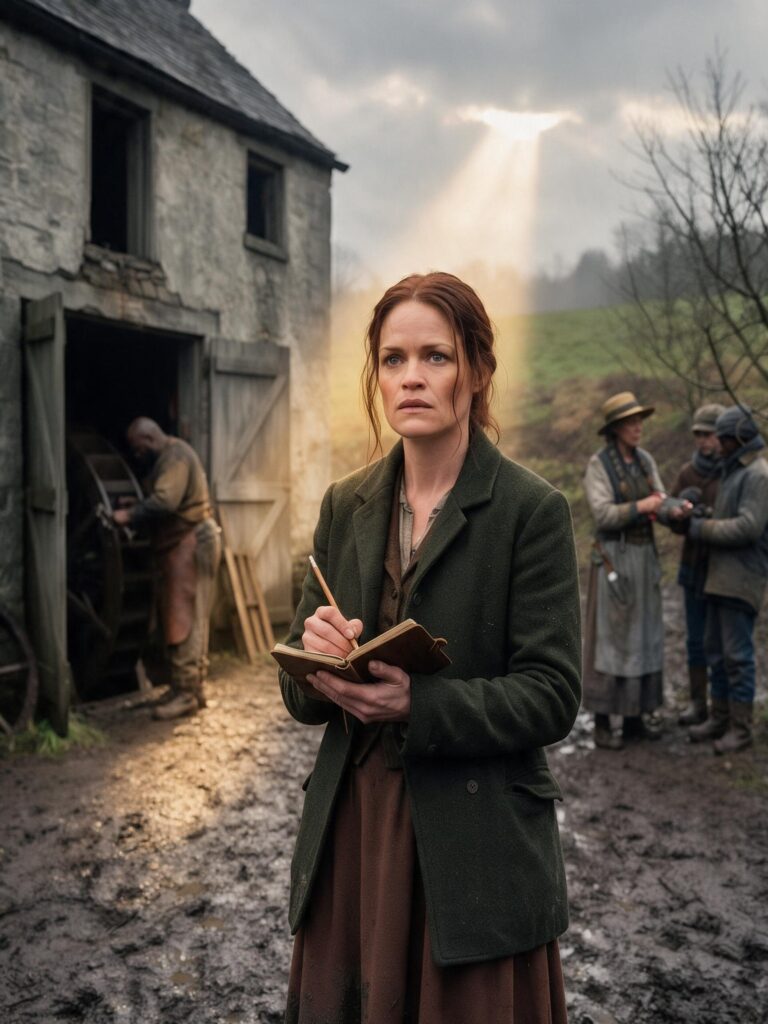
he was handed a ruined mill farm so her brother-in-law could be rid of her — she made the creek pay attention and turned it into the best farm in the valley
Part 1
The wagon wheel dropped into the mud with a sound like a heavy door slamming.
Louisa Tarrant grabbed the seat as the whole wagon tipped. The old gray mare, Pepper, threw her weight into the harness. Her hooves slid. Rain came sideways off the hills and ran down the back of Louisa’s neck, cold as a hand laid on her skin.
“Come on, girl,” she said. “One more pull.”
Pepper pulled. The wheel did not move.
Louisa climbed down. Her boots sank to the ankle in cold brown mud. She walked around to the front and saw the problem. The lane had washed out, and the wheel sat in a hole as deep as a bucket. She put her shoulder against the wheel and pushed. Nothing. She pushed again. Mud splashed her skirt to the knee.
Then she stopped, and for the first time she looked up.
At the end of the lane stood a gray stone building with one corner of its roof caved in. The old mill. Past it, on the hill, rows of crooked apple trees stood black and wet and tangled. A farmhouse sat below them with half its shutters gone and one chimney leaning. There was one thin line of smoke. It was the only sign that anyone still lived there.
Louisa was thirty-three. Everything she owned was in the back of that wagon. Two trunks, a crate of books, Daniel’s coat rolled in oilcloth, a kettle, and a notebook she had bought in town the day she signed the papers. This wet, sagging, forgotten place was now hers.
She took the notebook from inside her coat and held it in her hand. The pencil shook in the cold. She wrote one line.
Day one. Everything is broken.
Then she put the notebook away, set her shoulder against the wheel again, and pushed.
It had not started in the mud. It had started three weeks earlier, in a warm study with a good fire, when her brother-in-law put a pen in her hand and smiled.
Cyrus Tarrant did not think he was being wicked. That was the hard part. He thought he was being generous.
The Tarrant house stood on the river road, big and white, with a porch on three sides and a lawn that a hired man kept neat enough for Sunday. Louisa had lived in it since Daniel died. Two years now. Daniel had been Cyrus’s younger brother, the one who laughed easier and kept worse books, and the family had decided that a widow with no money of her own should live under the family roof. Nobody had been cruel to her. Cyrus paid every bill. She had a good room and a place at the table. The cook asked what she wanted for breakfast and then made what Cyrus liked. The minister’s wife told her which pew was suitable. Cyrus’s wife, Ellen, who was kind in the way of a woman who did not like trouble in her hall, chose the dresses Louisa wore to church and called it help.
Every choice about her life was made in some other room by some other person and told to her afterward. What she would wear. Who she would sit beside. What she could spend. Louisa had learned that a person can be ignored very politely. Politeness was the blanket they laid over her. It was warm. It did not let her stand up.
On a gray November morning, Cyrus called her into his study. His lawyer, Mr. Fitch, was already there with a stack of papers tied up in a ribbon. The fire snapped. Rain ticked at the window. Cyrus stood with his back to it, pleased with himself in the way of a man who has solved a problem before breakfast.
“Louisa,” he said. “I have good news. I’m giving you the Dunore place.”
She knew the Dunore place. Everyone in that part of the valley did. Old Absalom Dunore had built a mill there and planted an orchard back in the early days, when the creek still had a name people used with respect. After he died, trustees had let it sit. It had been empty for seven years, or near enough. Boys dared each other to go into the mill after dark. Farmers shook their heads when they passed the lane.
“The whole thing,” Cyrus went on. “House, barn, orchard, mill. A hundred and sixty acres. No loan against it. It’s yours.”
“Why?” Louisa asked.
“Because it’s empty, and it’s doing nobody any good.”
That was part of the reason. Louisa waited for the rest. Cyrus had never been good at silence.
Mr. Fitch cleared his throat. “There’s one paper that needs your signature, Mrs. Tarrant.”
He slid it across the desk. Louisa read it slowly. Under Oregon law, a widow had a claim on her husband’s land. Dower, they called it. The Tarrant brothers had owned a long strip of riverfront together, and after Daniel died, Louisa’s claim was tied to his half. Cyrus wanted to sell the whole strip to a man named Barnabas Kerr. Kerr owned the big warehouse at the river landing, and this land lay right beside it. No buyer paid full price for land with a widow’s claim still sitting on it. Her name on this paper would make the claim go away.
There was another reason too, one Cyrus did not say out loud. A widow in the house was a problem he had inherited from his brother. He wanted it solved. Ellen wanted her sewing room back. The valley wanted a story that ended neatly.
“I see,” Louisa said. “The farm is the price of my signature.”
“It’s a trade. A fair one. You get a home of your own. I get clear papers.”
“Is that all of it?”
Mr. Fitch turned the page. “Mr. Tarrant also keeps the right to buy the Dunore place back any time in the next two years, for what it is worth today. And there is a loan of two hundred dollars for repairs. Once a year, you would send a report on how the farm is doing.”
Louisa read the line twice. The buyback price was written as the present value, which Mr. Fitch’s summary put at very little. A ruin’s price. If she failed, she kept a ruin and a debt. If she did well, Cyrus could buy it back for what it had been worth when it was falling down.
“If I fail, I keep a ruin,” she said. “If I do well, you can buy it back at a ruin’s price.”
“I would never do that,” Cyrus said.
Mr. Fitch looked very carefully at the papers.
“Then you won’t mind that it’s written down,” Louisa said.
Cyrus leaned back. Something moved across his face, just for a moment. Not anger. Surprise, maybe, that she had said the quiet part in a room with a lawyer in it.
“You think the farm is a way to send you off?”
“I think it’s a very polite way to show me the door.”
“No one is showing you the door.”
“All right. So you’re only giving me somewhere to go.”
She did not say what else she thought. That two years of being managed had taught her the shape of a gift with a string on it. That Daniel, who had loved his brother and also known him, would have read the buyback clause twice and then laughed without humor. The reason mattered less than it used to. For two years, everything had been decided for her. These papers were unfair, and they were written to be easy for him. But they held one thing nothing else in that house ever had.
Her name, by itself, on land.
“I’ll want to read the books before I sign,” she said.
Cyrus looked surprised. “You’d rather read than celebrate?”
“I’d rather know what I’m celebrating.”
Mr. Fitch had a short summary of the farm’s accounts. She read it that night by a lamp in her room, the good room with the carpet Ellen had chosen. It was only one page of numbers. It did not say why the farm had failed. It only said that it had. Rents behind. Mill idle. Orchard income falling every year. A cow herd cut down again and again. Nowhere on the page did anyone ask a question. That was the thing that stayed with her. Nobody had ever asked why.
By morning she had decided. She signed the dower release. She signed the repair loan. She signed the buyback clause because she had read every word of it, and she meant to make it worthless.
“Thank you,” Cyrus said, as if the matter were done.
“I’ll thank you when I have something to thank you for,” Louisa said.
Ellen cried a little at the door, the way a person cries when a difficulty is leaving and they are decent enough to feel badly about being glad. Cyrus had the wagon loaded. He offered a hired man to drive her. Louisa said she would drive herself. She wanted the first set of hands on the reins to be her own.
Three weeks later she was stuck in the mud, and the place at the end of the lane looked like the numbers had been telling the truth.
The wagon came out of the hole at last, not because of Louisa, but because a man appeared out of the rain leading an old brown mule.
“Looks like you could use another set of legs, ma’am,” he said.
He hooked the mule to the wagon. In a minute the wheel came up out of the mud with a long, wet sucking sound. He did not make a speech about it. He nodded at the mare as if she had done her part, and he looked at Louisa’s two trunks and her one small wagon with the tired look of a man waiting for another owner who would soon give up.
“Elias Kimble,” he said. “Last hired man at Dunore. The old owners are gone. I stayed.”
“Louisa Tarrant,” she said. “I’m not visiting.”
He blinked rain off his lashes. “Then you’ll want the kitchen fire. Stove smokes when the wind turns. I was about to put a brick in the door to keep it from blowing open.”
She followed him up the lane. The house smelled of damp wool and cold ash. One window was boarded. The table had a burn mark shaped like a pot. Kimble set her trunks inside without being asked and stood with his hat in his hands, waiting to be told he could go back to whatever corner he had been living in.
“Where are the books?” Louisa asked.
He blinked again. “The books.”
“The account books.”
They were in a tin box under the kitchen table, wrapped in a feed sack to keep the mice out. Louisa lit the lamp. The stove coughed smoke into the room whenever the wind changed, so she opened the window a crack and read with her coat on. Kimble sat on a stool by the door and did not offer to explain anything until she asked. She liked that about him already.
By dark she understood why nobody wanted the place. The mill had not ground a single sack of grain in seven years. The orchard had earned less money every year, and nowhere in the books was there any pruning, any drainage work, any new trees. Two families rented small houses and fields from Dunore, and both were behind on their rent. The barn roof had been patched so many times that the patches had patches. Six farms sat along the creek. All six hauled their wheat six miles to another mill, owned by a man named Ephraim Don, and paid him to grind it. On bad roads in winter, the trip could take a whole day.
Louisa tapped her finger on that line in the ledger.
“Mr. Kimble. Why did the mill close?”
“Trustees said it cost too much to fix. They did the numbers once. Then they stopped looking.”
“Did anyone ever look at the creek?”
He shook his head slowly.
“Why did you stay? You can’t have been paid much.”
“Half the time, not at all.” He looked at the stove. “Nobody ever told me to go.”
Louisa wrote that down. Not the words. She just wrote: Kimble knows everything. Ask him.
Outside, the rain kept on. The leaning chimney ticked as it cooled. She slept that night in her coat, on a mattress that smelled of mice and cedar, and woke to a thin line of smoke still rising because Kimble had kept the stove alive. Day one was over. Day two would be walking.
Part 2
In the morning, Mr. Kimble offered to bring the wagon around. Louisa said no. She pulled on Daniel’s old boots, packed her notebook, and walked.
The cold was sharp and clean. Frost sat on the grass along the lane. The mill rose on her left, stone and silence, the broken corner of the roof letting in a slice of white sky. She did not go in yet. She wanted the people first. Land lied less when somebody who lived on it was talking.
At the first of the rented houses, a woman named Ruth Haskell stood in the doorway with three children behind her. The roof over her head was patched with boards. Her husband had hurt his back at harvest and had not been right since. They were behind on rent by a season and a half. Ruth answered Louisa’s questions the way a person answers a census man, politely, with no expectation that the answers would turn into shingles.
At the second house, an old man named Brewer showed her a wall black with damp where rain came in around a cracked chimney. His son had sold the calves last spring and spent the money on a new buggy. The buggy sat in the shed with a shine on it. The chimney did not. Brewer did not apologize. He also did not ask for mercy. He seemed to have used up both.
Louisa almost wished someone would shout. The quiet was worse. It was the quiet of people who had stopped expecting anyone to do anything about the answers.
So she kept asking, and she wrote down everything. Which roads flooded first. Which fields stayed wet. How far to market. Who had left for the railroad. Who kept hens. Who needed a coat before January. She wrote the names of the children. She wrote that the Haskell girl had a cough that sounded deeper than a cold.
She walked the creek too. She stood at the old mill gate and laid a stick on the water, and with Daniel’s pocket watch she timed how long it took to float thirty feet. She wrote the number down. She did it again the next day and the next. She did not know yet what the numbers meant, but she knew she would need them by August, when every man on the creek said the water went thin.
On the fifth night, in the barn, she found something folded behind a stack of old harness. A map, drawn by hand. The ink had faded brown. Absalom Dunore had made it himself. It showed the creek, a narrow channel leading off it, and the mill. On the hill above, six acres of orchard, every tree marked in its row. There were notes in a small careful hand. Race leaks at the bend. North row wants sun. Do not plant the low meadow to wheat.
She spread it flat under the lamp.
“Mr. Kimble,” she said when he came in from shutting the mule in, “tomorrow I want to go through that mill. Every room.”
He looked at the map, then at her. For the first time since she had arrived, there was something besides tiredness on his face.
Ephraim Don arrived the next week. He came on a tall black horse with flour still in the creases of his coat. He was about fifty, broad and slow-spoken, and by every account a very good miller. He did not get down from the horse.
“Hear you’re thinking of starting up the old mill, ma’am.”
“I’m thinking of looking at it.”
“I’ve lived on this creek all my life. I hauled grain to that mill when I was a young man. That race leaks. The creek runs half thin by August. You’ll spend your money, and then you’ll sit beside a dry wheel.”
“How thin?” Louisa said.
He blinked. “You beg your pardon?”
“You said half. Half of what? I’ve been measuring it every day. Now I’ll know what half looks like.”
For a moment Don just looked at her. Then he gave a short laugh. Not mean, but not kind either.
“Well. Good luck to you.”
When he rode away, Louisa wrote in her notebook: Don says half in August. Plan for half.
She did not try to fix everything at once. She started with what would hurt most if it waited.
Two of the leaking house roofs were mended before the worst of the winter rain. She used part of the repair loan and Kimble’s back and a neighbor boy who would work for meals. The cracked chimney at Brewer’s was rebuilt. She visited the two renting families one at a time, and she did not treat them the same, because they were not the same. The Haskells got until next fall to catch up. Ruth cried once, briefly, and then asked what day Louisa wanted the boy for the orchard. The Brewers got no extra time. The buggy could be sold, or the rent could be paid. Brewer’s son blustered. Louisa waited him out. Being fair, she told Kimble that night, did not mean treating everyone the same. It meant looking closely at each.
The orchard took more patience. She drove over to the next farm to meet Dorcas Penn, a widow of fifty-five who had kept her own orchard alive for twenty years. Dorcas had hands like old roots and a laugh that came from nowhere and went back there when she was done with it.
“Those Dunore trees,” Dorcas said. She stood at the top of the hill, hands on her hips, looking down at the crooked rows. “They’re old. Not dead. Somebody back then knew what he was doing.”
She showed the hired men how to open up the middle of each tree so the sun could reach the fruit. They scraped off the moss. They cut out dead wood and burned it in a long smoky line that the valley could smell for two days. Where a tree was too far gone, they cleared the spot and planted a young one Dorcas had grafted herself. Along the top of the hill they dug a long ditch to carry rainwater away from the roots. The oldest rows would take years to come back. The trees were stronger than the ledger had said. Louisa wrote that down too, because she was learning that ledgers recorded neglect and called it nature.
In January she hired Ansel Toiver. He was a millwright, a big quiet man with scarred hands who lived two miles away and had not had steady work in years. He spent most of a morning inside the mill. He tapped the walls with a hammer. He lay on his back in the wheel pit with a lantern. When he finally climbed out, he had cobwebs in his hair and a look Louisa was starting to recognize. A man finding out the place was better than its reputation.
“The wheel’s rotted through,” he said. “I could push my thumb in it. The gears are chewed. But whoever built those walls knew what he was doing. They’ll outlast us both. And the race is choked with roots. Two weeks of shoveling and it will run.” He rubbed his jaw. “I’d also build you a small pond above the gate. Hold water for the dry weeks.”
“What will it cost?”
He named it. Ninety dollars in timber and iron, plus his work.
“How long?”
“Three months. Maybe four.”
Louisa did not say yes. She asked for something else first. She asked Kimble to find out what the six farms paid Don each year in grain and in hauling. She asked what they would pay to grind closer, if the fee was fair and the road was short. She sat up two nights with the numbers, the stove smoking, her coat on, the map weighted at the corners with a cup and a stone and Daniel’s watch. Only when the numbers said yes did she say yes.
Winter bit down after that. The lane froze and thawed and froze again. Pepper went lame for a week and Kimble poulticed her with something that smelled like the barn and worked anyway. Louisa learned the house by its complaints. The board by the pantry that sang when you stepped wrong. The window that had to be propped with a stick. The way the chimney leaned but held, which felt like a lesson she was not ready to trust.
She wrote Cyrus his nothing-letter in January, because the papers said a yearly report and she meant to keep every term she had signed. The mill is down. The orchard is cut back. Two roofs are mended. I have hired a millwright. She did not write what she thought, which was that his bargain was already starting to look like a door he had meant to shut and had instead left open.
Mr. Fitch sent a polite acknowledgment. Cyrus did not write at all.
Part 3
The bad news came in March, when the gears turned out worse than Toiver had thought. New iron cost far more than the plan. By then the repair money was almost gone. Cash was scarce through the valley that year. The big money panic had frightened the banks, and they were still afraid. Men who had lent easily the year before now looked at a widow the way they looked at a wet field. Possible, but not this season.
Louisa went to a lender in town named Mr. Rudd. He had a small office over the feed store and a habit of tapping his pencil while other people talked. He gave her a small loan with a hard look and a high price. It was enough for the gears. She signed it because the mill without gears was a building, and a building did not pay the Haskells’ time or Toiver’s hands or the note Cyrus still held like a string.
In the second week of May, the new wheel turned for the first time.
It gave a groan, shook off a winter of dirt, and began to turn. Then the whole mill began to hum, a low sound Louisa felt in her feet before she heard it in her ears. Toiver stood with his hands on his hips and said nothing, and Louisa saw that his eyes were wet. Kimble took his hat off, which he did not do for weather. Dorcas, who had come to see if the widow was as stubborn as advertised, laughed once and said, “Well. It remembers.”
Ephraim Don watched from his horse at the edge of the yard.
“Well,” he said at last. “That’s a wheel.”
“Come back in August,” Louisa said, “and tell me about the water.”
He almost smiled.
By June the mill was busy. The six farms on the creek brought what was left of last year’s wheat. They saved the long trip to Don’s, and they said so, some of them grudging, some of them glad. Louisa charged everyone the same fee, rich or poor, large farm or small. Kimble told her folks would pay a little more and never complain. They’d got nowhere closer.
“They’d pay it once,” Louisa said. “Then they’d go right back to Don’s. I want them here in ten years.”
She had flour now. The first good flour Dunore had made in seven years. It smelled clean. It packed into sacks that held their shape. Her plan was simple. Send it to Portland by steamboat, the way the whole valley did, through the big warehouse at the river landing.
The man who owned that warehouse came to see her first.
Barnabas Kerr was fifty, trim and calm, in a good gray suit that did not have flour in the creases. He was the same man who wanted the Tarrant riverfront. He never raised his voice. He never needed to. He ran the landing, and the landing was the only door the valley’s wheat could go through on its way to the world. Farmers paid him to store it. Steamboat men took his orders. Prices in the valley were whatever he said they were, a little higher or a little lower, depending on how he felt about you.
He walked through the mill with his hands behind his back.
“Very handsome piece of work, Mrs. Tarrant. I’m told it’s already earning its keep.”
“It’s early.”
“I’d be glad to buy it today, if you like. I’d pay you more than you’ve spent.”
“It’s not for sale.”
“Of course.” He smiled. “Then I hope you’ll find that shipping goes smoothly.”
Two days later her wagon of flour rolled up to his landing. The clerk at the door would not look at her.
“Sorry. No room.”
Louisa looked past him. She could see the inside of the warehouse. It was half empty. A cat slept on a sack. A boy swept a clean floor.
“Mr. Kerr has told us we’re full up,” the clerk said.
She drove the wagon home. The flour sat in the mill like a question. That night she sat at the kitchen table, and Kimble sat across from her, and neither spoke for a long time. The stove behaved, for once. Rain ticked and quit.
“He’s telling the whole creek that the new mill can’t ship,” Kimble said.
“Then we need a way to ship without him.”
She took out her notebook. Over the winter she had written down every road in the district and which ones flooded. She had walked them herself, in Daniel’s boots, with Kimble sometimes and sometimes alone, because a road told you different things when you were the one carrying the weight of the decision. On page forty-one she found what she wanted. An old ridge road that ran along high ground, rough but dry, to a small landing six miles up the river. That landing belonged to a man named Holt who did not like Kerr and was not shy about saying so at the grange.
She wrote three letters that night. They went to three buyers in Portland. In each she described her flour and asked for their best price, and she did not mention Kerr’s name, because she wanted the flour judged as flour.
Two weeks later the answers came. One buyer offered more than Kerr’s price had ever been for creek wheat. So Louisa’s flour went up the ridge road, past Kerr’s landing, without stopping. Holt’s man loaded it without a speech. A week after that, three of the creek farmers asked if their grain could go with hers.
August came, as Don had said it would. The creek dropped. Toiver’s pond held for ten days. Then the water in it began to sink, and the wheel turned slower and slower and stopped.
Louisa walked upstream with Kimble. They went past the old gate, past the bend, past the Haskell field where the girl with the cough was hanging wash and waved. A quarter mile above, they found it. A new dam. Logs and brush and packed mud built across the creek in a place where there had never been one. Behind it the water lay flat and still. Below it, only a trickle.
A man was sitting on the bank with his hat over his eyes. His name was Slade. He worked for Barnabas Kerr, and he had rented the field just above the Haskell place the month before.
“For my cattle,” he said. “They need water.”
“That’s a lot of water for cattle,” Louisa said.
“A man can water his stock.”
She did not argue. She did not shout. She looked at the dam long enough to remember it, and she went home, and she thought. The notebook filled two pages. Who used the creek. Who had a right. Who would be hauling to Don’s again before frost if the wheel stayed still. Who in the valley still believed a woman with a repaired mill was a temporary inconvenience.
The next evening she did something she had never done. She stood up in the grange hall.
Part 4
The hall was crowded. Farmers from up and down the creek sat in their work clothes with their arms folded. The lamps smoked. Somebody’s dog had got in and was asleep under a bench, which made the room feel more like a kitchen than a court. Louisa had worn her plain dress and Daniel’s watch, not because the watch helped her speak, but because her hand needed somewhere to go.
She told them what she had seen. She said that if the dam stayed, the mill would stop, and the six farms would be hauling grain to Don’s again before the first frost. She did not say Kerr’s name until someone else did. She did not need to. Half the room had already done the arithmetic.
“Why should we care?” a man called from the back. “It’s your mill. Not ours.”
“Because it’s your creek too,” Louisa said.
It was quiet. The dog sighed. Then a chair scraped, and a big slow man stood up. Ephraim Don. Everyone in the room knew he had the most to lose from her mill. His coat still had flour in it. He looked at the floor for a moment, as if the words were down there and he had to pick them up.
“I was a young man hauling grain to that mill in ’53,” he said. “The creek ran that mill every summer. Every summer. Absalom Dunore never had trouble with water, because nobody above him ever took more than their share.” He looked around. “Now somebody has. And I’ll tell you something. I told this lady that mill would sit dry. I was wrong. It wasn’t the creek that was going to stop it.”
He sat down.
The room did not cheer. It did something better. It shifted. Men who had come to watch a widow fail looked at their boots. Ruth Haskell’s husband, back still bad, said if the creek was common water then a private dam was a private theft. Two others agreed, not loudly. By the time the lamps were blown out, the grange had asked Judge Maddox to come look.
The next morning the judge rode up the creek, looked at the dam, and told Slade to take it down. He did not make a speech either. He was a man who liked fences where fences belonged and water where water had always gone. Slade took the dam apart with a bad grace and a mule. The water came back. The wheel began to turn.
Louisa wrote one line in her notebook that night. Don told the truth when it cost him.
September brought a letter from Mr. Rudd. It was short. He was sorry, but the small loan was due in thirty days. All of it. Cash was tight. He needed his money. The loan, he wrote, had been sold to another party. He did not say who. He did not need to.
Louisa read it three times. Then she sat at the kitchen table with the lamp turned low and the ledger open and added up the numbers. She did not have enough. Not that fast. The mill had been paying its way for only four months. The orchard had given a small, sour crop, better than nothing, not enough to bury a called note. The buyback clause sat in the drawer like a second weather.
Kimble came in and sat down without being asked.
“I can lend what little I’ve saved.”
“No.”
“It’s not much. But it’s something.”
“You’ve already given this place years it didn’t pay you for,” she said. “I won’t take your winter on top of it.”
He stayed anyway, which was its own kind of loan.
Dorcas Penn came the next day with a jar of apple butter and an envelope. Inside was money, folded small, the kind of money a woman keeps where a bank cannot lecture her. Then the Haskells came. Then two other families from up the creek. They stood in the doorway with their hats in their hands, mud on their boots, the particular embarrassment of people who have decided to be decent in public.
“We figured something out,” said the oldest Haskell. “We’ve been grinding here since May. We’ll grind here all next year. So we’ll pay ahead. Whatever you need to get that note off your table.”
It was not charity. It was a bet that Louisa would still be there next year. They were betting with their own grain.
She did not cry. She wrote down every name and every amount. She made them take receipts, because a favor without a record turns into a story somebody else tells later. The next morning she went to town and paid the loan in full, in coins, at Mr. Rudd’s office. She made him write paid across the paper. He tapped his pencil. He did not smile. She did not need him to.
Then she rode to the grange hall, and with the six farms of the creek she made a plan that was simple. One shipment. One price. One route up the ridge road to the upper landing. Everyone’s grain, her flour, and the first dried apples from the orchard in the same wagons. No special rate for a big farm. No penalty for a small one. Holt would take the loads. The Portland buyer would pay on delivery. It was not a trick. It was a lot of people doing the same thing at once.
That autumn, a man in a good gray suit looked at the empty road that ran past his landing and said nothing at all.
Mr. Fitch came out to Dunore in October, politely, to look at her first yearly report, as the paper said he could. He went through every page. The mill’s fees. The rents, one caught up and one on a written extension. The orchard costs. The note marked paid. When he finished, he set down his pen.
“I will tell Mr. Tarrant that the books are in very good order.”
“Will he be pleased?”
Mr. Fitch took a moment before he answered. “I believe he will be surprised.”
Back in the white house on the river road, Cyrus Tarrant had been surprised for some time. The talk had started in the spring. At the church picnic a neighbor said the Dunore mill was running. At the feed store someone mentioned a shipping group that did not use Kerr’s landing. Even his own hired men asked about it, carefully, the way men ask about weather that might reach their own fields. He heard the name Mrs. Tarrant more often than he heard his own, and he did not like how much it bothered him.
There was something else too. Cyrus owed money. The panic had hit him hard, and the year before he had borrowed a large sum from Barnabas Kerr to carry him through. He had thought nothing of it at the time. Kerr’s terms had sounded like friendship. They were not.
Now, in his study, he listened to Mr. Fitch.
“Mr. Kerr has made you an offer,” Fitch said. “Use your right to buy back the Dunore place. Sell him the mill site. In return, he will let your loan run another three years at a lower rate.”
“And if I don’t?”
Fitch did not say. He did not have to. A landing man who held your note did not need to raise his voice.
Cyrus stared at the window. It was October, and the rains had come early and heavy. Two days of it. The roads in the valley were turning into rivers of mud. Wagons sank to their axles. At Kerr’s landing, grain sat piled in the open, wet through, because no wagon could reach the warehouse door. Cyrus had four hundred sacks of his own wheat sitting in his barns with no road to carry them out.
The next morning he rode to Dunore in the rain.
Louisa met him in the mill, flour on her sleeve, a ledger open on a sack of grain. He looked older than he had in the study. Wetter, certainly. Smaller, which was not a thing she had expected to feel glad about, and she was not glad. She was tired, and she was curious, and she was not going to make it easy just because he had finally driven his own wagon into weather.
“You didn’t ride out in this to look at my roof,” she said.
“I came to ask for advice.”
“Whose?”
“Yours. I want to know what you would do about my wheat.”
“That’s a new question from you.”
“I know.”
He did not defend himself. She did not make him suffer for it, but she did not pretend the last two years had been a misunderstanding. She opened her winter notebook on the flour sack and showed him a map. The roads that flooded. The roads that did not. The old ridge road. The upper landing. She told him how the shipping group worked. Everyone paid the same. Everyone shared the wagons. Nobody got special treatment. Not even him.
“You’re welcome to join,” she said. “On the same terms as anyone.”
Cyrus read the map. He read it again. Water ran off his hat onto the stone floor and found the drain Toiver had cut.
“Your notebook knows more about this valley than I do.”
“I walked it. That’s all.”
He was quiet. Outside, the rain kept falling.
“What would you do with my wheat?”
“Send it up the ridge road today, before the creek rises any higher. And next year, stop pretending the low meadow is a wheat field.”
He did send it. Over the next weeks she spent three days on his own farms, walking his fields with his foremen, because he asked and because the creek did not care who had been polite to her in a study. She did not spare him. At one low meadow, the wind flattening the wet grass around their boots, she said, “You’ve been trying to grow wheat in a swamp for ten years. Dig a ditch. Put cows on it. Stop arguing with the water.”
“You make it sound like the land gives orders.”
“It’s been giving them for years. Nobody was listening.”
He laughed. It was short and surprised. She did not say it aloud, but that was when she knew something had changed. Cyrus no longer looked at her like a problem to be handled. He looked at her like a person who had been right about a thing he had been wrong about, and the knowledge sat badly on him, which was the beginning of it sitting honestly.
Through the winter and the next summer, the valley changed its habits. The shipping group grew. By spring, nineteen farms were sending their grain up the ridge road and through Holt’s landing. Cyrus’s wheat went with them. By midsummer he had paid down almost half of what he owed Kerr. The weight began to hurt the landing. A warehouse with no wheat is just a shed beside a river. Kerr still smiled when he was seen in town. The smile had less room in it.
The buyback clause still hung over Dunore. It would end in November. There were only weeks left. Kerr’s offer to Cyrus still stood. So did the two years Louisa had spent making a ruin into a place a man might want to take back at a ruin’s price.
She did not write Cyrus about it. She had already said what she meant to say, the day she signed. She kept the mill turning. She kept the receipts. She waited to see what kind of man he was when the paper in his drawer could still be used.
Part 5
The county fair came in September. By noon the grounds were crowded with farmers and merchants and county officials, and the dust had a sweet smell of animals and pie. There were long tables of apples, pens of fat cattle, sacks of grain with ribbons pinned on them. Louisa walked in with Kimble, Dorcas Penn, and Toiver. She carried a small box of the mill’s books because people kept asking to see them, and she had learned that a rumor traveled faster if you did not bring the page that answered it.
“They tell me your dried apples brought the best price in Portland this year,” said a man at the Dunore table.
“The first year was poor. This one was better. Ask me again next year.”
“Is it true you lowered everyone’s rent?”
“No. I looked at each family and gave time to the ones who needed it. That’s all.”
By afternoon the Dunore table was the busiest at the fair. Dorcas sold apple butter until her hands ached and refused to sit down. Toiver stood like a post and blushed when a boy asked how a wheel was built. Kimble told anyone who would listen that he had stayed because nobody told him to go, and now he was glad of it, which was as close as he came to a speech.
At noon the county society held its big lunch under a canvas tent. Louisa sat near the end of a long table. Cyrus was near the head. Barnabas Kerr sat across the aisle, calm as ever, a napkin tucked in his collar. Judge Maddox stood with a glass in his hand.
“Friends,” he said, “I want to say a word about the Dunore farm. Two years ago that place was a ruin. Today it is the talk of the county. And I think we should all thank Cyrus.” He lifted the glass. “Cyrus, you saw what that creek could do before the rest of us did. Setting your sister-in-law out there was the smartest bet in the county.”
People laughed and clapped. A few turned to nod at Cyrus. Louisa kept her smile. Her hands went cold in her lap. The judge meant it kindly. He had taken two years of her work, the mud, the measuring, the called note, the dam, the ridge road, and set it in Cyrus’s hands, as if he had planned every bit of it. As if she were a piece he had moved across a board.
Cyrus could have accepted it. No one would have blamed him. The tent was warm with approval, and approval was a thing he had lived inside for most of his life.
He put down his glass and stood.
“Judge, I’m afraid I can’t take that one.”
The tent grew quiet.
“I’ll tell you why I gave Louisa that farm. I wanted my riverfront sold, and I wanted her out of my house. I thought I was handing over a bad piece of land. I was wrong about the land. And I was wrong about her.”
A few people shifted in their seats. Kerr’s fork paused.
“Everything good on that farm, she built. The mill. The orchard. The shipping group. All of it. All I did was sign a paper I thought was a bargain. If I deserve any credit, it’s for being the worst judge of land in this county.”
There was a soft, uncertain laugh. Nobody was sure whether they were meant to.
Then Cyrus reached into his coat and took out a folded paper. Louisa knew it the moment she saw it. The buyback clause. His copy, with his signature.
“I also have something to say about this.” He did not look at Kerr. “There are some of you who know I’ve been asked to use this paper to buy back the Dunore place and sell it to a man who wants it for himself.” He held it up. “I won’t.”
He tore it in half. Then he tore the halves in half, and he laid the pieces on the white tablecloth.
“It’s her farm. It has been her farm since the day she drove up that lane.”
The silence in that tent was the loudest sound Louisa had ever heard. Across the aisle, Barnabas Kerr set down his fork. His face did not change. He wiped his mouth carefully, folded his napkin, and stood. He did not look at anyone. He walked out into the sunlight and did not come back to the table.
Louisa looked at Cyrus. He looked back. He had said it plainly, in front of a tent full of neighbors, with nothing to gain but the loss of a lever. She nodded once. It was not forgiveness in full. It was recognition, which was the thing she had wanted from that house for two years and had not been given until he tore the paper himself.
Later that afternoon a man in a dark coat came to the Dunore table with an envelope. The county society’s inspectors had visited Dunore in August. They had spent two days there. They had stood in the mill and counted sacks. They had talked with Kimble and the Haskells while Louisa was in town. They had walked every field. Louisa had taken them to the worst one first.
“You’ll find it anyway,” she had told them. “I’d rather you heard it from me.”
Now the envelope held the society’s top prize for the best-run farm in the county. It named her mill, her orchard, her fair dealing with her neighbors, and the fact that she had built it all without borrowing more than she could pay back.
Kimble read it twice, then a third time, moving his lips.
“Says here you’re the best,” he said. “Well. I could have told them that for free.”
Louisa laughed. Dorcas thumped the table hard enough to jump the apple butter. Toiver looked at the sky as if the sky had done it.
The news traveled farther than the fair. By winter there were stories. Kerr’s landing had lost most of its business. The wheat that used to go through his warehouse now went up the ridge road. People said he sold the landing the next spring and moved to a larger town. People said a lot of things. Louisa never did find out which were true, and she did not go asking. A man’s exit was his own. Her work was the wheel.
Cyrus paid his last note to Kerr by Christmas. He kept sending his grain with the group, and the group kept growing, and there was talk of a second mill on the lower creek, which Don heard and did not fight. He came by Dunore once in the snow and stood in the doorway and said the creek had room, if nobody got greedy again. Louisa said that was the whole rule. He nodded and left a sack of his own flour, which was either a joke or a peace offering. She ground nothing that day and sent it back with a note that said his was good flour and he should keep his name on it.
He came to Dunore the following March, Cyrus did, on a bright morning without a letter. Louisa was in the orchard, where Dorcas’s crew was checking the young grafts for frost. The apple buds were just showing green. The mill wheel turned below them in the spring light, steady as a clock somebody had finally remembered to wind.
For a while neither of them mentioned the fair. They walked along the top row. The ditch they had dug still held. The low ground below the orchard was in grass, the way Absalom’s map had said it wanted to be.
“Daniel would have liked this,” Cyrus said at last.
“He would have said it was too much work.”
“He would have. And then he’d have rolled up his sleeves.”
Cyrus smiled a little. Then the smile faded.
“I should have asked what you wanted, Louisa. I decided, and then I handed you a pen.”
“Yes. You did.”
He took that without arguing. Below them the wheel kept on.
“You gave me this farm because you’d stopped seeing it,” Louisa said. “I took it because I hadn’t. That’s the whole story.”
Cyrus nodded. “I’ll tell it that way.”
That evening a small notebook sat on the mantel in Louisa’s study, next to the county’s prize paper. The cover was stained. The corners were soft. She had carried it from the first day in the rain, in the mud, through the grange and the called note and the tent where a man tore up his advantage. On the first page, in shaky pencil, was one line.
Day one. Everything is broken.
Below it, in newer ink, she had added another.
It wasn’t. Nobody had counted.
Dunore was never rich. It never wanted to be. But it was a place where a roof held, a wheel turned, and nobody had to pay extra to be treated fairly. People still said Cyrus Tarrant gave Louisa that farm. He did. But a farm is only dirt until someone pays attention to it. Louisa paid attention every single day, until the ground answered.


