
Part 1
The first thing Celestine Harrow heard that evening was the sound of her stepmother turning the key.
It was a small sound, scarcely louder than the click of a lady’s fan closing. Yet after six years, Celestine knew it better than she knew the sound of her own laughter.
She stood beside the window of her bedroom, one hand resting against the faded blue curtains, and watched the first carriages approach Harrow Manor.
Beyond the lawns, the western sky burned a deep copper. Footmen hurried beneath the portico with lanterns. Somewhere below, a musician was testing the strings of his violin.
Another ball was beginning.
And Celestine, as always, would not be attending.
She was twenty-two years old, the eldest daughter of Lord Edmund Harrow, and had spent nearly a third of her life being treated as an embarrassment no one was permitted to explain.
Her younger sisters were downstairs, preparing to greet the most distinguished guests the estate had entertained in years. Lydia would wear her pearl-colored silk. Marianne had begged for a gown embroidered with silver thread.
Celestine had received no gown.
Instead, her stepmother had entered her room an hour earlier, inspected her plain muslin dress, and announced that she was to remain in the east wing until the guests departed.
“Your father wishes the evening to proceed without complications,” Lady Octavia had said.
Celestine had looked at her reflection in the mirror.
“And am I a complication?”
Her stepmother’s answer had been almost gentle.
“There are matters you do not understand, child.”
“I am no longer a child.”
“Then demonstrate some maturity by respecting your father’s wishes.”
There had been nothing more to say.
Now the door was locked, and the chandeliers below were being lit one by one.
Celestine turned from the window and crossed to the writing desk beneath the portrait of her late mother.
Her mother had died when she was nine. What little Celestine remembered came in fragments: lavender water, a warm hand against her forehead, a voice singing French lullabies beside the nursery fire.
There was one other memory, stranger and more persistent.
A silver pendant.
Her mother had fastened it around her neck shortly before her death, telling her to keep it safe.
Celestine had worn it until the summer of her sixteenth year, when she had been permitted to attend her first ball.
She had danced twice that night.
During the third dance, an elderly gentleman had noticed the pendant.
He had gone so pale that Celestine thought he might collapse.
“Where did you get that?” he had demanded.
Her father had appeared almost immediately.
Within minutes, Celestine had been escorted upstairs. The next morning, the pendant vanished, and every question she asked was met with silence.
That was the beginning of her imprisonment.
No one called it imprisonment, of course.
Lord Harrow described it as protection. Lady Octavia preferred the word discretion.
Society was told that Celestine suffered from a nervous weakness that made public occasions dangerous to her health.
And in time, society ceased asking about her.
A gentle knock interrupted her thoughts.
“Miss Celestine?”
She turned.
It was Mrs. Finch, the elderly housekeeper, speaking through the door.
“Yes?”
“I’ve brought your supper.”
Celestine heard the key turn.
Mrs. Finch entered carrying a tray with cold chicken, bread, and a small dish of preserved peaches. Behind her, the corridor was empty.
“Your stepmother instructed me to make certain you were comfortable.”
“How considerate.”
The housekeeper’s expression softened.
“Miss, I don’t imagine it helps to be bitter.”
“Does it help to be obedient?”
Mrs. Finch had no answer.
Celestine looked past her toward the corridor.
“Is the Duke here?”
“His Grace arrived half an hour ago.”
“And is he as terrifying as everyone says?”
“I haven’t seen enough of him to judge.”
“I’ve heard he rarely smiles.”
“So I’ve heard.”
“And that he refused three marriage proposals last season.”
“Miss Celestine.”
“And that he once dismissed a countess from his drawing room because she insisted upon discussing his income.”
Mrs. Finch pressed her lips together, concealing a smile.
“You ought not listen to servants’ gossip.”
“It is the only society I am permitted.”
For a moment, the housekeeper looked genuinely pained.
Then she placed the tray on the desk.
“I shall return for the dishes before midnight.”
When she departed, Celestine noticed something extraordinary.
The key remained in the lock.
Mrs. Finch had forgotten to turn it.
Or perhaps, Celestine thought, she had deliberately chosen not to.
Downstairs, the musicians began a waltz.
Celestine stood motionless.
For six years, she had listened to life happening on the other side of locked doors.
That evening, for reasons she could not have explained, the familiar humiliation became unbearable.
She opened the door.
The east-wing corridor stretched before her, dimly illuminated by a succession of wall lamps.
She stepped outside.
Every instinct urged her to return.
Instead, she walked toward the music.
She passed the abandoned morning room and the gallery of ancestral portraits. She descended the servants’ staircase, careful to avoid the main landing.
The nearer she came to the ballroom, the louder the music grew.
She could hear laughter, conversation, the scrape of dancing slippers, the occasional sharp voice of her stepmother.
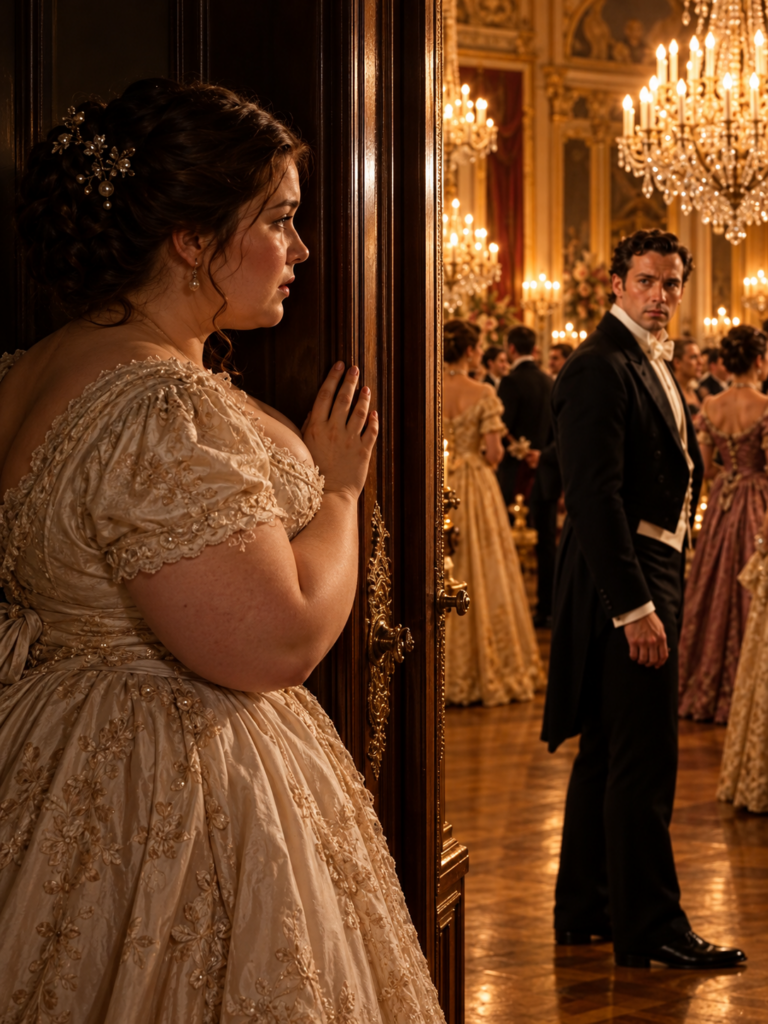
At last she reached a narrow passage beside the ballroom’s eastern entrance.
One of the double doors stood open a few inches.
Celestine stopped.
Through the opening she saw a world she remembered only in fragments.
Chandeliers glittered above the polished floor. Women moved through the room in silk and satin, their jewels catching the candlelight. Gentlemen bowed, laughed, and offered their hands.
Marianne was dancing with a young officer.
Lydia stood near the refreshment table, smiling at a gentleman whose admiration was unmistakable.
Their father presided over the gathering with the easy confidence of a man whose household possessed no secrets.
Celestine remained in the darkness.
She did not envy the gowns or jewels.
What hurt was something smaller.
Everyone inside that room had been invited to exist.
She had not.
“An unusual place to observe a ball.”
The voice came from behind her.
Celestine turned so quickly that her shoulder struck the doorframe.
A tall gentleman stood several paces away.
He wore an evening coat of severe black, a white cravat tied without unnecessary ornament, and an expression of quiet curiosity.
His dark hair was brushed neatly back, though a rebellious strand had fallen across his forehead.
He was handsome, but not in the polished manner of the young gentlemen Celestine remembered from her single season.
There was something guarded about him.
Something that suggested he had long ago learned to distrust rooms full of smiling strangers.
“Forgive me,” Celestine whispered. “I did not hear you approach.”
“So I gathered.”
She moved aside.
“The ballroom is through that door.”
“I know.”
“Then I shall not detain you.”
He glanced toward the opening.
“Do you intend to enter?”
“No.”
“Yet you seem rather interested in what is happening inside.”
“I enjoy music.”
“Then why not listen from the ballroom?”
Celestine almost laughed.
The question was so simple that it exposed the absurdity of her entire existence.
“Because I am not permitted.”
The gentleman’s expression changed.
“By whom?”
“My family.”
“Have you offended them?”
“Not to my knowledge.”
“Then perhaps there has been some misunderstanding.”
She looked at him.
“Sir, there are misunderstandings that last an afternoon. This one has lasted six years.”
For the first time, his mouth moved in something resembling a smile.
“That is a considerable misunderstanding.”
“It has become a family tradition.”
He studied her more closely.
Her dress was plain, but its cut and the dignity of her posture marked her as a gentlewoman. She wore no jewels. Her chestnut hair was arranged in a simple knot, and her hands were clasped tightly before her.
“May I ask your name?”
She hesitated.
“Celestine.”
“And your surname?”
Before she could answer, footsteps sounded behind them.
“Celestine!”
Lady Octavia Harrow appeared at the end of the passage.
The moment she saw the gentleman, her face drained of color.
“Your Grace.”
Celestine felt the blood leave her own cheeks.
The Duke of Ravensmere.
Gideon Ravensmere, thirty-two years old, master of one of the oldest estates in England, and the very guest whose visit had thrown her father’s household into such agitation.
He bowed slightly.
“Lady Harrow.”
Octavia approached with astonishing composure.
“I trust you are enjoying the evening.”
“Very much.”
Her gaze moved to Celestine.
“My daughter appears to have lost her way.”
“Your daughter?”
“Yes. She has been unwell.”
Gideon looked at Celestine.
“She seems quite capable of finding her way.”
Octavia’s smile tightened.
“Some illnesses are not readily apparent.”
“Indeed.”
“Come, Celestine.”
She seized her stepdaughter’s wrist.
The grip was not violent, but it was firm enough to make its meaning unmistakable.
Celestine lowered her eyes.
Then Gideon spoke.
“One moment, Lady Harrow.”
Octavia stopped.
“I was under the impression that Lord Harrow had only two daughters.”
“We rarely discuss Celestine’s circumstances.”
“That does not explain why.”
“It is a private family matter.”
Gideon’s voice remained perfectly courteous.
“I understand.”
But his eyes said something else.
Octavia led Celestine away.
As they disappeared around the corner, Celestine heard him ask one final question.
“Miss Harrow?”
She looked back.
“Do you truly prefer solitude?”
She could have lied.
It would have made everything easier.
Instead, she answered quietly.
“No, Your Grace.”
Then she was gone.
Gideon stood beside the ballroom door for several moments.
He had come to Harrow Manor to settle a dispute over timber rights in a woodland bordering his estate.
Lord Harrow had resisted every attempt to clarify an agreement signed nearly twenty years earlier.
The matter was inconvenient, though hardly remarkable.
But the young woman in the passage interested him far more than the disputed trees.
He knew the difference between shyness and fear.
He knew what it meant to have one’s future decided by others.
And he knew, with growing certainty, that Celestine Harrow had not been kept from the ballroom because of illness.
When he returned to the gathering, Lord Harrow greeted him with a glass of port.
“Your Grace. I trust the evening meets with your approval.”
“Your daughters are accomplished dancers.”
Edmund Harrow smiled.
“They have been carefully educated.”
“All three?”
The smile disappeared.
Gideon watched the transformation with interest.
“Ah. You have encountered Celestine.”
“I have.”
“She is a quiet girl.”
“She did not strike me as particularly quiet.”
“Her health has always been uncertain.”
“Lady Harrow mentioned as much.”
Edmund took a long drink.
“Then you understand.”
“Not entirely.”
A silence formed between them.
Lord Harrow eventually looked toward the musicians.
“I wonder whether we might discuss the boundary agreement tomorrow morning.”
“Certainly.”
Gideon set down his glass.
“But I suspect we shall have rather more to discuss than timber.”
That night, after the last dance, Gideon returned to the eastern passage.
He could not have explained why.
Perhaps he wished to confirm that the girl had not imagined the conversation.
Perhaps he was troubled by the speed with which her family had silenced her.
Or perhaps he had recognized something in her expression that he had seen too often in his own reflection.
The passage was empty.
The ballroom doors had been closed.
As he turned to leave, something glimmered beneath a narrow table.
A silver chain.
He bent and lifted it.
Attached was a small pendant bearing an unfamiliar crest: a white hart beneath three stars, enclosed within an oval of engraved ivy.
The silver was old.
The workmanship was exquisite.
Gideon held it closer to the lamp.
He knew that crest.
Or rather, he remembered seeing it in a collection of documents his father had forbidden anyone to examine.
The papers concerned a woman named Seraphina Vale.
She had vanished from the Ravensmere household more than twenty years earlier.
Officially, she had been his grandfather’s ward and his father’s stepsister.
Unofficially, her name had become something no member of the family was permitted to mention.
Gideon remembered a letter sealed with the same image.
The white hart.
The three stars.
The ivy.
He closed his hand around the pendant.
Then, for the first time that evening, he understood that the girl behind the ballroom door might be connected to something far more dangerous than a household disagreement.
The following morning, he requested an audience with Lord Harrow.
Edmund received him in the study, beneath a portrait of his own father.
“Your Grace.”
Gideon placed the pendant on the desk.
“Do you recognize this?”
The effect was immediate.
Lord Harrow’s fingers tightened around the arms of his chair.
“Where did you find it?”
“Outside the ballroom.”
“Then it belongs to my daughter.”
“Which daughter?”
Edmund did not answer.
Gideon continued.
“Why does she possess the crest of Seraphina Vale?”
The older man stood.
“I suggest you leave my family affairs alone.”
“I would gladly do so if they did not appear to concern mine.”
“Your Grace, you do not understand the danger.”
“Then explain it.”
Lord Harrow looked toward the door.
For one brief instant, Gideon saw naked fear in his face.
Not embarrassment.
Not anger.
Fear.
“Some truths,” Edmund said, “ought to remain buried.”
Gideon retrieved the pendant.
“Buried truths have a habit of being found.”
He turned toward the door.
Behind him, Lord Harrow spoke in a voice barely above a whisper.
“If you care anything for that girl, you will forget you ever saw her.”
Gideon stopped.
“Why?”
Edmund’s face seemed to age ten years.
“Because the last man who asked questions about her mother was found dead beside the north road.”
And with those words, the mystery ceased to be merely interesting.
It became a warning.
Part 2
For three days after the ball, Celestine was forbidden to leave the east wing.
Her stepmother claimed that the restrictions were necessary because she had behaved improperly before an important guest.
Her father offered no explanation.
But the servants knew something had changed.
Letters arrived at unusual hours. Lord Harrow spent entire mornings behind the closed study door. Lady Octavia dismissed visitors without receiving them.
And twice, Celestine heard her father speak the name Ravensmere in a tone that made her stop outside his study.
On the fourth morning, Marianne entered her room carrying a parcel wrapped in brown paper.
“You have a secret admirer,” she announced.
Celestine looked up from her book.
“That seems unlikely.”
“Then perhaps you have a secret enemy who sends books.”
She placed the parcel on the desk.
Inside was a slim volume of Shakespeare’s sonnets.
Between its pages lay a folded note.
Miss Harrow,
I believe this belongs to you. I have enclosed it where it may be carried without attracting attention.
I also believe you deserve an explanation for the extraordinary treatment you have received.
Should you wish to speak, I shall be at the old stone bridge tomorrow afternoon.
Gideon Ravensmere.
The pendant lay concealed in a hollow carefully cut into the rear pages.
Celestine stared at it.
For a moment, she could scarcely breathe.
She had believed the pendant lost forever.
Her fingers trembled as she lifted it.
“Where did this come from?” she asked.
Marianne sat on the bed.
“Mrs. Finch gave it to me. She said it was meant for you.”
Celestine held the silver in her palm.
“Do you remember this?”
Marianne shook her head.
“I wore it when I was sixteen.”
“Why did you stop?”
“Father took it.”
“Then how does the Duke have it?”
Celestine could not answer.
She turned the pendant over.
On the back, nearly invisible beneath years of wear, were three tiny initials.
S. E. V.
She had never noticed them before.
Marianne leaned closer.
“Whose initials are those?”
“I don’t know.”
The younger girl was silent.
Then she asked a question Celestine had never heard from anyone in the family.
“Do you think Father has been lying to us?”
Celestine looked toward the window.
Beyond the gardens, the trees stood motionless beneath a gray sky.
“I think,” she said slowly, “that Father has been lying for so long that he no longer remembers what the truth sounds like.”
The following afternoon, Celestine slipped from the house through the kitchen garden.
She wore a dark cloak and carried the pendant beneath her dress.
The old stone bridge stood at the edge of Harrow woodland, where a shallow stream crossed the boundary between the two estates.
Gideon was waiting beside his horse.
He removed his hat when she approached.
“Miss Harrow.”
“Your Grace.”
“I was uncertain whether you would come.”
“So was I.”
He smiled faintly.
She stopped several feet away.
“Why have you brought me here?”
“Because I suspected you would not be permitted to speak freely inside your father’s house.”
“That is a remarkably accurate suspicion.”
“Then perhaps we can begin with the pendant.”
Celestine withdrew it from beneath her cloak.
“It belonged to my mother.”
“Did she give it to you?”
“Shortly before she died.”
“And your father took it away?”
“After a guest recognized it at a ball.”
Gideon frowned.
“What guest?”
“Mr. Ashcombe. He was elderly, and I believe he knew my grandfather.”
Gideon’s expression grew thoughtful.
“Henry Ashcombe?”
“Yes.”
“He served as one of my grandfather’s solicitors.”
Celestine felt a chill.
“Why would he recognize my mother’s pendant?”
“Because it belonged to a woman who lived under my grandfather’s protection.”
He told her about Seraphina Vale.
How she had entered the Ravensmere household as a child following her mother’s remarriage.
How she had grown up among the duke’s children but had never been fully accepted by the aristocratic family.
How she had disappeared shortly before an arranged marriage intended to secure a valuable settlement.
And how every record of her departure had been carefully concealed.
“Was she your aunt?” Celestine asked.
“By marriage and family custom, yes. My father called her his sister, though they shared no blood. I remember her only faintly. She was kind to me when I was a boy.”
“Why did she disappear?”
“That is precisely what I intend to discover.”
Celestine looked down at the water flowing beneath the bridge.
“What does this have to do with me?”
“I do not yet know.”
“Then why have you involved me?”
Gideon hesitated.
“Because your father recognized her crest. Because someone has spent years preventing you from entering society. And because when I asked about your mother, Lord Harrow warned me that questions had once cost a man his life.”
Celestine looked up sharply.
“What man?”
“He did not say.”
She considered this.
Then, unexpectedly, she began to laugh.
It was not a happy sound.
“For six years, I believed there must be something wrong with me. I wondered whether I had inherited some dreadful weakness, whether my family was ashamed of my appearance, whether I had committed an offense too terrible to name.”
Her voice faltered.
“And now you tell me that all of it may have been because of a piece of silver.”
Gideon did not attempt to comfort her with easy words.
Instead, he said, “The pendant is evidence, Miss Harrow. Whatever wrong was done, it was not done by you.”
She looked at him for a long moment.
“Will you help me discover the truth?”
“Yes.”
“Even if my father objects?”
“Especially then.”
The answer unsettled her more than she expected.
She had never met a gentleman willing to oppose her father on her behalf.
But Gideon seemed to understand the danger in making promises too easily.
“You must decide how far you wish to pursue this,” he added. “I will not exchange your father’s authority for my own.”
Celestine felt the words settle somewhere deep inside her.
For the first time, a man had offered help without demanding obedience in return.
“I wish to know everything,” she said.
“Then we shall begin with the people who remember Seraphina.”
Their investigation started at Ravensmere Abbey.
Celestine could not visit openly, so Gideon examined the family papers himself.
He searched his father’s study, the old estate ledgers, and several boxes of correspondence that had remained untouched since the previous duke’s death.
In one locked cabinet, he discovered a bundle of letters tied with faded green ribbon.
They had been written by Seraphina.
The earliest were cheerful, filled with descriptions of gardens, music lessons, and visits to London.
The later letters revealed a darker story.
Seraphina had fallen in love with a gentleman of modest means, Thomas Bellamy, a surveyor employed to examine lands connected to the Ravensmere inheritance.
Her guardian had refused to approve the match.
Instead, he had arranged for Seraphina to marry a wealthy baronet whose family would surrender certain claims to a contested trust.
The marriage settlement involved property originally belonging to Seraphina’s mother.
Without Seraphina’s consent, the transfer could not be completed.
And so her guardian had exerted every pressure at his disposal.
Gideon found one letter that had never been sent.
I am not an ornament to be placed wherever the family finds me convenient. If the land is mine, let them say so openly. If it is not, why must they purchase my obedience with threats?
Below the signature lay a hurried addition.
Edmund has promised that he can help. Eleanor knows everything. If we succeed, perhaps our child will grow up beyond their reach.
Gideon read the sentence three times.
Their child.
He reached for the next letter.
It was missing.
The bundle ended abruptly in the autumn of 1803.
Seraphina had disappeared that same year.
Celestine had been born the following spring.
The dates were troubling, though not yet conclusive.
Gideon sent for the family solicitor, Sir Reginald Vane.
Vane was an elderly gentleman with carefully powdered hair and a habit of answering questions by asking others.
“Seraphina Vale?” he repeated.
Gideon watched him closely.
“You remember her.”
“Vaguely.”
“Then perhaps you remember the circumstances of her disappearance.”
“I was a junior clerk at the time.”
“That is not an answer.”
The solicitor folded his hands.
“Your Grace, certain arrangements were made in the interests of the family.”
“What arrangements?”
“I am bound by duties of confidentiality.”
“To whom?”
“To those whose affairs I was retained to protect.”
“My grandfather has been dead for fifteen years.”
“Confidential obligations do not always expire with a client.”
Gideon leaned forward.
“Was there a child?”
Sir Reginald’s hands became very still.
Gideon noticed.
“Was there?”
The solicitor looked toward the window.
“There are questions, Your Grace, which cannot be answered without opening matters of considerable consequence.”
“Then open them.”
“I cannot.”
“Cannot, or will not?”
Sir Reginald rose.
“I advise you to leave Miss Harrow in peace.”
Gideon’s eyes narrowed.
“I did not mention Miss Harrow.”
For the first time, the solicitor lost his composure.
The silence that followed was answer enough.
While Gideon investigated at Ravensmere, Celestine searched the rooms her mother had once occupied.
Lady Eleanor Harrow’s sitting room had remained closed since her death.
There were sheets over the furniture, old books stacked beside the fireplace, and a faint scent of lavender still lingering in the curtains.
Celestine searched the desk first.
Most of the drawers were empty.
Then she noticed that the bottom panel of the lowest drawer had warped slightly.
She pressed it.
The wood moved.
Beneath it lay a narrow compartment.
Inside was a small portrait wrapped in linen.
Celestine unfolded the cloth.
A young woman looked back at her.
She had chestnut hair, gray-green eyes, and an expression at once proud and melancholy.
The resemblance was unmistakable.
Celestine felt as though she were looking at an older version of herself.
On the back of the frame, someone had written:
Seraphina Vale, aged nineteen.
Beneath the portrait lay a folded sheet of paper.
The writing belonged to Eleanor Harrow.
If they discover the child survived, they will try to take everything from her. Edmund has promised she shall remain with us until it is safe.
Celestine’s knees weakened.
She lowered herself into a chair.
The child survived.
Who was the child?
And why had her mother concealed the portrait?
She searched the compartment again.
There was one final object.
A small envelope bearing her name.
For Celestine, when she is old enough to bear the truth.
Her hands shook so badly that she could scarcely break the seal.
Inside was a letter.
My darling girl,
If you are reading this, then I have failed to tell you the story myself. Forgive me.
You came into this house under circumstances no child should ever be made to understand. Your mother loved you. She loved you with a courage I have never possessed.
Whatever others tell you, you were not abandoned.
You were entrusted to us.
Celestine stopped reading.
The room seemed to tilt.
Her mother.
Your mother loved you.
Not Eleanor.
Someone else.
She forced herself to continue.
I have raised you as my own because I promised that no harm would come to you while I lived. Edmund has given you his name, though I fear he does not understand what the keeping of this promise may someday require.
If the truth finds you, seek the original deed. It is the only protection stronger than the word of powerful men.
There the letter ended.
No explanation.
No name.
Only an unfinished warning.
Celestine was still staring at the page when the door opened.
Lord Harrow stood on the threshold.
For several moments, neither spoke.
Then his eyes fell upon the portrait.
“Where did you find that?”
Celestine rose.
“Who is she?”
“Put it away.”
“Who is she, Father?”
His face hardened.
“You have been searching where you have no right to search.”
“This was Mother’s room.”
“Those papers are private.”
Celestine held up the letter.
“She wrote it to me.”
Edmund stopped.
His expression changed as he recognized the handwriting.
“Celestine.”
“No.”
Her voice shook, but she continued.
“You have lied to me for six years. You have allowed everyone in this house to believe I am weak, difficult, or disgraceful. I will not accept another command without an answer.”
Lord Harrow looked exhausted.
“What do you wish to know?”
“Was Eleanor Harrow my mother?”
He closed his eyes.
The silence lasted so long that she almost wished he would speak another lie.
At last he said, “She loved you as though you were.”
Celestine stepped backward.
“Then she was not.”
“No.”
“And you?”
Edmund swallowed.
“I gave you my name.”
She stared at him.
“My name is not an answer.”
“No.”
“Who am I?”
Before he could respond, a voice sounded from the corridor.
“That is a question I would also like answered.”
Gideon stood in the doorway.
He had arrived to discuss the missing letters and had been directed to the sitting room by Marianne.
His gaze moved from Celestine to the portrait.
He became very still.
“Seraphina.”
Lord Harrow turned.
“Your Grace, you have no business here.”
Gideon entered.
“That portrait once hung in my father’s private gallery.”
Celestine looked between the two men.
“Then you know her?”
“I knew her as my aunt.”
He took the portrait gently and examined the back.
There, concealed beneath a later strip of paper, was a second inscription.
It named the artist, the year, and the person for whom the portrait had been painted.
For Thomas Bellamy, upon our marriage.
Gideon looked at Lord Harrow.
“You told my father she had never married.”
Edmund’s face turned gray.
“I told him what was necessary.”
“Necessary for whom?”
“For the child.”
Celestine stepped forward.
“For me?”
Her father sank into a chair.
He seemed suddenly smaller, stripped of all the dignity that had once made him appear unanswerable.
“Yes.”
The word fell into the room like a stone.
Gideon looked toward Celestine.
Then he asked Edmund, “Was Thomas Bellamy her father?”
Edmund nodded.
“And Seraphina?”
Another nod.
Celestine pressed one hand against the mantelpiece.
For twenty-two years, she had believed herself the daughter of Edmund and Eleanor Harrow.
Now two strangers had stepped out of a painted canvas and an unfinished letter to claim her entire past.
“Where are they?” she whispered.
Her father looked away.
“Your mother disappeared after Bellamy was killed.”
“Killed?”
“His carriage overturned near the north road. That was the official account.”
“And the truth?”
Edmund’s voice broke.
“I have never been certain.”
Celestine stared at him.
“Did my mother abandon me?”
“No. She gave you to Eleanor because men were searching for her. She meant to return.”
“Did she?”
“No.”
“Why?”
Edmund said nothing.
Gideon approached the desk.
“What happened to Seraphina?”
Lord Harrow’s hands trembled.
“I do not know.”
“Then why have you hidden Celestine all these years?”
Edmund lifted his eyes.
“Because six years ago, Henry Ashcombe recognized the pendant. Two days later, a man arrived with papers demanding that I surrender the girl to the representatives of the Vale settlement.”
Gideon’s expression darkened.
“Who sent him?”
“He would not say.”
“And you refused?”
“Of course.”
“What happened then?”
“He told me that if Celestine entered society again, her existence would become a matter of public record. He said the people who had dealt with her parents would not hesitate to deal with her.”
Celestine could scarcely speak.
“So you locked me away.”
“I thought I was keeping you alive.”
“You let me believe I was unworthy of being seen.”
Edmund covered his face.
“I know.”
“No,” she whispered. “I do not think you do.”
She walked past him.
Neither man attempted to stop her.
Outside, rain had begun falling against the windows.
Celestine moved through the corridor as though the house had become unfamiliar.
For years, she had wondered why she was not loved.
Now she knew that she had been loved enough to conceal a truth.
Yet the knowledge brought little comfort.
Protection had become punishment.
Fear had been mistaken for affection.
And the people who claimed to cherish her had built an entire life around keeping her small.
That evening, Celestine made a decision.
She would leave Harrow Manor.
Not in anger alone.
Not merely to escape.
She would leave because the truth could not be found within walls designed to conceal it.
Gideon offered her a temporary residence with his widowed aunt, Lady Margaret Ravensmere, in London.
He arranged for Marianne to accompany her until a suitable companion could be secured.
For the first time in six years, Celestine entered a carriage without being told when she must return.
As the horses carried her away, she looked back at the house.
The ballroom windows were dark.
She remembered the night she had stood outside the door, longing to enter.
Now she was leaving by the front entrance.
And though her hands trembled, she did not ask permission.
But before the carriage reached the gates, a second carriage appeared on the road.
Its black lacquered panels bore no crest.
A gentleman stepped down and raised his hand.
Gideon, riding beside Celestine’s carriage, recognized him immediately.
Sir Reginald Vane.
The solicitor approached with a sealed document.
“Your Grace,” he said, “there is a matter you must hear before this young lady leaves the county.”
Gideon dismounted.
“What matter?”
Vane looked through the carriage window at Celestine.
Then he said something that changed the course of the entire investigation.
“The lady is not merely the daughter of Seraphina Vale.”
He opened the document case.
“She may be the lawful owner of the land upon which Ravensmere Abbey itself stands.”
Part 3
London was the first place where Celestine discovered that anonymity could feel like freedom.
No one knew she was the daughter hidden at Harrow Manor.
No one instructed her to remain upstairs when guests arrived.
Lady Margaret Ravensmere, a sharp-eyed widow with silver hair and a formidable reputation, welcomed her without ceremony.
“I am told you have been deprived of society,” she said on the first morning. “You shall discover that society is frequently tiresome, but it is best to make that judgment for yourself.”
Celestine smiled.
“I should like that very much.”
Lady Margaret inspected her over the rim of her teacup.
“Good. And I hope you have brought sensible walking shoes. I refuse to maintain a guest who faints at the sight of a pavement.”
Within a week, Celestine had visited a bookshop, attended a small musical gathering, and walked through Hyde Park.
These ordinary pleasures astonished her.
Yet beneath them lay the unresolved mystery of her birth.
Sir Reginald’s warning had led Gideon to demand a formal examination of the Vale family settlement.
The documents were more complicated than anyone had expected.
Seraphina’s mother had inherited substantial properties before marrying into the Ravensmere household. Among them were several farms, woodland holdings, and the original manor grounds.
When she died, these properties were placed in trust for Seraphina.
The trustees were granted authority to manage the income, but not to sell the land without her consent.
Years later, during financial difficulties, Gideon’s grandfather had arranged to consolidate several of the properties into the Ravensmere estate.
The arrangement depended upon Seraphina’s marriage to a baronet whose family possessed a competing claim.
But Seraphina had refused.
She had married Thomas Bellamy instead.
And she had disappeared before the settlement could be challenged.
Gideon examined the papers with mounting disgust.
“My grandfather spent years attempting to acquire land that was never his to take.”
Sir Reginald sat across the desk.
“That is a severe characterization.”
“Is it inaccurate?”
“The legal position is complicated.”
“Then explain it without hiding behind that word.”
The solicitor adjusted his spectacles.
“The original trust deed named Seraphina and her lawful descendants as beneficiaries. If Miss Harrow can prove that she is Seraphina’s legitimate daughter, she may claim the trust income and properties improperly transferred after her mother’s disappearance.”
“How much?”
Sir Reginald named the estimated value.
Gideon stared at him.
It was a fortune.
More troubling still, the claim included the oldest grounds of Ravensmere Abbey.
Not necessarily the house itself, as Vane’s roadside warning had implied, but enough land to leave the duke’s estate entangled in litigation for years.
“And you knew?” Gideon asked.
“I suspected.”
“For how long?”
The solicitor lowered his eyes.
“Since Henry Ashcombe recognized the pendant.”
Gideon’s hands clenched.
“Six years.”
“Your Grace—”
“For six years, a young woman was kept from society because powerful men found her existence inconvenient.”
Sir Reginald’s face reddened.
“There were threats.”
“From whom?”
The solicitor hesitated.
Then he spoke a name.
“Lord Wycliffe.”
Gideon knew the name.
Bartholomew Wycliffe was the son of the baronet Seraphina had been expected to marry.
His family had benefited from the disputed settlement.
If Celestine’s identity became established, Wycliffe stood to lose more than money.
He would lose lands, influence, and the carefully maintained appearance that his family’s dealings had been honorable.
Gideon rose.
“Then I shall speak to him.”
Sir Reginald shook his head.
“That would be unwise.”
“Most worthwhile conversations are.”
The confrontation took place two days later at Wycliffe House.
Lord Wycliffe was a broad-shouldered man in his late forties, with reddish hair and a smile that never reached his eyes.
He received Gideon in a richly furnished drawing room.
“Ravensmere. I had not expected a visit.”
“I have come about Seraphina Vale.”
Wycliffe’s smile faded.
“An old matter.”
“An unfinished one.”
“I understood the lady died abroad.”
“That seems to have been a remarkably convenient understanding.”
Wycliffe set down his glass.
“What do you want?”
“The original settlement documents.”
“They are not in my possession.”
“Then perhaps you can explain why portions of her trust were transferred to your family after she disappeared.”
Wycliffe’s expression hardened.
“You are trespassing upon dangerous ground.”
“That warning is becoming familiar.”
“Your grandfather understood the necessities of protecting an estate.”
“My grandfather may have understood many things. Honesty does not appear to have been among them.”
Wycliffe stepped closer.
“Be careful, Ravensmere. You have inherited the benefits of those arrangements yourself.”
Gideon did not move.
“Then I shall surrender whatever was never rightfully mine.”
For the first time, Wycliffe appeared genuinely startled.
“You would damage your own estate for a stranger?”
“She is not a stranger.”
“She is an obscure young woman with an uncertain pedigree.”
“She is the daughter of a woman your family wronged.”
Wycliffe’s face darkened.
“Prove it.”
The challenge was deliberate.
Without the original marriage record, Celestine’s claim remained vulnerable.
And the marriage record had vanished.
The parish church where Seraphina and Thomas Bellamy were believed to have married had suffered a fire twenty years earlier.
Several registers had been destroyed.
The surviving copies contained gaps.
For weeks, Gideon’s solicitor searched archives, questioned former servants, and traced the movements of the Bellamy family.
Nothing conclusive emerged.
At the same time, gossip began spreading through London.
An unknown young woman was claiming a fortune connected to the Ravensmere estate.
Some called her an impostor.
Others suggested the duke had invented her to settle an old grievance.
One newspaper printed a cruel paragraph describing Celestine as a provincial girl whose imagination had been inflamed by the prospect of wealth.
Lady Margaret threw the paper into the fire.
“People with insufficient understanding always find abundant confidence,” she said.
Celestine tried to smile.
But the accusations wounded her more deeply than she admitted.
She had spent years being told she was unfit for society.
Now, when she finally entered it, strangers questioned her right to a name.
One afternoon Gideon found her in the library, staring at an unopened book.
“You have been avoiding the drawing room,” he said.
She looked up.
“Have I?”
“Lady Margaret has threatened to summon a physician. I advised her that you were more likely to require an escape from physicians.”
Celestine smiled faintly.
Then the smile disappeared.
“Do you ever regret finding me?”
Gideon stopped.
“No.”
“Your inheritance may be reduced. Your family name is being dragged through every newspaper in London. People are suggesting that you have been deceived.”
“I am aware.”
“And all because you spoke to a girl standing outside a ballroom.”
He crossed the room and sat opposite her.
“Celestine, do you believe I value my name more highly than my conscience?”
“I do not know what you value.”
“Then perhaps I have failed to make it clear.”
She looked at him.
For a long moment, he seemed to consider what he wished to say.
“When my father died, I inherited a title, an estate, and a collection of responsibilities. Everyone congratulated me. No one asked whether I was afraid.”
“Were you?”
“Terrified.”
The admission surprised her.
Gideon looked toward the rain-streaked windows.
“My elder brother was meant to inherit. He was trained for it. I was the second son, useful chiefly when someone required a companion for hunting or a gentleman to sit through an unpleasant dinner.”
“What happened to him?”
“He died of fever.”
“I am sorry.”
“So am I.”
He was silent.
“Afterward, everyone expected me to become someone I did not know how to be. I learned quickly that the title encouraged people to flatter me, fear me, or calculate what I could provide.”
Celestine listened.
“Then I met you,” he continued. “And you did not care that I was a duke. You simply wanted to know why a man was standing in a corridor asking foolish questions.”
“They were rather foolish questions.”
“Indeed.”
She laughed softly.
He leaned forward.
“I do not regret finding you. I regret that you were made to believe your presence could be regrettable.”
Celestine lowered her eyes.
For a moment, neither spoke.
Then she asked, “What happens if the documents are never found?”
“You will still have a life.”
“And if I lose?”
“You will still be Celestine.”
She shook her head.
“I do not know who Celestine is.”
“Then perhaps that is something you may discover without asking your family to tell you.”
His words remained with her long after he left.
The breakthrough came from an unexpected source.
Mrs. Finch.
The housekeeper arrived in London with a battered leather trunk that had belonged to Eleanor Harrow.
Lord Harrow had finally permitted it to be opened.
Inside lay old music books, letters, receipts, and a small Bible with Eleanor’s name inscribed on the first page.
Between the pages of the Book of Ruth, Celestine discovered a folded document.
It was a copy of the marriage certificate of Thomas Bellamy and Seraphina Vale.
The ceremony had taken place in a private chapel in Scotland in September 1803.
Two witnesses had signed.
One was Eleanor Harrow.
The other was Edmund Harrow.
Celestine stared at her father’s signature.
After all his lies, he had preserved the one piece of evidence that could establish her legitimacy.
But the certificate alone was insufficient.
The original parish entry or an authenticated extract was still needed to satisfy the trustees.
Eleanor had left one final clue.
On the inside cover of the Bible she had written:
The minister’s son kept the register when the chapel closed. Ask at Glenmuir.
Gideon traveled north immediately.
Celestine insisted upon accompanying him, with Lady Margaret’s approval and her companion beside her.
The journey took several days.
At Glenmuir, they found the former minister’s son, now an elderly schoolmaster.
He remembered Thomas Bellamy.
“A quiet fellow,” he said. “Good manners. Loved the lady fiercely.”
“And Seraphina?” Celestine asked.
The old man smiled sadly.
“She was frightened when she came to the chapel. But when the minister asked whether she took Bellamy as her husband, she answered as firmly as any woman I ever heard.”
He led them to a small room behind the schoolhouse.
There, inside an iron-bound chest, lay the surviving register.
The marriage entry remained intact.
Gideon examined the signatures.
They matched the copy Eleanor had preserved.
Celestine reached out and touched her mother’s name.
For twenty-two years, she had known Seraphina only as a mystery.
Now she could imagine her standing in a chapel, frightened but determined, choosing a man she loved despite the consequences.
“She was brave,” Celestine whispered.
The schoolmaster looked at her.
“She was. And she wanted her child to be free.”
Celestine turned.
“You knew she had a child?”
He nodded slowly.
“She returned here once, some months after the marriage. She was carrying a little girl. Said they were going south to people she trusted.”
“What happened afterward?”
“I heard that Bellamy died. Then nothing.”
“Did she say where she intended to go?”
He hesitated.
“She asked directions to a coastal village. A place called Whitmere.”
Celestine’s heart quickened.
The name appeared in one of Eleanor’s letters.
Gideon noticed her expression.
“What is it?”
“Whitmere. My mother wrote that she received a letter from there after Seraphina disappeared.”
They returned to London with certified proof of the marriage.
Within another fortnight, inquiries at Whitmere uncovered the final chapter of Seraphina’s life.
She had lived there under an assumed name, supported by a small allowance from a sympathetic relative.
She had been ill when she arrived.
A local physician recorded her death from consumption in the winter of 1805.
Among his surviving papers was a letter she had asked him to send to Eleanor Harrow.
It had never reached its destination.
The envelope bore a failed forwarding address.
Celestine opened it with shaking hands.
My dearest Eleanor,
I am weaker than I expected to be. I had hoped to come for my daughter when the danger passed, but I begin to fear I shall never see her again.
Tell her that I did not surrender her because I did not love her. I surrendered her because loving her required me to place her beyond the reach of those who wished to use her.
Tell her that her father was an honorable man. He died trying to recover the papers that proved what was ours.
And tell her that when she is grown, she must never let fear choose her life for her.
I have loved her every day she has been absent.
Seraphina.
Celestine read the letter twice.
Then she pressed it against her heart.
For so many years, she had believed herself unwanted.
Now she knew the truth.
She had been loved by a woman who had risked everything to give her a future.
The realization did not erase the years of loneliness.
But it gave those years a different meaning.
She had not been concealed because she was worthless.
She had been concealed because others believed the truth about her was worth killing for.
The legal hearing took place in London before representatives of the trustees and the relevant estate interests.
Celestine entered the room wearing a simple blue gown.
Gideon walked beside her.
Lord Harrow attended, visibly older and diminished by the ordeal.
Lady Octavia sat beside him, her expression grave.
Sir Reginald Vane presented the surviving documents.
The marriage register established Seraphina’s lawful marriage.
Eleanor’s correspondence confirmed the child’s identity.
The old trust deed established the inheritance.
And Thomas Bellamy’s surviving survey notes revealed why he had been so dangerous to the men who wished to control the property.
He had discovered that several valuable parcels of woodland had been transferred without lawful authority.
His death had occurred while he was attempting to recover copies of the original surveys.
There was insufficient evidence to prove he had been murdered.
But the circumstances were troubling enough to expose years of intimidation, concealment, and improper dealing.
Lord Wycliffe denied wrongdoing.
His family faced separate legal proceedings concerning the disputed transfers.
The trustees could no longer deny Celestine’s claim.
After months of examination and negotiation, her identity was formally recognized.
The properties belonging to the Vale trust were restored to her beneficial ownership, and an accounting of the withheld income was ordered.
Ravensmere Abbey itself remained within Gideon’s estate, but its surrounding boundaries had to be corrected.
Some of the land Gideon had always considered his was not his at all.
He accepted the ruling without protest.
When the final settlement was placed before Celestine, Sir Reginald addressed her with stiff formality.
“Miss Harrow, there are practical considerations regarding the management of these properties. It may be advisable to appoint a gentleman of experience to act on your behalf.”
Celestine looked at him.
“Do you mean a gentleman to advise me, or one to decide for me?”
The solicitor flushed.
“Naturally, your wishes would be considered.”
“My wishes have been considered by other people for twenty-two years.”
She placed her hand upon the documents.
“I am quite capable of employing an honest steward, consulting a solicitor, and learning what I do not yet understand.”
Gideon lowered his head to conceal a smile.
Celestine continued.
“I intend to manage my inheritance responsibly. But I will not surrender authority over it merely because others find that arrangement more comfortable.”
Sir Reginald bowed.
“As you wish, Miss Harrow.”
And for the first time, the words did not sound like a courtesy.
They sounded like an acknowledgment.
The settlement changed Celestine’s circumstances.
But the greater change came afterward.
She returned to Harrow Manor in the spring.
Not because she had nowhere else to go, but because there were matters she wished to face before beginning her new life.
Her father met her in the garden.
For several minutes, they walked without speaking.
Finally, Edmund stopped beside a stone fountain.
“I do not suppose forgiveness is something I have the right to request.”
Celestine looked at him.
“No.”
He nodded.
“I thought I was protecting you.”
“I know.”
“I was frightened.”
“I know that too.”
His eyes filled with tears.
“Then perhaps you understand.”
Celestine stood very still.
“I understand why you were afraid. But I do not understand why you let me believe I was the cause of your shame.”
Edmund lowered his head.
“I was a coward.”
She had waited years to hear him admit it.
Yet the words brought no triumph.
Only sadness.
“You could have told me the truth when I was old enough.”
“Yes.”
“You could have let me walk in the gardens, attend church, visit friends.”
“Yes.”
“You could have trusted me.”
His voice broke.
“I should have.”
Celestine looked toward the house.
She remembered the locked doors, the lonely birthdays, the music drifting upward from rooms she was forbidden to enter.
Then she looked at the man who had raised her.
“I do not know whether I can forgive everything.”
Edmund nodded.
“I understand.”
“But I no longer wish to spend my life hating you.”
He covered his eyes.
It was not forgiveness in the simple sense.
It was something more difficult.
A decision to live beyond the harm.
That evening, Gideon found Celestine standing outside the ballroom.
The doors were open.
The room was empty, its chandeliers unlit.
He approached quietly.
“Are you avoiding another party?”
She smiled.
“There is no party.”
“Then perhaps you are rehearsing.”
“For what?”
“Your triumphant return to society.”
She laughed.
“I am not certain society deserves the honor.”
“An excellent point.”
He stood beside her.
For a while, they looked into the room together.
Then Celestine said, “Do you remember the first time we met?”
“Perfectly.”
“You accused me of hiding.”
“You were hiding.”
“I was watching.”
“From a very inconvenient position.”
She smiled.
“And you insisted upon asking questions.”
“I have been told it is an unfortunate habit.”
She turned toward him.
“Why did you come back?”
He did not answer immediately.
“At first, I wanted to know why your family was concealing you.”
“And afterward?”
“I wanted to know the woman they had concealed.”
Celestine’s expression softened.
“You know me now.”
“I am beginning to.”
She looked down.
“I am not certain I shall ever be an easy woman to love.”
Gideon considered this.
“I have never been especially drawn to easy things.”
She laughed, but there were tears in her eyes.
He stepped closer.
“Celestine, I have come to admire your courage, your stubbornness, your kindness, and your rather merciless judgment of foolish men.”
“That last quality must be particularly troublesome.”
“Frequently.”
His expression grew serious.
“I do not know what shape your life will take. Nor would I presume to decide it for you.”
He held out his hand.
“But if there might be a place for me in it, I should be honored.”
Celestine looked at his hand.
She thought of the people who had claimed authority over her in the name of love.
She thought of a mother who had risked her life so that her daughter might have choices.
And she thought of a man who had found her behind a door and opened a path without demanding that she follow him.
She placed her hand in his.
“There may be a place,” she said softly.
Gideon’s smile was slow and genuine.
“Then I shall endeavor to deserve it.”
He led her into the ballroom.
The polished floor reflected the last light from the tall windows.
There were no musicians.
No guests.
No whispering relatives.
Gideon bowed.
“Miss Harrow, may I have the pleasure of this dance?”
Celestine looked around the empty room.
“There is no music.”
“I am aware.”
“Then we shall look ridiculous.”
“Quite possibly.”
She laughed.
And for the first time in years, the sound came freely.
They began to move.
Slowly at first, then with growing confidence.
Celestine closed her eyes.
The silence was not empty.
It contained every dance she had missed, every evening she had spent alone, every dream she had been ashamed to entertain.
And now, without permission from anyone, she was dancing.
Six months later, Harrow Manor hosted another ball.
This one was different.
Celestine had arranged it herself.
She had used part of her restored income to establish a charitable fund for young women whose families had lost their financial security.
The evening was intended to introduce the fund and gather support for its work.
Lady Margaret arrived from London.
Marianne and Lydia helped receive the guests.
Even Lady Octavia participated, though her manner toward Celestine had changed from authority to something much nearer respect.
Before the first carriage arrived, the older woman approached her stepdaughter.
“Celestine.”
“Yes, Lady Octavia?”
“I owe you an apology.”
Celestine waited.
“I knew your father was frightened. I knew there were matters he would not discuss. But I allowed that fear to become cruelty.”
Her voice faltered.
“I told myself that I was protecting the family.”
“You were protecting its reputation.”
“Yes.”
For once, Octavia offered no excuse.
“I hope that someday you may forgive me.”
Celestine studied her.
“Perhaps someday.”
The older woman bowed her head.
It was enough for that evening.
When the guests began to arrive, Celestine stood beneath the chandeliers wearing a gown of pale blue silk.
A small silver pendant rested against her throat.
The white hart beneath three stars shone softly in the candlelight.
Some guests recognized it.
Others had heard rumors.
Whispers passed through the room.
But Celestine did not retreat.
She greeted each person with perfect composure.
She spoke of the charitable fund, the responsibilities of property ownership, and the young women she hoped to assist.
The guests soon discovered that the woman they had imagined helpless possessed a sharper understanding of estate matters than many gentlemen who had inherited their lands without ever examining a ledger.
Late in the evening, the Duke of Ravensmere entered.
He paused beneath the doorway.
Across the ballroom, Celestine looked up.
For a moment, the years seemed to fold together.
He was standing where she had once stood.
And she was standing in the center of the room.
He approached and bowed.
“Miss Harrow.”
“Your Grace.”
“May I have the first dance?”
She tilted her head.
“You have already had it.”
He smiled.
“Then perhaps I might be permitted the second.”
Celestine placed her hand in his.
“That depends.”
“Upon what?”
“Whether you intend to ask foolish questions.”
“Almost certainly.”
“Then I suppose I must keep you close enough to answer them.”
They stepped onto the floor.
The musicians began to play.
Around them, conversation softened as guests turned to watch.
Not because the duke had chosen an unlikely partner.
Not because a forgotten daughter had suddenly acquired wealth.
But because Celestine Harrow, once hidden behind locked doors, now moved beneath the chandeliers with the ease of someone who no longer needed anyone’s permission to belong.
In the years that followed, she would become known for her charitable work, her careful management of the Vale properties, and her refusal to let rank determine the worth of a human being.
She and Gideon would marry the following spring, after she had settled her affairs and chosen the shape of the life she wanted.
Their marriage would not erase the past.
There would still be difficult conversations.
There would still be relatives who resented the inheritance, trustees who disliked answering questions, and acquaintances who considered an independently minded duchess a tiresome novelty.
But Gideon never again suggested that Celestine remain silent for the convenience of others.
And Celestine never again confused obedience with love.
Years later, when their daughter was old enough to attend her first ball, she asked her mother why the little silver pendant was kept in a velvet box beside her bed.
Celestine opened the box and lifted the old chain.
“It belonged to your grandmother,” she said.
“Was she a princess?”
“No.”
“A duchess?”
“No, darling.”
“Then why is it so important?”
Celestine looked toward the open ballroom doors, where Gideon stood waiting for them.
“Because it reminds me that the truth belongs to no one who is powerful enough to hide it.”
The little girl considered this.
“Is that why Father always leaves the doors open?”
Celestine smiled.
“Perhaps.”
Then she took her daughter’s hand.
Together, they walked toward the music.
Once, Celestine had stood behind a door and believed the light beyond it was meant for everyone except her.
She had been wrong.
The doors had been locked by frightened people, and the shame had never belonged to the girl outside them.
It belonged to those who had turned fear into a prison and called that prison protection.
The duke had not given Celestine her worth.
He had not made her noble, deserving, or brave.
She had possessed those qualities long before he saw her.
He had merely noticed that someone was missing from the room.
And he had been unwilling to pretend otherwise.
Now the doors stood open.
And Celestine never walked past them without remembering how far she had come.
THE END


