
Part 1
The first warning came from beneath Clara Hayes’s boots.
It wasn’t the wind, although the November wind had been howling across the western Nebraska prairie since sunrise. It wasn’t the snow, either, though the first pale flakes were beginning to drift through the gray afternoon.
It was a hollow knocking sound.
Clara stood motionless on a lonely ridge, holding an armful of dead cedar branches against her worn wool coat. Beneath her right boot, the frozen ground had answered her weight with a sound no solid earth should make.
She shifted her foot.
Knock.
Her heart quickened.
A moment later, the ground gave way.
Clara stumbled backward, dropping the wood as a section of dirt collapsed into a black opening. Cold air rose from beneath the hill, carrying the faint smell of old smoke.
She stared at the darkness.
Someone had built something underground.
And whatever it was had been waiting there for decades.
Six weeks earlier, Clara had buried her husband beneath a cottonwood tree behind their homestead.
Thomas Hayes had been thirty-nine years old.
A hard-working man with broad shoulders, rough hands, and a quiet way of showing affection, Thomas had never been particularly good at telling his family how much he loved them. Instead, he fixed broken chairs, warmed the children’s blankets before bedtime, and left the largest portion of supper for Clara when he thought she wasn’t looking.
Then a splintered fence post cut his hand.
At first, the wound seemed harmless.
Thomas washed it, wrapped it in a strip of clean cloth, and returned to work. By the third day, his hand was swollen. By the fifth, red streaks had spread along his forearm.
Clara sent for the doctor in North Platte.
But the doctor arrived too late.
Thomas died shortly before sunrise, with Clara holding his hand and their two children sleeping in the next room.
After the funeral, Clara discovered that grief was not the heaviest burden a widow carried.
There were bills.
There were animals to feed.
There was a roof that needed patching, a stove that swallowed wood faster than she could gather it, and two children who had begun looking at their mother whenever a difficult question needed answering.
Caleb was eight, old enough to understand that his father would never return but too young to understand how much work his father had done.
Ruth was five.
She still asked occasionally whether Papa could see the house from heaven.
Clara always answered yes.
It was the only answer she could give without crying.
Their homestead stood nearly two miles from the nearest occupied property. The little cabin had been built from rough timber and repaired so many times that no two walls looked quite alike.
When Thomas was alive, it had seemed sturdy.
Without him, Clara began noticing every gap between the boards.
Cold air slipped beneath the door. Frost gathered around the window frames. The chimney sometimes rattled when northern winds swept across the prairie.
And winter had barely begun.
One evening, Clara opened the wooden box beside the stove and counted fourteen pieces of split wood.
She counted them twice.
Fourteen.
At their current rate of burning, that might last two days.
Caleb appeared beside her.
“Is that all we’ve got, Mama?”
Clara closed the lid.
“There’s more outside.”
“Not much.”
She looked at him.
He had Thomas’s serious brown eyes.
“Your job is to get ready for bed,” she said gently. “Mine is to worry about the firewood.”
Caleb hesitated.
“I could help cut some tomorrow.”
“I know you could.”
“I’m getting stronger.”
“You certainly are.”
He smiled faintly.
After he climbed into the loft, Clara opened the box again.
Fourteen pieces.
She sat beside the stove until the last flames settled into glowing coals.
There were thirty-seven dollars in a tin box beneath her bed. That money had to cover flour, salt, lamp oil, seed for spring, and whatever emergency might come before then.
She couldn’t spend it all on firewood.
But she couldn’t allow her children to freeze, either.
Three days later, Samuel Price stopped beside her fence.
Samuel was sixty, a widower’s old friend and a neighboring rancher who had known Thomas since the young couple first settled on the claim.
He arrived in a wooden wagon pulled by two patient horses.
Clara was shaking dirt from a feed sack when he climbed down.
Samuel looked toward the shrinking woodpile.
“That everything you’ve got?”
“For now.”
He studied the northern sky.
“Geese left early this year.”
Clara followed his gaze.
“What does that mean?”
“Usually means winter’s coming with a mean disposition.”
She returned to her work.
Samuel stood quietly for a moment.
“My boys could bring you a load.”
“I’ll pay you after spring.”
“I didn’t say anything about payment.”
“That’s why I did.”
He sighed.
“Clara, nobody thinks less of you for needing a little help.”
She stopped working.
“Maybe not. But I think about it every time somebody comes through that gate carrying something I can’t give back.”
Samuel removed his hat.
“Thomas helped half this county when folks needed him.”
“Thomas is gone.”
The words came out harder than she intended.
Samuel’s expression softened.
“I know.”
For a moment, Clara wished she could take them back.
But Samuel understood that grief sometimes spoke in a voice that sounded like anger.
He climbed back into the wagon.
“Don’t let pride make your children cold.”
Clara watched him leave.
That night, she lay awake listening to the wind.
She thought about Samuel’s words.
She also remembered something Thomas had once told her after a difficult harvest.
“Hard times don’t get to decide what kind of people we become, Clara. We still get that choice.”
Before dawn, she rose, wrapped her husband’s old scarf around her neck, and carried his small ax outside.
Their mule, Daisy, watched from the lean-to.
Clara rubbed the animal’s muzzle.
“You’ll have to manage without me for a few hours, old girl.”
She left Caleb in charge of keeping Ruth inside and feeding the mule.
Then she headed west toward the sandstone ridges.
The first miles were familiar.
Clara followed a dry creek bed where scattered cedar trees grew between patches of frozen grass.
She cut dead branches wherever she could find them.
By noon, her palms burned.
By midafternoon, her shoulders ached so badly that lifting the ax made her teeth clench.
The pile of wood on her makeshift sled looked painfully small.
Eight hours of work.
Perhaps three evenings of heat.
She sat on a rock and drank the last cold water from her canteen.
Across the prairie, the winter sunlight was already fading.
She should have gone home.
But beyond the next rise stood a darker line of cedar trees.
Perhaps there was fallen timber beneath them.
Clara thought about Ruth sleeping with her little boots beside the bed because she had noticed her mother doing the same.
She thought about Caleb trying to split wood with an ax that was nearly too heavy for his arms.
Then she stood.
“Just one more ridge.”
The climb was longer than expected.
Wind pushed against her skirts. Dry grass scraped her boots. Twice she nearly turned around.
Finally, she found a fallen cedar with thick, dead branches.
It was more wood than she had discovered all day.
Clara knelt and began chopping.
The ax struck the tree.
Again.
Again.
Then the blade slipped and hit the frozen soil.
Knock.
She paused.
The sound had come from below.
She struck the ground with the ax handle.
Knock.
Three feet to the left, the sound was solid.
Two feet to the right, hollow.
Clara brushed away the dead grass.
Beneath it lay a weathered wooden plank.
Then another.
An iron hinge emerged from the dirt.
She stared.
Someone had buried a door in the hillside.
Clara worked with her fingers until she uncovered a heavy iron ring.
She pulled.
Nothing happened.
She planted both boots against the slope and pulled harder.
The old wood groaned.
A crack opened between the door and the earth.
Then the soil along one edge collapsed, revealing a dark space underneath.
Clara stumbled backward.
Cold, dry air rose through the opening.
Her heart hammered.
She had lived on that claim for years.
She had walked these hills with Thomas.
Neither of them had known this place existed.
Clara leaned forward and looked into the darkness.
Below her, disappearing into the hill, was a narrow staircase made of stone.
And at the bottom of those stairs stood something that looked like the entrance to an entire buried home.
She glanced toward the distant prairie.
Night was coming.
Snow had begun to fall.
Every sensible instinct told her to close the door and return to her children.
Instead, Clara picked up her husband’s ax.
She took one careful step into the darkness.
Part 2
The staircase descended farther than Clara expected.
Eight steps.
Ten.
Twelve.
The air grew still around her.
Above, the prairie wind continued howling, but each step downward made the sound fainter.
At the bottom stood a rectangular chamber with stone walls and massive wooden beams supporting the earth overhead.
Clara could barely believe what she was seeing.
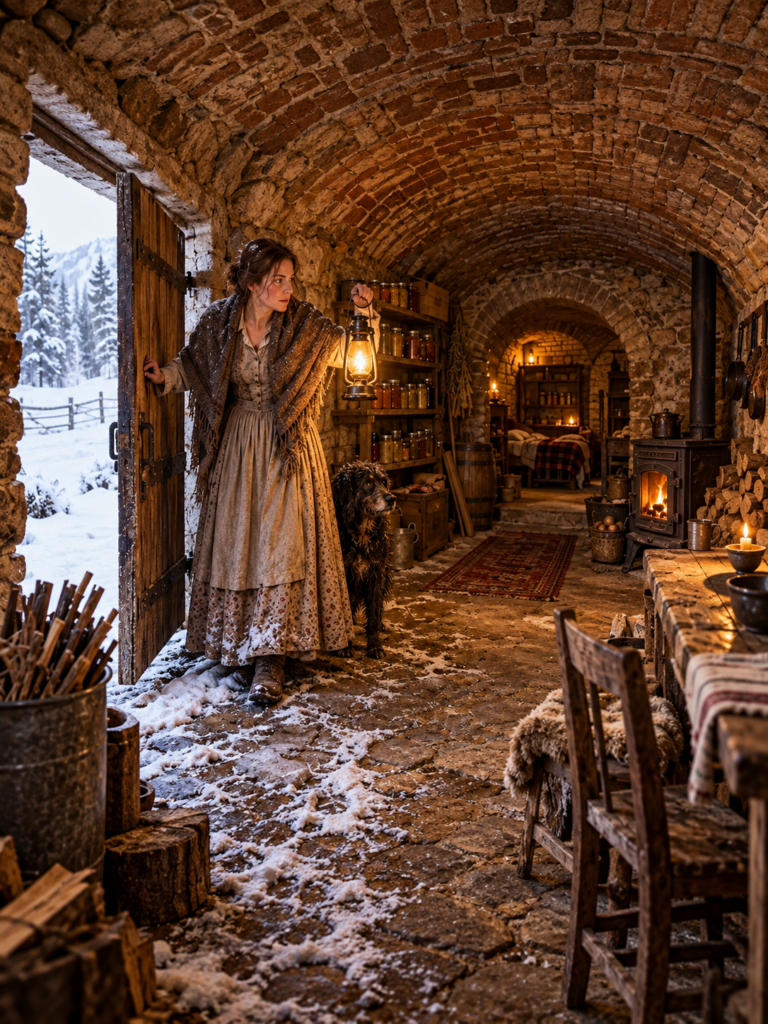
The room was large enough for several people to sleep comfortably. Three wooden bunks had been built against one wall. Iron hooks hung beside a narrow shelf, and an old shovel leaned near a small fireplace.
But it was not an ordinary fireplace.
A low iron firebox stood at one end of a long stone structure running beneath the bunks.
The stonework continued toward the opposite wall, where a brick chimney disappeared into the ceiling.
Clara stepped closer.
The construction reminded her of a story Thomas had once told about masonry stoves used in colder parts of Europe.
Instead of allowing most of the heat to escape straight up a chimney, the hot gases traveled through passages inside heavy stone or brick.
The masonry absorbed warmth and released it gradually.
Thomas had laughed when describing the idea.
“Imagine having a stove that stays warm after the fire’s gone out.”
At the time, Clara had been too busy washing dishes to pay much attention.
Now she wished she had listened more carefully.
She knelt beside the firebox.
The iron door was rusted but intact. A small pile of split wood lay nearby, strangely dry for something that had been abandoned so long.
She touched the stone.
Cold.
Everything was cold.
Yet the air seemed less biting than it had outside.
Clara looked up at the ceiling.
No daylight appeared through the beams. There were no visible cracks opening onto the prairie.
The earth itself sheltered the room from the wind.
She imagined Caleb and Ruth sleeping on those wooden bunks.
A single thought came to her.
Could this place keep them warm?
She immediately dismissed it.
The chamber was unknown, old, and potentially dangerous.
A blocked chimney could fill it with smoke. Rotten beams could collapse. A fire might draw poorly and poison the air without warning.
Still, the possibility refused to leave her.
Clara climbed outside and searched the top of the ridge.
After several minutes, she discovered a low arrangement of stones nearly hidden beneath cedar roots.
At its center was a square chimney opening.
Leaves, dirt, and an abandoned bird’s nest filled the top.
She carefully cleared the obstruction.
Then she returned underground and examined the firebox.
She had no way to inspect every hidden passage or know whether invisible gases might escape into the room. She understood that even a chimney that seemed to draw properly might not be safe.
Nevertheless, curiosity and desperation pushed her to try a very small fire.
She placed several dry cedar twigs inside the box and struck a match.
The flame caught.
For a moment, smoke curled toward her.
Clara held her breath.
Then it moved into the stone passage.
She watched carefully, prepared to abandon the experiment at the first sign of trouble.
The room remained clear.
Several minutes passed.
She reached toward the stone closest to the firebox.
Still cold.
She waited.
At last, a faint warmth reached her fingertips.
Clara stared.
The heat was entering the stone.
Not much.
Barely enough to notice.
But the system was working.
She remained only long enough to see that first small result. Then she extinguished the fire, checked that no embers remained, and climbed back outside.
She was not ready to trust the shelter.
But she could no longer dismiss it.
By the time Clara returned home, darkness had settled over the prairie.
Caleb was waiting beside the gate, wearing Thomas’s old coat.
“You said you’d be home before dark.”
“I know, sweetheart.”
“I was going to come looking.”
Clara put a hand on his shoulder.
“You must never go searching in weather like this. Promise me.”
He nodded reluctantly.
Ruth was curled beside the stove, holding her rag doll.
When Clara entered, the little girl lifted her head.
“Did you find enough wood, Mama?”
“Some.”
“Enough for Christmas?”
Clara swallowed.
“We’ll see.”
During supper, she told the children about the hidden room.
Caleb listened with growing excitement.
“A house under the ground?”
“Something like that.”
“Who built it?”
“I don’t know.”
“Can we live there?”
Clara looked at the stove.
The room near it was warm, but frost had already formed along the window.
“Maybe,” she said. “If we can make sure it’s safe.”
After the children slept, she drew the shelter on the back of an old invoice.
She sketched the firebox, the long stone channel, and the chimney.
Then she wrote a list of things they would need to know before relying on it.
Was the roof sound?
Were the passages clear?
Could the entrance be opened after heavy snow?
Where would they store water?
Could they carry enough food?
By midnight, the questions covered most of the page.
Clara folded the paper and placed it beside Thomas’s photograph.
The next morning, she took the children to the ridge.
Caleb pulled the hand sled while Ruth carried three boiled eggs and a loaf of bread wrapped in cloth.
The snow from the previous evening had been light.
The hidden door was still visible beneath the cedar.
When Clara opened it, Ruth gasped.
“It really is a house!”
The children entered cautiously.
Clara warned them not to touch the firebox or climb onto the upper bunks until she had inspected them.
In daylight, the shelter revealed details she had missed.
Wooden pegs lined the wall.
A small shelf held fragments of an old lantern.
Beneath the lowest bunk sat a wooden storage box.
Caleb tried lifting its lid.
“It’s stuck.”
Clara gently moved him aside.
“Stand back.”
She worked the edge loose with the ax head.
The brittle wood cracked.
Inside were scraps of cloth, two square nails, a rusted cup, and a small leather pouch.
When Clara picked up the pouch, the stitching broke.
Three coins rolled across the floor.
A brass button followed.
Then a folded piece of paper.
Clara opened it carefully.
The writing had faded, but she could still make out a name.
Elias Mercer.
Beneath it was a date.
October 1873.
Caleb leaned close.
“Was he the man who lived here?”
“Possibly.”
The paper contained a list.
Firewood.
Water.
Dried corn.
Lamp oil.
Blankets.
And beneath those ordinary supplies, one final sentence had been underlined twice.
Never let the stone go fully cold after the first hard freeze.
Clara read it several times.
She remembered how slowly the masonry had warmed during her experiment.
Someone had learned through experience that the shelter worked best when its stone retained heat.
But why had the builder abandoned it?
And why had no one told her about it?
The children spent the next several hours helping their mother clean.
Caleb carried loose stones outside.
Ruth swept dust into little piles.
Clara examined the roof beams and removed debris from the shelves.
Behind the bunks, she discovered a wooden panel that concealed a narrow opening.
She lifted the lantern.
A short passage disappeared into the hillside.
At its far end was another door.
Clara crawled through.
The second chamber was smaller.
And it was filled with firewood.
Not green branches.
Not scraps.
Neatly stacked hardwood, split and seasoned, protected from rain and snow for decades.
Clara slowly lifted the lantern.
The stacks reached almost to the ceiling.
She stood motionless.
There was more firewood here than she could have gathered in an entire winter.
Caleb crawled through behind her.
His mouth fell open.
“Mama…”
Clara could hardly answer.
For weeks, she had been measuring their survival in individual pieces of wood.
Now she was looking at enough fuel to make a real difference.
She placed one hand against the nearest stack.
The wood was dry.
Beautifully dry.
She thought of Thomas splitting logs beside the cabin, saving the straightest pieces for the coldest nights.
Her eyes filled.
“Oh, Thomas,” she whispered. “If only you could see this.”
Caleb touched her sleeve.
“Are we going to be all right now?”
Clara wanted desperately to say yes.
But she had already learned that hope could become dangerous when mistaken for certainty.
“We’ve found something that might help us,” she said. “That’s what we know.”
Then Ruth called from the other chamber.
“Mama? What’s that noise?”
Clara turned.
A low cracking sound rolled through the hill.
Dust drifted from the ceiling.
Outside, the wind had strengthened.
She hurried into the first chamber.
The buried entrance trembled beneath a sudden blast.
When Clara climbed the steps and pushed the door open, she saw that the world had changed.
Snow was no longer falling gently.
It was racing sideways across the prairie.
The distant cabin had vanished behind a wall of white.
Clara’s heart sank.
They had stayed too long.
She turned toward the children.
“Put on your coats. We’re leaving now.”
Within minutes, they were outside.
Clara tied a rope around her waist and secured the other end around Caleb.
Caleb held Ruth’s mittened hand.
They began walking east.
The storm swallowed them almost immediately.
The snow erased the creek bed.
The familiar rocks disappeared.
The prairie became an endless white confusion.
After twenty minutes, Clara stopped.
She could no longer tell whether they were walking toward home.
Ruth was crying.
Caleb’s eyebrows were crusted with ice.
Clara looked behind them.
The shelter was closer than the cabin.
At least she hoped it was.
She bent down and pulled both children close.
“We’re going back.”
Caleb stared at her.
“Can we find it?”
Clara looked into the blowing snow.
She had no answer.
But she took his hand.
And began counting her steps.
Part 3
The wind struck them directly in the face.
Clara carried Ruth against her chest while Caleb followed the rope tied around his waist.
Every step felt like pushing through deep water.
Snow gathered inside Clara’s collar and melted against her neck.
Her skirt stiffened with ice.
Once, Caleb stumbled and disappeared to his knees in a drift.
Clara immediately dropped Ruth long enough to pull him upright.
“Are you hurt?”
He shook his head.
His lips had turned pale.
“Just cold.”
She brushed snow from his face.
“Keep looking at me. Don’t close your eyes.”
They continued.
Fifty steps.
A hundred.
Two hundred.
Clara tried to remember the shape of the ground beneath the snow.
She knew there had been a slight rise before the cedar tree.
She knew the slope fell away sharply on one side.
But the storm had stripped the land of every familiar feature.
For the first time since Thomas died, Clara felt a fear so powerful that it seemed to stop her heart.
She could lose both children here.
Not because she hadn’t loved them enough.
Not because she hadn’t worked hard enough.
Simply because the prairie was larger than any person’s determination.
She whispered a prayer.
Then another.
At last, a dark shape appeared through the white.
A cedar tree.
Clara almost wept.
She hurried toward it.
Beneath the branches, barely visible, lay the buried wooden door.
She pulled the iron ring with both hands.
The entrance opened.
One by one, she pushed the children down the steps.
Then she followed and closed the door.
The wind vanished.
The sudden silence seemed impossible.
For several moments, no one moved.
Caleb sat against the wall, breathing heavily.
Ruth clung to her mother’s skirt.
Clara dropped to her knees and wrapped her arms around them both.
“We’re here,” she whispered. “We’re together.”
Ruth began crying again.
“I want our house.”
“I know, darling.”
“I want Papa.”
Clara closed her eyes.
“So do I.”
But wishing could not change the storm.
Their cabin was miles away.
They had brought only a small sack of food.
And now they were trapped inside a shelter whose ancient heating system Clara had not yet learned to trust.
She checked the entrance, the roof beams, and the chimney as best she could.
The room was dry, but cold.
She understood the danger of using an old firebox in an enclosed space. Without proper inspection, hidden blockages or leakage could be deadly.
Yet the children were shivering, and the storm outside was too violent to survive.
Clara made a difficult choice.
She would use the smallest practical fire and remain alert for anything unusual.
She brought several pieces of hardwood from the storage chamber.
The old firebox accepted them with a metallic groan.
Soon, a modest flame burned behind its iron door.
Clara watched the movement of smoke.
Then she waited.
The stone remained cold for a long time.
Caleb sat beside Ruth, rubbing her hands between his.
“Is it broken?” he asked.
“I don’t think so.”
“Then why isn’t it warm?”
“Because there’s a lot of stone to heat.”
He looked worried.
Clara placed a hand on the channel.
At last, she felt warmth.
She almost laughed with relief.
Little by little, the stone began releasing heat into the room.
The change was gradual.
The walls no longer seemed to pull the warmth from their bodies.
The air settled.
Ruth stopped trembling.
Caleb removed his heavy coat.
For the first time that day, Clara allowed herself to hope.
She prepared the lowest bunk for Ruth, spreading their coats across the old boards.
Caleb took the bunk above.
Clara sat beside the firebox and watched the masonry.
Hours passed.
Eventually, the flames dwindled.
But the stone remained warm.
That surprised her more than anything else.
At the cabin, the room became cold soon after the stove went out.
Here, the warmth lingered.
It lived inside the stone itself.
Clara thought about the unknown man who had built this place.
Elias Mercer.
Whoever he had been, he had understood something important about Nebraska winters.
Out on the prairie, a strong fire could still leave a family freezing if the walls surrendered every bit of warmth to the wind.
Underground, the earth and masonry worked differently.
The shelter held what little heat it received.
That night, the three of them slept beneath the hill.
Clara woke several times.
Each time, she checked the children and the condition of the room.
Near midnight, she found the fire had gone out.
Her stomach tightened.
Then she touched the stone.
Still warm.
Ruth slept without her coat.
Caleb had kicked off one blanket.
Clara covered his shoulders and sat beside him.
She remembered Thomas coming inside after long winter days, his beard white with frost, his hands aching from the ax.
He used to joke that the firewood disappeared faster than the children grew.
Clara had laughed then.
She hadn’t realized how much of their lives depended on the work he did quietly.
Now she understood.
She also understood something else.
If Thomas had been standing beside her, he would have been proud that she had found a way to keep going.
The storm lasted two days.
By the second morning, the food was nearly gone.
Clara spread everything they had on a clean cloth.
A little bread.
Three boiled eggs, two already eaten.
A small piece of cheese.
Nothing more.
She divided the remaining bread carefully.
Ruth looked at her portion.
“Is there more?”
“Not right now.”
“When can we go home?”
“When the wind lets us.”
Ruth nodded and took a small bite.
Caleb watched his sister.
Then, thinking Clara wasn’t looking, he broke his own bread in half and slipped one piece onto Ruth’s cloth.
Clara saw.
She pretended not to.
Later, when the children were resting, she sat alone beside the entrance.
Hunger was beginning to hurt.
Her hands were swollen and scraped from the work of the previous days.
She had found firewood and shelter, yet she had still nearly led her children into death.
She bowed her head.
“Thomas, I don’t know if I’m doing any of this right.”
No voice answered.
Only the faint creaking of the wooden door as the wind pressed against it.
For several minutes, she allowed herself to cry.
Then she wiped her face.
She had children to feed.
When the storm finally weakened, Clara forced open the door and climbed through the snow.
The sky had cleared.
Cold sunlight fell across the endless white prairie.
She climbed the ridge and looked east.
At first, she saw only snow.
Then something caught her eye.
A thin line of smoke.
It rose from the direction of their cabin.
Clara stiffened.
Someone had lit their stove.
A dark horse stood near the fence.
Beside it moved the figure of a man.
She hurried back for the children.
Their walk home was slow, but the wind had stopped.
When they reached the cabin, Samuel Price was waiting beside a wagon.
His two grown sons were unloading split firewood.
Samuel turned at the sound of their footsteps.
For a moment, he simply stared.
Then he strode across the yard.
“Good Lord, Clara! Where have you been?”
“Up in the western ridge.”
“We searched half the country!”
She looked at the fresh wood stacked beside the door.
“I’m sorry.”
Samuel glanced at the children.
Both were exhausted.
“Get them inside.”
Clara opened her mouth to protest.
He raised one hand.
“Inside first. Explanations later.”
After they had eaten warm food, Clara told him everything.
The buried door.
The stone room.
The firebox.
The hidden woodpile.
Then she showed him the old paper.
Samuel unfolded it.
His eyes moved toward the name.
Elias Mercer.
The old rancher suddenly became very still.
“Where did you find this?”
“Inside the shelter.”
Samuel read the date.
October 1873.
He slowly lowered the paper.
“Mercer’s winter room.”
Clara leaned forward.
“You know about it?”
“My father did.”
“Then why has no one used it?”
Samuel glanced toward Caleb and Ruth.
The children were resting beside the stove.
His expression changed.
“Because a man nearly died in that place.”
Clara felt the room grow cold around her.
“What happened?”
Samuel folded the paper carefully.
“The fire wasn’t the trouble. It was what the fire couldn’t get out of the chimney.”
He looked directly at her.
“Clara, you may have discovered the thing that can save your children.”
He paused.
“But unless we inspect it properly, that same place could kill all three of you in your sleep.”
Part 4
Samuel returned the following morning carrying a lantern, a hammer, a length of wire, and several tools wrapped in canvas.
Clara met him beside the gate.
She had barely slept.
Every time she closed her eyes, she pictured Caleb and Ruth lying on the wooden bunks beneath the hill.
What if the heating passages had failed during the storm?
What if the chimney had filled with soot?
What if something invisible had entered the room while her children slept?
Samuel seemed to understand her thoughts.
“Don’t punish yourself for what you didn’t know,” he said.
“I brought them into that place.”
“And brought them out alive.”
“That doesn’t make it safe.”
“No. It doesn’t.”
He picked up his tools.
“That’s why we’re going to look.”
Ruth stayed at Samuel’s home with his wife, Martha.
Caleb accompanied the adults, determined to help.
The walk across the snow-covered prairie took nearly an hour.
Samuel stopped beside the buried entrance.
For a long moment, he studied the hillside.
“My father brought me here when I was twelve,” he said.
“Was Mercer still alive?”
“No. He’d left the country years before.”
“Why?”
Samuel brushed snow from the iron hinge.
“Nobody knew the whole story. My father said Mercer was a clever man, but not much for company. He believed a family ought to be able to survive a bad winter even when the nearest neighbor was ten miles away.”
Clara looked at the door.
“Sounds like Thomas.”
Samuel nodded.
“Your husband would’ve liked him.”
Inside, Samuel went straight to the stone heating channel.
He examined the firebox, studied the chimney connection, and tapped several sections of masonry with his hammer.
Near the second bend, the sound changed.
Hollow.
Samuel tapped again.
“There.”
Clara knelt beside him.
“What is it?”
“Something’s loose behind this stone.”
He examined a narrow crack in the mortar.
“My father told me Mercer rebuilt part of this system after his first winter. The original passage was too narrow. Heavy snow blocked the chimney one night, and smoke couldn’t escape.”
Clara remembered the strange scratches in the storage chamber.
“And he survived?”
“Just barely.”
Samuel sat back.
“He woke coughing and managed to get the door open. My father helped him afterward. Said he looked twenty years older when they carried him outside.”
Clara touched the stone.
“Is that why the shelter was abandoned?”
“Maybe part of it. Mercer made repairs, but people didn’t forget what happened. Eventually he moved away. The door disappeared under dirt, and the rest of us stopped talking about it.”
Clara looked toward her son.
Caleb was standing beside the bunk where he and Ruth had slept.
The thought of what might have happened made her hands tremble.
Samuel noticed.
“Listen to me, Clara. The danger isn’t that the idea was foolish. It’s that something built a long time ago has to be examined and maintained. Even good masonry fails.”
He motioned toward the wall.
“Let’s find out what we’re dealing with.”
They spent the afternoon opening a section of the stone channel.
The work was painstaking.
Clara lifted each stone carefully while Samuel examined the passage behind it.
Caleb carried loose debris outside.
Eventually, they discovered the problem.
A section of old clay mortar had collapsed inward.
The remaining opening was large enough to allow smoke from a small fire to pass, but a larger fire could have overwhelmed the damaged channel.
Samuel studied it for a long time.
Then he shook his head.
“You were fortunate.”
Clara didn’t answer.
Her mind returned to that first storm.
She remembered adding wood while Ruth shivered.
She remembered how relieved she had been when the stone began warming.
If she had built a larger fire, the outcome could have been very different.
Samuel touched the damaged section.
“This needs rebuilding.”
Clara nodded.
“Tell me what we need.”
He studied her.
“You still mean to live here?”
“Samuel, I have thirty-seven dollars, two children, one mule, and a cabin that can’t hold heat on a windy night.”
She looked toward the bunks.
“I don’t have many choices. But I can make this one as carefully as possible.”
Samuel gave a slow nod.
“Then we’ll do it right.”
That evening, they made a plan.
The damaged masonry would be rebuilt.
Cracks would be repaired.
The entire chimney and hidden passages would be cleaned and checked.
Samuel also wanted a removable iron inspection plate near the bend, allowing the family to examine an area that had previously been sealed.
They would make sure the shelter had appropriate ventilation and would never treat the absence of visible smoke as proof that the air was safe.
Most importantly, they would not hurry the repairs.
For five days, the hidden shelter became a work site.
Samuel brought old firebrick from a collapsed smokehouse.
Clara hauled suitable clay and sand with the mule and sled.
Caleb scrubbed each brick clean.
Even little Ruth helped, carrying small cups of sand and proudly announcing herself the family’s “chief builder.”
Martha Price sent warm soup and fresh biscuits.
Samuel’s sons hauled additional supplies when their own chores allowed.
Clara accepted the help, but this time she worked beside everyone who came.
She wasn’t simply receiving charity.
She was rebuilding a home.
The distinction mattered.
One afternoon, Samuel found Clara kneeling beside the opened heating channel.
She was studying the shape of the bricks.
“You’ve been looking at that same corner for ten minutes,” he said.
“I’m trying to understand why Mercer built it this way.”
Samuel crouched beside her.
The passage twisted beneath the heavy stonework before reaching the chimney.
“Longer path gives the hot gases more opportunity to warm the masonry,” he explained. “But the draft has to be right. Too much restriction, and the whole thing turns dangerous.”
Clara nodded.
“Thomas used to say the cabin stove was heating the sky.”
Samuel smiled faintly.
“He wasn’t wrong.”
They worked in silence for a while.
Then Clara spoke.
“Sometimes I think losing him took half my mind with him.”
Samuel looked up.
“What makes you say that?”
“Everywhere I turn, there’s something he knew how to do. Repair a harness. Judge the weather. Fix the chimney. Keep a roof standing.”
She rubbed her aching hands.
“I spent years thinking I understood how hard he worked. Now I know I only understood part of it.”
Samuel leaned against the stone wall.
“Thomas learned most of those things because somebody showed him. You can learn them, too.”
Clara looked toward the entrance where Caleb was cleaning bricks.
“And maybe I can teach that boy before he has to learn everything the hard way.”
Samuel smiled.
“Now you’re talking like a homesteader.”
On the final day, Clara returned to the hidden storage chamber.
She wanted to count the remaining firewood and check for dampness.
As she moved the lantern along the wall, she noticed the old scratches again.
Groups of five.
Dozens of them.
Near the bottom, carved into the stone, were the words:
January 12th.
Samuel joined her.
She pointed.
“Do you know what happened on that date?”
He bent toward the marks.
For a long time, he said nothing.
Then he looked at the low ceiling.
“My father always said Mercer’s chimney trouble happened in January. Maybe this was the day.”
Clara ran her fingers lightly over the carving.
“Imagine surviving a whole winter in here, then nearly losing everything because you trusted the stove one night.”
Samuel nodded.
“That might be exactly why he left the date behind.”
Clara stared at the scratches.
Each group represented days counted by someone who had endured darkness, isolation, and bitter cold.
To her, they no longer looked like marks made by a stranger.
They looked like evidence of another person’s determination to survive.
She took Elias Mercer’s note from her pocket.
Never let the stone go fully cold after the first hard freeze.
Perhaps it had been advice for himself.
Perhaps for someone he hoped would come after him.
Either way, Clara intended to remember it.
When the masonry repairs were complete, Samuel insisted they allow the new work to cure.
During that time, the Hayes family continued sleeping in the cabin.
The old stove consumed their dwindling firewood.
Every morning, Clara carried ashes outside.
Every evening, she checked the seams around the door and pushed rags into the gaps.
The temperature kept falling.
One night, Caleb climbed down from the loft.
“Mama?”
“What is it?”
“Do you think Papa would’ve liked the underground house?”
Clara looked at him.
“Very much.”
“Would he have moved there?”
She considered the question.
“I think he’d have wanted to make certain it was safe first.”
Caleb nodded.
“Like we’re doing.”
“Exactly.”
He stood beside her for another moment.
Then he said quietly, “I wish he could’ve helped us build it.”
Clara put an arm around him.
“So do I, sweetheart.”
Outside, the wind rattled the window.
Clara watched the fire settle.
Soon, the time for repairs and preparation would be over.
They had done everything Samuel knew to do.
Now the question was whether the underground room could truly protect a family through the kind of winter Nebraska was capable of delivering.
On December 18, the answer began arriving from the north.
Part 5
The temperature plunged shortly after sunset.
At first, Clara noticed only that the wind had changed direction.
Then Daisy refused to leave the shelter beside the cabin.
By midnight, frost had spread across the inside of the kitchen window.
Clara woke to find the stove nearly dead.
She opened the woodbox.
Three small pieces remained.
She stood looking at them.
For weeks, she had been preparing for this moment.
Now it had come.
Caleb appeared at the edge of the loft.
“Mama?”
She turned.
“Get dressed.”
He was fully awake in an instant.
“Are we going to the hill?”
“Yes.”
“Right now?”
“Before the weather gets worse.”
Clara had already prepared two sacks of food, blankets, spare clothing, matches, lantern oil, and drinking water.
They had checked the shelter after the repairs and completed careful tests under Samuel’s supervision. The chimney and masonry had been examined, the draft improved, and the ventilation arrangements reviewed.
No fire-based shelter could be treated as risk-free, but this time Clara was not walking into an abandoned room she knew nothing about.
She understood its limitations.
She had made plans for emergencies.
And she had enough supplies to avoid repeating the hunger they had suffered during the first storm.
Caleb loaded the sled.
Clara settled Ruth into her warmest coat.
Then she stepped outside.
The cold struck her like a wall.
The sky was still dark, but the stars glittered sharply above the prairie.
She secured Daisy inside the protected lean-to with hay and water, trusting Samuel to check on the mule if the storm became too severe.
Then she and the children started west.
The sled runners scraped across the frozen ground.
Nobody spoke much.
Ruth held her doll beneath one arm and kept her other hand wrapped around Clara’s fingers.
Caleb pulled the sled with determined concentration.
Halfway to the ridge, Clara looked back.
Their cabin stood small and dark against the enormous prairie.
She remembered arriving there with Thomas years earlier.
They had possessed almost nothing.
A wagon.
A few tools.
A mattress.
Two tin plates.
And the belief that hard work would eventually give them a secure home.
They had built a life inside those walls.
Now she was leaving them because the house could no longer protect their children.
The thought hurt.
But Clara kept walking.
When they reached the buried entrance, the children hurried underground.
Clara secured the door and placed the supplies on the shelves.
The room was cold, but the wind couldn’t reach them.
She inspected the heating system, checked the ventilation, and prepared the first fire according to what Samuel had taught her.
The flames burned brightly.
Warm gases traveled through the repaired masonry channels.
The heavy stone slowly absorbed the heat.
Clara watched carefully.
No smoke entered the room.
The chimney drew as expected.
After a controlled burn, she allowed the fire to finish and secured the firebox.
The masonry continued releasing warmth.
By evening, snow was striking the ridge above them.
Caleb sat on a bunk reading from his old schoolbook.
Ruth arranged her doll and a blanket beside the warm stone.
Clara heated their supper and listened.
There was almost no sound.
Only the occasional movement of the children and the distant, muffled roar of wind above the earth.
She had never experienced anything like it.
For years, winter had been something that forced its way into their home.
Through the windows.
Under the door.
Between the boards.
Here, winter remained outside.
The next morning, Clara climbed carefully toward the entrance.
Samuel had hung an outdoor thermometer from the cedar tree before the storm.
She brushed frost from the glass.
Six degrees below zero.
She stared for several seconds.
Then she retreated underground.
Beside the warm stone, another thermometer showed fifty-eight degrees.
The previous day’s fire had already gone out.
Yet the masonry retained enough warmth to keep the room far more comfortable than the cabin would have been.
Clara removed her gloves.
She held both hands near the stone.
Warmth reached her fingers.
Steady.
Gentle.
Persistent.
Caleb looked up from his book.
“How cold is it outside?”
“Six below.”
His eyes widened.
“Really?”
“Really.”
He glanced toward Ruth.
She was sitting on the lower bunk without her heavy coat.
Then Caleb smiled.
“Papa would’ve wanted to see this.”
Clara looked at the stone.
“Yes,” she whispered. “He certainly would.”
The cold spell lasted four days.
Clara maintained a careful routine of short, controlled fires, inspections, ventilation checks, and regular attention to the children.
She measured their food.
She kept water available.
She made sure they could reach the entrance.
Each day, she examined the woodpile and compared what they had burned with what their cabin would have required.
The difference was astonishing.
The old heating system did not create warmth from nothing.
But it held onto warmth long after the flames disappeared.
By the fourth morning, they had used only a modest portion of their stored hardwood.
Clara began to understand the true value of what Elias Mercer had built.
Not luxury.
Not comfort alone.
Security.
The ability to make limited resources last.
The chance for a vulnerable family to endure conditions that might otherwise defeat them.
When the sky finally cleared, Samuel appeared at the entrance.
Clara heard him calling before she opened the door.
“Hayes family! Anybody home?”
She climbed the steps.
Samuel stood outside with frost in his beard and a heavy coat wrapped around his shoulders.
He looked past her into the shelter.
“Well, I’ll be.”
Clara smiled.
“Come inside.”
Samuel descended slowly.
He removed his gloves and approached the stone heating channel.
He placed one hand against it.
Warm.
Then he examined the wood stacked in the storage chamber.
“How much have you burned?”
Clara showed him.
He studied the small empty space in the stack.
“That’s all?”
“That’s all.”
Samuel stood quietly.
He looked at Caleb, who was reading on his bunk.
Then at Ruth, who had fallen asleep holding her doll.
Finally, he turned toward Clara.
“Thomas would be proud of you.”
The words struck her harder than she expected.
For weeks, she had been carrying the burden of doing what Thomas once did.
She had doubted her judgment.
She had feared every mistake.
She had wondered whether her children would suffer because she wasn’t strong enough.
Now, standing in that underground room, she understood that survival had never depended on her becoming Thomas.
She had survived by being Clara.
By learning.
By working.
By accepting help without surrendering her dignity.
By refusing to give up when every practical calculation seemed to be against her.
Tears filled her eyes.
Samuel pretended not to notice.
He examined the masonry instead.
“Mercer would’ve been pleased to know somebody finally made good use of this place.”
Clara looked toward the old paper hanging beside the shelf.
“I wish I could thank him.”
Samuel nodded.
“Maybe keeping it standing is thanks enough.”
Over the following weeks, the shelter became the Hayes family’s winter home.
They returned to the cabin during mild weather to collect supplies, tend the property, and care for Daisy.
But when heavy clouds gathered in the north, Caleb no longer checked the woodbox with frightened eyes.
He gathered the blankets.
Ruth carried her doll.
Clara inspected the provisions.
And the family walked west toward the sheltered hillside.
Eventually, word began spreading.
Samuel told another rancher.
That rancher told his brother.
Soon, neighbors started visiting the unusual underground room.
Some came out of curiosity.
Others came because they had been struggling with the same problem Clara knew so well.
Their stoves burned too much wood.
Their houses leaked heat.
Their winter supplies disappeared faster than they could replace them.
Clara welcomed them.
She showed them the masonry, the repaired channel, the inspection opening, and the ventilation arrangements.
She spoke frankly about the dangers of poorly maintained heating systems.
She never pretended the room was magical.
She explained that the shelter’s value came from sound construction, stored heat, protection from wind, and careful maintenance.
One afternoon, a woman named Edith Walker arrived with her husband.
Their farmhouse stood on exposed ground north of the creek.
Edith studied the thick stone walls.
“My mother used to say people survived winters better when they understood the land instead of trying to fight it.”
Clara smiled.
“Your mother sounds like a sensible woman.”
Edith placed a hand near the warm masonry.
“Maybe we ought to learn a thing or two from this.”
And they did.
Over time, neighbors began sharing ideas about improving insulation, reducing drafts, and protecting supplies.
Samuel helped another family repair a dangerous chimney.
A rancher found better ways to shelter his animals from northern winds.
Two families constructed safer, improved root cellars and storage spaces after consulting experienced builders.
The little underground room did not solve every hardship.
But it reminded people that survival was not always a matter of working harder.
Sometimes it required understanding what earlier generations had learned.
Clara found herself becoming someone neighbors came to for advice.
At first, the attention embarrassed her.
She still considered herself a grieving widow with more questions than answers.
But one day, Caleb pointed something out.
“Mama, people used to come here bringing things because they thought we couldn’t manage.”
Clara looked at him.
“And now?”
“Now they come asking you how to do things.”
She laughed.
“Well, I suppose that’s different.”
Caleb smiled proudly.
“I think Papa would like that, too.”
By January, the worst of the weather had settled over the county.
There were nights when Clara could hear the distant wind even through the deep earth.
But inside, Ruth slept peacefully.
Caleb studied by lantern light.
And Clara kept the household going with a steadiness she had not believed herself capable of after Thomas died.
Sometimes, late at night, she sat beside the old stone wall and thought about the man whose name had been written on a scrap of paper.
Elias Mercer.
A stranger from another generation.
A man who had faced his own long winters, made mistakes, survived danger, and left something useful behind.
His story had almost disappeared.
But his work had endured.
In February, Clara took the faded note from its shelf and placed it inside a small wooden frame Caleb made from scraps of cedar.
Beneath it, she wrote a few words.
Built by Elias Mercer, 1873.
Restored by neighbors who believed a family should never face winter alone.
She hung it beside the entrance.
When Samuel saw it, he removed his hat.
For a moment, neither of them spoke.
Then the old rancher said quietly, “That’s a fine way to remember him.”
Clara looked around the room.
Her children were laughing over something Caleb had drawn.
The firewood remained plentiful.
Their supplies were carefully stored.
Outside, the Nebraska winter continued.
But the fear that had once ruled every evening no longer lived in her heart.
She had found a way forward.
And she had learned that accepting a neighbor’s kindness did not diminish the work she had done.
That spring, Clara began planning improvements to the cabin.
She wasn’t going to abandon the place where she and Thomas had built their life.
She intended to repair its walls, improve the windows, and make the stove more efficient.
The underground shelter would remain a refuge during severe weather.
The cabin would remain their home during gentler seasons.
Both places mattered.
One held the memories of the life she had shared with Thomas.
The other represented the future she had nearly believed impossible.
In March, the first thaw softened the frozen prairie.
Snow disappeared from the southern slopes.
The dry creek began carrying a thin trickle of water.
Brown grass emerged beneath the cedar trees.
One afternoon, Clara climbed the ridge with Caleb and Ruth.
The sun was warm enough that Ruth removed her mittens.
Caleb pointed east.
From their position, they could see the old cabin standing beside the cottonwood tree.
A faint thread of smoke rose from its chimney.
“Mama?”
Clara turned.
“Yes?”
“Are we going back to the cabin?”
She looked across the prairie.
For a long time, she said nothing.
She remembered Thomas standing in that doorway.
She remembered bringing Caleb home as a baby.
She remembered Ruth taking her first uncertain steps across the kitchen floor.
She remembered the terrible morning when Thomas had closed his eyes for the last time.
There had been so much sorrow inside those walls.
But there had been love, too.
More love than grief could ever erase.
“We’ll spend plenty of time there,” she said.
Caleb looked toward the buried entrance.
“But not tonight?”
Clara smiled.
“Not tonight.”
Ruth slipped her little hand into Clara’s.
“Can we sleep in the warm room again?”
“Of course, sweetheart.”
The three of them began walking down the slope.
Near the doorway, Clara stopped.
She looked back toward the fallen cedar where she had first discovered the hollow ground.
Months earlier, she had come searching for enough wood to keep her children warm for a few more nights.
She had been tired, frightened, and almost out of hope.
She hadn’t been searching for a new home.
She hadn’t expected to discover the work of a man who had lived decades before her.
And she certainly hadn’t imagined that an abandoned underground room would help restore the dignity she feared she had lost when Thomas died.
But that was what had happened.
Clara looked down at her children.
Caleb was taller than he had been in autumn.
Ruth’s cheeks were rosy.
They were healthy.
They were laughing.
And they no longer looked at every approaching winter cloud with fear.
Clara thought of Thomas’s old words.
Hard times don’t get to decide what kind of people we become.
She understood them better now.
Poverty had not made her bitter.
Grief had not destroyed her courage.
And accepting help had not taken away her independence.
It had given her a chance to rebuild it.
She reached for the iron ring and opened the hidden door.
Warm air rose gently from the shelter below.
Ruth hurried down the steps.
Caleb followed, carrying the lantern.
Clara remained outside for one final moment.
Above her stretched the endless Nebraska sky.
Before her stood the old cedar tree.
And beneath her feet was the quiet refuge that had carried her family through the hardest winter of their lives.
She closed her eyes.
“Thank you, Thomas,” she whispered.
Then, after a moment, she added another name.
“And thank you, Mr. Mercer.”
No one answered.
But from below came the voices of her children.
“Mama! Come see what Ruth did!”
Clara laughed.
She descended the stone steps, one hand resting against the wall.
Then she pulled the heavy wooden door closed against the evening wind.
The winter had taken her husband, her security, and nearly her hope.
But it had not taken her children.
It had not taken her home.
And it had not taken the quiet strength that had been inside her all along.
For the first time since Thomas’s death, Clara Hayes no longer wondered whether she could face another winter.
She knew she could.
And whatever came next, she would never again mistake being alone for having nothing left.
Because beneath that forgotten Nebraska hillside, surrounded by the warmth of old stone and the sound of her children’s laughter, Clara had discovered something far greater than a hidden shelter.
She had found her way back to life.


