
Part 1
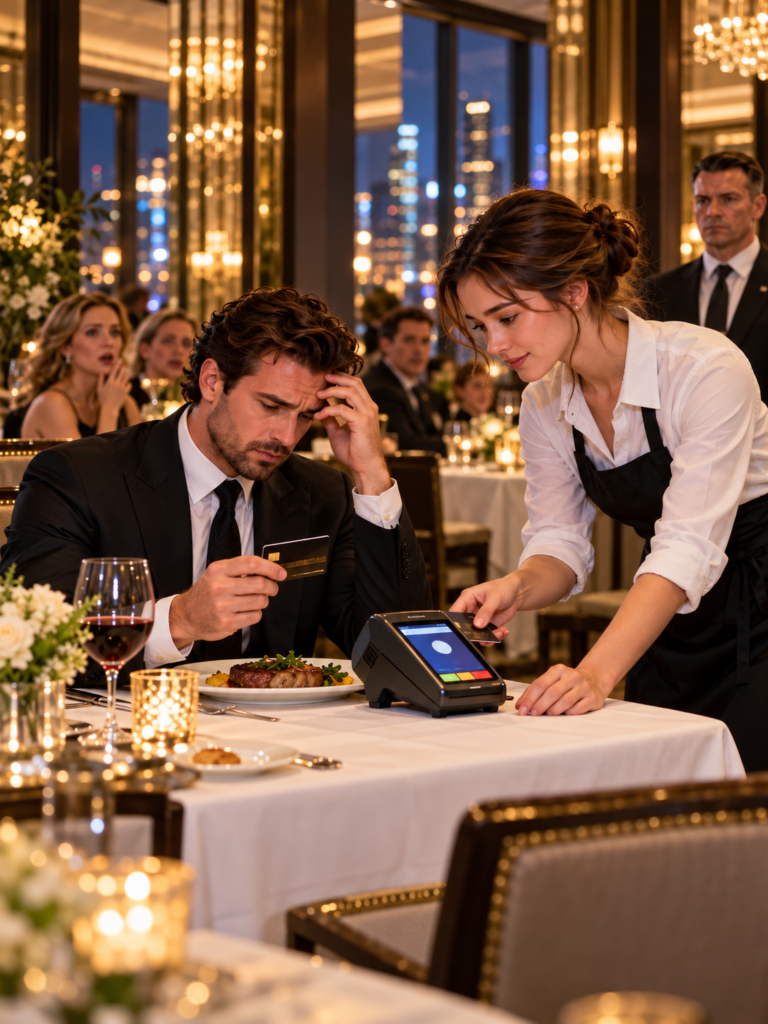
The credit card machine made a sharp, unforgiving beep.
Emily Carter looked down at the little screen, then quickly turned it away from the customer.
DECLINED.
Across the counter, the man in the worn brown jacket watched her expression change.
“I’m sorry,” he said quietly. “Could you try it one more time?”
“Of course.”
Emily ran the card again.
The machine beeped.
Declined.
Outside the windows of the Marigold Grill, rain battered the streets of Briarwood, Pennsylvania. It was almost ten o’clock on a Thursday night, and most of the dinner customers had already gone home. The neon OPEN sign buzzed above the entrance, casting a tired red glow across the wet sidewalk.
Emily glanced toward the kitchen.
Her manager was counting the cash drawer.
She lowered her voice.
“Sometimes the connection gets unreliable during a storm. Do you have another card you’d like to try?”
The man shook his head.
“No. I’m afraid that’s the only one I brought.”
He was perhaps forty, with dark hair touched by silver near his temples. His jacket looked ordinary, his shoes slightly scuffed, and his face carried the exhausted expression of someone who had spent too many hours thinking about something unpleasant.
He looked at the receipt.
Thirty-two dollars.
“I thought I had enough left,” he murmured.
Emily recognized that tone.
Not because she heard it from customers every day.
Because she sometimes heard it in her own voice.
“It’s all right,” she said. “We’ll figure something out.”
Before he could answer, another voice cut across the quiet restaurant.
“Emily? What’s taking so long?”
Richard Hayes emerged from behind the counter, his expression already tight with irritation.
Emily immediately straightened.
“Just a small issue with the payment, Mr. Hayes.”
Hayes examined the screen.
His jaw tightened.
“Declined?”
The man lowered his eyes.
“I’m sorry, sir. I seem to have made a mistake.”
Hayes folded his arms.
“Sir, you’ve eaten your dinner. You’ve had coffee. You’ve received service. Unfortunately, apologies don’t pay the restaurant’s bills.”
“Mr. Hayes,” Emily said softly.
He ignored her.
“We’re not running a charity here. If you don’t have another card, you’ll need to find someone who can pay.”
The man looked around.
Two customers near the window had stopped talking. A teenage busboy stood motionless beside a table, holding a plastic tub of dirty dishes.
The stranger’s cheeks reddened.
“I understand,” he said. “I never intended to cause trouble.”
Something twisted inside Emily.
She knew what it felt like to be watched when money became a problem.
She remembered standing at a grocery checkout three months earlier while a cashier removed eggs, bread, and laundry detergent from her cart because her debit card had insufficient funds.
She remembered the impatient sigh behind her.
And she remembered wishing the floor would open beneath her feet.
“Mr. Hayes,” she said, more firmly this time, “please. Everyone can hear.”
“Then perhaps he should have checked his account before ordering.”
The man’s face went still.
He didn’t argue.
Somehow, his silence made the moment worse.
Emily looked at the receipt again.
Thirty-two dollars.
Inside her apron pocket was a folded collection of bills.
Forty-one dollars in tips.
That was everything she’d earned in cash during a nine-hour shift.
She had planned to stop at the twenty-four-hour pharmacy after work.
Her mother’s prescription refill cost twenty-six dollars after insurance.
Emily had also been hoping to put fifteen dollars toward the electricity bill, which was already overdue.
She pressed her fingers against her apron.
Thirty-two dollars.
A stranger’s dinner.
Nearly an entire night’s worth of tips.
She could practically hear her mother’s voice.
Emily, sweetheart, you can’t keep carrying the whole world on your shoulders.
But she could also remember something else her mother used to say.
Having less than someone else doesn’t mean you have less to give.
Emily took a breath.
“Mr. Hayes, I’ll cover it.”
The manager turned.
“What?”
“I said I’ll pay for his meal.”
The stranger’s head rose.
“No, miss. Please. You don’t have to—”
“I know.”
Emily pulled the bills from her apron and counted them carefully.
Two tens.
Two fives.
Two ones.
Thirty-two dollars.
She placed the money beside the register.
Hayes stared at it.
“Emily, you work too hard to throw your money away.”
She kept her hand on the counter.
“Then please don’t make it harder by embarrassing him.”
For a moment, nobody spoke.
Finally, Hayes took the money.
“Fine. This once.”
He printed the receipt and walked back toward his office, shaking his head.
Emily turned to the stranger.
“Everything’s taken care of. You can finish your coffee.”
He stared at her as though he hadn’t understood.
“You paid for my dinner?”
“Yes.”
“With your own money?”
Emily gave a small smile.
“Well, unless somebody has been putting counterfeit bills in the tip jar.”
He didn’t smile.
Instead, his eyes moved toward the apron pocket where she had placed the remaining cash.
“Why would you do that?”
Emily glanced at the nearly empty dining room.
“Because you looked like you needed somebody to be decent to you tonight.”
“But you don’t know me.”
“Do I need to?”
He was silent.
She picked up his empty plate.
“Would you like me to warm up your coffee?”
The man swallowed.
“No. Thank you. I think I’ve had enough.”
When he stood, he paused beside the table.
“My name is Ethan.”
“Emily.”
“Emily,” he repeated, as though he wanted to remember it. “I won’t forget what you did.”
She shrugged gently.
“You don’t have to remember. Just do something kind for somebody else when you get the chance.”
Then she carried his plate toward the kitchen.
She did not see him watching her.
And she had absolutely no idea that the card he had handed her had never been intended to work.
Emily’s shift ended at 10:47 p.m.
By then, the rain had softened to a cold mist.
She stepped outside, pulled her thin gray cardigan around her shoulders, and checked her phone.
Three missed calls from her landlord.
One message from the electric company.
And a reminder from the pharmacy.
Your prescription is ready for pickup. Balance due: $26.40.
Emily opened her banking application.
Available balance: $18.63.
She stared at the number.
Then she looked at the nine dollars remaining in her apron.
Twenty-seven dollars and sixty-three cents.
Enough for the medication.
Not enough for the bus fare home if she paid for it tonight.
She stood beneath the restaurant awning, watching rainwater run along the curb.
For one brief moment, she wondered whether she had been foolish.
Not cruel.
Not heartless.
Just foolish.
She could have asked the man to come back with money the next morning.
She could have told Hayes to handle it.
She could have protected herself.
Instead, she had given away nearly everything she had earned.
Her phone vibrated.
Mom: Are you coming home soon? Don’t forget to eat something.
Emily smiled despite herself.
Her mother had been in and out of the hospital for months because of a worsening heart condition. Margaret Carter was sixty-two, a retired elementary school cafeteria worker with gentle eyes, stubborn pride, and a habit of worrying more about everyone else than herself.
Even from a hospital bed, Margaret worried about whether Emily was eating properly.
Emily typed back.
Just finishing up. I ate at work. Love you.
The first part was true.
The second was not.
She had taken three bites of leftover toast during her afternoon break.
Emily crossed the street to the pharmacy, paid for the medication with most of the money she had left, then began the forty-minute walk to her apartment.
The rain soaked through her shoes.
But she kept walking.
Half a block away, a black sedan sat beneath a darkened office building.
Inside, Ethan watched Emily disappear around the corner.
The man beside him looked up from a tablet.
“Sir, the board has been waiting for your decision all evening.”
Ethan didn’t respond.
His assistant, Daniel Mercer, followed his gaze.
“Is that the waitress?”
“Yes.”
Daniel glanced toward the restaurant.
“Did your experiment work?”
Ethan turned slowly.
“What?”
“The card. You instructed us to deactivate it before you came here. You wanted to see how strangers treated someone they believed couldn’t afford dinner.”
Ethan stared through the windshield.
“That was the idea.”
“And?”
Ethan opened his hand.
Resting in his palm was the receipt from the Marigold Grill.
At the bottom, someone had written:
PAID — EMILY C.
“She paid for me,” he said.
Daniel waited.
“Thirty-two dollars. From her own tips.”
“That’s generous.”
“Her manager humiliated me in front of the restaurant. She stepped in when everyone else was watching.”
Daniel leaned back.
“We can arrange a reward. Fifty thousand dollars would make quite an impression.”
Ethan shook his head immediately.
“No.”
“Sir?”
“No check. No cameras. No publicity.”
Daniel looked confused.
Ethan turned toward the rain-streaked window.
“I walked into that restaurant pretending I was poor. I knew I had a car waiting outside. I knew that if something went wrong, you would fix it.”
He paused.
“She didn’t know any of that.”
Daniel closed the tablet.
Ethan continued quietly.
“I treated somebody else’s kindness like a test. And she gave me money she might actually need.”
For the first time in many years, Ethan found himself unable to justify something simply because he had been able to arrange it.
“Find out the restaurant’s opening hours,” he said.
“Of course.”
“And Daniel?”
“Yes, sir?”
“Don’t investigate her private life.”
Daniel nodded.
Ethan looked once more toward the corner where Emily had disappeared.
“I’ve already taken enough from her without asking.”
The next morning, Emily arrived at work twenty minutes early.
Her shoes were still damp.
Her hair was tied into a loose ponytail, and she had covered the dark circles beneath her eyes with inexpensive concealer.
Lydia, another waitress, glanced up from the coffee station.
“You look like you got hit by a truck.”
“Good morning to you, too.”
“Seriously, Em. Did you sleep?”
“A little.”
Lydia handed her a cup of coffee.
“Drink.”
Emily accepted it gratefully.
Lydia was thirty-eight, divorced, and raising two children while working five shifts a week. She and Emily had developed the sort of friendship that existed between people who regularly survived bad shifts together.
Lydia lowered her voice.
“I heard what happened last night.”
Emily groaned.
“Please don’t.”
“You paid that man’s entire bill?”
“Yes.”
“Thirty-two dollars?”
“Lydia.”
“Emily.”
Emily set down her coffee.
“He looked embarrassed.”
Lydia’s face softened.
“I know why you did it.”
“But?”
“But I also know you’ve been taking extra shifts to help with your mother’s bills.”
Emily looked away.
Lydia reached across the counter.
“Being kind doesn’t mean you have to be the person who loses every time.”
“I know.”
“Do you?”
Emily gave her a tired smile.
“I’m working on it.”
Before Lydia could answer, the front bell rang.
A man entered wearing the same brown jacket as the previous evening.
Emily froze.
Ethan.
He saw her and smiled uncertainly.
“Good morning.”
Lydia glanced between them.
“Well,” she murmured, “speak of the devil.”
Emily approached his table.
“Coffee?”
“Yes, please.”
She poured a fresh cup.
He placed a small folded envelope on the table.
“Before anything else, I wanted to give you this.”
Emily looked at it.
“What is it?”
“Thirty-two dollars.”
She shook her head.
“You don’t owe me.”
“I do.”
“Ethan, I helped because I wanted to.”
“I know. That’s why I’d like to pay you back.”
Emily rested the coffeepot on the table.
“If you want to repay me, give somebody else a break someday.”
He looked at her.
“You really believe that?”
“My mother does. I’m trying to live up to her example.”
Ethan smiled faintly.
“What does your mother do?”
“She used to work in a school cafeteria. She knew every kid who forgot lunch money and every kid who pretended not to be hungry.”
“She sounds like a remarkable woman.”
Emily’s expression brightened.
“She is.”
For a moment, the restaurant disappeared around them.
Then Mr. Hayes stepped out of the kitchen.
“Emily! Table six is waiting.”
She straightened.
“Sorry, Mr. Hayes.”
Hayes noticed Ethan.
His expression hardened.
“You again?”
Ethan calmly lowered his coffee.
“I came back to repay what I owed.”
“Then pay the cashier. Emily has work to do.”
“Of course,” Ethan said.
He looked at Emily.
“Thank you for the coffee.”
Emily nodded and hurried away.
Ethan watched Hayes return to the kitchen.
There was something painfully familiar about the manager’s tone.
He had heard executives in his own offices speak to receptionists and maintenance workers the same way.
As though certain people became invisible once they put on a uniform.
He looked down at the envelope.
Emily had left the money untouched.
By noon, the restaurant was packed.
Emily moved between tables carrying plates, refilling drinks, remembering special orders, and apologizing for delays she hadn’t caused.
At 12:18, her phone began vibrating inside her apron.
She ignored it.
Then it rang again.
And again.
When she finally checked the screen, her stomach dropped.
St. Anne’s Medical Center.
She hurried into the narrow hallway behind the kitchen.
“Hello? This is Emily Carter.”
A nurse’s voice answered.
“Miss Carter, I’m calling about your mother.”
Emily pressed one hand against the wall.
“Is she okay?”
“She’s stable right now. But Dr. Mitchell would like to speak with you. Her condition has changed, and he believes another cardiac procedure may be necessary.”
Emily closed her eyes.
“But she was getting better.”
“She had shown some improvement. Unfortunately, her latest tests suggest we shouldn’t delay discussing the next step.”
Emily swallowed.
“When?”
“We’re arranging a consultation this afternoon.”
“I’ll come as soon as my shift ends.”
“Please do. And try not to panic. She’s being monitored carefully.”
The call ended.
Emily stood motionless.
From the kitchen came the sound of silverware clattering against plates.
Someone shouted for more coffee.
Mr. Hayes called her name.
The world continued moving while hers seemed to stop.
Another procedure.
Another hospital bill.
More days away from work.
Her rent was due in nine days.
She had no emergency savings.
She had spent the previous winter paying off the first round of medical expenses.
Her mother had Medicare coverage, but transportation, prescriptions, and remaining expenses had drained what little the two women owned.
Emily had done the math so often that the numbers appeared in her head without effort.
Rent: $1,180.
Electricity: $96 overdue.
Phone: $54.
Prescription expenses: unpredictable.
Hospital balance: already several thousand dollars.
She leaned against the wall.
“How am I supposed to do this?” she whispered.
“Emily?”
She looked up.
Ethan stood at the hallway entrance.
He had apparently been walking toward the restroom.
“I’m sorry,” he said immediately. “I didn’t mean to intrude.”
Emily wiped her face.
“It’s nothing.”
He didn’t move closer.
“You look frightened.”
She tried to smile.
“Just family stuff.”
He hesitated.
“Is it your mother?”
Emily looked at him sharply.
Then her shoulders dropped.
“Yes.”
She told him about the phone call.
About the tests.
About another procedure that could not be postponed indefinitely.
And about the terrible fear that no matter how many hours she worked, she would always be one emergency behind.
Ethan listened without interrupting.
When she finished, he said, “I’m sorry.”
Emily gave a shaky laugh.
“You keep saying that.”
“Because I keep meaning it.”
She stared at the floor.
“I can’t lose her.”
Her voice was barely audible.
Ethan’s expression changed.
He knew what it meant to have a phone call divide life into before and after.
Years earlier, his father had died unexpectedly after complications from a stroke. Ethan had been overseas finalizing a business acquisition when the hospital called.
The deal had closed.
His father had died before he reached home.
He remembered the congratulations waiting in his inbox.
And how meaningless they had seemed.
“Is she receiving the care she needs?” he asked.
“Yes. The doctors are helping. It’s just that everything costs money, even the things insurance is supposed to cover.”
He nodded.
“Have you spoken with a hospital financial counselor?”
“Not yet.”
“There may be assistance programs you haven’t considered.”
Emily looked tired.
“I’ve applied for things before. Most of the time, they send me another form and tell me to wait.”
“Then maybe somebody can help you sort through the forms.”
She shook her head.
“Ethan, I didn’t help you because I wanted something back.”
“I know.”
“Then please don’t offer me money.”
He was quiet.
Finally, he asked, “Would a ride to the hospital help?”
Emily blinked.
“A ride?”
“Yes. Nothing more. I have a car.”
She laughed weakly.
“Mine broke down six months ago.”
“Then let me drive you.”
She hesitated.
He added, “You can bring a friend if that makes you more comfortable. I understand we’re still strangers.”
Emily studied him.
He had returned to repay the dinner.
He hadn’t become angry when she refused.
He had listened without turning her problems into an awkward performance.
Still, pride made accepting even a simple favor difficult.
“All right,” she said at last. “But I’m paying for gas.”
Ethan smiled.
“We can discuss the gas.”
“No. We’re agreeing now.”
“Then we’ll agree to discuss it.”
Despite everything, Emily laughed.
It was the first time she had laughed that day.
And for one brief moment, the fear pressing against her chest loosened.
What Emily didn’t know was that Ethan’s kindness had begun with a lie.
And that the truth behind his ordinary clothes and modest introductions would eventually hurt her far more than she could imagine.
Part 2
At five-thirty that evening, Emily stepped out of the Marigold Grill and found Ethan waiting beside a dark sedan.
She slowed.
The car was noticeably nicer than she had expected.
Its paint gleamed even under the cloudy sky.
“That’s your car?”
Ethan glanced at it.
“Yes.”
Emily raised an eyebrow.
“You drive this and couldn’t pay for a thirty-two-dollar dinner?”
He felt the question like a blow.
For one dangerous second, he considered telling her everything.
Instead, he said, “The situation with my card wasn’t what it appeared to be.”
Emily gave him a curious look.
But before she could ask another question, her phone vibrated.
Another message from the hospital.
Her mother’s consultation had been completed.
Dr. Mitchell wanted to speak with her in person.
Emily forgot about the car.
“Can we go?”
“Of course.”
Ethan opened the passenger door.
As she settled into the seat, Emily noticed how clean the interior was. There were no loose receipts, no coffee cups, no forgotten grocery bags.
Her own old Honda had usually contained at least three empty water bottles and a pair of sneakers.
“Do you work for a car dealership?” she asked.
Ethan looked at her.
“Why?”
“Because this car looks like somebody has been paid to keep it clean.”
He laughed softly.
“No. I work in business.”
“What kind of business?”
“Investments. Operations. A little of everything.”
“That sounds exhausting.”
“It can be.”
Emily fastened her seat belt.
“Then you understand bad days.”
Ethan glanced at her.
“Not as well as I thought I did.”
St. Anne’s Medical Center occupied six city blocks beside the river.
Its parking garage was crowded, its emergency entrance busy, and its lobby smelled of disinfectant and burnt coffee.
Emily hurried through the automatic doors.
Ethan followed a step behind.
At the cardiology wing, a nurse recognized Emily.
“Your mother’s in Room 214. Dr. Mitchell will be with you shortly.”
Emily pushed open the door.
Margaret Carter was sitting upright against white pillows.
Her hair, once a rich chestnut brown, had gone almost completely silver. A heart monitor beeped steadily beside her bed.
“Mom.”
Margaret’s face brightened.
“There’s my girl.”
Emily crossed the room and hugged her carefully.
“You scared me.”
“Oh, sweetheart. I was going to tell the nurse to call back and say I’d changed my mind about having a dramatic day.”
Emily laughed through the tightness in her throat.
Then Margaret noticed Ethan.
“Well, hello.”
Emily straightened.
“Mom, this is Ethan. He gave me a ride.”
Margaret looked from her daughter to the stranger.
“Oh.”
“Mom.”
“I didn’t say anything.”
“You were thinking very loudly.”
Margaret smiled at Ethan.
“Thank you for bringing her.”
“It was my pleasure, Mrs. Carter.”
“Call me Margaret. Mrs. Carter makes me feel like I should be correcting somebody’s homework.”
Ethan smiled.
“Margaret, then.”
She studied him with open curiosity.
“You look familiar.”
Ethan’s smile faded almost imperceptibly.
“I don’t believe we’ve met.”
“Probably not. My memory isn’t as reliable as it used to be.”
Emily pulled a chair beside the bed.
“How are you feeling?”
“Like a woman who would very much like to go home.”
“Mom.”
“I know. I know. I’m following instructions.”
Margaret took Emily’s hand.
“Now tell me about your day.”
“Nothing exciting.”
Her mother narrowed her eyes.
“Emily Carter, I’ve known you for twenty-nine years. You don’t fool me with that voice.”
Emily looked down.
Before she could answer, the door opened.
Dr. Aaron Mitchell entered carrying a tablet.
He explained the situation carefully.
Margaret’s heart condition had worsened despite medication and previous treatment. Additional testing showed that a procedure was advisable soon, before the deterioration created greater risks.
“It isn’t something I want you to panic about,” he said. “But it is something we need to take seriously.”
Emily gripped her mother’s hand.
“How soon?”
“We’re preparing for the procedure within the next few days, assuming the remaining tests support that plan.”
“And what happens if we can’t pay?”
Dr. Mitchell paused.
“Medical decisions are based on your mother’s condition. We’ll continue providing the care she needs. Our financial counseling department can work with you on coverage and assistance.”
Emily nodded.
She heard the words.
But she couldn’t stop thinking about the growing stack of envelopes on the kitchen counter.
After Dr. Mitchell left, Margaret squeezed her daughter’s fingers.
“You’ve got that look again.”
“What look?”
“The one where you’re trying to solve everything in your head.”
Emily pressed her lips together.
“I just want you home.”
“I know.”
“I can’t do this without you.”
Margaret’s eyes softened.
“You’re not going to have to figure out tonight what the rest of your life looks like.”
Emily leaned forward, resting her forehead against her mother’s shoulder.
Ethan quietly moved toward the door.
He had no place in the intimacy of that moment.
And for the first time in years, he felt grateful to be invisible.
Two hours later, Emily sat in the hospital cafeteria with a paper cup of tea.
Margaret had fallen asleep.
Ethan sat across from her.
“You should eat something,” he said.
“Not hungry.”
“You’ve been at work all day.”
She looked at him.
“Are you always this persistent?”
“Only when I’m worried.”
Emily looked down at the tea.
“Then you must have an easy life.”
He said nothing.
She immediately regretted the remark.
“Sorry. That was rude.”
“No. It was fair.”
Emily sighed.
“I don’t mean to take it out on you.”
“I know.”
She rubbed her forehead.
“Mom spent thirty years working in school cafeterias. She packed lunches for kids whose parents couldn’t pay. She saved coupons. She mended our clothes. She made birthdays feel special even when we couldn’t afford much.”
Ethan listened.
“When I was little, I thought she knew some secret way to make money stretch.”
Emily smiled sadly.
“Now I realize she was probably just going without things herself.”
“What happened to your father?”
“He left when I was ten. Sent birthday cards for a couple of years. Then even those stopped.”
“I’m sorry.”
“Mom never let me hate him. She’d just say some people don’t know how to stay.”
Emily traced the edge of her cup.
“I guess that’s why I’ve always admired people who do.”
Ethan looked at her.
The words settled heavily between them.
He was still hiding the truth.
Still pretending to be merely a man who had suffered an unfortunate banking problem.
And the longer he remained beside Emily, the harder that lie became to carry.
The following day, Emily arrived at work to find her schedule taped inside the employee break room.
She searched for her name.
Monday: 7 a.m.–3 p.m.
Tuesday: OFF.
Wednesday: 11 a.m.–4 p.m.
Thursday: OFF.
Friday: 5 p.m.–10 p.m.
Her stomach sank.
Only three shifts.
She had worked five the previous week.
Mr. Hayes walked into the room carrying a clipboard.
“Something wrong?”
Emily pointed at the schedule.
“I’m missing two shifts.”
“We’re adjusting labor costs.”
“But I covered three doubles last month.”
“And I appreciated it.”
“Mr. Hayes, I need those hours.”
He looked uncomfortable.
“Everybody needs hours, Emily.”
“I understand. But I’ve never called out unless it was an emergency. I’m always early. I cover for people.”
Hayes sighed.
“This isn’t personal.”
She stared at him.
“It’s going to feel personal when I can’t pay my rent.”
For a moment, the manager looked genuinely troubled.
Then he hardened his expression.
“I’ll see what I can do.”
Emily knew what that meant.
Probably nothing.
By lunchtime, the restaurant was crowded.
Emily moved quickly from table to table, trying to make up for the schedule reduction with tips.
At table four, an elderly man dropped his fork.
At table seven, a family asked to split their check six ways.
Near the window, a young mother was struggling to calm a crying toddler while searching her bag for a missing wallet.
Emily brought the child crayons and a clean piece of paper.
“Here,” she said. “Would you like to draw something for your mom?”
The little boy nodded.
His mother looked relieved.
“Thank you.”
“No problem.”
Across the room, Ethan watched quietly.
He had returned to the restaurant for breakfast.
Emily had greeted him politely, brought his coffee, and gone straight back to work.
She didn’t linger.
She didn’t ask for anything.
And she had once again refused the envelope containing thirty-two dollars.
Ethan noticed more than he expected.
Emily remembered that a regular customer needed decaffeinated coffee.
She carried an extra plate to the kitchen when the busboy fell behind.
She quietly replaced a damaged chair before an elderly woman sat down.
She corrected a mistaken charge without making the customer feel foolish.
None of those things were extraordinary on their own.
Together, they told him something important.
Her decision the previous night had not been a rare performance of generosity.
It was simply how she treated people.
He had been searching for a dramatic answer about human kindness.
Emily was showing him dozens of small answers he had never thought to look for.
When Lydia approached his table, Ethan asked, “Has Emily worked here long?”
“Almost four years.”
“She’s good at her job.”
Lydia smiled.
“Better than most people realize.”
“Does management appreciate her?”
Lydia gave a careful look toward the office.
“Let’s just say the people who keep a place running aren’t always the people who get thanked for it.”
Ethan nodded.
He knew far too many businesses where the same thing was true.
That evening, Ethan sat in his office high above downtown.
Floor-to-ceiling windows overlooked the city.
On his desk lay financial reports, contract proposals, and a presentation from a hospitality company hoping to secure investment.
Blackwood Holdings controlled interests in transportation, commercial property, healthcare services, and regional hospitality businesses.
Ethan had spent nearly twenty years building it.
The company employed thousands of people.
He knew its quarterly earnings down to the decimal.
He knew the performance of every major division.
He knew which executives would receive bonuses.
Yet he couldn’t remember the last time he’d spoken to a restaurant worker without someone else arranging the meeting.
Daniel entered carrying a folder.
“The board is concerned about your absence from yesterday’s strategy session.”
“They’ll survive.”
“Probably. Although two members are asking whether the customer experience project is still moving forward.”
Ethan stared at him.
“The project is over.”
Daniel hesitated.
“The anonymous service evaluations?”
“Yes.”
“But we already scheduled visits to twelve businesses.”
“Cancel them.”
Daniel looked surprised.
Ethan pushed a report across the desk.
“I wanted to understand how people respond to someone with no money or influence.”
“And now?”
“Now I understand how insulting it is to put a stranger in that situation for my own curiosity.”
Daniel remained silent.
Ethan continued.
“When I was younger, I used to tell myself that money wasn’t changing me.”
He looked toward the skyline.
“I think I stopped checking whether that was true.”
Daniel set the folder down.
“There’s something else.”
“What?”
“The hospital you mentioned is affiliated with a regional medical assistance network. Our foundation supports some of its grants.”
Ethan turned.
“Does the grant program accept applications directly?”
“Yes.”
“Then send me the public eligibility information.”
Daniel hesitated.
“Wouldn’t it be easier to arrange assistance for her mother?”
“No.”
“Sir, with respect, the entire purpose of the foundation is to help people.”
“And it should help people according to their needs, not according to whether I happen to know them.”
Daniel nodded.
“Understood.”
Ethan leaned back.
“Make sure the application process is accessible. If there are barriers that keep people from getting assistance, I want to know. But nobody is to alter a decision on my behalf.”
He paused.
“And no one is to use Emily’s situation for publicity.”
At home that night, Emily sat at the small kitchen table surrounded by bills.
The apartment was quiet.
Her mother’s favorite blue sweater hung over the back of a chair.
On the windowsill stood a row of plants Margaret had grown from cuttings.
Emily opened a notebook.
She wrote down what she owed.
Then she wrote down what she expected to earn.
She did the subtraction.
The result was negative.
She tried again.
Still negative.
Her phone buzzed with a message from Lydia.
I can give you my Saturday morning shift if you want it. My sister can cover the kids.
Emily stared at the screen.
She knew Lydia needed the money too.
No. You need your shifts. I’ll figure something out.
A reply came almost immediately.
Em, you helped me when my daughter was sick. Let people help you.
Emily closed her eyes.
She remembered bringing Lydia groceries one winter when her children had the flu.
It had seemed like such a small thing.
Now Lydia remembered it as something important.
Maybe kindness had a longer memory than money.
Emily began filling out financial assistance forms.
Every question seemed to require another document.
Proof of income.
Insurance details.
Recent tax returns.
Bank statements.
Household expenses.
She sorted through papers until after midnight.
Then she placed everything in a worn manila envelope labeled:
MOM — HOSPITAL.
Her alarm was set for 5:15 a.m.
She went to bed with only three hours left before it would ring.
Two days later, Emily’s life became more complicated.
Her landlord left a voicemail reminding her that rent was due soon.
Her phone company sent a late-payment notice.
And her mother’s procedure was scheduled for Monday morning.
Emily stood behind the restaurant beside a dumpster, breathing cold air and trying to keep her hands steady.
She was exhausted.
Not the kind of tired that a good night’s sleep could fix.
The kind that settled into her bones.
The back door opened.
Lydia stepped outside.
“Hey.”
Emily quickly wiped her eyes.
“I’m fine.”
“I didn’t ask.”
Lydia leaned against the wall.
For a moment, they listened to traffic passing beyond the alley.
Then Lydia said, “My cousin works at a grocery store. They’re hiring overnight stockers.”
Emily turned.
“Overnight?”
“Four nights a week. It’s temporary, but the pay isn’t terrible.”
Emily imagined finishing a restaurant shift at ten, stocking grocery shelves until four, then going to the hospital before sleeping for a few hours.
It sounded impossible.
It also sounded necessary.
“Can you get me the number?”
Lydia’s expression tightened.
“Emily.”
“Please.”
Lydia looked at her.
Then she took out her phone.
When Ethan returned to the Marigold Grill the following afternoon, Emily wasn’t there.
Lydia was working behind the counter.
“She’s off today,” she said when he asked.
“I hope everything is all right.”
Lydia hesitated.
“She went to the hospital.”
Ethan nodded.
“And she’s been picking up extra work.”
“She doesn’t tell people much.”
“I’ve noticed.”
Lydia studied him.
“Can I ask you something?”
“Of course.”
“Why do you keep coming here?”
Ethan didn’t answer immediately.
Finally, he said, “Because somebody here reminded me of the kind of person I used to want to be.”
Lydia watched him for a moment.
“Well,” she said, “don’t make her regret it.”
The words struck him harder than she knew.
On Sunday afternoon, Emily received an unexpected call.
“Miss Carter? This is Olivia Grant from St. Anne’s financial counseling department.”
Emily sat upright.
“Yes. Hello.”
“I’ve reviewed the documents you submitted. First, I want you to know we can continue working through your mother’s insurance and remaining costs while her medical team proceeds with treatment.”
Emily released a breath.
“Thank you.”
“I also want to tell you about a medical assistance program that may be available.”
“What kind of program?”
“A foundation grant intended for patients facing financial hardship. It won’t necessarily cover every expense, and approval depends on independent eligibility review, but your mother may qualify.”
Emily gripped her phone.
“Really?”
“Yes. There’s additional paperwork, but I can help you complete it.”
“Is there a catch?”
Olivia’s voice softened.
“No catch. We’ll explain the program clearly, and your application will be assessed under the same rules as everyone else’s.”
Emily blinked rapidly.
She hadn’t realized how badly she needed someone to speak to her that way.
As though she was a person seeking help.
Not an inconvenience.
“Thank you,” she whispered.
Monday morning arrived gray and cold.
Emily sat beside her mother’s hospital bed while nurses prepared Margaret for the procedure.
Ethan had offered to drive her again.
This time, Emily accepted without arguing over gas.
She was too frightened to pretend she didn’t need somebody.
Margaret reached for her daughter’s hand.
“Come here.”
Emily leaned closer.
“You’re going to be okay, Mom.”
Margaret smiled.
“You sound like you’re trying to convince yourself.”
“Maybe I am.”
“Then listen to me.”
Emily’s eyes filled.
“Mom—”
“Whatever happens, I need you to remember that your life is supposed to be more than taking care of me.”
Emily shook her head.
“Don’t talk like that.”
“I’m not saying goodbye. I’m saying something I should have said years ago.”
Margaret squeezed her fingers.
“You’re allowed to have a life, sweetheart. You’re allowed to laugh. You’re allowed to be happy without feeling guilty.”
Emily bowed her head.
“I just want you home.”
“I know.”
A nurse stepped forward.
“We’re ready, Mrs. Carter.”
Margaret looked toward Ethan, standing near the door.
“Would you do me a favor?”
“Anything I can,” he answered.
“Make sure she eats lunch.”
Emily gave a watery laugh.
“Mom!”
Margaret winked.
“Somebody has to.”
Then the nurses wheeled her toward the procedure area.
Emily watched until the doors closed.
Only then did she let herself cry.
Ethan stood beside her.
He didn’t tell her everything would be fine.
He didn’t make promises he couldn’t keep.
He simply stayed.
The hours passed slowly.
Emily drank coffee she couldn’t taste.
She walked to the vending machines and back.
She checked the clock every few minutes.
Ethan remained nearby, answering work messages quietly and stepping away whenever she needed privacy.
At one point, his phone rang.
He looked at the screen and declined the call.
Emily noticed.
“You don’t have to stay. I’m sure you have things to do.”
He slipped the phone into his pocket.
“They can wait.”
“Are you sure?”
“Yes.”
She studied him.
“Most people leave when things get complicated.”
Ethan looked toward the closed doors.
“Some people do.”
“You didn’t.”
He swallowed.
“No.”
She leaned back in her chair.
For the first time since they met, Emily wondered whether something more than gratitude had begun to grow between them.
He was thoughtful.
Patient.
And strangely comfortable being quiet.
But there were things about him she didn’t understand.
The expensive car.
The unusual freedom to leave work whenever he wanted.
The calls he never answered in front of her.
The way hospital administrators seemed to recognize him, then quickly look away.
She was about to ask when a woman in a navy blazer approached.
“Miss Carter?”
Emily stood.
“Yes?”
“I’m Olivia Grant. We’ve spoken on the phone.”
“Of course.”
Olivia smiled warmly.
“I wanted to review a few details of your mother’s assistance application.”
“Now?”
“If you’re comfortable. We can wait until after the procedure if you prefer.”
Emily glanced toward the doors.
“No. I’d rather do something useful.”
Olivia led them to a small consultation room.
Ethan followed reluctantly.
Inside, a thin folder lay on the table.
Olivia explained the outstanding insurance review and the grant process.
Then she said, “The foundation’s medical assistance program is currently accepting applications. Your mother’s information is being evaluated under the standard guidelines.”
Emily nodded.
“Can I ask who runs the foundation?”
Olivia opened the folder.
Before she could answer, a man in a dark suit appeared at the doorway.
Ethan went still.
The man glanced at him.
“Mr. Blackwood, I’m sorry to interrupt. Daniel Mercer asked me to let you know that the board is waiting for your approval.”
Silence settled over the room.
Emily slowly turned.
“What did he call you?”
Ethan closed his eyes.
The man in the doorway looked confused.
“Mr. Blackwood?”
Emily stared at Ethan.
“Ethan?”
He looked at her.
There was no way to postpone the truth now.
And as she studied his face, the first terrible possibility began to take shape.
The man whose dinner she had paid for had never been the person she thought he was.
Part 3
For several seconds, Emily couldn’t speak.
The consultation room felt suddenly too small.
The clock on the wall continued ticking.
Olivia looked between them, sensing something had gone wrong.
Ethan turned toward the man in the doorway.
“Please tell Daniel I’ll call him later.”
“Yes, sir.”
The man left.
Emily remained motionless.
Finally, she whispered, “Mr. Blackwood?”
Ethan faced her.
“My full name is Ethan Blackwood.”
She shook her head.
“Blackwood?”
He nodded.
“Blackwood Holdings?”
“Yes.”
Emily stared at him.
She knew the name.
Everyone in Briarwood knew it.
Blackwood Holdings owned commercial buildings across the region, operated major transportation investments, and had recently appeared in the news after a multibillion-dollar acquisition.
Ethan Blackwood was one of the wealthiest businessmen in the state.
Emily had seen his photograph in newspapers.
She simply hadn’t recognized the man wearing a faded brown jacket inside the Marigold Grill.
Her mouth went dry.
“You own Blackwood Holdings?”
“Yes.”
Olivia quietly closed the folder.
“I can give you a few minutes.”
Emily nodded without looking at her.
The door shut.
For a long moment, neither of them spoke.
Then Emily asked the question Ethan had been dreading.
“Why couldn’t you pay for dinner?”
Ethan’s expression changed.
“Emily—”
“Was your account frozen?”
“No.”
“Did you lose your wallet?”
“No.”
“Then what happened?”
He looked down.
“The card was deliberately deactivated.”
The words seemed to hang in the air.
Emily blinked.
“Deactivated?”
“Yes.”
“By who?”
Ethan raised his eyes.
“By my instruction.”
Her face went blank.
Then, very slowly, she stepped back.
“You’re telling me you intentionally brought a card that wouldn’t work?”
“Yes.”
“Why?”
He struggled to answer.
Because every explanation sounded worse when spoken aloud.
Finally, he said, “I wanted to understand how strangers treat someone they believe has no money.”
Emily stared at him.
“You were testing people?”
He said nothing.
“You walked into my restaurant and pretended you couldn’t afford dinner just to see what would happen?”
“Yes.”
Her breathing grew shallow.
Ethan took a step toward her.
She raised her hand.
“Don’t.”
He stopped immediately.
Emily pressed her fingers against her forehead.
“You let Mr. Hayes humiliate you.”
“I did.”
“You let me feel sorry for you.”
“Yes.”
“And you let me give you my tips.”
The last sentence came out barely above a whisper.
Ethan’s face tightened.
“I know.”
Emily laughed once, without humor.
“Do you?”
He couldn’t answer.
She looked at him with a mixture of hurt and disbelief.
“Thirty-two dollars, Ethan.”
“I remember.”
“No. I don’t think you understand.”
She moved toward the window.
“That money was supposed to pay for my mother’s medication.”
Ethan lowered his head.
“I didn’t know that at the time.”
“Of course you didn’t. You didn’t know anything about me.”
She turned.
“You had a nice car waiting outside, didn’t you?”
“Yes.”
“And somebody working for you?”
“Yes.”
“While I was deciding whether I could afford to get home after buying Mom’s medicine.”
Ethan stood completely still.
Emily’s voice broke.
“I walked home in the rain that night.”
His eyes widened.
“You walked?”
“Forty minutes.”
“Emily, I—”
“And I didn’t regret helping you.”
That stopped him.
She wiped her cheek.
“Not until this moment.”
Ethan felt the words settle deep inside him.
He had expected anger.
He deserved it.
But hearing that he had turned her good deed into something she now questioned was worse than anything he had imagined.
“I was wrong,” he said quietly. “What I did was selfish. It was disrespectful. And I’m sorry.”
Emily shook her head.
“You don’t get it.”
“Then help me understand.”
She looked at him.
“I thought you trusted me.”
Ethan’s throat tightened.
“I do.”
“No. You trusted me to pass a test I never agreed to take.”
He said nothing.
“You stood beside me while I worried about my mom. You listened while I told you about our bills. You knew I was scared.”
Her eyes filled again.
“And the whole time, you knew I was talking to a billionaire.”
Ethan looked away.
“Yes.”
Emily pressed her lips together.
“Was the hospital ride another test?”
“No.”
“Was coming back to the restaurant part of it?”
“No. I came back because I knew I’d done something wrong.”
“Then why didn’t you tell me?”
He hesitated.
“Because I was afraid you’d never speak to me again.”
She stared at him.
“And you thought lying longer would help?”
“No.”
Her hands fell to her sides.
Ethan could see her pulling away from him emotionally, piece by piece.
He wanted to offer money.
To repair the immediate damage.
To fix her bills, restore her savings, and erase every practical consequence of what he’d done.
But he finally understood that money could not resolve the injury he’d caused.
It had been money, and the power it gave him, that allowed him to create the situation in the first place.
“I won’t ask you to forgive me,” he said.
Emily looked down.
“Good.”
He swallowed.
“I won’t use my position to influence your mother’s treatment or her grant application. And I won’t ask you to trust me because I can help financially.”
She gave a bitter smile.
“That’s probably the first honest thing you’ve said about your money.”
He accepted it.
“I deserve that.”
Emily walked to the door.
Then she stopped.
“There’s something I want you to understand.”
Ethan looked at her.
“When I paid your bill, I didn’t know whether you were a good person. I didn’t know if you’d ever come back.”
Her eyes shone.
“I helped you because you looked ashamed, and I didn’t want you to feel that way.”
She gripped the door handle.
“You didn’t have to pretend to be poor to find kindness, Ethan.”
Her voice cracked.
“You only had to treat people like they mattered.”
Then she opened the door and left.
Ethan did not follow her.
Emily returned to the cardiology waiting area and sat alone.
Her mother’s procedure was still underway.
She stared at the hospital floor.
She had never imagined that the man she’d helped was wealthy.
But wealth itself wasn’t what hurt.
She had waited tables for years.
Some customers arrived wearing expensive watches and left generous tips.
Others counted coins and still thanked her as though she’d done something extraordinary.
She had learned long ago that money didn’t automatically tell you what kind of person someone was.
What hurt was being turned into an experiment.
What hurt was discovering that something sincere had been observed, evaluated, and remembered by a man who could have paid the bill a thousand times over without noticing the difference.
And what frightened her most was the realization that she had begun trusting him.
The man who stayed.
The man who listened.
The man who made her laugh when everything else felt impossible.
She had let herself believe that perhaps someone had finally entered her life who wasn’t going to disappear when things got difficult.
Now she didn’t know what was real.
She sat with those thoughts until Dr. Mitchell emerged from the procedure area.
“Miss Carter?”
Emily stood so quickly her chair scraped against the floor.
“How is she?”
His expression was reassuring.
“The procedure went well.”
Emily covered her mouth.
“She’s okay?”
“She’s stable, and we’re moving her to recovery. We still need to monitor her closely over the next few days, but we’re pleased with the result.”
Emily let out a breath that seemed to have been trapped inside her for weeks.
“Thank you,” she whispered.
Dr. Mitchell smiled.
“You’ll be able to see her soon.”
When he walked away, Emily sank back into her chair.
Then she cried.
Not because everything was fixed.
Not because the hospital bills had disappeared.
Not because the future was suddenly certain.
But because her mother had survived another frightening day.
And for that moment, it was enough.
Ethan spent the evening in his office.
He had a dozen unanswered calls.
He ignored most of them.
Daniel entered quietly.
“Sir?”
Ethan looked up.
“Is Margaret Carter stable?”
“Yes. Her medical team has completed the procedure, and the family has been informed.”
Ethan nodded.
“Good.”
Daniel hesitated.
“Emily knows?”
“Yes.”
“How did she take it?”
Ethan gave a tired smile.
“Exactly as she should have.”
Daniel sat across from him.
For several minutes, neither man spoke.
Then Daniel said, “You know, we could still make this easier for her.”
Ethan looked up.
“By writing a check?”
“By helping with the medical bills.”
“And what would that buy?”
Daniel frowned.
“Nothing. It would simply help.”
Ethan leaned forward.
“Daniel, I can pay bills. I can authorize donations. I can fund a foundation. But I can’t decide that because I hurt somebody, I’m entitled to become the solution to their problems.”
He paused.
“Her mother’s case should be reviewed fairly.”
“It will be.”
“Good.”
Daniel studied him.
“You’ve changed.”
Ethan looked toward the dark city.
“I’m beginning to understand how much I need to.”
Over the next week, Ethan made several decisions that surprised his staff.
He ended the anonymous customer tests.
He canceled a publicity campaign designed to showcase the company’s charitable activities.
He instructed senior managers to review employee grievance procedures across the businesses Blackwood Holdings controlled.
He requested interviews with frontline workers, with participation voluntary and confidential.
He also asked the foundation’s directors to examine whether their grant applications were unnecessarily complicated.
Not because Emily had asked him to.
She hadn’t.
And not because he expected her to hear about it.
He did those things because he could no longer ignore how much power he had exercised without asking whether it was fair.
At a leadership meeting, one executive asked whether the changes were worth the disruption.
Ethan looked at him.
“When was the last time you worked a full shift in one of the businesses we invest in?”
The executive frowned.
“I don’t see how that’s relevant.”
Ethan leaned back.
“That’s the problem.”
Meanwhile, Emily’s life remained difficult.
Margaret was recovering.
But her recovery required follow-up appointments, transportation, medication adjustments, and help around the apartment.
Emily continued working.
She picked up an additional weekend shift at the grocery store.
She slept in short stretches.
And she avoided looking at the empty table near the Marigold Grill’s front window.
Ethan didn’t return.
Part of her was relieved.
Another part noticed his absence.
She hated that.
One afternoon, Lydia found her staring at the untouched coffee cup she’d poured for herself.
“You’re thinking about him.”
Emily sighed.
“Is it that obvious?”
“Only to somebody who’s known you for four years.”
Emily rested her elbows on the counter.
“He lied to me.”
“I know.”
“And I’m angry.”
“You should be.”
“Then why do I miss talking to him?”
Lydia considered the question.
“Because people can do something wrong and still have parts of them you care about.”
Emily looked at her.
“That’s inconvenient.”
“Most important things are.”
Emily laughed softly.
Then her smile faded.
“I don’t know whether I could ever trust him again.”
Lydia squeezed her hand.
“Then don’t decide today.”
Three days later, Emily sat with Olivia Grant in the hospital’s financial counseling office.
Margaret was due to be discharged the following afternoon.
Olivia reviewed the updated figures.
“Your mother’s insurance has processed more of the charges, and we’ve identified some additional support options.”
Emily leaned forward.
“What does that mean?”
“Her application for the foundation’s medical assistance program has been approved for a portion of her remaining eligible expenses.”
Emily stared at her.
“Approved?”
“Yes.”
“How much?”
Olivia turned the paperwork toward her and explained the amount.
It wouldn’t erase every bill.
Emily would still have to arrange payments for part of the balance.
But it substantially reduced what she owed and gave her room to breathe.
For the first time in months, the numbers on the page didn’t feel impossible.
Emily pressed her fingers to her lips.
“Are you sure?”
“Yes. The review was completed under the program’s published criteria.”
Emily hesitated.
“Did Ethan have anything to do with the decision?”
Olivia shook her head.
“He wasn’t part of the review or approval process. The application was handled by the grants team.”
Emily looked down.
For a moment, she couldn’t speak.
Then she whispered, “Thank you.”
Olivia smiled.
“You did a lot of work gathering those documents. And you kept asking questions when things were confusing.”
Emily laughed weakly.
“I was probably annoying.”
“Not at all.”
Olivia handed her a copy of the payment plan.
“There’s one more thing.”
Emily looked up.
“We have a patient-family support group that meets twice a month. A lot of caregivers don’t realize how much pressure they’re under until they’re exhausted.”
Emily nodded slowly.
“I might need that.”
“You don’t have to do everything alone.”
Emily studied the paperwork.
For the first time, she began to believe it.
Margaret came home on a sunny Friday afternoon.
Emily had cleaned the apartment twice.
She had placed fresh flowers on the kitchen table, borrowed an extra pillow from Lydia, and prepared a pot of chicken soup using her mother’s recipe.
Margaret stepped inside and looked around.
“Oh, sweetheart.”
“Welcome home.”
“You’ve been busy.”
“Doctor’s orders. No cooking, no lifting, no arguing.”
Margaret raised an eyebrow.
“No arguing?”
“Especially that.”
“Then I suppose I’d better leave.”
Emily laughed and helped her into the armchair.
For a while, they sat together in comfortable silence.
Then Margaret asked, “Are you going to tell me what happened with Ethan?”
Emily’s smile disappeared.
She had told her mother the basic facts.
The fake declined card.
His wealth.
The hidden test.
But she hadn’t explained how deeply it had hurt.
Now, sitting beside the person who knew her best, Emily finally told the whole story.
Margaret listened.
When Emily finished, her mother looked thoughtful.
“What he did was wrong.”
Emily nodded.
“I know.”
“And you have every reason to be hurt.”
Emily stared at her hands.
“I keep wondering whether I was stupid.”
Margaret turned toward her.
“Why?”
“Because I believed him.”
Margaret shook her head.
“Sweetheart, you believed what he chose to show you.”
Emily’s eyes filled.
“But I gave him money we needed.”
“Yes.”
“And I let him get close.”
“Yes.”
Margaret reached for her hand.
“That doesn’t make you foolish. It means he was responsible for being honest, and he failed.”
Emily looked at her.
“Would you forgive him?”
Margaret considered the question carefully.
“I might. Eventually.”
“Really?”
“Forgiveness doesn’t mean pretending something didn’t happen.”
Emily waited.
“And it doesn’t mean trusting someone immediately just because they say they’re sorry.”
Margaret squeezed her hand.
“It means you decide, in your own time, whether their actions give you a reason to open the door again.”
Emily stared toward the window.
“What if he really changes?”
“Then you’ll see it.”
“And what if he doesn’t?”
Margaret smiled gently.
“Then you’ll see that too.”
The following Monday, Ethan returned to the Marigold Grill.
It was just after the breakfast rush.
Emily was wiping down a table when she noticed him standing near the entrance.
Her heart gave an unwanted jolt.
He wasn’t wearing the brown jacket.
Instead, he had on a simple navy sweater and dark trousers.
He looked tired.
Almost nervous.
Mr. Hayes approached him.
“Table for one?”
Ethan nodded.
“Yes, please.”
Hayes began leading him toward the front window.
Then recognition flickered across his face.
“Wait. You’re that customer.”
“Yes.”
Hayes cleared his throat.
“I heard about who you are.”
Ethan looked at him.
“I’m the same customer.”
The manager flushed.
“Of course. I didn’t mean—”
“There’s no need to explain.”
Ethan looked toward Emily.
“I came to speak with her, if she’s willing.”
Hayes immediately turned.
“Emily! Come here.”
Ethan raised his hand.
“Please don’t order her over. She can decide whether she wants to speak to me.”
Hayes stopped.
Emily had heard the exchange.
She approached slowly.
“Hello, Ethan.”
“Hello.”
He looked at her for a moment.
“I’m glad your mother is home.”
“Thank you.”
“I won’t take much of your time.”
She folded the cleaning cloth.
“All right.”
He took a small envelope from his pocket.
Emily’s expression tightened.
“If that’s money—”
“It’s thirty-two dollars.”
She exhaled sharply.
“Ethan.”
“I know you didn’t help me expecting repayment. But you paid for a meal that I could afford. I should never have let that happen.”
Emily stared at the envelope.
“This isn’t going to fix what you did.”
“I know.”
“Then why bring it?”
“Because keeping your money would be another way of pretending the original situation was real.”
He set it on the table but didn’t push it toward her.
“You don’t have to accept anything else from me. And you don’t have to forgive me.”
Emily looked up.
“Why are you here?”
Ethan took a breath.
“To apologize without making excuses.”
She waited.
“I spent years convincing myself I understood people because I studied the companies they worked for. I knew their salaries, productivity, and turnover rates.”
His voice grew quieter.
“But I didn’t really see them.”
Emily said nothing.
“I thought that if I could create the right situation, I could measure kindness.”
He shook his head.
“All I did was take advantage of yours.”
Emily studied his face.
There was no polished speech.
No promise of an extravagant gift.
No attempt to persuade her that his intentions had been noble.
Just a man who looked deeply ashamed.
He continued.
“I’ve stopped the tests. I’ve made changes at work. I don’t expect you to care about any of that, but I wanted you to know I’m taking what happened seriously.”
Emily looked toward the envelope.
“Did you help my mom get approved?”
“No.”
“Not at all?”
“I made sure Daniel gave you public information about an existing program. But I didn’t influence the decision.”
She nodded slowly.
“That matters to me.”
“I know.”
They stood in silence.
Finally, Emily said, “I don’t know whether I can trust you.”
Ethan accepted the words.
“I understand.”
“And I don’t want expensive gifts or people showing up at my door.”
“They won’t.”
“And no more secrets.”
“No more secrets.”
Emily looked at him for a long time.
Then she picked up the envelope.
“I’ll take the thirty-two dollars.”
Ethan exhaled softly.
“But that’s all you’re buying today.”
He nodded.
“Fair enough.”
She almost smiled.
Then she gestured toward the nearest table.
“Would you like coffee?”
Ethan looked surprised.
“If you’re comfortable with that.”
“It’s a restaurant, Ethan. We sell coffee.”
For the first time in days, he laughed.
Emily turned toward the counter.
“And this time,” she called over her shoulder, “make sure your card works.”
The next several weeks passed slowly.
Ethan didn’t force his way into Emily’s life.
He stopped by the restaurant occasionally, always paying for his meals.
Sometimes they talked for five minutes.
Sometimes she was busy, and he simply left a normal tip.
He never asked her to skip work to meet him.
He never sent flowers to her apartment.
And he never tried to solve her problems without asking.
Instead, he learned ordinary things about her.
She hated black licorice.
She liked old detective movies.
She kept a notebook of recipes she wanted to try when she had enough money for ingredients that weren’t on sale.
She dreamed of managing a restaurant one day, perhaps even opening a small café.
And she loved her mother’s chicken soup more than almost anything in the world.
Emily learned things about him too.
His father had been a hardworking man who believed promises were more important than contracts.
His mother had died when he was young.
He had spent most of his adult life building a business because he was terrified of losing what he had created.
And somewhere along the way, he had forgotten that a successful life needed room for other people.
He spoke about those things awkwardly.
But he spoke honestly.
That mattered more than his wealth.
One afternoon, Mr. Hayes called Emily into his office.
Her stomach tightened.
She had been expecting another schedule reduction.
Instead, Hayes gestured toward a chair.
“Sit down.”
Emily hesitated.
“Is something wrong?”
“No. Actually, I wanted to discuss something.”
He cleared his throat.
“The restaurant owner has been reviewing our staffing situation.”
Emily nodded.
“And we’ve been shortchanging the people who’ve been here the longest.”
She looked surprised.
Hayes sighed.
“You’ve been covering shifts, training new hires, and handling customer problems for years.”
“Yes.”
“And I haven’t given you enough credit for that.”
Emily wasn’t sure what to say.
He slid a sheet of paper toward her.
“We’re creating a lead server position. It comes with a raise, more predictable hours, and some responsibility for training new staff.”
Emily stared at the paper.
“Is this because of Ethan?”
Hayes looked uncomfortable.
“No. The owner and I have discussed operational changes for months. I also reviewed the schedule records and customer feedback.”
Emily waited.
Hayes continued.
“You’ve earned this. I should’ve recognized it sooner.”
Emily looked down.
The raise wasn’t enormous.
It wouldn’t make her rich.
But stable hours meant she could plan.
A slightly better paycheck meant fewer desperate calculations.
And recognition meant that the years she’d spent caring about her work had not been completely invisible.
“I’d like to think about it,” she said.
Hayes nodded.
“Of course.”
She took the paper.
At the door, she paused.
“Mr. Hayes?”
“Yes?”
“Next time somebody’s card gets declined, could we handle it privately?”
He looked at her.
For a moment, his expression was unreadable.
Then he nodded.
“Yes, Emily.”
She left the office feeling lighter than she had in months.
By early spring, Margaret was strong enough to walk to the neighborhood park with Emily.
They went slowly.
Sometimes Margaret needed to rest.
Sometimes they sat on a bench and watched children chase pigeons near the fountain.
But she was home.
She was recovering.
And that was something Emily had once been afraid to hope for.
One Saturday, they stopped at the Marigold Grill for lunch.
Emily had the day off.
Ethan joined them.
Margaret immediately began asking him questions.
“Do you know how to cook?”
Ethan smiled.
“A little.”
“Meaning?”
“Eggs. Pasta. Grilled chicken.”
Margaret shook her head.
“Emily, we may have a problem.”
Emily groaned.
“Mom.”
“A grown man should know how to make a proper meal.”
Ethan laughed.
“Then I suppose I’ll need lessons.”
Margaret smiled.
“Good. I charge by the hour.”
Emily watched them banter.
There was something unexpectedly comforting about it.
Ethan wasn’t trying to impress her mother with his money.
Margaret wasn’t impressed by his money anyway.
She wanted to know whether he could cook, whether he called his friends, and whether he remembered people’s birthdays.
At one point, Margaret went to the restroom.
Ethan turned toward Emily.
“Can I ask you something?”
“Sure.”
“Would you have dinner with me sometime?”
She looked at him.
“We’re having lunch.”
He smiled.
“I meant dinner somewhere else.”
Emily pretended to consider it.
“Do you have a working credit card?”
He laughed.
“Yes.”
“Are you planning to test the waiter?”
“Absolutely not.”
“Are you going to tell me if you’re secretly the president of another company?”
“I’ll bring a list.”
She laughed.
Then her expression softened.
“Dinner would be nice.”
Ethan looked almost relieved.
“But,” she added, “we’re splitting the check.”
He nodded solemnly.
“Understood.”
She smiled.
“And Ethan?”
“Yes?”
“Don’t make me regret giving you another chance.”
He met her eyes.
“I won’t take it for granted.”
Six months after the stormy night that first brought them together, the Marigold Grill was busy with an early dinner crowd.
Emily had accepted the lead server position.
The raise had helped her make regular payments on the remaining hospital balance.
Her mother’s health had improved enough for her to volunteer twice a week at a community reading program.
Emily was still careful with money.
She still bought groceries with a list.
She still checked her bank balance before making large purchases.
But the constant fear had eased.
She could finally save a little.
She could finally sleep without mentally adding up every unpaid bill.
And perhaps most importantly, she had begun making plans that extended beyond the next paycheck.
That evening, Emily was training a new waitress named Sophie.
Sophie was nineteen, nervous, and on her third day at work.
Near the front window, an elderly man finished a bowl of soup and reached for his wallet.
He searched one pocket.
Then another.
His expression changed.
“Oh dear.”
Sophie approached.
“Is everything okay, sir?”
The man looked embarrassed.
“I believe I left my wallet at home.”
He glanced at the bill.
“I’m terribly sorry. My daughter usually handles these things, but I came out by myself today.”
Sophie looked toward the register.
“I can ask my manager.”
The man lowered his head.
“Please don’t make a fuss.”
Emily had been passing the table when she heard those words.
She stopped.
For a moment, she was back on that rainy Thursday evening.
The declined card.
The manager’s voice.
The quiet shame in a stranger’s eyes.
She approached the table.
“Sir, don’t worry.”
The elderly man looked up.
“I can come back tomorrow. I live just a few streets away.”
Emily smiled.
“That’s perfectly fine. We can make a note and settle it when you return.”
His shoulders relaxed.
“Are you sure?”
“Absolutely.”
Sophie glanced at her.
Emily gave her a small nod.
There was no need for a scene.
No reason to embarrass him.
The man thanked them several times before leaving.
When the door closed, Sophie turned toward Emily.
“Are we really allowed to do that?”
Emily looked toward the office.
“We have a policy for handling payment problems now. We can arrange another payment method or a return visit.”
Sophie nodded.
“What if he doesn’t come back?”
Emily considered the question.
“Then we’ll handle that if it happens.”
The younger waitress looked thoughtful.
Emily placed a hand on her shoulder.
“Just remember something. If someone is having a hard moment, we don’t need to make it harder.”
Sophie smiled.
“Okay.”
Across the dining room, Ethan sat at the same table where his card had been declined six months earlier.
He had arrived a few minutes before.
He watched Emily return to work.
She hadn’t noticed him yet.
He thought about the man he had been that night.
Wealthy.
Successful.
Certain that he understood human nature.
He had entered the restaurant intending to test strangers.
He had left carrying a lesson he had never expected to learn.
And he had nearly lost the woman who taught it to him.
Emily finally spotted him.
She walked over, smiling.
“Your usual?”
“Yes, please.”
“Coffee?”
“Please.”
She poured him a cup.
Then she placed the bill from his previous visit on the table.
Ethan glanced at it.
“Already paid?”
Emily smiled.
“Of course. You paid before you left last time.”
He looked at her.
“You remembered?”
“I remember things.”
He smiled softly.
“I know.”
Emily sat opposite him for a moment while Sophie handled the next table.
Outside, the evening sun warmed the windows.
Cars passed.
People hurried home.
Somewhere in the kitchen, Lydia was arguing good-naturedly with the cook about an order of fries.
It was an ordinary evening.
Nothing dramatic.
Nothing extraordinary.
Ethan reached across the table and took Emily’s hand.
“Do you ever think about that first night?”
She looked at him.
“Sometimes.”
“Do you wish you hadn’t helped me?”
Emily considered the question.
There had been a time when the answer would have been complicated.
When she had been so hurt that she wished she could take back not only the thirty-two dollars, but every hopeful feeling that followed.
Now she looked toward the front door where the elderly man had just left with his dignity intact.
Then she turned back to Ethan.
“No,” she said.
He squeezed her hand.
“Even after everything?”
“Even after everything.”
She smiled faintly.
“But I wish you’d trusted people enough not to test them.”
Ethan nodded.
“So do I.”
Emily glanced at the receipt beside his coffee.
“You know what I learned?”
“What?”
“That helping somebody doesn’t mean you have to know how the story ends.”
Ethan looked at her.
She continued.
“I didn’t know who you were. I didn’t know whether you’d ever come back. And I certainly didn’t know we’d be sitting here six months later.”
He smiled.
“Neither did I.”
Emily stood as another customer entered.
“But I know something now.”
Ethan looked up.
“What?”
She smiled at him.
“Next time somebody’s card gets declined, you’re buying dinner.”
Ethan laughed.
“Deal.”
Emily walked toward the entrance to greet the new customer.
Ethan watched her go.
Six months earlier, thirty-two dollars had seemed like nothing to him.
An amount he could spend without noticing.
An insignificant charge on a statement filled with far larger numbers.
But to Emily, thirty-two dollars had meant medicine, transportation, and the difference between a manageable week and a difficult one.
She had given it anyway.
Not because she believed the universe would reward her.
Not because she knew a wealthy man was watching.
And certainly not because she expected her life to change.
She had given it because she couldn’t bear to watch a stranger lose his dignity over a dinner bill.
In the end, her kindness had not magically erased life’s hardships.
There were still bills.
Still difficult days.
Still responsibilities that couldn’t be solved by a grand gesture.
But Margaret was home.
Emily had more security and a future she could begin planning.
Ethan had learned to see the people his wealth had once allowed him to overlook.
And the two of them had found something far more difficult to earn than money.
Trust.
That evening, as Ethan left the restaurant, he stopped beside the register.
Sophie was helping a tired father count cash for a family meal.
The man apologized for taking so long.
Sophie smiled.
“Take your time, sir.”
Ethan glanced toward Emily.
She was carrying a tray of coffee to the far end of the dining room.
He could hear her laughing at something Lydia had said.
Then he looked back at the man counting his money.
For once, Ethan didn’t wonder whether this was a test of someone’s goodness.
He simply waited patiently until the man finished.
And when Sophie thanked him for his patience, Ethan smiled.
“Of course.”
Outside, a light rain had begun falling.
Ethan stepped beneath the restaurant awning.
He remembered another rainy night, another dinner, another moment when a young waitress had chosen compassion over convenience.
He had entered that restaurant believing he could measure what people were worth.
Instead, a woman who had almost nothing to spare had shown him the value of something he couldn’t buy.
And this time, he intended to spend the rest of his life remembering it.
The End.


