
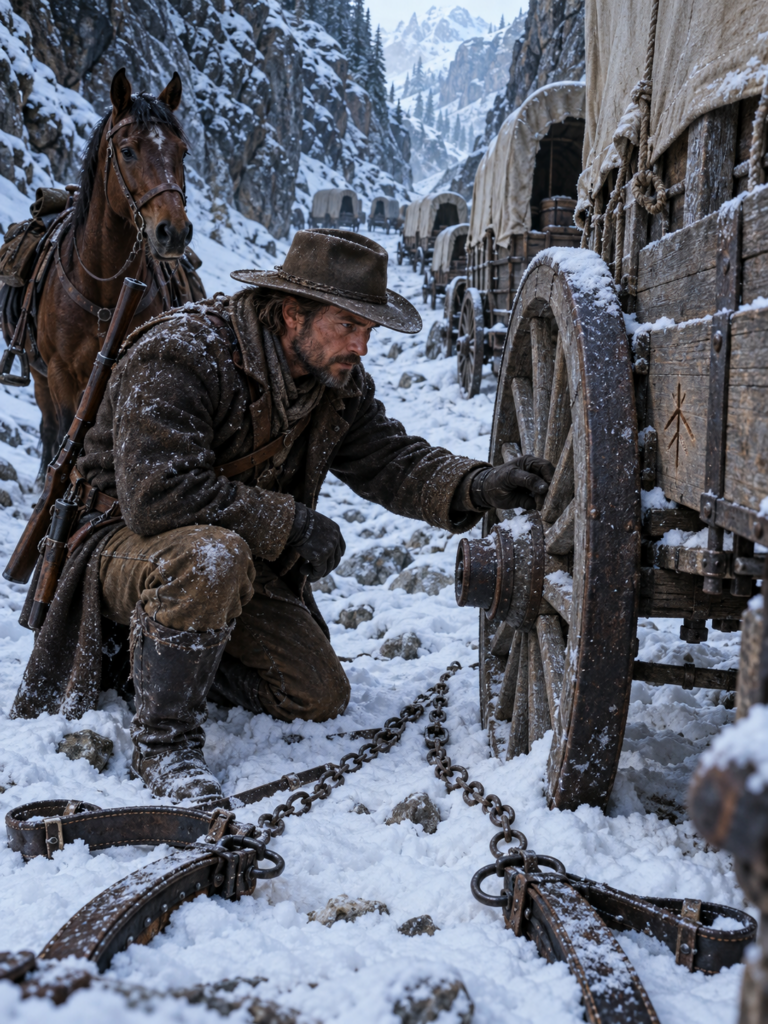
Henry came off the gravel bench with the rifle in both hands and moved toward the ravine wall before the falling snow could erase whatever had just crossed the rim.
He did not call out.
Someone who had hidden for two winters could answer a question with a bullet.
He reached the game trail, climbed ten careful yards, and found a boot print pressed into the fresh crust.
Large.
Recent.
The heel had cut through snow that had fallen after sunset.
Henry touched two fingers to the edge.
Still sharp.
The watcher had been standing there while Henry opened Peter Hollis’s notebook.
He followed the prints to the crooked spruce.
Beyond it, they vanished onto bare stone.
Henry stayed crouched.
No horse tracks.
No camp smoke.
No sound of retreat.
Whoever had come here knew how to cross rock without leaving sign.
Henry returned to the wagons after dark and extinguished the fire.
That changed the problem.
Peter’s notebook had proved the column had been deliberately stopped.
The fresh carving proved someone had returned after the disappearance.
The footprint proved that person might still be guarding what had been left behind.
Henry buttoned the tally book inside his shirt.
He would not leave it in the wagon.
He would not carry it in a saddlebag.
If somebody wanted Peter’s words, they would have to take them from Henry himself.
Before dawn he saddled the bay and packed the mule.
He stood once beside the third wagon and touched the strange carved symbol.
Line.
Circle.
Line.
Not Peter’s mark.
Not army work.
A signal, perhaps.
A count.
Or a warning meant for somebody who understood it.
He could ride back to Red Hollow.
Four days in good weather.
Longer if the pass closed.
Captain Ord could send soldiers.
Daver could be arrested.
But Peter’s last entry did not say return to the fort.
It said south by the fork.
Past the leaning rock.
Henry looked toward the ravine mouth.
If any of Peter’s men had lived long enough to leave that message, two years had already been stolen from them.
Henry would not steal another four days because he wanted witnesses behind him.
He mounted.
The first snow began before he reached the South Fork.
By midmorning the mountains had disappeared behind white.
Wind drove powder across the trail until the bay walked with its head low and Henry had to lean forward just to see the next stretch of ground.
The mule pulled behind him.
At the leaning rock, Peter’s trail disappeared.
Henry dismounted.
For twenty minutes he found nothing.
Then, beside a windfallen pine, he saw a boot protruding from the snow.
He dropped the mule’s lead.
The shape beneath the tree moved.
Henry crossed the distance in three strides.
A young man lay twisted against the trunk, face blue with cold, beard rough across cheeks Henry remembered smooth.
Blood had frozen black along one trouser leg.
The man’s eyes opened.
For an instant he looked straight through Henry.
Then recognition came.
“You came late, Scout.”
Henry stopped breathing.
“Tom?”
Little Tom Barrow tried to smile.
He had been nineteen when the supply column disappeared.
Now he was twenty-one and bleeding into the snow.
Henry knelt and put both hands under him.
“Who shot you?”
Tom’s fingers caught weakly at Henry’s sleeve.
“South Fork.”
“How many?”
“Six of ours.”
Alive.
Henry closed his eyes once.
Peter had written eleven names into silence.
At least seven had survived long enough to reach the South Fork.
Tom shivered violently.
“Daver comes up,” he whispered. “Every third week.”
Henry looked back toward the road to Red Hollow.
Four days.
Tom did not have four days.
He looked south.
Unknown distance.
Unknown armed men.
Six prisoners who might not have another week.
Henry made his choice.
He lifted Tom from the snow.
He would carry him back to the hidden wagons, shelter him in the paymaster’s bed, and at first light Henry Mercer would ride south alone.
Tom’s weight sagged against Henry’s chest as he carried him through the blowing snow toward the ravine.
The young man tried once to walk.
His wounded leg folded beneath him.
Henry caught him before he struck the ground.
“Save it,” Henry said.
Tom’s teeth were chattering too hard for an answer.
The wind had nearly buried Henry’s own trail by the time they reached the game path leading down to the wagons.
He tied the bay and mule close under the rock shelf, then carried Tom into the sixth wagon.
The paymaster’s canvas was torn but the wagon bed stood higher than the snow and blocked the worst of the wind.
Henry spread his bedroll across the floor.
Then he took the bloodstained army blanket he had found in the fourth wagon, shook loose the frost, folded the clean portion inward, and wrapped Tom in it.
The irony was not lost on him.
A blanket hidden by a missing man two years earlier was now keeping another missing man alive.
Henry cut Tom’s trouser leg.
The bullet had passed through the flesh of the thigh without breaking bone.
That was good.
The bleeding and cold were not.
Henry packed the wound with clean cloth cut from his own shirt, bound it tight, then set a coffee tin over a small sheltered flame outside the wagon.
When he returned, Tom’s eyes were open.
“You still carry that ugly rifle?”
Henry looked at the weapon propped beside the tailgate.
“You still complain when somebody keeps you alive?”
Tom’s mouth twitched.
For the first time since entering the ravine, Henry felt something inside him loosen.
Not relief.
Not yet.
But proof.
A living voice from the dead column.
Henry held the tin cup to Tom’s hands.
“Tell me.”
Tom drank once, grimaced, and rested his head against the sideboard.
“They stopped us above the ford,” he said.
“I read Peter’s book.”
Tom’s eyes sharpened.
“You found it?”
“Under the paymaster’s seat.”
“He said you would.”
The words landed harder than Henry expected.
Henry lowered himself onto an overturned crate.
“What happened after Peter hid it?”
Tom stared at the wagon roof.
For several seconds, only wind spoke.
“They had papers,” he said at last. “Daver’s men. Army seal. Said Captain had changed the freight contract because storms had closed the pass ahead. Said we were to leave the wagons and walk south to Daver’s temporary camp.”
“You gave them the rifles.”
“Peter did not want trouble over an army order.”
Tom swallowed.
“By the time Amos saw the seal was the old one, they already had them.”
“Why not fight?”
“We thought Tom Sutton—one of Daver’s men—was riding back for confirmation.”
Tom gave a humorless laugh.
“He rode back for more men.”
Henry said nothing.
The young man’s expression changed.
“Peter blamed himself.”
“He shouldn’t.”
“He said the same about you.”
Henry looked toward the open tailgate where snow moved silver through the dark.
Tom continued.
“They took us to South Creek. Daver had a cut up there.”
“A cut?”
“A freight road.”
Henry frowned.
“There is no freight road on South Creek.”
“There is now.”
That was the first answer Henry had not expected.
Tom shifted painfully.
“Daver was trying to open his own route through the timber. Shorter than yours. He had contracts coming due. Needed the fort believing the northern pass was bad.”
Henry understood before Tom finished.
The lost column had not merely disappeared.
It had become evidence.
If six loaded wagons vanished on Henry’s route, every future contract could be moved south.
Daver would profit from the road the army funded to replace it.
The eleven men were not killed because someone wanted what they carried.
They were taken because living witnesses could prove the road had never failed.
Henry rubbed a hand over his face.
“Why keep you alive?”
“Labor.”
Tom’s voice went flat.
“Winter trapped us. He had supplies. We didn’t. South Creek is boxed in three sides. Men watching the fourth.”
“And Peter?”
Tom’s gaze moved away.
Henry knew.
He did not make the boy say it twice.
“How many are alive?”
“Six besides me when I ran.”
Henry corrected him quietly.
“Six including you?”
“No.”
Tom looked back.
“Six there. Me makes seven.”
Seven.
Henry thought of eleven names on Captain Ord’s page.
Four missing from Tom’s count.
He did not ask yet.
“How did you get out?”
“Daver came three days ago. Brought flour and cartridges. They were moving us farther south before the next snow. I heard one of them say the fort had sent for you.”
Henry’s head lifted.
“They knew?”
Tom nodded.
“Daver knew before he came up.”
That meant the fresh mark on the wagon.
The watcher.
Somebody had returned to see whether Henry had found anything.
“Who carved the mark on the third wagon?”
Tom frowned.
“What mark?”
Henry described it.
Tom’s face lost what little color the cold had left him.
“That’s theirs.”
“Meaning?”
“Means checked.”
Henry felt the pieces lock together.
Daver’s men had been returning to the abandoned wagons.
Not to steal.
To verify they remained undiscovered.
“How often?”
“Don’t know. One man would disappear every few weeks. Sometimes overnight.”
Henry stood.
Tom caught his sleeve.
“Don’t go tonight.”
“I wasn’t planning to.”
“You are now.”
Henry looked down.
The boy still remembered him.
Henry sat again.
“No.”
“There’s twelve of them.”
“You said six.”
“Six guards. Daver brought six more.”
“Still there?”
Tom hesitated.
“No. Daver left with four yesterday. Two stayed.”
Eight, then.
Against one scout.
Henry asked, “How many rifles do your six have?”
“None.”
“Axes?”
“Tools. If they haven’t locked those too.”
“Where are the guards positioned?”
Tom stared at him.
Henry waited.
The boy finally understood that Henry was not asking whether the camp could be attacked.
He was asking how men could be brought out without attacking it.
Tom shifted until he could reach a scrap of crate board.
With a piece of charcoal Henry handed him, he drew.
The South Creek cut followed a narrow timbered shelf.
Cook shack here.
Supply lean-to here.
Prisoners slept in a half-finished road cabin.
Two armed men remained near the lower gate during daylight.
Others rotated through the work site.
Above the camp, the mountain rose steep enough that no sensible wagon road would ever cross it.
Below it, the creek cut through a gorge.
Daver had spent two winters forcing a road through country that did not want one.
He had needed Henry’s road to look worse than his own.
Henry studied the crude map.
“There.”
Tom looked.
Henry touched the creek above camp.
“What’s this?”
“Old flume channel.”
“Water?”
“Not since summer. Snow now.”
“Where does it come out?”
“Behind the tool shed.”
“Wide enough for a man?”
Tom slowly nodded.
“For you.”
“For seven.”
Understanding moved across his face.
“You mean take them out.”
“I mean bring them home.”
Tom looked toward Henry’s rifle.
“What about the guards?”
“If I can avoid shooting them, I will.”
“They won’t avoid shooting you.”
“That will be their decision.”
Henry slept in his coat beside the wagon tailgate.
Not deeply.
Twice he woke because Tom had begun shivering again.
The third time, the snow had stopped.
Dawn revealed a world remade white.
Henry fed the bay grain, checked Tom’s bandage, left food and water within reach, and placed the revolver from his saddle holster beside the boy.
Tom looked at it.
“If someone comes?”
“Don’t be brave.”
Tom gave him a thin smile.
“You came to the wrong column for that advice.”
Henry almost smiled back.
Then he buttoned Peter’s notebook inside his shirt and rode south.
The storm had helped.
Fresh snow showed every track.
Two horses had passed north during the night.
One rider each.
Daver’s remaining messengers, perhaps.
Or watchers returning from the wagons.
Henry followed their trail only long enough to establish direction.
They had come from South Creek.
By noon he smelled woodsmoke.
He left the bay in dense timber, removed the horse’s bridle bell, and continued on foot.
The camp appeared below him through pine branches.
Tom’s drawing had been accurate.
A rough road scar cut across the mountainside.
Half-built cribbing held sections above the creek.
Men moved along the cut carrying timber.
Henry counted.
One.
Two.
Three.
Four.
Five.
Six.
All thin.
All dressed in fragments of army freight clothing he recognized.
Amos Fry still limped on his right leg.
John Riley had gone gray.
Peter Hollis was not among them.
Henry had known that from Tom’s silence.
Knowing did not make seeing the empty space easier.
A guard stood above the road cabin.
Another near the cook shack.
A third carried a rifle along the unfinished road.
Three.
Tom had expected more.
Henry waited.
Near dusk, two riders entered from the north.
Five.
One horse bore the same tread pattern Henry had seen at the ravine.
The watcher.
Henry studied him.
Lean man.
Dark coat.
Gray hat.
The man dismounted, spoke briefly to the guard, then walked toward the cabin.
Henry shifted along the ridge.
If the prisoners were locked inside at night, the flume channel mattered.
But the watcher complicated everything.
Henry reached the dry channel after sunset.
The old wooden flume had collapsed years before, leaving a snow-filled trench between stone and timber supports.
He crawled.
Twenty yards.
Fifty.
Then the mountain carried him behind the tool shed exactly as Tom had said.
A narrow crack showed between two boards.
Henry waited until the guard passed.
Then he entered.
Axes.
Shovels.
Picks.
A coil of rope.
And hanging from a nail—
six army cartridge belts.
Empty.
Henry’s jaw tightened.
The evidence of disarmament had been kept here like trophies.
He eased the rear door open.
The road cabin stood fifteen paces away.
One lantern burned inside.
A shadow crossed the window.
Henry moved.
He reached the wall, crouched beneath the sill, and whispered one name.
“Amos.”
The shadow stopped.
A long silence followed.
Then a man’s voice, barely audible:
“Mercer?”
Henry closed his eyes.
“Back wall. Two minutes.”
He returned to the tool shed, lifted three axes, and slid them through the gap.
A board creaked softly.
Then another.
The prisoners were dismantling their own wall from inside.
Henry watched the guard’s lantern move along the road.
Coming closer.
One plank dropped into the snow.
John Riley’s face appeared in the opening.
Older.
Hollow.
Alive.
Henry motioned him through.
Amos came next.
Then four more men.
Six.
Exactly as Tom had said.
Henry handed Amos an ax.
“We leave the way I came.”
John gripped Henry’s shoulder once.
“Tom?”
“Alive.”
Every man’s expression changed.
That single word gave them strength food could not have supplied.
They reached the flume.
Then a voice behind them said:
“Stop.”
The watcher stood beside the tool shed with a rifle leveled at Henry’s back.
Henry did not reach for his gun.
Neither did the six men.
The watcher smiled.
“Daver said you’d come south instead of going home.”
Henry turned slowly.
“So he knows me.”
“He knows guilt.”
The man stepped closer.
“He said you’d always choose the men before the evidence.”
Henry looked at the rifle.
Then at the unstable cribbing above the man’s shoulder.
And finally at Amos.
Amos understood.
He drove the flat of the ax—not into the man, but into the rope securing the stacked road timbers.
The pile collapsed between them.
Henry shouted, “Move!”
Six prisoners plunged into the flume trench.
The watcher fired.
The shot broke timber above Henry’s head.
Henry dropped into the channel and crawled after the others as the camp erupted behind them.
For the first time in two years, the lost men of Red Hollow were leaving South Creek under their own power.
The second shot struck the stone lip above John Riley and showered the flume channel with chips of rock.
Henry shoved him forward.
“Don’t stop.”
Behind them, men shouted across the South Creek camp.
Lanterns moved through trees.
Somebody fired again.
The bullet vanished into timber.
The collapsed road beams had bought seconds, not safety.
Henry reached the place where the flume bent around the mountain and looked back.
Amos Fry was limping badly.
Two winters of forced labor had sharpened every bone in the man’s face.
Henry caught his arm.
“Lean on me.”
Amos resisted.
“You got six men to move, Mercer.”
“I counted seven.”
Amos looked at him.
Henry hooked the man’s arm over his shoulder.
They went together.
The flume opened into timber fifty yards above the camp.
Snow erased their shapes but slowed them almost to walking.
Henry led them toward the bay.
The horse heard them first and lifted its head.
One of the prisoners gave a strangled laugh.
“Never thought I’d be glad to see one horse.”
Henry untied the reins.
“Don’t get sentimental. He has to carry Amos.”
“I can walk.”
“No.”
It was not command for command’s sake.
Amos’s damaged leg was already folding.
Henry put him in the saddle.
John Riley took the lead rope.
The others moved behind.
“Where’s Tom?” John asked.
“Wagons.”
“You found the wagons?”
“All six.”
That stopped them.
Even with armed men somewhere behind, the six survivors stood in the snow and stared at him.
Henry understood.
For them, those wagons belonged to another life.
A last ordinary morning before everything went wrong.
Peter complaining about axle grease.
Tom talking too much.
Amos checking brake blocks.
John swearing about weather.
The sight of those wagons would mean the lost time had been real.
And finished.
“Move,” Henry said more gently.
They moved.
By midnight they reached the leaning rock.
The tracks behind them had disappeared.
Either the guards had stopped following or were circling.
Henry trusted neither possibility.
He left the bay with John and went ahead on foot.
At the ravine rim he found no fresh tracks except his own.
He whistled once.
A pause.
Then Tom answered from below.
“Ugliest bird I ever heard.”
John Riley sat down hard in the snow.
Henry looked at him.
The older man covered his face with both hands.
Nobody mocked him.
They descended one by one.
Tom was awake inside the paymaster’s wagon, revolver across his lap.
When John climbed through the canvas, Tom stared.
John stared back.
Then John crossed the wagon in two steps and wrapped both arms around him.
Neither spoke.
Amos came next.
Then the others.
Men Henry had known as loud teamsters, stubborn freight hands, card cheats, camp cooks, and practical fools stood crowded inside a frozen wagon while one wounded boy laughed and cried into their coats.
Henry remained outside.
Some reunions belonged to the people who had survived them.
He built the fire.
A few minutes later, John came out and sat opposite him.
“You found Peter’s book?”
Henry touched his shirt.
“Yes.”
“Then you know.”
“Some of it.”
John stared into the flames.
“Peter made us swear that if one got loose, we’d bring the truth back before we went after Daver.”
“Tom told me about the road.”
“Not all of it.”
Henry waited.
John lifted his eyes.
“Daver did not just want the contract.”
The night seemed to contract around them.
“He needed the northern road condemned,” John continued. “He had already taken money for a new southern route. Timber, labor, grading. Some of it billed to the army before the work was even started.”
“Fraud.”
“Enough to ruin him.”
“So he staged a failed column.”
John nodded.
“But the wagons being found wouldn’t have been enough. Could have called it weather. Teams panicked. Men made bad choices.”
Henry’s jaw tightened.
“Unless the men came back.”
“Exactly.”
That was why they had lived under guard for two years.
Not ransom.
Not robbery.
Erasure.
Daver had found a way to make eleven living witnesses disappear without eleven bodies drawing immediate suspicion.
The wilderness would be blamed.
Henry’s map would be blamed.
Winter would finish the explanation.
“What happened to Peter?”
John’s face changed.
The answer came slowly.
“First winter, he tried to get three of us out through the creek.”
Henry looked at the fire.
“Did he make it?”
“No.”
“How?”
John did not answer immediately.
Henry looked up.
“There were four missing from Tom’s count.”
“Yes.”
“Peter?”
“Yes.”
“Who else?”
“Ben Cole. Nathan Wells. Samuel Price.”
Henry knew all three.
He had eaten beside them.
Played cards with two.
Once hauled Nathan out of a flooded crossing by the collar.
“Dead?”
John nodded.
“Different times. Cold. Sickness. Ben tried to run. Samuel got hurt under a timber.”
“And Peter?”
John’s voice roughened.
“Shot.”
Henry looked away.
The ravine blurred for a second, not from tears but from the kind of anger that narrowed sight.
Peter Hollis had spent his last useful minutes writing Henry’s name into a notebook.
Not because Peter blamed him.
Because Peter trusted him.
For two years Henry had lived alone with the wrong verdict.
He had abandoned the fort.
Stopped answering letters.
Let men in Red Hollow say the road had killed his friends.
All while Peter’s final act had been to tell him the opposite.
John reached into his coat.
“I have something else.”
He removed a folded piece of stained cloth.
Inside was a brass army seal.
Old pattern.
Henry stared.
“Amos took it off one of Daver’s men the first week,” John said. “We’ve kept it hidden ever since.”
The forged authority.
Physical proof.
Peter’s notebook gave testimony.
The seal connected the deception to army orders.
Living witnesses could identify the men.
Daver’s scheme was no longer rumor.
It was a case.
Henry looked toward the wagon.
“Why didn’t Tom take it?”
“Because we thought whoever escaped first would be searched if caught. Amos hid it in the road cabin wall.”
Henry almost laughed.
Even imprisoned men had been building an evidence chain.
They had not merely survived.
They had waited for a chance to make survival matter.
A shout came from the rim.
“Mercer!”
Every man froze.
Henry stood.
The voice came again.
“You have something that belongs to Mr. Daver.”
Henry recognized the watcher.
He lifted his rifle but stayed below the rim.
John moved beside him.
“Five of them?”
“Maybe.”
“Can we hold this?”
Henry looked around.
The ravine walls protected them from distance but trapped them if attacked from both ends.
The wagons narrowed movement.
Tom could not travel fast.
The bay could carry one injured man, not two.
Fighting would risk the very witnesses Henry had come to save.
Then Henry looked at the wagons.
Six heavy freight wagons.
Brake blocks worn from the grade.
Trace chains intact.
Ropes still usable.
A narrow ravine.
He understood.
The wagons had been hidden to erase the story.
Now they could protect the men who told it.
Henry pointed.
“John, Amos—release the brake on the lead wagon.”
John stared at him.
“It hasn’t moved in two years.”
“It does not need to move far.”
Three men climbed to the first wagon.
Henry cut loose frozen debris around the wheels.
The ravine floor sloped toward the lower entrance.
He had noticed it when examining the brake blocks.
Amos Fry had once jammed green pine behind one wheel because the grade worried him.
Henry removed the old wedge.
The wagon groaned.
A shout came from above.
“Last warning!”
Henry called back.
“Then make it a good one.”
A rifle cracked.
The shot struck the canvas.
Henry shoved against the wheel.
John joined him.
The frozen rim broke loose.
The wagon rolled six inches.
Stopped.
They pushed again.
A foot.
Then gravity took it.
The heavy freight wagon moved down the ravine, slow at first, then faster.
Henry jumped aside.
The front wheel struck a rock.
The wagon twisted crosswise and slammed between the ravine walls.
Crates shifted but held.
The entire lower approach was blocked.
John stared.
Henry pointed uphill.
“Second wagon.”
They moved another.
This one they angled near the upper game path.
Not enough to crush anyone.
Enough to make a charging entrance impossible.
The ravine became a fort built from the evidence itself.
The watcher shouted something Henry could not hear.
No one answered.
They remained there until dawn.
No attack came.
When first light reached the rim, Henry climbed alone.
The watcher was gone.
Tracks led north.
Back toward Red Hollow.
That could mean the man had abandoned them.
Or it could mean Daver would know Henry had living witnesses before Henry reached town.
Henry returned below.
“We leave now.”
Tom tried to stand.
His injured leg immediately betrayed him.
Henry rigged a travois from two saplings and rope taken from the fifth wagon.
They wrapped Tom in the army blanket.
Amos rode the bay until the grade eased, then insisted on walking.
Henry did not argue once he saw the man could manage.
The mule carried packs.
Seven survivors moved north.
Henry walked ahead.
The notebook remained inside his shirt.
The old seal rested in a pouch against John’s chest.
They had evidence split between them deliberately.
If one man was stopped, the truth could still continue with another.
Near the second day’s camp, they saw riders.
Six shapes came through the timber behind.
Daver’s men.
Henry did not need a spyglass to know.
John stepped beside him.
“We can run.”
“Tom can’t.”
“We can fight.”
Henry looked at the narrow trail.
“Maybe.”
Then Amos said, “Or we can make them decide whether they want murder witnesses added to the freight fraud.”
Henry turned.
Amos gave a tired shrug.
“Two years is enough time to think.”
Henry studied him.
Then he nodded.
They did not hide.
They spread across the trail.
Seven thin men.
One wounded on a travois.
One scout.
One rifle Henry carried openly but did not raise.
The riders slowed fifty yards away.
The watcher was among them.
He looked at the survivors.
Perhaps for the first time, he understood the problem.
Killing one missing column in secret was one thing.
Killing seven men together on an open trail when Red Hollow already knew Henry had gone searching was another.
Henry spoke loudly enough to carry.
“Captain Ord has my route.”
It was not exactly true.
Ord had Henry’s general orders and map.
That was enough.
“He knows where I went. He knows when I was due.”
The watcher said, “You are overdue.”
“Good.”
Henry let the word settle.
“Then men are already looking.”
That, too, might be true.
The riders exchanged looks.
Henry continued.
“You shoot now, you leave seven bodies on a road the army is about to search.”
The watcher looked at Tom.
Then John.
Then Amos.
His rifle remained across his saddle.
Henry had learned over twenty years that many violent men depended more on isolation than courage.
Daver’s scheme worked because nobody had witnessed it.
Sunlight was its enemy.
Numbers were its enemy.
Names were its enemy.
The watcher finally turned his horse.
One by one, the others followed.
They disappeared south.
Tom let out a shaky breath from the travois.
“You knew they’d leave?”
“No.”
Tom stared.
Henry started walking.
“That seems important.”
“It was.”
For the first time, John Riley laughed.
The sound followed them down the mountain.
Eleven days after Henry left Red Hollow, a trapper on North Creek saw the small procession crossing the flats.
Henry did not know the man had ridden ahead.
He learned when the road curved above town and he saw people gathering on the plank street.
By the time the bay reached the first hitching post, nearly everyone in Red Hollow was outside.
The same freight men who had laughed when Henry left stood silent in front of the saloon.
The boy from the water trough held a wooden bucket at his side.
Two women in dark shawls stood outside the mercantile with their hands raised to their mouths.
Nobody asked whether Henry had found the wagons.
They were looking at the men behind him.
Amos Fry.
John Riley.
Men who had been reduced to names on a casualty list.
Little Tom Barrow strapped to the travois, pale but conscious.
Henry heard someone whisper:
“My God.”
Then another voice:
“They’re alive.”
The words traveled down the street.
Alive.
Alive.
Alive.
Henry did not look at the saloon.
He looked at the fort gate.
Captain Ord came down the hill on foot without his coat.
He stopped in the road.
For several seconds, the younger officer could not seem to choose which man to look at first.
Henry reached inside his shirt.
Peter’s tally book had ridden against his skin for days.
He handed it to Ord.
“Peter Hollis wrote the last pages.”
Ord opened it.
The street remained silent while he read.
Henry watched his face.
Confusion.
Disbelief.
Then fury so controlled it became almost stillness.
John stepped forward and placed the old army seal in Ord’s hand.
“They used this.”
Ord stared at it.
“This seal was retired before I took command.”
“We know.”
“Who had it?”
“Daver’s men.”
Ord looked toward the freight office.
Daver’s storeroom stood halfway down the street.
The door was open.
A clerk inside had gone motionless.
Ord closed Peter’s book.
“Sergeant Barlo.”
The sergeant emerged from the crowd.
His face had turned gray.
“Sir.”
“Take four men. Arrest Elias Daver. Secure every freight ledger, contract, seal, letter, and account in his office.”
Barlo did not hesitate.
“Yes, sir.”
Daver came out of his storeroom before the soldiers reached the door.
His store-bought coat hung open.
He looked first at Ord.
Then at the book.
Then at the men behind Henry.
His expression changed only once.
When he saw Tom.
There it was.
Recognition.
Not surprise that a stranger had appeared.
Recognition of a man Daver had believed contained by the mountain.
Tom saw it too.
He pushed himself upright on one elbow.
“That’s him.”
The street heard.
Daver’s eyes moved toward Henry.
“You don’t know what you found.”
Henry answered quietly.
“I found your road.”
Something hardened in Daver’s face.
“You think one notebook proves anything?”
John Riley said, “No.”
He lifted the old seal.
“This helps.”
Amos Fry stepped forward.
“So do six witnesses.”
Tom raised his head from the travois.
“Seven.”
Daver looked around.
For two years, distance had been his shield.
Now the entire town stood within hearing.
Captain Ord motioned.
Barlo took Daver’s arm.
Daver did not fight.
As the sergeant turned him toward the fort, Daver passed Henry.
He paused.
“You were finished before this.”
Henry met his eyes.
“No.”
Daver waited.
Henry looked toward the seven men.
“I was wrong about what finished meant.”
Daver said nothing more.
He was led away.
The post surgeon took Tom immediately.
Henry followed as far as the infirmary door.
Dr. Witt, a spare man with impatient hands and no taste for ceremony, pointed at a chair.
“Sit or leave.”
Henry sat.
For two hours he listened to movement behind the curtain.
Water.
Metal.
Low voices.
Tom cursed twice.
That reassured Henry more than silence would have.
Finally Witt emerged wiping his hands.
“You packed the wound correctly.”
Henry stood.
“Leg?”
“Stays.”
Henry breathed out.
Witt added, “Another night in that snow, I might not have saved it.”
Then he looked directly at Henry.
“Another day, I might not have saved him.”
Henry nodded.
That was enough.
The investigations lasted weeks.
Peter Hollis’s notebook matched the testimony of the survivors.
The old seal matched impressions on papers Daver’s clerk eventually surrendered.
Freight ledgers showed payments for South Creek grading before the army had formally approved any replacement route.
Invoices listed timber that had never reached the fort.
Payroll sheets carried names of men who had never worked there.
Daver had not built his deception in a moment.
He had built it page by page.
Contract by contract.
Then six inconvenient wagons rolled into the center of it.
So he made the wagons disappear.
The northern road remained open.
That fact mattered almost as much to Henry as the arrests.
Army riders went back with engineers.
They inspected the pass.
No fatal defect.
No impossible grade.
No evidence Henry’s map had doomed the column.
The road had never failed.
The sentence the old man had spoken outside town became official truth.
But vindication did not feel the way Henry had imagined during the worst nights of the previous two years.
It did not erase Peter.
It did not return Ben Cole, Nathan Wells, or Samuel Price.
It did not give Tom back two winters.
Truth could restore a name.
It could not restore time.
That knowledge kept triumph from becoming cruelty.
When Sergeant Barlo found Henry brushing the bay near the corral four mornings later, the older soldier stood quietly until Henry looked up.
“I said something when you left.”
Henry returned to the horse’s shoulder.
“You’ve said plenty.”
Barlo nodded.
“That particular thing was wrong.”
Henry kept brushing.
Barlo shifted.
“I was wrong out loud.”
Henry stopped.
The sergeant’s face reddened slightly.
“I figured I should be right out loud too.”
Henry looked at him for a long second.
Then nodded once.
Barlo nodded back.
Nothing more was needed.
The freight man with the tobacco-stained beard came later.
He rested a hand on the corral rail.
“I told you to bring back a wheel.”
Henry did not answer.
The man glanced at the bay.
“Turns out you brought back considerably more.”
“You owe me a wheel spoke.”
The man laughed once.
Fairly.
Not meanly.
“I’ll get one.”
Little changes followed.
A woman Henry barely knew brought bread to the room above the office where Ord had insisted he sleep until the hearings ended.
The livery stopped charging him for the bay’s feed.
The boy from the trough began appearing each afternoon with questions about tracking.
Henry answered exactly one question per day.
The boy came back anyway.
John Riley stayed at the fort until the army arranged transport east.
Amos Fry refused to leave until he had walked, with his limp and a borrowed cane, to the north road and stood at the place where the column had first been stopped.
Tom spent most of his days complaining about infirmary coffee.
Dr. Witt considered this evidence of recovery.
One week after Henry’s return, he walked beyond the last house in town.
The old trapper sat on the split-log bench.
Same wool blanket.
Same cold pipe.
Same pale eyes.
He looked up.
Henry stopped.
“You knew something.”
The old man considered.
“Knew men had been moving through South Creek when no honest freight belonged there.”
“You could have told the fort.”
“Told the old captain. He liked Daver’s invoices more than an old man’s weather sense.”
Henry absorbed that.
“Why tell me?”
The old man’s eyes moved toward the mountains.
“Because you were still listening.”
Henry thought of the sentence.
Mind which one you bring home.
“I brought seven.”
The old man smiled without showing teeth.
“One is what I meant.”
Henry understood then.
Not one man.
One truth.
The truth that could carry all the others home.
He touched his hat.
Twice.
Then he walked back toward the fort.
At dusk several days later, Henry stood beside the corral with the bay.
The mountains behind Red Hollow glowed dark red beneath the last light.
Tom appeared on the infirmary porch using a crutch.
The old army blanket from the fourth wagon hung around his shoulders.
Henry had almost thrown it away after seeing the bloodstain.
Tom had refused.
“Warm blanket,” he had said.
The object had changed.
Once, it had been proof somebody suffered beside the wagons.
Now it was keeping a survivor warm.
Captain Ord crossed the yard carrying a folded paper.
He stopped several feet away.
Not close enough to crowd Henry.
Henry noticed that.
Ord had learned something too.
“There is a position open,” he said.
Henry removed a burr from the bay’s mane.
“What kind?”
“Chief of scouts.”
Henry looked toward him.
“Quarters inside the fort. Regular pay. Authority to review routes before freight contracts are approved.”
“That last part sounds newly invented.”
“It is.”
Henry almost smiled.
Ord held out the paper but did not force it into Henry’s hand.
“You earned the right to write your own road this time.”
Henry studied the page without taking it.
Two years earlier, the offer might have felt like restoration.
Nine months earlier, he might have refused simply because he believed he deserved exile.
Now neither motive seemed honest.
He looked toward the mountains.
His road remained there.
Snow would cover it again.
Wagons would use it in spring.
Men would curse its grades and praise its shortcuts according to weather.
It did not need Henry defending it.
Tom lifted a hand from the infirmary porch.
Henry raised his own.
Then he looked at Ord.
“I am obliged.”
Ord waited.
“I’ll keep the road instead.”
The captain nodded.
No argument.
No persuasion.
He folded the appointment and returned it to his coat.
“Fort could still use your judgment.”
“You know where to find me.”
Ord stood beside him at the rail.
After a while, he said, “Peter trusted you.”
Henry’s hand stopped on the bay’s neck.
“Yes.”
“You trusted him?”
“Yes.”
“Then maybe that’s the part worth keeping.”
Henry looked toward Tom.
The young man had settled into a chair.
The blanket covered his knees.
A square of lamplight appeared in the mercantile down on the plank street.
Another lamp came on in the livery.
Then one behind the fort office window.
For two years Henry had believed his promise to those men had ended when their wagon tracks disappeared into winter.
He understood differently now.
A promise did not end because the road became difficult.
It did not end because people mocked the man who had made it.
It did not end because guilt offered an easier story than uncertainty.
Sometimes keeping a promise meant returning to the place that had broken you and looking again until what was true became impossible to ignore.
Henry ran his hand once down the bay’s warm neck.
“I wasn’t trying to bring back wagons,” he said.
Ord looked at him.
Henry watched Tom on the porch.
John and Amos were inside somewhere, alive enough to argue about supper.
Peter’s notebook rested under guard in the fort office.
The six abandoned wagons would be recovered when spring opened the grade.
Daver would answer for the road he built from other men’s silence.
And Henry’s map, once treated as a confession, had become only what it had always been.
A road.
“I was trying to bring back the word we gave them.”
The bay flicked one ear and leaned its weight against the rail.
Ord said nothing.
He did not need to.
Above them, the fort flag settled in the still evening air.
The plank street emptied.
The mountains darkened from ember-red to black.
Henry remained at the corral until the cold thickened and Tom’s porch chair was finally carried inside.
Tomorrow he would saddle the bay.
There were fence lines east of the flats that still needed riding.
There were routes through the mountains the army would ask him to inspect.
There were seven living men whose names would have to be restored in ledgers that had already written them dead.
And there were four others who would not ride home.
Henry could not change that.
What he could do was make sure nobody ever again called their disappearance an accident.
He could make sure Peter Hollis’s final words survived longer than Daver’s lie.
He could keep the road.
For the first time in two winters, that felt like enough.


