
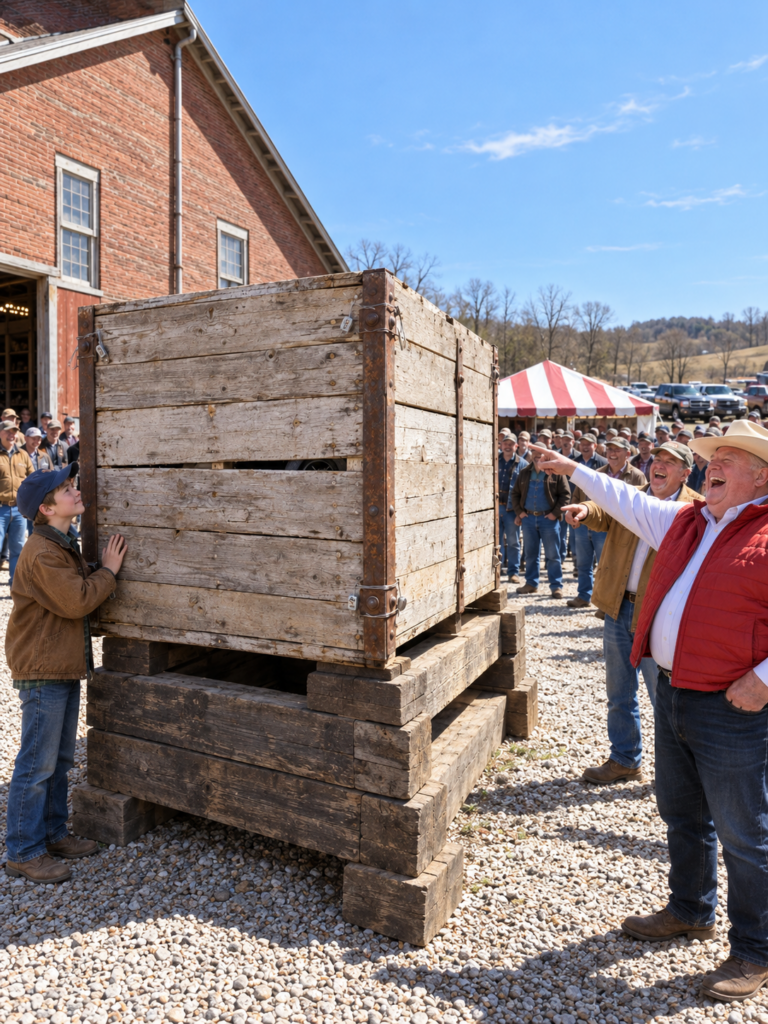
they laughed at the mail carrier’s twelve year old boy for buying a sealed crate of rotten boards for twenty five dollars then sat silent while he bought the family farm they planned to turn into a gravel pit with cash
Part 1
The feed barn at the edge of Ashby Mill had stood for a hundred and twelve years, and on the day it closed for good the cold came down early. October light lay thin across the concrete floor where the last pallets of feed sacks had been stacked and then sold, and the smell of old grain and machine oil hung in the air the way it always had. Marv Tuttle, the auctioneer, saved lot 206 for last because he did not know what else to call it. The crate stood in the back corner where it had always stood, taller than any man in the room, bound in rusted iron straps, bolted at every corner, and hung with small gray wire seals that nobody in town had ever cut. Its boards had been whitewashed so many times that whatever stenciled letters once marked them had long since vanished under the paint.
Owen Pelfrey was twelve. He stood near the front with his hands in the pockets of his brown canvas chore jacket and watched the bidding fall. Marv opened at a hundred. Nothing. He came down to fifty and somebody near the big door called out for firewood and got his laugh. At twenty-five the only hand that went up was Owen’s. The quarters from the jar on his dresser took long enough to count that the laughter started a third time. Royce Amler farmed three thousand acres north of town, sat at the head of the co-op board, and wore the same red quilted vest from the first frost to the last. He liked an audience. That afternoon the feed barn had given him sixty people and nothing else to look at.
“Twenty-five,” Royce said, loud enough for the whole room. “Folks, the Pelfrey boy just paid twenty-five dollars for a box of rotten barn boards.” He leaned down so the boy would catch the rest of it. “Hang on to your change, son. Your mother’s going to need it for the moving truck.”
The laughter rolled across the concrete like spilled grain. Owen counted the money into the clerk’s hand—a twenty, four ones, and the rest in quarters—and did not look up. Only one man in the barn was not laughing. Walt Ness sat on a folding chair by the office door with his cane across his knees. He was ninety-one, and the barn had belonged to his grandfather, then his father, then him, and as of that afternoon it belonged to strangers. When Owen passed him on the way out, the old man caught his sleeve.
“That crate was here before I was,” Walt said. His voice was thin but steady. “My father wouldn’t let anybody touch it. Don’t let them rush you, son.”
Outside the wind cut across the gravel lot. Owen’s mother, Rhonda, stood by the old station wagon she drove from the passenger side so she could reach the mailboxes on her ninety-four-mile rural route. She had taken the morning off without pay. She asked him only one question. “Are you sure?”
“Yes,” he said.
She nodded and let it be.
Saturday morning came up cold and bright. By nine o’clock more people stood in the gravel lot behind the feed barn than had come to the sale. Word had gone around. Nobody wanted to miss a twelve-year-old trying to move a box the size of a chicken house. Lonnie Vic arrived with his flatbed. Lonnie was seventy-four, a retired machinist with a white mustache, and he had been Owen’s neighbor, his teacher, and on the hardest days something close to a grandfather. He walked around the crate twice without a word, then knelt and looked at the oak skids it stood on.
“She’ll go nearly three tons,” he said. “Skids are sound. Whoever built this box meant it to travel.”
Royce had parked his pickup where he could watch. “Where you going to put it, son?” he called. “That’s my shed you live next to, remember? Don’t go cracking my floor.”
“It’ll be gone before your sale,” Owen said.
“It’ll be gone by Christmas,” Royce answered. “Takes a whole winter to burn that much oak.”
The crowd gave him that one, too.
Lonnie ran the winch cable through the back door and hooked it to a chain around the skids. The whole lot went quiet as the cable came tight. The crate groaned. Dust came off the top of it in a long gray sheet. Then it moved an inch at a time out of the corner where it had stood for more than a century, over the sill and up the tilted bed of Lonnie’s truck while Owen and his mother stood well back against the fence the way Lonnie had told them to. They drove it home at fifteen miles an hour down the county road with a line of pickups behind them that nobody bothered to pass.
The Pelfreys rented the old Amler home place, a white farmhouse on forty acres along Plum Creek with a red machine shed that Royce’s grandfather had built. Lonnie backed the flatbed to the shed door and winched the crate down onto a bed of railroad ties, and it filled the shed from wall to wall. That night Rhonda stood in the doorway of the shed with her coat on.
“All right,” she said. “Now tell me what’s in it.”
“I don’t know,” Owen said. “Not for certain.”
“Then how do you open it?”
“I don’t,” he said. “I’m not going to open it. Not yet. Maybe not ever. Not me.”
She looked at him a long moment, then nodded once and went back to the house. In the kitchen the letter from Royce Amler still lay on the table, typed on co-op letterhead. The Amler home place, forty acres and the farmhouse, would be sold at public auction on the last Saturday in October. The tenants would have thirty days after closing to get out. Everybody in Ashby Mill knew who wanted it. Brasque Aggregate had been testing the creek bottom for two years. There was good gravel under Plum Creek, and a gravel pit did not need a farmhouse. Curtis Pelfrey drove a long-haul truck and was home two weekends a month. Rhonda carried the mail. Between them they had paid six years of rent on time and never once had enough left at the end of a month to dream about buying the place. The night the letter came, Owen had heard his mother crying in the kitchen after she thought he was asleep. He had never heard that before.
Part 2
It had started a week before the sale on preview day. Everybody looked at the scales and the grain cleaner and the old roll-top desk. Nobody looked at the crate because the crate had always been there the way a wall is always there. Owen looked at it because nobody else was. Near the bottom of the backside where the crate stood against the brick, one oak board had shrunk away from the next and left a gap about as wide as a pencil. He put his flashlight to the gap and his eye beside it. What he saw was a curve of iron, black iron, and on the iron square cleats bolted in a row, the way cleats were bolted on the rear wheel of a tractor before anybody put tractors on rubber tires. Past the curve, deeper in, something round and cast—a hub, maybe—with a raised letter on it he could not read, and a smell came out of that gap that he knew. Old grease. Clean old grease, the kind that has never been near dirt.
Every August for four years Lonnie had taken him to the Thresher Reunion out at the county fairgrounds. Three days of steam engines and old gas tractors. Owen had read every tractor book the Ashby Mill library owned twice. One afternoon, standing in front of a rusted machine somebody had dragged out of a creek bed, Lonnie had told him something he never forgot.
“Iron that’s been used, you can always find more of,” Lonnie had said. “Iron that nobody ever used. That’s a different story. Once you pry the box, it’s just old iron. As long as the box is shut, it’s history.”
So Owen had gone home and emptied the jar on his dresser—twenty-six dollars and some change, a whole summer of mowing the Methodist church lawn every Thursday—and he had gone to the sale with a plan nobody knew about.
By Monday the story had gone all the way around Ashby Mill and come back with extra on it. At the co-op Royce told it at the coffee counter to anybody who came through the door. The Pelfrey boy, twenty-five dollars, a box of whitewashed barn boards, and the best part, he said, was that the boy would not open it. Afraid of what’s inside, Royce said, afraid it’s empty. Smartest thing he’s done all week. On her route Rhonda heard it from people she had delivered mail to for nine years. A man on the Kettle Ridge Road met her at his box and asked if her boy was going into the firewood business. She smiled and drove on, and two miles later she pulled over by a culvert and sat there for a while with the engine idling and her hands still on the wheel.
At school it was worse the way school is. By Wednesday they had a name for him and it had the word crate in it. Owen let it slide off him. He was not going to argue with anybody. He was going to find out. Through all of it the crate stayed shut. He measured it instead—twelve feet long, six feet wide, seven feet and four inches tall—and wrote it all in a spiral notebook and photographed every side with his mother’s old phone. Then one evening, with Lonnie sitting on an upturned bucket beside him in the shed lights on, he laid his flashlight almost flat against the boards and raked the light sideways across the whitewash the way Lonnie said you read a worn date on a coin. Letters came up out of the paint. Not all of them. Enough. Big stenciled freight letters, a word that began with K, and below it a word that ended in QUE, and on the end of the crate, faint as breath on glass, the words Ness and Ashby Mill. Then he looked at the wire seals. There were nine of them, one on each strap where the strap ends met. Small gray twists of wire run through a stamped metal tag, and every tag carried the same three letters: KMP.
“Factory seals,” Lonnie said quietly. “That’s not a crate somebody packed in a barn, Owen. It came off a rail car exactly the way it left the factory, and it never got opened.”
“Then it’s still new,” Owen said.
Lonnie looked at the boy for a long moment. “Don’t you let anybody near it with a pry bar.”
His father called that Thursday from a truck stop outside Rollins, Wyoming. Owen could hear the wind behind him.
“Your mother says the whole county’s laughing,” Curtis said. “Is it worth anything?”
“I don’t know yet,” Owen said. “That’s why I’m not opening it.”
His father was quiet for a second. Then he laughed, but it was a different kind of laughing than the kind at the feed barn. “Okay,” he said. “Okay, bud. You find out.”
The Ashby Mill Public Library was one room above the old bank, and Dolores Fen had run it for thirty-one years. She was a small woman with short white hair and a lavender cardigan who believed that every question had an answer somewhere on paper. Owen showed her the notebook. A K, a word ending in QUE, KMP, Ness, Ashby Mill.
“Debuque,” Mrs. Fen said. “I’d bet Iowa. And if it came to Ness’s, then Albert Ness ordered it. And if Albert Ness ordered anything big, he advertised it. Albert advertised everything.”
She went to a gray steel cabinet and came back with a box of microfilm. The Ashby Mill Ledger. Every issue since 1892. They found it on the third evening. Mrs. Fen found it really, because by then Owen’s eyes were swimming. A quarter-page advertisement in the Ledger for the second week of March 1919 with a drawing of a squat little tractor on big cleated wheels. Ness Feed and Implement, it said. The Kesler Motorplow of Debuque, one arriving this spring. See it first at Ness’s. KMP. Kesler Motorplow.
They kept reading. Five weeks later, on page six, there was a short paragraph with no picture. The Kesler Motorplow Company of Debuque, Iowa, had closed its doors. Its creditors had taken the factory, and dealers who had ordered machines were advised that no parts or service would be available. After that the Ledger never mentioned Kesler again, and Albert Ness never advertised a motor plow again either.
Owen sat back in the hard library chair. “He couldn’t sell it,” he said slowly. “Nobody would buy a tractor if the company was gone. No parts. So he just left it in the box.”
“Waiting for somebody to sort it out,” Mrs. Fen said, “and nobody ever did.”
That night, in the back of the library’s thick blue encyclopedia of American farm tractors, Owen found a single line he had read a dozen times without knowing what it meant. Kesler Motorplow Company, Debuque, Iowa, 1917 to 1919. Production: small. No known survivors. He wrote a letter to the State Museum of Agriculture that night by hand, three pages long, with his measurements and his photographs of the stencils and the seals and the advertisement Mrs. Fen had printed off the microfilm. He did not say he was twelve. Mrs. Fen typed it up the next morning and sent it by email too, with a line at the bottom in her own words: I have known this young man since he was four. He does not exaggerate.
Royce Amler came by the machine shed the next Sunday afternoon with Dwight trailing behind him and walked in without knocking, looking around the shed like a man pricing it. He wrapped the crate with his knuckles.
“Tell you what, son,” he said. “I’ll do you a kindness. I’ll give you fifty dollars for it. Double your money. I’ll haul it out of here and burn it myself, and you can tell the kids at school you made a profit.” He grinned at Dwight. “That’s more than anybody else in the county will do for you.”
“No, sir,” Owen said. “It’s not for sale.”
Royce’s grin stayed on, but something behind it went flat. “Then you get it off my property before the sale,” he said. “Because on the twenty-sixth of October, whatever’s in this shed goes with the shed, and I don’t believe the gravel people want it.”
On his way out he stopped at the door. Down in the creek bottom a man in a Brasque Aggregate windbreaker was walking the fence line with a bundle of survey stakes under his arm. And every hundred feet or so he stopped and drove one in. Royce watched him with real pleasure. Then he looked back at Owen.
“Better start packing,” he said.
Part 3
The phone rang two days later while Owen was eating supper. His mother answered it, listened, and held it out to him with a strange look on her face. The woman on the line said her name was Margaret Lindfist, that she was the senior curator of the State Museum of Agriculture, and that she had read his letter four times.
“Owen,” she said, “I have been looking for a Kesler for twenty-two years. I have one photograph of one taken at the factory in 1918, and an empty space on my floor where I always hoped one would stand. I want to drive up and see your crate, and I want to bring a man named Harlon Weeks. He’s an appraiser at an auction house in Kansas City that sells antique engines and tractors, and he’s the best in the country at what he does.” She paused. “Can I ask you something? Have you opened it?”
“No, ma’am. Not one board, not one seal.”
He heard her let out a breath. “Good,” she said. “Please don’t.”
“I won’t,” Owen said. “But ma’am, I’d like to ask one thing. When it does get opened, I want it opened once in front of people. I want the people who laughed to be there.”
There was a silence on the line. Then Margaret Lindfist said, “I think that’s the most sensible thing anybody’s said to me all year.”
Lonnie Vic knew the man who ran the county fairgrounds, so the opening would be held in the exhibit hall where the Threshers Reunion set up every August, a long steel building with a concrete floor and big doors at both ends. Lonnie hauled the crate there on a Friday with Owen riding beside him in the cab and a much smaller crowd following than the first time. People had started to wonder. The Methodist church lent forty folding chairs. Owen and his mother set them up in three rows facing the crate. Then Owen sat at the kitchen table and wrote out the invitations by hand. Walt Ness because it had been his grandfather’s crate. Marv Tuttle because he had sold it. Mrs. Fen because she had found it. Paul Sabbo, the young editor of the Ashby Mill Ledger. Lonnie, his mother and his father. And Royce Amler.
His mother read that last one over his shoulder. “You’re sure?”
“He’s the one who said it in front of everybody,” Owen said. “So he should be there in front of everybody.”
Royce took the invitation at the co-op counter, read it out loud to the room, and laughed until he had to wipe his eyes. “I wouldn’t miss it,” he said. “I’ll bring the marshmallows. When that boy finds a pile of rotten feed sacks, somebody ought to get some use out of the fire.”
Curtis Pelfrey handed his load off in Omaha to another driver and drove all night to get home. He walked in the kitchen door at six on Saturday morning, still in his gray work jacket, smelling of diesel and coffee. He put a hand on the back of Owen’s neck and didn’t say anything at all. He didn’t have to.
They got to the fairgrounds at nine. Royce Amler’s pickup was already in the lot. He was leaning on the tailgate in his red vest with Dwight beside him and a bag of marshmallows on the hood. When Owen got out of the car, Royce pushed off the tailgate and walked over with his hand out like a man with a deal.
“Last chance, son,” he said, loud enough for the people walking in to hear. “Five hundred cash right now. Save yourself the embarrassment.”
Owen looked at the hand. Then he looked up at Royce. “Everybody already knows,” he said. “You told them.” And he walked past him into the hall.
There were more than forty people by ten o’clock. The invited witnesses sat in the front row, Walt Ness in the middle with his cane between his knees, and behind them the borrowed chairs filled up and then people stood along the walls. Royce sat on the end of the second row with his arms folded and the marshmallows in his lap. Margaret Lindfist was a slight woman in her fifties with a silver-gray bob, wire-rimmed glasses, and a navy blazer. Harlon Weeks was taller and soft-spoken in a tweed jacket and a bow tie with a canvas tool bag that looked older than he was. They walked around the crate for twenty minutes with a flashlight and a camera while the room shifted in its chairs.
Then Harlon Weeks crouched by one of the wire seals and turned the little metal tag over in his fingers. “Kesler Motorplow Company,” he said to nobody in particular. “Factory seals wired at the plant and not a one of them cut.” He stood up. “Young man, this box has not been opened since it left Debuque. Would you like me to open it now?”
Owen stood up from the front row. Every face in the hall was on him. “Yes, sir,” he said. “Please.”
Harlon cut the first seal with a pair of side cutters, and the snip of it carried to the back of the hall. Margaret photographed it and the next one, all nine. Then Lonnie and Harlon backed the nuts off the iron straps with penetrating oil and patience and let the straps down one by one onto the concrete. Then came the boards. Harlon pulled the nails slowly, one at a time, so the oak wouldn’t split, and Lonnie lifted each plank down and laid it on the floor in order, numbered in chalk, because Margaret asked them to. The first board came off the top of the long side, and there was green underneath. Not rust. Green. Dark, deep, glossy green. The color of a field before harvest, as bright as the day somebody in Debuque had brushed it on. Nobody in the hall said a word. The second board came off, and the third, and a big rear wheel came into the light. Iron, taller than Owen, with a row of square cleats bolted across its face and its spokes painted bright red. Then the radiator, with a brass plate across the top of it. Then the seat, a pressed steel pan with the factory paper still wrapped around it and tied with string.
By the time the last board came down, the Kesler motorplow stood alone in the middle of the exhibit hall on its oak skids, squat and green and gleaming, exactly as it had stood in the dark behind the feed sacks for more than a hundred years. Grease still shone in the cups. The tires of its little front wheels had never touched a field. Behind Owen, someone made a small sound. Walt Ness had gotten to his feet. He was leaning hard on his cane and he was crying and he did not seem to care who saw.
“My grandfather ordered that,” he said. “Dad said he ordered something once that broke his heart. I never knew what.” He shook his head. “He never could bring himself to open it.”
In a wooden toolbox bolted to the frame, Harlon found a canvas roll of wrenches, every one still oiled, and a manual wrapped in waxed paper. Tacked to the side of the seat was a shipping tag, brittle and brown. Margaret read it aloud, her voice not quite steady. “Albert Ness, Ness Feed and Implement, Ashby Mill. Shipped the eighteenth of March, 1919.”
Then Margaret Lindfist turned to face the folding chairs. “I want to tell you what you’re looking at,” she said, “because I think this town ought to know. The Kesler Motorplow Company built thirty-eight of these machines in two years. They were good machines, light and simple, made for a family farm with one team of horses and no money to spare. But the company had borrowed too much. And in the spring of 1919 the bank called the loan, and Kesler went under three weeks after this machine shipped. Every one of the others was sold, worked, broken, and scrapped. For forty years people like me have been looking for one. The books say there are no known survivors.” She put her hand flat on the green hood. “There’s one now. Serial number 31. Never fueled, never run. The tank is clean and dry. It is the only Kesler on earth, and it is as new as the day it was made.”
She looked at Harlon, and Harlon took off his glasses, folded them, and put them in his jacket pocket. “I’ve been appraising farm machinery for thirty-four years,” he said. “I’ve stood in front of maybe four machines in my life that made me want to sit down. This is one of them. A complete unrun factory-crated tractor, the only survivor of its maker, with its tools, its manual, its shipping tag, and an unbroken chain from the factory sealed to this room.” He let that sit. “For insurance purposes, I would not let this machine leave this building for less than three hundred and ten thousand dollars.”
Nobody moved. It was the kind of silence that has weight to it, the kind you can feel on the back of your neck. Rhonda Pelfrey had both hands over her mouth. Curtis had an arm around her. Lonnie Vic was staring at the floor and smiling into his mustache. Paul Sabbo from the Ledger forgot to take a picture, then remembered and took about twenty. And on the end of the second row, Royce Amler sat with the bag of marshmallows in his lap and stared at the green machine with his mouth a little open. He did not laugh. He did not say a single word. Dwight was looking at his own boots. After a long moment Royce stood up, put the bag under his arm, and walked out the side door of the hall, and nobody turned to watch him go.
Part 4
Margaret Lindfist made her offer that same afternoon, sitting on folding chairs in the emptied hall with Owen and his parents. The museum had found a donor, and together they could match Harlon’s figure. Three hundred and ten thousand dollars. Owen asked for two things. The crate had to go with it—every board and every strap and every one of the nine cut seals laid out the way it had arrived, with Albert Ness’s name on the card beside it. And on the day they put fuel in the Kesler for the first time, he wanted to be there. Margaret shook his hand on both.
The money came through on the twenty-fourth of October, two days before the land auction. It was a bright, cold Saturday, and they held the sale in the front yard of the white farmhouse on Plum Creek, the house Owen had lived in since he was six. Marv Tuttle stood on a hay wagon with his microphone. Royce Amler stood beside him in his red vest and did not look at the Pelfreys. Near the front of the crowd stood the man from Brasque Aggregate with a bidder’s card and a folder full of plans for a gravel pit. Owen stood with his mother on one side and his father on the other. In his hand was bidder number 43.
Marv opened at one hundred and fifty thousand. The man from Brasque nodded. Owen raised his card. The bidding climbed in fives and then in twos, while Royce Amler stood on the wagon and watched his own home place fought over by a gravel company and the boy he had told to start packing. At two hundred and thirty-six thousand the man from Brasque looked at his folder for a long time, and then he shook his head.
“Sold,” said Marv Tuttle, and his voice cracked a little on it. “The Amler home place, forty acres and the house, to the young man with the crate. Two hundred and thirty-six thousand.”
The Pelfreys paid in full that afternoon, cash with a certified check from the bank in town, and Royce Amler had to sign the papers on the hood of his own pickup while half of Ashby Mill stood in the yard and watched. His hand was not quite steady. He signed, handed the pen back to Marv, and drove away without a word.
Part 5
The next spring, on a warm morning in May, the Kesler motorplow stood on the floor of the State Museum of Agriculture with its crate laid out beside it, plank by numbered plank. Walt Ness came in a wheelchair, and Mrs. Fen and Lonnie, who had spent the winter going through the engine with the museum’s mechanic. Lonnie turned the crank because Owen’s mother had said that was the one job a twelve-year-old was not doing, and Owen stood back beside his parents and watched. On the third turn of the crank the engine coughed and caught and ran for the very first time, steady and sure, in a cloud of blue smoke that rolled up toward the high windows while a room full of people clapped. Owen didn’t clap. He just stood there grinning with his hands in the pockets of his brown canvas chore jacket, listening to it run.
Outside the museum the spring light lay soft across the parking lot, and somewhere beyond the trees the fields were greening. Back in Ashby Mill the white farmhouse on Plum Creek still stood where it had always stood, and the survey stakes had been pulled and the creek ran clear. Rhonda carried the mail in the same old station wagon, but she no longer drove past the culvert where she used to pull over. Curtis came home on the weekends and walked the fence lines with Owen, and sometimes they stood together in the machine shed where the crate had once filled the space from wall to wall and said nothing at all, which was enough. Walt Ness still came by on Sundays when the weather allowed, and Lonnie still sat on an upturned bucket in the shed light and told the old stories the way he always had. The boy who had paid twenty-five dollars for a sealed box of history stood on the land that was now his and listened to the wind move through the cottonwoods along the creek, and for the first time in a long while the sound of it did not feel like leaving.


