
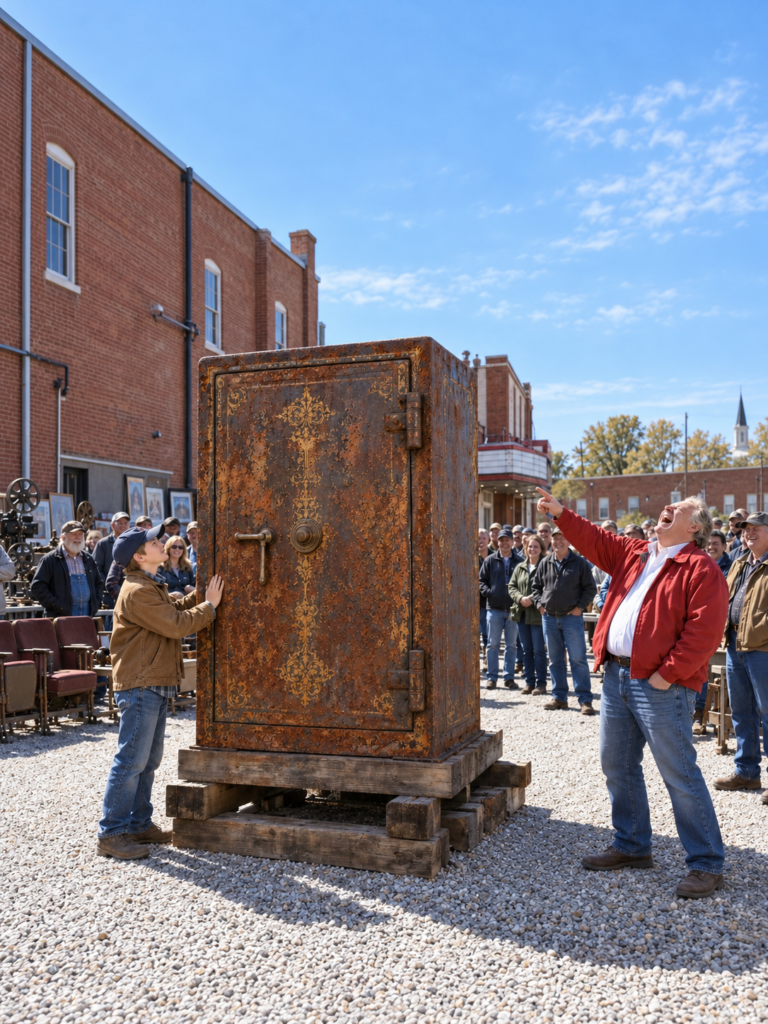
the whole town laughed when the skinny twelve year old spent his lawn money on a rusted shut safe taller than any man there until he opened it cold and found the lost picture that had waited almost a hundred years
Part 1
The gravel lot behind the old Paragon Theater smelled of diesel and damp earth that Saturday morning. The building was coming down in three weeks, and half the county had turned out to buy pieces of it before the demolition crew finished the job. Brass stair rails went for two hundred dollars. Four rows of velvet seats sold early. Gil Haverty, who owned Haverty’s Antiques and Salvage out by the grain elevator and who sat on the town council, had bought the marquee letters before ten o’clock and walked around the lot in his bright red company jacket like a man who owned the morning.
Abel Sorenson stood near the back of the crowd with his grandfather. He was twelve, thin in the shoulders, wearing a faded navy ball cap and a brown canvas chore jacket that had once belonged to Lyall. The sleeves were rolled twice so his hands would show. In the lining of the cap he had kept four folded ten-dollar bills since August. Lawn money. Every Saturday of the summer, every yard on Cherry Street.
The safe stood on a wooden pallet in the middle of the lot. Seven feet tall, wide as a wardrobe, its door crusted with orange scale. The brass dial was seized solid. The handle would not turn. The demolition crew had needed a forklift and most of a morning to bring it down from the projection booth. Nobody had wanted it. Wendell Marsh, the auctioneer, had opened the bidding at a hundred dollars and been answered by a silence so complete he could hear the trucks out on Route 9.
Then Abel’s voice came from the back. “Twenty.”
People turned. Lyall put a hand on the boy’s shoulder. Maybe to stop him. Maybe only to be there.
Gil looked at the boy, then at the safe, and raised his own hand. “Twenty-five,” he said, winking at the men around him. “Just to make it interesting.”
That got a laugh. Abel did not look at Gil. He looked at the safe. “Forty.”
Gil threw up both hands like a man surrendering to a toddler. “Let him have it, Wendell. Forty dollars? I wouldn’t pay forty to have that thing hauled to the scrapyard.”
Wendell had been calling sales for thirty-four years and had never once sold a lot to a child. He brought the gavel down anyway. “Sold to the young man for forty dollars.”
That was when the laughing really started. Gil walked a slow circle around the safe, rapping on it with his knuckles the way a man thumps a melon he has no intention of buying. “You know what’s in here, folks? I’ll tell you what’s in here. Old Josiah Pell’s lunch from 1929. A ham sandwich and a pickle. Maybe the pickle’s worth something by now.”
The crowd roared. Somebody near the front called out, “Better call the fire department, Gil.” That got the biggest laugh of the morning.
Gil stopped right in front of Abel and looked down at him. “Seriously, son. Your granddad’s got a cutting torch. Half this town’s got a cutting torch. Have him cut it open right here and put us all out of our misery.”
Abel looked at him. Then he looked at the safe. Then he said the one thing nobody in that lot expected. “No, sir. I’m not going to open it here.”
Gil blinked. “Why on earth not?”
“Because whatever’s inside has waited a long time,” Abel said. “It can wait for somebody who knows how to open it right.”
There was a beat of quiet, and then Gil laughed so hard he coughed. “Somebody who knows how. Listen to him. Forty dollars and he’s hiring a professional.” He wiped his eyes with the back of his hand. “Son, I’ll tell you what. When you finally find somebody to open that box of rust and you find a ham sandwich, you call me. I want to be there. I’ll bring the popcorn. It’s a movie theater safe after all.”
Half the crowd thought that was the funniest thing they had heard all year. Abel did not laugh. He only nodded. “All right,” he said. “I’ll call you.”
Lyall Sorenson did not say a word until the two of them were standing alone by the safe, the crowd drifting off to bid on a crate of old lobby cards. “You want to tell me what that was about?” he asked quietly.
Abel shrugged, but his ears had gone red. “You told me the story, Grandpa. About Mr. Pell and the safe. You told me a hundred times.”
Lyall had. He had run the projectors at the Paragon from the summer he turned sixteen until the night it closed in 1987. When his daughter and grandson moved in with him four years ago, the old man and the boy built most of their friendship on old films watched late on Friday nights. And the story Abel loved best was the one about the safe.
It went like this. The Paragon had been built in 1921 by a showman named Josiah Pell, a man who loved pictures so much that in the summer of 1926 he put up his own money to make one. He hired a young cameraman from Chicago named Walter Branick, a fellow nobody had heard of, and together they shot a feature right there in Ferris Mill. The town’s people were the extras. Main Street was the set. The picture was called The Lamplighter of Ferris Mill, and when it premiered at the Paragon that October, the line went around the block twice. Then Walter Branick went to Hollywood and became one of the most famous directors of his age. Every print of his first picture, the ones the distributor kept back east, burned in a film vault fire in 1937. Film historians had been hunting for it for most of a century.
“Augustus Pell told me himself,” Lyall used to say. “Josiah’s grandson. He owned the place when I started. He told me his grandfather locked that safe in the spring of ’29, the year the talking pictures came in, and never opened it again. He and Branick had some kind of falling out. Josiah took the combination with him when he died. Nobody’s opened that safe since.”
“What’s in it?” Abel had asked every single time.
And every time Lyall had given him the same answer. “Augustus figured it was the old books. Ledgers. Nobody ever knew.”
Lyall looked at his grandson a long while. “You think it’s the picture?”
“I think it might be,” Abel said. “And if it is, Grandpa, then nobody should be cutting it open with a torch in a parking lot so Mr. Haverty can laugh.”
Lyall Sorenson had learned his trade from old projectionists who still told stories about nitrate fires. He knew exactly what a cutting torch would do to a can of it. He took off his wire-rimmed glasses, cleaned them on his cardigan, and put them back on. “Well,” he said at last, “then I guess we’d better figure out how to get it home.”
Getting it home turned out to be a story of its own. At two and a half tons, the safe was too big for Lyall’s pickup and too heavy for any trailer they owned. So Lyall made a phone call to Hollis Grady, who ran the tower service out on the county road and who owed him, in Lyall’s words, about nine years of free popcorn. Hollis came that afternoon with his flatbed wrecker, looked at the safe, and scratched his head.
“Lyall,” he said. “What in the world did you buy?”
“I didn’t buy it,” Lyall said. “He did.”
Hollis looked down at Abel and laughed. Not meanly, the way a man laughs when somebody hands him a puzzle he likes. He tilted the bed of the wrecker, ran the winch cable out, and wrapped heavy chain twice around the safe. Then, inch by inch, with the motor groaning and the pallet creaking, the winch dragged that enormous iron box up onto the flatbed while a dozen people watched as if it were a parade. Gil Haverty was among them. He had his phone out. “Smile, son,” he called, and took a picture of Abel standing beside the flatbed. “This one’s going on the town page.”
Hollis drove the three miles to the farmhouse at the speed of a funeral procession, the safe held down with four yellow ratchet straps, while Gil’s red pickup followed for the first mile, tapping its horn twice at every turn, like a joke he wanted to keep telling.
At the farm the safe would not fit through the door of Lyall’s machine shed. So Hollis set it on a bed of old railroad ties just inside the big sliding door, under a canvas tarp. Abel’s mother, Dana, came home from her twelve-hour shift at the county hospital at seven that evening, still in her navy scrubs, and found her son sitting on an upturned bucket in the machine shed, staring at a safe that was taller than her kitchen doorway. She stood there a long moment.
“Dad,” she said finally, without looking away from it. “Explain.”
Lyall explained all of it. When he was done, Dana crouched down beside her son. “Did they laugh at you?” she asked.
Abel nodded. “All of them. Mostly Mr. Haverty. But everybody else, too.”
Dana Sorenson had grown up in Ferris Mill. She had known Gil Haverty since she was in pigtails, and she had never once seen him pass up a chance to be the loudest man in a room. She looked at the safe, then at her son. “Then you’d better be right,” she said. “And you’d better do it properly.”
Gil’s picture went up on the Ferris Mill community page that same night. It showed Abel beside the flatbed, the safe looming over him, his cap pushed back and his face serious. Underneath it Gil had written: Congratulations to Ferris Mill’s newest millionaire. Paid forty dollars for Josiah Pell’s lunchbox. Grand opening coming soon. I’m bringing popcorn. By morning it had two hundred comments, most of them laughing faces. Somebody posted a photograph of a ham sandwich. On Monday a seventh grader walked past Abel’s locker and said, “Hey, safe boy. What’s the combination?” By lunch half the cafeteria was calling him that.
Abel did not complain. He went to school, came home, and sat on his bucket in the machine shed with a library book open on his knees.
Part 2
On Wednesday afternoon Gil Haverty’s red pickup came crunching up the gravel drive. Lyall met him on the porch. Gil was all smiles, holding a folded check between two fingers. “Lyall, I’m here to do you a kindness,” he said. “That boy paid forty. I’ll give him sixty. I’ll haul it off myself, scrap it at the yard in Lima, and nobody ever has to talk about it again. He makes twenty dollars and saves his dignity. Everybody wins.”
Lyall looked past him at his grandson standing in the yard with his hands in his jacket pockets. “It’s not my safe, Gil,” Lyall said. “Ask him.”
“What do you say, champ?” Gil said, all friendliness. “Sixty dollars. Better than the stock market.”
“No, thank you, Mr. Haverty,” Abel said.
The friendliness drained out of Gil’s face like water down a sink. “You’re going to look awful foolish when you open that thing,” he said. “You know that, don’t you? The whole town’s going to come out and watch you look foolish.”
“I know,” Abel said. “You said you’d bring popcorn.”
For a second Gil did not seem to know what to do with that. Then he laughed, short and sharp, tucked the check back inside his jacket, and climbed into his truck.
“Saturday after next,” Abel called after him. “Ten o’clock in the morning. You’re invited.”
Gil leaned out of the window. “Wouldn’t miss it for the world.”
What Gil did not know was what Abel had been reading on that bucket. On Sunday he had ridden his bike to the county library and asked the librarian, Mrs. Okafor, for the old newspapers on microfilm. She showed him how to thread the spools, and he spent four hours scrolling through the Ferris Mill Courier for the autumn of 1926. He found it on a front page that October: a photograph of the Paragon’s marquee under a headline announcing that Ferris Mill’s own motion picture would premiere that Friday. The article listed the town’s people who appeared in the picture. More than sixty names. The mayor, the blacksmith, the whole Methodist choir, and a little girl named Clara Fairchild who played the lamplighter’s daughter. Abel printed it out.
Then he found a second article from April of 1929, a single paragraph on page four. It said that Mr. Pell had retired the Paragon’s copy of the Branick picture to his vault, together with its advertising matter, and did not intend to exhibit it again. Abel read that line about forty times.
That night he wrote an email, rewrote it three times, let his mother fix two commas, and sent it to the film archive at the state university. He did not expect anyone to answer. On Tuesday somebody did. Her name was Dr. Miriam Castellano. She was a film conservator at the university archive, and she talked with Lyall for forty minutes while Abel was at school. When Abel came home, his grandfather was still by the telephone with a page full of notes.
“She says she gets a call like ours about once a month,” Lyall told him. “She says nine times out of ten the safe is empty or it’s full of tax papers or somebody’s old shoes. She was very honest about that.”
Abel’s face fell a little. But Lyall went on. “She also said this. If there’s nitrate film in that safe, nobody should put a torch anywhere near it. Not me, not Hollis, not anybody. She said nitrate can catch from heat alone and once it goes, water won’t stop it. She said if we open it, we open it cold with a drill with somebody who knows safes, and she wants to be there when we do. She’s coming.”
“She’s coming?” Abel said.
“She’s coming, and she’s bringing a safe technician she trusts, a woman from Toledo named Lorraine Kubak. And if there’s anything inside worth looking at, she knows a specialist at an auction house in Dallas who handles film posters, so it all gets put on the record properly.”
Abel sat down on the kitchen chair across from his grandfather. “Saturday after next,” he said. “I already told Mr. Haverty.”
Lyall smiled for the first time all week. “I know. I heard you from the porch.”
So they made a plan. The safe would stay sealed until that Saturday. No prying, no peeking, no tapping at the hinges to see how stubborn they were. Abel made his grandfather promise, and then he made Hollis promise, and then, because she laughed at him, he made his mother promise too. Whatever was in that safe would come out once, in daylight, in front of witnesses, and nobody would ever be able to say he had opened it alone and made up a story.
He wrote out a list of who to invite. His mother and his grandfather, of course. Hollis Grady, who had hauled it. Wendell Marsh, who had sold it, because a man ought to see what he sold. Mrs. Odet Fairchild, eighty-six years old, the president of the Ferris Mill Historical Society, because she would know what anything from 1926 meant to the town. And at the top of the list, in pencil, underlined twice: Mr. Haverty.
The Methodist church lent them twenty folding chairs. Hollis rigged his chain hoist from the main beam of the shed, and Lyall swept the floor twice, the way he used to sweep the projection booth. The night before, Abel could not sleep. He came downstairs near midnight and found his grandfather at the kitchen table with a cup of coffee he was not drinking.
“What if it’s empty?” Abel asked.
Lyall thought about it. “Then it’s empty. Gil will laugh and the town will laugh and in a month they’ll be laughing at something else, and you’ll still be the boy who wouldn’t let anybody burn it open just to win an argument. That’s worth forty dollars to me.”
Abel sat down across from him. “What if it’s not?”
Lyall turned the coffee cup slowly in his hands. “Then I’d like to see that picture,” he said quietly. “Just once before I go.”
Saturday came up cold and bright under a sky so blue it looked painted. Abel had invited a dozen people. Close to forty came, many of them the same faces that had laughed behind the Paragon, drawn back by the same curiosity that makes a driver slow down for a car in a ditch. The borrowed chairs filled in five minutes. Dr. Miriam Castellano arrived first in a university van, a slim woman with black hair in a low bun and a charcoal blazer, carrying a hard case of white cotton gloves and a meter for reading the air. Lorraine Kubak pulled in right behind her, a sturdy gray-haired woman in blue coveralls, who walked straight to the safe, laid both hands on it the way a doctor lays hands on a patient, and said, “Well, hello, old girl. Aren’t you something?”
The man from Dallas came last. Harlon Booker was tall and bald, somewhere in his sixties, in a navy suit and a bow tie, and he shook Abel’s hand as if he were meeting a colleague. “Dr. Castellano tells me you refuse to open this with a torch,” he said.
“Yes, sir.”
“Good man. You would be amazed how many people don’t.”
At five minutes to ten, Gil Haverty’s red pickup pulled in. He came through the big door in the red jacket, of course, carrying, of course, a bag of popcorn the size of a pillowcase, and he held it over his head so everyone could see. The people who had laughed at the auction laughed again. “Didn’t want to miss the premiere,” Gil announced. He took the last empty chair in the front row, crossed his legs, and opened the bag.
Abel stood in front of the safe. His voice shook a little, but everybody heard him. “Thank you for coming,” he said. “Most of you saw me buy this. You know what I paid. I haven’t opened it. Nobody has. Mrs. Kubak is going to open it now the safe way, and Dr. Castellano and Mr. Booker are going to tell us what’s inside.” He glanced at Gil. “Even if it’s a sandwich.”
That got a laugh too, but a different kind.
Lorraine Kubak went to work. She used no torch, not with nitrate possibly inside. She worked cold. She chocked the hinge side of the door, clamped a magnetic drill to the steel, and bored slowly, cutting oil running down the rust in brown streaks, stopping every few minutes so Dr. Castellano could check her meter and nod. It took an hour and forty minutes. Nobody left. Even Gil quit eating popcorn after the first hour, though he kept up his remarks, quieter now, to the man beside him.
At last Lorraine stepped back and wiped her forehead. “Three hinges. Two are cut. The last one’s a brass pin about as thick as your thumb, and rust has eaten most of it. A handsaw will finish it.” She held out a hacksaw. “It’s your safe, Abel. You want to cut it open?”
Abel pulled on a pair of work gloves. His grandfather settled safety glasses on his nose and kept one hand on his shoulder the whole time. The drill was unplugged and set aside on the bench, and Hollis drew the hoist chain tight so the door would hang from the beam when it came free. Then Abel Sorenson, twelve years old, set the blade against the last brass hinge pin of Josiah Pell’s safe and began to cut.
It took about four minutes. The shed was so quiet that every stroke of the saw carried out into the yard. When the pin parted, there was a small sharp snap. Then a long groan of iron as the great door shifted on its chain, swung, and hung there, free for the first time in nearly a hundred years.
Hollis and Lorraine walked it aside. Lyall swung the work lights around, and light poured into the safe. For a moment nobody could see anything but shelves. Then Dr. Castellano stepped forward with her gloves on, and she made a small sound that Abel would remember all his life. It was not a gasp. It was the sound a person makes on finding something they had quit believing in.
On the top two steel shelves, stacked on edge like plates in a cupboard, stood round flat film cans, eight of them, each wrapped in brown waxed paper and tied with twine. On the bottom shelf lay a long shallow tin tray under a sheet of oilcloth. Dr. Castellano lifted the first can down with both hands as carefully as if it were a sleeping infant and turned the paper label to the light. The ink had faded to brown, but every word could be read.
“The Lamplighter of Ferris Mill,” she read aloud. “Reel one of eight. Branick Paragon print.”
Behind Abel, his grandfather made a sound like the air going out of him.
Part 3
Dr. Castellano opened the can a crack and bent close, then a little wider. “Cold, dark, and dry,” she murmured. “No light, no damp. It smells like nitrate, but it doesn’t smell like dying nitrate.” She drew out the outermost turn of film between two gloved fingers and held it up to the work light. Tiny frames, brown and silver, each no bigger than a postage stamp, and in them, plain as day, was the marquee of the Paragon Theater, with a street full of people in hats and long coats beneath it.
Mrs. Odet Fairchild rose out of her folding chair. She came forward on her cane, peered at the strip of film, peered again, and put her free hand over her mouth. “That’s Main Street,” she whispered. “That’s the Courier building. Dr. Castellano. My mother was in this picture. Clara Fairchild. She was the lamplighter’s daughter, seven years old. She used to tell me about it, and I never saw a single frame. Nobody ever saw a single frame.”
Not one person in that shed said a word. Then Harlon Booker crouched by the bottom shelf and lifted a corner of the oilcloth. Underneath, laid flat between sheets of yellowed tissue, were posters, not folded and pinholed the way nearly every poster of that age survives, but flat stone lithographs printed in Chicago for the premiere and never hung on any wall. The top one showed a little girl holding up a lantern on a dark street, the colors as deep as the day the ink went down. Midnight blue, lamplight yellow, the red of a small girl’s coat. He lifted the tissue on the next and the next. Seven one-sheets and two great three-sheet posters, every one of them perfect.
Harlon Booker sat back on his heels and took off his reading glasses. For a man who handled valuable paper for a living, he looked badly shaken. “Mr. Pell called it his advertising matter,” Abel said softly. “In the newspaper in 1929.”
“Did he now?” Harlon said. “Son, I have been doing this for thirty-six years. I have never seen a tray like this one.”
The two experts spent the next forty minutes on their knees, checking every can and every sheet. Seven of the eight reels were sound. Reel six had begun to crumble at its edges. The posters were flawless. At last Harlon stood, brushed off his knees, and faced the room. Dana had taken her son’s hand without either of them noticing.
“I want to be careful,” Harlon said, “because a number said aloud in a room like this gets repeated, and it ought to be a number I would sign. So here is what I will put on paper today for insurance purposes.” He looked down at his notes. “The posters first. Original stone lithograph advertising for the first feature Walter Branick ever directed, never displayed, in this condition. There is no other set on today’s market. Conservatively, the posters alone appraise at one hundred ninety-six thousand dollars.”
Somebody in the back said, “Holy smoke.” And nobody laughed at him.
“Then the picture. The only known surviving print of a lost Branick feature, seven reels sound, one damaged. Dr. Castellano will tell you rightly that it belongs in an archive and that its true value is that it exists at all. But for the record, as property, I put the print at one hundred eighty-five thousand, and I am being cautious.” He closed his notebook. “Altogether, for the contents of this safe, three hundred eighty-one thousand dollars.”
For a second the only sound in the shed was the wind rattling the big sliding door. Then the room broke open. People were on their feet. Hollis Grady let out a whoop that probably carried to the county road. Dana pulled her son into her arms so hard his cap fell off. Wendell Marsh, who had sold that safe for forty dollars, sat down heavily in his folding chair and said to nobody in particular, “Thirty-four years. Thirty-four years.”
And in the front row Gil Haverty said nothing at all. He sat with the bag of popcorn in both hands, staring at the open safe, his mouth slightly open like a man who had walked into the wrong building. People turned to look at him, some of the same ones who had laughed loudest behind the Paragon. Not one of them laughed now. The man beside him quietly moved his chair a few inches away.
Gil did not leave. That was the strange part. He sat in silence while Dr. Castellano packed the cans into her cases and Harlon photographed every poster. And when the crowd had thinned, he set the popcorn down on his chair and walked over to Abel, looking as though he did not know what to do with his hands.
“Son,” he said, and stopped. “Abel. I owe you an apology. A public one, I expect.”
“You don’t have to, Mr. Haverty.”
“Yes,” Gil said. “I do.”
That night his old post came down from the Ferris Mill community page. In its place went a photograph of Abel beside the open safe, Mrs. Fairchild holding his hand, and beneath it Gil had written: I laughed at this young man in front of half this town. I was wrong. He was right. And he was a gentleman about it. He paid forty dollars for that safe. Today it appraised at three hundred eighty-one thousand dollars. I’m the fool in this story, not him. It drew more comments than the first one. None of them were laughing faces.
Abel gave the film to the archive. He asked only one thing in return. That when the picture was restored, the first place on earth to see it would be Ferris Mill. Two posters sold at auction in Dallas that winter, and the money paid off his grandfather’s farmhouse and opened a college account his mother checked twice a week just to look at it. One poster went to the historical society, framed with a small brass plate reading Clara Fairchild, the lamplighter’s daughter. The girl with the lantern hung over the Sorenson’s fireplace.
On a warm evening the next May, in the high school gymnasium, with four hundred folding chairs in rows and Mrs. Fairchild in the front one in her best lavender dress, The Lamplighter of Ferris Mill was shown again on a new print made on safety film. The man who threaded it into the projector, his hands perfectly steady and his grandson right beside him, was Lyall Sorenson. When the little girl with the lantern came walking down Main Street on that screen, Mrs. Fairchild reached over and squeezed Abel’s hand. And near the back of the gym, in a red jacket, a heavyset man who had once brought popcorn to laugh at a boy watched the whole picture without a single word.
Part 4
The weeks after the opening settled into a quieter rhythm, but the farmhouse felt different. The safe still sat under the canvas tarp just inside the machine shed door, its great door hanging open now, empty and ordinary. Abel walked past it every morning on his way to the school bus and every evening when he came home. Sometimes he stopped and put his hand on the cold iron the way he had that first day in the gravel lot. It no longer felt like a secret. It felt like something finished.
Dana came home from the hospital one Thursday with a stack of papers from the bank. The mortgage on the farmhouse had been paid in full. She set the papers on the kitchen table beside Lyall’s coffee mug and did not say much. Lyall read them twice, then folded them carefully and put them in the drawer where he kept the old projector manuals. Abel watched his mother’s shoulders drop a little, as if she had been carrying something she had not known she was carrying.
“Your grandfather always said this place would stay in the family,” she told Abel that night while they washed the supper dishes. “I wasn’t sure how. Now I am.”
Abel dried a plate and set it in the rack. “Grandpa still wants to see the picture on a real screen. Not just the little frames.”
“He will,” Dana said. “They’re working on the restoration. Dr. Castellano called yesterday. They think they can have a safety print ready by spring.”
Outside, the wind moved across the fields. The corn was down. The nights were getting longer. Abel finished the dishes and went out to the shed. He sat on the upturned bucket for a while with the library book open on his knees, but he did not turn the pages. He was thinking about the night he and Lyall had sat at the kitchen table and talked about what might be inside the safe. He was thinking about the way his grandfather’s voice had gone quiet when he said he wanted to see the picture just once before he went.
The next Saturday Gil Haverty’s red pickup came up the drive again. This time he did not get out with a check or a bag of popcorn. He stood on the porch with his hat in his hands and asked if he could talk to Abel for a minute. Dana looked at her son. Abel nodded.
They walked out to the machine shed. Gil stopped in front of the open safe and was quiet for a long time. “I keep thinking about what I said that day,” he said at last. “About the ham sandwich. About the popcorn. I keep thinking about the picture I put on the town page.”
Abel stood with his hands in his jacket pockets. “You took it down.”
“I did. But taking it down doesn’t put the laughing back.” Gil turned the hat in his hands. “I’m not asking you to say it’s all right. I’m asking if there’s anything I can do that would mean something. To you. Or to your grandfather.”
Abel thought about it. “Mrs. Fairchild’s mother was in the picture,” he said. “Clara. She never got to see it. When they show it here, maybe you could help make sure the chairs are set up right. And that people who want to come can come. Even if they laughed.”
Gil looked at him. “I can do that.”
“And maybe don’t bring popcorn this time,” Abel said. “Unless you want to share it.”
Gil almost smiled. “All right.”
He stayed long enough to help Lyall move a couple of old equipment cases out of the way so the hoist chain would not catch on them. When he left, Dana stood at the kitchen window and watched the red pickup turn onto the county road. “He’s trying,” she said.
“I know,” Abel said.
Winter came on slow and cold. Snow fell in December and stayed. Abel and Lyall walked the fence line together on the clear days, checking posts and tightening wire where the deer had pushed through. Lyall moved slower than he had in the fall. He stopped more often to catch his breath, and sometimes he sat on the tailgate of the pickup and looked out across the fields without talking. Abel did not ask him about it. He just stayed close and handed him the fencing pliers when he needed them.
One afternoon in January the mail brought a letter from the university. Dr. Castellano wrote that the restoration was going well. Reel six was damaged, but the rest of the picture was sound. They had found a lab that could make a new safety print. She asked if the family still wanted the first public screening to be in Ferris Mill. Abel read the letter out loud at the kitchen table. Lyall listened with his hands folded around his coffee mug.
“Tell her yes,” he said when Abel finished. “And tell her I’ll thread the projector myself if they’ll let me.”
Dana looked at her father. “Dad.”
“I’ve been threading projectors since I was sixteen,” Lyall said. “I can do one more.”
That night Abel lay in bed and listened to the wind against the farmhouse. He thought about the little girl with the lantern walking down Main Street in 1926. He thought about Mrs. Fairchild’s mother telling her daughter stories about a picture nobody had ever seen. He thought about his grandfather wanting to see it just once. The college account sat in a folder on the kitchen counter. Dana checked it every few days, the way she checked the weather. Abel did not think about the money much. He thought about the night in May when the lights would go down in the high school gym and the picture would start, and his grandfather would be the one who made it start.
Part 5
Spring came late that year. The snow melted in April and left the fields soft and dark. The high school gymnasium smelled of floor wax and the coffee the Methodist women had brought in big thermoses. Four hundred folding chairs stood in rows. Mrs. Odet Fairchild sat in the front one in her best lavender dress, her cane across her knees. Gil Haverty had spent the afternoon helping set the chairs and had stayed to make sure the side doors were propped open so people could come in without crowding. He stood near the back in his red jacket, hands in his pockets, and did not say much.
Abel sat beside his mother. Lyall stood at the projector table they had set up at the rear of the gym. The new safety print was on a reel no bigger than a dinner plate. Lyall’s hands were steady as he threaded the film. Abel watched him from his seat. Dana reached over and took her son’s hand.
The lights went down. For a moment there was only the sound of people shifting in their chairs and the low hum of the projector. Then the first frames appeared on the screen. Main Street in Ferris Mill, 1926. People in hats and long coats. The marquee of the Paragon. And then a little girl walking down the middle of the street, holding a lantern up against the dark.
Mrs. Fairchild made a small sound. She reached over and found Abel’s hand and held it tight. On the screen the little girl kept walking. The lantern light moved across the storefronts. The crowd in the gym was quiet. Even the people who had laughed in the gravel lot behind the Paragon were quiet.
Near the back of the gym Gil Haverty stood with his hands still in his pockets and watched the whole picture without a single word. When the lights came up at the end, people stayed in their seats for a moment. Then they began to stand. Mrs. Fairchild turned to Abel. Her eyes were wet, but she was smiling.
“She used to tell me about the lantern,” she said. “I never thought I’d see it.”
Abel nodded. He looked toward the projector table. Lyall was still standing there, one hand resting on the machine, watching the empty screen. Dana went to him. Abel followed. For a little while the three of them stood together in the quiet gym while people filed out around them. Outside, the evening was warm and the fields were green. The safe still sat in the machine shed, empty now, its door open to the spring air. Abel put his hand on his grandfather’s arm.
“You saw it,” he said.
Lyall looked down at him. “I did,” he said. “We both did.”
They walked out together into the soft May evening. The red pickup was still in the parking lot when they reached the farmhouse road, but Gil was already gone. The college account would still be there in the morning. The farmhouse mortgage was paid. The picture had been seen. And the boy who had spent forty dollars of lawn money on a rusted safe nobody wanted had given his grandfather the one thing he had asked for: to see the lamplighter’s daughter walk down Main Street, just once, before he went.


