
Part 1
The day Renata Salazar paid eight hundred dollars for forty starving bison, the people of Cañada Roja laughed as though they had witnessed the funniest mistake in county history.
Some laughed behind their hands. Others made no effort to hide it. A few shook their heads with the solemn satisfaction of people watching someone else throw away money they could not afford to lose.
Augusto Montenegro laughed louder than anyone.
He stood near the auction yard with his boots planted in the gravel, looking perfectly comfortable among the livestock dealers, ranch owners, and men who had spent their lives buying animals by the truckload. He owned more cattle than most people in the county could count, along with enough land to make his name almost impossible to avoid.
In Cañada Roja, a man could disagree with Augusto Montenegro. But sooner or later, he would probably need something Augusto controlled.
Feed. Transport. Grazing rights. A buyer for his cattle.
Or a favor at the bank.
Renata needed none of those things from him that afternoon. At least, she had not expected to.
She had driven to the liquidation auction at Mesa Azul Wildlife Ranch for one simple reason: used fencing wire.
Her own place needed repairs, and secondhand materials were all she could comfortably afford. The ranch she had inherited from her late husband covered one hundred and sixty hectares, but land did not put money in the bank simply because a person owned it. Every season brought another expense, and every expense seemed to arrive before the previous one had been paid.
More troubling still, her property lay between two large sections of Montenegro’s cattle operation.
Augusto had wanted that land for years.
Renata had refused him for years.
And neither of them had forgotten it.
The Mesa Azul auction had already dragged through most of the afternoon when Renata wandered toward the last livestock pen.
Forty bison stood inside.
They were a miserable-looking collection of animals. Their thick coats hung unevenly from their bodies, patches of old winter fur tangled around their shoulders. Their ribs showed through areas where the hair had thinned. Several stood with their heads lowered, conserving what little energy remained.
The ranch had run out of money, and the animals had suffered for it.
There were no clean registration papers to accompany them. No guarantee of their breeding history. No buyer willing to shoulder the cost of moving and rehabilitating an entire herd.
All forty had to leave the property by the following day.
To most of the people at the auction, they were not livestock anymore.
They were an expensive problem.
Renata stopped beside the fence.
At first, she simply watched.
Then she noticed something unusual.
The herd was not scattered randomly around the enclosure. The weakest animals stood near the center, sheltered by the larger ones. Older bison occupied the outer edges, their massive heads turning occasionally toward the fence and the people beyond it.
When one thin cow shifted unsteadily, the animals beside her adjusted without fighting or crowding.
Renata had spent enough years around livestock to recognize the difference between animals that had forgotten how to survive and animals that were struggling to survive despite everything done to them.
These bison were hungry.
They were exhausted.
But they had not surrendered.
She walked slowly along the fence, studying their hooves and the way they carried their weight. She watched their eyes, searching for the dull, distant expression that could accompany serious illness. She looked at their breathing, their reactions, and how they responded when she approached.
There were problems. Plenty of them.
Yet she did not see the hopeless sickness everyone else seemed determined to find.
What she saw was neglect.
And beneath that neglect, a herd that still knew how to protect itself.
A voice behind her interrupted her examination.
“Thinking about taking one home, Renata?”
Augusto Montenegro had approached with two other ranchers.
She kept her attention on the pen.
“Just looking.”
Augusto glanced at the bison and smiled.
“Those things are finished. Whoever buys them is buying a funeral bill.”
The men beside him chuckled.
Renata did not answer.
The auctioneer called everyone closer and announced that the remaining forty bison would be sold as a single lot.
The opening price was eight hundred dollars.
Nobody raised a paddle.
The auctioneer repeated the number.
Still nothing.
A breeze carried dust across the gravel. Somewhere beyond the yard, a truck engine turned over and settled into a rough idle.
Augusto leaned toward the men around him.
“Eight hundred dollars to bury forty animals before Christmas. Sounds like a bargain.”
This time the laughter spread through the crowd.
Renata studied the animals one last time.
One of the larger cows lifted her head and looked directly toward the fence.
There was no reasonable argument for what Renata was about to do.
Her fences had been built for horses, not bison. Her stored hay might last three weeks if she managed it carefully. She had no suitable livestock trailer, no prepared handling facilities, and almost no money to spare.
She knew all of that.
She also knew the difference between an animal that could recover and one that could not.
Before she had fully talked herself out of the idea, she raised her paddle.
“Eight hundred.”
The auctioneer turned toward her.
For a moment, the yard went quiet.
Then someone laughed.
Augusto looked around, expecting another bidder to reveal that it had been a joke.
Nobody did.
He stared at Renata.
“You can’t be serious.”
She lowered the paddle.
“I made a bid.”
“On those?”
“That’s what they’re selling.”
His amusement sharpened.
“Going to feed them with your unpaid bills?”
Several people laughed again.
Renata turned to face him.
“I paid with my own money, Augusto. What I do with what I buy is my business.”
The auctioneer called for another bid.
Nothing.
He asked again.
The silence held.
Then the hammer fell.
Forty bison belonged to Renata Salazar.
For eight hundred dollars.
A transaction that might have taken less than two minutes had just placed the future of her ranch in greater danger than she cared to admit.
As the crowd began to disperse, she stood beside the pen with her auction paddle hanging loosely from one hand.
She had bought the animals.
Now she had to figure out how to save them.
And she had less than twenty-four hours to get them off the property.
Augusto caught up with her near the parking area.
Away from the other ranchers, his smile disappeared.
“That was a foolish thing to do.”
Renata kept walking toward her truck.
“Maybe.”
“You don’t have the equipment for them. You barely have the property.”
“I have enough property.”
He stepped closer and lowered his voice.
“By spring, I’ll own those animals and your land. And I won’t have to spend eight hundred dollars to get either one.”
Renata stopped.
The threat was delivered almost casually, as though he were discussing the weather.
She understood exactly what he meant.
Augusto had been waiting for her to make a mistake large enough to force her into selling. Now he believed she had given him that mistake herself.
She looked at him without speaking.
Then she opened her truck door and drove away.
On the road home, the scale of her decision settled over her.
Forty bison.
Not four.
Not a pair of unwanted calves she could nurse back to health in an ordinary pasture.
Forty enormous animals, some of them dangerously weak, all requiring food, water, secure fencing, and careful handling.
She tightened her hands around the steering wheel.
The road rolled through dry pastureland, with low hills standing against a pale afternoon sky. These were fields she knew in every season. She knew where the grass stayed green longest, where water collected after rain, and which stretches of fence needed attention after a hard wind.
She also knew what Augusto would see when he looked at her ranch.
An obstacle between two pieces of his empire.
He had offered to buy it before. He would offer again.
But it was her home.
It was Mateo’s home.
And the thought of explaining to her son that they had lost it because she had been afraid to fight for it was more painful than the thought of a winter spent saving animals everyone else had abandoned.
That evening, she opened a notebook and began writing down what needed to happen.
Transport.
Veterinary examination.
Fencing.
Feed.
Water.
The list grew longer until she stopped looking at the bottom of the page.
She called Rodrigo Vargas first.
Rodrigo was an old family friend who owned a freight truck and understood the practical difficulty of moving large animals. When she told him what she had bought, he went quiet.
“Forty?”
“Forty.”
“Bison?”
“Yes.”
He exhaled.
“Renata, I thought you went there for wire.”
“I did.”
“Must’ve been some pretty convincing wire.”
Despite herself, she smiled.
Then she explained the deadline.
Rodrigo listened without interrupting.
When she finished, he asked about payment.
She told him she could not afford his normal rate.
He thought for a moment.
“You still know how to repair a fence?”
“I’ve been repairing mine for years.”
“Then come fix mine in the spring. We’ll call it even.”
Renata closed her eyes briefly.
“You mean that?”
“I wouldn’t offer otherwise.”
He was not promising that the move would be easy. They both understood that.
But he had given her a way to attempt it.
Next, she called Dr. Salvador Rojas.
Salvador was a semi-retired veterinarian whose experience included conservation herds. He had spent enough time around large, unpredictable animals to know that good intentions could become dangerous without proper knowledge.
He asked her to describe the herd.
She told him about the ribs, the neglected coats, and the way the animals held themselves.
Then she described the formation she had noticed in the pen.
Salvador became more interested.
“You’re telling me the stronger animals were protecting the weaker ones?”
“That’s what it looked like.”
“Could be something there. But don’t mistake strong herd instincts for good health.”
“I won’t.”
“I’ll look at them before you move the first truck.”
After the call, Renata went out to inspect the fences.
The light was fading.
Beyond the pasture, the house stood quiet against the hills. Mateo was inside, and the familiar sight of home brought both comfort and dread.
She had just spent money the ranch could hardly spare.
More expenses were coming.
Still, when she pictured the forty bison standing together in that dusty pen, she could not convince herself she had made the wrong decision.
Not yet.
Salvador arrived at Mesa Azul before the first truck was loaded.
He moved methodically along the enclosure, taking his time with each animal. He examined the weakest individuals, checked their condition, and watched how the herd reacted to human movement.
His expression remained serious.
Finally, he turned to Renata.
“They’re in worse shape than I hoped.”
Her stomach tightened.
“But?”
“But not beyond recovery.”
She let out the breath she had been holding.
He pointed out three animals that needed especially close attention.
“These are dangerously weak. We have to manage them carefully.”
Renata asked whether she should begin feeding heavily as soon as they arrived.
“No. That’s exactly what you shouldn’t do.”
He explained that animals deprived of adequate nutrition could suffer severe metabolic problems when rich feed was introduced too rapidly. Recovery required time, balance, and close observation.
“People see a starving animal and want to fill it up overnight,” he said. “That’s how they end up killing what they’re trying to save.”
Renata listened carefully.
She had no intention of losing one of those animals because she was too impatient to help it properly.
Salvador watched a group of older bison move toward the loading area.
Something about them caught his attention.
“Interesting.”
“What?”
“The way they move together.”
Renata followed his gaze.
“They did that yesterday.”
“I’ve seen that kind of response in professionally managed conservation herds. These animals have been handled as a group before.”
“Does that matter?”
“It tells me there’s more to their history than a few months in a neglected pasture.”
He did not offer a bigger explanation.
Neither of them had enough information for one.
But Renata remembered his words.
Moving the herd took patience. The bison were large, wary, and weakened by neglect, and nothing about the process could be rushed safely.
Rodrigo coordinated the transport while Salvador supervised the handling of the most vulnerable animals.
Renata helped wherever she could.
When the last truck finally left Mesa Azul, she stood in the empty yard for a moment.
There was no applause.
No sudden certainty that she had rescued anything.
Just the unpleasant awareness that the hard part was beginning.
At home, she used nearly all the money she had left to purchase mineral supplements and reinforce the weakest sections of her fencing.
Salvador helped her develop a careful feeding and recovery plan. Rodrigo stayed involved until the transport was completed.
The north pasture became the center of her daily life.
And word of the purchase traveled through Cañada Roja faster than Renata could have imagined.
By the time the herd was settled, people were already sharing videos mocking the widow who had bought forty dying bison.
Some called it a charity project.
Others called it a breakdown of common sense.
Augusto Montenegro gave an interview to the local newspaper, suggesting that one woman working alone could not possibly control animals of that size.
Renata saw enough of the comments to understand what the town thought of her.
Then she put the phone away.
The animals still needed feeding.
Their opinion of her mattered considerably more.
The first serious test came that night.
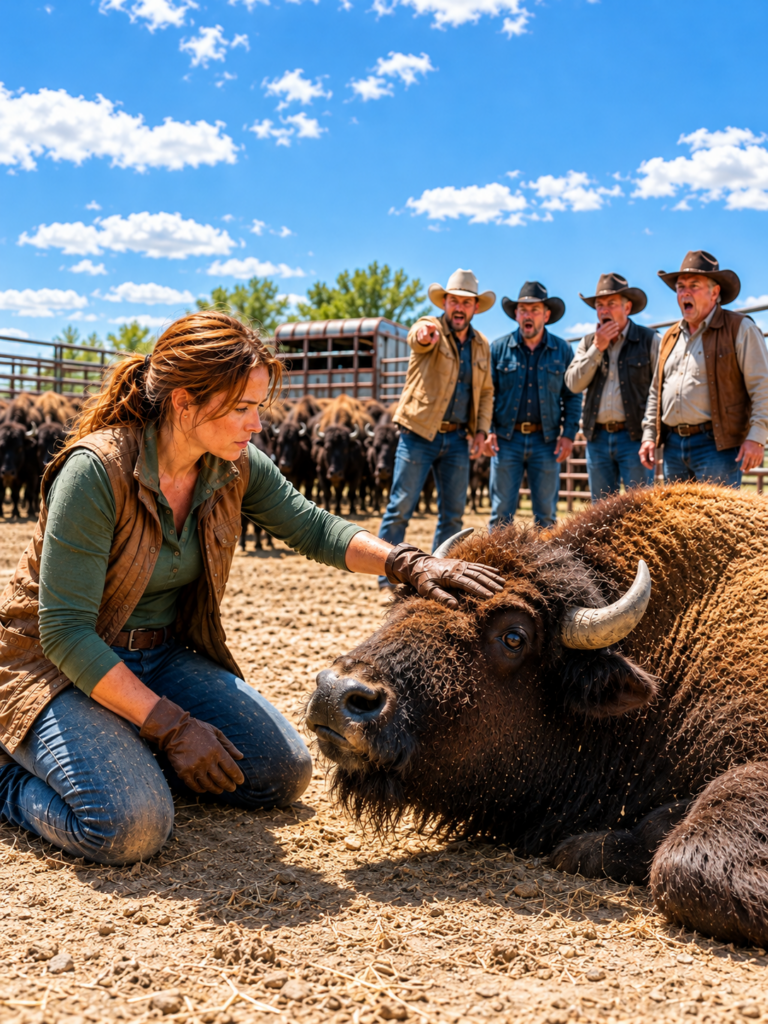
One of the weakest cows went down in the north pasture.
Renata found her lying on the cold ground, struggling to rise. Her legs shifted beneath her, but she could not get enough strength together to stand.
The air had turned bitter.
Renata called Salvador immediately.
He asked questions, gave instructions, and explained what signs to watch for while they arranged the safest next steps.
She followed his directions as closely as she could.
Time passed.
The cold worked through her coat and gloves. Frost settled along the fence wire. Every time the cow moved, Renata felt a burst of hope, only to watch her settle back into the ground.
At one point, she looked toward the house.
A light glowed in the kitchen window.
Mateo was there.
Everything she was trying to protect was only a short walk away.
But leaving the pasture would not change what was happening.
She stayed.
She kept checking the cow, monitoring her condition and speaking softly whenever she approached.
“You’ve come this far,” she murmured. “Don’t give up now.”
The words were as much for herself as for the animal.
Near dawn, the cow made another attempt.
Her front legs shifted beneath her.
For a terrible moment, Renata thought she would fall again.
Then the bison pushed upward.
One leg steadied.
Then another.
Finally, she stood.
Renata remained perfectly still.
The animal swayed, lowered her head, and took a small step.
Renata pressed a gloved hand against her mouth.
Only then did she realize how close she had come to crying.
When Salvador checked on them, she told him what had happened.
He was pleased but cautious.
“Standing is a good sign. It doesn’t mean we’re finished watching her.”
“I know.”
“She’s got a chance.”
Renata looked toward the cow, now resting her weight more evenly.
“Her name’s Hope.”
Salvador paused.
“You named her?”
“Seems appropriate.”
He gave a tired chuckle.
“All right. Let’s make sure Hope gets through the week.”
For the first time since the auction, Renata permitted herself to feel something approaching optimism.
It lasted less than a day.
The next morning, her hay supplier called.
The order she had been counting on was canceled.
There was no additional hay available.
The region’s remaining reserve had been purchased by Montenegro Livestock and Meats.
Renata stood in her kitchen with the phone pressed to her ear, looking through the window at the pasture beyond.
The supplier apologized.
His hands were tied.
The transaction was legal.
Augusto had simply bought the feed before she could.
That was the advantage of being wealthy enough to influence a market without openly breaking a rule.
He did not have to touch her animals.
He only had to make sure she could not afford to keep them alive.
For a few moments, Renata stood still.
Then she opened her notebook again.
There had to be another way.
She began calling anyone who might know where usable hay could be found. She searched for alternative supplies, asked permission to cut material from abandoned fields, and reorganized her pastures to make better use of what remained.
Instead of allowing the bison to graze continually over the same ground, she divided the available land into rotating sections.
It meant moving fences, monitoring grass cover, and paying closer attention to how quickly each section recovered.
The work was exhausting.
But the approach began to give her something she desperately needed.
Time.
The animals continued eating.
The pasture was not stripped bare.
And the herd slowly began to change.
Their coats grew healthier. Their movements strengthened. They spent less time standing listlessly and more time exploring the ground available to them.
Hope became steady enough to move with the others.
Renata checked on her every day.
She had no idea then how much that first successful recovery would come to mean.
Augusto summoned Renata to his office before winter had finished tightening its grip on the valley.
She did not like the invitation, but she went.
His office was a world away from her kitchen table and the worn notebook where she recorded feed purchases.
Everything about the place suggested money that did not have to be counted before it was spent.
Augusto remained seated as she entered.
“I’ve been thinking about your situation,” he said.
Renata took the chair opposite him.
“Have you?”
“I know you’re under pressure.”
“Most ranchers are.”
“Not like you.”
She waited.
He folded his hands on the desk.
“Ninety thousand dollars.”
Renata looked at him.
“For what?”
“Your property. All one hundred and sixty hectares.”
She had expected an offer eventually.
She had not expected him to make it while the animals were still recovering.
He leaned back.
“It’s a fair price for someone in your position. You could clear your problems and walk away.”
“My problems aren’t your concern.”
“They become my concern when your land is sitting between two parts of my operation.”
There it was.
The truth he rarely bothered to conceal.
She looked past him through the office window.
He did not see fields and fences the way she did.
He saw the inconvenience of a gap on a map.
“I’m not selling.”
Augusto’s jaw tightened.
“You should think carefully before making that decision.”
“I have.”
He waited, then changed his tone.
“Banks get nervous about operations carrying too much risk. Spring reviews can be unpleasant.”
Renata met his eyes.
“Are you speaking for my bank now?”
“I’m telling you how the world works.”
“No, Augusto. You’re telling me how you want it to work.”
She stood.
The meeting was over.
Outside, the cold struck her face with an almost welcome honesty.
At least the wind did not pretend it was trying to help.
When she reached home, however, she found another problem waiting.
Three bison had pushed through a section of fence.
Her stomach dropped.
An escaped bison could become a danger to people, vehicles, and other livestock. Recovering three of them under winter conditions would be difficult enough. Losing control of the entire herd could cost her everything.
She followed their tracks toward the hill.
What she found stopped her.
The animals had not wandered toward the road or disappeared into neighboring property.
They had climbed higher, where wind had swept portions of the hillside nearly clear.
There, with deliberate movements, they were pushing their heavy heads through the snow.
They moved the snow aside in broad, circular sweeps, uncovering dry grass beneath.
Renata watched from a safe distance.
The animals were finding food where ordinary grazing might have seemed impossible.
They were using an old survival behavior that Salvador later explained had become uncommon in many commercially managed herds.
When she described what she had seen, he listened with growing interest.
“That’s another useful sign,” he said.
“Of what?”
“That they’ve kept instincts some other herds have lost.”
Renata thought about the animals protecting their weakest members at Mesa Azul.
About the coordination Salvador had noticed during loading.
And now this.
There was a history written into the way these bison behaved.
She simply did not know how to read all of it yet.
The escaped animals were brought back under control, and the damaged fence became another urgent repair on a list that never seemed to shorten.
But the memory of those broad heads sweeping through the snow stayed with her.
The town saw forty mistakes.
Augusto saw an opportunity to acquire her land.
Renata was beginning to see something else.
She still could not have named it.
By the end of that first winter, Renata had lost one bison.
An elderly animal died of natural causes despite the care provided.
She felt the loss more deeply than she expected.
Every animal had become familiar to her through its movements, temperament, and place within the herd. Losing one was not merely a change in a number written on paper.
But thirty-nine had survived.
And those thirty-nine were stronger than they had been when they arrived.
Their bodies had filled out. Their coats had improved. The pasture no longer looked like a place where a collection of dying animals had been deposited.
It looked like a herd was living there.
Renata walked the fence one evening as the final weeks of winter approached.
Mateo stood nearby with his weather notebook, making observations of the changing conditions.
He looked toward the animals.
“They look different.”
“They are different.”
“Do you think they’re going to be okay?”
Renata studied the herd.
For months, she had been afraid to answer that question.
Now she allowed herself a small smile.
“I think they’ve got a better chance than anybody gave them.”
It was not a promise.
Ranching had taught her not to make promises about things she could not control.
But the next visit from Salvador brought news that changed everything again.
After examining the herd, he asked Renata to join him by the fence.
His expression was thoughtful.
“There’s something you need to know.”
She immediately looked toward Hope.
“Is somebody sick?”
“No.”
“Then what?”
“At least eighteen of your cows are pregnant.”
Renata stared at him.
“Eighteen?”
“At least.”
For a moment, she could think of nothing to say.
Eighteen calves.
Eighteen new lives.
Eighteen more animals requiring shelter, feed, water, and the kind of attention she had barely managed to provide for their mothers.
Salvador watched her reaction.
“It’s good news, Renata.”
“I know.”
“You don’t look happy.”
She gave a breathless laugh.
“I’m trying to figure out how to be happy and terrified at the same time.”
He smiled faintly.
“That’s probably the right response.”
The promise of new calves should have been the end of the worst uncertainty.
Instead, the weather forecasts began warning of severe drought during the coming calving season.
Water supplies across the region would be strained.
Grass growth could slow or fail.
Feed would become more expensive.
Renata looked across her pastures, counting the animals she had fought so hard to keep alive.
Winter had been difficult enough.
Now she had to bring eighteen calves into a world that might have too little water for their mothers.
And somewhere beyond those fences, Augusto Montenegro was still waiting for her to fail.
Part 2
Augusto Montenegro did not wait long to apply more pressure.
When buying the region’s available hay had failed to destroy Renata’s operation, and his ninety-thousand-dollar offer had failed to separate her from her land, he found another way to make her life difficult.
This time, the trouble arrived in the form of an official complaint.
Prudencio Vera, Augusto’s ranch manager, filed a report alleging that Renata’s fencing was unsafe and that her property did not meet the standards required for keeping such large animals.
Renata learned about the complaint while working near the pasture.
She read the notice twice.
There was enough truth behind the accusation to make it dangerous.
Her original fencing had been designed for horses. She had reinforced several sections, and the incident involving the three escaped bison had shown exactly where more work was needed.
She had not ignored those weaknesses.
But improving the property cost money, and money was the one resource she could never produce simply by working harder.
The inspection went ahead.
Renata did not attempt to conceal anything. She showed the improvements already completed, explained her management practices, and made her records available.
The inspectors found that the operation could continue with relatively minor corrections.
For a few hours, Renata believed she had survived another attempt to push her off the land.
Then the county delivered a further requirement.
She would have to install new steel fencing within thirty days.
The cost nearly exhausted what remained of her savings.
She sat at the kitchen table that evening with the notice beside her notebook.
Outside, the herd moved slowly across the pasture.
Mateo was nearby, writing in his weather journal.
Renata looked at the numbers on the page.
Materials.
Posts.
Equipment.
Repairs.
Every calculation ended in the same place.
There was not enough money.
She rubbed her forehead and went over the figures again.
No different answer appeared.
Eventually, she pushed back her chair and stepped outside.
The bison were grazing.
Hope stood among several other cows, her body now rounded with recovered strength. It was difficult to reconcile the animal in front of her with the weak creature that had lain helpless in the frozen pasture.
Renata watched her for a while.
Then she went back inside and began making another list.
The money might not be there.
The work still had to be done.
Rodrigo arrived with his truck and tools.
Salvador joined them when his veterinary work allowed.
The three worked through the fencing problems section by section, replacing weak areas and strengthening the boundaries that had once been adequate for horses.
The work was slow.
Heavy materials had to be moved across uneven ground. Old posts resisted removal. Weather and soil conditions complicated jobs that would have been easier under better circumstances.
Some evenings, Renata’s hands ached so badly she had trouble holding her coffee cup.
Rodrigo noticed.
“You keep going like this, you’re going to wear yourself out before the calves show up.”
Renata looked at the unfinished section of fence.
“Then we’d better finish before that happens.”
He shook his head.
“You’re stubborn.”
“That’s what everybody keeps telling me.”
“Maybe everybody’s right.”
He returned to his work.
Renata knew he was worried about her.
She was worried too.
But the animals did not care whether a fence had been difficult to afford. They only knew whether it held.
One afternoon, while they were checking a section near the pregnant cows, Renata noticed something beneath the thick hair along the side of one animal.
At first, she thought it was an ordinary mark left by an old injury.
She moved to get a better look.
The shape was faint.
Three points rose from a small curved pattern.
A crown.
Renata stared.
“Salvador, come look at this.”
He approached carefully.
She indicated the mark.
He studied it for several moments.
Then his expression changed.
“Have you seen that before?”
“Not on this cow.”
He examined the mark again.
“That’s unusual.”
Renata looked toward the other animals.
A second cow carried a similar marking.
Then she found another.
Not every animal had one, but the pattern was too consistent to dismiss as an accident.
Salvador stood quietly.
“Well?”
He shook his head.
“I recognize the shape. But I can’t tell you where it comes from.”
“Could it be a ranch mark?”
“It certainly could be connected to an old herd identification system.”
He paused.
“Remember what I told you when we moved them? About the way they handled themselves?”
Renata nodded.
“I remember.”
“There’s a good chance somebody managed these animals carefully before Mesa Azul let them fall into this condition.”
She looked back at the first cow.
The mark was almost hidden beneath the recovering coat.
All those months, she had been looking for signs of illness, injury, and recovery.
She had never thought to look for a crown.
“What do we do?” she asked.
“Find out where they came from. Start with the old Mesa Azul paperwork.”
That evening, Renata sat at the kitchen table with a different kind of problem.
Until then, almost every question she had asked about the herd had concerned survival.
How much feed?
How much water?
How strong a fence?
How quickly would the pasture recover?
Now she had another question.
Who had owned these animals before they ended up in that auction pen?
And why had forty bison with signs of careful management been allowed to deteriorate so badly?
Marina Castro helped Renata search for the answer.
The county archives held older records connected with livestock movement and ranch operations. Some were organized well enough to locate quickly. Others required patient searching through documents that had not mattered to anyone in years.
Renata told Marina everything she knew.
The Mesa Azul liquidation.
The missing registration papers.
Salvador’s observations.
The unusual crown markings.
Marina began tracing the old ranch’s records.
Hours passed without anything useful.
A few documents referred to ordinary business transactions. Others offered names and dates without explaining where the herd had originated.
Renata was beginning to wonder whether the trail had disappeared with the ranch’s financial collapse.
Then Marina found a shipping manifest.
She studied it.
“Renata?”
Renata looked up.
“I think you should see this.”
The document was old but readable.
It contained a reference to a conservation line called High Prairie.
And alongside that reference was a name.
Red Crown herd.
Renata read the words slowly.
“Red Crown.”
Marina indicated the entry.
“That’s what it says.”
Renata remembered the faint symbol hidden beneath the cows’ fur.
Three points.
A crown.
She took a breath.
“Could that be our herd?”
“It’s possible,” Marina answered. “But this document alone doesn’t prove it.”
The distinction mattered.
A shipping manifest could connect a group of animals to an older line, but it could not establish the identity of every bison now living on Renata’s ranch.
For that, they would need stronger evidence.
Renata carried the information to Salvador.
He reviewed the records and considered the markings.
For the first time, he seemed genuinely excited.
“If those animals belong to the original Red Crown conservation herd, that could explain some of what we’ve been seeing.”
“The way they protect each other?”
“Possibly.”
“And the snow grazing?”
“That too. But behavior isn’t a pedigree. We need to establish the actual connection.”
Renata looked at the manifest again.
“How?”
“Genetic testing.”
She asked the price.
One thousand dollars.
The number seemed almost cruel.
She had bought the entire herd for eight hundred.
Now proving what she had bought would cost more than the purchase itself.
She sat quietly with the document in her hands.
A thousand dollars could buy feed.
It could pay for additional fencing material.
It could help the ranch survive another unexpected expense.
Spending it on a laboratory test might produce an important answer.
Or it might produce nothing.
Salvador did not pressure her.
“You’re the one who has to decide whether it’s worth it.”
Renata stared at the three-pointed crown in her mind.
Somewhere inside her uncertainty, another thought had begun to grow.
Augusto Montenegro was not an inexperienced rancher.
He knew livestock markets. He knew auctions. He knew when to buy and when to wait.
He had mocked those bison loudly enough to discourage anyone already uncertain about bidding.
And he had threatened to take both the animals and her land.
What if he had recognized something she had not?
What if the herd had never been worthless at all?
There was no proof that Augusto knew its genetic history.
Not yet.
But Renata could no longer look at the auction in quite the same way.
She told Salvador to arrange the testing.
The money came from selling her late husband’s old truck.
It was a practical decision, and Renata tried to treat it as one.
The vehicle was old. The ranch needed money. She could not afford to keep something simply because it carried memories.
But when the buyer came to collect it, she found herself standing beside the truck longer than necessary.
She remembered its place in the life she had shared with her husband.
Years of work had left their marks on it.
Worn surfaces.
Weathered paint.
The small imperfections that made an old vehicle familiar.
Selling it felt different from selling equipment purchased after his death.
For a brief moment, she rested her hand against the door.
Then she stepped back.
The truck went away.
The testing was paid for.
And Renata was left with another period of waiting.
She did not tell everyone about the possible Red Crown connection.
A shipping manifest was not enough to make claims she might later have to retract.
She had spent too much time being laughed at to invite more ridicule over an unproven possibility.
She kept working.
So did Rodrigo.
So did Salvador.
Marina continued gathering and organizing the information they had collected.
At the ranch, the pregnant cows grew heavier.
The season moved forward.
And the drought arrived.
At first, the changes were gradual.
The soil dried faster.
Grass that should have recovered after grazing grew more slowly than expected.
The air carried a persistent dryness that made Renata think of everything the coming weeks would demand.
Water had always been important on the ranch.
Now it was becoming the central concern.
Renata adjusted her grazing plan again, protecting areas that still had useful cover and watching carefully for signs of overuse.
She checked the water system constantly.
Every day, she tried to calculate how much remained between the herd and serious trouble.
Then the pump failed.
It happened at almost the worst possible moment.
The drought had already made reliable water essential, and Renata was dealing with the failure when she discovered that one of the pregnant cows had gone into labor.
For a few moments, the demands seemed impossible to separate.
The pump needed attention.
The herd needed water.
And a calf was coming whether Renata was ready or not.
She called Salvador for guidance.
Then she returned to the cow.
Night settled over the pasture.
Renata knelt in the dirt with a flashlight held between her teeth, following the veterinarian’s instructions and focusing on the animal in front of her.
Dust clung to her clothes.
Her knees ached.
Every movement had to be deliberate.
She could not repair the drought.
She could not force the old pump to work by worrying about it.
But she could do what was needed in that moment.
She could help bring this calf into the world.
The cow strained.
Renata steadied herself and worked carefully.
Then, at last, the calf was delivered.
For a moment, all Renata could hear was her own breathing.
The newborn lay beside its mother, its coat showing an unusual copper-colored tone beneath the light.
Renata watched for signs that it was responding properly.
The calf moved.
Its mother turned toward it.
Something inside Renata finally loosened.
She sat back in the dirt.
After everything the herd had survived, a new life was lying in front of her.
Not merely surviving.
Beginning.
She smiled through her exhaustion.
“Copper,” she whispered.
The name seemed to belong to him immediately.
The first calf born on the ranch after that terrible winter.
The first visible proof that the herd had a future beyond simply staying alive.
Before dawn, Renata was back to thinking about water, the pump, the drought, and the work that still waited.
But the sight of Copper beside his mother gave that work a different meaning.
She was no longer fighting only to preserve what she had purchased.
She was protecting what the herd might become.
Over the following weeks, seventeen more calves were born.
Each arrival brought its own demands, and Renata refused to treat a healthy birth as a reason to become careless.
Salvador continued monitoring the mothers and newborns.
Renata made adjustments whenever necessary, keeping the animals’ condition and available pasture at the center of her decisions.
The drought did not disappear.
The expenses did not stop.
But the calves survived.
All eighteen.
Some were lively from the beginning. Others took more time to find their confidence and strength.
Renata learned to recognize them just as she had learned to recognize their mothers.
Copper remained especially memorable because he had been the first.
Mateo spent long stretches watching the young animals.
He recorded the weather in his notebook and followed the changes in the pasture with the seriousness of someone who had watched his mother fight to keep it alive.
One afternoon, Renata found him studying the calves through the fence.
“What are you watching?”
“They’re always moving.”
“They’ve got plenty of energy.”
He looked toward Copper.
“Hard to believe people thought they were all going to die.”
Renata followed his gaze.
“People can be wrong.”
Mateo considered that.
Then he returned to his notebook.
Renata stood beside him for a moment, watching the herd.
She had spent months making decisions based on the smallest margins.
How much feed could be stretched.
How long a pasture needed to recover.
Which section of fence had to be repaired first.
Now there were eighteen young animals moving through the grass.
The sight was beautiful.
It was also frightening.
Because every calf represented another responsibility.
And the ranch still had debts.
The laboratory results arrived after the calves had been born.
Salvador was the one who brought Renata the news.
He had reviewed the report before speaking to her.
When she saw his face, she thought something was wrong.
“Salvador?”
He looked down at the pages in his hand.
For once, he seemed unable to find the right words.
Renata’s stomach tightened.
“Just tell me.”
He raised his eyes.
“Renata, the records were right.”
She stared at him.
“What do you mean?”
“The Red Crown connection. It’s real.”
He handed her the report.
She looked at the figures but struggled to take them in.
Salvador explained.
Of the original animals tested, thirty-one had a direct genetic connection to the original Red Crown herd.
And among the eighteen calves, sixteen carried exceptional genetic markers.
Renata read the numbers again.
Thirty-one.
Sixteen.
Her thoughts returned to the auction yard.
The weak animals standing together.
The silence when the opening bid was announced.
Augusto’s laughter.
The way he had assured everyone that the herd would be dead before the holidays.
She remembered paying eight hundred dollars while people looked at her as though she had lost her mind.
Then she looked through the window toward the pasture.
Those same animals had survived winter, recovered their strength, and produced eighteen living calves.
And now a laboratory had confirmed that much of the herd carried genetics from a documented conservation line.
She sat down slowly.
“Are you certain?”
Salvador tapped the report.
“The results establish the genetic connection. They’re not just ordinary guesses based on markings anymore.”
Renata was silent.
She understood enough to know that this information could matter greatly to people working to preserve and restore appropriate bison herds.
But she also knew that a valuable genetic history did not magically erase a ranch’s debts or solve its water problems.
The animals still needed land.
The calves still needed time to mature.
And any future breeding program would require responsible management, not simply someone offering a large sum of money.
Salvador seemed to understand where her thoughts were going.
“You’ve got something important here,” he said.
Renata looked down at the papers.
“We’ve got a herd that deserves to be taken care of.”
He nodded.
“That’s true too.”
News of the results began to spread beyond Cañada Roja.
There was interest in the conservation connection, the calves, and the way Renata had managed to bring the herd through a difficult winter and drought conditions.
Eventually, Celeste Herrera, a representative of the High Plains Grassland Fund, scheduled a visit.
Her organization had an interest in grassland conservation and herd management, making Renata’s operation worth examining.
For the first time, people were preparing to visit the ranch for reasons other than to inspect her fences or tell her why she would fail.
Renata should have been relieved.
Instead, she remembered Augusto.
A man who had tried to buy her land for ninety thousand dollars was unlikely to ignore a herd that now attracted attention from outside the county.
She was right.
Before Celeste could make her visit, Augusto called a press conference.
He accused Renata of misrepresenting the herd’s value and history.
Then he produced a document.
According to him, Montenegro Livestock and Meats possessed a right of first refusal over the bison if Mesa Azul Ranch dissolved.
If the document were valid and enforceable, it could create a serious dispute over the herd Renata had spent months saving.
The man who had publicly called the animals worthless was now claiming that his company should have been given the first opportunity to acquire them.
Renata listened to the accusation in disbelief.
She looked at the genetic report.
Then at the paperwork Augusto had presented.
For months, he had tried to make her believe she was powerless.
Now he was trying to turn her success into another reason to take what she owned.
But he had made one mistake.
And Marina Castro was about to find it.
Part 3
Marina Castro had learned something important while searching through the county’s old ranch records.
A document could look official.
It could carry a company name, a signature, and language written to sound as though the law itself were speaking.
But none of those things mattered if the document had no legal validity.
When Augusto Montenegro presented his claim to the Red Crown herd, Marina did not begin by arguing about his motives.
She began with the dates.
She located the records establishing when Mesa Azul Ranch had been legally dissolved.
Then she compared that information with the date on the document Augusto had produced.
At first, she thought she had misread something.
She checked again.
The discrepancy remained.
The supposed agreement giving Montenegro Livestock and Meats a right of first refusal had been signed after Mesa Azul’s legal dissolution.
Under the circumstances described in the records, the document could not establish the right Augusto claimed.
Marina stared at the papers.
Then she called Renata.
“I found something.”
Renata had been checking the herd when her phone rang.
“About Augusto?”
“Yes.”
“Is it bad?”
“For him.”
Renata stopped walking.
Marina explained the dates and what they meant.
Renata listened without interrupting.
For months, Augusto had used every advantage he possessed to make her life more difficult. He had purchased the available hay, pressured her to sell, threatened her financial security, and allowed his manager to challenge the safety of her operation.
Now he had publicly asserted a right to animals he had once mocked as worthless.
And the evidence he had chosen to support that claim did not hold up.
Renata felt a rush of anger.
It would have been easy to respond with accusations of her own.
She could have called the newspaper, repeated everything Augusto had done, and let the county watch them fight.
But after a moment, she realized that arguing with him would allow him to keep controlling the conversation.
He wanted the story to be about whether she had misrepresented the herd.
She wanted the facts to speak for themselves.
The animals were healthy.
The calves were alive.
The genetic results existed.
Her grazing records showed what she had accomplished.
And Marina had the documents needed to challenge Augusto’s claim.
Renata called Salvador.
Then Rodrigo.
Then Marina again.
She had made her decision.
If Augusto wanted the public to question her ranch, she would give the public an opportunity to see it.
Not through rumors.
Not through a carefully worded newspaper statement.
But in person.
Renata invited journalists, ranchers, county authorities, and Celeste Herrera to a public inspection of her property.
She made the purpose clear.
Anyone attending would be able to examine the herd’s condition, review the management information, and hear the findings concerning its genetic history.
She would not hide behind the fence.
She would not ask anyone to believe her simply because she said she was right.
She would show them what had happened.
On the morning of the inspection, Renata walked through the pasture before the visitors arrived.
The air was dry, and the consequences of the difficult season were still visible in the surrounding landscape.
But her ranch had held together.
The grazing areas had been managed carefully enough to preserve useful grass cover. The herd moved with a confidence entirely absent from those terrible days at Mesa Azul.
Hope stood among the other cows.
Copper and the younger calves moved nearby.
Renata watched them for a long moment.
When she first brought the bison home, she had been afraid of losing even one more animal.
Now eighteen calves were alive because their mothers had survived.
She rested one hand on the fence.
“Whatever happens today,” she said quietly, “we did that much.”
The herd continued grazing.
They had no understanding of newspaper accusations, disputed documents, or powerful men worried about losing influence.
Their needs were simpler.
Food.
Water.
Space.
Safety.
Renata wished, sometimes, that human problems could be answered so plainly.
By the time the visitors began arriving, Salvador had joined her.
Rodrigo helped manage the practical arrangements around the ranch.
Marina carried the records they would need.
Mateo watched from a safe place, his familiar notebook nearby.
For once, Renata was not standing alone.
The inspection began with the animals.
People who had seen the mocking videos struggled to reconcile those images with the bison in front of them.
The gaunt creatures from the auction yard were now part of an established, reproducing herd.
The older animals moved steadily.
The calves appeared healthy.
Even those familiar with livestock could see the difference.
Several visitors asked Renata how she had managed the recovery.
She did not pretend there had been a secret solution.
She explained Salvador’s cautious feeding advice, the mineral supplements, and the importance of avoiding sudden changes in nutrition.
She described the search for alternative hay after her supplier canceled the order.
Then she discussed rotational grazing.
Rather than letting the animals exhaust the same areas continuously, she had divided the available pasture into sections, allowing grazed ground time to recover.
She had watched the condition of the land as closely as she watched the animals.
Nothing about it had been effortless.
Most of the work had been tiring, repetitive, and uncertain.
But it had produced measurable results.
Celeste Herrera reviewed the information and presented her findings.
The herd’s calf survival was exceptionally strong, with all eighteen calves from that first calving season surviving.
The grass cover on Renata’s property compared favorably with the surrounding operations and was better than on any neighboring property in the data Celeste presented.
Renata’s supplemental feeding costs were also significantly lower than those associated with the commercial herds used for comparison.
The numbers drew attention.
A ranch that had supposedly been incapable of supporting forty weakened bison was now demonstrating unusually effective management under difficult conditions.
One rancher looked out over the pasture.
“You did this through the drought?”
Renata nodded.
“It wasn’t easy.”
“Your grass held up better than mine.”
“We moved the herd before it took too much from one place.”
He studied the pasture again.
“Seems I ought to pay more attention to that.”
Renata did not smile triumphantly.
She understood how hard the man probably worked on his own property.
And she knew that what succeeded on her land would still need to be adapted carefully elsewhere.
But she felt a quiet satisfaction.
For months, people had treated her as though she had no business managing large livestock.
Now experienced ranchers were asking how she had done it.
The questions continued.
Some concerned the animals’ recovery.
Others focused on breeding and grazing.
Several visitors wanted to know more about the genetic results.
Salvador explained the testing and its connection to the original Red Crown herd.
The thirty-one documented genetic connections were no longer a rumor.
Neither were the exceptional markers identified in sixteen of the eighteen calves.
The information mattered to conservation programs interested in the herd’s genetic background.
The animals still required responsible management, and their value would depend on how they were cared for and placed.
But there was no longer any reasonable basis for dismissing them as a worthless collection of unwanted livestock.
Renata looked toward the fence.
The bison were doing what they had always done when given the chance.
Living.
The remarkable part was not that they had become different animals.
It was that people were finally seeing what had been there all along.
The discussion eventually turned to Augusto Montenegro’s claim.
He had been confident when he first presented the document.
In his version of events, Renata had acquired a herd to which his company possessed an earlier contractual right.
The accusation had been public.
Now the response would be public as well.
Marina stepped forward with the relevant records.
She identified the purported agreement and explained its claimed purpose.
Then she presented the dissolution information for Mesa Azul Ranch.
The dates did not match the story Augusto had told.
The purported agreement had been signed after Mesa Azul had already been legally dissolved.
It therefore could not establish the right of first refusal Augusto was asserting.
Several people leaned closer to examine the papers.
Questions followed.
Marina answered them patiently.
She did not need to raise her voice.
The contradiction was visible in the documents.
Augusto’s expression hardened.
He challenged the interpretation, but the available records did not support his claim.
Renata stood a short distance away.
She had imagined confronting Augusto many times.
During the first winter, when she was stretching feed supplies.
After the inspection notice arrived.
When the old truck had to be sold.
And especially when he stood before reporters suggesting that she had misrepresented animals he had called worthless.
In those moments, she had thought of all the things she might say.
Now, seeing his claim collapse under the dates printed on a few pages, she discovered that she had very little desire to argue.
She had spent too many months allowing Augusto to occupy her thoughts.
She wanted to return to her work.
Then Prudencio Vera spoke.
Augusto’s ranch manager had been standing among the visitors, listening as the questions grew more difficult.
Until that moment, he had remained quiet.
But with the document’s weakness exposed, the pressure on him was becoming obvious.
Prudencio looked toward Augusto.
Then toward the gathered journalists.
He hesitated.
Finally, he admitted something the public had not known.
Before the original Mesa Azul auction, Augusto had attempted to acquire the herd cheaply by discouraging other potential buyers.
The public ridicule had served a purpose.
It was not merely the careless amusement of a wealthy rancher who thought forty starving animals were a bad investment.
It had also been part of an effort to frighten competition away.
The admission moved through the gathering almost like a sudden change in the weather.
People began looking at one another.
Renata remembered Augusto’s laughter.
His prediction that the animals would die before the holidays.
The threat he whispered as she walked toward her truck.
The months of pressure that followed.
She had suspected that his behavior concealed more than ordinary contempt.
Now Prudencio had confirmed the attempt to manipulate the auction.
Whether Augusto had known the herd’s full genetic history at that time was a separate question.
But his effort to acquire the animals cheaply was no longer just Renata’s suspicion.
Augusto looked at Prudencio.
For a moment, Renata thought he might shout.
He did not.
Perhaps there was nothing useful left for him to say.
The genetic evidence had been presented.
The herd’s condition was visible.
The grazing results were available for examination.
His document had failed.
And his own manager had contradicted the innocent version of the auction he had allowed people to believe.
Augusto turned away.
He walked toward his vehicle and left without a word.
No one tried to stop him.
Renata watched him go.
For the first time since her husband’s death, she felt that Augusto Montenegro’s money no longer determined the future of her land.
The feeling was unfamiliar.
It was not revenge in the way she had once imagined revenge might feel.
There was no sudden joy in humiliating him.
No desire to chase after him with another accusation.
There was simply the knowledge that she had refused to surrender.
And that refusal had finally mattered.
The following morning, trucks began appearing along the road leading to Renata’s ranch.
At first, she thought there might be another delivery.
Then a second truck arrived.
And another.
By the time she understood what was happening, a line of vehicles had formed outside the property.
The news from the inspection had traveled far beyond Cañada Roja.
Ranchers from several states wanted to see the herd.
Some were interested in reserving calves.
Others wanted to learn more about the pasture management practices that had helped the animals survive difficult conditions.
Representatives connected with legitimate conservation efforts were interested in the Red Crown genetic line and how it might contribute to restoring resilient herds.
Renata stood near the gate and watched the arrivals.
A year earlier, she had been unable to find anyone willing to pay eight hundred dollars for forty neglected animals.
Now people were driving across state lines to ask whether she would sell their offspring.
Rodrigo came to stand beside her.
“That’s quite a line.”
Renata looked down the road.
“Seems to be.”
“You going to sell?”
“Some, when they’re ready.”
He glanced toward the pasture.
“Probably get some big offers.”
“I imagine so.”
Rodrigo watched her face.
“You’ve already decided how you’re going to handle this, haven’t you?”
Renata nodded.
She had spent too long protecting the herd to allow its future to be determined only by whoever offered the most money.
When the interested buyers gathered, she explained her conditions.
No calf would be sold before reaching a safe age.
Anyone hoping to purchase one would have to demonstrate suitable facilities and the ability to care for the animal properly.
Priority would go to smaller producers and legitimate conservation programs.
There would be no careless rush to sell animals simply because people were suddenly eager to buy them.
A few prospective buyers appeared surprised.
Some had probably expected that a financially strained widow would accept any substantial offer placed in front of her.
But Renata knew what it had cost to save those animals.
She knew what happened when people treated livestock as numbers rather than living creatures.
She intended to protect the herd’s future as carefully as she had protected its survival.
Interest remained strong.
Reservations began to develop into serious commitments.
The animals that had almost bankrupted her were finally making it possible to imagine financial security.
Then Augusto Montenegro returned with an offer of his own.
He wanted all eighteen calves.
And he wanted exclusive breeding rights.
The proposal would have concentrated the herd’s immediate breeding future under his control.
Renata listened.
She did not raise her voice.
She did not remind him of the auction.
She did not repeat his threats or the things he had said about her.
When he finished, she answered him.
“You can compete for them like everybody else.”
Augusto stared at her.
He was accustomed to deals made between powerful people, often before anyone else even knew something was available.
This time, there would be no special arrangement.
No privileged claim.
No exclusive rights simply because he demanded them.
Renata would consider suitable buyers according to the conditions she had already established.
Augusto Montenegro was welcome to participate.
But he would receive no treatment that another qualified rancher could not receive.
For Renata, that was enough.
She did not need to destroy him.
She only needed to make certain that he could no longer control her choices.
The deposits from other buyers began changing the ranch’s finances.
For the first time in a long while, Renata could look at the accounts without immediately searching for something else to sacrifice.
She paid down the debts that had followed her through the winter.
The remaining fencing work was completed.
A new well was built, providing a lasting answer to the water problems that had threatened the herd during the drought.
Most importantly, she secured full ownership of the ranch without the burden of the debts that had once made it vulnerable.
The land was no longer something Augusto could expect to acquire simply by waiting for her to run out of options.
Renata had worked for years to keep it.
Now she could begin planning how to improve it.
The changes did not erase everything difficult that had happened.
She still remembered standing beside Hope in the freezing pasture, afraid the cow would never rise.
She still remembered the phone call canceling her hay delivery.
The impossible calculations.
The old truck leaving the property.
The night her water pump failed.
The exhaustion of helping bring Copper into the world.
Those memories remained part of the ranch.
But they no longer pointed toward an inevitable loss.
Instead, they had become the history of how the place survived.
A year after the auction, the ranch had a new name.
Red Crown Prairie Ranch.
Renata had chosen it because the name belonged to the herd’s documented history.
But it also belonged to what the animals had helped her rebuild.
The pastures were green and thick again.
A solar-powered well supplied water where the failing old pump had once threatened the operation.
The completed steel fencing enclosed ground that no longer looked exhausted and desperate.
Salvador remained the ranch’s official veterinarian.
He still visited the animals, checked their condition, and offered the same cautious advice he had given when everyone else thought the herd was beyond saving.
Rodrigo continued helping with transportation.
Marina kept careful records of the animals and their history, ensuring that the information once nearly lost at Mesa Azul would not disappear again.
And Mateo continued filling his notebook with observations about the weather.
Renata sometimes saw him standing near the fence, recording conditions while watching the younger bison run across the pasture.
It made her smile.
He had watched the herd arrive in miserable condition.
He had watched his mother work through the winter.
Now he was growing up on land that had a future.
Not because somebody powerful had chosen to save it.
Because the people who cared about it had refused to stop working.
Renata kept one object from the Mesa Azul auction.
The bidding paddle.
Number 47.
She hung it inside the barn where she would see it during ordinary days of work.
The paddle was plain and unremarkable.
To anyone else, it might have looked like an old piece of auction equipment that should have been thrown away.
But Renata remembered exactly what had happened when she raised it.
She remembered the silence before the bid.
The laughter afterward.
Augusto’s voice asking whether she intended to feed forty bison with unpaid bills.
The sound of the auctioneer’s hammer.
Eight hundred dollars.
Forty animals.
A mistake, according to nearly everyone who witnessed it.
Sometimes, when she passed through the barn, she stopped and looked at the number.
Forty-seven.
It had been the number that made her an object of ridicule.
Now it reminded her how unreliable other people’s certainty could be.
The crowd had believed the animals were worthless because their appearance made recovery seem unlikely.
Augusto had believed Renata would fail because she lacked the money and power he possessed.
Even Renata had spent many nights wondering whether she had taken on more than she could manage.
But the animals had recovered.
Their genetic history had been uncovered.
The calves had survived.
And the ranch had endured.
None of it had happened because she possessed some extraordinary power to change the world.
It had happened through difficult choices, careful work, help from people she trusted, and an unwillingness to accept that a living thing was worthless simply because it had been neglected.
On some evenings, Renata still walked the fence alone.
The habit had begun during the hardest days of the first winter, when checking the herd was as much an act of worry as a necessary part of her work.
Now she walked because she enjoyed seeing the animals settle as daylight faded.
The valley seemed quieter than it had a year earlier.
The wind moved over the grass.
The fence stood secure.
Farther out, the bison gathered in familiar groups before slowly making their way toward the rising ground.
Hope moved steadily among them.
Copper had grown stronger.
The younger animals followed the older ones, learning the land by traveling over it.
The herd that nobody wanted had become the foundation of something much larger.
Over time, what had begun with forty neglected animals would grow toward nearly a hundred.
Renata sometimes struggled to comprehend that number.
She remembered the cramped pen at Mesa Azul, the dull coats and the visible ribs.
She remembered the way the herd had protected its weakest members, even when it had so little strength left to spare.
That was what she had noticed before anyone else.
Not a pedigree.
Not a market price.
Not a promise of valuable calves.
A circle of animals refusing to abandon one another.
The discovery of the Red Crown genetics had changed the ranch’s financial future.
But it had not been the reason she raised her paddle.
She had raised it because she saw life where other people saw only loss.
And perhaps, though she had not understood it then, she had recognized something of herself in those animals.
After her husband’s death, people had looked at Renata and seen a widow struggling to hold on to a ranch that a richer man wanted.
They saw the debts.
The aging equipment.
The long list of repairs.
They saw a woman who might eventually become tired enough to sell.
Very few had considered how determined she might be to stay.
Renata stood beside the fence as the afternoon light began turning gold.
For a moment, she remembered the old auctioneer calling out the opening bid into a silent yard.
Eight hundred dollars.
She had thought that day would be remembered as the moment she made the worst financial decision of her life.
Instead, it had become the moment everything began to change.
She looked across the pasture toward her home.
The place was still hers.
Mateo would have a future here.
The herd had room to grow.
And the people who had helped her through the hardest season remained part of the ranch’s life.
Renata rested her hands on the top rail.
She had believed she was rescuing forty animals from neglect.
But those animals had given her something she had almost lost.
The ability to imagine a future without Augusto Montenegro standing between her and everything she loved.
The strength to make decisions without asking whether he would approve.
And the knowledge that survival was not always a matter of being the strongest creature in the pasture.
Sometimes it was a matter of protecting what remained, accepting help, and refusing to leave the weakest behind.
In the distance, the herd began moving up the hillside toward the trees.
Their heavy forms passed through the last warm light, dark against the grass.
The wind crossed the valley, gentle now, carrying the familiar scents of soil and pasture.
Renata watched until the animals disappeared beyond the rise.
Then she looked back toward the house.
For the first time in years, there was no immediate crisis demanding that she run.
No auction deadline.
No threatening phone call.
No question of whether the ranch would survive another season.
There would be work tomorrow, of course.
There was always work.
But tonight, the land was peaceful.
And it belonged to her.
Renata stayed beside the fence a little longer, allowing the quiet to settle around her.
Then she turned toward home.
Behind her, the Red Crown herd continued across the green hillside, carrying forward a history that had almost been lost.
Forty unwanted bison had entered her life when she could barely afford to save herself.
She had given them a place to recover.
And in the end, they had helped her reclaim the one place she had been determined never to lose.


