
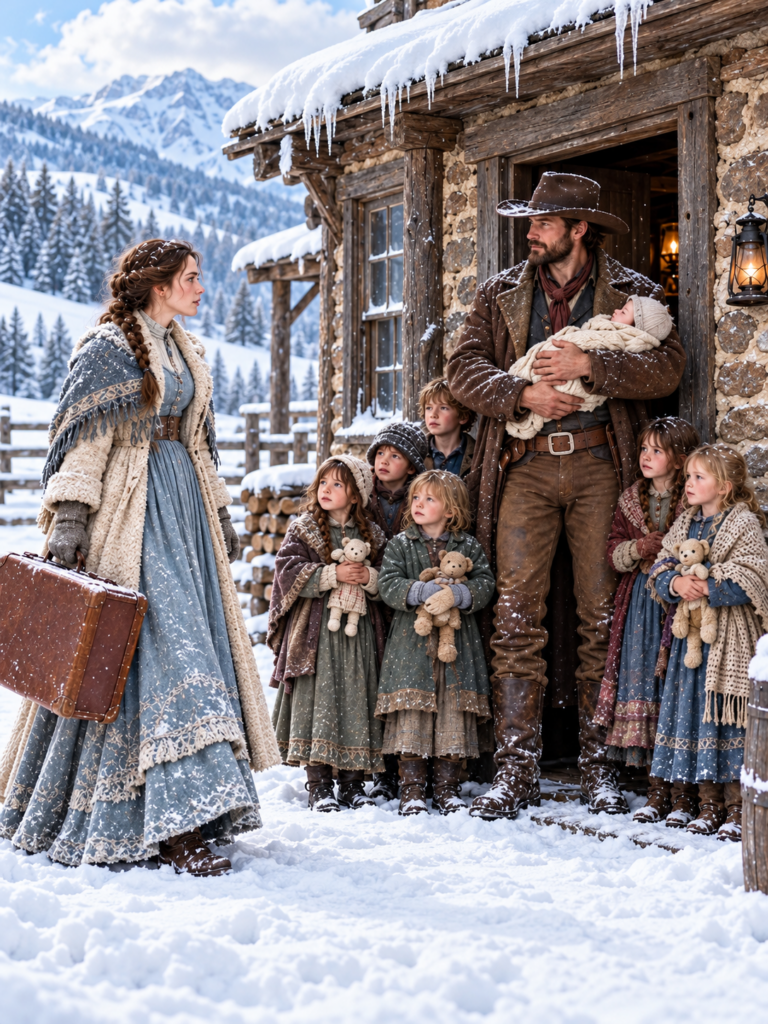
She came home after four months away, only to find a stranger and five children living inside her house in the dead of a Wyoming winter.
The wagon hit a rut in the frozen road, and Martha Cordell grabbed the seat board with both hands. She didn’t curse. She just breathed through her teeth and kept her eyes on the trail ahead.
Four months. That’s how long she’d been gone.
Four months sleeping in a borrowed cot at her mother’s place in Cheyenne, changing compresses at two in the morning, listening to that rattled breathing that got worse every week until it simply stopped one Tuesday before dawn.
She’d buried her mother in cold ground, settled what little there was to settle, and then pointed the wagon north toward home.
Home.
She rolled the word around in her mind like a river stone. It didn’t feel like much of anything right now.
The Wyoming sky was that particular gray you only get in late November, flat and heavy, pressing down on the world like a lid. The cottonwoods along the creek had gone bare and skeletal. Ice had locked the wheel ruts solid, and every jolt sent a shudder up through the wagon bench and into her spine.
The horse, an old dun mare named Bessie, moved without complaint.
Maddie appreciated that about Bessie. No complaints, just forward motion.
She’d gotten word in Cheyenne about Thomas. A letter from Ned Colter, brief and plain the way Ned always wrote.
Thomas broke a young stallion on October 3rd. Horse threw him. He didn’t last the night. Ranch is standing. Livestock are fed. Come home when you’re able.
Thomas, her husband of 11 years, dead in the same dirt he’d worked his whole life.
She’d sat with that news for a long time before she cried. And when the crying came, it wasn’t what she expected. It wasn’t grief exactly. It was something more complicated and harder to name, and she was still working on what to call it.
She topped the last long rise before the valley opened up, and there it was.
The Broken Wheel Ranch, sitting low and quiet in its shallow bowl of land. The main house and the outbuildings, small against all that open country.
The gray smoke from the chimney.
Maddie pulled the mare to a stop.
Smoke.
A thin curl of it rising from her chimney.
She sat very still.
Ned wouldn’t be inside. Ned had the Colter place three miles east, and he wasn’t the type to make himself at home in another man’s house. She had no hired hand wintering over.
She had no—
Boot prints in the snow. Big ones. And beside them, smaller ones. Much smaller.
She counted the impressions without meaning to. Several sets of small feet, different sizes, coming up the porch steps.
Maddie reached under the bench and pulled out the Winchester. She checked the chamber by feel, working the lever quiet as she could manage, and then she set the mare moving again.
Slow. Deliberate.
She tied Bessie at the far fence post and came at the house from the side, keeping the woodpile between herself and the front window.
Her boots made no sound on the packed snow.
The smoke was steady above the chimney cap, which meant whoever was inside had gotten a real fire going, not just a few coals.
They’d been here a while.
She stepped up onto the porch and put her hand on the door.
She went through it hard.
The door swung wide, and she came in behind the rifle, sweeping the room in one motion.
The fireplace threw orange light across the walls. The smell of boiled cornmeal and damp wool hit her at once.
There was a man standing at her dry sink.
He was tall, taller than Thomas had been, and Thomas wasn’t short. He wore a Union Army overcoat so faded it was more gray than blue, and the coat was buttoned wrong at the top, like he’d fastened it in a hurry.
She noticed in the first second that his arms were crossed over his chest, and in the second second she understood why.
There was an infant tucked inside that coat, small enough to disappear entirely against his breastbone.
Behind him, pressed against the far wall beside the dry sink, were four children.
A girl who looked about 14, dark-eyed and rigid, standing in front of the younger ones with her arms spread wide.
A boy, maybe 11, with a split across his lower lip and dried blood on his chin.
A girl of eight or so, perfectly silent, holding a small wooden figure in both hands.
And a boy who couldn’t have been more than five, clutching the back of the older girl’s dress and staring at Maddie with round dark eyes.
They were thin, all of them. The kind of thin that doesn’t come from missing a meal or two.
The man hadn’t moved.
He turned slowly, no sudden motion, keeping his body between Maddie and the infant. He looked at the rifle barrel without flinching.
He had a gaunt face, deep-set eyes, the weathered look of a man who’d spent years outdoors in hard weather. His jaw was dark with a few days of growth. There were shadows under his eyes like bruises.
He was exhausted, bone-tired in a way that goes past the body and gets into something deeper.
He exhaled a long breath. In the cold air that still held near the door, it came out white and faint.
“I know who you are, Mrs. Cordell.”
His voice was low and even. Not nervous, not aggressive. Just tired and steady.
“We came on account of an old man’s letter.”
He paused. His eyes went briefly to the children behind him, then came back to her.
“But if this roof can’t hold us, just say the word, and we’ll leave tonight.”
Maddie didn’t lower the rifle.
She looked at him for a long moment. Then she looked past him to the boy with the split lip, who was now standing straight with his chin up, doing his level best not to look scared.
She looked at the infant, just the crown of a wool-capped head visible above the coat buttons.
She looked at the little boy in the back, who had pressed his whole face into the older girl’s spine.
She looked at the baby’s lips.
Pale. Not right.
Maddie lowered the rifle slowly. She kept her finger near the guard, but she pointed it at the floor.
“Sit down,” she said. “All of you.”
Nobody moved right away.
“I’m not going to shoot anybody,” she said. “Sit down.”
The older girl let out a breath, and the children moved toward the bench along the wall.
The tall man stayed where he was. He watched Maddie the whole time. Not staring her down, just watching, alert like a man who’d learned the hard way to keep track of where the doors were.
“That baby sick?” Maddie asked.
“Getting there,” he said plainly, no drama in it. “She took a chill two days out of Laramie. I’ve kept her against my chest since then.”
“How long have you been in this house?”
“Three days.”
“You eat anything?”
A pause.
The older girl looked at the man’s back with something Maddie recognized.
It was the same look she’d worn herself at 14, watching the adults in a room, trying to calculate which version of the truth was the safest one to tell.
“We had what we brought,” the man said.
Maddie looked at the pot on the stove. Her pot. It had been scrubbed clean and set back properly on the iron.
She looked at her wood box. It had been filled.
She looked at the floor. It had been swept.
She hung the rifle on the rack by the door. She didn’t lock it away, just hung it where she could reach it easy, and she let him see her do it.
“I’ve got salt pork and dried corn,” she said. “Enough for tonight.”
She moved to the kitchen side of the room and started working without looking at them again.
“While I cook, you’re going to tell me who you are and what letter you’re talking about.”
She heard him settle onto the bench near the fire. The young boy immediately climbed up next to him, and without thinking about it, the man shifted his arm to make room.
“My name is Gideon Thorn,” he said. “Thomas Cordell was my half-brother. Same father, different mothers. I was the one they didn’t put in the family Bible.”
Maddie set the salt pork in the skillet without turning around.
“The letter,” she said.
“Came to me in August. A solicitor’s clerk in Laramie said Thomas had passed and left a legal document behind, signed in front of two witnesses, stating I had a right to put forward a claim on this property.”
He was quiet a moment.
“I wasn’t planning to come. Didn’t feel like my place. But my wife passed in September. Fever.”
He paused there, not for effect, just because it was a hard thing to say.
“I had five children and no work after the railroad shut down its western line. By October, I had eight dollars and the letter.”
Maddie set the lid on the skillet.
“So you broke into my house.”
“I didn’t break anything. Your back window latch was loose. I fixed it.”
He said it without apology, without pride either. Just a fact.
“The baby needed warmth. I would have slept in the barn myself, but I couldn’t put Mercy in the cold.”
Mercy.
That was the baby’s name.
Maddie turned around.
“How old is she?”
“Ten months.”
She nodded once and turned back to the stove.
She cooked without talking for a while, and he let her.
The children were quiet too, except for the little boy, who whispered something to the older girl and was hushed gently.
When she put the food on the table, she set out six bowls and then caught herself looking at the line of them on the bench and added a seventh for herself.
She brought the pot and ladled it out.
The little boy reached for his bowl with both hands and then stopped and looked at the man first.
The man nodded, just barely, and the boy picked it up and started eating with focused determination, like a small creature that had learned to take nothing for granted.
The older girl fed the silent eight-year-old first, then the baby, then herself, taking the smallest portion without announcing it.
Gideon Thorn didn’t eat right away.
He set the baby on the older girl’s lap and stood up.
“Before I sit down to your table,” he said, “I want to be straight with you about something.”
Maddie looked up at him.
“The Thorn children may be cold,” he said, “but they don’t eat off pity. I’ll rehang your hayloft door and split three cords of firewood by sunrise to square this meal.”
He said it quietly, no bluster in it. A man stating terms, not making threats.
There was a particular kind of dignity in it, the sort that doesn’t need volume to land.
Maddie held his gaze for a moment. Then she looked back down at her bowl.
“Hayloft door’s been dragging since September,” she said. “Sit down and eat.”
He sat.
The fire crackled.
Outside, the wind had started to build, pushing at the corners of the house, whistling thin and high through some gap she hadn’t found yet.
Inside, it was warm and strange.
Six people and a baby at a table that had been set for one, or for none, for longer than Maddie cared to admit.
She ate without tasting much of it.
She was watching them without appearing to watch them.
The man ate carefully. He worked through the broth portion of his bowl first, going slow, and when the meat was gone, she noticed there wasn’t much meat in his bowl to begin with.
She looked at the children’s bowls.
The meat was there.
He’d split what they had and given his share away.
He was doing it quietly enough that the children didn’t seem to notice, or maybe they’d learned not to notice, which was its own kind of understanding.
Maddie looked away.
After supper, while the older girl settled the younger children on the floor near the fire with the only two blankets they seemed to own, Maddie took her lamp and went back to the far side of the house.
She stopped at the end of the hall.
There was a door there, painted yellow.
Butter yellow.
She’d painted it herself ten years ago on a warm spring afternoon, full of a particular kind of hope that had nowhere to go after that.
The room behind it was small and square and still had the little crib Thomas had built in the corner, white with a carved rail along the top.
She hadn’t opened the door in three years.
She stood in the dark hall with her lamp and looked at the door for a long time.
Then she heard the baby cough.
A small, thin sound from the other room.
And then Gideon’s voice, very low, saying something she couldn’t make out. Something private, the kind of murmur a person uses when they’re talking to someone who can’t answer back yet.
Maddie turned around and went to her room.
She sat on the edge of her bed in the dark for a while.
She thought about Thomas.
She thought about eight dollars and a letter and five children and 900 miles of hard Wyoming road.
She thought about that man’s eyes when he’d looked at her rifle barrel. Not scared, not angry, just waiting.
Waiting to see what kind of person she was going to turn out to be.
She thought about pale lips on a ten-month-old baby.
She’d tell them in the morning they could have the east barn. Three days until the circuit judge came through. Ned had mentioned it in a postscript.
Three days to look at whatever papers this man claimed to have, and then she’d figure out what came next.
That was enough deciding for one night.
She lay back on the bed without undressing and pulled the quilt up and stared at the dark ceiling.
The wind pushed at the windows.
The fire in the main room settled into itself.
Somewhere in the house, a board creaked once, then was still.
She closed her eyes.
Tomorrow, she thought. Tomorrow is soon enough.
Outside, the snow started again, slow and quiet and steady, covering the wagon tracks and the boot prints and the small footprints alike, laying a clean white sheet across the whole frozen yard.
The Broken Wheel Ranch held its breath in the dark and waited to see what morning would make of them all.
Morning came in gray and grudging, the way Wyoming mornings do in late November.
The light didn’t so much arrive as it seeped, pale and thin, through the frost that had built up overnight on the east-facing windows.
Maddie was up before it.
She’d slept in her clothes, and she woke with the particular alertness of someone whose mind had kept working while the rest of her rested.
She lay still for exactly one minute, listening.
The house was quiet.
She got up, put her boots on, and went to the window.
The barn.
The east barn, the smaller one, the one she used for hay and equipment and the two plow horses that weren’t Bessie.
There was a thin line of light under the door.
They were already awake.
She built the kitchen fire back up from coals and put the coffee on.
Then she went to the barn.
She didn’t knock. It was her barn.
She lifted the latch and pushed the door open and stood in the entrance with the cold at her back.
Gideon was standing at the workbench along the far wall.
He’d found her spare lantern and lit it, and in its circle of yellow light she could see he’d rearranged the loose hay in the corner into a rough sleeping area, using the horse blankets from the stall rail.
The children were still there, most of them asleep in a pile, the older girl sitting up with the baby against her shoulder, rocking slowly without making a sound.
Gideon turned when she came in.
He had a leather harness in his hands, one of hers, and he was working a cracked section of the stitching with an awl and a length of waxed thread.
He set it down.
“Mrs. Cordell.”
“You found the harness repair kit.”
“It was on the bench. Stitching was going on the left trace. Figured I’d get to it while there was light.”
He paused.
“I hope that sits right with you.”
She looked at the harness.
He’d already done three or four inches of tight, even stitching, better than she’d have done herself.
“The circuit judge comes through Thursday,” she said. “That’s three days. Until I see whatever papers you’re carrying, I can’t have strangers in my house.”
He nodded once. No argument.
“But this barn’s drafty, and the baby’s cough is worse than it was last night.”
She kept her voice matter-of-fact, working through the problem the same way she’d approach a frozen pump or a sprung fence rail.
“There’s a second stove in here, the small one in the back corner. Flue needs to be checked before you light it. There’s a stack of cedar splits on the north wall.”
“I’ll check the flue,” he said.
“There are extra quilts in the cedar chest in the tack room, top shelf. I’ll bring food out at midday.”
She turned to go and then stopped.
“The older girl. What’s her name?”
“Prudence.”
The girl looked up from across the barn, dark eyes careful and measuring.
Maddie had the impression of a 14-year-old who had spent the last several months being responsible for things she shouldn’t have had to be responsible for yet.
“Prudence,” she said, “if the baby gets worse before midday, you come to the house and knock. Don’t wait.”
Prudence held her gaze for a moment. Then she gave a single slow nod, the kind that means I hear you and I’m deciding whether to trust you at the same time.
Maddie went back to the house and started cooking.
She made cornmeal mush, which she had plenty of, and she added the last of the dried beef she’d brought back from Cheyenne, shredding it into the pot with her fingers and letting it simmer until the whole thing was thick and hot.
It wasn’t elegant food.
It was the food you made when the temperature dropped and bodies needed fuel and there wasn’t time to be particular about it.
She carried it out at midday in the cast-iron pot, nested in a folded grain sack to keep the heat in.
She brought a ladle and six tin bowls and a small crock of the blackstrap molasses she kept for baking.
She set everything on the workbench and stepped back.
Gideon had gotten the back stove going. The flue must have been clear because there was real heat coming off it now, and the barn felt 20 degrees better than it had that morning.
The children were up and gathered near the warmth.
The little boy, Jonas, she’d later learn his name, had found a curry comb somewhere and was attempting to groom one of the plow horses with the focused intensity of someone who has decided that this is now his job.
The horse appeared to be tolerating it.
Gideon looked at the pot.
He looked at Maddie.
“That’s a full pot,” he said.
“It is.”
“Mrs. Cordell.”
He paused, and she could see him choosing his words carefully, not because he was unsure of himself, but because he was very sure and wanted to say it right.
“The Thorn children may be cold, but they don’t eat off pity. I’ll rehang your hayloft door and split three cords of firewood by sunrise to square this meal.”
She looked at him.
She thought about pointing out that he was in no shape to be splitting three cords of anything.
He was gaunt, and he hadn’t slept enough, and his hands, she could see from here, had the slightly stiff movement of someone fighting off the first stages of cold damage.
She thought about saying, just eat the food. There are no terms attached. It’s just cornmeal and dried beef.
She didn’t say any of that because she understood, standing there in the cold barn with the smell of cedar smoke and horse and something like desperation in the air.
She understood that what he was offering wasn’t labor.
It was the only currency he had right now that wasn’t charity.
He was telling her he wasn’t a man who took without giving back, and that mattered to him in a way that went down to the bone.
You don’t take that from a person.
You just don’t.
“Hayloft door’s been dragging since September,” she said. “Split what you can manage. Two cords is fine.”
He held her gaze.
Then he pulled two of the tin bowls toward the younger children and started ladling without further discussion.
Maddie turned to go, and then she turned back because she’d thought of something.
“The molasses,” she said. “The children can put it on the mush. It’s sweet.”
Jonas looked up from the horse with enormous eyes.
“Sweet?” he repeated, like it was a word from another language.
“Sweet,” Maddie confirmed, and left them to it.
She went back to the house, and she stood at the kitchen window for a while, looking out at the barn.
The door was closed.
The smoke was rising steady from the flue pipe.
She could hear, faintly, the sound of Jonas laughing at something, high and surprised, like he’d forgotten for a moment that the world was hard.
She made herself a cup of coffee and sat at the table.
The house was very quiet.
It had been quiet for a long time, this house.
When Thomas was alive, it had still been quiet in a particular way, a silence full of things not being said, grief that didn’t have a name they agreed on, hope that kept getting deferred and eventually stopped being mentioned.
After Thomas died, it just became ordinary quiet, emptiness maintaining itself.
She looked down the hall at the yellow door.
She’d painted it on a Saturday in April ten years ago.
Thomas had been in town.
She’d bought the paint herself at the mercantile, a soft yellow she’d seen in a lady’s catalogue, and she’d spent the whole afternoon getting it right.
Two coats, painting around the hinges with a small brush.
She’d stood back when she was done and felt something she could only describe as readiness.
Like a room you clean and make up with fresh linens when you’re expecting company.
Like a welcome prepared in advance.
The company never came.
After the third year, she’d stopped painting it fresh when the paint chipped.
After the fifth year, she’d stopped going into the room.
By the seventh year, the door just existed at the end of the hall like an old wound she’d learned to walk past without touching.
She finished her coffee.
That afternoon, she heard the axe.
It started around two, a steady rhythm coming from behind the barn where she kept the splitting rounds.
She went to the side window and looked.
Gideon had found the axe in the equipment lean-to, and he was working through the stacked rounds she’d been meaning to split all fall.
He wasn’t rushing it.
He’d found a pace that he could sustain, smooth and even. Lift and swing and step and reset.
He worked with his coat off despite the cold, which told her he was generating enough heat to manage without it.
She watched him for a moment.
Then she looked past him, through the barn wall with her imagination, to where she knew Prudence was sitting with the baby.
She went to the tack room and pulled out the extra quilts she’d mentioned.
She brought them to the barn and left them inside the door without interrupting the older girl.
She went back to the house and got a small tin of the chest salve she kept for winter coughs, and she left that too, along with a clean rag.
She didn’t announce it.
She just left it where Prudence could find it.
By four, the light was going, and Gideon finally stopped.
He’d split, by her rough count from the window, close to a cord and a half.
She didn’t know what that had cost him, and she wasn’t going to ask.
She cooked supper, salt pork again with dried beans she’d soaked since morning and a pan of cornbread.
She put it all on a tray and carried it to the barn.
She knocked this time.
Gideon opened the door with a towel in his hands, which meant he’d found the water basin and washed up.
The children were arranged around the small stove, the two youngest asleep already, the boy with the split lip sitting on an upturned bucket reading something, which surprised her.
“He reads,” she said before she thought better of it.
Gideon took the tray.
“Prudence taught him. She taught herself first, off a land company broadsheet, then taught the others.”
He set the tray on the workbench.
“She’s a good teacher. Better than some of the schoolmasters I’ve seen.”
Maddie looked at Prudence, who was pretending not to have heard that.
Her mouth had gone just slightly less tight, though. Just barely.
“Thursday,” Maddie said to Gideon. “Judge Sterling usually comes through before noon. If your papers are in order, we’ll talk about next steps.”
“They’re in order,” he said.
No boasting, just a statement of fact.
“We’ll see Thursday,” she said, and went back inside.
The second day passed.
Gideon rehung the hayloft door in the morning, working the hinges off and resetting them straight so the door swung clean and easy.
Maddie watched him do it from the yard.
He didn’t do it the way someone does a job they’ve been assigned. He did it the way someone does a job they’ve decided matters, working slow and careful, testing the swing three times before he was satisfied.
The silent girl, the eight-year-old whose name she’d learned was Susanna, sat on a fence post nearby the whole time and watched him work.
She had a small piece of pine in her hands and a little folding knife, and she was carving something with small, patient strokes.
She didn’t speak.
She hadn’t spoken once since Maddie had arrived.
Maddie brought out a midmorning cup of coffee for Gideon and stopped near the fence post.
Susanna looked at her, not alarmed, not welcoming, just watching.
On the fence post beside her was a small finished figure.
A horse, Maddie realized after a moment.
A very good small horse, standing square on four legs with its head raised.
“You make that?” Maddie asked.
Susanna looked at the figure, then she looked at Maddie.
She picked the horse up and held it out.
“That’s yours,” Maddie said. “You keep it.”
Susanna put it back on the post.
She went back to the piece she was working on.
Maddie left the coffee with Gideon and went back to her kitchen.
She stood at the stove for a while, not cooking anything, just standing there.
She was thinking about an eight-year-old who had stopped talking and replaced words with small carved figures.
She was thinking about what kind of grief does that to a child. What kind of loss goes so deep that language stops feeling useful.
She knew something about that.
Not exactly the same, but she knew the territory.
She went and got her old primer, the one she’d used to teach herself to read better back in Missouri, and that afternoon she left it inside the barn door without explanation.
Prudence found it.
Maddie saw through the window that she held it for a long moment, turning it over in her hands, and then looked toward the house.
Maddie had already moved away from the window.
Wednesday night, the temperature dropped hard.
Maddie lay in her bed and listened to the wind work at the house, finding the seams, whistling in the corners.
She got up at midnight and put more wood on the fire.
She stood in the main room and looked out at the barn.
The line of light under the door was still there.
She pulled her coat on over her nightgown and crossed the yard.
She didn’t go in.
She stood outside the barn door and listened.
She could hear, faintly, Gideon’s voice, low and steady. Not words she could make out, just a murmur, a rhythm.
He was talking to the baby, she realized, or singing. Something in between.
The baby wasn’t crying.
Maddie stood there in the dark and the cold for a moment, listening to a man sing something quiet and shapeless to a ten-month-old in a drafty barn in the middle of a Wyoming winter.
And she felt something move in her that she didn’t have a name for and didn’t try to find one.
She went back inside and put another log on and went to bed.
Thursday morning was clear and brittle and cold.
The sky a hard blue with no cloud in it.
Maddie was up early.
She made a real breakfast, fried eggs and cornbread and coffee, and she brought the whole thing out to the barn on two trips.
Gideon was already up, already dressed, and he’d combed his hair, which struck her as something.
His coat was brushed as clean as it was going to get. His boots had been polished with something, bear grease maybe, or the neatsfoot oil from the tack room.
The children were all up, and Prudence had somehow gotten all four of them into cleaner clothes, the younger ones’ faces scrubbed and their hair flattened into order.
They looked, Maddie realized, like people who understood that today was important, who had prepared for it accordingly without being told.
She set the food down and looked at Gideon.
“You know your papers are solid,” she said.
It wasn’t a question.
“Yes,” he said.
“And you’re not here to take the ranch.”
He met her eyes directly.
“I’m here because I had nowhere else to take my children that wasn’t worse. I’m not interested in what’s yours.”
“The letter said there was a legitimate claim.”
“I thought it meant there might be a legitimate conversation.”
He paused.
“That’s all I came for. A conversation between people.”
Maddie nodded slowly.
She went back to the house and set the kitchen table with her good tin cups instead of the cracked ones.
She put the coffee pot where it would stay warm on the back of the stove.
She swept the floor even though she’d swept it yesterday.
She wasn’t sure what she was preparing for exactly.
She stood at the end of the hall and looked at the yellow door.
She walked down the hall.
She put her hand on the door handle.
The metal was cold, the same as it had always been.
She stood there with her hand on it for a long moment.
Then she heard wheels on the frozen road.
A wagon moving at the steady trot of a horse that knew the route.
That would be Judge Sterling.
She let go of the handle.
Not today, she told herself. Not yet.
She turned around and went to put fresh coffee on and to be standing at her own table in her own house when the judge knocked on her door.
Whatever came next, she’d face it on her feet.
That much she was sure of.
Outside, the sun was climbing in that cold blue sky, throwing long, thin shadows across the yard, and the smoke from the barn stove was rising straight and steady in the still morning air.
Gideon Thorn was standing in the barn doorway watching the wagon come up the road, one hand resting on the doorframe.
Five children ranged around him like they’d been orbiting him all their lives, which Maddie supposed they had.
She watched them through the window for just a moment.
Then she turned away and got to work.
Judge Alister Sterling was a small man who took up a lot of room.
He wasn’t tall. He wasn’t broad. He had a neat white beard trimmed close and wore a black coat that had seen better decades but was kept impeccably clean.
And he carried himself with the particular self-possession of someone who had long ago stopped needing to prove anything to anybody.
He came through Sweetwater Valley four times a year on the circuit, and Maddie had met him twice before.
Once when she and Thomas had filed a water rights dispute with the county. Once at a neighbor’s probate hearing.
He was fair.
That was his reputation, and Maddie had seen nothing to contradict it.
He pulled his wagon up in the yard and climbed down with a grunt and a hand on his lower back.
And he looked at the barn and then at the house and then at Maddie standing on the porch.
“Mrs. Cordell. I was sorry to hear about Thomas and your mother.”
“Thank you, Judge.”
“I understand you have a matter requiring examination.”
“I do. Come in out of the cold.”
She brought Gideon in from the barn.
She left the children with Prudence, who seemed to understand without being told that this was an adult conversation held in a particular kind of room, the kind where children sitting quietly in corners could sometimes do more harm than good by simply existing and reminding everyone of the stakes.
Gideon came in and stood at the kitchen table and didn’t take a seat until Maddie indicated he should.
Judge Sterling sat across from him and set his leather satchel on the table and opened it with the brisk efficiency of a man who’d done this several thousand times.
“Documents,” the judge said.
Gideon reached inside his coat and brought out a folded envelope.
Heavy paper, the kind that costs something.
He set it on the table and smoothed it flat with one hand.
The judge put on his spectacles and read.
Maddie stood near the stove and watched.
She’d made coffee, and she poured two cups without asking and set them where they could be reached.
Her own hands were steady.
She’d made a decision the night before, somewhere between midnight and the gray edge of sleep, that she was going to approach this the way she approached every difficult thing.
Straight on, with her eyes open, prepared to deal with whatever she actually found rather than whatever she feared.
“Hmm.”
The judge read for a long time.
He turned pages.
He held one sheet up toward the window light and examined it closely.
He set it down.
“This is a Wells Fargo notarized bequest document,” he said. “Filed in Laramie in September of this year. Witnessed by two parties whose signatures I recognize.”
He looked at Gideon over his spectacles.
“You have a physical token accompanying this? The document references one.”
Gideon reached into the breast pocket of his coat and set it on the table.
A pocket watch.
Silver, worn smooth at the edges from years of handling.
The judge picked it up and turned it over, and Maddie moved a step closer without meaning to because she could see from where she stood that there was an engraving on the back.
A wheel.
A broken wheel.
Same as the brand she’d used on every head of cattle she and Thomas had run on this ranch for 11 years.
The Cordell family crest, such as it was.
Thomas had shown it to her once in a different watch. His own. The one he’d worn on their wedding day.
She hadn’t known there were two watches engraved with the Cordell family mark.
“Consistent with established family property as registered in the Sweetwater County records,” Judge Sterling said to no one in particular.
He was documenting out loud the way she’d seen him do before, saying the facts plainly so they existed in the room as spoken things and not just thoughts.
He set it down.
He looked at Gideon.
“You are the eldest son of Robert Cordell, born of a prior relationship before his marriage to the Cordell family.”
“Yes, sir.”
“Born out of wedlock.”
“Yes, sir.”
“And you have no intent to contest the primary deed of title to this property. You are presenting a claim to a minority share as documented in this bequest, which would require either a legal buyout from the estate or a negotiated arrangement with the surviving party.”
He looked at Maddie.
“That being Mrs. Cordell.”
Maddie looked at the watch on the table.
“What percentage?”
“Forty percent,” the judge said. “As specified.”
The room was quiet.
The coffee steamed.
Maddie pulled out the chair at the end of the table and sat down.
She looked at the watch for a moment longer.
Then she looked at Gideon.
His face told her nothing.
He wasn’t pressing her. He wasn’t watching for her reaction with any kind of calculation behind his eyes.
He was just sitting there, letting the facts sit in the room, waiting for her to do whatever she was going to do with them.
“I’d like to look at Thomas’s papers,” she said. “Before we go any further.”
“That’s entirely appropriate,” the judge said.
She excused herself and went to the bedroom.
In the corner under the window was a cedar chest Thomas had brought from his family’s house in Ohio.
He’d kept the key on his watch chain.
The watch chain that was buried with him.
She’d broken the lock with a chisel the week after his funeral, intending to organize his affairs.
She’d found insurance documents and the ranch deed and a bundle of correspondence from the bank, and she’d organized all of it into the leather folder she kept in the sideboard.
And she’d closed the chest and not looked in it again.
She hadn’t gone through everything.
She carried the chest to the kitchen table and set it between the two men without ceremony.
The broken latch swung loose.
She lifted the lid.
Thomas’s things.
A folded flag. A small tintype photograph she’d never seen of a woman who must have been his mother. The insurance papers she’d already found. A land survey she knew about. Loose letters from the bank.
And below all of that, tied with a piece of waxed string, a bundle of letters she hadn’t found before.
Or hadn’t gotten to.
Or had closed the chest before she reached.
She took them out.
The string was knotted tight, and she worked it loose with her thumbnail.
The top letter was on a doctor’s letterhead, a medical practice in Omaha, Nebraska.
The date was eight years ago.
August.
She read it standing up.
She read it twice.
Then she sat down.
The judge said, “Mrs. Cordell?”
She didn’t answer him.
She was reading the second letter.
Same letterhead, three months later.
A follow-up to prior correspondence confirming the diagnosis, using words she had to read carefully because they were medical and precise, and she’d had no reason before today to know what they meant.
But the plain meaning was clear enough.
The language of the letters was the careful, formal language doctors used when they were delivering permanent news.
The kind that doesn’t get better.
Thomas had contracted mumps as an adult, the letter said.
The complications had been severe.
The result was permanent.
Irreversible.
The doctor had informed his patient of this in person and had followed up in writing per the patient’s request.
The patient.
Her husband.
Thomas Cordell.
There was a third letter, shorter, from Thomas to the doctor.
She recognized his handwriting, cramped and careful, the same handwriting as the note he’d left her when he rode into town.
She read it.
He was asking for absolute discretion.
He was requesting that the correspondence be kept in the strictest confidence.
He explained that he was a man of standing in his community, that he had a wife, that there were expectations.
He used the phrase “preserve the dignity of my household” twice in four short paragraphs.
Maddie set the letters down on the table.
The kitchen was very still.
The fire in the stove made small ticking sounds as the iron expanded.
Outside, someone was opening the barn door. One of the children, probably. The hinges swung smooth and silent now.
Judge Sterling had taken his spectacles off.
He was looking at her with an expression she didn’t have the energy to interpret.
Gideon was looking at the letters on the table.
His jaw had gone tight.
Maddie looked at the wall above the stove.
There was a small crack in the plaster she’d been meaning to fill since spring.
She looked at that crack for a long moment.
Ten years.
She had spent ten years believing her body had failed at the one thing a woman on the frontier was most expected to do.
She had spent ten years carrying the weight of her neighbors’ careful sympathy and her mother-in-law’s pointed silences and the Sunday morning prayers offered on her behalf by women who meant well and still made her feel like a specimen in a jar.
She had spent ten years apologizing in a hundred small, wordless ways for a condition that was not hers.
It had never been hers.
Thomas had known for eight of those ten years.
He had known and tied the letters up with waxed string and locked them in the cedar chest under the flag and the tintype photograph of his mother.
And he had gone on letting her carry the weight of it because setting it down would have required him to pick it up himself.
She pressed her hands flat on the table.
“Mrs. Cordell,” Judge Sterling said carefully, “if you require time—”
“I don’t.”
Her voice came out level.
She was surprised by that. She’d expected it to shake.
“I want to understand what I’m looking at legally. Thomas left a bequest to this man’s father’s son. Forty percent interest. That’s the legal position.”
“That’s correct.”
“And the contents of this chest, including these letters, are estate materials.”
“They are.”
She looked at Gideon.
He was still watching her, and she could see he’d read the situation clearly because he was that kind of man.
The kind who paid attention and understood what things meant.
His expression hadn’t changed exactly, but there was something in it now.
Not pity.
She would have stood up and left the room if she’d seen pity.
It was more the look of a man who has seen an injustice he can name and is choosing very carefully whether to speak.
He spoke.
“A man who hides behind a woman’s shame just to save his pride isn’t fit for this country.”
His voice was quiet.
Not gentle exactly.
More the way a surgeon is precise, cutting straight to the thing that needs to be said without extra motion.
“You were never broken, Maddie. You were just living in a cage built out of someone else’s lies.”
She looked at him.
Nobody had called her Maddie since her mother died.
She looked back at the letters.
She thought about what to do with anger this large.
There wasn’t really a procedure for it.
You couldn’t take it outside and split it into cords. You couldn’t put a fence around it.
It was just there, big and hot and clarifying, burning away everything that wasn’t absolutely true.
What was true?
The ranch was hers.
Her sweat was in every fence post.
Her decisions had kept the cattle alive through three hard winters.
Thomas was dead, and whatever conversation she might have had with him about these letters was never going to happen.
What was also true?
There were five children in her barn and a man at her kitchen table who had come 900 miles with eight dollars and a letter because he had nowhere else to go.
And the letter said he had a legal right to be here.
And the judge had confirmed it.
And the papers were in order.
She straightened the letters and set them aside carefully, not because she was done with them, but because they weren’t for the table right now.
“All right,” she said. “Here’s what I want to know. The forty percent. Is it transferable? Can it be bought out?”
“With agreement from both parties,” the judge said, “and a fair appraisal of the property’s value, yes.”
“And if we can’t agree on terms?”
“Then the interest stands as a legal partition, and either party may apply to the county court for formal division, which, given the nature of ranch property, would likely result in a forced sale.”
He said it without apology.
He was telling her the facts.
“That outcome benefits neither of you.”
Maddie nodded slowly.
She looked at Gideon.
He was quiet.
He wasn’t pressing her toward anything.
She understood, looking at him, that he’d meant what he said the first night.
He hadn’t come to take from her.
He’d come because he had children who needed a roof and a letter that said there might be one available, and he was out of other options.
And he was sitting at her table in a faded Union coat with polished boots and repaired harness stitching and two cords of split firewood behind the barn.
And he had given his meat to his children and sung a baby to sleep in a cold barn.
And he had looked down the barrel of her rifle without flinching and told her she could send him away if she needed to.
She didn’t fully trust him.
It was too soon for that.
But she didn’t distrust him either.
And in her experience, that was a more meaningful place to start.
“I’m not going to make a decision today,” she said to the judge. “I need time to look at the ranch accounts and understand what a forty percent appraisal would actually mean in real numbers.”
She paused.
“But I’m also not going to send this family back out into the cold while I’m thinking about it.”
Judge Sterling looked at her.
Then he looked at Gideon.
Then he put his spectacles back on and pulled a fresh sheet of paper from his satchel.
“I’ll draft a temporary residence agreement,” he said. “Thirty days. Gideon Thorn and his children may remain on the Broken Wheel property as working guests while the parties negotiate terms. No legal claims may be pressed or acted upon during this period. Both parties sign. Both parties are bound.”
He looked up.
“Acceptable?”
Maddie said yes.
Gideon said yes.
The judge wrote.
The clock on the mantel ticked.
The fire in the stove settled.
Maddie looked at the silver pocket watch still sitting on the table.
She reached out and picked it up.
It was heavier than she expected, solid and real in her palm.
She turned it over.
The broken wheel engraved on the back was the same design as the brand she pressed into her cattle, the same mark on the sign over the ranch gate.
Two watches.
Same mark.
Two brothers who’d never formally been brothers.
One buried in the cold ground, and one sitting at her kitchen table because a letter and a child’s need for warmth had brought him here.
She set the watch down in front of Gideon.
He didn’t pick it up immediately.
He looked at it.
Then he looked at her.
“Judge Sterling will need it as part of the documented evidence,” she said. “You can have it back after.”
He nodded.
The judge finished writing.
He blotted the page and turned it around, and each of them signed where he indicated.
Maddie with her own pen from the sideboard drawer.
Gideon with the pen the judge offered.
Sterling folded his copy carefully and tucked it into his satchel.
He left the second copy on the table.
“I’ll be back through in January,” he said, standing and collecting his coat. “I’d encourage you both to have a clear proposal by then. The county court is not a process that benefits small ranchers. Either of you.”
He looked at them over his spectacles one last time.
“Work it out between yourselves if you’re able. People who’ve done honest work on honest land generally can.”
He let himself out.
Maddie and Gideon sat at the table after he’d gone.
The wagon sounds in the yard faded.
A log shifted in the stove.
She picked up Thomas’s letters again.
She untied the wax string fully this time and spread them out flat and read through all three of them one more time.
Slowly.
Because she’d learned years ago that it’s better to understand a hard thing completely than to understand it halfway.
Half understanding leaves gaps where old stories can creep back in.
Gideon didn’t say anything.
He drank his coffee.
He waited.
When she finished, she stacked the letters and looked at them sitting there on the table.
Three letters.
Eight years of a weight she’d carried for nothing.
She thought about the yellow door at the end of the hall.
She’d painted it with hope.
A room waiting for a life that was never going to arrive, not the way she’d imagined it.
But she’d painted it, and it was there, and the paint was old and chipped now, and the room behind it had been cold and still for years.
Things that have been shut up for too long needed air.
She pushed her chair back and stood up.
“The children can have the bedroom at the end of the hall,” she said. “It’s small, but it’s warmer than the barn. There’s a crib in there.”
She paused.
“For Mercy.”
Gideon looked up at her.
She held his gaze for a moment.
“We’ll talk about the ranch accounts tomorrow,” she said. “Tonight, bring your family inside.”
She picked up Thomas’s letters and walked to the fireplace and held them there for a moment.
Then she set them in the fire.
She watched them go.
They caught quickly.
The dry old paper, the careful doctor’s handwriting, and the cramped, apologetic handwriting of her dead husband, all of it going to ash in a clean, bright flare.
It lasted about four seconds and was over.
She turned around.
Gideon was still at the table, watching her with an expression she couldn’t fully read and didn’t try to.
“I’ll start dinner,” she said. “Tell Prudence there are two rooms upstairs and a small one at the back of the hall. They can sort themselves out.”
She went to the stove.
Behind her, she heard Gideon’s chair scrape back.
She heard him stand.
She heard him walk to the door and open it and then stop.
“Mrs. Cordell,” he said.
She didn’t turn around.
“Thank you.”
He said it.
It was a plain enough thing to say.
Two words.
She’d heard them a thousand times in her life, and they’d meant varying amounts depending on who was saying them and what had preceded them.
These two words on this particular afternoon meant something she didn’t have a name for yet.
“Go get your children,” she said. “It’s cold.”
The door opened and closed, and she heard his boots cross the porch and go down the steps.
And then his voice in the yard calling to Prudence.
And then the sound of small feet coming across frozen ground.
Maddie stood at the stove and listened to all of it and kept her face very still and her hands very busy.
And she let the thing she didn’t have a name for exist quietly in the room around her while she figured out what to cook for dinner.
The yellow door was going to need a fresh coat of paint.
The yellow door opened on a Wednesday morning.
Maddie did it herself, early, before the children were up.
She carried a bucket of warm water and a rag, and she went down the hall and turned the handle and pushed the door back on its hinges.
The air inside was cold and still.
The smell of old wood and something faintly floral from a dried sachet on the windowsill that had long since lost its scent.
She stood in the doorway for a moment.
The crib was still in the corner.
Thomas had built it from pine boards sanded smooth, with a carved rail along the top edge.
She ran her hand along the rail.
The wood was good.
Solid.
It had been waiting in here for a decade, and it was still solid.
She cleaned the room without sentiment.
Wiped the windowsills, swept the floor, shook out the small braided rug, and hung it over the porch rail to air.
She moved the crib to the warmest corner, closest to the interior wall where the chimney ran up through the house and kept the plaster warm.
She brought a folded quilt from the cedar chest and lined the bottom of the crib with it.
When she was done, she stood in the doorway again and looked at the room.
It looked like what it was now.
A room for children.
Not a monument to something lost.
Just a room, warm and plain and ready.
She went to the barn and told Prudence.
Prudence came and stood in the doorway the same way Maddie had, looking at everything carefully.
Then she carried Mercy in and laid her in the crib and stood over her for a moment, watching the baby breathe.
Mercy’s cough was better.
Three days of real warmth and Maddie’s chest salve and Prudence’s patient attention had knocked the worst of it back.
The baby’s lips had color in them now.
She slept with her fist curled under her chin and her chest rising and falling steady and even.
Prudence looked at Maddie.
“She’s going to be all right,” Maddie said.
Prudence nodded.
Her eyes were bright, but she didn’t cry.
She was 14, and she had spent the last several months being the person who handled things, and she had gotten very good at not crying in front of people who needed her to be steady.
Maddie recognized that particular skill.
She’d learned it herself at about the same age.
“The two upstairs rooms are yours to sort as you see fit,” Maddie said. “There are extra blankets in the trunk at the top of the stairs.”
She left Prudence to it.
By that afternoon, the children had migrated from barn to house with the natural efficiency of people who had learned to move quickly when conditions improved.
Jonas had claimed a spot near the main room fireplace as his personal territory and was spending a significant portion of his day simply sitting there absorbing heat with the focused dedication of a lizard on a warm rock.
Enoch had found a loose board on the back porch and fixed it without being asked, using the hammer and nails from the lean-to with enough competence that Maddie suspected Gideon had taught him early.
Susanna moved quietly through the house, her pine figurine always in her hand or her pocket, leaving small carved objects on windowsills and tabletops the way some children leave muddy footprints.
A bird on the kitchen windowsill.
A small dog on the bottom stair.
Maddie picked up the dog and looked at it.
The work was clean.
Better than clean.
Susanna carved the way some people talked, fluently and without hesitation, putting into wood what she apparently couldn’t put into words.
Maddie set it back where she’d found it.
That evening after dinner, she and Gideon sat at the kitchen table with the ranch ledgers spread between them.
The lamp threw a warm circle of light across the pages.
Outside, the temperature had dropped again, and the wind was making itself known at the north window.
Maddie had been keeping the books herself since Thomas died.
Before that, she’d been keeping them alongside Thomas, and before that, she’d been keeping them instead of Thomas while he signed his name at the bottom.
Numbers were something she had always been comfortable with.
They told the truth without negotiation.
She walked Gideon through the current position.
The land. The cattle. The equipment. The bank note Thomas had taken out three years ago to buy the additional quarter section to the east. The interest accruing on that note. The operating costs through winter. The cash on hand, which was not enough for comfort but enough for survival if nothing unexpected happened.
Gideon listened without interrupting.
He asked two questions, both precise and practical, about the cattle count and the spring market price per head.
When she answered, he did the arithmetic in his head, and she could see by his expression when he arrived at the same number she already had.
“The note is the problem,” he said.
“The note is the problem,” she agreed.
“When’s it due?”
“April. The bank in town has been carrying it since Thomas died. I have until April to either pay it down substantially or renegotiate.”
Gideon leaned back in his chair and looked at the ceiling for a moment.
He had the look of a man sorting through possibilities, running through what he knew and what could be done with it.
“I can work,” he said. “I spent six years with the Union Pacific. I know timber, heavy construction, land grading. The railroad is pushing its secondary line through the valley in spring. I can hire on as foreman for the grading crew. The pay is good, and it’s regular.”
“You’d be gone during calving.”
“Prudence can manage the younger ones, and I can be here for the difficult births. The railroad works six days, not seven.”
He paused.
“And there’s the forty percent to settle. I’ve been thinking about it.”
“So have I.”
“I don’t want a piece of land,” he said. “I want my children to have a roof, and I want to earn my keep under it. If you’re willing to let us stay on through the spring, and I put my railroad wages against the bank note, we can talk about a different kind of arrangement. Labor equity instead of land partition.”
Maddie looked at him.
“Meaning what exactly?”
“Meaning I work this ranch as a full partner in the operations. Not hired help. A partner with a voice in decisions. In return, the forty percent claim converts to a working arrangement instead of a property interest. I don’t hold title. I don’t have a legal stake in the deed. But my family has a home here for as long as we’re useful to it and you’re willing to have us.”
She studied the ledger page in front of her without seeing it.
She was listening to what he’d actually said, which was that he was offering to give up the one legal protection he had in exchange for something that depended entirely on her continued willingness to honor it.
“That’s a lot of trust to put in a handshake,” she said.
“I know it.”
“You’d have no legal recourse if I changed my mind.”
“I know that too.”
He said it simply, no drama in it.
“But a piece of paper that gives me forty percent of a ranch I’m not capable of running alone doesn’t help my children much if the ranch goes under from the bank note. Working beside someone who knows the land and keeps the books honestly does.”
He met her eyes.
“I’ve read people for twenty years, Mrs. Cordell. You’re not dishonest.”
She was quiet for a moment.
“Equal say in decisions,” she said. “Not final say. Equal.”
“Equal,” he said.
“I handle the books, the supplies, the trading accounts, and the children’s education. You handle the cattle, the timber, and the heavy repair and construction.”
“Agreed.”
“And either of us can call a halt to this arrangement with thirty days’ notice. No court required.”
He nodded.
“We’ll try it through spring,” she said. “If it works, we revisit it in June.”
She put out her hand across the ledger.
He looked at it for just a beat.
Then he shook it.
His hand was rough and large, and he shook firmly once, the way a man shakes when he means it.
They divided up the ledger pages and spent the next hour going through costs and plans.
And Maddie wrote things down as they talked, and Gideon read the numbers upside down across the table without difficulty, which told her he was more comfortable with accounts than he’d let on.
She filed that away.
Enoch came home from town the next afternoon with a split lip and dried blood on his chin and his coat sleeve torn at the shoulder seam.
He walked in the back door and went straight for the water basin, moving efficiently and quietly, trying to get himself cleaned up before anyone saw.
He might have managed it if Jonas hadn’t been sitting on the kitchen floor building something complicated out of kindling sticks and hadn’t looked up and said at full volume, “Enoch, your face is all blood.”
Maddie came in from the main room.
She looked at Enoch.
He looked back at her, chin up, jaw set, exactly the expression of a boy who has decided that the best defense is not to appear to need one.
“Sit down,” she said.
“I’m fine.”
“I didn’t ask if you were fine. Sit down.”
He sat.
She got the tin of medical salve and a clean rag and pulled her chair around beside him.
The split in his lip was clean and not deep.
He had the beginning of a bruise along his left cheekbone.
His knuckles, when she looked, were scraped.
“Other boy looks worse?” she asked.
Enoch glanced at her sideways.
“Maybe.”
“What started it?”
He was quiet for a moment.
His jaw worked once.
“They said my father wore a beggar’s boots and came to steal a widow woman’s land.”
Maddie pressed the damp cloth to his lip.
He didn’t flinch.
“Who said it?”
“Harlan Cross’s boy and two others.”
Cross.
She noted the name and kept her face neutral.
“Did you win?” Jonas asked from the floor, deeply interested.
“Jonas,” Maddie said.
“Sorry.”
She finished cleaning the cut and applied the salve.
Enoch submitted to it with the stoic resignation of someone who has learned that fighting the doctoring takes longer than just letting it happen.
Maddie sat back and looked at him.
He was 11, this boy.
He had his father’s bone structure and his father’s way of holding himself, that careful, controlled stillness that was always just one layer above something more turbulent underneath.
He’d been fighting the world with his fists since before he arrived here.
She could see that.
He was good at it, and it wasn’t helping him.
“Let me tell you something,” she said. “About fists.”
He looked at her warily.
“Balling your fists only shows them where it hurts.”
She said it plainly, not as a lecture, just as a thing she knew.
“Your honor isn’t measured by a clean coat. It’s proven by whether your hands are clean of malice when you protect your own.”
Enoch stared at her.
“They were saying things about my father.”
“I know.”
“Bad things.”
“I know that too.”
She held his gaze.
“And your father is a man who fixed a stranger’s harness at midnight in a cold barn because he didn’t want to owe a debt he hadn’t settled. Your father is a man who gave his dinner to his children and called it enough. What Harlan Cross’s boy says about his boots doesn’t change any of that. It just says something about the Cross family.”
She paused.
“You understand the difference?”
Enoch looked at the table.
His jaw was still tight, but something in the set of his shoulders had shifted.
A degree less rigid.
“They’ll say it again,” he said.
“Probably.”
“So what do I do?”
“You look them in the eye, and you don’t look away, and you say nothing, and you walk on.”
She folded the rag in her lap.
“That’s harder than throwing a punch. A lot harder. But it lands heavier, and it lasts longer.”
He thought about that.
He was the kind of boy who actually processed things. She could see it, the gears turning behind those dark eyes.
“My father’s boots aren’t that bad,” he said finally.
“No,” Maddie agreed. “They’re not. He polished them before Judge Sterling came.”
Enoch looked up.
He hadn’t known that.
She watched him absorb it.
What it meant that his father had polished his boots before a formal meeting. The quiet message in that kind of preparation.
“Go wash up properly,” she said. “Supper’s in an hour.”
He pushed back his chair and went upstairs without another word.
But the set of his back was different than when he’d come in.
Maddie rinsed the rag in the basin.
Jonas had abandoned his kindling construction and was watching her with great seriousness.
“Is Enoch in trouble?” he asked.
“No.”
“Is he gonna do it again?”
“Probably.”
Jonas considered this.
“Is that okay?”
“It’s something we’ll keep working on,” Maddie said. “That’s what you do with things that matter.”
She started supper.
Gideon came in from the north pasture at dusk, stamping snow from his boots on the porch.
He’d spent the afternoon reinforcing the fence line along the creek bank, where the ice had heaved two posts loose.
Maddie could tell by his hands how cold it had been out there.
He went to the basin and washed without commenting on the temperature of the water.
“Enoch was in a fight in town,” she said.
He stilled.
“He’s fine. Split lip. The other boy said things about you.”
She kept her voice even, stirring the pot.
“I talked to him.”
Gideon turned around.
He leaned against the dry sink and folded his arms and looked at her.
She could see him working out whether to be angry, whether to go find Enoch, what the right move was.
“What did you tell him?” he asked.
She told him, plain and brief, what she had said.
Gideon listened.
When she finished, he was quiet for a moment, looking at the floor.
“That’s better than what I would have said,” he said finally.
“What would you have said?”
“Something about pride.”
He shifted his weight.
“Which would have been right, but not useful.”
“Pride is useful when it’s grounded,” she said. “It needs something to stand on besides anger.”
“Yes,” he said.
It was like he was agreeing with something he’d known a long time but hadn’t heard stated that simply before.
She handed him a plate to take to the table, and he took it and set it without asking which chair was whose.
Which she found she didn’t mind.
There was a practicality to the way he moved in her house.
No performance to it.
He was just a person who saw what needed doing and did it and didn’t wait to be shown where things went after the first time.
That evening, after the children were upstairs, she spread the ranch map on the table.
It was a survey map from six years ago, hand-drawn by the county assessor, showing the property lines and the creek and the timber sections to the north.
She put her finger on the north timber.
“Thomas never touched this section,” she said. “Forty acres of good lodgepole pine. I’ve had two logging outfits come through wanting to buy cutting rights. I always said no because I didn’t want to negotiate alone and I didn’t trust the figures they quoted me.”
Gideon bent over the map.
He studied the timber section for a moment.
“Lodgepole is worth something to the railroad. They use it for ties and trestle work.”
He traced the creek line with one finger.
“If we cut it right and float the logs down to the junction in spring thaw, we cut out the middleman entirely and sell direct to the railroad purchasing agent.”
“You know the purchasing agent?”
“I know three of them.”
She looked at him.
“Six years on the railroad,” he said. “You learn who signs the checks.”
Maddie sat back in her chair.
She was looking at the map, but she was calculating something else.
The shape of what this arrangement could actually be.
A woman who knew the land and kept the books, and a man who knew the labor and knew the buyers.
Two different sets of knowledge.
Two different networks sitting across from each other at the same table, looking at the same map and arriving at the same conclusion.
“We’d need to file a timber plan with the county,” she said.
“I can draft one. I did it twice for the railroad.”
“It would need my signature as deed holder.”
“Of course.”
She folded the map along its existing creases.
“I’ll write to the county land office tomorrow. We’ll need the application approved before spring thaw.”
“I’ll have a draft ready by Friday,” he said.
She put the map in the sideboard drawer and pushed it closed.
“This is going to work or it isn’t,” she said. “I don’t know which yet.”
“Neither do I,” he said. “But the alternative is worse for both of us.”
“Yes.”
She picked up the lamp.
“That’s why we’re trying it.”
She went to her room.
She set the lamp on the nightstand and sat on the edge of the bed and looked at her hands in the lamplight.
Work hands.
Calloused at the base of every finger, rough at the knuckles, nails cut short and practical.
Eleven years of ranch work written into the skin.
She thought about Thomas.
Not with anger exactly.
The anger had gone with the letters into the fire.
What was left was something quieter and harder to categorize.
A long accounting.
A rereading of years she thought she’d understood.
She thought about what Gideon had said.
You were never broken, Maddie. You were just living in a cage built out of someone else’s lies.
She turned that over for a while.
She’d been told in a hundred small ways and a few large ones that the emptiness in that yellow room was hers to own.
That it was evidence of some deficit in her, some failure of her body or her prayers or her worth.
She had believed it.
Not completely. Never completely.
But enough.
Enough that it had shaped how she moved through the world, careful and apologetic and a little smaller than she might have been.
The letters were ash.
The cage was open.
She was 34 years old, and she had a ranch that needed saving and a partnership she hadn’t planned on and five children sleeping under her roof, making small sounds of sleep in the rooms above her.
She blew out the lamp.
Outside, the wind had softened.
The cold was still there, but the fury had gone out of it, and the silence that settled over the valley was the clean kind, the kind that comes after a hard thing has been said out loud and the saying of it has cleared the air.
Maddie lay back on her bed and looked at the dark ceiling.
Tomorrow she would write to the county land office.
She would start the children’s lessons at the long dining table.
She would check the north fence line and look at the timber survey and calculate the spring cattle count.
She had a great deal to do.
She closed her eyes.
Down the hall, behind a door that was no longer yellow but would be again once she found the right paint, a baby breathed in and out in a pine crib.
Steady and even and warm.
That was enough for one night.
The first week of December brought a cold that had teeth in it.
It came down from the north in the night, and by morning the water in the horse trough had frozen solid despite the fact that Maddie had broken it twice the evening before.
The thermometer on the porch post read 14 degrees at sunrise.
By midday, it had climbed to 21 and stopped there, as if it had decided that was far enough and wasn’t going to argue about it.
Inside the house, life had organized itself into something that resembled routine, which surprised Maddie.
She hadn’t expected routine to come this quickly.
She’d expected friction and adjustment and the long, awkward process of strangers learning each other’s edges.
There was some of that.
But there was also, underneath it, a practical rhythm that seemed to emerge on its own from the simple requirements of keeping seven people fed and warm and functional in a Wyoming winter.
Mornings belonged to chores.
Gideon was up before light, checking the cattle and breaking ice on the water troughs and doing the heavy outdoor work before the temperature dropped again in the late afternoon.
Prudence handled the younger children and helped Maddie in the kitchen.
Enoch worked alongside Gideon without being asked, which was its own kind of conversation between them.
The silent, ongoing negotiation of a boy figuring out how to become a man by watching one up close.
Afternoons belonged to school.
Maddie had cleared the long dining table and set it up with slates and chalk and the three primers she owned.
She taught all five children together, which required some creativity since their levels ranged from Jonas, who was just beginning his letters, to Prudence, who could read better than most adults Maddie knew and was now working through a volume of American territorial law that Maddie had found in Thomas’s bookshelf and never touched herself.
Susanna sat at the end of the table and did her lessons on paper instead of slate, writing her letters and numbers in a careful, neat hand that suggested she had no difficulty with language itself, just with speaking it aloud.
She would pass her paper to Maddie when she was done, and Maddie would look at it and nod or make a small correction, and Susanna would take it back and fix it without expression.
They had worked out this system without discussing it.
It simply appeared, the way practical arrangements tend to when two people are paying attention.
The morning Bartholomew Cross came to the Broken Wheel, the temperature had climbed back to the mid-30s, and the sky had gone a pale, washed-out blue with high, thin clouds that meant more weather was building somewhere to the northwest, still a day or two out.
Maddie heard the horses before she saw them.
Not one horse.
Several.
She was at the kitchen window, and she looked out and counted four riders coming up the ranch road at a collected trot.
The horses were too good for ordinary cowhands, big and well kept with expensive tack that caught the light.
The riders sat them with the ease of men who spent serious money on horseflesh and knew it.
The man in front was heavyset and rode like he was used to people watching him do it.
He wore a wool coat, dark gray, the kind that came from an actual tailor and not the dry goods store in town.
His hat was black and new.
He had a thick brown mustache going silver at the edges and the broad, confident face of a man who had not heard the word no in quite some time.
Maddie had seen him once before, at the county land auction two years ago.
She hadn’t been introduced, but she’d heard the name from three different ranchers in the same afternoon.
Bartholomew Cross.
She dried her hands on her apron and went to the front porch before they made the yard.
She wanted to be standing on her own porch when they arrived, not coming out after them.
There was a difference, and she understood it.
Gideon had come in from the north pasture at noon, and he was at the woodpile when Cross and his riders came into the yard.
He set the axe down and stood where he was, which put him about thirty feet to the left and slightly behind Maddie.
He didn’t come forward.
He didn’t retreat.
He just stood there with his arms loose at his sides, watching.
Cross pulled up and looked at Maddie.
He took his time about it, the kind of slow appraisal that’s designed to establish something.
Then he looked at Gideon.
Something moved across his face, quick and calculating, gone before it finished forming.
“Mrs. Cordell,” he said.
His voice was big, the voice of a man who’d found that volume and confidence together saved a lot of arguing.
“I’m Bartholomew Cross. Cross Ranch up the valley. I don’t believe we’ve been formally introduced.”
“I know who you are,” Maddie said. “What brings you to the Broken Wheel?”
He smiled.
It was a good smile, the kind that had been used to good effect many times before.
“Business, ma’am. The straightforward kind. May I step down?”
She didn’t say yes.
She didn’t say no.
She just waited.
He took that as permission and swung down from his horse and handed the reins to one of his men without looking at them.
He came to the foot of the porch steps and stopped there.
He didn’t come up.
He was making a show of respecting the boundary, which meant he’d thought about this visit and planned his approach.
That told her something.
“I’ll come to the point,” Cross said. “Thomas Cordell was carrying agricultural notes at First Territorial Bank in town. Three of them. I’ve acquired those notes from the bank.”
He paused to let that land.
“Total outstanding balance is four hundred and sixty dollars, plus accrued interest through April.”
Maddie kept her face neutral.
She hadn’t known he’d bought the notes.
She’d known about the debt. She hadn’t known it had changed hands.
“The bank sold Thomas’s notes to a private buyer,” she said, “without notifying the estate?”
“Within their legal right to do so, I’m afraid.”
He didn’t sound particularly afraid.
“I’m prepared to offer you a clean settlement, Mrs. Cordell. The Broken Wheel, main house, outbuildings, and all three sections. Fair market value as assessed by my own man, which I think you’ll find is more than generous. You’d walk away clear of the debt and with enough to relocate comfortably.”
“And your man’s assessment,” Maddie said. “That would be fair, would it?”
“I stand behind it.”
“I’m sure you do.”
She kept her voice even.
“Is that the business?”
He looked past her at the house, then at Gideon, who hadn’t moved.
Cross’s expression did that calculating thing again, brief and deliberate.
“There’s another matter,” he said. “A more personal one. I say this with respect, Mrs. Cordell, and only because I think you deserve plain talk.”
He shifted his weight.
“A widow woman living under one roof with a laborer and five children. The congregation at First Methodist has noticed. The Ladies Auxiliary has noticed. In a territory that’s trying to establish itself as a civilized place, appearances carry weight.”
He let that sit for a moment.
“If you sell and relocate, those conversations stop. Fresh start in a new town. Nobody knows your situation there.”
The yard was very quiet.
Maddie was aware of Gideon behind her and to her left, still and watchful.
She was aware of the curtain moving slightly at the main room window, which meant Prudence was listening.
She was aware of how cold her hands were in the December air and how steady her voice had been so far and how important it was that it stay that way.
She looked at Bartholomew Cross.
She thought about four hundred and sixty dollars of debt that had just moved into the hands of a man who was standing in her yard offering to fix her reputation for her.
She thought about the word relocate and what it meant when applied to eleven years of her life and every fence post she’d ever set.
“Every fence post on this section was set with my own sweat,” she said. “I don’t need a land speculator buying up my reputation with dirty money.”
Cross’s smile didn’t disappear, but it went flatter.
“Mrs. Cordell, I think you…”


