
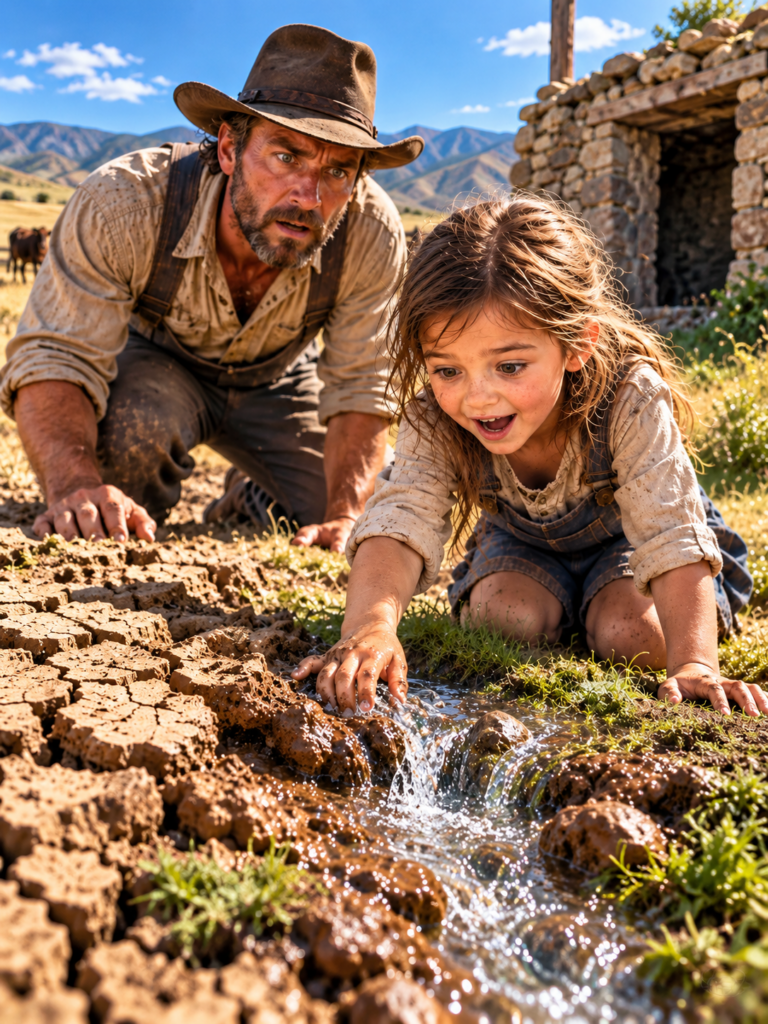
By the time the sun came up on the day Elias Marsh’s water got shut off, his cattle had already stopped walking to the trough out of habit.
They just stood near the fence line instead, heads low, waiting on something that wasn’t coming.
Elias stood at the headgate that fed his 40 acres, watching a stranger from the county water office snap a padlock shut on a valve his family had used, unbothered, for three generations.
The man didn’t look him in the eye when he did it. He just checked a clipboard, said something about reallocation priorities, and drove off in a truck that still had the dealership tag on the back window.
Two hundred yards up the hill, behind the old collapsed stone springhouse nobody had touched in decades, Elias’s eight-year-old daughter, Ren, was crouched low in the weeds with her notebook open on her knee, staring at a strip of grass that had no business staying green while everything around it had already gone the color of old rope.
She didn’t call out to him. She didn’t say a word to anyone yet.
She just kept looking at it, the way she looked at everything, like it was a puzzle nobody else had noticed was even a puzzle.
What had an eight-year-old spotted in a dying pasture that a whole water district full of engineers had somehow walked right past?
And why was the ground behind that ruined old springhouse staying cool and green when the rest of the farm was already cracking apart under a summer sun that hadn’t let up in weeks?
To understand that, you have to go back to where all of it actually started.
Because the answer to Elias Marsh’s problem had been sitting quietly under his own land for longer than anybody in that county had been alive to remember.
Elias was 39. Built like a man who’d spent his whole life around livestock instead of people.
The kind of quiet that made strangers assume he had nothing to say, when really he just didn’t waste words on things that didn’t need saying twice.
He’d taken over the farm from his father, Denny, who’d taken it over from Otis Marsh, a hard, silent man who’d come out west after the war with almost nothing and turned 40 acres of scrub ground into something worth passing down.
The valley Elias farmed didn’t run on rainfall the way outsiders assumed.
It ran on an old handshake water-sharing agreement between his grandfather and the grandfather of the man who owned the ranch next door, a sprawling operation now run by Garrett Voss, whose family had quietly bought up most of the water rights in that basin over three decades while everyone else was busy just trying to keep their fields alive.
The agreement had never been written into anything modern. It was just decades of goodwill and a shared ditch with a single headgate sitting right on the property line.
That goodwill ran out the same year Garrett signed a supply contract with a bottling company looking to expand into the region.
A deal that made his water suddenly worth more sitting in a tanker truck than it ever had been running through Elias’s alfalfa.
Garrett showed up at the fence line himself the evening after the shutoff. Engine still running, not bothering to get out of the truck.
“Drought’s hard on everybody, Elias,” he said, like he was reading off a card. “I’ve got obligations now I didn’t have five years ago. County understands that. Maybe you should, too.”
“That water’s been running to this farm since before either one of us was born,” Elias said.
“Paper doesn’t care about before, Elias. Paper cares about now. And now that water’s spoken for.”
He let that sit a second, watching Elias’s face for something.
“I’ll give you a fair number for the place. More than fair, considering where things are headed. Better than watching the bank take it in a year.”
Elias didn’t answer him.
He didn’t need to.
Garrett read the silence exactly the way he read everything, like a man calculating instead of listening, and drove off before Elias could tell him otherwise.
What followed wasn’t one disaster.
It was a hundred small ones stacked until they made the shape of an entire ruined summer.
Elias started hauling water from a rental tank in town, 40 minutes round trip, twice a day, burning fuel money that didn’t exist.
He sold his father’s old flatbed to cover the gap.
He rationed what little he hauled between the cattle and his wife Dana’s tomato rows, watching things he loved get smaller by the week, while Dana picked up extra shifts at the clinic just to keep the mortgage from sliding backward.
Neighbors mostly kept their distance.
Garrett had spent years cultivating friendships with half the officials at the county water office, and he had a long memory for who helped his enemies.
One rancher, two farms over, stopped returning Elias’s calls entirely after Garrett mentioned in passing that he was reconsidering a grazing lease that rancher depended on.
Garrett’s offers kept coming, each one a little lower than the last.
Each one delivered with the same unbothered patience of a man who believed time was working for him.
“Eighty thousand,” he said the second time, standing at the fence instead of driving up to the house. “That drops next month.”
“You’re negotiating against a drought you’re profiting from,” Elias told him.
“I’m negotiating with reality,” Garrett said. “Reality doesn’t care whose fault it is.”
Elias went to bed most nights running numbers in his head that refused to add up and woke most mornings before the sun to walk fences out of habit more than hope.
It was on one of those early walks that he first noticed the cattle drifting again and again toward the same corner of the lower pasture near the old collapsed springhouse his grandfather had built and never bothered to fully repair.
They’d stand there longer than anywhere else on the property, noses down, pawing gently at the dirt.
Elias noticed it.
He filed it away as one more small mystery in a season already too full of them.
Ren noticed it, too.
And Ren didn’t let things go.
She’d always been the kind of kid who paid attention to what adults walked right past.
She kept a composition notebook, not because anyone assigned it, but because she liked writing down what she saw the way some kids collect rocks.
Which corner of the yard the dog picked during a heat wave. Which plants browned first. Which patch of ground stayed damp two days after everywhere else had already dried to dust.
Weeks before the shutoff, she’d already logged the springhouse corner in her notebook.
“Cows keep going there. Grass greener. Ground cold even when it’s hot.”
Three days after the water got cut, she went to check it herself, kneeling down and pressing her palm flat against the soil near the collapsed stone wall.
It was cooler than it had any right to be.
Two days after that, she found a shallow new dip in the ground beside the ruin, like the earth itself had started to settle.
And once, holding her breath in the fading evening light, she thought she heard a faint trickle underneath the stone.
Gone the second she strained to hear it again.
She ran back to the house with mud on her knees.
“Daddy, the ground by the springhouse is sinking. I think there’s still water under there.”
Elias almost brushed it off.
He was tired in the specific way that makes a person stop trusting good news.
But something in how carefully she said it made him grab a flashlight and follow her out anyway.
Standing there in the dark, he remembered something his own father had mentioned once, offhand, years earlier.
Grandpa Otis never wanted that springhouse torn down, even after it stopped being useful.
Said there was a reason it sat exactly where it sat.
The next morning, Elias climbed into the attic and pulled down a trunk of Otis’s belongings, untouched since the funeral.
Buried under feed receipts and an old pocket watch was a slim, water-stained ledger.
Near the back, in different ink, like it had been written all at once instead of across seasons, was a line Elias read four times sitting on the attic floor.
“Built the springhouse over the seep at the base of the hill because it never once ran dry, not even in the bad years. If this land ever goes hard again, remember it’s there. Don’t let anybody cap it, and don’t let anybody talk you out of what it’s worth.”
He went and found his daughter on the porch and told her they were going to dig.
The digging was slow and miserable.
The old stone had partially caved inward, and clearing it meant hauling debris by hand in 90-degree heat while still watering cattle twice a day on the side.
Four days in, a section of the collapsed lip gave way without warning, and Elias went down hard enough to wrench his shoulder and lose the rest of the afternoon to pain and a swelling equipment bill.
That night, icing his shoulder at the kitchen table, he came closer than he wanted to admit to calling Garrett back and asking what was still on the table.
Ren slid her notebook across to him without a word, open to the June entry.
He went back out the next morning anyway.
Two days after that, his shovel struck something that wasn’t rock.
Old hand-laid channel stone fitted without mortar, curving down into the earth, exactly the way a spring box gets built to guide water instead of blocking it.
And at the bottom, in a shallow basin still holding the shape somebody had carved for it 60 years earlier, water was moving.
Clear, cold, rising steadily out of a crack in the bedrock no wider than a shovel blade.
Ren cupped both hands under it like she was afraid it might vanish if she looked away.
“Is this ours?” she asked. “Actually ours?”
Elias didn’t answer right away because the honest answer, the one that mattered more than the water itself, was that he had no idea yet whether anybody else was going to try to claim it, too.
A county well contractor confirmed it within the week.
A genuine seep fed by a fractured limestone shelf under the hillside, entirely separate from the shared ditch Garrett controlled, running steady at close to 30 gallons a minute regardless of drought.
For a few days, Elias let himself believe the worst was behind him.
He and Ren cleared brush around the old stones together and watched a trough fill on their own land for the first time in months, laughing for what felt like the first time all summer.
Then the contractor’s assistant, a young man named Denny Cobb, mentioned the discovery in passing to a cousin who did fence work over at the Voss ranch.
Word moved the way it always does in a small valley.
Quietly, quickly, and directly toward the one man Elias least wanted to hear it.
Garrett’s truck was back at the fence three days later.
He wasn’t smiling this time.
He was calculating.
“Hear congratulations are in order,” he said. “That aquifer runs under both our properties, Elias. You might want a lawyer to look real close at whose water that actually is before you get too comfortable.”
The formal claim followed within the week, delivered by a lawyer who clearly hadn’t enjoyed the drive.
The argument was layered and not entirely baseless.
Without a specific permit and without documentation proving the spring’s origin sat exclusively on Marsh land, the water fell under a shared resource designation requiring Garrett’s approval to use at any real scale.
Garrett didn’t stop at paperwork either.
He mentioned to two county officials that the discovery might be unregistered extraction during an active drought emergency.
He floated a rumor at the feed store that Elias was hoarding water while neighbors suffered.
A county inspector showed up within days, polite but thorough, asking about permits that didn’t exist yet.
It was Ren, digging through Otis’s old trunk a second time, looking for anything else useful, who found the first real thread.
Tucked inside a farm almanac from 1961 was a torn survey fragment referencing a protected spring structure built in 1938, within the Marsh boundary, cut off mid-sentence right where it seemed about to name the exact boundary line.
“There’s more of this somewhere,” Ren said. “This isn’t the whole thing.”
Elias drove into town and found Louise Pruitt, the county’s retired land surveyor, a woman in her seventies who still kept four decades of records long after anyone asked her to.
It took two visits and an afternoon of dusty boxes before Louise found the rest of it.
A complete 1958 property survey documenting the spring and springhouse structure squarely inside Marsh land, three years before the water district that now claimed jurisdiction had even been formed.
That was evidence one.
The structure existed, and it predated the very authority trying to govern it.
Digging further, Louise turned up something else.
A 1990s county hydrology assessment showing the fractured limestone pocket feeding the spring was hydrologically isolated from the larger channel Garrett controlled, not part of any shared system at all.
That was evidence two.
The spring wasn’t shared water dressed up as a discovery.
It never had been.
The third piece came from an unexpected direction entirely.
Buried in the same box of Louise’s old files was a letter over a decade old addressed to Garrett Voss himself, commissioned by his own ranch to evaluate expansion possibilities.
It referenced, almost in passing, an unregistered spring source on the neighboring Marsh property, currently uncapped and unused.
Garrett had known about that spring for years.
He’d simply waited for a drought severe enough to make Elias desperate enough to sell.
And when that failed, he’d built a legal fight he expected to win on resources alone.
That was evidence three.
The fourth piece took longer, and it needed somebody willing to talk who hadn’t been willing before.
Denny Cobb came to the Marsh door one evening looking uneasy, carrying the particular guilt of a man whose careless gossip had started this whole fight.
His own father, it turned out, had done seasonal maintenance on the Voss ranch’s irrigation system for years before he passed and had once mentioned, almost as an aside, that the shared headgate hadn’t been damaged or drought-restricted at all when it got closed.
It had simply been locked manually weeks before any official conservation order took effect.
“He always said Mr. Voss told him to close it early,” Denny admitted. “Said it was strange doing maintenance on a valve that wasn’t broken.”
That was evidence four, and it changed the entire shape of the story Elias would tell at the hearing.
Garrett arrived at the county water board composed and confident, flanked by his lawyer.
Elias arrived with Louise’s documents, Denny’s signed account, and a folder Ren had helped him organize the night before in her own careful handwriting.
Garrett’s lawyer opened with the shared aquifer argument.
Elias answered with the hydrology assessment, proving the source was isolated.
The lawyer pivoted to the missing permit claim.
Elias answered with the 1958 survey, predating the district’s authority entirely.
Garrett’s composure started slipping, a tightness settling into his jaw.
When Elias produced the letter Garrett had commissioned himself, proving he’d known about the spring for over a decade, the room went quiet in a different way.
And when Denny’s signed statement was read aloud, describing a valve closed weeks ahead of any drought order, Garrett stood up too fast, said something about the statement being secondhand, and revealed more anger in that one motion than a confident innocent man ever needs to show.
The ruling came two weeks later.
The spring belonged entirely to the Marsh farm, protected under the 1958 survey and outside the district’s jurisdiction.
The board additionally found the shared headgate had been closed without proper cause, ordering Garrett to restore Elias’s original ditch share and entering a formal warning into county water records regarding manipulation of a shared resource.
It wasn’t a fortune, and Elias never once expected it to be.
What he walked away with mattered more.
Water security, a record nobody could argue with twice, and the simple unfamiliar ability to plan more than a week ahead.
The following summer, drought tightened its grip across the whole valley again, and Garrett Voss’s larger operation, stretched thin across more acres than his contract could comfortably water, found itself running low.
For the first time in his life, he stood at Elias’s fence line, asking for something instead of offering it.
Elias didn’t gloat.
He didn’t need to.
He set the same fair terms he offered every neighbor who came asking that season, based on actual need instead of leverage or history.
Over the year that followed, Elias used part of the spring’s steady flow to put in a modest drip system across his most vulnerable fields, cutting his water use nearly in half while keeping his crops healthier than they’d been in years.
He built a small shared reserve tank at the property line, available to any neighbor during a declared emergency.
He started walking other farms in the valley, showing people the same quiet signs his own daughter had taught him to notice.
Cool ground, grass that stayed green too long, cattle gathering somewhere for no obvious reason.
Two neighboring families found modest springs of their own that same year, following exactly that method.
On a cool evening the following spring, Ren walked out to the springhouse, rebuilt now on its original stones, water moving steadily past into a trough where cattle drank without crowding.
The way animals drink when they trust the water will still be there tomorrow.
She knelt and touched the surface the way she had the very first time, when it was nothing but a single cold bead pooling in her palm and a question nobody could yet answer.
Elias walked up beside her.
“You saw it before any of us did,” he said.
She shrugged the way nine-year-olds do when they don’t quite know how to hold a compliment that big.
“I was just paying attention.”
He put a hand on her shoulder, watching the water move past the stones that had hidden it for 60 years.
“Sometimes,” he said, “that’s the whole difference.”


