
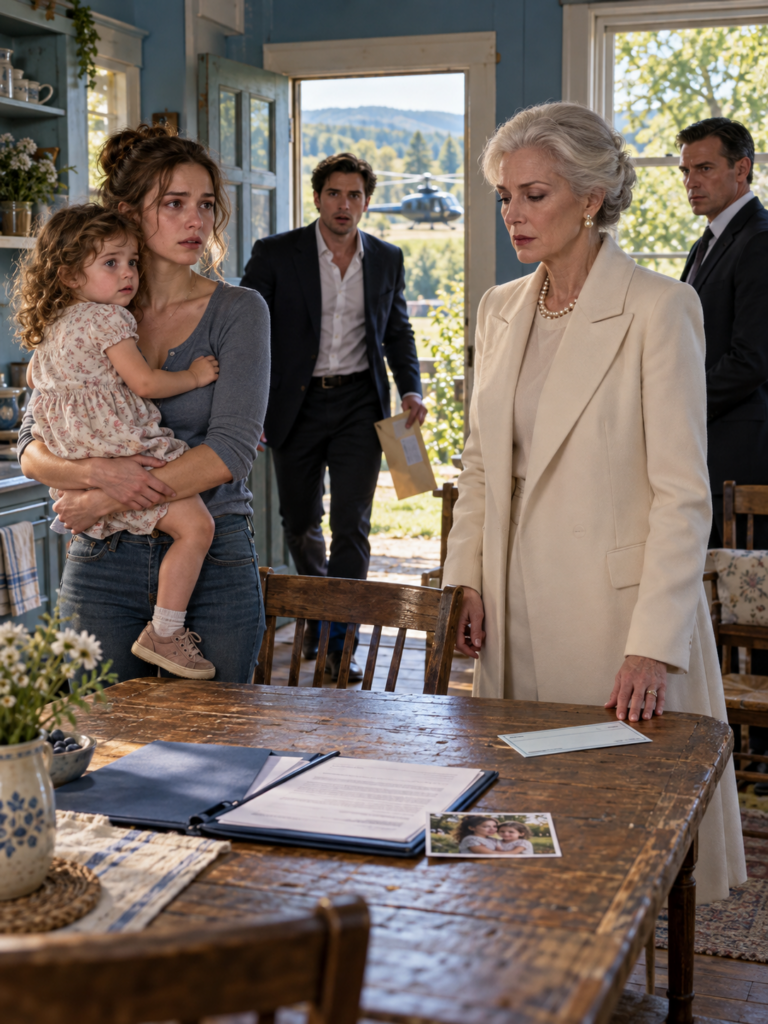
I reached for the second letter before Celeste could cover it with her hand.
The first sentence made my breath catch.
It said I had decided to raise my baby alone.
The next paragraph said I wanted no further relationship with Adrian Vale and would not contact his family again.
At the bottom was my name.
Beneath it was something that looked like my signature.
I read it twice, hoping I’d misunderstood.
Then I looked at Adrian.
“I didn’t write this.”
“I know,” he said.
His voice sounded rougher than I remembered.
Celeste lifted her chin.
“Adrian, we should discuss this privately.”
“No.”
“Your father is still recovering. You have responsibilities that extend beyond whatever happened here.”
Adrian didn’t move.
“What happened here?” he repeated.
Celeste pressed her lips together.
He pointed to the paper in my hand.
“You told me Elena wanted me out of her life. You gave me that letter as proof.”
I felt as though the floor had shifted beneath me.
“You showed him this?”
Celeste’s attorney stepped closer to the table, but she raised a hand to silence him.
“You both need to understand the circumstances.”
I looked back at Adrian.
For two years, I’d imagined him ignoring my letter. I’d imagined him choosing his Manhattan life over a waitress and a baby. On the worst nights, I’d imagined him reading every word and deciding we weren’t worth a reply.
But I had never imagined someone had written a reply for me.
“When did she give you this?” I asked.
Adrian hesitated.
“During the succession fight. After I asked whether anyone had heard from you.”
“You asked about me?”
“More than once.”
The answer hurt almost as much as the letter.
All those nights I’d told myself that his silence was the answer.
All those mornings I’d gone to work while Poppy stayed with Uncle Raymond, because rent and groceries didn’t wait for heartbreak.
Adrian had been asking about me.
And someone had decided what we were allowed to know about each other.
Celeste folded her arms.
“Neither of you understands how fragile the company was at the time.”
“I understand that my daughter was born without her father knowing she existed,” I said.
Celeste’s eyes flickered toward Poppy.
The little girl had gone quiet. She was resting her head against my shoulder, studying the unfamiliar man by the table.
Adrian took one cautious step closer.
“How old is she?”
“Twenty-three months.”
He swallowed.
“What’s her full name?”
“Penelope Rose Brooks. Everyone calls her Poppy.”
He repeated it softly.
“Penelope.”
Then he looked at her gray eyes.
I could see him doing the math. His expression changed when he understood exactly how much time had passed.
“Her birthday?”
I told him.
He stared down at the table.
For a moment, the businessman who’d arrived by helicopter seemed to disappear. Standing in my kitchen was simply the man who’d once argued with me about whether maple syrup belonged in coffee.
He looked like someone who’d just discovered an entire part of his life had been happening somewhere he couldn’t reach.
Celeste broke the silence.
“This proves nothing about paternity.”
Adrian turned sharply.
“I haven’t asked you to determine that.”
“You have a reputation to protect.”
“I have questions you keep refusing to answer.”
The attorney by the window shifted uneasily.
Adrian looked at him.
“Did you know about the letter?”
The man opened his mouth, then closed it.
Celeste snapped, “You are here as my counsel.”
“And I strongly recommend that we stop discussing this without independent legal advice,” he answered.
Adrian gave a humorless laugh.
“Interesting. You weren’t worried about legal advice when you came here to offer Elena money.”
I looked at the blank check.
It was still lying beside my original envelope.
The contrast was almost unbearable.
One piece of paper had tried to tell the truth.
Another had tried to buy my silence.
And between them lay a third, carrying words I had never written.
“How did you find my letter?” I asked Adrian.
His eyes returned to mine.
“An internal review of archived executive correspondence turned it up. The routing history didn’t match what I’d been told.”
“Why was anyone reviewing it?”
“Because I questioned the explanation I’d been given about why you disappeared. I wanted the actual records.”
Celeste gave an impatient sigh.
“Your time would have been better spent running the company.”
Adrian ignored her.
“The envelope was held before it ever reached me. Once we found that, I asked for an outside review.”
I glanced toward the helicopter.
“Is that why you came today?”
“Someone told me my mother was traveling to Vermont.”
My gaze went to her attorney.
He looked away.
Adrian followed my eyes but didn’t comment.
“I was already trying to reach you,” he said. “When I realized where she was going, I came myself.”
I wanted to believe him.
God, I wanted to.
But wanting wasn’t the same as trusting.
“Your number stopped working,” I said. “Your emails disappeared. I thought you’d changed everything to get away from me.”
“I lost access to the old number during the corporate transition. My email was routed through executive support. I thought you were choosing not to answer me.”
“You knew my address.”
He went silent.
That silence mattered.
Celeste had lied to him. But the letter hadn’t kept him physically from coming to Vermont.
He looked at my kitchen floor.
“I know.”
I waited.
“I should have come,” he said. “Even if I believed that letter was real, I should have found a way to talk to you directly.”
It wasn’t a grand apology.
There was no explanation that magically erased twenty-three months.
But he hadn’t blamed me.
That was more than his mother had managed.
Poppy began reaching toward the photograph in the folder.
“Daddy picture.”
Adrian heard her.
His face crumpled slightly.
I held up the photograph so he could see it.
He was standing on my porch in a faded blue shirt, smiling into the summer sun. I’d taken it the week before he returned to Manhattan.
“You gave me that,” I said. “Remember?”
He nodded.
“I told Poppy who you were. I wasn’t going to teach her that she didn’t have a father just because I didn’t know why he wasn’t here.”
Adrian brushed a hand over his mouth.
“May I say hello to her?”
I looked at Poppy.
She stared at him curiously.
“Just slowly,” I said.
He crouched a few feet away.
“Hi, Poppy. I’m Adrian.”
She blinked.
Then smiled.
“Daddy.”
He laughed once, shakily.
“Yes,” he whispered. “I hope I get to be.”
I felt my throat close.
I had imagined this moment a thousand times.
None of those imaginings included his mother watching from my kitchen table with a blank check still in front of her.
Celeste finally spoke.
“This is exactly what I was trying to prevent.”
Adrian rose.
“You were trying to prevent me meeting my daughter?”
“I was trying to prevent you from being destroyed by something you weren’t prepared to handle.”
“She’s a child, Mom.”
“And you were inheriting responsibility for thousands of employees.”
“Those things aren’t mutually exclusive.”
Celeste looked at me.
“You cannot possibly understand the pressure he was under.”
I held her gaze.
“I understand pressure. I understand going to work with two hours of sleep because my baby was sick all night. I understand wondering if the paycheck will cover groceries and childcare. And I understand writing a letter to a man I loved, only to be told two years later that someone decided he shouldn’t read it.”
Her attorney lowered his head.
I wasn’t finished.
“You came into my home and threatened me with your resources because you thought I didn’t have any way to defend myself.”
Celeste said nothing.
I pointed at the blue folder.
“But I kept the receipt.”
Adrian looked at the certified-mail documents.
“Can I see them?”
I hesitated.
Then I set Poppy down beside her blocks and handed him the folder.
He examined the postal receipt, the delivery confirmation, and the copy of my original letter.
As he read the first paragraph, his shoulders tightened.
He turned the page.
I watched his face as he reached the words about our baby.
He touched the paper with one fingertip.
“You wrote that you still loved me.”
I couldn’t answer immediately.
“Yes.”
Celeste looked toward the door.
“This has gone far enough.”
“No,” Adrian said. “It hasn’t.”
He carefully returned the letter to the folder.
“I brought someone who can explain what the company’s records actually show.”
Celeste stiffened.
“Adrian.”
He glanced toward the helicopter.
A woman in a charcoal suit was crossing my yard with a sealed case.
She was in her fifties, composed, with a silver pin on her lapel.
The attorney beside Celeste recognized her.
His expression changed.
The woman reached the porch.
Adrian opened the door.
“Margaret Sloan,” he said. “Outside counsel for the Vale Corporation board.”
Celeste took an involuntary step back.
Margaret entered and offered me a small nod.
“Miss Brooks. I’m sorry to arrive under such difficult circumstances.”
I looked at the case in her hand.
“Why does the corporate board need to be involved in my daughter?”
“It doesn’t,” Margaret replied. “But it does have an interest in whether company resources and internal systems were used to interfere with executive correspondence.”
Celeste’s voice sharpened.
“You have no authority to discuss internal company matters in this woman’s home.”
Margaret remained calm.
“The board authorized my involvement. We will share only what is necessary and appropriate here.”
Adrian turned toward his mother.
“You told me Elena had rejected me. You handed me a letter in her name. And the original letter from her was routed to you.”
Celeste reached for her handbag.
“I refuse to participate in this circus.”
She moved toward the door.
But Margaret set her case on the kitchen table.
“Mrs. Vale, before you leave, you should know the board has already reviewed the initial findings.”
Celeste stopped.
For the first time, she looked uncertain.
Margaret opened the case.
Inside were correspondence records, internal routing logs, and an examination report.
She placed the executive mail register beside my blue folder.
Adrian stepped closer.
I stayed where I was, Poppy beside my leg.
Margaret turned a page.
“Your certified letter reached Vale Tower twenty-four months ago, Miss Brooks.”
My pulse quickened.
“It was accepted by the executive mailroom, then placed on a special hold.”
She indicated the corresponding entry.
“Mrs. Vale personally signed for it.”
Adrian stared at his mother.
Celeste didn’t deny the signature.
Margaret continued.
“And the letter supposedly sent by Miss Brooks was prepared using company resources. Our review identified a digital reproduction of her signature.”
I felt sick.
Adrian turned toward me.
His expression held a question he didn’t seem able to ask.
I answered anyway.
“I never gave anyone permission to write in my name.”
Margaret nodded.
“That is consistent with what our preliminary investigation has found.”
Celeste looked at Adrian.
“I did what I believed was necessary.”
He stepped away from her.
“Necessary for whom?”
“For you. For the family. For everything your father built.”
“And what about Poppy?”
Celeste looked toward my daughter.
Then away.
Adrian’s face hardened.
I had never seen him look at his mother like that.
Margaret took one more document from the case.
“This isn’t the only matter under review. During our investigation into the correspondence, the board’s team identified financial records requiring independent examination.”
Celeste snapped her head toward Margaret.
“Those records have nothing to do with Elena Brooks.”
Margaret didn’t disagree.
Instead, she said, “They may have a great deal to do with your exercise of authority within the corporation.”
Adrian frowned.
“What financial records?”
Margaret paused.
Before she could answer, Celeste turned toward me.
“Think carefully, Elena. Once this becomes formal, you lose control of what people say about you. Your daughter will become part of a story neither of you can contain.”
I looked at Poppy.
She was on the floor again, trying to balance a red block on top of a blue one.
She had no idea what her grandmother was threatening.
All I wanted was to keep her safe.
And now everyone in my kitchen seemed to be waiting for me to decide whether I wanted the truth badly enough to risk whatever came after it.
Margaret placed an authorization and statement form on the table.
“Miss Brooks, the board may need your voluntary statement and copies of the postal documents. Your account will help establish what happened, but you have the right to review anything before you sign.”
Adrian looked at me.
“I won’t tell you what to do.”
Celeste gave a sharp, exhausted laugh.
“Of course you won’t. You’ll let her make the decision that destroys this family.”
I looked at the pen beside the blank check.
The same pen Celeste had pushed toward me to purchase my silence.
I picked it up.
But instead of touching the check, I drew Margaret’s statement form closer.
“Then let’s make sure everyone finally hears what actually happened.”
I uncapped the pen.
And Celeste reached across the table toward my hand.
Celeste’s fingers stopped inches from mine.
“Don’t do this,” she said.
I looked at her hand.
“Move it.”
She stared at me.
“I’m asking you to think about your daughter.”
“I’ve been thinking about my daughter since the day I learned I was pregnant.”
Celeste slowly withdrew her hand.
I turned back to Margaret.
“Before I sign anything, I want to know exactly what you’re asking me to confirm.”
Margaret nodded.
“That’s reasonable.”
She walked me through the statement. It covered the date I’d mailed the letter, the contents of the photocopy I’d preserved, the delivery confirmation, and the fact that I’d never written the document Adrian had been shown.
She made clear that I wasn’t being asked to speculate about who had reproduced my signature.
Just what I knew.
After reading every page, I signed.
I kept the original contents of my blue folder. Margaret arranged for copies to be made and logged for the board’s review.
It was such a small action.
A signature. A date. A few pieces of paper.
But Celeste watched as though I’d just taken away something she believed belonged to her.
Control.
Adrian stood beside the table, holding the letter she’d given him two years earlier.
“What did you think would happen?” he asked her.
Celeste didn’t answer.
“You knew Elena was pregnant. You knew where she lived. You knew I cared about her.”
“You were vulnerable.”
“So you decided I wasn’t allowed to know?”
“I decided you couldn’t afford to be distracted.”
“By my own child?”
Celeste’s jaw tightened.
“You keep saying that as though I had the luxury of thinking about only one person.”
I felt a strange, reluctant understanding.
Not forgiveness.
Understanding.
To Celeste, the corporation had become something that justified every other decision. Its survival, its reputation, and her influence over it mattered so much that even her granddaughter had been reduced to a potential problem.
She had convinced herself that withholding the truth was protection.
That belief didn’t make what she’d done any less cruel.
Adrian set the false letter down.
“Tell me something,” he said. “If Elena hadn’t kept her records, would you ever have told me?”
Celeste looked toward the window.
The helicopter waited beyond the maple trees.
“Your life was going well.”
It wasn’t an answer.
It was worse.
Adrian exhaled.
“You were never going to tell me.”
Celeste remained silent.
Margaret gathered the signed statement and carefully closed the folder.
“There are additional matters that need to be addressed,” she said.
Adrian turned.
“The financial records?”
“Yes.”
Celeste immediately straightened.
“That is confidential corporate business.”
Margaret regarded her steadily.
“The board has identified approximately forty-two million dollars in irregular transfers involving charitable trusts connected to the Vale Foundation.”
Adrian went completely still.
“Forty-two million?”
“Approximately. The independent examination is ongoing. At this stage, the records establish discrepancies and transfers requiring explanation. They do not, by themselves, establish who is legally responsible for every transaction.”
I looked from Margaret to Celeste.
Until that moment, I’d thought the entire conflict was about one powerful mother protecting her son’s reputation.
Now I understood why the atmosphere had changed when Margaret arrived.
The investigation had reached beyond my letter.
Adrian placed both palms on the table.
“How long has the board known?”
“The initial discrepancies were identified during the broader review. The examination expanded as investigators compared account records and authorization histories.”
Celeste gave a bitter laugh.
“So now I’m accused of stealing from the foundation because I wanted to protect my son from a scandal?”
Margaret answered without raising her voice.
“The issues are being investigated separately. No one is suggesting the intercepted letter proves a financial offense. The board is concerned about both matters because they involve oversight and the use of institutional authority.”
That distinction mattered.
My pregnancy had not somehow caused forty-two million dollars to disappear.
And I wasn’t going to let anyone in that kitchen pretend that it had.
I looked at Celeste.
“Whatever happens to the foundation is not Poppy’s responsibility.”
Her eyes narrowed.
“I never said it was.”
“You just warned me that telling the truth would destroy your family.”
She looked away.
Margaret turned to Adrian.
“The board has voted to suspend Mrs. Vale’s authority over foundation assets while the investigation continues.”
Celeste gripped the back of a chair.
“You let them do this?”
Adrian held her gaze.
“Did you expect me to stop an independent investigation after learning what you did with Elena’s letter?”
“I’m your mother.”
“And I’m Poppy’s father.”
The words hung in the kitchen.
Poppy looked up at the sound of her name.
Adrian turned toward her, and his expression softened immediately.
He crouched again.
“Hi, sweetheart.”
She offered him a wooden block.
He accepted it as though it were made of glass.
“Thank you.”
Then he looked at me.
“May I hold her?”
I hesitated.
There was something overwhelming about seeing him there, in the room where I’d fed her breakfast and rocked her through sleepless nights.
A few hours earlier, he’d been a photograph.
Now he was kneeling in front of her, asking permission to do the simplest thing in the world.
I held out my arms to Poppy.
She came to me first.
Then, when I asked if she wanted to say hello to Adrian, she reached toward him.
I nodded.
He took her carefully.
For several seconds, neither of them moved.
Poppy studied his face.
Then she touched his cheek.
“Daddy,” she said.
Adrian closed his eyes.
When he opened them, tears had gathered along his lower lashes.
“Hello, Poppy.”
She giggled and reached for his hair.
He laughed softly.
And something in my chest, something that had been braced against disappointment for two years, finally loosened.
Only a little.
I wasn’t ready to trust the future yet.
But I could acknowledge the moment in front of me.
Celeste watched them.
For the first time, she had no argument prepared.
Margaret closed her case.
“Mrs. Vale, you should retain independent legal representation. There will be formal requests for information and opportunities to respond to the findings.”
Celeste looked at the attorney who’d accompanied her.
He had remained near the window through most of the confrontation.
“Get the car,” she told him.
He didn’t move immediately.
“Mrs. Vale, I need to make something clear.”
She turned.
“What now?”
“I’ve been cooperating with the board’s investigation for the past three weeks.”
Adrian looked sharply at him.
Celeste stared.
The attorney continued.
“I became concerned about the executive correspondence records and the explanations given for certain internal decisions. I provided information to the independent reviewers.”
Celeste’s face went white.
“You work for me.”
He lowered his gaze.
“My professional obligations didn’t permit me to conceal what I knew.”
“You betrayed me.”
He didn’t answer.
I thought about all the times my uncle Raymond had said that someone must know why Adrian had disappeared.
He’d been right.
But knowing something was wrong and being willing to speak about it were two different things.
The attorney hadn’t stopped Celeste from coming to my farmhouse.
He’d stood there while she offered me money and hinted at what her resources could do.
Cooperating now didn’t erase his earlier silence.
Still, it meant someone inside her world had finally stopped accepting her version of the truth.
Celeste reached for the blank check.
I put my hand over it first.
She stared at me.
“Now you want the money?”
“No.”
I lifted it.
For a moment, I remembered every bill I’d paid late. Every shift I’d covered when I was exhausted. Every time I’d stood in the grocery store calculating whether I could afford something extra for Poppy.
A blank check could have changed our lives.
Celeste knew that.
It was why she’d brought it.
But I knew something she didn’t.
I had built a life here that wasn’t for sale.
I tore the check in half.
Then in half again.
I dropped the pieces into the kitchen trash.
“I don’t want yours,” I said.
Celeste looked at the scraps as though she couldn’t understand my decision.
Adrian adjusted Poppy in his arms.
His mother looked at him.
“Are you really going to let her treat me this way?”
He answered quietly.
“She hasn’t done anything to you that you didn’t come here prepared to do to her.”
Celeste picked up her handbag.
At the doorway, she paused.
“You’ll regret letting private matters become public.”
Adrian didn’t respond.
Neither did I.
The attorney followed her outside.
We heard their car doors close.
A moment later, the black SUV pulled away.
For the first time since Celeste arrived, my kitchen was quiet.
Margaret remained long enough to explain the next steps in the investigation, including how the documents I’d provided would be handled and how any further requests would come through appropriate channels.
Then she left as well.
Adrian carried Poppy toward the window so she could watch the helicopter.
She pressed her hand to the glass.
“Big!”
He smiled.
“Very big.”
I watched them from the table.
This was the strange part of getting the truth I’d wanted.
It didn’t bring back my pregnancy.
It didn’t bring back the night Poppy first laughed.
It didn’t erase the loneliness of sitting on the farmhouse steps wondering whether Adrian had abandoned me.
And it didn’t make us a family just because we’d discovered why we’d been kept apart.
Adrian seemed to understand that.
After Poppy returned to her blocks, he came to the table.
“Elena, what do you need from me?”
I looked at him.
“Time.”
He nodded.
“I owe you that.”
“You owe Poppy more than a dramatic afternoon.”
“I know.”
“You can’t arrive in a helicopter, meet her once, and decide money will fix the rest.”
“I don’t want to do that.”
I searched his face.
“Then what do you want?”
He looked toward our daughter.
“I want the chance to be her father. Not just on paper. Not just when it’s convenient.”
I let the silence stretch.
“What about New York?”
“My work is there. But I can arrange my life differently.”
“And your mother?”
His expression changed.
“She won’t have access to you or Poppy through me unless you’re comfortable with it. I’m not asking you to trust her.”
“And what about us?”
He seemed to understand immediately that I meant more than parenting.
He looked at the faded photograph on the table.
“I don’t know what you’ll be able to forgive,” he said. “I don’t know if we can ever have what we had before.”
I appreciated that he didn’t promise otherwise.
“But I love you,” he continued. “And I never stopped wondering about you.”
I looked down.
Those were the words I’d wanted for two years.
Hearing them now was almost frightening.
“Love isn’t the same as showing up,” I told him.
“No,” he agreed. “It isn’t.”
Poppy dropped a block.
Adrian bent to retrieve it.
He handed it back to her.
She rewarded him with a delighted laugh.
He looked at me again.
“Then let me show up.”
I didn’t answer immediately.
I had one more question.
The one I hadn’t wanted to ask while everyone else was listening.
“Adrian, when your mother gave you that letter supposedly from me, did you ever suspect it wasn’t real?”
He sat down slowly.
“Yes.”
My heart sank.
He didn’t try to take the word back.
“Something about it felt wrong,” he admitted. “It didn’t sound like you. But I was exhausted, Dad was ill, and I wanted to believe that respecting your decision meant leaving you alone.”
I stared at him.
“So you chose the explanation that was easiest for you.”
He nodded.
“I did.”
There it was.
The truth that no forged letter could erase.
Celeste had kept us apart.
But Adrian had allowed an explanation he didn’t fully trust to become an excuse for not asking more questions.
He looked toward Poppy.
“I can’t change that.”
“No,” I said.
He lowered his head.
“But I can stop making that kind of choice.”
I looked at the man I’d once loved enough to believe every promise he made.
Then at our daughter, who was trying to build her little tower again.
I didn’t tell him everything was forgiven.
I didn’t ask him to leave.
I simply pulled out the empty chair beside me.
“Sit down, Adrian,” I said.
“We have a lot to talk about.”
Adrian pulled out the chair and sat.
For the first time since he’d stepped off the helicopter, he wasn’t looking toward his mother, a lawyer, or a document.
He was looking at me.
And I realized that was where rebuilding would have to begin.
Not with a check.
Not with a dramatic apology.
With an ordinary conversation neither of us could afford to avoid again.
I asked him about the months after he returned to Manhattan.
He told me about the hospital corridors, the endless meetings, and the relatives and executives who’d treated his father’s illness as an opportunity to fight over control of the company.
He admitted that he’d allowed his mother and executive staff to manage too much of his personal life.
At the time, he thought he was being practical.
Now he understood what that dependence had cost.
“When I couldn’t reach you,” he said, “I should have come back.”
“Yes.”
“I kept telling myself there would be time once the company settled.”
I looked toward Poppy.
“Life didn’t wait for the company.”
He followed my gaze.
“No,” he said. “It didn’t.”
We talked until the light outside turned golden.
I told him about the day I discovered I was pregnant.
About standing in my bathroom with a test in my hand, terrified and happy at the same time.
About how I’d wanted to tell him in person.
About the letter I’d written at the kitchen table after every other attempt to contact him failed.
He listened without interrupting.
When I told him about Poppy’s birth, he put a hand over his eyes.
“When did Raymond get you to the hospital?”
“Just after midnight.”
“Was everything okay?”
“In the end, yes. But I was scared.”
He nodded.
“I wish I’d been there.”
“So do I.”
There was no reason to pretend otherwise.
Later, when Poppy grew sleepy, I carried her upstairs.
Adrian waited in the living room.
I came back down to find him standing beside the photograph I’d kept of us.
“You really showed her this all the time?” he asked.
“Whenever she asked about her daddy.”
He set it down carefully.
“I didn’t deserve that.”
“She deserved to know where she came from.”
He looked at me.
“Thank you.”
I didn’t know how to respond.
So I sat beside him, and we kept talking.
Over the next several weeks, the truth about Celeste’s decisions became clearer.
The company’s records showed that she had personally intercepted my certified letter.
The mailroom entry and routing instruction placed the correspondence in her control before it could reach Adrian.
The digital examination of the false letter showed that my signature had been reproduced from a document held within company files.
The investigators connected the document preparation to internal resources used under Celeste’s authority.
Celeste disputed parts of the investigators’ interpretation, but she could no longer plausibly maintain that she knew nothing about the correspondence.
The conclusion that mattered most to me was straightforward.
I had tried to tell Adrian about our daughter.
His mother had stopped my message.
Then she’d allowed him to believe I’d chosen to disappear.
The deeper motive emerged through the same records and the explanations she gave during the inquiry.
Celeste had feared that a pregnancy outside marriage, involving a woman with no connection to the family’s corporate world, would become a vulnerability during the succession fight.
She had convinced herself that Adrian needed to remain focused on the company.
She had also convinced herself that she alone was entitled to decide what counted as a distraction.
In her mind, preventing a scandal was the same as protecting her son.
But she’d gone further than withholding a letter.
She’d substituted my wishes with words of her own.
And when that wasn’t enough to guarantee silence, she’d come to Vermont with a blank check.
The financial investigation moved separately.
The board’s independent reviewers continued examining approximately forty-two million dollars in irregular foundation-related transfers.
The inquiry extended across charitable trust accounts, authorization records, and decisions made while Celeste held authority over those assets.
I learned about its progress mostly through Adrian, and only when there were developments he was permitted to discuss.
I didn’t attend corporate meetings.
I didn’t become an accidental financial investigator.
My job was still serving coffee at Millie’s Corner Café, raising my daughter, and deciding what kind of relationship we wanted with her father.
Eventually, most of the charitable funds identified as missing or improperly transferred were recovered.
Celeste resigned from her positions connected to Vale Corporation, and the intercepted correspondence and false letter became part of the formal legal proceedings.
The loss of her authority didn’t restore the two years she’d taken from us.
But it meant she could no longer use that authority without accountability.
I thought that distinction mattered.
Consequences weren’t the same as revenge.
I didn’t want Celeste impoverished or publicly humiliated.
I wanted her to stop being able to decide other people’s lives without their consent.
Adrian established firm boundaries with her.
Their conversations became limited and difficult.
He wouldn’t discuss Poppy with her as though grandmotherhood automatically granted access.
He wouldn’t ask me to make peace for the family’s appearance.
And he wouldn’t pretend that loving his mother required defending what she’d done.
One evening, after a particularly strained conversation with her, he came over to the farmhouse looking exhausted.
“She says I chose you over my family,” he told me.
I was washing dishes.
I turned off the faucet.
“What did you say?”
“That Poppy is my family too.”
I dried my hands.
“And?”
“And that this was never supposed to be a choice.”
I looked at him for a long moment.
That was the first time I felt something shift between us.
Not because he’d made a grand romantic declaration.
But because he’d finally recognized the impossible choice his mother had created.
A mother or a daughter.
A corporate reputation or the truth.
A comfortable lie or a difficult responsibility.
And he’d stopped accepting her terms.
Adrian didn’t try to buy his way into our lives.
He asked about Poppy’s routines.
He learned which foods she liked, what frightened her, and how she wanted her blanket tucked beneath her chin before bed.
At first, he came for short visits.
He sat on the living room floor and built block towers with her.
He read the same picture book three times because she insisted the first two readings weren’t enough.
He learned that she called every large animal a cow, including the neighbor’s horse.
And when she became tired or overwhelmed, he didn’t take it personally if she reached for me.
He asked questions.
He listened.
He returned when he said he would.
There were awkward moments.
Sometimes I caught myself explaining something about Poppy as though Adrian were a visiting stranger.
Sometimes he looked hurt when he realized how many routines I’d developed without him.
Once, when he offered to replace our old kitchen table, I snapped at him.
“Not everything in this house needs improving.”
He looked startled.
Then apologized.
“I wasn’t criticizing it.”
“I know.”
I ran my hand over the worn wooden surface.
“But I sat here with Poppy on my lap when she had a fever. I filled out job applications here. I wrote your letter here.”
Adrian looked at the table.
Then he understood.
“This isn’t just furniture.”
“No.”
He rested his hand on the back of a chair.
“Then we keep it.”
And we did.
The table stayed exactly where it had always been.
Over time, Adrian began thinking seriously about how to make Vermont a regular part of his life.
He had obligations in Manhattan that weren’t going to disappear.
But he also understood that Poppy’s home was here.
He found the farmhouse next door when it became available.
Before making the purchase, he told me what he was considering.
He didn’t announce that he was moving us into a mansion.
He didn’t make plans for my property without asking.
He simply explained that living nearby would allow him to spend consistent time with our daughter while continuing to meet his professional responsibilities.
I thought about it.
Then I said I was comfortable with the arrangement as long as it didn’t become an excuse to interfere with my independence.
He agreed.
He bought the house next door and renovated it gradually.
Some mornings I watched workers carrying lumber across the yard while I packed Poppy’s snacks for daycare.
Other mornings, Adrian arrived at my kitchen door with coffee and asked whether I needed anything before my shift.
Usually I told him no.
Occasionally I asked him to watch Poppy while I ran an errand.
We were learning to share responsibility.
That was different from being rescued.
The first time Poppy spent an afternoon playing at his house, I stood at my kitchen window longer than I wanted to admit.
I trusted Adrian more than I had when he arrived.
But trust grew slowly when it had once been broken, even by circumstances larger than either of us.
He didn’t complain about that.
He kept showing up.
One Sunday, Uncle Raymond stopped by while Adrian was helping Poppy push a little wooden wagon across the grass.
Raymond watched them from my porch.
“Well,” he said, “I guess you weren’t wrong about the letter.”
I smiled faintly.
“I wasn’t right about everything.”
“No one ever is.”
He leaned against the railing.
“I was angry with him before I knew the whole story.”
“So was I.”
“Still a little angry?”
I watched Adrian crouch beside Poppy as she pointed toward a butterfly.
“Yes,” I admitted.
Raymond nodded.
“That’s allowed.”
I looked at my uncle.
He’d been the person who answered the phone when I went into labor.
The one who fixed the farmhouse steps while I was pregnant.
The one who carried Poppy around the living room when she wouldn’t sleep.
He had been steady when everything else felt uncertain.
“Thank you,” I said.
He looked confused.
“For what?”
“For being here.”
Raymond glanced toward Poppy.
“Where else would I be?”
I nearly cried.
It was such a simple answer.
And after two years of wondering why one man hadn’t come, it meant everything.
By late summer, Poppy’s second birthday was approaching.
Adrian asked what kind of party she wanted.
I told him she was too young to care about anything except cake, balloons, and people she recognized.
He grinned.
“Then let’s give her exactly that.”
He brought a small cake.
Raymond hung a few decorations on the porch.
Millie from the café stopped by with a little wrapped present.
There were no reporters.
No enormous birthday installation.
No photographers hired to make the Vale family look sentimental.
Just a little girl in a yellow dress, laughing as she reached for the frosting.
Adrian helped her blow out the candles.
She promptly smeared icing across his nose.
He stared at her in surprise.
Then laughed so hard he had to sit down.
I found myself laughing too.
For a moment, I remembered the Adrian I’d known before Manhattan pulled him away.
Not the billionaire in business magazines.
The man who made coffee badly and smiled when I teased him.
Poppy clapped.
“Again!”
Adrian wiped his nose.
“I think Daddy has had enough cake on his face.”
She disagreed.
The rest of us laughed.
It wasn’t a perfect family.
It was a real afternoon.
And that was better.
Later that night, after the guests had gone and Poppy was asleep upstairs, Adrian joined me on the porch.
The fields were quiet.
A few insects hummed near the porch light.
From the neighboring farmhouse, I could see the faint glow of a lamp.
Adrian stood beside me for a while before speaking.
“I read your letter again.”
I turned toward him.
“The original?”
He nodded.
“I keep thinking about what it must have taken to write it.”
I looked toward the dark trees.
“I was frightened.”
“You didn’t sound frightened.”
“I was trying not to.”
He smiled sadly.
“You wrote that you weren’t asking for financial help.”
“I wasn’t.”
“You wrote that you loved me.”
I swallowed.
“Yes.”
“And you wrote that if I didn’t want to be involved, you would understand.”
I looked at him.
“I would have tried. But I never wanted you to leave.”
“I know that now.”
He reached toward my hand but stopped just short of touching it.
I closed the distance.
His fingers wrapped around mine.
“I can’t give you those years back,” he said.
“No.”
“And I can’t promise I’ll never make another mistake.”
“I wouldn’t believe you if you did.”
He gave a small laugh.
Then grew serious.
“But I can promise I won’t hide behind other people’s decisions again. If something affects you or Poppy, I want us to talk about it directly.”
I nodded.
“That would be a good start.”
He looked toward the upstairs window.
“I love her so much, Elena.”
“I know.”
“And I still love you.”
The words settled between us.
Two years earlier, I might have thrown my arms around him and believed that love alone was enough.
Now I understood something different.
Love mattered.
But so did consistency.
So did honesty.
So did staying for the difficult conversations instead of allowing silence to swallow them.
“I still care about you,” I said. “More than I’ve wanted to admit.”
He waited.
“But I can’t go back to being the woman who waits by the phone wondering whether you’ve chosen to disappear.”
“I don’t want you to.”
“And I don’t want Poppy growing up believing that love means accepting whatever someone powerful decides for you.”
Adrian nodded.
“Neither do I.”
I looked down at our hands.
“When your mother came here, she thought she could decide our future with a check.”
He glanced through the kitchen window toward the table.
“I’m sorry.”
“I know.”
“She took so much.”
“Yes.”
For a while, we stood quietly.
Then I said something I hadn’t fully understood until that moment.
“But she didn’t get to decide how the story ended.”
Adrian squeezed my hand.
“No,” he said. “She didn’t.”
We didn’t make sweeping promises that night.
We didn’t plan a wedding.
We didn’t agree that every wound had healed.
Instead, we talked about the following morning.
Poppy needed breakfast.
I had an early shift at Millie’s.
Adrian wanted to take her for a walk before lunch.
Ordinary things.
Beautifully ordinary things.
Eventually, he stepped down from the porch.
“Good night, Elena.”
“Good night.”
He reached the bottom step, then turned back.
“Is there anything you need tomorrow?”
I thought about it.
Then smiled.
“Come back.”
His expression softened.
“I will.”
And he did.
The next morning, I was standing at the kitchen sink when I saw him crossing the grass between our two farmhouses.
He carried coffee in one hand and a little paper bag in the other.
Poppy spotted him through the window.
“Daddy!”
She ran toward the door.
I followed, smiling despite myself.
As I reached for the handle, my eyes fell on the old blue folder resting on the kitchen shelf.
Inside were the receipt, the delivery confirmation, and the copy of the letter I’d once feared had disappeared into nothing.
For two years, I’d kept those papers because they were the only proof that I’d tried.
Now they meant something else.
They reminded me that the truth had existed even when powerful people tried to bury it.
The scratched kitchen table was still there.
The farmhouse was still blue.
I still worked at the café.
And Poppy still liked her pancakes cut into tiny pieces.
Our life hadn’t been replaced by Adrian’s wealth.
It had grown to make room for a father who was learning how to stay.
I opened the door.
Adrian smiled at Poppy.
She ran into his arms.
Then he looked up at me.
“Morning.”
I stepped aside to let them in.
“Morning, Adrian.”
He crossed the threshold carrying our daughter, and I closed the door behind him.
Not because everything was fixed.
Not because I’d forgotten what we’d lost.
But because this time, no one was deciding for us.
And when Adrian set Poppy in her chair at the same kitchen table where his mother had once offered to buy our disappearance, I understood what justice had finally given us.
Not the years we couldn’t recover.
Not a perfect family.
The freedom to decide what came next.
Together, one ordinary morning at a time.


