
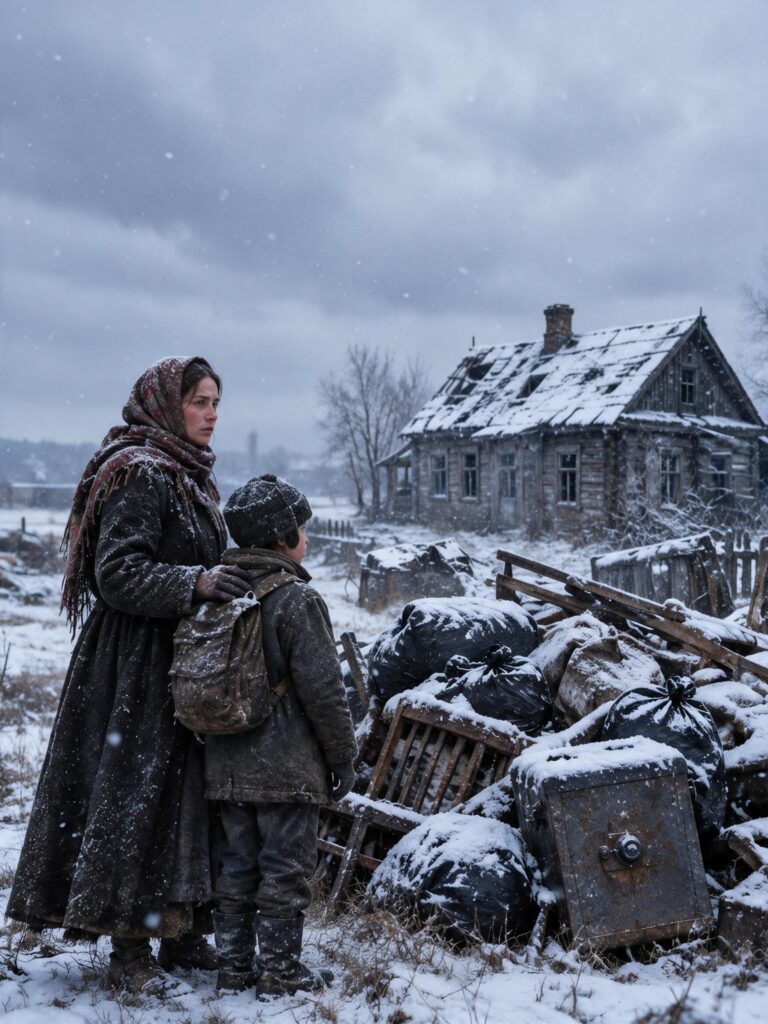
the mother-in-law handed the grieving widow nothing but a county junkyard but one rusted metal box buried under the trash made the whole greedy family weep for mercy
Part 1
The November wind cut sideways across the county road, carrying the smell of wet leaves and distant woodsmoke. Kate Matthews sat in the passenger seat of her old Ford Ranger, the heater barely working, and watched the gray light fade over the fields outside Millersville. Michael was asleep in the back, his head against the window, one small hand still clutching the red fire truck Ron had given him three months before the accident. The toy’s paint was already chipped. Kate hadn’t had the heart to throw anything away.
Three months. Some days it felt like three years. Some days she still expected Ron’s truck to pull into the drive at six-thirty, the way it always had, headlights sweeping the porch.
The call had come at two in the morning. A state trooper’s voice, careful and flat, telling her there had been a wreck on the interstate and she needed to come to the hospital. By the time she got there Ron was already gone. Thirty-six years old. A construction company truck, a patch of black ice, a semi that couldn’t stop. The doctors said he hadn’t suffered. Kate still didn’t know if that was true or just something they said to keep the living from screaming in the hallway.
Now the house where she and Ron had lived for ten years belonged to Irene Matthews, Ron’s mother. Kate had never questioned it. Ron had always said the place was “family property,” that Irene had kept it in her name for tax reasons after Ron’s father died. Kate had painted the kitchen herself, hung the curtains, planted the lilacs along the fence. None of that mattered when Irene walked in with Derek and Natalie and a lawyer two weeks after the funeral.
They sat in the living room Kate had vacuumed that morning. Irene wore her pearl necklace and the same closed-mouth smile she used at church board meetings. The lawyer read from a folder in a voice that never rose. The house had always belonged to the Matthews family. Kate was to be out by the end of the month. Any personal belongings not removed would be considered abandoned.
“I’ve lived here ten years,” Kate said. Her voice sounded thin even to herself. Michael stood at her knee, silent, one fist twisted in the hem of her sweater.
Derek, the older brother, leaned back on the couch Ron had bought secondhand and refinished. “Ron never had anything in his name. Never did. Mama always took care of him. Everything he had came from the family.”
Natalie examined her red nails. “He also had debts. Fifteen thousand in advances and loans from the company he never paid back.”
Kate stared at the papers the lawyer slid across the coffee table. Ron’s signature looked right. The dates went back five years. They had lived carefully. Ron brought home a steady paycheck from the family construction business. Where would fifteen thousand have gone?
Irene folded her hands. “We’re a Christian family. We don’t want you left with nothing. There’s a piece of ground out past the old quarry road in Shushan Township. We’ll deed it to you in exchange for the debt and as Michael’s inheritance. That way you won’t be completely unprotected.”
Kate should have asked questions. She should have called someone. Instead she signed where the lawyer pointed, took Michael’s hand, and walked out of the only home her son had ever known.
The lot was worse than she had imagined. The metal gate hung from one hinge. Beyond it lay five hundred square yards of everything the Matthews construction company had nowhere else to put: broken pallets, torn plastic sheeting, chunks of concrete, old tires, a sofa with its springs sticking through the fabric, paint cans, tangled wire, shattered bottles. The ground was packed hard in places and soft with rot in others. A cold rain had started. Michael’s voice was small.
“Mama, why is there so much trash?”
Kate couldn’t answer. From the neighboring property an older woman stepped out onto her porch, arms folded against the wind.
“You the new owner?”
“I think so.”
The woman shook her head. “That family used this place to dump whatever they didn’t want. Five years at least. Folks around here complained. Never did any good.”
Kate drove back to the single room they were renting above the laundromat. Michael cried most of the night, asking why Grandma Irene had been so mean, why Uncle Derek had laughed, why they couldn’t go home. Kate lay awake listening to the radiator knock and made herself a promise. She would not run. She would not give them the satisfaction of seeing her broken.
Before the sun was up she had Michael dressed for school and was on the two buses that would get her to the edge of town. She wore the oldest clothes she owned, rubber gloves bought for three dollars at the discount store, and carried a backpack with water and two slices of bread. When she pushed the broken gate open and looked at the piles in the thin morning light she said the words out loud so she would hear them.
“Let’s see who laughs last.”
She started with the first bag. Opened it. Sorted what could be recycled. Tied the rest. Her back already ached. Her hands were cold inside the gloves. She kept going. Somewhere under all of it, she told herself, there had to be a way to start over. She did not yet know that Ron had left her something more than trash.
Part 2
By the second week the rain had turned the lot into mud. Kate arrived at six every morning the way she had every day before. Some of the piles she had sorted the afternoon before had been scattered again by wind and water. She stood with her hands on her hips, breathed once, and started over.
She had a system now. Anything that could be sold for scrap—metal, cardboard, clean plastic—went into the bed of the Ranger she had borrowed from a neighbor who felt sorry for her. The scrap yard two miles down the county road paid fair, sometimes a little more. The man who ran it, Walter, was past sixty, sun-creased, missing part of a finger from an old mill accident. The first time Kate rolled up with a load he studied her hands and the way she didn’t complain.
“Where you getting all this?”
“Place I inherited.”
He nodded once. “You work hard. I respect that.” He paid her more than the posted rate. When she thanked him he shrugged. “Life’s hard enough without shorting people who are trying.”
On the rainy morning she was working near the back fence she found the box. It was under a mound of black contractor bags and broken ceramic tile. Metal, the size of a large toolbox, heavy with rust and dirt. She pried the lid with a length of pipe until it gave. Inside were zip bags sealed against moisture, a leather notebook, three flash drives in a small cloth pouch, and several envelopes.
Her hands shook when she opened the first envelope. Invoices. Dozens of them from the Matthews construction company, many for ordinary materials at prices that made no sense even to her. She opened the notebook. Ron’s handwriting. Small, neat, the same hand that had written grocery lists and the notes he left on the refrigerator.
March 15. Found out Derek is writing fake invoices to shell companies. Money’s moving offshore. Over three hundred thousand in two years. Told Mama. She said keep quiet. Said that’s how the family protects its assets.
Kate had to stop and sit on an overturned bucket. The rain ran down the collar of her coat. She turned pages.
April 22. Derek knows I have copies. Threatened to fire me and pin the theft on me. Said he could forge my signature on anything he wanted.
Later entries described the scheme in careful detail. Then, on May 10:
The lot in Shushan doesn’t mean anything to them because they’ve been dumping on it for years. But I checked. The county’s going to take the whole stretch for a linear park. Compensation will be serious money. Derek and Natalie don’t know yet. I saw the preliminary plans at the planning commission. I’m putting the lot in my name so they won’t notice. If something happens to me at least Kate and Michael will have something.
The last page was a letter dated a week before the accident, addressed to her.
My dear Kate, if you’re reading this then I’m gone and something went wrong. Don’t trust them. The debts they’ll talk about don’t exist. The papers they’ll show you are forged. They’re good at that. Everything you need is in this box. Take it to a lawyer you trust and to the IRS. The lot looks like trash. It isn’t. The taking will happen. It may take time but it will happen. Hold on. Teach Michael to be honest in a world full of liars. Teach him to stay standing when people try to break him. I loved you from the first day I saw you in the high-school library with that book of poems under your arm. Be happy. You deserve it. Ron.
Kate sat in the mud with the letter against her chest and cried until the rain stopped. Then she packed everything carefully back into the box, carried it to the truck, and drove straight to the small office of a lawyer she had found after three careful phone calls. Alex Ramirez was in his forties, gray at the temples, no ties to the county’s bigger firms. He read for nearly an hour, making notes, occasionally letting out a low whistle.
“Mrs. Matthews,” he said at last, “what you have here is evidence of tax fraud, money laundering, and forgery on a scale that can put people in prison. As for the lot—your husband was right. The county has approved the park. Preliminary estimates put compensation for a parcel this size somewhere between two hundred and two hundred fifty thousand.”
Kate felt the room tilt. She had the deed in her name. The family had given it to her themselves, thinking they were handing her garbage.
“What do we do with the rest of it?”
“We file with the IRS and we sue to void the supposed debt. It will get ugly. These people won’t sit still.”
“I know,” Kate said. She thought of Derek’s smile the night they put her out. “Let’s start.”
Part 3
For the next several weeks two things happened at once. Alex prepared the filings. Kate kept clearing the lot. She no longer worked only to survive. Every bag she hauled away felt like something she was building for Michael. The older woman next door—Annie, everyone called her—began bringing hot coffee in the mornings and, once, a slice of pie. “You remind me of my daughter,” she said. “Same stubborn streak.”
Michael started coming on weekends. Kate hadn’t wanted him there, but he insisted. “Dad left it to us. I should help.” He sorted plastic bottles into crates, small hands careful. Kate watched him and saw the boy growing steadier even while the grief stayed in his eyes.
One Saturday they sat on a cleaned log eating sandwiches. Michael asked if they would be rich when the county bought the land.
“We’ll have money,” Kate said. “But the important part is we didn’t quit. Your dad taught me that. I’m teaching you.”
“Are Grandma and Uncle Derek bad people?”
Kate chose her words. “They’re people who decided they could do whatever they wanted. They’re going to learn they can’t.”
The call from Alex came early the following Monday. “They took the bait. A firm representing the family offered ten thousand cash for the lot. Immediate wire.”
Kate almost laughed. Ten thousand for ground worth twenty times that. “Tell them no.”
Natalie showed up the next afternoon in a white SUV, heels sinking in the still-soft ground. She tried a smile that didn’t reach her eyes. “We’re family. Family helps each other.”
“Family is what you were when you put me and Michael on the street.”
Natalie’s voice cooled. “We can make your life very difficult.”
“Try,” Kate said. “This time I have a lawyer too. And I have something you don’t.”
“What’s that?”
“The truth.”
Natalie went pale, turned, and walked back to the SUV, heels sticking with every step. Annie watched from her porch. “Brave or foolish,” she said.
“Both,” Kate answered. “They’ll come harder now.”
“Let them. This whole stretch of road knows what that family did out here. You’re not alone.”
That night, after Michael was asleep, Kate stood at the window of the rented room and felt something she had not felt in months. Not quite hope. Something older and harder. A chance.
Part 4
Three weeks later the pressure arrived in layers. First came the quiet comments in the local Facebook group about people who took advantage of family tragedy. Then a blog post that painted Kate as a manipulative widow chasing a fortune. One afternoon Michael came home from school with red eyes. “Some boys said you stole money from Dad’s family.”
Kate knelt so they were face to face. “Look at me. I never stole anything. Your father left us that land because he knew what they would try. He was right. We are not those people.”
The next morning she found fresh trash dumped across the cleared ground—contractor bags, broken drywall, a heap of roofing shingles. Weeks of work undone in a night. She stood in the middle of it, hands shaking, and thought about selling for whatever they would give and leaving the county. Then she remembered the last lines of Ron’s letter. Be strong when they try to break you.
She picked up the first bag. Annie came over furious. “I saw the truck. They did it on purpose.” Walter from the scrap yard arrived later with two nephews. Other neighbors brought water and coffee. An older man Kate barely knew said, “We know who you are. We know who they are.”
Irene called that evening. Her voice was soft at first. “Let’s stop this. The lot always belonged to the family. Ron had no right to transfer it.”
“He did,” Kate said. “It’s documented.”
There was a pause. When Irene spoke again the softness was gone. “You don’t understand what you’re stirring up. Company matters. Delicate matters.”
“I understand exactly. Ron left me the records. I know about the shell companies and the money that left the country.”
Silence. Then, almost a whisper: “How did he know we would move against him?”
“Because he prepared for it. To protect me and Michael.”
“If you push this you’ll destroy the company. There are employees. Suppliers.”
“You should have thought of that sooner. This was never about the money, Irene. It was about how you treated your own son. How you treated me when I had nothing.”
She hung up. Her hands were still shaking, but the path was clear.
Derek came to the lot one morning and stayed in his truck, window down, face flushed. “You think you’re smart? We’ll prove you manipulated him.”
“Careful,” Kate said. “My lawyer likes new evidence.”
He slammed the truck into reverse and spun gravel as he left. Annie hurried over. “I almost called the sheriff.”
“They’re desperate,” Kate said. “Desperate people make mistakes.”
“You’re strong.”
“I’m scared to death,” Kate answered. “But I have to keep going for Michael. For Ron.”
Annie nodded. “That’s the real kind.”
Part 5
The call came on a Friday afternoon. Alex’s voice was careful. “Sit down if you can. The county approved the taking. Compensation is two hundred thirty thousand. And the IRS finished its preliminary review. There’s enough for criminal referrals against Derek Matthews and Irene Matthews. The company has been assessed a four-hundred-thousand-dollar penalty. The supposed debt has been voided.”
Kate had to lean against the side of the Ranger. When she could speak she said only, “We won.”
“You won,” Alex said, and she could hear the smile.
Michael found her crying when he got off the school bus. She pulled him close. “We won, baby. Justice. A future. A chance.”
They stood together on the cleared ground while the late-winter sun turned the sky the color of old gold.
Six months later Kate rented a plain hall on the edge of town. Plastic chairs, folding tables, a banner she had printed herself. More than fifty women filled the room—widows, divorced mothers, women starting over after one hard season or another. She stood at the front with Michael’s hand in hers.
“Welcome to the Ron Matthews Center,” she said. “Named for a man who tried to do right even when it cost him. We’re here for anyone who needs a lawyer they can trust, a small no-interest loan to start a business, or just a place to sit and remember they’re not alone.”
She had set aside fifty thousand from the settlement. Two attorneys volunteered hours. A counselor came one afternoon a week. After the meeting a woman named Svetlana—Kate still thought of her by the name she had used when she first arrived—cried because her late husband’s family was trying to take her children. Another woman, Julia, needed three hundred dollars for basic equipment to open a small beauty shop out of her kitchen. Kate sat with each of them and made a plan.
The local paper ran a full-page story: “From Junkyard to Hope.” Donations arrived. Volunteers appeared. The hall grew too small; they moved to a larger space. Kate bought a modest three-bedroom house with a yard where Michael could play. It was not grand. It was theirs.
Derek was charged. Irene stepped down from the company. Natalie sold her share and moved south. Kate felt no pleasure in their fall, only the quiet sense that a balance had been restored.
Nearly a year after it began, Irene came to the center. She looked ten years older. Her hair, once carefully kept, was gray and uncombed. They sat in a small side room.
“I came to apologize,” Irene said. “It won’t change what we did. But I had to say it. Ron was my boy. I was so fixed on money and keeping up appearances that I lost sight of him. Now I’ve lost everything.”
“You haven’t lost everything,” Kate said. “You have a grandson. If you want to know him without the lies, without the games, the door is open. Not because you deserve it. Because Ron loved you anyway, and Michael deserves to know the grandmother his father remembered, not the one who tried to erase us.”
Irene cried. Kate felt something loosen inside her chest. It was not full forgiveness. It might never be. It was a beginning.
That evening she picked Michael up from school. He ran to her with a math test marked with a perfect score. “Can I come to the center tomorrow? I want to help with the donation boxes.”
“Of course.”
They walked. Michael looked up. “Do you think Dad is proud of us?”
Kate watched the first stars appear in the winter sky. “I’m sure he is.”
Two years after the morning she first pushed open the broken gate, the old junkyard had become the Ron Matthews Linear Park. Playground, walking path, a small ball field. At the entrance a simple plaque read: Dedicated to the memory of Ron Matthews, who fought for what was right.
Michael, now ten, studied the words. “Dad helped make this happen?”
“He planted the seed,” Kate said. “We just kept tending it.”
“I want to be like him. And like you.”
She kissed the top of his head. “You already are.”
They stood together while families moved across the grass that had once been piles of trash and broken concrete. The path had been hard. The nights had been long. But the ground under their feet was clean, and the name on the plaque was spoken with respect instead of shame. Kate closed her eyes for a moment and let herself believe, fully and without reservation, that Ron could see it all.


