
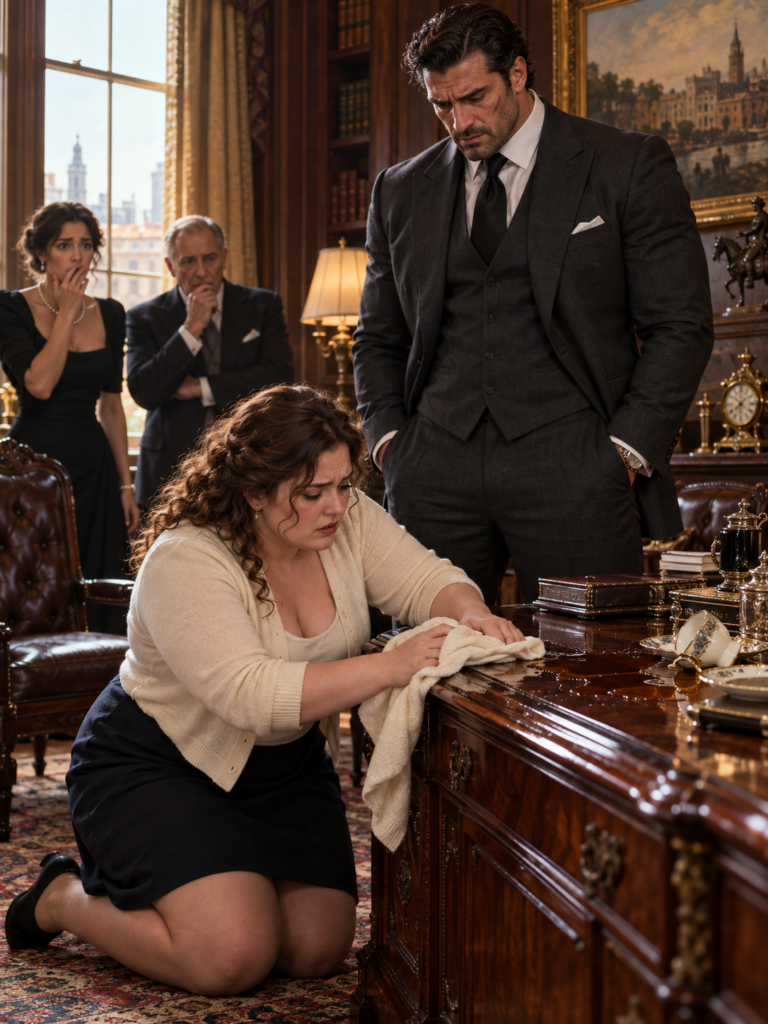
Otie’s fingertips froze against the brass hinge.
She turned slowly.
A small elderly man stood behind her holding a porcelain teacup and saucer.
He wore a soft gray cardigan and reading glasses. His silver hair was neatly combed, and his smile was warm enough to belong to someone’s favorite grandfather.
Yet something about the precision of his stillness made her uneasy.
“Just admiring the cabinet,” Otie said.
“Wonderful piece, isn’t it?”
“Very.”
“Casemir’s father purchased it in 1979.”
Otie stood.
“Then it’s been here a long time.”
“Longer than almost anyone.”
He offered his free hand.
“Raasmus Vogle. I help look after the family.”
She knew the name.
Vogle was Casemir’s consigliere, the trusted adviser who had raised him after his father was murdered.
Silas had spoken about the man as though he were the only reasonable person in an organization full of dangerous people.
“Otie Brennan.”
“Of course.” Raasmus smiled. “The young lady who attacked our antique desk with tea.”
She flushed.
“An accident.”
“Most interesting things are.”
His eyes moved briefly toward the hinge.
“Was there something about that cabinet that caught your attention?”
Otie almost told him.
She had spent her adult life explaining bad repairs to anyone willing to listen. It was a habit she rarely controlled.
But she remembered how her father had agreed to the marriage.
And how little she knew about the people who had arranged it.
“Only the workmanship,” she answered.
Raasmus watched her for a moment.
Then he nodded.
“Welcome to the family, my dear.”
He continued down the hall.
Otie looked back at the cabinet.
She couldn’t explain why she had lied.
Only that she was suddenly glad she had.
***
Three days later, a car collected her from Fishtown.
The house on Delancey Place was unlike any home she had entered.
Everything had been modified for Casemir’s extraordinary height.
Doors rose above ordinary frames. Counters were higher. Chairs were reinforced and fitted to his proportions.
Otie, who had spent her entire life being made to feel physically excessive, found herself in a place where she felt almost absurdly small.
The contrast hurt more than she expected.
The wedding preparations were already underway.
At her dress fitting, two women working for the atelier discussed her body through a partly open door.
“So much material.”
“Well, considering the groom, perhaps that’s necessary.”
Otie stood rigidly while the corset squeezed the breath from her lungs.
She had heard worse.
That didn’t make it pleasant.
Then Casemir entered.
He noticed her shallow breathing immediately.
“Remove it.”
The head stylist hurried forward.
“Mr. Dragamir, the silhouette requires—”
“She can’t breathe.”
“We need to create a proper waist.”
“She has a waist.”
The woman’s face reddened.
Casemir glanced toward the other room.
“And I heard your conversation.”
He made a phone call.
When it ended, he informed the stylist that he had purchased the struggling business through one of his companies.
The woman’s expression collapsed.
“You’ll be paid to make clothing that fits people,” he said. “Not to punish people for failing to fit your clothing.”
A seamstress appeared with scissors.
Otie could finally breathe.
Later, however, she found Casemir alone.
“Thank you for helping me,” she said. “But you didn’t have to buy an entire shop.”
“I wanted to make certain it wouldn’t happen again.”
“You could have asked me what I wanted first.”
He looked at her.
She continued carefully.
“I don’t want every unpleasant person punished on my behalf. Sometimes I only want someone to listen.”
For a moment he seemed almost offended.
Then he nodded.
“Understood.”
That night, unable to sleep, Otie went downstairs for water.
She found Casemir sitting on the kitchen floor with an ice pack beneath his knee.
He looked mortified.
“Don’t,” he warned.
“I haven’t said anything.”
“You were about to be sympathetic.”
“Actually, I was about to complain about your flooring.”
He stared.
“Stone over concrete,” she explained, sitting several feet away. “Awful for damaged knees. You need a wool runner with cork underneath.”
“You analyze everything?”
“Only things that are badly constructed.”
He laughed quietly.
Then he told her why the marriage mattered.
In several weeks, the family council would review his leadership. Three failed engagements had damaged his standing. Men who should have been discussing business had begun discussing whether their unmarried boss had a future.
He needed a public marriage to silence them.
“I won’t expect affection,” he said. “And I won’t touch you without permission.”
Otie studied him.
“Then we’re going to agree on something else.”
“What?”
“My work stays mine. My decisions stay mine. And if you want my trust, you ask for it instead of arranging it.”
Casemir considered her.
“Agreed.”
She still wasn’t ready to call the arrangement fair.
But the following morning, when she asked that the wedding remain a public partnership rather than a demand for intimacy, he accepted.
And when they married that Saturday, he waited for her answer instead of speaking for her.
At the reception, she caught him watching her while she inspected the carved back of an antique chair.
“What?” she asked.
“Nothing.”
“You’re looking at me strangely.”
“I’ve never met anyone who forgets to be frightened of me because she’s distracted by furniture.”
“Then you clearly haven’t met enough conservators.”
He smiled.
For one brief moment, she almost forgot why they were married.
Then she remembered the linen press.
The replacement hinge.
The strange question from Raasmus Vogle.
And the way the old man’s eyes had lingered when she pretended not to notice anything.
Several days later, Casemir offered her workspace in the conservation studio beneath his family’s prestigious antiques auction house.
Otie accepted because she needed the equipment and because her existing clients could remain independent.
On her fourth morning, carrying a tray of brushes, she caught her shoe on a floor drain.
She fell sideways into an eighteenth-century chest.
Its bottom drawer flew out.
Otie reached desperately to catch it before it struck the concrete.
But when she turned the drawer over, she saw something so impossible that she stopped breathing.
Beneath the old wood were unmistakable circular saw marks.
The chest was cataloged as having been made in 1765.
The marks came from machinery that didn’t belong to that period.
Someone had manufactured a lie worth hundreds of thousands of dollars.
And this time, the mistake wasn’t a hinge.
Otie lowered the drawer onto a padded worktable and stared at the marks again.
They didn’t disappear.
The timber was old. The joinery looked right. Even the wear around the drawer pulls had been applied with extraordinary skill.
But no amount of expert craftsmanship could alter history.
Someone had used modern machinery on a piece presented as eighteenth-century furniture.
She checked the catalog.
Newport block-front chest.
Estimated value: $410,000.
The previous ownership records looked immaculate.
Almost too immaculate.
Otie had spent eleven years conserving furniture. She knew the difference between a repaired antique and something reconstructed to deceive a buyer.
This was not a simple restoration mistake.
Someone had deliberately made an object appear older than it was.
She replaced the drawer, photographed her observations, and requested access to the conservation records.
By the end of the week, she had identified nine suspicious pieces.
By the following week, twelve.
The pattern was always similar.
An authentic antique entered the auction house.
It sold to a legitimate buyer.
Eighteen months or so later, records showed that the piece had been acquired again through another purchaser.
But the item subsequently stored in the vault was not the original.
It was a carefully made substitute.
Someone was removing valuable antiques, replacing them with convincing copies, and relying on the documentation to conceal the substitution.
The more records Otie examined, the worse the figures became.
Over nine years, the suspected losses exceeded forty-one million dollars.
She sat alone in the conservation studio one evening, surrounded by catalog photographs.
“Beautiful work,” a voice remarked.
Otie looked up.
Raasmus Vogle stood in the doorway with two cups of tea.
“I hope I’m not disturbing you.”
“No. Just finishing something.”
He crossed the room and set a cup on her table.
A coaster appeared beneath it.
“I’ve worked around antiques long enough to know better than to put hot tea directly on wood.”
He smiled.
Otie didn’t.
“Casemir tells me you’re exceptionally talented.”
“That’s kind of him.”
“He doesn’t offer praise lightly.”
Raasmus glanced at the documents spread around her.
“You’ve been working very hard.”
“I enjoy it.”
“Even so, marriage to Casemir comes with responsibilities. The women who manage this life well generally learn which matters deserve their attention.”
Otie folded her hands.
“Which matters don’t?”
“The inventory, for instance. We employ people to handle such things.”
“I’m a conservator.”
“Of course.”
He said it affectionately.
As though she were a child describing an imaginary profession.
Then his expression softened.
“How is your father?”
“I wouldn’t know.”
“A difficult situation.”
“Yes.”
“Family can disappoint us.”
Otie looked directly at him.
“Have you ever been disappointed by Casemir?”
Something almost imperceptible changed in his eyes.
“Never,” he answered.
He rose.
“Don’t work too late, my dear.”
After he left, Otie waited until she could no longer hear his footsteps.
Then she pushed the untouched tea aside.
She had never trusted a question less than the one he’d just asked about her father.
***
Over the next several nights, she traced the questionable acquisitions backward.
Every fraudulent item had passed through the same internal approval process.
Every appraisal had been signed by a senior authority.
Every suspicious transaction ultimately connected to Raasmus Vogle.
Then she discovered something that made her stomach turn.
A Philadelphia highboy from 2019.
Its conservation certificate carried her own signature.
Otie remembered the furniture.
She had been twenty-seven and working at a small restoration shop in Manayunk, earning eighteen dollars an hour. The shop accepted overflow jobs from larger dealers.
She remembered thinking the finish looked unusually fresh.
She had accepted the explanation that the piece had been carefully stored.
And she had signed.
Now her name sat inside a fraudulent provenance chain.
If investigators examined the records, they could reasonably suspect that she’d been part of the deception.
Otie rested her forehead against her hands.
The fact that she had been young, exhausted, and underpaid wouldn’t erase her signature.
It was still hers.
She would have to explain it.
Before leaving, she checked one more file.
Silas Brennan.
Her father had always claimed he’d lost money on property and bad business deals.
Otie had never entirely believed him, but she assumed the debt was the result of ordinary recklessness.
It wasn’t.
The documents revealed loans secured against forty-one antiques he didn’t actually own.
Four years of borrowing.
Repeated appraisals.
Additional obligations layered over earlier ones until the total reached $5.2 million.
And the same approving signature appeared again.
Raasmus Vogle.
Otie sat back.
Her father had made decisions that led him into debt.
But someone had supplied the false valuations and extended the credit that trapped him.
Someone who understood exactly how desperate he would become.
She thought of Jocelyn crying on the office couch.
Of her father’s eager acceptance when Casemir requested the other daughter.
Of the old man smiling in the hallway.
Welcome to the family, my dear.
Otie’s skin went cold.
She couldn’t yet prove the marriage had been arranged as part of the fraud.
But she no longer believed the timing was accidental.
***
The next discovery happened because she fell again.
The oldest provenance ledgers were stored in an upstairs records vault.
Otie climbed a step stool to reach a box on a high shelf.
Her shoe slipped.
She grabbed a cabinet drawer to steady herself.
The drawer came loose.
A stack of documents scattered across the floor.
And something thick and rectangular fell out of the hidden cavity behind the drawer.
Otie landed painfully on her hip.
For several seconds, she simply sat there, swearing under her breath.
Then she noticed the file.
Its cover contained three words.
Fitness for Command.
Inside were photographs of Casemir.
Not business photographs.
Not portraits.
Photographs of him struggling to rise from chairs.
Walking down steps.
Climbing into cars.
There were observations about his knees, hips, back, and posture.
Medical documents.
Dates.
Descriptions of incidents she knew must have humiliated him.
One entry detailed a chair breaking beneath him at a family gathering.
Another recorded his difficulty standing after a prolonged meeting.
The file stretched back eleven years.
Otie turned page after page.
Someone had documented the private physical suffering of a man who trusted almost nobody.
The observations weren’t sympathetic.
They had been organized as evidence of weakness.
Evidence that could be presented to the council to challenge his leadership.
At the bottom of the newest page was Raasmus Vogle’s signature.
Otie looked toward the vault door.
She suddenly understood why the old man had been so careful when asking about her work.
If the antique fraud became public, Casemir would investigate.
If Casemir investigated, Raasmus might lose control.
But if the council removed Casemir first, the person who knew the organization best would be in position to direct what happened afterward.
She spent the rest of the night copying and organizing the evidence.
She used a studio camera she controlled rather than relying on the phone and devices provided through the household.
By dawn, she had begun constructing a complete record.
***
Casemir entered the kitchen shortly after seven.
Otie had photographs spread across the island.
“Sit down,” she said.
He looked at the documents.
“What happened?”
“I need you to read these.”
Three pages in, he stopped.
His jaw tightened.
“Where did you find this?”
“In the records vault.”
He turned another page.
Then another.
His color slowly drained.
“Raasmus?”
“Yes.”
Casemir stared at the photograph of himself struggling out of a chair.
“He raised me.”
Otie said nothing.
“He was there after my father died.”
“I know.”
“He taught me to drive. Took me to school. He was the only person I trusted when I was a child.”
His voice became unsteady.
“When they buried my father, Raasmus carried me out of the church.”
Otie moved closer.
“Casemir, there’s more.”
She placed three additional records in front of him.
Three payments.
Two hundred thousand dollars each.
Three separate families.
Three dates immediately preceding his failed engagements.
Casemir stared.
“No.”
“Read the dates.”
He did.
His expression changed.
“The women were afraid of me.”
“Maybe they were uncomfortable. Maybe some of their fear was real. These documents don’t tell us everything they felt.”
She touched the records.
“But they do tell us someone paid their families before those public humiliations.”
Casemir pushed away from the counter.
He turned toward the window.
For years, he had carried those rejections like proof of something shameful inside himself.
Otie could see him trying to understand what the payments meant.
“Why would he do that?”
“I think he wanted you isolated.”
Casemir turned.
“He protected me.”
“He may believe he did.”
“He loved my father.”
“That doesn’t make what he did to you right.”
His breathing changed.
He struck the kitchen cabinet with his fist.
The wood split.
Blood appeared across his knuckles.
Otie flinched.
Casemir saw it and immediately stepped back.
“I’m sorry.”
She looked at the broken cabinet.
“Don’t do that again around me.”
He swallowed.
“You’re right.”
Then his expression hardened.
“I’ll have him brought here.”
“No.”
“Otie—”
“If you threaten him, you give him the evidence he wants.”
Casemir stopped.
She pointed to the file.
“He’s spent eleven years documenting every physical limitation and every moment when you appeared angry or unstable. If you have him dragged into a basement, what will the council think?”
Casemir stared at her.
“That his concerns were justified,” she said.
His hands slowly opened.
“Then what do you suggest?”
Otie placed the auction records between them.
“We show the council what he’s been doing.”
Casemir looked down.
“How much?”
“Forty-one million dollars, conservatively. And I can demonstrate how the substitution was done.”
He read in silence.
She continued.
“The tests can be independently repeated. They don’t have to trust me. They can examine the wood, the finish, the construction. The physical evidence doesn’t care who Raasmus is.”
He looked at her with an expression she’d never seen before.
Not fear.
Not authority.
Recognition.
“You built a case.”
“I’m building one.”
“Against the man who raised me.”
“And against the man who helped create my father’s debt.”
That stopped him.
She showed him the loans.
The appraisals.
The signatures.
Casemir’s face darkened as he read.
“He engineered it,” he said.
“At least part of it. My father participated, but Raasmus supplied the machinery.”
Otie swallowed.
“I think Jocelyn was supposed to be another public rejection. I think your adviser wanted a fourth humiliation before the council met.”
“And you?”
She looked down at her hands.
“I was the sister waiting in the hallway.”
Casemir remained silent.
“I don’t think he expected you to choose me.”
Her voice broke.
“I don’t think anyone did.”
Casemir moved toward her, then stopped.
“May I?”
She nodded.
He cupped her cheek carefully.
“Then he underestimated both of us.”
For the first time, she let herself lean into his hand.
Only briefly.
There was too much to do.
***
Otie established two conditions before continuing.
Raasmus was not to be threatened or harmed.
And her own signature on the 2019 certificate would be included in the evidence.
Casemir objected to the second.
“That could expose you.”
“I’m already exposed.”
“We could leave it out.”
“No.”
She looked at him steadily.
“If we hide evidence because it makes us uncomfortable, we’re doing the same thing he did.”
Casemir lowered his eyes.
Then he nodded.
“Include it.”
The following week, Otie worked with two conservation technicians to document the suspect pieces.
She arranged independent examinations and had a lawyer secure copies of the records.
On the third night, someone entered her Fishtown workshop.
They had a key.
They stole computers, hard drives, and notebooks.
They left her tools and the furniture untouched, though they damaged the surface of a client’s table by setting a coffee cup on it.
Otie stood inside the workshop the following morning and looked around.
Casemir arrived beside her.
“I’m arranging additional security.”
“Ask me first.”
He stopped.
She pointed to the empty shelves.
“They took copies.”
“What?”
“The originals are with my lawyer.”
He stared at her.
“You anticipated this?”
“I thought somebody might try.”
Casemir exhaled.
She looked at the damaged antique table.
“He broke into the one place in the city that’s entirely mine.”
“I know.”
“Then understand that I need to make the decisions here.”
Casemir nodded.
“Tell me what help you want.”
It was a small sentence.
It changed something between them.
***
On the sixth night, Otie’s phone rang.
The screen showed her father’s name.
She almost ignored it.
Then she answered.
“Otie?”
Silas sounded frightened.
“Sweetheart, you have to stop.”
“Stop what?”
“Whatever you’re investigating.”
She straightened.
“Who told you I was investigating anything?”
A long silence followed.
Then Silas whispered, “He’s here.”
Otie’s hand tightened around the phone.
“Who?”
“Raasmus.”
Casemir rose from his chair across the room.
Otie held up a hand, asking him to remain quiet.
“Put him on.”
There was a rustling sound.
Then that gentle voice came through the speaker.
“Good evening, child.”
“Don’t call me that.”
A small pause.
“Very well.”
“What do you want?”
“A conversation.”
“About what?”
“Your future. Your father’s. Casemir’s.”
Otie looked at her husband.
Raasmus continued.
“Come to the house where you grew up. Tomorrow morning. Ten o’clock.”
“Why there?”
“Because people tend to tell the truth more easily in familiar places.”
“And my father?”
“He’ll be here.”
The line went dead.
Casemir spoke immediately.
“You’re not going.”
Otie looked at him.
He stopped.
For a moment, neither said anything.
Then he corrected himself.
“I don’t want you to go.”
“I know.”
“He’s dangerous.”
“I know that too.”
“Then why?”
“Because he thinks he can still decide what I’m worth.”
Casemir looked toward the documents covering the table.
Otie moved closer.
“I want security on the street. I want my lawyer to know where I am. And I want you close enough to respond if I need help.”
“I’ll be there.”
“But I’m walking into that kitchen alone.”
Casemir closed his eyes briefly.
Every instinct he had told him to refuse.
Yet he had promised her something more important than his instinct.
Choice.
“All right,” he said.
***
The next morning, Otie entered her childhood home carrying a small handbag.
Silas sat at the kitchen table, pale and exhausted.
Raasmus Vogle stood beside the window.
He wore the same gray cardigan.
The same gentle smile.
“Otie,” he said. “Please sit.”
She remained standing.
From her bag, she removed a single sheet of paper.
“A recording consent form.”
Raasmus raised his eyebrows.
“I document professional consultations,” she explained. “If you want this conversation, we record it openly.”
He studied the form.
Then he smiled.
“Always so careful.”
He signed.
Otie placed the recorder on the table.
“Now,” she said, “tell me what you want.”
Raasmus folded his hands.
“I want to offer you a way out.”
She remained silent.
“Your name disappears from the 2019 conservation file. Your father’s debt is canceled. His financial exposure is addressed. And you’ll receive a well-paid consulting position.”
“What do you receive?”
“A truthful statement about the circumstances of your marriage.”
Otie’s stomach tightened.
Raasmus continued calmly.
“You’ll explain that Casemir purchased a marriage by canceling a debt. That you entered his household under overwhelming pressure. That the documents you later produced were gathered while you were dependent on him.”
“And the council removes him.”
“Yes.”
Otie stared at the kindly old man.
“You want me to tell the truth in a way that destroys him while concealing everything you did.”
Raasmus’s smile did not fade.
“I want you to understand that truth is often a matter of which facts are presented.”
Otie rested her hand beside the recorder.
“Then let’s discuss the facts.”
She looked straight into his eyes.
“Did you pay three families to publicly reject Casemir Dragamir?”
Raasmus adjusted his glasses.
“Yes.”
She hadn’t expected him to admit it so easily.
And in the silence that followed, he leaned forward.
“Would you like to know why?”
Otie looked at the small red light on the recorder.
“Yes,” she said. “I’d like to know why.”
Raasmus Vogle settled back in his chair.
“Casemir’s father was a sentimental man.”
Silas Brennan kept staring into his untouched coffee.
“He believed loyalty could be purchased with generosity. He trusted people who were never worthy of him. And eventually, that trust got him killed outside a diner.”
Raasmus spoke without visible emotion.
“Casemir was nine. His father had left him an organization that would devour an inexperienced successor. I promised to keep the boy alive.”
Otie listened.
“And you decided the best way was to make sure nobody loved him?”
“I decided attachments were dangerous.”
“His father had attachments.”
“Exactly.”
Raasmus leaned forward.
“A wife creates a routine. A routine creates predictability. Predictability makes a powerful man vulnerable. His father died because someone knew where he would be.”
“So you paid women to humiliate him?”
“I paid them to leave.”
“In public.”
“Because private departures would have left him hopeful.”
Otie stared at him.
The cruelty lay not in his anger.
He had none.
He was discussing the emotional destruction of a child he’d raised as though explaining how to preserve an old table.
“You knew he believed his size made him unlovable.”
“I understood his insecurities.”
“And used them.”
“I kept him alive.”
“Those are not the same thing.”
For the first time, Raasmus’s smile thinned.
“You don’t understand the world he inhabits.”
“I understand what you did.”
He removed his glasses.
“Do you? For thirty-five years, I ensured that boy survived. I managed his affairs. I protected him from his enemies. I kept him from making his father’s mistakes.”
“And you documented every physical problem he had.”
Raasmus’s expression remained composed.
“Leadership requires assessment.”
“Eleven years of photographs?”
“Prudence.”
“Medical reports he didn’t authorize?”
“Preparation.”
“Notes about broken chairs and the way he climbed stairs?”
“Facts, Miss Brennan.”
Otie leaned closer.
“Facts you collected to make sure you could remove him whenever he stopped obeying you.”
Raasmus said nothing.
She let the silence remain.
Then she asked, “And the forty-one million dollars?”
For the first time, something like pride appeared in his face.
“Compensation.”
“For stealing?”
“For a lifetime of work.”
He spoke more sharply now.
“I built that auction house into something respectable. I managed people Casemir never understood. I made the arrangements. I kept the books balanced. He inherited an empire and assumed it would continue running because he happened to share his father’s name.”
“Then why didn’t you leave?”
Raasmus looked faintly amused.
“And allow everything I built to belong to someone else?”
Otie nodded slowly.
There it was.
Not love.
Not only fear.
Ownership.
He had convinced himself that protecting Casemir entitled him to control Casemir’s life, his businesses, his relationships, and eventually his fortune.
“How many antiques?” she asked.
“One hundred and twelve.”
“Over nine years?”
“Yes.”
“Forty-one million?”
“Approximately.”
Otie looked at the recorder.
Then at him.
“Why my family?”
Raasmus’s expression softened again.
“Your father was financially vulnerable. The loans created useful leverage.”
“And Jocelyn?”
“She was attractive, socially ambitious, and unsuited to Casemir. She would have rejected him eventually. I merely arranged the circumstances.”
“And me?”
Raasmus studied her.
For the first time that morning, he seemed to consider whether the truth might hurt her.
Then he decided it didn’t matter.
“You were not the intended bride.”
Otie felt something twist in her chest.
“You were the older daughter,” he continued. “Unmarried. Quiet. Working long hours in a modest workshop. Always helping your father. Always grateful when anyone paid attention.”
He gestured toward her body with one hand.
“Society treats women of your size rather predictably, my dear. I assumed you would be so thankful that someone like Casemir wanted you that you’d never question the arrangement.”
Otie didn’t move.
“I expected Jocelyn to flee. I expected Casemir to be humiliated again. You were simply the sister waiting in the hallway.”
The words struck harder than she expected.
Not because they were new.
Because some part of her had spent most of her life fearing they were true.
The other daughter.
The convenient one.
The one who would always be there to help because nobody expected her to have anywhere more important to go.
Raasmus folded his hands.
“You see? Nothing personal.”
Otie almost laughed.
“That’s the worst part,” she said.
She turned toward Silas.
“Dad.”
He didn’t look up.
“Dad, look at me.”
Eventually, he raised his head.
His eyes were swollen.
“You heard him,” she said.
Silas nodded miserably.
“He told you exactly what he thought of your daughters. He used your debts to make Jocelyn into a weapon. And you let him.”
“I didn’t know all of it.”
“You knew enough.”
“Otie—”
“You knew you were offering your children to pay your bills.”
Silas began crying.
“I was desperate.”
“So was I.”
Her voice remained remarkably steady.
“Thirty-three years, Dad. I ran errands for you. I repaired things you broke. I did your books without charging you. I sat through family dinners listening to you praise Jocelyn and introduce me as though I were an afterthought.”
He covered his face.
“I thought you were embarrassed by me,” Otie said. “But now I understand. You weren’t ashamed of me. You barely saw me.”
Silas tried to speak.
She raised her hand.
“I’m not asking you to explain it.”
She picked up the recorder.
“I’m telling you what happens next.”
Raasmus watched closely.
“You’re making an emotional decision,” he observed.
“No.”
She placed the recorder in her handbag.
“I’m making a documented one.”
She looked directly at him.
“You signed permission for this conversation to be recorded. You admitted arranging payments, manipulating my father’s debt, and removing valuable antiques.”
Raasmus’s eyes narrowed.
“The recording doesn’t erase your own signature from 2019.”
“I know.”
“Or Casemir’s responsibility for his businesses.”
“I know that too.”
“You could both lose everything.”
Otie looked toward the kitchen doorway.
“Then we’ll tell the truth and accept what follows.”
She turned back to her father.
“I’m going to give investigators the records connected to your loans.”
Silas made a broken sound.
“Please.”
Her eyes filled.
“You had the chance to protect me before any of this happened. You chose yourself.”
She picked up her bag.
Raasmus spoke quietly.
“Child.”
Otie stopped.
“Don’t call me that.”
She left the kitchen.
Outside, the autumn air felt impossibly cold.
She walked down the path, through the gate, and onto the sidewalk.
Her knees trembled.
She wanted to collapse.
At the end of the street, Casemir sat in the back of a parked car.
He could see her.
She knew he could.
But he stayed exactly where he’d promised to stay.
He didn’t rush forward.
Didn’t send anyone.
Didn’t decide that her trembling meant she needed to be controlled.
He waited until she reached him.
Only then did he open the door.
Otie climbed inside.
For a long moment, neither spoke.
Then Casemir asked, “Are you all right?”
“No.”
He nodded.
“Do you want to tell me?”
She shook her head.
“Not yet.”
He reached toward her hand, stopped, and waited.
She took it herself.
***
The evidence was delivered the following Monday.
The family council received a sealed copy.
Independent authorities received records concerning the auction fraud, false valuations, and financial transactions.
A Philadelphia reporter who had investigated questionable antiquities sales for years received supporting documentation.
Otie met investigators with her attorney, Dileia Okoro, and answered their questions for hours.
She disclosed the certificate she had signed in 2019.
She explained what she had examined and what she had failed to examine.
She did not ask to be excused because she had been young.
She wanted the record to be accurate.
When an investigator asked why she had exposed her own father, Otie looked at the papers in front of her.
“Because being related to someone doesn’t make their actions disappear.”
There were questions about Casemir as well.
His organization had used the auction business to conceal criminal proceeds.
The fraud investigation would expose financial arrangements he had long allowed to operate without proper scrutiny.
Otie did not shield him.
When she showed him the final report naming those operations, he read it silently.
“This may end the auction house,” he said.
“It might.”
“It may affect everything else.”
“I know.”
He looked up.
“You included it anyway.”
“I said I would tell the truth.”
Casemir handed the document back.
“Then finish it.”
That was when Otie began to believe he understood what partnership actually required.
Not protection from unpleasant facts.
Not unquestioning loyalty.
The willingness to let another person remain honest even when the truth cost him something.
***
The council met several days later.
Nine senior men occupied the long table.
Raasmus Vogle was absent.
Otie stood beside a presentation case containing photographs, transaction records, and independent technical findings.
She had expected to speak first.
Instead, Casemir rose.
It cost him visible effort.
His right knee stiffened as he pushed himself upright.
He looked around the room.
“Before my wife presents her evidence,” he said, “there’s something you should hear from me.”
He opened the thick file labeled Fitness for Command.
Then he read.
He described his damaged knees.
The pain in his back.
The chairs that had broken.
The accommodations he needed in order to work.
He named the physicians.
The limitations.
The incidents he’d spent years hiding because he’d learned to regard physical discomfort as personal humiliation.
Nobody interrupted.
When he finished, he placed the file on the table.
“That’s what Raasmus collected about me for eleven years.”
He looked at the men who had watched him grow up.
“Some of it is true. My body hurts. There are things I can’t do comfortably, and perhaps never could.”
He paused.
“But those facts don’t prove I can’t lead. They prove I have a body.”
Otie felt her eyes burn.
Casemir closed the file.
“If you decide I should no longer lead, make that decision based on my judgment and my actions. Not on photographs taken when I didn’t know anyone was watching.”
Then he sat.
Otie stepped forward.
She didn’t give a dramatic speech.
She presented the inventory.
One hundred and twelve substituted antiques.
Nine years of transactions.
More than forty-one million dollars in calculated losses.
Fourteen of the affected pieces had financial connections to men seated in that room.
She showed the repeated appraisal signatures.
The substituted objects.
The construction inconsistencies.
The tests that established modern fabrication techniques.
And the three payments made shortly before Casemir’s public romantic humiliations.
One council member, Fiko Nagy, shook his head.
“I’ve known Raasmus for fifty-one years.”
Otie looked at him.
“I understand.”
“He helped my family.”
“I’m not disputing that.”
“He paid for my daughter’s surgery.”
“That may be true too.”
Fiko leaned forward.
“And you expect me to condemn him because a woman who’s been here a few months says he’s a thief?”
“No.”
Otie opened a case containing a documented furniture sample.
“I expect you to examine the evidence.”
She gave him the laboratory findings.
“Choose any disputed item. Choose the independent examiner yourself. Check the physical construction against the sale records.”
He stared at her.
“Don’t rely on my word, Mr. Nagy. That’s the advantage of physical evidence. It doesn’t change because someone is kind to your family.”
Fiko looked down.
She placed the three wire records beside him.
Then she played the portion of the recorded conversation in which Raasmus acknowledged paying women to reject Casemir and explained why.
The old man’s gentle voice filled the room.
No one moved.
When the recording ended, Fiko removed his glasses.
He looked toward Casemir.
Then toward the table.
He said nothing more.
Within twenty minutes, the council voted unanimously to remove Raasmus from his position and withdraw his authority over the organization’s interests.
The evidence already submitted to investigators led to further action.
Raasmus was arrested.
Silas Brennan was arrested later in connection with his own fraudulent transactions.
Neither event made Otie feel victorious.
Her father was still her father.
Casemir had still lost the man who had raised him.
And exposing the truth did not erase the years stolen from either of them.
***
When the room emptied, Otie found Casemir seated at the end of the long table.
The lights had been dimmed.
His shoulders were bent.
For the first time, he looked less like the feared head of a criminal organization and more like a tired man who had just learned that his entire childhood had been carefully arranged by someone else.
Otie sat beside him.
“I’m sorry,” she said.
Casemir turned.
“Why?”
“Because you lost him.”
Casemir looked toward the empty chair that Raasmus had occupied for years.
“I lost him a long time ago,” he said. “I just didn’t know it.”
She reached for his hand.
He accepted it.
After a while, he spoke.
“There’s something I want to ask you.”
Otie’s heart began beating harder.
“I need to ask something first.”
She placed a folder on the table.
Casemir looked at it.
An annulment petition.
Prepared by an independent attorney.
Her signature was already on the preliminary documents.
He went still.
“You want to leave?”
“I want the freedom to decide whether I stay.”
He looked down.
“Isn’t that what you’ve had?”
Otie swallowed.
“Not entirely.”
She touched the folder.
“My father exchanged me for a debt. You needed a wife to satisfy the council. We agreed to make the marriage work because the alternative was frightening for both of us.”
Casemir didn’t interrupt.
“I care about you,” she whispered. “More than I meant to.”
His eyes lifted.
“But I don’t want to spend the rest of my life wondering whether you love me or whether you’re simply grateful I didn’t run away.”
He looked wounded.
She continued.
“And I need to know whether I chose you or whether I learned to love the first person who treated me better than my father did.”
The silence lasted a long time.
Then Casemir picked up the pen.
“You’re right,” he said.
His voice was rough.
“I had no right to turn your father’s debt into a marriage arrangement. I can tell you why I did it, but that doesn’t excuse it.”
He signed the documents required to let the legal process begin.
Then he placed the pen beside her.
“I won’t ask you to remain my wife because of something I paid for.”
Otie began crying.
Casemir didn’t reach for her.
He waited.
She removed her wedding ring.
Placed it on the table.
Then took a deep breath.
“There’s something else.”
He nodded.
“The auction house needs a real provenance department. Independent authority. Direct access to the board. Proper oversight.”
“Yes.”
“And no one, including you, gets to alter my findings.”
“Agreed.”
“I’ll take the job for a fixed term, with an independent employment agreement.”
Casemir studied her.
Then he gave the smallest smile.
“You’re negotiating employment while dissolving our marriage.”
“I’m very good at multitasking.”
He laughed softly.
It hurt them both.
“All right,” he said.
Otie wiped her face.
“And if we still want each other after we’ve had time to build separate lives, we can discuss that.”
“How much time?”
“A year.”
Casemir looked at the ring.
Then back at her.
“A year,” he agreed.
***
Otie moved into an apartment in Fishtown the following spring.
She chose it herself.
Paid the deposit herself.
Bought a sturdy workbench before she bought a dining table.
For the first time, she lived in rooms that belonged to nobody but her.
One afternoon, she delivered the restored Pembroke table to the widow whose calls she’d been returning every Tuesday.
The old woman examined the repaired leaf and ran her fingers along the smooth finish.
“My husband used to sit beside this every evening,” she whispered.
Then she embraced Otie.
They had lunch together.
And on the drive home, Otie cried.
Not because she’d lost something.
Because she’d kept her promise.
***
The changes in Casemir’s life were slower.
He cooperated with the investigations into the auction house and the organization he had inherited.
He faced the consequences of businesses that had operated through deception.
He sold interests he could no longer justify keeping.
The auction operation underwent a painful restructuring, eventually abandoning its criminal financial role.
The changes cost him money, influence, and relationships.
They also required him to stop pretending that his grandfatherly adviser had been the only problem.
Raasmus had committed enormous wrongs.
But Casemir had allowed parts of the business to operate outside the law.
He had to account for that too.
Over time, he became involved in a smaller group of legitimate businesses, with independent accountants and ordinary legal oversight.
Otie ran the auction house’s provenance department for nineteen months.
Then she resigned.
Not because anyone dismissed her.
Because she had plans of her own.
She opened Brennan Conservation on Frankford Avenue.
The business began with three employees.
It grew to nine.
Alongside commercial restoration, she provided free or reduced-cost assessments for small museums and historical societies unable to afford specialists.
She found other misleading provenance claims.
Helped institutions correct their records.
Returned furniture to proper ownership when the evidence justified it.
For the first time, her work was not simply something she did to survive.
It was a life she’d chosen.
***
Raasmus Vogle went to trial.
He wore his familiar cardigan.
He spoke gently.
He still seemed convinced that his actions had been reasonable.
But the documents, recordings, and expert evidence were extensive.
The jury heard him acknowledge the payments to Casemir’s former prospective brides.
They heard him explain why he had kept a man emotionally isolated for decades.
And they examined the evidence of the substituted antiques.
His attorney tried to undermine Otie’s credibility.
He questioned her professional history.
Her marriage.
Her motives.
And, with increasingly obvious contempt, the attention she had received from Casemir.
“Mrs. Brennan,” he asked, “do you genuinely expect this jury to believe a man of Mr. Dragamir’s position would choose a woman like you without some underlying convenience?”
Otie looked toward the defense table.
Raasmus sat perfectly still.
She thought of the hallway.
The teapot.
The word her father had said so quickly.
Then she looked back at the attorney.
“Your client spent six hundred thousand dollars making sure three women left Casemir Dragamir,” she said. “If he believed a woman like me was too insignificant to matter, he made a very expensive mistake.”
The courtroom became silent.
Raasmus was convicted and sentenced to twenty-two years.
Silas Brennan received a shorter prison sentence for his involvement in the financial fraud.
He wrote Otie letters.
She read them.
She didn’t answer.
People asked whether she’d forgiven him.
She never found a simple answer.
She simply stopped waiting for him to become the father she’d needed.
***
Fourteen months after the annulment proceedings began, Casemir asked Otie to dinner.
She said no.
Not because she hated him.
Because she was still learning what it felt like to be completely responsible for herself.
He accepted her answer.
Several months later, he asked again.
“Not yet,” she said.
He smiled.
“All right.”
Then he went home.
No argument.
No dramatic declaration.
No suggestion that his patience entitled him to a reward.
He continued living his life.
So did she.
They occasionally met through mutual acquaintances.
Sometimes Otie attended public exhibitions where his restructured businesses were represented.
Sometimes she saw him quietly supporting the work of restoration organizations.
He never used those encounters to pressure her.
He learned to be a man who could want something deeply without trying to control whether it happened.
That was the change she had needed to see.
***
Twenty-six months after they separated, Casemir appeared at Brennan Conservation just before closing.
He ducked beneath the doorway.
Otie looked up from a mahogany chair she was repairing.
“You’re going to knock yourself unconscious on that frame one day.”
“I’ve been avoiding doorframes for forty years.”
“Not successfully.”
He smiled.
She noticed he moved more comfortably.
His doctor had helped him develop a better pain-management routine.
And he had finally installed a proper runner in his kitchen.
“You look well,” she said.
“So do you.”
He glanced at the furniture around the room.
“Business good?”
“Very.”
“Employees?”
“Nine.”
“Still frightening people with your opinions about polyurethane?”
“Whenever possible.”
Casemir laughed.
Then his expression softened.
“Would you have dinner with me?”
Otie set down her brush.
“Why?”
He looked surprised.
Then he considered the question.
“Because I like talking to you. Because you’ve built something extraordinary and I’d like to hear about it. Because I think about you when good things happen and wish I could tell you.”
He paused.
“And because I love you. But dinner doesn’t have to mean anything more than dinner.”
Otie studied him.
There was no ring.
No expensive gift.
No expectation that she would be grateful.
Just a man standing in her workshop, asking.
She smiled.
“Friday.”
He blinked.
“Friday?”
“Seven o’clock. Don’t be late.”
“I wouldn’t dare.”
***
Their second wedding took place on an October Saturday.
Twenty-eight guests attended.
Otie chose the garden.
She chose the dress.
She chose the food.
And she paid for part of the celebration from an account that belonged entirely to her.
Jocelyn attended and embraced her sister.
She cried while apologizing for what had happened years earlier.
Otie held her close.
“You were frightened,” she said. “You didn’t do anything wrong by refusing.”
Casemir stood beside them, no longer interpreting that old refusal as proof that he was impossible to love.
Later, during the reception, he rose to make a toast.
He still needed a moment to straighten his knee.
He didn’t hide it.
“I spent most of my life believing I was too much,” he told their guests.
“Too tall. Too heavy. Too difficult to live beside. Too much trouble to love.”
He looked at Otie.
“Someone made certain I kept believing those things.”
The garden grew quiet.
“But I don’t want to give that man credit for the rest of my life.”
He lifted his glass.
“Otie didn’t rescue me. She isn’t responsible for fixing me. She showed me that love is something you have to offer freely, not arrange through fear or obligation.”
Otie’s eyes filled.
“And I learned that if I wanted her beside me, I had to become someone who respected her right to stand somewhere else.”
He smiled.
“Fortunately for me, she decided to come back.”
The guests laughed.
Otie stood.
“Only because he finally learned to ask.”
Casemir reached for her hand.
She took it.
***
They never became a perfect couple.
Otie remained clumsy.
She knocked over a lamp at their reception.
She stumbled on museum steps.
One Christmas, she dropped an entire ham onto the kitchen floor.
Casemir laughed until his back hurt.
Then he helped her clean it up.
Sometimes he caught her before she fell.
Sometimes he didn’t.
And sometimes she caught him, not physically, but in quieter ways.
She reminded him to rest when his knees were hurting.
He reminded her that a successful business owner was allowed to take an afternoon off.
They disagreed.
They apologized.
They listened.
She kept her company.
He kept responsibility for his own businesses.
They didn’t pretend love meant never needing boundaries.
One evening, years after their first disastrous meeting, Otie stood in the old Philadelphia office examining the antique desk.
The same desk she’d covered in tea.
The finish had been properly restored.
The damaged polyurethane was gone.
The grain was warm and luminous beneath her hand.
Casemir stood beside her.
“Still inspecting my furniture?”
“Someone has to.”
He smiled.
“How does it look?”
“Much better.”
“And the linen press?”
She glanced across the hallway.
The false hinge had long since been replaced, and the cabinet’s history corrected.
“That one too.”
Casemir studied her.
“Do you ever think about that day?”
“Sometimes.”
“What would you change?”
Otie was quiet for a moment.
“I’d still try to save the desk.”
He laughed.
“But I wouldn’t let my father answer for me.”
Casemir took her hand.
“And I wouldn’t ask him.”
She looked up at him.
There had been a time when both of them believed their bodies made them somehow less deserving of love.
He had learned to make himself smaller in rooms where he was physically impossible to ignore.
She had learned to apologize for every inch of space she occupied.
Neither of them did that anymore.
Otie looked at the enormous man beside her, the one who had once mistaken loneliness for destiny and authority for the right to choose another person’s life.
“Does your back hurt?” she asked.
He smiled.
“A little.”
“Sit down, then.”
“Are you ordering me?”
“No. I’m offering excellent advice.”
He lowered himself into the reinforced chair.
Otie pulled another beside it and sat.
Their hands met across the polished desk.
The woman who had once been treated like an expendable daughter now owned a respected conservation business.
The man who had once believed himself unlovable had learned to live without demanding that someone prove otherwise.
And the most important thing between them wasn’t the money, the mansion, the marriage, or even the love they had eventually found.
It was that neither had to become smaller to remain beside the other.
Years earlier, Otie Brennan had fallen into a room where everyone assumed she was the least important person present.
She had saved a desk.
Then discovered a forged antique.
Then uncovered the evidence that dismantled a powerful criminal deception.
But the greatest thing she ever reclaimed wasn’t an object, a business, or a fortune.
It was the right to decide how much room she deserved in the world.
All of it.
She deserved all of it.


