
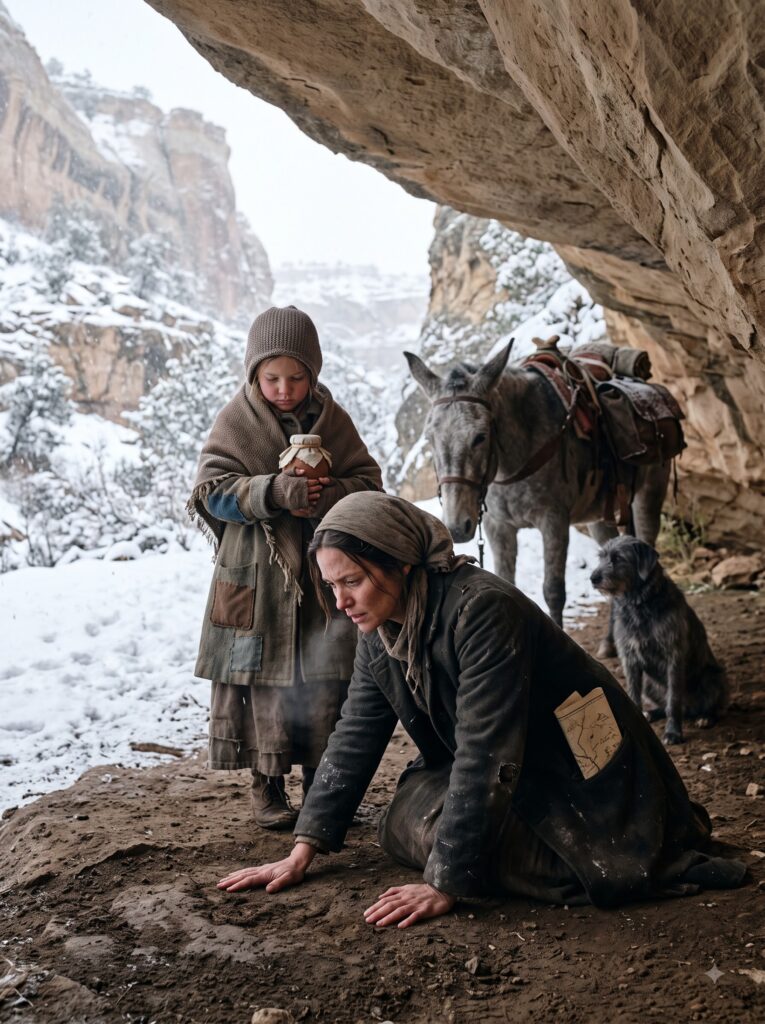
Her hand met a current of air that felt different from the freezing wind outside.
It was not hot.
But it was moving steadily through the narrow opening, and it did not carry the sharp bite of the storm.
Cordelia raised the burning twig higher.
The passage ran between two walls of pale stone before curving out of sight.
Flint entered first, stopping several paces inside to look back.
Cordelia followed far enough to establish that the floor was dry and that the passage continued.
Then she returned to May.
“We’ll stay under the overhang tonight,” she said.
May looked toward the darkness.
“What’s back there?”
“Something we can look at when we have daylight.”
That answer was honest.
And in Cordelia’s circumstances, honesty mattered more than reassurance.
She had already made one mistake by imagining the map guaranteed safety.
Elias had never said that.
Owen had never said that.
A notation on a survey chart was evidence of an unusual location, not proof of a home.
Before darkness settled, she tested the smoke again and observed the direction of the draft from several positions.
The fire stayed near the open edge of the overhang, where its smoke could escape safely.
She laid out the blanket in the driest sheltered corner, unloaded essential supplies, and checked Cinder’s legs after the slip on the mountain.
The mule was stiff but able to bear weight.
May removed her wet boots and sat close to the fire.
Flint curled beside her.
Cordelia counted what remained in the saddlebags.
A limited quantity of flour.
The seed pouch.
Tools.
The sourdough culture.
No proper building.
No known winter food supply.
No certainty that the unusual ground temperature would last.
But there was shelter from the worst wind.
There was dry fuel tucked beneath the canyon ledges.
And there was a passage she intended to investigate.
May held up the little clay jar.
“Will it freeze?”
Cordelia took it carefully.
Inside was the culture her father had tended for eleven years before giving it to her on her wedding day.
Owen had made a shelf for that jar in every home they had occupied.
It had survived failed harvests, moves, and his death.
But Cordelia knew that severe cold could weaken it.
She wrapped the jar in wool and settled it away from the direct heat of the fire.
“We’ll do our best,” she said.
May considered that answer.
Then she climbed beneath the blanket.
For a long time, Cordelia remained awake, listening to the weather beyond the canyon walls.
Her thoughts returned to Owen.
He had spent his working life reading landforms, comparing stone layers, and studying the practical meaning of small observations.
In August, he had asked Elias about Iron Hollow.
In September, he was dead.
Had he intended to bring them here?
Had he imagined building something?
Or had it simply been another geological curiosity that interested him?
Cordelia had no way to know.
She refused to turn a question into an answer just because she desperately wanted one.
Three mornings later, with the outer shelter organized and the storm weakened, she returned to the passage.
This time, May stayed near the entrance with Flint while Cordelia moved deeper.
The walls narrowed enough that she had to turn sideways.
Then the stone opened into a second chamber.
Cordelia stopped.
A thin shaft of winter sunlight descended through a natural crack high overhead.
It fell across a dry section of floor.
She crouched.
Pressed her hand against the earth.
And felt the same strange resistance to the cold.
Then she moved to the far wall.
Its stone surface felt slightly warmer than the rock near the entrance.
She tested another place.
Then another.
The warmth was subtle but persistent.
The survey notation had not been an idle description.
Something about the hollow’s geology was helping the inner chamber retain heat.
Cordelia looked upward at the moving daylight.
Then down at the ground.
A sheltered place with light.
Ground that remained workable.
A stable source of stone warmth.
Each fact was small.
Together, they suggested something she had never imagined while sleeping behind Harlon’s mill wall.
She might be able to grow food here.
In winter.
Not enough to fill a valley’s granary. Not without exhausting work and considerable luck.
But perhaps enough to help keep May alive.
Cordelia returned to the outer shelter, pulled Owen’s oiled leather seed pouch from their belongings, and carefully opened its folded mouth.
Inside were the hardy seeds he had received from a survey crew botanist the previous spring.
Kale.
Turnips.
Beets.
Rye.
She touched the dry seeds with one finger.
Then she looked toward the inner chamber.
Her husband had known about the place.
He had obtained the seeds.
He had asked Elias about the canyon.
Those facts did not prove exactly what Owen intended.
But for the first time since his death, Cordelia could see how two things he had left behind might work together.
She gathered the seed pouch, axe, and a small container for carrying soil.
May came to her side.
“Are we making a garden?”
Cordelia held out her hand.
“We’re going to see whether this place will let us.”
And together they stepped toward the chamber where sunlight touched the unfrozen ground.
Cordelia led May into the inner chamber and placed the seed pouch on a dry ledge beyond the reach of water seeping down the walls.
There was no reason to plant everything immediately.
If the soil failed, they could lose the only seeds they possessed.
She began by examining the chamber.
The sunlight entered through a crack overhead, tracing a narrow path across the floor as the day advanced.
The earth was workable, but that did not make it fertile.
Cordelia knew the difference.
She gathered decomposed plant material from protected recesses of the outer hollow, mixed it with sandy soil, and worked in modest quantities of clean wood ash.
It was a poor substitute for a proper garden bed.
Still, it was a beginning.
May carried material in their small tin pot.
The child worked without complaint, stopping occasionally to study the seeds.
“Which ones grow first?” she asked.
“We’ll have to find out.”
Cordelia planted a small trial strip of kale, then portions of beet and turnip seed.
She held back the rye.
The first test would tell her whether the chamber could support the others.
During the following days, she divided her attention between food, shelter, and the garden.
Flint helped her locate rabbit trails among the brush near the canyon entrance.
Cordelia fashioned snares from the wire she had brought from the mill.
They produced food irregularly, never enough to allow carelessness.
She carefully rationed the flour.
And she began building an oven.
The first construction seemed reasonable.
A low stone foundation supported clay walls, with an opening large enough to manage the fire.
She shaped it using the cooking knowledge accumulated over years of feeding Owen and May.
When it had dried and been fired, she prepared a small batch of dough.
The sourdough culture responded.
For a few hours, the familiar smell of fermentation restored something almost ordinary to their strange new home.
May sat beside the oven, waiting.
When Cordelia finally drew out the loaf, one side was nearly black.
The center remained wet.
Smoke had stained the crust.
The heat had traveled unevenly, and the opening allowed too much warmth to escape.
May looked at the bread.
“Can we eat any?”
Cordelia cut into the least damaged section.
“A little.”
They ate what was usable.
Then Cordelia examined the oven instead of tearing it apart in frustration.
The burned surface showed where the heat had been strongest.
The raw interior showed where warmth had failed to reach.
She was beginning to understand that the hollow would not reward determination by itself.
Every useful result required observation.
She rebuilt the oven with thicker clay at the back and heavy sandstone behind it to store heat.
She narrowed the mouth and shaped a stone plug to retain warmth after the fire had burned down.
The second version took more labor.
It also demanded patience.
Cordelia heated it thoroughly, allowed the temperature to settle, and tested another small quantity of dough.
She refused to sacrifice their remaining flour on an experiment she had not yet proven.
While the bread baked, she inspected the garden.
The first kale seedlings had appeared.
But several were lying flattened against the soil.
Her excitement vanished.
She knelt beside them.
The ground was wet.
A seam in the limestone wall had been releasing moisture, which collected exactly where she had planted.
The air was sufficiently mild for growth, but the roots were sitting in water.
She pressed her fingers against the wall.
Then she followed the damp trail down to the planting strip.
The problem had nothing to do with the seed.
She had put the seed in the wrong place without first understanding how water moved through the chamber.
For two days, she studied the dampness.
May helped mark the wet areas using small stones.
Cordelia cut a shallow drainage channel along the wall’s base, directing seepage away from the growing soil.
She wove willow branches into a simple barrier that kept the plants separated from the damp limestone while allowing air to circulate.
Only then did she plant again.
The new seedlings remained upright.
They were thin.
Their color was pale.
But they were alive.
One morning, while Cordelia was checking the soil, an unfamiliar smell reached her from the outer chamber.
Bread.
Properly baked bread.
She hurried back.
May stood beside the oven with both hands clasped.
Cordelia removed the stone plug and drew out a loaf whose crust was evenly browned.
She tapped the bottom.
The sound was firm.
She waited until it cooled enough to cut.
The knife passed through a properly baked center.
May received the larger piece.
She ate it slowly, apparently determined to make the moment last.
Cordelia watched her daughter finish.
For the first time since leaving Coldstone Creek, she permitted herself to imagine that surviving winter might involve more than counting how little they had left.
But the hollow was not finished testing her.
The sourdough culture began to weaken as the weeks passed.
It bubbled less after feeding.
The dough rose poorly.
Cordelia tried placing the jar near the oven.
It grew too warm during firing and cooled too much afterward.
She moved it near their bedding.
The overnight temperature fluctuated.
She tried a place near the inner passage.
The results improved slightly but remained unreliable.
The starter represented more than bread.
It was the last living thing Cordelia possessed that her father had personally tended.
And Owen had protected it in every house they had shared.
Losing it would mean losing something no written account could restore.
One afternoon, Cordelia leaned against the inner chamber’s rear wall while considering another place for the jar.
The stone felt distinctly warmer against her back.
She turned.
Touched it with her palm.
Then compared it with the surrounding surfaces.
The warmth did not come from the oven.
It was present even when no fire had burned recently.
Cordelia cut a shallow, secure recess into the stone.
She wrapped the jar in the soft collar of Owen’s wool coat and placed it inside.
Two mornings later, small bubbles had returned to the starter.
By the next feeding, its activity was stronger.
May inspected the cloth-covered jar.
“Is it better?”
Cordelia smiled.
“Much.”
She did not pretend to know the precise workings beneath the canyon.
The geological heat was real enough to observe.
Its usefulness had to be learned.
The next trial came in December.
A mountain downdraft struck the shelter from above, unlike the winds that normally traveled through the passage.
Cordelia had constructed a protective stone windbreak along the outer chamber.
Part of it failed under the unusual pressure.
The shelter’s airflow changed.
Smoke began drifting toward the sleeping platform instead of escaping through its usual route.
Cordelia moved May away from the smoke and began rebuilding the damaged wall.
She worked through the night.
She widened the base.
She replaced loose stones.
She strengthened the sections most exposed to the descending wind.
Yet each test fire showed that the draft remained wrong.
By the darkest hour before dawn, her hands were aching and her eyes stung.
She sat back and mentally retraced the work.
What had she changed?
The original wall had contained a narrow gap between two stones.
She had considered it an imperfection.
During the repairs, she had fitted another stone into the opening.
Now she remembered the smoke drawing through that portion of the shelter before the wall failed.
She removed the fitted stone.
The current of air changed.
Within minutes, the haze began clearing.
The gap had been helping regulate airflow.
She had sealed an opening the hollow needed.
Cordelia stared at the space in the wall.
There was no enemy to blame.
The failure had come from her own incomplete understanding.
She strengthened the surrounding masonry and left the passage open.
At dawn, she checked the fire again.
The draft had returned.
That morning, after May woke, Cordelia walked her through the repair.
“See this opening?” she asked.
May crouched beside the wall.
“Why didn’t you close it?”
“Because closing it stopped the air from going where it needed to.”
May considered the gap.
“It looks broken.”
“It did to me, too.”
That was the last time Cordelia rebuilt anything in the hollow without first taking time to observe what it was already doing.
The weeks passed.
The second kale planting continued to grow.
Beet leaves appeared.
The turnips advanced more slowly.
Cordelia finally planted small sections of Owen’s hardy rye, placing them where the winter light remained longest.
The shoots rose as pale green threads.
Not a harvest yet.
Not a guarantee.
But proof that the seeds could germinate.
The garden was still too small to feed them by itself.
Their meals depended on a combination of carefully rationed flour, bread, trapped game, and the modest greens they could safely harvest.
Cordelia knew how fragile their arrangement remained.
Fuel was limited.
The outer chamber grew colder in December.
Every storm required new calculations.
Yet their position improved.
The oven worked.
The sourdough culture remained active.
The drainage held.
The windbreak continued to protect the living space.
And May no longer asked when they would return to the valley.
One evening, after a successful rabbit snare provided enough meat for a nourishing broth, the little girl sat beside Cordelia holding the warm tin in both hands.
“Papa would have liked it here.”
Cordelia looked around.
At the oven.
At the sleeping platform.
At the garden passage.
“He knew about this place,” she said.
May looked up.
“Did he come here?”
“I don’t know. He read about it on a survey chart. And he asked Elias about the trail.”
May thought about that.
Then she studied the seeds growing beneath the winter light.
“Did he know we could grow things?”
Cordelia rested one hand against the stone beside her.
“Perhaps he thought we might try.”
She could not prove what Owen had intended.
But she now understood why a man who studied land, kept useful notes, and prepared for difficult seasons might have been interested in Iron Hollow.
The canyon was not an inheritance of land or money.
It was information.
And information had become their chance to live.
By early January, Cordelia had begun to trust the routines she had built.
On the fifty-second day after leaving the mill, Flint suddenly rose from beside the sleeping platform.
His ears pointed toward the outer passage.
Cordelia set down the dough she was mixing.
Footsteps sounded against the stone.
A man emerged from the canyon entrance, frost covering the shoulders of his coat.
Elias Foot.
He stopped when he saw the oven, the organized food storage, the stone windbreak, and the pale garden beyond the inner passage.
His gaze moved slowly across the shelter.
Then he looked at Cordelia.
“I followed your trail from the switchback,” he said.
She glanced at the snow on his coat.
“Why?”
Elias took off his gloves.
“Coldstone Creek is in trouble.”
He approached the fire, but did not sit immediately.
“The flour’s running short. Worse than Harlon told people.”
Cordelia felt herself become still.
“The storage roof?”
Elias looked at her.
“You knew about that?”
“I warned him in October.”
He nodded.
“The eastern section has been letting water in. More sacks are moldy than the town realizes.”
Cordelia thought of her ledger.
Of the gray, softened timber joint.
Of Reverend Drum reassuring everyone that the roof had served them well before.
Elias continued.
“The community oven isn’t working properly either. The chimney’s cracked. Smoke keeps coming back through when the wind turns.”
Cordelia glanced at her own oven.
“And the families?”
Elias hesitated.
“Some are stretching meals with whatever roots they have left. The youngest children and the older people are having the hardest time.”
May stood near the garden entrance listening.
Cordelia looked at the loaves cooling on the shelf.
Then at the kale leaves ready for another careful cutting.
The answer to one of her questions was suddenly clear.
The people who had sent her away were not prospering without her.
Their food stores were failing.
And the roof she had warned about was part of the reason.
But another question was harder.
What should she do with the knowledge?
She crossed to the flat stone where her ledger lay.
She opened it to a clean page.
Then she dipped her pen and looked at Elias.
“Tell me which households have children.”
Elias looked at the open ledger.
Then he began naming families.
Cordelia wrote each name carefully.
She asked how many children lived in the household, whether the adults had enough provisions, and whether there were elderly relatives struggling to eat.
Elias answered what he knew.
Where he was uncertain, Cordelia left space for correction.
By the time they finished, twelve households appeared on the page.
Several names were painfully familiar.
One belonged to a family whose members had watched her leave the mill without speaking.
Another belonged to people who had openly supported Harlon’s decision to withdraw her shelter.
Cordelia held her pen over the final name.
For a moment, she remembered May standing beside Cinder in the snow, clutching the sourdough jar against her coat.
Then she finished the entry.
A hungry child did not bear responsibility for what an adult had said in November.
Cordelia closed the ledger long enough to inspect the food she could spare.
There were four loaves on the shelf.
Some greens could be harvested without damaging the plants.
But the garden remained small, and the survival of her own household could not be sacrificed through careless generosity.
She calculated a modest beginning.
Two loaves.
A little of the available kale.
Then she explained to Elias how she wanted the food distributed.
The households most pressed would receive it first.
He listened.
“Do they know it’s yours?” he asked.
“No.”
“Do you want them to?”
Cordelia looked toward the narrow passage leading out into the snow.
“Not yet.”
She wrapped two loaves in clean cloth and handed them over.
Elias placed them inside his saddlebags.
Before leaving, he paused near the oven.
“I don’t think Owen knew what you’d build here,” he said.
Cordelia considered that.
“Neither did I.”
After he departed, she returned to the garden with May.
There were seedlings to inspect.
A drainage channel to clear.
Bread to prepare for the next firing.
And beyond those immediate tasks, another possibility had appeared.
Iron Hollow might help more than two people survive winter.
But only if Cordelia managed it carefully.
Four days later, Elias returned.
His saddlebags were almost empty.
He said the bread had reached the families on her list.
Cordelia asked whether any had refused it.
None had.
A few had asked where it came from.
Elias had not answered.
Instead, he handed back the ledger page and described the households’ changing needs.
Cordelia updated her figures.
Then she packed another delivery.
Over the following weeks, the arrangement became regular.
Elias visited every four to six days when the mountain conditions allowed it.
He brought information from the valley and sometimes modest supplies from his own stores.
Cordelia sent bread and carefully harvested greens whenever she could spare them.
Each delivery was measured.
Each household received what she could reasonably provide.
Rumors spread through Coldstone Creek.
Some people believed a distant ranch family was helping.
Others suspected a trapper had shared provisions.
Few considered that the food might be coming from the widow the town had forced into the snow.
Cordelia did not correct them.
The mystery of the bread’s origin was less important to her than the knowledge that it was reaching people who needed it.
And with each delivery, the ledger changed.
Once, it had recorded sacks of flour beneath Harlon’s damaged roof.
Now it recorded food given to families whose names she knew.
The same careful hand filled both sets of pages.
But this time, Cordelia determined what the numbers meant.
One January morning, Elias brought troubling news about an elderly woman living on the north side of the settlement.
The household had food that required more chewing than she could manage.
Cordelia listened, then altered the next delivery.
“Give her the soft part from the middle of the loaf,” she instructed.
Elias looked up.
“She’ll be able to eat that?”
“More easily than the crust.”
He nodded and added the instruction to his page.
Neither spoke about kindness.
They were discussing a practical solution to a specific problem.
That suited them both.
Meanwhile, the hollow continued to demand attention.
Its natural warmth never eliminated the need for fire.
The winter garden never supplied food without labor.
When the air cooled, Cordelia used more fuel.
When seepage increased, she cleared the drainage channel.
When a section of willow lattice loosened, May helped repair it.
The little girl became so familiar with the garden that she began checking the dampness of the soil without being reminded.
One afternoon, Cordelia found her kneeling beside the beet row with two small stones.
“What are you doing?”
“Seeing if the water comes back.”
Cordelia watched her place the stones along the edge of the channel.
It was the same method they had used to identify the original seepage problem.
May had remembered.
And she had understood why it worked.
Cordelia went back to the oven without interrupting.
She thought of Owen teaching her how to test dangerous ice before trusting it.
She thought of her father tending a living culture through years when his business had not survived.
Knowledge had traveled through their family without becoming a formal inheritance.
It lived in habits.
In tools.
In the way May now looked carefully at something before deciding what it meant.
In February, a severe storm descended on Coldstone Creek.
Wind and snow battered the mountain through two days and nights.
Iron Hollow held.
The rebuilt windbreak redirected the strongest drafts.
Cordelia protected the oven and checked the chimney airflow repeatedly.
The inner chamber cooled somewhat, and the youngest leaves showed stress, but the garden survived.
The stone walls, drainage, stored heat, and protected growing conditions continued doing their work.
When Elias finally returned, his expression told Cordelia the news would not be good.
“Harlon’s roof came down in the storm,” he said.
She sat motionless.
“The east storage?”
“Part of it. Water reached the lower sacks. A great deal of flour’s been lost.”
Cordelia closed her eyes briefly.
She remembered standing beneath that very joint in October.
The gray timber.
The signs of repeated moisture.
Her warning written in the ledger.
The promise that repairs would be made before snow.
Now the damage had become exactly what she feared.
“Can he save any of it?”
“Some. Not what the town expected to have.”
“And the community oven?”
“The chimney repairs failed again.”
Cordelia looked toward the fire.
For months, people had described her as an unnecessary burden upon their limited resources.
Yet the valley had been carrying a different burden all along.
An overlooked roof.
Poor storage.
Repairs postponed because the danger was not yet visible enough to demand attention.
She felt no satisfaction in being proven right.
Spoiled flour would not feed anybody.
Elias waited.
“The town’s asking about the bread,” he said.
Cordelia looked up.
“What are they asking?”
“Where it’s coming from. Why it keeps arriving. Some people have started putting things together.”
She turned toward the inner chamber.
Winter sunlight rested on the kale leaves.
She had never intended to keep her work secret forever.
But once the valley knew, people might come.
They might ask for more than she could provide.
They might mistake her success for an unlimited supply.
They might even assume that because Iron Hollow was useful, it belonged to whoever claimed to need it most.
Cordelia considered the risks.
Then she made her decision.
“Tell them where it comes from.”
Elias watched her carefully.
“All of it?”
“Tell them I found the hollow with Owen’s information and your map. Tell them what I’ve managed to grow. And tell them there are limits.”
He nodded.
Before leaving, he accepted another carefully measured delivery.
Cordelia stood at the passage entrance after his departure, listening to the diminishing sound of his horse.
She had sent the truth down the mountain.
What Coldstone Creek did with it was no longer entirely hers to control.
Three days later, she spent a morning inspecting the garden.
The drainage held.
The leaves were healthy.
The rye was growing.
Nothing required an immediate repair.
She stood beneath the shaft of sunlight longer than usual.
For months, every waking hour had been assigned to some urgent problem.
Now she had built a place where the work sometimes ran as intended.
It was an unfamiliar kind of security.
Not wealth.
Not freedom from uncertainty.
But a little time in which she could decide what came next.
When she returned to the outer chamber, she mixed the day’s bread and set it to rise.
Not long afterward, Elias sent word that several people from the valley wanted to visit.
Cordelia read his note, folded it, and placed it in the ledger.
She did not prepare a special reception.
On the appointed morning, she checked the snares.
Fed the sourdough culture.
Inspected the growing beds.
And attended to the oven.
Then Flint lifted his head.
Footsteps echoed through the canyon passage.
Harlon Puit emerged first.
Behind him came Vernon Galt, a respected local builder, Reverend Drum, and several residents of Coldstone Creek.
Among them were people who had watched Cordelia leave on November 8.
A younger woman carried an infant.
The visitors entered the outer chamber and stopped.
Before them stood the evidence of an entire winter’s labor.
The stone windbreak.
The raised sleeping platform.
The suspended food storage, positioned away from damp surfaces.
The oven with its heavy sandstone backing.
And, beyond the narrow inner passage, a garden growing beneath natural winter light.
Vernon approached the oven.
He examined its clay walls and stone lining.
He studied the narrowed opening and the plug Cordelia used to retain heat.
“How does it keep its temperature?” he asked.
Cordelia explained the retained warmth in the heavy backing stones.
Then she described the airflow.
Vernon turned toward the windbreak.
He noticed the deliberate gap between two stones.
“Why leave that open?”
Cordelia told him what happened during the December downdraft.
How she had rebuilt the wall.
How she had sealed the opening.
How smoke had begun accumulating until she realized the gap served an important purpose.
Vernon listened without interruption.
Then he examined the opening again.
“That keeps the draft moving.”
“Yes.”
He studied the construction a little longer.
There was no need for exaggerated praise.
He understood what she had built.
And Cordelia knew it.
Harlon moved more slowly.
He inspected the elevated food storage.
He checked the space between its containers and the stone wall.
Then he examined the driest section of the outer chamber.
Finally, he approached Cordelia.
“How did you keep the moisture from reaching your supplies?”
She looked at him.
For an instant, the mill returned to her memory.
The wet timber overhead.
The flour sacks beneath it.
The ledger open in her hands while Harlon promised that repairs would be made.
She answered the question.
“First, I found where the moisture came from. Then I kept the stores clear of those surfaces. They’re raised off the floor, and air can pass around them.”
Harlon glanced toward the storage.
“And the roof?”
Cordelia held his gaze.
“That must be checked before the wet season becomes a problem.”
He looked away.
She had not raised her voice.
She had not accused him.
But the meaning was unmistakable.
The same knowledge he had disregarded at the mill was now protecting supplies in a remote canyon.
Harlon nodded once.
He said nothing else.
Reverend Drum entered the inner chamber.
Cordelia found him standing beneath the narrow band of sunlight.
He looked at the kale.
At the beet leaves.
At the young rye.
Then at the drainage channel cut along the damp wall.
Months earlier, he had spoken confidently about which households deserved the community’s limited resources.
Now he stood in a place the valley had considered useless, surrounded by food grown by the woman it had refused to shelter.
He offered no sermon.
Cordelia checked the soil and returned to the outer chamber.
The younger woman with the infant approached her near the oven.
Her expression was strained.
“I wanted to thank you,” she said quietly.
Cordelia looked at the child.
The infant was awake, bundled tightly against the mother’s coat.
“My family received some of the bread.”
“I’m glad it reached you.”
The young woman glanced down.
“I saw you leave that morning.”
Cordelia said nothing.
“I should have spoken.”
It was not an explanation.
And it could not undo November.
Cordelia understood both things.
She reached out and lightly touched the infant’s cheek.
The child turned toward the warmth of her finger.
Then Cordelia withdrew her hand.
“How is the baby eating now?”
“Better.”
“Good.”
They stood quietly for another moment.
The young woman moved aside.
By afternoon, the visitors departed.
Vernon paused once more at the oven.
Harlon walked out without another conversation.
Reverend Drum put on his hat as he entered the passage.
When the last footsteps faded, the hollow felt strangely large.
May emerged from the garden with soil on her knees.
She looked around at the empty space.
“Are we going back with them?”
Cordelia looked at the oven.
The beds.
The wall where Owen’s coat kept the sourdough jar protected.
Then she looked at her daughter.
“Not yet.”
May nodded.
She washed her hands.
“Will there be bread tomorrow?”
“Yes.”
That was enough for the moment.
May went to sit beside Flint, and Cordelia returned to her work.
In the following weeks, news reached Iron Hollow about changes in Coldstone Creek.
Vernon repaired the community oven’s chimney using lessons Cordelia had learned about heat and airflow.
Its next firing worked properly.
Harlon rebuilt the damaged section of his storage roof.
He also raised the lowest row of flour sacks on salvaged timber to protect them from dampness.
These repairs did not restore the supplies already lost.
But they reduced the likelihood of repeating the same mistake.
Cordelia recorded the information in her ledger.
Under the same heading she had used at the mill.
Condition.
The column had once documented a danger nobody wished to address.
Now it contained evidence that people were finally acting on what had been observed.
In early March, a man from a canyon south of Coldstone Creek came to examine her oven.
He had heard about it through others and wanted to understand the design.
Cordelia showed him the sandstone backing.
She explained the purpose of the plug.
She described how the draft through the shelter affected the fire.
The man asked detailed questions.
She answered them.
For years, her knowledge had been treated as useful only when it supported somebody else’s decisions.
Now people were traveling to ask for that knowledge directly.
She did not need them to marvel at her.
She needed them to understand what worked and why.
During the second week of March, Elias returned with welcome news.
The valley’s remaining flour supplies had stabilized.
There was still hardship ahead, and the season had not ended.
But the combination of repairs, careful rationing, and deliveries from Iron Hollow had helped carry the most vulnerable households through the worst part of winter.
Cordelia listened.
“Will you still need bread?”
“For a few more weeks, if you can spare it.”
“I can manage some.”
Elias placed his gloves on the flat stone.
“There’s something else.”
She looked up.
“The people have started calling your loaves by a name.”
Cordelia frowned slightly.
“What name?”
“Bain loaves.”
She looked toward the four loaves cooling beside the oven.
For a moment, she thought of Owen.
He had been dead for nearly half a year.
In that time, his daughter had grown accustomed to sleeping beneath a canyon overhang.
His wife had become a builder, a winter gardener, and the keeper of a food supply upon which other families now depended.
And the sourdough culture had continued living.
A gift from her father, maintained in kitchens Owen had helped make, had traveled into the mountains and become bread for strangers.
Cordelia understood why the name mattered to people.
But she did not want gratitude to become another form of ownership.
She did not want the loaves turned into a legend so large that the work behind them disappeared.
“They can call it bread,” she told Elias.
He studied her for a moment.
Then he nodded.
He loaded the next delivery and departed.
Cordelia walked to the entrance and watched until the trail turned beyond the canyon wall.
Snow remained on the high peaks.
But the light had changed.
Winter was losing its grip on the lower slopes.
She returned to the inner chamber.
The kale leaves were broad and dark.
The beets filled their section.
The hardy rye stood in pale green rows, responding to the narrow sunlight that had seemed insufficient when she first found the place.
She touched one of the leaves gently.
She remembered the November afternoon when her hand first pressed into the unfrozen ground.
That small physical contradiction had brought her this far.
But she understood something now that she had not understood then.
Iron Hollow had never been a secret shelter already prepared for them.
Owen had not left a hidden house.
He had not left money, provisions, or a miraculous refuge requiring nothing from its occupants.
What he left was a clue to a place whose unusual geology might be useful.
And Elias had given her the directions when she needed them.
The map had brought her here.
But it was Cordelia who had decided to enter.
Cordelia who had tested the ground.
Who had found the inner chamber.
Who had failed at the oven and rebuilt it.
Who had corrected the drainage.
Who had learned to keep the culture alive against the stone.
Who had discovered that an imperfect gap in a wall was essential to the shelter’s airflow.
Who had chosen to feed people who had not protected her when she needed them.
Owen’s discovery mattered.
So did her father’s gift.
So did Elias’s quiet act of help.
But the home itself was the result of her own decisions, corrected mistakes, and persistent labor.
For the first time, she could understand the difference without diminishing what Owen had given her.
May entered the chamber.
“Are the plants ready?”
“Some of them.”
The girl crouched beside the rye.
“Papa gave us these.”
“He did.”
May looked toward the outer chamber.
“And Grandpa gave us the bread jar.”
Cordelia smiled.
“Yes.”
Then May touched the soil near the drainage channel.
“And we made this.”
Cordelia knelt beside her.
“We did.”
Outside, the March wind moved across the canyon entrance.
Inside, the soil remained workable.
The oven retained its heat.
The sourdough culture rose after feeding.
And the garden continued growing.
Cordelia did not know exactly what the next year would bring.
She did not know whether Iron Hollow would remain their home forever.
She did not know whether the town would ever fully understand the cost of its November decision.
Those questions no longer prevented her from recognizing what she had accomplished.
May reached for her mother’s hand.
Cordelia took it.
Together, they stood beneath the narrow sunlight.
There was bread cooling in the other chamber.
A small amount would go down the mountain.
The rest would feed them.
And tomorrow, as on every morning since the storm, there would be work worth doing.
Cordelia looked once more at the garden.
She had arrived believing her husband had left a secret behind.
Now she understood the greater truth.
He had left her knowledge she could use.
Her father had left her something living to preserve.
And she had turned both into a future for their daughter.
Beyond the stone walls, the last of winter still covered the mountains.
But beneath the light of Iron Hollow, green leaves continued to grow.


