The door swung inward beneath Nell’s desperate pull, striking the wall with a wooden crack.
“Mama!”
Her mother’s water cup lay shattered beside the bed.
Delia Marsh had tried to reach it. Now she was half out from beneath the quilts, one hand gripping the bedframe, struggling to draw a full breath.
Robert crossed the room.
“Mrs. Marsh, I’m Dr. Rhodes. Your daughter fetched me.”
Delia turned her fever-bright eyes toward Nell.
“You went to town?”
“Yes, Mama.”
“Alone?”
Nell nodded.
Delia tried to rise.
Robert kept his voice calm.
“Please don’t sit up yet. I’d like to examine you.”
He waited for her faint agreement before supporting her shoulders and settling her against the pillows.
Nell gathered the broken cup pieces, carrying them carefully to the kitchen.
From the bedroom she heard her mother coughing, the doctor’s quiet questions, and the rustle of bedding.
She also heard the question she feared.
“How much will this cost?”
Robert did not answer immediately.
“First, let me tell you what I believe is wrong.”
Nell came back to the doorway.
The physician had finished listening to Delia’s chest.
“I believe you have a serious infection in your lungs. What we commonly call lung fever.”
Delia watched his face.
“Can you cure it?”
“I can care for you and give you the best chance I know how. But I won’t promise what no honest doctor can promise.”
The room fell silent.
Then Nell stepped forward.
“She drank nearly a whole cup yesterday morning.”
Robert turned to her.
“And how much today?”
“Less. But I can get her to take little sips.”
“That’s helpful. Keep doing that, carefully.”
Delia closed her eyes.
“She’s eleven.”
“I know.”
“She’s been doing everything.”
Robert looked toward Nell’s exhausted face.
“Then we’ll see that she doesn’t have to do everything alone.”
He brought fresh water, explained what he intended to do, and helped Delia become comfortable.
Nell watched every movement.
At last, when her mother rested, the girl slipped toward the shelf above the bed.
There stood a small cedar box.
She lifted it down, unfolded the blue cloth inside, and placed the wedding ring in its familiar hollow.
For nine years, her mother had guarded that ring.
Nell hoped returning it might somehow undo the wrong of taking it.
But when she turned, Delia was watching.
“That was what you brought him?”
Nell’s stomach tightened.
“Yes.”
“Your father’s ring?”
“I thought he could sell it.”
Delia shut her eyes.
Nell whispered, “I’m sorry I took it without asking.”
Her mother’s expression softened with pain.
“You frightened me, Nell.”
“I know.”
Robert quietly began closing his bag, giving them room.
Delia reached toward her daughter.
“But you brought help.”
Nell took her hand.
“I didn’t know what else to do.”
For a moment, Delia held on.
Then she looked at Robert.
“I cannot pay your fee.”
“We can settle that later.”
“No.”
Her voice remained thin but determined.
“I’ve never made promises I couldn’t keep.”
Robert regarded the woman who could scarcely lift her head yet still insisted on deciding her own affairs.
“Very well. What work do you do?”
“Sewing. Mending. I keep accounts for my orders.”
“Then perhaps, when you’re well, there’ll be work we can agree upon.”
“With the charges written down?”
“Every one.”
“And the work valued fairly?”
“Yes.”
Delia studied him.
“Then we may have an understanding.”
Robert nodded.
But the bargain did not ease his deepest concern.
Her breathing remained difficult. The fever had weakened her considerably, and the next nights could be dangerous.
He explained that he would return the following day, though the journey would cost him hours.
Nell stood beside the bed.
“What should I do if she’s worse tonight?”
Robert repeated his instructions patiently. Then he made sure she understood when to seek help.
As he prepared to leave, Delia caught his sleeve.
“Doctor.”
He stopped.
“If I recover, I intend to pay every cent.”
“I believe you, Mrs. Marsh.”
“And if I don’t?”
Nell turned sharply.
“Mama, don’t!”
Delia kept her eyes on Robert.
The doctor looked at the child, then back at her mother.
“We are not making that decision today.”
Nell reached for Delia’s hand again.
For the first time since entering the house, Robert saw how little strength the girl had left.
He placed a chair beside the bed so she could sit.
Then, before leaving, he checked the water pitcher once more.
Delia watched him.
“Why are you doing this?”
Robert rested his hand on the worn medical bag.
He could have mentioned professional duty.
He could have spoken about the child who had traveled nine miles.
But neither answer seemed complete.
“Because your daughter came for me,” he said.
“And because you need a doctor.”
When Nell looked back toward the cedar box, Delia tightened her fingers around the child’s hand.
The fever had not broken.
The doctor could not promise her mother would survive.
And Nell understood that bringing him home had been only the first part of saving her.
She pulled her chair nearer the bed and lifted the cup of water toward her mother’s lips.
Nell steadied the cup beneath her mother’s mouth, waiting while Delia managed two small swallows.
“Enough for now,” Delia murmured.
Nell lowered it carefully.
“Doctor Rhodes says little amounts often.”
“Then we ought to listen to him.”
That was the last conversation they managed before darkness settled over the Marsh property.
By midnight, Delia’s fever had risen again.
Nell sat beside the bed with a lamp, listening to her mother’s breathing and trying to remember everything the doctor had said.
Outside, Duchess shifted in the barn.
The house creaked gently in the night.
Nell had never been frightened of the dark before. She knew the sounds of their little home better than she knew any place on earth.
But that night, familiar noises seemed terribly small against the thought of being left alone.
Near dawn, Delia stirred.
“Nell?”
“I’m here.”
“You ought to be sleeping.”
“So ought you.”
Her mother almost smiled.
Then another fit of coughing bent her forward.
Nell brought the cup again.
And they began another day.
Robert returned that afternoon.
He came again the following morning and continued visiting as the illness demanded, even though the road was rough and his practice in town needed him.
He never entered without knocking.
He never spoke over Delia when she was capable of answering.
And when Nell asked questions, he took them seriously.
On his third visit, he found her sitting at the kitchen table with a school slate.
“What are you working on?”
“I’m counting how many times Mama drinks.”
He glanced at the neat marks.
“You might also note when the fever seems worst.”
She looked up.
“Would that help?”
“It would help me understand how she’s doing.”
Within a day, Nell had filled half the slate.
Robert studied it in silence.
“You have a good eye for detail.”
“My mama taught me accounts.”
“Then she taught you well.”
From the bedroom, Delia called weakly, “Don’t encourage her to miss school forever.”
“I wouldn’t dream of it,” he answered.
But he smiled as he said it.
The fourth night was particularly hard.
Delia drifted between sleep and confused wakefulness. At times she spoke to Nell as though the girl were still a toddler. Once she called for Amos.
Nell heard her father’s name and felt a strange ache.
She had no real memory of his voice.
Only a few things remained: the cedar box, her mother’s stories, an old wool coat, and the table he had built with his own hands.
Now she wondered whether she might lose the person who remembered him.
When Robert arrived the following morning, he found Nell unusually quiet.
“Did something happen?”
“She called for Papa.”
Robert paused.
“That can happen with a high fever.”
“Does it mean she’s going to die?”
“I cannot tell you that.”
Nell looked away.
Robert pulled up a chair.
“But I can tell you I’m watching her carefully. And I see reasons to keep hoping.”
For a child who had been living on fear for nearly two weeks, hope was difficult to trust.
Then, on the fifth morning after the doctor first came, Delia opened her eyes and asked for broth.
Not a sip.
A proper bowl.
Nell nearly dropped the spoon.
Robert, who had arrived early, stood at the window while Delia slowly ate.
Afterward, he examined her again.
The fever had eased. Her breathing was still weak, but the change was encouraging.
Delia looked at him.
“Well?”
“I believe you’re improving.”
“That sounds considerably better than your first opinion.”
“It is.”
Nell began to cry.
Not loudly.
She simply covered her face with both hands.
Delia held out her arm.
The girl came to her, careful of the blankets and her mother’s weakness.
Robert turned toward the window.
He had watched families celebrate recoveries before.
Still, something about the sight made his throat tighten.
Perhaps because, for several nights, he had been afraid this child would have to learn what losing a parent meant all over again.
Delia recovered slowly.
By late October, she could walk across the room without needing to stop at every few steps.
By November, she was once again sitting at her sewing machine, though long hours still tired her.
And she had not forgotten the doctor’s account.
One afternoon, Robert arrived to find her waiting at the kitchen table with pencil and paper.
“I’ve worked out a proposal.”
He removed his hat.
“Have you?”
“Your coat needs mending. Your shirt sleeves are disgraceful. And Mr. Fenwick tells me your office records are an embarrassment.”
Robert sighed.
“Fenwick ought to spend less time discussing my affairs.”
“He says your front room hasn’t been properly arranged since you arrived.”
“That may be an exaggeration.”
“Is it?”
Robert said nothing.
Delia smiled faintly.
“I propose two afternoons a week. Sewing, mending, and organizing records. We’ll value the work and deduct it from what I owe.”
“And once the debt is paid?”
“The arrangement ends.”
Robert studied her.
She wanted no favors.
No indefinite obligation.
No kindness that might later be presented as a claim upon her life.
“Agreed,” he said.
“Then we’ll put it in writing.”
They did.
Both signed.
And the following Thursday, Delia Marsh entered Robert Rhodes’s office carrying a sewing basket and the determined expression of a woman who had survived enough to know exactly how she intended to use her recovered strength.
She found papers stacked on chairs.
Medical books scattered across two desks.
A torn curtain hanging beside the window.
And, on a shelf, a cracked photograph of a young woman.
Delia noticed it.
She said nothing.
Robert appeared behind her.
“I’m beginning to suspect you’re reconsidering.”
“Not at all.”
She examined the floor.
“Where do you keep your broom?”
Robert hesitated.
“I don’t believe I have one.”
Delia turned.
“Doctor Rhodes, how have you lived here for two years without a broom?”
“I’ve been rather occupied.”
“Clearly.”
She sent him to Fenwick’s store to borrow one.
By supper, the floor was clean, the books had been sorted, and the first stack of patient records was arranged in reasonable order.
Robert came from his examination room and looked around.
“I hardly recognize the place.”
“You may find that convenient.”
He gave her a thoughtful look.
“I believe I will.”
That evening he walked her to the buggy.
“Mrs. Marsh?”
“Yes?”
“Thank you.”
She adjusted her gloves.
“You’ll find the hours entered in the ledger.”
“I know.”
But his expression suggested he had meant something more.
The Thursdays continued.
Nell came after school when lessons allowed, completing arithmetic at a little desk near the window.
Delia repaired shirts, balanced accounts, and occasionally reminded Robert that meals were meant to be eaten sitting down.
He resisted her observations with dry remarks.
She answered them without hesitation.
In time, he began looking forward to Thursdays.
So did she.
And Nell noticed everything.
She noticed how the doctor listened when her mother spoke.
She noticed her mother’s laughter, a sound that had grown rare in their house.
Most of all, she noticed that Robert never treated Delia as though illness had made her weak in character.
He respected her judgments.
When they disagreed about the accounts, he listened to her reasoning.
Sometimes he discovered she was right.
One November afternoon, Nell said casually, “I think I left my gloves at the doctor’s.”
Delia looked at her daughter’s hands.
Both gloves were plainly visible.
“Nell Marsh.”
Nell examined them.
“Oh.”
“Have you taken up inventing excuses?”
The girl hesitated.
“He looks lonely when we’re leaving.”
Delia’s needle stopped.
“That is not our concern to manage, sweetheart.”
“I know.”
After a moment, Nell added, “But we might ask him to supper.”
Delia resumed sewing.
Outside, the last light touched the pasture.
“We do have potatoes enough for another person.”
Nell tried very hard not to smile.
On Sunday, Robert appeared at their door in a freshly repaired shirt, carrying a jar of Fenwick’s pickles.
He seemed distinctly uncomfortable.
“I wasn’t certain what a person ought to bring.”
Delia took the jar.
“Pickles are perfectly respectable.”
Nell ushered him inside before he could reconsider.
They ate stew at Amos Marsh’s old table.
For the first twenty minutes, Robert spoke little.
Then he began telling Nell about his medical books, and she asked enough questions to make him forget his reserve.
Afterward, as Nell cleared the dishes, Delia studied the doctor across the lamplight.
“May I ask something personal?”
“You may.”
“Why did you leave Philadelphia?”
He set down his cup.
His eyes moved toward the window.
For a long time, Delia thought he would decline.
Then he spoke.
“I was married.”
She waited.
“My wife died of fever. I was treating people in the city that winter. Dozens of patients, one after another.”
His hands lay still against the table.
“I helped many of them recover.”
He swallowed.
“But I couldn’t save her.”
Delia understood the silence that followed.
There were kinds of grief that did not vanish because the house had been rearranged or the years had passed.
“I’m sorry,” she said.
Robert nodded.
“I thought coming west might make it easier to bear.”
“Did it?”
“Not particularly.”
A faint, rueful smile touched his mouth.
“Then one morning a child appeared in my office with a wedding ring. Somehow I’ve spent the months since remembering why I became a doctor.”
Delia’s hand moved across the table.
It stopped near his.
Neither touched the other.
But the distance between them was smaller than before.
The following Thursday, the young woman’s photograph stood facing the room.
Delia noticed.
And quietly went about her work.
December brought another test.
A hard wind damaged several boards on the Marsh roof.
Robert arrived with a ladder before Delia had finished planning the repair.
“You shouldn’t be climbing up there,” he said.
Delia folded her arms.
“I have maintained this house for years.”
“You’re still recovering your strength.”
“That does not make the house yours to manage.”
Robert stopped.
She looked directly at him.
“You came with a ladder and a decision. You never asked what I wanted.”
The words struck deeper than either expected.
Robert looked at the roof.
Then at the ladder.
“You’re right.”
Delia waited.
“May I help repair it?”
“On what terms?”
He considered.
“A day’s work on your roof in exchange for mending my winter coat.”
“That coat needs more than mending.”
“Then I’m getting an excellent bargain.”
Despite herself, Delia smiled.
“Very well.”
Robert placed the ladder against the house.
“I’ll steady it while you—”
“No,” Delia interrupted. “I’ll hold the ladder. You’re doing the climbing.”
He looked at her.
Then he laughed.
It surprised them both.
“Agreed.”
She took her place at the foot of the ladder.
And as he began climbing, she said, “Mind that loose board, Robert.”
He looked down.
It was the first time she had spoken his given name.
For a moment, he forgot the roof entirely.
“Robert,” she repeated, amused. “The board.”
He returned his attention to the repair.
But the warmth in his face remained long after the work was finished.
Weeks later, by the January fire, Nell found the courage to speak about the ring.
“Mama?”
Delia continued mending a stocking.
“Yes?”
“Did you know I took Papa’s ring?”
“I found your note.”
Nell stared at her.
“You never said.”
“I knew why you’d gone.”
“Are you still angry?”
Delia set down the stocking.
“I was frightened beyond anything I can properly describe.”
Nell lowered her eyes.
“I’m sorry I frightened you.”
“Are you sorry you went?”
Nell thought carefully.
“No.”
Delia drew a long breath.
Then she reached toward the cedar box.
“For nine years I kept your father’s ring where I could see it whenever I needed to. I told myself it was how I stayed close to him.”
Her voice trembled.
“But you took it out into the world because you needed help. You understood something I had forgotten.”
Nell moved closer.
“What?”
“That loving someone doesn’t mean keeping every part of life shut away.”
She opened her arms.
Nell embraced her.
“I still love Papa,” she whispered.
“So do I.”
They held each other beside the fire.
And the next time Delia looked at the cedar box, it no longer seemed like the only place her memories could live.
In February, Robert presented the completed medical ledger.
Every visit, supply, journey, and hour of sewing had been accounted for.
At the bottom stood the final balance.
Paid in full.
Delia read it twice.
“You’re certain?”
“Quite.”
“And I owe nothing further?”
“Not a penny.”
She closed the book.
“Then our agreement is finished.”
Robert nodded.
“Yes.”
Neither looked especially pleased.
The following Thursday, Delia appeared at the office carrying a loaf of fresh bread.
Robert rose so quickly he knocked his pen from the desk.
“Mrs. Marsh?”
“Good afternoon.”
“Did we overlook an item?”
“No.”
“Then what brings you?”
She placed the bread on the clean table.
“I thought you might have coffee.”
He stared.
“The account is settled.”
“I know.”
She removed her gloves.
“I came because I wished to.”
For a moment, Robert could think of nothing to say.
Then he went to prepare coffee.
And for the first time in years, the office seemed like somewhere a man might be glad to come home to.
By March, the thaw had softened the road to the Marsh house.
One afternoon, Robert arrived while Delia was kneading bread.
He stood in the kitchen holding his hat.
“Delia, there’s something I would like to ask.”
She looked at his expression and quietly set the dough aside.
“Then ask me.”
He took a breath.
“I don’t want you to mistake what I’m offering. Or why.”
Her hands rested on the table.
Robert looked toward Amos’s old chair.
“I know there was a good man in this house before me. I know you loved him. I’m not asking you to stop.”
Delia’s face softened.
“I also know Nell has a father she’ll always remember in her own way.”
He paused.
“But if there might be room for me beside those memories, I’d like to become part of this family.”
Delia said nothing.
Robert’s hand tightened around his hat.
“I would like to marry you, Delia. If that is what you want, too.”
He had prepared himself for hesitation.
For refusal.
For the possibility that he had misunderstood every gentle Thursday, every shared supper, every ordinary kindness.
Then Delia began walking around the table toward him.
Delia came around the kitchen table, flour still clinging to her hands.
Robert stood motionless.
She stopped directly before him.
“Robert Rhodes,” she said softly, “for a doctor, you have an astonishing talent for making a simple matter complicated.”
His mouth opened.
Then closed.
“Was that a refusal?”
“No.”
He searched her face.
“Then what was it?”
Delia lifted both hands to his cheeks.
“An answer.”
She kissed him.
Not with the desperation of someone afraid of losing shelter.
Not with the gratitude of a patient who owed a physician her life.
But with the certainty of a woman who had spent months learning the character of the man standing before her.
When she drew back, Robert was staring at her.
“Yes,” she said.
He exhaled.
“You’re certain?”
“Quite.”
“And Nell?”
“We shall tell her together.”
That evening, they sat Nell down at the kitchen table.
Delia held her daughter’s hand.
“Robert has asked me to marry him, and I’ve said yes. But I want to know how you feel about that.”
Nell considered them both.
“Would we still live here?”
“That’s what we hope,” Delia said.
“Would I still go to school?”
“Certainly,” Robert answered.
Nell examined the doctor.
“Could I read the books in your office?”
Robert’s eyebrows rose.
“Some of them.”
“All of them?”
“Not the surgical volume until you’re older.”
“How much older?”
“Fourteen.”
“That seems unreasonable.”
“Then you’re already practicing the art of arguing with a physician.”
Delia laughed.
But Nell was not finished.
“Would you be my father?”
Robert grew serious.
“I would like to care for you as a father does. I would never expect you to stop remembering Amos.”
Nell looked down at her hands.
“You didn’t take his ring.”
“No.”
“I thought you would. I thought if you took it, Mama might live, but we’d have nothing left of him.”
Robert leaned forward.
“Nell, that ring was never mine to take.”
She stood.
For a moment he thought she was leaving the table.
Instead, she came around it and wrapped her arms around his neck.
Robert held her carefully.
He had spent two years believing that everything most precious in his life had already been taken.
Now an eleven-year-old girl who had once stood trembling in his office was trusting him with a place in her family.
He looked toward Delia.
She was crying.
And smiling.
They did not rush the wedding.
Delia wanted another summer to strengthen her sewing business and save for a better machine.
Robert wanted to add a bedroom to the Marsh house so everyone would have enough room.
Nell had opinions about the construction.
She thought the room ought to have a window facing east.
Robert asked why.
“Because you can read earlier when the sun comes up.”
“A persuasive argument.”
“And I think we should make shelves.”
“For your books?”
“And yours.”
The doctor nodded solemnly.
“Then shelves it shall be.”
They spent the following months planning the work.
Delia continued sewing for customers in Cedar Bend and managing her own earnings.
Robert kept his practice in town.
They discussed expenses, work, household decisions, and the future with the same care they had once given the medical ledger.
Neither wanted an arrangement built on unspoken debts.
One evening, Delia asked, “Are you quite sure you want to live out here and travel to town every day?”
Robert considered the road.
“The journey will be tiresome.”
“It will.”
“The mare will complain.”
“She does already.”
“But I believe I’d rather travel nine miles home than remain one street from an empty house.”
Delia reached for his hand.
That settled the question.
They married on the second Saturday of June, 1886, in the small church at the end of Cedar Bend’s main street.
Mr. Fenwick escorted Delia down the aisle.
He wore a dark coat and looked so solemn that several neighbors had difficulty keeping their composure.
Nell stood beside her mother in a blue dress Delia had made from one of her own older gowns.
Robert wore his Philadelphia suit.
It was a little tight across the shoulders.
When the minister asked for the ring, Robert produced a simple gold band.
Delia offered her left hand.
But beneath the collar of her dress, hidden against her heart, hung another ring.
Amos Marsh’s ring.
The little engraved leaves rested on a fine chain.
She had taken it from the cedar box that morning.
Nell knew.
No one else did.
As Robert slipped the new band onto her finger, Delia touched the old ring through her dress.
He noticed.
And understood.
He merely squeezed her hand.
There was no jealousy in the gesture.
No demand that she explain.
That evening, back at the Marsh house, they sat together after the guests had gone.
Delia took the old ring from beneath her collar.
“I wondered if it might trouble you.”
Robert shook his head.
“Why should it?”
“He was my husband.”
“I know.”
“I loved him.”
“I know that, too.”
She turned the small band between her fingers.
“Amos was a good man.”
“Then tell me about him.”
Delia looked up.
Robert’s expression held nothing but patience.
She smiled.
“He was a dreadful singer.”
Robert leaned back.
“How dreadful?”
“He sang to the cow while he worked in the barn. She would walk away from him.”
“An animal of excellent judgment.”
Delia laughed.
Then tears came unexpectedly.
Robert moved beside her.
She leaned against him, still holding the ring.
For years she had feared that finding happiness again might mean being disloyal to Amos.
But the man beside her had never asked her to choose between remembering and living.
And Robert, who kept his late wife’s photograph where he could see it, understood that the same freedom belonged to him.
They could carry their losses honestly.
And still make something new.
That summer, Robert moved into the Marsh house, keeping his medical office in Cedar Bend.
He developed the habit of sitting on the porch steps at dusk to remove his muddy boots.
Delia discovered that he could overlook an untidy desk but became strangely concerned about the condition of her tomato plants.
“Those need more water,” he announced one evening.
She glanced toward the garden.
“Robert, I have raised vegetables longer than you have.”
“I’m merely observing.”
“Then observe from the porch.”
Nell laughed from the doorway.
The doctor obeyed.
It was an ordinary evening.
That was what made it precious.
By August 1887, Delia had begun leaving her morning coffee untouched.
Robert noticed.
He noticed again the following day.
And the next.
After a week, he sat beside her on the porch.
“Delia?”
“Yes?”
“I believe we may be expecting a child.”
She regarded him with amusement.
“You took long enough.”
He stared.
“You knew?”
“I had my suspicions.”
Robert lowered himself onto the step.
“I’ve attended countless births.”
“And?”
“I find that knowledge does very little to steady my nerves when the mother is my wife.”
Delia took his hand.
“Then we’ll be nervous together.”
During the following months, they prepared carefully.
Robert made a cedar cradle in the barn, smoothing the wood until Delia declared it finer than any piece of furniture they owned.
One evening she sat beside him, watching his work.
“If it’s a boy, I’ve been thinking of a name.”
“Have you?”
“Ellis.”
Robert looked up.
“It was Amos’s middle name.”
She waited.
“I thought perhaps our son could carry something of him.”
Robert set down his tool.
“Then Ellis would be a good name.”
Their son arrived in April 1888, during a night of heavy rain and thunder.
Mrs. Henderson, an experienced local birth attendant, came to assist.
Robert did not attempt to manage everything himself.
He knew too well how fear might cloud his judgment when someone he loved was in danger.
Instead, he paced between the porch and the barn.
Nell sat nearby with a lantern.
“You’re a doctor,” she observed.
“That is unfortunately true.”
“Then shouldn’t you be calm?”
Robert looked at the house.
“My dear girl, I know far too much to be calm.”
Near midnight, a baby’s cry sounded through the rain.
Robert stopped walking.
Mrs. Henderson appeared at the doorway.
“Come meet your son.”
He entered on unsteady legs.
Delia lay exhausted but smiling, a tiny infant resting beside her.
Robert knelt.
The baby’s hand closed around his finger.
He looked toward his wife.
“He’s very small.”
“He’ll grow.”
“He has a remarkably strong grip.”
“That sounds familiar.”
Nell came closer.
She offered the baby one finger.
He caught it.
And the girl who had once feared losing the only family she remembered became an older sister.
They named him Ellis Amos Rhodes.
The years that followed were crowded and imperfect and full.
Montana became a state in 1889.
Cedar Bend grew.
The family grew with it.
Delia purchased a better sewing machine and expanded her work.
When customers from nearby settlements began sending more orders than she could finish, she hired other women to help.
By the middle of the 1890s, three women earned wages through her business.
Robert was intensely proud.
Although he pretended not to involve himself, he recommended Delia’s work to nearly everyone who entered his office.
“Doctor,” she told him, “your patients come to you for medicine.”
“Some of them have very poorly mended coats.”
“That is not a medical diagnosis.”
“I believe it may become one.”
Their daughter Dorothea was born in February 1891.
They called her Dot.
She grew into a spirited little girl who seemed determined to manage everyone around her, especially Ellis.
Another son, Abel, arrived in October 1893.
And a daughter named Bess completed the busy household in the spring of 1896.
Their home gained additional chairs, shelves, and responsibilities.
The kitchen became noisier.
The porch steps were seldom empty.
But Robert and Delia remained careful about making time for the person each had chosen.
Sometimes that meant nothing more than sitting together after the children had gone to bed.
Sometimes it meant talking about Amos.
Sometimes it meant Robert speaking of Philadelphia and the wife he had lost.
Their marriage had no need to erase those stories.
Meanwhile, Nell was growing toward a future of her own.
She spent increasingly long afternoons in Robert’s office, learning the value of clean instruments, careful observation, reliable notes, and patient attention.
As she grew older, she began assisting with suitable tasks under his supervision.
One day she announced, “I intend to become a nurse.”
Robert looked up from his ledger.
“A proper trained nurse?”
“Yes.”
“Then you’ll need formal study.”
“I know.”
“And considerable discipline.”
“I know that, too.”
He regarded her for a long moment.
Then he smiled.
“I have no doubt you’ll manage.”
In the summer of 1895, at twenty-two, Nell left for Chicago to enter a hospital training program.
At the station, Delia handed her the small cedar box.
Nell recognized it immediately.
“Mama.”
“I want you to have it.”
“But it’s yours.”
Delia opened the lid.
Inside lay the little gold ring, wrapped in its familiar blue cloth.
“You carried this nine miles when you were eleven years old.”
“I thought it would pay for the doctor.”
“And instead, you found a man who understood that our lives were worth more than what we could offer him.”
Nell touched the ring.
Delia gently lifted it from the cloth.
“I spent years believing I had to keep it hidden to remember your father. I know better now.”
She placed the ring in Nell’s hand.
“It’s yours to carry.”
Nell could not speak.
Delia kept the blue cloth, folding it carefully into her palm.
Robert stood a little apart, pretending to examine the train.
When Nell hugged him, he held on longer than usual.
“Write every Sunday,” he said.
“I will.”
“Even when you’re busy.”
“Especially then.”
He stepped back.
“And don’t believe every instructor merely because he possesses an impressive title.”
Nell smiled.
“Would you prefer I challenge them?”
“When you have good reason.”
The train began moving.
Delia and Robert watched their eldest daughter leave, carrying the ring that had once brought all three of them together.
Nell studied nursing for three years.
She wrote home about lectures, crowded wards, difficult examinations, and the extraordinary amount she had yet to learn.
Robert answered with advice.
Delia answered with news from the house.
Ellis wanted to know whether Chicago had better fishing.
Dot asked whether the buildings truly seemed taller than churches.
Abel wished to know whether Nell would bring presents.
And when Bess was born, Nell received the news in a letter and cried over her anatomy notes.
In the autumn of 1898, she returned to Cedar Bend with her training certificate and a young surgeon named Andrew Cole.
Andrew had already corresponded with Robert about joining the medical practice.
When Nell introduced them at the station, Robert regarded the young man closely.
“Can you bear being corrected by a nurse, Mr. Cole?”
Andrew glanced at Nell.
“I’ve had considerable practice.”
Nell smiled.
Robert offered his hand.
“Then we may get along.”
Andrew joined the practice.
Nell began nursing in Cedar Bend.
And over the following months, the companionship between the young nurse and the surgeon grew into something more.
Robert observed it quietly.
Delia observed it with considerably less secrecy.
One evening she asked her husband, “Have you noticed the way Andrew looks at Nell?”
Robert continued reading.
“I have eyes.”
“And?”
“And I intend to let Nell conduct her own affairs.”
Delia smiled.
“That sounds remarkably wise.”
“I learned it from a woman who once refused to let me repair her roof without asking.”
“An excellent woman.”
“Quite formidable.”
They laughed.
In the spring of 1899, Dot asked a question that brought the family’s history into the open.
She was sitting on the porch beside Robert when she said, “Papa, who was Amos?”
Robert put down his pipe.
“Where did you hear that name?”
“Mrs. Ogilvie mentioned him at the store. She said he was Nell’s father.”
“That’s right.”
Dot considered this.
“Was he your friend?”
“I never had the chance to meet him.”
“Then why do we talk about him?”
Robert looked toward the pasture.
“Because he loved your mother and Nell. He was part of this family before I came.”
Dot thought a little longer.
“Do you love Nell the same as you love us?”
Robert turned toward her.
“Yes.”
“But she’s not your real daughter.”
“She is my daughter in every way that matters to how I care for her.”
Dot waited for more.
Robert smiled faintly.
“When Nell was a little girl, she walked nine miles to ask me to help her mother. She offered me the most precious thing she had.”
“What was it?”
“Her father’s wedding ring.”
“Did you take it?”
“No.”
“Why?”
“Because she needed a doctor, not a bargain.”
Dot nodded.
“And then?”
“And then I met your mother.”
He looked toward the house.
“I believe Nell helped us find one another.”
The screen door opened.
Delia came out and sat beside him.
She had heard enough.
Robert took her hand.
Dot leaned against his shoulder.
For a little while, none of them spoke.
That June, Nell married Andrew Cole in the same little Cedar Bend church where Delia and Robert had married thirteen years earlier.
Fenwick was too old to escort the bride.
So Robert walked Nell down the aisle.
She wore Delia’s wedding dress, carefully altered to fit.
Andrew waited at the front with a new gold ring.
Before the ceremony, Nell had fastened her father’s old ring onto a chain.
It rested beneath her collar.
When Andrew placed his wedding band on her finger, she touched the chain briefly.
Afterward, she showed him the ring.
“I’d like to keep wearing this, too.”
Andrew looked at the tiny engraved leaves.
“I’d be honored if you did.”
From the front pew, Delia watched her daughter.
She reached for Robert’s hand.
“She’s wearing it.”
“I see.”
“Amos would have been proud.”
Robert squeezed her fingers.
“So am I.”
Outside, sunshine filled the churchyard.
Family and neighbors gathered around the newlyweds.
Someone tossed rice.
Ellis attempted to catch it.
Dot declared that he was embarrassing everyone.
Abel tried to follow his example.
And little Bess approached Robert with chocolate around her mouth.
“Papa, why is Mama crying?”
Robert looked toward Delia.
She was smiling through her tears while Nell laughed beside Andrew.
He lifted Bess into his arms.
“Because she’s happy, sweetheart.”
“People cry when they’re happy?”
“Sometimes the heart gets rather full.”
Bess considered this explanation.
Then she rested her head against his shoulder.
In the years afterward, Robert continued practicing medicine in Cedar Bend.
His office expanded as the town grew.
He became known for accepting payment in whatever honest form families could reasonably offer: money when they had it, goods or labor by agreement when they did not.
He never forgot how fiercely Delia had insisted that help and dignity could exist together.
Nor did he forget the small girl who had taught him that fear could make a person extraordinarily brave.
Nell built her own career in nursing.
She and Andrew made their home and work among the people they served.
The old ring remained precious to her.
In time, it passed to her daughter, carrying a family history far greater than the eleven dollars Amos Marsh had once paid for it.
And at the Marsh house, Delia kept the square of faded blue cloth.
It rested among her treasured belongings, no longer needed to hold the ring itself.
Sometimes, when the children asked about the past, she brought it out.
She would tell them about a young man named Amos, who had loved her and sung terribly in the barn.
About a small house beside a creek.
About an illness that nearly took her life.
About a frightened eleven-year-old who had refused to sit beside a bed and wait for the worst.
And about a doctor who did not take the payment she offered.
Robert would listen from his chair.
Occasionally, Delia would look toward him and smile.
He always knew what came next.
“And that,” she would tell the children, “is how your sister brought the doctor to our door.”
But Robert knew the story had another meaning.
A little girl had walked nine miles because she could not bear to lose her mother.
A doctor had traveled those same nine miles because he could not bear to turn away a child who needed him.
And two people who believed their happiest years were behind them had slowly discovered that love did not demand the surrender of memory.
It asked for honesty.
For patience.
For room at the table.
Years after that first September morning, Robert still sometimes came home at dusk and found Delia standing in the kitchen.
Her hair carried more silver.
His hands had grown rougher.
The house was larger and louder than either had imagined.
But she still looked up when he entered.
And he still paused, for just a moment, grateful to be expected.
One evening, Delia found him looking at the old family table.
“What is it?”
He smiled.
“I was thinking about the first time I ate supper here.”
“You hardly spoke.”
“I was nervous.”
“You brought pickles.”
“An excellent decision, as I recall.”
She laughed.
He reached for her hand.
On her finger shone the ring he had given her in 1886.
Amos’s ring was now with Nell, exactly where Delia wanted it to be.
Neither love had been lost.
Neither needed to compete.
And the doctor who had once believed his life had narrowed to an empty office now stood in a house filled with the people he loved.
“Robert,” Delia said, “you look as though you’re thinking too hard again.”
“An unfortunate habit.”
“Then come to supper.”
He followed her toward the kitchen.
And if anyone had asked him what had changed his life, he would not have spoken first of his wedding, his children, or the years of happiness that followed.
He would have remembered a frosty September morning in 1884.
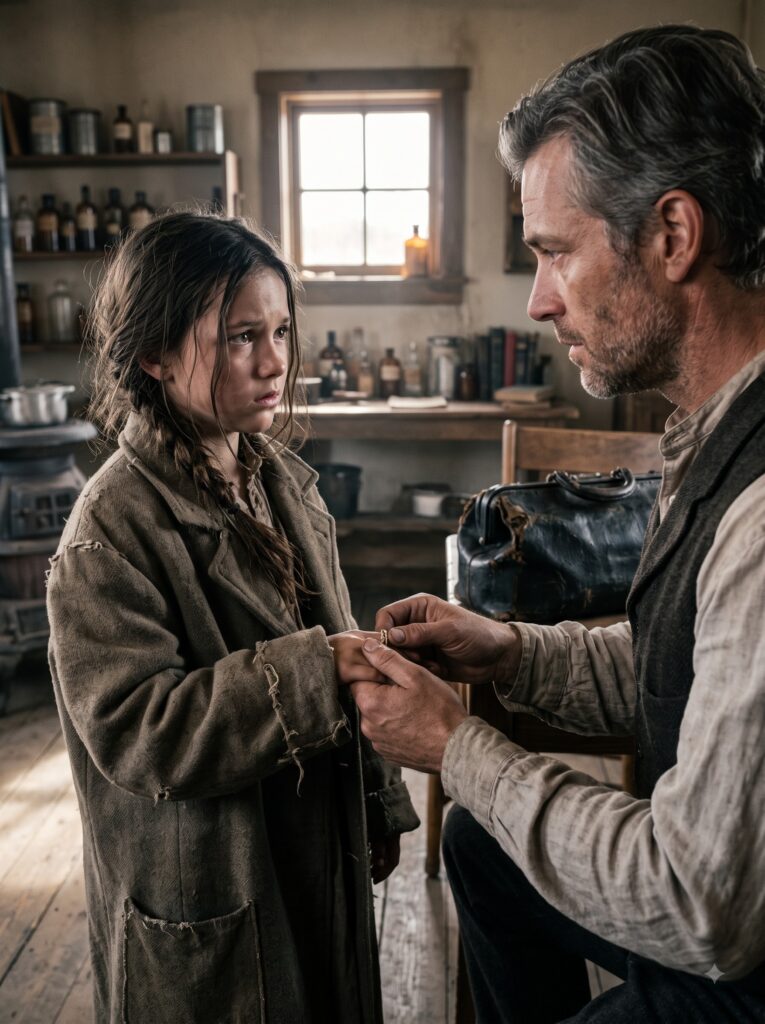
A little girl in a coat too large for her.
A gold ring resting in a trembling hand.
And the moment he closed her fingers around it and told her to keep it.
Because the ring had never been the price of saving a life.
It was the beginning of a family that would make room for every love that came before, and every love still waiting to arrive.