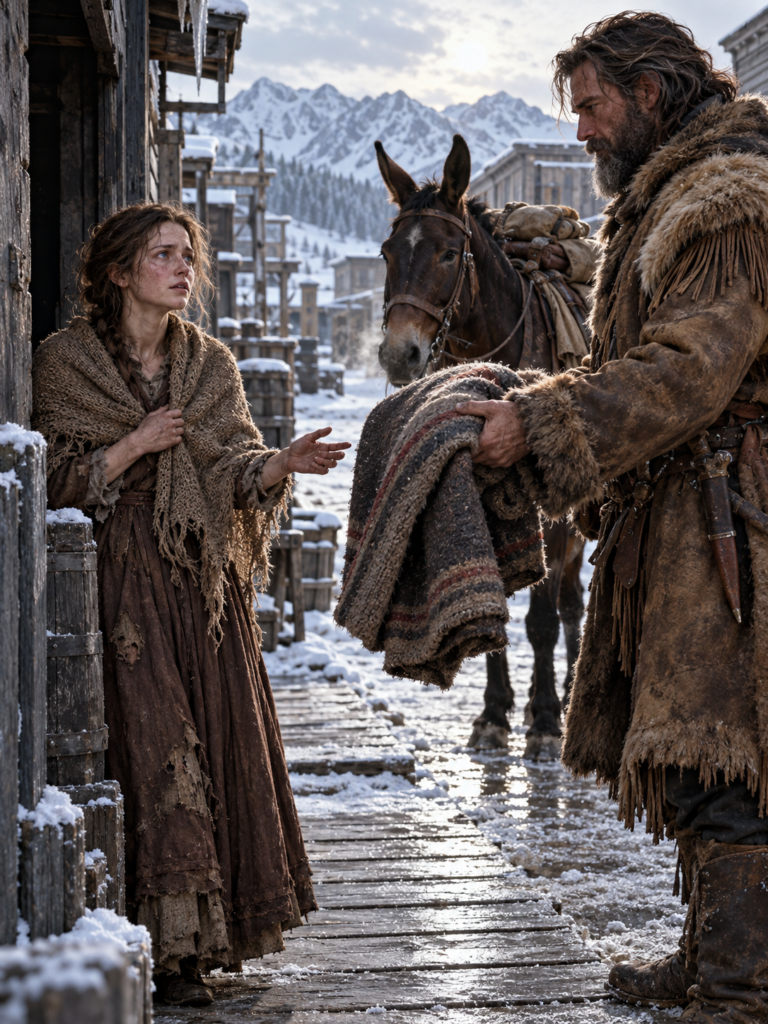
Martha pulled the blanket over the narrow cot, smoothing its coarse wool with hands still trembling from cold and exhaustion.
Then she turned toward Gideon.
“Where will you sleep?”
“By the stove.”
“On the floor?”
“I’ve done worse.”
She glanced at his broad shoulders, then at the hard boards.
“That bed is yours.”
“For tonight it’s yours.”
She looked troubled rather than relieved.
“I don’t want to owe you more than I can repay.”
Gideon paused with the bedroll in his hands.
“Did I ask you to repay me?”
“No.”
“Then don’t go inventing a debt.”
Martha lowered her eyes.
He understood enough to leave the subject alone.
Before lying down, he checked the stove, set a bucket of water within reach, and explained how the door latch worked.
“You can open it from inside. If you want me to step outdoors while you get settled, say so.”
She watched him carefully.
“Would you?”
“Of course.”
She nodded.
“Please.”
He took his coat and went onto the porch.
Martha changed into the dry garments she had bought, pulled the curtainless bedding close around her, and called that she was ready.
Gideon returned, banked the fire, and settled on his bedroll.
Neither spoke again.
By morning, the stove had burned low.
Gideon woke to the faint sound of uneven breathing.
Martha lay curled beneath the blankets, deeply asleep.
He added wood to the coals, careful not to wake her.
Then he pulled on his heavy coat and stepped outside.
The temperature had fallen sharply.
Snow swept across the clearing.
Rust stood beneath the lean-to, waiting impatiently for breakfast.
Gideon fed him, checked the water, and split enough wood to replenish the cabin’s supply.
As he worked, clouds thickened above the northern ridge.
A storm was gathering.
When he returned, Martha was standing at the cookstove.
She had made coffee.
Her cheeks remained hollow, and she leaned against the table as though standing required all her strength.
“Morning,” she said.
“You should still be resting.”
“I’ve rested.”
“Not enough.”
She held out a tin cup.
He accepted it.
The coffee was strong enough to wake a dead miner.
“Good,” he said.
She gave the faintest smile.
He looked toward the window.
“Weather’s turning. We need to secure the place before it closes in.”
Martha straightened.
“What can I do?”
He almost told her to return to bed.
Instead, he considered the work.
“There’s a rope in the chest. I’ll set a line between the porch and Rust’s shelter. You can help me measure it, then stay inside and make sure the stove’s drawing properly.”
“I know knots.”
“You do?”
“My father worked with freight teams in Kansas. I grew up around mules.”
Gideon studied her.
“Then you know more than I do about some things.”
“Not mountains.”
“No. But I reckon we’ll manage between us.”
They worked carefully.
Gideon stretched the line from the porch to the lean-to while Martha secured one end with a practiced hitch.
Rust turned his ugly head toward her.
“Mind yourself,” Gideon warned. “He bites.”
Martha looked the mule in the eye.
“Then he and I had better reach an understanding.”
Rust snorted.
Gideon laughed under his breath.
By afternoon, the storm arrived.
Wind drove snow across the cabin until the trees disappeared.
The walls creaked.
The stove required constant attention.
Martha sat beside the table mending a torn wool sock while Gideon sharpened a tool.
For a while they listened to the weather.
“Your father taught you freight work?” he asked.
She nodded.
“He ran mules on the Santa Fe Trail.”
“Is he still living?”
“No. Cholera took him in sixty-eight.”
Gideon set the tool aside.
“I’m sorry.”
She looked at her hands.
“He was good to me. I think of him whenever I see a mule.”
Rust gave an indignant bray from the lean-to.
Martha smiled faintly.
“Though Father kept better-mannered animals.”
The storm continued through the next day and the one after.
Snow piled against the walls.
Their firewood dwindled faster than Gideon expected.
Martha grew quieter.
At first he thought she was merely tired.
Then she stopped eating much of her supper.
By the fourth morning, Gideon had spent hours clearing a passage toward Rust’s shelter.
He returned through the tunnel carrying a fresh armload of wood.
The stove had nearly gone out.
Martha lay on the floor beside it.
She was shivering violently, her eyes unfocused.
Gideon dropped the wood.
“Martha?”
She did not answer.
He knelt and touched her forehead.
Her skin was burning.
He called her name again.
Her lips moved.
“Papa,” she whispered.
Then her eyes closed, and Gideon reached beneath her shoulders to lift her from the freezing floor.
Gideon lifted Martha from the cold floor and carried her toward the narrow cot.
She weighed terribly little.
The realization frightened him more than he wanted to admit.
Her head rested against his arm, her breathing shallow and uneven.
“Martha, can you hear me?”
Her eyelids moved.
No answer came.
He laid her on the bed and drew the blankets over her, then turned immediately toward the stove.
The fire had faded to a bed of dull coals.
He added kindling, coaxed the flame back, and set a pot of water to warm.
He knew enough about sickness to recognize danger.
Martha had arrived starving and exhausted. The journey, bitter cold, and days confined by the storm had left her little strength.
Now she had a fever.
And the nearest settlement lay beyond miles of snow-covered mountain trail.
Gideon returned to her bedside.
“Can you drink?”
She opened her eyes briefly.
He offered a little water while she was awake enough to swallow.
She managed a few sips before turning her head away.
He set the cup down.
Her face was flushed.
Her breathing troubled him.
He checked the fire again, removed the excess coverings when she grew too hot, and used a damp cloth to ease her discomfort.
There was no physician to call.
No neighbor within easy reach.
He understood that she needed skilled care, but the storm had made travel impossible for the moment.
He would have to watch her closely, keep water available, and do what he could until help became reachable.
That first evening she began talking in fragments.
“Papa, the wagon…”
He leaned closer.
“The wagon’s all right.”
“The wheel…”
“You’re in the cabin, Martha.”
She looked straight through him.
“Don’t leave the mules.”
Gideon held the cup near her hand.
“Rust’s fed. He’s under shelter.”
The answer meant nothing to her.
She drifted back into uneasy sleep.
He sat beside her for hours.
Outside, wind scraped snow against the logs.
Inside, the stove ticked and sighed.
Gideon had lived alone for years without finding the silence difficult.
Now every quiet moment frightened him.
He listened for Martha’s breathing.
Sometimes it was rough.
Sometimes so faint he leaned forward to be certain it continued.
He spoke to her whenever she woke, reminding her where she was.
By the second night, he was exhausted.
He had slept only in brief stretches, rising repeatedly to tend the stove and offer water.
Martha’s fever remained high.
Once she gripped his sleeve.
“Don’t send me back.”
The words were barely audible.
Gideon went still.
“Back where?”
She did not answer.
He laid his hand beside hers on the blanket.
“You’re not going anywhere tonight.”
Her fingers loosened.
A few minutes later she slept again.
He remained in the chair.
The sight of her illness had awakened something he had not expected to feel.
Fear of losing someone.
A week earlier, he had been content to pass another winter speaking only to Rust.
Now the thought of returning to that existence seemed unbearably bleak.
He looked at Martha’s thin face.
She had entered his life asking only for work.
She had offered labor because she believed she had nothing else worth giving.
But her presence had already changed the cabin.
There had been conversation at supper.
Coffee made by another person’s hands.
A voice laughing at his disagreeable mule.
A second chair occupied beside the stove.
He wanted her to survive long enough to discover that she was worth far more than the labor she could perform.
Near dawn, her breathing grew calmer.
The fierce heat in her skin began to lessen.
Gideon watched anxiously.
He had seen fevers ease and then return.
He would not mistake a little improvement for recovery.
When Martha finally opened her eyes, they seemed clearer.
She looked at him.
“Gideon?”
He leaned forward.
“I’m here.”
“Why do you look so terrible?”
He let out a long breath.
“That is a fine thing to say to the man who’s been keeping the stove burning.”
Her lips moved in the faintest smile.
“Water?”
He helped her sit slightly and take slow sips.
She drank, then settled back.
“How long have I been sick?”
“Several days.”
Her eyes moved toward the scattered cloths and the chair beside the cot.
“You stayed?”
“Where else was I going?”
She looked at him for a moment.
“Thank you.”
He shrugged.
“Didn’t much care for the thought of eating my own cooking again.”
Her smile widened weakly.
He looked away so she would not see how deeply relieved he was.
Recovery came slowly.
Martha remained exhausted for days. Some mornings she could sit upright; others left her too weak to do more than drink broth and rest.
Gideon continued the outside work, checked Rust, carried water, and tended the stove.
He prepared simple meals.
He also admitted, reluctantly, that he was poor at making corn cakes.
“You burn them,” Martha told him one afternoon.
“They’re cooked.”
“There’s a difference.”
“You going to instruct me from that bed?”
“If you’ll listen.”
He handed her the spoon.
“Go on, then.”
She explained how to lower the heat, add the fat more carefully, and let the cakes cook without charring.
He followed her instructions.
The next batch was edible.
Martha looked pleased.
“See? A man can learn.”
Gideon gave her a sideways glance.
“Don’t tell Rust. He’d lose respect for me.”
Gradually her strength returned.
When she finally stood unaided, she remained beside the cot until the dizziness passed.
Gideon watched from the table.
“Need a hand?”
“Not yet.”
He waited.
She walked slowly toward the stove.
Every step required effort, but she reached it.
She placed a hand against the warm iron.
Then she turned toward him.
“I thought I was going to die.”
“So did I.”
He had spoken before he could stop himself.
Martha looked at him.
He did not soften the truth.
“I was afraid.”
She returned to the chair and sat down.
“So was I.”
For the first time, neither pretended that survival had cost nothing.
As the winter deepened, they found ways to share the cabin more comfortably.
Gideon gave Martha the cot while she recovered, continuing to use his bedroll near the stove.
When she grew strong enough, she insisted they discuss a fairer arrangement.
“You can’t sleep on the floor all winter.”
“I’ve slept there plenty.”
“That doesn’t make it sensible.”
Together they made a second sleeping place from spare boards and a thick bedroll, arranging it behind a hanging blanket to give her privacy.
Martha took charge of the small provisions ledger she began keeping on scraps of paper.
Gideon showed her how much flour, meal, beans, and dried meat remained.
She calculated what they could use each week without exhausting their stores too early.
She had a good head for the work.
“You should have been keeping records,” she told him.
“I keep them in my head.”
“Your head is not nearly as orderly as you think.”
He laughed.
She also knew mending, basic food preservation, and enough about pack animals to recognize when Rust needed attention.
Gideon discovered that the mule obeyed Martha more readily than he obeyed his owner.
This irritated him.
It delighted her.
By January, the snow stood deep around the cabin.
They maintained the passage to Rust’s shelter, cleared snow where it threatened the roof, and watched the wood supply carefully.
Their days followed a steady pattern.
Gideon tended his tools and handled the heavy outside labor.
Martha managed much of the cooking and provisions, though they shared tasks according to strength and need.
Sometimes they spent evenings in quiet conversation.
She told him about Kansas.
Her father had run freight teams along the Santa Fe Trail, and she had grown up learning the practical work of horses, mules, harnesses, and wagons.
After his death from cholera in 1868, her life had become less certain.
The mining camps had offered work while silver drew people into the territory.
Then the veins failed.
Employers closed their businesses.
Wages vanished.
She had moved from one temporary arrangement to another until there was nothing left.
One evening Gideon asked, “Why didn’t you leave Oak Haven?”
“With what money?”
He said nothing.
She looked into the fire.
“I kept believing another place would hire me. By the time I understood there wasn’t work, I could hardly feed myself.”
She rubbed her hands together.
“I was ashamed to be seen asking strangers for help.”
“You weren’t ashamed enough to stop asking me.”
“I wasn’t asking you for charity. I was offering to cook.”
Gideon considered that.
“You’re a good cook.”
She smiled.
“But you didn’t need one badly enough to take me all this way.”
“No.”
“Then why did you?”
He stared at the stove.
“Because you were cold. And because I could help.”
Martha looked at him quietly.
“And now?”
“Now I’m glad you came.”
The words stayed between them.
Neither spoke of love.
But something had changed.
A week later, their carefully managed supplies revealed a new danger.
The flour and beans were holding out.
The meat was not.
Gideon studied the ledger while Martha scraped the last of the cooking fat from its jar.
“We’ve got to bring in more game.”
She looked toward the window.
The wind was sweeping powder from the roof.
“Today?”
“Not if I can help it.”
“When, then?”
He checked the remaining stores.
“Soon. We can’t wait until we’re weak.”
Martha stood beside the table.
“I know those figures as well as you.”
He nodded.
They discussed the weather, the supplies required for a hunt, and how long he might be away.
Gideon knew a lower valley where elk sometimes gathered during deep snow.
Getting there would be difficult.
Bringing meat back would be harder.
Martha listened without interrupting.
Then she said, “You shouldn’t go alone in weather like this.”
“There’s no one else nearby.”
“Then wait until the wind settles.”
He studied the sky.
For a day he agreed.
They used the time to prepare.
Martha packed food and dry kindling for him. She checked the straps on his snowshoes and examined a length of rope for worn fibers.
Gideon prepared his Winchester, sharpened his knife, and checked the weather.
When the wind eased enough to make travel possible, he dressed before daylight.
Martha waited by the stove.
“How long?”
“I intend to be back tomorrow. Possibly tonight if everything goes well.”
“And if it doesn’t?”
He paused.
“I’ll take shelter if I must. Don’t come wandering down the trail searching.”
She frowned.
“I know better than to chase you blindly through the snow.”
“Good.”
“But you’ll leave markers where you can?”
“Where they’ll be useful.”
She handed him the food bundle.
He took it.
Then she looked directly at him.
“Come back, Gideon.”
There was no teasing in her voice.
He held her gaze.
“I’ll do my best.”
She opened the door.
He stepped into the snowy passage.
The cold swallowed him almost immediately.
Martha closed the door and lowered the wooden bar.
For hours she worked to keep herself occupied.
She stirred the stove, sorted provisions, and mended clothing.
But her attention kept returning to the door.
Gideon was somewhere beyond the ridge.
The cabin seemed larger without him.
And the silence, once familiar, now felt wrong.
Far below, Gideon traveled slowly through deep snow.
He reached the lower valley after hours of difficult walking.
There he found signs of elk.
Bark stripped from trees.
Tracks pressed deep into the snow.
He followed them carefully.
Near the edge of the timber he spotted an older bull standing apart from the main herd.
Gideon approached from downwind.
When he had a clear opportunity, he fired.
The elk fell.
Gideon waited to make certain the animal was dead before approaching.
He had meat.
But the danger was far from over.
The sun was already low.
He began dressing the animal and preparing what he could carry.
As he worked, a low growl reached him from the trees.
He stopped.
Three wolves stood beyond the blood-darkened snow.
They were thin and watchful, their attention fixed on the carcass.
Gideon moved toward his rifle.
The largest wolf stepped forward.
He raised his voice to drive it away.
It did not retreat.
Instead, it rushed toward him.
Gideon lifted the rifle.
The shot broke across the valley.
One wolf fell.
The other two scattered briefly among the trees.
He backed away from the carcass, trying to keep them in sight.
Then another wolf darted toward him from the side.
He fired again and missed.
A heavy shape struck his left arm.
Gideon fell backward into the snow.
Pain tore through his forearm as teeth caught through his coat.
He struggled to free himself.
The rifle slipped from his grasp.
With his right hand he drew his hunting knife and defended himself at close range.
The attack ended in a few desperate moments.
The wounded animal fell away.
The remaining wolf disappeared among the trees.
Gideon lay still, breathing hard.
His left arm throbbed.
Blood darkened the torn fabric.
He was alive.
But the injury was serious.
And the mountain stood between him and the only warm shelter he had.
He forced himself upright.
The elk lay nearby.
Martha needed the food.
So did he.
He could not carry the whole animal through the deep snow, especially injured.
He prepared a manageable portion and secured it for hauling, leaving what he could not safely transport.
By the time he started back, darkness had fallen.
His injured arm was painful and weak.
Each step seemed longer than the last.
He followed the familiar terrain, stopping repeatedly to rest and check his direction.
The rope dragged behind him.
The meat was heavy.
His gloves were stiff with cold.
Once he stumbled and struggled to regain his feet.
He thought of the cabin.
The iron stove.
The narrow table.
Martha sitting beside the fire with her mending in her lap.
He kept walking.
At the cabin, Martha waited.
Night settled over the mountains.
She had prepared warm water and a meal in case he returned hungry.
But the hours passed.
No footsteps came.
She checked the door.
Then the clock.
Then the fire.
She told herself he might have taken shelter lower in the valley.
That was sensible.
That was what they had agreed he should do if travel became unsafe.
Still, she could not stop listening.
Near midnight she heard something outside.
A faint dragging sound.
Then a heavy scrape against the cabin door.
Martha stood.
“Gideon?”
A low groan answered.
She pulled the wooden bar free.
The door opened.
Gideon stood in the narrow passage, white with frost, his coat stiff with ice and darkened blood.
A rope hung from his right hand.
His left arm rested uselessly against his side.
He looked at her.
“Got meat,” he whispered.
Then his knees folded, and he fell forward across the threshold.
Martha caught Gideon as he fell, but his weight drove her backward onto one knee.
“Gideon!”
He gave no answer.
His shoulder struck the doorframe, and the rope slipped from his hand.
Cold air rushed into the cabin.
Martha braced her feet, took hold of his coat beneath the arms, and dragged him inch by inch across the threshold.
He was too heavy to lift.
But the floor was smooth, and she had learned how to move freight that outweighed her many times over.
She pulled.
Stopped.
Changed her grip.
Pulled again.
At last his boots cleared the doorway.
She shut the door against the wind and lowered the wooden bar.
Only then did she kneel beside him.
“Gideon. Look at me.”
His eyelids moved.
“Cold,” he murmured.
“I know.”
She removed his hat and loosened the stiff clothing around his neck.
His beard was crusted with frost. His gloves were frozen. Blood had soaked the left sleeve of his coat.
She checked his breathing and tried to determine how badly he was injured.
His right hand moved weakly toward her.
“Wolf.”
Her stomach tightened.
She looked again at his left arm.
The sleeve had been torn through, and beneath it the wool was dark.
Martha had seen wounds before.
Her father had worked with mules, wagons, harnesses, and rough men. Freight work had given him more than his share of injuries.
But she had never tended a wound like this alone.
She knew enough to fear infection.
And she knew Gideon needed warmth, clean dressings, and more help than the mountain could readily provide.
First she removed his wet outer garments as carefully as possible.
Then she brought a basin of warm water and began loosening the cloth around the injury.
Gideon stirred.
“Easy,” she said. “I’m going to look at your arm.”
He opened his eyes.
“Did the meat get here?”
She stared at him.
“You’re lying on my floor bleeding, and you’re worrying about supper?”
His mouth moved.
“Promised we’d eat.”
Martha felt tears rise.
She pushed them aside.
“We will. But first you’re going to let me take care of you.”
He nodded faintly.
She worked slowly, avoiding unnecessary movement of the injured arm.
The wolf’s teeth had broken the skin in several places.
The wounds were painful and deep enough to cause serious concern.
Martha cleaned away the visible dirt with water and covered them with clean linen, leaving the dressing loose enough not to cut off circulation.
She did not try to seal the punctures or pretend her work could prevent every danger.
When she finished, she helped Gideon move nearer the stove.
He sat against the wall, exhausted.
His face was pale.
She draped a dry blanket across his shoulders and brought warm broth.
“Drink a little.”
He obeyed.
Then she went to the door and looked at the rope he had dropped.
The meat lay in a bundle outside.
She brought it into the sheltered work area, secured it against animals, and returned to the cabin.
Gideon was still awake.
“How much?” he asked.
“Enough to make a difference.”
“Good.”
She sat across from him.
“That doesn’t mean you’re doing this again.”
He looked toward his bandaged arm.
“Wasn’t planning on meeting wolves.”
“I’m not joking.”
“Neither am I.”
She leaned forward.
“You could have died.”
He lowered his eyes.
“I know.”
“You could have frozen on that trail. You could have lost too much blood. And nobody would have found you until the thaw.”
“I know, Martha.”
Her voice broke.
“Then why are you sitting there acting as though bringing home meat is all that matters?”
He looked at her.
For a long moment he said nothing.
Then he answered quietly.
“Because I was afraid you wouldn’t have enough to eat.”
She stared at him.
He glanced toward the stove.
“I saw what hunger had done to you in Oak Haven. I wasn’t going to watch it happen again.”
Martha’s expression softened, but she did not withdraw her objection.
“And what would happen to me if you never came home?”
He looked back at her.
The question seemed to reach him more deeply than anything she had said before.
“I hadn’t thought far enough about that.”
“No. You hadn’t.”
He accepted the rebuke.
Martha wiped her eyes with the back of her hand.
“I don’t want to survive by losing the only person who’s treated me like I matter.”
The words surprised them both.
Gideon looked toward her.
“Martha…”
She rose abruptly.
“You need something to eat. I’ll make supper.”
He did not stop her.
While she worked, he watched the careful movements of her hands.
He remembered the woman in the alley, thin and shivering, offering the only skill she believed she had left.
He had thought her too frail to reach his cabin.
Then he had watched her survive the climb.
He had watched her make useful meals from simple ingredients.
He had listened to her fevered breathing and feared the silence that might follow.
Now she had dragged him into the cabin, tended his wound, and spoken to him with an authority nobody had exercised in his home for years.
He realized that somewhere during those long winter weeks, she had become essential to him.
Not because he needed a cook.
Because he wanted Martha there.
Her thoughts.
Her humor.
Her stubbornness.
The way she spoke to Rust as though the mule were a badly behaved child.
The quiet humming that filled the cabin while she worked.
He wanted all of it.
But he said nothing.
She had come into the mountains with no safe alternative.
He would not turn her dependence into a romantic obligation.
Later, when she placed a plate of carefully cooked elk before him, he looked up.
“Thank you.”
She sat down across from him with her own meal.
“Eat while it’s hot.”
He took a bite.
The meat was tender.
The relief of having fresh food was immediate.
For a while they ate without speaking.
Then Gideon said, “You saved my life tonight.”
Martha looked at his injured arm.
“I helped you inside and dressed the wound. We still need to watch it carefully.”
“You did more than that.”
She shook her head.
“You came back. That part was yours.”
He studied her.
“I used to think the only way to survive up here was to depend on nobody.”
“And now?”
He looked around the cabin.
At the second sleeping place.
At the mended clothing.
At the provisions ledger beside the flour sack.
At the two plates on the table.
“Now I know I was wrong.”
She lowered her eyes.
For the first time that evening, she smiled.
His wound remained painful through the following days.
Martha checked the dressing regularly and watched for worsening redness, swelling, fever, or other signs that he might need urgent care.
Gideon rested more than he liked.
He could still move about the cabin, but he could not safely perform heavy work with his left arm.
Martha took responsibility for much of the cooking, firewood already within reach, and managing the provisions.
They also adjusted their remaining food carefully.
The elk had eased the shortage, though winter had not ended.
Gideon taught her more about storing meat in the cold and protecting it from animals and spoilage.
She recorded what they had.
He began asking her judgment before making decisions that affected both of them.
This pleased her more than she admitted.
One evening, while she was checking the food stores, Gideon reached for his coat.
Martha looked up.
“Where are you going?”
“To see about Rust.”
“I fed him.”
“He’ll need water.”
“I checked that too.”
Gideon stopped.
She folded her arms.
“Sit down.”
He looked at her.
“You getting accustomed to giving orders?”
“Only to foolish men with injured arms.”
He lowered himself into the chair.
“There’s only one man here.”
“Then you’ve saved me considerable trouble.”
He laughed.
The sound filled the little cabin.
Martha smiled as she returned to her work.
It was a simple moment.
But it mattered.
For months she had feared becoming useless.
Now she knew she could contribute without being driven past her limits.
And Gideon was learning that accepting care did not lessen his strength.
As the winter continued, his arm slowly healed.
The injury left scars and stiffness.
Some movements remained painful.
He practiced using his hand gently as strength returned, careful not to force it.
Martha watched him learn patience.
It was not a skill he possessed naturally.
One afternoon he struggled to close his left hand around a piece of wood.
He swore under his breath.
Martha sat beside him.
“Try again tomorrow.”
“I need this hand.”
“I know.”
“If I can’t grip an axe properly—”
“Then we’ll have to change how we do things until you can.”
He looked at her.
“We?”
“Yes.”
“Martha, you don’t have to carry my burdens.”
She held his gaze.
“I’m not offering to carry them alone. I’m asking you to let me share them.”
He lowered the wood.
For a moment he looked almost ashamed.
“I don’t know how to do that very well.”
“I’ve noticed.”
He smiled faintly.
Then he handed her the piece of wood.
“Help me figure it out.”
She took it.
That evening they discussed ways to prepare more efficiently for the following winter, should both remain in the high country.
Martha suggested improving the shelves and protecting dry stores from damp.
Gideon wanted to enlarge the covered wood storage.
They talked about carrying better reserves of dried food before the passes closed.
She also insisted that some provisions remain available for an emergency return journey or unexpected hardship.
Gideon listened.
He did not agree with every suggestion immediately.
But they discussed each one.
For Martha, the conversation itself felt extraordinary.
She had spent years working for others.
She had cooked their meals, cleaned their rooms, and obeyed their instructions.
Now a man who had survived alone in the wilderness for a decade was asking what she thought.
Not because he pitied her.
Because he had learned that her judgment mattered.
Through the remaining winter they developed a quiet understanding.
She no longer asked whether she was allowed to use flour or mend a garment.
He no longer acted as though every task must be his responsibility.
They shared supper.
They talked when they had something to say.
And sometimes they sat without speaking, comfortable in the warmth of the stove.
Their affection grew slowly.
A smile held a little longer.
A cup of coffee placed beside a tired hand.
A blanket drawn over someone’s shoulders without demanding thanks.
Gideon found reasons to remain at the table after eating.
Martha found herself listening for his footsteps whenever he went outside.
Neither pretended these feelings were simply gratitude.
Yet neither hurried to name them.
The winter had forced them together.
They both understood that the real test would come when Martha could leave.
At last, spring began breaking the mountain’s hold.
The first thaw arrived in sudden bursts.
Snow softened along the southern slopes.
Water dripped from the eaves.
The deep white banks around the cabin shrank into gray patches of ice and wet earth.
Rust emerged from his shelter with renewed enthusiasm for making trouble.
Martha caught him trying to pull a piece of clothing from the line.
“Leave that alone!”
The mule flicked an ear.
She stepped forward.
He released the garment reluctantly.
Gideon watched from the porch.
“Never seen him listen that quick.”
“He knows who’s reasonable.”
“Does he?”
“He certainly doesn’t believe it’s you.”
Gideon laughed.
Martha turned toward him.
The sun shone across her face.
She had changed greatly since Oak Haven.
The hollows in her cheeks had softened.
Her movements were stronger.
Her hands remained rough from work, but they no longer shook with hunger.
She stood straight.
And when she smiled, her whole expression changed.
Gideon looked at her longer than he intended.
She noticed.
“What?”
“Nothing.”
“You’re a poor liar.”
He smiled.
“You’re looking well.”
She glanced down at her plain dress.
“I’ve looked better.”
“Not since I’ve known you.”
Martha’s smile faded into something more tender.
For a moment neither spoke.
Then Rust brayed loudly, demanding attention.
The spell broke.
Martha laughed and went to fetch the mule’s feed.
Gideon watched her go.
He knew the trail would soon open.
And with it would come the decision he had been avoiding.
By late April, the lower route to Oak Haven was passable.
Gideon checked the trail himself before preparing Rust for the journey.
The town could provide supplies, repairs, and a chance for Martha to continue toward a different life.
He had considered the matter carefully.
He would not let her believe that surviving the winter meant she owed him another.
Nor would he make her ask permission to go.
On the morning he decided to speak, he packed a small canvas sack.
Inside were eighty dollars in gold coins.
He also set aside a valuable silver fox pelt.
Together they represented a substantial chance for Martha to begin again.
He knew she might refuse.
He hoped she would not feel insulted.
The money was not wages for cooking.
Nor payment for saving his life.
He intended it as a gift she could accept or decline freely.
Martha stood on the porch as he finished adjusting Rust’s pack saddle.
“What are you doing?”
“Getting ready for a trip down to Oak Haven.”
“Today?”
“Soon.”
She watched him tighten the strap.
“And what have you planned?”
Gideon stopped.
He reached into his coat and brought out the canvas sack.
He held it toward her.
“There’s eighty dollars here. And a silver fox pelt worth more when it’s sold.”
She did not take it.
“Why?”
“The trail is open. You could buy a seat on a stagecoach. Go somewhere with milder winters and steady work.”
Her expression changed.
For a long moment she stared at him.
“You want me to leave?”
Gideon’s chest tightened.
“I want you to know you can.”
“That isn’t what I asked.”
He looked toward the mountain.
She stepped closer.
“Gideon.”
He faced her.
“Do you want me gone?”
“No.”
The answer came so quickly that neither could mistake it.
“Then why are you standing there offering me money to go?”
“Because when I found you, you had no choice. I don’t want you staying because you think you owe me something.”
Martha looked at the sack.
Then at the cabin.
Then back at him.
“You think I cooked through winter because I expected a wage?”
“No.”
“Do you think I tended your arm so you would buy me passage somewhere else?”
“No.”
“Then why won’t you ask what I want?”
Gideon went still.
She held out her hand.
“Give me the sack.”
He placed it in her palm.
She weighed it briefly.
For a moment he thought she meant to accept it and leave.
The knowledge hurt more than he had expected.
Then Martha turned toward the muddy yard.
She swung her arm and threw the sack into the soft earth.
It landed with a heavy splash.
Gideon stared.
“Have you lost your senses?”
“Possibly.”
“That’s eighty dollars!”
“I heard you.”
“And good money doesn’t grow on pine trees!”
“Then perhaps you’d better fetch it.”
He looked at her in disbelief.
She stood with her hands on her hips.
For one terrible second he thought she was furious.
Then he saw tears shining in her eyes.
“Don’t stand there deciding my future because you’re frightened to ask me about it.”
Gideon’s anger disappeared.
He stepped toward her.
“Martha…”
“No. Listen.”
She drew a breath.
“When I met you, I was starving. I thought the only thing I had left was the ability to cook.”
Her voice trembled.
“I offered you that because I didn’t believe anyone would help me otherwise.”
He listened without interrupting.
“You gave me food. You gave me a place to sleep. And when I was sick, you cared for me.”
She looked toward the cabin.
“But that’s not why I’m standing here.”
Gideon said nothing.
“I stayed when you were hurt because I wanted you alive. I kept the fire going because this had become my home too.”
She stepped closer.
“I like the mountains. I like the work. I like that stubborn mule, though I don’t know why.”
A faint smile crossed her face.
“And I like you, Gideon. Even when you’re difficult.”
He looked down at her.
For the first time in years he had no sensible words ready.
She placed one hand against his chest.
“I don’t want to spend the rest of my life serving strangers for a little bread and a place to sleep.”
She paused.
“I want to choose where I belong.”
Gideon swallowed.
“And where is that?”
She looked straight into his eyes.
“Here.”
The word settled between them.
He raised his injured left hand.
The scars pulled as he moved, but he gently covered her fingers.
“Winter will come back,” he said.
“I know.”
“The snow will close the trail.”
“I remember.”
“I can’t promise it’ll be easy.”
“I don’t expect easy.”
He searched her face.
“Are you certain?”
Martha smiled through her tears.
“More certain than I was when I followed you out of that alley.”
Gideon looked toward the cabin.
For years it had been enough to survive there.
He had thought a man who wanted little from the world could never lose much.
But he had been wrong.
Without Martha, the cabin would still shelter him.
The stove would still burn.
Rust would still complain.
Yet the place would be missing the woman who had taught him that being needed and being loved were not the same thing.
He looked back at her.
“Then I’d like you to stay.”
She raised an eyebrow.
“As what?”
He considered the question seriously.
“Not a hired cook.”
“Good.”
“Not somebody who owes me for taking her in.”
“Better.”
“As my partner, if you’ll have me.”
Martha’s expression softened.
“And who decides what happens here?”
“We both do.”
“Who keeps the stores?”
“Whoever keeps the better accounts.”
“That would be me.”
“I suspected as much.”
She laughed.
He smiled.
“Who gets a say in the work?”
“Both of us,” he answered.
“And if one of us wants to leave?”
“The other won’t stop them.”
She nodded slowly.
“Then I believe we understand each other.”
Gideon lowered his head a little.
“May I hold you?”
Martha stepped into his arms.
He embraced her carefully, his injured arm still stiff.
She rested her cheek against his chest.
For a long while they stood together in the cold spring sunlight.
Neither needed another promise.
The choice had been made.
Not from desperation.
Not from gratitude.
Not because one was helpless and the other strong.
But because two people who had survived a terrible winter had discovered they wanted to share the next one.
After a while Martha drew back.
“We ought to get that money out of the mud.”
Gideon looked toward the yard.
“I was wondering when you’d remember it.”
She smiled.
“I never said I was foolish enough to waste it. I simply didn’t want it handed to me as a farewell.”
Together they recovered the sack, cleaned the coins, and returned the silver fox pelt to a dry place.
They agreed that the money should remain available if Martha ever needed to travel or establish herself elsewhere.
She accepted that arrangement.
Her ability to leave was not an insult to their partnership.
It was one of the reasons she could stay freely.
The days that followed were busy.
Spring meant repairing what the winter had damaged.
Gideon’s arm remained stiff, so they divided the work carefully.
Martha helped manage supplies, mend harnesses, and plan what they needed to purchase in Oak Haven.
Gideon repaired the roof where the weight of snow had loosened the covering.
Together they enlarged the wood shelter and improved the storage shelves.
They made a list of provisions for the coming winter.
More flour.
More beans.
Enough salt.
Extra blankets.
And more preserved food than Gideon had kept before.
They no longer intended to survive on the narrowest possible margin.
One afternoon Martha stood beside the cabin, examining the small patch of ground where the snow had melted.
“What are you studying?” Gideon asked.
“Sunlight.”
He looked up.
“Still there.”
She ignored him.
“This place gets sun through most of the afternoon. When the ground dries, I think we could plant a few useful things.”
Gideon considered the rocky earth.
“The growing season’s short.”
“I know.”
“Frost comes early.”
“I know that too.”
He smiled.
“Then I suppose we ought to try.”
Martha looked pleased.
It was not much land.
But it was something they could tend together.
A small beginning.
As spring advanced, the cabin changed.
Not through expensive furniture or grand construction.
Through ordinary signs that two people lived there.
A second cup stood permanently on the shelf.
Martha’s sewing basket rested beside the chair.
The provisions ledger hung near the pantry.
Gideon’s tools were arranged where his injured hand could reach them more easily.
Rust’s harness received repairs Martha had insisted upon.
And the little patch of ground beside the cabin was prepared for planting.
Their life was not free from difficulty.
The mountain remained cold and demanding.
Game was uncertain.
Supplies required planning.
Gideon’s arm did not recover all its former strength.
There were days when they disagreed.
There were mornings when Martha worried about another winter.
There were evenings when Gideon grew silent under the weight of his old habit of depending only on himself.
But now they spoke.
He learned to say when he was afraid.
She learned that accepting help did not make her worth less.
And together they found ways to manage what neither could change.
One evening, as the sun dropped behind the Bitterroots, Martha stood on the porch holding two tin cups of coffee.
Gideon came from the lean-to.
Rust brayed after him.
“What’s wrong with him now?” she asked.
“He seems to think he’s starving.”
“He’s eaten twice.”
“That argument has never impressed him.”
She handed Gideon a cup.
He took it with his good hand.
They stood side by side watching the mountains.
The air smelled of thawing earth and pine.
From somewhere below came the sound of meltwater moving over stone.
Martha looked toward the trail leading down to Oak Haven.
“Do you remember what I said when we met?”
Gideon glanced at her.
“That you could cook?”
She nodded.
“I thought that was all I had to offer.”
He studied her.
“You offered more than you knew.”
She smiled faintly.
“So did you.”
For a moment they looked toward the distant settlement.
Somewhere down that trail, a narrow alley stood beside the mercantile.
Martha remembered the frozen mud.
The broken crate.
The bitter wind.
And a man who had stopped beside his mule when she spoke.
She had entered that alley believing she was worth very little.
Now she understood differently.
Her value had never depended on how well she cooked, how hard she worked, or how much suffering she could endure.
Gideon had not given her worth.
He had helped her survive long enough to recognize it again.
And in return, she had helped him discover that solitude was not the only way to live with dignity.
He reached toward her.
She placed her hand in his.
“What are you thinking?” he asked.
“That next winter we’ll be better prepared.”
He smiled.
“That’s a pleasant thought.”
“And that we need more firewood.”
“That’s less pleasant.”
She laughed.
“Winter comes whether we like it or not.”
“That it does.”
She squeezed his hand.
“Then we’d better start cutting wood.”
Gideon looked down at her and smiled.
“Tomorrow.”
Martha raised an eyebrow.
“Tomorrow?”
“Tonight we’ve done enough.”
She leaned against his shoulder.
For once, he did not feel compelled to fill the quiet with work.
They stood together as the last sunlight touched the mountain peaks.
Behind them, their cabin waited.
Warm.
Plain.
Imperfect.
And no longer lonely.
The woman who had once begged for a chance to cook had found a home she could freely choose.
The mountain man who believed he needed nobody had learned how to trust another person’s strength.
And when winter returned to the Bitterroots, they would meet it as partners.
Not because either had promised to save the other from every hardship.
But because both had chosen to share the life that hardship could not take away.