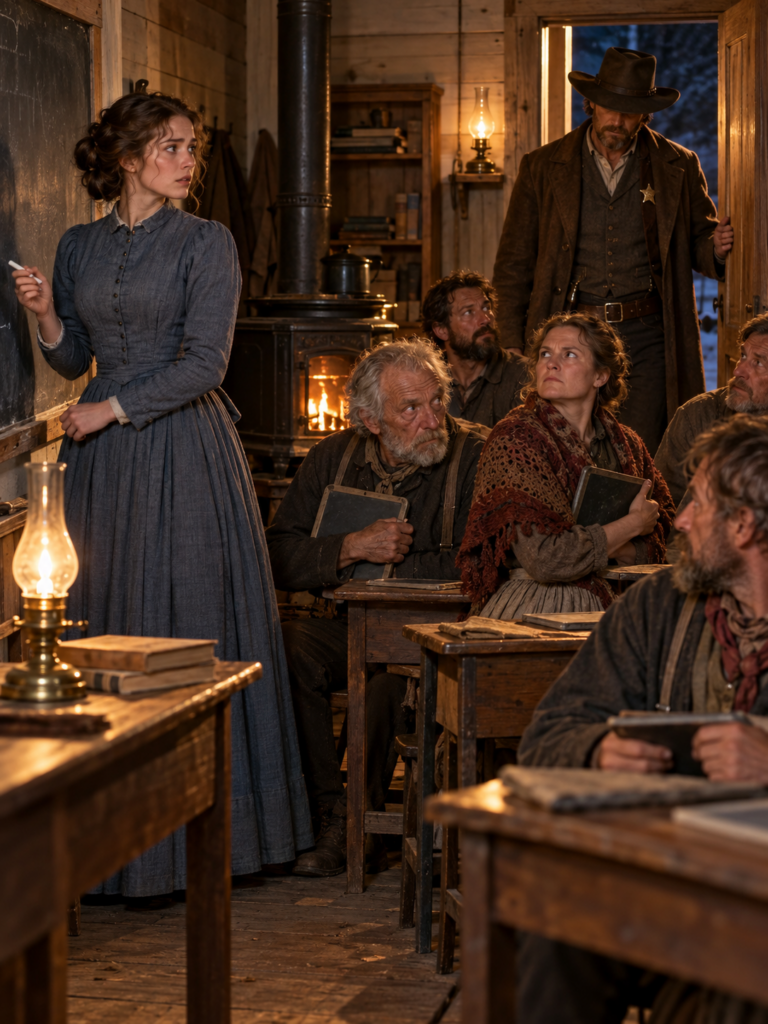
Abel held out his enormous hand, blocking Lucas from lifting Hazel into the chair.
“Let me help her, Sheriff. She won’t let anybody do anything while you’re all staring.”
Lucas stopped immediately.
Hazel, still gripping his sleeve for balance, managed a weak protest.
“I am standing right here.”
“Just barely,” Ida answered.
Abel pulled the chair forward. Lucas released Hazel’s elbow once she was steady enough to sit, and Ida brought water from the covered pail.
Hazel’s cheeks burned.
“I only missed a little sleep.”
Gus gave a disbelieving grunt.
“A little? Girl, you’ve been burning both ends of your candle since October.”
“I have lessons to finish.”
“And we’ve got hands,” Abel replied.
The big stable worker turned toward Mr. Cutler.
“We’ve been talking.”
Cutler nodded.
“For several nights.”
Hazel looked uneasy.
“About what?”
Abel picked up his slate.
“I know my letters now. Enough to help Eddie with his. He gets stuck where I used to get stuck. I can show him.”
“That doesn’t mean you’re ready to teach.”
“Maybe not everything. But I can show a man what I’ve learned.”
Ida moved beside him.
“And I can help with figures. Been keeping the vegetable wagon accounts in my head for thirty years. Can’t always put the numbers on paper, but I know when a sum’s wrong.”
The laundress agreed to practice letters with Gus. Cutler offered to prepare exercises for the younger mule driver.
One by one, the students began dividing the work.
Hazel stared at them.
“You’ve been planning all this?”
“We’ve been watching you wear yourself down,” Ida said. “Seems a poor way to repay the woman who believed in us.”
Hazel shook her head.
“You don’t owe me repayment.”
“Then call it helping our own school.”
That quiet correction silenced her.
Lucas remained near the stove.
He wanted to tell her to accept.
Instead, he remembered how fiercely she protected these people’s right to make decisions for themselves.
Perhaps she deserved that same respect.
Hazel looked down at her hands.
“Thursday evenings,” she finally said.
Abel leaned forward.
“Ma’am?”
“You may take Thursday evenings. I’ll prepare the exercises, and you can help one another. I’ll stay home.”
Ida folded her arms.
“And actually sleep?”
Hazel glanced at Lucas.
“I suppose the sheriff can make that part of his rounds.”
Lucas lifted one eyebrow.
“Only if requested.”
“Consider it requested.”
A ripple of laughter moved through the room.
Yet as they gathered their books, Lucas noticed Gus Halvorsen standing apart, pressing an old envelope between his rough fingers.
The paper had been folded so often the edges were nearly worn through.
“Something troubling you, Gus?”
The miner hesitated.
Then he handed Lucas the envelope, keeping one finger over the handwriting.
“My daughter sent that.”
“I didn’t know you had a daughter.”
“Lottie. Lives in Denver.”
“Have you heard from her lately?”
Gus looked at the envelope.
“That letter came three weeks ago.”
Lucas understood.
“You haven’t read it.”
“No.”
“Miss Fairbanks could—”
“I know she could.”
The old man’s voice tightened.
“But I haven’t seen my girl in twenty years. Her mother died, and I couldn’t bear staying in that house. I went where the work was, and somehow the years got away from me.”
He swallowed.
“She wrote first. After all that time.”
Lucas waited.
“If there’s forgiveness in that paper, I want to find it myself. And if there isn’t, I want to know that too.”
He returned the envelope to his coat.
“I’ve spent sixty-eight years making my way through the world. Surely I can learn enough letters to read a message from my own child.”
Hazel, who had heard him, rose slowly from the chair.
She did not offer to open his letter.
Instead, she took a fresh slate from her desk.
“Then we’ll begin with the letters you need most,” she said.
Gus accepted it.
His large, scarred hand trembled as he took the chalk.
Lucas watched Hazel move beside him, still pale and exhausted but smiling now.
For the first time, the classroom was no longer something she had to carry alone.
And for the first time, Lucas understood how deeply he wanted to remain part of this strange midnight fellowship.
But beyond the schoolhouse windows, the first real winter cold was gathering.
The lamps were consuming more oil.
The stove required more wood.
And the school board was responsible for every hour the building remained occupied.
Sooner or later, someone would ask why six adults needed a classroom after midnight.
As the last student departed, Hazel picked up the nearly empty oil can.
Lucas took his hat from the desk.
She turned toward him.
“If the board finds out, they’ll want names.”
“Maybe.”
“And I won’t give them.”
Lucas looked at the little oil can in her hand.
He knew she meant every word.
Hazel carried it toward the schoolhouse door, pulled the door open into the bitter night, and stepped out to determine how much longer she could afford to keep those lamps burning.
The cold struck Hazel’s face as she stepped outside with the oil can.
Lucas followed, carrying his hat in one hand.
Across the street, the windows of Cedar Fork were black. Frost silvered the hitching posts, and the narrow schoolhouse steps creaked beneath her boots.
Hazel shook the can.
A little kerosene moved at the bottom.
“Two evenings, perhaps three,” she murmured.
“I can purchase another can.”
“No.”
Lucas stopped.
Hazel turned toward him.
“You’ve already brought wood, fixed the lamps, and spent half your patrol keeping people from wondering why this building stays open. I won’t have you paying for the lessons besides.”
“Is it pride?”
“Some of it.”
“Fair enough.”
She studied his face, evidently expecting an argument.
He offered none.
“Then we’ll find another way,” he said.
Hazel looked back at the schoolhouse.
The building seemed small against the dark Colorado sky.
But somewhere inside it, a sixty-eight-year-old man was learning how to read the first letter his daughter had written him in twenty years.
She could not bear the thought of extinguishing that possibility.
Neither could Lucas.
For the next several weeks, the Thursday arrangement gave Hazel more rest. Abel patiently guided Eddie through the alphabet. Ida helped the others with arithmetic. Mr. Cutler discovered that explaining a word made him remember it better.
And Gus struggled.
The old miner was accustomed to work that required endurance, strength, and courage.
Reading demanded another kind of patience.
Some evenings a letter he had recognized the night before looked entirely unfamiliar.
He would scowl at his slate.
“These blasted things won’t hold still.”
Hazel would place another letter beside it.
“Then we’ll start here.”
He disliked being helped.
She had learned not to mistake that dislike for ingratitude.
One January evening, Gus took the envelope from his coat.
It had become almost soft from handling.
He laid it upon the desk and began sounding out the salutation.
“D…”
His voice scraped.
“E…”
Ida stopped moving her chalk.
“A…”
Abel sat motionless.
“R.”
Gus stared.
Then the meaning reached him.
“Dear…”
His hand tightened around the paper.
“Dear Papa.”
Nobody spoke.
The miner’s eyes filled so suddenly he looked almost angry about it.
He covered his face with one hand.
“Well, I’ll be damned.”
Hazel turned away just long enough to wipe her eyes.
Lucas stood by the stove, remembering another kitchen, another letter, and the father who had once been too ashamed to ask what a document meant.
Gus had crossed the first line.
The rest of the letter took many evenings.
But each word brought him nearer to Lottie.
She had married a printer in Denver.
She had a little boy named Gustav, named for the grandfather he had never met.
And she was not writing to accuse him of abandoning her.
She wanted him to visit.
There was a spare bed.
Her son wanted to know his grandfather.
Gus read that final invitation twice.
Then he folded the letter with great care.
For a long while he remained seated.
“I reckon,” he said eventually, “I’ll have to learn how to write back.”
Hazel smiled.
“We can do that.”
But their quiet triumph did not last undisturbed.
During the last week of January, Mr. Ostrander, chairman of the school board, arrived after the children’s afternoon lessons.
He was a careful man, neither cruel nor easily persuaded.
Hazel had always respected him.
That made his visit harder.
“Miss Fairbanks,” he began, “I’ve received information that this building is being used well past midnight.”
Hazel rested her hands upon the desk.
“Yes, sir.”
“Mr. Purdy tells me you’re buying an unusual quantity of kerosene.”
“I pay for it myself.”
“I don’t doubt your honesty.”
He glanced toward the stove.
“My concern is the building. Lamps burning late, a heated room occupied after hours, no formal arrangements for supervision. If a fire started, the children would lose their school.”
Hazel knew the danger was real.
“I take precautions.”
“I’m sure you do. Nevertheless, the board is responsible.”
He hesitated.
“I’m asking for an explanation before the end of the month. Otherwise, we’ll have to investigate.”
Hazel felt the room grow terribly still.
“If I cannot explain?”
“Then I may have to recommend closing the building after dark.”
He sounded regretful.
That was almost worse than anger.
When he left, Hazel sat alone behind her desk until the winter daylight had disappeared.
The children had gone home.
The six adults would soon arrive.
And everything she had built depended upon a decision she had no right to make for them.
Their secret belonged to them.
Not to her.
The following morning, Lucas went to see Ostrander.
He explained that he had inspected the stove and lamps and believed the building could be operated safely under appropriate precautions.
He offered to take responsibility for making additional checks.
He did not reveal the students’ identities.
Ostrander listened.
Then he leaned back.
“You are asking me to permit something you won’t explain.”
“For a little longer.”
“That’s an unusual request from a sheriff.”
“It’s an unusual situation.”
After careful thought, Ostrander agreed to a temporary arrangement.
The volunteer fire chief would inspect the stove and lamps.
Sand and water would be kept ready.
No lamp would remain burning in an empty room.
At the end of the school term, the board would receive an honest explanation of the building’s nighttime purpose.
No individual names were required.
Lucas thanked him.
For the first time in days, he felt hopeful.
He rode back to Cedar Fork intending to tell Hazel the danger had passed.
Instead, he discovered he had created another.
“You went to him?” she asked.
They stood alone in the schoolhouse.
“Yes.”
“Without asking me?”
Lucas removed his hat.
“I thought I could protect the classes.”
“By making an agreement about my classroom without allowing me to speak?”
He looked at her.
“I didn’t give him any names.”
“That’s not the point.”
Her voice shook.
Not with fear this time.
With hurt.
“These lessons began because people were tired of others deciding what they were capable of. And now you’ve decided what happens to them, and to me, without asking.”
Lucas opened his mouth.
The explanation seemed obvious.
He had wanted to help.
He had prevented an immediate closure.
He had done what a sheriff did when a problem appeared.
Then he remembered his father.
A man had once arrived at their kitchen table certain he knew what was best.
That man had presented a decision already made, requiring only a mark beneath it.
Lucas lowered his gaze.
“You’re right.”
Hazel blinked.
“I should have come to you first,” he continued. “I meant to keep the school open. But the decision wasn’t mine.”
She looked toward the blackboard.
“I know you meant well.”
“That doesn’t excuse it.”
“No.”
He waited.
Finally, she said, “Ask me next time. Even when it takes longer.”
“I will.”
“And don’t promise the board something I haven’t agreed to.”
“I won’t.”
Silence settled between them.
Then Hazel gave a small, unhappy laugh.
“I believe we’re both rather skilled at carrying things alone.”
Lucas looked up.
“That we are.”
For a moment, something tender moved through her expression.
Not forgiveness for a grand romantic gesture.
Something more difficult.
Trust being rebuilt after a mistake.
The following evening, Hazel told the students everything.
Lucas sat at the back of the room.
When Abel asked why the sheriff had gone to Ostrander, Lucas admitted plainly that he should have consulted Hazel first.
Nobody needed to defend him.
Hazel explained the chairman’s conditions.
“The board wishes to know what the building is being used for. It doesn’t require your names.”
Ida leaned forward.
“So we may keep attending without being put on display?”
“For now. But at the end of the term, we must give them a truthful account.”
Cutler folded his hands.
“I’ve hidden this for thirty years.”
Nobody interrupted.
“I used to pretend I could judge a contract by the feel of the paper. My wife has read my correspondence all our married life, and I’ve told her my eyes were troublesome.”
He stared at his slate.
“I’m tired of pretending.”
Abel shifted.
“I don’t want folks laughing at my mother when she finds out.”
“Then you needn’t stand before them,” Hazel answered.
Gus sat with Lottie’s letter in his pocket.
“I want to write my name,” he said.
The room quieted.
“Not an X. Not some mark that means I couldn’t do better. My own name.”
Hazel nodded slowly.
Then she offered an idea.
At the end of April, they would hold one public evening.
The classroom would open before sunset.
The board could witness what the lessons had accomplished.
Those who wished to demonstrate their progress could do so.
Those who preferred privacy would remain seated.
Nobody would be identified without permission.
“Not even by the sheriff?” Ida asked.
“Not even by the sheriff.”
Lucas raised both hands.
The room laughed.
And something that had once felt like a hiding place began to feel like a place where people might choose to be seen.
Spring approached slowly.
Rain softened the streets.
The last snow withdrew from the hills.
On Thursday evenings, Hazel rested.
On the others, she taught.
Lucas continued bringing wood, although now he asked before making changes.
Sometimes she accepted his help.
Sometimes she told him she had everything in hand.
He learned to hear both answers.
Their walks home grew longer.
They spoke of children who struggled with sums, horses that kicked stable doors, Mrs. Ogden’s determined matchmaking, and the curious silence that settled over Cedar Fork after the final saloon patron went home.
Then, on a rainy March evening, Lucas stopped halfway along the street.
“Hazel.”
She turned.
“I ought to tell you something.”
His expression made her serious.
“What’s wrong?”
“Nothing.”
“Then why do you look as though you’re about to arrest yourself?”
He gave an uncertain smile.
“Because tonight isn’t part of my patrol.”
She looked along the empty road.
“No?”
“No, ma’am.”
“Then what are you doing?”
“Walking you home because I want to.”
Her smile disappeared.
He continued before courage failed him.
“I’d come even if the school lamps weren’t burning. Even if there were no lessons to protect. Even if you didn’t need me for a single thing.”
The rain whispered from the porch roofs.
“I’ve spent years watching over this town,” Lucas said. “I don’t know how to ask for something just because I want it.”
Hazel stepped closer.
“What are you asking?”
He looked directly at her.
“For the chance to know you outside that schoolroom.”
She took a breath.
“Then come calling on Sunday.”
“Sunday?”
“In daylight. Without your badge being the reason.”
“Would you allow me my hat?”
“Under certain conditions.”
“What conditions?”
“Bring your own chalk.”
He stared at her.
Then he laughed.
At Mrs. Ogden’s gate, Hazel paused with her fingers upon the latch.
“I mean it, Lucas.”
“So do I.”
For a moment, she looked as though she might reach for his hand.
Instead, she opened the gate.
But the smile she carried into the house remained long after she had closed the door.
And when Lucas returned the following Sunday afternoon, he stood on Mrs. Ogden’s porch in his best clean coat, his hat in one hand and a single piece of white chalk in the other.
He lifted his hand to knock.
Before his knuckles touched the door, it swung open.
Hazel stood before him, looking at the chalk.
Then she raised her eyes to his.
“Well, Sheriff,” she said softly, “are you prepared to tell me what you really want?”
Lucas stood in Mrs. Ogden’s doorway with the chalk balanced awkwardly between his fingers.
For a moment, every answer he had rehearsed seemed foolish.
Hazel waited.
She wore a simple Sunday dress and had pinned her brown hair neatly at the back of her head. There were still faint shadows beneath her eyes, but she looked rested in a way he had scarcely seen since October.
“I’d like to spend the afternoon with you,” he answered.
“And after that?”
“I suppose I’d better earn another invitation.”
Her laughter startled him into smiling.
“That will do for a beginning.”
Mrs. Ogden appeared behind Hazel.
“I’ve some peas to shell,” she announced. “A great many peas. I expect they’ll occupy me until supper.”
Lucas glanced at the empty bowl in her hands.
“Yes, ma’am.”
“And I don’t expect either of you to return before you’ve had a proper walk.”
Hazel covered a smile.
A few minutes later, they followed the path above Cedar Fork, carrying bread and cheese wrapped in clean cloth.
The hills smelled of damp sage after the rain.
Below them, the town looked small enough to fit in a person’s palm.
The schoolhouse roof shone pale against the darker buildings.
They settled on a flat stone overlooking the valley.
For a while, they ate and talked of ordinary things.
Then Hazel asked the question she had been carrying since their first midnight walk.
“What do you want for yourself, Lucas?”
He considered.
“Not for the county,” she added. “Not for anyone you’re sworn to protect.”
He looked out over the town.
“I have a house on Alder Street. Two rooms downstairs, two above. Built the porch myself.”
“That sounds pleasant.”
“I’ve never made much use of it.”
“Why?”
“Always somewhere else to be.”
Hazel waited.
Lucas turned the chalk in his hand.
“I think I’d like to sit there with somebody.”
She watched him.
“And I’d like to stop being the fellow who stands at the back of every room, making sure everyone else is all right.”
He took a breath.
“Sometimes I’d like to be the person someone hopes to see.”
Hazel’s expression softened.
“That’s a very ordinary wish.”
“Seems difficult enough.”
She looked down toward her school.
“I want people to walk through those doors without wondering whether anyone will laugh at them.”
“Then perhaps we want much the same thing.”
“Perhaps.”
She took a small piece of bread but did not eat it.
“Lucas, there’s something I ought to tell you.”
He waited.
“I’m grateful for everything you’ve done. But it isn’t gratitude that makes me look for you when the lamps are burning.”
He remained still.
“Sometimes I am tired and disagreeable. Sometimes I refuse help I ought to accept. Most people try to correct me.”
“I’ve noticed.”
“But you listen. Even when I tell you no.”
“I haven’t always managed that.”
“No. But you admitted it when you failed.”
She looked at the chalk.
“That matters.”
He held it toward her.
“I brought this because you asked.”
Hazel took it, smiling.
She placed it carefully in her pocket.
Then, without another word, she rested her hand beside his on the stone.
Lucas turned his palm upward.
She placed her fingers in it.
They sat that way until the afternoon light began to fade.
Neither needed to hurry.
***
On the final Thursday of April, Hazel opened every schoolhouse shutter before sunset.
The fire chief had already inspected the lamps and stovepipe. A bucket of sand stood near the door, and the water barrel was full.
For the first time since the secret lessons began, Cedar Fork could see exactly what was happening inside.
The students arrived one by one.
So did their families.
Abel’s mother wore her best bonnet.
Mr. Cutler’s wife held her husband’s arm as though attending a church service.
Ida’s granddaughter slipped proudly into the front row.
Gus came in a clean shirt, his white beard carefully combed.
Mr. Ostrander occupied a desk at the back.
His hat rested upon his knees.
Lucas stood near the door.
Hazel had decided there would be no speeches about shame, ignorance, or charity.
Only demonstrations of what people had learned.
Ida went first.
She held up the old painted sign from her vegetable wagon.
Then she showed the new one she had written herself.
“Fresh turnips,” she read, sounding each word with steady confidence. “Three for five cents.”
She lowered the sign.
“The old one had a letter missing. Four years I’ve been riding about with it wrong, and not a soul thought to tell me.”
Somebody chuckled.
Ida lifted her chin.
“This one belongs to me.”
Applause filled the room.
Abel read a short passage about caring for a horse.
He stumbled twice, corrected himself, and continued until he reached the final sentence.
His mother pressed both hands against her mouth.
When he sat down, she squeezed his shoulder.
Mr. Cutler stood next.
He chose a sentence containing the word “because,” which had taken him several frustrating evenings to master.
He read it clearly.
His wife wiped her eyes with her glove.
Then Gus Halvorsen rose.
He walked slowly toward the blackboard.
Hazel placed a piece of chalk in his hand.
For nearly thirty years, Gus had labored in the Little Annie Mine.
He had hauled injured men out of dangerous workings.
He had endured hunger, cold, and loneliness.
Yet standing before his neighbors with a small piece of chalk made him tremble.
He faced the board.
The first letter took several seconds.
G.
Then U.
His S came out backward.
He stared at it.
Hazel moved instinctively to help, then stopped herself.
Gus wiped the letter away with his sleeve.
He tried again.
This time it faced the proper direction.
Slowly, painfully, he wrote his full name.
GUS HALVORSEN.
When he finished, he stepped back.
He stared at the chalk marks.
His name.
Written by his own hand.
“There,” he whispered.
He cleared his throat.
“Reckon that’s one bit of fence I managed to put up straight.”
Mr. Ostrander stood first.
Then Cutler.
Then Abel’s mother.
Within moments, everyone in the schoolhouse was applauding.
Gus stood before the blackboard with tears slipping into his beard.
For once, he made no attempt to hide them.
Hazel felt Lucas’s hand touch hers.
Only briefly.
Just enough to say he was there.
Later, when the families had gone home, Gus asked for paper.
He sat beneath a lamp for nearly two hours, writing a letter to Denver.
Hazel did not read over his shoulder.
Lucas waited beside the stove.
At last, Gus folded the page.
He had written four brief lines.
He told Lottie he had read her letter himself.
He told her he would come in June.
And beneath the message, he signed his complete name.
No X.
No witness required to identify his mark.
He walked with Lucas to the post box and dropped the envelope inside.
Then he stood looking at the box as though he had sent part of his heart away.
“You reckon she’ll understand?” he asked.
Lucas rested a hand on the old man’s shoulder.
“I reckon she’ll be watching for you.”
***
The school board met in May.
Mr. Ostrander recommended that evening education become an officially permitted use of the schoolhouse.
The lamps would be inspected regularly.
Kerosene would be included in the budget.
Attendance would be voluntary.
There would be no requirement that students publicly explain why they had come.
The proposal passed without opposition.
When Hazel heard the news, she sat behind her desk and cried.
Not because the school was hers.
Because it no longer depended upon her secrecy, exhaustion, or private wages to survive.
Ida painted a sign for the door.
EVENING CLASSES.
EVERYONE WELCOME.
NO QUESTIONS ASKED.
For a long time, Hazel stood looking at those words.
She remembered her mother holding the letter from the mining company.
She remembered the helplessness of being nine years old and having to speak the terrible news aloud.
She remembered the shame she had seen in her mother’s eyes.
Now, somewhere beyond Cedar Fork, there might be another woman or man who had spent a lifetime pretending to understand printed words.
Such a person could come to this little schoolhouse.
Sit down.
And begin.
Without an explanation.
Without an audience.
Without shame.
Hazel touched the wooden door.
For the first time, her private promise had become something larger than herself.
***
Gus traveled to Denver in June.
He returned three weeks later carrying a small photograph of a solemn boy whose ears looked remarkably like his own.
“My grandson,” he told anybody willing to listen.
He showed Hazel the message written on its back.
GRANDPA.
Gus read it himself.
Then he laughed until his eyes watered.
That same June, Lucas invited Hazel to his house on Alder Street.
She had visited before, but this time he had swept the porch and brought out two chairs.
There was coffee.
A plate of Mrs. Ogden’s biscuits.
And a small slate resting upon the table.
Hazel noticed it immediately.
“Are you joining my evening class?”
“Possibly.”
She picked up the slate.
A question had been written upon it in careful, slightly uneven letters.
WILL YOU MARRY ME, HAZEL?
For several seconds, the only sound was the breeze moving through the porch railing.
Lucas remained seated.
“I love you,” he said. “Not because you need a sheriff. And not because I think I can make your life easier by making your decisions.”
She looked at him.
“I expect we’ll disagree about a great many things,” he continued.
“Without question.”
“I don’t want you to stop teaching.”
“You couldn’t make me.”
“I know.”
His smile was nervous.
“I’d like to build a life with you anyway. One where we ask each other first.”
Hazel looked at the slate again.
Then she picked up the chalk and wrote beneath his question.
YES.
She handed it back.
Lucas studied the answer.
“Spelled correctly,” he said.
Hazel laughed.
“I should hope so.”
He took her hand.
“Is that truly what you want?”
She leaned toward him.
“Yes, Lucas.”
And she kissed him.
Not because he had protected her secret.
Not because he had rescued her from exhaustion.
Not because she owed him anything.
But because she wanted the man who had learned to stand beside her rather than ahead of her.
***
They married in August inside the schoolhouse.
The desks were pushed against the walls.
The lamps were lit before sunset.
Mrs. Ogden cried openly and denied it afterward.
Ida brought flowers.
Abel wore a clean coat and looked uncomfortable in it.
Cutler read a short passage during the ceremony without assistance.
Gus signed his name among the witnesses.
When Hazel walked toward Lucas, she saw the room where six frightened adults had once hidden from the town.
Now every shutter stood open.
She reached Lucas and took his hand.
Whatever happened beyond that day, she knew one thing with certainty.
She had come to him freely.
And he had waited for her answer.
After the wedding, she moved into the house on Alder Street with three boxes of books.
Lucas possessed three chairs.
By September, he possessed seven.
He never learned quite how the increase had happened.
Hazel insisted that a home needed places for guests to sit.
Lucas argued that seven people had never visited at once.
“Then we’re prepared,” she said.
He surrendered.
Marriage did not make Hazel less stubborn.
Nor did it cure Lucas of his habit of watching every doorway.
But they learned how to make room for one another.
When Lucas offered to carry wood to the schoolhouse each morning, Hazel accepted with conditions.
“You may carry the wood,” she told him.
“Yes, ma’am.”
“You may not take charge of my school.”
“I wouldn’t dare.”
He meant it.
One afternoon, he asked what she wanted done with the little room at the back of their house.
“Could be a store room,” he suggested. “Or a place for your work.”
Hazel stared at him.
“Mine?”
“Whose else?”
She looked through the doorway at the bare walls.
“An office,” she whispered.
Lucas nodded.
“Then an office it is.”
He built shelves.
Not merely enough for the books she owned, but enough for the ones she had not yet found.
When she asked why, he said, “Seems foolish to build for yesterday.”
That winter, the first heavy snow closed the roads around Cedar Fork.
One Sunday, Hazel read a novel aloud while Lucas repaired a bridle near the stove.
After a chapter, he offered to entertain her by reading from the county ordinances.
She told him no woman had ever been courted so passionately.
He read the section concerning firearms within town limits anyway.
She threw a dishcloth at him.
He caught it.
They laughed.
And Hazel realized she had become accustomed to a kind of happiness that did not need to announce itself.
Sometimes Lucas brought coffee before she asked.
Sometimes she took his hand during a difficult silence.
Sometimes they disagreed and went to bed without finding the right words.
But the next morning, they tried again.
That was their marriage.
Not a grand promise made once.
A hundred small promises kept.
***
In January, several months after their wedding, Hazel asked Lucas to meet her at the schoolhouse after the last lesson.
She had lit the lamps.
He arrived looking worried.
“Is something wrong?”
“No.”
“With the school?”
“No.”
“With me?”
“Not presently.”
She was smiling and trembling at the same time.
“Lucas, by late summer, there will be another person living in our house.”
He stared.
Then he sat down abruptly in a child’s desk.
His knees rose nearly to his chin.
Hazel laughed through sudden tears.
Lucas looked at her.
“A baby?”
She nodded.
He lifted his hands, then let them fall.
For once, the sheriff of Cedar Fork had no words ready.
Finally, he said, “I believe we’ll need another chair.”
“And perhaps another room.”
He began laughing.
Then he stood and held out his hands.
“May I?”
She stepped into his arms.
They remained together before the blackboard while the lamps burned softly above them.
Their first daughter, Alma, arrived during the last hot nights of August.
Mrs. Ogden and Dr. Halloran attended Hazel.
Lucas spent much of the night walking from room to room carrying a cup of coffee he never drank.
At last, Mrs. Ogden informed him that he would be more useful somewhere else.
He went to the schoolhouse.
There, beneath the lamps, he sat in the smallest desk and waited.
Shortly before one o’clock, the door opened.
Ida entered carrying fresh coffee.
Abel followed.
Then Cutler.
Then Gus.
Nobody offered a speech.
They simply took their old places.
Men and women who once feared being discovered in that room now sat openly beside the sheriff while he waited to become a father.
At dawn, Mrs. Ogden appeared.
Her face looked tired and triumphant.
“Lucas Kendrick,” she announced, “you have a daughter.”
He sprang up so quickly that his desk tipped backward.
“Hazel?”
“Exhausted, cross, and doing splendidly.”
Lucas hurried toward the door.
As he passed Gus, the old miner held up his slate.
One word was written upon it.
ALMA.
The letters were crooked.
But every one was right.
***
Years passed.
Alma grew into a bright-eyed girl who loved books and regarded every chalkboard as an invitation.
Her younger brother Ellis arrived in the spring of 1890, quieter than his sister and fascinated by lamps.
Josie came two years later, full of mischief and determined to greet every evening student personally.
Calvin, the youngest, discovered chalk before he properly discovered sentences.
Their home grew crowded with books, boots, laughter, and work.
The children did not make Hazel’s work less important.
Nor did being a sheriff become Lucas’s only duty.
They found ways to share both family life and the work they believed mattered.
The school board engaged another teacher for daytime lessons, giving Hazel greater freedom to oversee the evening classes.
Former students helped newcomers.
Abel had become particularly patient with men who thought their hands were too large for pencils.
Ida taught numbers with the brisk authority of a woman who had calculated wagon sales all her adult life.
Cutler found endless pleasure in reading prices aloud.
Gus, older and slower now, became something of a favorite among the children.
When Alma corrected one of his letters, he pretended outrage.
“Girl, I’ve been writing since before you were born.”
“Not very long before,” she answered.
He laughed until he coughed.
Letters from Lottie continued arriving.
Gus read every one.
Sometimes his grandson enclosed a drawing.
Sometimes Gus wrote back with news of Cedar Fork.
No one needed to read his mail for him anymore.
Meanwhile, Hazel’s mother in Pueblo had begun learning her letters.
For years, Hazel had written to her every Sunday, careful never to make her feel like a pupil being examined.
Slowly, her mother had begun answering.
The handwriting was uneven.
The words were simple.
But they belonged to her.
One day, Hazel stood on the porch holding a letter and said to Lucas, “She did it.”
He understood immediately.
He sat beside her while she read the letter again.
The sorrow that had begun when Hazel was nine had not vanished.
Her father was still gone.
Her mother had still endured years of difficulty.
But something that had once seemed impossible had become ordinary.
A woman had learned to read her own daughter’s words.
That mattered more than Hazel could easily explain.
***
One autumn evening in 1895, the Kendrick family walked together toward the schoolhouse.
Lucas carried Calvin on his shoulders.
Josie skipped ahead with a little tin of biscuits.
Alma held the schoolhouse key.
Ellis walked beside Hazel, looking up at the glowing windows.
The evening classes were no longer secret.
People came openly.
Farm workers, shopkeepers, laborers, and widows.
Some were learning their first letters.
Others were writing business accounts or letters to distant relatives.
No one thought it remarkable anymore that the school lamps remained lit after sunset.
Ellis stopped outside the door.
He looked at Ida’s weathered sign.
He had learned to read well enough to sound out the words.
“No questions asked,” he said.
Lucas lowered Calvin from his shoulders.
“That’s right.”
Ellis looked puzzled.
“Why doesn’t anybody ask?”
Lucas crouched beside him.
“Because sometimes a person has a reason they aren’t ready to tell.”
“Even a grown-up?”
“Especially a grown-up.”
Ellis considered this.
Then he whispered, “I don’t like the dark.”
Lucas turned toward him.
“I know.”
“I didn’t want to tell anybody.”
“That’s all right.”
“Does that mean I can have a lamp?”
“A safely kept one. Yes.”
Ellis looked toward the schoolhouse windows.
“Is that why Miss Fairbanks kept the lamps burning?”
Lucas glanced at Hazel.
She stood a few steps away, Calvin holding her hand, watching them with a quiet smile.
“Your mother kept them burning because she knew some people needed a little light before they could find their way.”
Ellis nodded solemnly.
“Then we ought to leave them on.”
Lucas smiled.
“For as long as they’re needed.”
Inside, the classroom was already filling.
Josie hurried to distribute biscuits.
Alma took her slate to the desk beside Gus.
Hazel moved toward the blackboard, where fresh lessons were waiting.
And Lucas, the sheriff who had once opened that door expecting trouble, took off his coat and sat beside a farm worker struggling with his first written sentence.
The man held the chalk awkwardly.
Lucas watched him try.
Then he remembered an elderly miner, a feed merchant in a fine coat, a vegetable seller with painted signs, and a teacher whose hand had trembled from exhaustion.
He remembered his father sitting at a kitchen table before a contract he could not read.
Most of all, he remembered the night Hazel had looked at him and demanded the right to decide what happened in her own school.
Lucas set another piece of chalk upon the desk.
“Take your time,” he told the worker. “We’ve got plenty of it.”
At the front of the room, Hazel turned.
Their eyes met across the lamplight.
They had built a marriage, raised a family, and helped make a place where grown people could begin again without being ashamed of what they did not know.
And the schoolhouse had become something neither of them could have built alone.
That night, after the final lesson, they walked home together.
The children were sleepy.
Gus had gone to his lodgings.
The street was quiet.
At their house on Alder Street, Lucas opened the gate while Hazel gathered the youngest children inside.
Then she looked back.
“You coming, Sheriff?”
He smiled.
“In a moment.”
He turned toward the distant schoolhouse.
A single lamp still glowed while Abel checked the room before closing.
Lucas remembered that first October night when he had crossed the street, expecting mischief and finding six frightened adults.
He had believed then that protecting someone meant standing between them and danger.
Hazel had taught him something greater.
Sometimes it meant guarding a secret.
Sometimes it meant opening a door.
And sometimes it meant loving someone enough to let her make her own choices.
He went inside.
Hazel had left a cup of coffee on the table.
Beyond the window, the last schoolhouse lamp went dark for the night.
But Lucas knew it would be lit again.
Because somewhere in Cedar Fork, another person was still waiting to learn a word, write a name, or read a letter without fear.
And when that person came, there would be a place at a desk.
A patient hand.
A piece of chalk.
And someone willing to begin.
Lucas sat beside his wife, their children asleep upstairs.
Hazel rested her head against his shoulder.
“Do you ever wish you hadn’t opened that schoolhouse door?” she asked.
He looked around their warm, crowded home.
At the books.
At the extra chairs.
At the woman who had changed his life without surrendering her own.
“Not once,” he answered.
And in the quiet that followed, neither of them needed another word.