
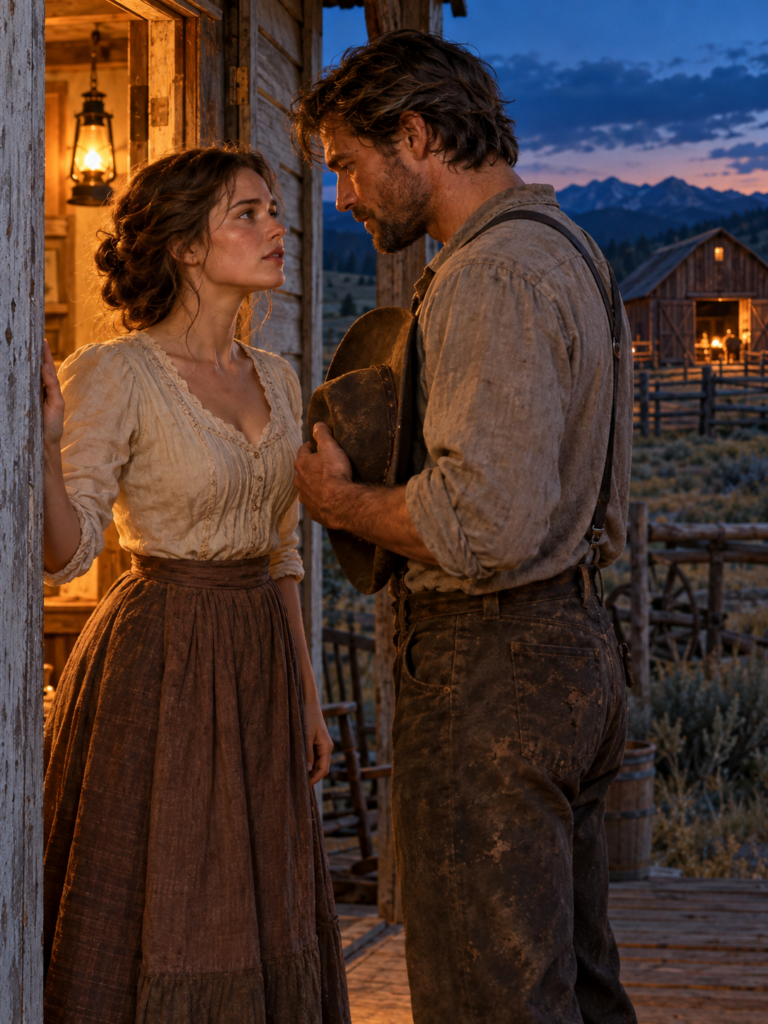
His fingers stopped just short of hers.
Catherine could feel the hesitation in that narrow space between their hands. A man who had climbed onto damaged rafters without complaint now seemed uncertain whether he dared touch a woman’s fingers.
“You can change your mind,” she said.
Colton looked into her face.
“So can you.”
“I know.”
Only then did she take his hand.
His palm was rough from months of carpentry. Hers was marked by the familiar work of tending cattle, carrying pails, and keeping a farm alive.
Nothing about their hands suggested the beginning of a grand romance.
Yet when Catherine drew him nearer, the small movement seemed to undo six years of practiced distance.
Colton leaned down slowly enough for her to refuse.
She didn’t.
Their first kiss was gentle, unhurried, and so unexpectedly tender that Catherine felt the grief she had carried since April shift beneath something she had almost forgotten.
Hope.
When they separated, Colton did not release her hand immediately.
“That,” he murmured, “wasn’t especially sensible.”
“No,” Catherine agreed.
“You’re smiling.”
“So are you.”
He looked mildly startled to discover she was right.
They sat together on the porch steps afterward, their shoulders nearly touching.
For a long time, they listened to the insects and the faint movements of livestock settling for the night.
Then Colton spoke.
“I’ve spent six years making sure there was nothing in any town that would make it difficult to leave.”
“Because of your family?”
“Because there’s always another job. Sometimes a better-paying one. I can’t afford to forget what the money means back home.”
Catherine nodded.
She had seen enough of his careful calculations to understand.
“And now?” she asked.
Colton looked at the house, the barn, the darkened fields.
Then he looked at her.
“Now leaving doesn’t seem like the simple part anymore.”
She rested her hand beside his on the step.
Neither made promises that night.
They simply remained together until the lantern burned low.
For Catherine, that was enough.
For Colton, it was more happiness than he had permitted himself in years.
And that was precisely what made the following week so difficult.
The letter came through the post office.
It offered Colton a foreman’s position on a large cattle ranch near Cheyenne.
The wages were nearly twice what he could ordinarily earn moving from one temporary job to another.
Regular employment.
Steady income.
A chance to provide his mother and Eliza with a degree of security he had been chasing across the West for six years.
He read the offer once outside the post office.
Then again before returning to Catherine’s farm.
And once more that night in the hayloft.
He calculated the money carefully.
His mother’s needs.
Eliza’s schooling.
The expenses that arrived whether work was plentiful or scarce.
The opportunity was almost everything he had been trying to find.
Except it required leaving the first place he had ever genuinely wanted to stay.
For three days, Colton said nothing.
He continued repairing a section of fencing, ate supper with Catherine, and returned her goodnight with the same warmth that had begun to make her blush.
But she noticed something altered in him.
His answers came slowly.
Once, while she was speaking, he seemed not to hear her at all.
On the third afternoon, she carried fresh bedding into the hayloft.
There, on his neatly made bed, lay the folded letter.
She had no intention of searching through his belongings. But the sheet lay partly open, and the prominent wage figure, circled twice in pencil, caught her eye.
She recognized the place named at the top.
Cheyenne.
A considerable distance from their little farm.
She should have turned away.
Instead, she saw enough to understand why Colton had grown so quiet.
A foreman’s position.
Nearly double his ordinary earnings.
An opportunity too important to dismiss.
And he had not told her.
Catherine stood motionless, the clean bedding in her arms.
The pain was not that another ranch wanted him.
She had always known he was free to leave.
It was that he had allowed her to believe they were beginning to share something honest while keeping the choice that might end it entirely to himself.
At last she set the bedding down, folded the letter without disturbing its contents, and walked toward the barnyard.
Colton was repairing a fence rail.
He looked up at her approaching footsteps.
His expression changed when he saw the paper in her hand.
Catherine stopped directly before him.
Then she extended the letter between them.
“You were going to tell me about this, weren’t you?”
Colton laid his hammer down.
For the first time since she had known him, he had no ready answer.
Colton looked at the letter in Catherine’s outstretched hand, then at the hammer lying beside the fence post.
He had faced difficult foremen, uncertain wages, and months when every dollar he earned already belonged to someone waiting hundreds of miles away.
None of those things had prepared him for the disappointment in Catherine Finn’s eyes.
“I meant to tell you,” he said.
“When?”
“As soon as I knew what I intended to do.”
“And you thought I should know nothing until then?”
Colton lowered his gaze.
“I hadn’t decided.”
“That much is plain.”
She held the letter a moment longer, waiting for him to take it. When he did not, she laid it on the fence rail between them.
The paper moved slightly in the afternoon breeze.
Catherine caught one corner beneath her fingertips.
“I understand why you would consider it,” she said. “I know what your mother and sister depend upon. You needn’t apologize for wanting to provide for them.”
“Then what troubles you?”
“That you couldn’t tell me.”
He looked up.
She continued before he could answer.
“I’m not asking you to stay because you kissed me. And I wouldn’t ask you to leave your family wanting simply because I might miss you. But I thought we had begun speaking plainly to each other.”
“We had.”
“Until something mattered enough to frighten you.”
Colton flinched slightly.
It was such an accurate description that denying it would have been foolish.
“The wages are nearly twice what I’ve been earning,” he said. “Eliza could finish her schooling. Mother wouldn’t have to wonder every month whether enough money was coming.”
“I saw the figure.”
“Then you know.”
“Yes. What I don’t know is why you thought you had to face the decision alone.”
He rubbed a hand across the back of his neck.
“I suppose I’ve been making decisions alone for so long I forgot another person might want to understand them.”
Catherine watched him for a moment.
Then she stepped back.
“Well, I do.”
He nodded.
“I’ll remember that.”
“See that you do.”
She turned toward the farmhouse, carrying herself with the same determined composure she used when a calf became troublesome or a day’s work went badly.
Colton watched her go.
He could have followed.
He could have tried to explain everything in a rush, offered promises, or asked her to assure him that whichever choice he made would not hurt her.
But he understood that he had already placed too much responsibility upon her by keeping silent.
For once, the repair required more than working harder.
It required him to speak before he knew the answer.
That evening, Catherine served supper at the kitchen table.
She did not withdraw his plate or treat him coldly.
She asked whether the fence would hold, listened to his answer, and told him which cow had given trouble during milking.
Ordinary conversation continued.
Yet both felt the weight of what remained unsaid.
When the meal was finished, Colton rose to clear the dishes.
Catherine stopped him.
“Leave those. I’ll see to them.”
He stood beside the table.
“I haven’t accepted the position.”
“I know.”
“Nor have I refused it.”
“I know that too.”
He hesitated.
“Would you rather I stopped coming by?”
Catherine looked at him.
“Is that what you want?”
“No.”
“Then don’t make me answer for you.”
He nodded slowly.
“I’ve been doing a fair amount of that lately.”
“Yes,” she said. “You have.”
There was no cruelty in her voice.
Somehow that made the truth harder to escape.
Colton returned to the hayloft and sat on the edge of his narrow bed, holding the letter beneath the lantern.
He read the wages again.
Then he thought of his mother.
He remembered the years after his father’s death, when the little Kansas farm had seemed determined to consume every dollar and every hour they possessed.
At seventeen, he had discovered that growing up could happen in the length of a single funeral.
There had been no time to consider what kind of life he wanted.
His mother needed help.
Eliza needed clothing and schooling.
The farm needed money.
So he went where work could be found.
He learned to mend fences, build roofs, handle livestock, and take instructions from employers who often knew less about the tasks than the hands they hired.
He learned to travel lightly.
Most importantly, he learned to leave.
If he stayed nowhere long enough to become attached, leaving never cost anything more than the price of the journey.
That had seemed a reasonable arrangement.
Until Catherine.
He thought about her old kitchen table, broad enough for a family but occupied by one woman who still sometimes glanced at her father’s empty place.
He remembered finding her one afternoon checking figures in an account book while a pot threatened to boil over on the stove.
When he moved to save the pot, she had rescued her figures first.
“Milk washes off,” she had explained. “Numbers don’t always come back when you’ve lost your place.”
She was capable, stubborn, practical, and occasionally so dryly amusing that he had to turn away to hide a grin.
She did not need a man to inform her how to run a dairy farm.
She needed another pair of reliable hands, a fair division of responsibility, and enough income to keep the holding secure.
He respected her more than he had ever managed to say.
And he wanted to sit at that table for reasons having nothing to do with employment.
But wanting had never been sufficient to settle an obligation.
The next morning, Catherine was waiting in the yard when he came down from the hayloft.
She carried her account book.
“Have you a little time before breakfast?” she asked.
“Of course.”
“I’d like you to look at something.”
They went to the kitchen table.
Catherine opened the book to several pages of figures.
Milk sales.
Feed costs.
Necessary repairs.
The savings she had protected since her father’s death.
Colton studied the numbers carefully.
“Your accounts are better than you let on,” he remarked.
“I’ve never let on otherwise.”
“No,” he conceded. “I suppose you haven’t.”
She pointed to the next page.
“I’ve been working on this since July.”
“What is it?”
“A plan.”
He leaned closer.
She explained that the barn repairs had protected the farm’s most important shelter. With that danger removed, she could begin thinking beyond the next month’s expenses.
There was room to increase the dairy herd gradually, provided the farm could support the extra feed and labor.
She had enough savings for a cautious beginning.
What she lacked was a reliable working partner who understood livestock, buildings, and the demands of a small holding.
Colton followed her calculations.
“You’ve allowed for feed?”
“Yes.”
“Additional fencing?”
“On the following page.”
“And if prices fall?”
“I’ve made a smaller estimate beneath the first.”
He studied her for a long moment.
“How long have you been planning this?”
“Since you finished the barn roof.”
“Why didn’t you tell me?”
She gave him a meaningful look.
“I hadn’t decided whether there was anything worth telling.”
He deserved that.
Catherine allowed him a moment before continuing.
“I cannot offer you the wages from Cheyenne. Not now. Perhaps not for a year or two.”
Colton watched her hand rest upon the account book.
“But I could offer you a regular wage and a genuine share of what this farm earns beyond its expenses. We could decide together how much to put back into the herd, how much to reserve against poor seasons, and how much could be taken as income.”
He remained motionless.
“I don’t need another hired hand for a month,” she said. “I need someone willing to help build something over years.”
“Catherine…”
“Let me finish.”
He closed his mouth.
“I would still own the land my father left me. I’m not offering to surrender that. But the business we grow can belong to us both according to an arrangement we agree upon. You would have a say, a share of the earnings, and a stake that doesn’t disappear whenever the roof is fixed.”
He looked at the numbers again.
She spoke more softly.
“And you could continue sending money home.”
“At first, less than Cheyenne might allow.”
“Perhaps. We would have to be careful. I’m not pretending otherwise.”
“There’s risk.”
“Yes.”
“You’ve thought of that?”
“At considerable length.”
Colton smiled faintly.
She did not.
“I also want something understood,” Catherine said.
He straightened.
“This isn’t payment for what happened on the porch. If you choose Cheyenne, I’ll survive it. I may not enjoy it, but I will manage my farm. And if you stay, it must be because you believe in the work as well as whatever may be growing between us.”
He felt the truth of that settle deeply.
She was not begging him to remain.
She was offering him a future in which both would carry responsibility.
“What exactly are you asking?” he said.
Catherine looked directly at him.
“Stay, Colton. Not as a man waiting for the next position. Stay as my partner.”
The word hung between them.
For six years, every employment agreement Colton had made contained an understood ending.
Finish the job.
Take the pay.
Move along.
This was something different.
The barn roof stood completed. Catherine owed him nothing beyond the wages already agreed.
Yet she was inviting him to share the uncertainty of another season, another year, perhaps many years.
He wanted to accept so badly that the desire frightened him.
“I need time,” he said.
“Then take it.”
“I don’t want to disappoint you.”
“Don’t give me an answer to spare my feelings. Give me one you can stand behind.”
Colton rose slowly.
“Thank you.”
She closed the account book.
“There’s no need to thank me yet. You haven’t earned this partnership simply by looking troubled.”
That coaxed a small laugh from him.
“No, ma’am.”
“And stop calling me ma’am.”
“Yes, Catherine.”
He walked the fence line that evening, considering every figure in her book against the certainty of the Cheyenne wages.
Catherine’s offer had real merit.
It also demanded patience, restraint, and faith in a small farm’s ability to grow.
He could not pretend it guaranteed his family’s security.
Nor could he pretend that accepting the foreman’s position guaranteed happiness.
As twilight settled, he stopped beside the section of fence they had never quite gotten around to repairing together.
The wood was weathered but sound.
He rested both hands upon the top rail.
In Kansas, his mother would be preparing for evening.
Eliza would probably be reading by whatever light remained.
Neither had asked him to sacrifice every possibility of having a life of his own.
He had simply assumed that was what loving them required.
The following morning, he found Catherine carrying two empty milk pails toward the barn.
He took one only after she offered it.
Then he said, “I’ve been thinking about what you asked.”
She stopped.
“I thought you might.”
“I still can’t see how choosing this place isn’t choosing myself ahead of them.”
Catherine regarded him quietly.
Then she set down her pail.
“Colton, I think there’s something we ought to settle before you make any decision.”
She opened the account book she had brought beneath her arm and turned it toward him.
“We need to stop talking as though your family and your future must always stand on opposite sides of the same fence.”
Colton looked down at the open account book.
Catherine had drawn two careful columns across the page.
One held the expenses necessary to operate the farm.
The other showed what might remain for wages, savings, and the monthly money Colton intended to send to Kansas.
He recognized the figures.
They were the same numbers they had studied the previous morning, but Catherine had arranged them differently.
Not to hide the risk.
To make it plain.
“These are cautious estimates,” she explained. “Not promises. If a cow goes dry or feed costs rise, the income changes. We both know that.”
Colton nodded.
“And this is what I could pay you now, before we earn anything from expanding the herd.”
She indicated the regular wage.
“And here is the amount you told me you generally try to send home.”
He studied the two figures.
They were not comfortably far apart.
But they were not impossible to reconcile.
“I could manage that,” he admitted.
“With care.”
“Yes.”
“And any additional profits would be divided according to what we agree. Some should stay here to strengthen the farm. Some would come to you. If we’re fortunate, your family’s position improves as ours does.”
He remained quiet.
Catherine closed the book halfway.
“I’m not asking you to gamble your mother’s well-being on a pretty notion. I would never respect myself for doing that.”
“I know.”
“But you cannot keep measuring every choice by what you might earn somewhere else. There will always be another employer willing to offer something. At some point, you must decide what kind of life all that work is meant to support.”
Colton looked beyond her toward the barn.
Its new roof caught the morning sunlight.
Four months earlier, the building had seemed a temporary assignment.
Now he knew precisely which timbers carried its weight, where the old walls required watching, and how Catherine preferred the doors secured before nightfall.
He had made himself familiar with every weakness of the place.
Somewhere along the way, he had become familiar with its owner too.
“All these years,” he said, “I’ve been thinking that if I wanted anything for myself, I must be taking something away from them.”
Catherine’s face softened.
“Your mother and sister need you, Colton. That much is true. But needing your help isn’t the same as needing you to remain a stranger everywhere you go.”
He looked at her sharply.
She did not turn away.
“Your sister wants to become a teacher. You told me yourself. She’s working toward a future she wants.”
“Yes.”
“Then perhaps the man who’s helped her do that deserves permission to imagine one too.”
For several moments, he could find no answer.
It had been easier to bear the burden when he could call it duty.
The possibility that duty and happiness might share a road was harder to accept, because it required him to change something he had believed for nearly half his life.
“I’ll need to go through every figure again,” he said.
“I would expect nothing less.”
“And we must agree on the terms plainly. I don’t want either of us relying on a promise we remember differently.”
“Neither do I.”
“Your father left you the land.”
“He did.”
“I wouldn’t claim a right to it merely because I work here.”
“I wouldn’t offer one merely because I care for you.”
He smiled.
“Good.”
“Good.”
She stepped nearer.
“Does that sound terribly unromantic?”
“No,” Colton said. “I think it may be the most hopeful conversation I’ve ever had.”
They spent much of that day reviewing the accounts.
There were no grand declarations.
Catherine explained which cattle were most dependable and which expenses could not safely be reduced.
Colton considered the feed requirements of a larger herd and the improvements they would need to make before winter.
They argued mildly over one proposed purchase.
Catherine won the argument by producing figures he had overlooked.
He accepted the correction, then found a less costly way to arrange the work.
By evening, they had a plan that both considered fair.
It did not make them rich.
It gave them a reasonable beginning.
And for the first time in six years, Colton could imagine earning money without already picturing the road that would take him away.
Still, one decision remained.
He needed to answer the ranch near Cheyenne.
That night, seated in the hayloft beneath the roof he had rebuilt, he laid both offers before him.
The foreman’s position promised more immediate money.
Catherine’s proposal offered less certainty but a share in something he could help develop.
He was careful not to confuse affection with sound judgment.
Had she offered a poor arrangement, loving her would not have made it wise.
But she had thought through the business with the same intelligence she brought to every part of the farm.
She understood the risks.
She was prepared to carry them with him.
He realized that the wages in Cheyenne were not the only honest measure of security.
A regular place to work, a fair share of earnings, and a capable partner had value too.
By the time he extinguished the lantern, he knew his answer.
The next morning, he found Catherine near the chicken coop.
She was testing the latch he had repaired weeks earlier.
It closed smoothly.
She frowned at it anyway.
“Still don’t trust my work?” he asked.
“I trust the coop is shut. I simply miss knowing it by the way the latch catches.”
“There’s no pleasing you.”
“There is. You just haven’t always been paying attention.”
He laughed, then grew serious.
“Catherine.”
She turned toward him.
“I’d like to accept your offer.”
For an instant, she said nothing.
The familiar steadiness in her expression gave way to astonishment.
Then she smiled.
“Are you certain?”
“Certain enough to put it in writing and spend the next several years proving we were both sensible.”
“And Cheyenne?”
“I’ll send my answer today.”
She approached him slowly.
“You’re not doing this because of the porch?”
“I’m doing it because I believe your farm can grow. Because I know how to help it grow. Because I’d rather share the results of my work than spend every year beginning again somewhere else.”
He paused.
“And because when the day’s finished, I’d like very much to find you here.”
Catherine reached for his hand.
“That last part is worth mentioning.”
“I thought so.”
She stepped closer.
“Do you still think it’s foolish?”
“Some days I expect I will.”
“Then we shall have that much in common.”
He kissed her gently in the morning sunshine.
The cattle needed tending, the milk pails needed cleaning, and the day held more work than either could finish alone.
But neither hurried to turn away.
Later that week, Colton sent a courteous letter declining the Cheyenne position.
The ranch had offered an honorable opportunity, and he was grateful for it.
He explained only that he had chosen another arrangement.
Then he and Catherine began turning their proposal into an operating partnership.
They set down the agreed wage and how they would divide profits after expenses.
They kept clear accounts of the money each contributed.
Catherine retained ownership of the forty acres inherited from her father.
Colton gained a genuine financial stake in the farm’s business, with a voice in decisions affecting their shared work.
Neither considered affection a substitute for fairness.
That autumn, they increased the herd modestly.
Catherine supplied part of the savings she had guarded since April.
Colton invested some of the wages he had accumulated.
They bought cautiously, knowing that animals required feed, shelter, and attention long after the purchase price had been paid.
A growing herd did not guarantee growing profits.
But good care, careful accounts, and steady work improved their prospects.
Colton continued sending money to Kansas each month.
The amount was familiar to his mother, even if his letters were not.
For years, those letters had mostly contained assurances.
Work was available.
He was healthy.
Money would follow.
Now they began carrying ordinary descriptions of his days.
The dairy cows.
The repaired barn.
The stubborn chicken-coop latch.
And, more often than he intended, Catherine.
He wrote about the way she kept accounts, how she worked beside him when another hand was needed, and how she could detect a mistake in his reasoning before he had finished making it.
His mother noticed the difference.
So did Eliza.
In one letter, his sister observed that he had devoted an extraordinary amount of paper to describing a barn roof.
Colton read the remark at the supper table.
Catherine raised an eyebrow.
“Did you tell her about the roof?”
“Naturally.”
“How much?”
“Enough to explain the repairs.”
“How many pages?”
He folded the letter.
“That’s hardly relevant.”
Catherine laughed until he was obliged to laugh with her.
By the time winter approached, their partnership had settled into a working rhythm.
Some days were difficult.
There were unexpected expenses.
A cow required special attention at an inconvenient hour.
A piece of fencing needed repair just when they had hoped to finish another task.
They occasionally disagreed over how quickly to spend their earnings.
Catherine preferred caution.
Colton sometimes saw improvements that could save labor over time.
Neither was always right.
Both learned to listen.
And every month, they examined the accounts together.
What pleased Colton most was not that the work had become easy.
It had not.
It was that his labor now pointed toward a future he could picture clearly.
The farm was no longer merely somewhere an employer had given him temporary shelter.
It was a place where his judgment mattered, where his earnings had a continuing purpose, and where someone wanted him to come in when the day was done.
For Catherine, the change was equally profound.
She no longer faced every repair and every financial worry alone.
More importantly, she could speak of plans beyond the next season without feeling foolish for making them.
Her father’s farm had once seemed like an obligation too heavy to carry.
Now it was becoming a livelihood she could shape.
And Colton never treated her as though his arrival had transferred authority away from her.
When they disagreed, they worked toward a decision.
When she knew more, he listened.
When he knew more, she asked questions.
They had both spent years doing what necessity demanded.
Partnership gave them room to consider what they might choose.
As their affection deepened, they began speaking of marriage.
Neither treated it as an unavoidable consequence of the kiss on the porch.
They had already proved that they could work together honestly.
Marriage was another choice, one they wanted to make deliberately.
Colton asked her one evening while they stood outside the barn, watching the last light fall across the fields.
He did not kneel dramatically or produce a fine speech.
He simply took her hand.
“Catherine, I’ve been thinking that I’d like to spend the years ahead with you. Not only working this place, but sharing everything that comes with living here.”
She studied his face.
“Even my opinions about how you repair perfectly serviceable latches?”
“Particularly those. They keep a man humble.”
“And my accounts?”
“I’ve learned better than to question them without evidence.”
She smiled.
“You’re improving.”
He grew quieter.
“Would you marry me?”
Catherine looked toward the farmhouse.
It was the same house in which she had watched her father grow old, the same house she had feared losing to repairs and unpaid expenses.
For a long time after his death, she had believed that remaining there meant abandoning the wider life she once imagined.
Now, standing beside Colton, she understood that a home need not be a prison simply because a person chose to return to it.
She turned back to him.
“Yes,” she said. “I would.”
He exhaled with such visible relief that she laughed.
“Did you think I might refuse?”
“You’re a woman of strong opinions.”
“And one of those opinions is that I should marry you.”
“Then I shall endeavor not to argue.”
Their wedding took place at the farm.
It was a modest gathering, made memorable by the people who came and the work that had brought the couple together.
Colton’s mother and Eliza traveled from Kansas.
The town blacksmith attended too, claiming more credit for the match than Catherine thought entirely justified.
“I only told her you could fix a roof,” he reminded Colton.
“You’ve told everyone that several times,” Colton replied.
“Because it was important advice.”
Catherine shook her head.
The blacksmith surveyed the solid barn.
“Mind you, I suspected something when he chose such fine lumber for a temporary job.”
Colton said nothing.
That was quite enough encouragement for the blacksmith to continue.
Eliza, now a bright and determined young woman with her sights still set upon teaching, proved equally merciless toward her brother.
“You know,” she told Catherine, “his letters got much longer after he came here.”
“Did they?”
“Terribly long. He described everything. The roof. The fences. The cattle.”
“All important subjects,” Colton protested.
“Then there was the woman who managed the farm. He managed to mention her in nearly every letter.”
“I had reason to.”
“Oh, certainly. Nothing more interesting than a widow who keeps excellent accounts.”
Catherine laughed.
Colton resigned himself to the teasing.
Later, while the guests talked near the barn, his mother found Catherine standing quietly beside the open doorway.
She took Catherine’s hands.
“Thank you,” she said.
Catherine looked surprised.
“For what?”
“For giving my boy a reason to stop wandering.”
Catherine glanced across the yard.
Colton was helping Eliza carry something toward the farmhouse, listening patiently while his sister continued talking.
“He gave me one too,” Catherine replied.
His mother squeezed her hands.
“I think he’s been trying to take care of us for so long that he forgot he had a life of his own.”
“I know.”
“I never wanted him to forget.”
Catherine felt emotion tighten her throat.
“He hasn’t stopped caring for you.”
“I know that too. His letters tell me.”
They stood together for another moment.
Then his mother smiled.
“And I believe he’ll be writing even longer ones now.”
After the wedding, Colton carved their initials into the new barn door.
He chose a place low near the hinge, where the marks were hidden unless someone knew to look.
Catherine discovered them several days later.
She crouched to examine the small carving.
“Why put them down here?”
Colton joined her.
“Didn’t see much reason to put them where everyone passing through could find them.”
“They’re hardly a secret.”
“No.”
“Then why hide them?”
He ran a thumb over the wood.
“I suppose I like the thought of there being something here that’s just ours.”
Catherine touched the marks.
Two small initials beside two more.
Nothing elaborate.
Yet the meaning pleased her more than anything polished or expensive could have done.
The barn had first been the problem that brought them together.
Now it carried a small reminder of the life they had chosen.
The years that followed were not free of difficult seasons.
Farm work rarely allowed such luxury.
But their herd increased steadily rather than recklessly.
They improved what needed improving and postponed what could wait.
Colton’s regular payments continued reaching Kansas.
In time, their growing business gave him greater freedom to help his family without uprooting himself.
Within three years, Eliza’s schooling had been paid for.
When she wrote about her studies, Colton read her letters with a satisfaction Catherine recognized immediately.
It was the expression he wore after finishing a difficult task and knowing the work would last.
One evening, Catherine found him sitting at the kitchen table, holding a letter from his sister.
“Good news?”
He looked up.
“She’s doing well.”
“I thought she would.”
“She’s worked hard.”
“So have you.”
Colton considered the letter.
“I used to think sending the money was the whole of my responsibility.”
“And now?”
“Now I think I ought to have written to her more about living, instead of only about working.”
Catherine sat beside him.
“There’s still time for that.”
He smiled.
“Yes. There is.”
It was a small conversation.
Yet it marked how far he had come from the restless hired hand who once believed attachment was an expense he could not afford.
He had not become less devoted to his family.
He had learned to be devoted without disappearing into the duty.
Catherine changed too.
For years, the old map in her kitchen drawer had been a quiet reminder of roads she never traveled.
Her father had needed her help.
Later, the farm had needed her strength.
She had almost accepted that wanting to see distant places belonged to a younger version of herself.
But one spring, as their third year of marriage began, Colton discovered the map spread across the kitchen table.
Catherine had been looking at Denver.
He stood behind her chair.
“Thinking of going somewhere?”
She folded her arms.
“Only thinking.”
“That’s generally where going begins.”
“The cows won’t milk themselves.”
“No.”
“And there are arrangements to make.”
“There are.”
“And we cannot simply abandon the farm for a week.”
“Certainly not.”
She looked over her shoulder.
“You’re agreeing with me rather readily.”
“I’m waiting to hear whether you’ve finished listing the difficulties.”
Catherine eyed him.
“Perhaps.”
“Good. Because I’ve been looking at the same question.”
He explained that, with the herd now more stable and their finances stronger, they might be able to arrange trustworthy help for a short absence.
They would have to plan carefully.
The animals would still need proper attention.
They could not afford a careless holiday.
But a week away no longer seemed impossible.
Catherine stared at him.
“You’ve been planning this?”
“Considering it.”
“Without telling me?”
He winced.
She laughed.
“Colton Briggs, haven’t we discussed that particular habit?”
“Frequently.”
“And?”
“I was going to ask you before making arrangements. I only wanted to know whether the idea was practical.”
“Is it?”
“I believe we can make it so.”
She looked at the map again.
For ten years, the marked towns had represented everything she could not reach.
Now one of them might become a real journey.
“Denver,” she said softly.
“If that’s where you’d like to begin.”
She reached across the table and took his hand.
“It is.”
They traveled when the farm could spare them, stayed for a week, and returned with more stories than Catherine had ever expected to bring home from a place she once knew only as a name on paper.
The following year, they ventured farther.
They did not become careless wanderers.
Both loved the farm too much for that.
Instead, they learned to make room for the world beyond it.
Catherine discovered that coming home could be as satisfying as leaving when the departure had been freely chosen.
Colton discovered that travel felt entirely different when someone was going with him and the road led back to a place where they belonged.
One cool morning several years after their first meeting, Catherine stood beside the chicken coop, attempting to close its latch.
It moved with the same easy action Colton had given it that first summer.
She frowned.
“You know, you could have left this thing the way it was.”
Colton, seated nearby with his coffee, glanced over.
“I could have.”
“It used to catch. I liked knowing it was secure.”
“It is secure.”
“So you keep telling me.”
“And yet you test it every morning.”
“Because a sensible woman checks what she’s responsible for.”
He smiled into his cup.
“I’ve learned that.”
She walked over to him.
“You’re a stubborn man, Colton Briggs.”
“I had an excellent teacher.”
“Oh?”
“A woman who once told me to do something foolish before making up my mind.”
Catherine leaned against the porch post.
“And was she wrong?”
He looked at her for a long moment.
Then he set aside his coffee and rose.
“No,” he said. “She wasn’t.”
He took her hand.
The gesture was familiar now, but Catherine still remembered the first time he had reached toward her fingers and stopped, uncertain whether he had permission to come closer.
So much of their life together had begun with that small hesitation.
A man afraid to want something.
A woman afraid that wanting more meant losing what she already had.
A repaired roof.
A shared table.
A carefully written agreement.
Letters mailed to Kansas.
A map finally taken out of its drawer.
None of those things had made their marriage remarkable to anyone passing by.
But together they had become the life they loved.
Later that evening, they walked toward the barn as the last light settled over the forty acres.
Its roof remained strong.
Its walls were whitewashed.
The cattle moved peacefully beyond the fencing they had spent so many seasons maintaining.
Catherine paused beside the door.
She bent and found the small initials Colton had carved years before.
The marks were weathered but still clear beneath her fingertips.
“You know,” she said, “when I hired you, all I wanted was someone to fix that roof.”
“I remember.”
“I thought you’d be gone inside a month.”
“So did I.”
She straightened.
“And look at all the trouble that came of it.”
Colton rested his hand against the barn door.
“Terrible trouble.”
“A bigger herd.”
“Longer accounts.”
“More repairs.”
“A wife who still disputes my workmanship.”
She smiled.
“And a husband who doesn’t know when to leave well enough alone.”
He turned toward her.
“I’ve learned when to stay.”
The words settled between them with the quiet weight of everything they had lived.
Six years of traveling had taught Colton how to leave a place without looking back.
Ten years of postponed dreams had taught Catherine how to remain in one place without expecting more.
Together, they had learned something neither understood alone.
A responsibility could be honored without surrendering every desire.
A home could be loved without becoming a prison.
And two people could choose each other not because one needed rescuing or the other needed saving, but because the work, the trust, and the life ahead were better when shared freely.
Catherine took his hand.
The barn door stood open beside them.
Far away, the old roads still ran toward Cheyenne, Kansas, Denver, and countless places they might someday visit.
But tonight, neither felt the need to follow them.
There were cattle to tend in the morning, accounts to settle, and a comfortable kitchen waiting across the yard.
Colton picked up the lantern.
Catherine reached for the barn door.
Together, they closed it, tested the familiar latch, and walked home.
