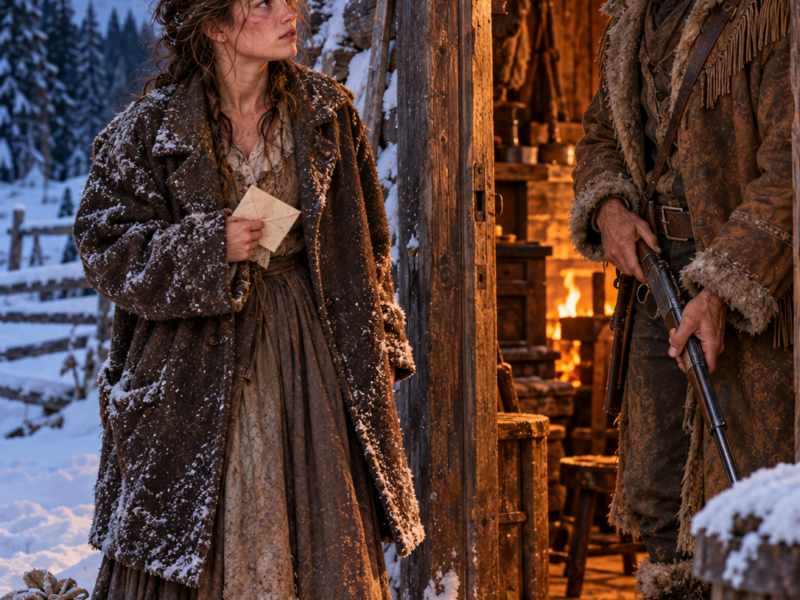
Abigail reached beneath the washstand, found the hammer, and placed it in Amos’s waiting hand.
Above them, the roof groaned again.
Toby lifted his head from the mattress.
“Mama?”
“Stay with your sister,” Abigail told him. “We’re fixing something.”
Amos examined the exposed rafters by lantern light.
The storm had not yet reached its full strength, but snow was collecting on the weakened roof.
“This beam’s been giving trouble awhile,” he said.
Abigail nodded.
“David meant to strengthen it.”
“Your husband?”
“Yes.”
She looked away.
“He died before finishing.”
Amos did not ask how.
There would be time for questions later.
He found several short boards among the household scraps and strengthened what he could reach from below.
They were not enough to make the roof sound, but the bracing might help it withstand the night.
Abigail held the lantern while he worked.
When she saw a board slipping, she shifted her grip and told him.
He followed her direction without argument.
Finally he stepped back.
“That should help us until morning.”
“Should?”
“I won’t promise what I can’t know.”
She appreciated the answer more than a false reassurance.
A gust struck the cabin.
Cold air whistled between the wall logs.
Amos studied the openings.
“Have you any clay soil nearby?”
“Near the spring.”
“Bucket?”
“Beside the door.”
He explained that damp earth mixed with fibrous material could be packed into the worst gaps once the weather allowed them to gather it. For now, they could use the material already inside to block the drafts.
Abigail showed him where she kept old cloth scraps and packing material.
Together they worked along the coldest wall.
He was faster with the heavier work.
She knew which openings troubled the cabin most when the wind came from the north.
By the time they finished, the stove’s warmth was holding better.
Toby and Nelly slept beneath their new blankets.
Abigail sat at the table, exhausted.
Amos poured the remaining coffee into her cup.
She accepted it.
For a while neither spoke.
Then she looked toward the stacked provisions.
“My husband would have been ashamed to see us needing all that.”
Amos sat opposite her.
“Would he?”
“He was proud of this place.”
She lowered her eyes.
“David believed we could make a living from it. There was timber, a spring, and enough cleared ground for planting.”
“What happened?”
“He was cutting trees for building and firewood. One came down wrong.”
Amos’s face changed slightly.
Abigail continued.
“The neighbors helped bury him. After that, I tried to keep things together.”
“And Miller?”
“David owed him money. I thought I could settle it with work.”
She rubbed her damaged hands.
“But the account never seems to grow smaller.”
Amos glanced toward the window.
“Did David leave the papers?”
“Yes. In a strongbox beneath the floor.”
“Keep them safe.”
She studied him.
“Do you think Miller can take our land?”
“I don’t know what the papers allow. We’d have to read them.”
Abigail’s expression tightened.
“I have tried. I know what David borrowed. I know payments were missed.”
She drew a slow breath.
“But I haven’t been able to make Miller explain exactly what is owed now.”
Amos considered that.
“Then we’ll look at the figures when there’s light.”
“We?”
“If you want my help.”
She was silent.
Then she nodded.
“Yes. I do.”
Something eased between them.
Not trust entirely.
But the beginning of it.
Amos rose to feed the stove.
As he bent, Abigail noticed a small worn leather cord emerging from beneath his shirt.
A child’s little carved wooden token hung from it.
His fingers closed around the object before she could see it clearly.
She looked away.
He had his own sorrows.
She understood enough not to demand them.
Outside, the wind climbed.
The storm pressed snow against the window until the glass disappeared behind whiteness.
Hours passed.
The children slept.
Abigail struggled to keep her eyes open.
Amos remained awake beside the stove, listening.
At last, the storm struck with such force that the door shook in its frame.
Amos stood.
A heavy cracking noise sounded overhead.
He looked up sharply.
A small shower of bark fell near the table.
“Abigail.”
She rose immediately.
“Wake the children.”
Toby stirred as she reached him.
Nelly began to cry.
“Bring them beneath the table,” Amos said. “Away from the middle of the room.”
Abigail gathered the children and guided them into the safer space.
Then she turned.
Amos was standing beneath the sagging roof beam.
He looked from the damaged ceiling to the wooden bed frame.
There was no suitable spare post.
No way to remove the accumulated snow in the darkness without endangering himself further.
The roof cracked again.
Amos reached for the axe.
“I’m going to take timber from the bed frame,” he said. “It may give us a temporary support.”
Abigail glanced at her children.
Then back at him.
“Tell me where you need my hands.”
He pointed toward the thick wooden footboard.
“Help me free that.”
She crossed the room, grasped the timber, and began pulling as Amos loosened its fastenings.
The damaged roof groaned above them.
Abigail pulled hard on the footboard while Amos freed the last stubborn fastening.
The timber came loose with a sharp crack.
She nearly lost her balance.
Amos caught the wood before it struck the floor.
“Easy,” he said.
The roof answered with another ominous groan.
There was no time to waste.
Amos turned the thick footboard upright beneath the weakest section of the ceiling beam.
It was almost long enough.
Almost.
“Hold it steady,” he told Abigail.
She planted her boots against the dirt floor and gripped the timber with both hands.
The weight was difficult to control.
Her cracked palms burned.
Amos found a wooden block and the iron wedge from his tools.
He fitted the block beneath the makeshift post and carefully drove the wedge into place.
The timber rose enough to press firmly against the beam.
Another cracking sound filled the room.
Abigail gasped.
“I can’t hold it much longer.”
“Move your hands lower. I’ll take the weight.”
He stepped beside her and steadied the support.
Together they kept it straight while he adjusted the wedge.
At last the post settled firmly between floor and ceiling.
The beam remained bowed.
But its movement stopped.
Amos examined the timber without touching it unnecessarily.
Then he stepped back.
“Leave it be.”
Abigail stared at the support.
“Will it hold?”
“Long enough to get us through the night, I hope.”
The uncertainty frightened her.
But his refusal to lie made her believe the rest.
She looked toward the children.
Toby was peering out from beneath the table.
“Did you catch the roof, Mr. Amos?”
Amos glanced at Abigail.
“Your mother helped hold it.”
Toby looked up at her with enormous eyes.
Abigail crouched beside him.
“We’re all right for now.”
Nelly reached toward her, and Abigail gathered the little girl close.
The child was warm beneath the new blanket.
That single fact nearly brought Abigail to tears.
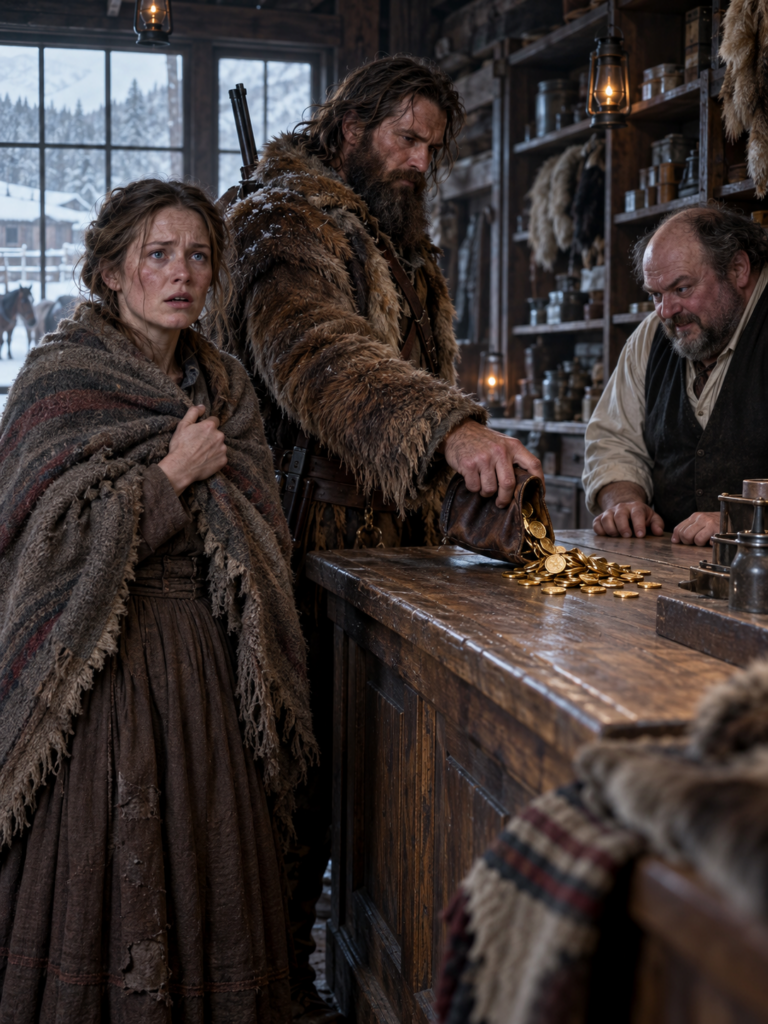
Only yesterday, she had stood before Miller’s counter wondering whether she could bring home enough food to keep her children alive.
Now the cabin was warm.
They had supplies.
And a stranger who had no obligation to them was sitting beside the stove, keeping watch over a damaged roof.
She did not understand him.
That troubled her almost as much as it comforted her.
***
By morning, the storm had eased enough for Amos to examine the roof from outside.
He cleared a narrow passage through the drifts and went up with a shovel fashioned from boards available around the homestead.
He worked cautiously, removing accumulated snow in manageable sections so the weakened structure would not bear unnecessary strain.
Abigail watched from the doorway.
“Be careful,” she called.
He glanced down.
“I’m trying.”
“You could fall.”
“I’ve noticed.”
She frowned.
Then realized he was teasing her.
It was the first sign of humor she’d seen from him.
She returned inside, shut the door against the cold, and prepared food for the children.
When Amos came down, she made him sit at the table.
“You’ll eat before you go up again.”
He regarded her.
“Is that an order?”
“It is my kitchen.”
Something like a smile moved beneath his beard.
“Then I reckon it is.”
They spent the following days making the cabin safer.
Amos repaired the worst gaps in the walls and strengthened the door.
Abigail sorted the supplies and decided where each item should be stored away from dampness.
She knew the habits of the house, the places mice could reach, and the corners that stayed coldest.
He listened.
The work progressed faster because they used both kinds of knowledge.
Toby followed Amos whenever he could.
He asked about traps, mountain trails, the pack mule, and the scar along the man’s neck.
Amos answered most questions briefly.
When he tired of them, he said so.
Toby learned that the mountain man did not dislike him.
He simply had not spent much time around children lately.
Nelly took longer.
For the first several days she watched him from behind Abigail’s skirt.
Then one afternoon, while Abigail mended Toby’s coat, Amos sat carving a wooden spoon from a piece of birch.
Nelly edged closer.
He stopped the knife.
“Want to see?”
She nodded.
He showed her the unfinished spoon, turning it slowly so she could see the curved bowl and handle.
“Will it be mine?”
He glanced at Abigail.
Her mother nodded.
“If Mr. Amos wishes to give it to you.”
Amos returned to his carving.
“Reckon I can manage that.”
Nelly sat nearby, watching in delighted silence.
Something changed in Amos’s expression that afternoon.
Abigail noticed.
He looked almost frightened by the child’s trust.
***
On the second evening after the roof had been made temporarily safe, Abigail finally asked the question she had been carrying since the trading post.
“Why did you do it?”
Amos was sharpening his axe beside the stove.
“Do what?”
“Buy the wagon. The food. Everything.”
He did not answer immediately.
She placed her sewing in her lap.
“I understand you are kind enough to help strangers. But that was more than ordinary kindness.”
Amos continued working the stone along the blade.
“It was money I’d earned from furs and years of work.”
“I know.”
“Money wasn’t doing much good in my pack.”
“That doesn’t explain it.”
He stopped.
The children were asleep.
Firelight moved across the rough walls.
At last he set the axe aside.
“I had a family once.”
Abigail remained still.
“A wife,” he continued. “And a boy.”
His eyes shifted toward the carved spoon resting on the shelf.
“The boy was about Toby’s age when he died.”
Abigail felt her chest tighten.
“I’m sorry.”
“Fever took him.”
He looked down at his hands.
“We were living far from town. By the time I understood how bad he was, there wasn’t help close enough.”
His voice remained controlled.
But Abigail could hear how much effort that control required.
“His mother fell ill afterward. I lost her too.”
The room seemed quieter.
Abigail did not reach for him.
She could see that he was struggling simply to speak.
“I had money,” Amos said. “More than I needed. I’d earned some of it working a cattle drive before I took to the mountains.”
He shook his head.
“Couldn’t buy back one hour with either of them.”
Abigail lowered her gaze.
“And afterward you went into the timber?”
“Yes.”
“Why?”
He considered the question.
“Up there, a man knows what the day wants from him. Find water. Keep a fire. Watch the weather. Set traps. Check the trails.”
He paused.
“There’s not much room left for remembering.”
She looked toward Toby and Nelly.
“And when you heard me say they hadn’t eaten…”
Amos nodded.
“I remembered my boy.”
Abigail’s eyes filled.
For the first time, she understood that the wagon had not been purchased because Amos considered himself wealthy enough to impress a widow.
He had seen something he could prevent.
And he had refused to stand aside.
But she also understood the danger in allowing that loss to define everything between them.
“Amos,” she said gently, “Toby and Nelly cannot replace your children.”
He looked up sharply.
She held his gaze.
“And I cannot replace your wife.”
His expression tightened.
“I know that.”
“Do you?”
The question was not cruel.
It was necessary.
Amos looked toward the sleeping children.
For a long time he said nothing.
Then he nodded.
“Yes,” he answered quietly. “I do.”
Abigail reached across the table and rested her fingers beside his hand.
“Then perhaps we can be grateful for what you have done without making it into something either of us owes.”
He studied her hand.
“Perhaps we can.”
That night, Amos slept near the stove as before.
But when Abigail told him good night, he answered her by her first name.
It was a small change.
She remembered it.
***
As the weather improved, Abigail returned to work around the cabin.
Her strength recovered gradually.
She began mending clothing that could be traded or sold in town.
The children grew livelier.
Amos saw to the animals, gathered usable firewood, and continued improving the shelter.
But not everything had been settled.
One afternoon, while repairing a bed support, Amos asked about the strongbox Abigail had mentioned.
She retrieved it from beneath the floorboards.
Inside lay David’s papers.
Amos spread them across the table with her permission.
One was a mortgage note.
David had borrowed three hundred dollars against the homestead for seed and tools.
The note had come due the previous November.
The bank had transferred its interest to Miller.
Abigail showed Amos the repayment entries she had managed to keep.
“David expected the harvest to cover it.”
“What happened?”
“Locusts ruined the wheat in August. Then he was killed cutting timber.”
She traced a line on the paper.
“I tried to arrange more time. Miller refused.”
Amos examined the documents.
The principal was still substantial, and the overdue charges required verification.
“So Miller holds the note now.”
“Yes.”
“And he’s been refusing you food on credit while this debt remains unsettled.”
Abigail nodded.
Amos looked toward the window.
“What does he want with the property?”
“The spring runs even in dry months. And there’s good pine above the cabin.”
“Miller owns timber interests?”
“A sawmill in town.”
Amos understood her concern.
But he did not claim to know the merchant’s motives for certain.
“He might see more value here than the little you’ve cleared.”
Abigail folded her arms.
“This was David’s land. It’s where the children have lived. I don’t want Miller taking it because he believes I cannot manage the payments.”
“What do you want done?”
She studied the documents.
“I want the amount checked. Then I want a proper agreement to settle it.”
Amos nodded.
“I’ll help you read the figures.”
She looked relieved.
Then a distant dog bark sounded from the trail.
Amos turned toward the window.
Through the remaining snow, three riders were approaching.
One carried a shotgun across his saddle.
Abigail’s expression changed.
“The man in front is Carver.”
“You know him?”
“He collects debts for Miller.”
Amos looked at the strongbox.
Then toward the children.
“Have them stay away from the front window.”
Abigail gathered Toby and Nelly into the rear of the cabin.
Amos took his rifle from the wall.
She looked at the weapon.
“Please don’t start shooting.”
“I don’t intend to.”
He went to the door.
Outside, the riders halted near the clearing.
Carver dismounted only halfway, keeping one foot in his stirrup.
“Mrs. Hayes!” he called.
Amos stepped onto the porch.
“She’s here.”
Carver studied him.
“You the mountain man from Miller’s store?”
“Yes.”
“Then you’ll know why we’ve come.”
“State it.”
Carver removed a folded paper from his saddlebag.
“Miller holds a note against this property. It’s overdue. We’re here to serve notice and inspect what’s available toward the debt.”
Amos remained still.
“You can leave the paper. You’re not taking goods I purchased.”
Carver’s gaze moved toward the wagon.
“Miller says there’s enough food here to make a decent payment.”
“The food isn’t his.”
Carver smirked.
“Debts don’t vanish because a generous fool buys groceries for a widow.”
Amos’s hand remained near the rifle.
“Nor does buying groceries give Miller ownership of them.”
The rider with the shotgun shifted uneasily.
Carver’s tone hardened.
“Step aside.”
Amos did not move.
“This is Mrs. Hayes’s home. She will speak for herself. You can deliver your notice without entering.”
Carver swung down from his horse.
“You telling me my business?”
“No. I’m telling you where the door is.”
Carver reached toward the revolver at his belt.
Amos saw the movement.
“Don’t.”
The warning came quietly.
For one moment, the men stared at one another.
Then Carver drew.
The next seconds broke apart in noise.
Amos brought up his rifle and fired.
The shot struck the shotgun held by the second rider, smashing its mechanism and injuring the man’s hands.
The startled horses lurched.
Carver fumbled with his revolver as his mount shied sideways.
The third rider attempted to intervene and was thrown hard during the confusion.
Amos dropped his empty single-shot rifle and moved toward Carver.
By the time the dust and powder smoke began to clear, Carver’s revolver lay in the snow.
The two men faced each other across the churned ground.
Carver was breathing hard.
One of his companions groaned beside the trail.
Amos’s voice was low.
“You brought weapons to a widow’s door and threatened to take her children’s food.”
Carver looked toward the wounded man.
“You’ve gone too far.”
“Then take them for treatment.”
Amos pointed toward the road.
“Leave the notice. Tell Miller he can have his account examined properly. But he is not sending armed men here to help themselves to property that isn’t his.”
Carver hesitated.
Then he collected the fallen paper, placed it on the porch step, and turned toward his companions.
He wanted no more of this fight.
Amos watched until the riders began moving down the trail.
Only then did he return to the door.
Inside, Abigail stood beside the open floor hatch, her children close behind her.
Her face was pale.
She had heard the gunshot.
Amos set the rifle aside.
“The men have gone.”
She stared at him.
“Are they dead?”
“No.”
“Will they come back?”
“I don’t know.”
Abigail looked toward the children.
Then she approached the table.
Her voice shook, but it did not break.
“We cannot live waiting for men with guns to settle a debt, Amos.”
He lowered his eyes.
“I know.”
She placed David’s mortgage papers in front of him.
“Then we must settle this properly. Before Miller sends anyone else.”
Amos looked down at the documents.
And for the first time since entering her life, he realized that protecting Abigail’s home would require something more difficult than facing danger.
It would require trusting her to decide what became of it.
Amos looked from the mortgage papers to Abigail’s face.
Outside, the last of Carver’s riders disappeared beyond the trees.
The gunshot still seemed to echo in the cabin.
Abigail stood beside the table with both hands resting on the wood.
“Tell me something,” she said.
Amos waited.
“When those men came, were you protecting my home, or were you deciding what should happen to it?”
The question struck harder than he expected.
“Protecting it.”
“And if I had asked you to let them deliver their papers and leave?”
He hesitated.
“I thought they meant to take the supplies.”
“So did I.”
She looked toward Toby and Nelly.
“But I will not have my children growing up believing every quarrel must end with someone hurt.”
Amos glanced toward the door.
The wounded man’s cries had followed him long after the riders left.
“I should have found another way.”
Abigail studied him.
She had seen him stand between her family and men carrying weapons.
She had also seen the terrible speed with which that confrontation had turned violent.
Both things were true.
“You saved us from hunger,” she said. “And you helped keep this roof over our heads.”
Amos lowered his gaze.
“But I need more than protection. I need to know you will listen when I say something must be done differently.”
He met her eyes.
“I’ll listen.”
“Even when you’re afraid?”
“Especially then.”
She nodded slowly.
“Good.”
It was not forgiveness for everything that had happened.
It was a beginning.
***
The notice Carver had left confirmed what Abigail feared.
The overdue mortgage threatened her right to remain on the property unless the debt could be settled.
Amos read the papers carefully with her.
The original principal was three hundred dollars.
Additional charges had been entered, but the exact balance required confirmation.
Abigail had saved a few receipts and records.
David’s written accounts showed what he had borrowed and what he had intended to repay from the failed wheat harvest.
There was no hidden fortune.
No legal trick that would make the debt vanish.
The money had been borrowed.
The harvest had failed.
David had died.
And Abigail had been left responsible for finding a way forward.
Amos studied the figures.
Then he looked toward the strongbox.
“How much have you saved from sewing?”
“Not enough.”
“Enough to show you’ve been trying?”
“Yes.”
He nodded.
“We’ll take the records when we go to town.”
Abigail looked at him.
“And then?”
“We’ll find out what Miller will accept to settle the note.”
She was silent.
Amos understood why.
Money had already been used as a weapon against her.
She had stood in Miller’s store begging for flour while the merchant measured her need against a ledger.
Now Amos was offering to help with the same debt.
He did not want to make a different kind of prison out of his generosity.
“Abigail,” he said, “I have gold left from my work.”
She stiffened.
“I know.”
“I could help pay it.”
She shook her head.
“You’ve already spent more than you should.”
“That’s for me to judge.”
“And this land is for me to judge.”
He accepted the correction immediately.
“Yes.”
She looked away.
“I cannot have you buy my home and then expect me to be grateful for living in it.”
Amos leaned forward.
“Then we won’t do that.”
She turned back.
“What do you mean?”
“If I put money toward the debt, we can have the agreement written so the land stays yours. We can make clear what’s a gift and what’s a loan, if you want to repay any part.”
Abigail studied him.
“And you won’t ask to own it?”
“No.”
“Not even half?”
“Not unless someday you freely decide that’s what you want.”
She looked down at the papers.
For months, every discussion of money had left her feeling smaller.
This was the first in which someone had asked what she wanted the terms to be.
“I want the bank to confirm the balance,” she said.
“We’ll do that.”
“And I want receipts for every payment.”
“You’ll have them.”
“And I will not promise marriage in exchange for help.”
Amos looked surprised.
Then his face softened.
“I haven’t asked for that.”
“I know. I need to say it anyway.”
“Then I’m glad you did.”
***
The remaining winter was not easy.
The storm damage could be repaired temporarily, but the cabin still needed substantial work before another cold season.
Amos strengthened the roof and repaired the shed as materials and weather permitted.
Abigail managed the provisions carefully.
They had enough food to eat, but there was still the matter of feeding the animals, keeping the stove supplied with wood, and preparing for spring planting.
Toby became Amos’s eager assistant whenever the task was safe.
He learned how to carry kindling, care for the mule, and keep tools dry.
He also learned that mountain knowledge did not make Amos infallible.
Once, Amos misplaced a small carving tool.
Toby found it beneath a pile of wood shavings.
“You ought to keep better track of your things, Mr. Amos.”
Amos looked at the boy.
Then at the tool.
“Reckon you’re right.”
Toby grinned.
Abigail laughed from the table.
It was the first full, unguarded laugh Amos had heard from her.
He looked up.
For an instant, the kitchen seemed to contain something he had believed was gone forever.
Not the life he had lost.
Something new.
That distinction mattered.
His son was not standing before him.
His wife had not returned.
But the room was warm.
Children were laughing.
And he was allowed to be present for it.
***
By late March, the worst of the winter had broken.
Snow retreated from the southern slopes.
The trail toward Oak Haven became passable again.
The spring behind the cabin ran clear beneath its remaining fringe of ice.
Amos had been watching the weather.
His trapped furs were still packed carefully for sale, but they would not improve by sitting in the shed.
He needed to take them to a larger market.
Cheyenne offered better opportunities for trading and arranging the necessary purchases.
One evening, Abigail found him examining the pack saddles.
“Preparing to leave?”
He looked up.
“Need to trade the pelts.”
“When?”
“Soon.”
She nodded.
Then walked past him into the cabin.
Amos watched her go.
He had spent years traveling alone.
Departure had always been simple.
Pack the mule.
Extinguish the fire.
Follow the trail.
Now the thought of riding away from the blue-gray smoke above Abigail’s chimney left an unfamiliar ache in his chest.
Inside, she was stirring beans over the stove.
Toby was teaching Nelly a counting game.
Amos sat at the table.
For a while, nobody spoke about his journey.
Then Abigail put the spoon down.
“Will you come back?”
Amos looked toward the children.
“Yes.”
She studied him.
“You have always lived in the mountains.”
“For a long time.”
“And you said you preferred being alone.”
“I did.”
“What changed?”
He rubbed his hands together slowly.
“I found out I don’t prefer it as much as I thought.”
Abigail’s heart began beating harder.
She lowered her gaze.
“You have been good to my children.”
“They’re good children.”
“And good to me.”
Amos said nothing.
She looked back at him.
“But I don’t want you staying because you cannot bear to remember your own family.”
The words hurt.
Because they were close to something he had feared himself.
He sat with them.
Then he answered.
“I remember them every day.”
Abigail waited.
“I used to think being alone was the only way to keep what was left of them.”
He looked toward Nelly, who was trying to balance a wooden spoon across her palm.
“But remembering them doesn’t mean I can’t care about anyone else.”
Abigail felt tears gather.
She blinked them back.
Amos continued.
“I don’t expect you to make a home for a man who can’t stand his own thoughts.”
He paused.
“I want to help build one because I believe there could be a good life here.”
Abigail moved slowly toward the table.
“And what would that life look like?”
He gave a quiet, uncertain laugh.
“I know how to build a shed. Haven’t thought much beyond that.”
“Then perhaps you’d better begin.”
He smiled.
“I reckon I should.”
***
Before leaving, Amos laid his remaining gold on the table.
Abigail stared at the coins.
“What is this?”
“Money I can put toward settling the mortgage.”
She shook her head.
“I told you—”
“I remember what you told me.”
He pushed none of the coins toward her.
Instead, he waited.
“I’ll take the papers and see what the bank confirms. If you choose to accept the help, the debt will be cleared in your name. Not mine.”
Abigail sat opposite him.
“And what do you want in return?”
Amos looked toward the window.
Beyond it, the bare earth of the garden was beginning to show through the thawing snow.
“I’d like to plant something.”
She frowned.
“Plant?”
“Wheat. Vegetables. Something that grows instead of something I trap.”
His voice softened.
“I’ve spent a long time taking what I needed out of the timber and moving on. I’d like to stay somewhere long enough to see what comes up in spring.”
Abigail studied his face.
“And if I said no?”
“Then I’d still see the debt settled if you accepted that help. And afterward I’d leave you in peace.”
She believed him.
Not because he sounded noble.
Because she had already told him no, more than once.
And he had listened.
She reached across the table.
“Then there is something I would like.”
“What?”
“A proper agreement. I want to know what belongs to whom, what work must be done, and what we are each promising.”
Amos nodded.
“And afterward?”
She smiled faintly.
“Afterward, Mr. Mountain Man, perhaps you could ask whether I’d like you to stay.”
He looked at her for a long moment.
Then he said it simply.
“Abigail, would you like me to make a home here with you and the children?”
She took a slow breath.
“Yes.”
His shoulders relaxed.
“But we will make it together,” she added.
“Together.”
And for the first time since David’s death, Abigail could imagine the seasons ahead without feeling that every one of them would be another struggle she had to face alone.
***
The journey to settle the mortgage and sell the furs took Amos away from the homestead.
Abigail did not spend those days waiting helplessly at the window.
She had work to do.
She prepared the garden soil, patched clothes, sorted seed, and helped Toby repair a small fence around the planting ground.
She also went through David’s remaining records.
Looking at the papers no longer filled her only with dread.
They reminded her of the hopes she and her husband once shared.
David had wanted a home where his children could grow up with something of their own.
He had not lived to see that hope fulfilled.
But Abigail realized she could honor it without spending the rest of her life trapped inside his unfinished plans.
The homestead could change.
She could change.
And those changes would not erase him.
One afternoon, Toby found her looking at the garden.
“Mama?”
“Yes, sweetheart?”
“Will Mr. Amos come back?”
“He said he would.”
“Do you believe him?”
Abigail thought carefully.
“Yes.”
Toby nodded.
“Good. Nelly wants him to make another spoon.”
Abigail smiled.
“Does she?”
“She says the first one doesn’t stir mud properly.”
Her laughter carried across the clearing.
***
When Amos returned, the trail was soft with spring mud.
The mule carried fewer furs and more household goods.
There were seed sacks, tools, materials for window repairs, and other supplies they had discussed before he left.
He brought documents as well.
Abigail met him beside the wagon.
For a moment, neither moved.
Then she reached for his hand.
“You came back.”
“I said I would.”
“I know.”
She smiled.
“I wanted to say it anyway.”
Inside the cabin, Amos spread the papers across the table.
He explained that he had obtained a confirmed accounting of the mortgage and arranged its settlement through the bank.
The proper releases and receipts were included.
The homestead remained in Abigail’s name.
She examined the documents carefully.
She checked the amount.
Then she checked it again.
Amos waited without impatience.
At last she placed her hand flat on the final receipt.
“It is finished?”
“The debt is settled.”
Abigail covered her mouth.
For a moment she could not speak.
Her whole body seemed to remember the trading post.
Miller’s refusal.
The empty flour bin.
Toby asking whether there would be supper.
Nelly lying silent beneath the blankets.
And now the document before her showed that the debt threatening their home had been cleared.
She looked up.
“You didn’t put your name on the land.”
“No.”
“Only mine?”
“Only yours.”
Tears ran down her cheeks.
Amos did not reach for her immediately.
He let her have the moment.
Then Abigail stood, crossed the small room, and took his hands.
“Thank you.”
He looked down at her.
“You don’t owe me—”
“I know.”
She smiled through her tears.
“Amos, let me thank you because I want to.”
He nodded.
“Then you’re welcome.”
She stepped closer.
This time, when she rested her head against his chest, it was her choice.
He wrapped his arms around her gently.
Outside, Toby’s excited shouting announced that he had discovered the new tools in the wagon.
Nelly was demanding to know whether Amos had brought her another spoon.
Amos laughed quietly.
Abigail felt the sound beneath her cheek.
It was not the laugh of a man who had forgotten his sorrows.
It was the laugh of a man learning that sorrow and happiness could exist in the same heart.
***
Spring became summer.
The homestead changed through work.
Not because Amos possessed some magical ability to make hardship disappear.
He knew timber, animals, and weather.
Abigail knew the household, the soil they had been trying to cultivate, and the children’s needs.
They made decisions together.
When Amos proposed clearing more land, Abigail pointed out that they could not plant more than they could tend.
He listened.
They chose a smaller field.
When Abigail wanted better storage for the household food, Amos built shelves and repaired the dry spaces in the cabin.
She organized the provisions.
Toby helped carry small boards.
Nelly insisted she was responsible for keeping the wooden spoons clean.
Their home grew sturdier.
The roof was rebuilt properly.
The shed received new supports.
The spring was cleared and protected.
A window was repaired so more daylight entered the room where Abigail sewed.
That small change mattered greatly.
Her work became easier, and she began earning more reliably from neighbors.
Amos continued trading where necessary.
He did not abandon the skills that had sustained him for years.
But now he returned to the homestead.
He had somewhere to bring the fruits of his labor.
Somewhere people noticed when he was absent.
And somewhere his return was welcomed.
***
There were difficult days.
Toby sometimes argued when Amos corrected him.
Nelly sometimes cried when she could not get her own way.
Abigail still worried about expenses.
Amos occasionally withdrew into long silences when memories overtook him.
But they were learning how to live with one another.
One evening, Abigail found Amos sitting outside beneath the trees.
He held the small wooden token that had once belonged to his son.
She sat beside him.
“Thinking of him?”
Amos nodded.
“He would have liked Toby.”
Abigail waited.
“He was curious about everything. Never stopped asking questions.”
“Toby has that habit.”
“Yes.”
Amos smiled faintly.
“Mine used to ask whether the moon followed our wagon.”
Abigail listened.
For the first time, Amos told her stories about his son without speaking only of his death.
He told her about the boy’s laughter.
About his love of horses.
About how his wife had made their little home warm even during difficult winters.
Abigail listened until the stars appeared.
Then she said softly, “You may speak of them whenever you wish.”
Amos looked at her.
“I don’t want to make you sad.”
“You aren’t.”
She rested her hand beside his.
“They were part of your life. I don’t need you to forget them so I can be part of it too.”
He closed his fingers around hers.
The gesture contained more tenderness than any grand declaration he could have made.
***
By autumn, they had settled into a partnership neither had expected at the start of the year.
Amos no longer slept on the cabin floor.
They had spoken openly about their feelings and had chosen to share their lives.
They had also spoken about the children.
Amos did not demand that Toby and Nelly call him their father.
Their father was David.
They remembered him.
They asked questions about him.
Abigail answered those questions without discomfort.
Amos never treated David as a rival.
Instead, he understood that the family he was joining had a history he could respect.
One afternoon, Toby helped Amos repair the gate.
The boy was struggling with a crooked fastening.
Amos watched him work.
“Try it from the other side.”
Toby adjusted the board.
It fitted.
He stepped back proudly.
“Did you see that?”
“I did.”
Toby hesitated.
Then asked, “Will you still be here next winter?”
Amos stopped working.
The question was asked so quietly that for a moment he wondered whether he had heard correctly.
He looked at the boy.
“If your mother and you children still want me here, I intend to be.”
Toby considered that.
“We do.”
Amos swallowed.
Then he nodded.
“I’m glad.”
The boy returned to his work.
But Amos stood for another moment beside the gate.
He remembered a child he had lost.
And he realized that caring for Toby did not take anything from that memory.
Love was not something a man had to divide into smaller and smaller pieces until there was none left.
It could grow.
He had forgotten that during his years alone.
***
The next winter came.
The first cold wind swept down from the timber.
Snow gathered along the fence rails.
But the cabin was prepared.
Its roof was strong.
The walls were sealed.
Food was stored.
Firewood stood beneath cover.
The children had warm clothing and sturdy footwear.
Abigail knew there would still be hardship.
Winters on the frontier never made promises.
But they were not facing the cold with an empty pantry and a broken roof.
One evening, as snow began falling beyond the window, she prepared supper while Amos brought in the last armful of wood.
Toby sat at the table reading aloud.
Nelly stirred a little bowl with the wooden spoon Amos had carved for her.
Abigail watched them all.
Then she remembered the trading post.
The smell of kerosene.
The rough counter.
Miller’s impatient expression.
Her own voice, barely steady, saying her children had not eaten.
It seemed impossible that so much life had grown from that terrible afternoon.
Amos noticed her silence.
“What is it?”
She turned toward him.
“I was remembering the first day we met.”
He set the wood beside the stove.
“Not a day worth remembering fondly.”
“No,” she agreed.
Then she smiled.
“But worth remembering.”
He sat opposite her.
She reached into the cupboard and took down the little ledger she now kept for the household.
Every purchase was entered.
Every earning was counted.
Every payment and supply had its place.
Amos glanced at it.
“Something wrong with the figures?”
“Not at all.”
She opened the book.
“I wanted to show you something.”
On one page were the amounts earned from sewing.
On another were the expenses for tools, seed, and supplies.
And beneath them was a simple account of the improvements they had made together.
Amos studied the pages.
“Looks to me like we’re doing all right.”
“We are.”
She closed the book.
“Do you know what I like best?”
“What?”
“That I can show you the figures and you do not become angry when I ask you to check them.”
He smiled.
“After all you’ve taught me, I’d be foolish not to.”
Abigail reached across the table and took his hand.
“And do you know what I learned?”
Amos shook his head.
“That accepting help is not the same as surrendering your life.”
He looked at her quietly.
“No, ma’am. It isn’t.”
She squeezed his fingers.
Outside, the snow deepened.
Inside, the stove burned steadily.
Amos looked at the children, the strong walls, the shelves of food, and the woman whose courage had first drawn him out of the shadows of a trading post.
He had gone into Oak Haven looking for coffee and salt.
He had meant to trade his furs and return to a lonely camp above the timberline.
Instead, he had bought a wagon of provisions for a widow who refused to surrender her dignity.
He had thought, at first, that saving her family might somehow answer the loss of his own.
It hadn’t.
His son was still gone.
His wife was still gone.
There would always be a place in his heart where their absence lived.
But that grief no longer required him to spend the rest of his life alone.
Abigail had not asked him to forget.
She had asked him to stay as himself, to listen, to share the work, and to respect the home she was determined to keep.
He had found that he wanted exactly those things.
Across the table, Abigail caught his eye.
“What are you thinking?”
Amos looked toward the window.
Snow settled softly against the glass.
Then he looked back at her.
“Thinking I ought to have bought more coffee when I was in town.”
She laughed.
“You always say that.”
“Because you always make it so good.”
Toby groaned.
“Mr. Amos, you say that every supper.”
“And I’ll likely say it again tomorrow.”
Nelly giggled.
Abigail shook her head, smiling.
The mountain man reached for her hand again.
This time, there was nothing uncertain about the gesture.
He was not offering to rescue her.
He was sitting beside the woman who had chosen him, in the home they had built together, with two children whose laughter filled the room.
Outside, the Dakota winter remained wild and indifferent.
But inside, the table was full.
The fire was warm.
And no child was going to bed hungry.
For Abigail Hayes, that was the life she had fought to preserve.
For Amos, it was the home he had finally found the courage to choose.
And neither of them had to give up who they were to belong there.