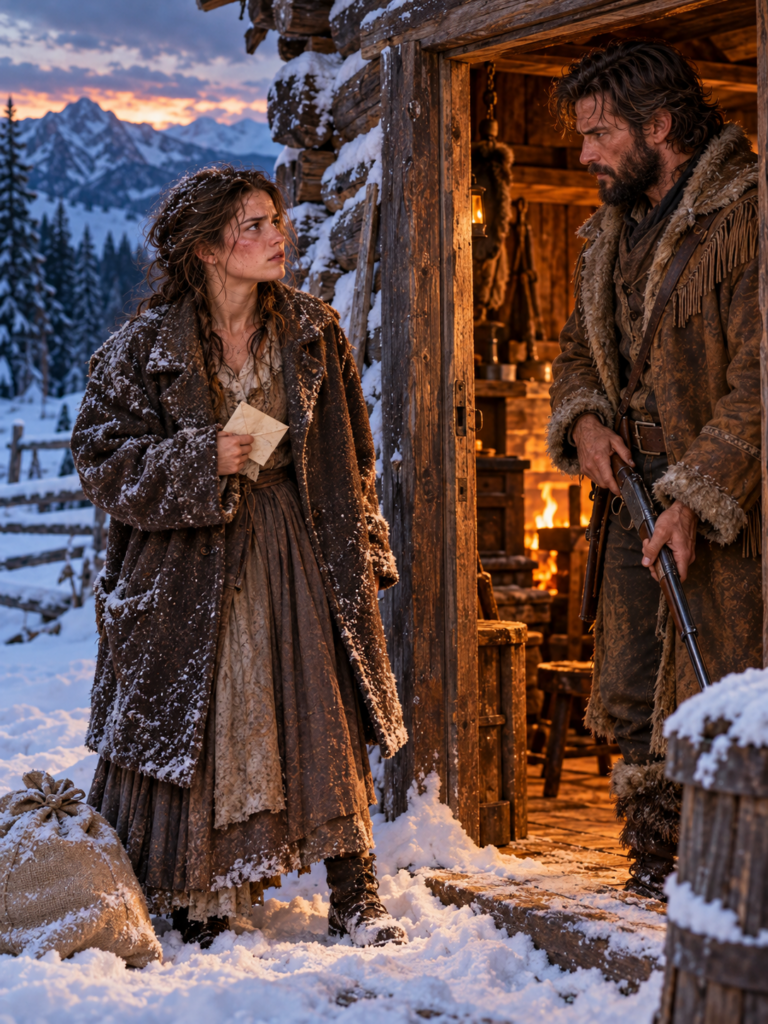
Boon lowered his eyes to the paper Norah had spread across the table.
The writing was Margaret’s, carefully formed and utterly without warmth.
Boon read the first lines, and the muscles beside his jaw tightened.
Norah watched him.
“Well?”
He did not answer immediately.
“She says your father’s estate will settle the disputed boundary if I accept responsibility for you.”
Norah felt her stomach turn.
“What does that mean?”
“It means she wants to make a land matter sound like a bargain between men.”
“And I am what she offers.”
He folded the paper once.
“That’s what she’s trying to arrange.”
Norah looked toward the fire.
Margaret had never loved her.
She had tolerated Norah while Henry lived, counting the days until the house could be hers alone.
But Norah had believed that even Margaret possessed some limit to her cruelty.
Now that belief was gone.
“Did my father know?” she whispered.
Boon looked at her.
“About sending you here? No reason to think so.”
“The debt?”
“He knew we disagreed about the boundary.”
“Was it a large debt?”
Boon sat across from her.
“It was a disputed strip of foothill land. Your father and I never settled where one claim ended and the other began.”
“Margaret said you demanded payment.”
“I demanded no such thing.”
He returned the paper.
“Whatever your father and I disagreed about, it didn’t give anyone the right to trade you.”
Norah stared at the envelope.
She wanted to believe him.
Yet believing strangers had brought her to this mountain.
“How do I know you’re telling me the truth?”
“You don’t.”
His answer surprised her.
“You’ll have to judge me by what I do.”
For several moments, neither spoke.
Then a violent shiver passed through her.
Boon noticed immediately.
“Your boots.”
“What?”
“Take them off. They’re soaked.”
She glanced at his hands.
“I can manage.”
He stepped back.
“Then manage.”
The simple surrender of control loosened something in her chest.
She sat near the hearth and struggled with the frozen leather. Her fingers barely obeyed.
Boon set a dry cloth beside her without touching her.
When the boots finally came free, she found blisters along both heels.
Her right knee throbbed beneath the torn skirt.
Boon brought warm water and a clean strip of cloth.
“That cut ought to be cleaned.”
Norah examined it herself.
“I’ll do it.”
He nodded and returned to the stove.
She cleaned the scrape carefully, then wrapped it with the cloth.
Boon placed bread beside the broth.
“Eat.”
She looked at him.
“Will you demand work tomorrow?”
“Not while you’re shaking like that.”
“But eventually?”
“There’s work enough for two people. We’ll speak of it when you can stand properly.”
Norah took a bite of bread.
She had expected commands.
She had expected threats.
Instead, Boon kept leaving decisions in her hands.
It made him harder to understand than Margaret’s description of a cruel wilderness man.
“Why do you live alone?” she asked.
He glanced toward the dark window.
“Because I prefer it.”
“Always?”
He did not answer.
Norah understood that some questions would have to wait.
She finished the broth.
The warmth began returning to her feet, painfully and slowly.
Boon moved his bedding nearer the hearth and pointed toward the bed.
“You can sleep there.”
“And the door?”
“Barred against the weather.”
“I want to know I can open it.”
Boon looked at her for a moment.
Then he showed her how the wooden bar lifted free.
“You may open it whenever you choose.”
Norah nodded.
It was the first promise she had received that carried no demand in return.
She stood carefully and crossed toward the bed.
Before lying down, she retrieved her father’s coat and folded it over the footboard.
Boon added another log to the hearth.
Outside, the wind shook the cabin.
Inside, the silence settled between two strangers who had no reason to trust each other.
Norah drew the heavy furs over herself.
“Mr. Boon?”
“Just Boon.”
“If the pass opens and I leave, where will I go?”
He stopped tending the fire.
For the first time, she saw that he had no answer.
Neither did she.
She looked toward Margaret’s envelope lying on the table.
Then, despite the pain in her knee, she pushed back the furs, rose from the bed, and reached for the paper.
“I want that kept where I can see it,” she said. “Whatever happens when spring comes, nobody will decide my future from a paper I wasn’t allowed to read.”
Norah took the envelope from the table and folded it into the inside pocket of her father’s coat.
Boon watched without interfering.
“That’s yours,” he said.
She looked back at him.
“It always was.”
He nodded.
Then he turned down the lamp, leaving the hearth to light the room.
That night, Norah slept beneath the heavy furs with Margaret’s letter close by and her father’s coat within reach.
For the first time in weeks, nobody was demanding that she surrender something.
But safety was not the same as comfort.
And the mountain had barely begun testing her.
Morning arrived with the sound of an axe.
Norah woke to cold air and a fire burned nearly to embers.
Her injured knee was stiff.
The blisters on her heels hurt when she put on her boots.
Outside, snow glittered beneath a merciless blue sky.
Boon stood beside the chopping block, splitting pine rounds with steady, economical strokes.
Norah watched through the window.
He did not work like a man showing off his strength.
He worked like someone who understood that a winter cabin survived one log at a time.
She turned toward the empty water bucket.
Margaret would have expected her to wait for instructions.
Norah had no intention of spending another season being told what she was worth.
She carried the bucket toward the creek.
The path was slippery, and the stream ran beneath a crust of ice. She found a narrow opening where water still moved, filled the bucket, and carried it carefully uphill.
By the time she returned, her hands ached and her skirt was wet near the hem.
She set the bucket beside the stove, started water warming, and found oats among the provisions.
When Boon entered with an armful of wood, breakfast was cooking.
He glanced at the pot.
“You found the oats.”
“Yes.”
“And the creek?”
“Yes.”
“Next time, tell me before you go down there. Ice breaks along the bank.”
Norah stiffened.
“I was getting water.”
“I know. There’s a safer place farther upstream.”
She studied his face.
He was not mocking her.
He was offering information.
“Then show me.”
“After breakfast.”
They ate together.
Boon explained that he would be checking traps along the northern ridge.
Norah asked what she could do while he was gone.
“Keep the fire alive,” he said. “Rest that knee. There’s sewing if you want it.”
She looked toward the woodpile.
“And the splitting?”
He glanced at her hands.
“Leave the heavy rounds.”
She made no promise.
By midday, she had swept the cabin, washed the breakfast dishes, and repaired a torn seam in her father’s coat.
The steady work helped settle her thoughts.
But the wood bin was nearly empty.
Outside, a pile of unsplit pine stood beside the chopping block.
Norah took the smaller axe.
She had watched Boon use the larger one.
How difficult could it be?
The first swing struck at an angle.
The second buried the blade without splitting the round.
By the sixth attempt, her wrists throbbed.
By the tenth, a blister had formed near her thumb.
She stopped long enough to wrap her hands in cloth.
Then she tried again.
Every blow seemed to carry the anger she had swallowed since her father’s death.
Margaret’s cold voice.
Cobb’s wagon disappearing down the trail.
The closed door of the house where Norah had grown up.
She split one round.
Then another.
By late afternoon, a crooked pile of firewood stood beside her.
When Boon returned with two foxes from his trapline, he found her leaning against the chopping block.
The axe handle was marked with blood.
He set down his catch.
“Show me your hands.”
Norah pulled them behind her.
“I’m fine.”
“That handle says otherwise.”
She reluctantly opened her palms.
The skin was torn in several places.
Boon’s expression darkened.
“Why didn’t you stop?”
“Because I wanted to do something useful.”
He looked at the split wood.
“You did.”
She blinked.
“But you hurt yourself doing it.”
“I know.”
He picked up the axe and demonstrated the grip and swing with a fresh round.
Norah watched carefully.
When the log split cleanly, she looked from the two halves to her own damaged hands.
“You make it look simple.”
“It took me years to learn.”
“Margaret said I was too soft for hard work.”
“Margaret isn’t here.”
The words were plain.
Yet they lifted a burden Norah had carried since childhood.
Boon set the axe aside.
“Let those hands heal. There are other things to learn.”
That evening, he helped her gather clean cloth for the blisters.
He asked before examining the deeper tears and showed her how to keep the dressings secure.
Then he sat at the table sharpening a knife while she carefully mended another seam.
After a long silence, Norah said, “You really don’t want me here.”
Boon stopped working.
“I didn’t expect you.”
“That isn’t what I asked.”
He looked toward the fire.
“I’ve lived alone a long time.”
“Why?”
“Because there’s less to explain.”
“To whom?”
“Anyone.”
Norah gave a tired laugh.
“That must make conversations very short.”
The corner of his mouth moved.
“Usually.”
It was the first time she had nearly made him smile.
The following day, Boon showed her the safer path to the creek and the place where water remained accessible beneath the ice.
He taught her how to recognize unstable snow near the bank.
Later, he explained how he stored meat, protected supplies from animals, and judged when a trail was unsafe.
Norah listened.
She asked questions.
When she did not understand something, she made him explain it again.
Boon was not accustomed to being questioned.
But he learned that she remembered what he showed her.
And Norah learned that he did not ridicule what she had yet to master.
When her hands were sufficiently healed, she helped him with a deer he had brought down earlier.
The work was unpleasant.
She had never been so close to the realities of keeping people fed through winter.
Boon gave her manageable tasks and showed her how the meat would be divided, cooked, and preserved.
She was pale by the end.
But she had not walked away.
That evening, they ate fresh venison beside the fire.
Boon watched her finish.
“You did well.”
Norah looked up.
It was the first clear praise he had offered.
“You sound surprised.”
“I was.”
She laughed.
A short, rusty sound.
Boon stared at her for a moment, then returned to his supper.
But the silence afterward felt different.
Not empty.
Companionable.
Over the following weeks, Norah became part of the cabin’s daily rhythm.
She learned to bank the hearth properly.
She learned which wood burned too quickly and which lasted through the night.
Boon showed her how to repair damaged snowshoes.
She showed him how to strengthen a torn seam so it would hold through repeated wear.
He knew the mountain.
She knew patience, needlework, and careful organization.
Neither knew everything.
Together, they wasted less.
By January, deep snow had buried much of the lower trail.
For twelve days, a hard blizzard kept them largely inside.
The shutters rattled.
Snow drifted against the cabin walls.
They counted firewood, checked supplies, and cleared the doorway whenever the weather permitted.
The storm did not make them suddenly affectionate.
It made them tired.
Restless.
Too familiar with the same four walls.
One afternoon, Norah drove a needle into her thumb while mending Boon’s trousers.
She dropped the cloth.
Then she pushed back her chair.
“I cannot do this anymore.”
Boon looked up.
“The sewing?”
“The silence!”
Her voice cracked.
“I wake. I work. I eat. I sleep. And sometimes you barely speak three words to me all day.”
Boon set down the trap he had been repairing.
Norah pressed the injured thumb against her skirt.
“I know you didn’t ask me here. I know you would rather be alone. But I’m a person, Boon. Not another bundle of supplies Cobb left at your door.”
He stared at her.
For a long moment, she feared he would tell her to leave the moment the snow cleared.
Instead, he said, “You’re right.”
Norah went still.
Boon looked down at his hands.
“I’ve kept my own company so long that I stopped thinking how it feels to somebody else.”
“You could have said that weeks ago.”
“I suppose I could.”
He moved the trap aside.
“I don’t always know what to say.”
“Then ask me something.”
He considered.
“What did your father do?”
Norah’s face softened.
“He kept the house and the property accounts. He taught me to read the weather from the clouds over our fields. He could tell when rain was coming before anyone else believed it.”
Boon listened.
“He sounds like a useful man.”
“He was a good father.”
Her eyes filled.
“I didn’t get to say goodbye properly.”
Boon said nothing at first.
Then he pulled out the chair opposite hers and sat.
“You can tell me about him.”
So she did.
For the first time since Henry died, Norah spoke of him without someone interrupting to discuss the estate.
She told Boon about the peppermint he carried, the way he laughed at his own jokes, and the old wool coat he insisted would last another ten winters.
Boon listened until the fire burned low.
Then he rose and added another log.
“Did he know you were unhappy with Margaret?”
“He knew they didn’t get along. He believed she’d look after me when he was gone.”
Boon’s expression tightened.
“He was wrong about that.”
“Yes.”
Norah looked down.
“But he wasn’t wrong about everything.”
The next morning, Boon brought out his rifle.
He explained that Norah needed to understand how to handle it safely, especially when he was away.
She insisted on learning.
He showed her how to determine whether it was loaded, how to keep the muzzle pointed safely, and how to handle it only when she was certain of what she was doing.
At first, the weight made her arms tremble.
She practiced under his supervision.
When the weather eased, she fired at a dead tree well away from the cabin.
The recoil startled her.
Her first shot missed.
Boon examined the mark in the snow.
“High and left.”
Norah lowered the rifle.
“Then I need more practice.”
He looked at her.
“Yes, you do.”
She smiled.
“So do you at conversation.”
This time, he laughed.
The sound surprised them both.
Training became another part of their work whenever weather and ammunition allowed.
Boon taught carefully.
Norah learned deliberately.
She did not become an expert overnight.
But she stopped fearing the rifle simply because it was unfamiliar.
By February, the storms had left them with a dangerous shortage of accessible firewood.
Boon spent much of one morning digging a path toward the remaining pile.
Norah stayed inside tending a thin stew.
She was checking the pot when she heard a low scraping sound outside.
Then a growl.
She crossed to the rear shutter.
Five gaunt wolves moved through the clearing near the meat shed.
Boon was still outside.
Three of the animals had turned toward the woodpile.
Norah saw one lunge.
Boon swung his axe.
His footing slipped.
He went down on one knee.
Another wolf advanced.
Norah’s heart seemed to stop.
She ran toward the rifle.
Her hands found the familiar stock.
She checked the weapon, took aim through the open doorway, and saw a wolf moving behind Boon.
He could not see it.
There was no time to call him away.
Norah steadied herself.
Then she fired.
The rifle cracked across the frozen clearing.
The wolf behind Boon dropped into the snow.
The others recoiled at the sudden report.
Norah felt the recoil through her shoulder, but she kept her eyes on the animals.
Boon struggled upright, gripping his axe.
Two wolves remained close enough to threaten him.
Norah fired again.
The bullet struck the snow ahead of the largest animal.
Startled by the noise and the loss of its packmate, it turned toward the trees.
The second wolf followed.
Within moments, the surviving animals had disappeared into the timber.
Norah stood at the doorway, trembling.
The rifle felt suddenly enormous in her hands.
Boon looked at the fallen wolf.
Then at her.
For several seconds, neither spoke.
He trudged through the snow toward the cabin.
Norah lowered the muzzle.
Her knees threatened to fold beneath her.
Boon stopped at the porch.
“Are you hurt?”
She shook her head.
“You?”
“Nothing serious.”
He glanced toward the rifle.
“You kept your head.”
Norah tried to answer.
No words came.
The fear she had pushed aside now swept through her.
Boon stepped closer but stopped before touching her.
“May I?”
She nodded.
He laid a hand gently on her uninjured shoulder.
“You saved my life.”
Norah looked into his face.
There was no mockery.
No cold appraisal.
Only the unmistakable recognition of what she had done.
Her eyes filled.
“I thought they would kill you.”
“So did I.”
The admission startled her.
Boon had never spoken so plainly about fear.
He looked toward the woodpile.
“Reckon we’ve got more work to finish before dark.”
Norah let out a shaky laugh.
“Of course we do.”
The mountains did not pause because two people had nearly died.
They still needed firewood.
The stew still simmered.
The remaining meat needed protection.
Boon made sure she was steady before returning to the clearing.
Together, they dealt with the aftermath.
Norah kept watch while he moved the dead wolf away from the cabin and checked the shed.
Neither pretended that danger had made them invincible.
They had been fortunate.
They knew it.
That evening, Boon sat beside the hearth longer than usual.
Norah warmed her sore shoulder with a cloth.
The wind pressed gently against the shutters.
After supper, she said, “You were frightened.”
Boon looked at her.
“Anyone with sense would have been.”
“I didn’t think you were ever frightened.”
“Then you’ve been giving me too much credit.”
She smiled faintly.
He studied the fire.
“I was afraid I wouldn’t get back to the door.”
Norah’s smile faded.
“I saw that.”
“And when I heard the rifle…”
He stopped.
She waited.
“I thought of you standing there. A girl who had been brought into my cabin against her will, risking herself for me.”
Norah lowered the cloth.
“I chose to help.”
“I know.”
His voice softened.
“That’s what frightens me about it.”
“Why?”
“Because I would hate to have you harmed on my account.”
She looked at him for a long moment.
For months, Boon had given her lessons in surviving the mountain.
Now she understood that he had been learning something too.
How to care about another person without treating that person as property.
How to accept help without feeling diminished.
How to let someone remain beside him.
“You cannot stop every danger,” she said.
“No.”
“And you cannot keep me safe by pretending I am not here.”
Boon smiled sadly.
“No.”
She leaned back in her chair.
“Then perhaps we had better keep teaching each other.”
He looked toward her bandaged shoulder.
“What have you got left to teach me?”
“Conversation, for one.”
His laugh filled the little cabin.
It was a sound Norah had never expected to hear when she first crossed his threshold.
And now she wanted to hear it again.
The next weeks passed under the weight of late winter.
Snow remained deep in the sheltered hollows.
Boon continued his trapline work when conditions allowed.
Norah helped prepare meals, mend clothing, keep the supplies organized, and carry out tasks she could manage safely.
Their days still demanded effort.
But the cabin no longer felt like a place where one person endured another’s presence.
They began making decisions together.
When wood ran short, Norah helped determine how to ration the remaining supply.
When a trap needed repair, Boon showed her how the pieces fitted.
When a seam failed on his winter coat, she explained why his previous stitching had pulled loose.
He accepted the criticism with a grumble.
She answered with a smile.
The smallest changes mattered.
Boon no longer left each morning without saying where he intended to go.
Norah no longer felt compelled to prove her usefulness by working until she hurt herself.
They had learned that survival required judgment as much as endurance.
And somewhere within those ordinary lessons, affection grew.
It appeared in small gestures.
Boon began leaving a warm cup near her chair when he rose before dawn.
Norah repaired the lining of his gloves before he noticed the holes.
He remembered that she preferred her broth with a little more salt when they had it to spare.
She learned the difference between his thoughtful silence and the silence that meant he was worried.
Sometimes they talked late into the evening.
Other nights they sat quietly and found it enough.
One night in March, Norah took her father’s coat from its peg.
The wool was worn badly at the cuffs.
She ran her fingers along the seams.
Boon looked up from his work.
“Still fits?”
“Too large.”
“It always was.”
She smiled.
“My father liked to say a good coat ought to leave room for growing.”
She examined the damaged lining.
“I think he’d laugh to see what I’ve done to it.”
Boon set down his tools.
“What are you thinking?”
“Cutting the sound pieces into blankets for the bedrolls.”
“You’re certain?”
Norah looked at the coat for a long while.
At first, she had clung to it as the last thing she possessed that still smelled faintly of home.
Now the familiar scent was nearly gone.
But her memories remained.
“I don’t need to keep it whole to remember him.”
Boon nodded.
“Then we’ll make something worth using.”
They worked together.
Norah cut and stitched the strongest portions of wool.
Boon helped with the heavier pieces.
When they finished, the old coat had become part of two warm bedrolls.
She touched the familiar fabric and smiled.
“He would approve.”
Boon glanced at her.
“Seems to me he raised a capable daughter.”
Norah looked away quickly.
Tears came before she could prevent them.
Boon did not tell her to stop crying.
He simply stayed nearby.
A few nights later, while the last hard winds of winter moved over the ridge, Norah asked the question she had carried for months.
“Why did you come up here alone?”
Boon sat motionless.
The fire cast orange light across his face.
“I was tired of people deciding what sort of man I ought to be.”
She waited.
“Years ago, before I kept this place, I spent more time around settlements. Every disagreement seemed to become a matter of pride. Men measuring one another by what they owned, what they could take, what they could make somebody else yield.”
He looked toward the window.
“I found I liked the mountains better.”
“Because nobody could command you?”
“Because there were fewer reasons to argue.”
Norah considered.
“And my father?”
Boon’s expression changed.
“That boundary was one of the arguments I never managed to finish.”
“Did you dislike him?”
“No.”
The answer came immediately.
“He was stubborn. So was I.”
Norah smiled faintly.
“That sounds like Father.”
“We both believed the land ought to be marked differently. We should have settled it plainly while we had the chance.”
“Instead, Margaret used it.”
“Yes.”
Boon looked directly at her.
“She turned an unfinished argument into an excuse to send you away.”
Norah rested her hands in her lap.
“Do you think she believed you would hurt me?”
“I don’t know.”
“She said you needed a woman to keep your house.”
“I never asked her for one.”
“I know that now.”
Boon leaned forward.
“I should have brought you inside the moment I saw you. I let my anger over her scheme fall on you.”
Norah remembered the cold porch, her numb feet, and the terrible possibility that he might close the door.
“Yes,” she said. “You should have.”
He accepted the answer.
“I’m sorry.”
The apology was quiet.
It mattered because he did not make excuses for himself.
Norah reached toward the hearth and adjusted the small log near the edge of the fire.
“I was frightened of you.”
“I know.”
“I thought you might be exactly what Margaret said.”
“And now?”
She looked at him.
“Now I know you can be difficult, stubborn, and very poor at conversation.”
His mouth twitched.
“But you are not cruel.”
Boon watched her.
“And you?”
“What about me?”
“Are you still frightened of being here?”
Norah considered the question.
“Sometimes I’m frightened of what comes next.”
“Spring?”
“Yes.”
He said nothing.
She understood that he knew exactly what spring meant.
When the lower pass cleared, she could leave.
For months, their arrangement had depended on that fact.
He had promised temporary shelter.
She had promised to help when she was able.
Neither had spoken of anything beyond the thaw.
But now the coming season carried a different kind of uncertainty.
If she left, she would be leaving a place where she had worked, learned, and begun to feel useful again.
If she stayed, she would be choosing a life far removed from everything she had known.
And she would have to know that the choice was entirely hers.
By early April, the snowpack began to break.
Water ran loudly beneath the ice.
The lower trail became a narrow ribbon of mud between melting drifts.
The air smelled of wet pine, thawing earth, and new growth.
Norah stood outside one morning with the splitting maul resting beside the block.
Her hands had changed.
The delicate skin that once tore against the axe handle had grown calloused.
Her posture had changed too.
She stood with the balance of someone who knew how to move over uneven ground.
Her father’s old wool coat had become useful bedding.
She wore practical winter clothing altered and reinforced through months of work.
Nothing about her looked like the exhausted girl Cobb had abandoned on the trail.
But the deepest change was not visible.
Norah no longer measured her worth by Margaret’s judgment.
She knew what she could do.
She knew what she still needed to learn.
And she understood that neither fact made her less deserving of respect.
One afternoon, Boon stood beside her watching the creek surge through its rocky banks.
“Pass ought to be open soon.”
She nodded.
“Yes.”
“I’ll make certain you’ve got provisions if you decide to go.”
Norah looked at him.
“You would help me leave?”
“Of course.”
“Even if you don’t want me to?”
He took a long breath.
“Wanting you here doesn’t give me the right to keep you.”
The words settled between them.
Norah felt her heart beat harder.
“You want me here?”
Boon looked uncomfortable for the first time in months.
“I do.”
She waited.
He turned his hat in his hands, a gesture she had not seen before.
“I don’t know what name to give what we’ve become. I know the cabin’s better with you in it. I know I miss you when you’re out of sight longer than I expected.”
His voice lowered.
“And I know I don’t want another winter here without you.”
Norah looked toward the creek.
She had imagined what he might say when spring came.
She had feared an order.
An obligation.
Perhaps even the suggestion that she owed him a future because he had sheltered her.
Instead, he was telling her what he wanted without claiming the right to decide.
She looked back at him.
“I need to know I can still choose.”
“You can.”
“Even tomorrow?”
“Tomorrow too.”
She smiled faintly.
“Then I have something to think about.”
Boon nodded.
“I reckon you do.”
He said nothing more.
A week later, they heard wagon wheels.
The sound came slowly up the muddy lower trail.
Norah was standing beside the chopping block when the draft horses appeared through the trees.
Cobb sat on the bench.
His beard was stained with tobacco, his heavy coat smeared with road mud.
He hauled the team to a stop and stared.
At first, he seemed unable to recognize her.
Then he squinted.
“Norah?”
“Good afternoon, Cobb.”
He looked her over.
The altered clothes.
The strong posture.
The maul beside the woodpile.
“Well, I’ll be damned.”
Boon emerged from the meat shed and stopped several yards away.
He carried the knife he had been using, but lowered it at his side.
Cobb glanced between them.
“Margaret sent me.”
Norah folded her arms.
“What does she want?”
“To know whether you’re still alive.”
“And?”
Cobb shifted on the wagon seat.
“To see whether Boon considers the land matter settled.”
Boon’s face hardened.
“I settled that the day she sent the girl here.”
Cobb swallowed.
“She said if the girl was dead, she’d need to know whether some other arrangement was required.”
Norah stared at him.
There it was.
Six months had passed.
And Margaret still spoke of her as a term in a bargain.
Not a daughter.
Not even a stepdaughter she had mistreated.
Only a matter of property to be cleared away.
Norah stepped forward.
“Listen carefully.”
Cobb straightened.
“The boundary argument was between my father and Boon. It never gave Margaret the right to send me anywhere.”
The wagon driver looked uneasy.
Norah continued.
“I am alive. I have food, work, and a place to sleep. And the question of where I go next belongs to me.”
Cobb cleared his throat.
“Well, wagon’s empty. I can take you down as far as Oak Haven.”
Norah looked toward the lower trail.
For months, she had imagined this moment.
She could climb onto the wagon.
She could leave the mountain.
She could search for work in a settlement where nobody knew how Margaret had tried to dispose of her.
That future was possible.
Boon had already promised to help her reach it.
She turned toward him.
He stood quietly.
There was no command in his expression.
No wounded pride.
No attempt to use the wolf attack or their months together as a debt she must repay.
He simply waited.
Norah realized that he would let her go.
And that knowledge made her next decision clear.
She faced Cobb again.
“I won’t be riding with you.”
Cobb blinked.
“You’re staying?”
“Yes.”
“Up here?”
“Yes.”
He glanced toward Boon.
“With him?”
Norah stepped across the clearing until she stood beside the mountain man.
“With him.”
Boon looked at her.
She met his eyes.
“Because I want to.”
Cobb shifted uncomfortably.
“Margaret won’t like it.”
Norah smiled.
“Margaret has had enough say in my life.”
The driver looked down at his reins.
“Then what shall I tell her?”
“Tell her I survived the winter.”
Cobb nodded.
“And that I don’t intend to return to her house.”
“Anything else?”
Norah looked toward the cabin, the stacked firewood, and the rough garden patch she had begun planning beside the clearing.
“Tell her the debt she spoke of never belonged to me.”
Boon added quietly, “And tell her I won’t recognize any bargain involving Norah.”
Cobb studied them a final time.
Then he gathered the reins and began turning the wagon.
The horses struggled through the mud.
At last, the team disappeared into the pines.
The clearing became quiet again.
Norah watched until the sound of the wheels faded.
She felt no triumph.
Only a deep and unfamiliar peace.
For the first time since her father’s death, Margaret’s plans had no power over her future.
Boon stood beside her.
“You sure?”
Norah looked up.
“Yes.”
“You could still go to town. Find work. Start somewhere else.”
“I know.”
“I’d help you.”
“I know that too.”
She took his hand.
“And that’s why I can stay.”
He looked at their joined hands.
Norah smiled.
“I don’t want to remain because I have nowhere else to go. I want to remain because we’ve made something here.”
Boon’s expression softened.
“What have we made?”
She glanced at the cabin.
“A place where two people work together. Where someone can be frightened without being shamed. Where help isn’t held against them later.”
Her voice grew quieter.
“A place where I can remember my father without being told to stop grieving.”
Boon squeezed her hand gently.
“And what would you call a place like that?”
Norah looked into his weathered face.
“Home.”
For a long moment, he could not speak.
Then he smiled.
It was no longer the reluctant twitch she had once struggled to earn.
It was warm, open, and entirely genuine.
“I like the sound of that.”
Norah stepped closer.
“There’s something else.”
“Go on.”
“If we’re to share this place, then we both get a say in what happens here.”
Boon nodded.
“Agreed.”
“I want my own work. My own decisions. And I want to learn the mountain well enough that I’m not helpless whenever you ride out.”
“You’ve already come a fair distance toward that.”
“I intend to go farther.”
He smiled.
“I believe you.”
She glanced toward the little cabin.
“And perhaps another chair that doesn’t wobble.”
Boon laughed.
“That chair’s served me fifteen years.”
“It has spent fifteen years trying to throw people onto the floor.”
“Then I suppose it’s earned retirement.”
Norah laughed with him.
They stood beneath the pale spring sunlight, their hands still joined.
Neither spoke of marriage.
Neither made promises larger than they understood.
What lay between them was already serious enough.
They were choosing to build a shared life.
And they intended to do it carefully.
Over the following weeks, the thaw made outdoor work possible again.
Together, they cleared a small patch beside the cabin for vegetables.
Boon showed Norah where the ground held moisture and where spring runoff might damage the planting.
She measured the rows and planned what could be grown in their short season.
They repaired the roof where winter winds had loosened the covering.
They strengthened the wood shed.
Boon made another chair.
Norah insisted on testing it before declaring it finished.
When it held her weight without rocking, she looked at him solemnly.
“A vast improvement.”
He bowed his head.
“High praise.”
They both laughed.
The cabin itself changed slowly.
There were two places set at the table without anyone thinking about it.
Her sewing lay beside his tools.
The books and small belongings she had brought from Oak Haven no longer remained packed away as though she might be sent off without warning.
Her father’s coat, transformed into bedrolls, warmed them on cold nights.
And Margaret’s letter remained folded inside a small box with Norah’s few personal papers.
She did not destroy it.
Not because she feared Margaret.
But because it reminded her how far she had come.
One evening, as the sun lowered over the ridgeline, Norah stood outside beside the chopping block.
Boon came from the shed carrying a bundle of repaired traps.
He stopped when he saw her looking toward the trail.
“Thinking about Oak Haven?”
“A little.”
“Missing it?”
“Some parts.”
He set down the traps.
“Your father?”
“Always.”
Boon stood beside her.
Norah looked at the pines.
“I used to think that losing his house meant losing everything he’d given me.”
“And now?”
She held out her hands.
The palms were rough.
The fingers strong.
There were small scars from work she had once believed herself incapable of doing.
“He taught me to keep going when things were difficult. You taught me how to do it here.”
Boon shook his head.
“You did the hard part.”
“We both did.”
He accepted that.
The last light warmed the cabin walls.
Norah remembered the first night she had arrived.
The snow.
The envelope.
The terrible cold.
The man standing in the doorway, refusing to accept her as payment for another man’s debt.
She had believed that mountain cabin was the end of her life as she knew it.
In one sense, it had been.
But it had also become the beginning of a life she could choose.
Boon offered his arm.
“Ready to go inside?”
Norah looked toward the open door.
Warm light spilled across the threshold.
She remembered standing there with frozen feet, unsure whether she would be permitted to enter.
Now she knew she could leave whenever she wished.
And she knew exactly why she was staying.
She slipped her hand through his arm.
“Yes.”
Together, they crossed the clearing.
At the doorway, Boon stepped aside to let her enter first.
Norah stopped.
Then she reached for his hand and drew him in beside her.
The door closed against the evening cold.
Outside stood the mountains that had nearly taken her life.
Inside waited the home she had helped build.
Norah had not been purchased.
She had not been claimed.
She had been given the chance to survive, to learn, to refuse, and finally to choose.
And the quiet mountain man who once believed solitude was all he needed had discovered that a home could become stronger when its door opened to another person.
The mountain had not made Norah belong to Boon.
It had given them the chance to belong beside one another.
And this time, nobody else would decide what that meant.