
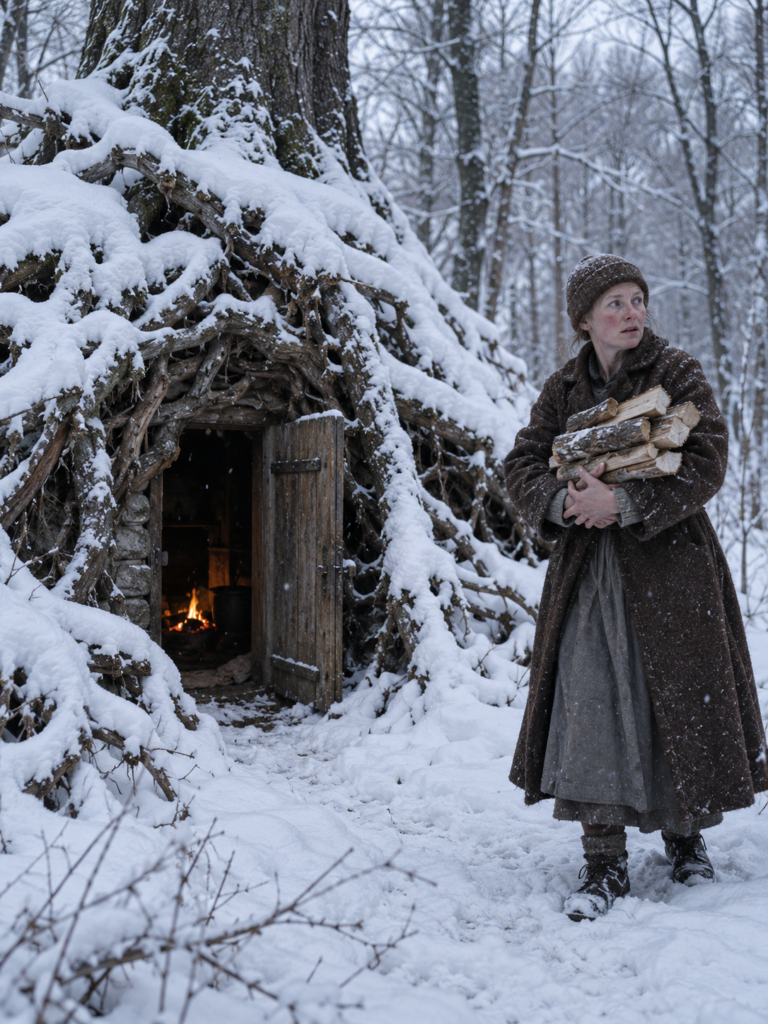
she went looking for firewood in the devil’s wash and found a hidden stone shelter that turned the blizzard against itself
Part 1
The snow had not yet begun to fall in earnest when Hannah Mercer saw the angle of the stone.
It was not a boulder left by some old slide, and it was not a shadow thrown by the late light against the limestone. It was a right angle, clean as a doorframe, half swallowed by the side of the ridge in a place where nothing square had any business standing. The dead wild grape hung over it in a curtain so straight it looked pulled.
Hannah stopped. Her breath went out in a white plume and came back cold against her teeth. The canvas sack on her shoulder was only half full of cottonwood limbs, and her legs had already told her, twice on the way down, that they were finished bargaining. She had walked the edge of the place the valley called the Devil’s Wash a dozen times that November. She had never seen the stone. Or she had seen it and her mind, worn thin by grief and short rations and the cold that never quite left a Dakota cabin, had refused to keep it.
She set the sack down and brushed the vines aside with a gloved hand, slow, the way a person moves when a thing might startle and be gone. The vines snapped. The stone stayed. It was cold and solid under her fingers, mortar joints tight, the face of it plumbed true.
Four days earlier she had stacked the last of the split ash against the cabin wall and said nothing out loud, because there was no one left in the cabin to hear it.
Samuel had been gone since the first hard frost of September. The fever had started as a dry cough he blamed on threshing dust. Within a week he was in the bed, chest rattling with a fluid that would not clear. Hannah had sat with cool cloths and the lamp turned low and watched the man she had crossed half a continent with go somewhere she could not follow. He died on a Tuesday morning as the sun broke over the eastern bluffs. The men from town lowered him into the hardpan of the prairie cemetery while the wind took the words the preacher tried to say. Hannah had done her weeping then, in the dark after they left, with the cabin door shut and Samuel’s coat still on the peg.
What she felt now was different. It was the cold clarity of a sum she could not make come out.
The woodpile had once run the length of the eastern wall. Samuel cut the winter wood in August, a habit born of respect for a country that did not keep promises. By the first week of December the pile barely reached her waist. Twenty good pieces of seasoned ash. A heap of green pine that would smoke, coat the chimney, and give back little heat. If she let the fire die to embers every night and slept in all her clothes, it might last twelve days. Winter had not shown its teeth yet. January was still ahead, and January in the territory did not care what a widow had planned.
She had tried the ax. Her palms blistered, then callused, then split again. A woman working alone in the short light could not do what two people had done in August. She did not stand over the shrinking pile and weep. She counted. Counting did not stretch a log. It only told her the truth without decoration.
She had thought about asking for help. The thought did not survive the walk into town.
They looked at her when she came for flour and salt. The widow on the creek claim. The woman who would not sell. At the mercantile the talk dropped and then resumed a half-step lower, which was worse than silence. Silas Thorne had caught her outside the post office a week before. He was fifty-two, built like a barrel, with a mind that weighed everything in what it cost and what it returned. He was not cruel in the way of a man who enjoyed pain. He was cruel in the way of a man who believed mercy was a poor kind of arithmetic.
“Hannah,” he had said, not unkindly, and with no room in it. “You cannot stay out there. The claim is too far. The cabin is drafty. Samuel didn’t leave you enough wood to roast a chicken, let alone survive January. Sell to me. I’ll give you stage fare east before the prairie freezes you solid.”
She had looked at him. The wind off the street cut through her shawl. “I will consider it, Mr. Thorne.”
She had no intention of considering it. The claim was the only thing she and Samuel had ever truly owned. The cabin was small and the creek went thin in August and the soil had rocks in it that hated a plow, but the paper was in both their names, and Samuel had put his blisters into every log. To sell it to Silas for pennies, so he could add it to the parcels he already held along the bench, felt like handing him the grave as well as the ground.
What she intended was to walk farther than she usually walked.
The tree lines near the claim had been picked over. Deadfall close to a road did not stay deadfall long. The Devil’s Wash lay a mile past her line, a steep-sided ravine where spring floods stacked cottonwood and cedar and then left them to dry. Nobody logged it. The footing was bad. Rocks came down without warning. In snow the crevices hid until a boot found them. It cost more strength than most people had to spare, and strength was the one thing the valley was short of in December.
On the afternoon she found the stone, the sky had gone the color of a bruised skillet. The air was dead still, the kind of stillness that made a person’s ears ring. Hannah wore Samuel’s old wool coat, too large, the sleeves rolled past her wrists, and carried the sack and a small hatchet. The descent was ugly. Frost slicked the old grass. She slipped twice and scraped a knee on hidden rock. The cold bit her cheeks raw. At the bottom she found what she had come for: a tangle of dead cottonwood and twisted cedar roots, gray and light and ready to burn.
She was reaching for a thick limb when the vines on the eastern wall stopped her.
They did not drape. They hung straight, veiling a recess in the limestone. She dropped the branch. Her boots crunched. When she pulled the vines aside they broke like dry bones.
Under them was a door.
Rough-hewn cedar planks, grayed by decades of weather, held by iron bands rusted the color of dried blood. The stone framing around it was true. The mortar had been laid by someone who cared whether a joint held. Hannah stood with her hand on the wood and felt the old caution rise. The territory was full of stories about caches, about men who went into the ground to get away from other men, about holes that were better left shut. But outlaws did not build like this. Outlaws threw up what would last a season. This had been anchored into the bedrock and turned so the north wind would slide past the face of the ridge instead of striking it.
She pushed. The door did not move. She set her shoulder to it and dug her boots into the frozen dirt. The hinges shrieked, a long metal cry of something waking after half a century, and the door gave inward with a heavy thud.
The air inside was still. It smelled of old dust, dry earth, and ash so faint it might have been a memory of ash. Gray winter light came in behind her. The room was perhaps twelve feet square, opening into a limestone hollow that someone had squared with stacked river stone. In the center of it sat a thing that made her stop breathing.
It was a massive masonry block, pale firebrick and hardened clay, taking nearly half the floor. It looked like a stone bed built for a giant. At one end was an iron firebox no larger than a bread box, with a heavy cast door. The chimney did not rise from the firebox. It rose from the far end of the stone mass and disappeared into the roof of the cave.
Around the room were the quiet remains of a life that had been interrupted and not ended in violence. A hand-carved stool missing one leg. A rusted tin cup on a stone shelf. A wool blanket folded in the corner that crumbled to dust when she touched it. No bones. No broken latch from the inside. No sign of a struggle. Whoever had built this had walked out the cedar door one day and not come back.
Hannah knelt by the firebox and ran her glove over the cold iron. She knew what she was looking at, or she knew the cousin of it. Her grandfather had been a clockmaker out of Prussia. In his letters he had described the great stone stoves the Russian and Scandinavian settlers built to live through winters that killed men who trusted an open hearth. A small hot fire. Smoke driven through a maze of flues inside the stone. The mass taking the heat and giving it back slowly, long after the fire was ash. Not a fireplace. A battery made of brick.
The question was whether it still worked.
That question followed her up out of the wash in the failing light. It followed her into the cabin, where the windowpanes rattled and the ash on the hearth was already thin. It followed her into the bed, into Samuel’s coat, into the dark.
She lay awake and did the sum again. Twelve days of wood. Four months of winter. A hole in a ridge that might be a grave or might be a machine.
In the morning she began to move.
Part 2
It was an extreme decision, and she knew how it would sound if the town ever heard it. The widow’s folly. The woman who left a cabin to live in a hole. Hannah Mercer was not interested in how it would sound. She was interested in seeing April.
She carried what she had. A sack of flour. A tin of lard. The cast-iron skillet. Two wool blankets that still held together. The Bible with Samuel’s name in it. The last of the split ash, piece by piece, down the slick path into the wash, until her shoulders shook and her knee bled through the scrape from the day before. Three days of it. On the fourth afternoon the shelter held her life in one corner and the cabin on the creek held almost nothing but the bed and the cold.
The room was colder than the cabin in a different way. Cabin cold was a draft with a direction. This was the deep damp of a place that had not held a fire in fifty years. It sat in the stone and did not hurry.
She built the first fire with care. Dry pine needles. A page torn from an old ledger Samuel had used for seed counts. Thin splits of ash. She struck a sulfur match on the stone, lit the paper, and closed the iron door. For three minutes it was perfect. She heard the fire roar in the small box. The draft pulled. The iron grew warm under her glove.
Then the sound choked. The roar became a wet gasp. Smoke seeped from the seams of the door, then poured, thick and acrid, filling the twelve feet of room until she could not see the far wall. She coughed until her chest burned. She threw the cedar door open, grabbed a piece of scrap iron, and dragged the burning splits out into the snow, where they hissed and died.
She sat outside in the twilight with her eyes streaming and her hands shaking inside Samuel’s sleeves. The structure was a failure. The flues had collapsed, or the chimney was choked with a rockfall, or fifty years had turned a clever idea into a cold tomb. She had spent the last of her strength moving the last of her wood to a ruin.
Silas had been right. She was going to die here. The winter was going to take her the way it had taken Samuel, only slower, and with nobody sitting beside the bed.
She walked back to the cabin in the dark. The path had iced over. She fell once and stayed down longer than the fall required, her cheek against the frozen grass, listening to her own breath. Getting up was a decision. She made it because the alternative was the wash in the morning and a body the spring floods would find.
The cabin was no warmer for her return. She did not light a fire. She sat at the table in the coat and looked at the empty peg where Samuel’s hat had hung until she put it in the trunk. The trunk was still here. She had not been able to carry it down the ridge.
Her father had been a watchmaker’s son before he was anything else, and he had raised her on a high stool in a shop that smelled of oil and brass. When a watch stopped, he used to say, it was not the fault of the watch. It was the fault of the person who had not yet understood the gears. He had said it when she was eight and a mainspring snapped under her fingers. He had said it without anger. Understanding was the work. Blame was a way of leaving the work undone.
She was the daughter of that man, and she was the wife of a man who had cut August wood because he respected a country that did not forgive a late start. Sitting in the dark, she found she was not ready to let Silas Thorne’s arithmetic be the last sum done on this claim.
In the morning she did not pack for the east. She did not walk into town. She took a kerosene lantern, a length of stiff wire unwound from a broken fence, and the small hand mirror from the washstand, and she went back down into the Devil’s Wash.
For two days she worked the way her father had worked on a stubborn movement. She found the small stone access plates set into the side of the masonry and pried them open with the hatchet’s poll. She snaked the wire through the channels, feeling for collapse. She pulled out a few mummified mice, a nest of old grass, handfuls of dust as fine as flour. The bricks inside were intact. The maze was still a maze. She angled the hand mirror at the cleanout and looked up the chimney shaft. Far above, a pinprick of daylight. The chimney was open to the sky.
The machine was unbroken. The flues were clear. So why had it choked?
She sat on the dirt floor with the lantern between her boots and made herself stop being a woman who needed heat. She looked at the room the way her father had looked at a watch laid out on velvet.
The cedar door was heavy. It fit the stone frame so tightly that when it was shut the wind outside became a rumor. The room was a box cut into limestone, not a cabin full of cracks. Near the floor, on the wall that faced the ravine, there was a fist-sized hole. It had been stuffed with rotted rags, packed so hard they had become part of the wall.
She pulled the rags out. Cold air rushed in, a steady stream against her wrist.
She understood it all at once, the way a stuck gear lets go.
A masonry heater needed a hard, fast fire to push smoke through the long stone maze. A fast fire needed air. In a drafty cabin the fire stole what it needed through the walls. Here, with the door shut, the fire had eaten the air in the room, made a vacuum, and the smoke had had nowhere to go but backward, out the seams, into her lungs. The hole was the intake. Someone had built a lung into the wall and then, leaving, had stuffed it, maybe to keep animals out, maybe because they meant to return and never did.
Hannah laid a second fire. She left the rags out. She lit the splits, closed the iron door, and latched the cedar door until the room held only the lantern. She waited with her hands on her knees.
The fire caught. It roared. It sounded like a train shut inside the stone. Smoke did not leak. Cold air hissed through the hole at the floor, feeding the box, while the exhaust was driven through the maze and up into the ridge.
She sat on the broken stool and watched the iron. Two hours later the wood was fine white ash. The room was still freezing. She walked to the stone mass and laid her hand on it. Cold. The disappointment came up thick. She had solved the draft, and the heater was dead. The stone was too old, or too thick, or she had misunderstood her grandfather’s letters the way a child misunderstands a story.
She was too tired to climb back to the cabin. She curled on the stool in Samuel’s coat, arms around her knees, and let the wind outside put her under.
When she woke, the lantern had burned out. The room was black. Something was wrong with the black, or right with it. She unbuttoned the coat at the throat. The air against her skin was not the damp cold of the cave. It was warm. It was radiant. It felt, absurdly, like standing in a July meadow with the sun on her shoulders.
She felt her way to the stone and put both hands flat on the masonry. It was hot. Not enough to burn. Deeply, evenly hot, the way a bake oven is hot after the coals have been raked out. The thousands of pounds of firebrick had taken the violent little fire and held it. The heat had needed hours to walk from the inner flues to the outer face. Now it was coming back, slow, steady, a release that did not care whether she was awake to see it start.
Hannah sank to the dirt floor. She pressed her forehead to the warm stone. For the first time since September she cried, not from grief and not from despair, but from the relief of a machine doing exactly what it had been built to do.
She stayed there until the tears stopped, because there was nobody to see them, and because the stone did not ask her to be finished.
Part 3
She learned the heater the way a person learns a tool they cannot afford to misuse.
A short, hot fire. Dry wood, not green. The door shut. The intake clear. Then nothing. No feeding it all day the way she had fed the cabin hearth, nursing a stingy flame because the pile was short. The stone wanted a fierce burn and then silence. Two hours of fire bought her a day of heat, sometimes more if she did not open the cedar door every time the wind changed and she got afraid.
Fear was the hard part. The cabin had been a poor shelter, but it was a known one. This was a hole in a ridge with a dead man’s engineering inside it. The first night she slept on the blankets against the stone, she woke twice certain the ceiling was coming down. The second night she woke because she was warm, and warmth in December felt like a mistake she would be punished for.
She talked to Samuel because the room was quiet enough to allow it.
“You would have counted the bricks,” she said. “You would have wanted to know who laid them.”
The stone gave back heat and no answers. She did not need the builder’s name. She needed the flues to stay clear and the intake to stay open. On the third day she cut a small wooden plug for the hole so she could close it when the fire was out and the wind tried to steal what the stone had stored. The plug was a guess. It worked. She felt foolish for how proud she was of a scrap of cedar whittled with a folding knife.
Food was the other sum. Flour, lard, a little salt, coffee that was mostly chicory. She mixed flatbread on the warm stone, which felt like an extravagance until she realized the stone cooked more evenly than her old stove top ever had. She rationed. She did not pretend the ration was comfortable. Comfort was a word for people with wood to spare.
On a clear afternoon she climbed back to the cabin for the trunk. It took two trips and a rope. Inside were Samuel’s spare shirt, the seed ledger, a packet of letters from her father, and the deed. She read the deed by lantern light with her back against the heater. The land was still hers. The hole in the wash was not on the paper. It sat past her line, in ground nobody had bothered to claim because the ravine would not take a plow. If Silas ever came looking, he would look at the cabin. He would not look here unless someone told him where to look.
She did not intend to tell him.
The town, meanwhile, did what towns do with a woman who stops appearing. Mrs. Pell at the post office mentioned to Silas that the widow had not come in for salt. A hand at the livery said he had seen no smoke at the Mercer place for three days, which was not quite true. There had been smoke. It had come out of a fissure in the ridge, thin and brief, and nobody had been on that ridge to see it.
Silas thought about riding out. He did not, not yet. He had made his offer. A man who forced a widow onto a stage could say he had saved her, and he could also say he had gotten the claim. He preferred the second sentence to arrive looking like the first. He told himself she would come in when the cold got honest. He had seen it before.
Hannah used the days to improve what the builder had left. She reset the broken stool with a cedar peg. She stacked her wood where the drip from the door would not reach it. She cleared the chimney mouth as high as she could reach with the wire, pulling down a wad of old bird nest that might have been the difference between a clear flue and a smoky one. She found, behind a loose river stone, a tin box with three sulfur matches, a needle, and a scrap of paper so faded the writing had gone. She kept the matches. She put the paper back. It was not hers to throw away.
At night she read her father’s letters. He wrote about balance wheels and about a winter in the old country when the shop stove smoked and he had learned to open a window a crack rather than curse the fire. She understood that letter differently now. Air in. Heat held. The rest was patience.
On the morning of Christmas Eve she fired the heater with four splits and sat in her shirt sleeves while the wind picked up outside. She had three logs left after that. Three. She laid them in a row and did not count them again, because counting had never stretched a log and she was tired of proving it.
She thought about the cabin, buried already in her mind if not yet in snow. She thought about Samuel’s grave on the bench, with a wooden marker the weather would take in a year. She thought about Silas’s stage ticket and the look on his face when he had said freeze you solid, as if he were naming a weather event and not a woman.
“Not tonight,” she said to the stone.
The stone kept its heat. Outside, the sky went the color of lead.
Part 4
The true test arrived the day after Christmas. It did not begin with snow. It began with a drop in the air so sharp Hannah’s ears popped while she was mixing flour and water on the warm face of the heater. By noon the sky had turned a sick yellow-gray that made the limestone look like another country. By two in the afternoon the blizzard that the territory would later call the great white hurricane came down off the benches and hit the valley without a polite start.
The wind did not howl. It screamed. It sounded like sheet iron tearing. The cold fell through zero and kept falling. Hannah did not have a thermometer. She did not need one. The intake hole whistled, and the whistle was enough.
Up on the open prairie, cattle froze where they stood. Roofs went. A man who stepped off his porch in town to check a latch did not make it back to the latch. Visibility dropped to the length of an arm. To be outside was to invite the wind to finish a job the cold had started.
Hannah had latched the cedar door hours earlier. The heater had been fired the night before. The stone was already throwing an even warmth. She had the last three logs. She had the flour. She had the coat, and for the first time in months she did not need the coat.
Then the storm took hold of the chimney.
Wind ripping across the top of the ridge made a low pressure over the exit, a pull she could hear. Snow did not dump down the flue. The draft ran the other way. The intake screamed like a kettle. When she laid the last three logs in the firebox, she did not have to coax them. The storm itself hauled the air through the hole, through the fire, through the maze, and up into its own belly. The harder the wind blew, the fiercer the burn. The fiercer the burn, the more heat the stone swallowed.
She understood it while she watched the iron door tick. The shelter had not been built merely to withstand a storm. It had been built to use the storm. The same wind that was killing cattle on the bench was pulling her fire through the brick.
She sat on the stone in her shirt sleeves and knitted a pair of socks by the lantern, because her hands needed work and because Samuel’s heels had always worn through before spring. The roar outside came through the limestone as a muffled pounding, distant, like a river under ice. The room stayed warm. The plug for the intake stayed out. Cold air poured in low and the stone took it, heated it, and gave it back.
The blizzard held for three days and three nights. She slept in pieces. She ate flatbread. She melted snow in the skillet by setting it on the masonry, a thing that felt like cheating and was only physics. Once, in the deep part of the second night, the draft roared so hard the firebox shuddered, and she thought the chimney might come apart inside the ridge. It held. The builder had known the wind. He had turned the door out of the north and set the chimney where the ridge would make the storm work for him.
On the third night she spoke to him, whoever he had been.
“You left the rags in the hole,” she said. “That almost killed me. But you left the hole. I suppose that was the lesson.”
No answer came back. She did not require one. The stone under her was hot enough that she had to fold a blanket between her shoulder and the brick.
On the fourth morning the wind broke. The silence that followed was heavy, the kind of silence that rings. Hannah opened the cedar door a crack. The wash was filled level with snow. The vines were gone under it. The sky was a hard blue that hurt to look at. Her breath smoked, and behind her the room breathed warmth onto the back of her neck.
She shut the door again and waited. Walking out into that bright cold with no wood left and the path buried was a different kind of sum. She had heat. She had a little flour. She could wait one more day for the drifts to crust.
Up in the settlement, the town was digging itself out. Drifts stood at the second-story windows of the mercantile. A roof had left a house on the side street and not come back. Silas Thorne strapped on a pair of wide snowshoes, wrapped a wool scarf over his face, and set out toward the Mercer claim. He carried an iron shovel and a canvas tarp rolled under his arm.
He expected to dig a frozen woman out of a cabin full of snow. He had seen it in other years. Homesteaders who thought stubbornness was a fuel. He had bought two of those claims from estates that no longer argued. He told himself, on the way out, that he had warned her. He also told himself he should have put her on a wagon. Both sentences were true. Only one of them made him feel like a practical man.
At the property line his fear looked confirmed. The cabin was buried to the eaves. The front door had been blown inward, and the interior was packed solid. Snow had drifted across the bed. The stove was a white lump. Samuel’s hat trunk was gone, which he noticed without understanding it. He took off his hat. His breath plumed. A knot of guilt sat under his ribs, unfamiliar and unwelcome.
He was turning back toward town, already arranging the spring search in his head, when he saw the smoke.
A thin, straight pillar of gray rising from the cut of the Devil’s Wash.
Silas frowned. Smoke meant a fire, and a fire meant someone alive, and alive was not the story he had brought the shovel for. He adjusted the snowshoes and went down the slope, fighting chest-high drifts, sliding where the old ice hid under the new snow. The ravine tried to turn his ankles. He kept the shovel because a man did not drop a tool on a day like this.
When he rounded the corner of the limestone, he stopped.
The cedar door stood open. Hannah Mercer was in the doorway. She was not shivering. She was not frostbitten. Her cheeks were pink. She held a tin cup of steaming chicory, and the air pouring out of the shelter behind her felt, even at ten paces, like a different month.
Silas stared. He looked past her at the stone mass humming with heat. He looked at the corner where a few sticks remained, not enough for a cabin, enough for this. He looked at the woman he had already written into the spring’s unpleasant chores.
“I brought a shovel, Hannah,” he said. His voice was rough. “I came to bury you.”
Hannah took a slow sip. The steam curled around her face and vanished in the cold.
“You can put the shovel away, Silas.” Her voice was steady. There was no triumph in it, and no forgiveness she had not earned the right to skip. “The ground here is already spoken for.”
He did not have an answer that fit. He stood in the snow with the tarp under his arm and the heat of her doorway on his face, and for the first time in a long while his arithmetic did not tell him what to do next.
Part 5
He came inside because she stepped back and the cold at his back was worse than his pride. The room took him in. He pulled the scarf down. Sweat started under his coat within a minute, which embarrassed him more than the shovel had.
“What is it?” he asked.
“A masonry heater,” Hannah said. “Small fire. Long flues. The stone holds what the chimney would have wasted.” She nodded at the intake. “It needs air. I didn’t know that the first day. It smoked me out. I almost quit.”
“You should have quit.” He heard how it sounded and did not take it back. “The cabin is full of snow. You could have died in that wash and nobody would have found you till May.”
“I could have died in the cabin in January,” she said. “You told me so yourself.”
He looked at the stone. He put a glove on it and pulled the glove back. “Who built it?”
“I don’t know. They left before I was born, I expect. They left the door, the flues, and a hole in the wall. The rest I had to learn.”
Silas was quiet. The guilt under his ribs had not left. It had company now, a reluctance he did not like. If he told this in town, the claim was still unsold and the widow was still on it, and his offer looked like what it had been: a purchase dressed as concern. If he did not tell it, he was a man who had seen a thing and buried it, which was a different kind of shovel.
“I told you to take the stage,” he said.
“I considered it.”
A corner of his mouth moved, not quite a smile. “You said that.”
“I meant I heard you.” She poured him chicory in the rusted cup from the shelf. He drank it. It was bitter and hot. “I am not selling the claim, Silas. Not for stage fare. Not this winter. If I sell, it will be because I choose to, and not because you have a tarp.”
He nodded once. It cost him something. He was not a man who enjoyed being wrong in a doorway. He was, however, a man who could see a working machine when it was radiating into his coat.
“The town will ask where you’ve been.”
“Tell them the truth,” she said. “Or tell them I was stubborn. Both will do.”
He told them the truth, mostly. At the mercantile, with his hands around a mug and the shovel back on its nail, he described the stone bed, the iron box, the heat coming off a handful of logs while the cabin stood full of snow. He did not embellish. Embellishment was not his habit. The men listening went quiet in the way men go quiet when a fact has inconvenienced a story they preferred.
No one in the valley called her the widow’s folly after that. Some of them called her lucky, which was also wrong, but it was kinder.
By the following autumn three families had started heaters of their own, built into house walls where a ridge was not available. They came to the wash and stood in the doorway while Hannah drew the flues in the dirt with a stick. She showed them the intake. She told them about the rags, and the vacuum, and the two hours of doubt when the stone was still cold and she thought she had failed. She did not charge them. She asked only that they season their wood in August and leave a way for air to enter. Two of them listened. One stuffed his intake the first windy night and smoked his family into the yard, then came back and listened better.
The shelter did not bring Samuel back. It did not erase the arithmetic of grief, or the marker on the bench, or the nights she still woke expecting his cough. The winters that followed were not easy. Flour still cost money. The ax still blistered her hands when she cut wood for other people as well as herself. A late storm in March buried the wash again, and she waited it out with the plug out and the stone hot, knitting, because the socks had worn through after all.
What it gave her was a place to stand.
In the spring she shoveled the cabin out. She did not move back full time. She used it for storage and for the days when she wanted a window. The real winter home remained the room in the ridge, with the door that fit and the hole that breathed and the stone that kept what she gave it. She put Samuel’s trunk against the wall. She set the tin cup on the shelf where she had found it.
Silas came once more, in May, without a shovel. He looked at the heater, cold now in the warm weather, and at the garden she had scratched into the south edge of the claim.
“The offer stands,” he said. “A fairer one, if you want it.”
“I don’t,” she said. “But I’ll sell you eggs if the hens take.”
He bought the eggs. It was not friendship. It was a transaction both of them could see the edges of. That was enough.
Years later, when a younger woman on a far claim asked how Hannah had lasted the blizzard winter, Hannah did not tell it as a miracle. She took her down into the wash and put her hand on the stone.
“Someone built a thing that holds heat instead of wasting it,” she said. “I almost walked away because the first fire failed. The failure was mine. I hadn’t found the air yet.”
The woman asked who the builder was.
“I never knew his name,” Hannah said. “I don’t think I need it. He left the lesson in the wall. I understood it when the storm was already on top of me. That is later than a person would like. It was not too late.”
She still walked the ridge in November with a sack over her shoulder, counting limbs, because counting was a habit and the stone did not excuse a person from work. Sometimes she paused at the right angle in the limestone, half hidden again by new vines, and set her glove on the mortar the way she had the first day.
The stone remained. It did not startle. It did not vanish. It kept what it was given, and it gave it back when the wind tore across the ridge and the valley above went white, and a woman who had been told to leave sat in her shirt sleeves and listened to the draft sing.


