
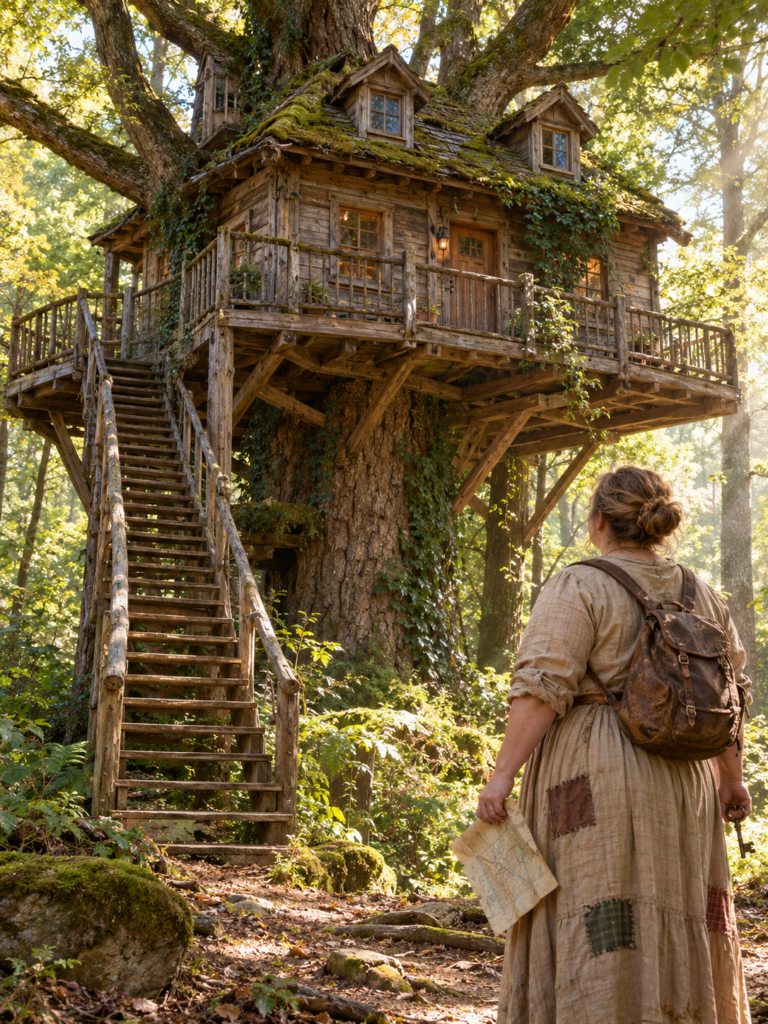
her uncle stole the ranch the day her father died, but the hidden cabin and the iron key he left her brought the truth down the mountain
Part 1
The day they brought Silas Whitlock down off the north mountain road, Mabel stood at the ranch gate with one worn bag and a hole in the left sole of her boot, and the whole of Cedar Falls found something else to look at.
She was eighteen. She did not cry. She pressed her father’s iron key into her palm until the teeth bit skin, and she watched Harlon Whitlock put a hand on her shoulder and arrange his face into grief that never reached his eyes.
“Terrible thing,” Harlon said. “Horse must have spooked.”
“His horse never spooked,” Mabel said.
Harlon tilted his head, the way a man does when he has already decided what a girl is worth and is only waiting for the room to agree with him. He was her father’s younger brother by eight years, compact and pale-eyed, a moon that had spent its life wanting to be the sun. Mabel was large in the way Cedar Falls liked to discuss in low voices. Tall, broad through the shoulders, full in the arms and hips, her mother’s wide mouth and her father’s stubborn jaw, dark hair that curled no matter how hard she pinned it. People had been making up her story since she was nine. Slow. Soft. A girl who would need looking after. None of them had asked what story she was building for herself.
“You’ll want to rest,” Harlon said. “I’ll see to the business side. Don’t worry yourself.”
“I’m not worried,” Mabel said. “I’m grieving.”
He patted her arm. She wanted to pull away and did not, because a corner was a bad place to fight, and her mother had taught her that before the winter took her.
Silas Whitlock had not died quietly, and he had not died by accident. Mabel knew it the moment she saw the wagon. Her father had ridden that road five hundred times. He had taught her the edge at twelve, one hand steady on her reins. Fear looks down. Survival looks ahead. The men who carried him said the horse had shied at a loose stone. Mabel looked at the gray of his face under the autumn dust and felt the lie settle in her chest like creek ice.
The funeral drew the town, which was not large and was proud of that. Ranchers and merchants sat in the front pews of the Baptist church and believed being seen doing right was close enough to doing it. Mabel sat through hymns and kind words from men who had borrowed her father’s money and paid it back slow. Nobody said he had come to Colorado at nineteen with seventy-three cents and a secondhand mule. Nobody mentioned the silver claims he had worked himself half to death to register, or the way he paid his hands before he paid himself. Mabel kept her eyes dry. Public grief was something men watched for in women the same way they watched for weakness in horses.
Four days later she was in his study, looking for the north pasture deed. Burl, the older hand, had come to her at dawn with his hat crushed in his fists and told her two strangers had ridden the perimeter at first light, measuring. Harlon had been with them a spell by the creek fence.
She had the third drawer out when Harlon opened the door.
“What are you doing?”
“Looking for the north pasture title. It’s my property.”
He closed the door behind him. Something in the set of his shoulders changed. “Sit down, Mabel.”
“I said sit down.”
He was not a large man. He set a ledger on the desk she had never seen. “Your father was not the man you thought. He died owing more than this ranch is worth. Debts. Liens. Settle them today and there’s nothing left.”
Mabel did not touch the book. “That’s not his handwriting. He crossed his sevens. Every one, since I was a child. Those sevens are bare.”
Harlon’s eyes went still. “You’re understandably upset.”
“Show me the bank letters. Show me a signature.”
“This is not a negotiation. You are eighteen. Unmarried. Under Colorado law the estate is contested and the debts take precedence. Hire an attorney if you like.” He paused. “Can you afford one?”
She said nothing.
“That’s what I thought. A week to pack. The hands work for the estate now. House, stock, land, claims. All of it under management until the debts are settled.”
“And who manages the estate?”
He looked at her with something that was almost pity and was worse. “Who do you think?”
She packed that night. Not because she believed him. Because she was eighteen and alone in a house that now had Harlon Whitlock in it, and she had grown up in wild country long enough to know when a room was no longer safe. Don’t fight in a corner. Get yourself to open ground first.
She took her warmest dress, her mother’s wool coat, three days of dried food, her father’s hunting knife, the small notebook she had used when she sat across from him in summer and watched him work the accounts. And she took the iron key.
It had lived for four years in a velvet pouch he gave her on her fourteenth birthday, wrapped in paper with nothing written on it except you will need it most. She had asked what it opened. He had smiled that private smile, the one that meant he was three steps ahead of the room. Nothing you’ll need for a long time. And everything you’ll need when the time comes.
On a cold November ride along the south fence, when she was fifteen, she had asked him what he would do if he lost everything. He had been quiet a long stretch of wire. Then he said, “If they ever take everything from you, go where I learned to survive before I had a dollar.”
She understood it now.
Harlon was at the lawyer’s in town. The hands were at chores. Mrs. Peterman, the cook, saw Mabel at the gate with the bag and opened her mouth and closed it again.
“I’ll pray for you, Miss Mabel.”
“Pray I find what I’m looking for.”
She walked out twenty feet from the spot where her mother was buried. She did not look back. It hurt too much to look back and still walk forward, and walking forward was the only thing left.
Part 2
There was a man at the crossroads she had not expected.
Barely past sunup. Thin autumn air. The mountain road empty both ways. He leaned on a fence post where the road met the old eastern trail, arms crossed, boots crossed, a rifle in a scabbard on a patient horse. Young, not more than twenty-five, lean and road-worn, dark coat, battered hat. He had a stillness that reminded her of her father. Not laziness. The kind that came from knowing what was around you and deciding which of it mattered.
He touched his brim. “Miss.”
“I’m not lost.”
“Didn’t say you were. Your face said you were about to ask if I was.”
“I’m looking for the Whitlock ranch. Told it was this road.”
She stopped. “It is. Two miles. Whitlock.”
He said the name like he was checking a list. “You wouldn’t happen to be family.”
She studied him. Honest eyes. She was not a girl given to trusting fast, but she had inherited her father’s habit of reading a man before she answered him.
“I’m Mabel Whitlock. Silas Whitlock’s daughter.”
Something moved in his face. Recognition, not surprise. “I’m sorry about your father. He was a fair man. Met him once, two years back. Helped me settle a water claim near Telluride. Didn’t have to.”
“You rode all the way up here to tell me that?”
“No.” He took a folded paper from his coat. “I’m a surveyor. Independent. Your father wrote me in September. Asked for a survey of the north pasture and the eastern claims. Wanted an independent record before year’s end. Said he had reason to believe the county books might be contested.”
The word landed like a stone. Her father had known.
The paper was his hand. Clean upright letters. Sevens with the cross through the stem.
“My name’s Callum Reed,” the man said. “Whatever’s happening at that ranch, he wanted somebody outside the family to have a clean record of what the land was worth. I thought you ought to know before I rode in.”
“Don’t ride in,” Mabel said.
“Pardon?”
“My father’s brother has the ranch. He’ll see you as a threat or a tool. You won’t leave with what you came for.” She glanced at the empty road. “How good are you at waiting?”
“Tolerably good.”
“Then wait. I’ll be in touch.”
She picked up the bag and took the logging trail.
It was harder than memory. She had walked it once at nine, an adventure of sap and cold air and her father pointing out tracks. Now it was six miles of rough ground, a full bag, ranch boots not made for stone, wind off the peaks pushing at her back like a hand trying to turn her. She kept going. Cedar Falls had built a whole life for her out of the size of her body and never once asked whether she could outlast a mountain. She could.
The cabin was worse than she hoped and better than despair. Roof sagging on the west. Windows clouded. One porch board rotted clean through. The door hung at a slight angle, frame shifted by years of freeze and thaw. She stood in front of it breathing hard, feet aching, and almost let the town’s voice in. You won’t last.
Almost.
The key was heavier than it looked, the bit too complex for any lock she knew. The lock itself was nearly invisible, flush in the weathered wood. She turned it. The mechanism released like a held breath.
Inside was dark and cold and not empty. Shelves of provisions in cloth and wax paper. Firewood cut and stacked dry beside the stove. A lantern with oil. Blankets in oilskin. A medical kit. A hand axe. Flint and steel. Her father had stocked the place as a refuge. For himself. For her.
This was where Silas Whitlock had spent his first winter in the territory, before the ranch, before the claims, alone and broke and twenty, finding out whether he had enough in him to build a life. He had. Now he was asking her the same question.
She got a fire going. For three days she worked. Timber from the lean-to. Spare hinges. Nails. She hauled water from the creek fifty yards east, heated it, scrubbed every surface with the lye soap he had left. Vinegar on the glass. Oil on the hinges. A mend on the roof that would hold until spring if the snow was merciful. By the third evening she had a clean heated shelter and a notebook full of everything she could remember. Claim names. Water rights on the east fork. Grazing lease on the south. Private loans to three neighbors. What Harlon’s ledger had said against what she knew to be true. Callum Reed’s name, and the word contested.
Where would a man like her father hide the truth? Not in the ranch house. Harlon had that. Not with a town attorney. He had never fully trusted the county seat. Somewhere he controlled. Somewhere only she would know to look.
She had searched the cabin while she cleaned. Provisions. Tools. A spare set of his work clothes. A Bible with his name inside. Letters from her mother, twenty years old. No financial paper.
Then she heard the horses.
Two riders, slow, lanterns low. She banked the fire and killed the lantern and sat in the dark by the back wall.
A voice carried through the gap in the window skin. “Said he spent winters up here early on, before the ranch. Harlon’s sure he hid something. Wants the deed bundle and the account ledgers. Silver trust certificates if they’re here.”
They tried the door. The lock held. One of them swore. They circled the lean-to, the well, the fresh porch board.
“Somebody’s been here.”
“We come back at first light. And if the girl’s here—” A longer pause. “Mr. Harlon said bring the papers. He didn’t say anything about being polite.”
They rode off. Mabel sat with the key in her hand and until dawn to find what her father had hidden.
Floorboards. Nothing. Hearthstones. Nothing. Chimney. Nothing. Walls, twice. Nothing.
The safest hiding place is the one nobody thinks to look at. He had said that when she was sixteen. She had laughed, because it sounded like a penny novel.
She looked up.
The ceiling was low, lower than a cabin that size should have been. Third board from the north wall, a tiny circular mark, not a knot. A keyhole.
She climbed onto the table, fitted the iron key, and turned it. Four boards released on hidden hinges with a soft click. From the dark above came the smell of old paper, oil, and metal.
Her father’s legacy, waiting exactly where he had left it. And Harlon’s men were coming at dawn.
Part 3
She did not climb into the attic in a rush.
Her father had taught her that the worst decisions were the ones made with a pounding heart and shaking hands. Four hours, maybe. She needed to know what she was carrying before she ran with it. If she took silver and left the deeds, Harlon would finish what he had started and she would have metal and no proof.
He planned in layers. Claims registered in two counties. Grazing lease duplicated in Denver. Every serious agreement in at least two written forms. The attic would not be a pile. It would be labeled. Built for someone who had to understand it fast, in the dark, under pressure. Built for her.
The space above the ceiling was narrow, barely four feet of headroom. She crawled with the candle and nearly knocked it twice. On the left, three wooden chests with brass plates. Land. Accounts. Evidence. On the right, shelves with silver bars and oilskin packages shaped like bank certificates. At the far end, a small iron safe, and beside it a sealed envelope with her name in his hand.
She opened the envelope first. September 12, 1887. Six weeks before he died.
Mabel. If you are reading this, then something has happened to me, and Harlon has done what I feared. I am sorry. I tried to build enough protection around you that none of this would be necessary. I was not fast enough.
He had found the first discrepancy three years ago, reviewing land tax records at the courthouse. Forty acres of eastern grazing, registered to him, with a second filing eighteen months earlier listing Harlon as co-owner. A signature that was almost his. Almost. He had not confronted his brother. He had started documenting.
The evidence chest was three years of quiet work. Title discrepancies. Forged signatures set against originals. Bank letters showing withdrawals on accounts that should not have allowed them. A sworn affidavit from a Denver notary who had refused to authenticate a paper because the signature did not match. Harlon had not begun this after the funeral. He had been building it for years. And Silas, knowing he might not live long enough to stop it, knowing the mountain road had already taken another man who crossed Harlon, had hidden the originals here.
The safe combination was her mother’s birthday. A date Harlon had never cared to learn.
You are more capable than anyone in that town has ever allowed you to believe. You always have been. I should have said it louder while I could. Find Ephraim Calder in Ridgerest. He is the only man in this territory whose name I trust completely. Take the evidence first. Everything else can be rebuilt. The truth cannot. I love you. I am proud of you. Don’t let them make you small.
She went through the evidence chest fast. Land fraud. Signature comparisons. Bank records. The notary’s affidavit. And at the bottom, a surveyor’s report dated August, signed by C. Reed, Independent Survey, Telluride district. At the bottom, one line in the notes: Survey conducted at the request of S. Whitlock, who stated he anticipated a legal challenge to these boundaries within the coming year. True copy filed independently at the Telluride land office per client’s instruction.
Harlon could burn the attic and a clean record would still sit in Telluride under Callum Reed’s seal.
She repacked the evidence in the oilskin her father had left ready. The safe opened on the third try. Gold certificates. A cashier’s letter from a Denver bank. A private account in Silas Whitlock’s sole name, with a figure that stopped her breath. There had never been any debt. Harlon had manufactured every number, counting on an eighteen-year-old girl with no lawyer and no witness. He had not counted on her father.
She took the certificates and the letter. Left the heavy silver shares. Her father’s instruction had been clear.
Then she heard horses. Not two. Four, maybe five, coming fast up the logging trail. They had come early.
She dropped from the table, grabbed the bundle and the bag, and found the south-wall panel by touch, the one the letter had named. Cold air. Creek side. Steep rock and thick pine. She ran, not reckless, fast and deliberate, picking her footing by feel and the thin gray that was separating sky from trees.
Behind her the cabin door hit the wall. “Find it. Every corner. Start with the floor.”
She did not stop until the cabin was a mile behind and the pines had thinned enough for dawn. No hoofbeats following. They were still searching. She had closed the ceiling. It would sit flush for anyone who did not have the key.
Ridgerest was eight miles south. She thought about his handwriting. The crossed sevens. A man who had spent three years building a fortress of truth around his daughter without telling her, because if she had known she would have confronted Harlon and been removed before she could use any of it. He had trusted her to find it.
She found Callum Reed before she found the town. Half a mile off the main road, in a hollow between two ridges, a small careful fire. He was on his feet with the rifle before she cleared the pines, and he lowered it the moment he saw her.
“Miss Whitlock.” He looked at the bundle, the bag, the fact that she was alone and breathing hard. “What happened?”
“They came early. Four or five. I got out the back. I found what he hid. I also found your name.”
He went still.
“Your survey. He filed a copy at Telluride.”
Relief moved across his face, and something like a decision confirmed. “He told me he was going to. I didn’t know if he’d had time.”
“He had years.” She sat on a flat rock because her legs had finished their argument. “You knew him better than you said at the crossroads.”
Callum crouched so he was not standing over her. “He helped me when I needed it. I meant that. He also wrote me in September. Said he was preparing something for his daughter. Said if anything happened to him, I might meet a young woman on that mountain road who would need a credible witness to what the land was worth. He asked me to be available.”
“He arranged for you to be there.”
“He asked me to be available,” Callum said carefully. “He hoped.”
Mabel looked toward the ridge and refused the tightness in her throat. Refuge. Hidden inheritance. Letter. Witness. All of it carried alone so she would not have to, and so Harlon would not see the knowledge on her face.
“We need Ridgerest,” she said. “Ephraim Calder. Can you get me there off the main road?”
“East ridge. Adds an hour.”
“Then we should go.” He was already moving toward the horses. “Can you ride?”
“Can I ride?” The dryness in her voice was the driest thing he had heard in months. He had the sense not to laugh. He almost did.
Part 4
Ridgerest was smaller than Cedar Falls. Weathered timber. A general store, a post office, a livery, a courthouse annex that woke up every third week when the circuit judge came through. Callum rode in like a man who was known and did not lean on it. Mabel rode his spare horse and watched the street the way her father had taught her. A man stopped sweeping. A woman looked up from the post office counter. They were seen. She filed that away.
Ephraim Calder’s office still had the ghost of old survey lettering on the glass. He was seventy if he was a day, deep lines, pale quick eyes sharper than the rest of him suggested. He looked at Callum, then at Mabel, then at the bundle.
“Come in. Close the door.”
“You’re Silas’s girl.”
“I am.”
“What did you bring me?”
“Everything.”
He read the way a man reads who has spent fifty years telling real paper from false by weight and texture alone. The forged signature comparison stopped him. He held it to the light for two full minutes.
“Lord in heaven.”
“He found the first discrepancy three years ago,” Mabel said.
“He told me something was wrong. A year ago, maybe. Said he was handling it. I thought he meant he was confronting Harlon.”
“He was building a case. He wanted to bury him, not warn him.”
Ephraim looked at her a long moment. “Silas was smarter than any ten men I knew. And I knew a lot of smart men.”
“He is, in the work he left me. Harlon’s men will know I have these by tonight. He’ll go to the county.”
“The recorder’s name is Potts,” Ephraim said. “Potts has been accepting Harlon’s hospitality for the better part of two years. Draw your own conclusions.”
“Then we go above the county,” Mabel said. “Territorial attorney. Telegraph direct, not through Cedar Falls. Get it in writing before Harlon files locally. Whatever Potts does after that is obstruction, not procedure. Do you have a contact?”
Ephraim leaned back. The look on his face was the one her father used to wear when she surprised him in a direction he liked. “Your father wrote me last month. Asked me to keep correspondence with a man named Arthur Goss in Denver. Territorial attorney. Former judge. I’ve been writing him for six weeks.”
Of course he had.
They sent the wire at two in the afternoon. Ephraim drafted. Callum checked the claim numbers against his notes. Mabel read every word three times before the operator touched the key, because her father had never sent a message he had not read three times. A reply could take hours. It could take until morning. Harlon had until tomorrow, at best, before he moved at the county level.
They waited. Callum sharpened a knife he did not need sharpened. Mabel laid the documents in the order a judge would need them. Ephraim made coffee and pretended to read a paper.
“Silas would have liked this,” he said to nobody. Neither of them answered. The room felt different afterward.
The reply came before supper, carried by a dust-covered boy with a post office badge. Arthur Goss confirmed receipt. The summary constituted grounds for immediate review under territorial fraud statutes. An examiner would be dispatched within forty-eight hours. All estate transactions from the Whitlock ranch were under review. County filings made without territorial knowledge would be flagged. At the bottom, added after the first message: I knew Silas Whitlock. He was an honest man. Tell his daughter the territorial office will see this done correctly.
Mabel set the paper down. Four days ago she had walked out with one bag and a key she barely understood. Harlon had put a forged ledger in front of her and smiled the smile meant for a girl with nothing. He had been wrong in a way that was about to cost him.
The forty-eight hours did not stay quiet.
Fear changes a careful man. Mabel had expected Harlon to keep moving slowly. She had underestimated how fast patience collapses when a thing built over years starts to crack.
Before midnight, three riders moved down Ridgerest’s main street at a measuring pace, learning a town they meant to come back to. Callum woke her from the cot in the back room. Ephraim came out in a heavy robe.
“He knows I’m here,” Mabel said.
“He knows you’re not at the cabin. Ridgerest has the nearest telegraph. He’d be a fool not to guess.”
“He’s not a fool. That’s the problem.”
She did not sleep again. The summary was already in Goss’s hands. That could not be undone. Which meant Harlon’s remaining move was to remove her, or the originals, before she could stand them up in person.
At four she woke Ephraim. “Split the documents. If they take everything in one place, the wire becomes uncorroborated.”
Half stayed with Ephraim, land titles and deed comparisons, in the false bottom of a filing drawer. Not impossible to find. Slow enough that finding it would look like burglary. Callum took a certified copy of the survey to the post office as registered correspondence addressed to Arthur Goss in Denver. Sealed. Dated. Federal mail. Nobody sensible touched federal mail. Mabel kept the financial records and wrote from memory everything still in the attic she had not carried out. Silver bars. Trust shares. The accounts chest she had not had time to open.
She wrote Burl’s name too. He had come to her with nothing to gain. The other hands had seen things people in power forgot were visible. Strangers on the pasture. New padlocks. Paper from the county signed before anyone on the place was told. They were witnesses. She could not go back to Cedar Falls yet. She needed someone who could.
Callum returned at six with the postal receipt and a tighter face. A man had been waiting outside the post office. Same stillness as the night riders. And a fresh notice on county letterhead: the Whitlock estate under emergency administrative review, contested inheritance, outstanding debt. Anyone holding estate documents was directed to surrender them to Potts.
“He can’t do this,” Mabel said. “Denver already has it.”
“He can if nobody challenges it fast enough,” Ephraim said. “Potts is betting the examiner won’t arrive before a county order creates precedent. Then we spend six months fighting paper instead of Harlon.”
She thought for thirty seconds. “We need the hands. Sworn statements. Before that order lands.”
“Those have to be sworn before a notary or a justice.”
“Are you one?”
Ephraim straightened. “I have been. The commission still holds.”
“Then I need Burl, and anyone willing to put a name on paper. Callum. Can you get to Cedar Falls and back without them knowing?”
“I can get there. Getting back with people is harder.”
“This is dangerous.”
“Harlon will call it worse than interference,” he said. “But you should see this.” He held out a second paper, plain stock, folded behind the county notice. Six words. Burl says come. We’ve been waiting.
He left within the hour.
The waiting after that was the hard kind, where the next move belonged to someone else. Mabel organized the documents again. Wrote a chronology of the fraud. Helped Ephraim draft an objection to Potts and sent it anyway, because a thing needed to exist even if it arrived late. At two in the afternoon a stranger handed her a card with a Denver address. Goss’s examiner had left that morning. He would reach Ridgerest by noon tomorrow. Hold your position. Do not allow any local filing to proceed unchallenged. And below that: Your father contacted this office fourteen months ago. We have been building our own record. You are not starting from nothing, Miss Whitlock. You are finishing what he started.
She sat down. Not from weakness. From the weight of it. Not only three years in a cabin. Fourteen months with a territorial attorney. Harlon had not been hunting a girl with a key. He had been walking into a wall her father had been building, and he did not know it yet.
Callum came back at dusk. Seven people with him. Burl at the front, gray-bearded, steady. Five other hands she knew from years of working beside her father. And at the back, slower and no less determined, Mrs. Peterman.
“We should have come sooner,” Burl said.
“You’re here now.”
“Mr. Harlon went through the study this morning. Floor to ceiling. Found the safe behind the south panel. Cash and a little gold. They took it. Some letters. He burned them in the yard.”
Mabel felt her chest tighten, then ease. The study safe had been a decoy with real money in it and nothing that could finish the case. The real paper was in the attic, or in her bundle, or already on a wire to Denver. Harlon had found a victory that was a distraction.
Mrs. Peterman caught her arm. “Your father gave me this three weeks before he died. Said if anything happened, give it to you and nobody else. Not an attorney. Not an official. To you, when I saw you were safe.”
The paper was brief. A name Mabel did not know. Jonas Whitlock. An address in Denver. And under it, in her father’s print: Your grandfather’s brother. My uncle. He knew what Harlon was planning before I did. He tried to warn me. Find him. He has testimony that predates mine by fifteen years.
Ephraim swore the witnesses one at a time, careful, no rush. Burl testified to the riders on the north pasture the morning after the funeral, and to a conversation six months back in which Harlon had called the girl’s claim something that would be resolved by year’s end. Orville, a quiet hand, said he had watched Silas sign a paper in the kitchen in September, unassisted, and had signed as witness himself without understanding why it mattered.
September. The survey. The letter in the attic. Something her father had wanted dated and witnessed outside Harlon’s reach.
Mabel looked at her notebook. The accounts chest. She had not opened it.
“I need to go back to the cabin,” she said.
Callum looked at her like she had proposed flying. “They’ve been over that place twice.”
“They haven’t found the attic. They’re looking for a lockbox in the floor. They haven’t looked up.”
Burl cleared his throat. “I know that trail better than anyone alive. I’ll take you.”
“Three people make more noise than two,” Mabel said.
“Two people with Harlon’s men on the property make two targets,” Callum said. “Three is better.”
She did not argue. They left when the street was quiet.
The mountain at night was a different country. Burl moved by the slope of the ground and the change in air near the creek. An hour and a half up, he stopped and lifted a hand. Through the trees, a lantern. One man, maybe two, still at the cabin.
Callum went wide toward the front, not to fight, to give the watcher a sound to think about. Mabel and Burl took the creek side. The south panel opened on its oiled peg. She was inside in half a minute. The lantern was on the porch. The cabin was dark. She climbed the table, turned the key, pulled herself into the attic on arms that three days of hauling water had made ready.
The accounts chest opened over a ribbon she recognized from her mother’s sewing box. Inside, a sworn affidavit. September 19, 1887. Signed by Silas Whitlock. Witnessed by Orville Crane. Countersigned, stamped, and sealed by a notary in Pueblo whose commission number was printed clear across the bottom.
He had driven to Pueblo. He had found a notary with no tie to Cedar Falls. He had made it as close to bulletproof as a living man could.
The affidavit named dates, figures, county men Harlon had cultivated, investors he had been talking to about the silver claims. And at the bottom, set off from the rest: I have reason to believe my death may be arranged before this matter reaches resolution. I make this affidavit while I am of sound mind and full health, so the truth survives me. I ask any court receiving this document to treat it with the force of live testimony. It was intended for exactly that purpose.
He had known they would kill him. He had written it in plain language. He had kept riding the mountain road anyway, because the fortress was not finished, and Silas Whitlock did not leave a thing unfinished.
She pressed the paper to her chest, took the true account bundle, reset the ceiling, and was back in the cold air with Burl before the man on the porch shifted his weight again.
They came down the mountain in the dark, fast and silent, carrying enough truth to end Harlon Whitlock’s carefully built world.
Part 5
Ephraim was awake when they came through the door. He read the affidavit without being interrupted. His face tightened, then went carefully neutral, the way a man’s face goes when a thing is larger than the feeling he can afford to show.
“He drove to Pueblo,” Mabel said. “He wrote it as testimony from a man who did not expect to deliver it himself.”
“This isn’t support anymore,” Ephraim said. “This is the case. Any territorial court in Colorado will take it seriously.”
They had until noon, if the stage ran true. Harlon was already trying to scare the witnesses. Burl said a man named Stitch had come to the bunkhouse and promised forfeited wages and a blacklist for any hand who spoke against the estate. Two young men with families had stayed. Mabel did not blame them. Fear of a man who held your livelihood was arithmetic, not a failure of character.
“If he wanted to stop this before it starts,” she asked Ephraim, “not slow it, stop it, what would he need before noon?”
“He’d need a county judge to declare you an infant for estate purposes. Age. Unmarried. Or incapacity. It’s been used in this territory against young women before. If that order lands before Goss’s man, your standing gets muddy.”
“Then we file my competency ourselves,” Callum said. “Direct to the territorial office. Heir and competent administrator. If it’s already in the record when the examiner steps off the stage, Harlon’s challenge is secondary.”
“You’ve done this before.”
“I’ve seen it done. My father was a land attorney. Before everything else.”
He said it simply. She filed the door it opened and did not open it further. Not this hour.
Harlon’s move at nine was not a judge. It was a Denver attorney named Greer, pleasant in the way men are pleasant when they bill by the hour. He set a leather folder on the desk without being invited.
“A settlement. My client acknowledges certain irregularities during his brother’s final illness. Joint holding of the ranch and primary claims for five years. A monthly income. Quite generous, I think, for a young woman in your position.”
The phrase sat in the room.
“My position,” Mabel said, “is that I am the heir to an estate my father built over thirty years. My position is that I hold a notarized affidavit describing the fraud in detail. My position is a territorial attorney, an examiner on the road, and seven sworn witnesses. Tell me more about my position.”
Greer did not change expression. “Litigation is expensive. Years, potentially. In the meantime you have no income and no access.”
“What does he want?” she said. “Not what he’s offering. What does he want?”
“The affidavit,” Callum said from the wall. “He found out about it. He needs it off the table before noon.”
She closed the folder and pushed it back. “Tell him the affidavit is in Ephraim Calder’s custody. Copies are on their way to Denver by registered mail. The original will be in the examiner’s hands at noon. The time for settlements was four years ago.”
Greer left. Callum let out a breath. “He’ll ride for the judge.”
“Four hours if they push it. The examiner is at noon. Finish the draft.”
She sent one more wire, to Jonas Whitlock in Denver. Short. I am Silas Whitlock’s daughter. I have the affidavit. The territorial hearing begins today. If you can come, come. If you cannot, send what you know. Your name is in my father’s instructions. He trusted you. So do I.
The stage was eleven minutes late. Mabel did not run. Running looked like desperation, and she had decided she was done offering this territory that picture. Callum walked beside her. Ephraim behind, with the filing and the bundle. Burl, Mrs. Peterman, the hands. Not a mob. A group of people going somewhere that mattered. Doors opened. Faces appeared.
Frederick Holt was younger than she expected, maybe thirty-five, serious, rumpled from a night on the stage, unwilling to let that diminish the work. “Mr. Goss briefed me. I understand the situation is time-sensitive.”
“Harlon’s Denver attorney offered a settlement this morning. When that failed, he likely rode for a judge. We have about four hours. I would like to present the evidence before any order arrives.”
Holt looked at her. “You’ve been busy.”
“I’ve had four days. My father had four years. I’m catching up.”
They used Ephraim’s office. Holt worked through the land discrepancies, the signature comparisons held to the window, the bank letters, Callum’s survey and the Telluride receipt. Then she set the affidavit in front of him. He read it three times. Fast. Slow. Line by line.
“He believed they would kill him.”
“He wrote it plainly. The county filed the mountain road as accidental death inside forty-eight hours. Potts.”
Holt’s pen moved for twelve minutes. When he stopped, his voice was level. “I cannot restore your property this afternoon. A territorial examination has steps that cannot be skipped. What I can do today is issue a stay on all county estate proceedings. That stay supersedes Potts. It supersedes any order Harlon’s man brings back today or tomorrow. It freezes every transaction and every claim until the examination is complete.”
“How long?”
“Sixty days standard. With evidence of this quality, I would expect faster. I have done this work nine years. I have never read a premortem affidavit this detailed. Your father understood what he was building.”
“Issue the stay,” Mabel said.
It went out from the Ridgerest telegraph office at seventeen minutes past two. The county judge’s emergency order arrived at quarter to three, carried by a rider who had pushed his horse hard. Twenty-eight minutes late.
Mabel watched the deputy’s face change. Watched the rider look down the street and look away, the blankness of a man whose errand had finished before it started.
“Twenty-eight minutes,” Callum said.
“My father would have liked the margin. He used to say a good plan doesn’t just work. It works with room to spare.”
“He sounds like someone worth knowing.”
“He was the best person I knew.”
The reply from Jonas Whitlock came at four. He was already on the stage. He had been waiting two years for someone in the family to contact him. He had documents.
Letters, the wire said, from Harlon to a Denver land speculator, dated 1874, acknowledging his intention to acquire Silas Whitlock’s Colorado holdings by any means necessary. Kept thirteen years. He had tried twice to give them to Silas. Silas had loved his brother too much to believe them.
-
Mabel had been five. Her father had still been building the ranch by hand. Harlon had already been writing about how to take it.
Jonas Whitlock stepped off the Pueblo stage at fourteen minutes past eight the next morning, and she knew him at once. Seventy at least. A frame that had been substantial and had thinned without bending. A cane he clearly disliked. Her father’s jaw. He stopped when he saw her.
“You look like your grandmother. Your father’s mother. Large woman. Strong as an ox and twice as stubborn. I mean that as the highest compliment I know how to give.”
“My father left me your name. Hidden with everything else.”
“I failed him,” Jonas said. “I need you to know I know that.”
“You’re here now.”
“You sound like him when you say that.”
His letters were thirteen years old and in better condition than they had a right to be, carried in oilskin inside a locked case that had not left his person. Holt, who had stayed the night, read the first and did not change expression. By the fourth he had stopped taking notes and was only reading. Harlon had described the acreage, the claims, the water, Silas’s character. Honest to a fault. Trusts too readily. Keeps everything documented, which will make the transfer easier. He had been calling it a transfer since 1874. The last letter, 1876, said the brother’s daughter would be the primary obstacle. Sharp, in the way some women were. She would need to be managed, probably through a marriage Harlon intended to arrange when she was of age.
Mabel had been six. She sat with that for ten seconds, which was all she could afford, and then set it aside. The hearing was in three hours.
Jonas testified to how the copies had come to him. He had been the speculator’s land attorney for six months in 1876, dismissed when he asked questions. He had kept the correspondence because he knew it was evidence of something. In 1879, when he saw the Whitlock name on the Colorado silver claims, he had ridden to Cedar Falls. Silas had received him politely and said Harlon was his brother, and whatever lay between them would be handled in the family. Two years ago Jonas had written again, after a notice in the Denver paper about a survey request. The letter may never have reached Silas. Everyone in the room understood who would have intercepted it.
“Whatever happened before,” Mabel said, “you’re here. That’s what matters. My father would have said that.”
“I believe he would have.”
The hearing was held in the annex at eleven. Holt was an examiner, not a judge, but he had sent for a court reporter, and the room had the weight of a thing that would be kept. Harlon arrived at ten-fifty with Greer and two men dressed too well to be hands. He stopped when he saw the room. Holt. The reporter. Ephraim. Callum. Burl and the hands. Mrs. Peterman, prepared to sit until recorded time ended. And Jonas.
Harlon’s eyes found Jonas and stayed there. Not panic. A fast recalculation, visible only in the tightening around his eyes. He recognized the old man. He sat down.
Holt walked the documents into the record. Callum testified to the survey, the method, the Telluride copy, and produced the commission letter in Silas’s hand when Greer suggested the work had been done after the fact to prop up a girl’s claim. The hands testified to small things that meant little alone and were devastating together. Greer was skilled. He found gaps in timing. He could not lift the weight of what was true.
Then Harlon stood and did the thing Mabel had been waiting for without knowing its shape.
He said he had loved his brother. He said he would not pretend the documents did not exist. He said Silas, in the final year, had suffered a deterioration of mind that those closest to him had accommodated out of love, and that the papers from those months were the work of a confused man protecting his daughter from threats that lived only in a failing head. Greer produced a statement from Dr. Marcus Weld of Cedar Falls, dated two weeks ago, claiming two consultations consistent with mental confusion.
Mabel knew the name. A doctor who did a good business with mining men and owed his practice to their goodwill.
She had already asked Ephraim about the Pueblo commission. He had wired the night before. The notary was still practicing. The appointment was confirmed.
She stood. “Dr. Weld’s statement is dated this October. My father has been dead more than a month. He is diagnosing a dead man, in a paper presented by the party accused of defrauding him. The affidavit was executed September nineteenth. The notary is a practicing commission in Pueblo. His office confirmed the appointment in writing last night.” She set Ephraim’s reply in front of Holt. “A confused man does not drive to another county, find an independent notary, bring a witness, and execute a seventeen-page account with that precision. If my father had been impaired, the notary was required to refuse. He did not refuse. My father was not impaired. He was afraid. There is a difference.”
She looked at Harlon. She had been meeting versions of that look since the morning he put his hand on her shoulder. She was done flinching.
“And the claim is contradicted by a witness in this room.”
Jonas stood with his cane. Harlon’s composure cracked a fraction.
“I don’t know this man.”
“His name is Jonas Whitlock,” Mabel said. “He is your uncle. He has been holding your correspondence with Aldis Price since 1876.”
The silence that followed was different from the silences before it. Not a room waiting. A room in which something had become irrevocable.
Jonas testified for forty minutes. Dates. Names. The 1879 visit. The two years of waiting. When Greer rose to cross-examine, Harlon put a hand on his arm. Greer sat. Harlon looked at Jonas, and what was in his face was not strategy. It was older. The hatred of a man looking at the one thing that had dismantled him.
“You have nothing to do with this family.”
“I have everything to do with this family,” Jonas said. “I have spent thirteen years wishing I had done more with it.”
“You will address the examiner,” Holt said, flat and final.
Harlon looked at the documents. At the reporter’s moving hand. At the seven witnesses. At Holt’s face, which gave him nothing. He sat down. He did not speak again.
Holt read his preliminary findings at half past one, in the same clear voice, because the evidence did not need drama. Nineteen documented discrepancies in Harlon’s accounting. Unauthorized secondary registrations. Signatures inconsistent with verified samples. An independent survey that contradicted the county filings. A notarized affidavit constituting direct testimony of fraud. Letters establishing premeditation across thirteen years. The stay remained. County filings were suspended. Harlon was directed to surrender his administrative claim by close of business and make himself available to the territorial attorney within fourteen days. Potts’s office was flagged. The accounting firm was referred to the bar. And Mabel Rose Whitlock was recognized as the legal heir and rightful administrator of the Whitlock estate, pending the conclusion of the examination.
She heard her name and sat very still. Her hands were steady. She had not expected that. She had been so fixed on the next thing that she had left no room for what it would feel like when the next thing was done.
Callum, beside her, said quietly, “It held.”
“It held.”
Harlon left without speaking. Greer followed two steps behind with the leather folder. From the courthouse steps Mabel watched them ride and felt not triumph exactly. Something quieter. A wrong thing set back where it belonged.
Burl came to stand with her. “What happens to the ranch?”
“It goes back to what it was. Honest management. Fair wages. The contracts my father made. If you’re asking whether you still have a job, yes. Every one of you.”
He turned his hat in his hands. “Your father was a good man, Miss Mabel.”
“I know. I’m going to spend the rest of my life making sure what he built is worth what it cost him.”
Mrs. Peterman squeezed her arm once and considered that enough. Jonas came slowly and stopped beside her on the step. The street moved in its ordinary afternoon, indifferent to the fact that something sideways for thirteen years had just been set straight.
“I need to tell you something,” he said. “Your father wrote me last spring. I answered. His answer to my answer never reached me, or it was intercepted. But the letter he sent said something you should hear. He said he had a daughter smarter than anyone had given her credit for, and braver than she herself understood, and that whatever happened to him, she was going to be fine. He said he wasn’t worried about you. He said he had built everything he could build and trusted the rest to you. And that trusting you was the easiest decision he had ever made. He wrote that in April. Five months before he died.”
Mabel stood in the Colorado air and let it settle. He had not been afraid for her. He had been angry, and determined, and at the end at peace, because he had built the fortress and left the key and trusted she was what he had raised.
She had found the cabin. Opened the ceiling. Carried the evidence down a mountain in the dark. Stood in a room and spoken until the room had to hear her. He had known, in April, that she would.
Callum found her an hour later on the bench outside Ephraim’s office, the iron key in her hand. He sat without asking if she wanted company. She had been adding to the list of things she liked about him for four days. The steadiness. The habit of thinking before he spoke. The way he had not once tried to take out of her hands what was hers to carry. The way he had gone up the mountain in the dark because it was right, and had not made a speech about it after.
“What happens now for you?” she asked.
“I finish the season’s contracts. Telluride for the winter, most likely.” He paused. “Unless something comes up.”
“Something like what?”
He looked at the key. “You’ve got a ranch to put back together. A silver operation to reopen under honest paper. Sixty days of examination. You’re going to need a surveyor.”
“I reckon I might.”
“I reckon you might.”
She looked at the key. Small. Iron. Heavier than it looked. Teeth that fit one lock, in one ceiling, in one cabin her father had turned into a fortress before she was old enough to know she would need one. She had carried it four years without knowing what it opened. She had pressed it into her palm the morning she walked out. She would keep it. Not only for sentiment. Because some objects earned their permanence.
“What will you do with the cabin?”
“Keep it. Fix the roof properly. A real window.” She turned the key over. “Maybe someday I’ll tell someone else what he told me. Go where you learned to survive before you had a dollar. The hiding place nobody thinks to look at. I thought he meant a location. He meant a way of thinking. The money and the deeds and the affidavit were necessary. What he really left me was how he saw the world. That the truth is the strongest thing you can carry. That preparation is a form of love. That you can be everything they say you’re not, and it will not change what you are.”
She closed her hand around the key. “He didn’t leave me a fortune to make me rich. He left me the truth so I could never be powerless again.”
The afternoon was going toward evening. The air was turning cold the way Colorado turned cold, fast and honest about it. She had a ranch to return to. Workers to stand behind. An uncle to know. A surveyor who seemed inclined to stay through the hard season. Real work. Not the performance of competence. The daily, unglamorous practice of building from what was available.
She had been put out of her home with one bag and a key. She was going back as the legal owner of what that home contained. Not because she had been lucky. Not because someone had rescued her. Because she had walked six miles through cold pine to a cabin she barely remembered, opened a lock in a ceiling no one else knew existed, read her father’s words by candlelight, and decided, without waiting for permission, that the truth was worth carrying even when everything else had been taken.
At the end of the street she looked toward the mountains. Somewhere up there the cabin waited, clean window, stocked shelf, hidden ceiling, for her to decide what it became next. She already knew. It became the place where Mabel Whitlock learned that survival was not about what other people gave you. It was about what you were willing to find in yourself when they took everything else away.
She pressed the iron key into her palm once, firm, to feel the weight and confirm it was real. Then she slipped it into her coat pocket and walked forward into everything that came next.


