
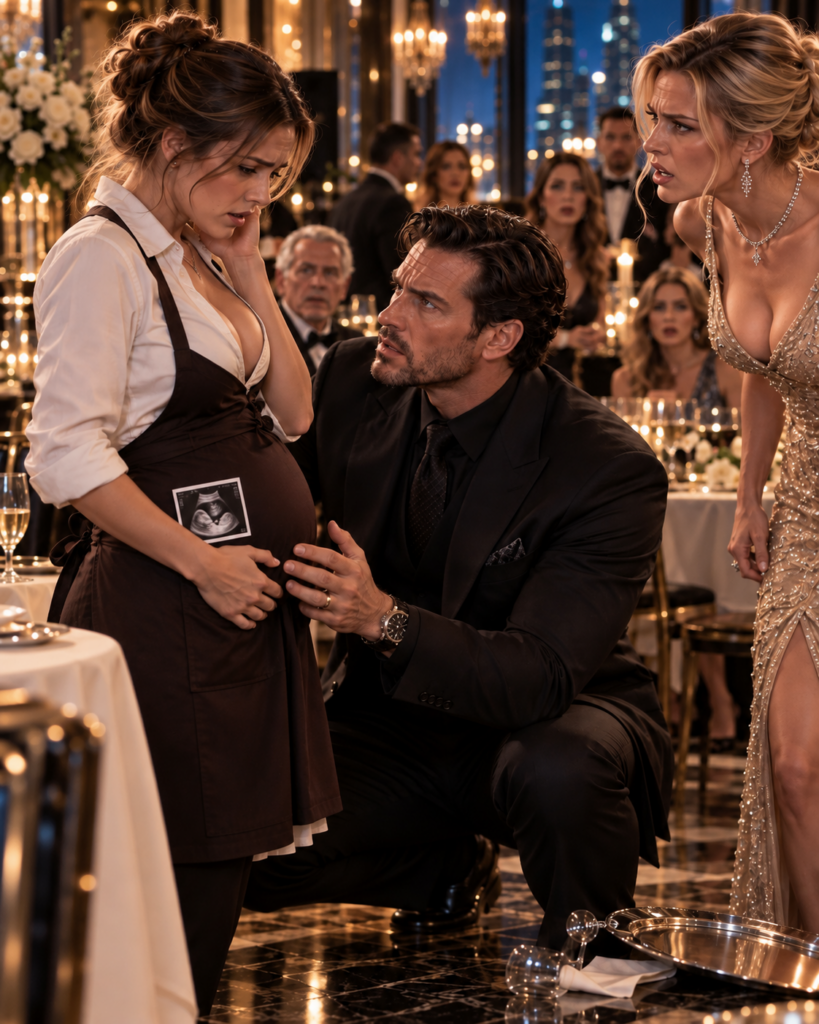
ABillionaire Heiress Slapped a Pregnant Waitress—Then the Mafia Boss Knelt Down and Said, “I’ve Been Looking for Her for Eight Years”
Vanessa Sinclair slapped a seven-month-pregnant waitress so hard that a silver tray crashed onto the ballroom floor and champagne glasses shattered beneath crystal chandeliers.
Three hundred wealthy guests watched Abigail Foster kneel among broken glass while Vanessa laughed and told her, “People like you should learn where you belong.”
Then Matteo Romano—the one man in the ballroom nobody dared challenge—walked forward, knelt beside Abigail, read the name on her broken employee badge, and went completely still. “I’ve been looking for this woman for almost eight years.”

PART 1 — THE WAITRESS EVERYONE WATCHED FALL
The slap echoed through the Grand Atoria ballroom like a gunshot.
Music stopped.
Conversation vanished.
Abigail Foster staggered backward, one hand flying instinctively to the round curve of her seven-month-pregnant belly.
The silver tray slipped from her fingers.
Six champagne flutes hit the marble floor and exploded.
Vanessa Sinclair looked down at the mess.
“Wonderful.”
She wore pale silver silk and enough diamonds to pay Abigail’s rent for several years.
“You almost ruined my dress.”
Abigail’s cheek burned.
“I’m sorry, ma’am.”
“Of course you are.”
Vanessa stepped closer.
“You people are always sorry after you’ve already made yourselves inconvenient.”
A few guests shifted awkwardly.
Nobody intervened.
The Sinclair family financed hospitals, museums, political campaigns, and half the charitable causes represented in the ballroom that night.
Richard Sinclair’s name could open boardroom doors across three continents.
His daughter knew it.
Abigail crouched carefully.
Her lower back screamed as she reached for broken crystal.
“I’ll clean this.”
Vanessa laughed.
“That’s probably the first intelligent thing you’ve said.”
Abigail’s employee badge had broken loose during the fall.
Before she could reach it, a polished black shoe stopped beside it.
The room changed.
Not dramatically.
More like the air had become heavier.
Matteo Romano had left the donor table.
Abigail recognized him immediately.
Everyone did.
Thirty-seven.
Owner of Romano Hospitality.
Shipping interests.
Luxury hotels.
Real-estate holdings.
The kind of man newspapers called a billionaire businessman and federal investigators described much more carefully.
He looked at Abigail.
Then at the redness spreading across her cheek.
Then at Vanessa.
Without speaking, Matteo bent one knee and picked up Abigail’s badge.
A man like him did not kneel publicly.
The photographers noticed first.
So did Richard Sinclair.
Matteo examined the cracked plastic.
ABIGAIL FOSTER.
His expression changed.
“Your name is Abigail?”
She swallowed.
“Yes, sir.”
He looked at her face as though comparing it to a memory.
Vanessa folded her arms.
“Matteo, if you’re worried about liability, management can replace her.”
He ignored her.
One of his security men produced a new badge clip.
Matteo attached it himself, careful not to pull the uniform stretched over Abigail’s pregnancy.
Then he stood.
“Apologize.”
Vanessa blinked.
“What?”
“To her.”
She actually laughed.
“I don’t apologize to employees.”
Matteo’s face remained perfectly calm.
“I wasn’t asking about your habits.”
Richard started toward them.
“Perhaps everyone should take a moment.”
Matteo looked at him.
“No.”
Then back to Vanessa.
“You struck a pregnant woman.”
“She nearly spilled champagne on me.”
“And you believe those things belong in the same sentence?”
Vanessa’s confidence faltered.
“You don’t even know her.”
Matteo looked at Abigail again.
His voice softened.
“That’s where you’re wrong.”
Abigail frowned.
Matteo said:
“I’ve been looking for her for almost eight years.”
The ballroom went silent again.
Vanessa stared.
Richard stopped walking.
Abigail shook her head.
“I think you have the wrong person.”
“No.”
Matteo’s gaze never left her.
“Eight years ago, my seventeen-year-old sister was nearly killed in a highway crash.”
Something in Abigail’s chest tightened.
“It was raining.”
He continued.
“She needed emergency surgery.”
“Her blood type was rare.”
“The hospital couldn’t find enough compatible blood fast enough.”
Abigail stopped breathing.
Memory opened.
Antiseptic.
A frightened nurse.
Her own sleeves rolled above both elbows.
A teenage girl barely conscious beneath hospital lights.
Matteo took one step closer.
“You donated.”
Abigail’s eyes filled.
“You never gave your full information.”
“You refused payment.”
“You left before my family arrived.”
His voice broke almost imperceptibly.
“But my sister lived.”
From beside the orchestra, a woman stepped forward.
Elegant.
Dark-haired.
Tears already running down her face.
Abigail recognized the eyes before she recognized the memory.
Isabella Romano whispered:
“You told me I was going to be okay.”
Abigail covered her mouth.
And somewhere behind Vanessa Sinclair, her father stopped looking embarrassed by his daughter—
and started looking afraid of what Matteo Romano had just remembered.
PART 2 — THE ENVELOPE THEY COULDN’T LET HER TAKE HOME
Isabella crossed the ballroom slowly.
For years, Abigail had remembered the girl from the hospital as fragments.
White fluorescent light.
Bruised forehead.
Blood beneath transparent tubing.
A hand that felt impossibly cold in Abigail’s palm.
She had never known the girl’s name.
She had not asked.
Eight years earlier, Abigail had been twenty-four and working back-to-back shifts at a diner near Albany while helping her younger brother finish community college. She had stopped at St. Catherine’s Medical Center only because a coworker had injured his wrist and needed a ride.
Then a nurse entered the waiting area asking whether anyone had O-negative blood.
The need was urgent.
Abigail volunteered.
The first donation was not enough.
She agreed to return for a second medically permitted collection through the emergency donor protocol after doctors determined her values remained safe.
She remembered feeling dizzy afterward.
Remembered the nurse offering money.
Abigail refused.
She had taken a bus home.
Then forgotten almost everything except the girl.
Now Isabella stood six feet away.
Alive.
Thirty-five.
Beautiful.
Breathing because Abigail once had forty-three minutes to spare and blood somebody else needed.
“I saw your face,” Isabella said.
Abigail’s eyes filled.
“You were awake?”
“Only for a few seconds.”
Isabella smiled through tears.
“You were holding my hand.”
Abigail looked down at her own fingers.
“I remember telling you not to be scared.”
“You told me, ‘You’re going to be okay.’”
Abigail laughed shakily.
“I had no idea whether that was true.”
“It became true.”
Isabella embraced her carefully.
The ballroom watched.
Not with the hungry excitement of scandal now.
Something quieter.
Even photographers lowered their cameras.
Matteo did not.
He watched Abigail.
Not as a mystery solved.
As a debt too large for money.
Vanessa destroyed the silence.
“This is absurd.”
Every face turned.
She gave a brittle laugh.
“So she donated blood eight years ago. Wonderful.”
Richard Sinclair closed his eyes.
“Vanessa.”
“What?”
“Stop.”
Her expression hardened.
“You’re taking her side now?”
“I’m asking you to stop speaking.”
Matteo looked toward Richard.
“For the first time tonight, Mr. Sinclair, good advice.”
Richard forced a diplomatic smile.
“Emotions are high.”
“No.”
Matteo looked toward the broken glass still waiting on the floor.
“What happened is simple.”
He turned to the hotel general manager.
“Do your cameras cover this ballroom?”
The manager swallowed.
“Yes.”
“Preserve tonight’s footage.”
Richard’s head lifted.
Matteo continued.
“No deletions.”
“No edits.”
“No conversations with witnesses intended to influence their recollection.”
“You don’t control this hotel,” Richard said.
Matteo turned.
“I own forty-two percent of its debt.”
Silence.
Richard knew immediately that was probably true.
Matteo’s investment companies quietly held distressed hotel and commercial assets all over the Northeast.
Matteo looked back toward the manager.
“Preserve the recording.”
The manager nodded.
“Yes, sir.”
Abigail became uncomfortable.
“Please.”
Matteo’s expression softened.
“I don’t want people losing their jobs because of me.”
“They won’t.”
Then:
“But nobody gets to hit you and make the evidence disappear.”
Vanessa scoffed.
“You’re making this sound like a federal case.”
“No.”
Matteo’s eyes hardened.
“You did that when you decided laws apply according to uniforms.”
Richard stepped toward his daughter.
“Enough.”
This time Vanessa actually stopped.
Matteo took out a business card.
No gold lettering.
No grand title.
His direct office number.
He wrote another number on the back.
“This reaches me.”
Abigail hesitated.
“I don’t want trouble.”
“You didn’t create any.”
She accepted the card.
It felt too heavy.
The general manager insisted Abigail end her shift.
She wanted to refuse.
She needed the money.
But her cheek throbbed, her feet had swollen, and the baby had been unusually still for several minutes after the fall.
That frightened her more than anything.
She went downstairs.
The employee corridors looked nothing like the ballroom.
Concrete floor.
Fluorescent lighting.
Laundry carts.
Exposed pipes.
The hotel’s luxury ended exactly where guests stopped looking.
Abigail entered the locker room and sat.
Her shoes came off immediately.
Her left ankle had puffed around the strap.
She placed both hands on her belly.
“Come on.”
Nothing.
Her heartbeat accelerated.
“Please.”
Then one kick.
Hard.
Another.
Abigail closed her eyes.
“Thank you.”
A voice behind her said:
“Abby?”
Grace Holloway stood near the lockers.
Thirty-two.
Waitress.
Single mother.
Three years at the hotel.
“I’m sorry.”
“For what?”
“I didn’t help.”
Abigail looked up.
“You have two children.”
“That doesn’t make me feel better.”
“It should.”
Abigail gave a tired smile.
“Getting fired for confronting Vanessa Sinclair wouldn’t help them.”
Grace sat beside her.
“That’s the problem.”
“What?”
“We all know that.”
Something in her tone made Abigail turn.
Grace looked toward the door.
Then walked to her locker.
She removed a brown envelope from beneath folded shoes.
“I wasn’t going to show anyone.”
Abigail frowned.
“What is it?”
Grace sat again.
“For six months, payroll files were accidentally accessible through banquet scheduling.”
“That seems impossible.”
“It was fixed fast.”
“Not fast enough.”
Grace opened the envelope.
Photocopies.
Termination documents.
Leave requests.
Medical restrictions.
Abigail recognized names.
Jessica Morales.
Maria Jensen.
Hannah Park.
Lauren Rivers.
Women she assumed had quit.
All pregnant.
One had requested reduced lifting after developing preeclampsia.
Her next file showed reassignment to banquet storage.
Another lost health coverage twelve days before delivery.
A third had allegedly signed a resignation letter dated before the HR meeting in which she was supposedly offered alternatives.
Abigail frowned.
“These signatures…”
“I know.”
“They look copied.”
“I know.”
Grace whispered:
“They weren’t resigning.”
Abigail looked up.
“What happened?”
“Pressure.”
“Reduced hours.”
“Punitive shifts.”
“Benefit cutoffs.”
“Sometimes they were offered small payments if they signed confidentiality agreements.”
“Why?”
Grace laughed bitterly.
“Pregnancy costs money.”
Abigail stared at the documents.
The hotel was part of a network benefiting from Sinclair Foundation grants and employment subsidies.
The same foundation that publicly advertised itself as a champion of women and children.
“This can’t be legal.”
Grace looked tired.
“Who was going to challenge them?”
Abigail handed the pages back.
“No.”
Grace shook her head.
“You keep them.”
“Grace—”
“I have copies.”
Abigail stared.
“Why me?”
Grace’s eyes filled.
“Because you got slapped in front of three hundred people and you still asked management not to fire anyone.”
“That doesn’t make me brave.”
“It makes you safer than the people upstairs.”
Neither woman noticed the camera above the outer hallway.
Security supervisor Thomas Bell did.
He sat in a small monitoring office scrolling backward through ballroom feeds after receiving a call from Richard Sinclair’s private counsel.
Then he saw Abigail.
Envelope.
Grace.
His stomach tightened.
He dialed.
Richard answered.
“Yes?”
“She has something.”
“What?”
“Documents.”
“From whom?”
“Another employee.”
Silence.
Richard’s voice lowered.
“Keep her in sight.”
Thomas swallowed.
“Mr. Sinclair…”
“Just keep her in sight.”
The call ended.
Thomas stared at the monitor.
For fifteen years, he had accepted Sinclair instructions because everyone did.
That night, for the first time, he wondered whether obedience had a statute of limitations.
Forty minutes later, Abigail exited through the employee entrance.
Rain had started.
A November rain sharp enough to work through cheap wool within minutes.
She held her coat closed over her belly.
The envelope rested inside her tote.
She intended to read it.
That was all.
Not become a whistleblower.
Not start a crusade.
Read.
Then decide.
A black sedan rolled beside the curb.
Rear window down.
Matteo.
“Miss Foster.”
She stopped.
“You’re still here?”
“I could ask you the same.”
“I work here.”
“Not tonight.”
She gave a tired smile.
“The bus stop is one block.”
“I’d rather drive you.”
“No.”
Matteo nodded immediately.
That surprised her.
“Then let my car follow.”
“That’s unnecessary.”
“No.”
She frowned.
He explained.
“Richard Sinclair watched you leave.”
“So?”
“He wasn’t watching like a donor whose daughter embarrassed him.”
“What does that mean?”
“It means I don’t know yet.”
“Which is why I’m asking, not ordering.”
Abigail looked toward the bus shelter.
“You’re used to ordering.”
“Yes.”
“Does asking hurt?”
“Considerably.”
Despite herself, she smiled.
Then headlights appeared around the corner.
No running lights.
Dark SUV.
Too fast for the wet street.
Matteo saw it first.
His entire body changed.
“Abigail.”
The vehicle mounted the curb.
“Get in!”
She froze.
Matteo lunged.
He wrapped one arm around her shoulders and another across her belly, turning so his own back faced the SUV.
They hit the sidewalk together.
The SUV missed them by inches.
Its mirror struck a light pole.
Glass exploded.
Then the vehicle swerved back into traffic and vanished.
Abigail could not breathe.
Matteo rolled immediately.
“Are you hurt?”
She pushed him away and grabbed her stomach.
“No.”
No movement.
“Oh God.”
“Abigail.”
“Baby.”
His face went pale.
Then—
kick.
She gasped.
Another.
Her body collapsed with relief.
“He moved.”
Matteo closed his eyes once.
Security poured from his car.
One man photographed the broken side mirror.
Another called police.
Matteo looked down the street.
His voice became quiet.
“They know about you.”
Abigail looked toward him.
“Who?”
“I don’t know.”
“What are you talking about?”
His eyes moved to her tote.
“Did someone give you something downstairs?”
Abigail instinctively pulled the bag closer.
Matteo noticed.
Did not reach.
“Don’t show me here.”
She stared.
“You knew?”
“No.”
“But someone else might.”
Rain ran down his face.
“This wasn’t random.”
Abigail looked toward the road.
Then the broken mirror.
For the first time, humiliation disappeared from the center of her fear.
Something larger had taken its place.
Matteo drove her to a private medical clinic after police took initial statements.
Not one he owned.
Not one Sinclair funded.
Abigail insisted on that.
The obstetrician performed an ultrasound.
Heartbeat normal.
Placenta intact.
No signs of trauma.
“Stress and soreness are likely,” the doctor said.
“But the baby looks healthy.”
Abigail cried.
Quietly.
Matteo waited outside.
No attempt to enter.
When she emerged, he stood.
“How is he?”
She paused.
“You assumed boy?”
Matteo looked horrified.
“I—”
Abigail laughed for the first time that night.
“He is.”
Relief moved across Matteo’s face so openly it startled her.
“He’s okay.”
“Good.”
She looked at the dark circles under his eyes.
“Why do you care this much?”
The question stopped him.
They stood beside a hallway window.
Night traffic moving below.
Matteo answered:
“Eight years ago my family had money.”
“Helicopters.”
“Doctors.”
“People who answered phones at two in the morning.”
“And none of it could manufacture compatible blood.”
He looked at her.
“You walked into that hospital tired from a diner shift and gave what we could not buy.”
Abigail lowered her eyes.
“It was blood.”
“No.”
“It was time.”
“Pain.”
“A stranger deciding another stranger mattered.”
He paused.
“My world is full of people who help when they expect return.”
“You didn’t even leave your last name.”
Abigail smiled weakly.
“I was in a hurry.”
“Apparently.”
Then he became serious.
“I’m not protecting you because I think you owe me a role in your life.”
“Good.”
“I’m protecting you because somebody tried to put a vehicle through you.”
“Also good.”
“And because Isabella will kill me if anything happens to you.”
Abigail smiled again.
“That one I believe.”
By morning, Matteo had assembled a team.
Not men with guns around a table.
Lawyers.
Forensic accountants.
Employment counsel.
Cybersecurity professionals.
A former federal prosecutor named Ethan Brooks.
Matteo placed the recovered SUV mirror on the conference table.
“We do not retaliate.”
Several faces showed surprise.
“We preserve.”
“Verify.”
“Document.”
“Then we let the people who have jurisdiction do their jobs.”
Ethan nodded.
“Good.”
Matteo looked offended.
“You sound surprised.”
“Your reputation occasionally involves less paperwork.”
“Reputation is lazy.”
“Usually built from something.”
Matteo ignored that.
Grace’s copied records were reviewed.
Authentic.
Enough to suggest a pattern.
Not enough to prove every allegation.
Former employees were contacted through counsel.
Slowly.
Jessica Morales responded first.
She had been six months pregnant when her hours were reduced below benefits eligibility.
Maria Jensen had been placed on heavy banquet inventory despite medical restrictions.
Hannah Park produced emails showing HR repeatedly pressuring her to “consider whether motherhood was compatible with hospitality leadership.”
Lauren Rivers had saved a resignation document she said she never signed.
The story grew.
Then financial analysts found another inconsistency.
Sinclair Foundation grants to hotels supposedly funding maternal-workplace programs did not match money actually spent on employees.
Large administrative charges flowed through nonprofits connected to Sinclair advisers.
Ethan said:
“We have two issues.”
“Employment discrimination and possible financial misuse.”
“Can we prove the second?”
Matteo asked.
“Not yet.”
“Then don’t say we can.”
Abigail joined one meeting two days later.
Against Matteo’s advice.
She sat at the far end of the conference room wearing a simple maternity sweater and compression socks.
“Those are my coworkers.”
She said.
“I’m not staying home while strangers tell their stories for me.”
Matteo did not argue twice.
Grace came too.
So did Thomas Bell, the security supervisor.
He looked terrified.
“I have something.”
He placed a USB drive on the table.
Ethan did not touch it.
“What is it?”
“Camera copies.”
“From?”
“Employee hallways.”
“Ballroom.”
“Security office.”
Thomas swallowed.
“Also call logs.”
Richard Sinclair’s number appeared repeatedly.
Including the call immediately after Thomas saw Grace handing Abigail the envelope.
Matteo’s face changed.
Abigail touched his sleeve.
“No.”
He looked toward her.
“You know exactly what I’m thinking?”
“Yes.”
“And?”
“Don’t.”
Matteo looked at Ethan.
Ethan said:
“We send this through counsel to investigators.”
Matteo nodded.
That was growth in real time.
The ballroom video went viral anyway.
Someone had posted a thirty-second clip before hotel management could control anything.
Vanessa striking Abigail.
Tray falling.
Then Matteo kneeling with the badge.
The internet did what it always did.
Simplified.
Amplified.
Invented.
One headline called Abigail Matteo’s secret pregnant girlfriend.
Another claimed she was his sister.
Another called her an undercover federal agent.
Abigail stopped reading after twelve minutes.
The part that mattered was different.
Former Sinclair employees began speaking publicly.
Not anonymously anymore.
Pregnant employees.
Women with medical restrictions.
A bartender who was fired after reporting harassment.
A housekeeper whose health benefits vanished during cancer treatment.
One video became a door.
The Sinclairs could not shut it.
Richard convened emergency board meetings.
Vanessa raged.
“This is one waitress.”
The chief legal officer said:
“No.”
He closed his laptop.
“This is a pattern.”
Richard stared at his daughter.
“You created the visible moment.”
“Other people are supplying the history.”
Vanessa folded her arms.
“So fix it.”
The lawyer looked at Richard.
“That is not a legal strategy.”
Institutional donors suspended partnerships.
Two hotel transactions stalled.
Labor organizations requested government review.
The Sinclair Foundation issued a statement promising an independent audit.
No one trusted it.
Matteo refused to comment publicly.
Abigail did too.
That frustrated reporters.
It also protected the investigation.
Three weeks after the gala, government investigators obtained preservation orders covering employment files, digital communications, and selected financial records based on evidence submitted through lawful channels.
No federal judge appeared dramatically on a gala stage.
No agents used charity guests as an audience.
The actual moment was quieter.
Richard Sinclair sat inside his corporate office when counsel received formal notice.
Records could not be destroyed.
Devices had to be preserved.
Certain payments entered enhanced review.
Former HR director Linda Mercer resigned that afternoon.
Then called Ethan Brooks.
“I kept originals.”
“How many?”
“Enough.”
“Why?”
“Because five years ago they ordered me to terminate a woman two weeks before she gave birth.”
Linda’s voice broke.
“She lost coverage for her premature baby.”
“I told myself I was following policy.”
“Then it happened again.”
“And again.”
“Why now?”
Silence.
Then:
“I watched Vanessa hit Abigail.”
“I watched everyone stand still.”
“I realized I have been standing still for five years.”
Linda brought archive boxes.
Original leave requests.
Internal instructions.
Draft resignation forms.
Emails.
Payroll adjustments.
A directive from a Sinclair Foundation executive describing pregnancy-related employees as “cost-heavy personnel requiring aggressive transition.”
Richard’s signature did not appear on most.
But correspondence showed he received summary reports.
His legal exposure became a factual question rather than a social assumption.
That mattered.
Abigail insisted on that distinction.
“I don’t want anybody punished because their surname is Sinclair.”
She told Ethan.
“I want the records followed.”
Matteo watched her.
Later he asked:
“Why are you protecting Richard?”
“I’m not.”
“You always do that.”
“Do what?”
“Refuse the satisfying version.”
Abigail folded baby clothes on the sofa in the apartment Matteo had helped her temporarily secure through a relocation service.
“I know what it’s like to be judged before facts.”
She looked at him.
“I’m not recreating it because now the rich people are the defendants.”
Matteo sat quietly.
“You keep making me better.”
“That sounds exhausting.”
“It is.”
Months passed.
The investigation separated people into categories.
Some executives had knowingly participated.
Others had followed policies without understanding their purpose.
Some objected internally.
A few had tried to protect employees and been overruled.
Richard had known more than he initially admitted about the cost-cutting strategy.
Whether he understood every unlawful implementation was disputed.
He ultimately accepted responsibility in civil and regulatory settlements tied to governance failures and misrepresentations in foundation reporting.
The Sinclair Foundation was dissolved and its remaining assets transferred under court-supervised agreements into independent employee-support funds.
Several executives faced criminal charges related to falsified financial records and obstruction.
Vanessa was not charged for being cruel.
She faced the ordinary legal consequences of the assault in the ballroom and later entered a diversionary program after Abigail declined to seek punitive escalation beyond what prosecutors deemed appropriate.
People online hated that.
Abigail did not care.
“She hit me.”
She told Grace.
“She didn’t murder me.”
Grace raised an eyebrow.
“Very disappointing of you.”
“I know.”
“What if I wanted vengeance?”
“Buy dessert.”
“Fine.”
The hotel paid settlements to affected employees.
Jessica Morales used hers to finish nursing school.
Maria opened a childcare business.
Hannah returned to hospitality with another company.
Grace became employee-relations director after the Grand Atoria’s board restructured management.
She almost refused.
Abigail said:
“You’ve been keeping six months of evidence in your locker.”
“You were already doing the job.”
Grace laughed.
“You sound like Matteo.”
“Take that back.”
Abigail’s son was born in March.
Thomas Foster.
Seven pounds, six ounces.
Healthy lungs.
Angry disposition.
Matteo arrived at the hospital carrying no flowers.
Instead, a small wooden music box.
Isabella had chosen it.
Abigail was holding Thomas when he entered.
Matteo stopped just inside the room.
“May I?”
The question mattered.
Abigail smiled.
“Yes.”
He came closer.
Thomas opened his eyes briefly.
Matteo looked terrified.
Abigail laughed.
“You own hotels.”
“Hotels don’t weigh seven pounds.”
“You’re scared of him.”
“He looks judgmental.”
“He is.”
Matteo offered one finger.
Thomas grabbed it.
Something in Matteo’s face softened beyond recognition.
“I think he likes me.”
“He thinks you’re furniture.”
“Cruel.”
Abigail smiled.
By then, she knew she loved him.
She also knew love was not enough to make decisions safely.
Matteo’s world carried shadows.
His business empire had legitimate hotels, shipping, property, and finance interests.
It also had history.
Connections.
Men who spoke too quietly in restaurants.
Abigail was not stupid.
She asked.
“What would being with you actually mean?”
They were sitting on her apartment balcony six weeks after Thomas’s birth.
Matteo did not romanticize it.
“Security sometimes.”
“Public attention.”
“People assuming motives about you.”
“Possibly risks I work hard to keep away from you.”
“Possibly?”
“Yes.”
“I won’t lie.”
“Would you expect me to stop working?”
“No.”
“Move into your house?”
“No.”
“Let your security follow Thomas to preschool someday?”
“If there is a specific threat, I would ask.”
“And if I say no?”
His jaw tightened.
“Then we discuss it.”
Abigail watched him.
“That wasn’t the question.”
Matteo breathed slowly.
“If you say no, I don’t override you because I’m afraid.”
Better.
She nodded.
He asked:
“What would you want?”
“A job.”
“You have one when maternity leave ends.”
“I don’t want to go back to serving tables.”
“What do you want?”
Abigail looked toward Thomas sleeping inside.
“I don’t know.”
Matteo did not offer an executive position.
That mattered too.
Instead, Isabella introduced Abigail to a nonprofit hospital donor program seeking a community liaison.
Her background was unconventional.
Diner.
Waitress.
Years caring for her mother before she died.
No bachelor’s degree.
But she understood people ignored by institutions.
She applied.
Interviewed.
Was rejected the first time.
Applied elsewhere.
Took evening courses in nonprofit administration.
Six months later, she became program coordinator for an employee and patient support organization.
Her salary was modest.
Her pride enormous.
Matteo celebrated by taking her to a restaurant where he had no ownership.
“Why here?”
“You earned something unrelated to me.”
“I wanted no conflict of interest.”
Abigail smiled.
“Learning.”
“Painfully.”
The romance developed in ordinary spaces.
Coffee.
Baby bottles.
Hospital parking garages.
Matteo assembling a crib incorrectly.
Abigail refusing to let his staff redo it.
“You put the panel backward.”
“It is abstract.”
“It is unsafe.”
“Aesthetic disagreement.”
“Move.”
He moved.
One night Thomas screamed for two uninterrupted hours.
Matteo walked him through the apartment while Abigail showered.
When she returned, Matteo’s shirt was covered in spit-up.
He looked exhausted.
She laughed.
“This is your glamorous reward for finding me.”
“I have negotiated port acquisitions with less resistance.”
Thomas screamed again.
Matteo looked down.
“Your mother is laughing at us.”
Thomas sneezed.
Abigail’s heart opened a little farther.
Vanessa disappeared from public life for months.
Then surprised everyone.
She requested a private meeting with Abigail.
No lawyers present inside the room.
Counsel nearby.
Abigail accepted because she wanted to know whether the apology in the ballroom had been fear or understanding.
Vanessa arrived without diamonds.
Still expensive.
But quieter.
She sat.
For a minute neither spoke.
Then Vanessa said:
“I hated you.”
Abigail raised an eyebrow.
“Encouraging start.”
Vanessa almost smiled.
“I hated that Matteo looked at you like you mattered.”
“That’s why you hit me?”
“No.”
She looked ashamed.
“I hit you because I already believed people working in service jobs were available for my anger.”
Honest.
Ugly.
Useful.
Vanessa continued.
“When he defended you, I made it about attraction because that was easier than admitting I had become cruel.”
Abigail said nothing.
“My father raised me around people who fixed consequences.”
“Tickets.”
“Bad headlines.”
Complaints.”
“Staff problems.”
“I started thinking consequences were something poor people dealt with.”
She swallowed.
“Then my father lost his foundation.”
“Our name became a joke.”
“Friends stopped calling.”
“And I realized the worst part wasn’t losing those things.”
“What was?”
Vanessa’s eyes filled.
“Watching the videos again.”
“I kept waiting to see some version where I looked misunderstood.”
“There wasn’t one.”
Abigail understood that.
Evidence can be merciless.
“What do you want from me?”
“Nothing.”
“Then why come?”
“To apologize when I’m not surrounded by cameras.”
Better.
Vanessa looked toward her.
“I am sorry.”
“For hitting you.”
“For insulting you.”
“For believing your uniform told me how much respect you deserved.”
“And for not caring that you were pregnant until the room cared.”
Abigail thought of the old instinct to make everyone comfortable.
She no longer had it.
“I believe you regret it.”
Vanessa nodded.
“That’s all I can ask.”
“No.”
Abigail corrected.
“That is all you can receive.”
Vanessa accepted that.
They never became friends.
They did not need to.
Accountability did not require intimacy afterward.
A year after the gala, Grand Atoria completed a major workplace reform.
Independent complaint systems.
Pregnancy accommodation.
Protected health benefits.
External review for executive misconduct.
Transparent leave policies.
Grace helped design them.
Former employees were invited to critique them.
Not for public relations.
For defects.
The hotel reopened its annual Hope Gala with different leadership.
Abigail nearly declined the invitation.
Then Grace said:
“If you make me stand onstage alone, I’ll tell everyone you snore.”
“I do not.”
“Matteo says—”
“Matteo is dead.”
Grace laughed.
Abigail attended as honorary chair of the employee dignity initiative.
Not because she had become a symbol.
She insisted the title rotate annually among employees and former employees.
She wore navy.
Thomas was eight months old.
Isabella carried him through half the reception and refused to return him.
“You have your own family.”
“I like this one.”
Matteo stood nearby in a simple dark suit.
No intimidating entourage.
Although Abigail knew security existed.
Discreetly.
By agreement.
The ballroom looked the same.
That was strange.
Chandeliers.
Marble.
Champagne.
Physical rooms are often innocent of what people do inside them.
Abigail stood where the tray had shattered one year earlier.
She could almost hear the slap.
Matteo came beside her.
“Want to leave?”
She thought.
“No.”
“You sure?”
“Yes.”
The host called her name.
Abigail walked onto the stage.
Applause rose.
She waited until it ended.
Then looked across the room.
“One year ago, I worked a shift in this ballroom.”
She smiled faintly.
“I was tired, pregnant, and thinking mostly about whether I could get home before the last bus.”
A few people laughed softly.
“I did not expect my life to change.”
“I certainly did not expect anyone to know something I had done eight years earlier.”
She looked toward Isabella.
Isabella smiled.
Abigail continued.
“I spent a lot of my life believing good people should be quiet about the things they give.”
“Maybe that is still partly true.”
“Kindness should not require applause.”
“But silence has another side.”
Her voice strengthened.
“Silence can protect kindness.”
“It can also protect cruelty.”
The ballroom became very still.
“The women who lost jobs here were silent because they needed references.”
“Managers were silent because they needed salaries.”
“Coworkers were silent because they were afraid.”
“I was silent after I was hit because my first instinct was still to keep my job.”
She looked toward Grace.
“Then one woman opened a locker and showed me papers she was terrified to carry.”
Grace wiped one eye.
Abigail continued.
“Courage is rarely one person being fearless.”
“It is usually one frightened person doing something small enough that the next frightened person can do something too.”
She looked at Thomas in Isabella’s arms.
“My son will grow up in a world where people have power over one another.”
“Employers.”
“Parents.”
“Governments.”
“Money.”
“Names.”
“I cannot teach him power is bad.”
Her eyes found Matteo.
“I can teach him the measure of power is what you do when someone cannot repay you or fight back.”
Matteo lowered his head.
The audience rose.
Abigail did not need the applause.
But this time she accepted it.
Later, after dinner, she found Matteo alone near the terrace doors.
“You disappeared.”
“I’m respecting your event.”
“You’re standing fourteen feet away.”
“Extreme restraint.”
She smiled.
“Isabella stole my baby.”
“I noticed.”
“She says he prefers her.”
“She’s wrong.”
“Obviously.”
They stood quietly.
Then Abigail said:
“You told me once your father said character is how you treat people who can’t repay you.”
“Yes.”
“You’ve repeated that a lot.”
“My father only had three good sentences.”
She laughed.
Matteo became serious.
“I have something I want to tell you.”
Her eyebrows rose.
“Dangerous.”
“I love you.”
Abigail looked toward him.
No kneeling.
No ring.
No audience directed toward them.
Just Matteo.
“I know.”
He looked offended.
“That response is terrible.”
“Do you want me to lie?”
“No.”
She smiled.
“I love you too.”
His expression changed.
Relief.
Joy.
Fear.
All of it.
“But.”
He sighed.
“Of course.”
“I’m not moving into your house tomorrow.”
“I know.”
“I’m not quitting my job.”
“I know.”
“My son is not becoming a Romano project.”
“I know.”
“And if someday this stops being good for me—”
“You leave.”
Matteo answered before she finished.
Abigail held his gaze.
“And?”
“I do not make leaving dangerous.”
There.
The sentence she needed.
She took his hand.
Months later, she moved into his house.
Not because he bought enough things.
Because enough ordinary days passed without her being managed.
She kept her own account.
Her job.
A room she used as an office.
Thomas’s last name remained Foster.
Matteo never argued.
When he eventually proposed, Thomas was two.
He proposed in their kitchen after burning pasta.
Abigail stared at the blackened pan.
“You own restaurants.”
“I employ people who cook.”
“That was obvious.”
He held out a ring.
Simple.
Not enormous.
He had listened.
“You can say no.”
“That should be printed inside.”
“I considered it.”
She laughed.
Then cried.
Then said yes.
The wedding was small.
Isabella stood beside Abigail.
Grace cried loudly.
Matteo pretended not to.
Vanessa sent a handwritten card.
No gift.
Abigail appreciated that.
Richard Sinclair did not attend.
His legal matters had concluded through settlements, penalties, governance restrictions, and public disgrace.
He had resigned from several boards.
Lost much.
Not everything.
Justice did not require destitution.
It required that money no longer erase accountability.
Years later, Abigail returned to the Grand Atoria with Thomas.
He was seven.
Curious.
Restless.
He stared at the chandeliers.
“Mom, is this where Aunt Isabella says Dad became obsessed with you?”
Abigail nearly choked.
“Isabella says what?”
Matteo, walking behind them, said:
“She is banned from unsupervised conversation.”
Thomas laughed.
Abigail stopped near the marble floor.
Same place.
She looked down.
No visible mark remained from the broken glass.
Thomas tugged her hand.
“What happened here?”
He knew pieces.
Not all.
Abigail crouched.
“A woman was cruel to me.”
“Dad beat her up?”
“No.”
Matteo coughed.
Abigail gave him a look.
“No one beat anyone.”
“Then what happened?”
“People told the truth.”
Thomas considered.
“That’s boring.”
“Usually.”
“Did it work?”
Abigail looked around the ballroom.
Grace was now vice president of employee experience across the hotel group.
The maternity-support program had expanded nationwide.
An independent legal clinic funded partly from Sinclair settlement money advised workers before signing severance or leave documents.
Isabella ran a blood-donation foundation.
Matteo had reduced his darker business connections substantially over the years, though Abigail never pretended his world had become entirely ordinary.
The important difference was that he never asked her to lie about what she could see.
“Yes,” she said.
“It worked.”
Thomas pointed toward the stage.
“Can I have cake?”
“Now that,” Matteo said, “is an excellent question.”
They walked toward dessert.
Abigail paused once and looked back.
Eight years before the gala, she had given blood and expected nothing.
One year before her wedding, she had been hit and expected nobody to help.
Both assumptions had changed her life.
But the deepest change had nothing to do with Matteo finding her.
Kindness had not made Abigail valuable.
She had already been valuable.
Matteo’s recognition did not create her dignity.
His protection did not grant it.
The legal investigation did not prove it.
Those things only exposed how easily society confuses visibility with worth.
A waitress can save a life.
A billionaire can destroy one.
A frightened employee can carry evidence powerful institutions missed.
A woman wearing a uniform can be the most important person in the room long before anyone wealthy learns her name.
Abigail joined Matteo and Thomas beside the dessert table.
Thomas had already selected something enormous and chocolate.
“Absolutely not.”
“Dad said yes.”
Abigail looked at Matteo.
He raised both hands.
“I am being falsely accused.”
Thomas betrayed him instantly.
“He said Mom would say no but we could try.”
“Matteo.”
“I believe in democratic process.”
“You live dangerously.”
“I married you.”
She tried not to smile.
Failed.
The orchestra started.
Not the same song.
Something lighter.
Matteo held out his hand.
“Dance?”
“I’m wearing sensible shoes.”
“Your most dangerous form.”
She gave him her hand.
Thomas groaned dramatically.
“Gross.”
“Go find Isabella.”
“Can I take the cake?”
“No.”
“Yes,” Matteo said simultaneously.
Abigail stared.
He corrected:
“No.”
“Learning,” she said.
“Painfully.”
They walked onto the floor.
Abigail remembered the first night.
Her swollen feet.
The uniform.
The tray.
The humiliation.
The way everyone looked away.
She had thought the worst part was being struck.
It wasn’t.
It was that for several seconds afterward, she believed Vanessa was right.
That a waitress had no right to demand dignity from people powerful enough to punish her.
That belief did not survive the year.
Now Abigail understood dignity differently.
It did not rise or fall with salary.
Pregnancy.
Uniform.
Money.
Marriage.
Matteo’s surname.
Or applause.
It was not something another person could hand you.
Only something they could either recognize—
or reveal themselves by refusing to.
Matteo’s hand rested lightly at her back.
“Abigail?”
“Yes?”
“You went somewhere.”
“Just thinking.”
“Dangerous.”
“Very.”
He smiled.
The chandeliers caught in his eyes.
Across the ballroom, Thomas had somehow acquired the chocolate cake.
Isabella was obviously responsible.
Abigail sighed.
“Your sister is corrupting my child.”
“Our child.”
She looked at him.
Years earlier, that phrase might have frightened her.
Now it felt warm.
“Our child,” she agreed.
Matteo smiled.
They kept dancing.
No cameras focused on them.
No crowd gathered.
No one needed to know what the moment meant.
And that was perhaps the greatest luxury Abigail Foster had ever received—
not being rescued,
not being discovered,
not becoming important because a powerful man remembered her—
but finally living a life where she no longer needed anyone’s permission to know she mattered.


