
Part 1
The first warning came not from the river, but from a piece of broken iron laid upon the Duke of Montclair’s dinner table.
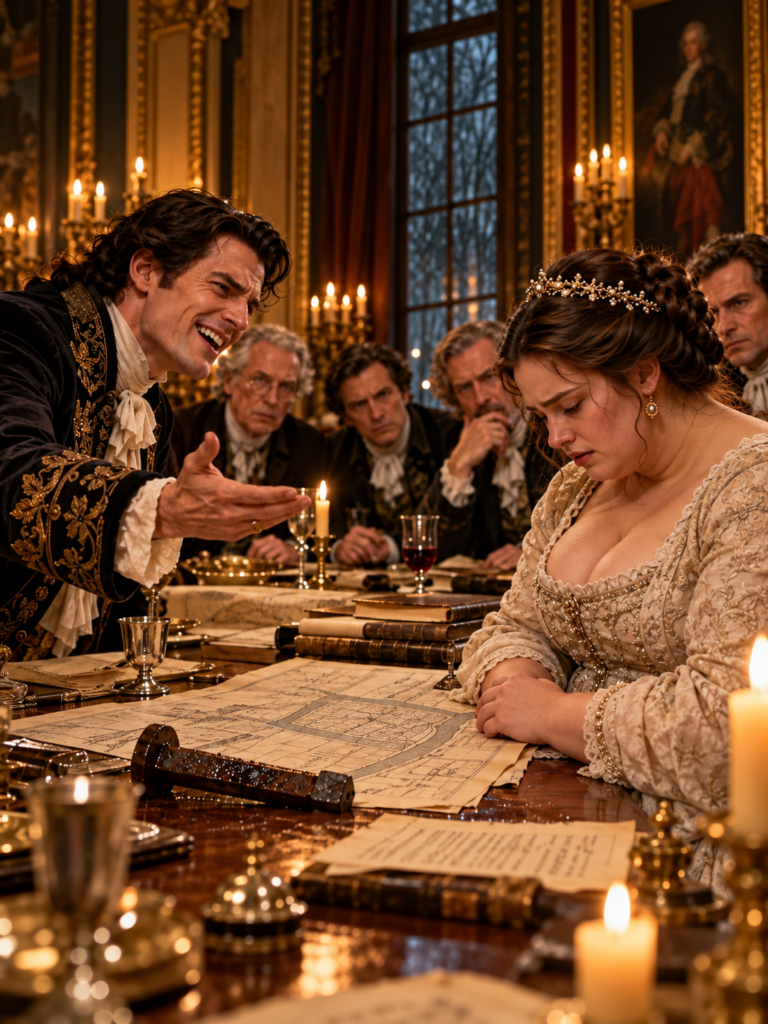
It was nearly ten o’clock, and rain had been striking the windows of Morven Hall for so many hours that the sound had become part of the house itself. Beyond the long panes, the northern countryside lay beneath a black October sky. Within, a dozen candles burned above polished silver, crystal goblets, and a collection of ancient documents that had displaced most of the evening’s supper.
Six gentlemen had been invited to examine the old drainage system beneath the Montclair estates. Three were celebrated scholars. Two were engineers of considerable reputation. The sixth, Lord Hadron Veyle, possessed neither profession nor expertise but had inherited sufficient acreage to consider his opinions indispensable.
At the head of the table sat Tavian Montclair, Duke of Morven, a man of thirty-nine who had seldom encountered a question he believed himself incapable of settling.
Beside him sat his wife.
Elvira Montclair had been Duchess of Morven for seven years. She wore a gown of dark green silk, a modest string of pearls, and the patient expression of a woman who had spent an evening listening to men explain something she understood better than they did.
Her husband had barely addressed her since the soup.
He was not deliberately cruel in the ordinary sense. He did not shout at her, restrict her movements, or deny her comfort. He entrusted her with the household accounts, the organization of large entertainments, and the management of charitable obligations that would have exhausted a less competent woman.
But there was one room in the house into which he had never truly invited her.
The room where important decisions were made.
Tonight, that room happened to be the dining room.
Professor Gorvan Elde, the distinguished antiquarian from Bellwick College, was explaining a passage from an inscription found beneath the northern embankment.
“The command is quite unmistakable,” he declared, tapping the parchment with one long finger. “When the northern waters reach the third measure, the eastern mouth must remain secured.”
Doctor Caldus Renn, a younger linguist with ink on his cuff, nodded thoughtfully.
“The verb has several historical applications, but the formal meaning is containment.”
“Precisely,” said Elde. “The builders intended the eastern channel to remain closed during periods of excessive rainfall.”
Tavian leaned back.
“Which confirms my decision not to disturb the old eastern works.”
Elvira looked at the map.
She had been looking at it for most of the evening.
The plan showed a network of underground channels, stone reservoirs, drainage galleries, and sluice gates built two centuries earlier, when the Montclair lands had supported a thriving collection of watermills.
Most of the mills were gone.
The channels remained.
And for the past three weeks, something beneath the northern fields had been going terribly wrong.
The River Edren, which should have been swollen by the autumn rains, ran strangely low.
Fields that had remained dry for generations were turning to marsh.
Water had appeared in the cellars of two mills uphill from the river.
The estate surveyor, Edric Verne, had warned that pressure was accumulating somewhere in the buried system.
Tavian had summoned the scholars to discover why.
Now they were congratulating themselves upon an answer that made no practical sense.
Elvira moved her finger along the edge of her napkin.
“Professor,” she said quietly, “may I ask something?”
The conversation faltered.
Elde looked surprised.
“Certainly, Your Grace.”
“If the northern reservoir is filling, and the eastern outlet remains shut, where is the excess water supposed to go?”
Elde smiled with the indulgent confidence of a man accustomed to answering elementary questions.
“Into the central holding basin, naturally.”
“And when that basin fills?”
“That is precisely why the retaining gates were constructed.”
“But the gates do not remove the water.”
“No, Duchess. They contain it.”
Elvira glanced toward the surveyor.
Edric Verne was a broad-shouldered man with weathered hands and a face that had spent more time under open skies than in drawing rooms. He met her eyes for a moment, then lowered his gaze toward the plans.
Before she could speak again, the dining-room doors opened.
A servant entered, pale and unsettled.
Behind him came a drenched laborer carrying a long object wrapped in sacking.
“Your Grace,” the servant said, “Mr. Verne’s assistant has come from the northern works.”
Edric rose immediately.
“What has happened?”
The laborer set his bundle on the table and pulled away the cloth.
A broken iron pin rolled against a silver serving dish.
It was nearly the length of a man’s forearm, rusted at one end and freshly sheared at the other.
“The north retaining gate, sir,” the laborer said. “She’s begun to give.”
Edric picked up the pin.
“Which section?”
“Second junction above Bellwick.”
The surveyor’s expression changed.
Elvira watched him.
She knew that expression.
It was the look of a man discovering that a calculation he had feared was finally becoming reality.
Tavian stood.
“How serious?”
“We cannot tell without inspecting the lower chambers.”
“Then inspect them at first light.”
Edric hesitated.
“The pressure has been rising throughout the evening, Your Grace.”
Professor Elde leaned toward the damaged iron.
“Then the necessity of securing the eastern channel is all the more apparent.”
Elvira spoke before she could prevent herself.
“No.”
The word was not loud.
Yet every man at the table turned toward her.
Tavian looked irritated.
“No?”
“If that gate has failed where Mr. Verne says it has, closing the eastern channel is the very thing that will destroy the northern embankment.”
A moment of silence followed.
Then Lord Hadron gave a faint, amused cough.
Elde adjusted his spectacles.
“Your Grace, with respect, the inscription states quite otherwise.”
“Then either the inscription has been misunderstood, or the men who built the system intended to flood their own land.”
Tavian’s expression hardened.
“Elvira.”
She looked at him.
“We have been discussing this matter for more than an hour,” he said. “Professor Elde has devoted forty years to the study of ancient Austeric. Doctor Renn has published three volumes on its grammatical development. These gentlemen have examined documents you have scarcely seen.”
“I have seen the map.”
“That is not the same as understanding it.”
She said nothing.
Tavian mistook her silence for retreat.
He gave a small laugh and gestured toward the documents.
“Since you know so much, my dear, explain it.”
Lord Hadron smiled openly.
Someone shifted a wineglass.
The challenge had been delivered in the polished tone of an aristocratic dinner, but there was no mistaking its purpose.
He expected her to embarrass herself.
Elvira looked at her husband for several seconds.
Then she removed her napkin, folded it carefully, and laid it beside her plate.
She rose.
There was something in the deliberateness of the movement that caused Edric Verne to straighten.
“Very well,” she said.
She walked around the table.
Not toward her husband.
Toward the map.
“Professor Elde, may I have the original transcription?”
Elde hesitated, then slid the parchment toward her.
Elvira studied it beneath the candlelight.
The writing was cramped, its lines broken by abbreviated symbols and technical markings.
She touched a particular word.
“This verb. You translate it as secure?”
“That is correct.”
“And you believe it refers to the eastern gate?”
“Naturally.”
“Why?”
The professor frowned.
“Because the noun immediately preceding it designates the eastern opening.”
“That tells us where the instruction applies. It does not tell us what is being secured.”
Doctor Renn leaned forward.
Elvira continued.
“When you close a door, Professor, what do you secure?”
“The door.”
“And when a miller secures a quantity of water?”
Elde opened his mouth.
Then stopped.
Elvira touched two small symbols beneath the principal inscription.
“These are not legal abbreviations. Nor are they ceremonial language. They are millers’ notations.”
Caldus Renn drew the parchment nearer.
“Are you certain?”
“Quite.”
“On what authority?”
“On the authority of having seen them used.”
Hadron gave a short laugh.
“At Morven?”
“No. At Renford Vale.”
She looked at the professor.
“The old millers there still use forms of Austeric that disappeared from formal documents generations ago. My father’s estate had three working watermills and a winter reservoir. I spent a considerable part of my childhood watching the engineers maintain them.”
Tavian frowned.
He knew that her father had owned a modest country estate.
He knew it had been associated with grain production.
He did not know about the mills.
Elvira turned back to the inscription.
“In the language of those men, the verb you have translated as secure does not always mean to close. It means to bring something under proper control.”
“An imprecise distinction,” Elde replied.
“Only when you ignore the object.”
Doctor Renn had begun reading the passage again.
Elvira pointed to another symbol.
“This marking refers to retained pressure, does it not?”
Caldus studied it.
“Possibly.”
“Then read the sentence with water as the object being controlled, not the gate.”
He lowered his head.
The room grew very quiet.
Outside, rain struck the windows harder.
Caldus read once.
Then again.
His lips moved without sound.
At last he raised his eyes.
“Professor.”
Elde came around the table.
The younger scholar pointed to the same abbreviated marking.
“I believe Her Grace has identified a different grammatical construction.”
Elde bent over the parchment.
“What construction?”
“The operational form used in hydraulic instructions.”
“That form became obsolete before the late Austeric period.”
“Not everywhere,” Elvira said.
Elde ignored her and examined the sentence.
For nearly a minute no one spoke.
Then the professor’s expression shifted.
It was a small change.
But Tavian noticed.
“Well?” the duke demanded.
Elde did not answer.
Caldus did.
“The sentence may not instruct the keeper to close the eastern outlet.”
Tavian stared.
“What does it instruct him to do?”
The younger scholar swallowed.
“To release the retained water through the eastern outlet before it reaches the third measure.”
Edric Verne took one step toward the map.
Elvira lifted the broken iron pin and placed it on the northern junction.
“That,” she said, “is why the pin broke.”
The surveyor examined the point.
Then he traced the old buried channel eastward.
His face lost its color.
“We have been holding back the discharge.”
“Yes.”
“And forcing the entire northern supply into the central basin.”
“Yes.”
Edric looked up.
“The eastern outlet is not a flood barrier.”
Elvira met his gaze.
“It is the relief system.”
For the first time that evening, Professor Elde had no answer.
Neither did the duke.
A heavy sound rolled across the countryside.
At first Tavian thought it was thunder.
Then another sound followed.
A bell.
Faint, distant, and hurried.
The warning bell from Bellwick.
Edric turned toward the windows.
“Your Grace,” he said, “if the north wall gives way, there are two villages below it.”
Tavian stared at the map.
“How long?”
“Without seeing the reservoir, I cannot know.”
“An hour?”
“Possibly less.”
The duke’s gaze moved toward his wife.
Only minutes earlier he had been certain of humiliating her.
Now the lives of hundreds of his tenants might depend upon the knowledge he had dismissed.
Elvira had already begun rolling the map.
“We must go to the waterworks.”
Tavian looked toward the storm.
“At this hour?”
“Before the next gate fails.”
He opened his mouth to object.
Then the warning bell sounded again.
This time, no one laughed.
Morven Hall had not seen such disorder in decades.
Footmen ran through corridors with lanterns. Grooms were summoned from their beds. The stable yard filled with horses, carriages, and men struggling into oilskin coats.
Tavian gave orders rapidly.
Messengers were sent toward Bellwick to warn the constable and village elders.
Work crews were ordered to the northern embankments.
The estate physician was instructed to prepare for injuries.
For several minutes, the duke recovered the familiar comfort of command.
Then Elvira interrupted him.
“The eastern works will require carpenters as well.”
Tavian turned.
“Why?”
“Because the old counterweight frames may have rotted. If the gates are to be moved after so many years, we cannot rely upon the surviving iron.”
He considered it.
Then called for the master carpenter.
Edric approached with a second plan.
“Your Grace, there is another difficulty. The lower access gallery was buried in a landslip forty years ago.”
“Then we excavate it.”
“That would take days.”
Elvira looked over his shoulder.
“May I see the upper survey?”
Edric handed it to her.
She searched among the faded lines.
Near the eastern bank was a small mark that looked almost like a chapel symbol.
She pointed to it.
“What stands here?”
“A wooded rise. A small mound above the old causeway.”
“Has anyone examined it?”
“Not closely.”
“It may be an inspection shaft.”
Edric bent nearer.
“That symbol?”
“The lower stroke is divided. At Renford, it denoted an access chamber.”
Professor Elde, standing behind them, examined the drawing.
“I had classified it as a religious marker.”
“Perhaps the surveyor was more interested in reaching his equipment than in documenting chapels.”
The professor did not smile.
Neither did he argue.
Edric suddenly seized his lantern.
“I know the mound.”
“Then send men ahead,” Elvira said. “They may need to clear its entrance.”
Tavian looked between them.
He had invited six learned men to solve an engineering problem.
And now the practical direction of the rescue was coming from the wife he had scarcely allowed to speak.
Something about that realization disturbed him more deeply than the prospect of being publicly wrong.
He was accustomed to making errors.
He was not accustomed to discovering that the person best qualified to correct them had been sitting beside him for seven years.
As Elvira turned toward the hall, he stopped her.
“You’re coming?”
“Of course.”
“It will be dangerous.”
“That is precisely why I am coming.”
He wanted to tell her that the men could manage.
That the work belonged to engineers and laborers.
That she ought to remain in the safety of the house.
But he remembered the professor’s pale face above the parchment.
The broken iron pin.
The warning bell.
For once, Tavian Montclair said nothing.
He merely reached for her cloak.
And when he held it out, she took it without thanking him.
The gesture did not require gratitude.
It required a change of understanding.
One he was only beginning to make.
Outside, the storm waited.
And beneath the fields of Morven, an ancient reservoir was filling beyond anything its builders had intended.
Part 2
The carriage wheels sank nearly to their hubs before the party reached the northern causeway.
Rain crossed the road in slanting sheets. Lanterns swung on their hooks, throwing restless patches of light across the flooded fields. Where sheep had grazed only a week earlier, black water now spread between hedgerows.
Elvira sat opposite Tavian, her gloved hands resting upon the rolled survey.
Neither had spoken for several minutes.
At last the duke said, “You might have mentioned your familiarity with hydraulic works.”
She lifted her eyes.
“I did.”
“When?”
“During our second winter at Morven. The southern orchard flooded, and I suggested examining the old culverts.”
“I remember that.”
“You told me the steward was quite capable of handling drainage.”
Tavian looked away.
“The steward had been responsible for the grounds for twenty years.”
“And yet the orchard continued to flood until I paid the gardeners to clear the blocked stone channel.”
He remembered that, too.
He remembered being pleased when the water disappeared.
He had credited the steward.
Elvira looked back toward the darkness.
“I also mentioned the winter sluices at Renford during our first visit to the northern farms.”
“I thought you were speaking of ordinary millwork.”
“I was.”
The answer carried no anger.
That made it harder to bear.
Tavian had expected an accusation.
Instead, he was being confronted with his own lack of curiosity.
He had not forbidden her to speak.
He had simply found nothing worth hearing in the things she said.
The carriage rocked violently.
A wheel struck a submerged rut.
Tavian reached toward Elvira automatically.
She had already caught the doorframe.
“I’m quite steady,” she said.
He withdrew his hand.
For the remainder of the journey, they listened to the rain.
Edric’s men had found the mound.
What appeared from the road to be an ordinary wooded rise was, upon closer examination, a mound of earth built over a circular stone structure.
A team of laborers had begun digging.
They worked by lanternlight, boots deep in mud, shovels striking roots and buried rubble.
As Elvira stepped down from the carriage, Edric hurried toward her.
“The upper stones are exposed.”
“Any iron?”
“A rim beneath the earth.”
“Then it is almost certainly the inspection shaft.”
Tavian examined the excavation.
“How long to clear it?”
“Another quarter hour, perhaps.”
A laborer shouted.
Metal rang beneath his shovel.
The men scraped away mud, revealing a broad circular plate set into dressed stone.
An iron lifting ring stood at its center.
Edric crouched beside it.
“Well, I’ll be damned.”
Professor Elde, who had followed in a smaller carriage, stared at the opening.
“Two hundred years,” he murmured. “It has been there all this time.”
Elvira studied the weathered masonry.
“The builders expected someone to need it.”
The workers attached ropes and hauled.
The plate resisted.
Then, with a sucking sound, it rose from its seat.
Cold air rushed from the darkness below.
It smelled of wet stone, rust, and water that had not seen daylight in generations.
Edric raised a lantern over the opening.
An iron ladder descended into a vertical shaft.
Far below, something roared.
Tavian peered down.
“How deep?”
“Thirty feet to the first gallery,” Edric answered.
“And the water?”
“Behind the retaining works. For now.”
Elvira took the lantern.
Tavian caught her wrist.
“You cannot mean to descend.”
She looked at his hand.
He released her.
“Edric needs someone who can interpret the original markings.”
“Professor Elde can do that.”
The professor shifted uncomfortably.
“Your Grace, the duchess has already demonstrated that she may recognize certain local usages unfamiliar to me.”
It was not an easy admission.
Elvira acknowledged it with a brief nod.
Tavian looked toward the shaft again.
He could order her to remain above.
He was her husband.
He was the duke.
Everyone present would obey him.
But the very thought of doing so now seemed to expose the weakness in his position.
He had nearly endangered his tenants by valuing authority over understanding.
Would he do it again merely because the danger had become physical?
At last he said, “Then I’m coming down with you.”
Edric intervened.
“Only four at first. We must test the galleries before bringing more men below.”
“Very well. You, Her Grace, myself, and a mechanic.”
Elvira shook her head.
“Doctor Renn should come. The lower inscriptions may require translation.”
Tavian’s pride stirred.
He wanted to be useful.
He wanted to prove that he belonged in the chamber where his wife now held the advantage.
But he had no training in ancient machinery.
Doctor Renn did.
“You’re right,” he said.
The words surprised them both.
He turned to Edric.
“I’ll remain above and organize the crews.”
Elvira studied him.
For a moment he thought she might thank him.
Instead she said, “Have the carpenters prepare replacement wedges. And keep the western access clear in case we must withdraw quickly.”
“Of course.”
She turned and began descending.
Tavian stood beside the opening until her lantern disappeared below.
Then he went to work.
The first gallery was narrower than Edric had expected.
Water ran along the floor, cold enough to numb the ankles. The vaulted ceiling was black with mineral deposits. Old iron brackets projected from the walls, and at intervals carved markings identified the machinery concealed behind the stone.
Caldus held his lantern close to one inscription.
“Remarkable.”
Edric did not look back.
“Save your admiration for later, Doctor.”
The gallery trembled.
Not visibly.
The movement passed through the stone like the shudder of a living animal.
Elvira felt it through her boots.
“The northern pressure is reaching the lower works.”
They entered a circular chamber containing three great wheels.
Behind each stood an iron gate set within a stone channel.
The largest passage continued toward the east.
Edric raised his lantern.
“Three regulating gates.”
Elvira nodded.
“If we release the pressure through them gradually, we may prevent a violent discharge from the main spillway.”
Caldus began examining the carvings.
“The first is marked with a single stroke. The second with two. The third…”
He stopped.
“The third has a different symbol.”
Elvira moved closer.
A crescent had been carved beside the wheel, with a small notch beneath it.
She recognized the marking from her father’s mill.
It indicated a suspended counterweight.
A system designed to use gravity rather than direct pulling force.
“That one must not be operated like the others,” she said.
Edric studied the wheel.
“Agreed.”
He signaled to the mechanic.
“Check the first frame.”
The man inspected the bolts and supports.
“Rust along the lower brace. The wheel still turns.”
“Can you move it?”
“With help.”
Edric looked at Elvira.
“How far?”
“A quarter turn first. Then we measure the downstream rise.”
“Not halfway?”
“No. The channel has been dry for decades. We cannot know whether its banks will hold under a sudden rush.”
The surveyor nodded.
They attached ropes to the wheel.
Aboveground, Tavian heard a bell ring from within the shaft.
The first signal.
The workers braced themselves.
At Edric’s command, they hauled.
For several moments nothing happened.
Then the wheel shifted.
Rust cracked from the spokes.
The mechanism groaned.
Far below the chamber, a hollow sound became a rushing scream.
Water entered the ancient eastern channel.
Men shouted measurements from the monitoring passage.
“The gauge is falling!”
“How much?”
“Two inches!”
Edric watched the mark.
“Another quarter?”
Elvira shook her head.
“Not yet. Let the discharge settle.”
They waited.
Stone dust fell from the ceiling.
The gauge dropped again.
Only slightly.
Not enough.
“The second gate,” she said.
The mechanic examined its frame.
“This one’s worse.”
A lower support had split.
The iron wheel hung at an angle, and water seeped through a crack behind the masonry.
Edric cursed beneath his breath.
“If we force it, the bracket may tear free.”
Elvira knelt beside the mechanism.
She ran her fingers over the bolts.
One was newly bent.
Another had been replaced at some point in the previous century.
“The frame is carrying pressure it was never meant to sustain,” she said.
“Can we brace it?” Edric asked.
“With timber, perhaps. But not from this side alone.”
Caldus raised his lantern.
“There is an access passage marked behind the western wall.”
Edric examined the plan.
“No passage appears on the estate survey.”
Elvira turned toward the wall.
She saw a faint vertical seam.
“The original builders may have sealed it when the mills closed.”
The mechanic pressed his shoulder against the masonry.
Nothing moved.
They searched along the edges.
At last Caldus found a recessed iron catch.
He pulled.
A narrow stone panel opened inward.
Beyond it lay a maintenance corridor scarcely broad enough for one man.
Edric gave a grim smile.
“We’ve been studying maps for weeks, and the place is full of doors.”
“Only if you know which markings describe doors,” Caldus replied.
There was no defensiveness in his voice.
He had begun to understand something the old professor would learn more slowly.
A scholar could spend a lifetime mastering the language of a vanished people and still fail to understand the practical world in which that language had been used.
They entered the passage.
Behind the second gate stood a massive timber frame, its joints weakened by age but largely intact.
The lower support had shifted.
Elvira examined it.
“If we wedge the frame from behind, the wheel may turn without tearing the bracket away.”
Edric sent a signal upward.
Timber was lowered through the inspection shaft.
The carpenter descended to supervise the bracing.
Nearly an hour passed before the frame was secured.
When the second gate finally opened, water thundered through the chamber.
The floor shook.
The gauges began falling more rapidly.
For the first time that night, Edric permitted himself to hope.
Then a messenger arrived from the surface.
“Sir! The northern embankment has split!”
Edric seized him.
“Where?”
“Above the Bellwick road. The water’s lifting the paving stones.”
Elvira closed her eyes.
She knew what that meant.
The underground pressure had begun forcing water upward through the earth.
The retaining system was approaching failure.
Edric released the messenger.
“Tell His Grace we need every available man on the northern bank.”
The laborer hurried away.
Elvira turned toward the third wheel.
“The final regulator must be opened.”
Edric looked at its immense counterweight housing.
“If we cannot move it?”
“Then we may have to release the main spillway.”
“And flood the lower village?”
She did not answer.
There was no easy answer to give.
Aboveground, Tavian had discovered a kind of labor for which no title could provide protection.
The northern workers had carried sandbags through knee-deep water for nearly an hour. Farmers arrived with carts, shovels, and frightened horses. A section of the road had vanished beneath the rising flood.
The duke’s fine boots were ruined.
Mud covered the hem of his coat.
A shallow cut crossed his knuckles where he had helped pull a timber support into position.
He did not care.
When the messenger delivered Edric’s warning, Tavian ordered half the men to reinforce the northern breach.
The other half remained at the shaft.
“Can the third regulator be opened?” he asked.
“They’re working on it, Your Grace.”
Tavian looked toward the distant lights of Bellwick.
In seven years as duke, he had presided over disputes, managed difficult accounts, negotiated leases, and overseen the repair of roads and bridges.
But none of those responsibilities had required him to confront the possibility that a decision made through vanity might cost his people their homes.
He turned toward Professor Elde, who was standing beside a lantern with the original inscription in his hands.
“Tell me something, Professor.”
“Your Grace?”
“When you first translated that passage, were you certain?”
The old scholar hesitated.
“I believed the grammatical evidence was compelling.”
“That is not what I asked.”
Elde looked down.
“Yes. I was certain.”
“And when my wife questioned it?”
“I believed her interpretation unlikely.”
“Because she was wrong?”
The professor did not immediately reply.
Tavian continued.
“Or because she had no academic standing?”
Elde’s face tightened.
“I would not deliberately dismiss sound reasoning on such grounds.”
“Neither would I.”
The words came bitterly.
“Yet we both did.”
The professor folded the parchment.
“There is a difference between being mistaken and refusing correction.”
“Is there?”
“An enormous one.”
Tavian looked toward the shaft.
“Then I hope we are not too late to demonstrate it.”
In the lower chamber, the third wheel would not move.
Six men pulled on the attached chains.
The mechanism shuddered, but the gate remained fixed.
“Again!” the carpenter shouted.
“No!” Elvira called.
The men stopped.
She had been watching the counterweight housing.
Each pull tightened the chain around an upper drum, forcing a massive iron block harder against its supporting frame.
They were increasing the resistance rather than relieving it.
Edric came beside her.
“What have you seen?”
“The counterweight is loaded backward.”
He examined the assembly.
“The chain is attached to the lifting arm.”
“Yes, but the lifting arm is not intended to carry the full weight while the gate is seated.”
She pointed to a second wheel hidden behind a stone projection.
“That smaller drum controls the balance.”
The mechanic leaned forward.
“Then we must release tension before turning the main wheel.”
“Exactly.”
Edric studied the supports.
“We’ll need to transfer the load.”
For twenty minutes, men worked to shift ropes, brace the axle, and ease the counterweight away from its resting point.
The process was slow.
Every sound from the machinery made them flinch.
Twice, water burst through cracks along the wall.
Once, the ceiling shuddered so violently that the carpenter ordered everyone away from the gate.
Elvira remained near the markings.
She was not fearless.
Her heart beat painfully beneath her wet gown.
Her hands had grown stiff with cold.
And for the first time since leaving Morven Hall, she allowed herself to think of what might happen if the chamber collapsed.
She thought of the tenants at Bellwick.
The children sleeping in upper rooms.
The old miller at Renford who had once taught her to read the markings above a sluice.
Then, unexpectedly, she thought of her husband.
Not the duke who had laughed at her.
The young man she had married seven years earlier.
He had been charming then, and attentive in the ways that came naturally to him. He remembered her favorite flowers. He noticed when she was tired at a ball. He had once traveled twenty miles in the rain to bring her a book she had admired in a shop window.
She had loved him for those kindnesses.
Perhaps she still did.
But affection without interest had slowly become a form of loneliness.
He remembered which tea she preferred.
He did not know what she had learned from the people who worked beside her father’s mills.
He could speak for an hour about the achievements of Professor Elde.
He had never asked what she studied when she was alone.
It was possible to be cherished and still remain unseen.
The carpenter called out.
“Ready!”
Elvira returned to the present.
Edric tested the balance.
“Now.”
The men pulled.
The smaller wheel began to turn.
The counterweight rose.
Then the main gate shifted.
An enormous groan moved through the chamber.
Water burst into the eastern channel with such violence that every lantern flame bent toward the opening.
The stone floor trembled beneath their feet.
“Hold the wheel!” Edric shouted.
The men strained against the ropes.
The gate continued opening.
A roar filled the chamber.
Then came a sharp metallic crack.
The carpenter staggered backward.
A retaining bracket had snapped.
The main wheel lurched.
One of the ropes tore loose, whipping through the air.
A worker fell.
Elvira seized the edge of the stone wall.
The counterweight began dropping.
Edric lunged toward the emergency chain.
“Get clear!”
The gate was opening too quickly.
If the weight fell unchecked, the eastern channel could receive the entire reservoir discharge at once.
Bellwick lay directly below its lower bend.
Elvira saw the problem before anyone shouted it.
The auxiliary brake.
A narrow lever stood beside the counterweight housing.
But its locking teeth had been buried beneath mineral deposits.
She grabbed the iron bar lying beside the carpenter’s tools.
“Edric! The brake!”
He turned.
Together they forced the lever upward.
It moved an inch.
Then stopped.
The falling weight shook the frame.
“Again!” Edric cried.
Elvira pressed with all her strength.
Pain shot through her shoulder.
The iron moved.
A tooth caught.
The counterweight jolted.
Then stopped.
For several seconds neither of them breathed.
The channel continued roaring.
But the gate had halted before reaching its full opening.
Edric stared at the brake.
“Another moment…”
“I know.”
Water flowed around their boots.
The pressure gauges were falling.
Yet the danger had not passed.
A man shouted from the eastern monitoring tunnel.
“The lower bank is overtopping!”
Edric seized the survey.
“How far?”
“Near the old mill bend!”
Elvira looked at the map.
The eastern discharge had begun relieving the reservoir, but the old channel could not yet carry the flow safely.
It would have to be controlled from above.
And somewhere beyond the chamber, the northern embankment was still close to collapse.
They had saved one part of the system.
The next decision could still destroy Bellwick.
Part 3
Tavian heard the third gate open.
The sound rose from underground like distant artillery, followed by a trembling that reached the soles of his boots.
A moment later, men at the eastern causeway began shouting.
“The channel’s running!”
Water surged through the long-abandoned course, carrying branches, stones, and decades of accumulated silt.
The first wave struck the old mill bend.
The bank held.
Then the flow rose higher.
A laborer ran toward the duke.
“Your Grace, the lower road is flooding!”
Tavian raised his lantern.
Beyond the fields lay Bellwick, its windows glimmering in the storm.
He knew the road.
He knew the cottages.
Several families lived immediately beyond the lower bend.
He turned to the constable.
“Clear every house along the eastern lane. Take the people uphill to the parish church.”
The constable hesitated.
“Some will refuse to leave their property.”
“Then tell them the duke orders it.”
The man hurried away.
Tavian looked back toward the shaft.
Elvira was still below.
He wanted to descend.
More than anything, he wanted to bring her out of danger.
But she had placed him aboveground for a reason.
There were people to evacuate.
Banks to reinforce.
Workers who needed direction.
And for the first time in his life, Tavian understood that doing his duty did not always mean standing at the center of every decision.
Sometimes it meant trusting the judgment of someone else.
He turned toward the men.
“Bring every cartload of timber to the old mill bend. We must strengthen the bank before the next surge.”
He took a shovel from a laborer’s hands.
And went with them.
The evacuation of Bellwick began shortly before midnight.
Doors were hammered upon.
Families emerged carrying blankets, infants, and hastily packed bundles.
An elderly woman refused to leave her cottage until two neighbors carried her treasured wooden chest up the lane.
A farmer remained behind to free his horses.
Three men went back for him when the yard flooded.
By the time the first families reached the church, water was running down the eastern road.
The constable sent word that every occupied house in the lowest quarter had been cleared.
Tavian received the message while standing beside a half-built timber barrier.
He had been working without rest.
His shoulders ached.
His hands were nearly numb.
He looked at the rising water.
“How high?”
The carpenter examined a stake driven into the bank.
“Another foot, perhaps, before it crosses the road.”
“And the reinforcement?”
“It may hold.”
“May?”
The carpenter met his eyes.
“That’s the best answer I have, Your Grace.”
Ordinarily Tavian would have demanded certainty.
Tonight he nodded.
“Then we’ll make it as strong as we can.”
They worked on.
Belowground, the pressure readings continued to fall.
The northern reservoir was slowly surrendering its dangerous accumulation.
But the release had to be managed carefully.
Edric stood beside the third regulator, adjusting the brake in small increments.
Caldus Renn read the old instructions aloud.
Elvira checked each movement against the pressure gauges.
The carpenter supervised the timber braces.
No one questioned whose expertise belonged where.
They had reached a point at which rank, reputation, and formal learning mattered far less than doing the necessary work.
After another half hour, the northern gauge finally dropped beneath the critical mark.
Edric let out a long breath.
“The wall may hold.”
Elvira rested one hand against the cold stone.
“Do we have enough flow to keep it falling?”
“Provided the eastern bank holds.”
A bell rang from the surface.
Three measured strokes.
The agreed signal that the lower channel was stable.
Edric closed his eyes briefly.
“Thank God.”
But Elvira was studying the final inscription.
There was one additional marking beneath the third gate’s instructions.
A warning about the return of pressure.
“Edric,” she said, “we must not close these regulators when the immediate danger passes.”
He looked at the stone.
“Why?”
“The northern basin will remain saturated for days. If we close the outlet too soon, the water will begin accumulating again.”
Caldus examined the wording.
“She’s right. It instructs the operator to maintain a steady discharge until the lower measure is reached.”
Edric nodded.
“Then the gates remain partially open under watch.”
He turned to the mechanic.
“Make the wheels secure. We’ll need a permanent crew here until the system is repaired.”
For the first time all night, the work became orderly.
There were still dangers.
Cracks to inspect.
Supports to replace.
Measurements to record.
But the flood had ceased to be an uncontrolled threat.
The old waterworks were doing what their builders had intended.
They were carrying the northern waters away from the villages.
Slowly.
Carefully.
Safely.
When Elvira finally climbed the inspection ladder, the storm was beginning to weaken.
The wind still moved through the trees, but the rain had become a cold drizzle.
She emerged into gray darkness.
Tavian was waiting near the opening.
He looked almost unrecognizable.
His coat was covered with mud. One sleeve had been torn. Blood marked the knuckles of his right hand.
For a moment he simply stared at her.
Then he stepped forward.
“Are you hurt?”
“No.”
He looked at her face.
“You’re pale.”
“I’m tired.”
“Has the pressure fallen?”
“Below the critical measure. Edric believes the northern wall will hold.”
Tavian closed his eyes.
The relief was so great that it seemed to weaken him.
“Bellwick?”
“How badly flooded?”
“Two eastern streets. Several cellars. A footbridge lost at the mill bend.”
“Any lives?”
“None reported.”
Elvira looked toward the village.
The distant church windows glowed with lanternlight.
“Then we were fortunate.”
Tavian shook his head.
“Fortune had very little to do with it.”
She looked back at him.
He wanted to tell her everything.
That he had been afraid.
That the thought of her trapped beneath the waterworks had nearly driven him mad.
That he had spent seven years believing he understood the woman beside him, only to discover that he knew almost nothing of the abilities that had shaped her life.
But the words would not come.
Instead he offered her his coat.
She hesitated.
Then accepted it.
They stood in the weakening rain while the workers secured the final braces.
After a while Tavian said, “The families from the eastern lane are safe at the church.”
“Good.”
“The lower bank is holding.”
“Good.”
He waited.
Elvira turned toward him.
“What is it?”
Tavian looked down at his injured hands.
“I owe you an apology.”
She was silent.
“I should never have mocked you.”
“No,” she agreed.
His jaw tightened.
“Nor should I have questioned your judgment before those men.”
“That is true.”
He looked up.
“Then what else do you wish me to say?”
Elvira studied him for a long moment.
“Not here.”
He followed her gaze.
Around them, exhausted laborers were still hauling timber and inspecting the channel.
She drew his coat closer.
“There will be time for that conversation when everyone is safe.”
Tavian nodded.
And for once, he did not demand that the matter be settled immediately.
By dawn, the northern countryside looked as though a shallow sea had passed across it.
Water covered the lowest meadows.
Fences leaned beneath caught branches.
A small wooden bridge had disappeared.
Several cottages suffered damage to their lower floors, and two mills required extensive repairs.
But the northern embankment stood.
The pressure had fallen.
The reservoir was draining through the eastern works.
The threatened villages remained standing.
At Morven Hall, the dining room had not changed since the previous evening.
The candles had burned low.
The silver dishes remained where the servants had abandoned them.
The maps still covered the table.
And beside Tavian’s chair lay the broken iron pin.
The duke stopped at the threshold.
He looked at it for several seconds.
The object seemed different now.
Not merely a damaged piece of machinery.
A warning that had been brought directly into his house.
A warning that his wife had understood before anyone else.
He crossed the room and picked it up.
Elvira entered behind him.
Her hair had been loosened from its formal arrangement, and she wore a simple wool dress borrowed from the housekeeper’s daughter after changing out of her soaked gown.
She looked exhausted.
Yet there was a steadiness in her expression that Tavian found newly difficult to meet.
“The steward says the kitchens have prepared hot food,” he said.
“Has anyone eaten?”
“The workers are being served in the lower hall.”
“And Edric?”
“With them.”
“Good.”
She moved toward the window.
Outside, the first pale light touched the wet lawns.
Tavian set the iron pin upon the table.
“Elvira.”
She turned.
“There is something I must say.”
She waited.
He had spent much of the previous hour forming sentences.
Elegant ones.
Reasonable ones.
Words that acknowledged his mistake without making him sound quite as foolish as he felt.
Now, facing her, they all seemed inadequate.
“I was wrong about the inscription,” he said.
“Yes.”
“And wrong to dismiss your interpretation.”
“Yes.”
“I behaved disgracefully at dinner.”
She did not answer.
He drew a breath.
“I thought that was the worst of it.”
Elvira remained still.
“But I begin to understand that it wasn’t.”
Something in her face changed.
Very slightly.
Tavian continued.
“I knew Professor Elde’s qualifications. I knew Doctor Renn’s publications. I knew where Edric trained and which surveyor taught him. I knew that Hadron had opinions about nearly everything, whether he understood it or not.”
Despite herself, Elvira almost smiled.
Tavian did not.
“I knew all those things because I considered those men worth asking.”
He looked at her.
“And I never asked you.”
She lowered her eyes.
“No.”
“I knew you grew up at Renford. I knew your father managed the estate himself. I knew you liked to ride along the mill road when we visited.”
“You knew those things.”
“But I did not know why.”
Elvira walked to the table.
She touched the edge of the ancient map.
“When I was twelve, the winter floods damaged the western mill. My father took me with him while the engineers examined the sluices.”
Tavian listened.
“The miller was an old man named Tomas Bell. He had little formal education. He could not read half the documents my father kept in his library. But he understood every gate, wheel, and culvert in the valley.”
She paused.
“He taught me that a drawing was not merely a collection of lines. It was a record of decisions made by men who had worked with their hands.”
Tavian looked at the map.
“I wish I had known him.”
“You could have.”
The quiet answer struck harder than an accusation.
Elvira continued.
“You have visited Renford three times. On each occasion, the old mill buildings were less than a mile from the house.”
He remembered.
He had always preferred the hunting grounds.
“I suppose I never thought…”
“No,” she said. “You didn’t.”
They stood in silence.
At last Tavian asked, “Why didn’t you insist?”
Elvira looked at him.
“Would you have listened?”
He wanted to answer immediately.
To say that of course he would.
That she could have spoken more plainly.
That he had never intended to make her feel unimportant.
But the memory of the previous evening stopped him.
Since you know so much, explain it.
He could still hear the amusement in his own voice.
“No,” he admitted.
“Not then.”
She nodded.
“That is why.”
He looked away.
For years, he had thought arrogance meant refusing to acknowledge an error after it had been proven.
Now he recognized a quieter form.
One that occurred before a disagreement ever began.
He had decided who possessed knowledge worth seeking.
And his wife had not been among them.
Tavian placed both hands on the table.
“I cannot give you back those seven years.”
“No.”
“I cannot make last night unhappen.”
“No.”
“But I can change what comes after it.”
Elvira watched him.
“Perhaps.”
The word wounded him.
He deserved it.
“What would you have me do?”
“For a beginning?”
“Anything.”
She shook her head.
“Do not say that merely because you feel ashamed.”
He fell silent.
“I don’t want gratitude for helping the estate,” she continued. “I don’t want the scholars told that I am clever, as though I were an unusual ornament you have suddenly discovered.”
Tavian flinched.
“I want you to understand that there were things you might have learned from me years ago, had you thought to ask.”
He lowered his head.
“And I want you to listen even when my answer is inconvenient.”
He looked at her again.
“Then I shall try.”
Elvira held his gaze.
“Trying will have to become a habit.”
“Yes.”
It was not forgiveness.
Not yet.
But it was the first conversation they had ever had in which Tavian felt he was truly discovering the woman he had married.
And this time, he did not interrupt.
The weeks following the flood brought more work than ceremony.
Bellwick’s damaged homes required repairs.
The eastern drainage channel had to be cleared and strengthened.
The old iron gates needed replacing.
Several sections of the buried system were found to be unstable, and the estate’s flood procedures had to be rewritten.
Tavian could have delegated the matter to Edric and returned to his ordinary duties.
Instead, he established a permanent waterworks commission.
Edric Verne was appointed to oversee engineering and maintenance.
Professor Elde and Doctor Renn were asked to prepare corrected translations of the surviving inscriptions.
Local millers, farmers, and drainage workers were invited to contribute practical knowledge.
It was an unusual committee.
At its first meeting, a village miller interrupted Professor Elde twice.
Lord Hadron declared the arrangement rather irregular.
Tavian informed him that irregularity was preferable to another flood.
Then the duke did something more difficult than issuing any order.
He asked his wife whether she wished to serve.
Not whether she would permit her name to appear on a list.
Not whether she might attend occasionally as a courtesy.
Whether she wished to take part in the actual work.
Elvira considered him.
“With the same authority as the other members?”
“With the same authority.”
“And without your deciding in advance which subjects I should address?”
Tavian glanced toward the assembled gentlemen.
A year earlier, he might have resented the question.
Now he recognized why she had asked it.
“Without that,” he said.
“Then yes.”
The commission began its work.
Under Elvira’s guidance, the surviving inscriptions were recorded beside clear modern operating instructions.
Where an ancient term possessed more than one meaning, both were noted.
Where a translation remained uncertain, it was marked as uncertain.
Workers were consulted before instructions were finalized.
For the first time in generations, the estate treated practical experience as evidence rather than an inferior substitute for education.
Professor Elde resisted certain revisions.
Sometimes he was correct.
Sometimes Elvira was.
On one occasion, Edric demonstrated that both had misunderstood a measurement symbol because neither had accounted for a later alteration in the channel.
The professor took the correction with surprising grace.
“I appear to be learning an extraordinary number of things in my old age,” he remarked.
Elvira smiled.
“Then you are having a fortunate old age, Professor.”
He laughed.
And from that day forward, they became friends.
The change in Tavian was less immediate.
He still disliked contradiction.
He still spoke too quickly when convinced of his own position.
He still occasionally began sentences with an authority that assumed every listener would agree.
At the second commission meeting, he interrupted a farmer describing the seasonal rise of underground springs.
Elvira said nothing.
She merely looked at him.
Tavian stopped.
He returned his attention to the farmer.
“Forgive me. Please continue.”
At another meeting, he questioned the need to examine a small drainage ditch behind the southern orchard.
Elvira reminded him that the ditch had flooded years earlier.
Tavian remembered their conversation in the carriage.
He asked for her reasoning.
She explained.
The ditch was examined.
Its buried outlet was found nearly blocked.
The repairs cost very little.
The next heavy rain passed without flooding the orchard.
These were small things.
That was precisely why they mattered.
Great apologies were easy to make in the aftermath of danger.
Real change revealed itself in ordinary afternoons, when there was no audience and no catastrophe to make humility seem heroic.
Tavian began asking questions.
He asked Elvira what her father had taught her about winter drainage.
He asked why the wells behind the kitchens sometimes rose after northern storms.
He asked which of the old Renford millers had first taught her to read hydraulic diagrams.
And he learned that her interests extended far beyond waterworks.
She understood estate accounts, crop rotation, drainage rents, and several practical methods of improving poor soil.
She had strong opinions about the education offered to village girls.
She believed the estate’s widowed tenants were too often treated as dependents rather than capable householders.
She had once corrected an error in a grain contract that would have cost Morven hundreds of pounds.
He discovered that she had done so quietly, through the steward, because she knew he would be more inclined to accept the correction from another man.
That realization stayed with him for days.
He could not repair every injury through conversation.
Nor did Elvira pretend that seven years of dismissal could be erased by a few months of improved attention.
But something changed in the house.
Their dinners grew longer.
Their arguments became more interesting.
Silence no longer meant that Elvira had surrendered.
And Tavian gradually learned that listening to his wife did not diminish his authority.
It made his judgments better.
In early spring, Tavian accompanied Elvira to Renford Vale.
He had requested the visit himself.
The journey took most of a day, passing through low hills and broad farming country where the winter grass was beginning to turn green.
Renford was a modest estate compared with Morven.
Its house lacked the imposing towers and ceremonial halls of a ducal residence.
But the grounds had been carefully maintained, and the mill channels ran between old stone banks with a quiet, purposeful sound.
Elvira took him to the western mill.
An elderly worker was repairing a wooden sluice frame.
He looked up when they approached.
For a moment, he stared at the duchess.
Then his face broke into a broad grin.
“Miss Elvira!”
She laughed.
“Tomas.”
The old miller wiped his hands on his apron.
“I’d heard you’d come, but I didn’t think you’d be down here before luncheon.”
“Where else would I go?”
Tomas chuckled.
“Same girl as ever.”
He turned to Tavian.
“Begging Your Grace’s pardon, but this one used to haunt my workshop. Couldn’t get her away from the wheels. Always questions. Always drawings.”
Tavian smiled.
“So I have learned.”
“Once she made me take the west sluice apart because she said the lower hinge was carrying too much weight.”
“Was it?” Tavian asked.
Tomas laughed.
“Course it was. I’d been meaning to mend it for months.”
Elvira shook her head.
“You told me the hinge would last another winter.”
“And you told me I was a stubborn old fool.”
“You were.”
“Still am.”
They laughed together.
Tavian watched them.
The easy familiarity.
The shared memories.
The affection built through years of questions and practical work.
Nothing had been hidden from him.
There had been no secret academy.
No extraordinary revelation about his wife’s birth or education.
Only an ordinary history of curiosity, patience, and attention.
A history he might have known from the beginning.
Later, they walked beside the old western channel.
Sunlight fell across the water.
Elvira stopped beside a stone marker engraved with a series of worn symbols.
“My father taught me to read these when I was young.”
Tavian bent to examine them.
“What do they mean?”
She looked at him.
For a moment, she seemed almost surprised.
Then she began explaining.
He listened carefully.
And when she finished, he asked another question.
They spent nearly an hour beside the water.
By the following autumn, the Greyward Channel had been fully restored.
The eastern spillway had been reinforced.
The damaged retaining gates had been replaced.
New pressure gauges were installed beside the old stone markings, and a modern set of flood instructions was prepared for every keeper assigned to the works.
At the entrance to the inspection shaft, the estate erected a small stone tablet.
It did not carry Elvira’s name.
She had declined that suggestion when Tavian first proposed it.
Instead, the tablet bore the corrected instruction in clear modern Austeric:
When the northern waters rise, release the eastern outlet before the third measure is reached.
Below the inscription appeared a second line.
No warning is too small to examine, and no knowledge too humble to hear.
Tavian had suggested those words.
Elvira had approved them.
One afternoon, they visited the restored channel together.
The sky was bright.
Water moved steadily between its stone banks.
The great gates stood open at their proper measures, and the surrounding fields had recovered from the flood.
Tavian stopped beside the tablet.
“I have wondered about something,” he said.
Elvira turned.
“What?”
“That evening at dinner, when I challenged you before the scholars…”
“Yes?”
“Did you know immediately that you could prove them wrong?”
She considered the question.
“No.”
He looked surprised.
“But you were so certain.”
“I was certain their interpretation contradicted the behavior of the system. I was not certain why.”
“Then how did you know where to begin?”
She smiled faintly.
“By asking what the water was doing.”
Tavian looked toward the channel.
“Not what the inscription appeared to say?”
“Not until I understood what problem the inscription was intended to solve.”
He thought about that.
Then gave a quiet laugh.
“I believed I had asked you a question no one could answer.”
“You had.”
He turned toward her.
She began walking.
“I simply knew how to look for the answer.”
Tavian followed.
For a while they walked without speaking.
He no longer found the silence uncomfortable.
At the next bend, Elvira pointed toward a small inspection marker half-hidden among the stones.
“Do you see that symbol?”
Tavian leaned closer.
“A maintenance passage?”
“Very good.”
He straightened with a pleased expression.
“Have I learned something?”
“A little.”
“Only a little?”
“You have a considerable amount to make up for.”
He laughed.
This time there was no cruelty in it.
She laughed with him.
Several months later, Professor Elde returned to Morven Hall for dinner.
The gathering was smaller than the one held during the disastrous storm.
Edric Verne attended, along with Doctor Renn, two younger researchers, and a local millwright whose understanding of the restored system had proved indispensable.
Once again, maps appeared upon the dining table.
Once again, a disputed ancient term interrupted the meal.
One of the younger scholars offered an interpretation.
Doctor Renn questioned it.
Professor Elde proposed an alternative.
After several minutes, the young man turned toward Elvira.
“Your Grace, what do you make of the passage?”
Before she could answer, Tavian raised a hand.
“Take care.”
The room fell quiet.
For a fleeting moment, Elvira saw the old duke.
The man who disliked being contradicted.
The man who had once believed a woman’s silence was evidence of her intellectual limitations.
Then Tavian smiled.
“If the duchess tells you that you have misunderstood the word, I strongly advise you to examine it again.”
Laughter moved around the table.
Professor Elde smiled into his wine.
And Elvira, who had once stood alone before those same polished chairs, laughed as well.
Tavian turned toward her.
“What do you think, my dear?”
She reached for the parchment.
“Well,” she said, “the first mistake is assuming the writer was describing a gate.”
The duke leaned forward.
This time, he listened.
And outside Morven Hall, beyond the autumn fields and the restored stone channels, the northern waters flowed safely toward the River Edren.
The broken iron pin remained in Tavian’s study, mounted beneath a small inscription.
Not as a monument to the night his wife had defeated six scholars.
Nor as proof that a duchess could possess knowledge equal to that of learned men.
It stood as a reminder of something far simpler, and far more difficult.
A man may spend years surrounded by wisdom and remain ignorant if he has already decided whose voice deserves to be heard.
Tavian Montclair had needed a flood to understand it.
Elvira had understood it all along.
And in the end, the greatest thing she saved that stormy night was not her husband’s pride, nor even his reputation.
It was the possibility that their marriage might finally become a partnership between two people who truly knew one another.
The duke had once asked his wife to explain herself because he was certain she could not.
Seven years later than he should have, he finally began asking because he wanted to understand.
And that made all the difference.


