
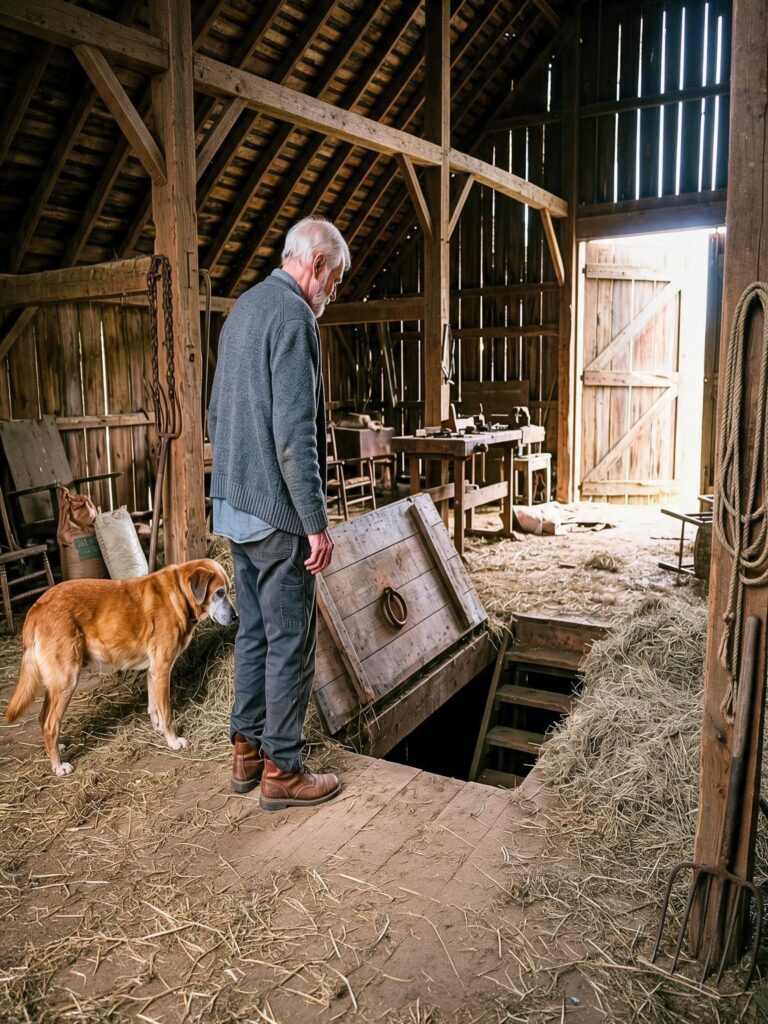
after his wife of 51 years died, the lonely 76-year-old farmer opened her forbidden barn — but when his old dog dug beneath the hay, he uncovered the heartbreaking secret she had carried to her grave
Part 1
Three weeks after burying his wife, seventy-six-year-old Walter Whittaker discovered that the woman he had loved for fifty-one years had left him a key to a door she had forbidden him to open.
The key was small, made of brass, and darkened with age.
It lay inside an ordinary white envelope beneath Margaret’s insurance papers, her church membership card, and the yellowed photograph taken on their wedding day.
Across the front of the envelope, in handwriting Walter would have recognized anywhere, she had written one word.
Walter.
He stood in the farmhouse kitchen, holding the envelope while the old wall clock ticked above the stove.
Outside, October rain tapped against the windows.
The pastures beyond the house lay brown and wet beneath a sky the color of dirty wool.
Walter turned the key over in his hand.
He had seen it before.
Not recently. Not in years.
But he knew the shape of it.
It belonged to the padlock on the abandoned barn at the far end of the north pasture.
The barn Maggie had refused to let him enter for twenty-seven years.
Walter sat down slowly.
His knees were stiff from carrying firewood the previous afternoon, and his back had been aching since the funeral.
He placed the key on the table beside her favorite blue coffee mug.
The mug still had a faint lipstick stain near the rim.
He had washed it twice since she died, but each morning he found himself taking it from the cupboard and placing it where she used to sit.
Old habits were stubborn things.
So was grief.
For fifty-one years, Walter had awakened to the sound of Maggie moving around the kitchen.
Sometimes she sang while making biscuits.
Sometimes she complained about the weather.
Sometimes she stood silently at the window, watching the birds gather around the feeder, with a cup of coffee warming her hands.
Now the house was so quiet that Walter could hear the refrigerator motor start from the bedroom.
He hated that sound.
It reminded him that machinery could keep running after a human life had stopped.
Across the kitchen, his old golden retriever, Rusty, lifted his head from the rug.
The dog was thirteen, nearly deaf in one ear, and gray around the muzzle.
Since Maggie died, he had spent most of his days beside her empty rocking chair.
Walter held up the key.
“Your mama’s got me puzzled, boy.”
Rusty’s tail moved once.
Walter unfolded the small paper that had been tucked beneath the key.
There were only five words.
Walter, please open the barn.
He read them several times.
Then he looked through the kitchen window.
Beyond the pasture, behind a stand of maple trees, the old barn stood beneath the rain.
Its roof sagged in the middle.
Gray boards leaned away from the frame.
Wild grapevines climbed the western wall.
The building had belonged to Maggie’s family long before Walter married her.
For the first twenty-four years of their marriage, they had used it for hay, tools, and winter feed.
Then, one spring, Maggie had insisted they move everything to the newer equipment shed.
She had locked the barn herself.
“That old place isn’t safe anymore,” she told him.
Walter had offered to repair it.
She refused.
Later, he suggested tearing it down before it collapsed.
She became so upset that he never mentioned the matter again.
He had thought it was sentiment.
Maggie’s father had built part of the barn with his own hands, and she had spent much of her childhood there.
Walter understood keeping old things because they carried memories.
He had never understood locking those memories away.
Now, with Maggie gone, the key sat on the table between them.
And Walter realized that his wife had left him one final request.
He was afraid to honor it.
Not because he expected to find something dangerous.
Because opening that door would be one more thing he did without her.
The last thing Maggie had said to him was ordinary.
“Don’t forget to close the chicken-house window. Rain’s coming.”
He had kissed her forehead, pulled on his boots, and gone outside.
Twenty minutes later, he found her on the kitchen floor.
The doctor said her heart had failed.
There had been no warning sufficient to prepare him.
No last conversation.
No chance to ask whether she was frightened.
He had spent three weeks remembering that he never answered her properly about the window.
He had only said, “I know, Maggie.”
Now he wished he had said something better.
Something worth being the last words she heard from him.
Walter folded the note and placed it in his shirt pocket.
Then he spoke to the empty kitchen.
“All right, sweetheart. I’ll go.”
But he did not go that afternoon.
He made excuses.
The rain was too heavy.
The barn floor might be rotten.
His flashlight needed new batteries.
He could wait until morning.
The truth was that Walter had survived his wife’s funeral by refusing to touch the parts of the house that still belonged to her.
Her sweater remained behind the bedroom door.
Her slippers rested beneath the bed.
A half-finished crossword lay beside her chair.
Opening the barn felt like opening a place where she might still be waiting.
And he did not know whether he could bear another discovery that ended with her absence.
The following morning, the weather cleared.
Frost silvered the grass.
A thin mist hung over the lower pasture, and the hills beyond Briar Glen glowed pale beneath the rising sun.
Walter made coffee for himself and, without thinking, poured a second cup.
He stared at it.
Then he emptied the extra coffee into the sink.
Rusty watched from the doorway.
“Come on,” Walter told him. “We’ve got work.”
He put on his old canvas jacket, took a flashlight from the kitchen drawer, and slipped the brass key into his pocket.
They crossed the pasture slowly.
Walter carried a walking stick, though he disliked admitting he needed one.
His right knee had never fully recovered from a fall off a roof fifteen years earlier.
Rusty walked beside him, occasionally stopping to sniff the grass.
The barn stood nearly a quarter mile from the farmhouse.
Up close, it looked worse than Walter remembered.
One side of the roof had lost several shingles.
A narrow crack ran down the stone foundation.
The western door hung crooked on its hinges.
Walter stopped before the padlock.
Someone had cleared the vines away from it.
He could see fresh scratches on the metal.
That was strange.
Maggie had been too weak during her final months to walk such a distance.
Or so he had believed.
Walter inserted the key.
It turned smoothly.
He frowned.
A lock abandoned for twenty-seven years should not have opened so easily.
He pushed the doors.
They groaned outward.
A smell of old hay, dry timber, mouse droppings, and cold earth drifted into the morning air.
Dust floated through shafts of sunlight.
For several moments Walter stood without moving.
The barn was exactly what he expected.
An old workbench against the eastern wall.
Rusted hand tools hanging from wooden pegs.
A broken harness.
Several empty feed barrels.
Stacks of rotting boards.
And hay scattered across the floor.
Nothing looked important.
Nothing explained why Maggie had kept the place locked.
Walter stepped inside.
“Well, Maggie,” he murmured, “you sure knew how to keep a man curious.”
Rusty entered behind him.
The dog’s nails clicked against the boards.
Walter spent the next hour clearing a path through the clutter.
He carried broken buckets outside.
He stacked sound lumber beneath the overhang.
He found an old rake whose handle he remembered replacing in the summer of 1989.
The work felt good.
For three weeks, he had wandered from room to room with nothing he wanted to accomplish.
Now there were boards to move.
Hinges to inspect.
Things that could be repaired.
A man who had spent fifty years building cabinets, fixing fences, and patching roofs understood work better than sorrow.
Then Walter noticed the rocking chair.
It stood behind an old feed chest near the back wall.
He stopped so suddenly that Rusty bumped into his leg.
The chair was made of walnut, with curved arms and a little carved heart beneath the seat.
Walter had built it for Maggie on their twenty-fifth wedding anniversary.
Years later, when he asked where it had gone, she told him she had given it to her sister.
But there it stood.
Beside it was a small wooden table.
On the table sat a chipped blue coffee mug.
Walter recognized the mug immediately.
It had been part of a set their son Daniel bought them one Christmas.
The handle had broken when Maggie dropped it on the kitchen floor.
Walter had glued it back together.
He picked it up.
There was dust inside, but not the thick layer that covered most of the barn.
His stomach tightened.
Someone had been using this place.
Perhaps Maggie.
Perhaps recently.
He looked toward the rocking chair.
The cushion was worn in the center.
Beneath it lay a folded wool shawl.
Walter lifted the shawl.
It smelled faintly of cedar and the lavender soap Maggie had always kept in her dresser.
He closed his eyes.
For one painful moment, he could almost imagine her sitting there, reading beside the window while the wind moved through the boards.
“What were you doing out here?” he whispered.
Rusty suddenly barked.
Walter turned.
The dog stood near the rear wall, staring at a mound of old hay.
“What’s the matter, boy?”
Rusty barked again.
Then he began digging.
Hay flew beneath his paws.
“Hey now. Easy.”
Walter crossed the barn and tried to pull him back.
Rusty resisted.
He whined, lowered his nose, and clawed harder.
Walter looked down.
The hay was different in that corner.
Most of the barn floor was covered with gray, brittle straw.
But this pile had been carefully packed, and beneath the upper layer the hay looked newer.
Walter crouched.
He pulled away a handful.
Then another.
His knees protested.
His fingers brushed something hard.
He cleared more hay.
An iron ring appeared, set into a wooden panel.
Walter stared.
He knew every board of the barn’s main floor.
He had replaced half of them himself after a flood in 1986.
But he had never known there was a trapdoor beneath this corner.
He hooked his fingers through the ring.
Pulled.
Nothing happened.
He planted one boot against the floor and tried again.
The panel shifted.
A long wooden groan filled the barn.
Rusty backed away.
Cold air rose from a dark opening.
Beneath the floor, a narrow staircase disappeared into the earth.
Walter stood motionless.
The morning sun shone across his shoulders.
His hands began to tremble.
He thought of Maggie’s note.
Please open the barn.
Not sell it.
Not repair it.
Open it.
Walter switched on his flashlight.
“Stay here, Rusty.”
The dog immediately stepped toward the stairs.
Walter sighed.
“You never listened to her either.”
He descended carefully.
The steps were steep, built of thick oak.
The air grew colder.
At the bottom, the flashlight revealed a small underground chamber lined with stone.
Shelves covered two walls.
Wooden crates stood beneath them.
There were photographs, bundles of letters, old maps, ledgers, and several metal document boxes.
A desk sat near the far wall.
And beneath a canvas covering was a large wooden trunk.
Walter walked toward it.
On top lay a photograph.
He lifted it into the flashlight beam.
The picture showed Maggie as a young woman, no more than twenty.
She was standing in front of the barn, smiling beneath the summer sun.
Beside her stood a young man Walter had never seen.
He was tall, dark-haired, and serious-looking, with one hand resting on the fence rail.
Walter turned the photograph over.
On the back, in Maggie’s handwriting, were six words.
June 1971. The promise we made.
Walter felt an unexpected stab of jealousy.
He and Maggie had met in 1972.
She had never spoken of this man.
He examined the picture again.
Then his flashlight moved across the trunk.
A name had been carved into the lid.
Arthur Hayes.
Walter whispered it.
“Who in God’s name were you?”
Behind him, Rusty began growling.
The old dog faced the staircase.
Walter looked up.
A floorboard creaked above them.
Then another.
Someone was walking inside the barn.
Walter switched off the flashlight.
Darkness swallowed the chamber.
He stood beside his dog, listening.
The footsteps moved slowly overhead.
Then stopped directly above the open trapdoor.
A scraping sound followed.
Metal against wood.
Walter’s heart began pounding.
He tightened his hand around the flashlight.
“Who’s there?” he called.
No answer came.
Then something crashed against the barn floor.
Rusty exploded into barking.
Walter climbed the stairs as quickly as his aching knees allowed.
By the time he reached the top, the barn was empty.
The side door stood open.
A rusted shovel lay on the floor.
Walter stared at it.
He wanted to believe the wind had caused the noise.
Then he saw the footprint.
Fresh mud marked the boards near the side entrance.
A large boot.
Not his.
And not one of Maggie’s.
Walter looked toward the trees beyond the barn.
The woods were still.
But he had the unmistakable feeling that someone was watching.
He closed the side door and slid the bolt into place.
Then he returned to the hidden staircase.
For fifty-one years, he had believed his marriage contained no locked rooms.
Now he was standing above one.
And someone else appeared determined to keep it closed.
Part 2
Walter did not sleep much that night.
He sat at the kitchen table until nearly two in the morning, studying the photograph of Maggie and Arthur Hayes.
Rusty lay beside his chair.
The kitchen was cold because Walter had forgotten to put another log in the stove.
He barely noticed.
He kept turning the photograph over.
June 1971.
A year before he met Maggie at the county fair.
She had been helping her aunt sell homemade apple butter.
Walter, then twenty-four, had bought three jars because he wanted an excuse to keep talking to her.
She had laughed at him.
“You planning to eat all that yourself?”
“If buying another jar keeps you talking, I might.”
Three months later, he asked her to marry him.
They married the following spring.
He had never known Arthur Hayes.
Never heard the name at dinner.
Never seen a photograph.
Walter looked toward Maggie’s empty chair.
“Who was he, sweetheart?”
The silence felt different now.
Before, it had been the silence of losing her.
Now it carried a question.
The following morning, Walter returned to the barn with a thermos of coffee, a notebook, a small toolbox, and the canvas bag he had used during his years as a carpenter.
He also brought a portable lantern so he would not have to depend on the flashlight.
Rusty followed.
Walter left the barn doors open for daylight and secured the side entrance before climbing into the underground chamber.
He began with the trunk.
Inside, wrapped in old pillowcases, were photographs, letters, property maps, and notebooks.
There was no money.
No jewelry.
No mysterious treasure.
Only paper.
Hundreds of pieces of paper.
Walter picked up the oldest notebook.
It belonged to Maggie.
The first entry was dated March 1971.
She had been nineteen.
Her handwriting was smaller then, with neat loops and carefully underlined dates.
Most early entries concerned ordinary life.
Her father’s failing health.
The price of seed corn.
A neighbor’s new tractor.
An argument with her mother over whether she should move to Lexington and work in a department store.
Then Arthur’s name appeared.
Arthur came by after supper. He says the Grady family never signed away their lower pasture.
Two pages later:
Father says we must stop asking questions. He says certain men in town have made fortunes buying land nobody truly meant to sell.
Walter frowned.
He turned another page.
Arthur found another deed. Same witness. Same handwriting. Different owners.
Farther into the notebook, the entries became more urgent.
Someone followed Arthur home.
Father says the county books are no longer safe.
We made copies tonight. Arthur wants to take them to a lawyer.
Then came the entry dated June 18, 1971.
Arthur is gone.
Walter stopped reading.
His hands felt cold.
The next page contained only two sentences.
Everyone says he ran away. I know he didn’t leave willingly.
Below it Maggie had written:
I promised I would keep the records until it was safe.
Walter stared at the words.
Outside the barn, a crow called from the pasture fence.
He looked toward the old trunk.
Arthur Hayes had not simply been a young man from Maggie’s past.
He had been involved in something that frightened her.
Something connected to land.
Walter understood how dangerous land disputes could become in rural Kentucky.
He had seen brothers refuse to speak over six feet of fence.
He had watched neighbors fight for years over a creek crossing.
And he knew families who lost farms because they could not afford lawyers while the other side could.
But this was different.
Maggie had preserved documents for more than fifty years.
Why?
Walter opened another box.
Inside were copies of deeds, tax notices, and handwritten statements from families he vaguely remembered.
The Grady family.
The Millers.
The Hensleys.
The Cooks.
Each family had once owned property along the northern ridge.
Much of that land eventually passed into the hands of a company called Briar Valley Development.
Walter recognized the name.
The company had been buying property around Briar Glen for years.
Recently, there had been talk of building expensive vacation cabins along the ridge.
He had paid little attention.
He was retired.
His farm was paid for.
He had no interest in selling.
But Daniel had mentioned the development more than once.
Walter felt a small chill.
He continued searching.
Near the bottom of the trunk, he found seven envelopes, numbered in Maggie’s handwriting.
Or rather, he found six.
The envelopes were numbered one, two, three, four, five, and seven.
Number six was missing.
Walter searched the trunk again.
He lifted every photograph.
He checked beneath the lining.
He searched the shelves.
Nothing.
Then Rusty began sniffing around the desk.
Walter opened the middle drawer.
Inside was a small cassette recorder wrapped in a dish towel.
Beside it lay one tape.
A white label carried two words.
For Walter.
He sat down.
His heart felt suddenly heavy.
Maggie had made recordings when Daniel and his younger sister, Ellen, were children.
She used to mail tapes to Walter’s mother during the years when travel was difficult.
Later, she recorded herself singing old hymns for the grandchildren.
Walter had always loved hearing her voice.
Now he had spent three weeks wanting to hear it just once more.
He inserted the tape.
Pressed play.
Static crackled.
Then Maggie spoke.
“My Walter.”
His breath caught.
He knew that voice.
Older than in their early years.
A little weaker.
But unmistakably hers.
“If you’re hearing this, then I suppose you’ve found the barn. And if you’ve found the barn, you’ve probably already gotten mad at me.”
Walter covered his mouth.
A faint laugh came through the speaker.
“I know you, Walter. You never did like secrets.”
He closed his eyes.
For one unbearable second, it felt as if she were sitting beside him.
Then her voice grew serious.
“I need you to understand that there was a part of my life before you that I never told you about. Not because I loved you less. Not because I didn’t trust your heart. Because I trusted it too much.”
A pause.
Walter heard her draw a slow breath.
“You have spent your whole life trying to fix things. Roofs. Fences. Broken chairs. People who didn’t know how to ask for help.”
He smiled through tears.
“And if I’d told you that certain people once threatened me because of what I knew, you’d have marched straight up to their door and demanded answers.”
Walter lowered his head.
She was right.
He would have.
“I couldn’t bear the thought of losing you over something that happened before we met.”
The tape hissed softly.
“Arthur Hayes was my friend. A good friend. He was trying to prove that families around here were losing their land through forged documents and dishonest dealings.”
Walter looked at the old photograph.
“I helped him copy what we could. Then he disappeared. People said he ran off. But before he vanished, he made me promise that the evidence wouldn’t disappear with him.”
Another pause.
“I kept that promise.”
Walter wiped his eyes.
“I thought the matter was buried. Maybe I hoped it was. But a few months ago, someone began asking about the old records. Someone who knew they existed.”
Her voice trembled.
“If envelope number six is gone, Walter, somebody has already been here.”
Walter looked at the empty space among the envelopes.
Then Maggie said something that made his stomach turn.
“And if that happens, be careful whom you trust. Even people who love us can make terrible choices when they’re afraid.”
The recording stopped.
Walter sat motionless.
The little machine clicked softly.
Rusty rested his chin on Walter’s knee.
For several minutes, Walter could only stare at the recorder.
Then he stood and began examining the room more carefully.
Beneath the lowest shelf, behind a loose board, he found another photograph.
It showed Maggie outside the barn.
She was older in this picture.
Perhaps seventy.
Beside her stood a man Walter knew immediately.
Their son Daniel.
On the back, Maggie had written:
Daniel knows more than he admits. Please be careful, Walter.
Walter felt as though the floor had shifted beneath him.
Daniel was forty-eight.
He owned a small home-building business outside Lexington.
He had been married once and divorced eight years earlier.
He had two grown children.
Walter loved him.
But in recent months, Daniel had become unusually insistent about the farm.
Even before Maggie died, he had suggested selling some of the north pasture.
After her funeral, he began talking about Walter moving into a retirement community.
“Dad, you’re not getting younger.”
“The property is too much for one person.”
“You could sell and live comfortably.”
Walter had assumed his son was worried about him.
Now he remembered Daniel asking about the abandoned barn.
“Why don’t you let me bring somebody out and take it down? That thing’s dangerous.”
Maggie had become upset.
More upset than Walter understood.
She had told Daniel to leave it alone.
He had laughed and called her stubborn.
Walter sat down again.
He remembered the photograph.
The warning.
The muddy footprint.
And his wife’s voice.
For the first time in his life, he wondered whether his own son had been trying to hide something from him.
He hated the thought.
It felt disloyal.
Daniel had driven him home from the hospital when Walter had heart surgery.
He had helped repair the farmhouse roof.
He had stood beside Walter at Maggie’s grave with tears running down his face.
A man could be a loving son and still make a terrible mistake.
Walter knew that.
But he did not know which mistake Daniel had made.
He gathered several copies of the documents, the photographs, Maggie’s notebook, and the recorder.
He placed them inside his canvas bag.
The original deeds and older records remained underground.
He covered the trunk, closed the room, and replaced the trapdoor.
Then he scattered the hay carefully across it.
By late afternoon, he was back in the farmhouse.
He made soup from a can of vegetables and ate half a bowl.
The other half went untouched.
At seven, the telephone rang.
Walter looked at the caller identification.
Daniel.
He let it ring twice before answering.
“Hello, son.”
“Dad, where’ve you been? I’ve called three times.”
“Out working.”
“On what?”
Walter looked toward the dark window.
“Just cleaning some things.”
There was a pause.
“You’re not messing around in Mom’s old barn, are you?”
Walter’s hand tightened around the receiver.
“Why would you ask that?”
“Because I know you. You get restless, you start fixing things. That barn’s not safe.”
“I’ve worked around old buildings my whole life.”
“You’re seventy-six, Dad.”
“I’m aware.”
Daniel sighed.
“Look, I can come tomorrow. I’ve got a contractor who can inspect the place.”
“No need.”
“Dad—”
“I said there’s no need.”
Silence followed.
Walter could almost hear Daniel thinking.
Then his son’s voice changed.
“Did Mom leave you anything about that barn?”
Walter looked at the canvas bag beside his chair.
“She left me a lot of things.”
“What kind of things?”
“Memories, mostly.”
Another pause.
“Dad, just promise me you won’t go back in there until we talk.”
Walter felt something inside him settle.
Not anger.
Something firmer.
“Good night, Daniel.”
He hung up.
That night, he locked the farmhouse doors for the first time in years.
Rusty slept beside his bed.
But Walter remained awake long after midnight.
He thought about Maggie hiding in the barn with her documents.
He imagined her carrying bundles of paper across the pasture in the dark.
He wondered how many nights she had spent alone protecting a secret while he slept peacefully in their house.
And for the first time since her death, he felt something other than helpless grief.
He felt that Maggie had left him work to finish.
Part 3
The county historical society occupied a small brick building beside the old courthouse in Briar Glen.
Walter had passed it hundreds of times without stopping.
Its front windows displayed black-and-white photographs of coal wagons, tobacco fields, church picnics, and families standing in front of farmhouses that no longer existed.
On the morning he finally entered, a bell jingled above the door.
An elderly woman looked up from behind a desk.
She had silver hair, wire-rimmed glasses, and the expression of someone who had spent many years correcting people’s assumptions.
“Morning,” she said. “Can I help you?”
Walter removed his hat.
“I hope so. I’ve got some old papers.”
“What kind?”
“Land deeds. Letters. Things from the early seventies.”
She smiled.
“We get plenty of those.”
“These might be different.”
He set the canvas bag on the counter.
The woman introduced herself as Clara Bennett.
She had worked at the historical society for nearly thirty years.
Walter knew her name from the local newspaper, but they had never met.
He showed her the photograph of Maggie and Arthur.
Clara adjusted her glasses.
“Where did you find this?”
“My wife’s barn.”
She studied the picture.
“Your wife was Margaret Whittaker?”
Walter nodded.
“Maggie.”
Clara looked up sharply.
“Margaret Nolan before she married?”
“That’s right.”
Clara slowly lowered the photograph.
“Mr. Whittaker, do you know who Arthur Hayes was?”
“Only what my wife left behind.”
Clara stood.
“Then you’d better sit down.”
She went into a back room and returned carrying a thick folder.
Inside was a newspaper clipping from June 1971.
The headline read:
Local Farm Worker Missing After Land Records Dispute.
Beneath it was Arthur’s photograph.
Walter stared at the young man.
The same face.
The same serious eyes.
Clara explained that Arthur’s family had owned a modest farm north of Briar Glen.
In the late 1960s and early 1970s, several families claimed their property had been transferred without their knowledge.
Some had been told they owed back taxes.
Others discovered mortgages they insisted they had never signed.
A few signed documents they could not read well, believing they were authorizing repairs or short-term loans.
Later, those documents appeared in the county records as transfers of ownership.
“Arthur thought it was organized,” Clara said.
“Organized by who?”
“Land agents. A few lawyers. Perhaps someone inside the county clerk’s office. That’s what he claimed.”
“Did anybody prove it?”
“Not then.”
Clara opened another folder.
“Records disappeared. Witnesses changed their stories. Families couldn’t afford long court fights.”
She looked at Maggie’s photograph.
“Arthur was trying to collect evidence. Your wife’s father worked as a deputy clerk, didn’t he?”
Walter nodded slowly.
“Ezra Nolan. He retired before I met Maggie.”
“He may have helped them access the records.”
Walter remembered Ezra.
A stern man who attended church every Sunday and rarely spoke unless he had something important to say.
He had died twenty-eight years earlier.
Walter wondered what his father-in-law had carried to his grave.
Clara examined one of the copied deeds.
Her expression changed.
“Good heavens.”
“What?”
“This appears to be a copy of a deed that was reported missing in 1972.”
Walter leaned forward.
“Is it important?”
“It could be.”
She spread two documents side by side.
“See these witness signatures? Same names. Same shapes. If someone copied signatures from one transaction onto another, there may be evidence of forgery.”
Walter studied them.
He could see similarities.
But he was a carpenter, not a lawyer.
“Can you prove it?”
“Not by looking at them here. We would need a qualified examiner, original records, and a proper chain of custody.”
Walter sighed.
“Sounds expensive.”
“Sometimes truth is.”
Clara looked at him.
“But it is not impossible.”
For the first time that morning, Walter felt hope.
Small.
Cautious.
But real.
He told Clara about the hidden room.
The missing envelope.
The cassette.
He hesitated before mentioning Daniel.
Then he showed her Maggie’s warning.
Clara read it carefully.
“Do you believe your son is involved?”
“I don’t know.”
“That’s an honest answer.”
Walter rubbed his forehead.
“Daniel’s a good boy.”
Clara smiled sadly.
“Good boys can grow into complicated men.”
Walter looked toward the window.
“He’s all I’ve got close by now.”
Clara closed the folder.
“Then give him the chance to tell the truth. But protect the documents first.”
She recommended a retired property attorney named James Holloway, who had spent years helping rural families with disputed deeds.
She also knew an archivist at the state university.
“Don’t bring every original in at once,” she advised. “Make copies. Photograph the storage area. Keep a written record of what you’ve found.”
Walter almost smiled.
“My wife used to say the same thing.”
“Then she sounds like a sensible woman.”
Walter looked down at the photograph.
“She was.”
His voice broke.
Clara waited quietly.
Then Walter added, “She was the best person I ever knew.”
When he returned to the farm that afternoon, a black pickup was parked beside the barn.
Walter slowed his truck.
Daniel stood near the open doors.
Beside him was a broad-shouldered man in work boots and a dark jacket.
The stranger held a crowbar.
Rusty began growling.
Walter stopped the truck and sat still for a moment.
The stranger’s boots were covered in reddish mud.
The same color he had seen on the barn floor.
Walter opened the driver’s door.
Rusty jumped down beside him.
“Dad,” Daniel called. “I was just about to phone you.”
Walter approached slowly.
“Who’s your friend?”
“Mark Ellison. He’s a contractor.”
Mark nodded.
“Afternoon, sir.”
Walter looked at the crowbar.
“What are you contracting?”
Daniel rubbed the back of his neck.
“I told you I wanted somebody to inspect this barn.”
“Without asking me?”
“I was trying to help.”
Walter looked at the open doors.
“Did you break the lock?”
“No,” Daniel said quickly. “It was already open.”
Walter knew that was a lie.
He had locked it himself.
Mark shifted his weight.
Walter noticed reddish mud along the man’s boot soles.
“Have you been inside before?” he asked.
Mark hesitated.
“No, sir.”
Rusty growled again.
Walter looked at the dog.
Then back at Mark.
“Funny thing. I found a boot print in there yesterday. Looks about your size.”
Daniel stepped forward.
“Dad, this is getting ridiculous.”
Walter raised one hand.
“No. What’s ridiculous is two grown men opening my barn without permission.”
Daniel’s expression tightened.
“We’re worried about you.”
“Then you could have knocked on my door.”
Mark cleared his throat.
“Mr. Whittaker, the building has structural problems. Your son mentioned that you might want to sell the property. We were just—”
“I don’t want to sell.”
The words came out sharper than Walter intended.
Daniel looked embarrassed.
“Dad, please.”
Walter turned to him.
“Did your mother tell you about Arthur Hayes?”
The color drained from Daniel’s face.
Mark lowered his eyes.
For several seconds, no one spoke.
Then Daniel whispered, “Where did you hear that name?”
Walter felt the answer settle inside him.
“From your mother.”
Daniel stared toward the barn.
“Dad, we should talk privately.”
“Then start talking.”
Daniel looked at Mark.
“Give us a minute.”
Mark did not move.
Walter noticed something protruding from the stranger’s jacket pocket.
A brown envelope.
One corner carried a handwritten black number.
Six.
Walter’s heart began pounding.
“What’s that?” he asked.
Mark glanced down.
“Nothing.”
Walter pointed.
“That envelope.”
Mark took a step backward.
Daniel looked confused.
“Mark?”
The stranger’s expression hardened.
“It’s not your concern.”
Walter straightened.
“Anything taken from my barn is my concern.”
Mark turned toward his truck.
Rusty barked.
Daniel grabbed his arm.
“Hold on. What did you take?”
Mark jerked away.
The envelope slipped from his jacket.
It landed in the wet grass.
Walter bent slowly and picked it up.
His fingers shook.
Across the front, in Maggie’s unmistakable handwriting, was a single number.
6.
He looked at Mark.
“You stole this.”
Mark said nothing.
Daniel stared.
“Mark, you told me there was nothing in the barn worth worrying about.”
The stranger rubbed his face.
“Look, this has gotten out of hand.”
Walter opened the envelope.
Inside were several old copies of legal documents, a handwritten list of names, and a small brass key.
The key was attached to a tag marked with the number seventeen.
There was also a folded statement.
Walter recognized Maggie’s handwriting in the margin.
This is the one Arthur was most afraid to lose.
Mark looked toward the road.
“You don’t understand what you’re holding.”
“Then explain it.”
Mark hesitated.
“My grandfather worked for one of the land companies back then.”
Walter waited.
“Those papers could drag a lot of people into trouble.”
“People who stole land?”
“People whose families have owned it for fifty years.”
Walter looked at the envelope.
“That doesn’t change how they got it.”
Mark’s face tightened.
“Some of those families didn’t know anything about the original dealings.”
“Then they deserve the truth too.”
Mark looked toward Daniel.
“Tell him.”
Daniel closed his eyes.
“Dad, I was trying to keep this from becoming a disaster.”
Walter turned toward his son.
“By lying to me?”
Daniel swallowed.
“I found some of Mom’s papers last spring.”
Walter waited.
“She was sorting through old boxes. I saw a deed with a name I recognized from a property deal near the ridge.”
“Whose name?”
“Ellison.”
Walter looked at Mark.
Daniel continued.
“I asked questions. Mark told me there were old disputes that could affect property values. He said if the records came out, people might sue, the development could collapse, and families could lose everything they’d invested.”
“So you decided to destroy the barn?”
“No.”
Walter looked toward the crowbar.
Daniel’s shoulders sagged.
“I thought if we sold the property before things got complicated, you could get out of here. Move somewhere safe. Somewhere with people around.”
“Safe from what?”
Daniel had no answer.
Walter stepped closer.
“Your mother was dying, son. She knew it. And you were talking to strangers about selling our home.”
Daniel’s eyes filled.
“I was scared.”
“So was she.”
“I thought after she was gone, you’d fall apart.”
Walter looked toward the farmhouse.
His throat tightened.
“I did fall apart.”
Daniel lowered his head.
Walter continued quietly.
“But I’m still here.”
Rusty pressed against his leg.
Walter rested one hand on the dog’s head.
“I’m seventy-six years old, Daniel. My knees hurt every morning. Sometimes I forget why I walked into a room. I miss your mother so badly there are days I can barely breathe.”
His voice trembled.
“But I am not a child.”
Daniel began crying.
Walter had seen his son cry only a handful of times since boyhood.
“I know, Dad.”
“No. You forgot.”
Daniel wiped his face.
Walter looked at Mark.
“I want you off my property.”
Mark hesitated.
“Those documents—”
“Are staying with me.”
“You could create years of trouble.”
Walter looked at the old barn.
Then at the farmhouse where Maggie had lived, laughed, grown old, and died.
“Trouble doesn’t begin when somebody tells the truth,” he said. “It begins when somebody decides the truth is too inconvenient to hear.”
Mark lowered his eyes.
He left without another argument.
His black pickup disappeared down the gravel road.
Daniel remained beside the barn.
Walter held up the envelope.
“Your mother warned me about you.”
Daniel looked stricken.
Walter’s expression softened slightly.
“She didn’t say you were evil. She said you were afraid.”
Daniel stared at the ground.
“She was right.”
Walter nodded.
“Fear doesn’t excuse what you did.”
“I know.”
“And being my son doesn’t mean you get to decide what happens to me.”
Daniel wiped his eyes.
“I know that now.”
Walter looked toward the barn doors.
For a long moment, he saw his son as a twelve-year-old boy standing in the workshop with a broken wooden chair.
Daniel had once tried to repair it secretly.
He used too much glue and drove a nail through the seat.
When Walter discovered the damage, the boy had burst into tears.
“I thought you’d be mad.”
Walter remembered kneeling beside him.
“Son, things get worse when you hide them.”
The memory hurt.
He had taught Daniel that lesson forty years earlier.
Now they both stood amid the consequences of forgetting it.
Walter turned toward the farmhouse.
“Come inside.”
Daniel looked up.
“Dad?”
“We’ve got a lot to talk about.”
He started walking.
Then stopped.
“And Daniel?”
“Yes?”
“Tomorrow morning, you’re helping me fix that barn.”
Daniel looked at him.
Walter’s voice was tired but firm.
“Not tear it down.”
“Yes, sir.”
Walter nodded.
“Good.”
But before they could repair anything, they still had to learn what the missing envelope had been protecting.
And the answer lay somewhere behind a lock neither man had yet found.
Part 4
For the next two days, rain swept across the Kentucky hills.
Water ran through the pasture ruts.
The creek beyond the barn rose high against its banks.
Walter stayed inside with the documents spread across the dining room table.
Daniel came each morning.
At first, they barely spoke.
Walter made coffee.
Daniel carried the cups.
Rusty settled beneath the table.
The only sounds were rain against the windows and the turning of old pages.
Walter had called Clara Bennett and told her about envelope six.
She came to the farmhouse on Wednesday afternoon with James Holloway, the retired attorney.
Holloway was seventy-two, thin as a fence post, and dressed in a brown suit that had seen better days.
He carried a leather briefcase and a magnifying glass.
After examining the documents, he leaned back.
“Mr. Whittaker, your wife preserved material that could be very important.”
Walter looked toward Maggie’s photograph on the mantel.
“That’s what I’m beginning to understand.”
Holloway pointed to the papers.
“These are copies of property transfers. Some contain irregularities. One appears to include the same witness signature on transactions supposedly completed months apart, with details suggesting it may have been copied.”
“Does that prove fraud?”
“Not by itself.”
Walter sighed.
Holloway continued.
“But this statement may be more significant.”
He unfolded the paper from envelope six.
It was dated June 1971.
The signature belonged to Thomas Pritchard, a former employee of the county clerk’s office.
In the statement, Pritchard acknowledged witnessing several deeds entered into the county records without the property owners appearing in person.
He also described being ordered to replace original pages in a deed book.
Walter stared at the writing.
“Why would a man sign a thing like that?”
“Perhaps he developed a conscience,” Holloway said. “Perhaps he was frightened and wanted protection.”
Clara pointed to the brass key.
“What about this?”
Holloway examined it.
The number seventeen was stamped on the tag.
Walter remembered seeing similar tags on storage lockers at the old railroad depot.
But the depot had closed decades earlier.
Clara considered the key.
“Could belong to a safety deposit box.”
“At which bank?”
“We can check.”
Daniel leaned forward.
“I remember Mom going to the Briar Glen Savings office a few years ago.”
Walter looked at him.
“Which office?”
“The old branch near the feed mill. Before they closed it.”
Clara nodded slowly.
“The bank’s records were transferred to the county financial archive when it merged.”
Holloway examined the key again.
“Then we start there.”
Walter felt a familiar urge to jump in his truck immediately.
But his knee was swollen from the trips to the barn.
His doctor had warned him about overexertion after a spell of dizziness earlier that summer.
He hated being reminded of his limitations.
Still, Maggie’s voice echoed in his memory.
You’d have tried to fix everything yourself.
This time, Walter decided to do something different.
He would let people help.
Clara contacted the bank’s successor institution.
Holloway arranged to review the necessary records.
Daniel took photographs of every document and made duplicate copies.
Walter wrote an inventory in a spiral notebook.
And for the first time in weeks, the farmhouse kitchen became a place where people gathered for a purpose other than mourning.
At night, however, grief returned.
One evening, after Daniel had gone home, Walter sat alone beside Maggie’s rocking chair.
Rusty slept with his nose against Walter’s boot.
A cold wind moved through the old window frame.
Walter held Maggie’s first letter.
My Walter.
He read those words again and again.
Then he spoke softly.
“You should have told me.”
His voice cracked.
“We had fifty-one years, Maggie. I would’ve stood beside you.”
The room remained silent.
Walter looked at her empty chair.
“You carried all this alone.”
A tear slipped down his cheek.
Then he remembered something from their marriage.
The winter of 1998.
Walter had injured his back badly while replacing a barn roof.
For six weeks, he could barely stand.
He had been ashamed of needing help.
Maggie had fed the livestock, hauled firewood, paid the bills, and cared for him without complaint.
One night he apologized.
“I ought to be doing more.”
She sat beside him and took his hand.
“Walter, you don’t have to earn your place at this table.”
He had never forgotten those words.
Now he wondered whether Maggie had forgotten them herself.
Had she believed she needed to protect him from every danger because he had protected her from so many ordinary hardships?
He pressed the letter against his chest.
“Oh, sweetheart,” he whispered. “You didn’t have to do this by yourself.”
The following morning, the bank contacted Clara.
The brass key belonged to a small document box once held at the closed Briar Glen Savings branch.
The bank had preserved the box with other unclaimed records.
Its original rental information listed the name Ezra Nolan.
Maggie’s father.
Walter stared at Clara when she told him.
“Ezra?”
“Yes.”
“But he’s been dead almost thirty years.”
“The box remained sealed because the bank had no clear instructions regarding the contents.”
Holloway arranged for a formal inspection with the appropriate bank representative and estate documentation.
Walter, Daniel, and Clara traveled together.
The drive took nearly an hour.
Walter watched the countryside pass through the truck window.
Old tobacco barns stood empty beside newer subdivisions.
Fields where he once bought hay had become parking lots.
The world had changed.
And Maggie had kept a piece of its forgotten history hidden beneath their barn.
At the bank’s records office, a manager led them into a small conference room.
A gray metal box rested on the table.
Number seventeen.
Walter took out the brass key.
His hands shook.
Daniel moved closer.
“You want me to do it, Dad?”
Walter looked at him.
For a moment, the old instinct returned.
The wish to prove he could still handle everything himself.
Then he shook his head.
“No. Just stand here with me.”
Daniel nodded.
Walter inserted the key.
The lock turned.
Inside were several packets of original documents wrapped in brown paper.
There were signed statements.
A handwritten index.
A carbon copy of correspondence between Arthur Hayes and an attorney in Lexington.
And a letter addressed to Maggie.
Walter opened the letter first.
The paper was fragile.
The writing belonged to her father.
Margaret,
If you are reading this, I may no longer be here to explain why I kept these papers.
I was not brave when bravery was required.
I saw men misuse the county records, and I told myself it was not my business. By the time I understood what they were doing, families had already lost their homes.
Arthur Hayes tried to correct the wrong. You helped him when wiser and older people were too frightened.
I have kept the original documents because I cannot undo my silence, but I can refuse to let the evidence disappear.
If these papers ever become useful, place them before people who will examine them honestly.
Your father, Ezra.
Walter lowered the letter.
He remembered Ezra sitting stiffly at their kitchen table, speaking little, always watching the road.
He had assumed the old man was simply stern.
Now he understood that Ezra had lived with fear and regret.
Clara examined the documents.
Holloway leaned over her shoulder.
After several minutes, the attorney looked at Walter.
“These could establish a much stronger historical record than we had before.”
“Will families get their land back?”
Holloway hesitated.
“Some claims may be time-barred. Other properties have changed hands many times. We can’t promise that.”
Walter felt disappointment rise.
“Then what good are they?”
Clara looked at him.
“Because people deserve to know what happened. And where legal remedies remain possible, this may help.”
Walter stared at the stack of documents.
He thought of farmers losing fields their grandparents had cleared.
Of families leaving homes because they could not afford court.
Of Arthur Hayes disappearing.
Of Maggie preserving the truth for more than half a century.
“Then we keep going,” he said.
But the investigation was not finished.
The university archivist found a discrepancy in the old newspaper accounts.
Arthur Hayes had supposedly left Kentucky voluntarily in June 1971.
Yet a hospital record from southern Ohio showed a man matching his description admitted with serious injuries weeks later.
He had used a different name.
Clara began tracing that record.
Meanwhile, Daniel was struggling with his own shame.
He continued coming to the farm each Saturday.
They repaired the barn slowly.
Walter showed him how to replace rotten floorboards without damaging the old oak beams.
Daniel brought new hinges.
They reinforced the staircase.
They repaired the roof.
They installed proper lighting.
The hidden room was cleaned carefully, but the original documents were moved to secure archival storage while their history was examined.
One afternoon, Daniel stood beside Walter at the workbench.
He held a board that had split along the grain.
“Should I throw this away?”
Walter examined it.
“Not necessarily.”
“It’s cracked.”
“Only along one side.”
Walter showed him how to trim the damaged edge and reuse the sound wood.
Daniel worked in silence.
Then he said, “Mom knew you’d save this place.”
Walter kept planing.
“Maybe.”
“I think she did.”
Walter stopped.
He looked at the old barn.
For weeks after Maggie died, he had believed his useful days were behind him.
Every morning had seemed empty.
Every chore felt pointless.
Now his hands were busy.
People were calling him.
Questions needed answering.
His experience mattered.
Walter rested the plane on the workbench.
“Your mother didn’t leave me a barn because she thought I’d save it,” he said.
Daniel frowned.
“Then why?”
Walter looked toward the open doors, where Rusty slept in a patch of sunlight.
“Maybe she knew it would save me.”
Daniel said nothing.
Then his eyes filled.
“Dad, I’m sorry I tried to make you sell.”
Walter nodded.
“I know.”
“I thought I was doing what was best.”
“That’s what scares me most, son.”
Daniel looked up.
Walter continued.
“People can do an awful lot of damage when they decide somebody else’s life is theirs to manage.”
Daniel swallowed.
“I was scared of losing you.”
Walter’s expression softened.
“Then spend time with me.”
He picked up the plane again.
“Don’t spend what time we’ve got left trying to move me somewhere I don’t want to be.”
Daniel gave a shaky laugh.
“Yes, sir.”
They worked until evening.
Just before sunset, Clara’s car appeared at the end of the driveway.
Walter recognized the urgency in the way she parked.
She stepped out carrying a folder.
Her face was pale.
“Walter,” she said, “we found Arthur Hayes.”
He stopped beside the barn door.
For a moment, the years seemed to disappear.
Arthur’s photograph flashed through his mind.
Maggie at nineteen.
The unfinished promise.
The letters.
The fear.
“Alive?” Walter asked.
Clara shook her head.
“No.”
Walter lowered his eyes.
“But we found out what happened to him.”
She held out the folder.
“And I think you need to hear it.”
Part 5
Walter carried Clara’s folder into the barn.
He did not open it immediately.
Instead, he sat in Maggie’s old walnut rocking chair.
The same chair he had built for their twenty-fifth wedding anniversary.
Its curved arms were smooth beneath his hands.
Rusty settled beside his boots.
Daniel stood near the workbench.
Clara remained by the doorway, giving Walter time.
The late afternoon sun moved through the repaired windows.
For a moment, Walter imagined Maggie sitting in that chair, holding a cup of coffee and looking at him with the patient expression she wore whenever he took too long to understand something.
Then he opened the folder.
Arthur Hayes had not run away because he wanted to disappear from his friends.
In June 1971, he had traveled toward Lexington carrying copies of disputed land records.
He intended to meet an attorney who had agreed to review the evidence.
He never reached the meeting.
On a rural road outside the county, two men stopped his truck.
The surviving records did not establish every detail of the attack, but Arthur had been found badly beaten.
He suffered broken ribs, a fractured wrist, and injuries to his head.
A farmer took him to a small hospital across the state line.
Arthur survived.
But while recovering, he received warnings that returning to Briar Glen could put Maggie and her family in danger.
He left Kentucky under a different name.
For years, he worked in Ohio and Missouri.
He eventually married.
He had a daughter.
He became a mechanic.
And he never returned to the place where he had once tried to expose the theft of family land.
Walter looked up.
“He lived?”
Clara nodded.
“For many years.”
“Did he ever contact Maggie?”
“We found letters he wrote. It appears he never mailed most of them.”
Walter stared at the papers.
“Why?”
“Perhaps he was afraid. Perhaps he believed staying away was the only way to protect her.”
Clara hesitated.
“His daughter says he spoke about Kentucky near the end of his life.”
Walter lowered his eyes.
Arthur had died twelve years earlier in Missouri.
He was seventy-one.
His daughter, Rebecca Hayes, still lived there.
She had kept a wooden box filled with photographs and letters.
When Clara contacted her, she recognized Maggie’s name immediately.
Rebecca had agreed to share copies.
Walter opened one of the letters.
It was written in Arthur’s uneven handwriting.
Maggie,
I hope you made a good life after I left.
I hope you found somebody kind.
I am sorry I never came back to finish what we started.
I was young, and I was frightened, and after what happened on the road, I didn’t know whom to trust.
If you kept those records, then you were braver than I ever managed to be.
I hope one day somebody tells the truth for the families who lost their homes.
And I hope you know that keeping your promise was never supposed to cost you your happiness.
Walter read the letter twice.
Then he lowered it onto his lap.
For weeks, he had feared there had been another man in Maggie’s heart.
A love she never confessed.
A hidden life that somehow made their fifty-one years less real.
Now he understood.
Arthur had been a frightened young man who tried to stop something wrong.
Maggie had been a frightened young woman who refused to forget.
Their bond was not a secret romance.
It was a promise.
Walter covered his eyes.
“Oh, Maggie.”
His voice broke.
“You carried all of this.”
Daniel knelt beside his chair.
“Dad?”
Walter shook his head.
For a long moment, he could not speak.
Then he looked at Clara.
“She never told me because she thought I’d go looking for the men who hurt Arthur.”
Clara nodded gently.
“That’s possible.”
Walter gave a sad little laugh.
“She was right.”
He looked toward Maggie’s photograph hanging above the workbench.
“Stubborn woman.”
Tears ran down his cheeks.
“You were always protecting somebody.”
Over the following months, the old records were examined by historians, archivists, attorneys, and property specialists.
The conclusions were careful.
Some documents confirmed that serious irregularities had occurred in the transfer of rural land during the early 1970s.
Others supported claims that original deeds had been altered or replaced.
Several families were contacted.
Some received information they had searched for over generations.
A few began consulting attorneys about what remedies might still be available.
Other families learned painful truths but had no practical way to recover property that had changed hands many times.
Not every question was answered.
Not every wrong could be repaired.
Walter struggled with that.
He had spent his life believing broken things could be fixed if a person worked carefully enough.
But Maggie’s papers taught him that some damage survived longer than the people who caused it.
The best anyone could do was stop pretending it had never happened.
Walter also learned more about Mark Ellison.
His grandfather had worked as a land agent involved in several of the disputed transactions.
Mark had grown up hearing his family describe the old accusations as lies spread by bitter farmers.
When he discovered Daniel knew about Maggie’s papers, he became frightened that a new investigation might destroy the reputation of people he loved.
He had entered the barn looking for the documents.
He stole envelope six because he believed it contained the strongest evidence.
After being confronted, he eventually gave a statement describing how he had entered the property and what he had taken.
Walter did not pretend Mark’s behavior was harmless.
But he also understood something about fear now.
He had seen it in Daniel.
He had heard it in Ezra Nolan’s letter.
He had read it in Arthur’s words.
Fear could make a person hide.
Lie.
Steal.
Turn away.
The difference was what someone chose to do after recognizing the harm.
Daniel chose to stay.
He came to the farm every Saturday.
Some weeks he arrived with lumber.
Other weeks he brought groceries.
Sometimes he simply sat with Walter on the porch while Rusty slept beneath their feet.
They did not always talk about the barn.
Sometimes they talked about fishing.
Sometimes about Daniel’s children.
Sometimes about Maggie.
One afternoon Daniel asked, “Did Mom ever tell you she was proud of me?”
Walter turned.
“Of course.”
Daniel looked toward the fields.
“Even after my divorce?”
“Especially then.”
Daniel frowned.
Walter smiled faintly.
“She said you were hurting, and people shouldn’t be judged by the worst season of their life.”
Daniel lowered his head.
“Sounds like Mom.”
Walter nodded.
“She had a way of seeing the person underneath the trouble.”
He paused.
“Doesn’t mean she let you get away with everything.”
Daniel laughed softly.
“No. She sure didn’t.”
For the first time since the funeral, father and son laughed together without feeling guilty.
By spring, the barn had changed.
The sagging roof was straight.
The doors hung firmly on new hinges.
The floor was safe.
The old workbench had been restored.
The underground chamber remained preserved as part of the building’s history, with copies of Maggie’s records displayed in protective cases.
The original documents were stored professionally.
Clara helped organize an exhibit explaining the land disputes, Arthur’s disappearance, Ezra Nolan’s role, and Maggie’s decades of quiet preservation.
Walter insisted the barn remain open to the public without an admission fee.
“If Maggie kept all that safe for fifty years,” he said, “I’m not charging people to see what she protected.”
Daniel smiled.
“You’re as stubborn as she was.”
Walter looked at him.
“Somebody has to be.”
They named it the Margaret Whittaker Memory Barn.
Walter carved the sign himself.
His hands were slower than they once had been.
He had to stop often and rest his shoulders.
Sometimes his fingers cramped around the chisel.
But he refused to let anyone else finish the lettering.
Beneath Maggie’s name, he carved a simple sentence.
Nothing worth remembering should stay buried.
The opening day came on a warm Saturday in May.
The Kentucky hills were green.
Dogwood blossoms brightened the fence lines.
The apple trees beside the farmhouse were flowering.
More than a hundred people arrived.
Some came because they remembered Maggie.
Others came because their parents or grandparents had lost land.
A few came only because they had heard about an old barn with a hidden room beneath the floor.
Walter stood near the entrance wearing the blue shirt Maggie had always loved.
Rusty wore a new red collar.
Daniel greeted visitors and helped older people navigate the steps.
Ellen arrived from Tennessee with her husband and children.
She hugged Walter for a long time.
“Mom would love this,” she whispered.
Walter looked toward the barn.
“I hope so.”
Inside, people moved quietly among the photographs.
Some recognized names.
Some cried.
An elderly woman stood before a picture of the old Grady farmhouse.
“My grandfather lived there,” she said.
Walter approached.
She pointed toward the image.
“He used to say they took it from him. Nobody believed him.”
Her voice broke.
“For years, we thought he was just angry.”
Walter looked at the picture.
“Your grandfather wasn’t imagining things.”
The woman covered her mouth.
Then she took Walter’s hand.
“Thank you.”
Walter felt tears rise.
He had received plenty of thanks in his life.
For repairing porches.
For building kitchen cabinets.
For helping neighbors after storms.
But this was different.
He was not being thanked for fixing wood.
He was being thanked for helping somebody’s family recover the truth.
Near the back of the barn, a woman in her fifties waited beside Clara.
She had dark hair streaked with silver.
Her eyes reminded Walter of the young man in the photograph.
Clara introduced her.
“Walter, this is Rebecca Hayes.”
Walter stared.
“Arthur’s daughter?”
Rebecca nodded.
“I came from Missouri.”
Walter removed his hat.
For a moment, he did not know what to say.
Then Rebecca held out her hand.
“My father would have wanted to meet you.”
Walter took it.
“I wish I could’ve met him.”
Rebecca smiled sadly.
“He would have liked you.”
They stood together before the photograph of Arthur and Maggie.
Rebecca studied it for a long time.
“Dad kept a copy of this picture in his toolbox,” she said.
Walter looked at her.
“He did?”
“Yes. He told me she was the bravest girl he ever knew.”
Walter’s throat tightened.
Rebecca continued.
“He never spoke badly about the people back here. He just got quiet when someone mentioned Kentucky.”
She looked toward the displayed letters.
“Now I understand why.”
Walter nodded.
Rebecca reached into her purse and removed a small envelope.
“There’s something I want you to have.”
Inside was an old photograph.
Arthur stood in front of a service station in Missouri.
He was older, gray-haired, smiling beside his wife and young daughter.
On the back, in Arthur’s handwriting, was a short message.
For Maggie, if I ever find the courage to send it. I kept going. I hope you did too.
Walter read the words.
He looked at Rebecca.
“She did.”
His voice shook.
“She kept going. She had a good life.”
Rebecca smiled through tears.
“I’m glad.”
Walter held the photograph gently.
“She would’ve wanted to know that about your father too.”
Late that afternoon, after most visitors had gone, Clara approached Walter near Maggie’s rocking chair.
She carried a small cassette.
“We found something else.”
Walter looked at it.
“Another recording?”
Clara nodded.
“It was tucked inside the lining of envelope six. We didn’t notice it until the archivist examined the paper layers.”
Walter took it.
On the label, Maggie had written:
For Walter. Last one.
His hands trembled.
Daniel approached.
“Dad?”
Walter looked toward the empty barn.
Then at his son.
“Stay with me.”
They sat together.
Rusty lay at Walter’s feet.
Clara quietly closed the barn doors partway so the evening wind would not disturb them.
Walter placed the cassette in Maggie’s recorder.
Pressed play.
Static crackled.
Then came her voice.
“My Walter.”
He closed his eyes.
“If you’re hearing this one, then I suppose you’ve found more of the truth than I ever managed to tell you.”
A faint laugh followed.
“And knowing you, you’ve probably repaired half that foolish old barn.”
Walter laughed through tears.
Daniel smiled.
Maggie continued.
“I know you’re going to be angry with me. Maybe you already are. You have every right.”
Walter looked down.
“But I want you to understand something.”
Her voice became softer.
“Arthur was part of my life before I knew you. That promise mattered. It still matters.”
She paused.
“But you, Walter, were never something I settled for. Never a second choice. Never a man I married because another life was taken away.”
Walter covered his mouth.
“You were the life I chose.”
The words came slowly.
Clearly.
With all the tenderness he remembered from fifty-one years of marriage.
“You were the man who fixed my father’s porch without being asked. The man who carried our babies through the house at three in the morning. The man who worked until his hands cracked and still came home asking whether I needed anything.”
Walter began crying.
Daniel put a hand on his shoulder.
Maggie’s voice continued.
“You spent our whole marriage believing you were the one protecting me.”
A small pause.
“But Walter, you gave me fifty-one years in which I finally felt safe.”
Walter bowed his head.
“I know you’ll miss me,” she whispered. “I know you’ll wake up and reach across that bed. I know there will be mornings when the house feels too quiet.”
Her breathing was faintly audible.
“And I know you’ll think the best part of your life has ended.”
Walter could barely see through his tears.
“But listen to me, you stubborn old carpenter.”
He laughed, a broken little sound.
“You’re still here.”
Daniel wiped his eyes.
“You still have hands that know how to build. You still have people who need you. There are children who haven’t heard your stories. There are broken things you haven’t seen yet. And there are people who need a door opened.”
Walter looked toward the barn entrance.
“I don’t want my death to become the end of your life.”
Her voice trembled.
“Grieve for me, Walter. Miss me. Talk to me if it helps. But don’t spend the years you have left sitting beside an empty chair.”
A long pause followed.
Then Maggie spoke again.
“Open the barn.”
Walter closed his eyes.
“Open your heart.”
He pressed one hand against his chest.
“And when you’re ready, sweetheart, open your life again.”
Her voice grew faint.
“I loved you every day I had.”
The tape clicked.
Silence filled the barn.
Walter remained in the rocking chair.
For a long time, neither he nor Daniel spoke.
Rusty lifted his head and rested it against Walter’s knee.
Walter lowered one hand and gently scratched behind the dog’s ears.
Then he looked toward Maggie’s photograph hanging above the workbench.
“Well, sweetheart,” he whispered, “you certainly knew how to leave a man one last job.”
Daniel laughed softly through tears.
Walter smiled.
Then his face crumpled.
“I miss her, son.”
Daniel knelt beside him.
“I know, Dad.”
“Every morning.”
“I know.”
Walter looked into his son’s face.
“You know, for fifty-one years, I thought the worst thing that could happen was losing her.”
Daniel waited.
Walter glanced around the restored barn.
“Turns out the worst thing would’ve been losing her and forgetting how to live.”
Daniel took his father’s hand.
They sat together until the sunlight faded.
That summer, Walter began spending his mornings at the barn.
He greeted visitors.
Told stories about the property.
Explained how Maggie had preserved the documents.
Sometimes he sat quietly while families studied the photographs.
Other times he worked at his old bench, repairing chairs and small wooden boxes.
He refused to become a man whose only story was that his wife had died.
He was a widower.
He was seventy-six.
His body hurt.
His heart still carried a grief that never entirely went away.
But he was also a father.
A grandfather.
A carpenter.
A keeper of his wife’s promise.
And a man who still had something useful to give.
One autumn evening, nearly a year after Maggie’s death, Walter stood outside the barn with Rusty beside him.
The Kentucky hills glowed gold beneath the setting sun.
A cool wind moved through the grass.
The farmhouse windows shone warmly in the distance.
Daniel’s pickup was parked beside the porch.
Inside, the family was gathering for supper.
Walter looked back through the open barn doors.
Maggie’s rocking chair sat beside the restored workbench.
Her photograph hung above it.
For a moment, he could almost hear her singing while she worked.
“I miss you, Maggie,” he said softly.
His voice cracked.
“I reckon I always will.”
Rusty leaned against his leg.
Walter smiled through tears.
“But I’m still here.”
He reached inside and turned off the barn lights.
Then he stepped outside.
He had taken only three steps when he stopped.
Above the barn door hung a small lantern he had installed that spring.
Walter turned around.
He switched it on.
A warm golden light spilled over the entrance.
He stood watching it for a moment.
Then he nodded.
“That’ll do.”
From that evening forward, a light remained burning above the Margaret Whittaker Memory Barn.
Not because Walter expected Maggie to come home.
Not because he believed the past could be undone.
But because he knew what it meant to feel lost.
He knew what it meant to stand in the darkness, believing the useful part of life was over.
And he knew something he had nearly forgotten after the funeral.
A person did not stop mattering because they had grown old.
Love did not become worthless because the one who gave it was gone.
And a life did not end simply because the person who had shared it was no longer there.
Maggie had spent more than fifty years protecting a promise made by two frightened young people.
Walter would spend whatever time he had left making sure that promise was remembered.
The abandoned barn had once held secrets beneath rotting hay.
Now it held photographs, family histories, children’s laughter, and the truth.
And the seventy-six-year-old widower who had entered it believing he had nothing left to live for had found one final gift from the woman he loved.
Not money.
Not land.
Not an inheritance hidden beneath the floor.
She had left him a reason to wake up in the morning.
A place where his hands could still do good work.
A purpose that honored the dead without surrendering the living.
And whenever the evening sun disappeared behind the Kentucky hills, Walter could look across the pasture and see that little golden light shining above the barn.
It reminded him of Maggie.
Of Arthur.
Of every family whose story had nearly been erased.
But most of all, it reminded him of the words his wife had left on the final recording.
You’re still here.
And as long as Walter Whittaker was still here, he intended to keep the light burning.
For Maggie.
For the forgotten.
And for anyone who needed to remember that it was never too late to begin again.


