
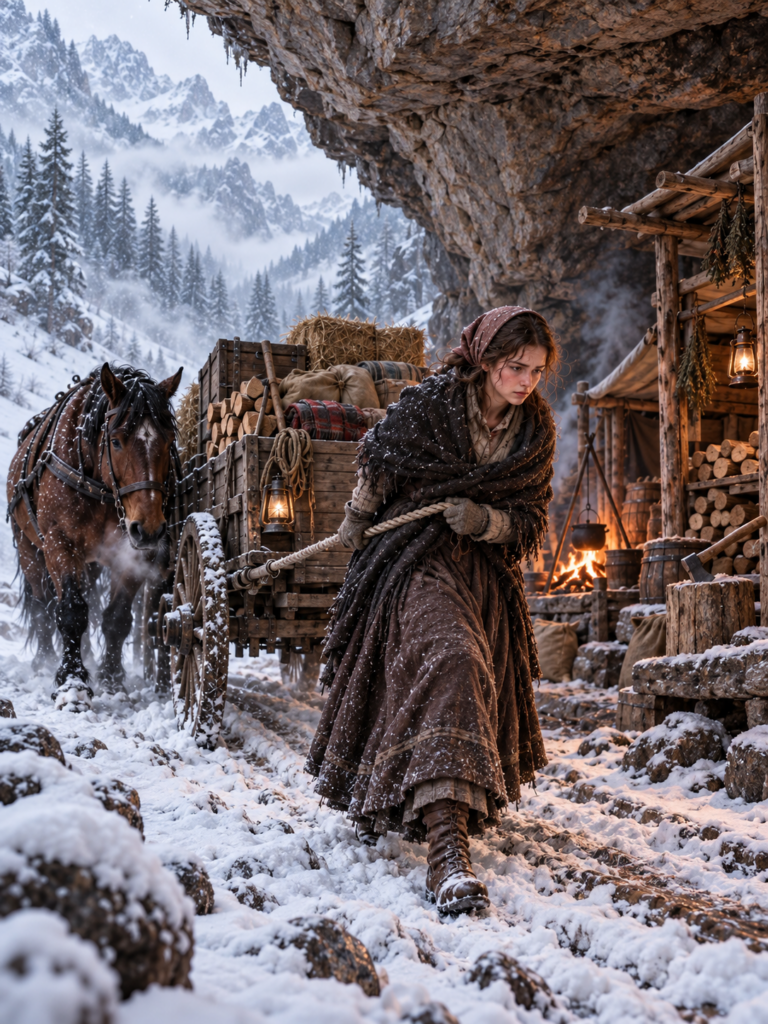
Part 1
The frost had settled thick across the boards of the old freight wagon by the time Evelyn Hart finished tying down the last bundle of blankets.
It was November 1891 in Silverton, Colorado, and daylight had not yet reached the mountains surrounding the town.
At eighteen years old, Evelyn was leaving the only home she had ever known.
She wasn’t leaving because she wanted adventure. She wasn’t heading west in search of fortune, and there was no welcoming relative waiting for her at the end of the road.
Her uncle had told her to get out.
Silas Hart had given her one hour.
By sunrise, he expected her belongings gone, the yard empty, and the house where she had grown up returned entirely to his control.
Evelyn pulled the rope tight, braced one boot against the wagon wheel, and tied another knot.
The cold had made her fingers stiff. She could barely feel the rope against her palms, but she tested the knot twice anyway.
A loose load could overturn a wagon on a mountain trail.
And the wagon itself was hardly fit for a mountain trail.
One rear wheel had already been repaired twice. Its rim was worn, its leather binding cracked, and the weight of the supplies made the whole wagon lean slightly to one side.
Beside it stood Jasper, her aging bay horse.
His winter coat had begun to thicken, and pale steam rose from his nostrils whenever he breathed. He shifted one hoof against the frozen ground and turned his head toward Evelyn.
She rested her palm against his neck.
“Just a little farther to go,” she whispered.
She wasn’t sure whether she meant the packing or the journey ahead.
Inside the house, a door closed.
Evelyn looked up.
For a moment, she could almost imagine her mother standing at the kitchen window, watching to make certain her daughter had dressed warmly enough.
That window had once meant breakfast, lamplight, and the smell of bread coming out of the oven.
Now it was dark.
Her father had died two winters earlier.
Before his death, he had kept the property going through work that never seemed to end. There had been fences to mend, wood to cut, tools to sharpen, and repairs to make before the snow came.
Her mother had managed the household with the same quiet determination.
After her father’s death, the work had become harder.
After her mother’s death the following spring, it had all fallen to Evelyn.
She had planted what she could. She had repaired loose boards, hauled firewood, and kept the small property standing through weather that wore down stronger buildings.
Then Silas arrived.
At first, he spoke as though he had come to help.
He was her father’s brother, after all. Family.
He said she was too young to carry the responsibility alone. He offered advice about the property, the supplies, and the decisions that had to be made before winter.
His help became supervision.
His supervision became authority.
By autumn, he spoke of the house as though Evelyn were merely someone he had allowed to stay there.
He wanted the property. He wanted the land. And he wanted the money Evelyn’s mother had set aside for her.
Evelyn had surrendered the house rather than continue a struggle she had no practical power to win.
But the money was different.
It was the last protection her mother had tried to leave her.
Silas had not persuaded her to surrender it.
That refusal had brought them to this morning.
The previous evening, he had stood near the kitchen doorway, his face hard and impatient.
“You can take whatever fits in the wagon,” he told her.
Evelyn remembered looking past him toward the familiar kitchen table.
There were scratches in its surface from years of ordinary use. Her father had once repaired one of its legs. Her mother had kneaded dough there.
Those memories did not change Silas’s decision.
So Evelyn had said very little.
She had simply begun deciding what a person needed when there was nowhere left to go.
Flour.
Beans.
Dried meat.
Four tightly bound bales of hay for Jasper.
Two sacks of oats.
Blankets, candles, a kettle, a skillet, rope, and a few spare clothes.
Then came the tools.
Her father’s axe, saw, hammer, chisels, and the smaller tools he had used for repairs.
She packed nails, leather strips, and anything else that might help her mend a broken wheel or put a shelter together.
Every item cost space.
Every item added weight.
There was no room for things she wanted only because they reminded her of home.
Near the wagon, she stood for a long moment with her father’s tools in her hands.
They were worn smooth where his fingers had held them.
She placed them carefully beneath the blankets.
By the time the church bells might ordinarily have called the town into motion, the wagon was ready.
Evelyn checked the harness, climbed onto the seat, and gathered the reins.
An upstairs curtain moved behind the house.
She didn’t turn to see who was watching.
“Come on, Jasper.”
The horse leaned into the traces.
The damaged wheel gave a strained wooden creak.
And Evelyn Hart left Silverton before sunrise.
The first snowflakes were already drifting across the road.
She had one destination in mind.
Years earlier, her father had shown her a limestone recess in the mountains above the Animas River.
It lay beneath a broad shelf of rock, tucked among the trees and turned away from the strongest winter winds.
Hunters had once built a crude timber lean-to across part of its opening.
Her father had pointed it out during a trip through the area.
“A place like that can keep a man alive if the weather turns,” he had told her.
Evelyn had never expected to need it.
Now she was relying on a memory from childhood to keep herself and Jasper from freezing.
The road climbed steadily above Silverton.
At first, she could still recognize familiar bends and stands of trees.
Then the town disappeared behind the slope.
The mountains seemed to close around her.
Wind moved through the spruce branches with a low, steady roar.
She kept Jasper walking slowly.
The wagon swayed whenever the wheels struck frozen ruts, and each jolt made her glance back toward the repaired corner.
She could not afford a broken wheel.
She had neither the strength nor the daylight to drag the supplies through deepening snow.
By noon, the weather had worsened.
Snow crossed the road in thick, slanting sheets.
Evelyn pulled her coat tighter and repeated her father’s directions under her breath.
Follow the river.
Pass the split pine.
Climb toward the pale limestone.
Look for the broad shelf facing away from the wind.
She found the split pine, though half its trunk was hidden beneath fresh snow.
Beyond it, the trail grew narrow.
Twice she stopped because the landscape no longer matched her memory.
Each time, she climbed down, studied the hillside, and searched for another familiar feature.
The third time, she almost turned back.
Then she saw it.
A dark opening beneath a broad sweep of pale stone.
Evelyn felt her chest loosen with relief.
She urged Jasper forward.
But when she reached the recess, that relief faded.
The place was smaller than she remembered.
The limestone shelf was solid and broad enough to offer some protection, but the old timber extension was falling apart.
Two heavy roof poles still stretched from the rock toward an outer wall.
Several smaller branches had collapsed.
The covering was torn, and gaps in the rough wall allowed the wind to pass almost freely through the shelter.
Snow lay inside the entrance.
The floor was uneven stone and frozen earth.
Evelyn climbed down and stood beneath the overhang.
It was hardly a home.
Yet the shelf provided a roof, and the ground beneath its deepest section was dry.
That would have to be enough.
She backed the wagon beneath the overhang as far as she safely could and began unloading the supplies.
Food came first.
She carried the flour, beans, and dried meat to the driest corner.
She laid old boards beneath the hay to keep it from touching wet ground, stacked the four bales against the sheltered wall, and covered them with canvas.
She led Jasper into the remains of the timber extension and secured him where the limestone offered partial protection.
Then she gathered loose stones and branches to block the worst gaps.
By the time darkness approached, her arms ached.
Her shoulders burned.
And she was colder than she had ever been inside a building.
She needed a fire.
Evelyn arranged small pieces of wood near the rear stone wall and touched a flame to the kindling.
The fire caught.
For several precious seconds, she watched the flames climb and felt the warmth against her hands.
Then smoke began collecting above her.
It rolled beneath the limestone ceiling and spread downward.
Evelyn coughed and moved closer to the opening.
The smoke followed her.
She dragged the burning wood toward the entrance, hoping the open air would carry it away.
Instead, a gust scattered sparks across the ground.
Several landed dangerously near Jasper’s hay.
Evelyn rushed forward and stamped them out.
She moved the fire back.
Smoke filled the recess again.
Her eyes watered.
Her throat tightened.
She pulled a cloth over her mouth and bent close to the ground, where the air remained clearer.
Outside, the wind was growing stronger.
Inside, the fire threatened either to suffocate her or destroy her supplies.
She had expected the journey to be the hardest part.
Now she understood that reaching the shelter did not mean she could survive in it.
She extinguished the larger flames and kept only enough heat to preserve a small bed of coals.
Then she raised the lantern and began studying the stone overhead.
Near the back wall, its flame flickered sideways.
Evelyn held it still.
The flame bent again.
Air was moving through a narrow crack between the limestone slabs.
She climbed onto a low stone and looked closer.
The opening was too small to serve as a proper smoke vent, but it offered something she had not possessed a few minutes earlier.
A possibility.
She marked the place in her memory and spent the night beneath her blankets, waking whenever the wind struck the broken extension.
Jasper stood nearby, occasionally shifting his weight.
Every sound made her listen.
Before dawn, she had already begun planning how to reach the crack from above.
When daylight finally came, she took her father’s hammer and chisel and climbed carefully around the hillside.
Snow covered much of the limestone.
She brushed it away and searched along the rock until she found a narrow seam between two slabs.
There were faint traces of soot beneath it.
She worked the chisel into the opening.
The first strikes did almost nothing.
She adjusted the angle.
A small piece of stone broke away.
She widened the gap patiently, stopping whenever she needed to warm her fingers inside her coat.
By midday, she had opened the seam enough to test it.
She returned below, rebuilt the fire, and watched.
Smoke rose.
For a moment it gathered against the rock as before.
Then it began moving toward the crack.
A thin stream escaped upward.
Evelyn waited, hardly breathing.
More smoke followed.
The air around her slowly cleared.
She sat back on her heels.
It worked.
She could have a fire.
But as the flames strengthened, cold wind swept across the shelter and carried much of the heat outside.
The smoke problem was solved.
The shelter itself was still too open.
So Evelyn went back to work.
She gathered loose stones and fitted them into the worst gaps of the outer wall.
She used branches to support canvas along the exposed front.
She secured what remained of the hunters’ roof covering to the surviving timbers, careful not to disturb the heavy rock shelf.
Near Jasper, she left a narrow entrance through which she could move supplies and lead him outside.
By evening, the shelter no longer felt quite as exposed.
The fire burned without filling the recess with smoke.
Ice inside her kettle began to soften even when the kettle wasn’t directly above the flames.
She smiled at that small improvement.
Then the storm intensified.
Snow drove against the canvas.
The wind shook the outer covering.
Before midnight, the wagon wheels were buried nearly to their hubs.
Evelyn woke twice to clear snow away from the entrance.
A third time, she climbed just far enough to make certain the smoke seam remained open.
By morning, the trail back to Silverton had vanished.
The mountains were white in every direction.
There would be no easy return.
Evelyn began counting her supplies.
She measured the flour and beans, checked the dried meat, and considered how little she could eat while still having strength to work.
Then she looked at Jasper’s feed.
Four hay bales.
Two sacks of oats.
They had seemed substantial when she loaded them.
Now, surrounded by mountains that could remain buried in snow for months, they looked painfully small.
Jasper needed hay every day.
He could not live on oats alone, and snow would soon cover most of the grass along the lower slopes.
Evelyn divided the hay into measured portions.
Whenever the weather allowed, she would gather dry grass from exposed places and suitable willow browse from near the river to supplement his feed.
She would not replace his hay entirely.
But she had to make it last.
Her own food required the same care.
She measured what remained and calculated what she might need if winter persisted well into spring.
The numbers were not comforting.
She had enough only if nothing went badly wrong.
And already the mountain had shown her how quickly things could go wrong.
That afternoon, the clouds thinned.
Sunlight touched the upper branches, and Evelyn decided to collect additional firewood before the next storm.
She carried her rope, axe, and a small bundle of supplies into the timber.
She intended to stay close.
Ten minutes out, she found several dead branches.
Farther uphill, she saw a fallen tree.
Its exposed wood looked drier.
She walked toward it.
Then she found another.
The wood was heavier than she expected, and she stopped to rest after gathering an armful.
When she straightened, the light had changed.
Clouds were rolling over the ridge.
The wind strengthened.
Snow swept between the trees.
Evelyn turned downhill.
She expected to see the pale stone shelf within minutes.
Instead, she reached a slope she did not recognize.
She stopped.
Spruce trunks surrounded her on every side.
Snow had already filled her footprints.
She turned left, then right, searching for the route she had taken.
Nothing looked familiar.
She had left without tying a guide rope from the shelter.
The sky had been clear.
She had trusted the weather.
Now she could not tell which direction led home.
Evelyn dropped the bundle of wood.
Her heart pounded.
She wanted to run downhill, but she forced herself to stand still.
Moving blindly might take her farther away.
She tried to remember the slope near the limestone shelf.
She tried to picture the trees.
The wind drowned every other sound.
Then, very faintly, she heard a horse.
Evelyn lifted her head.
“Jasper?”
She waited.
Another whinny carried through the trees.
She turned toward it and began walking.
After several minutes, the sound disappeared.
She stopped again.
Snow blew against her face.
Then Jasper called once more, this time from her left.
Evelyn changed direction.
She pushed between two spruce trees, climbed across a low drift, and suddenly saw the pale limestone emerging through the snowfall.
The shelter.
She hurried downhill.
By the time she reached the entrance, her hands shook so badly she struggled to loosen the flap.
She stumbled inside and went straight to Jasper.
The old horse lowered his head toward her.
Evelyn wrapped both arms around his neck.
For several moments, she could not speak.
She had left the shelter believing she was gathering wood for them.
But Jasper had been the one to bring her home.
That night, as she fed the dying fire and waited for feeling to return to her fingers, Evelyn understood something her father had once tried to teach her.
Survival was not only about knowing how to do difficult things.
It was about knowing when to stop doing them.
And the next morning, before she stepped beyond sight of the limestone shelf, she tied fifty feet of rope to the outer wall.
The other end went around her waist.
She drove a stripped branch into the snow above the entrance to mark its position.
From then on, she would not trust a clear sky to remain clear.
Winter was only beginning.
And she had already come close to losing everything.
Part 2
By the second week, snow had risen halfway up the rough stone wall.
Evelyn watched the drifts grow with a mixture of worry and fascination.
Each morning, the entrance appeared smaller.
The path she had cleared the previous day filled again during the night.
The wagon was little more than a white mound beneath the edge of the rock.
At first, she feared the snow would bury the shelter completely.
But something unexpected happened.
Inside, the air began to feel warmer.
The packed snow blocked gaps where the wind had once passed through the wall.
The fire no longer had to fight the same constant drafts.
Evelyn could sit a short distance from the flames without feeling icy air against the back of her coat.
She began to understand that the snow, dangerous as it was, could also protect her.
Rather than remove every drift, she carved a narrow passage to the entrance and left the packed snow along the outer wall.
She kept the smoke vent clear and watched the roof covering for signs of strain.
Each improvement came with another responsibility.
A better-sealed shelter was warmer, but it needed careful ventilation.
A snowbank could block the wind, but snow accumulating above timber might break it.
A fire could keep her alive, but sparks could destroy her food.
There was no single repair that made the place safe.
Safety required constant attention.
Every morning, Evelyn rose before the light reached the entrance.
She fed the fire, checked the vent, examined the walls, and listened for changes in the timber.
Then she checked Jasper.
She felt along his ribs, examined his bedding, and measured his feed.
Only afterward did she prepare her own breakfast.
Most mornings, that meant a small portion of beans or flour cooked with water.
Sometimes she warmed a little dried meat.
She learned to eat slowly.
She also learned not to think too long about the meals her mother used to make.
Those memories could turn a modest breakfast into something that felt even smaller.
Jasper’s supplies worried her more than her own.
The horse had carried her from Silverton and remained her only dependable means of returning.
He needed daily roughage, and the hay pile diminished steadily.
Whenever the weather opened, Evelyn searched for dry bunchgrass on slopes where the wind had swept the snow away.
She gathered willow tips from suitable exposed growth near the river.
Some days, she returned with enough forage to add a generous handful to Jasper’s feed.
Other days, the weather changed before she had gathered anything useful.
The guide rope became part of her routine.
She checked its knots before leaving.
She watched the sky.
When the cloud cover thickened, she turned back.
Once, while collecting branches near the edge of her rope’s reach, she heard Jasper call from the shelter.
She looked toward the sound and smiled.
“Not going far,” she told him.
His ears moved.
It was a strange partnership.
He depended on her to find food and keep the shelter safe.
She depended on him for companionship, transportation, and, as the blizzard had already proved, sometimes even her life.
The days settled into a pattern of difficult, ordinary work.
Evelyn repaired loose bindings on the outer wall.
She split small pieces of wood to keep beside the fire.
She cleared snow from the entrance passage.
She lifted supplies away from patches of damp ground and used stones to improve drainage.
At night, she made notes in her head about what needed attention the following morning.
A loosened knot.
A damp corner.
A branch pressing too heavily against the roof covering.
She no longer expected the shelter to remain unchanged while she slept.
One afternoon, she was securing part of the outer covering when she heard a low wooden groan.
Evelyn stopped hammering.
The sound came again.
It wasn’t the limestone overhead.
It came from one of the old timber supports beneath the snow-covered extension.
She brushed away accumulated snow and examined the wood.
A split had opened along the grain.
The support was still standing, but the weight above it had begun forcing the damaged section apart.
Evelyn leaned back and studied how the poles rested against the wall.
Removing the support immediately would be dangerous.
Instead, she cut another post from suitable wood and wedged it beside the old one.
She checked the footing, adjusted its position, and tested it carefully.
The new post did not completely remove the load from the damaged timber.
But it helped support the covering.
That evening, she looked at the roof several times before going to sleep.
The repair held.
For the moment, that was enough.
Then she discovered the flour.
She had been moving a kettle when she noticed dampness spreading across the storage corner.
A jar near the rear wall had cracked after freezing.
As the ice thawed near the warmth of the shelter, water had leaked across the boards and soaked the bottom of a flour sack.
Evelyn pulled the sack free.
The lower portion was wet and clumped.
She spread the flour near the fire, hoping it might dry before spoiling.
But part of it had already begun to sour.
She pinched a lump between her fingers and smelled it.
There was no saving it.
For several minutes, she sat beside the ruined flour.
She could not replace it.
The nearest store was in Silverton, and the road was buried.
Even if the weather suddenly cleared, the journey would be dangerous.
She gathered the spoiled portion and carried it outside.
Throwing it away felt worse than any other task she had performed that day.
Then she returned, pulled several boards from the wagon, and built a raised platform for the remaining food.
She moved every sack above the floor.
She checked the storage corner for further moisture.
She placed containers where freezing and thawing would be less likely to damage them.
The lesson was expensive.
But losing more flour would be worse.
The next morning, she inspected the food before doing anything else.
From then on, the storage platform became as important to her routine as the fire.
She learned that winter did not always threaten her with dramatic storms.
Sometimes danger arrived as a cracked jar.
Sometimes it was a loose knot.
Sometimes it was meltwater spreading quietly beneath a bag of flour while she slept.
A person could survive a blizzard and still be undone by a small problem left unnoticed.
The next storm lasted four days.
The wind began during the afternoon, driving fine snow across the entrance.
By evening, it was hammering the ridge.
The canvas covering snapped so violently that Evelyn feared the ropes would tear free.
She reinforced what she could, then retreated beneath the limestone shelf.
Outside, the trees groaned.
Snow struck the canvas like handfuls of gravel.
The narrow entrance passage disappeared beneath drifting powder.
Evelyn stopped making trips for wood.
She depended on the stack she had gathered beneath the overhang.
Each log mattered.
She burned only what was necessary and kept the fire small enough to control.
On the second night, Jasper refused his oats.
Evelyn noticed immediately.
He usually lowered his head toward the feed as soon as she offered it.
This time, he only shifted his weight and turned away.
She set the cup aside.
“What’s wrong, old boy?”
She ran her hands along his neck and back.
Then she noticed the bedding beneath him.
The spruce tips were wet.
Meltwater had worked beneath the timber extension and collected along the ground.
Jasper had been standing on damp bedding in bitter cold.
Evelyn moved him to a drier place beneath the overhang.
She stripped away the soaked spruce tips, carried them outside, and deepened the drainage channel.
Water slowly began moving away from the area where he stood.
She replaced the bedding with dry material from her protected supplies.
The work took hours.
Her hands were raw by the time she finished.
She offered Jasper a little feed again.
He sniffed it but still seemed reluctant.
Evelyn stayed awake.
She listened to the storm and watched him move.
Near dawn, he finally lowered his head and began eating.
She closed her eyes in relief.
For a moment, the storm outside seemed less frightening.
Then the real disaster came.
A powerful gust struck the outer covering.
One of the fastenings tore loose.
Snow rushed through the opening and spilled across the storage platform.
Evelyn sprang to her feet.
She grabbed the canvas and tried to pull it back into place.
Another gust drove snow across the floor.
She heard wood crack behind her.
A support had shifted.
One of the boards on the raised platform lurched sideways.
A sack of oats slid from its place.
Evelyn turned just as it struck the ground.
The sack split.
Grain poured across wet snow and into the dirty bedding.
For a second, she could only stare.
Then she dropped to her knees.
She grabbed the kettle and began scooping oats into it, working as quickly as her cold fingers allowed.
She gathered what she could from the cleaner patches.
But much of the grain had mixed with moisture, dirt, and ruined bedding.
She could not safely recover it for Jasper.
The kettle filled with a small portion of what had spilled.
The rest lay scattered across the floor.
Evelyn looked at the torn sack.
Then at the remaining feed.
Nearly half the concentrated oats had been lost.
She sat back.
Her knees were soaked.
There was grain stuck to her sleeves.
For the first time since reaching the limestone recess, she understood that careful rationing might not be enough.
She could measure every cup perfectly and still run out.
She could protect one supply and lose another.
The mountain did not care how hard she worked.
The storm continued while Evelyn repaired the torn covering.
She reset the shifted board, moved the surviving oats higher, and tightened the ropes.
By the time she finished, exhaustion had settled into her bones.
She sat beside the fire and stared at the small pile of grain she had managed to save.
There was no dramatic promise to become stronger.
No sudden confidence.
Only the practical knowledge that Jasper now had less food, and she would have to find more somewhere outside.
When the storm finally eased, Evelyn began spending every safe hour gathering forage.
She returned to the exposed ridges and the areas near the river where snow had blown away.
She cut dry grass and suitable willow browse.
She carried bundles back against her chest, never taking so much that she could not move safely.
She used the guide rope near the shelter and relied on familiar landmarks only when conditions allowed her to travel beyond it.
Some days, the wind drove her home almost immediately.
On others, she collected enough to make the effort worthwhile.
She reduced Jasper’s oats and watched him carefully for weight loss.
She also reduced her own meals.
If she could avoid unnecessary activity, she did.
She sat beneath the blankets and sharpened tools, repaired leather bindings, or planned the next day’s work rather than spend energy she could not easily replace.
Hunger became familiar.
Not a sudden sharp pain, but a constant emptiness.
She learned to recognize the difference between needing food and wanting the comfort of a full stomach.
At times she missed ordinary things more than she missed any luxury.
A dry shirt.
A warm room without smoke.
A clean floor.
A morning when she did not have to inspect the ceiling before eating.
But whenever her thoughts drifted toward Silverton, she remembered Silas.
She remembered his impatience as she packed.
She remembered the way he had claimed the house.
And she knew that returning to him for mercy was not the same as returning home.
Her home, as she had known it, no longer existed.
The shelter beneath the limestone shelf was harsh and temporary.
Yet every repair she made there belonged to her own effort.
Every board she raised and every stone she fitted had been placed because she chose to keep going.
Weeks passed.
Snowstorms blurred into one another.
Evelyn marked the days by cutting notches into a scrap of pine.
At first, she kept careful count.
Later, when storms lasted through several dark days, the marks became a way to reassure herself that time was moving at all.
She occasionally spoke aloud to Jasper.
She told him when the weather looked promising.
She told him when the hay pile needed to last longer.
Sometimes she talked about her parents.
“My father would have fixed that better,” she said one evening, looking at the reinforced wall.
Jasper chewed slowly.
“He would’ve known which wood to use.”
She examined her rough repair.
“Still standing, though.”
The horse continued chewing.
Evelyn smiled faintly.
“That’s something.”
One afternoon, she found deer tracks near the river.
They crossed a patch of exposed ground and continued toward a slope where dry grass showed between stones.
Evelyn followed them.
The tracks suggested a route through the snow, and farther ahead she could see what looked like another promising patch of forage.
She climbed toward it.
Then she saw a second ridge beyond.
For a moment, she was tempted.
The memory of Jasper’s dwindling feed pressed against her.
One more ridge might offer enough grass for several days.
She stopped.
Above the treetops, clouds were thickening.
She studied the sky.
The wind had begun to change.
Months earlier, she would have told herself she could hurry.
She would have walked farther because the next patch looked better than the one she had already found.
Now she turned around.
The bundle in her arms was smaller than she wanted.
But she reached the shelter before snowfall returned.
That night, while the fire burned low, Evelyn thought about her parents.
She remembered her mother standing at the kitchen table with flour on her hands.
Her father sitting near the door, sharpening a saw with patient strokes.
She remembered the warm light of windows along the streets of Silverton.
It hurt to imagine those familiar places while she sat wrapped in blankets beneath a mountain.
She missed her mother so sharply that she began to cry.
At first, she tried to stop.
Then she let herself.
There was nobody there to hear except Jasper.
When the tears passed, she wiped her face with the edge of a blanket and added a little wood to the fire.
In the morning, she returned to work.
She decided to inspect the wagon.
Snow still buried much of it, and the road home remained impassable.
But she knew the wagon would eventually have to carry her down the mountain.
If she waited until spring to repair it, she might discover a problem too late.
She dug around the damaged rear wheel.
She cleared ice and frozen dirt from the hub.
She examined the old repairs and found a cracked leather binding.
Evelyn removed it, cut a replacement from her supplies, and tightened the rim.
She worked slowly, keeping the tools organized on a board beside her.
Her fingers became stiff in the cold, and several times she returned to the fire to warm them.
When the binding was secure, she used a little fat to grease the hub.
Then she lifted the wheel enough to test it.
It turned.
She spun it again.
This time, there was no catching or sudden shift.
Evelyn rested one hand against the rim.
It was still an old wheel.
The wagon was still worn.
But the repair was sound.
She could not open the road or bring spring any sooner.
She could prepare.
Afterward, she inspected the shelter.
The replacement roof support was holding, but the split in the original timber had widened.
She cut another post, shaped one end, and stored it beside the wall where she could reach it quickly.
She did not install it immediately.
The existing frame was still stable enough.
But the extra post gave her something she had lacked during earlier emergencies.
A prepared response.
Each morning, she began asking herself the same questions.
What had changed overnight?
What could fail next?
What could she fix while there was still daylight?
Those questions became the foundation of her routine.
Then, one January night, the outer roof began to move.
The first sound was a dull groan.
Evelyn opened her eyes.
A moment later, timber snapped somewhere above the entrance.
Snow dust sifted through the brush covering.
Jasper jerked backward against his rope.
Evelyn seized the lantern and held it high.
The old support was bowing inward.
Above it lay a heavy accumulation of snow.
The limestone shelf was solid.
But the timber extension that sheltered Jasper and their supplies was giving way.
If it collapsed, it could crush the horse, bury the hay, and block the only entrance.
Evelyn looked toward the spare post she had cut weeks earlier.
She had prepared it because she feared something like this might happen.
Now the roof was moving.
And she had only one chance to brace it before the weight came down.
Part 3
Evelyn’s first thought was Jasper.
The horse was shifting nervously beneath the damaged roof, his ears pinned toward the snapping timber.
She set the lantern where it could not be knocked over and hurried to his rope.
“Easy. Come here.”
He resisted for a moment.
Another groan passed through the roof.
Evelyn pulled gently but firmly, guiding him from the outer extension to the safer space beneath the limestone overhang.
Only when he stood clear did she return for the supplies.
She dragged the nearest food sacks away from the weakening support.
She moved the protected hay as far as she safely could.
Every second seemed to make the roof heavier.
Snow pressed down on the brush covering.
The old support bowed farther inward.
She could not simply knock it away.
The damaged timber still carried part of the load.
Removing it might cause the extension to fall immediately.
Evelyn took the spare post from beside the wall.
She had cut it in advance, but it needed more work before it would fit beneath the strained beam.
She laid it across two stones and used her father’s tools to shave one end.
The sound of her knife and hammer seemed terribly small beneath the groaning roof.
She worked faster.
Then she forced herself to slow down.
A poorly fitted post would slip.
A rushed repair could bring the roof down on top of her.
She positioned the post beside the failing support.
Its base rested on hard ground near the stone wall.
Its upper end pressed against the beam carrying the outer covering.
She reached for a wooden wedge.
The first wedge slipped when she drove it beneath the post.
She caught the support before it fell sideways.
Snow sifted down again.
Evelyn set the wedge aside and tried another.
This one split beneath the hammer.
She stared at the broken wood.
Her hands were numb.
Pain ran through her wrists with every blow.
For an instant, she wanted to keep hammering, to force the repair into place before anything else moved.
But she stopped.
She pulled back, returned to the fire, and warmed her fingers until she could close them around the hammer without trembling.
Then she cut a thicker wedge.
She checked its grain and shaped it more carefully.
Back beneath the roof, she fitted it against the post and struck it with controlled blows.
The wedge tightened.
The post rose firmly against the beam.
Evelyn tapped it again.
This time, it held.
She placed flat stones beneath the base to strengthen the footing.
Then she wrapped rope around the damaged timber and the new support, pulling them together.
Slowly, she adjusted the load so that the fresh post carried more of the weight.
The roof groaned.
A mass of snow shifted overhead.
Evelyn froze.
Dust drifted from the branches.
Nothing fell.
She remained crouched beside the support for a long moment.
Then she carefully stepped back.
The new post stood straight.
The old timber remained damaged, but the frame was no longer moving visibly.
Evelyn crossed to Jasper.
The horse had settled beneath the rock.
She ran a hand over his shoulder, then looked back toward the roof.
The repair had held for several minutes.
That did not mean it would hold all night.
She gathered her blankets and sat near Jasper, keeping the lantern close.
She listened.
Every small creak made her raise her head.
Sometimes the timber made ordinary sounds as the temperature changed.
Sometimes snow slid over the outer covering.
Each time, she waited to learn whether the sound would become something worse.
At one point, she remembered the house in Silverton.
She remembered the walls her father had repaired, the familiar roof, and the feeling of falling asleep without wondering whether the building would still be standing at dawn.
She had once believed shelter was simply something a person possessed.
Now she knew it was something that had to be maintained, especially in the mountains.
She listened until the darkness began to thin.
At first light, she examined the repair again.
The new post had not shifted.
The rope remained tight.
The damaged support had not cracked farther.
Evelyn climbed outside cautiously.
From a safe position, she used a long pole to remove loose snow from the weakened section of roof.
She worked in small amounts, careful not to place herself beneath the load.
Snow slid down the slope and fell away from the extension.
The pressure slowly decreased.
When she finished, she stood in the cold and looked back at the shelter.
The repair was crude.
The walls were uneven.
The canvas had been patched so many times that it looked like several coverings tied together.
But the entrance remained open.
Jasper was alive.
The hay was dry.
Evelyn rested one hand against the new post.
Then she went inside and measured his morning feed.
Before noon, she added a second brace beside the first.
She retied the canvas and checked the weakened frame, working carefully to avoid sudden movement.
The roof held.
For the first time since the disaster began, she allowed herself to believe that the immediate danger had passed.
Winter did not end that day.
There were more nights of bitter cold.
More mornings spent digging out the entrance.
More days when the clouds hung so low that Evelyn could barely distinguish the ridge above the trees.
She continued measuring Jasper’s hay and oats.
She gathered forage whenever it was safe.
She kept the vent open and the fire under control.
She inspected the food sacks and repaired anything that showed signs of wear.
But the weeks after the roof repair felt different.
She no longer faced each problem as something entirely unknown.
She had learned how the shelter behaved in strong wind.
She knew which corner collected moisture.
She understood where snow tended to accumulate.
She recognized the sounds of the timber when it was carrying too much weight.
She had made mistakes, some of them dangerous and expensive.
Yet she had survived long enough to learn from them.
As winter gradually began to loosen its grip, the changes were small.
One morning, the water in her kettle had not frozen solid.
Evelyn noticed it while preparing breakfast.
She touched the surface and found only a thin film of ice.
The following afternoon, drops of water began falling from the icicles near the entrance.
She stood beneath the rock and listened to them strike the ground.
The snow tunnel softened along its southern edge.
Sunlight reached places that had remained frozen for weeks.
Still, she did not relax her precautions.
Mountain weather could turn without warning.
A warm afternoon did not guarantee a warm night.
She kept the wood stack dry and checked the roof supports as carefully as before.
She continued rationing food.
She did not allow herself to believe the journey home was close until the ground began providing evidence.
Then one afternoon, while walking downhill, she heard running water.
Evelyn stopped.
At first, she thought the sound might be wind moving through branches.
She listened again.
It was steady and unmistakable.
Water.
She followed it through the thinning snow and found a narrow opening above the river.
Beneath the remaining ice, dark water moved freely over the stones.
Evelyn knelt beside it.
For months, she had depended on melting snow, using precious fuel to turn frozen handfuls into drinking water.
Now the river was moving again.
She filled her kettle.
The cold water splashed against the metal.
Beside her, Jasper lowered his head toward a patch of exposed grass.
He pulled at it eagerly.
Evelyn watched him.
Then she laughed.
The sound surprised her so much that she stopped and looked around.
There was nobody there.
Only Jasper, the river, and the mountains.
She laughed again, quietly this time.
For the first time in months, spring seemed less like a hope and more like something she could touch.
As the thaw strengthened, Evelyn began preparing the wagon.
She cleared snow from the wheels.
She dug around the axle and checked the bindings she had repaired during winter.
The leather was holding.
The rim remained secure.
She inspected the harness and tightened any straps that had loosened.
She checked Jasper’s condition carefully.
He had made it through winter, but he was older and thinner than when they left Silverton.
She would not ask him to pull more than necessary.
Evelyn sorted her belongings.
Some supplies were gone.
Some were worn beyond further use.
She had less flour, fewer oats, and less hay than she had hoped when winter began.
The tools, however, remained.
Her father’s hammer.
His saw.
The axe she had used to gather wood and shape supports.
The chisels that had helped open the smoke vent.
She packed them carefully.
They had become as necessary as the food she carried.
When the road finally cleared enough for travel, Evelyn could have left immediately.
But she looked around the limestone recess and saw what winter had taught her.
The old hunters’ shelter had been little more than a damaged lean-to when she arrived.
Now the outer wall was stronger.
The smoke vent worked.
The drainage channel carried water away from the bedding.
The roof extension had new support posts.
She decided not to leave it neglected.
She spent additional days rebuilding sections of the wall and replacing damaged timber.
She cleared the smoke channel and secured the covering as well as she could.
She deepened the drainage trench where meltwater had once soaked Jasper’s bedding.
Then she gathered dry wood and stacked it beneath the limestone shelf.
Under a sheltered stone ledge, she placed a small bundle of kindling, a tin cup, and a few nails.
They were modest things.
But she remembered the night she had first arrived.
She remembered trying to light a fire while smoke filled her eyes.
She remembered the cold and the fear of having no place else to go.
Perhaps someone else might someday reach the same shelter during bad weather.
If they did, a little dry kindling and a usable cup might matter more than anyone living comfortably in town could imagine.
When the trail finally appeared as a muddy line through the trees, Evelyn loaded the wagon.
She secured her supplies, checked Jasper’s harness, and tested the repaired rear wheel one last time.
It turned smoothly.
She led Jasper from beneath the limestone shelf.
The horse stepped onto the open trail and paused.
Evelyn looked back.
The shelter was almost invisible among the stone and trees.
A person passing at a distance might never notice the dark opening.
Yet for months it had held everything that mattered to her.
Her food.
Her tools.
Her fire.
Her horse.
Her life.
She stood there for a moment, remembering the frightened girl who had arrived in a snowstorm.
That girl had believed the worst thing in the world was losing her home.
The woman standing beside the wagon understood that losing a home could be terrible without being the end of a life.
She touched Jasper’s neck.
“Come on.”
The horse began walking.
The repaired wheel rolled over the muddy ground without breaking.
At the first bend, Evelyn looked back once.
Then she turned toward Silverton.
She did not look back a second time.
The journey downhill was slow.
Melting snow had softened parts of the trail, and runoff crossed the lower road in shallow channels.
Evelyn walked beside Jasper when the ground was difficult.
She watched the wheels and avoided places where mud might trap the wagon.
As they descended, the trees changed.
The snow thinned.
More patches of earth appeared.
The air carried the smell of wet soil and thawing wood.
Then, through the trees, she saw Silverton.
Smoke rose from the chimneys.
Wagon tracks crossed muddy streets.
The buildings looked smaller than she remembered.
Evelyn slowed.
For months, she had imagined returning.
She had wondered whether anyone would recognize her, whether Silas would hear about her survival, whether she would feel anger when she passed the familiar road leading toward her old house.
Now the town stood before her.
And she felt something quieter.
She was tired.
She was hungry.
She needed work.
Most of all, she needed to decide what came next.
As Jasper pulled the wagon into town, people began looking toward them.
A man near one of the buildings stopped what he was doing.
A woman carrying supplies turned and stared.
Evelyn recognized several faces.
They recognized hers.
Word had spread after she left.
Some people believed she had gone south.
Others assumed she had died somewhere above the river when the winter storms arrived.
Few expected to see the eighteen-year-old girl Silas Hart had driven from his house return with the same horse and wagon.
Yet here she was.
The wheel still turned.
Jasper still walked steadily.
And most of her father’s tools remained packed beneath the blankets.
Evelyn continued through the street.
She could feel people watching.
She did not stop to explain herself.
She had spent too many months fighting for each ordinary day to turn her survival into a performance.
When she reached the road leading toward Silas’s property, she recognized it immediately.
She knew every bend.
She knew where the fence began.
Somewhere beyond the trees stood the house where her parents had raised her.
For one brief moment, her grip tightened on Jasper’s lead rope.
She could have turned.
She could have gone to the door and demanded that Silas look at her.
She could have asked him whether he had expected her to survive.
But there was nothing she needed from him that would make the winter disappear.
He had taken the house.
He had not taken her ability to work, to repair, to choose, or to build something new.
Evelyn walked past the road without turning her head.
She rented a small room at the edge of town.
It was not much.
There was little space, and it lacked the familiar comforts of the home she had lost.
But the roof was sound.
The walls kept out the wind.
And the door belonged to a room she had chosen for herself.
The first night, she slept beneath her blankets and woke more than once.
She listened for timber groaning under snow.
She expected to hear canvas snapping.
Then she remembered where she was.
There was no blizzard pressing against a makeshift wall.
No need to clear the entrance before breakfast.
For a while, she simply lay still.
In the weeks that followed, Evelyn looked for work.
She did not have a great deal of money or influence.
But she had tools, and she knew how to use them.
She sharpened blades.
She patched harnesses.
She repaired wagon boards and reset loose handles.
She split wood and took whatever practical jobs she could manage.
Some people were surprised by how confidently she handled the tools.
Others merely wanted their work completed.
Evelyn preferred the second kind.
She had little interest in becoming a story people told for amusement.
She wanted to earn enough to feed Jasper, pay for her room, and begin putting something aside.
Her father’s tools made that possible.
She remembered watching him use them when she was young.
Back then, they had seemed ordinary.
The hammer had hung in its place.
The saw had rested beside the workbench.
The chisels had been kept sharp because he believed a dull tool made a hard job harder.
After his death, they had become reminders of him.
During winter, they had become the difference between a shelter that failed and one that held.
Now, in Silverton, they became the beginning of a new livelihood.
Evelyn found satisfaction in small repairs.
A wagon wheel that turned properly.
A harness strap that held.
A tool handle fitted tightly enough not to slip.
She understood the value of such things in a way she never had before.
A broken strap might mean an inconvenient delay in town.
In the mountains, it could mean lost feed, wasted daylight, or a failed journey.
A loose board might be a minor annoyance in a workshop.
Beneath a snow-covered roof, it could become a disaster.
Each task reminded her that survival had not given her a grand secret.
It had taught her to pay attention.
Summer eventually arrived.
The mountain trails opened.
Jasper grew stronger with better forage and rest.
And Evelyn began thinking about the limestone recess again.
She no longer needed it for shelter.
She had a room in town.
She had work.
She had a life that was beginning to take shape.
Still, the place remained in her thoughts.
She remembered the smoke vent, the drainage channel, and the roof posts she had reinforced.
She wondered how the repairs had survived the spring thaw.
One clear day, she packed her tools and supplies and returned to the mountains.
This time, she traveled without snow blowing across her face.
The road was visible.
The river moved openly beside sections of the trail.
Birds called from the trees.
When she reached the limestone shelf, she climbed down and stood near the entrance.
The shelter looked smaller in summer.
Without the towering snowbanks, she could see the whole rough extension.
She could also see how much work remained.
Evelyn stayed long enough to strengthen the timber frame and improve the drainage.
She enlarged the protected wood stack.
She placed sealed food beneath the rock shelf.
She replaced the branch marker above the entrance with a taller pole that would remain visible after heavy snowfall.
Then she inspected the smoke channel and the outer covering one more time.
She did not do these things because she expected to live there again.
She did them because she knew what the shelter could mean to someone stranded by winter.
Years passed.
People in Silverton continued remembering the terrible winter of 1891.
They spoke of roads buried beneath snow.
Of livestock that had died.
Of fences disappearing beneath enormous drifts.
They remembered storms that had shut down travel and kept families isolated.
And sometimes they remembered Evelyn Hart.
The young woman whose uncle had turned her out before winter.
The girl who had taken an aging horse and a worn freight wagon into the mountains and somehow returned when the thaw came.
For some, her story was remarkable because she had survived.
For others, it was remarkable because she had done so alone.
But Evelyn remembered that winter differently.
She remembered the smell of spoiled flour near the fire.
She remembered kneeling in wet snow, trying to save oats from a torn sack.
She remembered the sound of timber groaning above Jasper’s head.
She remembered driving a wedge beneath a roof support while her hands trembled from cold.
And most clearly of all, she remembered standing lost among the spruce trees, unable to find the limestone shelf.
She remembered the fear that had settled over her when the snow erased her footprints.
Then she remembered Jasper’s call.
A thin sound carried through the wind.
A sound that gave her a direction when every tree looked the same.
That winter had taken much from her.
Food.
Warmth.
Strength.
Sleep.
The certainty that tomorrow would resemble today.
She had entered the mountains with more supplies than she brought out.
Yet she returned with knowledge she had never possessed before.
She knew how quickly weather could change.
She knew that preparation mattered more than confidence.
She knew that even a small loss could become serious when there was no way to replace it.
She knew when to press forward and when to turn back.
Most importantly, she understood that a person’s future did not have to belong to whoever had taken away their past.
Silas Hart had taken the house where she grew up.
He had driven her into the cold with little more than an old horse, a damaged wagon, her mother’s money, and her father’s tools.
But he had not decided where her life would end.
When another difficult winter eventually came to the mountains, Evelyn knew what to watch.
She knew how to inspect a roof before the snow grew too heavy.
How to keep supplies above damp ground.
How to protect a fire without wasting fuel.
How to recognize the moment when a journey had become too dangerous to continue.
And how to begin again after losing something she could not recover.
She never believed she had conquered the mountain.
The mountain was too large for that, and winter was too unforgiving.
She had simply learned to survive without surrendering herself.
In the end, the most important thing Evelyn Hart carried back from the mountains was not a piece of property, a hidden fortune, or anything another person could give her.
It was the knowledge that even when every familiar door had closed, she could still find a way to build a place for herself.
And this time, nobody else would decide when she had to leave.


