
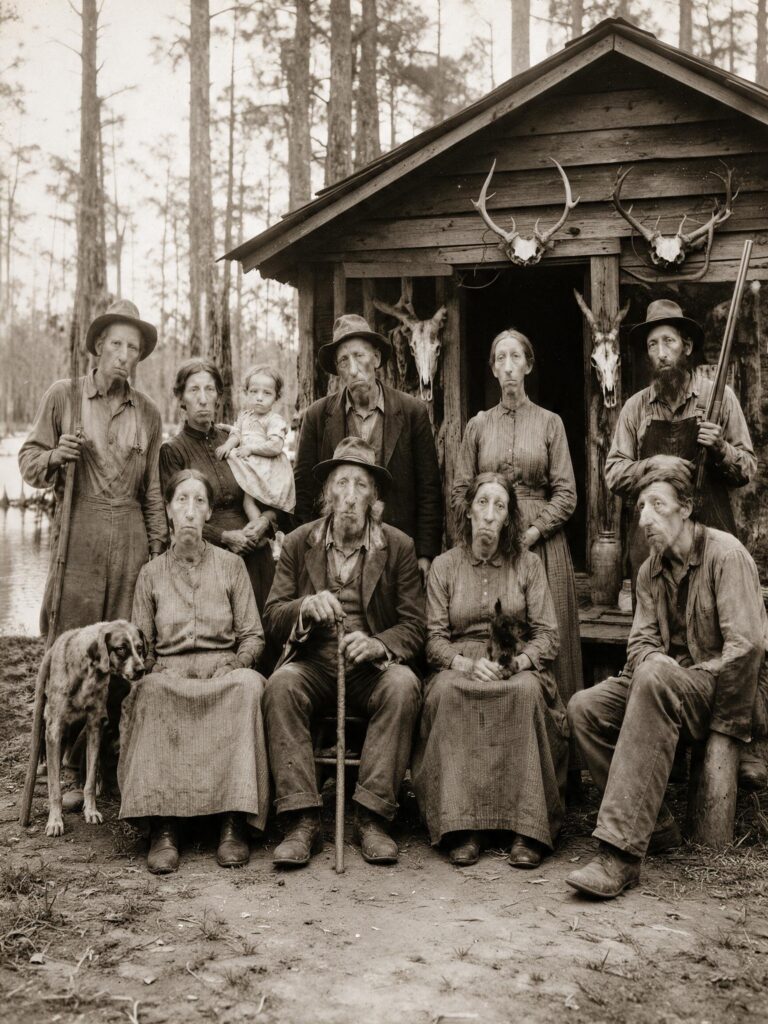
Part 1
In the basement of the Hancock County Courthouse in Bay St. Louis, Mississippi, there stood an old metal filing cabinet behind a door that had remained locked for much of the 20th century. The cabinet was unremarkable in appearance. Its drawers were stiff with age, its painted surface worn at the corners, and its contents arranged in 7 folders whose labels had yellowed beneath the damp Gulf Coast air.
Every folder carried the same surname.
Pardio.
For generations, that name had occupied a peculiar place in the history of Hancock County. It appeared in no ordinary account of the county’s settlement. No commemorative marker bore it. No local history devoted a chapter to the family. Land records, tax assessments, and survey maps revealed remarkably little about the people who had carried it into the lower Pearl River basin during the middle of the 19th century.
Yet the folders suggested that the family had not been forgotten through negligence.
The documents had been gathered, organized, and deliberately withheld from public view.
Among them was a sealed envelope containing 46 pages removed from the field journal of a railroad surveyor named Thomas Callaway. Attached to the envelope was a short note attributed to a former county sheriff. Its language was unusually personal for an official record.
The contents were not to be entered into the public register.
Beneath that instruction, the sheriff had written a final sentence.
God help whoever reads this next.
The envelope remained among the sealed records for more than a century.
In 2019, Katherine Morell, a graduate student at the University of Southern Mississippi, requested historical survey materials while researching timber rights disputes along the Pearl River corridor. Through what appeared to have been a clerical mistake, she received a collection of documents that went well beyond the maps she had requested.
There was the surveyor’s journal.
There was an 11-page deposition dating from 1856.
There were handwritten notations made by successive county officials.
And there was a small notebook bound with rough cord, its pages filled with carefully formed French handwriting.
Together, the records described a settlement that had existed beyond the ordinary reach of county government for more than 60 years. They described people who had been born there, people who had wandered into it, and others who had tried to leave. They described a system of authority that passed from generation to generation without interruption or meaningful outside interference.
Most troubling was not simply what the records said about the settlement.
It was what they revealed about the people who had known of its existence.
To understand how those folders came to be hidden in a courthouse basement, the account must return to the autumn of 1905, when Thomas Callaway entered the bottomlands southeast of Kiln and discovered a clearing that did not appear on his maps.
Callaway was 31 years old, employed as a surveyor by the Gulf and Ship Island Railroad. He had already completed 6 surveys across the Gulf States and had developed the deliberate habits required of a man whose judgments might determine where tracks could safely be laid.
He carried a compass, measuring chain, field glasses, drawing instruments, and a leather-bound journal. Every evening he copied his observations into careful entries, recording elevations, streams, timber, soil conditions, and the distances separating important landmarks.
His journals contained details that other surveyors might have dismissed as unnecessary. He identified unfamiliar birds by their calls, described the condition of creek beds, and noted changes in vegetation that suggested variations in soil or drainage.
He did not consider such observations wasted effort. In difficult country, a small detail could establish a location more reliably than a landmark visible only in favorable weather.
His assignment in September 1905 was straightforward. The railroad was considering a spur line through part of the lower Pearl River basin. Callaway was to examine the proposed route, measure the terrain, identify obstacles, and submit a report.
The country through which he traveled was poorly suited to the work.
South of the settled roads, the Pearl River broke into an intricate system of waterways that wandered through cypress swamps, low ridges, and tidal marshes. A channel broad enough for a boat in winter might diminish to a muddy ribbon in summer. Ground that appeared firm during a dry spell could disappear beneath several feet of water after heavy rain.
The trees complicated everything.
Bald cypress rose from black pools on buttressed trunks. Tupelo gum crowded the higher banks. Vines crossed narrow openings in the canopy, while palmetto and tangled brush concealed the transition between solid earth and soft, dangerous mud.
During certain hours, sunlight entered the swamp in thin, pale columns. At other times the forest seemed to close over itself, leaving the water beneath it almost completely shaded.
There were insects in every season, snakes along the fallen timber, and alligators in the deeper channels. Fever remained a familiar danger in the region, and a traveler who lost his bearings could spend days wandering among waterways that offered no reliable indication of direction.
The swamp was not uninhabited. Hunters, trappers, timber cutters, and river men knew portions of it intimately. But their knowledge was local, and the names by which they identified its channels seldom appeared on official maps.
On September 14, Callaway had been working roughly 11 miles southeast of Kiln when the ground began to change beneath him.
He had left his temporary camp early, expecting to reach a low ridge indicated by the railroad’s preliminary notes. By noon the footing had become uncertain. The water, initially no deeper than his boots, rose above his ankles and then to his knees.
At several points he was forced to lift his equipment above his shoulders while negotiating submerged roots.
By early afternoon, the canopy had grown so dense that he could no longer judge the hour by the sun. He consulted his watch repeatedly, finding himself surprised by how little daylight reached the ground.
The air smelled of damp bark, decaying vegetation, and an occasional sharp trace of sulfur released from the disturbed mud.
Toward 4:30, he noticed that the bird calls had ceased.
He stopped and listened.
There was still the movement of insects and water. Somewhere beyond the trees, something large disturbed a shallow pool. But the small, persistent sounds that had accompanied him since morning were absent.
Callaway recorded the observation without assigning it any meaning.
He checked his compass, made his way around a fallen cypress, and emerged from the dense timber into a clearing.
At first he saw only the roof.
It was a long, dark structure, its line interrupted by the irregular edges of hand-split shingles. As he moved farther through the trees, more of the clearing became visible.
There were cabins, animal pens, cultivated plots, and beaten paths. Smoke drifted from a cooking area. Several figures moved between the buildings.
This was not an abandoned settlement.
It was inhabited, organized, and considerably larger than anything his route notes had prepared him to find.
Callaway lowered his equipment and remained among the trees.
He took out his journal.
He did not yet know the name Pardio, nor did he know that the buildings before him stood on land which county officials had been quietly avoiding for decades.
The settlement had begun, according to the earliest surviving records, in 1841.
On October 11 of that year, a man identified as Augustine Pardio purchased supplies from a trading post near Gainesville in Hancock County. The transaction was ordinary enough to have escaped notice had later events not given it significance.
The receipt listed salt, gunpowder, lead shot, 3 bolts of rough cloth, an iron cooking pot, and 40 pounds of cornmeal.
The purchaser signed with an X.
In the margin, the clerk made a brief observation: the buyer was a middle-aged Frenchman traveling with a wagon, several women, and numerous children.
No destination was recorded.
Beyond that receipt, little could be established about Augustine Pardio’s arrival in Mississippi. There was no reliable account of his previous home, the circumstances that brought him south, or the relationship between the people traveling with him.
What the records suggested was that Pardio had no intention of joining an established community.
He went into the lower basin, where the channels multiplied and the ground offered few places suitable for permanent construction. Somewhere among those channels, on a ridge rising scarcely 3 feet above the surrounding water, he began clearing land.
The location was isolated but not entirely without advantages.
The ridge provided a small area of relatively dependable ground. The surrounding bayou supplied fish, turtles, and game. Timber was abundant. Corn and sweet potatoes could be grown where enough brush had been cut away and the soil worked continuously.
Access, however, was difficult.
A visitor approaching from the wrong direction might pass within a short distance of the settlement without seeing it. High water could conceal the most direct routes for weeks. From the outside, the place was protected less by fortifications than by the geography itself.
For nearly 14 years, no voluntary contact between Augustine Pardio and the settled communities appeared in the surviving record.
The next substantial account came from Solomon Greer, a trapper who had spent much of his adult life moving through the Pearl River bottomlands.
Greer knew the waterways in a manner no government map could reproduce. He recognized channels by the direction of their current, the shape of the trees along their banks, and the places where old logs had settled beneath the water.
During the winter of 1855, he followed his muskrat traps farther upstream along a waterway he called Bayou Malure.
The name, he later explained, was associated with the Choctaw people who had once lived in the region. He understood it to mean something close to water of misfortune.
Years earlier, an elderly Choctaw woman had warned him against traveling into its upper reaches.
Greer had listened respectfully and then disregarded the warning. The trapping was good, and a man who made his living from the swamp could not afford to abandon every productive stretch of water because someone feared it.
On the morning in question, he poled his narrow pirogue through a channel obstructed by fallen cypress.
The journey was slow.
At times the water was too shallow to use the pole effectively. Elsewhere the mud was too deep to permit walking. Greer maneuvered around submerged trunks and pushed beneath branches that scraped against his shoulders.
After approximately 2 hours, the channel opened into a broad, motionless pool.
Across the water lay a low ridge.
On that ridge stood 7 buildings.
The largest was a rectangular log structure roughly 40 feet long and 15 feet wide. It had no windows and only 1 visible door. The smaller cabins stood in a rough semicircle, facing inward toward the larger building.
Behind them Greer could see a cultivated field of perhaps 2 acres.
There were hogs penned near the trees, chickens moving through the dirt, and a number of people carrying out their daily work.
He counted between 15 and 20 individuals, including children.
Their clothing was coarse and evidently made within the settlement. Most of the children were barefoot. The women’s hair hung loose about their shoulders.
At first Greer thought he had stumbled upon an unusually remote family holding.
Then the people noticed him.
The change was immediate.
A woman carrying something toward the largest building stopped where she stood. Children near the field turned their heads. A man beside an animal pen straightened and looked toward the water.
There was no shouting.
No alarm was raised.
Every visible inhabitant simply stopped working and looked toward Greer’s boat.
The door of the largest building opened.
A tall, heavily built man emerged and walked across the clearing to the water’s edge. He had a full gray beard and exceptionally large hands, which Greer remembered with particular clarity when describing the encounter later.
The man stood motionless.
Greer raised his hand and called a greeting.
He explained that he was a trapper, that he had been following his lines, and that he intended no intrusion.
The man did not answer.
Behind him, the inhabitants began moving away.
They did so slowly, without any apparent instruction, disappearing around the larger building until the clearing was empty.
Within perhaps 30 seconds, only the tall man remained.
Greer tried speaking again.
There was no response.
He later said the man’s expression contained neither hostility nor curiosity. He simply looked at Greer as though waiting for something already understood between them to be completed.
Greer had encountered armed men in lonely country before. He knew the immediate fear of approaching violence and the ordinary caution required when entering another man’s land.
What disturbed him was different.
The people had withdrawn without a word. The man before him showed no interest in whether he stayed or left. Everything about the scene suggested a private order of conduct into which Greer had entered by accident.
He turned his pirogue downstream.
The tall man remained on the bank until the channel bent and the clearing vanished behind the trees.
Greer did not return for approximately 3 months.
Nevertheless, the settlement remained in his thoughts.
He remembered the strange arrangement of the buildings and the way the inhabitants had moved out of sight. Most of all, he remembered the absence of ordinary human curiosity.
By March 1856, he had persuaded himself that another visit would settle the matter.
He approached from the east, using a shallow slough parallel to the main channel. Leaving his pirogue secured to a cypress knee about a quarter mile from the ridge, he continued on foot.
He came upon the settlement from behind a dense screen of brush.
The first thing he noticed was its growth.
There were now 9 buildings instead of 7.
The new structures were smaller than the original cabins, made of rough logs with mud packed into the gaps. One appeared to have no door at all. Its only visible opening was a narrow vertical slot cut high into the wall.
Greer remained concealed and watched.
Over approximately 3 hours, he counted 23 people.
Several women appeared to be pregnant. The children ranged from very young to perhaps 15 years old.
None played.
No child chased another across the clearing. No quarrel broke out. There was none of the noise Greer would have expected from a settlement occupied by so many people.
He saw the tall patriarch emerge from the central building on several occasions.
Each time, activity in the clearing stopped.
A person holding a tool remained still. Someone carrying a basket waited in place. Those working near the cabins suspended their labor.
Movement resumed only when the patriarch returned indoors or gave a short nod.
Greer had seen men command obedience through strength, money, or fear. He had never seen an entire household respond so completely to the mere appearance of its leader.
Later that afternoon, he noticed 8 wooden posts along the western edge of the clearing.
They had been driven into the ground in a straight line.
Each stood roughly 4 feet high, with a short iron chain fixed near its base.
Greer studied them through the branches.
The chains ended in leg shackles of the kind he recognized from plantations.
At 2 posts, the shackles were occupied.
The prisoners sat on the ground, shifting occasionally in the dirt. Their clothing made it difficult for Greer to determine whether they were men or women.
Neither called out.
Neither attempted to attract attention.
Greer watched them for several minutes, unable to reconcile their presence with the ordinary appearance of the cultivated fields and cabins.
The chains were short enough to prevent the prisoners from standing or walking freely. Their positions left them exposed to the heat, rain, and insects of the clearing.
There were people working within sight of them.
Nobody approached.
Nobody appeared to regard the prisoners as unusual.
Greer remained in the trees until the shadows began to lengthen. Then he returned to his boat and moved back into the channel.
That night he did not attempt to reach his usual camp.
He anchored the pirogue in open water and sat awake beneath a blanket, listening to the swamp.
Within 3 days, he had gone to Gainesville and presented himself at the office of Bartholomew Keane, the Hancock County justice of the peace.
Keane was an established local official who had held the position for approximately 11 years. He owned a modest farm along the Jordan River and was regarded as deliberate and generally fair in his judgments.
Greer described the route, the buildings, the inhabitants, and the chains.
His testimony filled 11 handwritten pages.
Keane read the deposition twice.
He then questioned Greer about the settlement’s location, its approaches, the number of adult men present, and whether any of the inhabitants appeared to possess firearms.
Greer answered as accurately as he could.
He had not seen a gun, though he could not say whether the household possessed weapons. He could identify the channel and believed he could lead a party back to the ridge in suitable weather.
Keane made no arrangements for such a party.
At the bottom of the deposition, he wrote a brief official notation stating that no action would be taken. The circumstances, while irregular, were said to fall outside the jurisdiction of his office because no enforceable statute had been shown to have been violated.
Greer left without securing an investigation.
The deposition was filed.
The chains remained where they were.
Later examination of Keane’s decision would raise serious questions about the legality of his refusal. Even within the law of antebellum Mississippi, the unexplained restraint of unidentified persons could not simply be dismissed as a private matter beyond inquiry.
There were procedures governing lawful detention, and the mere existence of a secluded family settlement provided no exemption from them.
Keane had been presented with testimony suggesting that people were being held against their will.
He had asked how difficult the settlement would be to reach.
Then he had chosen not to go.
For nearly 50 years, the official record offered little further explanation.
By the time Thomas Callaway stood at the edge of the same clearing on September 14, 1905, the settlement had grown beyond anything Solomon Greer had described.
Its original central building had become a hall nearly 80 feet long, its walls reinforced and its roof covered with cypress shingles. Heavy double doors replaced the original entrance.
On either side of those doors, narrow openings had been cut into the logs.
Callaway recognized them as rifle ports.
The surrounding cabins had multiplied. Some stood on wooden stilts above the damp ground. Others were constructed partly into the earth, their roofs covered with woven palmetto and layers of packed soil.
The arrangement was orderly but peculiar.
Cabins closest to the main hall were relatively substantial, with raised floors and sound roofs. Beyond them stood rougher buildings, and along the outer limits of the clearing were shelters barely sufficient to exclude the weather.
The quality of housing diminished with distance from the central structure.
Callaway sketched the arrangement in his journal.
He had been trained to look for practical explanations. Perhaps the buildings represented successive generations of construction, with the oldest families occupying the best ground. Perhaps the outer shelters housed seasonal workers.
Yet the arrangement appeared too deliberate to be accidental.
The whole settlement seemed organized around its central hall.
He spent the remaining afternoon watching from the southern tree line.
He heard a hammer striking wood and the steady sound of grain being worked at a grinding stone.
At 1 point, a child began crying.
There was a sharp interruption, followed by silence.
Near 5:00, a bell sounded from inside the hall.
It was not the clear, carrying sound of a church bell. Callaway described a dull iron note, heavy and abrupt, as though 2 pieces of metal had been struck together.
Every inhabitant visible in the clearing stopped working.
Then they formed a line.
Without speaking, they moved toward the double doors of the main hall and entered in an orderly procession.
The final person was an older woman, perhaps in her 60s, who pulled the doors shut behind her.
Callaway waited.
For approximately 40 minutes, no human sound came from the building.
He could hear insects beyond the clearing and occasional splashes in the water among the trees. But within the long hall there seemed to be no conversation, no movement, not even the scrape of furniture against the floor.
When the doors opened again, the inhabitants emerged in nearly the same order.
They dispersed toward their cabins.
Within 10 minutes, the clearing was empty.
Callaway withdrew before dark and established a temporary camp about half a mile away.
He had watched the movements of those people with the detached attention of a surveyor observing an unfamiliar procedure. Only later, while arranging his notes beside a small fire, did he recognize the resemblance that had troubled him.
Their conduct had reminded him of prisoners responding to a bell.
The regularity of their movements, the silence, the division between central authority and assigned quarters—all belonged less to the life of a family than to the operation of an institution.
Yet no uniformed guards had been present.
No enclosing walls surrounded the settlement.
The swamp performed the work of confinement, and authority appeared to rest with whoever occupied the fortified building at its center.
Callaway slept poorly.
At dawn on September 15, he examined his survey route again.
The proposed railroad line crossed directly through the land occupied by the settlement. He could not complete a legitimate survey without recording the buildings and the people living there.
He also understood that he could avoid confrontation by adjusting his route around the clearing and making only a general notation about the terrain.
The alternative would be easier.
He considered it for some time.
Then he packed his equipment, buttoned his canvas railroad vest, and walked out of the trees in plain sight.
The man who came to meet him was perhaps 55 or 60 years old.
He was broad through the shoulders, gray-haired, and powerfully built. His hands were unusually large, the fingers thick and weathered from years of labor.
Callaway would later recognize the resemblance between this man and the patriarch described in Greer’s old deposition, although he did not yet know that such a deposition existed.
The stranger stopped several paces away.
He regarded the surveying instruments, the canvas vest, and finally Callaway himself.
“You aren’t the first man to come here,” he said.
His voice was quiet and controlled.
“And you won’t be the last. But you’ll leave when I tell you, and you won’t return.”
Callaway introduced himself and explained the proposed railroad survey.
He said his responsibility was to record structures and terrain that might affect the route. He was not there to interfere with anyone’s property.
The patriarch listened without interruption.
When Callaway finished, the man considered him for several moments.
“You may look,” he said. “You may write. But you will take nothing from this place.”
He glanced toward the buildings.
“Not a stone. Not a board. Not a person.”
Callaway noticed the final condition.
He entered the clearing anyway.
Over the next 72 hours, the surveyor would fill 46 pages of his journal with observations that transformed his understanding of the isolated settlement.
He would discover that the population was not merely governed by a stern patriarch.
It was subject to an entire system of rules governing speech, work, food, marriage, punishment, and movement.
He would learn that the man’s name was Augustine Pardio, although that name carried a significance he did not yet understand.
And he would come to see that the buildings were arranged not simply according to comfort or age, but according to a hierarchy in which the distance from the main hall reflected the measure of authority permitted to those who lived there.
By the evening of his 1st day inside, he had counted 67 inhabitants.
There were 41 adults and 26 children. Of the adults, he estimated 28 were women and only 13 were men.
The imbalance was striking.
Callaway initially considered the familiar hazards of swamp life. Hunting accidents, disease, and the constant physical demands of the environment might have reduced the number of men.
But he could find no evidence to support that explanation.
On the morning of September 16, the patriarch’s eldest son approached him.
He was a man of approximately 30, heavily built, with hands resembling his father’s and a scar running from his left ear toward the corner of his mouth.
The inhabitants referred to him as the Second.
His speech was brief and direct. He appeared neither suspicious of Callaway’s questions nor especially willing to explain himself beyond what he considered necessary.
The Second had been instructed to show the surveyor several buildings that he had not been permitted to enter the previous day.
As they walked toward the outer cabins, Callaway asked about the disproportionate number of women.
The Second answered without hesitation.
“Boys who cannot lead are sent away. Girls stay. We need mothers more than mouths.”
Callaway looked at him.
“Where are the boys sent?”
“The bayou takes them.”
“Do you mean they’re put out of the settlement?”
The Second continued walking.
Callaway followed.
“A child turned loose out here could die,” he said. “Surely you know that.”
The Second stopped beside a low structure partly concealed by brush.
He looked at Callaway with an expression that suggested the question had no purpose.
Then he reached down and lifted a wooden trapdoor from the ground.
Beneath it was a narrow opening descending into darkness.
“The bayou takes them,” he repeated.
Part 2
The opening was scarcely wide enough for a grown man to pass through comfortably.
Callaway stood beside it while the Second moved a short distance away and retrieved a lantern. The morning was warm, and moisture had gathered along the underside of the wooden cover. When it was lifted, a heavy, stale smell rose from the chamber.
The Second lowered the lantern.
A crude ladder descended into a room approximately 12 feet square and 7 feet deep. The walls were packed earth, reinforced by upright cypress planks. The floor was bare dirt. No window admitted light, and the only apparent ventilation came through a clay pipe running upward from a corner of the ceiling.
The pipe was perhaps 4 inches across.
Callaway asked what the chamber was used for.
“Correction,” the Second replied.
There was no embarrassment in his answer. He spoke as he might have identified a storehouse or cooking shed.
Callaway descended carefully, testing the ladder with each step.
The room was empty.
Its walls, however, had been marked.
At first he mistook the shallow scratches in the cypress for damage caused by tools. When he moved the lantern closer, he recognized the pattern.
Vertical strokes had been grouped together, generally in sets of 5, with a crossing mark completing each group.
There were hundreds of them.
Callaway ran his fingertips along the wood. Some marks were deep enough to have been made with a sharp stone. Others were little more than grooves worn into the softened surface.
The markings extended along several boards at approximately the height a person sitting against the wall could have reached.
He took out his notebook and began counting.
In the longest uninterrupted sequence, he counted 312 marks.
He checked the number and counted again.
When he climbed out of the chamber, the daylight seemed unnaturally bright.
“How long do you keep someone down there?” he asked.
“As long as correction requires.”
“Someone was kept there for 312 days.”
The Second replaced the lantern on the ground.
“If that was needed.”
“What could a person do that required almost a year underground?”
The Second looked toward the main hall.
“The kind of correction that works.”
He lowered the trapdoor.
For several moments, Callaway said nothing.
He had traveled through places where men had been killed over cattle, property boundaries, or disputed water rights. During his railroad work, he had encountered labor camps where workers were housed badly and treated with open contempt. He knew that cruelty could be practiced in isolated places beyond the immediate attention of authorities.
But the chamber beneath the clearing suggested something more systematic.
Its purpose was not improvised punishment.
It had been constructed, ventilated, maintained, and used long enough for the walls to carry a record of extended confinement.
Whoever had scratched those marks had possessed enough awareness to count the passing days and enough determination to continue making them.
Callaway could not know what had happened to that person.
The Second gave no indication that the question interested him.
They continued their inspection.
The buildings nearest the main hall belonged to the patriarch, his immediate household, and those who exercised authority on his behalf. They were better maintained than the others, with solid floors, dry sleeping areas, and storage space protected from vermin.
The smaller cabins held groups of women, children, and elderly inhabitants. Several had no proper beds. Their occupants slept on pallets filled with Spanish moss or other available material.
At the outer edge of the settlement, the shelters were scarcely distinguishable from temporary constructions. Roofs sagged beneath layers of palmetto. Damp earth had penetrated the lower walls. In some places, Callaway could see the marks left by previous floods.
The Second moved through these dwellings without appearing to notice their condition.
Callaway made sketches and measurements, recording the dimensions of doorways and the materials used in each structure.
The inhabitants watched him when he entered.
No one addressed him.
He began to understand that their silence was not merely a reluctance to speak with strangers.
There was an established rule against it.
Speech, the Second explained, was permitted only during designated periods, announced by the iron bell. Outside those periods, the inhabitants were expected to perform their duties without speaking.
The patriarch could speak whenever he wished. The Second enjoyed the same privilege, as did 2 older women whom Callaway understood to occupy favored positions within the household.
Everyone else communicated through gestures.
Callaway observed the system throughout the morning.
A woman near the cooking area indicated an empty container with a motion of her hand. A younger woman picked it up and carried it toward the well. An older man directing work in the garden pointed toward a pile of tools, and several children immediately moved to retrieve them.
The signals were economical and familiar.
No instruction needed to be repeated.
Callaway had seen military work parties operate with comparable discipline, but this was different. The silence extended into the most ordinary activities of domestic life.
Children carried water and fuel. Women worked at the grinding stones and cooking fires. Men repaired buildings, tended animals, and cleared brush beyond the cultivated ground.
The settlement functioned with the apparent efficiency of a household in which every task had already been assigned.
That efficiency had a cost.
Callaway watched an elderly man drag a heavy log across the clearing. The man was bent and walked with difficulty. Several younger inhabitants passed nearby, but none offered assistance.
When the log caught against a root, the old man stopped and struggled to free it.
A child standing a short distance away looked toward him, then toward the main hall.
The child remained where he was.
Eventually the old man worked the timber loose and continued.
Later, a woman carrying a bucket stumbled near the cooking area.
Water spilled across the ground.
She looked briefly toward the central building, righted the bucket, and returned to the well.
She made no complaint.
No one offered to help her.
Callaway asked the Second whether people were permitted to assist those who had fallen behind in their work.
“Work is assigned,” the Second replied.
“That doesn’t answer the question.”
“Each person does what is assigned.”
“And if someone cannot?”
The Second looked at him without speaking.
Callaway understood that the rules were not designed to accommodate weakness or necessity. They were designed to eliminate decisions made without permission.
He began to observe the inhabitants more closely.
Many bore old scars on their arms and shoulders. Some had healed injuries that restricted their movements. Several older women walked with pronounced stiffness, and a few had lost teeth at ages that did not seem to Callaway sufficiently advanced to explain their condition.
The children were not visibly starving.
Their meals were plain, but food was available. They wore rough clothes and had places to sleep, although those places were often damp or overcrowded.
What distinguished them was their behavior.
Callaway saw no games.
There were no shouted arguments, no laughing pursuits between cabins, no quarrels over possessions or sudden bursts of activity.
A young child working beside a stack of split wood cut a finger on a sharp edge.
The child recoiled and immediately covered his mouth with his uninjured hand.
He stood very still.
An older girl glanced toward him, then toward the central hall. When no authority appeared, she tore a narrow strip from a piece of cloth and wound it around his finger.
Neither spoke.
The girl returned to her work.
The boy followed.
Callaway recorded the incident without comment, but it stayed with him throughout the afternoon.
He had seen children become quiet in the presence of stern adults. He had known families where obedience was demanded severely and punishment delivered without much concern for fairness.
The silence in the Pardio settlement went further.
The children appeared to have learned that even an involuntary cry might carry consequences.
The mechanism of ordinary discipline became clear before the day was over.
The patriarch wore a length of braided rawhide at his belt.
It was approximately 3 feet long, heavier than the usual riding crop, and had been worked into a dense, flexible cord.
Callaway saw him use it 4 times during his visit.
The punishments were swift and public.
In each instance, the patriarch approached someone engaged in work, delivered a single stroke across the shoulders or legs, and continued on his way.
He did not shout.
He did not offer an explanation.
The person struck returned immediately to the assigned task.
On 2 occasions the recipients were adults. On the other 2, they were children.
Callaway could not identify the offenses.
He asked the Second about the rawhide.
“Correction,” came the answer again.
“What did those people do?”
“They failed.”
“At what?”
“What was required.”
The Second seemed to regard the matter as settled.
Callaway began to understand that the patriarch’s power operated through more than the threat of violence.
The rules were sufficiently numerous, and their enforcement sufficiently certain, that people were compelled to monitor their own movements constantly.
A word spoken at the wrong hour, a task completed too slowly, a meal taken without permission, or assistance offered without authorization might all become grounds for punishment.
The individual inhabitant could not simply avoid disobedience.
He or she had to avoid any appearance of independent judgment.
During the afternoon, Callaway asked about the settlement’s family arrangements.
There were no marriage ceremonies, the Second explained. The patriarch assigned men and women to live together when he determined that a pairing was appropriate.
The assignments were permanent unless he chose to alter them.
Young girls could be designated for such arrangements at ages Callaway estimated to be approximately 13 or 14.
Callaway found the explanation difficult to accept.
“Do the women agree to these arrangements?”
“The Father knows.”
“But the women must have a choice.”
“The Father knows what is needed.”
“What happens if a girl refuses?”
The Second’s eyes moved briefly toward the earthen chamber they had visited earlier.
He offered no verbal answer.
The children born from these arrangements were not regarded as belonging exclusively to their mothers.
The patriarch named them, determined where they would live, and assigned their work as they grew old enough to perform it.
The women cared for infants and assisted each other during childbirth, but they possessed no recognized authority over their children’s futures.
Callaway had observed 2 women in advanced pregnancy during his visit.
Both continued to work.
They carried water, prepared food, and tended the cultivated ground despite obvious physical discomfort.
There was no visiting physician or midwife from the settlements beyond the swamp. Women delivered their children in designated cabins with the assistance of older inhabitants, afterward returning to their duties as soon as they were able.
The Second described these arrangements with the same indifference he had shown toward the underground chamber.
To him they were the ordinary workings of life.
Callaway returned to the question of children being sent away.
“How many boys have left the settlement in your lifetime?”
The Second considered.
“11. Perhaps 12.”
“And how many returned?”
The man looked genuinely puzzled.
Callaway repeated the question.
The Second turned toward the next building.
The surveyor did not press him further.
That evening he recorded his suspicion that the phrase the bayou takes them meant something considerably darker than ordinary exile.
A child released into the swamp without food, shelter, or knowledge of the channels would have little chance of reaching the settled roads. Even an experienced woodsman could become lost among the waterways.
Callaway could not prove that the boys had been deliberately killed.
He had witnessed no such act, and the Second had described no specific incident.
Nevertheless, he found it difficult to believe that the people responsible for sending children away were unaware of the likely consequences.
The ratio of adult women to men no longer seemed accidental.
He wrote the figures in his journal again.
67 inhabitants.
41 adults.
28 adult women.
13 adult men.
He stared at them for some time before closing the book.
Elsewhere in the clearing, the evening bell sounded.
The inhabitants began their silent procession toward the main hall.
Callaway watched from his place near the outer cabins.
Their movements were orderly and unhurried. No guard accompanied them. They needed no instruction beyond the sound of iron.
The doors closed.
The silence that followed was so complete that Callaway could hear water dripping from leaves at the edge of the settlement.
He wondered what occurred inside the building.
The Second had not permitted him to attend the gatherings, and the patriarch had offered no explanation of their purpose.
Callaway suspected some form of religious observance. He had seen no church or chapel, but the language used by the Second suggested that the patriarch’s authority was rooted in something more than family custom.
The older man’s decisions were referred to with a gravity usually reserved for divine instruction.
Callaway would later learn that the patriarch claimed to speak directly with God.
For the moment, he knew only that the inhabitants entered the hall when summoned and emerged under the same discipline that governed the rest of their lives.
Near dusk, on September 16, another incident occurred.
A young woman came from a shelter near the outer edge of the clearing. She was thin, barefoot, and carrying a clay jug.
She walked with a visible limp, favoring her left leg.
Callaway watched her cross the packed earth toward the well.
She set the jug on its stone rim and began lowering the bucket.
The rope slipped from her hands.
The bucket struck the water with a hollow splash.
The sound carried across the clearing.
Several inhabitants who were still outdoors stopped moving.
The young woman remained beside the well, staring downward.
The double doors of the main hall opened.
Augustine Pardio emerged.
He walked toward her at an ordinary pace.
She did not attempt to retrieve the rope.
She stood with her head lowered and her arms at her sides.
Callaway was perhaps 30 yards away. Even at that distance he could see that her hands were trembling.
The patriarch stopped in front of her.
For nearly a minute, neither moved.
Then Pardio reached down, took hold of the rope, and drew the bucket from the well.
He filled the woman’s jug.
He set it carefully on the rim.
Without speaking or looking back, he returned to the hall.
The woman remained motionless until the doors had closed.
Then she lifted the jug and walked back to her shelter.
Her hands were still trembling.
Callaway watched her disappear inside.
It was the 1st occasion during his visit when the patriarch had intervened personally without administering an obvious punishment.
The act had been almost ordinary.
A man had retrieved a dropped bucket for someone who needed water.
Yet nothing in the young woman’s behavior suggested that she had understood it as kindness.
She had seemed no less frightened after he departed than while he stood before her.
Callaway wrote that the incident demonstrated a form of authority more complete than punishment alone.
The patriarch could strike a person or forgive an offense.
He could offer assistance or withhold it.
Either decision belonged entirely to him, and those subject to his judgment possessed no expectation upon which they could depend.
Even mercy functioned as a reminder of power.
Later that night, Callaway sat beneath the weak light of his lantern and reviewed the notes he had made over the previous 2 days.
He had seen labor performed with extraordinary regularity, but no sign of satisfaction in the work.
He had observed people sharing shelters and responsibilities without the easy gestures of affection that generally accompanied family life.
He had seen mothers attending to children, though always under the apparent pressure of rules that governed even their smallest actions.
He had seen no laughter.
He could not recall an instance of spontaneous conversation between inhabitants.
What troubled him was not the absence of affection in any single encounter. A stranger might fail to notice the private kindnesses of an unfamiliar household.
It was the uniformity.
The same restraint appeared in every part of the clearing, among children and adults, at work and at rest.
He wrote for a considerable time.
The settlement, he concluded, was neither an ordinary family nor a conventional prison. It possessed elements of a farm, a religious community, a military camp, and an institution of confinement.
Its purpose was to preserve itself.
Every inhabitant served that purpose, and the authority of the patriarch reached into circumstances that most people understood as belonging to private life.
Callaway could not determine how many generations had lived under the system or how many people had died without ever leaving the ridge.
He knew only that it had been functioning long enough for its practices to appear natural to those born within it.
The next morning, September 17, he prepared to depart.
Before leaving, he made a final survey of the buildings and compared his measurements with the rough plan he had drawn.
His estimate remained 67 inhabitants.
Among them, he had noticed at least 4 adults whose appearance differed markedly from the people he understood to be descendants of the original French family.
There were 2 women and 2 men.
One woman appeared to have Choctaw or mixed Native ancestry. One of the men had dark skin and a physical build that suggested a life of heavy labor.
Callaway had no reliable means of identifying their origins.
He asked the Second whether everyone in the settlement belonged to the Pardio family.
“Some came from outside.”
“How did they come?”
“The bayou brought them.”
“Were they invited?”
“They came. The Father accepted them.”
“Could they leave if they wished?”
The Second gave him a long look.
“Everyone comes to the bayou of their own will,” he said. “What happens afterward is God’s business.”
Callaway remembered the row of posts he had seen near the western tree line.
Most were unoccupied during his visit, but the chains remained fixed to them.
The iron had rusted, and the ground beneath several posts was packed smooth from prolonged use.
The explanation offered itself, although he had no direct testimony from anyone who had been restrained there.
The settlement had not grown through childbirth alone.
People from the outside had entered it.
Some might have been wanderers, laborers, trappers, or travelers who lost their way. Others might have approached willingly, seeking food or shelter.
Once accepted by the patriarch, they were subject to the same authority as everyone else.
The chains suggested what happened when newcomers refused that authority.
Resistance could be contained.
A person could be restrained, isolated, and subjected to correction until the habits and expectations of the outside world became difficult to sustain.
Callaway thought of the chamber beneath the ground.
He thought of the marks in the cypress planking.
He wondered how many people had entered the clearing expecting a temporary refuge and discovered that departure was no longer permitted.
Shortly before noon, Augustine Pardio accompanied him toward the southern tree line.
The patriarch appeared entirely at ease.
He showed no anxiety about the journal Callaway carried or the drawings that now recorded the buildings in considerable detail.
Near the trees, he stopped.
“You have seen what you came to see,” he said.
“Yes.”
“Then go and forget it.”
Callaway looked back toward the main hall.
The clearing had resumed its routine. People moved between the buildings, carrying tools and containers. Smoke drifted steadily from the cooking area.
A child crossed the yard with a bundle of firewood.
No one turned to watch the surveyor leave.
Callaway shook the patriarch’s hand.
The grip was firm, the palm broad and heavily calloused.
Then he entered the trees.
He did not look back again.
He reached the settled roads with his equipment and journal intact, but his understanding of the assignment had changed.
The railroad had sent him to measure ground.
He had discovered a community whose inhabitants appeared to possess no independent rights over their own lives.
He had seen the means by which their obedience was maintained.
And he had been permitted to leave only after promising, at least by his silence, to carry nothing of the settlement away except what he had written.
He returned to Bay St. Louis and completed his official survey report.
The report contained the required measurements of terrain, timber, elevations, and waterways.
It did not identify the Pardio compound.
Callaway had a reason for that omission, though whether it was caution, uncertainty, or fear is impossible to determine from the official paperwork alone.
He may have believed that the railroad was not the proper institution to investigate what he had witnessed.
He may have been concerned that the report would circulate among employees who could do nothing to protect the inhabitants.
Or he may have understood that naming the settlement publicly would expose him to consequences he could not yet measure.
What is known from the surviving account is that he sought another means of reporting it.
He requested a private meeting with the Hancock County sheriff.
The sheriff was Emil Fontineau.
Callaway arrived at his office carrying the leather-bound field journal.
He explained where he had been, placed the journal on the desk, and asked Fontineau to read the 46 pages describing the settlement.
Fontineau began reading.
For nearly 2 hours, Callaway waited.
The sheriff turned the pages slowly. Occasionally he returned to an earlier passage or studied a drawing before proceeding.
His face gave little indication of what he thought.
When he reached the final entry, he closed the journal and laid it flat on the desk.
For several moments, he remained silent.
Then he leaned back in his chair.
“I know,” he said.
Callaway had expected surprise, disbelief, or questions about the people and the buildings.
He had prepared himself to defend the accuracy of his observations.
The sheriff’s answer left him uncertain how to proceed.
“You know about the settlement?”
“Yes.”
“How long have you known?”
Fontineau rested his hands on the arms of his chair.
“My predecessor knew. So did the sheriff before him. Every man who’s held this office since before the war has known about the Pardio place.”
Callaway stared at him.
He thought of the fortified hall, the row of chains, the quiet children, and the chamber beneath the ground.
“If you’ve known,” he said, “why hasn’t anything been done?”
Fontineau looked toward the window.
Outside, wagons passed along the street. The ordinary sounds of Bay St. Louis entered the room: harness chains, horses on packed earth, distant conversation.
“Because the bayou keeps its own, Mr. Callaway.”
Callaway waited.
Fontineau continued.
“People in this county don’t go into that bayou. Not for the Pardios. Not for the chained people. Not for those who disappear.”
“Those are human beings out there.”
“I know what they are.”
“Then surely there’s a law—”
“There are laws,” Fontineau said. “And there are places where men have never found it wise to carry them.”
Callaway looked down at the journal.
“The people I saw cannot leave. Some of them have spent their whole lives there.”
The sheriff said nothing.
“Children are being sent into the swamp. People are locked underground. You have enough information here to send deputies.”
Fontineau leaned forward.
“The bayou has been there longer than your railroad and longer than this county. It was there before my grandfather was born. It’ll be there after both of us are dead.”
“That isn’t an answer.”
“It’s the answer I have.”
Callaway became quiet.
He began to recognize the same quality of finality he had heard in Augustine Pardio’s voice.
The sheriff did not deny what was happening.
He did not dispute the measurements, the witnesses, or the existence of the settlement.
He simply regarded intervention as impossible, or at least sufficiently undesirable that it would not be attempted.
“What do you intend to do with my journal?” Callaway asked.
Fontineau placed his hand upon it.
“I intend to put it somewhere nobody will find it.”
Callaway looked at the sheriff for a long time.
“And I intend to ask you,” Fontineau continued, “as a personal favor and for the peace of this county, never to speak of the place again.”
“What happens to the people?”
Fontineau did not answer immediately.
Beyond the window, someone called to a passing driver. A wagon wheel struck a rut in the road.
Then the sheriff said, “What has always happened to them.”
Callaway waited.
“Nothing.”
The journal remained on the desk.
In due course, its 46 pages were removed, placed in an envelope, and sealed among the county’s private records.
The official survey proceeded without any public reference to the settlement.
And deep within the Pearl River basin, the inhabitants of the Pardio compound continued their lives beneath the authority of the man they called the Father.
Part 3
The last official reference to the Pardio settlement was written in 1912.
By then Emil Fontineau had left office, and the Hancock County sheriff was a man named Curtis Ladier. His notation was brief, almost casual in its treatment of a matter that had occupied the attention of several generations of county officials.
The Pardio situation was unchanged.
There had been no contact and no complaints.
The file was to remain sealed in accordance with previous instructions.
The notation contained no suggestion that deputies had visited the compound or that anyone had attempted to determine the welfare of its inhabitants.
It did not identify the current patriarch.
It offered no estimate of the population.
There was no indication that the chains had been removed or that the people living along Bayou Malure had gained any greater freedom than Solomon Greer had observed in 1856.
The record simply ended.
For a time, the settlement may have continued much as it always had. Corn would have been planted and harvested. The hogs would have been fed. Children would have grown into adults, their work assigned according to the patriarch’s judgment.
The iron bell might still have sounded across the clearing each morning and evening.
But after 1912, the documents offered no dependable account of life on the ridge.
The county’s silence did not end with the disappearance of direct references to the family.
It acquired a different form.
During the 1920s and 1930s, as timber operations expanded and government surveyors worked to improve maps of the lower Pearl River basin, the land associated with the compound remained conspicuously absent from ordinary records.
There was no continuous chain of property ownership.
No clear homestead claim established the family’s title.
Tax assessments failed to account for the parcel in the same manner as neighboring tracts.
Survey routes approached the region and then turned elsewhere.
The ground on which the Pardio family had lived for decades occupied an administrative vacancy, an area that existed in geography but was treated with remarkable inconsistency by the institutions responsible for measuring and governing it.
The swamp provided a convenient explanation.
The channels were difficult to navigate. Seasonal flooding could render even familiar routes impassable. Surveying equipment was cumbersome, and the dense vegetation obscured landmarks.
There were legitimate reasons to avoid the deepest portions of the basin.
Nevertheless, the repeated omissions raised a question that the surviving records could not answer.
How much of the avoidance resulted from practical difficulty, and how much from an understanding that certain places were not to be examined?
During the Works Progress Administration mapping projects of the 1930s, federal surveyors came within approximately 2 miles of the area identified in Greer’s deposition.
On a map of the watershed, a dotted line approached the network of channels associated with Bayou Malure.
Beside it appeared a notation indicating that the country was impenetrable and could not be surveyed.
The explanation was plausible on its face.
Yet elsewhere in the region, survey parties had entered country of comparable difficulty, measuring waterways and recording elevations under conditions that demanded considerable physical endurance.
It was possible that the men assigned to Bayou Malure had been defeated by unusually poor conditions.
It was also possible that local guides had discouraged them from going farther.
No surviving testimony established which explanation was correct.
The dotted line remained.
Beyond it, the maps provided no further detail.
In the 1950s, Walter Perkins, a reporter for the Biloxi Daily Herald, prepared a short article concerning vanished settlements along the Gulf Coast.
Among the stories he encountered was a rumor about a French family that had once lived in isolation south of Kiln.
Perkins was unable to confirm the account.
Local residents, he wrote, were reluctant to discuss the matter.
The article appeared on page 11 of a Tuesday edition and attracted little recorded attention.
There was no published follow-up.
The family returned to obscurity.
In the 1970s, a retired Bay St. Louis teacher named Meline Quas undertook a local heritage project, recording the memories of elderly Hancock County residents.
She collected more than 100 hours of interviews on cassette tape.
Most concerned familiar subjects: childhood along the rivers, former timber camps, fishing grounds, storms, family farms, and changes in the old roads.
But during 3 separate interviews, the name Pardio was mentioned.
Each time, the conversation changed.
An elderly woman stopped speaking and crossed herself.
A man requested that the recording equipment be switched off.
The 3rd person, a fisherman who had spent much of his life on the local waterways, offered only a brief statement.
“We don’t talk about the Pardios. Not now. Not ever.”
He refused to elaborate.
When Quas attempted to ask another question, he described the matter as a closed road.
She did not pursue him.
Later, in her project notes, she described the peculiar discomfort she had felt during those conversations.
There had been no explicit threat, no account of a personal encounter, and no explanation of what the family might have done to inspire such lasting reluctance.
The elderly residents seemed to regard the name itself as something better left undisturbed.
Whatever had happened in the lower bayou, its memory had survived in fragments long after the settlement disappeared from official discussion.
That memory had been passed along without requiring a complete account.
Children learned not to follow certain channels.
Hunters were discouraged from entering particular reaches of the swamp.
Questions about the old French family received evasive answers or none at all.
The understanding was sufficiently durable to outlast the people who had first encountered the compound.
It survived floods, storms, changes in county government, and the gradual expansion of roads and settlements along the Gulf Coast.
The most revealing evidence of that understanding, however, lay in the documents sealed with Callaway’s journal.
Among them was a conversation the surveyor had recorded after his return from the swamp.
He had spoken with a farmer named Hebert, whose property lay approximately 6 miles from the compound.
The meeting occurred on Hebert’s porch.
Callaway asked whether the farmer knew of a family living deep in the bayou southeast of Kiln.
Hebert denied it.
“There is no family out there.”
Callaway explained that he had visited a settlement.
The farmer repeated his denial.
“There is nothing in that bayou.”
He urged Callaway to stop asking questions.
When the surveyor pressed him, Hebert rose from his chair and walked to the edge of the porch.
He pointed toward the distant trees.
“Beyond those trees is swamp,” he said. “Beyond the swamp is water. Beyond the water is mud. And beyond the mud, there is nothing.”
He looked back at Callaway.
“Do you understand?”
Callaway said that he did not.
Hebert gave no further explanation.
Before entering his house, he offered a final warning.
“The bayou has ears, Mr. Callaway. And it has a long memory.”
The door closed.
Callaway remained on the porch for several moments before leaving.
In his journal he described the farmer’s denial as excessively deliberate. Hebert had not appeared confused about the location or curious about the stranger’s discovery.
He seemed already familiar with the question.
Callaway suspected that Hebert knew far more than he was willing to admit.
There were other indications of deliberate intimidation.
The sealed records contained scattered references to livestock killed after a property owner spoke publicly about the family. Another account concerned a barn fire. In a separate incident, a threatening message written in French had reportedly been left at someone’s door.
The evidence was fragmentary.
No reliable record identified those responsible.
The Pardios may have acted to discourage investigation. Other residents may have taken measures to protect the silence surrounding the settlement.
It was also possible that unrelated misfortunes acquired significance through association with a story people already feared.
The documents did not permit a firm conclusion.
What they established was that knowledge of the compound had not been confined to county officials.
People living near the lower basin had heard of the place.
Some had known enough to avoid it.
Others had apparently understood that speaking about it could invite consequences.
By the time Katherine Morell received the old courthouse files in 2019, these fragments of local memory were among the few surviving signs of a settlement that had once contained at least 67 people.
But the most intimate account of the compound had not been written by a surveyor, trapper, sheriff, or neighboring farmer.
It had been written by a woman who lived inside it.
The notebook was small, approximately 5 inches wide and 7 inches long.
Its cover was plain. The pages were made from rough, unbleached material, and the binding consisted of cord twisted from plant fiber.
There was no name.
No date appeared on the cover.
The handwriting was in French, formed carefully enough to suggest that its author had learned to write before the habits of the compound overtook her life, or had found some means of acquiring the skill within it.
References to births, seasons, and internal events placed the surviving entries approximately between 1870 and 1885.
Parts of the notebook were damaged by water.
The edges of several pages had softened and broken away. Ink had spread into the fibers, leaving some lines unreadable.
Nevertheless, much of the text remained intact.
In 2020, a translator working with the University of Southern Mississippi prepared an English rendering of the legible passages.
The woman’s account was neither elaborate nor sentimental.
She wrote as someone accustomed to recording only what was necessary.
She described rising before dawn and beginning work before the morning bell.
She worked in the cultivated plots, prepared food, carried water, and performed whatever duties were assigned.
Meals consisted largely of corn mush and meat brought back by the hunters. Raccoon and opossum appeared frequently. At times the family ate alligator.
The food was distributed according to the patriarch’s instructions.
Nobody was permitted to take more than had been assigned.
After the evening meal, work continued until dark.
The woman slept on a pallet of Spanish moss in a cabin shared with 3 other women and 5 children.
Not all the children were hers.
Some belonged to women who were no longer present in the settlement.
The notebook did not explain where those women had gone.
The author seemed to regard their absence as a fact that required no elaboration, although at times a line would end abruptly, leaving the impression that she had chosen not to continue.
Her descriptions of the patriarch were similarly restrained.
She called him Le Père.
The Father.
She did not identify him by another name.
According to her account, Le Père claimed to receive instructions directly from God.
He delivered those instructions during the silent assemblies held inside the main hall.
Everyone was required to attend.
The gatherings were not occasions for discussion.
The patriarch announced what was expected, and his decisions acquired the force of law within the settlement.
The woman recorded several of those laws.
Speaking during forbidden hours brought a stroke of the rawhide.
Eating food without permission resulted in 3 days without rations.
Refusing an assigned duty required confinement in the underground chamber for at least 30 days.
Leaving the compound without permission led to imprisonment for a period determined by Le Père.
An attempt to escape entirely carried a more final consequence.
The woman wrote a single word.
Death.
Beneath it, she left a considerable space blank.
Whether the penalty was carried out by direct violence, abandonment in the swamp, or some other method was not explained.
Elsewhere, the notebook described 2 attempts to flee.
The 1st involved a boy of approximately 15.
He escaped into the swamp.
His body was found in the water 3 days later.
The 2nd involved a woman who had spent 100 days in the underground chamber.
She ran on the night of her release.
No trace of her was found.
Le Père did not send a party after her.
According to the notebook, he declared that the swamp would accomplish what was necessary and that the woman was already dead.
The author gave no indication that anyone knew whether this judgment was correct.
There remained the possibility that the woman had escaped.
She might have reached a navigable channel, found a road, or encountered someone willing to help.
Equally, she might have died alone among the cypress.
The notebook preserved no answer.
For the people who remained, the distinction may scarcely have mattered.
The woman’s disappearance had served as another warning.
The laws of the compound were inseparable from the apparent certainty that no life existed beyond its boundaries.
Those who had been born there knew the outside world only through fragments: the sight of smoke beyond the trees, the distant sound of a hunter, or the rare arrival of a stranger.
Their movements were regulated from childhood.
Their meals, sleeping places, work assignments, and relationships were determined by others.
Even speech was not something they could use freely.
The notebook’s author understood that this discipline had gradually altered how people regarded themselves.
There was little need for constant violence when the inhabitants had learned to anticipate punishment before any rule was broken.
The Second, whom Callaway had encountered in 1905, represented the intended result of that education.
He did not defend the system with elaborate arguments.
He saw no need.
Its practices had become so ordinary to him that questions about consent or personal freedom seemed almost unintelligible.
The woman’s notebook revealed that this condition was not an accident of the patriarch’s personality.
It was the explicit purpose of a hereditary institution.
The name Augustine Pardio did not belong permanently to any individual man.
It was a title passed from a patriarch to his chosen successor.
When Le Père grew old, he selected the son who would inherit his position.
The choice was not necessarily made according to age or physical strength.
The woman wrote that the successor must possess the same inward stillness as the man he replaced.
He must be capable of holding the settlement together without hesitation or compromise.
He must understand its rules not as customs that could be questioned, but as the natural structure of existence.
In the woman’s words, he must have the silence inside him.
The succession took place in the main hall.
Every member of the settlement was required to attend.
The outgoing patriarch named his successor.
The chosen man accepted the title Augustine Pardio and with it the authority to govern the lives of everyone in the compound.
Then the former patriarch left the hall.
He walked toward the bayou.
The family watched as he entered the water.
He continued walking until the water covered him.
He did not return.
No one called after him.
No one followed.
The ceremony marked both the ending of a life and the continuation of the institution.
It also explained a discrepancy in the historical record.
The Augustine Pardio who purchased supplies near Gainesville in 1841 would have been well over 100 years old by the time Callaway visited the compound in 1905.
Yet the patriarch the surveyor encountered appeared to be only 55 or 60.
The man could not reasonably have been the original founder.
He was likely the 3rd or 4th person to carry the name.
The patriarch’s identity had changed over time.
The authority had remained.
That continuity gave the compound a stability no ordinary household could possess.
Individuals aged, weakened, and died. Children were born, grew up, and assumed assigned duties.
But the central figure never truly disappeared.
There was always an Augustine Pardio.
The woman also recorded a fragment concerning the family’s origins.
She referred to a place called Le Nord, meaning the North.
Whether she meant northern France, French Canada, or some part of the northern United States was unclear.
She wrote that the original Augustine had fled this place because of a grave offense.
She called it son péché.
His sin.
No description of the offense survived.
The woman indicated only that Augustine believed himself cursed by God and had sought a means of escaping that curse.
The answer he found was to establish a new community beyond the influence of the outside world.
Its inhabitants would live according to instructions received directly from God, conveyed through Augustine alone.
The isolation of the lower Pearl River basin made such a project possible.
The channels concealed the settlement.
The difficulty of travel discouraged visitors.
The surrounding wilderness made escape uncertain and investigation inconvenient.
Under those conditions, Augustine created a household in which his personal authority gradually became indistinguishable from religious law.
The institution survived long after the original reasons for its founding had been forgotten.
Each successive patriarch inherited the rules, punishments, and ceremonies.
The settlement became a world whose inhabitants could no longer easily imagine another.
The woman’s notebook supplied the explanation that Callaway had lacked when he studied the main hall and its obedient congregation.
The gatherings were not merely a religious observance.
They were the means by which the patriarch announced and renewed the laws governing every part of life.
The bell marked the passage between permitted and forbidden speech.
The chamber beneath the earth gave physical form to the consequences of disobedience.
The rawhide permitted immediate correction.
The chains at the edge of the clearing held those whose resistance had not yet been broken.
And the succession ceremony ensured that the institution could survive the death of its ruler.
Yet the notebook contained another truth, less easily reduced to rules.
The author understood that the people beyond the swamp knew of the compound.
She had heard hunters moving through the trees.
She had seen the distant smoke of fires outside the settlement.
She knew that towns and roads existed within reach.
She believed that help could come from those places if anyone chose to provide it.
But nobody came.
In a passage written with unusual bitterness, she described the inhabitants as the bayou’s business, people whom the outside world had decided were not entitled to the same concern as those living along the settled roads.
The phrase was striking.
The bayou keeps its own.
It was the same idea Emil Fontineau had expressed to Thomas Callaway.
It appeared in the records associated with Curtis Ladier’s administration.
And it had found its way into the language of a woman who lived under the system that the phrase excused.
Within the compound, the words expressed abandonment.
Outside it, they provided a justification for doing nothing.
The bayou, of course, possessed no law of its own.
Its water did not distinguish between a prisoner and a free traveler. Its trees did not decide whose suffering deserved attention.
People had made those distinctions.
The phrase allowed them to speak as though geography had relieved them of responsibility.
What Greer had witnessed in 1856 was dismissed.
What Callaway documented in 1905 was concealed.
What neighboring residents knew became a subject they refused to discuss.
The consequence was not merely that an isolated family escaped oversight.
An entire population remained subject to a private authority that might otherwise have been challenged.
In the notebook, the unnamed woman described this isolation with painful precision.
She wrote of the town people who lived close enough to reach the settlement in a day, the men who traveled the roads, and the hunters whose movements she could sometimes hear.
Their nearness did not comfort her.
It made the silence more difficult to bear.
Somewhere beyond the trees, ordinary life continued.
Children attended school. Families gathered around tables. Men argued in stores and courthouses. People traveled freely from town to town.
Within the compound, permission was still required to speak.
The author knew the difference.
She had enough memory of another life to understand that the rules surrounding her were not universal.
That knowledge made the final legible entry in her notebook especially difficult to read.
Several blank pages separated it from the preceding passages.
The gap suggested that she had stopped writing for a time.
When she resumed, she did not record a birth, a punishment, or an instruction from Le Père.
She wrote about her name.
She remembered having possessed a name before coming to the compound.
Someone, a woman from her childhood, had spoken it aloud.
The author could no longer remember the woman clearly. She could not recover the name itself.
But she remembered the feeling of hearing it.
She had once been someone separate from the will of Le Père.
Someone whose identity did not depend on the work she performed or the place assigned to her.
That memory had grown faint, yet she had preserved enough of it to understand what had been taken away.
She wrote that within the compound she was whatever the Father declared her to be.
And in his judgment, she was nothing.
But she knew that judgment was false.
She had been someone.
The sound of her forgotten name was proof.
After that entry, the notebook stopped.
There was no signature.
No date of death.
No explanation of how the book left the compound or came into the possession of county officials.
It may have been removed by a visitor. It may have been carried away by someone who escaped. It may have been confiscated and hidden by an official who understood its significance but lacked the willingness to act upon it.
The surviving documents did not establish the answer.
The fate of its author remained unknown.
She might have died on the ridge.
She might have been sent into the bayou.
She might have been among those who eventually left the settlement after its authority weakened.
There was no record of her arrival in another community.
No known grave bore her name.
And the name itself had vanished from her memory before she finished writing.
Following Morell’s discovery, specialists examined the documents and the materials from which they had been made.
The journal attributed to Thomas Callaway was found to be consistent with paper and writing instruments available during the early 1900s.
Solomon Greer’s deposition resembled the legal records produced in Hancock County during the 1850s.
Analysis of the unnamed woman’s notebook placed its paper and ink within a period consistent with the dates inferred from its contents, approximately 1865 to 1890.
The handwriting, materials, and administrative forms provided support for the chronology presented by the records.
They did not, however, answer every question.
A document could survive long after the events it described.
A missing page could conceal an important qualification.
And an official record, even when genuine, could preserve a deliberate omission as readily as an accurate observation.
The investigators could assemble the history of the compound only from the fragments available to them.
The largest absence concerned its ending.
After the 1912 notation, the records gave no clear account of what happened to the people living on Bayou Malure.
Several possibilities remained.
The first involved the catastrophic hurricane that struck the Mississippi Gulf Coast in 1915.
The storm devastated low-lying communities and drove water far inland, disrupting the waterways and settlements of the lower basin.
A compound situated on a ridge only 3 feet above the ordinary waterline would have been exceptionally vulnerable.
Buildings constructed from logs, mud, palmetto, and timber could have been damaged or swept away.
The cultivated ground might have been submerged beneath saltwater and debris.
Even those who survived the initial storm could have faced the loss of food stores, shelter, and navigable routes.
If the Pardio settlement still existed in 1915, the hurricane might have brought it to an end.
But there was no surviving account of the compound during that storm.
No witness described its destruction.
No record identified refugees from the ridge.
The theory remained plausible rather than proven.
Another possibility was that the population gradually fragmented.
Disease, accidents, poor living conditions, and the continual demands of the surrounding environment may have reduced the number of inhabitants.
As the population declined, the work necessary to maintain the fields, buildings, and waterways would have fallen on fewer people.
Some may have escaped.
Others may have been permitted to leave.
The descendants of the original family could have entered nearby communities under different names, concealing their origins out of fear, shame, or simple habit.
If so, the Pardio settlement might have disappeared without a single decisive event.
Its people could have scattered into the country around it, leaving their buildings to deteriorate.
A 3rd explanation arose from the notebook’s account of succession.
The patriarch’s authority depended upon the uninterrupted transfer of his title.
Every generation required a successor capable of enforcing the same rules.
If an aging Augustine Pardio had failed to choose such a man, the entire structure might have become unstable.
The last patriarch could have entered the water according to custom, leaving no one to replace him.
Or he might have died unexpectedly before completing the succession.
Without a recognized authority, the system of punishments and assignments might have broken down.
The bell could still have hung in the hall.
The chamber beneath the ground could still have been there.
The rawhide and chains could have remained.
But without a man whose decisions were accepted as absolute, those objects would no longer have possessed the same power.
The inhabitants would have faced circumstances for which their upbringing had not prepared them.
For decades, perhaps generations, they had been required to seek permission before making the most ordinary choices.
Freedom of movement, speech, and personal association had been denied to them so consistently that they might have had little experience of independent action.
The sudden absence of authority would not necessarily have produced immediate freedom in any meaningful sense.
It might have produced confusion.
People would have needed to decide where to go, what to eat, whom to trust, and how to conduct their lives beyond the clearing.
Those who had never traveled outside the swamp might not have known the routes.
Those who reached nearby settlements would have entered a society that had already demonstrated its reluctance to acknowledge them.
They might have found employment, shelter, or family.
They might equally have encountered suspicion and rejection.
Whatever happened, the surviving records did not preserve their experiences.
The last years of the Pardio settlement remained concealed behind the same silence that had characterized its existence.
In 2021, a preliminary archaeological survey was conducted at the location associated with the compound.
By then, the landscape had altered substantially.
The waterways had shifted. Trees had grown over areas once cleared for cultivation. The low ridge was again surrounded by dense vegetation.
The central hall, cabins, animal pens, and cooking areas described by Callaway were no longer standing.
From the surrounding swamp, the site appeared to be another stretch of overgrown bottomland.
The surveyors searched for evidence beneath the vegetation.
They identified a series of postholes consistent with former wooden structures.
A collapsed root cellar contained fragments of rough, unglazed pottery.
Soil samples showed elevated phosphorus levels of the kind associated with prolonged human occupation and animal husbandry.
A heavily corroded iron hinge was recovered from a depth consistent with the foundations of a substantial building.
These findings supported the conclusion that people had occupied the ridge for an extended period.
Other discoveries were more specific.
The team recovered 17 fragments of hand-forged iron chain.
Their form was consistent with the kind of restraints Solomon Greer had described along the western edge of the clearing.
No complete shackle was recovered.
The fragments alone could not establish precisely how the chains had been used or how many people had been restrained.
Nevertheless, their presence gave physical substance to an image preserved in Greer’s 1856 deposition.
The chained figures seated beneath the posts had left no names in the written record.
Only the iron remained.
Elsewhere on the ridge, the surveyors identified a rectangular depression approximately 3 feet below the present ground level.
Its dimensions corresponded closely to the underground chamber Thomas Callaway had described.
The surrounding earth contained traces of decomposed cypress planking.
The chamber itself had collapsed long before the excavation.
Roots had penetrated its walls, and the soil had settled over the void.
The surveyors examined the surviving surfaces.
There, in the clay and remnants of the original construction, they found scratches.
Many were arranged in groups of 5.
The marks were shallow and irregular, but their pattern recalled the tally marks Callaway had counted inside the chamber in September 1905.
Someone had made them deliberately.
Whether every mark recorded a day or whether different prisoners had contributed to the series could no longer be established with certainty.
What survived was the evidence of repeated human effort.
In a place constructed to exclude light and restrict movement, someone had attempted to measure the passage of time.
The person had counted through days that left no other record.
Eventually the marks ended.
No explanation accompanied them.
The archaeologists also examined a shallow depression approximately 40 yards from the presumed location of the main hall.
Ground-penetrating radar detected several subsurface anomalies.
Their arrangement and spacing suggested possible burial sites.
The survey team did not excavate them.
The work was preliminary, and the available funding did not permit a full archaeological investigation.
The lead archaeologist recommended further examination.
Until such work could be undertaken, the anomalies would remain unidentified.
They might represent graves.
They might result from other forms of ground disturbance associated with prolonged settlement.
Without excavation, no reliable conclusion could be reached.
The uncertainty was important.
Solomon Greer had seen people restrained in chains.
Thomas Callaway had witnessed punishments and recorded the underground chamber.
The unnamed woman had written of people who disappeared and a boy whose body was found in the water.
But the exact number of deaths associated with the compound was unknown.
No complete burial register survived.
There was no census spanning the full history of the settlement.
No official record accounted for the children who were sent away or the outsiders who entered and never returned.
Even the 67 people Callaway counted represented only a brief moment in a history extending over more than 60 years.
How many people had lived there in total was impossible to determine.
How many had died remained equally uncertain.
The bayou offered no answer.
Its water had risen and fallen across the site for more than a century, softening the earth and carrying away the lighter remains of habitation.
The cypress and tupelo had reclaimed the cleared ground.
Where the main hall once stood, roots now spread beneath the mud.
The paths between the cabins had disappeared.
The cultivated fields were overgrown.
Nothing remained above ground to reveal how carefully the settlement had once been organized around the authority of its patriarch.
The natural world had erased the visible arrangement.
It had not resolved the history.
The recovered fragments, the sealed documents, and the recorded memories of local residents presented different parts of the same account.
Taken together, they described a settlement maintained through isolation, discipline, and the expectation that nobody from outside would interfere.
They also described a surrounding community that had repeatedly been given opportunities to intervene and had chosen other courses.
Bartholomew Keane had received Greer’s deposition in 1856.
He had declined to investigate.
Emil Fontineau had read Callaway’s journal in 1905.
He had ordered it concealed.
Curtis Ladier had preserved the silence in 1912.
Later officials had permitted the land to remain largely absent from ordinary records.
Residents who remembered the family had refused to discuss it.
Not everyone involved could have known the full extent of the abuses. Some may have possessed only rumors, passed along without proof. Others may have feared reprisals or doubted that the authorities would protect anyone who challenged the settlement.
The surviving evidence did not establish the motives of every person who remained silent.
But it did show how the silence perpetuated itself.
The authorities pointed to the difficulty of the terrain.
Residents pointed to the authorities’ refusal to act.
Each generation inherited a reason not to disturb what the previous generation had left alone.
Eventually, that refusal became a local custom.
The phrase the bayou keeps its own gave the custom a form that could be spoken aloud.
It suggested that the settlement belonged to a different order of existence, beyond the moral and legal responsibilities of the surrounding county.
The words required no formal agreement.
No official conspiracy was necessary.
A sheriff could close a file.
A farmer could deny knowledge.
A surveyor could alter the wording of a report.
A neighbor could warn a curious stranger away.
Each decision was small enough to seem practical in isolation.
Together, they made the compound nearly invisible.
And within it, the people whose lives were governed by Augustine Pardio continued to work, obey, and endure.
The unnamed woman’s notebook offered the clearest account of what that invisibility meant to someone inside.
She had not written in the hope of changing the patriarch’s decisions.
Nothing in her surviving entries suggested that she expected rescue.
She wrote because she understood that a life left unrecorded could disappear completely.
The writing itself was an act of resistance to the system around her.
In a place where speech was regulated, she had found a way to preserve words.
In a household where identity was assigned by the Father, she had tried to remember the name that once belonged to her.
She had recorded the rules, the punishments, the hunger, the work, and the people who vanished.
Her pages were small and fragile.
The water had damaged them.
Time had erased parts of their meaning.
Yet they had survived the buildings, the patriarchs, the iron bell, and the authority that had governed the settlement.
The 2021 survey left much unanswered.
The possible burial sites remained undisturbed.
No final count of the dead could be made.
No definitive evidence established whether the compound had been destroyed by the hurricane of 1915, abandoned gradually, or dissolved after a failed succession.
Perhaps the last Augustine Pardio walked into Bayou Malure while his family watched in silence.
Perhaps someone was chosen to replace him and the institution continued for years beyond the final official notation.
Perhaps the bell ceased sounding 1 morning, and the inhabitants discovered that no one would come from the main hall to tell them what to do.
The records could not distinguish among those possibilities.
Nor could they establish whether descendants of the Pardio family still lived somewhere along the Gulf Coast, unaware of the history concealed behind an inherited surname.
Families change their names.
People leave places that have harmed them.
Children grow up hearing incomplete stories about grandparents who arrived from elsewhere.
Over enough generations, silence can resemble forgetting.
The site itself no longer offers visible evidence of the lives once governed there.
A traveler passing through the lower Pearl River basin would see dark water beneath cypress branches, slow currents moving around old roots, and the familiar vegetation of the Gulf Coast bottomlands.
Insects would gather where the sunlight reached the water.
Birds would move through the canopy.
The ground would appear much as it had before Augustine Pardio arrived with his wagon in 1841.
Only a careful examination might reveal the remains of the ridge and the disturbances beneath it.
The 7 courthouse folders eventually passed into archival custody for preservation and study.
There, the evidence could be handled, examined, and compared with the remaining county records.
The story that had once been held behind a locked basement door became available for investigation.
The documents did not restore the lives that had been lost.
They could not identify every person who had lived in the compound, nor could they determine the fate of the woman who had written the French notebook.
What they preserved was the fact that those lives had existed.
Somewhere on Bayou Malure, children had been born and named by men who claimed absolute authority over them.
Women had worked through pregnancy and returned to labor within days of childbirth.
Old people had continued their duties despite failing strength.
Outsiders had entered a settlement from which leaving was no longer a matter of choice.
Prisoners had counted days in a chamber beneath the earth.
And beyond the trees, men charged with enforcing the law had known enough to ask questions but had chosen not to pursue the answers.
The remaining evidence was incomplete, but its gaps were themselves part of the history.
There was no final register.
No surviving list of the missing.
No account of the last day when the iron bell sounded across the clearing.
The oldest documents ended in silence.
The woman’s notebook ended in silence.
The compound had vanished into the swamp without leaving a clear account of its destruction.
But silence was not quite the same as absence.
The scratches in the chamber remained.
So did the fragments of chain.
And on the last legible page of the notebook, a woman whose name had been taken from her memory had left a final declaration.
She had once been someone.
She could no longer remember the name by which she had been called, but she remembered that it had existed.
She remembered the voice of the woman who had spoken it.
And despite everything that had happened afterward, she knew that the person who had answered to that name had not been nothing.
The page that followed was blank.
Beyond it, the notebook contained no further account of her life.
No surviving document established when she died, where she was buried, or whether she ever again walked beyond the boundaries of the Pardio settlement.
That uncertainty may never be resolved.
The same is true of the final patriarch, the vanished inhabitants, and the possible graves beneath the old ridge.
The waters of Bayou Malure have concealed their history for more than a century.
Yet the bayou did not write the laws that governed those people.
It did not place chains upon the prisoners or confine them beneath the earth.
It did not forbid children to speak or instruct officials to conceal what they had learned.
Those decisions belonged to human beings.
For generations, the surrounding county had described its refusal to intervene as though the swamp itself had demanded it.
But the water had made no such demand.
The cypress trees had issued no warning.
And the woman who wrote in careful French, by whatever small light she could obtain, had understood the difference.
She had not asked for the bayou to remember her.
She had asked that somewhere beyond the trees, someone would know she had lived.
That request survived.
The rest remains beneath the water.


