
Eric shot to his feet so fast that his chair scraped harshly across the floor.
“Mom?”
He didn’t sound angry or even defensive. He sounded caught.
That, more than anything, hurt me.
The room was smaller than I expected, half office and half storage space. There were stacked boxes against one wall, a cheap coffee machine on a filing cabinet, and a folding table covered with papers. Daniel was there too, standing near the window in the same dark shirt he had worn the night before, except now there was nothing warm or charming about him. No bar-light softness. No easy smile. Just a flat, unreadable face and the sudden tension of a man who had not expected his work to follow him home.
Nina stepped in behind me and shut the door.
For one second nobody spoke.
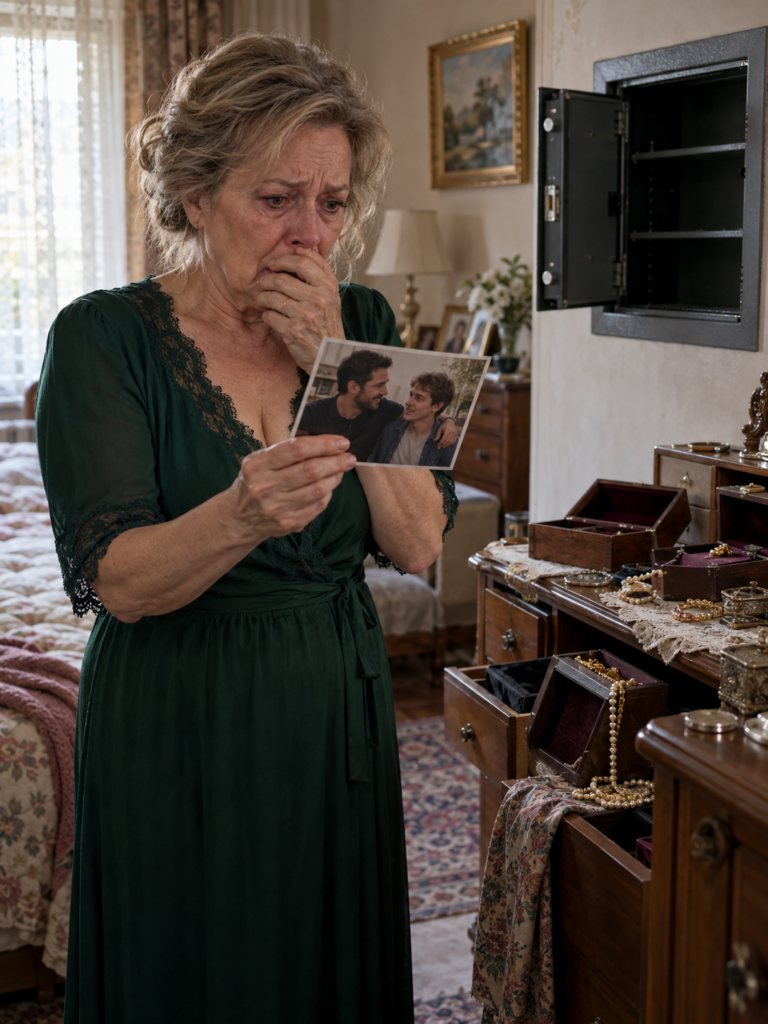
Then I held up the photograph.
“You,” I said to Eric. “Explain this.”
His eyes moved from the photo to my face, then to Daniel.
That was answer enough.
Nina made a sound beside me—small, broken, disbelieving.
“Eric,” she said, “tell me she’s wrong.”
He scrubbed a hand over his mouth.
“Mom, I can explain.”
I laughed once, and it came out sharp.
“You had a stranger seduce me, steal from me, and take photographs of me while I was asleep. Start there.”
Daniel shifted.
“I never touched you without consent,” he said.
I turned on him so quickly he stopped talking.
“You do not get to speak as if that is the part that matters.”
He lowered his eyes.
Eric stepped around the desk.
“It wasn’t supposed to happen like this.”
“There was no version of this that was supposed to happen,” Nina snapped.
I looked at my son and saw, under the shock, something worse than guilt—panic mixed with exhaustion, the kind that had probably been growing for months while I knew nothing.
“What did you take?” I asked.
He swallowed.
“The cash. The jewelry. The document folder.”
“Where is it?”
His hesitation was tiny, but I saw it.
“Eric.”
“It’s not all here.”
The room went very still.
“What do you mean, not all here?”
Daniel finally spoke, but carefully this time. “The papers and most of the jewelry are here.”
“Most?” Nina repeated.
He looked at Eric, not at me. “We sold two pieces this morning.”
My knees nearly gave way.
“Which pieces?”
Eric shut his eyes briefly.
“Grandma’s bracelet,” he said. “And the diamond earrings.”
I grabbed the back of a chair because I suddenly needed something solid under my hand.
Those had been my mother’s. Not expensive enough to matter to strangers, perhaps, but priceless to me because they were hers. The bracelet had a dent near the clasp from when she caught it on the garden gate twenty years ago. I knew every mark on it.
“You sold my mother’s jewelry on the morning after my birthday,” I said, each word clearer now than the last. “How much?”
Neither of them answered.
“How much?”
“Three thousand six hundred,” Daniel said.
I turned back to Eric.
“Why?”
He sank into the chair he had just left, as if his legs no longer wanted to hold him up.
“Because I was out of time.”
Nina folded her arms tightly across herself. “Out of time for what?”
He stared at the desk.
At first I thought he was refusing to speak. Then I realized he was trying to choose between lies and a truth that had finally become too heavy.
“I owe money,” he said.
I felt anger rise so quickly it almost rescued me from the hurt.
“To whom?”
He shook his head.
“Eric.”
“To people I should never have borrowed from.”
Nina swore under her breath.
I thought of all the recent cancellations, the distracted calls, the times he said work was “complicated.” Eric had always drifted financially—small business ideas, delivery jobs, freelance tech work that sounded solid for two months and vanished in three. I had worried, but worry is not knowledge. Mothers mistake the distance between those two all the time.
“How much?” I asked.
He whispered the number.
“Twenty-eight thousand.”
Nina actually stepped back as if the amount had shoved her.
“For God’s sake, Eric.”
He looked at me then, and in that look was the boy he had once been and the man he had become—still wanting rescue, still believing that if he looked miserable enough, love might turn consequences into mercy.
“I was trying to fix it before anybody knew.”
“You solved your problem by creating mine.”
“I was going to put the apartment papers back.”
The absurdity of that nearly made me dizzy.
“After what? After using them for what?”
His face collapsed.
Daniel answered instead, perhaps because Eric could not.
“They were going to use the property papers as leverage for a short-term private loan,” he said.
I stared at him.
“So you steal a widow’s documents and family jewelry, and you call it leverage?”
He flinched, but he did not deny it.
Nina took out her phone. “I’m calling the police.”
Eric shot up again. “No.”
I turned to her. “Wait.”
She looked at me in disbelief.
“Mom—”
“Wait.”
I wasn’t protecting him. At least I told myself I wasn’t. I just needed the truth before everything broke into a dozen voices and official statements and denial.
I faced Eric again.
“How did you know about the safe key?”
He wiped both hands down his jeans.
That answer came too quickly.
“It was in your purse.”
I shook my head.
“No. I mean how did Daniel know the key in my purse mattered?”
Silence.
And then, with the slow horror of puzzle pieces locking together, I understood that my question had landed harder than the others.
Nina understood too.
She looked at Eric. “You told him.”
He said nothing.
“You told him where Mom keeps the key,” she said.
“I only told him because he asked how she stores things. I didn’t think—”
“You didn’t think?” she said. “You gave a stranger a plan to rob our mother.”
“I knew him.”
That was the first truly revealing sentence he had said.
I looked at Daniel.
“How long?”
He answered me directly. “About six months.”
“Six months,” I repeated. “So last night wasn’t chance. The bar wasn’t chance. The candle, the walk, the hotel—none of it.”
“No,” he said.
The shame hit me then with a force the fear had delayed.
Not because I had slept with a man. At sixty-two, I did not owe innocence to anyone. The shame came from something deeper and uglier: I had been lonely in exactly the way they needed me to be. My forgotten birthday, my eagerness to be seen, my relief at being listened to—Eric had known all of that about me. He had known what would work.
“Did my son tell you it was my birthday,” I asked Daniel, “or did you figure that out from listening at the bar while I said it like a fool?”
Daniel’s jaw tightened.
“He told me.”
Nina covered her mouth.
I could not breathe for a moment.
Eric stood up again, desperate now. “Mom, I swear I didn’t know he’d take that picture of you.”
Daniel looked at him sharply, and that was another answer.
“You didn’t know?” I said. “So there are parts of this crime you find distasteful? That’s your line?”
“It wasn’t supposed to be cruel.”
I stepped closer to him.
“Then what was it supposed to be?”
He had no answer, because there wasn’t one that didn’t reveal the truth. It was always cruel. It only looked different from where he was standing.
Nina was already dialing again.
This time Eric heard it.
He moved toward her. “Please don’t.”
I stepped between them before he could come any closer.
“Don’t you dare.”
He froze.
I had not raised my voice often as a mother. I did not need to now. Something in my face must have told him that the years of automatic forgiveness had ended.
“Where are the papers?” I asked.
“In the back room,” Daniel said quietly. “In the gray duffel bag.”
Nina slipped past us, pushed open an interior door, and disappeared into the next room. I heard things being moved, a zipper dragged open, then her voice calling out, tight with relief and fury.
“They’re here. The deed papers too.”
I closed my eyes briefly.
At least that.
When I opened them, Eric was staring at me with tears he had not yet earned.
“I was going to fix it,” he said again.
“No,” I said. “You were going to hide it.”
He looked down.
“And Daniel?” I asked. “Who is he really?”
No one answered.
I turned to him. “Not a photographer, I assume.”
He gave a short nod. “Sometimes. Not the way I told you.”
“Then what are you?”
The answer came from Eric, barely above a whisper.
“He helps people get money fast.”
That told me enough.
Nina came back in carrying the gray bag and my document folder pressed to her chest as if protecting it from contamination.
“Mom,” she said carefully, “we need to go. Right now. With this. And we need to call the police from outside.”
Eric’s face changed from pleading to frightened.
“Mom, if you do that, they’ll destroy me.”
I looked at him for a long time.
That was the first honest thing he had said all afternoon.
And it left me standing between two unbearable truths: if I walked out and made the call, I might save what was left of my future and lose my son for good. If I didn’t, I would be teaching him that even this could be survived by letting me absorb the cost.
I tightened my hand around the photograph.
“Then give me one reason,” I said, “why I shouldn’t.”
Eric stared at me as if the right answer might still exist if he searched hard enough.
But there was no right answer.
Only the truth.
He looked older in that moment than thirty-four, not because he was finally becoming a man, but because excuses had stopped fitting him. His shoulders sagged, and when he spoke, his voice had lost the frantic edge it had carried since I walked in.
“Because it started with Dad,” he said.
For a second, I thought I had misheard him.
Nina did too. “What?”
Eric swallowed. “Not this. Not Daniel. I mean… everything else.”
My late husband had been gone for eight years. He was not here to answer for anything, and that alone made me resist what Eric was trying to do. Dead men are easy shields. Too easy.
“Don’t use your father to soften what you did,” I said.
“I’m not.” He dragged a hand through his hair. “I’m telling you how I ended up here.”
Nina looked at me, asking silently whether we should hear him out. I hated that I needed even ten more seconds in that room, but I also knew this was the first time Eric had stopped trying to dodge and started trying to explain.
So I said, “Talk.”
He sat again. Daniel remained by the window, silent now, as if he understood he was no longer the center of the room. He was just the instrument.
“After Dad died, I took over some of his old debts,” Eric said. “Not officially. I just… handled them.”
My chest tightened.
“Your father didn’t have debts.”
Nina looked from him to me. “Mom…”
I turned to her. “He told me everything.”
But even as I said it, I heard how defensive it sounded.
Eric gave a tired, disbelieving laugh. “No, Mom. He didn’t.”
He looked down at his hands.
“Dad had borrowed against the workshop before he got sick. Then after the surgery, he borrowed more. Some of it was to keep things running. Some of it was because he didn’t want you to know how bad things were.”
My husband had owned a small repair workshop for years before he sold it. In the last years of his life, he had become quieter about money, always saying he had things under control. I had believed him because I wanted to. Because illness had already taken enough from him, and I didn’t want to turn love into auditing.
“How do you know this?” I asked.
“Because I found the letters after he died. And because one of the men came to me. He knew I was your son.”
Nina went still. “You never told us.”
Eric nodded miserably. “I thought I could handle it.”
That sentence felt tragically familiar. It was the sentence men in our family used when they were already drowning.
“He paid some of it before he died,” Eric continued. “But not all. A man named Viktor kept calling. At first it was a few thousand. Then penalties. Interest. Things added up. I paid some. Borrowed some. Then I started borrowing from worse people to deal with the first people.”
“A chain,” Nina said flatly.
He nodded.
I asked the question that mattered most. “How much of that twenty-eight thousand was Dad’s?”
Eric hesitated.
“Six.”
The room went cold around me.
“So twenty-two thousand belongs to you,” Nina said. “Your choices. Your mess.”
“Yes.”
I believed him. Not because he deserved trust, but because this was the first answer that sounded unpolished enough to be true.
“And instead of coming to me,” I said, “you decided to set me up.”
“I couldn’t ask you.”
“You could ask me to fund your lies through theft, but you couldn’t ask me a question?”
He covered his face.
“I knew you’d see me differently.”
I almost said, You should have worried about that before last night. But anger was no longer the only thing in me. Something sadder had entered the room. Not forgiveness. Never that. But grief—fresh grief, not just for what he had done, but for how long he had been building a second life of secrets while sitting in my kitchen, drinking my tea, letting me think distance was just adulthood.
Nina set the gray bag on the desk and took out my folder, checking page by page that the apartment documents were still there.
“They haven’t used them yet,” she said. “Everything looks intact.”
Daniel spoke without looking at me. “They would have been returned once the loan cleared.”
Nina rounded on him. “Returned? You drugged our mother with compliments, got her into a hotel room, stole her safe key, broke into her home, and stole family property. Don’t talk like this was an administrative inconvenience.”
He accepted that in silence.
I looked at Eric. “Did you know he would sleep with me?”
His eyes snapped shut.
“Yes.”
The word did not echo in the room, but it echoed in me.
Nina inhaled sharply.
I put one hand on the desk to steady myself. That answer hurt more than the theft. More than the jewelry. More than the documents. Because it meant my son had not simply chosen my savings over my safety. He had chosen my humiliation as part of the plan.
He started crying then, truly crying, with none of the neatness people use when they want mercy. I watched him and felt almost nothing soft.
“You don’t get to cry first,” I said quietly.
He looked up, ashamed.
“I am not calling the police to punish you for being a disappointing son,” I continued. “I am calling because a man entered my life under false pretenses, took intimate advantage of my trust, entered my apartment, stole my property, and used my child to do it. Do you understand the difference?”
He nodded.
Nina touched my arm. “Mom, we should go.”
I nodded, but before I moved, I had one more question.
“Who took the photo of you and Eric?”
Daniel answered. “A friend.”
“Why?”
He met my eyes for the first time since the beginning. “Insurance.”
That single word clarified everything.
Not romance. Not impulse. Not even chaos. They documented each other because none of them trusted the others. The picture left for me had not been a confession. It had been a pressure point. Someone—maybe Daniel, maybe his friend—had made sure that if the theft went wrong, blame could be aimed where it would hurt most.
I realized then that Eric had not only betrayed me. He had also entered a world where betrayal was routine. That did not excuse him. It simply meant he was no longer the only danger in the story.
“We’re leaving,” I said.
Eric stood. “Mom, please. Let me come with you. Let me help fix this.”
“No.”
“Please.”
“You can help by staying exactly where you are until the police arrive.”
His face drained again. “You really mean to do it.”
I held his gaze.
“You arranged for a stranger to use my loneliness against me on my sixty-second birthday.”
The words came out calm, which made them more powerful than shouting would have been.
“Yes,” I said. “I really mean to do it.”
Nina picked up the bag. I tucked the photographs into my purse. We went to the door.
“Mom,” Eric said once more.
I paused, but I did not turn around.
“I’m sorry.”
There are apologies that crack something open, and apologies that arrive too late even to be cruel. His belonged to the second kind.
“I believe you are,” I said. “But being sorry is not the same as stopping the consequences.”
Outside, in the stale hallway, my legs finally weakened. Nina put an arm around me and guided me toward the stairs.
We had only reached the landing when Daniel’s voice came from inside the office.
“Wait.”
Nina stiffened.
He stepped into the doorway, one hand raised—not threatening, just urgent.
“There’s something she needs to know before the police get here.”
I turned slowly.
If he was about to tell another lie, I didn’t have room left for it.
But his face had changed. Whatever calculation had kept him composed until now was breaking.
“What?” I asked.
He looked past me to the stairwell, then back at Eric inside the office.
“The key theft and the safe weren’t the original plan,” he said. “He changed the target after he found something in the apartment.”
Every muscle in my body went rigid.
“What did he find?”
Daniel swallowed.
“A letter. Written by your husband. Hidden in the same drawer where he first saw the safe key.”
I stared at him.
Nina did too.
“A letter to whom?” she asked.
Daniel looked at me.
“To your son.”
And suddenly the robbery was no longer the only thing my child had been hiding.
For a moment, none of us moved.
It was extraordinary, how one sentence could reorder a lifetime.
I went back down the hall before Nina could stop me. She came with me anyway, close behind. Eric was standing where we had left him, but the second he saw my face, he knew something had changed.
“What letter?” I asked.
He didn’t answer.
“What letter, Eric?”
His eyes moved to Daniel with naked fury. “Why would you tell her that?”
Daniel’s expression was hard now. “Because I’m not carrying this by myself.”
So that was it. Insurance, again. Men turning on each other the moment consequences became real.
I took one step toward my son.
“Did you find a letter from your father in my apartment?”
He nodded once.
“When?”
“Three months ago.”
“Three months,” Nina repeated, stunned. “You’ve been in Mom’s apartment going through drawers for three months?”
“I wasn’t going through everything,” he said. “I was looking for—”
“For money?” she snapped.
“For anything Dad left.”
I kept my eyes on him. “Why didn’t you tell me?”
His mouth worked before sound came out.
“Because of what it said.”
Something in my chest folded in on itself.
I thought I had finished grieving my husband years ago. I was wrong. Grief does not end. It waits in quiet rooms for new information.
“Say it,” I told him.
He sat slowly, as if the truth itself were heavy.
“After Dad died, I found old notices in his things,” he said. “Loan reminders. Warnings. Nothing complete. I always thought there had to be more, and when Daniel kept pushing me for some way to get collateral, I remembered Dad used to keep papers in your bedroom desk. I came by one day when you were at the market. I had your spare key from when I watered your plants last spring.”
That detail hurt in its own simple way. Trust has ordinary entrances.
“I found the safe key first,” he continued. “Not the letter. The key was in the back compartment of the drawer. I realized then you still kept valuables in the apartment. Then I found an envelope under the drawer lining.”
His voice grew thinner.
“It was addressed to me.”
“And you opened it,” I said.
“Yes.”
He reached into his jacket pocket with shaking fingers. For one terrible second I thought he might still have some weapon or another surprise. Instead he took out a folded sheet, worn soft at the creases.
“I kept it,” he said.
Nina let out a breath I hadn’t realized she’d been holding.
He handed it to me.
I recognized my husband’s handwriting immediately.
My dear Eric,
If you are reading this, then I did what I prayed I would not do: I left you with a burden I should have handled myself…
I could not read the rest standing up. Nina pulled out the chair behind me, and I sat.
The letter was short, brutally honest, and more painful than any speech could have been. My husband admitted he had hidden the worst of his financial trouble from me after his second surgery because he was ashamed. He had borrowed money to keep his failing workshop afloat and then borrowed more to cover treatment and living expenses. He wrote that he had managed to repay much of it, but not all. He believed around six thousand remained unsettled, though he feared penalties might increase it. He begged Eric not to “become the man who keeps secrets because he thinks secrecy is strength.” He wrote that if the debt ever resurfaced, Eric was to bring the letter to me immediately and let me decide what we would do as a family. He underlined one sentence near the end:
Do not protect my pride by sacrificing your mother’s trust.
My hands trembled so badly the paper crackled.
Nina read over my shoulder and covered her eyes.
I looked up at Eric.
“So you knew,” I said. “You knew your father’s part. You knew he told you to come to me. And instead you used that secret to justify a greater one.”
He broke then, whatever control he had left collapsing completely.
“I was ashamed,” he said. “First of Dad. Then of myself. I paid some of it. Then I got in deeper. By the time I met Daniel through a friend, I didn’t need help anymore—I needed rescue, and I knew you would never give me that much money without questions.”
I stood, letter in hand.
“You’re right,” I said. “I would have asked questions.”
He cried harder.
“And if you had answered them honestly,” I continued, “I might have helped with the six thousand your father left behind. Maybe even more, depending on the truth. But you didn’t want help. You wanted access without accountability.”
That was the center of it. Not money. Not even desperation. He wanted to stay my son without enduring the humiliation of becoming a man who had failed. So he turned me into the cost.
Nina went to the desk and took a pen from a chipped mug. “Mom,” she said quietly, “call the police now. We have the stolen property, the photographs, the office, the letter, and both of them here.”
I nodded.
This time I did not hesitate.
I made the call myself.
My voice was steadier than I expected as I explained that I had been the victim of a targeted theft involving my adult son and another man. I gave the address. I described the stolen items and the documents recovered. I said there were photographs and a written note. I did not cry until after I hung up.
Eric looked at me like a child watching a door close.
“What happens now?” he asked.
I folded my husband’s letter and placed it in my purse.
“Now,” I said, “you tell the truth to someone whose job is to record it.”
The police arrived twenty minutes later. Long enough for silence to harden, not long enough for anyone to escape what had been set in motion. Statements were taken. The photographs were collected. The office was searched. The remaining jewelry, cash, and documents were logged. Eric confessed more quickly than I expected once he saw I would not reverse course. Daniel spoke too—carefully at first, then more openly when he understood that half-truths would not protect him.
In the weeks that followed, I learned details I never wanted. Daniel’s real first name was Daniel, but almost everything else he told me had been crafted for effect. He had done similar “introductions” before, though never one that involved someone he knew through family. Eric had contacted him through a man who handled off-the-record loans and debt collection. The hotel, the birthday timing, the charm, even the dessert with the candle had all been part of making me feel safe enough not to question anything.
Some of the cash was recovered. One of my mother’s pieces was recovered too—the earrings, found before they could be resold again. The bracelet was gone for good.
That loss grieved me in a strange, concentrated way. Out of everything taken, that bracelet became the shape of the wound. My mother’s wrist. Her laugh in the garden. The dent near the clasp. Gone because my son had run out of courage.
Nina stayed close through all of it. She drove me to appointments, sat beside me through statements, and never once told me what kind of mother I should be. That was its own mercy.
Eric called from custody first, then later through his lawyer, then once by letter. In every version he said he was sorry. In every version, he wanted me to know he loved me. I did not doubt the love. That was part of what made this unbearable. Love does not cancel betrayal. Sometimes it only explains how betrayal found the door.
I wrote back once.
I said I hoped he would finally do what his father failed to do and what he himself refused to do until forced: tell the truth all the way through. I said that if he ever wanted a relationship with me again, it would begin after consequences, not instead of them. I said I forgave the frightened part of him that had panicked. I did not forgive the part that chose me as the solution.
Months passed.
I changed my locks. Then I moved the safe out of the apartment altogether. I updated my papers, closed the small habits of access I had once left open for family, and gave Nina only the keys I wanted someone else to have. I no longer kept trust in hidden pockets.
On my sixty-third birthday, Nina came over early with coffee and a fresh cake. We set it on the kitchen table in the same spot where the lonely one had sat the year before. For a while, I simply looked at it.
“You don’t have to make a wish,” she said gently.
“I know.”
I cut the cake anyway.
Later that afternoon, when the apartment was quiet again, I opened the top drawer of my desk and placed my husband’s letter inside a new envelope. Not hidden under the lining. Not buried behind old papers. Visible.
Then I took out the only piece of my mother’s jewelry that had come back to me—the earrings—and set them beside it.
For a long time, I stood there looking at those two things: one returned, one revealed. The earrings and the letter. What was recovered, and what was finally known.
In the beginning, I thought justice would mean getting my belongings back.
But that wasn’t the whole truth.
Justice was hearing the lie named aloud.
Justice was refusing to protect my son from the consequences of using my loneliness against me.
Justice was understanding that my husband’s secrecy had planted one seed, but my son had still chosen what to grow from it.
Justice was no longer organizing my love around someone else’s hidden damage.
Eric and I are not reconciled. Not yet. Maybe not ever in the way we once were. We speak rarely, carefully, and only when I choose. He is no longer the son with automatic access to my home, my purse, my memories, or my silence. If any relationship survives, it will be built slowly, with truth carrying the full weight instead of me.
That is the cost of what he did.
And that is also the dignity I finally kept.
Last year, I spent my birthday wanting to feel like an ordinary woman again.
Now I know something better than that.
I am not a lonely woman waiting to be chosen.
I am a woman who can still choose for herself.


