
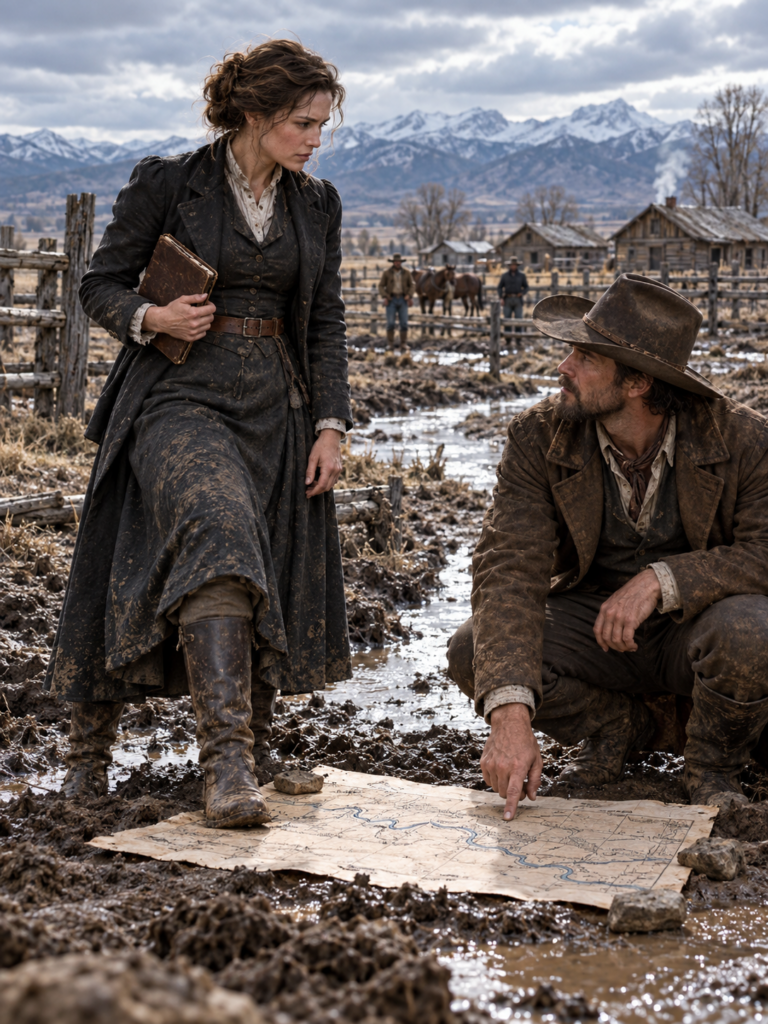
Clara drew the new line north across the map and marked out nine days of work she now knew had been planned badly.
Sutton stood beside her desk.
“The first survey cost us money.”
“I know.”
“We could bury part of it in the general land account.”
“No.”
He looked at her.
Clara dipped her pen.
“Put it where it belongs.”
She entered the wasted fee herself.
Three days later Gideon found her at the old mill.
The millwright was testing warped timbers above the stream while Clara stood below with costs written across two pages.
“I heard you changed the drainage,” Gideon said.
“It was wrong.”
“You say that very easily.”
“No.”
She closed the book.
“I say it plainly. That is different.”
He studied the mill.
“You truly mean to repair this?”
“If it can be repaired.”
“At that price?”
“Every sack of grain hauled eight miles also has a price.”
Gideon leaned against the stonework.
“You’re trying to repair the entire ranch at once.”
“No.”
She handed the millwright one page.
“That is what nearly killed it. I am trying to find which things cannot wait.”
Something shifted in Gideon’s expression.
He had ridden down expecting either stubbornness or collapse.
Instead he found a woman willing to abandon her own plan when evidence proved it wrong.
“You’re speaking directly to tenants.”
“They know the ground.”
“Most owners prefer reports.”
“Reports are written by people who expect owners to read them.”
Clara looked over the wet fields.
“Land is less polite.”
This time his laugh carried no ridicule.
But the hardest discovery came from the leases.
For several evenings Clara spread the agreements across the office table.
Fixed crop requirements.
Compulsory suppliers.
Fees created decades earlier.
Restrictions that prevented tenants from rotating exhausted fields.
None of it had begun as cruelty.
That made the problem worse.
Bad rules had survived simply because they were old.
One tenant wanted to move weak wheat ground into clover.
Another wanted more sheep on land too wet for grain.
A third could afford drainage tile only if he stopped buying overpriced fertilizer through the ranch-approved agent.
Clara promised nothing.
She asked each man what he would risk if given greater freedom.
Some answers were sensible.
Some were not.
She rejected two.
Demanded better figures on three.
Then she rewrote the renewal terms.
Gideon arrived while Sutton was reviewing them.
“You are changing half the habits of Briarwood.”
“Only the ones costing everyone money.”
“Tenants will like this.”
“That is not the purpose.”
“No.”
His tone sharpened.
“The purpose is survival.”
Clara met his eyes.
“Yes.”
He picked up one page.
“You understand what people will say if this fails.”
She waited.
“They will not say a landowner made a mistake. They will say a woman inherited a ranch, discarded established practice, and proved why she should never have managed it.”
The words were blunt.
But not mocking.
Clara held his gaze.
“Then I had better make only mistakes I can defend.”
Gideon went still.
Outside, rain struck the windows.
For a long moment neither spoke.
Then he put the agreement down.
The first hard weather came in November.
Six days of rain turned roads into brown channels and pushed the millstream against its rebuilt timbers.
Clara spent those days in boots and a heavy cloak moving farm to farm.
The new northern drainage held.
Not perfectly.
But fields that once drowned began shedding water.
Two old walls collapsed.
A barn lost part of its roof.
The mill jammed once.
Yet the tenant cabins stayed dry.
Clara stood inside the cottage where she had first seen a basin beneath a brown ceiling stain.
Now the fire burned steadily.
No basin sat on the floor.
The tenant woman looked upward.
“Slate held.”
Clara nodded.
Only then did relief reach her.
Back at the house, Sutton laid the storm costs before her.
“We can meet them,” he said. “But something else must go.”
Clara looked toward the grand rooms beyond the office.
Silver that lived inside cupboards.
Two French cabinets visitors noticed more than anyone used.
Gilt mirrors.
Objects preserved while fields failed.
“Sell them.”
Sutton looked stricken.
“People will talk.”
Clara glanced toward the rain.
“They have been talking since March.”
She took up her pen.
“The roofs have not fallen because of it.”
Clara signed the sale order before Sutton could argue further.
By noon, the silver inventory was being prepared.
The following afternoon Gideon rode in through mud deep enough to darken his boots above the ankle.
He entered the office carrying concern disguised as irritation.
“The western road is gone in two places.”
“I know.”
“The drainage held better than I expected.”
Clara looked up.
“Better than your old southern system would have?”
His jaw shifted.
“Yes.”
That answer cost him something.
She respected him for paying it.
Then he noticed the sale list.
“You are selling household pieces.”
“Furniture does not keep livestock fed.”
“You could borrow.”
Clara’s eyes lifted.
“From whom?”
“From me, if necessary.”
The room grew still.
He continued quickly.
“Privately. Fair terms. Enough to carry repairs through winter.”
For one instant, Clara understood the temptation.
Keep the valuables.
Preserve Briarwood’s appearance.
Buy time.
Then she thought of how the ranch had reached this point.
Not through one disastrous choice.
Through a thousand decisions to protect appearance from consequence.
“No.”
Gideon barely moved.
“You have not heard the terms.”
“I do not need to.”
“Pride is expensive.”
“So is dependence.”
The answer struck harder than she intended.
She did not withdraw it.
Gideon was silent.
Then he reached inside his coat.
“Take something that is not money.”
He placed a folded packet on her desk.
Old flood maps.
Creek heights.
Winter water marks.
Thirty years of Redborn records.
Clara stared.
“Why bring these?”
“Because you were nearly wrong once about where your water goes.”
His expression was dry.
“I prefer not to watch you discover the next mistake by losing a field.”
She took the packet.
“This I will accept.”
His mouth moved faintly.
“I had noticed you prefer useful gifts.”
“Useful information is not a gift if it prevents bad decisions.”
“That is an extremely Briarwood answer.”
He left before dusk.
Clara spread his records beside her own.
The storm had damaged the ranch.
Cost money.
Exposed weakness.
But the repairs that mattered most had held.
Cabins stayed dry.
Water moved.
The mill could be repaired again.
Briarwood had survived not because Clara had been right about everything.
It had survived because she had learned to correct what mattered before failure made the lesson permanent.
Winter passed hard but cleanly.
By April, the ranch looked poorer from the road.
The greenhouse stood partly closed.
Two formal rooms remained unused.
Several ornamental garden plots had been turned to vegetables.
Stacks of drainage tile sat where visiting carriages once stopped.
But the accounts had stopped bleeding.
The mill wheel turned again.
Its wooden rhythm carried across the yard.
Grain that once traveled eight miles could now be processed on Briarwood ground.
Tenant rents steadied.
Two farms that had remained behind for years paid spring obligations without borrowing against autumn.
Then a fashionable architect arrived from Denver with plans for restoring the manor.
New reception rooms.
A sweeping front approach.
Ornamental terraces.
“It would reestablish Briarwood’s standing at once,” he said.
Clara studied the estimate.
The same money could repair the farm road, build a dry grain shed, and strengthen the bridge used by wagons after heavy rain.
“Thank you,” she said.
“We will not do it.”
He looked as though she had rejected civilization.
Sutton waited until the carriage vanished.
“You are certain?”
Clara handed him the estimate.
“Would another parlor move barley to market?”
“No.”
“Then yes.”
The road work began the next week.
Gideon arrived while men were laying stone through the worst mud.
He found Clara beside the new grain shed discussing ventilation with the miller.
“You have accomplished something extraordinary,” he said when she joined him.
“What?”
“Briarwood is improving while appearing poorer.”
She looked toward the house.
“That may be the first honest thing its appearance has done in years.”
He smiled.
Then they walked toward the mill.
“Your tenants are doing better.”
“Some are.”
“My steward has been comparing yields.”
Clara raised an eyebrow.
“Should I worry?”
“Only if yours is not studying mine.”
“He is now.”
Gideon laughed.
Their ease had grown without either naming it.
It was not courtship.
Not yet.
What existed between them had been built from disagreement, correction, evidence, and the increasingly dangerous knowledge that each respected the other’s mind.
“I used to think,” Gideon said, “that a great ranch was one capable of looking prosperous.”
“What do you think now?”
He looked toward the mill.
“I was hoping you might tell me.”
Clara watched a wagon cross the repaired yard without sinking to its axle.
“Land that survives a bad year. Families that are not ruined by one failed harvest. Buildings repaired before they collapse. Accounts that tell the truth.”
“No marble staircase?”
“The old one still works.”
“People will never see half of what you have changed.”
“They live in it.”
The answer silenced him.
By summer, people had begun repeating Gideon’s original prediction at county dinners.
Most treated it as entertainment.
At one table, a prosperous rancher named Malcolm Avery laughed across his wine.
“Ruined within a year, was it not, Vale?”
Several men chuckled.
Clara sat farther down the room.
She did not turn.
Avery continued.
“To be fair, Briarwood has lasted longer than expected. Miss Hale appears too stubborn to recognize defeat.”
Gideon set down his glass.
“That is not what happened.”
The quietness of his voice carried.
Avery smiled.
“No?”
Gideon looked toward Clara only once.
Then back at the men.
“I knew Briarwood. I knew the failed drainage, weak accounts, poor tenants, broken mill, and debts. I believed knowing the condition meant knowing the outcome.”
The room quieted.
“And were you wrong about the ranch?” another man asked.
“No.”
Gideon’s answer surprised them.
“I was wrong about what followed from it.”
Avery waved one hand.
“She had a favorable spring.”
“She repaired tenant roofs before decorating the house. Rebuilt drainage before winter. Reopened the mill. Changed leases that punished improvement. Sold household goods rather than borrow against the next harvest.”
Gideon’s tone remained calm.
“Weather did none of those things.”
Clara felt faces turn.
She disliked it.
But Gideon was not praising her as though competence were a charming surprise.
He was accounting publicly for his own error.
That mattered.
Avery scoffed.
“You make her sound like some reformer.”
Gideon’s expression cooled.
“I make her sound like someone managing a ranch.”
Later, Clara stepped onto the terrace.
Gideon joined her only after meeting her eyes in silent question.
She nodded.
“You did not need to do that.”
“Yes, I did.”
“Because Avery insulted me?”
“Because he quoted me.”
Clara turned.
“There is a difference.”
“I know.”
He rested one hand on the stone rail.
“I have spent months learning how easily confidence resembles knowledge when no one challenges it.”
“That sounds unpleasant.”
“It has had moments.”
She smiled.
“You were not entirely wrong.”
His face sharpened.
“Briarwood could still fail.”
“Clara—”
“One good season is not salvation. Debts remain. Two farms are still weak. The west wall needs rebuilding.”
“You could allow yourself one evening of triumph.”
“Over what?”
“My embarrassment?”
“I was thinking of the ranch.”
“So am I.”
His laugh held none of the man who had laughed at the banker’s table.
“That may be why you are winning.”
Clara shook her head.
“I am not trying to win.”
He looked at her then with an expression she did not fully understand.
Or perhaps understood too well.
“No,” Gideon said quietly.
“You never were.”
Autumn brought four agricultural inspectors from the East—two commissioners, one surveyor, and an editor from a farming journal.
Sutton asked whether she wanted the work carts removed from the front yard.
“No.”
“They are here to inspect the ranch we actually run.”
So the carts stayed.
Clara showed them the drainage first.
Then the tenant farms.
The revised leases.
The mill.
The roads.
When asked about the original drainage mistake, she did not hide it.
“You changed the design after spending money?”
“Yes.”
“Why?”
“Because a more expensive correction was cheaper than repeating the same flood.”
The surveyor wrote that down.
At the cabins, the editor noticed repaired roofs.
“Before the manor?”
“Yes.”
“Most owners would reverse that.”
“Most visitors sleep in the manor.”
Clara looked toward the nearest cottage.
“Most tenants do not.”
Near sunset, Gideon arrived.
One commissioner asked whether Redborn had designed Briarwood’s reforms.
Gideon looked at Clara.
“On one drainage mistake, I corrected her.”
“And the rest?”
“Miss Hale.”
Nothing more.
No attempt to attach himself to her work.
That answer stayed with her after the inspectors left.
The following spring would mark one year since Gideon Vale had laughed.
Clara did not know what the inspectors would write.
She knew only that Briarwood was stronger.
And that somewhere between the flood maps and the public dinner, the most dangerous question facing her had stopped being whether Gideon respected her judgment.
It was what either of them intended to do with the respect once it became something warmer.
The answer arrived exactly one year after the banker’s meeting.
Sutton carried a thick journal into the estate office while Clara was bent over spring accounts.
“You may wish to see page forty-two.”
She looked at his expression.
“That sounds ominous.”
“I believe it is quite the opposite.”
The article occupied four pages.
It compared large working ranches and estates the inspection party had visited during the previous year.
Not by grandeur.
Not acreage.
Not the size of houses.
By soil recovery, management, tenant stability, useful investment, accounting, resilience, and the ability to survive bad weather without pushing loss onto the people least able to carry it.
Briarwood had been named the finest-managed property they had inspected.
Clara read the sentence twice.
Then she read the reasons.
Drainage improvements.
Repair priorities.
The mill.
Farm roads.
Lease revisions.
Falling arrears.
Reduced debt.
Dry tenant housing.
No reckless borrowing.
The article even mentioned unfinished rooms in the manor as evidence that money had been directed where production required it.
Clara lowered the journal.
“They make us sound terribly organized.”
Sutton laughed.
“We shall endeavor not to disappoint them.”
By afternoon, copies had reached neighboring ranches.
Gideon arrived before supper with another tucked under his arm.
Clara met him in the yard.
“You are late.”
“You have read it?”
“Twice.”
“Then I have brought you something useless.”
“That would be a first.”
He looked past her.
The mill turned steadily.
Two grain wagons stood near the dry storehouse.
A tenant who once apologized before criticizing a ditch was arguing freely with Sutton about fencing costs.
Gideon tapped the journal against his leg.
“One year.”
Clara knew.
“You said Briarwood would be ruined.”
“I laughed while saying it.”
“You did.”
There was no accusation in her voice.
None was necessary.
Gideon looked toward the house.
Several upper windows remained shuttered.
No new terrace.
No glittering reception rooms.
“I thought I knew what failure looked like because I understood the condition of the land.”
“You did understand the condition.”
“Not you.”
Clara was quiet.
Gideon continued.
“I mistook experience for the right to know an outcome before the work began.”
“And now?”
“Now I think experience should teach a man when habit has disguised itself as wisdom.”
She smiled faintly.
“That is an expensive lesson for a cattle baron.”
“Less expensive than building the wrong drainage system.”
Clara laughed.
The ease between them was no longer surprising.
Gideon held out the journal.
“You should keep this copy.”
“Why?”
“So when Briarwood has another terrible year, you remember that one article does not make you infallible.”
She stared at him.
“That may be the least romantic gift ever offered.”
Gideon’s eyes changed.
“I had not intended it romantically.”
“Good.”
His smile remained.
Neither moved.
Clara became suddenly aware of how quiet the yard had grown.
A horse stamped near the hitching rail.
The mill wheel turned beyond the trees.
Somewhere behind them Sutton closed a door.
Gideon looked toward the western fields.
“Walk with me?”
She considered him.
Then nodded.
They crossed the yard and followed the road toward the fields where the entire year had begun.
The drainage channels were softer now, grass taking hold along their edges.
A year earlier Clara had stood in mud with a wrong map beneath her boot while Gideon told her the route would fail.
She had disliked him that day.
Perhaps not entirely.
That realization irritated her.
They stopped near the ditch.
“You were insufferable when we first met,” she said.
“I have been told.”
“You laughed at me.”
“Yes.”
“In front of bankers.”
“Yes.”
“You seem remarkably comfortable admitting all this.”
“I have had a year of practice.”
Clara folded her arms.
Gideon’s expression sobered.
“I was wrong in more than one way.”
She waited.
“I thought competence belonged to experience, and experience belonged to men who had been doing something long enough to speak with certainty.”
“That sounds very convenient.”
“It was.”
He looked over Briarwood.
“I believed you would protect the house first because that was what every owner I knew would have done.”
“So did everyone else.”
“You did not.”
“No.”
“You listened to tenants.”
“They knew what failed.”
“You let a tenant farmer tell you a lease was foolish.”
“It was foolish.”
“You allowed me to tell you your ditch was wrong.”
“That remains the most difficult example.”
His mouth curved.
Clara looked toward the mill.
“What is it you are trying to say?”
Gideon did not answer immediately.
For once, he looked uncertain.
That alone told her the answer mattered.
“I know what people will make of this if I say it badly.”
“Then do not say it badly.”
He breathed out.
“I admire you.”
Clara held his gaze.
“That is safer than I expected.”
“I have not finished.”
“Then perhaps less safe.”
He came no closer.
That mattered to her.
“Not because the journal named Briarwood finest. Not because people who laughed have stopped laughing. Not because you proved me wrong.”
He glanced toward the house.
“I admire that you were willing to make the place look poorer so the people on it could become safer.”
Clara’s expression changed.
“That you wrote down your own mistake rather than hiding the fee. That you accepted my flood records but refused my money. That you listened when evidence disagreed with you.”
His voice lowered.
“And that after a year of being watched, judged, discussed, and measured, you still ask what the land needs before you ask what anyone will think.”
Clara looked down at the ditch.
“That sounds dangerously like romance.”
“I fear it may be.”
She should have laughed.
She did not.
Instead she asked, “What do you want?”
Gideon answered plainly.
“To know whether there is room in your life for me.”
Not in Briarwood.
Not control of Briarwood.
Not a merger of acreage.
For him.
Clara appreciated the distinction enough to let silence remain.
Then she said, “You own more land than I do.”
“Yes.”
“You have more money.”
“Yes.”
“More cattle.”
“Considerably.”
“And if this becomes something, I will not have Briarwood absorbed into Redborn because people consider that the obvious arrangement.”
Gideon’s reply was immediate.
“No.”
She studied him.
“You did not think.”
“I have thought about almost nothing else for three months.”
That startled her.
He continued.
“Your ranch remains yours.”
“And my decisions?”
“Yours.”
“That is too easy an answer.”
“Then shared decisions where our lives overlap. Separate where they do not.”
Clara looked at him carefully.
“You understand that I will disagree with you.”
“I am counting on it.”
“You say that now.”
“I said your ditch was wrong the first time I tried to help you. I hardly think we are building this on false harmony.”
She laughed.
Then her face softened.
“I am not interested in being admired from a neighboring hill.”
“Good.”
“I do not need protection from work.”
“I know.”
“Or money used to make choices for me.”
“I learned that.”
“And if Briarwood fails someday—truly fails—I will decide what comes next. Not a husband. Not a banker. Not a cattle baron.”
Gideon nodded.
“Yes.”
She watched him a long moment.
Then asked the question that mattered most.
“If I never married you, would you still respect what I built here?”
“Yes.”
No hesitation.
“If I said no today?”
“I would ride home disappointed.”
“And tomorrow?”
“Send the spring creek measurements. They are higher than last year.”
Clara smiled.
“That may be the first sensible proposal you have made.”
His eyes warmed.
“I have not actually proposed.”
“Not yet.”
Gideon became very still.
Clara looked toward Briarwood.
The roof still needed work.
Two farms remained weak.
The western stone wall required rebuilding before another winter.
The debts had fallen, not vanished.
Nothing had become perfect simply because strangers printed praise.
That was what made the moment feel real.
She turned back.
“You may court me.”
Gideon blinked.
“May I?”
“You may.”
“That sounded less encouraging than I hoped.”
“I am trying to prevent overconfidence.”
“Reasonable.”
They walked back toward the house together.
No engagement followed that week.
Or the next.
That would have been too easy, and neither of them had learned ease from the previous year.
Instead Gideon began coming to Briarwood openly.
Sometimes for supper.
Sometimes with records.
Sometimes merely to walk fields and argue.
Clara went to Redborn as well.
She examined his grazing rotations.
Criticized an overused south pasture.
Questioned why one bunkhouse roof had gone unrepaired while a new carriage had been purchased.
Gideon stared at her.
“You have been here half an hour.”
“The roof leaks.”
“It has leaked only since winter.”
Clara raised one eyebrow.
He sighed.
“It will be repaired.”
“Good.”
He kept his word.
Their courtship developed through exactly the kind of work neither of them could perform dishonestly.
They disagreed over whether Briarwood should expand cattle numbers after a strong season.
Clara said no.
Gideon initially believed she was being overly cautious.
Then she showed him the western grass counts and the cost of bought feed in a dry year.
He changed his mind.
Another time Gideon advised replacing an old bridge entirely.
Clara intended to patch it.
His engineer showed her rot inside two hidden beams.
She changed hers.
Neither kept a ledger of victories.
That may have been the clearest sign that affection had become partnership.
In autumn, Gideon proposed.
Not in a drawing room.
Not beneath a ballroom chandelier.
At the repaired mill.
The wheel turned behind them while grain dust drifted through shafts of afternoon sun.
“Clara.”
She looked at him.
“I have spent my life acquiring land.”
“That is an alarming beginning.”
“I know.”
He smiled.
“I thought ownership was the same as certainty. You taught me they are not.”
“I charged no tuition.”
“You were expensive anyway.”
She folded her arms.
“Continue.”
“I do not want Briarwood.”
Her face softened.
“I want a life beside the woman who runs it.”
He took out no ring yet.
No grand gesture.
Just words.
“Will you marry me?”
Clara looked toward the mill.
One year earlier it had been almost silent.
Now the wheel turned steadily.
The sound had become one of her favorite things on the property.
Not because she had saved it alone.
Because work had made it useful again.
She looked back at Gideon.
“If I say yes, Briarwood does not become Redborn.”
“No.”
“I retain control of the land I inherited.”
“Yes.”
“And the tenant agreements.”
“Yes.”
“You are aware I intend to rewrite them again next year.”
“I assumed you would.”
“And your south bunkhouse roof?”
“Already repaired.”
She smiled.
“Then yes.”
Their marriage took place quietly.
The largest change visible afterward was how little changed immediately.
Clara remained at Briarwood.
Gideon continued managing Redborn.
They divided their weeks according to work rather than social expectation.
Some evenings ended at his house.
Some at hers.
Neither property swallowed the other.
Their books remained separate where ownership required it.
Joint expenses were recorded plainly.
When they disagreed, they did so before decisions, not after resentment.
Briarwood continued improving.
Never dramatically.
That was the point.
One failing roof repaired before another room was decorated.
One stretch of road improved.
One exhausted field rested.
One tenant lease rewritten when experience proved an old clause unhelpful.
One reserve fund slowly built so the next bad winter would not require selling anything in panic.
The famous journal article was eventually folded into a drawer.
Clara valued it.
But less than Sutton did.
Years later, when a difficult summer reduced hay badly and two tenant families needed temporary relief, Clara found herself opening that drawer.
Not for praise.
For perspective.
The article called Briarwood England’s finest-managed estate in the original survey’s language of landed agriculture, but here on the Wyoming plains what mattered was simpler: the ranch had been judged strongest not because nothing failed, but because failure did not automatically become ruin.
She ran one finger down the old page.
Gideon came into the office.
“Bad?”
“Not yet.”
“What do you need?”
There was a time when his first instinct would have been to offer money.
Now he waited.
Clara looked at the hay figures.
“Redborn’s eastern pasture.”
“It is open.”
“For grazing?”
“Yes.”
“Temporary.”
“Of course.”
“We pay.”
He hesitated.
Then saw her expression.
“At market rate?”
“Neighbor rate.”
“That sounds invented.”
“It is.”
She smiled.
“Fine.”
He sat opposite her.
Together they worked through the figures.
The drought passed.
Briarwood bent.
It did not break.
That evening, Clara walked alone to the western ditch.
The grass was dry along the edge.
The water low.
But it still moved.
Gideon found her there after sunset.
“You come here whenever something worries you.”
“I come here when I need to remember being wrong.”
“That seems severe.”
“It keeps me useful.”
He stood beside her.
Years had changed him less visibly than they had changed the ranch.
He still carried himself like a man accustomed to being obeyed.
The difference was that now he knew obedience was not the same thing as wisdom.
Clara looked across the property.
The tenant roofs were sound.
The mill was turning.
The road held.
The manor still contained rooms not worth restoring.
She had never regretted that.
“Do you remember what you said at the banker’s table?”
Gideon sighed.
“You intend to keep that alive until I die.”
“It has educational value.”
“I said Briarwood would be ruined in a year.”
“You laughed.”
“Yes.”
“What would you say now?”
He considered the land.
Then Clara.
“That I understood every visible weakness and still knew almost nothing important.”
She looked at him.
“That sounds dramatic.”
“I married badly for restraint.”
She laughed.
He slipped his hand into hers.
The old ditch carried water beneath the darkening sky.
It had once represented the first large mistake Clara nearly made.
Then it became evidence that correction was not humiliation.
Later it became the place where Gideon’s certainty first began to change.
Now it was simply part of the ranch.
Useful.
Maintained.
Unremarkable.
Perhaps that was the finest thing Briarwood had become.
Not spectacular.
Not rescued by one brilliant owner.
Not transformed by marriage.
Not made important because a powerful man finally recognized Clara’s worth.
It endured because the people responsible for it learned to tell themselves the truth.
About money.
About land.
About pride.
About mistakes.
About each other.
Clara had inherited a ranch built to appear prosperous while quietly failing.
She rebuilt it by allowing appearances to lose.
Gideon had inherited confidence strengthened by years of being correct.
He became a better man by allowing correction to survive his pride.
And together they built no grander monument than a working life in which neither required the other to become smaller.
Beyond them, the mill wheel turned.
The tenant lamps came on one by one.
A wagon crossed the repaired road without sinking into mud.
The western fields drained as they should.
And Briarwood, once expected to be ruined inside a year, remained what Clara had always been trying to make it.
Not impressive from the road.
Strong enough for the people who lived there.


