
the whole county laughed when a boy spent his summer money on a nailed-shut hearse — and the man who mocked him stood silent when the boards finally came off
Part 1
The sale bill went up in the window of the feed store in KD Bend on a Tuesday morning in early October, and by noon everybody in Pharaoh County had read it twice. Lavel Denbo was selling out. For three generations the Denbo place on the north edge of town had been the funeral home, the flower shed, the carriage barn, and the family house all at once, which meant the bill ran long. Oak casket stands. A marble slab table. Folding chairs with the name of the parlor stenciled on the backs. And near the bottom, in letters no bigger than the rest, a line nobody paid much attention to until the day of the sale, when they all stood in front of it and laughed.
Lot number 44. One horse-drawn funeral coach, boarded and sealed, contents and condition unknown, sold where it sits.
Emory Tillet read the bill twice too, standing on the concrete step outside the feed store with his bicycle leaned against his hip. He was twelve that fall and small for it, a sixth grader with a cowlick that would not lie down and a jacket that had been his father’s, brown canvas gone soft at the elbows. He lived with his grandmother, Neva, in a white house on the Hackberry Road with a machine shed out back that was bigger than the house. His father worked a pipeline job three states away and sent money the first of the month, when he remembered. What Emory had that October was twenty dollars and some in a coffee can on the top shelf of his closet, earned one slow summer at a time, mowing nine yards on a rotation, including the churchyard, which paid in pie as often as cash.
He was saving for the little stick welder in the tool catalog, because the boy liked machines the way other boys liked ball games, and because his grandfather had left a shop full of iron in that shed and nobody to use it.
The sale was set for Saturday. Emory rode out to look at the lots on Friday evening, which anybody was allowed to do, and that is when he saw it.
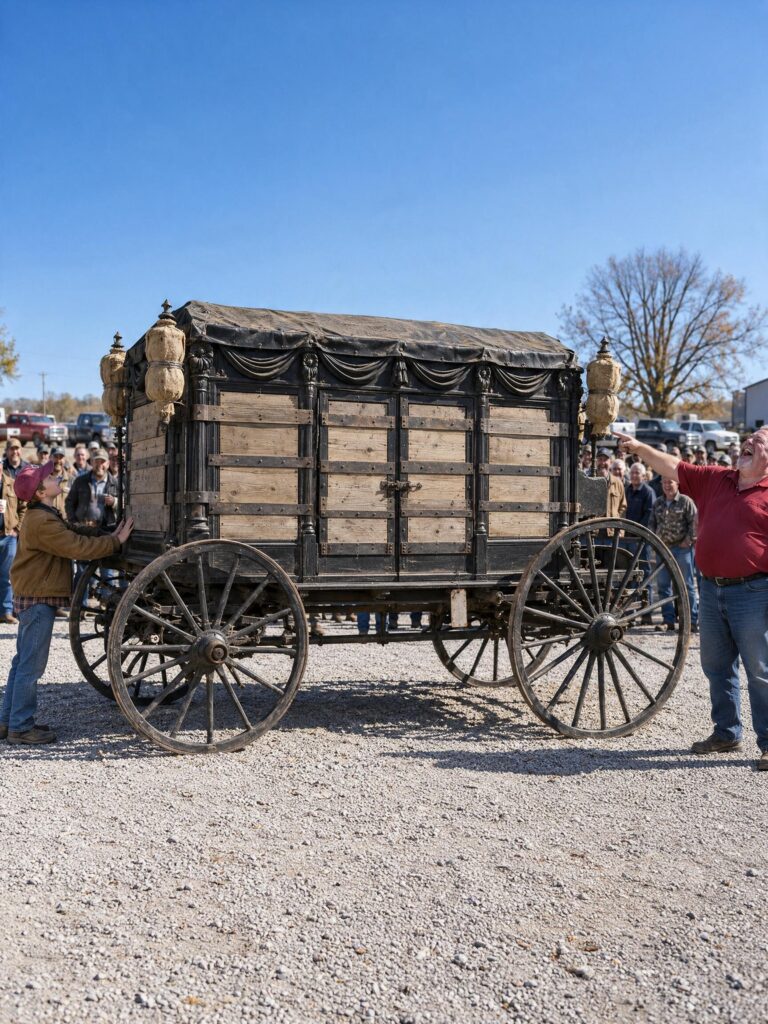
It stood at the far end of the row, past the casket stands, under an elm that had dropped half its leaves on the roof of it. It was black, or had been. It was longer than his grandmother’s car and half again as tall as the men walking past it, up on four tall wheels with iron tires, and every window was boarded over with poplar planks nailed flat across the frames. Somebody, long ago, had run iron strapping around the whole body and screwed the doors shut at top and bottom, then nailed a sheet of tarred canvas over the roof and banded that down as well. The lamps on the corners were wrapped in burlap and wired closed. Along the top edge ran a carved band of what looked like folded cloth cut out of solid oak, and the dust of eighty years had settled into the folds of it and gone gray.
Emory walked all the way around it twice. He put his hand flat on the side where the boards were, and it did not feel like a wagon. It felt dry and hollow and heavy. It felt like a building.
On the lower rail near the rear wheel there was a tin tag the size of a playing card, stamped and nailed on, and he had to crouch and rub the grime off with his thumb to read it. Hessel and Vey Carriage Works, Cincinnati. Under that a stamped number, and under that a line in script letters the boy would think about all night.
Number nine.
He rode home in the dark and did not say anything at supper. Neva had fried potatoes and a piece of ham and set his plate at the end of the table where his grandfather used to sit. The kitchen smelled like bacon grease and the woodstove. The radio on the counter was low, a weather report out of the county seat, and the window over the sink showed the machine shed as a blacker shape against the field.
“You’re quiet,” Neva said.
“Thinking.”
“About the welder.”
“Some.”
She looked at him the way she did when she already knew the next part and was waiting to see if he would say it. She was a narrow woman with gray hair pinned up and hands that never quite got the dirt out from under the nails, even in winter. She had raised his father in that house and was raising him in it now, and she did not waste words on things that would come out on their own.
At nine he said it to the ceiling from the couch. “I’m going to the sale in the morning.”
“All right.”
“I might bid on something.”
“The coffee can is yours,” she said. “You earned it. Don’t let anybody talk you into more than you’ve got, and don’t let anybody talk you out of what you mean to do.”
He lay awake a while after that, listening to the wind move in the hackberry trees along the road, and he kept seeing the tin tag and the carved oak gone gray under the leaves.
The sale drew a crowd the way a Denbo anything always drew a crowd. By eight there were two hundred people in barn coats walking the rows with numbered cards in their hands. The morning was bright and cold enough that breath showed, and the elm still held a few yellow leaves that came down one at a time when the wind took them. Dub Faraday ran the block as he had for thirty years, standing up on a flatbed trailer with a voice like a chainsaw that had learned manners, and Lavel Denbo sat in a folding chair by the porch and watched her family’s belongings go one at a time. She was past seventy, straight-backed, in a dark coat that had seen other sales. She did not cry. She watched.
Barrett Quillin came at nine. Everybody noticed because he drove a white truck with his name down the side of it in gold letters, Quillin Estate Buyers, and parked it across two spaces at the front of the yard where the whole sale could see it. He was a big man in his fifties, red-faced and loud in a friendly way that stopped being friendly the second money was on the table. For twenty years he had bought the good lots out of every farm sale in four counties and resold them at his shop on the pike. He wore a red polo shirt in October and never a coat, and he called half the county by their first names and the other half chief.
It was Quillin who first made a joke of the coach, standing in front of it with a paper cup of coffee while the crowd drifted past on their way to the good lots.
“A dead man’s wagon,” he called it, loud enough that the people two rows over turned around. He said the only thing it was good for now was firewood with a story, and that he would not take it as a gift because he would have to pay a man to haul it off. He said that last part with his arm out and his coffee cup pointing at the boarded windows like a man showing off a prize bull that had gone lame.
Three or four fellows around him laughed the way men laugh at a sale, easy and mean at the same time, and the laugh moved up the row ahead of him.
Emory heard all of it. He stood at the rear wheel with his bidder card rolled up in his fist and did not say anything, because he was twelve years old and there is nothing to say to a grown man with a crowd around him. He waited for the joke to move on. It did not move on. It came back around twice more that morning. Once when a woman asked what was under the boards, and Quillin said a disappointment and a mouse nest. Once when somebody wondered out loud if the iron on the wheels was worth the diesel to haul it, and Quillin said the boy standing there looked like he might find out.
They got to lot number 44 at twenty after eleven. Dub Faraday had the trailer pulled down the row by then, so the block was thirty feet from the elm. He read the lot off the sheet flat and fast, then looked up and let the corner of his mouth go.
“One horse-drawn funeral coach,” he said. “Boarded and sealed, sold as it sits. Nobody in eighty years has had a board off of it, including the family. The doors are screwed shut and the strapping is nailed. Buyer moves it. Who will give me a hundred?”
Nobody gave him a hundred. Nobody gave him fifty. The crowd stood there in the sun and enjoyed it, because a lot that will not sell is the best entertainment a farm sale has. A man in a seed cap said he’d give two dollars if Dub threw in a match. Somebody else said the salvage yard ought to pay them to take it. Dub came down to twenty-five, then to ten. He said it was a hundred and some years of Pharaoh County history and it was going to the salvage man for the iron on the wheels, and somebody hollered that the salvage man had better bring a big truck, and everybody laughed again.
Emory put his card up at ten.
It went quiet for about a second and a half, the particular quiet of two hundred people turning their heads at once, and then Barrett Quillin laughed out loud from the front of the crowd. Not a chuckle. A big open laugh with his head back so the whole yard could hear it. And then he said, “Go on then, chief,” and threw his hand out toward the boy the way a man does when he is handing over something he does not want.
Then, because he could not help himself, Quillin bid twenty.
People in KD Bend still argue about why. Some say sport. Some say he had looked at the carved oak on the top edge and had a thought he did not care to say out loud. They went back and forth in fives. The crowd came in tight around the elm to watch a grown dealer bid against a sixth grader for a boarded-up funeral coach, and Dub Faraday slowed his chant down and let it happen.
At forty, Quillin played to the crowd, both arms out, asking them what a man was supposed to do. At fifty, he stopped smiling. At sixty, he said out loud that the boy did not have sixty dollars.
Neva Tillet was standing behind her grandson with her purse on her arm. She had not planned to speak. She spoke anyway.
“The boy has it in a coffee can,” she said, and her voice carried the way a quiet voice does when a yard has gone still. “He cut grass all summer for it. Mr. Quillin can bid, or he can hush.”
The whole barn lot heard that too.
Emory put his card up at sixty-five.
Quillin looked at the coach and looked at the crowd and made a show of throwing his hands up and shook his head. Dub Faraday gave it three long calls, and the gavel came down, and the coach was sold. Sixty-five dollars. Lot number 44. A boy of twelve with a coffee can at home and a jacket that used to be his father’s, standing under an elm tree with his card still up in the air.
What happened next is why anybody remembers this at all.
The crowd did not break up. Sales do not usually hold still like that, but this one did, because two hundred people all wanted the same thing at the same time. They wanted to see inside.
“Well, open her up, son.”
Somebody else already had a claw hammer out of a toolbox and was offering it over the heads of the people in front. They were not being cruel, most of them. They were curious, and curiosity in a crowd is a kind of pressure that grown men cannot always stand up under. A woman near the front said it would only take a minute. A man said the boy had paid for the show and ought to give it. Quillin stood with his arms folded and a little smile on him, waiting.
Emory did not open it. He took the hammer that was offered him and handed it right back.
“It’s been shut for eighty years,” he said. People quote him a little differently depending on who is telling it. “It can stay shut another week. I’m not going to pry at it in a parking lot with everybody leaning on it.”
Dub Faraday said into the microphone that the young man had bought it and could do as he liked, and moved on to lot number 45, a crate of oil lamps. But the crowd stayed around the elm another twenty minutes anyway, and Barrett Quillin worked it like a man selling tickets. He offered the boy ten dollars for it, cash, out of his money clip, and said he would eat the hauling just to teach him a lesson cheap.
When the boy shook his head, Quillin turned to the people behind him, grinning, and said that in thirty days the kid would be paying somebody to drag it off. He said the only thing in a hearse is what somebody already took out of it. He said, and this is the line that got repeated at the feed store for a month, that the smartest thing in Pharaoh County that morning was the elm tree, because at least the elm had not paid sixty-five dollars for shade.
Emory did not open it that day. Not a board came off it in the sale yard. He paid at the clerk’s table out of a fold of bills his grandmother had counted twice that morning and got a yellow slip with lot number 44 on it and put the slip in his shirt pocket and buttoned it. Lavel Denbo signed the paper herself. She looked at the boy a moment longer than the signing required.
“My grandfather closed that up,” she said, low, not for the crowd. “Spring of 1938. The year he bought the motor hearse. He told my father there was no sense in letting people pick at it.”
Emory nodded. He did not know yet what to do with that. He put it where he had put the tin tag, in the part of his mind that did not talk at sales.
They walked back to the truck. Neva did not say he had done right and she did not say he had done wrong. She said the coffee can was empty now and the shed had better have room, and she started the engine and let it warm while the crowd noise moved on down the row toward the good lots, the ones a man could resell.
Part 2
Moving it was its own week.
The coach was too big to go on any trailer in the family. It stood a hand taller than Hollis Dre, who was six-foot-four, and the wheels were nearly as tall as the boy. Dre ran a winch truck for the co-op, and he came Sunday afternoon with it and a borrowed flatbed. Mostly, he admitted later, because he wanted a look.
“You sure about this,” he said, standing in the Denbo yard with his hands in his pockets and the October sun on the iron tires.
“Yes, sir.”
“It’s going to be a job.”
“I figured.”
It could not be lifted. They tried the loader first, and Dre backed off fast when the frame started to talk to him, a low complaint of old wood and iron that did not want to leave the ground it had sat on since before the war. In the end they cut two long skids out of oak, greased them with bar oil, and pulled the whole thing up onto the flatbed on its own wheels with the winch, a foot at a time, four men on chocks. The tarred canvas dragged. The boarded windows did not give. One of the men from the lumber yard, the same one who had offered the hammer, put his shoulder to a wheel and said it was like moving a small house that had decided to be a wagon.
Dre said afterward it weighed better than a ton and a half by the way the truck sat, and that whatever else it was, it was built by people who expected it to be around a long time.
They hauled it two and a half miles at a walking pace with the flashers on, and half the town found a reason to be on the Hackberry Road that afternoon. A woman hanging wash stopped with a sheet in her hands. Two boys on bicycles followed as far as the creek bridge. At the feed store somebody came out onto the step and watched the tall black shape go by under its canvas, and did not wave.
The coach went into his grandfather’s machine shed with four inches to spare at the top, the tarred canvas dragging a line of dust off the header. Then it sat there, and it stayed shut.
That is the part nobody expected, and the part that turned the whole thing from a joke into something people could not leave alone.
Every person in that county had already played the next scene out in their heads. The boy with a pry bar and a flashlight that same night, tearing the boards off in a hurry, his friends around him, hollering when the first plank came free. Emory left it sealed. He had his reasons, and they were not mysterious, though the town made them out to be.
The first was the tin tag on the rear rail. Hessel and Vey of Cincinnati, and the words number nine, which he had written down in pencil the night before the sale on the back of a feed-store receipt. The second was what Lavel Denbo had said at the clerk’s table, in a voice that was not for the crowd. Her grandfather, Orval Denbo, had closed that coach up himself in the spring of 1938, and had told her father there was no sense in letting people pick at it.
So the boy did what a twelve-year-old in a town with one library does. He went to the library.
Miss Arleta Coin ran the KD Bend branch two and a half days a week out of a room in the old school building that smelled like floor wax and radiator heat. She was a small woman who kept a cardigan on the back of her chair and knew which boys were there for a book and which were there to get out of the weather. Emory came on a Wednesday after school with the receipt in his pocket and asked if she had anything on funeral coaches.
“Not on the shelf,” she said. “We can ask the county.”
She put in for the county loan service and then the state service, and over three weeks a stack of books about carriage building came up the road in canvas bags. Funeral coaches are a narrow subject. Emory read them at the kitchen table after supper with the lamp pulled down, while Neva did the dishes and the wind worked at the loose piece of tin on the shed roof. Most of what he found was about wheels and springs and the names of towns that had once had a carriage works and did not anymore. In the back of one book there was a page and a half about Hessel and Vey, who built in Cincinnati from the 1870s until a fire took the works in 1911, and who were known for exactly one thing: glass-sided funeral coaches with carved drapery on the roof line, each one numbered in the ledger and never twice the same.
The page said that most were cut up for the glass and the silver plate in the 1920s, when horses went out and motor hearses came in, and that of the numbered coaches, the whereabouts of three were known.
Emory read that sentence a good many times. He read it until the words sat in his head the way the tin tag had. Then he got his grandmother’s stationery out of the desk, the box with the lilac on the lid that she used for Christmas cards and the once-a-year letter to his father, and he wrote four letters in pencil first and then in ink.
One to a carriage museum in Pennsylvania. One to a carriage association in Kentucky. One to the historical society that kept the Cincinnati trade ledgers on microfilm. And one, because Miss Coin suggested it, to Dr. Anakah Sabo, a carriage conservator at the Renfield Institute of Transportation History, who had written the page and a half in the back of the book.
Neva read them over his shoulder and did not change a word except to fix the spelling of Cincinnati, which he had right the second time.
“You’re sure you want to tell them you haven’t opened it,” she said.
“If I open it, I can’t say that anymore.”
She sealed the envelopes and put stamps on them and drove them to the post office herself, because the boy had school and because she had decided, without announcing it, that this was a thing the house was going to see through.
Meanwhile KD Bend had opinions. The joke had legs. All through October and into November the boarded coach in the Tillet machine shed was the standing bit at the feed store counter, and Barrett Quillin kept it fed because it cost him nothing and people laughed. He asked Neva at the grocery, in front of a whole checkout line, whether the boy had gotten his shed back yet. He told a fellow at the parts counter, with Emory standing eight feet away picking out a can of penetrating oil, that some people buy a thing because a crowd is watching, and that kind always ends up hauling it to the scrapyard on a Sunday when nobody can see them.
Emory bought the oil and went home. He laid a plywood floor under the wheels so the iron would not sit in dirt, and he kept the shed padlocked, which he had never once done before in his life. The lock was his grandfather’s, a brass thing gone green at the edges, and the key lived on a nail by the kitchen door. At night he could see the shed from his window, a darker block against the field, and he would lie there and think about the page and a half and the three coaches whose whereabouts were known, and about the one in his shed whose whereabouts were known only to him and his grandmother and Hollis Dre and half the town that had watched it go down the Hackberry Road.
Hollis Dre said later he came by one night to borrow a jack and found the boy sitting on an upturned bucket just looking at it. The way you look at a horse you are not ready to ride yet.
“You going to open that,” Dre said.
“Not yet.”
“Town’s got a pool on it. Most of them say before Thanksgiving.”
“They can have their pool.”
Dre looked at the boarded side a while. The work light Emory had hung from a rafter threw the iron strapping into hard lines. “Your granddad would have had the boards off the first night,” he said. “He liked to know what he had.”
“He also liked a thing built right,” Emory said. “This was built right. I can tell that from the outside.”
Dre took his jack and went. He told his wife about it later, and she told her sister, and by the end of the week the feed store had a new version of the joke: the boy was sitting vigil on a dead wagon like it might get up and leave.
Three of the four letters came back polite and useless. A photocopy of a parts catalog. A form letter. A note that the microfilm reader was broken until spring. Emory put them in a folder in the desk and did not throw them out. The fourth did not come back as a letter at all.
Dr. Sabo called the house on a Thursday night while Neva was doing dishes. The phone was on the wall by the refrigerator, the cord long enough to reach the table, and Emory answered it because Neva had her hands in the water.
“This is Anakah Sabo,” the woman said. “I’m calling about a letter from a boy in KD Bend who says he has a Hessel and Vey coach with a number on the tag.”
Emory stood very still. The dishwater ran. Outside, a truck went by on the county road and the headlights swept the kitchen once and were gone.
“Yes, ma’am,” he said. “That’s me.”
She asked him four questions. Whether the carved band on the roof line ran all the way around. Whether the tin tag had a stamped number under the maker’s name, and what it was. Whether the glass was covered. And then, in a careful voice, whether anybody had taken any of the boards off.
Emory said no. He said the doors were screwed shut and the strapping was nailed, and he had left every plank exactly where it was.
There was a pause on the line long enough that he thought the call had dropped. Then Dr. Sabo said, “Do not let anybody open that coach until I can be there.”
She said it twice. She said that if it was what the tag said it was, what mattered almost as much as the coach was that nobody had gotten at it. She used a word he had to ask her to spell. Unrestored. The value of a thing like that, she said, was in its original surface. The paint nobody sanded and the glass nobody replaced. Most of what survived of Hessel and Vey had been improved to death by well-meaning people with a paintbrush.
Neva had come to the doorway with a dish towel in her hands. She watched the boy’s face while he listened, and when he hung up she did not ask what the woman had said. She waited.
“She says not to open it,” Emory said.
“All right.”
“She wants to come. Not until December.”
Neva hung the towel on the oven handle and put the kettle on, because that was what she did when a thing had gotten bigger than the kitchen. They drank their coffee at the table with the folder of useless letters between them, and neither of them said the word money, because the woman on the phone had not said it either. She had said unrestored. She had said do not let anybody open it. That was enough to sit with, in a house where the coffee can was empty and the shed was locked and the town was still laughing.
Part 3
Dr. Sabo’s first free week was the second week of December. Here is where the story turns, and it turns because a twelve-year-old boy made a decision a lot of grown people would not have made.
He could have had her come out on a weekday morning with nobody around, which is what his grandmother expected. Neva said as much at breakfast the day the letter came, the one on institute stationery saying the eleventh, weather permitting, and that she would bring a colleague and a camera.
“We’ll keep it quiet,” Neva said. “No sense giving the feed store a show.”
Emory looked at the letter a long time. The kitchen was warm. Frost held on the inside of the north window. Out in the shed the coach sat under its canvas the way it had sat since October, and the padlock was cold enough in the mornings that it stuck until he breathed on it.
“I want witnesses,” he said.
“For what.”
“For whatever’s in there. And for the opening. So nobody can say later I made it up, or she made it up, or we switched it for something else in the night.”
Neva studied him. She had raised a son who left and a grandson who stayed, and she knew the difference between a boy showing off and a boy deciding. This was deciding.
“Who.”
“People who were there. People who helped. And him.”
She did not have to ask who him was.
So when the conservator wrote to say she would arrive on the eleventh, Emory sat at the kitchen table and wrote out nine invitations in ink, and Neva drove him around the county to hand them out. He invited Lavel Denbo because it had been her family’s. He invited Dub Faraday, who had sold it. Miss Arleta Coin, who had found the book. Hollis Dre, who had hauled it. He invited the two men from the lumber yard who had offered him the hammer at the sale, and the pastor of the church whose yard he mowed. And then he rode his bicycle out the pike, the cold cutting through his father’s jacket, and left the ninth invitation on the counter at Quillin Estate Buyers, with the man standing right there.
It said what all nine of them said. Saturday the eleventh, one o’clock, the Tillet shed on the Hackberry Road. The coach will be opened for the first time in eighty-three years, with witnesses present. Coffee after.
Quillin read it twice and laughed, and said in his big voice, with two customers in the shop, that he would not miss it for anything. He told them, after the boy had gone out the door, that he intended to stand in the front row and watch a kid find out what an empty box looks like inside. One of the customers laughed. The other one didn’t. He had been at the sale. He had seen the carved oak under the dust, and he had heard Neva Tillet tell a grown man to hush, and he was not as sure as Quillin was about empty boxes.
The week before the eleventh, Emory did not sleep well. He checked the lock twice a night. He swept the shed floor and set the bucket he sat on against the wall and then moved it back, because he did not know where a person was supposed to stand when a thing that had been shut since 1938 came open. Neva borrowed folding chairs from the church basement and wiped them down in the kitchen, and the house smelled like dust and lemon oil. Hollis Dre came by on the Friday and ran four work lights up on the rafters so the whole shed would be lit flat and bright, and while he was up on the ladder he looked down at the coach and shook his head.
“You know the town’s coming whether you invited them or not,” he said.
“I know.”
“Quillin’s coming to watch you lose.”
“I know that too.”
Dre climbed down and coiled the extra cord. “Your granddad used to say a man ought to know what he’s holding before he shows it. You don’t know what you’re holding.”
“I know I haven’t ruined it,” Emory said. “That’s more than most of them can say.”
It rained the night before and cleared cold. By noon on Saturday there were nineteen people in the Tillet machine shed, because invitations in a small town are a rumor with a time on them. Neva had set the church chairs in two rows. The work lights threw hard shadows. Somebody had brought a thermos and somebody else had brought a plate of cookies wrapped in a dish towel, and the shed smelled like tar and cold iron and coffee. Lavel Denbo sat in the front row in her dark coat with her hands folded. Dub Faraday stood near the door with his hat in his hands, looking like a man who had sold a lot of things and was not used to being invited back to see what became of them. Miss Coin had a notebook. The pastor had come in his good shoes and was trying not to step in the grease stain by the workbench.
Barrett Quillin came. That is important. Every account of that afternoon agrees on where he was standing. He came in his red polo shirt with his coat over his arm, and he said something to the lumber-yard fellows about a box, and he laughed when he said it, and he took a place at the back by the table where Neva had set the coffee.
Dr. Anakah Sabo turned out to be a small woman in her sixties in a canvas coat with a roll of tools under her arm, and her colleague was a young man named Peter who carried the camera cases. She shook the boy’s hand first, before anybody else’s, and asked him where he wanted her to stand. Then she walked the length of the coach twice with a flashlight, and when she came back to the front of it she put her hand on the boarded window and stood there a second with her eyes shut.
The shed had gone quiet in the way a church goes quiet before a reading.
She told the room how it was going to go. Photographs first, every side with the boards on. Then the roof canvas. Then the strapping, cut in the middle of a run and never at a screw, so the original screws stayed in the original holes. Then the planks, one at a time, starting at the rear. She said if anybody needed to leave, now was the time, because once they started she did not want feet moving and she did not want talk over the work. Nobody left.
Then she handed the pry bar to Emory Tillet and said it was his coach and he should be the one to open it.
The bar was heavier than he expected. His hands were cold. He looked at his grandmother, and she gave him the smallest nod a person can give and still have it count. He looked at Lavel Denbo, who had sold him a thing her grandfather had sealed, and she did not nod. She watched. He set the end of the bar where Dr. Sabo showed him, under the first band of the roof canvas, and he leaned.
The canvas came off the roof in one piece, tarred and stiff as a barn door, and underneath it the carved oak drapery ran unbroken from the driver’s box to the rear pillar, and the lacquer was not gray at all. It was black the way a piano is black, with a fine line of gold leaf striping laid along every edge, and the gold was still there.
There was a sound in that shed when the first work light hit it. Nineteen people taking the same breath at once. Miss Coin said afterward she had to sit down on one of the church chairs. Dub Faraday took his hat off the rest of the way, though he was already indoors. At the back, Barrett Quillin did not laugh. He shifted his coat from one arm to the other and did not say the word box again.
Emory stood with the pry bar in his hands and looked at the gold line running true under eighty-three years of canvas, and he understood, in the way a boy understands a thing before he has words for it, that he had been right not to open it in a parking lot. Not because of money. Because of this. Because a thing built by people who expected it to last had lasted, and the lasting was the part you could not get back if you hurried.
Part 4
They worked for two hours and ten minutes, and the boy pried it open himself with nineteen people watching him do it.
Dr. Sabo did not take the bar back. She stood at his shoulder and told him where to set it and when to stop, and Peter photographed every stage, the click of the camera loud in the cold shed. The strapping came off in cut sections, the original screws left in the original holes the way she had said. The first plank off the rear window stuck at the nail heads and then gave with a sound like a dry board splitting in a stove, and the smell that came out was not rot. It was old varnish and cloth and a sweetness Emory did not have a name for.
They were not windows. They were plate-glass panels the size of a door, three to a side, every one etched edge to edge with a pattern of lilies and folded cloth. And behind the glass, protected from eighty-three years of daylight by two poplar planks and a handful of nails, was the inside of the coach exactly as the last man to use it had left it.
Cream silk on the ceiling panels, buttoned and not rotted. Walnut columns at the corners with carved capitals. A deck floor of oiled rollers, and the rollers still turned when Dr. Sabo put two fingers on them. The corner lamps under their burlap wrappings were silver plate over brass with their original wicks, and the original ruby glass in the little rear panes, all four, not one cracked, which the conservator said later was the single most improbable thing in the shed.
Nobody talked over it. The lumber-yard man who had offered the hammer stood with his hands in his pockets and his mouth a little open. The pastor had taken his hat off. Neva stayed where she was, at the end of the row of chairs, and she did not come forward until the boy looked for her, and then she came and stood beside him and put one hand on the edge of the open door the way a person puts a hand on a shoulder.
Screwed to the frame inside the left-hand door, where Dr. Sabo told the boy to look before she looked herself, was a card of heavy paper under a pane of glass, printed and filled in by hand in brown ink.
Hessel and Vey Carriage Works. Cincinnati. Coach number nine of the numbered series. Body by W. Vey. Carving by A. Strub. Finished the fourth of April, 1893. Built to the order of the Denbo family, KD Bend.
And under that, in the same hand, a line that made Lavel Denbo put her hand over her mouth, because it was the name of her great-grandmother and the date they buried her.
Nobody said anything for a while. The shed was cold and bright and smelled like tar and old silk and coffee. Barrett Quillin was standing at the back by the coffee table in his red polo shirt with his coat over his arm. He had come in laughing an hour earlier and said something to the lumber-yard fellows about a box, and now he was not saying anything at all.
Dub Faraday said later that he watched Quillin’s face the whole time the boards were coming off the second side, and that the man went white as the paper on that card, and stared at the gold striping on the rear pillar like it owed him money. He did not come up to look at the builder’s card with everybody else. He stood exactly where he was.
Lavel Denbo read the name on the card twice. Her voice, when she finally used it, was smaller than it had been at the sale.
“He buried her in April,” she said. “My father told me that. He said Granddad closed the coach up the spring he bought the motor hearse, and he never said why he boarded it instead of selling the glass. I thought he was done with it. I thought it was junk he didn’t want to look at.”
“He wasn’t done with it,” Dr. Sabo said. “He was keeping it. There’s a difference.”
Emory had his hand on the walnut column inside the door. The wood was smooth and cold and not cracked. He thought about Orval Denbo in the spring of 1938, a man with a new motor hearse and an old coach and a town that would have picked the silver plate off it a lamp at a time if he had let them. He thought about the screws. About the tarred canvas. About a sentence said to a son: no sense in letting people pick at it.
Dr. Sabo worked three more days after the crowd went home. She and Peter measured and photographed and took paint samples the size of a pinhead from places nobody would ever see. She used an ultraviolet lamp in the dark shed to look for overpaint and found none anywhere on the body. She pulled one wheel and found the maker’s stamp on the hub and the original linchpin. She answered every question the boy asked, and he asked a great many, and she said afterward that he asked better ones by Wednesday than most graduate students ask in a year.
On the second evening, after Peter had gone to the motel on the highway, she sat at the Tillet kitchen table with a cup of Neva’s coffee and told them what she would and would not put in a letter yet.
“I won’t give you a number until the institute has seen the photographs,” she said. “Numbers get repeated and then they get argued with. What I will tell you is that I have been doing this work for thirty-one years, and I have not stood inside an unrestored numbered Hessel and Vey before today. The other two we know about were restored in the 1960s. Well-meaning people. New glass. New silk. Paint that looks like the old paint until you put a lamp on it.”
“So this one is different,” Neva said.
“This one is the one that wasn’t improved.” She looked at Emory. “You understand what you did by leaving it shut.”
“I didn’t want to break it in front of them,” he said.
“That’s part of it. The other part is that you didn’t decide you knew better than the man who sealed it. A lot of grown people would have.”
Quillin did not come back to the shed those three days. He was at his shop on the pike, and the story that went around town was that he had a cold, or a delivery, or a reason that changed depending on who was telling it. The feed-store joke did not quite stop. It thinned. Men who had laughed in October found they did not know what to say about gold leaf under a tarred canvas, and so they said less, and the less they said the more the silence did the work the laughter had done before.
Emory went to school. He mowed nothing, because it was December and the churchyard was frozen. He came home and did his figures at the table and then went out to the shed and watched Dr. Sabo work, and he learned the names of things he had not known a coach had. Cant rail. Boot. Hammer cloth. He wrote them down in the same notebook where he had copied number nine off the tin tag. At night Neva would find him still at the table with the notebook open, and she would tell him the light bill did not pay itself, and he would close it, and in the morning it would be open again.
The written appraisal came the last week of January in a flat envelope with the seal of the Renfield Institute of Transportation History on it, and Emory did not open that one either until he had people in the room.
Part 5
They used the Grange Hall this time, because nineteen chairs had not been enough in December.
Word had moved the way word moves in a county with one feed store and a grocery and a church. Not the number, because nobody had the number yet. The fact of the opening. The gold. The card with the great-grandmother’s name. The dealer in the red shirt who had not come up to look. By the last Saturday in January the hall had sixty-some people in it who had no business being there except that they had laughed at a boy in October and wanted to see how it came out.
Dr. Sabo drove out for it. Lavel Denbo came, and Dub Faraday, and Hollis Dre, and Miss Coin with her notebook, and the pastor, and the lumber-yard men. Neva had made two pots of coffee and set them on the pass-through, and she had argued with Emory that morning about whether he had to wear the good shirt. He wore it. The collar was too big. He stood near the front with his hands in his pockets and watched the door.
Barrett Quillin came. Nobody made him. He came in his red polo shirt with his coat over his arm and stood at the back by the door, which is where he had stood in the shed, and he did not say one funny thing the whole afternoon. A man near him started to say something about the elm tree and then didn’t. The joke had nowhere to land.
Dr. Sabo read the findings out loud, standing up, in the voice of a woman reading a document she expects to be quoted. Hessel and Vey number nine, built in 1893 to the order of the Denbo family. One of three numbered Hessel and Vey glass coaches known to survive, and the only one of the three with its original finish, glass, interior, and fittings intact. Unrestored and undisturbed. Sealed in 1938 and not opened again until the eleventh of December, with witnesses present, whom the report named one by one.
She named Lavel Denbo. She named Dub Faraday. She named Neva Tillet and Hollis Dre and Arleta Coin and the pastor and the men from the lumber yard. She named Barrett Quillin. She did not look at him when she said it. The name sat in the hall the way a nail sits in a board.
She said the institute was placing a replacement value on it for insurance purposes of four hundred and seventy-five thousand dollars, and that in her professional opinion the figure was conservative, because there was nothing to compare it against. The other two had been restored in the 1960s. Then she said the part that put the number in the record where anybody could check it. The carriage museum in Pennsylvania, the same one that had sent the boy a form letter, had reviewed the photographs and written to offer a purchase price, and an auction-house specialist in Philadelphia had independently valued it higher than the institute had.
The Grange Hall made a noise. Sixty-some people in folding chairs, all at once. A woman in the second row put her hand over her mouth the way Lavel Denbo had in the shed. Dub Faraday shook his head once, slow, the way a man does when a lot he called at ten dollars turns out to have been something else entirely. At the back, Barrett Quillin did not move. His coat stayed over his arm. His face had the look of a man listening to a number he had already begun to do the math on in October and had talked himself out of.
Emory Tillet stood up when it got quiet. He thanked Dr. Sabo. He thanked Miss Denbo for selling it whole instead of parting it out. He thanked Mr. Dre for hauling it. His voice was a boy’s voice in a hall full of grown people, and it held.
Then he said he was not selling it.
The noise came back, smaller. He waited it out.
“It’s going on loan to the museum for five years,” he said. “The hauling and the insurance on them. The card beside it will say the Denbo coach, KD Bend, and it will come home after. It was built for this place. It can visit. It doesn’t have to stay gone.”
He did not look at Quillin when he said it. He did not have to. The hall did the looking.
Barrett Quillin left before the coffee. He put his coat on at the back of the hall and went out the side door into the cold, and the people nearest the door said he did not look at anybody. He never told the story his way. The joke at the feed store counter simply stopped, the way a well goes dry, and by spring there were men in that county who would not sit with him at the back booth, because they had laughed along with him in October and did not care to be reminded.
He still bought at sales. He still parked the white truck across two spaces. He did not bid against boys anymore, or if he did, he did it quiet. The red polo shirt stayed. The loudness had a hole in it where a boarded coach used to be.
The coach went east on a lowboy trailer in April, blocked and braced by people who do that for a living, with Hollis Dre following for the first forty miles because he had hauled it first and felt entitled. It stands now in a gallery with its glass lit from above, and the gold striping doing exactly what a man named Vey meant it to do in 1893. The card beside it gives the maker, the date, the family, and the name of the twelve-year-old who bought it for sixty-five dollars and did not open it until there were witnesses in the room.
Neva Tillet got a new roof out of the loan fee, which she argued about and lost. The old roof had been leaking over the north bedroom since the year Emory’s father left for the pipeline, and she had been catching it in a dishpan and telling herself it could wait. It could not wait. The new shingles went on in May, and she stood in the yard with her arms folded and said it was more roof than an old woman needed, and then she went inside and did not put the dishpan back under the spot.
Emory bought the little stick welder out of the tool catalog finally, and burned up about forty dollars of rod learning to run a bead. The first beads were ugly. The later ones were less ugly. He kept the coffee can on the shelf, empty for a while and then not, because he still mowed nine yards, including the churchyard, which still paid in pie. The pastor, who had stood in the shed and watched the silk come into the light, started paying cash more often than he used to. He said a boy who could leave a thing shut when a crowd wanted it open could be trusted with a mower and a check both.
If you ask Emory about it, which people do, he will tell you the part that nobody claps for. He will not start with the number. He will not start with Quillin going out the side door. He will say the coach was worth what it was worth because of something a man did in 1938, when he screwed the doors shut and nailed the boards on and told his son there was no sense letting people pick at it.
Every other coach like it got improved and sanded and sold off a lamp at a time by people who were sure they knew what they had. The one that survived is the one that stayed shut.
On a Saturday in late spring, after the coach had gone east and the shed was a shed again, Lavel Denbo came by the house on the Hackberry Road. She brought a photograph in a paper sleeve, Orval Denbo standing beside the coach in 1937, the year before he boarded it, the glass still bare and the gold line bright in the sun of a different April. She set it on the kitchen table and did not stay long.
“He would have liked that you waited,” she said.
“I didn’t know him.”
“You knew the part that mattered.” She looked out the window at the shed, ordinary now, the doors open, the welder on the bench. “People in this county like a thing they can laugh at. They’re slower with a thing they have to live beside. You made them live beside it. That’s not nothing.”
After she left, Emory put the photograph in the folder with the letters and the appraisal, and he went out to the shed and ran a bead on a piece of scrap until the line was straight. The light was long on the Hackberry Road. Neva called him in for supper. He shut the shed and did not lock it, because there was nothing in it now that a crowd would pay sixty-five dollars to see opened, and the lock had done its work.
The elm at the Denbo place dropped its leaves again that October, onto an empty spot in the row where a boarded coach had stood. Barrett Quillin drove past it on his way to another sale and did not slow down. In a gallery a long way east, a card with a boy’s name on it sat beside glass that had not seen daylight for eighty-three years, and the gold did what it had been laid there to do. It held.


