
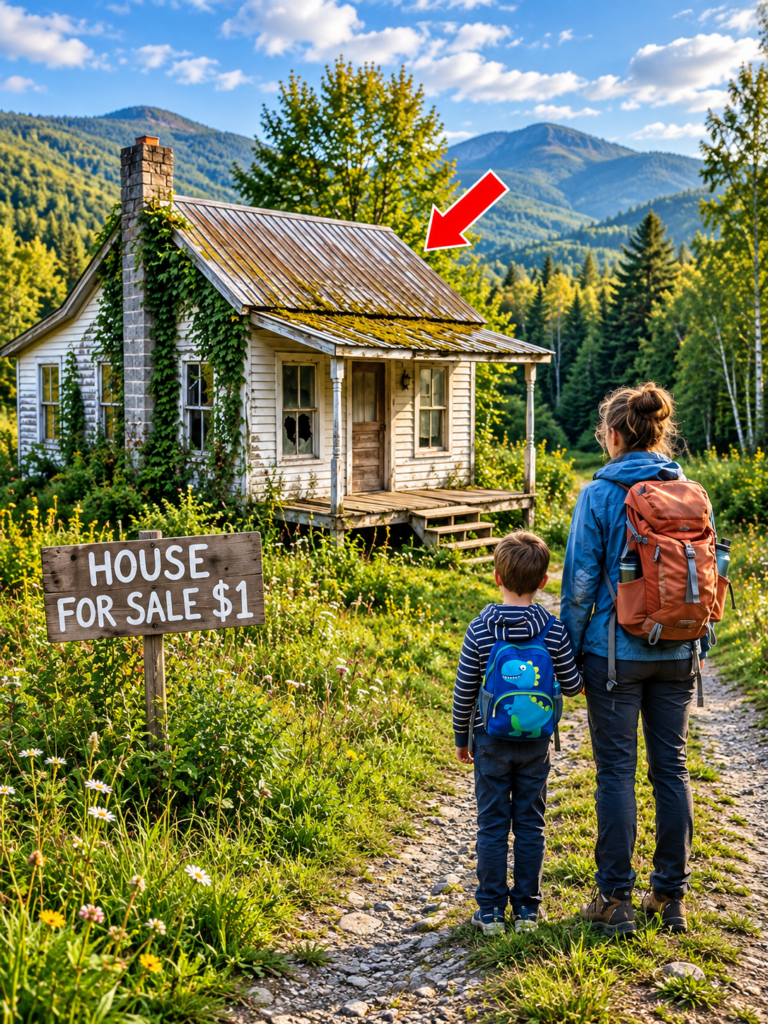
The day Melissa Ward bought an abandoned little house for just $1, nearly everyone in town laughed.
Some people stopped their cars just to watch. One man shook his head and muttered, “That poor woman has finally lost her mind.”
Melissa didn’t argue. She simply reached for 6-year-old Jacob’s hand, looked at the weathered front door, and quietly said, “No one can take this home away from us.”
What she didn’t know was that behind those broken walls waited a story that had been buried for nearly 30 years. A story that would not only change her life, but would leave an entire town wishing they had never laughed at the woman who bought a $1 house.
Three weeks earlier, Melissa Ward wasn’t searching for a miracle. She was simply trying to make it through another day.
At 29 years old, she had already learned that life could change in a single phone call.
Three years before, her husband had kissed her goodbye on his way to work, promising they’d celebrate Jacob’s birthday that weekend.
He never came home.
A construction accident took his life before lunchtime, leaving Melissa to raise their little boy alone.
Since that day, every morning began long before the sun came up. She worked breakfast shifts at a small roadside diner where she knew most of the regulars by name.
By the time she finished there, she hurried across town to pick Jacob up from school, helped him with his homework, made whatever dinner she could afford, tucked him into bed, and then headed back out to clean office buildings until nearly midnight.
Some nights, she didn’t walk through her apartment door until after 1:00 in the morning.
Then she would do it all again.
People often told Melissa she was one of the strongest women they had ever met.
The truth was, she didn’t feel strong.
She was simply a mother who didn’t have the luxury of giving up.
Money disappeared faster than she could earn it.
The rent went up. Groceries cost more every month. Jacob’s asthma medicine took another bite out of each paycheck.
When there wasn’t enough food for both of them, Melissa always smiled and said she’d already eaten at the diner.
Jacob believed her.
In reality, her dinner was often nothing more than a cup of coffee and a glass of water.
Still, she never complained.
Because every night, before turning off the light, Jacob would wrap his little arms around her and whisper, “Good night, Mom. I love our home.”
To anyone else, it was just a tiny apartment with stained walls, leaky windows, and mold creeping along the bathroom ceiling.
But to Jacob, it was where he still felt safe.
Melissa prayed she could keep it that way.
She had no idea that in just a few days, that fragile sense of safety would be taken away.
And she would be forced to make the most impossible decision of her life.
Melissa had always believed that if she worked hard enough, somehow things would get better.
It was the promise she repeated to herself every morning when the alarm rang at 4:30.
The promise she whispered every time another bill arrived in the mailbox.
The promise that kept her putting one foot in front of the other.
But life doesn’t always reward the people who try the hardest.
Sometimes, it simply asks for more than they have left to give.
Three days after Jacob told her how much he loved their little apartment, Melissa came home carrying two bags of discounted groceries she’d bought with the last $20 in her wallet.
She stopped before reaching the door.
A bright orange envelope had been taped across it.
She didn’t need to open it.
She already knew what it was.
Her landlord, Mr. Reynolds, happened to be walking down the hallway at that very moment.
“I’m sorry, Melissa,” he said, though his voice carried very little sympathy. “I’ve given you as much time as I can.”
She looked at him quietly.
“I just need another week.”
He sighed.
“I’ve heard that before.”
“My paycheck comes Friday.”
“I’ve already rented the apartment to someone else.”
Melissa felt her stomach tighten.
“Please, my son has nowhere else to go.”
Mr. Reynolds lowered his eyes for a moment before answering.
“I truly hope you figure something out.”
Then he walked away.
That was it.
No argument. No anger.
Just a door slowly closing on the only home Jacob had ever known.
Melissa waited until he disappeared down the stairs before peeling the notice from the door.
Final notice. Vacate within 72 hours.
Inside the apartment, Jacob was sitting on the floor surrounded by crayons, carefully drawing a little house with a bright red roof.
He looked up with a smile.
“Look, Mom.”
Melissa knelt beside him.
“It’s beautiful.”
Jacob pointed to the picture.
“That’s us.”
She noticed something else.
There were Christmas lights hanging from the roof. A snowman stood in the yard. Smoke curled gently from the chimney.
“You already decorated it for Christmas.”
Jacob nodded proudly.
“I wanted Santa to know exactly where we live.”
Melissa smiled.
Then she quietly folded the eviction notice and slipped it into her coat pocket before he could see it.
That evening, after Jacob had fallen asleep, she opened the kitchen cabinet.
A single can of soup, half a loaf of bread, one box of cereal.
That was everything.
She sat at the tiny kitchen table surrounded by silence, wondering how she had worked nearly every day for three years and still found herself one missed paycheck away from losing everything.
For the first time since her husband died, Melissa allowed herself to cry.
Not loudly, just enough to let the fear out before morning came.
The next day brought another blow.
Jacob suffered another asthma attack during recess.
His teacher called while Melissa was pouring coffee for customers at the diner.
She rushed to the emergency room still wearing her stained apron.
After the doctor examined him, he spoke gently.
“He’s going to be all right.”
Melissa finally breathed again.
But the doctor’s expression changed.
“The dampness in your apartment isn’t helping his lungs.”
She already knew what he was about to say.
“If you can,” he continued, “he really needs a drier place to live.”
Melissa nodded politely.
She didn’t have the heart to tell him she couldn’t even afford the place they already had.
That night, Jacob fell asleep in the hospital chair with his head resting against her shoulder.
Melissa watched the steady rise and fall of his breathing.
Then she noticed a folded newspaper someone had left behind in the waiting room.
The wind from the automatic doors blew it across the floor until it stopped against her shoe.
Without thinking, she picked it up.
Most of the pages were filled with advertisements she barely glanced at.
Used trucks, garage sales, part-time jobs.
Then, hidden in the bottom corner of one page, a tiny listing caught her eye.
For sale. Tiny house. $1.
Melissa stared at the words for several seconds.
She actually laughed.
Not because it was funny, because it sounded impossible.
She showed the ad to one of the nurses passing by.
The woman smiled.
“For a dollar?”
Melissa nodded.
“Probably falling apart.”
“Probably.”
She folded the newspaper and slipped it into her purse anyway.
She had no intention of calling.
Not really.
People didn’t sell houses for $1.
There had to be a catch.
But later that night, as she carried Jacob from the car to their apartment, she looked at the orange eviction notice still taped to the front door.
Then she looked at the newspaper folded inside her purse.
For the first time, that impossible little advertisement didn’t seem quite so ridiculous.
It felt like the only door that hadn’t already been closed.
Melissa barely slept that night.
Long after Jacob had drifted off, she sat at the kitchen table staring at the tiny newspaper advertisement.
Tiny house. $1.
The words refused to leave her mind.
By morning, she had convinced herself it was a scam.
No one sold a house for the price of a cup of coffee.
Still, something inside her whispered that she had nothing left to lose.
After dropping Jacob off at school, she dialed the phone number printed beneath the advertisement.
An elderly woman’s voice answered, soft, patient, almost as though she had been expecting someone to call.
Melissa asked the question everyone would ask.
“Why would anyone sell a house for $1?”
There was a long pause.
Finally, the woman replied, “Because I’m not looking for the highest bidder. I’m looking for the right person.”
Melissa frowned.
She wasn’t sure what that meant.
The woman gave her an address on the edge of a quiet little town and invited her to come that afternoon.
The tiny house sat at the very end of a narrow gravel road.
It was even smaller than the photographs.
Time had not been kind to it.
The white paint had faded to gray. Several porch boards were cracked. Wild vines had climbed across one side of the roof.
The mailbox leaned sideways as though it had been waiting years for someone to straighten it.
Melissa stepped out of her aging sedan and looked around.
The neighborhood was peaceful.
Children rode bicycles a few streets away. Wind chimes sang softly from a nearby porch.
It wasn’t the kind of place she had expected to find an abandoned home.
The elderly woman was already waiting outside.
Her name was Eleanor Brooks.
She had kind eyes and silver hair tied neatly beneath a straw hat.
She unlocked the front door without saying much.
“You should see it for yourself.”
The inside was surprisingly clean, small, but carefully built.
Every cabinet seemed perfectly measured. Every shelf fit neatly into the walls. Even the tiny kitchen felt thoughtfully designed.
“It doesn’t feel abandoned,” Melissa whispered.
Eleanor smiled.
“It never was.”
Melissa looked confused.
“I don’t understand.”
“This house has simply been waiting.”
Again, another answer that explained almost nothing.
As they walked through the rooms, Melissa noticed something unusual.
The floors barely creaked. The walls seemed thicker than normal. Some corners looked deeper than they should have been.
Almost as though the measurements didn’t quite make sense.
She couldn’t explain why.
It was simply a feeling.
Eleanor handed her a single brass key.
“If you decide to buy it, this key opens the front door.”
Melissa looked down.
“What does the other key open?”
“There isn’t another key.”
But Eleanor interrupted gently.
“When the house is ready, it will show you.”
Melissa almost laughed.
She wasn’t sure if the old woman was speaking in riddles or simply growing forgetful.
Outside, several neighbors had gathered near the sidewalk.
Word traveled quickly in small towns.
One man crossed his arms and called out, “You thinking about buying that place?”
Melissa nodded politely.
He chuckled.
“My grandfather said nobody’s lived there in decades.”
Another woman added, “People have tried fixing it up. They always leave.”
“Why?” Melissa asked.
The woman shrugged.
“They say the house is strange.”
A younger man laughed loudly.
“Strange? It’s falling apart. That’s what it is.”
The group laughed together.
Melissa thanked them and walked back toward her car.
She wasn’t frightened.
She was simply disappointed.
The house clearly needed more work than she could afford.
She climbed into the driver’s seat, started the engine, and looked through the windshield one last time.
At that exact moment, she saw something that made her stop.
Jacob, still wearing his little backpack after school, standing quietly beside the mailbox.
He had wandered only a few feet from the car while she was talking to Eleanor.
Melissa hurried toward him.
“What are you doing, sweetheart?”
Jacob didn’t answer immediately.
He was staring at the tiny house with wide eyes.
Finally, he smiled.
“It doesn’t look sad anymore.”
Melissa blinked.
“What do you mean?”
“I think…” He hesitated. “I think it was waiting for somebody.”
Melissa froze.
Those were almost the exact words Eleanor had spoken only minutes earlier.
Neither of them had heard the other.
Children sometimes notice things adults overlook.
Melissa looked back at the weathered little house.
For the first time, she didn’t see peeling paint or broken boards.
She saw possibility.
She turned toward Eleanor.
“If I buy it, is it really $1?”
The older woman smiled.
“One dollar, no debts, no hidden payments.”
Melissa slowly reached into her purse.
She found a single folded $1 bill, the very last cash she had.
For a brief moment, she looked at it in silence.
That dollar could buy a loaf of bread or a gallon of milk.
Instead, she placed it gently into Eleanor’s hand.
The old woman closed Melissa’s fingers around the brass key.
“Take good care of her.”
Melissa looked surprised.
“Her?”
Eleanor smiled through misty eyes.
“Some houses are just buildings, but every once in a while, a very special house becomes part of a family story.”
Melissa didn’t fully understand those words.
Not yet.
As she and Jacob carried their first small box through the front door later that afternoon, several neighbors stood on their porches watching.
One man laughed loudly enough for everyone to hear.
“I’ve seen people throw money away before, but never on that old place.”
Melissa said nothing.
She simply squeezed Jacob’s hand, then quietly whispered, “Whatever happens next, at least no one can make us leave.”
She believed she had just purchased the cheapest house in America.
She had no idea that the house had been waiting 30 years for someone exactly like her.
The first few days inside the little house were harder than Melissa had expected.
The electricity worked most of the time.
The plumbing had a habit of groaning in the middle of the night.
Cold air slipped through tiny cracks around the old windows.
And every morning began with another list of things that needed fixing.
There wasn’t enough money to hire anyone, so Melissa did what she had always done.
She figured it out one problem at a time.
After finishing her shifts at the diner, she stopped by the local hardware store, buying only what she could afford.
One week it was a box of nails.
The next, a small can of paint.
Sometimes, just a single piece of sandpaper.
Progress came slowly, but every evening Jacob waited by the front door with the same question.
“What are we fixing today, Mom?”
Melissa smiled every time.
“We’ll find something.”
And they always did.
Little by little, the house began to feel different.
Not because it had become beautiful.
It hadn’t.
The porch still leaned. The roof still needed work. The paint was still peeling.
But laughter slowly replaced silence.
For the first time in months, Melissa realized Jacob wasn’t coughing as often.
The dry air inside the old house seemed easier on his lungs than the damp apartment they had left behind.
One evening, while making grilled cheese sandwiches on the tiny stove, Jacob suddenly said, “Mom, I can breathe better here.”
Melissa stopped buttering the bread.
She looked at him carefully.
“You can?”
Jacob nodded.
“I didn’t wake up coughing last night.”
Melissa smiled.
Then quietly turned back toward the stove before he could see the tears gathering in her eyes.
Maybe, just maybe, she hadn’t made the worst mistake of her life.
The neighbors, however, hadn’t changed their minds.
Whenever Melissa drove home after work, she could feel people watching.
Some were simply curious.
Others weren’t nearly as kind.
One afternoon, while she was repairing a loose porch step, the same man who had laughed on moving day walked past with his dog.
He slowed down just enough to say, “You know, some things aren’t worth saving.”
Melissa looked up.
He wasn’t talking about the house.
She knew that.
For a brief second, she wanted to answer.
Instead, she simply smiled.
“Have a good afternoon.”
The man shrugged and kept walking.
Jacob had heard every word.
Later that evening, while they sat together eating dinner, he quietly asked, “Mom, why do people laugh at us?”
Melissa put down her fork.
She thought carefully before answering.
“They’re not really laughing at us. They’re laughing because they only see what the house looks like.”
Jacob frowned.
“What do we see?”
Melissa looked around the tiny kitchen.
She saw patched walls, old cabinets, a table that wobbled whenever they leaned on it.
Then she looked back at her son.
“We see a place where no one can tell us we have to leave.”
Jacob smiled.
“I like what we see better.”
The following Saturday became their first real day off together.
Melissa found an old radio at a thrift store for $3.
It only picked up one station clearly, but that was enough.
Music drifted softly through the little house as they cleaned room by room.
Jacob dusted the shelves. Melissa scrubbed the floors.
By lunchtime, both of them were covered in dirt and sawdust.
Jacob laughed.
“We look terrible.”
Melissa laughed, too.
“I think we look like homeowners.”
It was the first time she had used that word.
Homeowners.
The word felt strange, almost too big, yet somehow it fit.
That afternoon, Jacob wandered into the small living room carrying his favorite toy truck.
As he drove it across the wooden floor, one wheel suddenly caught on something.
He stopped, backed the truck up, then rolled it forward again.
The same spot.
The same tiny bump beneath the floorboards.
He frowned.
“Mom.”
Melissa walked over.
“What is it?”
“My truck keeps getting stuck.”
She knelt beside him and ran her hand across the old wood.
At first, she felt nothing.
Then, just beneath her fingertips, a faint ridge, almost invisible, almost perfectly hidden.
She pressed gently.
Nothing happened.
She pressed again.
Still nothing.
“It’s probably just an old board,” she said with a smile.
Jacob nodded, though he looked unconvinced.
He picked up his truck, and within seconds, he was distracted by something else.
Melissa stood up and returned to cleaning.
But before leaving the room, she glanced back at that same section of floor one more time.
She couldn’t explain why.
Something about it didn’t seem quite right.
Not enough to worry her, just enough to make her wonder.
Outside, the autumn wind rustled through the trees as evening settled over the neighborhood.
Inside the little house, mother and son finished another ordinary day believing they had finally found a safe place to begin again.
Neither of them realized that the old house had just offered them its very first whisper.
And soon, it would be impossible to ignore.
Melissa couldn’t stop thinking about the uneven floor.
It wasn’t because she believed the house was hiding treasure.
Real life didn’t work that way.
Old houses settled. Wood warped. Floors creaked.
There was almost always a simple explanation.
Still, every time she walked through the living room, her eyes drifted back to that same spot where Jacob’s little truck had caught.
She told herself to ignore it.
But curiosity has a quiet way of growing, especially inside a house that never quite felt ordinary.
The following weekend, Melissa borrowed a pry bar from the hardware store.
She wasn’t planning to tear the floor apart.
She simply wanted to replace one damaged board before winter arrived.
Jacob sat nearby coloring pictures at the small kitchen table.
“What are you fixing today?” he asked.
Melissa smiled.
“Just one loose board.”
“Can I help?”
“You can hand me the nails.”
Jacob grinned proudly.
Being her helper had become his favorite job.
Melissa carefully slipped the pry bar beneath the edge of the old plank.
The wood resisted at first.
Then, with one slow crack, the board lifted.
She expected to find nothing more than dust.
Instead, there was an empty space beneath the floor.
Not deep, only a few inches.
Enough for someone to have hidden something long ago.
Melissa frowned.
She reached inside.
Her fingers brushed against cold metal.
Slowly, she pulled out a small rectangular tin box covered with rust.
Time had nearly erased its original color.
Jacob’s eyes grew wide.
“Mom, what’s in it?”
Melissa brushed away years of dust before gently lifting the lid.
Inside, there was no money, no jewelry, no gold coins, only a neatly folded bundle wrapped in faded blue cloth.
She carefully unfolded it.
A collection of old hand-drawn blueprints rested inside.
Each page showed detailed sketches of tiny homes.
Every room had handwritten notes in careful pencil.
Small arrows pointed toward hidden storage spaces, fold-away furniture, built-in shelves, windows placed to capture sunlight during winter.
Nothing looked extravagant.
Everything looked intentional.
Jacob leaned closer.
“Did somebody draw all these?”
“I think they did.”
Melissa turned another page.
Each drawing was signed with the same initials.
A. H.
No full name. No date.
Only those two letters.
At the bottom of the stack rested a single envelope.
Its edges had turned yellow with age.
Across the front, written in elegant handwriting, were only five words.
“For whoever calls this home.”
Melissa hesitated.
It felt strangely personal.
Almost as though opening it meant stepping into someone else’s memories.
Jacob whispered, “I think it’s for us.”
Melissa smiled softly.
“Maybe.”
She unfolded the letter.
The paper trembled slightly in her hands.
It read:
“If you’re reading this, then this little house finally belongs to someone who needed it more than I ever did.”
Melissa stopped.
She read the sentence again, then continued.
“Most people believe a home is measured by its size. They are wrong. A true home is measured by the peace it gives the people inside it.”
No signature.
Only those familiar initials.
A. H.
Melissa didn’t realize tears had begun rolling down her cheeks until one landed softly on the page.
She wasn’t crying because of the letter.
She was crying because, for the first time in years, she felt as though someone understood exactly what she had been fighting for.
Not wealth, not success, simply a place where her son could feel safe.
That evening, Melissa spread every blueprint across the kitchen table.
The more she studied them, the more she noticed something unusual.
Several measurements didn’t match the house around her.
One hallway on paper appeared longer than the hallway she walked through every day.
One wall seemed thicker than it should have been.
A storage cabinet appeared in the drawings, yet no such cabinet existed inside the house.
She checked again, then again.
The measurements were unmistakable.
Something wasn’t adding up.
Jacob pointed at one corner of the blueprint.
“Mom, what’s behind that wall?”
Melissa looked where his finger rested.
According to the drawing, there should have been empty space, but inside the actual house, there was only a solid wall.
She quietly folded the blueprint.
“It’s probably just an old design.”
But even as she said the words, she didn’t believe them.
Over the next several days, something changed inside Melissa.
She still worked two jobs. She still counted every dollar.
Life was far from easy.
Yet every evening, instead of collapsing onto the couch from exhaustion, she found herself walking slowly through the little house, studying it, listening, running her fingertips along the old wooden walls, looking at every corner with fresh eyes.
The house no longer felt broken.
It felt unfinished, as though someone had started telling a story and never had the chance to finish it.
One evening, Jacob found Melissa staring at the blueprints again.
He climbed into the chair beside her.
“Are we looking for treasure?”
Melissa laughed quietly.
“No.”
“What are we looking for?”
She looked around the tiny kitchen, then back at the old drawings.
“I think…” She paused. “I think we’re looking for the reason this house was built.”
Jacob smiled.
“I hope we find it.”
Melissa reached over and gently squeezed his little hand.
“So do I.”
Outside, the wind carried dry autumn leaves across the porch.
Inside, the little house stood in complete silence.
Its secrets had not yet been revealed.
Not all of them.
The hidden box beneath the floor was never meant to be the destination.
It was only the invitation.
And somewhere behind those aging walls, another piece of the story was still waiting patiently to be found.
For the next several weeks, the little house became more than a place to sleep.
It became a question Melissa couldn’t stop trying to answer.
Every evening, after finishing both of her jobs, she would spread the old blueprints across the kitchen table.
Jacob would sit beside her with a pencil tucked behind his ear, pretending to be an architect.
Together, they compared the drawings to the walls around them.
Sometimes they found a hidden shelf exactly where the plans suggested.
Sometimes they found nothing at all.
But neither of them seemed disappointed because every small discovery made the house feel a little more alive.
One Saturday morning, Melissa borrowed a tape measure from her neighbor across the street.
Mrs. Henderson was one of the few people who had never laughed when Melissa moved in.
Instead, she had quietly left a homemade apple pie on the porch during their first week.
As Melissa measured the hallway, something immediately caught her attention.
According to the blueprint, the hallway should have ended nearly four feet farther than it actually did.
She measured again.
The numbers didn’t change.
Jacob watched her with growing excitement.
“So, there’s another room?”
Melissa smiled.
“I don’t know. But I know these measurements don’t make sense.”
For the first time since moving in, she wasn’t simply guessing anymore.
She had proof.
Somewhere inside the house, there was space that shouldn’t have existed.
That evening, while Melissa was washing dishes, Jacob wandered down the hallway carrying the blueprints.
He stopped in front of the solid wall at the very end.
He studied the drawing, then the wall, then the drawing again.
Finally, he knocked gently.
Once, twice, three times.
The sound changed.
Most of the wall answered with a dull, solid thud.
But one small section echoed differently.
Almost hollow.
“Mom?”
Melissa dried her hands and hurried over.
“What happened?”
“I think this wall sounds funny.”
She knocked where Jacob pointed.
He was right.
The sound was subtle.
So subtle that she would have missed it if she hadn’t been listening for it.
She ran her hand slowly across the old wooden trim.
Years of paint had covered almost every detail.
Then her fingertips brushed against something unusual.
A tiny brass screw.
Unlike every other screw in the hallway.
She looked at Jacob.
He looked back at her with wide eyes.
Neither of them spoke.
Melissa carefully removed the screw.
Nothing happened.
She gently pressed against the wall.
Still nothing.
For a brief moment, she wondered if they had imagined the whole thing.
Then a quiet click echoed somewhere inside the wall.
So faint it was almost swallowed by the silence.
The narrow wooden panel shifted no more than half an inch.
Melissa stepped backward.
Her heart began beating faster.
Jacob whispered, “Mom, I think the house opened.”
Neither of them moved.
Melissa wasn’t frightened.
She was overwhelmed.
For weeks, she had convinced herself every strange detail had a simple explanation.
Now she wasn’t so sure.
She slowly pulled the hidden panel toward her.
Old hinges creaked after decades of silence.
Behind it there wasn’t another room.
Not yet.
Only a narrow passage, barely wide enough for one person.
A single light bulb hung from the ceiling.
It hadn’t worked in years.
The air smelled of cedar wood and old paper.
Melissa reached for the flashlight she kept in the kitchen drawer.
Jacob instinctively reached for her hand.
Together they stepped inside.
The passage stretched only 15 feet before ending at another wooden door.
Unlike the rest of the house, this door looked carefully crafted.
Someone had polished it. Protected it.
Almost as though they had wanted it to survive long after everything else had grown old.
There was no lock.
Only a simple carved message.
“Not every treasure shines.”
Melissa gently traced the letters with her fingertips.
She felt an unexpected lump rise in her throat.
Whoever had built this place hadn’t hidden something valuable.
They had hidden something meaningful.
Before opening the door, Melissa looked down at Jacob.
“You don’t have to come in if you’re scared.”
Jacob shook his head.
“I’m not scared. I’m curious.”
Melissa smiled.
“So am I.”
She slowly turned the handle.
The hinges whispered open.
Inside sat a small workshop.
Dust covered nearly every surface.
A sturdy wooden drafting table stood beneath a skylight.
Shelves lined the walls from floor to ceiling.
Hundreds of carefully rolled blueprints rested inside wooden tubes.
Pencils still lay neatly arranged beside rulers and measuring tools.
A faded work jacket hung from a hook near the window.
It looked as though its owner had simply stepped outside for a few minutes and never returned.
Melissa stood frozen.
The room didn’t feel abandoned.
It felt remembered.
Jacob walked quietly toward the drafting table.
On top rested a leather notebook.
He picked it up carefully.
“Mom, there’s a picture.”
Melissa opened the notebook.
Inside was an old black-and-white photograph.
A smiling woman sat on a small porch holding the hand of a little boy.
Behind them stood the very same tiny house.
Written beneath the picture were seven simple words.
“Everything I built began with her.”
Melissa stared at the sentence.
She didn’t know the woman’s name.
She didn’t know the little boy’s name.
But somehow, she understood exactly what those words meant.
This house had never been someone’s greatest achievement.
It had been someone’s greatest promise.
She looked around the quiet workshop once more.
The blueprints, the notebooks, the carefully organized tools, this wasn’t the discovery that would make headlines.
It was something far more powerful.
It was proof that one ordinary person had spent a lifetime believing every family, no matter how poor, deserved a place to feel safe.
Melissa looked at Jacob.
Jacob looked back at her.
Neither of them said a word.
They didn’t have to because, for the first time since her husband died, Melissa wasn’t just surviving anymore.
She had found something worth believing in again.
And neither she nor Jacob realized the final secret of the little house was still waiting inside one last unopened notebook.
Melissa waited until Jacob was asleep before opening the final notebook.
The little workshop had already given them more than she ever imagined.
The blueprints, the hidden passage, the photograph.
Each discovery felt like another piece of a life that had quietly disappeared decades ago.
But somehow, she knew the notebook was different.
Its leather cover was worn smooth from years of use.
Unlike the blueprints, it wasn’t filled with measurements or calculations.
It was a journal.
The first page carried only a name.
Arthur Harrison.
Melissa smiled.
“So, you were…”
She gently turned the page.
The handwriting was neat and deliberate.
Almost as though every sentence had been written with great care.
The first entry read, “People spend their lives building bigger houses. I have chosen to build better homes.”
Melissa continued reading.
Arthur had once been a respected architect in a large city.
He had designed expensive homes for wealthy clients.
The awards had come. The money had followed.
Yet none of it had made him happy.
Everything changed after his wife became seriously ill.
During the final years of her life, she often told him, “The happiest days we ever had weren’t in our biggest house. They were in the smallest one, when all we needed was each other.”
After she passed away, Arthur sold nearly everything he owned.
He walked away from the career people envied.
Instead, he devoted the rest of his life to designing small, affordable homes for widows, veterans, single parents, and families who had nowhere else to go.
Not because it made him rich, because it gave people a second chance.
Tears blurred Melissa’s vision.
For years, she had believed she was completely alone.
Now, a man she’d never met had somehow reached across three decades to remind her that kindness could outlive the person who offered it.
Over the next several weeks, Melissa read one journal entry every evening.
Arthur never wrote about fame.
He rarely mentioned success.
Instead, he wrote about families, about children sleeping peacefully for the first time, about parents planting flowers outside homes they never believed they would own, about laughter returning to kitchens that had once been filled only with worry.
One sentence stayed with Melissa more than any other.
“If even one child feels safe because of something I built, then my life mattered.”
She closed the journal and looked toward Jacob’s bedroom.
He was asleep.
His breathing was calm.
No coughing. No wheezing.
Just peaceful silence.
Melissa whispered into the empty room, “It mattered.”
Word about the hidden workshop spread quickly through town.
At first, people came simply because they were curious.
Then local historians arrived.
They confirmed Arthur Harrison had once been one of the region’s most respected architects before quietly disappearing from public life nearly 30 years earlier.
No one had known what became of him.
His final project had been the little $1 house.
Soon, reporters began calling.
They wanted interviews.
Television stations wanted to film inside the workshop.
One company even offered Melissa a large sum of money to purchase Arthur’s journals and original blueprints.
The amount was more money than she had ever seen.
For one brief moment, she considered it.
The money would erase every debt.
She could finally stop working two jobs.
Life would become so much easier.
Then she looked around the workshop.
She imagined Arthur carefully rolling each blueprint by hand, writing every journal entry, believing someone someday would understand why he had built this place.
She quietly shook her head.
“No.”
The reporter looked surprised.
“You don’t want to sell?”
Melissa smiled.
“I don’t think these were ever meant to belong to one person.”
Months passed.
With help from volunteers, neighbors, and local craftsmen, the workshop was carefully restored.
Something remarkable happened along the way.
The same people who had laughed when Melissa bought the little house were now the first to offer hammers, paintbrushes, lumber, and their weekends.
Even the man who had mocked her on moving day arrived one Saturday carrying a toolbox.
He stood awkwardly on the porch.
“I owe you an apology.”
Melissa smiled gently.
“You don’t owe me anything.”
“I judged you. I judged this house.”
He lowered his head.
“I’ve been wrong before, but never like this.”
Melissa handed him a paintbrush.
“Then help us finish it.”
That was enough.
No speeches, no bitterness, just another chance to begin again.
One crisp autumn afternoon, nearly a year after Melissa bought the house for $1, the town gathered outside for a small dedication ceremony.
The restored workshop would become a free community learning space where young architects, carpenters, and students could study Arthur Harrison’s designs for affordable housing.
A bronze plaque was placed near the front porch.
It didn’t mention money.
It didn’t mention awards.
Instead, it carried Arthur’s favorite words.
“A home is measured by the peace it gives the people inside.”
Jacob stood beside his mother, proudly holding the ribbon before the ceremony began.
He looked up at Melissa and smiled.
“Mom, remember when everyone laughed?”
Melissa laughed softly herself.
“I remember.”
Jacob looked around at the crowd.
“They’re not laughing anymore.”
“No, they’re not.”
As applause echoed across the little street, Melissa glanced at the weathered front door that had once looked beyond saving.
She realized something extraordinary.
The greatest miracle hidden inside the $1 house had never been the secret room or the blueprints or even Arthur’s journals.
It had been hope.
Hope that quietly transformed one frightened mother into someone strong enough to inspire an entire community.
And in doing so, the little house fulfilled the purpose it had been waiting 30 years to complete.
Months later, the little $1 house had become something no one in town ever expected.
Not a tourist attraction, not a museum, simply a place where people remembered that hope could begin in the smallest of places.
Every Saturday, young students gathered inside Arthur Harrison’s workshop, studying the blueprints he had left behind.
His dream hadn’t disappeared.
It had simply found new hands.
One evening, after the last visitor had gone home, Melissa switched off the workshop lights and stepped onto the front porch.
Jacob was already waiting for her.
He looked up and asked quietly, “Mom, do you think Dad would have liked our house?”
Melissa smiled as she wrapped an arm around his shoulders.
“I think he would have loved it.”
For a few peaceful moments, they simply sat together watching the porch light glow against the evening sky.
The same porch, the same front door, the same little house everyone had laughed at.
Melissa remembered the words she whispered the day she bought it.
“No one can take this home away from us.”
Back then, she thought she was talking about a house.
Now she knew.
She had been talking about hope.
Because the greatest treasure hidden inside that $1 home was never a secret room or a collection of blueprints.
It was the reminder that even after loss, heartbreak, and disappointment, life can still surprise us.
The next chapter of your life may not begin with something extraordinary.
It may begin with one small decision, one unexpected opportunity, or one ordinary door that everyone else walked past.
And remember, the richest homes aren’t the ones with the biggest rooms.
They’re the ones where love never gives up.


