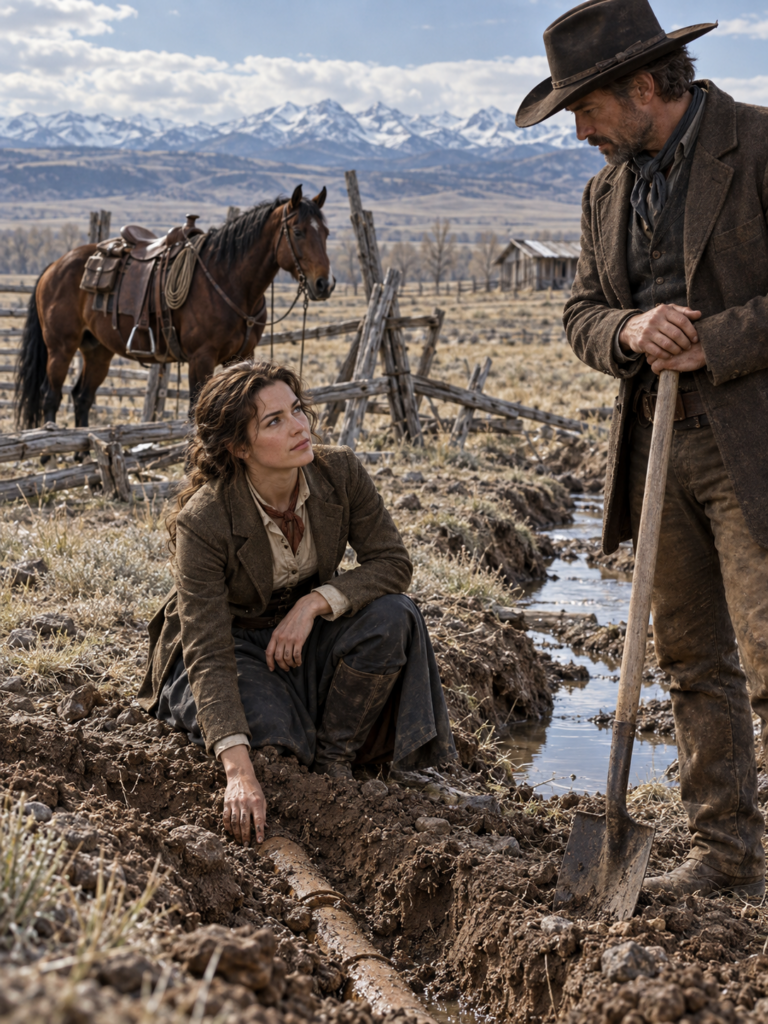
Dina planted Holt’s spade into the ditch beside her boot and faced her father from the bottom of the channel she had helped correct.
“I have.”
George Prescott’s expression did not change.
“That wasn’t a question.”
“No, Papa.”
The wind moved dry grass along the bank.
Holt could have spoken.
He did not.
This was between father and daughter unless Dina chose otherwise, and he would not use her presence on his land as protection against a conversation George had come to have with him.
George looked toward the channel.
“You showed him this grade.”
“Yes.”
“Why?”
“Because he had it wrong.”
For the first time, George’s jaw tightened.
Holt almost smiled.
Dina had evidently inherited more than her father’s eyes.
George turned to him.
“You’ve made progress.”
“Yes, sir.”
“My daughter says you listen.”
“When she’s right.”
“And when she isn’t?”
Dina folded her arms.
Holt considered the question.
“Hasn’t happened often enough to establish a rule.”
Dina’s mouth twitched.
George did not appreciate the humor.
He walked the edge of the field, examining every improvement as though measuring the ranch against something only he could see.
Then he stopped.
“My daughter was educated in Denver,” he said. “She reads Latin. She could have taught piano. She was not raised to spend her life repairing the mistakes of a man who used every dollar he owned buying exhausted land.”
Dina went still.
Holt did too.
There it was.
Not the property.
Not the drainage.
Not even her visits.
George Prescott had ridden south because he had seen where those visits might lead.
“Papa.”
George raised one hand.
“I came to speak plainly.”
Dina climbed out of the ditch.
“So did I.”
But Holt spoke first.
“Mr. Prescott, I haven’t asked your daughter to marry me.”
“That isn’t the point.”
“It seems important.”
George’s eyes hardened.
“You are forty-seven years old. You have a patched roof, six usable horses if I’m generous in counting, almost no capital left, and land three men with better means declined to purchase.”
“All true.”
“My daughter deserves more.”
Holt glanced at Dina.
She looked furious, but not embarrassed.
That mattered.
“With respect,” he said, “what she deserves seems like something she ought to decide.”
The silence afterward was absolute.
George stared at him as though no hired hand, neighbor, banker, or business rival had spoken that sentence to him in twenty years.
Then he looked at Dina.
She did not lower her eyes.
“Not while you are living under my roof,” he said.
Dina’s face changed.
Not into submission.
Into certainty.
“I am your daughter wherever I live.”
George’s expression flickered.
“And I have given that ranch everything it has asked of me since Mama died. I have kept accounts, ridden fences, treated stock, negotiated feed, and done work you would pay three men to do if I were your son.”
“Dina.”
“No.”
One word.
Quietly spoken.
It stopped him more effectively than a shout.
“I am not asking permission to know my own mind.”
George’s anger cooled into something harder to name.
Dina stepped away from the ditch and toward her horse.
Holt moved instinctively, then stopped himself.
She did not need rescuing.
She needed room to make her own choice.
George saw the movement and the restraint.
Dina saw it too.
She untied the bay.
“I am riding home with you,” she told her father. “Not because you ordered me to. Because this conversation belongs there now.”
Then she turned to Holt.
“I’ll be back Tuesday.”
George’s head snapped toward her.
Dina mounted.
Holt looked from daughter to father.
He knew enough about stubborn people to understand that nothing useful would come from making her declaration harder.
“I’ll be working the west fence Tuesday.”
“I know.”
She turned the bay north.
George remained on the ground another moment.
His gaze settled on Holt.
“You think refusing my money makes you independent of me?”
“No, sir.”
“What does it make you?”
Holt looked across the recovering field.
“A man who owns the consequences of his own decisions.”
Something moved behind George’s eyes.
Recognition, perhaps.
Or irritation at recognizing something.
He mounted without another word.
Father and daughter rode north together, separated by several horse lengths.
At the gate, Dina looked back once.
Holt did not wave.
He picked up the spade she had left standing in the ditch and returned to the channel.
Yet after three strokes he stopped.
On the northern ridge, Dina had reined in.
George was still riding.
For one heartbeat, she sat alone against the Wyoming sky.
Then she turned her horse and followed her father home.
Holt drove the spade into the soil again, knowing Tuesday was four days away and knowing for the first time that the question was no longer whether George Prescott approved of him.
It was whether Dina would still be free to ride through that gate when Tuesday came.
Tuesday morning came with Holt at the west fence before sunrise.
He told himself that was because the work needed doing.
By nine, he had reset twelve posts.
By ten, he had stopped looking toward the north road every few minutes.
Or had almost stopped.
At half past ten, the blood bay appeared on the ridge.
Dina rode alone.
Holt kept driving staples until she reached the fence.
“You’re late.”
“I had an argument.”
“Lose?”
“I’m here.”
He nodded once.
“Then I suppose not.”
She dismounted.
For several minutes they worked without discussing George.
That was one thing Holt had learned about Dina: if she wanted to speak, she would. Silence did not frighten her into filling it.
Finally she said, “My father told me the visits were finished.”
Holt set a post upright.
“And you told him?”
“That I’m twenty-four.”
“Did that surprise him?”
“A little.”
Holt hid a smile.
Dina braced the post while he tamped earth around it.
“He thinks this is about you.”
“Isn’t it?”
She considered him.
“Not entirely.”
That answer landed deeper than he expected.
Dina looked toward the north.
“My father has trusted my judgment with sick horses, payroll figures, breeding records, and half the practical running of his ranch. But he still believes my future is somehow a separate matter on which my judgment becomes unreliable.”
Holt leaned on the tamping bar.
“You want me to argue with him?”
“No.”
“Good.”
“I want you not to.”
He waited.
“If you make this into two men deciding which one has the better claim on me, I will leave both of you standing in the road.”
Holt looked at her directly.
“Fair.”
The tension left her shoulders by a fraction.
That was the boundary.
He understood it.
Whatever stood between them would be chosen by her as much as by him, or there would be nothing between them at all.
They went back to the fence.
June settled over the ranch.
The south pasture thickened where the repaired channels finally carried water as they should. Holt planted winter wheat in the north field after Dina warned him the ridge shadow would hold frost later than the county averages suggested.
He had intended alfalfa.
He planted wheat.
She noticed.
She did not congratulate herself.
That pleased him more than praise would have.
By July, six horses grazed on the place.
The barn roof remained temporarily patched with salvaged lumber because Holt refused to spend money twice when he could wait and do the job properly once.
Dina climbed onto the corral rail one evening and studied the roof.
“That won’t survive two winters.”
“It only needs to survive one summer.”
“You always this patient?”
“No.”
She glanced at him.
“With land?”
“Yes.”
“With people?”
Holt took longer to answer.
“I’m learning.”
Her expression softened.
The months changed them by inches.
There was no single moment Holt could point to afterward and say that was when work became courtship.
It happened in smaller things.
Dina began leaving an extra pair of gloves in the barn.
Holt began keeping coffee hot on the mornings he knew she might come.
She trusted him to listen when she disagreed.
He trusted her knowledge enough to change his plans before failure proved her right.
Once, when they were tightening wire along the west pasture, their hands reached for the same tool.
Neither moved away immediately.
Dina looked at him.
Holt released the pliers.
Her smile was barely there.
But it stayed with him until dark.
George Prescott did not visit.
He also did not stop her.
Dina told Holt that much and nothing more.
Holt accepted it.
In late July, she stood beneath the repaired portion of the barn roof.
“The west pasture needs another cross fence before you add stock.”
“How many?”
“More than eight horses and they’ll favor the north strip. By October you’ll graze it down too hard.”
“You sure?”
“I’ve watched that ground since I was nine.”
Holt looked across the pasture.
“All right.”
The next morning he began setting posts.
Three weeks later, that fence would matter less than either of them could have imagined.
The second Thursday in August broke dry and warm.
Nothing in the valley suggested disaster.
But sometime after dark, rain far up in the mountains gathered into the draws and came down faster than the dry country could absorb it.
Holt woke after midnight.
At first he did not know what had pulled him from sleep.
Then he heard it.
Water.
Not rain on the roof.
Moving water where there should not have been moving water.
He dressed, saddled, and rode north.
The first flooded ditch crossed his path before he reached the Prescott boundary.
By the time he saw lanterns, men were shouting.
A section of George Prescott’s lower pasture had become a black sheet of water.
Breeding mares were trapped inside it.
Dozens of them.
The current had torn fence from two sections, but panic had driven most of the horses away from the openings rather than toward them. Men on horseback pushed from the edges, shouting and waving.
The mares bunched tighter.
Wrong.
Holt rode straight through the broken fence.
Dutch, Prescott’s foreman, recognized him.
“Ramsay!”
“Quit pushing from behind!”
“They won’t turn!”
“Because you’re making them fight you.”
Holt had seen horses caught in floodwater once before, years earlier in Colorado.
You did not force terrified animals against water.
You joined their movement and bent it.
He took the outside of the herd.
Dutch understood quickly and moved opposite him.
Together they eased the mares into an arc.
One turned.
Then another.
Soon a dozen followed.
They made the first high ground after twenty brutal minutes.
Then went back.
Holt lost track of time.
His boots filled with water. His gelding trembled beneath him. Twice the current struck hard enough to shove horse and rider sideways.
Still they worked.
Group by group.
Turn by turn.
Until the final mares climbed out of the low pasture and stood blowing on the west slope.
Holt counted.
Again.
Sixty-three.
A rider stopped beside him.
George Prescott.
His coat was soaked. His face had gone gray with exhaustion.
“All of them?” he asked.
“Sixty-three.”
George counted anyway.
Holt let him.
When the older man finished, he looked at Holt for a long time.
“You’re not one of my hands.”
“No, sir.”
“I told you to stay away.”
“You told me to stay away from your daughter.”
George’s eyes narrowed.
Holt glanced at the mares.
“Your horses never entered into it.”
For once, George Prescott had no immediate reply.
“You could have lost your own horse.”
“Yes.”
“Could have broken your neck.”
“Yes.”
“And there was nothing here for you.”
Holt looked at him.
“There were horses in the water.”
George turned toward the herd.
Something in his face loosened.
Not surrender.
Not approval.
A calculation being dismantled.
“Come to the house,” he said.
“Dutch can—”
“I said come to the house.”
Holt almost objected from habit.
Then stopped.
“All right.”
They sat at George’s kitchen table before dawn.
Dina came in while Holt was holding a cup of coffee between both hands, trying to warm fingers that refused to stop shaking.
She froze when she saw him.
His clothes were soaked.
Mud streaked one side of his face.
“What happened?”
George answered.
“He brought every mare out.”
Dina looked at Holt.
He did not enjoy the expression on her face.
Fear.
After the danger had passed.
That was somehow worse.
“You rode into that water?”
“Seemed useful at the time.”
Her eyes flashed.
“That isn’t funny.”
“No.”
George watched them.
Holt saw him watching and refused to perform for him.
Dina crouched beside Holt’s chair and examined a scrape along his forearm.
“Does this hurt?”
“Yes.”
“Good.”
Holt blinked.
She stood.
“It means you have enough feeling left to remember not to do anything that foolish twice.”
George made a sound that might have been a cough.
Or the beginning of a laugh.
Dina turned on him.
“And you.”
George raised both brows.
“You knew those creek beds could take mountain runoff.”
“No one predicted that much water.”
“I didn’t say you predicted it. I said you knew.”
George’s face changed from father to rancher.
“So did you.”
“Yes.”
The argument that followed was about drainage, fencing, high-ground gates, and whether the lower pasture had depended too long on ordinary seasons continuing to behave ordinarily.
Holt listened.
This was Dina in full command of what she knew.
George disagreed with her twice.
Changed his mind once.
Accepted one point without saying so.
And Holt suddenly understood what had angered Dina all spring.
Her father did trust her.
Everywhere except where trust cost him control.
Near dawn, George walked Holt outside.
The sky had begun turning pale over the Wyoming grass.
“I judged you by what you owned,” he said.
Holt waited.
“That was easy.”
“Yes, sir.”
George looked toward the flooded pasture.
“Character’s harder to inventory.”
“So I’ve heard.”
“I’m not giving you my blessing.”
Holt almost smiled.
“I haven’t asked for it.”
George studied him.
“No. You haven’t.”
He turned toward the house, then stopped.
“The barn roof.”
“What about it?”
“It won’t hold winter.”
“I know.”
“I’ll send lumber.”
Holt shook his head.
“I’ll buy lumber.”
George faced him again.
For a moment the old resistance returned.
Then, unexpectedly, he nodded.
“Yes,” he said. “You will.”
A week later George Prescott rode south and walked Holt’s ranch for the first time without behaving as though he intended to purchase it.
At the irrigation ditch, he stopped.
“Dina showed you this grade.”
“Second visit.”
George crouched and touched the earth.
“I taught her to see that clay when she was twelve.”
Holt said nothing.
George remained there a moment longer.
“I think I believed everything I taught her belonged to this ranch.”
He looked north, toward his own two thousand acres.
“I never considered I was teaching her for her life.”
When he stood, his face looked older.
“My wife’s father thought she made a mistake marrying me.”
Holt glanced at him.
“I started with forty-five dollars and a rented room. Her father died before I proved him wrong.”
He looked at Holt’s patched barn, the six horses, the new fence lines.
“I have spent months becoming the man I once hated.”
The admission seemed to cost him.
Holt respected the cost enough not to soften it.
George put on his hat.
“I am not your enemy anymore.”
“That enough for today?”
“It will have to be.”
He mounted.
Before leaving, he looked once more at the barn.
“Get that roof finished before November.”
“I intend to.”
George nodded and rode north.
That evening, Dina arrived.
Holt was sitting on the porch step.
She dismounted and came toward him.
“My father was here.”
“Yes.”
“What did he say?”
“That he isn’t my enemy.”
Dina stopped.
For the first time since Holt had known her, she looked completely unprepared.
“He said that?”
“He did.”
She sat beside him.
Neither spoke for a while.
Then Holt took off his hat and turned it slowly between his hands.
“Dina.”
She looked at him.
He had repaired fences more easily than he could say the next sentence.
“I know what your father thinks I cannot offer you.”
Her expression sharpened.
“This is not about him.”
“I know.”
“Do you?”
Holt looked across the ranch.
“I can offer work. Debt-free land. A roof that currently has opinions about rain. Six horses. Twenty dollars became somewhat more than twenty dollars, though not enough to impress anybody north of my fence.”
Dina’s mouth curved.
“I can offer you no promise that this place gets easy.”
“I never asked for easy.”
“No.”
He met her eyes.
“What I’m trying to ask is whether you’d want the hard part with me.”
Dina went utterly still.
Holt stopped.
He would not finish the question until he knew she understood she was free to refuse it.
“If the answer is no, nothing changes about your place here. You ride through that gate whenever you please. You tell me when my drainage is wrong. You keep your own life.”
Dina’s eyes filled, but her voice did not shake.
“And if the answer is yes?”
“Then we decide the rest together.”
She reached over and placed her hand on top of his hat.
“Holt Ramsay.”
“Yes?”
“Ask me properly.”
Holt looked at Dina’s hand resting over his hat.
Then he stood.
She stood with him.
He did not kneel. The earth was hard, the porch narrow, and neither of them had ever needed ceremony to make truth more true.
He simply faced her.
“Dina Prescott, will you marry me and build this place with me?”
She answered before the final word had fully left him.
“Yes.”
Holt stared.
Dina laughed then, a sound he had heard too rarely and wanted, with sudden unreasonable force, to hear for the rest of his life.
“You might have let me finish.”
“I have been waiting through half the summer for you to begin.”
“That long?”
“Approximately since you told me Dewey Caldwell had loved this land and you thought that meant someone should keep caring for it.”
Holt shook his head.
“I was talking about the ranch.”
“I know.”
She stepped closer.
“That was the problem.”
He understood.
What she had heard that day was not a declaration of love.
It had been evidence.
A man did not become worthy because he claimed he would care for something.
He became worthy by caring for what was already in his hands.
Land.
Animals.
Work.
A promise.
Another person’s freedom.
Holt lifted one hand but stopped before touching her face.
Dina closed the distance herself.
When they kissed, it was brief and quiet.
Nothing was solved by it.
The roof still needed replacing.
The ranch still carried thin ground.
George Prescott still had not offered his blessing.
Winter would still come whether they were in love or not.
And Dina still had a decision to make about what marriage would mean for the life she had already built.
She stepped back first.
“There is something you need to understand.”
Holt nodded.
“I am not leaving one man’s ranch to become an unpaid hand on another man’s ranch.”
“You won’t.”
“I mean it.”
“So do I.”
“I have worked for my father since I was fifteen. I did it because the Prescott place mattered to me. But over time everyone started behaving as though my work belonged there because I did.”
Holt listened.
“If we marry, I want a say in this ranch.”
“You have one now.”
“I want more than advice you’re gracious enough to take.”
“Good.”
She searched his face.
“I want to know what we own, what we owe, what we earn, and what we risk. I want decisions made at the same table.”
“All right.”
“And if I tell you a pasture is overstocked—”
“I build the fence.”
“That was one time.”
“You were right.”
Dina laughed again.
Holt smiled.
Then his expression grew serious.
“I bought the land before you came.”
“Yes.”
“I won’t pretend that never happened.”
“I don’t want you to.”
“But anything built from here forward, we decide together.”
Dina looked over the recovering fields.
“That is what I needed to hear.”
The hardest conversation came two days later at the Prescott ranch.
Dina asked Holt to come.
Not to negotiate with George.
To stand beside her while she spoke for herself.
George received them in the study where she had told him months before that she would not stop riding south.
He looked from his daughter to Holt.
Then to their joined hands.
His face became unreadable.
“You asked her.”
Holt answered.
“Yes.”
George’s jaw shifted.
Dina squeezed Holt’s hand once.
Then released it.
The gesture was deliberate.
This part was hers.
“I said yes,” she told her father.
George walked to the window.
For several seconds he said nothing.
Dina waited.
Holt waited too.
At last George spoke.
“When?”
“Two nights ago.”
“And you are certain?”
Dina’s expression hardened.
George saw it.
He shut his eyes briefly.
“That was poorly asked.”
“Yes.”
He turned.
“I am attempting to improve.”
“That may take time.”
“So I’ve discovered.”
Holt looked down before either of them noticed the smile threatening him.
George returned to his desk but did not sit.
“What will happen to your work here?”
Dina had expected the question.
“I will help through the autumn accounts because I said I would. After that, you hire someone.”
“You do half of what Dutch and I miss.”
“Then perhaps you should pay attention to what that work is worth.”
George looked almost offended.
Then, to Holt’s surprise, he nodded.
“That is fair.”
Dina blinked.
George noticed.
“I said I was improving. I did not say I intended to enjoy it.”
The wedding was set for October.
Not because George wanted speed.
Not because society demanded it.
Because the ranch work allowed a narrow stretch after the early autumn jobs and before winter preparation took over their days.
Holt replaced the barn roof before then.
He paid for the lumber.
George sent two men to help install it.
Holt almost refused.
Dina stopped him.
“You said partnership.”
“With you.”
“You think accepting two skilled men for three days means my father owns the roof?”
“No.”
“Then stop making dignity more expensive than it needs to be.”
Holt considered that.
Then he accepted the help.
George said nothing about it.
That silence, for once, was generous.
October arrived cold and bright.
The wedding was held at the community church.
Dina dressed in the small room near the vestibule with one trusted friend helping fasten the final buttons.
She wore her mother’s brooch.
It was not ornate.
The metal had dulled slightly with age.
Her mother had worn it on important days, and after her death Dina had kept it for the occasions when memory felt less like sorrow and more like company.
She touched it once.
Her friend adjusted a fold of fabric.
“You’re quiet.”
“I’m thinking.”
“Dangerous habit.”
Dina smiled.
She had not asked her father to walk her down the aisle.
He had not offered.
Their relationship had changed, but change did not erase pride overnight.
She had accepted that.
She did not require his blessing to marry.
Still, when she placed her hand on the door, she felt the absence of him.
Her friend suddenly looked past her.
“Dina.”
The rear church door stood open.
George Prescott was there.
His good coat fit too tightly through the shoulders because he had owned it too long and refused to admit it.
His hat was in both hands.
For once in his life, George looked uncertain.
He came forward slowly.
Dina did not move.
He stopped in front of her.
For several seconds he seemed unable to find the sentence he had rehearsed.
Then he looked at the brooch.
“Your mother wore that the day we married.”
“I know.”
“She argued with her father that morning.”
Dina’s eyes warmed.
“That sounds familiar.”
George breathed out.
“I did not understand him then.”
“And now?”
“I understand him too well.”
The answer surprised her.
He looked directly into her eyes.
“You have your mother’s way of knowing when a man is wrong before the man himself has caught up.”
Dina swallowed.
“And your stubbornness,” George continued. “Which is more difficult to forgive because I know precisely where you acquired it.”
Her mouth trembled toward a smile.
Then his expression broke.
Not dramatically.
Just enough.
“There is something in you neither of us put there,” he said. “Something entirely your own. I should have trusted it sooner.”
Dina’s throat tightened.
He offered his arm.
“My daughter will not walk down that aisle without her father if she wants him beside her.”
The important words were the last ones.
If she wanted him.
Months earlier, George would simply have assumed.
Dina looked at his arm.
Then at his face.
She took it.
“I do.”
They walked together.
People throughout the valley filled the pews.
At the altar stood Holt Ramsay, forty-seven years old, in the best suit he had ever owned and boots he had polished twice because the first attempt had not satisfied him.
He watched Dina enter.
Then saw George beside her.
For an instant Holt’s face changed.
Dina caught it.
So did George.
When they reached the front, George looked at Holt.
There was no smile.
No easy affection.
George Prescott was not built for easy gestures.
But he extended his hand.
Holt took it.
“Take care of her,” George said.
Dina raised one eyebrow.
Her father corrected himself before she could speak.
“Take care of each other.”
Holt’s grip tightened once.
“That I can promise.”
The marriage did not make Dina part of Holt’s ranch.
It made them partners in one.
That distinction appeared almost immediately.
They kept the ranch in Holt’s name because it was the property he had purchased, but Dina controlled her own money and kept an accounting ledger beside his.
Major purchases were discussed.
Breeding decisions were shared.
The north field remained wheat because Dina’s reading of the frost line continued to prove correct.
The west pasture never carried more stock than its grass could bear.
Holt repaired what he knew.
Dina questioned what he assumed.
Sometimes he was right.
Sometimes she was.
Neither treated disagreement as betrayal.
George sent twelve horses that November.
Good breeding stock.
His note was characteristically practical: the west pasture fencing would support the additional animals if rotation remained careful.
Holt read the note twice.
Dina read it once and laughed.
“He has given us horses while pretending he is commenting on fence construction.”
“That may be the closest your father comes to affection.”
“No. He’s worse at affection.”
They added the note to the kitchen drawer where Holt had begun keeping documents that mattered for reasons having little to do with law or money.
The herd grew slowly.
Twelve became twenty.
Twenty became thirty-five.
They never expanded faster than the grass could carry.
Holt had spent too many years watching owners ruin good land by asking it for more than it could give.
Dina had spent too many years watching men confuse size with success.
Together they made the ranch careful rather than large.
George began coming to supper on occasional Sundays.
The first time, he arrived carrying nothing.
The second time, he brought coffee.
By the fourth visit, he criticized Holt’s method of stacking firewood.
Holt took that as evidence the relationship had become permanent.
At the table, they talked about feed prices, foaling dates, weather signs, pasture rotation, and whether the Sweetwater might rise again during spring runoff.
Sometimes George and Dina disagreed.
The difference now was that George listened until she finished.
Not always happily.
But completely.
In the second year, one Sunday evening, George walked outside after supper and stopped beside the south irrigation channel.
The original one.
Dina and Holt followed several yards behind.
George crouched.
He studied the grade.
Water moved steadily along it and sheeted west exactly where it should.
That ditch had begun with Holt making a mistake and Dina refusing to let politeness preserve it.
George stood.
He looked toward his daughter.
Then at Holt.
He nodded once.
Nothing more.
After he mounted and rode north, Dina stood beside Holt at the gate.
“He will never say it.”
“Say what?”
“That the channel is right.”
Holt watched George disappear along the ridge.
“I think he just did.”
Dina slipped her hand into his.
Beyond them, horses grazed in the west pasture behind the cross fence she had insisted upon before anyone knew why it might matter.
The barn roof sat straight and sound over beams that no longer leaked.
The north field had produced well.
The east ground, once scraped nearly to hardpan by grasshoppers and drought, had begun carrying thicker grass.
Nothing about the place looked wealthy.
That was not what they had built.
They had built something durable.
Years earlier, Holt had ridden onto the Caldwell property with five hundred ten dollars saved across sixteen years.
The bank had taken four hundred ninety.
He had been left with twenty dollars and land no one else wanted.
Dina had ridden down three days later intending to buy it back for her father.
Instead, she had stepped into a ditch.
That was how their life began—not with rescue, not with possession, not with one person saving the other.
With correction.
With a man willing to say, show me.
With a woman who knew the ground and expected her knowledge to matter.
With a father who mistook protection for authority until rising water forced him to look again at the kind of man he had dismissed.
The flood became part of valley memory.
People spoke of the sixty-three Prescott mares and the men who brought them out.
George never exaggerated Holt’s part.
Holt never exaggerated it either.
When someone praised him, he usually answered that Dutch had known exactly what to do once they changed their approach.
Dina knew what he did not say.
He had gone because the horses were there.
Nothing was owed.
No promise waited on the far bank.
George’s approval had not been guaranteed.
Dina’s affection was not a reward.
He had simply seen living creatures in danger and ridden toward them.
That fact mattered to her more as the years passed, not less.
One autumn evening, long after the wedding, Dina found Holt standing in the east field.
The light was low.
The grass moved gold around his boots.
She came beside him.
“You’re doing arithmetic.”
He glanced at her.
“How do you know?”
“You get that look.”
“What look?”
“The one you had the first day I came here.”
“You were trying to buy my ranch.”
“For an excellent price.”
“It was insulting.”
“It was generous.”
“You came back three days later and told me I couldn’t dig.”
“You couldn’t.”
He laughed.
Dina looked across the land.
“What are you calculating?”
Holt took his time.
“Whether sixteen years was too long to wait.”
“For the ranch?”
He turned toward her.
“For any of it.”
Dina considered the question.
“No.”
“No?”
“If you had bought land sooner, it would have been different land.”
“That’s likely.”
“If I had met you earlier, I would have been a different woman.”
“Also likely.”
“If my father had agreed with us immediately, none of us would have learned what we needed to learn.”
Holt looked north, where George’s land began beyond the ridge.
“Your father would dislike that conclusion.”
“He would call it poorly supported.”
“That sounds like him.”
She leaned against Holt’s shoulder.
The south channel caught the fading light.
Two years earlier, Dina had knelt there with dirt on her gloves and told him he was wrong.
He had listened.
That had seemed a small choice.
It had not been.
Most lives, Holt had come to understand, were built exactly that way.
Not from one grand decision.
From a hundred smaller moments in which pride could have spoken, but did not.
A question asked instead of an order given.
Help accepted without surrender.
Advice offered without claiming ownership.
A fence built because somebody else understood the grass better.
A father admitting that love had become control.
A daughter choosing without running away from the people she loved.
A man riding into dark water when nobody owed him anything.
Holt slipped his arm around Dina.
Below them stood the ranch everyone else had abandoned.
Not restored to what it had once been.
Made into something new.
Their horses.
Their fields.
Their arguments.
Their table.
Their decisions.
Their home.
And when the wind came down from the Wyoming mountains and moved through grass that had once been stripped almost bare, the land no longer looked like something that had survived because one quiet man refused to give up on it.
It looked like what it truly was.
Something three stubborn people had learned, in different ways, to stop trying to possess.
And finally learned how to care for.